Paper ID #8765
Design of On-line Courses: Implications for Student Time Management
Dr. Carole E. Goodson, University of Houston (CoT)Carole Goodson is a Professor of Technology at the University of Houston. As an active member of ASEE, she is a member of the Academy of Fellows, a past Editor of the Journal of Engineering Technology, a past Chair of PIC IV and the ERM Division, and a past Chair of the Gulf Southwest Section of ASEE.
Prof. Susan L. Miertschin, University of Houston (CoT)
Susan L. Miertschin is an Associate Professor teaching in the Computer Information Systems program at University of Houston. Her teaching interests are in the development of information systems applications and the complementary nature of back-end developer and front-end developer skill sets. Her research interests are program and student assessment, the impact of instructional technology on student learning, and the improvement of e-learning environments and experiences.
Dr. Barbara Louise Stewart
c
American Society for Engineering Education, 2014
P
Design of On-line Courses: Implications for Student Time
Management
The Chronicle of Higher Education reported that - from a student's perspective - the predominant difference between on-line courses and face-to -face courses is probably time management, stating that in “on-line, there's no teacher taking roll. ... You've got to be prepared to be
organized, and you've got to keep up with the work.”1. This perspective was echoed in previous work by the authors2, 3 and also in the research reported here in which students said:
I’ve learned, from taking on-line courses, that getting work done becomes second-nature more so than in face-to-face classes
I have developed the ability to not procrastinate during the semester and that has carried over into my daily life.
In designing on-line courses, the instructor must enable students to engage in a learning
environment that allows them to successfully complete assignments and ultimately meet course learning outcomes. Noting that effective time management is important to the academic success of these students, this paper investigates factors that can be addressed by faculty in designing their on-line courses.
Previous research2 suggested a relationship between course format and students’ skill in managing time. Not only did on-line students report having to learn better time management skills, but data suggested that this relationship was stronger for those students who had the most experience in on-line courses. As a follow-up, the authors explored the time management course features that students use most frequently, along with those that they perceive to be the most beneficial3. This current study also explores students’ use and perception of the impact of course elements including orientation materials, course calendar, chapter study guides, assignment availability, due date flexibility, and lateness policies. A survey was completed by 124 students enrolled in nine undergraduate courses, including courses in computer information systems, computer engineering technology, electrical technology, statistics, research, and supervision. The survey was directed at the students’ overall experience with both face-to-face and on-line
courses, as opposed to their experience in the particular course in which they were surveyed. (Note: 90% of the students had completed at least one on-line course.)
Using the results of the survey and related literature, this paper addresses the following issues. 1. What course features enhance the student’s ability to manage their time; which features do students use; which do they perceive to be most beneficial?
2. How can instructors design courses to have a positive impact on student time management skills?
Concepts of Time Management
The industrial revolution provided modern motivation for time management as a means of doing things effectively and efficiently4. As part of this evolutionary process, more recently in the 1950s and 1960s, authors investigated and proposed methods for time management on the job5-8. These works focused popular attention not only on the exploration of time management
principles, but also on the implementation of methods to enhance time management.
Review of the works of many authors yielded multiple perspectives. For several, control of time was the major theme. For example, Macan9 tested a process model of time management and concluded that the major outcome of engagement in time management behaviors was perceived control of time; and Eilam and Aharon10 saw time management as a way to monitor and control time. For others, time management focused on the use of time, including use of time as
structured and purposive11-14; gaining insight into time use15; and planning and allocating time16,
17
. Additionally, some authors focused on techniques for managing time9, 18-33. Furthermore, some authors viewed time management as a process of self-regulation, goal setting, or prioritizing34-36 or as a means to mitigate stress or achieve life balance20, 37, 38.
For this study, the authors were also interested in knowing whether the literature provided insight on whether instructional design can influence time management or whether time management skills can be taught. The research review showed mixed results. While multiple authors 19, 39-43 contended that skills to support time management can be taught and learned, studies by Slaven and Totterdell22 and Macan24 did not find that time management training improved time management practices. In fact, Claessens’44
work reviewed eight studies where the results of time management were mixed, showing both improvement and no improvement. Yet, many studies did report a positive relationship between time management training and subsequent time management behaviors9, 18, 22, 23, 35, 39, 42, 45.
Time Management in Education
Although much of the literature focused on time management training in work environments, experiences from education were also sought. Inferior time management behaviors, such as poor time allocation or cramming for exams were frequently discussed as a source of stress and poor academic performance46-48. Conversely, Macan, Shahani, Dipboye, & Phillips20 stated, “Students who perceived control of their time reported significantly greater evaluations of their
performance, greater work and life satisfaction, less role ambiguity, less role overload, and fewer job-induced and somatic tensions”20. Indeed, numerous studies of college students indicated a direct link between time management skills and academic performance10, 20, 21, 45.
Specifically, Britton and Glynn49 presented a theoretical model of time management practices intended to maximize intellectual productivity. Following up on that, in 1991 Britton and Tesser stated, “The present results show an encouraging relationship between time management
attitudes and skills and grade point average”21. This led to their conclusion that time management practices influence college achievement. More than a decade later, Nadinloyi, et al.50 similarly concluded, “Given the relationship between time management and academic achievement the use of such training programs could feasibly result in improvement in academic achievement”50
.
P
More specific to on-line learning environments, Shepperd51, while investigating student time management in distance education, found time management to be a predictor of student success. Relationships were noted for specific time management skills, ability to balance multiple roles, pacing ability, self-direction, and quality of work. Furthermore, students who were able to prioritize time commitments experienced great success. Conversely, poor time management was given as a reason for dropping distance education courses. Similarly, procrastination was found to yield a negative impact on completion.
Study Procedures
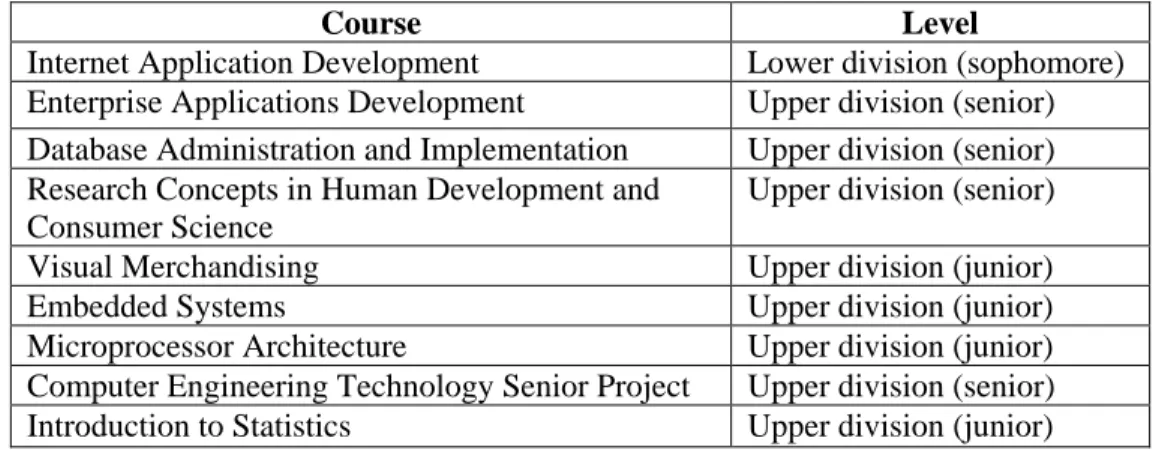
In order to obtain a clearer understanding of the course features that enhance a student’s ability to manage their time, 124 students were surveyed in November 2012 at the University of Houston. Participating students were registered in one of nine courses chosen for distribution of the study survey. The courses varied in subject, level and delivery mode.
Table 1: Courses Used for Survey Administration
Course Level
Internet Application Development Lower division (sophomore) Enterprise Applications Development Upper division (senior) Database Administration and Implementation Upper division (senior) Research Concepts in Human Development and
Consumer Science
Upper division (senior)
Visual Merchandising Upper division (junior)
Embedded Systems Upper division (junior)
Microprocessor Architecture Upper division (junior) Computer Engineering Technology Senior Project Upper division (senior) Introduction to Statistics Upper division (junior)
While the survey questions were directed at the students’ overall experience with on-line
courses, as opposed to their experience with the particular course in which they were surveyed, it is interesting to note that seventy-six percent of the students who completed the survey were enrolled in an on-line section, and 90% of the students had completed at least one on-line course while enrolled at the University.
The survey was administered on-line through the learning management system (Blackboard Learn). Students were asked to complete the survey, with the understanding that completion of the survey was voluntary and all responses were anonymous. The students were instructed to answer the questions with respect to their college learning experiences, in general, and not with respect to the specific course that delivered the survey. Student responses were downloaded for analysis with each response record identified by a number assigned by the learning management system’s assessment module.
The survey instrument was adapted from an instrument used in a previous study with the addition of specific items designed to address the specialized goals of this research. This survey instrument consisted of forty-two items. Items 1 through 6 addressed student demographic characteristics including: 1) student classification (freshman, sophomore, etc.), 2) number of on-line courses
P
completed, 3) enrollment status (mostly full-time or mostly part-time), 4) age, 5) estimated overall GPA, and 6) employment status.
Building on items of the previous study, the second part of the instrument (Items 7-10)
addressed issues related to students’ time management approach with respect to dedicated study time and deadlines. It elicited perceptions about whether the student’s time management
approach was different in on-line courses versus traditional face-to-face courses. It also addressed students’ perception of the degree to which they learned or improved time management skills through course participation.
The third and fourth parts of the survey were concerned with instructional components or features of on-line courses. Components were selected for investigation based on: 1) the
researchers’ collective experience with particular components widely used in on-line courses and 2) responses to a previous survey regarding time management3.
Items 11- 23 listed 13 course features. In this third part of the survey, students responded with frequency of use for each feature, i.e. daily, weekly, monthly, semester, or not used. The course features included orientation materials, course calendar, course requirements description, objectives, course study guides, course content (in any format), homework, solutions to homework, discussion boards, email with the instructor, instructor notices, on campus office hours, and on-line office hours.
Items 24 -36 presented the same 13 course features. In this fourth section, students responded to each item with their perception of the extent to which the feature was beneficial to their time management. A semantic differential scale was used to measure students’ perception of benefit. Students chose a value from 1 through 7, where 1 reflected a course feature that was perceived as not beneficial and 7 reflected a very beneficial feature with a continuum between these two extremes.
In the fifth part of the survey, specific course policies that potentially related to time
management were listed as items 37-40. The same semantic differential scale described above was used to measure the extent of perceived benefit to students’ time management. The policies included availability of all course assignments at the beginning of the course, strictly enforced due dates, allowing late submissions with a stated penalty, and requiring completion of frequent (weekly) quizzes that parallel course content.
The survey concluded with open ended items that queried the students as to what time
management/learning skills they had derived from their on-line course experiences (item 41) and from their face-to-face course experiences (item 42).
Item responses were tabulated, and tables, graphs, and descriptive measures were used to analyze and present the results. The open-ended responses were analyzed using the standard text analysis method of keyword extraction followed by tabulation. The results were also categorized for each course format.
P
Study Results
The analysis was designed to consider the following issues.
How frequently do students use certain course features?
What does the data indicate regarding students’ perceptions of the benefit of course features and policies with respect to managing time for their courses?
Is there a relationship between frequency of use and perceived value? That is, do students value time management features they frequently use?
Ninety percent of the students were classified as juniors or seniors, and thus, they were
experienced students. The students were also experienced with on-line courses; 57% of them had completed at least four on-line courses, and only 10% had zero or one on-line course. The
students were otherwise characterized as under 28 years of age (86%) and employed, either in a full-time or part-time position (72%), with a GPA greater than 2.50 (80%).
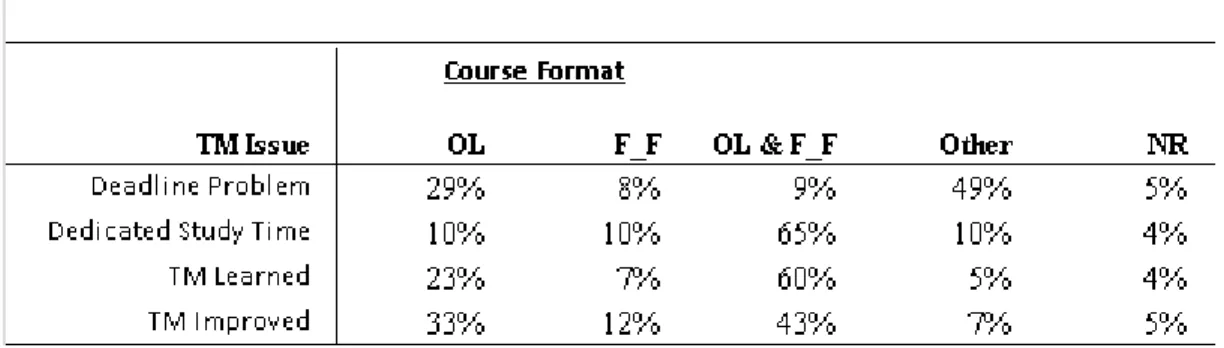
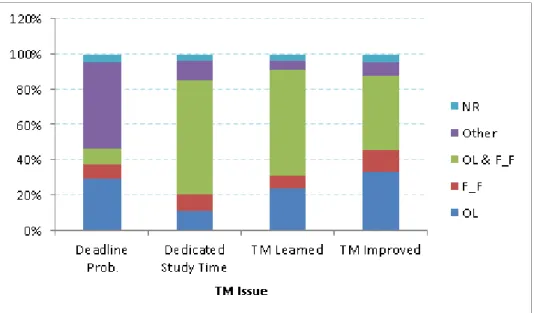
An analysis of the items concerning issues related to students’ perceptions about whether the student’s time management approach was different in on-line courses versus traditional face-to-face courses was compiled. The summarized data are presented in Table 2 and Figure 1. Note that these results are consistent with results from the aforementioned previous study that included the same survey items3.
Table 2 Time Management Issue by Course Format
(n=124)
P
Figure 1 Time Management Issue by Course Format
(n=124)
A review of this information indicates the following.
For most students (49%), meeting course deadlines is not a problem (the Other category in Table 2 and Figure 1). However, 45% of the respondents said it is a problem for them, with 29% saying that the problem exists only with on-line courses. Nine percent of respondents find meeting course deadlines to be a problem in both on-line and face-to-face courses and 8% find meeting course deadlines to be a problem only in face-to-face courses.
Most students (65%) indicate they dedicate a specific time to study each week for both on-line and face-to-face courses, with 10% indicating they do not dedicate a specific time to study each week regardless of format. Additionally, 10% indicate they dedicate a specific time to study each week for on-line courses only, and 10% indicated the same thing for face-to-face courses only.
The next survey item addressed in the table and chart is a query as to whether the student had to learn to manage his or her their time in order to be successful in courses of a certain format. Sixty percent of the students indicated that they had to learn to manage their time in order to succeed in either on-line or face-to-face format courses, while 23% said the learning was required for on-line format courses only. Only 7% said the learning was required for face-to-face courses only.
Then the students responded whether they perceived that their time management skills improved as a result of taking courses of a particular format. Thirty-three percent indicated that their time management skills had improved from taking on-line courses, while only 12% said that the improvement came from face-to-face courses. Forty-three percent of
respondents perceived improvement in their time management skills from courses in both formats.
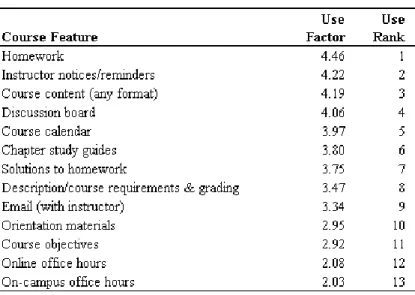
To understand the extent to which each course feature was used by students, a weighted mean of values chosen was calculated for each feature. This quantity is the Use Factor for a feature. The features were then ranked based on Use Factor where higher Use Factor values mean
P
more frequent use. The feature ranked 1 was used most frequently as indicated by the highest Use Factor value. The Use Factor and rank for each item is presented in Table 3.
Table 3 Course Features Ranked by Frequency of Use
To understand the extent to which each course feature was perceived as beneficial by the student, a weighted mean of values associated with the semantic differential scale used was calculated for each feature. This quantity is the Benefit Factor for a feature. The features were then ranked based on Benefit Factor where higher Benefit Factor values mean more perceived benefit. The feature ranked 1 was perceived by the students to be the most beneficial. The Benefit Factor and rank for each item is presented in Table 4.
Table 4: Course Features Ranked by Perceived Benefit
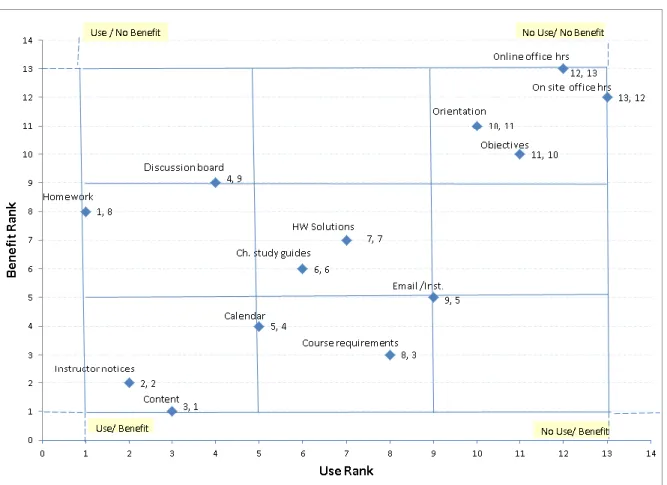
The Use Rank and Benefit Rank were then reviewed together to better understand whether a
P
relationship between the two existed. The results shown in Table 5 reflect the difficulty of extracting information about a potential relationship from a table of values. Plotting the paired values on a Use-Benefit grid as shown in Figure 2 is more revealing of potential relationships. Table 5: Use/Benefit Rankings
Figure 2: Use/Benefit Rankings
P
A review of this information indicates the following.
Instructor notices and content in any format lie in the highest Use/Benefit region. These two course features are both viewed as beneficial to students’ time management as well as used frequently by the students sampled.
Both on-line and on-campus office hours along with orientation materials, and course objectives all lie in the lowest Use/Benefit region. Thus, these four course features are viewed as not very beneficial to students’ time management, and they are used little by the students sampled. It makes sense that orientation materials would be used little, since once they are used to orient a student to the course content, policies and structure, they do not need to be accessed again and again. A similar observation might be made about course objectives. Once the student has read through the course objectives, he or she may not access them again and again. It also makes sense that on-campus office hours would be used less in on-line courses since there is not a regular on-campus attendance requirement associated with these courses. On-line office hours might be used more, depending on the technology used to implement them. The researchers did not investigate this use in the context of technology. For example, are on-line office hours accessed by calling the instructor on the telephone? Or is the instructor accessed on-line during office hours using an on-line chat tool or an on-line video-conferencing tool? And does the technology implementation influence how much use they get? Nonetheless, these features were not seen to be particularly beneficial for time management by the students surveyed.
A course feature that is used often and yet is perceived to be of less benefit to students’ time management is discussion boards. How often a discussion board is used can be heavily influenced by how the instructor incorporates the feature into the fabric of the course. Some instructors require weekly posts to discussion boards in order to reinforce content to be learned that week and also to motivate students to keep up with the pace of the content flow. Others may use discussion boards simply as an optional way for students to interact and ask questions. Because the research did not control for different ways this feature can be used, the results are difficult to interpret.
Course features that are perceived to be of similar benefit to time management as homework but that are used less frequently than homework include homework solutions, chapter study guides, and email with the instructor. Because not all instructors choose to include homework solutions and/or chapter study guides in courses, this may have impacted the use level
reported by the students surveyed.
Course features that are used at a similar level as the homework solutions, chapter study guides and email with the instructor but that are perceived as more beneficial to time management are course calendars and having all the course requirements spelled out at the beginning of the course (as in a syllabus document, perhaps).
There were no course features that the students were queried about that were little used that were also perceived as very beneficial to time management.
Using the same techniques, a Benefit Factor was determined for four course policies to determine their perceived benefit to time management. Results are presented in Table 6.
P
Table 6: Course Policies Ranked by Benefit
Review of the summarized course policies data reveals the following.
The policy perceived to have the greatest benefit, among those in the survey, was knowledge of course requirements at the beginning of the semester. The Benefit Factor is 6.50 which is a similar value to the Benefit Factors of the four course features
content in any format, instructor notices, description of course requirements, and course calendars. These four features had Benefit Factors of 6.24, 6.24, 6.30, and 6.15 respectively.
The other three policies had benefit factors that paralleled the course features perceived to be somewhat beneficial. Those were email with the instructor, chapter study guides, solutions to homework, and homework. These four features had Benefit Factors of 6.05, 6.04, 5.94, and 5.81. Allowing late submission of assignments with a penalty, weekly quizzes, and strict enforcement of due dates were all perceived as somewhat beneficial to students’ time management.
Responses to the open-ended questions are summarized in Table 7, Table 8 and Table 9. This data presents student perceptions of what time management skills they acquired from on-line courses and face-to-face courses. In each table, the percent shown is the percent of free-text responses that could be categorized as including mention of learning the skill identified. So, for example, 6% of the responses stated that the skill of prioritizing was acquired from experience with on-line courses, while 1% of the responses noted this skill development for face-to-face courses.
P
Table 7: Identified Acquired TM Skills / % Responding by Course Format
(n = 111 for OL; n = 95 for F-F)
Table 8:Identified Acquired TM Skills / % Responding for OL Only
(n = 111)
Table 9: Identified Acquired TM Skills / % Responding for F-F Only
(n = 95)
P
Review of the summarized open-ended comment data revealed the following.
The data in Table 7 show that some useful time management skills were reported as learned from both on-line and face-to-face courses. Note that these skills were more frequently mentioned by on-line students. The skill mentioned most, avoiding procrastination, was reported as learned from both course formats by a similar percent of students. Keeping a calendar and meeting deadlines was reported as being learned by a higher percent of on-line students than face-to-face students.
From Table 7, learning to ask questions is the skill that had the highest response rate from face-to face students. Perhaps it is more natural to ask questions of the instructor in a face-to-face setting, or perhaps the instructor may be more readily perceived to welcome questions in a face-to-face setting.
The data in Table 8 show that some useful time management skills were reported as learned only from on-line courses. The ones reported by more than 5% of students were developing consistent routines, using self-discipline, and accepting more responsibility and
accountability.
The data in Table 9 show that some useful time management skills were reported as learned only from face-to-face courses. The ones reported by more than 5% of students related to social skills and communication, the importance of attendance and punctuality, taking and reviewing notes, being attentive, and listening.
Summary and Discussion
This study reviewed concepts of time management in an academic environment where time management is perceived as a means of doing things effectively and efficiently. Particularly, there is an interest in whether instructional design can influence time management and which course features students use more and perceive as beneficial to time management. The information is intended to give insights into how design components might have a positive impact on student time management skills.
Whereas students indicated that they had to learn to manage their time in order to succeed.in either on-line or face-to-face format courses, more said the learning was required for on-line format courses only. Furthermore a third of the students indicated that their time management skills had improved from taking on-line courses.
Course features that were both used and had perceived benefit included instructor notices and content in any format. Thus, reminders sent by email or as tweets may enhance the on-line learning environment with respect to students’ time management.
Features that had both some benefit and some use included:
a discussion board (recognizing that this feature can be heavily influenced by how the instructor incorporates the feature into the course),
homework
homework solutions and chapter study guides (noting that not all instructors choose to include homework solutions and/or chapter study guides in courses, which may have impacted the use level reported by the students surveyed)
P
course calendars and identification of course requirements at the course onset (e.g., as in a syllabus).
Both on-line and on-campus office hours, along with orientation materials and course objectives, had the least use and benefit. Again, how on-line office hours are offered and implemented may make a difference in the perceived use and benefit, so this feature requires more investigation. Course objectives and orientation materials are, by their nature, low-use items since, once oriented, a student does not need to refer back to this material again and again. There were no course features among those offered in the survey that were both not used and also perceived as not beneficial to time management.
Student themselves noted that some things were learned from both on-line and face-to-face courses. Things mentioned the most were avoiding procrastination, keeping a calendar, and meeting deadlines. Useful time management skills reported as learned only from on-line courses were: developing consistent routines, using self-discipline, and accepting more responsibility and accountability. The concepts of self-discipline and accepting more responsibility and
accountability have important implications for students becoming mature, lifelong learners who recognize that while the instructor is responsible for framing the content to be learned, the student is ultimately accountable for whether learning takes place. Useful time management skills reported as learned only from face-to-face courses related to social skills and
communication, the importance of attendance and punctuality, taking and reviewing notes, being attentive, and listening – factors that may point to things that are lost in an on-line environment due to a less rich communication medium.
Because of the extensive time required to develop and implement on-line courses, instructors must consider which features are most important to their offerings. Whereas course content and homework require extensive instructor development time and effort, they are baseline important to the course offering, and this is recognized by the students. Thus, instructors should continue to put the time needed into development of quality content and quality homework assignments. Instructor notices are used and beneficial, plus the time requirement is less - so inclusion seems desirable. Although students do not seem to use or generally benefit from objectives, these are typically important to the instructor in the course design. Factors that should be weighed as to their importance in a particular course (because of time constraints and student use and/or perceived benefit) include discussion boards, chapter study guides, orientation materials, and on-campus and/or on-line office hours.
References
1. Young, J.R., Time-Management Skills Are One Key to Success for Online Students, in The Chronicle of Higher
Education. 2001, The Chronical of Higher Education: Washington, D.C.
2. Goodson, C., S.L. Miertschin, and B.L. Stewart, On-line delivery of courses: What components are important to
students? Computers in Education Journal, 2012. 22(1): p. 47-58.
3. Miertschin, S.L., C.E. Goodson, and B.L. Stewart, Managing time in on-line courses: Student perceptions.
Computers in Education Journal, 2013. 23(2): p. 101-112.
P
4. Adebisi, J.F., Time Management Practices and Its Effect on Business Performance.Canadian Social Science, 2013. 9(1): p. 165-168.
5. McCay, J., The Management of Time. 1959, Englewood Cliffs, NJ: Prentice Hall.
6. Drucker, P.F., The Effective Executive. 1967, New York: Harper & Row.
7. MacKenzie, R.A., The Time Trap: Managing Your Way Out. 1972, New York: AMACON.
8. Lakein, A., How to Get Control of Your Time and Your Like. 1973, New York: P. H. Wyden.
9. Macan, T.H., Time management: Test of a process model.Journal of Applied Psychology, 1994. 79(3): p.
381-391.
10. Eilam, B. and I. Aharon, Students’ planning in the process of self-regulated learning.Contemporary
Educational Psychology, 2003. 28(3): p. 304-334.
11. Bond, M.J. and N.T. Feather, Some correlates of structure and purpose in the use of time.Journal of
Personality and Social Psychology, 1988. 55(2): p. 321-329.
12. Strongman, K.T. and C.D.B. Burt, Taking breaks from work: An exploratory inquiry.Journal of Psychology,
2000. 134(3): p. 229-42.
13. Sabelis, I., Time management: Paradoxes and patterns.Time & Society, 2001. 10(2-3): p. 387-400.
14. Vodanovich, S.J. and H.M. Seib, Relationship between time structure and procrastination.Psychological
Reports, 1997. 80(1): p. 211.
15. Koolhaas, M.J., K. Sijtsma, and R. Witjas, Time perspectives in time management training programs.Gedrag
en Organisatie, 1992. 5(2): p. 94-106.
16. Burt, C.D.B. and S. Kemp, Construction of Activity Duration and Time Management Potential.Applied
Cognitive Psychology, 1994. 8(2): p. 155-168.
17. Francis-Smythe, J.A. and I.T. Robertson, On the relationship between time management and time estimation.
British Journal of Psychology, 1999. 90(3): p. 333.
18. King, A.C., R.A. Winett, and S.B. Lovett, Enhancing coping behaviors in at-risk populations: The effects of
time-management instruction and social support in women from dual-earner families.Behavior Therapy, 1986.
17(1): p. 57-66.
19. Woolfolk, A.E. and R.L. Woolfolk, Time management: An experimental investigation.Journal of School
Psychology, 1986. 24(3): p. 267-275.
20. Macan, T.H., et al., College students' time management: Correlations with academic performance and stress.
Journal of Educational Psychology, 1990. 82(4): p. 760-768.
21. Britton, B.K. and A. Tesser, Effects of time-management practices on college grades.Journal of Educational
Psychology, 1991. 83(3): p. 405-410.
22. Slaven, G. and P. Totterdell, Time management training: does it transfer to the workplace? Journal of
Managerial Psychology, 1993. 8: p. 20-8.
23. Orpen, C., The effect of time-management training on employee attitudes and behavior: A field experiment.
Journal of Psychology, 1994. 128(4): p. 393.
24. Macan, T.H., Time-management training: Effects on time behaviors, attitudes, and job performance.Journal of
Psychology, 1996. 130(3): p. 229.
25. Mudrack, P., The structure of perceptions of time.Educational and Psychological Measurement, 1997. 57: p.
222-40.
26. Jex, S.M. and T.C. Elacqua, Time management as a moderator of relations between stressors and employee
strain.Work & Stress, 1999. 13(2): p. 182-191.
27. Davis, M.A., Time and the nursing home assistant: Relations among time management, perceived control over
time, and work-related outcomes, in Sixtieth Annual Meeting of the Academy of Managment. 2000, Academy of
Management: Toronto, Ontario.
28. Morgenstern, J., Time Management from the Inside Out, Second Edition: The Foolproof System for Taking
Control of Your Schedule - and Your Life. 2004, New York: Henry Holt and Company, LLC.
29. Kane, L., Get more done.Medical Economics, 2007. 84(7): p. 37-38.
30. Tracy, B., Eat that frog!: 21 great ways to stop procrastinating and get more done in less time. 2nd ed. 2007,
San Fransisco: Berrett-Koehler Publishers.
31. Cross, D., Darryl Cross - Time Management. 2008.
32. Nikitina, A., 3 Powerful Techniques to Beat Procrastination. 2009, GoalSettingStudio.com.
33. Williams, K. (2011) Tips on effective time management. Ohio State University Fact Sheet - Small Business
Series.
34. Griffiths, R.F., Time management in telework and other autonomous work environments. 2003, Kansas State University: Ann Arbor. p. 145-145 p.
P
35. Hall, B.L. and D.E. Hursch, An evaluation of the effects of a time management training program on work
efficiency.Journal of Organizational Behavior Management, 1982. 3(4): p. 73-96.
36. Kaufman-Scarborough, C. and J.D. Lindquist, Time management and polychronicity: Comparisons, contrasts,
and insights for the workplace.Journal of Managerial Psychology, 1999. 14(3/4): p. 288-312.
37. Donaldson-Feilder, E., J. Yarker, and R. Lewis, Preventing Stress in Organizations: How to Develop Positive
Managers. 2011, Chichester, West Sussex: John Wiley & Sons Ltd. 270.
38. Lay, C.H. and H.C. Schouwenburg, Trait procrastination, time management, and academic behavior.Journal of
Social Behavior and Personality, 1993. 8(4): p. 647.
39. Van Eerde, W., Procrastination at work and time management training.Journal of Psychology, 2003. 137(5): p.
421-434.
40. Adamson, B.J., T. Covic, and M. Lincoln, Teaching time and organizational management skills to first year
health science students: does training make a difference? Journal of Further & Higher Education, 2004. 28(3):
p. 261-276.
41. Kisa, A. and K. Ersoy, The Need for Time Management Training Is Universal: Evidence from Turkey.Hospital
Topics, 2005. 83(1): p. 13-19.
42. Green, P. and D. Skinner, Does time management training work? An evaluation.International Journal of
Training & Development, 2005. 9(2): p. 124-139.
43. Häfner, A. and A. Stock, Time Management Training and Perceived Control of Time at Work.Journal of
Psychology, 2010. 144(5): p. 429-447.
44. Claessens, B.J.C., et al., A review of the time management literature.Personnel Review, 2007. 36(2): p.
255-276.
45. MacCann, C., G.J. Fogarty, and R.D. Roberts, Strategies for success in education: Time management is more
important for part-time than full-time community college students.Learning and Individual Differences
Journal, 2012. 22(5): p. 618-623.
46. Gall, J.P. and M.D. Gall, Making the Grade: Raise Your G.P.A. by Studying Smarter Not Harder. 1988,
Rocklin, CA: Prima Lifestyles.
47. Longman, D.G. and R.H. Atkinson, College Learning and Study Skills. 7th ed. Wadsworth College Success.
2005, Belmont, CA: Thomson/Wadsworth.
48. Walter, T.L., A. Siebert, and L.N. Smith, Student Success. 8th ed. 2000, Fort Worth: Harcourt Brace College
Publishers.
49. Britton, B.K. and S.M. Glynn, Mental Management and Creativity, in Handbook of Creativity: Perspectives on
Individual Differences, J.A. Glover, R.R. Ronning, and C.R. Reynolds, Editors. 1989, Springer: New York. 50. Nadinloyi, K.B., et al., The Study Efficacy of Time Management Training on Increase Academic Time
Management of Students.Procedia - Social and Behavioral Sciences, 2013. 84(0): p. 134-138.
51. Shepperd, R.S., Predictors of Student s\Success in Distance Education Courses, in College of Human Resources
and Education. 2002, Dissertation submitted to West Virginia University: Morgantown, WV.
P