RSA ENCRYPTION ALGORITHM AUGUMENTED WITH
BIT-STUFFING TECHNIQUE FOR DATA SECURITY
IBHARALU F. T, FALOWO M. O. AND AKINWALE A. T.
Department of Computer Science,Federal University of Agriculture, Abeokuta, Nigeria *Corresponding author:[email protected],, Tel: +2348033447288
control, among others (Pradhan and Shar-mal, 2013). Decryption is the reverse process of encryption, which means to convert ci-pher text back to plain text at the other end. Symmetric key cryptography uses a single secret key and this key is known by the mes-sage sender and the recipient. On the other hand, asymmetric key cryptography uses two different keys: one for the data encryption, known as the public key and the other for decryption, known as private key. The public key is generally known to everyone while the private key is used for decryption and it is only known by the message receiver. Asym-metric key cryptography solved the problem of key management encountered in symmet-ric key cryptography (William and Stalling, 2014). Nowadays, lower bits key of RSA are considered as insecure after a successful at-tack using an implementation of the General
ABSTRACT
Data transmission through the internet applications is growing very fast, and this continuous growth demands for new network bandwidth and data security. Encryption plays a major role in security of information systems and internet based applications. In this study, the RSA algorithm was modified with bit-stuffing technique to improve the protection and security of confidential data while in transits or in storage. Our modified algorithm, RSA Bit-stuffed, was implemented and compared with the modified Ron Divest Code4 and the modified RSA in MATLAB using time complexity and avalanche effect as performance metrics. The experimental results showed that our augmented bit-insertion technique increased the time complexity against different attacks, boost the randomness of encrypted messages, and also improve security of encryption keys with bit-length lower than that of the standard RSA. Keywords: Avalanche effect, Bit-insertion, Encryption, Metrics, RSA, Time complexity.
INTRODUCTION
Cryptography is a powerful tool for protec-tion of messages which entails many of the security mechanisms and built the science of data encryption and decryption (Singh, 2011). Cryptography refers to the ability to store data and transform such data in a par-ticular form that only an authenticate user can access and process (Yogita and Praveen, 2015). Cryptography applications include e-shopping, banking transactions, password and etc. Encryption and decryption process are done in all branches of cryptography which includes asymmetry and symmetry key cryptography. Encryption is the cryp-tography process of converting plaintext (readable) to cipher text (non-readable) form so as to prevent access from unau-thorized agents. Strong encryption guaran-tees integrity, confidentiality, privacy, access
19
Journal of Natural Science, Engineering
and Technology ISSN:
Print - 2277 - 0593 Online - 2315 - 7461
Number Field Sieve (GNFS) algorithm which factors ‘N’ easily into p and q in RSA.
In this work, RSA based encryption tech-niques augmented with bit stuffing algo-rithm is proposed for securing data trans-mission in order to increase the complexity and security of keys with short bit lengths and at the same time produce the same se-curity level as with keys with longer bits. The ‘bit-stuffing’ bits introduced in our al-gorithm totally increase the randomness of encrypted message since attacker is left con-fused as to how to separate the extra bits from original message.
RELATED WORKS
Several research works have been carried out in securing data transmission. Nag and Jain (2014) introduced the implementation of modified RSA in MATLAB (MRSA) by addition of appended bits per block after encryption with RSA algorithm. This ap-pended bit is removed before decryption with private key; these appended bits boost the security of RSA and also provide good option against increasing the number of bits but lack adequate randomness against tim-ing attacks. Balkee et al., (2014) focused on time complexity in key generation of RSA which involved selection of large prime. The work used the Fermat Little theorem for this purpose and for the test of primali-ty. This approach reduces the time com-plexity of the key generation process so as to speed up the RSA encryption. Jindal and Singh (2014) developed Modified Ron Di-vest Code4 (MRC4) and study its perfor-mance. It was observed that MRC4 has fast speed of execution, which sadly, also
al-lowed RSA security to be compromised quickly. Choudhary and Praveen (2014) de-veloped an enhanced RSA based on three prime numbers, generated new variable apart from’ n’ for encryption and decryption which make the encrypted message unreada-ble for hackers. The algorithm required more computational time. Jindal and Gupta (2013) introduced modification of RSA through positive justification of random component by addition of extra alphabet to the plaintext before encryption with RSA algorithm. These appended bits boost the security of the message, but the introduction of positive justification in the work made access to the encrypted message cumbersome, even after having access to the private key.
Alan, and Abdallah, (2012) introduced RSA algorithm using additional third prime number in composition of private and public key. This additional third prime in composition of both public and private key secures the system against brute force attack in RSA. The limitation of their research is that the complexity also increases as a result of the additional third prime number.
MATERIALS AND METHODS
The encryption algorithm enables the user A to send encrypted data to the intended recip-ient B by using public key generated from RSA algorithm to encrypt the message and later bit-stuffed the encrypted data E(M) (in binary form) before sending it through the communication network. The procedure for this operation is depicted in figure 1.Encryption operation
The first phase of any encryption operation involves the generation of public and pri-vate keys by the message recipient B. In this proposed RSA, the intended recipient B
performs the following mathematical steps to calculate both public and private key with the help of Fermat little theorem. This pro-cess is depicted in the key generation algo-rithm1.
21 Figure 1: Bit-Stuffed RSA Encryption Procedure
.
Algorithm 1: Key Generation
The private key (d) is kept secretly while the public key (e) is published on public data-base for easy access to any message sender A to establish a secure communication to recipient B.
Key Encryption Process
The encryption phase takes three input pa-rameters i.e. public key (e), message M and modulus size N. Encryption of messages will be done at the sender side through the steps below.
(i) Sender A obtains public key ‘e’ from public database.
(ii) Computes (1)
Bit Stuffing
The output result of equation (1) will then undergo a process called bit stuffing tech-niques. Bit stuffing techniques is the
addi-tion of non-informaaddi-tion bits into data. The inserted bits should not be confused with the overhead bits (Kelvin and Richard, 2012). Bit insertion is suggested as a logical means to improve the security of lower bit length of RSA by the addition of non- information bits at a reduced computational time when compared with standard RSA. The result , E (M) obtained in equation (1) is firstly con-verted to binary format and later scan for three conditional patterns 110,10 and 0 pat-tern to be bit stuffed using random binary strings ‘S’ of arbitrary length before it is sent out over the network. The function of these appended binary bits is to introduce random delay or noise to E (M). This increases the security provided by keys with short bit lengths and difficulty for attackers. The bit stuffing process is given in algorithm 2.
Input: encrypted message E (M) in binary format
Output: bit stuffed encrypted message BE (M)
Process
Step 1: I 110, J 10 and K 0
Step 2: scan E (M)
Step 3: Randomly generate binary string S of arbitrary length Step 4: for E (M) 1 to N
Step 5: if string I ϲ in E (M) do
Step 6: insert random ‘S’ next to each string I in E (M) Step 7: while E (M) still contain string ‘I’ do
Step 8: reuse binary random string ‘S’ and go to step 19 Step 9: else
Step 10: if string ‘J’ ϲ in E (M) do
Step 11: insert random ‘S’ next to each string ‘J’ in E (M) Step 12: while E (M) still contain string ‘J’ do
Step 13: reuse random string ‘S’ and go to step 19 Step 14: else
Receiving Phase
This phase firstly removed the inserted bits and then performs decryption which repre-sents the inverse of both bit-insertion and encryption processes respectively. The re-cipient B receives bit-inserted encrypted message BE (M) from the sender A,
re-moves these extra bits and then decrypt the message using its secret private key. Encrypt-ing and decryptEncrypt-ing the same message several-ly produces different encryption and decryp-tion time respectively. The removal process of the bit-stuffed non information data is detailed in algorithm 3.
23
Step 16: insert random ‘S’ next to each string ‘K’ in E (M) Step 17: while E (M) still contain string K do
Step 18: reuse random string S and go to step 19 Step 19: end while
Step 20: end if Step 21: end for Step 22: return BE (M) Step 23: end process
Algorithm 2: Bit-insertion of Encrypted Message E (M)
Input: Bit stuffed encrypted message BE (M) Output: encrypted message E (M)
Process
Step 1: I 110, J 10 and K 0 Step 2: scan BE (M)
Step 3: for BE (M) 1 to R Step 4: if string ‘I’ ϲ in BE (M) do
Step 5: remove random string ‘S’ next to each string ‘I’ in BE (M) Step 6: stop and go to step 14
Step 7: else
Step 8: if string ‘J’ ϲ in BE (M) do
Step 9: remove random ‘S’ next to each string ‘J’ in BE (M) Step 10: stop and go to step 14
Step 11: else
Step 12: if string ‘K’ ϲ in BE (M) do
Step 13: remove random string ‘S’ next to each string ‘K’ in BE (M) Step 14: end if
RESULTS AND DISCUSSIONS
Implementation
The implementation of the developed algo-rithm was done using Java language. The results of RSA Bit-stuffed (RSAB) were compared with the results of MRC4 and MRSA on the same hardware and software platform.
Analysis Metrics
(a) The Execution time
The execution time is very important for any type of encryption and decryption algorithm. This parameter decided the performance of encryption and decryption technique. Execu-tion time or EncrypExecu-tion time is the time tak-en for tak-encryption algorithm to produce the cipher text from the plaintext. Decryption time is also the time taken for decryption algorithm to produce plaintext from the ci-pher text
Step 16: return E (M) Step 17: end process
Algorithm 3: De-stuffing process.
The output of the algorithm 3 will later undergo decryption process with private key (d) by computing.
(2)
startTime = System.currentTimeMillis () BE (M),
endTime = System.currentTimeMillis ()
Encryption time = endTime – startTime (3)
startTime = System.currentTimeMillis () D (BE (M)),
endTime = System.currentTimeMillis ()
Decryption time = endTime – startTime (4)
(b) Time complexity of the algorithm One of the tools used to define the efficien-cy of an algorithm is the time used by com-puter to solve a problem by using particular algorithm when an input is specified. Time complexity is important when an algorithm is implemented, these are the terminology used for algorithm complexity are O (1) = constant complexity, O (n) = linear com-plexity, O (log n) = logarithm complexity
and O (nb) = complexity of polynomial.
With the analysis of algorithm through Big O notation we measured the performance of algorithm and also determine which algo-rithm is complex or not.
(c) Avalanche effect: A desirable property of good encryption algorithm is that, a slight variation in plaintext should produce signifi-cant change in cipher text. The avalanche
effect is directly proportional to the security level of an algorithm.
25 Result Comparison
Our developed encryption algorithm, RSAB, using 256-bit key was compared with both MRC4 and MRSA, each of which
employed a key length of 1024 bits. This comparison was conducted on message sized in bytes for the three algorithms as shown in tables I-VII.
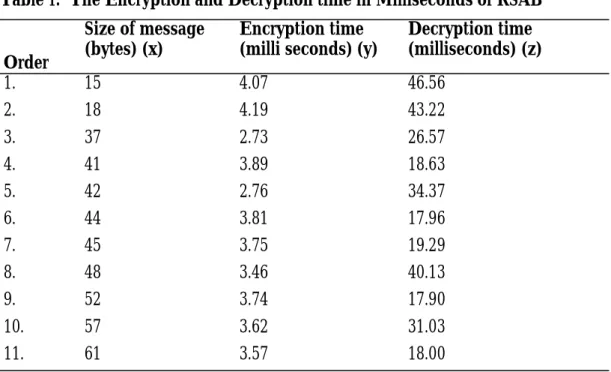
Table 1: The Encryption and Decryption time in Milliseconds of RSAB
Order
Size of message (bytes) (x)
Encryption time (milli seconds) (y)
Decryption time (milliseconds) (z)
1. 15 4.07 46.56
2. 18 4.19 43.22
3. 37 2.73 26.57
4. 41 3.89 18.63
5. 42 2.76 34.37
6. 44 3.81 17.96
7. 45 3.75 19.29
8. 48 3.46 40.13
9. 52 3.74 17.90
10. 57 3.62 31.03
11. 61 3.57 18.00
The encryption and decryption time of RSAB depends not only the size of the messages but also majorly on the binay pat-terns 110, 10 and 0 the encrypted message E (M) contains. If the message M, in binary format, contains large number of these
bi-nary patterns, then the more the insertions of extra bits into M. This produces variations in encryption and decryption times. The complexity of the RSAB encryption algo-rithm is derived from table I using polynomial
curve equation as follows:
Equation (7) is the decryption model of RSAB algorithm, x is the size of the mes-sage in bytes and Z is the decryption time in milliseconds
The RSAB was analyzed by measuring the complexity through the Big-O test with the series of test inputs (bytes). The results of RSAB encryption and decryption were as described in Table II and III respectively.
a = 4.8E-8, b = -1.1E-5, c = 1E-3, d = 4.6E-2, e = 1.1, f = -13 and g = 64.0
yielding y = 4.8E-8x6 - 1.1E-5x5 + 1E-3x4 - 4.6E-2x3 + 1.1x2 - 13x + 64 (6)
This equation (6) is the encryption model of RSAB algorithm, x is the size of the message in bytes and y is the encryption time in milliseconds.
Similarly, using the same polynomial curve equation to determine order of complexity of de-cryption algorithm of RSAB from table I, yields
A = -1.35E-7, b = 3.6E-5, c = -3.9E-3, d = 2.17E-1, e = -6.1, f = 82.0 and g = -372 and the
The result shows that the values of X ap-pear highest in the range of degree 4 for Big O encryption and highest in the range of degree 3 for Big O decryption as highlight-ed in tables II and III). The Big O notation for RSAB encryption is O (n4) and for the
decryption is O (n3) which indicated the
complexity and security level of RSA.
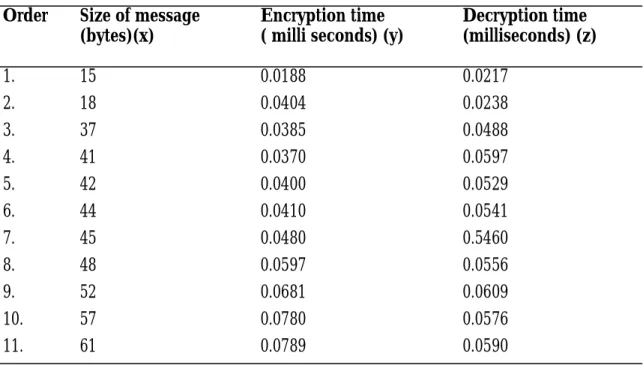
The encryption and decryption time of MRC4 is similarly derived from the data in table IV using polynomial curve equation.
27
Table 2: Test the degree of X for Big (O) Encryption
y=4.8E-8x6-1.1E-5x5+1E-3x4-4.6E-2x3+1.1x2-13x+64 X
Degree coefficient 37 44 45 52 61
6 4.8E-8 123.1 348.3 398.6 949.0 2473.0
5 -1.1E-5 -762.8 -1814 -2039 -4182 9291
4 1E-3 1874 3748 4101 7312 13845
3 -4.6E-2 -2330 -3918 -4192 -6468 -104411
2 1.1 1505 2129 2227 3327 4093
1 -13 -481 -572 -585 -676 -793
0 64.0 64.0 64.0 64.0 64.0 64.0
Table 3: Test the degree of X for Big (O) Decryption
y= -1.35E-7x6+ 3.6E-5x5 -3.9E-3x4 +2.17E-1.x3-6.1x2+82x-372 X
Degree coefficient 37 44 45 52 61
6 -1.35E-7 -346.4 -976.6 -1121 -2669 -6955
5 3.6E-5 2496.4 5937.0 6643 13687 30405
4 -3.9E-3 -7309 -14617 -15992 -28515 -53998
3 2.17E-1 10991.7 18484.5 19774.1 30511.9 49254.8
2 -6.1 -8351 -11809 -123525 -16494 -22698
1 82.0 3052 3630 3713 4290 5032
Table 4: Encryption and Decryption time of MRC4 Order Size of message
(bytes)(x)
Encryption time ( milli seconds) (y)
Decryption time (milliseconds) (z)
1. 15 0.0188 0.0217
2. 18 0.0404 0.0238
3. 37 0.0385 0.0488
4. 41 0.0370 0.0597
5. 42 0.0400 0.0529
6. 44 0.0410 0.0541
7. 45 0.0480 0.5460
8. 48 0.0597 0.0556
9. 52 0.0681 0.0609
10. 57 0.0780 0.0576
11. 61 0.0789 0.0590
a =9.59E10, b = +2.221E7, c = 2.0806E5, d = 1E3, e = 2.64E2, f = +3.5E1 and g =
-1.870 and the equation becomes
Equation (8) represents the encryption model of MRC4 where x is the size of the message in bytes and y is the encryption time in milliseconds of MRC4.
The complexity of decryption algorithm of MRC4 from X and Z in table V using poly-nomial curve equation is also given below.
29
a =-2.065E-12, b = 1.440E-10, c = 5.452E-8, d = -8.145E-6, e = 4.048E-4, f = -7.045E-3 and g = 0.0610 and the equation becomes
Z =-2.065E-12x6+1.440E-10x5+5.452E-8x4- 8.145E-6x3+ 4.048E-4x2-
7.045E-3x+0.0610 (9)
Equation (9) represents decryption model of MRC4, x is the size of the message in
bytes and Z is the decryption time in milli-seconds
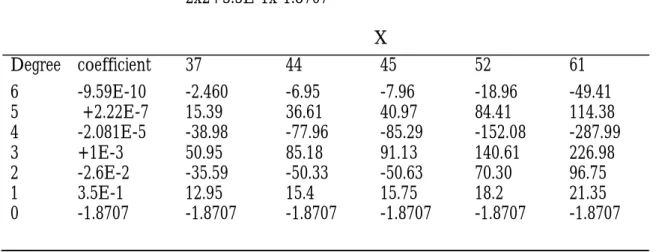
Table 5: Test the degree of X for Big (O) Encryption of MRC4
y=-9.59E-10x6+2.22E-7x5-2.081E-5x4+1E-3x3-2.64E-2x2+3.5E-1x-1.8707
X
Degree coefficient 37 44 45 52 61
6 -9.59E-10 -2.460 -6.95 -7.96 -18.96 -49.41
5 +2.22E-7 15.39 36.61 40.97 84.41 114.38
4 -2.081E-5 -38.98 -77.96 -85.29 -152.08 -287.99
3 +1E-3 50.95 85.18 91.13 140.61 226.98
2 -2.6E-2 -35.59 -50.33 -50.63 70.30 96.75
1 3.5E-1 12.95 15.4 15.75 18.2 21.35
The MRC4 was also analyzed by measuring the complexity through the Big-O test with the series of test inputs (bytes) under the same parameter settings with MRSA. The results for MRC4 encryption and decryp-tion were shown in Table V and VI respec-tively. The values of X appear highest in the range of degree 2 for Big O encryption and
highest in the range of degree 2 for Big O decryption. This is values were highlighted in table V and VI. The Big O notation for MRC4 encryption is O (n3) and the Big O
notation for MRC4 encryption is O (n2)
which indicated the complexity and security level of MRC4.
Table 6: Test the degree of X for Big (O) Decryption of MRC4
Z=-2.065E-12x6+1.440E-10x5+5.452E-8x4-8.145E-6x3+4.048E-4x2-7.045E-3x+0.0610
X
Degree coefficient 37 44 45 52 61
6 -2.065E-12 -0.00529 -0.01498 -0.01715 0.0408 0.1064
5 1.440E-10 0.0099 0.0237 0.0266 0.0547 0.1216
4 5.452E-8 0.1022 0.2044 0.2236 0.3987 0.7549
3 -8.145E-6 -0.4126 -0.6939 -0.7423 -1.1453 -1.8489
2 4.048E-4 0.5542 0.7838 0.8148 1.0947 1.5064
1 -7.045E-3 -0.260 -0.3099 -0.3170 -0.3663 -0.4297
0 0.0610 0.0610 0.0610 0.0610 0.0610 0.0610
The derivation of equation connecting the X and Y in table VII using polynomial curve to determine order of complexity of
the encryption algorithm of MRSA resulted into equation (10).
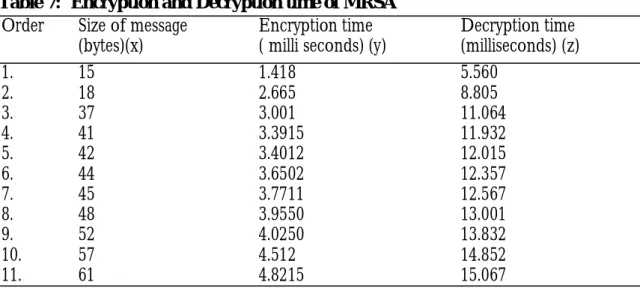
Table 7: Encryption and Decryption time of MRSA
Order Size of message (bytes)(x)
Encryption time ( milli seconds) (y)
Decryption time (milliseconds) (z)
1. 15 1.418 5.560
2. 18 2.665 8.805
3. 37 3.001 11.064
4. 41 3.3915 11.932
5. 42 3.4012 12.015
6. 44 3.6502 12.357
7. 45 3.7711 12.567
8. 48 3.9550 13.001
9. 52 4.0250 13.832
10. 57 4.512 14.852
The equation (10) represents encryption model of MRSA, where x is the size of the message in bytes and y is the encryption time in milliseconds of MRSA.
The derivation of equation connecting X
and Z in Table VII using the same polyno-mial curve to determine the order of com-plexity of decryption algorithm of MRSA resulted into equation (11).
31
A = 2.858E9, b = +1.1415E6, c =1.62E4, d = 1.05E2, e = 3.8E1, f = +6.674 and g =
-41.49 and the equation becomes
Z = -2.85E-9x6+1.1415E-6x5+1.62E-4x4+1.05E-2x3+3.8E-1x2+6.674x-41.49 (10)
Equation (11) represents decryption model of MRSA, where x is the size of the mes-sage in bytes and Z is the decryption time in milliseconds.
The complexity of MRSA was also analyzed with the Big-O test using the series of test inputs (bytes) under the same parameter settings with RSAB and MRC4. The en-cryption and deen-cryption models in equa-tions (10) and (11) respectively show that the values of x appear highest in the range of degree 3 for Big O encryption and high-est in the range of degree 3 for Big O de-cryption. The Big O notation for MRSA encryption is O (n3) and the Big O notation
for MRSA encryption is O (n3), which
indi-cated the complexity and security level of MRSA.
Avalanche Effect Analysis
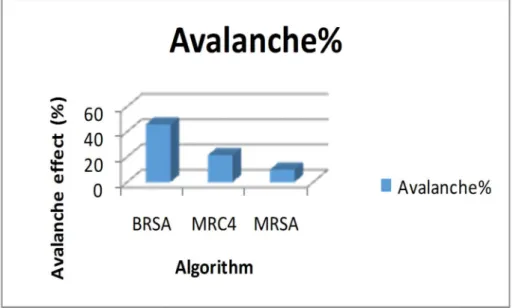
The output of avalanche effect by flipping one bit in plaintext of RSAB, MRC4 and MRSA generated 45.82%, 21.31% and 9.80% change in cipher text respectively. Figure 5 shows the graph of avalanche effect in (%) of the three algorithms RSAB, MRC4 and MRSA. The higher the value of avalanche effect of the encryption algorithm, the great-er the randomness and the bettgreat-er the security of such encryption algorithm against differ-ent attacks.
a 6.931E-8, b = 1.68E-5, c = -1.6459E-3, d = 8.427E-2, e 2.33207, f = 33.18 and g =-180.07 and the equation becomes
Z = -6.931E-8x6+1.68E-5x5-1.6459E - 3x4+ 8.427E-2x3- 2.33207x2+ 33.18x- 180.07 (11)
Result Comparison Analysis
The result evaluation of RSAB, MRC4 and MRSA is shown in Table VIII. This
con-sists of order of complexity of encryption (CE), order of complexity of decryption (CD)
and avalanche effects (AE).
33
Table 8: Comparisons of RSAMRC4 and MRC4B,
Encryption Algorithm CE CD AE
RSAB O(n2) O(n2) 45.82%
MRC4 O(n3) O(n2) 21.31%
MRSA O(n3) O(n3) 9.80%
The results in table VIII show that RSAB has avalanche effect value of 45.82% while MRC4 and MRSA have 21.31% and 9.80% respectively. The higher avalanche effect value in RSAB than in both MRC4 and MRSA confirms better secure level.
CONCLUSION
The RSA based encryption with bit inser-tion technique (RSAB) provided in this work guarantees adequate security mecha-nism for data in transmission and in stor-age. The algorithm performance analysis was conducted between proposed RSAB with key size of 256 bits, MRC4 (1024-bit key size) and MRSA (also 1024-bit key size). The time complexity factor prove that the order of complexity of proposed RSAB en-cryption is Big O notation O (n2) and
de-cryption is O (n2), and order of complexity
of MRC4 is O (n3) for encryption and O(n2)
for decryption while that of MRSA is O (n3)
for both encryption and decryption which indicates better security performance. The higher the avalanche effects value the better the security level which implies that the re-sult of RSAB is better than that of MRC4 and MRCA.
REFERENCES
Singh, S. 2011. The Code Book: the science of
secrecy from ancient Egypt in quantum cryptography. pp 1-23
Yogita, G., Praveen, S. 2015. Modified RSA
Algorithm used for Cloud Computing for Data Se-curity. International Journal of advanced technology in engineering and science. 3(6): 207-212.
Pradhan, S., Sharmal, B.K. 2013. Efficient
RSA Cryptosystem with BM Prime Method. Inter-national Journal of information and Network Secu-rity. 2(1):103-107.
William, S., Stalling, W. 2014. Cryptography
and network security principle and practice. (4th
Edi-tion) Pearson Education India. pp 591-615.
Nag, A. and Jain, V.K. 2014. Implementation
of modified RSA in MATLAB. International journal of innovatives research and development. 3 (13):382-384.
Balkees, M. S., Zaiton, M., Sharifah, Y.
2014. Improve Cloud Computing Security using
RSA Encryption with Fermat’s Little Theorem. International Organisation of Scientific Research Journal of Engineering. 4 (2):1-8.
Anal-ysis of Modified RC4 Encryption Algorithm. IEEE International Conference on Recent Ad-vances and Innovation in Engineering. Pp 1-5
Choudhary, V., Praveen, N. 2014. RSA
Cryptosystem Based on three Prime Num-bers. International Journal of Innovative Research
on Computer and Communication Engineering.
Vol. 1(10). pp. 753-757.
Jindal, P., Gupta, V. 2013. Modification in
RSA through positive justification of random
com-ponent. International Journal of Computer Applica-tion. 75(17):12-16.
Alan, H.H., Abdallah, A. 2012. Enhanced
Method for RSA Cryptosystem Algorithm. Inter-national Conference on Advanced Computer Science Applications and Technologies, pp. 402-408.
Kelvin, R. F., Richard, W. S. 2012. What is
bit-stuffing? Article retrieve on 19th January, 2016.
Available at http//en.wilkipedia.org/wiki/Bit-stuffing. Last edited on 26th October, 2015.