The influence of language on the teaching and
learning of Natural Sciences in Grade 7
by
ZONGEZILE GUDULA
Student Number: 3081578
Submitted in fulfilment of the requirements for the degree of
M Ed in Science Education
in the Faculty of Education at the University of the Western
Cape
Supervisor: Prof M. S. Hartley
http://etd.uwc.ac.za
DECLARATION Student no: 3081578I, ZONGEZILE GUDULA, declare that “The influence of language on the teaching and learning of Natural Sciences in Grade 7” is my own work and that all the sources that I have used or quoted have been indicated and acknowledged by means of complete references.
Signed at ………. on the ………… day of ………2017
………. Z. Gudula
http://etd.uwc.ac.za
ACKNOWLEDGEMENTSI wish to express my sincere gratitude and appreciation to the following people for their assistance in making this research possible:
1. My supervisor, Prof. Shaheed Hartley, for his patience, positive attitude and on-point guidance.
2. My supporting professor, Prof. Rajendra Chetty, for his encouragement and motivation to focus on set goal.
3. My wife, Nosange Gudula, for her efforts and support throughout the study.
4. All the higher primary school teachers and learners in the District who participated in the study.
5. Above all, Almighty GOD for giving me the courage and strength to start and complete this research and being with me in all travels and far-from-home stays.
http://etd.uwc.ac.za
DEDICATIONThe strength and courage to go through this thesis is a blessing from Almighty GOD. I thank GOD for the choosing me for this kind of honour. I dedicate this study to my daughter, Xabiso and my son, Zinzani, for their love, support and understanding throughout this long undertaking. I, also dedicate this work to my wife, Nosange Gudula, for her undying love, encouragement and support under the trying times of long weeks of absence. I also dedicate this study to my late mother for the love of education until her last breath.
http://etd.uwc.ac.za
AbstractIt has been noticed in many schools that Grade 8 learners arrive in the secondary school with a big gap in their understanding of the meaning of science concepts. In science cluster meetings teachers identified science terminology of the Grade 8 learners as problematic because learners tend to ascribe different meanings to science concepts that were dealt with in previous grades. Research conducted at the Grade 7 level to investigate the use of science language and terminology seemed the best way to understand this predicament. This study was aimed at understanding the meaning, use and application of language dealing with concepts in the Natural Sciences classes at the end of primary school. This study was underpinned by the critical theories of critical pedagogy and critical literacy. The study took place in three schools in one of the townships in the Eastern Cape. The sample for this study was Grade 7 Natural Sciences class from selected primary schools. Natural Sciences lessons at three schools were observed, one class per school. The teachers from each of the observed classes were interviewed for their perception of issues around language and science in their classes. The study aimed at providing some insight into the use of language and terminology in Grade 7 Natural Sciences classes and add some answers to the concerns of secondary school teachers regarding Grade 8 learners’ language and understanding of science concepts. The study found that educators would like to see Language Policies in the Education Department being changed to accommodate the African learners who are the majority in the country. As a result of LoLT being the second language, teaching and learning experiences a lot of misconceptions in Natural Sciences in Grade 7.
Keywords: Science Education, language of instruction, science terminology, Eastern Cape, Natural Sciences, concepts
http://etd.uwc.ac.za
Table of Contents Declaration 1 Acknowledgements 2 Dedication 3 Abstract 4 Table of content 5 FIGURES TABLES 6http://etd.uwc.ac.za
CHAPTER 1
RATIONALE OF THE STUDY
1.1 Introduction
This chapter provides the rationale of the study and describes the background of the study. It also outlines the context where the study was conducted to give an idea of the nature of the research problem. The research question to be answered is highlighted as well the significance and the limitations of the study. The aim of this chapter is to make the intention and rationale of the study known.
1.2 Background to the study
Many developed countries of the world owe their Growth Domestic Product (GDP), which is the measure of the country’s wealth, to Science and Technology. Mathematics is the complimenting subject that helps to enhance the cognitive thinking abilities. The above-mentioned field of learning is a challenge to many people and it needs to have its challenges eliminated and a larger intake of students accommodated in the Higher Education institutions.
The challenge that engulfed South Africa is the disappointing performance of the learners at the school level in Mathematics and Sciences. It has been recognized for decades that there is widespread underachievement in Sciences and Mathematics education in South Africa (de Lange, 1981; Taylor & Vinjevold, 1999; Asmal, 2000; Howie, 2001; Reddy, 2006). However, problems associated with Science and Mathematics education are not confined to this country, but are international phenomena (Driver, Guesne & Tieberghien, 1995) and international research has shown that issues of language are key areas contributing to high failure rates in these subjects (National Centre for Curriculum Research and Development, 2000). In turn, recent research on science literacy suggests that teacher education and professional development strategies should assign a more important role to language in the learning and teaching of science (Yore & Treagust, 2006), while a number of investigators have reported on strategies for improving reading, writing, discussing
http://etd.uwc.ac.za
and doing science (Hand, Prain & Yore 2001; Heselden & Staples, 2002; Marlow, 2005).
The majority of South African learners study a wide variety of school subjects using a language that is not their mother tongue (Probyn, 2004). However, they need to understand what needs to be learnt in all these subjects even though they experience difficulties when they switch from mother tongue instruction to the English language of instruction. Language and thinking are key aspects that are associated with gaining insight to problems that learners have to solve in class. In the Eastern Cape, isiXhosa is the most widely spoken indigenous language and home language to 83.8% of the population, yet the official medium of instruction in the majority of schools from the beginning of Grade 4 (ages 9-10) to Grade 12 is English (Probyn, 2004).
Most researchers recognize the language problems associated with science education. For instance, Yore & Treagust (2006) mention a three language (home language, instructional language, science language) problem which exists for most science language learners. Learners come to school with informal ways of talking and teachers have to move them from informal spoken and written language to formal language (Setati, Adler, Reed & Bapoo, 2002). Chimoro (2004) argues that children bring into the classroom socio-cultural characteristics from their environment which may create a wedge between what they are taught and what they learn. To change learner’s misconceptions, Black (2006) suggests that teachers need to be competent, patient and make connections between what learners learn in science classrooms and what they already know.
A survey carried out during 1998 in rural Grade 7-12 schools in the Eastern Cape (Muwanga-Zake, 2007), revealed that teachers did not seem to know their shortfalls in teaching science. For example, teachers claim that they do not teach science practical activities because they do not have apparatus. The survey results suggested that the teachers' problems, such as the inability to teach practical activities were underpinned by the teacher's lack of understanding of science concepts and processes, the knowledge and skills the teacher is supposed to transfer to learners (Muwanga-Zake, 2007). Understanding of concepts and processes can be directly related to learners being able to read and write (Gudula,
http://etd.uwc.ac.za
2014). The latter statement suggests that there is a deeper concern about language that should be attended to.
1.2.1 Learner performance in Science at national, provincial and district levels
South Africa is facing a challenge in terms of a shortage of human resources in scarce skills areas. As it stands, a good quality education is the country’s way-out. Subjects that are the hope for the development of the economy of the country are those that require abstract thinking like Mathematics, Physical Sciences, Engineering, Accounting, etc. Dreadfully, these are the subjects that many learners display that they are not coping with.
Post-1994, a change of curriculum was introduced with an aim of finding a suitable curriculum for all the people of South Africa, moving away from apartheid based form of curriculum. Outcomes Based Education (OBE) system was introduced and later it was changed to National Curriculum Statements (NCS). Many challenges ranging from understanding the curriculum itself and terminology used were confusing to educators to the extent that learners were confused too. A decline in the country’s pass rate was recorded. One of the subjects that reflected a downward trend is Physical Sciences as many learners achieved between 0% and 29% (i.e. between level 1 and level 2).
NCS was then revised to make it simpler and was changed to Curriculum and Assessment Policy Statement (CAPS) but the state of affairs of Physical Sciences up to 2014 remained unchanged. To get the understanding of this state of affairs of Physical Sciences, an analysis of results of four years became necessary. Figure 1 below shows the performance distribution in Physical Sciences:
http://etd.uwc.ac.za
Figure 1: Performance distribution curves in Physical Sciences 2011-2014
Figure 1 shows that a large number of learners achieved between levels one and three over the four-year period. From level four to level seven, the learners who achieve in this category decreased drastically. The causes of these trends do not just emerge from Grade 12 but are a build up from lower grades and that manifests itself in Grade 12. Something needed to be done to identify where the problem starts and a way to rectify it. A national strategy in the form of Annual National Assessment (ANA) was devised for lower grades. ANA revealed similar trends in Mathematics and English as subjects in Grades 3, 6 and 9. Mathematics and English serve as a base of understanding of sciences, especially Physical Sciences which starts as Natural Sciences in the Senior Phase. English, on one hand, is a language of teaching and learning; therefore, learners should have a good command of the language in order to be able to understand and manipulate scientific concepts. On the other hand, Mathematics helps learners in the enhancement of skills of manipulating numbers, developing a logical approach and easy handling of data. All the afore-mentioned about English and Mathematics, are encompassed in Natural Sciences because every skill is needed to accomplish better understanding of concepts and achievement of a better results.
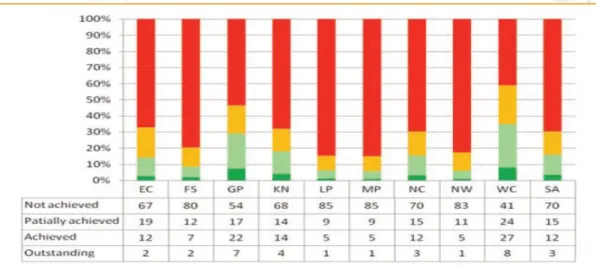
Figure 2 and Figure 3 below shows performance levels of Grade 6 learners in English language and also Mathematics obtained from 2011 Diagnostic Report of the Annual National Assessment. In the Eastern Cape, for instance, 67% of learners in language obtained ‘not achieved’ and only 2% obtained ‘outstanding’. This breakdown is not done according to race; this is the whole population of learners in Grade 6 in the Eastern Cape. Other provinces experience the same predicament as Eastern Cape as shown in Figures 2 and 3 below. For Mathematics in the Eastern Cape, 71% learners in Mathematics obtained ‘not achieved’ and only 1% obtained ‘outstanding’. This trend is transferred to the secondary schools and they adopt this problem as part of the challenges that they face from Grade 8 -12.
http://etd.uwc.ac.za
Figure 2: Performance in Grade 6 languages by level
Figure 3: Performance in Grade 6 Mathematics by level
The table that follows below is an analysis of Grade 12 learner performances in the Eastern Cape 2002 to 2012. This table is obtained from The Learner Attainment Improvement Implementation Plan 2013-2015 ((LAIS):
Table 1: Analysis of Grade 12 Learner Performance
PROVINCE OF THE EASTERN CAPE: ANALYSIS OF GRADE 12 LEARNER PERFORMANCE
CENTRE ACADEMIC YEARS
No DISTRICT 2002 2003 2004 2005 2006 2007 2008 2009 2010 2011 201 2 7 Research district 57.4 66 58.7 59.5 65.3 59.9 60.5 60 66.9 63.7 68.9
Table 1 shows the district where the research was done and that over a period of eleven years the learners pass rate never progressed beyond the 60% range. The shaded areas highlighted the years where the pass rate was below 60%. It is for this
http://etd.uwc.ac.za
reason that this study was focused to the start of the Senior Phase in order to understand the root of the problem.
1.2.2 Language policy issues in school
Language policy in Education is unfair to the majority of learners in South Africa. Macdonald and Burroughs (1991) attest to the uprooting of fun in lower classes of education as children learn through play and talk with other children even if they are from different backgrounds. It is understandable that solving language policy issues is not a solution to all education challenges in South Africa because “language” policy is largely influenced by politics (Hawes, 1979).
African children were given the first four years of study in home language as a language of instruction and there-after English or Afrikaans became their language of instruction. In 1991 an amendment was made to the 1979 Education and Training Act which gave a hollow choice of language of instruction to parents to choose which language they want their children to be taught in. That choice had its purpose defeated by the lack of resources like textbooks and other learning support material. New policy needed to be developed that would suit everyone in the population of the country. As one of the Government’s policy, Affirmative Action had to be applied to African languages to promote the development of these languages. Speakers of these languages had to be actively involved in promoting them. One of the vehicles used to promote African languages was that learners had to take on three African languages as a compulsory component of the curriculum.
According to my understanding, this problem did not only affect rural schools, but also urban schools. I agree with Muwanga-Zake (2007) when he advises that in the Eastern Cape, there is a need to consider solutions such as using English second language as the teaching medium. I did not agree with him when he said: “African Blacks suffer additional problems in that there could be no direct translations of concepts in the local language”. Any language can be developed to a point where it is possible to make it a medium of Instruction.
http://etd.uwc.ac.za
1.2.3 Language Issues in Science
Internationally there has been increasing research and recognition in recent years of the central role of language in learning science (Miller, 2006), and on the introduction of reading and writing in science literacy (Yore & Treagust, 2006). These researchers believe that for someone to be judged as scientifically literate they must be proficient in the discourses of science, which includes reading, writing and talking science. Others feel that science education becomes ineffective if it does not support learners in acquiring language skills (Yore, Bisanz & Hand 2003; Wallace, Hand & Prain, 2004). In fact, Wallace, Hand and Prain (2004) believe that reading and writing are essential activities that all students of science need to engage in to completely focus on their scientific understanding.
The study by Wallace et al (2004) presents the challenges facing education planners such as subject advisers in implementing changes in the syllabi that would result in the elimination of the language problems on the cognitive development of English second language learners. Furthermore, implications of English as a language of learning and teaching (LoLT) in South African schools have a distinctive presence. It was also considered to ascertain whether there are any prospects of using an African language as a language of learning. After outlining the problems faced by second language speakers of English when learning in a language that is not their mother tongue, a suggestion for the need to address the problems that arise and the shift from the English for social contact, to English for specific school subjects was provided.
Some studies, for example, Meyer (1985), have produced evidence to show that English is the exception rather than the rule. What is required is an acknowledgement of the factual situation which is that neither the students nor the teachers in the majority of schools are capable of using English at a sufficiently high level. One solution is to adopt a mixed language approach (allowing the use of two languages of instruction) (Rollnick & Rutherford, 1993). Ideally, small group discussion should proceed in the mother tongue (in the case of Eastern Cape, isiXhosa) and learners should be encouraged to ask questions in the mother tongue. The transition from isiXhosa to English should be made gradually so that students are not required to operate beyond their level of competence. There should be a
http://etd.uwc.ac.za
readiness to provide explanations in isiXhosa at any stage in the interests of a high level of comprehension.
1.3 Interventions in Science education in South Africa and Eastern Cape Province
To address the problem of underperformance in Mathematics and Sciences, the Department of Basic Education (DBE) in conjunction with the Department of Higher Education and Training (DHET) and Department of Science and Technology (DST) collaborated to improve the outcomes of the learners in the country. The Eastern Cape Department of Education came up with a strategy called Learner Attainment Improvement Strategy (LAIS). LAIS had a three-year period of implementation which had its own objectives that are as follows:
To rollout a program of action for LAIS over a period of three years.
To deal decisively with the factors that cause the education system in the
Eastern Cape to have poor learner outcomes.
To delineate the roles and responsibilities of the various levels of education
management from school to provincial level.
To promote collaboration particularly at district level To profile the Multi-Disciplinary Team concept
To promote the sustainability of the gains of LAIS by assisting the
underperforming schools while motivating the good performers to soar to greater heights.
The Eastern Cape Department of Education undertook the following strategies to address the challenges for science:
1. Incubation classes which took a few learners from a large pool of learners and, therefore, only catered for ‘bright sparks’. Unfortunately, most learners were struggling with physical sciences.
2. Winter and Spring Schools which were marked by overcrowded classes and did not cater for individual attention for learners.
http://etd.uwc.ac.za
3. Dinaledi program which supported and developed the schools that were already performing better. In the entire Eastern Cape province, only 60 schools were included in this program.
4. Science festivals which were held in Grahamstown. Unfortunately, not all learners were able to attend the festival as it was far from many schools in the province.
5. Nelson Mandela University (NMU) program for FET physical science educators which aimed at developing educators in physical sciences.
6. 1 +4 program which was aimed at developing foundation phase educators in numeracy which serves as a base for physical sciences.
7. University of the Western Cape Programs which were run by Science Learning Centre for Africa in the Eastern Cape Province from 2010 to date. This program included the following:
Advanced Certificate Education (ACE) in FET physical science which was a course that was offered to FET physical science educators and equipped them with the content gap, development of science clubs, and understanding of nature of science and scientific knowledge.
The program took the educators with ACE to BEd Honours’ level where they studied and gained an in-depth understanding of science and Science Education through teaching and learning by doing practical activities (hands-on).
To find out about and address the local challenges in education, an approach to increase research muscle, a pool of Masters students is being trained to be home-grown Science Education researchers.
Accredited short courses which certified Natural Sciences educators by providing them with the foundation of the content in each of the Natural Sciences knowledge areas.
1.4 Context of the study
The researcher is a Physical Sciences teacher in Grades 10, 11 and 12 and also teaches Natural Sciences in Grade 8. The school, where the researcher taught, is situated in the Eastern Cape in a township near a rural area. The school starts from
http://etd.uwc.ac.za
Grade 8 to Grade 12 with a variety of subjects grouped into learning streams. From Grade 10 to Grade 12 the streams were divided as follow: -
Stream of Languages
Stream of Mathematics and Sciences, Stream of Humanities and
Stream of Business and Commercial Management (BCM).
Subjects needed for Grade 8 and Grade 9 are, Languages, Mathematics, Natural Sciences, Economic Management Sciences, Life Orientation, Creative Arts and Social Sciences, for each learner to learn to qualify for progression to the next phase. It was in Grade 8 Natural Sciences where the researcher personally noticed the challenges experienced by learners concerning the grasp of science concepts due to the lack of command of the language of teaching and learning. A question arose as to where the learners lost the essence of the concepts, “in English as a subject or the teacher’s use or lack of use of scientific language in the science class?” The feeder schools were from both the township and the rural area, with the majority of learners coming from the nearby rural area. There were other surrounding high schools that the feeder primary schools also supplied with learners. Grade 7, the focus of this study, is at the primary school whereas Grade 8 to Grade12 is at the secondary school. One phase, Senior Phase, has Grades in two school levels, Primary School and Secondary School and that causes a disjuncture in the flow of understanding of the learners in the phase. Secondary school educators in my school did not have an understanding of what was happening in the primary schools because of their focus in the secondary school.
This study explored the issues of language and how it influenced Natural Sciences as experienced in the researcher’s school and the surrounding schools in an attempt to find a solution for the ongoing dilemma concerning learners being disadvantaged by language-related challenges. A better command of the language of teaching and learning is essential to participate in the various fields of the sciences.
http://etd.uwc.ac.za
1.5 Research Problem
As a teacher of Natural Sciences in Grade 8, the researcher noticed that learners coming from Grade 7, from different schools, experienced difficulties in understanding science concepts. Some learners show an acceptable level of understanding of English as a language but they lack a grasp of science concepts and this led to learners failing tests. Learners tended to view the Physical Sciences part of Natural Sciences, as difficult and many of them did not select it as one of their subjects in Grade 10.
Learners start their Grade 8 in the secondary school in Senior Phase having been in a class of Grade 7 that was located in the primary school. Teachers in the secondary school do not know what is happening with the learners in the primary schools and the same learners find it difficult to connect with the syllabus of the two grades in the secondary. Even though the policy document for Natural Sciences in the Senior Phase (Grades 7-9) is clear about the content to be taught, learners showed the content knowledge gap when they arrived in the secondary school. Learners were often familiar with one or two sections of the Senior Phase Natural Sciences curriculum, either “life and living” and/or “earth and beyond”. They often lack knowledge of the Physics and Chemistry part. This knowledge gap caused a backlog to Grade 8 teachers because the curriculum demands that at a certain time a given amount of work should be completed. Most of the terms became new to the learners as the Grade 8 teacher introduced them whereas the policy document for syllabus coverage clearly states that these terms should have been taught in earlier grades. This is where this study comes in, to find out about the proficiency of teachers and learners in the language of instruction in the Grade 7 classes. This study seeks to understand the challenges experienced by both teachers and learners in relation to the language when teaching and learning Natural Sciences occurs.
1.6 Research questions
Given the research problem highlighted in section 1.5 above, this study will be directed at answering the following research main question:
http://etd.uwc.ac.za
What is the influence of language on the teaching and learning of Natural Sciences in Grade 7?
(i) How were teachers incorporating language in their Grade 7 Natural
Sciences classes?
(ii) What were the teachers’ perceptions of the influence of language in
their Natural Sciences classes?
1.7 Significance of the study
This study could be significant for a number of reasons. The outcomes of this study could serve to inform science teachers, curriculum advisors and curriculum planners about the role that the language plays in the teaching of science. The study could provide some insight into language and terminology in Grade 7 Natural sciences and add some answers to the concerns of secondary school teachers regarding Grade 8 learners’ language and understanding of science concepts. This study could also add to the baseline data available with regard to issues of language and science at the primary school.
1.8 Limitations of the study
This study was located to three schools and it is therefore difficult to generalise the outcomes across the Eastern Cape. The sample was relatively small, namely one class per school, and therefore it was not representative of a wider population of the district or the province. Since the study was done over a relatively short period, it did not lend itself to a full-scale understanding of the whole situation. The study was done at different time intervals which made it difficult to compare similar topics taught as outlined in the work schedule of the subject.
1.9 Structure of the thesis
Chapter 1: Introduction
http://etd.uwc.ac.za
Chapter one introduced the study. It provided the background and context of the study which foregrounded the research problem and research questions. It also provided the significance and limitations of the study and gave an outline of the structure of the thesis.
Chapter 2: Literature review
This chapter provided the theoretical basis of the study and presented a review of studies in the area of language and science.
Chapter 3: Research Methodology
The methodology outlined the collection, presentation and analysis of data. Chapter 4: Findings and Discussion
In this chapter, the findings were presented and discussed. Chapter 6: Conclusion and recommendation
This chapter provided a summary of the thesis and presented the major findings of the study. It also highlights the implications of the study and recommends areas of future study.
Chapter 7: References
This chapter acknowledged the references used in this study and is presented using the 6th version of APA.
1.10 Conclusion
This chapter dealt with the rationale of the study. The aim was to give an overview of the study in relation to the research question. The context of the study and the research problem leading to the research question were clearly outlined and discussed. The significance and limitations of the study were identified. The next chapter will present the literature review for the study.
http://etd.uwc.ac.za
CHAPTER 2
LITERATURE REVIEW
2.1 Introduction
The literature review chapter provides the theoretical framework of the study and reviews existing literature on the topic of this study. The objective of this chapter is to portray the path of previous studies and how this study is linked to them. It also gave me the opportunity to learn from previous efforts and stimulated me to identify gaps and shortfalls in the field. Boote and Beile (2005) put it clear that a good review is one which helps the researcher to learn from other scholars and stimulate new ideas. This chapter provides the theoretical basis of this study in its endeavour to answer the following research question and its sub-questions:
What is the influence of language on the teaching and learning of Natural Sciences in Grade 7?
(i) How were teachers incorporating language in their Grade 7 Natural
Sciences classes?
(ii) What were the teachers’ perceptions of the influence of language in
their Natural Sciences classes?
2.2 Theoretical framework
This study is underpinned by the critical theories of critical pedagogy and critical literacy.
2.2.1 Critical pedagogy
Critical pedagogy is a philosophy of education and social movement that combines education with critical theory (Giroux, 2010).The focus is on a critical pedagogy in teacher education because of the goal of preparing citizens for participation in a democratic society. It is a process-oriented educational movement, guided by passion and principle, to help students develop consciousness of freedom, recognize
http://etd.uwc.ac.za
authoritarian tendencies, and connect knowledge to power and the ability to take constructive action (Giroux, 2010). Shor (1980) describes critical pedagogy as habits of thought, reading, writing, and speaking which goes beneath surface meaning, first impressions, dominant myths, official pronouncements, traditional clichés, received wisdom, and mere opinions, to understand the deep meaning, root causes, social context, ideology, and personal consequences of any action, event, object, process, organization, experience, text, subject matter, policy, mass media, or discourse. This study has its focus on revolutionising the education policy concerning language of teaching and learning in South Africa. Since the nation is the so-called Rainbow Nation, the majority of African-language speaking people have not been considered to be taught through their own languages. The way in which African children are taught needs to be looked at in a very close way. Critical pedagogy in this study is a theoretical framework suitable for that sought of an intended paradigm shift. The Nation has a duty to transform its people by critically looking at the factors that affect its people’s well-being. Critical theory is a school of thought that focuses itself on the role of critique of the societal and cultural way of life. It applies knowledge from the social sciences and the study of historical background of the society of concern. Theorist, Max Horkheimer (1937), described a theory as critical insofar as it seeks to liberate human beings from the circumstances that enslave them.
With critical theory in mind, a need to understand the learners’ views and understanding of their current level of knowledge was at the centre of this study. This view opened the doors that may lead to the consideration of looking into an introduction of new ideas. These ideas may revolutionise the ways in which the science lessons are conducted. The literature highlights language ability as a contributing factor to effective critical thinking skills (Feuerstein, 2007; Nisbett, Peng, Coi & Norenzayan, 2001). Critical thinking skills are regarded as important for problem-solving which strengthens the link between academic language proficiency and critical thinking (Facione, 2009; Halpern, 2007; Halx & Reybold, 2005; Vandermensbrugghe, 2004).
Critical theories generally share a social and cultural analysis with an activist component based largely on the critique of oppressive and dominant economic and political forces. They have a desire for social justice and equality, and a need to
http://etd.uwc.ac.za
represent marginalized perspectives (Tripathi, 2008). Kellner (2003), claims that critical theory of education must be rooted in a critical theory of society, and should be central to social critique and transformation. Paulo Freire (1970) emphasises that essential task for critical understanding is the valorisation, and not the idealization, of popular wisdom that includes the creativity of a people and reveals the level of their knowledge regarding reality. This then makes it critical that this study makes an impact and stimulates the creativity of those responsible for the changes to be made in the education sector regarding science education. The heart of this study is to understand what is happening in the classes of science at different schools in the Senior Phase concerning the use of science concepts.
2.2.2 Critical literacy
This study also has to do with teachers and learners paying a particular attention to text details. The correct use and understanding of a text is explained under the theory of critical literacy. Critical literacy is, according to Coffey (2008), an instructional approach, stemming from Marxist and Freirean perspective. It is the ability to read texts in an active, reflective manner in order to better understand power, inequality, and injustice in human relationships. According to Robinson & Robinson (2003), a text is defined as a vehicle through which individuals communicate with one another using the codes and conventions of society.
Students can evaluate whose knowledge is being privileged in texts and de-construct the message of those meanings. As readers, learners must also evaluate the social construction of a text and question the factors that may have influenced the author to create the text in a specific manner (Coffey, 2008). Moreover, using critical literacy, teachers should encourage students to look at texts from other perspectives and re-create them from the standpoint of marginalised groups in order to analyse the power relations and social inequities promoted by the texts. Science education is no different from other fields that require learners to pay attention to text detail. Natural Sciences is the body of knowledge that equips the society with adequate information that is used for the betterment of economic wealth in that society. For the learners to develop the power to be critical when reading a text, they should be able to analyse what each science concept means and be able to develop the necessary understanding of that concept. How the society will benefit from the concept
http://etd.uwc.ac.za
knowledge of the learners depends on the development of the skill of critical analysis of the text in the subject of Natural Sciences.
2.3 Factors impacting on this study
2.3.1 Learning capacity of learners
Science learning requires learners to have a certain learning capacity in order to be able to grasp its content and context. “Mathematical/Logical Intelligence”, as described by Gardiner (1999), involves planning, sequencing, and problem-solving. A child with a language disorder may not have these basic abilities required to complete mathematical problems, equations, and formulae. Science also involves formulae, laws, and experimentation. If the child is unable to sequence events, follow directions, or arrive at conclusions, science theory will be abstract, and hard to understand (Merkel-Piccini, 2001).
In South Africa in the primary school classes, Senior Phase in particular; all learners have to learn at least Natural Sciences (Department of Basic Education, 2011). This policy document prompts the teachers to find teaching strategies that will allow inclusivity of all learners despite their capacity to learn science. Merino and Scarcella (2005) argue that in order to learn science, students need to master the academic literacy skills specific to that discipline. Using a constructivist approach, they define academic literacy as the body of knowledge, strategies and skills necessary to accomplish the academic tasks of a specific discipline in a particular context. Teachers have a task of guiding the learners to master the basic academic literacy skills by offering extra attention to the learners they identify as having science learning barriers. Deducing from Merino and Scarcella’s statement, teachers should be equipped with the skills to identify and address the learners’ shortfalls so as to get them in line with the mainstream learners that are capacitated for the logic-demanding subject.
2.3.2 Language level used by teachers
For the learners, whom the language of instruction is a second language, there is an added burden of translating the language of instruction to their home language when being taught. The same learners are also faced with the added burden of thinking
http://etd.uwc.ac.za
answers in their own language and then translating them into the language of instruction before they actually answer them. The language changing within a lesson with the aim of creating an understanding of a concept or phenomenon is referred to as code-switching. Code-switching refers to alternations of language within a single conversation, often involving switches within a single speaker turn or single sentence (Rose & Dulm, 2006).
The Progress in International Reading Literacy Study (PIRLS) of 2006 is an international study of reading literacy which is conducted every five years and 40 countries participated, including South Africa. Approximately 30,000 Grade 4 and 5 learners were assessed and alarming findings were reported, namely, that South Africa’s Grade 4 and 5 learners achieved the lowest mean scores compared to the other participating countries (Pirls, 2006). Due to many factors, this problem persists right through to secondary school level of education. Pretorius (2002) argues that poor matriculation pass-rates in South Africa suggest a reading-to-learn barrier to academic performance which results in poorly equipped students entering higher education institutions.
Since this study has its focus on a class that is at a primary school level, it is proper to point out the way the primary school teachers are viewed internationally and to throw a prompting thought-provoking view that may be applying to South Africa. There is an assumption that primary teachers are generalists who have an ability to provide instruction in all key subject areas. In contrast, there seems to be a parallel discourse increasingly promoting the need for specialist teachers in the primary school setting. In England it has been argued that the idea of the generalist is outdated and does not reflect practice (Alexander, Rose & Woodhead, 1992) whilst, in the same breath, Masters (2009) claimed that, ideally, every primary school teacher would be an expert teacher of literacy, numeracy and science, thus explicitly prioritizing the development of teacher competencies in some subject areas over others. This statement gives rise to the fact that teachers, at least in the Senior Phase should all a have measurable amount of content and methodological knowledge of science that will give learners a fair chance of being eager to learn science when they get to secondary school level.
http://etd.uwc.ac.za
Teachers have to be considerate when asking questions and use words that would be of easy reach to these learners. There used to be what was called higher grade and standard grade for different cognitive levels of learners (Van der Berg, 2007). The same format could be used but this time focus should be on the difference in language. Care has to be taken by the teachers to have a strategy to use when approaching a lesson taking into consideration the language proficiency of learners. According to Sullivan (2008) in a recent study by Bryan Brown, an assistant professor of Education at Stanford, and Kihyun Ryoo, a doctoral candidate in Stanford’s School of Education, students who learned the basic concepts of photosynthesis in “everyday English” before learning the scientific terms for the phenomenon fared much better on tests than students taught the traditional way. For instance, words like "sugar" at the beginning of the lesson can be used and changed into “glucose” later. Also, the use of "energy pigments" initially and subsequently introducing “chlorophyll” and “energy pouch" as a temporary stand-in for “chloroplast”, is a strategic approach in the introduction of scientific terms. Examples given above show that science teachers should not only teach science content but also teach language within the lesson. In the study mentioned above, the method used to teach learners is called “content-first” approach. The results reveal that although learning the language of science remains a primary hurdle, students taught using “content-first” approach demonstrated an improved conceptual and linguistic understanding of science.
Teachers often talk to learners about the connection between words they know and the ones scientists use. For example, a teacher might explain that "sorting" the animal kingdom into two major categories—invertebrates and vertebrates—is the same thing as "classifying" them, to a scientist.
2.3.3 Language of teaching and learning
The teacher, as the immediate curriculum developer, has a responsibility to use suitable level of language of instruction to accommodate the learners whose home language is not the language of instruction. It is important for the teacher to use the language of science consistently and correctly without causing confusion by trying to simplify the scientific terms. The science language, generally, leans widely towards
http://etd.uwc.ac.za
the English language in South Africa. Science is also taught in Afrikaans in South Africa but it is not available in any of other languages related to Black Africans like Zulus and Sothos (Gudula, 2014).
Although it is increasingly acknowledged that proficiency in academic English requires more than 3 years to acquire; the nature of academic English language proficiency is not well understood (Cummins, 1984). The latter statement justifies that it is not always a case of learning difficulties that a learner does not achieve as expected. In most cases, the lesser time the learner is exposed to the English language, the more the learner is likely not to achieve as expected. It is often taken for granted that learners are able to systematically analyse a question creating a clear picture of what concept it refers to.
Okebukola (2008) notes that most African elementary schools have no formalised reading programmes. Reading is subsumed in the English language lesson and taught by the language teacher. Thus, largely, reading is taught as a tool to reinforce other language skills rather than as a discipline. Warwick (1999), berating the worrisome situation, notes that African children lack opportunities for catching up with the rest of the world in terms of satisfying employment and political choices as a result of their low literacy levels and limited horizons. This situation may persist well into the 21st century, unless there are massive changes.
Howie (2003), for example, believes that the most significant factor in learning Science and Mathematics isn’t whether the learners are rich or poor. It’s whether they are fluent in English. While there is surely some truth to the view that weak language proficiency in English spills over to learning in other subject areas, it is necessary to acknowledge the strong and complex relationships between language, socio-economic status and school functionality in South Africa.
When it comes to science, as there are these arguments, learners also have conceptual problems. Although there are many problems that are presented by concepts, there are four areas that are the most occurring in social science texts, namely, ambiguity, vagueness, unfamiliarity and emotive words. Most learners are faced with these challenges to the extent that the meaning of the question is lost to them (Rossouw, 2003). Internationally, there are many learning barriers that the
http://etd.uwc.ac.za
learners experience as individuals, different from each other. Learning barriers associated with learners’ inability to express their views are usually leaning towards language challenges. Language barriers can have long-term effects on learner’s academic performance (Elsworth, 2013).
2.3.4 Language of Instruction
The issue of language of instruction has been a matter of debate for a long time in South Africa. The language of instruction is the language that is used as a Medium of Instruction in schools as accepted by the Department of Education in South Africa. Before the passing of the Bantu Education Act of 1953, the home languages of African speaking learners were used as languages of instruction for the first four years of schooling. After 1953, the home languages were to be the medium of instruction up until the eighth year of schooling, and after that half of the subjects were to be taught in English and the other half in Afrikaans (UNESCO, 1953; McKibeen and Brice, 2001). Furthermore, the government of the time encouraged the African Languages board to develop vocabulary and terminology of the African Languages in subjects such as science, geography etc., but they never got support as the nationalist government went on a deliberate campaign to deny black children authentic models of English and also not giving support to the African Languages Board (Heugh, 1995). The language of instruction, after that, favoured the English-speaking and Afrikaans-English-speaking learners, who happened to be ‘White people’, since each group was allowed to have their children learn with their home languages as language of instruction. African learners had to abandon African languages as languages of instruction and adopt English language as their language of instruction. As colonialism in Africa matured, so also did the entrenchment of language policies and practices which elevated the position of colonial languages as languages of instruction. As compared to the British, the French from the start, tended to be very partial to the use of French as language of instruction, from the earliest age of schooling. The Belgians had always stressed the necessity for a broad basis of elementary instruction in the vernacular and by 1954, for example, the percentage of the total Congolese population in schools was 9.4 per cent as against 4.5 per cent in British territories and 2.7 per cent in French areas” (Foster 1965).
http://etd.uwc.ac.za
As Africans moved to a period of developing their education, free of the colonial bondage, they did not give much consideration to the African languages for the language of instruction. Brock-Utne (2006) likens the above statement, hypothetically speaking, to wanting to give education without considering the medium of instruction, which is like wanting to give water to a village but not considering the pipes. These statements show that either the interests of the policy makers are elsewhere, that is not education, or poor capabilities to plan and manage are a factor.
Malekela (2003: 111) made a statement that, “to continue using English as a medium of instruction in post-primary education is a torture to most of Black children”. When a country gets independence from a colonial oppressor, it is expected that favour will be a priority towards those that were oppressed. Language change is one of the main concerns together with political change and economic change but the language issue is neglected. Desai (2003) argues strongly that in South Africa, mother tongue education is seen as a given advantage for English-speaking, and to a lesser extent, Afrikaans speaking learners. It is taken for granted that these learners will learn best through their primary languages. However, when it comes to considering people who speak African languages, the debate rages furiously. I agree with Desai since many argue that in science, for instance, there is not enough vocabulary that would be in isiXhosa. My belief is that with enough time, resources and good motivation, vocabulary can become available because African languages are means of communication like any other language. Languages develop, including African languages.
The reasons offered during the colonial period for the limited and temporary use of local languages were articulated thus:
1. There are too many African languages to be able to justify rationally and economically their use.
2. African languages have limited demographic and geographical significance, therefore, it is wiser to use global languages.
3. African languages have limited lexical capacity to deal with the realities of modern society, science and technology.
4. African languages do not make for so-called “societal unity.”
http://etd.uwc.ac.za
These reasons have been inherited and are propagated now, quietly, by African elites.
2.4 Recent studies in language and science
In this section different studies that have been done in relation to Science and language, language of teaching and learning science in particular are considered. It is imperative that we understand science and its nature together with who learns it. It is believed that this combination, nature of science and the recipient of science lessons can give a brighter idea in understanding the role of language of learning and teaching (LoLT) in South Africa.
As a matter of fact, without understanding the language used to carry science through it is going to be very difficult to understand the terminology and concepts of science. Therefore, what is it that the teachers must understand about science that needs to be understood by the learners they teach? It is also very important to relate the language used to carry science through to the recipients of science learning, that is, their home language or a second-language to them. These questions lead to the need to understand the nature of science.
2.4.1 Science has a language: Science is a language
2.4.1.1
Nature of Science (NOS)
It is understandable to try to have knowledge about the nature of science and then pick up the scientific concepts and terms that are important to the essential teaching and learning of science. These concepts form the basic understanding of Science and they are the back bone of science since research is highly involved in making the world we live in known to us. The terms such as experiment, hypothesis, apparatus, method, observation, inference and observation are all English words but they are of special importance to science (National Science Foundation, 1998).
According to Lederman (2006) scientific knowledge, as research on Nature of Science has the following characteristics:
http://etd.uwc.ac.za
The distinction between observation and inference.
The relationship and distinction between scientific laws and theory.
Scientific knowledge is, at least partially, based on and/or derived from human
imagination and creativity.
Scientific knowledge necessarily is subjective and can never be totally
objective.
Science as human enterprise is practiced in the context of larger culture and
its practitioners are the products of that culture. Science, it follows, affects and is affected by various elements and intellectual spheres of the culture in which it is embedded.
Scientific knowledge is never absolute or certain: it is subject to change. Scientific knowledge is empirically based.
Nature of science refers to the values and beliefs inherent to scientific knowledge and its development (Lederman, 1992). Although disagreements exist among philosophers of science, historians of science, scientists, and science educators regarding a universal definition for NOS, these disagreements are irrelevant to Grade 12 students (Abd-El-Khalick, Bell & Lederman, 2000). It can be argued that the seven aspects of NOS referred to in this investigation are accessible to and relevant to Grade 12 students’ everyday lives. It can further be argued that the aspects are at a level of generality that avoids any contentious arguments. The aspects of NOS referred to here, involve an understanding that scientific knowledge is tentative, subjective, empirically based, socially embedded, and depends on human imagination and creativity. Two additional aspects involve the distinction between observation and inference and the distinction between theories and laws.
The point that is being made about the nature of science is that there is a relation between learning science through theory and practical where the connection between the two is language. The learner may do an experiment to investigate a certain concept, say acceleration, but the procedure that the learner has to follow will be in the language of teaching and learning that the society has chosen. This becomes a challenge when the language of instruction is the second language to the learner. The studies done on the nature of sciences show clearly, as stated above, that science has a lot of terminologies that is unique to it.
http://etd.uwc.ac.za
In one study by Abell, Martini & George (2001), two sections of an undergraduate course in elementary science education were observed during an extended investigation, in which students made observations of the moon and tried to develop explanations for what they saw. Students worked in groups, were engaged in many aspects of the process of science, and were asked to reflect on their own learning regarding the moon. Eleven student journals of the experience, along with interview transcripts from these students, were analysed for student learning regarding observation in science, the role of creativity and inference in science, and social aspects of science.
Major findings included:
• Students recognised that observations are key in science but didn’t recognise the role that observation plays in science.
• Students recognised that their own work involved observing, predicting, and coming up with explanations, but they did not generally connect this to the process of science.
• Students recognised that collaboration facilitated their own learning but did not generally connect this to the process of science.
This research highlights the pedagogical importance of making the nature and process of science explicit: even though students were actively engaged in scientific processes, they did not get many of the key messages that the instructors implicitly conveyed. The researchers also recommend asking students to reflect on how their own understanding of the nature and process of science are changing over time. This is where language articulation comes in, in order to drive a point about the observation made home.
In another study by Moss (2001), five 11th and 12-th grade students, with a range of academic achievement, taking an environmental science class, were interviewed six times over the course of a year. The class was project-based and engaged students in data collection for real scientific research. Interviews focused on students’ views of selected aspects of the nature and process of science. The researcher coded and interpreted transcripts of the interviews. Major findings included:
• In contrast to previous studies, most students understood that scientific knowledge builds on itself and is tentative. Students also seemed to understand science as a social activity.
http://etd.uwc.ac.za
• Many students didn’t know what makes science to be science and had trouble distinguishing science from other ways of knowing.
• Many students viewed science as merely procedural.
• Most students didn’t understand that scientists regularly generate new research questions as they work.
• Despite the authentic, project-based nature of the course, there were few shifts in student views of the nature and process of science.
This research supports the view that explicit instruction is necessary to improve student understanding of the nature/process of science. The researcher suggests that this can be done by having students develop their own descriptions of the fundamentals of the nature and process of science. The researcher also suggests that teachers need to focus on helping students understand the boundaries of science, perhaps by explicitly discussing how science compares to other human endeavours. The above studies depict just a few of the characteristics of the nature of science as practiced in the classroom. There is actually more than these characteristics that are needed to ensure the understanding of the teaching and learning of science. In the following subsection, I will look at some of the studies that connect science knowledge delivery to the language in which science adopted as a popular language and the language of the learners, as Home-language.
2.4.1.2
Attitudes of Language Learning
Attitudes refer to the sets of beliefs that the learner holds towards members of the group and also towards his own culture (Brown, 2000). Language attitude is an important concept because it plays a key role in language learning. For example, research conducted by Gardner (2001) about attitudes and motivation showed correlation with linguistic performance of learners, emphasizing the role of attitudes and motivation as determinant factors in language learning. It is also generally agreed among researchers that positive attitudes facilitate the learning process, though attitude does not determine the behaviour (Khanna & Agnihotri, 1994). In education, attitudes are considered both as input and output. Attitudes have a positive correlation with success in learning the second language because they facilitate learners’ motivation to learn the language (Gardner & Trembly, 1994). They added that individual attitudes towards the language that they learn meet important
http://etd.uwc.ac.za
needs as they satisfy certain functions such as achieving high grades in language examination.
Setati & Adler (2000) point out that, for learners to think, they have to talk but their fluency in expression and complex thoughts expression are limited if they are prohibited from using their mother-tongue. Learners are not capable of showing their potential to learn the content as they reach a deadlock in expressing what they mean. As a stand point, I fully support the call made by Hornberger (2002) that as many languages as possible should be recognised to increase the linguistic resources to ensure teaching and learning goals are done. This call can ensure that learning with understanding is achieved instead of getting learners to memorise and rote learn. Keeping up with language policy rather than allowing learners to express themselves in their home language (which in many instances is the same as the teacher’s), robs the learners of an enormous opportunity for their understanding to flourish.
Teachers have a tendency to teach learners to formulate patterns of learning by creating mnemonic devices. This approach promotes rote learning more than understanding of scientific concept. One concept may mean one thing in one learning area and mean the other in another learning area. For instance, “Power” in History may mean being in position of influence, control or authority but in science, it means a rate at which work is done.
2.4.1.3
Motivation and Language Learning
Motivation is the most used concept for explaining failure or success of a learner. Also motivation has been regarded as one of the main factors that influence the speed and amount of success of foreign language learners (Gardner, 2006). For instance, Gardner (2006) reported “Students with higher levels of motivation will do better than students with lower levels” (p. 241). He further added that “If one is motivated, he/she has reasons (motives) for engaging in the relevant activities” (p. 243). In another development, Elliot, Kratochil and Cook (2000) see motivation as an internal state that arouses to action, pushes us in particular directions, and keeps us engaged in certain activities. They added that learning and motivation are equally essential for performance and they enable us to acquire new knowledge and skills.
http://etd.uwc.ac.za
Furthermore, motivation provides the drive for showing what we have learned, and that more motivated people achieve higher levels but Harmer (2004) cautioned that the motivation that brings students to the task of learning English could be affected and influenced by the attitudes of a number of people. In teaching, motivation is one of the factors that influence success or failure in learning a language, particularly a second language or foreign language (Gardner, 2006). In the same breath, Petty (1998) argued that if students do not want to learn, their learning efficiency will be slow such that they may learn virtually nothing. However, if you know how to motivate students, you can increase their learning capabilities and capacity. Apart from motivation and attitudes, research shows clearly that the home environment, especially the home language, has a part to play in students’ poor performance in subjects that have a language of their own (Suleiman, 1999; Mapuri, 1999).
2.4.2 International studies on language of instruction
It is not difficult to assume that a clear command and understanding of a language that is used as a medium of instruction boost the confidence of a learner in the subject delivered, for example science. This leads to the understanding that everybody becomes comfortable with the language that is a mother-tongue and, therefore, learning science in the mother tongue would be a dream come true for the black South African child. This is an important fact since I agree with the view that language has symbolic investment and serve as a location of identity formation (Bourdieu 1991, Weedon, 1987). The latter statement purely indicates that language builds the cultural identity and it symbolises the continuity of culture. Text is considered as a social strategy historically located in a network of power relations in particular institutional sites and cultural fields (Luke, 1996). Voice can be considered as the capacity for semiotic mobility, that is, the ability to create favourable conditions for a desired endorsement across social spaces (Blommaert, 2005). This understanding puts value to the importance of language. Increased awareness of language and new ways of communicating that involve the continual negotiation of languages, language varieties and registers are feature of contexts of socio-political change (Heller 1982).
What is important about these insights is what they reveal about the nature of literacy within processes of participatory development and governance: most significantly,
http://etd.uwc.ac.za
that it is one of many semiotic resources on which people can draw, that it is inextricably bound up with these other forms of semiosis, and that written texts may be produced in two or more language varieties within the same discourse ‘event’ (Blommaert, 2005). Future research would need to provide more clarified, complex and context sensitive understandings of contemporary multilingual realities. It would need to investigate how particular literacies, languages and other semiotic and technological resources might be used productively to shape agency within local and wider structures of power, and the kinds of knowledge and skills which learners could use to secure material and symbolic aspects of citizenship, for themselves and those they interact with.
Studies that have attracted much attention in developed countries such as United States, United Kingdom, Canada and Australia in an attempt to unravel the causes of learners’ poor performance in science focused mainly on learner diversity in terms of racial, language, cultural backgrounds and socioeconomic status (Marshall 2002, Lemmer, Meier & Van Wyk, 2006, Norman, Ault, Bentz & Meskimen, 2001). For example, studies in United States suggest that the minority racial and cultural groups of Black and Hispanic science students displayed poor academic performance as compared to White American students of the dominant race and culture (Lee & Luykx 2006). These recent studies together with earlier ones that were documented in the long history of research among the minority racial and cultural groups of Maori in New Zealand, Aboriginal children in Australia, Afro-Caribbean descent in Britain and Inuit in Canada. Hodson (1993) established common factors, same as mentioned above, that cause poor performance in science. Together they emphasize that many science educators are challenged both professionally and personally by the populations of learners from diverse racial and cultural backgrounds they encounter in their science classes (Marshall 2002, Lemmer et al, 2006). The reason could be because too often, the educators’ knowledge of science and/or learner diversity is insufficient to guide learners from diverse backgrounds to meaningful science learning which results in poor performance in science by learners (Trowbridge, Bybee, & Powell, 2004). Science learners who come from different racial or cultural backgrounds to those of their science educators and/ or dominant race or culture, experience racial or cultural alienation and discontinuity which lead to poor performance in science (Marshall 2002, Lemmer et al 2006:19).
http://etd.uwc.ac.za
Related to these, are two separate survey studies. For example, an earlier one which was done in England that focused on science learners from a broad range of language communities, particularly immigrants (Strevens,1976). Another recent study in the United States concentrated on Spanish speakers where the medium of instruction was not their mother tongue (Lee & Luykx, 2006). Both studies showed that learners who were taught in English for whom it was a foreign language performed poorly in science as compared to those who were taught in English which was their mother tongue. It was further established that if English was a foreign language to the science educator, the educator also often found that new techniques made demands upon his/her spoken English which he/she could not meet. Together, these studies may suggest that learners’ limited proficiency in a second language constrains their science achievement when instruction and assessment are exclusively or predominantly in a second language. This is because learners who come to a science lesson taught in a second language usually bring their attitudes, cognitive styles, social and linguistic skills that have been developed in their first language (Lemmer et al 2006).
A wide range of possible communication problems between the educator and the learner emerge when science is taught in English to learners whom it is a foreign language which may lead to poor performance (Marshall 2002). For instance, non-English speaking learners need to develop non-English language and literacy skills in the context of content area instruction while content area should provide a meaningful context for English language and literacy development.
Babaci-Wilhite (2013) reviewed the debates on the choice of language of instruction in formerly colonized countries, giving special attention to the United Republic of Tanzania. The research explored the relationship of language of instruction to local debates on quality learning, cultural identity, as well as the influence of global actors and development discourses on language of instruction choices. A particular attention was given to:
1. The strong evidence for superior learning when the medium of teaching and learning is a local language;
2. The implications of these language of instruction policies for quality education, cultural identity and rights in education.