Loyalty Improvement Series
Copyright © Paytronix Systems, Inc. 2010. All rights reserved.
www.paytronix.com
WHITE PAPER
Optimizing Your Loyalty Program Return
Maximize the profitability of your loyalty program by finding your program’s ideal reward-value range.
Overview
A key aspect of designing and managing a loyalty program is setting its reward values. Determining how much to give back to your customers as recognition for exhibiting revenue-generating behaviors, such as spending more at your
restaurant or visiting more frequently, takes careful consideration. Giving too little does not motivate a change in behavior, while giving too much may unnecessarily erode profits.
Many of our customers have asked if there is an optimal setting for a loyalty program’s rewards structure. Intuitively speaking, the higher the value your guests place on your reward program, the higher their propensity to join and the more often they will visit. However, does the cost of an increasingly rich rewards structure affect the program’s overall return? In this Loyalty Improvement Series white paper, we will examine the factors involved in determining program reward levels
and explain how to map out an organization’s profitable reward zone. Whether you have an established program or are thinking about launching one, understanding the zone in which your program is likely to operate at an optimized profitability level will help you make the decisions that impact the success of your loyalty program.
Program Return is the amount of revenue generated from your loyalty program, minus associated program costs. Variable Cost Rate is expressed as a percentage of incremental revenue generated by a loyalty program. It accounts for expenses such as food and labor costs, reward costs, and program administrative costs.
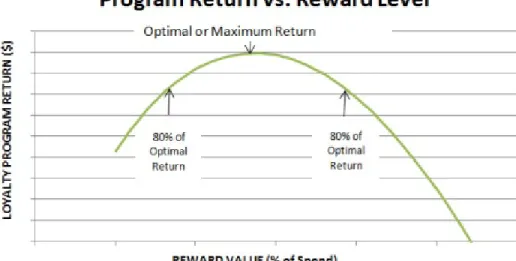
Figure 1A: A sample optimization curve for a specific variable food and labor cost percentage.
Results Applicability The results of this analysis were derived from a set of quick casual clients with similar check averages. While we expect similar findings for casual and fine dining, the detail results may vary by concept type and check average.
Loyalty Improvement Series
Copyright © Paytronix Systems, Inc. 2010. All rights reserved. 2
There are several factors that contribute to program return, including perceived reward value, buy-more rate, visit rate, member acquisition and costs. We created a model that incorporates these influencing factors, basing it on Paytronix client data. With this model, we
can input a variable cost rate to derive a reward- optimization curve that predicts the impact that changes in reward levels will have on a program’s return. The reward-optimization curve, generated with our model, uncovers a reward zone showing where a loyalty program
designer should set reward levels to maximize the program benefit. We recommend targeting a zone that promises between 80% and 100% of the program benefit for your core program, while leaving room to enrich your offer during short-term promotions. Figure 1B summarizes the reward profitability zones (between 80% and 100% of the maximum program return) for a variety of variable cost rates. The range is attractive because of the shape of the optimization curve itself. Since the curve is flat around its peak, a variance between a concept’s loyalty program and this model will not significantly compromise the program’s return.
This paper goes into detail about each element of the reward-optimization model. We share the methodology used to create the model and answer the following questions:
1. What are the relationships between reward level and visits, spend, and membership?
2. How do those relationships impact a program’s profitability?
3. Where should a reward structure be set, given a restaurant’s variable food and labor cost?
Our Methodology
Accessing a broad data set was imperative to this study. Based on our client data, we focused on quick-service concepts so that the data was derived from a
relatively homogeneous group of concepts with similar check sizes and reward styles (automatic rewards). In addition, we were only interested in merchants who
Figure 1B
The Perceived Value of Rewards How do guests value the rewards you offer within your program?
This is an important question to answer prior to establishing your reward types. In this analysis, we assume that guests’ perception of reward value is equal to the reward’s retail value. For example, if a guest is given a $10 off coupon or an entrée item that also has a retail value of $10, we assume, for our analysis, that the guest values both at $10. Here is an example of how we calculated the perceived value of a sample rewards program. Program Structure: Buy 10 Burritos, Get 1 Free Assumptions:
Guests typically buy one burrito and one drink at each visit.
The retail value of a burrito is $6.50. The retail value of a drink is $1.50. The total average check in this scenario
is $8.00.
It takes 10 visits or a total spend of $80 {10 X ($6.50+$1.50)} to reach the “free burrito” reward. In this case, the perceived value of the reward, or give-back rate, is calculated as follows:
Perceived Value =
= $ .
Loyalty Improvement Series
Copyright © Paytronix Systems, Inc. 2010. All rights reserved. 3
had been operating loyalty programs for at least three years.
We began creating the reward-optimization model by first making some observations regarding loyalty-member behavior and how it relates to the perceived value of the program benefits. This resulted in three basic principles being observed in data from our clients’ loyalty programs.
As the perceived value of a program’s rewards increases, members will: 1. Buy more per visit.
2. Visit more frequently. 3. Join at a faster rate.
The corollary of these principles is that each has a unique impact on a program’s return. Figure 2 illustrates how the perceived value of rewards drives the buy-more rate, the visit rate, and member acquisition, all of which contribute to the ROI calculation in our model and, thereby to the program’s overall return. (For a further explanation on the ROI model, please see the Loyalty Improvement Series article “Building Your Loyalty Program ROI.”)
Figure 2
Reward Cost in this model is the food and labor cost of the rewards. This excludes costs such as rent, utilities, and interest, which should not increase based on giving a reward.
Member Acquisition is a measure of the number of active members per restaurant who are participating in a given program.
Visit Rate is the percentage increase in guest visit frequency due to the loyalty program.
Buy-More Rate is the percentage increase in member spending due to the loyalty program.
Loyalty Improvement Series
Copyright © Paytronix Systems, Inc. 2010. All rights reserved. 4
Our analysis determined how spend, visits, and membership varied by the level of rewards offered and how each relationship impacts incremental revenue and incremental costs. We derived three mathematical functions, or curves, for these relationships and approached the establishment of each curve in the same manner. First, based on our experience, we hypothesized the shape of the curve to establish an estimated curve. Second, we graphed concrete data points from similar client programs. Last, we adjusted our estimated curve to reflect the actual data so that our curve would be an accurate representation of reality.
The Relationship Between Reward Level, Buy-More Rate, Visit Rate, and Member Acquisition
Buy-More Rate
Going a step further with the guest-behavior principle that members buy more as reward levels increase, our expectation was that the curve representing the impact of increased reward value would follow the law of diminishing returns. When guests redeem their rewards, the reward is subtracted from their check total, so we subtract the cost of the rewards when calculating the increase in spend (see the middle graph in Figure 3).1 The resulting hypothesized shape of the buy-more curve is shown in the graph to the right in Figure 3.
As you can see, raising reward levels increases buying behavior to a certain point, and then spending begins to diminish. Aggregating the data from several loyalty programs enabled us to model the likely difference in average check between a nonmember and a member as a function of reward levels. To establish our curve, we compared the check averages of member to nonmember for our quick casual
1
It is important to note that Paytronix measures spending after rewards have been redeemed from the check. Because the measurement is “net of rewards,” we need to deduct the cost of rewards from any projected increase in spend that would come from the motivational incentive that the reward structure creates for the guests to spend more.
Figure 3
Promotional Programs are tools used to engage members through the use of ad hoc offers that are designed to further compel specific desired behaviors.
Layered Programs add depth to your core loyalty program. Program layers can take several forms, including: giving a donation to a worthy cause for every member visit, creating a unique birthday or anniversary program, and adding a surprise-and-delight reward scheme.
Core Program is the heart of your loyalty program, that attracts guests to join and compels them to identify themselves at each visit. Loyalty Program Building Blocks
Loyalty Improvement Series
Copyright © Paytronix Systems, Inc. 2010. All rights reserved. 5
clients who have similar-size check averages. In each case, we found that the check average among loyalty members was more than the overall check average. The results were plotted against the perceived value of each customer’s rewards program and a best-match curve was established to fit the data points, resulting in the buy-more curve shown in Figure 4. Taking a closer look, we made four distinct observations from the data.
Observation 1: Client A’s position on the graph shows that there is a minimum
reward level that must be exceeded before a program has an impact on guest behavior. With a 3% perceived reward value, average guest checks among members were nearly identical to the overall average check for the restaurant. Members in this program are not being motivated to spend more per visit.
Observation 2: Client C has nearly maximized the benefit of its rewards’
perceived value. With about a 10% perceived reward value, this customer is motivating its members to spend greater than 15% more than its average guest. Adding to the reward value will likely not increase the average check, as
demonstrated by the shape of the curve.
Observation 3: Client D and E could afford to scale back the perceived value of
their rewards while maintaining a 12-15% lift in average check among program members.
Observation 4: Client F (the point of data that appears far above our curve) can
be explained in a couple of ways. After plotting this data set, our first question was, “What are they doing right?” After all, our clients want to offer rewards at the lowest cost to the business while compelling high involvement in their loyalty
Minimum Reward Level There is a reward threshold required to affect guest behavior. The results of our analysis show that the minimum level is somewhere between 0% and 5%. If you run a rewards program below a 5% reward value, it is unlikely that you will motivate your members to buy more or visit more.
Do guests value all rewards equally?
Perceived value for a specific menu item or piece of merchandise is a bit more difficult to ascertain when compared to a more general reward, such as a $10 dining certificate or a complimentary menu category item (e.g., an entrée).
If you limit the reward to a coffee, for example, not all guests value a cup of coffee at the same rate. A portion of your guests will have no interest in coffee and therefore assign a perceived value of $0 to the reward. In some cases, if a guest receives the same irrelevant reward repeatedly, the guest may actually associate a negative value to this reward and feel that you do not respect his or her preferences. On the other hand, if your guest has a passion for coffee, that guest may place a perceived value on the coffee reward that exceeds its retail value.
Loyalty Improvement Series
Copyright © Paytronix Systems, Inc. 2010. All rights reserved. 6
programs. We believe this restaurant, Client F, is enjoying higher-than-normal average checks among its members because it has succeeded in creating a high perceived value for its rewards.
Visit-More Rate
Measuring a change in visit behavior in the absence of a loyalty program is difficult for two reasons. First, since restaurants do not have the capability to track the purchasing behavior of guests before the existence of a loyalty program there is an absence of data with which to compare post-program results. Second, as soon as a loyalty program is introduced, guest behavior instantly changes. For example, when a new loyalty program is rolled out, some guests will immediately switch their behavior from visiting several different restaurants for lunch during the week to
visiting the restaurant with the new loyalty program multiple times per week. With each visit, the guest may be taking lunch orders for colleagues so that more
loyalty program points can be earned. In this scenario, the guest’s purchasing and visiting behavior prior to the loyalty program was drastically different than it was after the program’s launch. Guest behavior changes quickly upon implementation of a new loyalty program; therefore, guest behavior measured during the early phase of a program is not a good surrogate for pre-program behavior.
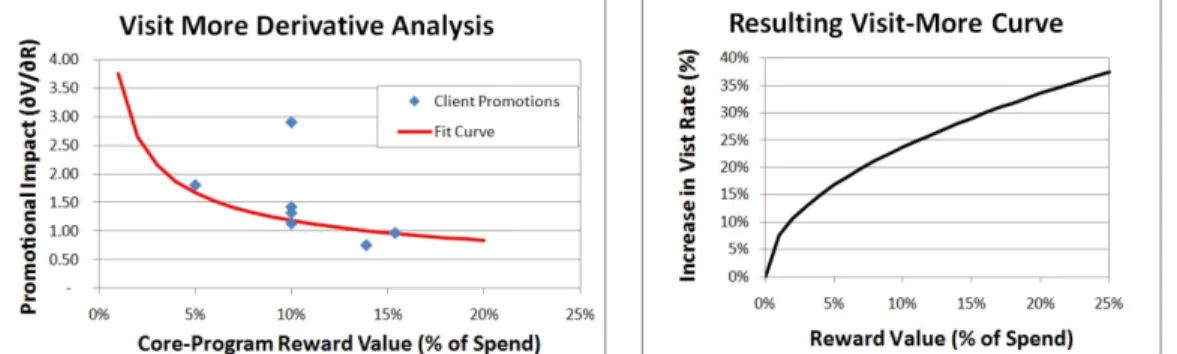
Despite the lack of pre-program data, the visit-rate curve can be derived by analyzing the change in visit rate caused by limited-time promotions. In lieu of comparing a “pre-program visit rate” against a “post program visit rate,” we analyze the incremental visits that occur during promotions. The likely change in visits that would occur with increasing reward levels can be extrapolated from data representing the short-term impact on visits resulting from an increase in reward value during promotions.
As members get closer to a reward, they will make a greater effort to achieve the goal. In an article published in the Journal of Marketing Research, authors Kivetz, Urminsky, and Zheng report their findings in member behavior from two empirical tests. They found that “members of a café RP (e.g., “buy ten coffees, get one free [loyalty program]”) purchase coffee more frequently the closer they are to earning a free coffee (on average, inter-purchase times decrease by 20% or .7 days throughout the program).”
Further findings include, “members were more likely to defect when they were farther away from the reward goal (or, equivalently, they were more likely to persist when they were closer to the goal.”
Source: Ran Kivetz, Oleg Urminsky, and Yuhuang Zheng, “The Goal-Gradient Hypothesis
Resurrected: Purchase Acceleration, Illusionary Goal Progress, and Customer Retention,”
Journal of Marketing Research, Feb. 2006
Loyalty Improvement Series
Copyright © Paytronix Systems, Inc. 2010. All rights reserved. 7
We predicted a curve that represented the impact that reward value has on
member visits. From our experience, we know that an increase in the reward value should increase visits, and as the member gets closer to receiving a reward, visit rate should accelerate. We also know that the change in visit rate for different types of promotions varies. For example, a limited-time offer (LTO) for a “free cookie with visit” will increase the perceived reward value slightly, thereby
increasing the visit rate slightly (see triangle C in Figure 5). Offering double points for visits, on the other hand, will increase the change in visits considerably (see triangle F in Figure 5). Triple-point offers will compel a greater increase in visits than a double-point offer, but the incremental benefit is less. Measuring the slope at different points along the visit-more curve during promotion periods provided the information needed to calculate the increase in visit rate due to the core loyalty program.
The formula we used to graph the visit-rate curve is:
∗ √
Since we can only measure slopes of this curve, we took its derivative, as shown below:
√ ∗
√
After plotting our estimated curve, we analyzed the results of several well-defined client promotions, including double-point offers, limited-time offers, bonus-point
Figure 5
Figure 5 Key
Client 1: Free Cookie LTO A: visits at original reward- value level
B: visits with increase in reward-value level for “free cookie” LTO C: change in visit rate as a result of the change in the reward value Client 2: Double Points Offer D: visits at original reward- value level
E: visits with increase in reward-value level for double points F: change in visit rate as a result of the change in the reward value
Increasing the Perceived Value of Rewards
There are two ways to increase the perceived value of your rewards: 1. Use highly relevant rewards
to motivate guest behavior. Rewards should appeal to guests based on their specific preferences. If they drink coffee, their reward is coffee, while if other guests favors donuts, their reward may be an extra donut.
2. Compel spending by offering exclusive or limited-supply rewards. In a fine-dining environment, the reward could be an exclusive invitation to a special wine tasting, a chef’s dinner, or a unique excursion for which only a certain number of seats are available.
Loyalty Improvement Series
Copyright © Paytronix Systems, Inc. 2010. All rights reserved. 8
offers, and visit challenges. Because we were interested in seeing the change in visit rate, we studied the “before promotion period” and compared it with the “during promotion period,” which uncovered a clear change in visit behavior. The data closely replicated the shape of our estimated curve (see Figure 6A). We adjusted our estimated curve slightly to fit the line you see in Figure 6B.
Member Acquisition
The number of members you attract to your program is directly related to the value of your reward structure. Higher-value programs enroll more members who will actively participate in the program. As we did with the buy-more and visit-more curves, we assume that the law of diminishing returns applies to the relationship between the reward-value and membership levels.
Several Paytronix clients have changed program reward structures during the life of their programs. As the perceived value of the rewards change, we see
merchants experience changes in enrollment activity and ongoing member participation. We can clearly see this effect by isolating one particular client that changed its reward structure three different times. This unique data set allows us to see the direct impact that reward value has on member behavior. In addition, the reward values within the data set cover the most interesting reward-level range, 5% to 20%.
Figure 6A Figure 6B
Free or Fee?
The programs analyzed within this paper either were free to join or had a nominal fee ($1 or less) associated with them. Whether or not you charge for membership to your loyalty program is a key decision. Free membership will engage a larger guest base and can motivate broad sales gains. Charging a fee will attract committed guests and speed time to profitability. See the Loyalty Improvement Series article “Free or Fee: Should You Charge for Your Loyalty
Loyalty Improvement Series
Copyright © Paytronix Systems, Inc. 2010. All rights reserved. 9
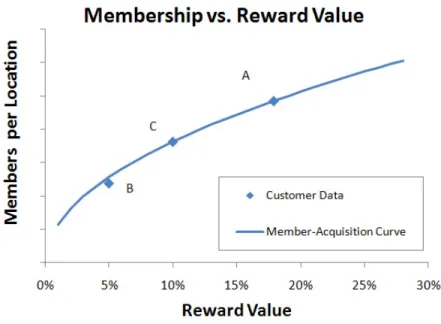
Figure 7 graphically depicts the impact that the three different reward levels had on member participation per location. The program began with a reward rate of 17.9% (point A), which attracted the highest active membership level over the program’s life. When the reward level was cut back to 5%, there was a dramatic decrease in the number of active members, as shown by point B in Figure 7. The client then increased the program reward level to 10% and experienced a significant increase in member activity (point C).
We used this membership activity data to establish a best-fit member-acquisition curve, which is overlaid onto this graph and used in the optimization model.
Deriving the Return-Optimization Curves
Once we established the buy-more, visit-more, and member-acquisition curves, we plugged them into our return-optimization model to find out what the best reward levels are, given an organization’s variable cost structure.
Our model includes related calculations for the incremental revenue that occurs from members who visit and spend more than nonmembers, along with the associated incremental food and labor costs. In addition, we included the program reward costs by multiplying the member-generated revenue by the retail value of the reward and the variable cost rate. Program costs also come into play when considering a program’s return on investment. Data from multiple client programs depicted a median program cost rate that was 1.6% of the incremental revenue generated by the loyalty program. We then plotted the results of the model based on several levels of variable cost rates, from 40% to 60%. See curves in Figure 8. The final set of curves represents the relationship of all loyalty program elements,
Figure 7
Double Points or Triple Points? Most recommended core-reward levels enable you to offer a double- point promotion and still receive at least 80% of the value of your program.
Triple-point promotions increase the value of the rewards beyond 80% optimization. In certain instances, aggressive promotions may make sense.
Temporarily reducing the program’s return may produce long-term program benefits. For example, running a short-term triple-point promotion with the purpose of igniting enrollment means you will have more members in your program who will spend more at each visit and will visit more
Loyalty Improvement Series
Copyright © Paytronix Systems, Inc. 2010. All rights reserved. 10
beginning with the effect that reward levels have on spending, visit behavior, and membership levels. As reward levels increase (x axis), program return increases at different rates depending on the restaurant’s variable cost rate. The lower the variable costs, the higher the return will be, up to a certain reward level. For example, if a restaurant’s variable cost rate is 60%, the return for the program begins to diminish after about a 9.5% reward value. Conversely, when the variable cost rate is 40%, the point of diminishing returns begins after a reward level of nearly 18%. Higher reward levels mean more members, which in turn translates to higher program returns.
Put the Loyalty Program Optimization Curves to Use in Your Restaurant
When the interrelationship between reward value, member behavior, and program costs is graphed, the curve reveals a range of reward values that are optimal for the program.
The return-optimization curves in Figure 8 have a shallow slope around their peaks. At the peak, or optimal return point, you would reap 100% of the program’s potential return. However, there is a point to the left of the peak where you would capture 80% of the program’s value and another point to the right of the peak where you would enjoy 80% of the program’s value. We have defined the area between these two 80% points to be the zone within which program rewards should be set. Your core-program reward level should be set at any point where reward levels bring from 80% to 100% of the value of the program. When extra rewards are added to your program for layers or promotions, set the reward value
Figure 8
Loyalty
Program
Optimization
Curves
Buy 10, Get 1 Free
Interestingly, over the years, most restaurateurs have found reward levels that work for their individual organizations. Whether they employed scientific testing or trial and error to find a level that works best for them, most reward programs out there today offer reward levels at about a 10% give- back rate, such as a “buy 10, get 1 free” program.
A 10% reward value strikes the right balance between giving enough to motivate guest behavior and profitability. Typically, 10% is within the profitability zone for restaurants with variable costs between 40% and 55% of sales.
Loyalty Improvement Series
Copyright © Paytronix Systems, Inc. 2010. All rights reserved. 11
between the 100% optimization point and a higher reward value so that you reap at least 80% of the program’s profitability. Leaving room for additional promotions will keep your guests excited and compel them to be continuously engaged in your program. Setting your reward level outside of this zone will result in lower program profitability levels.
Conclusion
Setting reward levels is not an exact science. Understanding the intricate factors that impact a program’s return will enable you to determine the reward level that makes sense for your organization. It is important to understand what range of optimization is acceptable to you. Once you have identified this range, be sure to set your core-program reward value at a level that allows you to periodically enrich your program in order to maintain a high level of member involvement.
Loyalty Improvement Series
Copyright © Paytronix Systems, Inc. 2010. All rights reserved. 12
About the Author
Andrew Robbins, President, Paytronix Systems, Inc.
Andrew concentrates on product development and design. He is the visionary behind the Paytronix Solution, making sure that the company stays several steps ahead of its competitors.
Prior to establishing Paytronix, Andrew co-founded Sparkventures, LLC, a venture capital firm specializing in software technology. He also worked for Caradon Doors and Windows, where he was Vice President of
Engineering. Caradon supplies products to home improvement outlets, including Home Depot and Lowe’s. Andrew previously spent seven years as an engineer with General Electric, designing computer controls for jet engines.
Andrew has a BS in mechanical engineering from Princeton University, an MS in
mechanical engineering from Massachusetts Institute of Technology, and an MBA from the Harvard Business School. He lives in Newton, MA, with his wife and two daughters. About Paytronix
Paytronix is a leading software‐as‐a‐service provider of gift, loyalty, and email solutions. Its unique platform is the most versatile in the industry, enabling restaurants to drive
measureable revenue increases. Through its innovative software design and integrations with widely used restaurant POS systems, Paytronix empowers its clients with the greatest amount of flexibility to build unique, brand-enhancing programs.
Paytronix Systems, Inc. 307 Waverley Oaks Road, Suite 309 Waltham, MA 02452 617.649.3300 [email protected]