ARGUMENTATIVE WRITING THROUGH A 21ST CENTURY FRAMEWORK: AN ACTION RESEARCH STUDY
Maria Pesce Stasaitis University of Bridgeport, 2016
Patricia Mulcahy-Ernt, Ph.D., Chair
Thomas W. Christ, Ph.D., Reader
Christopher Longo, Ed.D., Reader
Thomas W. Christ, Ph.D., Director, Education Leadership Doctoral Program
Allen Cook, Ph.D., Dean, School of Education
DISSERTATION
SUBMITTED IN PARTIAL FULFILLMENT OF THE REQUIREMENTS FOR THE DEGREE OF DOCTOR OF EDUCATION IN
THE SCHOOL OF EDUCATION UNIVERSITY OF BRIDGEPORT
Bridgeport, Connecticut 2016
ii
iv ABSTRACT
This Action Research study examined the implementation of integrated writing as originally described by MacArthur, Graham & Schwartz (1993) in order to investigate (a) seventh-grade English-Language Arts students' argumentative writing productions and demonstration of cognitive complexity on a blog site, and (b) the teacher’s ability to refine instructional planning strategies that impact student learning. This study aimed to impact teacher practice and student learning through writing interventions and reflective planning. Qualitative and quantitative data were collected to analyze the instructional strategies of integrated writing that influenced student argumentative writing, student feedback and teacher reflection. The researcher was referred to as the teacher-researcher throughout the dissertation because the researcher was the teacher in the seventh-grade classroom. This study was designed around argumentative writing theories that emphasized students' collaborative efforts in an online blogging forum. Two, four-week iterations of instruction guided by the intervention and data analysis produced data supportive of teachers utilizing integrated writing in their classrooms, primarily teachers using conferences to support students with individualized instruction during the drafting process of writing. The findings of this Action Research Study indicated that intervention instruction should focus on the ideational epistemology of writing and synthesis in cognitive complexity while giving students the opportunity to collaborate on argumentative blogs.
v
vi
ACKNOWLDGEMENTS
“Kindred spirits are not so scarce as I used to think. It's splendid to find out there are so many of them in the world.”
― L.M. Montgomery, Anne of Green Gables
I would like to thank the University of Bridgeport for giving me an opportunity to work with gifted professors on my research, especially Dr. Mulcahy-Ernt, my brilliant chair, and Dr. Christ, our cohort leader. Thank you to Dr. Longo for your guidance, support, and expertise in the school setting. I would also like to thank my research site in Connecticut for supporting my study and my seventh-grade bloggers for their dedication!
I would like to thank Monette, Jennifer and Sarah Jane. We went through many significant life changes as a group. You are my kindred spirits. I look forward to your many successes! I would like to thank my family and friends. Without you, nothing is possible! Thank you to my parents for always encouraging me, being a part of my dreams, and making me feel that what I have to say is important. Thank you to my sister, Jen. You will always be my very best friend. Thank you for Mike, Maci and my godchild, Tessa. Thank you to Mom and Dad Stasaitis, Chris, Brian and Heather for all of your support and love. Thank you, especially, for how you love Madison.
Lastly, thank you to my own little family Stan and Madison. Being your wife, Stan, and your mommy, Madison, is the greatest thing that I will ever do. Thank you, Stan, for being my partner and my best friend. You have encouraged me and have been my biggest fan. Our family will always come first!
vii
LIST OF TABLES
Table 2.1: Identifying Features of Three Argumentative Epistemologies 16
Table 2.2: Smarter Balanced Assessment Consortium Rubric (2010) 20
Table 2.3: Depth of Knowledge, Webb (2005) 31
Table 2.4: Approaches to Argument 37
Table 2.5 Hillocks (2011) Systematic Unit Planning 44
Table 3.1: Worldview Matrix 53
Table 3.2: Common Core State Standards, 2010 60
Table 3.3: Validation Steps 61
Table 3.4: Unit Development Guidelines (Lois Lanning) 62
Table 3.5: Codes that Emerged from Teacher Reflection Questions Iteration 1 73
Table 3.6: Codes that Emerged from Teacher Reflection Questions Iteration 2 73
Table 3.7: Argumentative Epistemologies 75
Table 3.8: Codes that Emerged from Student Reflection Questions Iteration 1 76
Table 3.9: Codes that Emerged from Student Reflection Questions Iteration 2 77
Table 4.1: Argumentative Elements Frequencies Iteration 1 83
Table 4.2: Cognitive Complexity Frequencies Iteration 1 85
Table 4.3: Argumentative Elements Frequencies Iteration 2 103
Table 4.4: Argumentative Elements Frequencies Iteration 1 and 2 104
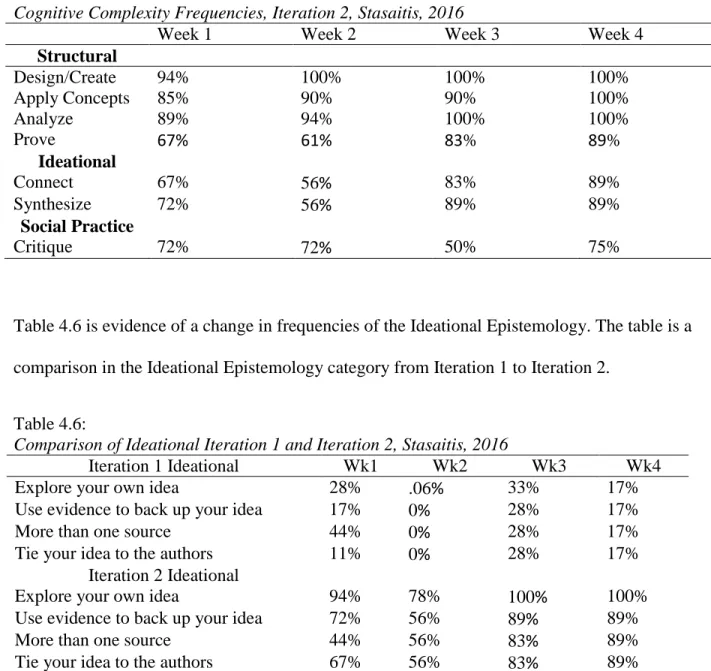
Table 4.5: Cognitive Complexity Frequencies Iteration 2 105
viii
Table 5.1: Social Practice Iterations 1 and 2 134
Table 5.2: Ideation Epistemology Frequencies Iteration 1 142
Table 5.3 Writing Standards Grades 6-8 156
Table 6.1: Steps to Achieve Transferability with Students of Varying Ability 172 Table 6.2: Steps to Achieve Transferability in Different Writing Types 172 Table 6.3: Steps to Achieve Transferability across Content Areas 173
ix
LIST OF FIGURES
Figure 1.1: Framework for 21st Century Learning Skills 4
Figure 2.1: The Zone of Proximal Development 11
x
TABLE OF CONTENTS
Abstract………...iv
List of Tables………...vii
List of Figures……….iv
CHAPTER ONE: INTRODUCTION………..1
Problem……….………...6
Purpose……….………7
Initial Research Question...………...………...7
CHAPTER TWO: REVIEW OF THE LITERATURE………...8
Theoretical Foundation………..…..9
Argumentative Writing and the Common Core……….21
Empirical Studies about Argumentative Writing………...23
Argumentation and Disciplinary Literacy……….28
Instructional Strategies that Foster 21st Century Learning………32
Research about Teaching Writing across Content Areas………...33
The Present Study………..38
Intervention Writing Intervention………..39
Blogging……….41
Operationally Defined Terminology………..45
Teacher-Researcher in Action Research………..………..46
xi
CHAPTER THREE: METHODS……….……….52
Study Design………..52
Role of the Researcher………...53
Intervention………....55
Intervention Instruments………58
Instruments……….61
Student Materials………...65
Measures………68
Bounding the Case………...………..69
Data Collection………..70 Data Analysis……….72 Bias………77 Credibility………..79 Limitations……….80 CHAPTER 4: FINDINGS……….………82
Quantitative Data Iteration 1 Argumentative Checklist………82
Quantitative Data Iteration 1 Cognitive Complexity Checklist……….84
Qualitative Data Iteration 1………...……….85
Summary of the Findings of Iteration 1 and Revision to Iteration 2………...102
Quantitative Data Iteration 2 Argumentative Checklist………...102
Quantitative Data Iteration 2 Cognitive Complexity Checklist………..….104
xii
CHAPTER 5: DISCUSSION………...132
Introduction………..132
Quantitative Data Iteration 1 and 2………..132
Qualitative Data Iteration 1………...…………...138
Qualitative Data Iteration 2 ………..………...144
Teacher Reflection Qualitative Data Iteration 1 and 2………....149
Implications for Practice……….…….…152
Recommendations for Research……….…….…155
Limitations……….…….….158
Context of the Research……….………..160
CHAPTER 6: REFLECTION………..162 References………175 Appendix A………..187 Appendix B………..192 Appendix C………..203 Appendix D………..206
1
CHAPTER 1: INTRODUCTION
The pressure for school reform has been at the forefront of the conversation in education for the past forty years. No Child Left Behind (2002),the Individuals with Disabilities Act (2004), and A Nation at Risk (1983) have challenged policymakers to introduce initiatives that impact teacher practice while raising student achievement through standards-based-reform (Voltz, Sims, & Nelson, 2010). A call for higher standards, more frequent student assessment, and higher expectations for the teacher evaluation system have left districts looking to reorganize struggling schools, while searching for transformational leaders and teachers to assist in the process (Elmore, 2000).
The location for the present research study, an urban school district in Connecticut, along with 48 other states, has adopted the Common Core State Standards (2010) as a part of a national grant, known as Race to the Top. Across the nation states are working with two student
standardized assessment systems to align state testing to the Common Core State Standards, one of which is the Smarter Balanced Assessment Consortium (2010).
A large component of the shift in the national standards movement is a call for students to be "reading, writing, and speaking grounded in evidence from texts, both literary and
informational" (Common Core State Standards Website, Key Shifts Section, para. 5). This shift affects students and teachers. One type of writing of interest to the present study is argumentative writing, first administered in 1993 on the Connecticut Mastery Test as persuasive writing. The CMT was replaced as Connecticut's standardized unit of assessing reading, writing, and math
2
with the Smarter Balanced Assessment when the Common Core State Standards Initiative (2010) was adopted by Connecticut.
The Common Core State Standards (2010) website explains,
The Common Core emphasizes using evidence from texts to present careful analysis, well-defended claims, and clear information. Rather than asking students questions they can answer solely from their prior knowledge and experience, the standards call for students to answer questions that depend on their having read the texts with care. The reading standards focus on students' ability to read carefully and grasp information, arguments, ideas, and details based on evidence in the text. Students should be able to answer a wide range of text dependent questions, whose answers require inferences based on careful attention to the text. Frequently, forms of writing in K-12 have drawn heavily from student experience and opinion, which alone will not prepare students for the demands of college, career, and life. Though the standards still expect narrative writing throughout the grades, they also expect a command of sequence and detail that are essential for effective argumentative and informative writing. The standards focus on evidence-based writing along with the ability to inform and persuade is a significant shift from current practice. (Common Core State Standards Website, Key Shifts Section 2, para. 6)
Preparing students to be career and college ready, inclusive of writing skills, is the reason for this shift. According to results on the Quality Counts 2014 report card that Education Week has been publishing since 1997, the Connecticut state report card reflects a grade of a D- for college readiness (Education Week, 2014). Adding to this data are the results of the 2011 writing
3
assessment for 8th graders on the National Assessment of Educational Progress (NAEP). A mere 24% of the nation's eight and twelfth graders performed at the proficient level in writing (NAEP, 2011). The national data reflects the local data of the urban district being researched.
The urban district in Connecticut where the study took place has adopted many new initiatives to address the shifts in the Common Core State Standards (2010); however a
significant decline in writing scores has been recorded. Results from the school's strategic school profile demonstrated improvements in reading; however, writing scores continued to decline, signaling the district to look for initiatives to improve student writing. Beginning with seventh-graders, 60.4% of students scored proficient in reading, while a mere 39.9% of students in the district scored proficient in writing (CT reports, 2012). The Smarter Balanced Assessment scores published in the Fall of 2015 reported, "26% percent of city students reached targets in the 'English/Language Arts' portion of the test taken last school year (Puffer, 2015, p. B1). This data reflects that the district where this study took place was significantly behind the state average.
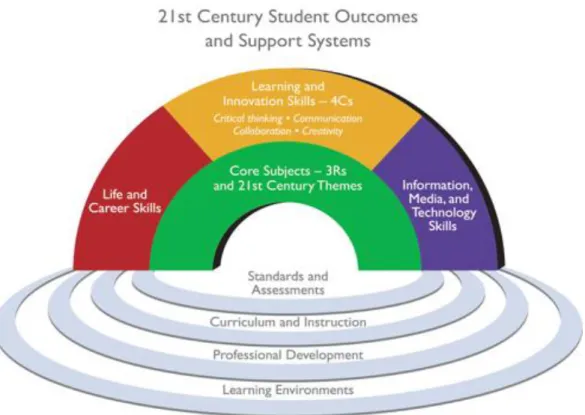
The Common Core State Standards (2010) has provided the recommended standards for grades K-12 with an emphasis on the skills needed to make students ready for post-secondary education or the work force. Four skills were identified as vital to the success of students being career and college ready. They are critical thinking, communication, collaboration, and creativity (Partnership for 21st Century Skills, 2006). These essential skills, noted by the Common Core State Standards (2010) are known as the 4C's. Figure 1.1 displays a visual of skills that are recommended for students to learn. Argumentative writing is an important shift in the Common Core State Standards (2010) with an emphasis placed on giving students 21st century
4
Figure 1.1. Framework for 21st Century Learning (Partnership for 21st Century Skills, 2009, para. 1).
The Common Core State Standards (2010) gives teachers the applicable standards in order to plan for effective instruction. Planning for active learning is a part of the evaluation system that the urban district is utilizing. That evaluation system was put into place with a focus on administrators evaluating teacher proficiency in four domains. The rubric for effective teaching that the Connecticut Department of Education uses to evaluate teachers is divided into four domains:
5
Domain 1: Classroom environment, student engagement, and commitment to learning Domain 2: Planning for active learning
Domain 3: Instruction for active learning
Domain 4: Professional responsibilities and teacher leadership
(CCT Rubric, 2014, p. 7) As teachers plan instruction to address Domain 1, Domain 2, and Domain 3 in the teacher evaluation rubric, teachers are encouraged to utilize Web 2.0 resources to provide students with "multiple means of representation, engagement, and expression" (Voltz, Sims, & Nelson, 2010, p. 35). Providing students with multisensory materials helps students to retain what they are learning, considering that students retain 90% of what they see and do (Rief, 1993). Web 2.0 is a term used for multimedia internet applications, such as blogs, wikis, podcasts, and social media in order to infuse popular culture into the classroom (Voltz et al., 2010). The Connecticut
Department of Education has developed an education technology plan (2011). That plan stresses that students are given the opportunity to express themselves in 21st century ways. The
Connecticut State Department of Education website states,
Literacy in the 21st century requires more than the ability to read, write, and compute. The Connecticut state department of education believes that every student must develop strong technological skills and continually use them in order to function adequately in our 21st century world. Connecticut schools must ensure that technology resources are
integrated across the curriculum in pre K-12 and become part of the fabric of instruction. Students must be able to use the many forms of technology to access, understand,
manage, interpret, evaluate and create information. They must also be able to analyze information for content, relevancy, and accuracy and be able to present that information
6
in a variety of formats, including those with technology platforms. (Educational Technology Plan, 2011, p. 4)
Planning rigorous curricula is essential to meeting the needs ofthe Common Core State Standards (2010), argumentation, 21st Century Skills and preparing students to be career and college ready. Wagner (2008) as found in Ainsworth (2010) defines rigor as incorporating seven 21st Century Skills. They are "critical thinking and problem solving, collaboration and
leadership, agility and adaptability, initiative and entrepreneurialism, effective oral and written communication, accessing and analyzing information, and curiosity and imagination" (p. 7).
Teachers utilize the domains of the Depth of Knowledge (Webb, 2005) to design rigorous curriculum for students to increase their cognitive complexity thinking skills. There are four domains in cognitive complexity. They are recall and reproduction, skills and concepts, strategic thinking, and extended thinking.
Problem
Low writing scores, the pressures to adjust teacher instructional methods to meet the needs of the writing expectations of the Common Core State Standards (2010), implementing 21st century instruction, designing rigorous curriculum to increase student cognitive complexity, and planning for and instructing active learning are the issues that the teacher-researcher
addressed in her middle school writing classroom through this Action Research project. The purpose of the study was to reflect on and refine teacher instructional practice when
implementing a writing intervention. The methodology of Action Research was employed because the teacher was the researcher during the study that spanned from the Fall of 2015 to the Spring of 2016.
7
Purpose
The purpose of this Action Research study was to investigate the teacher-researcher's instructional skills and strategies when shifting towards the Common Core State Standards (2010) designed to impact student argumentative writing instruction. The findings from this Action Research project may help inform other English language arts teachers about strategies designed to improve teacher practice and writing interventions for seventh-grade students. The purpose of the Action Research study was twofold: first, to determine if implementing
technology-based curricula across content areas using instructional strategies improves students’ argumentative writing, and second, for the teacher-researcher to improve her own teaching and research praxis.
The overarching research hypotheses driving the development and testing of the intervention in this Action Research Study are:
1.) Writing interventions and instructing students to produce writing in multimedia expression will improve student argumentative writing and cognitive complexity.
2.) The teacher-researcher will develop critical teaching and research skills by reflecting on student learning.
8
CHAPTER 2: REVIEW OF THE LITERATURE
Utilizing the Common Core State Standards (2010), integrated writing (MacArthur, Graham & Schwartz, 1993), the theoretical framework of social cognitive theory (Bandura, 2001) and the theoretical framework of sociocultural learning theory (Vygotsky, 1978)created the context for this study. These theories provided the underlying foundation for this study and the gateway into argumentative writing instruction through 21st century skills, with a focus on the writing intervention, integrated writing.
Two key shifts in the Common Core State Standards (2010) are (1) student writing productions, grounded in evidence from the text, and (2) speaking and listening skills. The anchor standard involving argumentative writing is to "Write arguments to support claims in an analysis of substantive topics or texts using valid reasoning and relevant and sufficient evidence" (CCSS.ELA-CCRA.W.1).The Common Core State Standards also place emphasis on the
students' ability to speak and listen in a magnitude of ways. The anchor standard reads to "Prepare for and participate effectively in a range of conversations and collaborations with diverse partners, building on others' ideas and expressing their own clearly and persuasively" (CCSS.ELA-Literacy.CCRA.SL1). This review of the literature has been separated into sections: (1) the study’s theoretical foundation, (2) argumentative writing and the Common Core, (3) empirical studies about argumentative writing, (4) argumentation and disciplinary literacy, (5) instructional strategies that foster 21st century learning, (6) research about teaching writing across content areas, (7) integrated writing intervention, and (8) blogging. The researcher
9
attempted to use best practices to instruct middle school students in the writing and collaborating processes.
Theoretical Foundation
By utilizing sociocultural learning theory (Vygotsky, 1978) and social cognitive theory (Bandura, 2001) the researcher formulated the research questions and study design. Vygotsy's (1962) theory on the way that people learn has influenced pedagogy in many ways; it has its roots in classroom strategies that teachers utilize to enhance student learning. Instructional strategies such as reciprocal teaching, scaffolding, small group instruction, group problem solving, and tutoring, have promoted engagement and student learning (Blake & Pope, 2008). Vygotsky placed a great emphasis on the social environment of where learning takes place. Discussion with a purpose is allowed to take place through interactions with others. Many teaching strategies have unfolded through this theoretical lens, such as student collaborative efforts, peer sharing, discussion-based learning, and students' private speech (Winsler, Abar, Feder, Schunn, & Rubio, 2007; Ostad, & Sorensen, 2007). Vygotsky argued that language is the basis for developing reading and writing skills. When teachers utilize social learning theory in their classrooms, the opportunity for debate, collaborative learning, conferencing and dialogue take place. The foundation of 21st century learning skills utilizes collaboration as a main
component for preparing students to be career and college ready in order to meet the needs of the ever-changing, evolving, 21st century (Partnership for 21st Century Skills, 2006).
Giving students the opportunity to engage in collaboration supports Vygotsky's (1978) principles of how students learn. Vygotsky believed that learning begins the first day of the child's life, when the child constructs his or her own knowledge. Development cannot be
10
separated from its social constructs. Student learning leads to development. Language plays a central role in a student’s mental development. Vygotsky believed the "zone of proximal
development" to be the goal for student learning stating, "Human learning presupposes a specific social nature and a process by which children grow into the intellectual life around them”
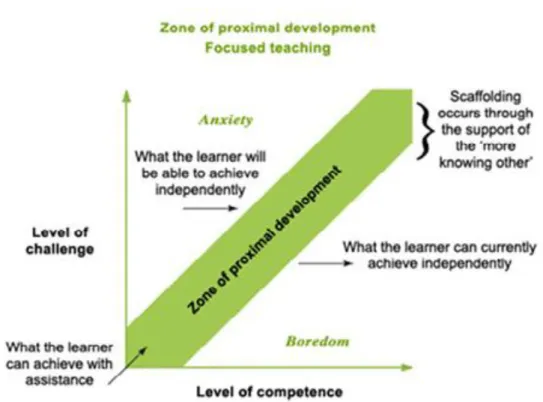
(Vygotsky, 1978, p. 87). This places great emphasis on the environment in which the student learning is taking place. Vygotsky defined the zone as "the distance between the actual development level as determined by independent problem solving and the level of potential development as determined through problem solving under adult guidance or in collaboration with more capable peers "(Vygotsky, 1978, p. 85). By helping a student utilize support from a "more Knowledgeable other," who can be a person with a higher ability level or a better understanding of the content, a peer, parent, or teacher, the learner’s "zone of proximal
development” is met. Vygotsky understood that by pairing students of differing learning abilities, students would have an opportunity to learn from each other. The zone would be looked at as the students’ goal for learning and essentially would be a moving target that would move as the students mastered the concept, as shown in Figure 2.1. This also gives teachers the opportunity to scaffold the instructional strategies to better serve the students in mastering the concept.
11
Figure 2.1: The Zone of Proximal Development, Hill & Crevola (2014).
Social Cognitive Theory (Bandura, 1977) also supports students learning from one another through modeling. Bandura understands observational learning as a major component of social learning theory, with the environment playing a crucial role. Bandura believes that humans process information actively and reflect on behavior and the consequences attached to it.
Observational learning cannot occur unless cognitive processes are at work; therefore, Bandura concludes that four concepts help us determine if social learning is successful, attention,
retention, reproduction and motivation. Self-efficacy plays an important role in order to build student cognitive processes. Self-efficacy is built through reflection. Giving the students the opportunity to reflect on their learning builds competency in learning. A teacher reflecting on student learning also builds teachers' instructional capacity. Bandura's (1986, 1993) focus on
12
self-efficacy shows that self-reflection is the capstone to improving self-efficacy (Bandura, 1986). Bandura (1993) defines self-efficacy as a person's belief in his or her own competence. He understands that people will only do what they think they can do and will not try what they think they will not do successfully. According to Bandura (1986), people with a strong sense of self-efficacy see tasks they cannot do as challenges, not threats, with four factors influencing efficacy: mastery experience, vicarious experience, verbal persuasion and somatic and emotional state. Studies have linked high self-efficacy to high achievement in education leaders, teachers and students. In the present research study's method design of Action Research (Wilborn, 2013; Looney, 2003; Piercy, 2013; Smith, 2009), social cognitive theory (Bandura, 2001) and
sociocultural learning theory (Vygotsky, 1978) complemented argumentation theories when using instructional strategies that improve argumentation. The intervention of integrated writing (MacArthur, Graham & Schwartz, 1993), chosen for this study, incorporates collaboration, writing and reflection.
The early theories about argumentation complement this investigation on middle school argumentative writing instruction. These early theories are still used modern instructional strategies in the way that argument is taught. The history of argumentation has its roots in the conflict between philosophy and rhetoric (Fletcher, 2015). The struggle between philosophy and rhetoric can be looked at as the difference between persuasion and argumentation, understanding that "the central tension between philosophers' bold claims to offer irrefutable demonstration of truths for ideal audiences versus rhetoricians' more modest claims to persuade given audiences that a particular conclusion warrants their assent" (Ramage, Callaway, Clary-Lemon, &
Waggoner, 2009, p. 50). Persuasion is the capability of presenting opinions based on beliefs and trying to persuade the audience to ascertain those views, while argument, or the demonstration of
13
truths grounded in evidence is defined as, "A speaker or writer, engaged in argumentation, uses certain words and sentences to state, question, or deny something, to respond to statements, questions or denials, and so on" (van Emeren, Grootendorst, & Henkemans, 1996, p. 2). Understanding the definitions of persuasion and argumentation is important because
philosophers, beginning in the 19th century, used rhetoric to discuss the politics and issues in the forum of debate.
Hillocks (2011) discusses persuasion and argumentation when he references philosophers whose early teachings are used in classrooms. Aristotle’s (1928d) Topics presented guidelines for debating, setting the stage for argumentation to be dialectic, which translates into strategies for teaching argumentation in the 21st century classroom. Aristotle questioned logic and how we know something to be true, therefore, discussing syllogism, the way that one arrives at a truth through statements and premises made. When syllogism was not appropriate in many of the debates that Aristotle saw in the senate, Aristotle (1924) wrote Rhetoric. It dealt with formulating probability regarding arguments of three kinds: forensic; epideictic; and deliberative or fact, judgment, and policy (Hillocks, 2011).
Freire (1962) plays a vital role in the influence of argumentation, emphasizing rhetoric and debate. The purpose of the classroom discourse in the teaching of argumentative writing is to debate, linking classroom discourse and argumentative writing together. Freire's theory of
"dialogical argument" had much significance when he wrote about the oppressor, the oppressed, and the liberated person. Freire asserted that when disagreement and agreement of opinion is discussed, true democracy is at hand. Freire saw the traditional classroom as taking on the role of the oppressor; however, when teachers and students engage in discourse, liberation from the oppressed occurs.
14
While early argumentative theories have roots in Aristotle and Freire's work, modern day instruction utilizes Toulmin's (1958) model for arguments of probability (Hillocks, 2011,
Fletcher, 2015). Toulmin's model for argumentative writing instruction is specific regarding the qualities that the argument must possess. Toulmin places critical emphasis on the rhetorical side of the argument, valuing the discussion between the speaker and listener. Chase (2011)
understands, "These elements represent the basis of argumentative discourse and an
organizational framework for argumentative essay writing" (Chase, 2011, p. 5). This has been translated to instruction in middle and high schools as having students discuss or write a claim based on evidence, a warrant that explains the evidence supporting the claim, backing to support the warrants, followed by counterarguments (Hillocks, 2011). These components all help to add validity to the argument. While many middle and high school students are familiar with utilizing claims and citing evidence, understanding the components of citing a warrant is not as easy (Fletcher, 2015). Using Toulmin's definition, Fletcher explains, "A warrant is an underlying principle or assumption that authorizes the connection between the data and the claim" (Fletcher, 2015, p. 164). Fletcher advises going back to Aristotle's word premise or using the word
assumption instead of Toulmin's word warrant in order to relay to students that what we usually assume is what we think to be true. Fletcher recommends that the teachers' goals for the students are that they question these assumptions, formulating argument and debate.
Linking argument and debate has offered educators the opportunity to link theory to pedagogy. Van Emeren & Grootendorst (1996) understand that debate is drawn from an understanding of argumentation and it has contributed to it. Toulmin's (1958) model gives teachers the opportunity to link the two. By allowing students the opportunity to engage in
15
discourse and writing with a structured framework, students are encouraged to learn from each other, while citing relevant evidence from the text that they are working with (Hillocks, 2011). While argumentative writing and debate have been linked together, debate continues on how teachers teach argumentative writing (Newell, VanDerHeide, & Olsen, 2014). Through Newell et al.'s (2014) research on thirty-one English language arts teachers' instruction, the researchers named three argumentative epistemologies that have significance in the way that teachers approach teaching writing. Table 2.1 represents the epistemologies. While structural and ideational have to do with the procedural facilitation of argumentative writing, social practice links the writing to the classroom language and collaboration. Newell et al.'s (2014)
argumentative epistemologies link theory to pedagogy, while supplementing Hillocks's (2011) model for instruction, furthermore, bringing to light the debate surrounding different
16 Table 2.1:
Identifying Features of Three Argumentative Epistemologies (Newell et al., 2014, p. 97).
Argumentative Epistemology Primary Instructional Focus Priorities for Learning to Argue Basis for Assessment
STRUCTURAL Developing coherent essay structure as an argument.
Learning terms for parts of argument and procedures for composing argumentative essay structure. Location of argument elements to develop formal essay structure. IDEATIONAL Developing original
ideas that are explored and justified through argument.
Using the process of argument to engage deeply in content (such as literature) and develop original ideas.
Relationships among and development of ideas within an argumentative framework. SOCIAL PRACTICE Developing a
projected or imagined social context with a “real” audience that anticipates an argument.
Considering the rhetorical context and warrants for arguing with an audience about significant social issues. Responsiveness to the social context, including audience, as well as appropriate evidence, warrants, and counter-arguments.
Newell et al.'s (2014) chart, based on the research of thirty-one English language arts teachers, breaks down the way that argumentative writing is taught in classrooms. As teachers adjust to the shifts presented in the Common Core State Standards (2010), many classrooms focus on the structural components of an argumentative essay in order to meet the needs of the Smarter Balanced Assessment Consortium (2010). Not only are teachers linking argument to debate, but middle school English language arts classrooms are structured with activities that link reading and writing skills and strategies with a balanced approach to literacy instruction
17
(Tompkins, 2010). Reading strategies complement the writing process, and they give readers a purpose for reading. Balancing and aligning reading and writing in an English language arts classroom is a part of balanced literacy. Vacca and Vacca (2005) explain,
When teachers integrate writing and reading, they help students use writing to think about what they will read and to understand what they have read. Writing may be used to catapult students into reading. It is also one of the most effective ways for students to understand something they have read. Teachers can put students into writing to read or reading to write situations because the writing process is a powerful tool for exploring and clarifying meaning. (p. 357)
Along with the understanding of a balanced literacy classroom, Robb (2010) understands nine reading strategies to be essential in an English language arts classroom. They are "Activate prior knowledge, decide what's important in a text, synthesize information, draw inferences during and after reading, self-monitor comprehension, repair faulty comprehension, ask questions, build vocabulary, and develop fluency" (p. 15). These meaningful strategies present the teacher with opportunities to teach reading and writing in a connected way.
Reading and writing workshops (Atwell, 1998) are ways that middle school English language arts teachers extend those nine reading strategies and engage in Newell et al.'s (2014) social practice. Reading and writing workshops allow teachers to work collaboratively with students in order to scaffold instruction. Atwell understands, "A workshop is student-centered in the sense that individuals' rigorous pursuit of their ideas is the primary content of the course" (p. 71). In workshop instruction or effective reading strategy instruction, teachers help students to determine a purpose for reading. This correlates with Robb's effective reading strategy of
18
"deciding what's important in a text." When reading nonfiction text, a purpose for reading is to research. Effective research is also a claim of the Smarter Balanced Assessment Consortium (2010). Argumentative writing begins with reading a text and synthesizing the information to make claims and warrants so the reading/writer can make inferences from the text (Hillocks, 2011). Based on these inferences, students use evidence from the text to back up the claims. Argumentative writing is a shift in instruction in student writing; however, prior to the Common Core State Standards (2010), reading, writing and math skills were assessed on the Connecticut Mastery Test (CMT). This test assessed the strands that students were expected to master by the end of the grade level. Persuasive writing was the type of writing assessed in seventh-grade. The CMT prompt asked students to take a stance on a topic in society. Some topics included persuading others about the student’s perspective about dress code, bullying in schools, or the school lunch menu. Students were to argue the side that favored without using textual evidence. This form of assessment only targeted student’s prior knowledge. The Common Core State Standards' shift in writing now expects students to use evidence from the text to support their stance while they acknowledge and discuss the claim and counterclaim. The Smarter Balanced Assessment (2010) provides students with texts of differing opinions on provocative topics in society and then gives a writing prompt, asking students to write an argumentative essay.
In order to meet the needs of the Common Core State Standards (2010) and the Smarter Balanced Assessment (2010), middle school teachers utilize a balanced approach to literacy instruction (Tompkins, 2010). Tompkins asserts, "The balanced approach to instruction is based on a comprehensive view of literacy that combines explicit instruction, guided practice,
19
instruction embodies reading literature and nonfiction, giving students the opportunity to use the internet and communicative technologies, literacy strategies that foster reading and writing skills, oral language or the opportunity to collaborate with peers and teachers, vocabulary,
comprehension, writing, and spelling (Tompkins, 2010, p. 18). This balanced approach to literacy instruction embodies Newell et al.'s (2014) epistemologies and the characteristics of Atwell's (1998) reader/writer workshop; this approach provided the rationale for choosing the instructional intervention, integrated writing (MacArthur, Graham & Schwartz, 1993) for this study.
Giving students the opportunity to write in a number of different genres is a part of a balanced literacy program. Expository and narrative writing are different genres of writing that students are expected to utilize in classrooms and are assessed on the Smarter Balanced
Assessment (2010). Argumentative writing includes elements of persuasion, however, in former assessments such as the Connecticut Mastery Test, students were only required to activate prior knowledge and not use evidence from the text to support their thinking. Table 2.2 demonstrates the structural components of argumentative writing as assessed on a four point rubric from the Smarter Balanced Assessment Consortium (2010).
20 Table 2.2
Smarter Balanced Assessment Consortium Rubric (2010), p. 1.
Smarter Balanced Argumentative Writing Rubric grades 6-12
Score Statement of Purpose/Focus and Organization Development: Language and Elaboration of Evidence Conventions
Statement of Purpose/Focus
Organization Elaboration of Evidence Language & Vocab
4 The response is
fully sustained and consistently and purposefully focused: --claim is clearly stated, focused and strongly maintained --alternate or opposing claims are clearly addressed* --claim is introduced and communicated clearly within the context
The response has a clear and effective organizational structure creating unity and completeness:
--effective, consistent use of a variety of transitional strategies
--logical progression of ideas from beginning to end --effective introduction and conclusion for audience and purpose
--strong connections among ideas, with some syntactic variety
The response provides thorough and convincing support/evidence for the writer’s claim that includes the effective use of sources, facts, and details. The response achieves substantial depth that is specific and relevant:
--use of evidence from sources is smoothly integrated, comprehensive, relevant, & concrete
--effective use of a variety of elaborative techniques
The response clearly and effectively expresses ideas, using precise language: --use of academic and domain-specific vocabulary is clearly appropriate for the audience and purpose
The response demonstrates a strong command of conventions: --few, if any, errors are present in usage and sentence formation --effective and consistent use of punctuation, capitalization, and spelling 3 The response is adequately sustained and generally focused: --claim is clear and for the most part maintained, though some loosely related material may be present --context provided for the claim is adequate
The response has an evident organizational structure and a sense of completeness, though there may be minor flaws and some ideas may be loosely connected: --adequate use of transitional strategies with some variety --adequate progression of ideas from beginning to end --adequate introduction and conclusion
--adequate, if slightly inconsistent, connection among ideas
The response provides adequate support/evidence for writer’s claim that includes the use of sources, facts, and details. The response achieves some depth and specificity but is predominantly general: --some evidence from sources is integrated, though citations may be general or imprecise
--adequate use of some elaborative techniques
The response adequately expresses ideas, employing a mix of precise with more general language --use of domain-specific vocabulary is generally appropriate for the audience and purpose
The response demonstrates an adequate command of conventions: --some errors in usage and sentence formation may be present, but no systematic pattern of errors is displayed --adequate use of punctuation, capitalization and spelling 2 The response is somewhat sustained and may have a minor drift in focus: --may be clearly focused on the claim but is insufficiently sustained --claim on the issue may be somewhat unclear and unfocused
The response has an inconsistent organizational structure, and flaws are evident:
--inconsistent use of basic transitional strategies with little variety
--uneven progression of ideas from beginning to end --conclusion and introduction, if present, are weak --weak connection among ideas
The response provides uneven, cursory support/evidence for the writer’s claim that includes partial or uneven use of sources, facts, and details, and achieves little depth: --evidence from sources is weakly integrated, and citations, if present, are uneven
--weak or uneven use of elaborative techniques
The response expresses ideas unevenly, using simplistic language: --use of domain-specific vocabulary may at times be inappropriate for the audience and purpose
The response demonstrates a partial command of conventions: --frequent errors in usage may obscure meaning --inconsistent use of punctuation, capitalization, and spelling
1 The response may
be related to the purpose but may offer little relevant detail:
--may be very brief --may have a major drift
--claim may be confusing or ambiguous
The response has little or no discernible organizational structure:
--few or no transitional strategies are evident --frequent extraneous ideas may intrude
The response provides minimal support/evidence for the writer’s claim that includes little or no use of sources, facts, and details: --use of evidence from sources is minimal, absent, in error, or irrelevant
The response expression of ideas is vague, lacks clarity, or is confusing: --uses limited language or domain-specific vocabulary
--may have little sense of audience and purpose
The response demonstrates a lack of command of conventions: --errors are frequent and severe and meaning is often obscure 0 A response gets no credit if it provides no evidence of the ability to [fill in with key language from the intended target].
21
Argumentative Writing and the Common Core
The standards movement emerged in the 1980's when President Ronald Reagan and Secretary of Education, Terrell H. Bell, appointed a group to serve on the National Commission on Excellence in Education. This commission was charged with publishing a report on the current state of the quality of education. The influential report began the call for higher standards and encouraged states to adopt higher expectations for all students (National Commission on Excellence in Education, 1983). Research related to the Common Core State Standards (2010) takes a number of different avenues. Wilborn (2013) focuses his work on teacher self-efficacy in implementing the Common Core State Standards within a 21st century learning skills framework by focusing on three experienced teachers' perceptions and attitudes toward instruction. The purpose of the research was to gain an understanding of teacher attitudes and ascertain teacher self-efficacy regarding their instruction. By using qualitative, instrumental, case study methods, Wilborn collected significant data by utilizing a beginning survey, observations, field notes, and interviews. The theories creating the lens for the research were constructivism, social learning theory, and situated learning theory. Wilborn's implications for further research prompted the present study on instructing the Common Core argumentative writing initiative due to the fact that teachers in Wilborn's study reported more student engagement when students utilized 21st century learning skills, one being collaboration. By understanding Bandura's (1997) self-efficacy theory, Wilborn justified the study by citing, “Teachers’ beliefs in their efficacy affect their general orientation toward the educational process as well as their specific instructional activities” (Bandura, 1997 p. 241). By giving students the opportunity to participate in 21st century learning, the environment and the classroom begin to take on a different structure when teaching the Common Core State Standards and argumentative writing.
22
The Common Core State Standards (2010) have provided education districts with a framework of expectations for teachers to tailor instruction, with an emphasis on what students should know from grades K-12, giving students the necessary skills needed to make them ready for post-secondary education, whether that be entering the work force or entering college. The 4C's are vital to the success of students being career and college ready: Critical thinking, Communication, Collaboration, and Creativity (Partnership for 21st Century Skills, 2006).
Allowing students to become rhetorical readers and writers is a way to fit the needs of the Common Core State Standards (2010) and utilize teaching 21st century skills (Fletcher, 2015). Argument literacy and rhetorical knowledge are the capstones of the Common Core State
Standards, with new resources being published on how to address the ever-changing needs of the classroom. Hillocks (2011) offers a step-by-step guide on teaching and evaluating arguments and recommends teaching students the basics of formulating claims and backing those claims up with evidence, while Fletcher (2015) understands, "As we move forward this focus on argument literacy, we're being challenged to teach in new ways" (p. xix). In order to do this, Fletcher inspires teachers to bring the conversations to life, designing opportunities to discuss and debate by being open-minded inquirers.
Facilitating conversations in the classroom is an important concept of the Common Core State Standard (2010). Argumentative writing is another key concept because of the speaking and listening claims that serve as an anchor standard. The anchor standard states, "To build a foundation for college and career readiness, students must have ample opportunities to take part in a variety of rich, structured conversations—as part of a whole class, in small groups, and with a partner" (CCSS, 2012a, Shift 2). Incorporating argumentative writing instruction with speaking and listening works in conjunction with new strategies to approaching curricula, resulting in
23
shifting approaches in pedagogy. Beach, Thein & Webb (2012) understand, "All of this suggests that as the primary facilitator of the classroom you will want to shift the focus from yourself, as the central initiator and evaluator of all interactions, to your students, as people interacting around important issues" (p. 203). These collaborative opportunities can take shape as classroom discussion or online discussion, giving teachers the opportunity to address the needs of the Common Core State Standards, argumentative writing, and 21st century learning skills.
Empirical Studies about Argumentative Writing
Empirical studies help link theory to pedagogy and influence teacher practices when it comes to classroom instruction. Newell, VanDerHeide, and Olsen’s (2014) study on
argumentative writing presents an influential study about argumentative writing. The authors acknowledged the shifts in student writing focus due to the implementation of the rigorous Common Core State Standards (2010) and analyzed thirty-one case studies on the way that teachers teach argumentative writing in the high school setting. The researchers selected three local teachers, recommended by administrators and colleagues, with reputations for being exemplary teachers of writing. This exploratory study took place over the course of two years and sought to find the ways that teachers were instructing their students in the argumentative writing process. The researchers collected various data, including three interviews with the three teachers, video and audio recordings, teacher and student surveys and classroom observations with field notes. The researchers interviewed the teachers, focusing on the teachers' goals, beliefs, assessment criteria and instructional strategies for teaching argumentative writing. The researchers researched how the instructional strategies fell into the identified epistemologies: structural, ideational, and social practice (as seen in Table 2.1, on page 15 where characteristics of each epistemology are cited). During the structural epistemology approach, teachers spend
24
more time on the components of the structure of an argumentative essay, where argumentative vocabulary is important and the assessment of the formal structure with a rubric is essential. During the ideational epistemology approach, value is placed on student ideas with using evidence to back up those ideas with literature as the foundation to encourage the thought process. Assessment includes looking at the development of ideas through the argumentative framework. The social practice epistemology approach pertains more to the strategies that encourage collaboration and debate with an importance set on the audience. These
epistemologies were developed by the researchers during past research endeavors. Newell et al. (2014) state, "This conceptual framework permits us to study the underlying and often hidden curricula in teachers' approaches to argumentation, as well as what experiences and epistemic knowledge lead to teacher change" (p. 116). The way teachers adapt to new instructional approaches is a significant part of argumentative strategies and has implications for researchers of instructional strategies and encourages teachers to engage in reflective dialogue about their role as practitioners.
While the setting of Newell et al.'s (2014) study is in the high school environment, Chase (2011) investigates community college students' argumentative writing skills with the purpose of extending research on argumentative writing. The setting of this study is significant because national data cites that the number of 12th grade students who scored at or above proficient in reading in 2013 was 38%. This score was not measurably different from the 2009 assessment, but it was a four point drop since the 1992 assessment (IES National Center for Education Statistics, 2015). The researcher chose the setting of the community college because many of the learners were remedial readers and writers. One hundred and twelve student work samples were analyzed to see if students included argumentative elements in their writing. The elements were
25
coherence, cohesive, of high school quality, and how the learners' background learning abilities contributed to the argumentative essays. Through descriptive analysis, the study's findings suggest that the community college students' argumentative essays were of poorer quality than that of 12th grade high school students. Implications from this study are significant for remedial reading and writing programs and for the instruction of argumentative writing in middle and high school settings. The study's findings indicate that students struggling with writing must know the expectations of the writing project. This echoes Newell et al.'s (2014) structural epistemology. A strategy that the study cited as an intervention to support struggling learners was Self-Regulated Strategy Development. This strategy helps writers to plan, monitor, evaluate, revise and manage the writing process by modeling and guided practice. Mnemonic devices are used as strategies to remind learners of the writing process. The study used STOP, a mnemonic device, which stands for, "suspend judgment, take a side, organize your thoughts, plan more while you write" (p. 85). The study has implications for this present study on argumentative writing because
Self-Regulated Strategy Development is an intervention for struggling writers and it addresses enhancing the structural epistemology of argumentation. The teacher-researcher of the present study developed an argumentative writing checklist as a way to help students with their own self-regulation of their writing. The teacher-researcher-created materials that are discussed in Chapter 3 are located in Appendix B and were created using the theoretical frameworks and research noted in this review of the literature.
While Chase (2011) investigates the structural components of argumentative writing, Sineath (2014) investigates a social practice approach to argumentative writing instruction. Sineath utilizes an 11th and 12th grade sample when using a quasi-experimental design to measure argumentative writing skills when students participate in classroom discourse. Two
26
types of discourse were introduced to the experimental and control group. The first was
procedural facilitation, while the other method was linking ideas and pressing for reasoning. By looking through a sociocognitive learning theory framework, the study confirmed that linking ideas and pressing for reasoning interventions lead to improvements in argumentative writing. Hillocks’s (2011) complements this when he discusses the characteristics of an effective argumentative essay embodying "claims, evidence, warrants, backing, and rebuttals," an adaptation of Toulmin's (1958) model as seen in Figure 2.2. The present study asks students to produce argumentative writing in the form of blogs, incorporating Newell et al.’s (2014) social practice and incorporating student writing productions in multimedia forums. This utilizes Sineath's (2014) pressing for reasoning intervention because the students must make comments on a peer's blog.
Figure 2.2: Toulmin’s (1958) Theory of Argument from (Hillocks, 2011).
Sineath (2014) looks to bridge the gap between theory and practice by acknowledging that he is a scholar and practitioner, looking to design interventions that could be replicated and utilized in other English language arts classrooms. Sineath understands, "Such a relationship between social interaction and cognitive development suggests that the connection between the
27
two needs to be carefully examined in order to determine how altering the social context and discourse within it can augment student achievement" (p. 19). Sineath's study has implications for teachers and researchers because of the utilization of social learning theory. He directly ties discourse in class to success in writing. The quantitative data shows growth on pre-test to post-test argumentative writing prompts and reflects that pressing for reasoning and linking ideas has a greater effect on student writing then procedural facilitation.
Utilizing student discourse when instructing argumentative writing has been studied in the middle school as well as high school and post high school instruction. It coincides with Newell et al.'s (2014) social practice epistemology, and the use of the intervention, integrated writing (MacArthur, Graham & Schwartz, 1993), in the present study to encourage discussion in multimedia ways. Yeh (1998) "contrasted explicit instruction in heuristics for constructing arguments in combination with immersion in debate and peer response activities, with a version of the same approach that excluded explicit instruction but included the immersion activities" (p. 54). Through quasi-experimental, case study research, the researcher looked to compare two instructional strategies and look for the effect on students' voice and conventions in writing. Yeh also looked to determine the effects of the experimental and treatment groups and the students' metacognition knowledge of argumentative criteria and strategies. Although Yeh's study precedes the Common Core State Standards (2010) initiative, it has significant implications for middle school instruction. The findings suggest "the importance for combining explicit and immersion approaches" and giving students opportunity to immerse in the learning by debating and writing, again recognizing the components of a balanced literacy program that fosters structural, ideational, and social practice epistemologies (p. 77).
28
The literature in this section is significant because sociocognitive learning is the
framework through which the researchers began their research in the different settings of middle school, high school, and post-secondary instruction. The differing methodologies employed also show a need for qualitative data from teachers and students and a need for metacognitive
thinking from students and teachers as to how teachers teach and students learn to write argumentatively. This research impacted this present study on argumentative writing in the middle school and the rationale for an Action Research study. In this present study the the
teacher-researcher completed reflections on the lessons and student learning in order to guide the instructional planning process.
Argumentation and Disciplinary Literacy
Content area literacy or interdisciplinary approaches to curriculum is not new; however, disciplinary literacy is coming to the forefront of conversations in education when meeting the needs of the Common Core State Standards (2010). It is important to recognize that "content area literacy prescribes study techniques and reading approaches that can help someone to
comprehend or to remember text better, whereas disciplinary literacy emphasizes the description of unique uses and implications of literacy use within the various disciplines" (Shanahan & Shanahan, 2012, p. 8). In the past, content area literacy meant utilizing the strategies that English language arts teachers use in the classroom for understanding the text. Teachers were taught to have students preview, question, predict, infer, connect, summarize, and evaluate a text.
Teaching students these strategies in the science and history classroom was a core component of an interdisciplinary curriculum. While these strategies are beneficial to students, it lacks the recognition of the different demands that each content area maintains. Disciplinary literacy
29
values the differences in the content areas and understands the importance of vocabulary and authors in different subject areas.
Argumentation also plays a pivotal role in disciplinary literacy. Shanahan and Shanahan (2012) recognize that "A student who could retell many facts from a history book but fail to grasp the author's underlying argument might, through disciplinary strategies, be able to analyze such reasoning or even to construct his or her own arguments from the information" (p. 16). This presents opportunities for content area teachers to utilize discourse strategies to encourage in "arguespeak" in different core subjects (Fletcher, 2015). Being a skilled student in audience analysis is vital to this concept because "students tend to identify different content areas by teacher personality, not by disciplinary distinctions in ways of thinking and communicating" (Fletcher, 2015, p. 104). Disciplinary literacy is pushing students to engage in becoming highly literate thinkers, something that is very important in the discussion of higher-order thinking skills that the Common Core State Standards (2010) has brought to light. Attributes of a highly literate thinker are that they pose questions, develop a logical reasoning, consider an issue from multiple perspectives, cope with ambiguity and conflicting ideas/tensions, seek complexity rather than simple answers, challenge another's opinion or viewpoint, think flexibly rather than rigidly, look for the marginalized or silenced voices in and out of the text (Adler & Rougle, 2005).
Understanding a literacy continuum is much like educators understanding Bloom's Taxonomy (1956) or Norman Webb's Depth of Knowledge Continuum (2005). The literacy continuum must move higher toward critical thinking skills instead of focusing on the basic skills of interdisciplinary learning.
30
In order to move away from basic literacy strategies of summarization across content areas, Shanahan and Shanahan (2008) explain, "Students need explicit teaching of sophisticated genres, specialized language conventions, disciplinary norms of precision and accuracy, and higher-level interpretive processes" (p. 43). This is backed up by the strategy of developing content area writers (Conley, 2012). When students write across all content areas, the needs of the Common Core State Standards (2010) are met, as well as disciplinary literacy. A content area writer is developed by expecting students to "write to learn, become strategic writers, guiding students to write to learn, teaching students to plan their writing, teaching students how to write, and teaching students how to review and revise" (p. 331). This has significant implications for middle and high school teachers because the student experiences must scaffold to fit their learning needs. It is also significant for teachers because the Common Core State Standards has integrated writing standards in social studies, science, and technical writing classes.
This has been reflected in a call for teachers to rethink their teaching practices.
"Supporting the development of disciplinary literacy, from this perspective, requires content area teachers to foster students' engagement in practices that provide them with opportunities to gain access to knowledge as well as to gain opportunities to engage in critique of new knowledge and disciplinary practices" (Fang & Schleppegrell, 2010, p. 588). These opportunities are made possible through language. Functional language analysis is a way for teachers to discuss content language and language patterns. "By helping students see how meaning is presented through language in their disciplines, teachers enable students to become independent readers who can not only comprehend but also reflect in critical ways on what they read" (Fang & Schleppegrell, 2010, p. 596). By opening the discussion up about content language, students are able to analyze the authors' purpose by discussing experiential meaning, textual meaning and interpersonal
31
meaning. This takes the foundational strategies on the continuum to higher-order thinking skills, encouraging students to analyze and discuss, therefore, changing the meaning of content area literacy, and linking argumentation to disciplinary literacy. By utilizing language and writing across disciplines, teachers maintain the language of their content areas but also provide rich opportunities for students to engage in critical thought, writing, and language conventions about that topic.
Rigorous curriculum design is needed to address disciplinary literacy and increase student cognitive complexity. Teachers utilize Webb's (2005) framework and design lessons around four domains. Table 2.3 displays the four domains, with examples of activities for the four Depth of Knowledge (DOK) levels for a research project.
Table 2.3:
Depth of Knowledge, Webb (2005). Recall and
Reproduction Level 1 DOK
Skills and Concepts Level 2 DOK
Strategic Thinking Level 3 DOK
Extended Thinking Level 4 DOK Students identify and
list possible research topics.
Students create a works cited page.
Students choose and apply note-taking organizational strategies.
Students analyze and synthesize multiple sources in order to write a full-process research paper.
Extending student thinking is an important component of cognitive complexity. Teachers use the Depth of Knowledge continuum to design rigorous lessons that progress toward Level 4. Level 4 involves reading multiple texts, reflecting on what is important, synthesizing complex information, and applying it in a unique way that requires extended time. It demands deep understanding of multiple concepts such as author's purpose and intended audience (Webb, 2005).
32
Instructional Strategies that Foster 21st Century Learning
In the discussion of language in the classroom, it is significant to note that the environment and culture of the classroom plays a great emphasis on the strategies that are utilized (Kutz & Roskelly, 1991). The authors point out, "Much early research on language took place around isolated tasks in the setting of a school, like responding to a series of pointed questions" (p. 65). Participation in classroom discourse traditionally falls in a pattern where "the teacher initiates talk by a question or invitation, the student responds, and the teacher evaluates the response" (p. 73). Kutz and Roskelly discuss the traditional classroom culture as it applies to the English classroom and directly tie language to learning in the English classroom. The authors agree that traditional classrooms focus importance on teaching grammar rules, instead of
developing meaningful opportunities for learners to engage in classroom discussion stating, "Learners acquire most important linguistic knowledge unconsciously in an environment that provides rich data; Because this is true, teachers can best facilitate the acquisition of new forms and uses by creating a language-rich classroom where students engage in real acts of
communication" (p. 135). Kutz and Roskelly see this as possible by bringing imagination into the traditional classroom. By using imagination as a strategy, students use techniques in their writing and speaking such as juxtaposition, repetition, metaphor, and the activity of imagination, interpretation. Traditionally, interpretation has been a way for teachers to bring in an old text and have students reiterate the meaningful passages, without bringing to the text their own views and opinions. Teachers feel more comfortable with conversations about plot and point of view (Kutz & Roskelly, 1991). By making imagination "central to all classroom learning" so students could connect the classroom to their own thinking, dialogue is emphasized in the classroom and the "language we write is the language we speak" (p. 246).
33
As Kutz and Roskelly (1991) promote imagination and interpretation as important strategies to increase student discourse in the classroom, Gillies (2007) base their recommended strategies on the work influenced by Webb (1985, 1991, 1992), where it was reported that high quality discourse is a prominent influence on student achievement; however, Gillies (2007) provides strategies to help students to engage in meaningful dialogue together. Reciprocal teaching as developed by Palinscar and Brown (1984), utilizes small group instruction while generating questions to help students reading comprehension. Each student has a role and an opportunity to lead and contribute to the group. Students utilize specific strategies to direct the discussion such as predicting, questioning, clarifying, and summarizing.
Collaborative Strategic Reading places great emphasis, as reciprocal teaching does, on teacher modeling. These strategies are geared toward reading comprehension; however, when students are given the opportunity to utilize the strategies of previewing, click and chunk, get the gist, and wrap up, students are able to use dialogue in small groups in order to enhance their understanding of the text (Gillies, 2007). Promoting dialogue in the classroom offers multiple opportunities for teachers to tailor their lessons to utilizing the strategies needed to create opportunities for conversations. Gillies recognizes scripted cooperation as a way for students of varying ages to discuss topics in small groups in a structured way. Roles are also assigned to keep student conversations on task. This supporting strategy guides the conversation and allows students to talk with the text in mind.
Research about Teaching Writing across Content Areas
In order to meet the needs of the Common Core State standards (2010), current research has been cited using a "literacy practices" approach in order to make the Common Core State