FOR SEVENTH- AND EIGHTH-GRADE STUDENTS
A Dissertation by
STACEY RAFFERTY SMITH
Submitted to the Office of Graduate Studies of Texas A&M University
in partial fulfillment of the requirements for the degree of DOCTOR OF PHILOSOPHY
Approved by:
Chair of Committee, Deborah Simmons Committee Members, R. Malatesha Joshi
Kimberly J. Vannest Myeongsun Yoon Head of Department, Victor Willson
May 2013
Major Subject: Educational Psychology
ABSTRACT
Reading is a complex construct with multiple components that have been theorized and empirically tested. Two multicomponent reading comprehension models were tested in this study to extend understanding of the relation of components skills and to extend prior research by adding a new component of motivation.
A battery of reading measures were completed by 172 seventh- and eighth-grade students that consisted of reading comprehension, vocabulary, background knowledge, inference, motivation, and sentence comprehension fluency. This study examined a full sample of students as well as a subset of students identified as struggling readers for those scoring less than the 25th percentile on comprehension.
Two models were tested for best fit for the Modified DIME and the Multicomponent Model of Reading Comprehension (MMRC). The Modified DIME Model accounted for 63.1% of total variance in reading comprehension. The MMRC also accounted for 63.5% of total variance in reading comprehension after motivation was included as a component of comprehension. Consistent with prior research, findings corroborated the direct influence of multiple components on reading comprehension; most notably vocabulary and the ability to make inferences. Vocabulary provided the largest direct and overall effect in both models. In the Modified DIME Model, vocabulary made the largest direct (.428) and overall contribution (.654) to reading comprehension; vocabulary also held the largest influence for the MMRC both directly (.429) and in overall influence (.653) to reading comprehension. Inference-making was
the second-largest direct and overall contributor for both the Modified DIME (.398) and the MMRC (.390). Findings were consistent for both struggling and typical readers in both models. In this study, there was no direct path from motivation to comprehension; however, when direct and indirect relationships were combined, motivation became the third largest contributor to reading comprehension (.186). Motivation was significantly and directly related to comprehension for typical readers (.171, p < .05), but not for those who struggle to read (-.043, p > .05). The findings suggest typical readers with higher motivation perform better on reading comprehension tasks, but there is no direct relationship for struggling readers. Limitations of the study and implications for future research are also discussed.
DEDICATION
I dedicate my dissertation work to my son, Cole, my husband, Josh, and Aunt Jeanne and Uncle Jeeper.
Cole Bear, you were both the reason I delayed my graduation and persisted in its completion. Of all of my accomplishments- you are my greatest.
Josh, thank you for allowing me this opportunity to contribute to our family’s future. The sacrifice you made to drop everything and move to Aggieland ended up being one of the highlights in my life. Thank you for your patience and encouragement. I love you.
Jeanne and Jeeper, you made it physically possible for my family to stay in College Station as I pursued my education. I cannot thank you enough for being such an impetus of change in our lives. Thanks and Gig ’Em!
ACKNOWLEDGEMENTS
I wish to sincerely thank my committee chair, Dr. Simmons, and my committee members, Dr. Joshi, Dr. Vannest, and Dr. Yoon, for their hours of reading, providing most helpful feedback, and most of all patience throughout the entire process.
To Dr. Simmons, a deep appreciation for your guidance, patience, and mentoring. You have been a steady influence throughout my education and have set a high standard of professional excellence that I always strive for. Thank you for the opportunities in research, grant writing, and intervention development. I also deeply appreciate your support to me as a new mother and professional. It is a difficult balance to maintain, and one that I hope to do as well as you. I know that I have drawn this process out far beyond your expectations, and I cannot thank you enough for your patience and kind prodding in my journey.
To Dr. Joshi, a sincere thank you for helping me develop my background in the fundamental basics of reading comprehension including orthography, spelling, dyslexia, and the Component Model of Reading.
To Dr. Vannest, a heartfelt thank you for investing so much of yourself to develop me professionally and personally. You took me under your wing from day one and encouraged me in my writing and research by providing ample opportunities to work towards becoming a polished professional.
To Dr. Yoon, a gracious thank you for helping me understand the new vocabulary of statistics and for always making time to meet with me to answer my SEM
questions. I appreciate your willingness to step in as Dr. Parker retired. You have been most helpful.
To my fellow ISSE cohort members, Melissa, Eric, Leigh Ann, Jaime, Rose, and Amy, it was wonderful and a relief to be able to study and grow alongside others as intelligent and kind as you.
To Eric Oslund, a special thank you for your statistical support, but most importantly- comic relief. You are hilarious and generous with your time. Thanks!
To Melissa Fogarty, my secret-friend-for-life, you and I have pushed our way through and transformed ourselves from teaching Calendar Time to surviving Thompson’s oral exams. Every time I bake cupcakes I think of you and all of our harebrained Plan Bs. Looks like Plan A panned out! Haha. (Although I am always open to selling surfboards on the beach, planning parties, or just a Fog). Thank you, friend!
To the ISSE grantors, investigators, and support staff, thank you for seeing a potential in me and for providing me the opportunity to better myself and my family. I am so very fortunate to be selected to be part of this elite group of scholars. You have invested so much time, money, knowledge, and effort into molding me into an early researcher. Thank you for the opportunity of a lifetime!
Finally, thanks to friends and family for their encouragement and supporting me through this endeavor.
To Kayla Spence, I did it, friend! I will now crawl out of my hole and see if I can peel this computer off of my lap. I look forward to available weekends with you!
To Ricky and LuAnn, thank you for your unwavering support. I can always count on you to love me and be there for me and my family. I think it’s about time to plan a celebration party in the shop!
And to Mom and Dad, thank you for instilling in me the importance of a good education and being a good person. Where else can I get a good education and become a better person? Aggieland!
TABLE OF CONTENTS
Page
ABSTRACT ... ii
DEDICATION ... iv
ACKNOWLEDGEMENTS ... v
TABLE OF CONTENTS ... viii
LIST OF FIGURES ... x
LIST OF TABLES ... xi
CHAPTER I INTRODUCTION ... 1
Multicomponent Models of Reading ... 3
Purpose of Study ... 10
Motivation Defined ... 11
Components of Motivation ... 12
Empirical Base of Motivation ... 14
Research Questions ... 15
CHAPTER II LITERATURE REVIEW ... 16
Path Analysis ... 17
Twelve Paths of the DIME Model ... 17
Components and Their Relation to Reading Comprehension ... 19
Proposed Paths ... 26
CHAPTER III METHODS ... 30
Research Design and Context ... 30
Participants ... 30
Materials and Measures ... 31
Procedure ... 35
CHAPTER IV ANALYSES AND RESULTS ... 36
Page
Research Question 1 ... 38
Research Question 2 ... 45
Research Question 3 ... 54
CHAPTER V DISCUSSION AND CONCLUSION ... 57
Components of Reading Comprehension and their Relation to the Modified DIME and Multicomponent Model of Reading Comprehension ... 59
Limitations, Areas of Future Research, and Conclusion ... 68
REFERENCES ... 74
LIST OF FIGURES
FIGURE Page
1 The DVC Triangle ... 9
2 The DIME Reading Comprehension Model ... 18
3 Modified DIME Model 2 ... 27
4 Modified DIME Model 3 ... 28
5 Multicomponent Model 1 of Reading Comprehension ... 28
6 Multicomponent Model 2 of Reading Comprehension ... 29
7 Modified DIME Model 2 with Path Coefficients ... 42
8 Modified DIME Model 3 with Path Coefficients ... 43
9 Multicomponent Model 1 of Reading Comprehension with Path Coefficients ... 48
10 Multicomponent Model 2 of Reading Comprehension with Path Coefficients ... 50
11 Comparison of Typical and Struggling Readers for Modified DIME Model ... 55
LIST OF TABLES
TABLE Page
1 Comparison of Reading Model Components ... 5
2 The DIME Reading Comprehension Model Findings ... 19
3 Inference Measure Based on “Barrio Boy” and “A Portrait of Americans” ... 34
4 Descriptive Analyses of Measures of Raw Scores ... 36
5 Model Component Correlations (N = 172) ... 38
6 Fit Indices for Modified DIME Models ... 41
7 Modified DIME Model 2 Path Coefficients ... 44
8 Modified DIME Model 3 Path Coefficients ... 44
9 Cumulative Effects for the Modified DIME Model ... 45
10 Fit Indices for Multicomponent Models of Reading Comprehension ... 47
11 Multicomponent Model 1 of Reading Comprehension Path Coefficients . 47 12 Multicomponent Model 2 of Reading Comprehension Path Coefficients . 49 13 Cumulative Effects for the MMRC ... 52
14 Comparison of Component Relationships between Modified DIME and MMRC ... 53
CHAPTER I INTRODUCTION
Two simple lines from a children’s book epitomize the spirit and predicament of the state of reading in today’s schools: “The more that you read, the more things you will know. The more that you learn, the more places you'll go” (Dr. Seuss, 1978, p. 27). Reading is a primary method of gaining knowledge. However, many do not possess the skills and strategies to read more and learn more. Correlational research suggests that students who struggle academically, especially with reading, are less likely to attend postsecondary school, less likely to make as much money as their peers with better literacy skills and higher education, and more likely to experience unemployment (Carnevale, 2000; OECD, 2007).
For many students in the United States, reading proficiency declines as they progress to later grades where reading comprehension becomes a prerequisite for content-area learning (Common Core State Standards Initiative, 2010; RAND Reading Study Group, 2002). Reading comprehension is the ability to extract and construct meaning from text, and is a prerequisite for accessing content-area curriculum (RAND Reading Study Group, 2002, p. xii). Biancarosa and Snow (2006) viewed reading comprehension as both the central goal and obstacle for adolescent readers. Specifically, while the purpose of reading for adolescents is primarily to acquire information from text, text complexity poses many challenges (Rampey, Dion, & Donahue, 2009). To be successful in content-area courses, demonstrate proficiency on high-stakes reading assessments, and read independently for entertainment, older readers must be able to
read narrative and expository text fluently with comprehension (Scammacca et al., 2007). This decline in comprehension begins as early as fourth grade. The “fourth-grade slump” is a well-known reference to the fact that many students begin to struggle with reading as they encounter increasingly complex informational text (Chall, 1983). While it begins in fourth grade, this decline becomes steeper as students advance beyond late elementary grades (Chall, Jacobs, & Baldwin, 1990). Indeed, without intensive intervention, the fourth-grade slump may turn into what some call “the eighth-grade cliff” (Sanacore & Palumbo, 2009, p. 69).
The National Assessment of Educational Progress ([NAEP]; Rampey et al., 2009) reported a disturbing finding: One-fourth of 8th- and 12th-grade students read at or below Basic level. NAEP defines “Basic” for eighth grade as the ability to “locate information; identify statements of main idea, theme, or author's purpose; and make simple inferences from texts. In addition, students should be able to interpret the meaning of a word as it is used in the text. Students performing at the Basic level should also be able to state judgments and give some support about content and presentation of content” (“Grade 8,” para. 1). Twelfth graders at the Basic level are expected to “make inferences, develop interpretations, make connections between texts, and draw conclusions; and they should be able to provide some support for each. They should be able to interpret the meaning of a word as it is used in the text” (“Grade 12,” para. 1). NAEP’s finding that a quarter of America’s 8th and 12th graders are not proficient at these reading tasks indicates that multiple components are implicated in reading comprehension.
The RAND Reading Study Group (2002) described reading comprehension as an interactive process of reader characteristics (e.g., motivation, memory, inference-making, and background knowledge), type and difficulty of text, the task demonstrating understanding, and the contextual factors specific to individual learners (e.g., school culture, curriculum, and teacher-student relationships). The characteristics, attributes, and skills students bring to the text and task have been a primary focus as reading theorists and researchers seek to understand factors associated with comprehension. Six essential component skills and processes demonstrated by proficient adolescent readers include (a) reading fluency, (b) vocabulary knowledge, (c) background knowledge, (d) higher-level reasoning and thinking skills, (e) cognitive strategies specific to reading comprehension, and (f) motivation and engagement (Torgesen et al., 2007). Although not a comprehensive list of reading comprehension components, these six essential skills are present in many multicomponent models of reading comprehension.
Multicomponent Models of Reading
To understand reading comprehension, and in particular the reading difficulties of struggling readers, researchers have begun to examine models of reading comprehension that take into account the direct and mediating role of multiple components. Multiple methods have been used to explore the relations of components and reading outcomes including structural equation modeling, meta-analyses, and correlational research. More specific to this study, structural equation models allow researchers a better understanding of the comparative strengths of relationships among components. Following is a brief review of the prevalent theoretical models of reading
comprehension, methods of analyses, and a summary of the findings of studies that have examined the relationships among the multiple components and reading outcomes.
DIME Model of Reading Comprehension. The Direct and Inferential Mediation Model of reading comprehension (DIME) developed and tested by Cromley and Azevedo (2007) measured the direct and indirect relationships of five components (background knowledge, word fluency, vocabulary, strategy use, and inference-making) to reading comprehension. Cromley and Azevedo hypothesized direct effects on comprehension from background knowledge, strategy use, inference-making, word reading, and vocabulary as well as indirect effects of strategy use, inference-making, word reading, and vocabulary. These researchers also hypothesized that background knowledge and word reading were correlated but would not directly affect each other.
After testing multiple variations of the structural equation model, Cromley and Azevedo (2007) reported that the DIME model explained 66% of the variance on a standardized reading comprehension measure for 175 ninth-grade students. According to this model, vocabulary and background knowledge made the largest direct contributions to comprehension, followed by inference, word reading, and strategies. Cromley and Azevedo also found struggling readers had difficulty with all of the measured components of reading comprehension and performed poorly on all measures compared to proficient readers.
In addition to Cromley and Azevedo’s DIME model, numerous theoretical models have been proposed to explain the complex process of comprehension. Table 1 summarizes the primary components of each model and compares their emphases.
Although many of the components are applicable to early readers, the following review is focused specifically on components for adolescent readers.
Table 1. Comparison of Reading Model Components
Model Components of Reading Comprehension
Direct and Inferential Mediation Model (Cromley & Azevedo, 2007) Background knowledge Inference Strategies Vocabulary Word reading Simple View of Reading
(Gough & Tumner, 1986) DecodingLinguistic comprehension (Vocabulary embedded) Component Model of
Reading
(Aaron, Joshi, Boulware-Gooden, & Bentum, 2008; Carreker & Joshi, 2010)
Domain 1: Cognitive Components (word recognition, decoding, and comprehension)
Domain 2: Psychological Components (e.g., motivation and interest)
Domain 3: Ecological Components (e.g., peer influence and classroom environment)
Construction Integration Model (Kintsch, 1988, 1994, 1998; Kintsch et al., 1993) Background knowledge Inference Strategies Vocabulary Word reading Working memory
Table 1. Continued
Model Components of Reading Comprehension
Verbal Efficiency Theory (Perfetti, 1985, 1988, 1989; Perfetti & Hart, 2001)
Inference Strategies Vocabulary Word reading Working memory The DVC Triangle
(Perfetti, 2010) DecodingVocabulary
The RAND Model of Reading Comprehension (RAND, 2002)
Reader (attention, memory, critical analysis ability, inferencing, visualization, motivation, knowledge, and personal experiences)
Text (text wording, units of meaning, and mental models or the way information is processed for meaning)
Activity (purpose, task, decoding, linguistic and semantic processing, comprehension monitoring)
Context (classroom, sociocultural environments)
Simple View of Reading. According to Gough and Tunmer’s Simple View of Reading ([SVR]; 1986), reading comprehension requires both the ability to decode words and listening linguistic comprehension. Gough and Tunmer (1986) define decoding as the translation of written text to language and linguistic comprehension as the integration and interpretation of word information, sentence structure, and discourse, similar to listening comprehension. Readers should not only be able to decode writing, but also understand what was read and be able to answer questions about it. According to the SVR, “reading equals the product of decoding and listening comprehension, or R = D x C, where each variable ranges from 0 (nullity) to 1 (perfection)” (Gough & Tunmer, 1986, p. 7). Gough and Tunmer’s formula implies that if there is no decoding (D = 0), then reading has not taken place, R = 0, because R = 0 x C. Similarly, if a student can
decode but does not comprehend what is said, C = 0, and reading has not occurred, R = 0.
The SVR was recently tested and validated through a meta-analysis of 20 studies involving preschool to fourth-grade students (Florit & Cain, 2011). Results of the meta-analysis indicated strong correlations between reading comprehension and decoding accuracy (R = .73; 95% CI [.70–.75]) and reading comprehension and linguistic comprehension (R = .72; 95% CI [.69–.74]) for English-speaking readers ages 8–11. Additionally, SVR explained a significant amount of variance in reading comprehension for 271 fourth-, seventh- and ninth-grade readers, with additional findings that the explained variance decreased in higher grade levels (Tilstra, McMaster, Van den Broek, Kendeou, & Rapp, 2009). Catts, Adolf, and Weismer’s (2006) findings also supported the SVR model among 182 eighth graders, and further suggested that a lack of advanced inference-making ability for those with poor comprehension may explain additional reading difficulties.
Component Model of Reading Comprehension. More recently, researchers have developed an extension on Gough and Tunmer’s SVR, called the Component Model of Reading ([CMR]; Aaron et al., 2008). Specifically, Joshi and Aaron (2000) revised the SVR formula to account for the variance explained by the speed of processing, resulting in R = D x C + S. The CMR further extended the SVR by including other factors such as psychological and ecological components that contribute to reading difficulty. The CMR consists of three domains, cognitive, psychological, and ecological, which are associated with the reader, and which target the cause of reading difficulty and
provide instruction for a specific component. When Aaron and colleagues (2008) tested Domain 1 of the CMR with 204 younger readers from second to fifth grades, two of the three components, decoding and listening comprehension, were validated in this sample. A Fisher’s Z-test showed the extension of SVR by adding speed of processing resulted in 57.76% explained variance (p < .000), compared to an SVR replication with 47.61% explained variance (p < .000). Speed of processing alone accounted for 10.24% of explained variance (p < .05).
Construction Integration Model. Walter Kintsch’s (1988, 1994, 1998; Kintsch et al., 1993) Construction Integration Model (CI) is a multiphase reading comprehension model that includes both a construction phase and an integration phase. The construction phase involves integrating the text with the reader’s background knowledge and the dynamic activation of word meanings (vocabulary) gained from decoding the text that can be aided through the use of reading strategies. For the integration phase, readers integrate what was previously constructed using inference-making with personal experiences and background knowledge to create new understanding.
Verbal Efficiency Model. According to Perfetti’s Verbal Efficiency (VE) Theory (Perfetti, 1985, 1988, 1989; Perfetti & Hart, 2001), reading comprehension requires more than word recognition accuracy. According to these researchers, reading comprehension begins when readers recognize words with nearly effortless automaticity. That is, proficient readers do not have to devote finite attentional resources to lower-level cognitive processes (such as decoding) and can, therefore, focus their mental working capacity on comprehension. The more inefficient a reader is with word reading
and automaticity, the fewer mental resources are available for comprehension, vocabulary, strategy use, and inference-making.
The DVC Triangle. Perfetti recently proposed a three-component reading comprehension model called the Decoding Vocabulary Comprehension (DVC) Triangle, or “the golden triangle of reading skills” (Perfetti, 2010, p. 291). In this model, causal relationships within reading comprehension are theorized using two components of reading comprehension: decoding and vocabulary. In a schematic of the model (Figure 1), direct and bidirectional arrows connect decoding with vocabulary as well as vocabulary with comprehension. The straight line with no arrows between decoding and comprehension suggests that indirect effects of decoding on reading comprehension are mediated by vocabulary.
Figure 1. The DVC Triangle.
RAND Model of Reading Comprehension. The RAND Reading Study Group’s (2002) multicomponent model of reading comprehension covers three interrelated
domains (reader, text, and activity) all within the sociocultural context of the classroom, school, and/or home environment. Each reader brings his or her own experiences, motivation, critical thinking ability, memory, and inference-making to the text. The text is comprised of numerous factors, including, but not limited to, the level of difficulty based on text wording and organization, type of text (e.g., print or electronic, narrative or expository), and linguistic structure. The activity, or purpose the reader has for reading the text, can be imposed either externally (e.g., by teacher assignment) or internally (e.g., wanting to assemble a desk).
Purpose of the Study
All the models reviewed for this study hypothesized that multiple components influence reading comprehension. While there is considerable convergence of components of reading comprehension among many of the theoretical models, limited research has tested the direct and indirect influence of components on reading comprehension with adolescents. Further, although many theories have been proposed, empirical research on direct and indirect influences of the various components on reading comprehension is limited. To address this gap in the knowledge base, the present study extended prior research in two primary ways.
First, this study aimed to extend our understanding of the relationship among components of reading comprehension by building on components of multiple models. We applied the direct and indirect mediation model methodology of Cromley and Azevedo (2007) and several common components including background knowledge, inference, and vocabulary. This study tested a modified DIME model that examined the
relationship of reading comprehension components of ninth grade students to a sample of 172 seventh- and eighth-grade students. This DIME model was modified by the substitution of measures which also included sentence comprehension fluency. Second, despite recent progress in understanding the relational roles of components to reading comprehension, current multicomponent theoretical models have not empirically tested motivation as a contributing factor to reading comprehension. This study aimed to provide a coherent and parsimonious representation of the complex nature of and interrelationships among components. Specifically, it included and assessed the direct and indirect role of motivation within a reading comprehension model. Additionally, this study examined the relations of model components among proficient and less proficient readers who scored at or below the 25th percentile on the Gates-MacGinitie reading comprehension subtest to determine whether components differentially influenced reading comprehension.
Motivation Defined
As is true for reading comprehension, motivation is a complex, multifaceted construct with many contributing components that range from personal interest to self-efficacy. The components of motivation discussed in this study include self-efficacy, extrinsic and intrinsic motivation, and social motivation. With respect to academic tasks, Wigfield and Guthrie’s (1995) definition of motivation focuses on the “the whys of behavior … the choices individuals make about which activity to do or not to do, their degree of persistence at the chosen activities, and the amount of effort they exert as they do the activity” (p. 14). Teachers often rank motivation as a primary component of
reading comprehension (Hootstein, 1996; Veenman, 1984); however, motivation to read declines as students move beyond primary grades (Moje, Young, Readence, & Moore, 2000; Wigfield & Guthrie, 1997).
Components of Motivation
Self-efficacy. A commonly agreed-upon foundational component of motivation is self-efficacy, the self-evaluation of competence (Bandura, 1997) How one evaluates one’s competence affects not only one’s affective nature but also one’s perseverance in tackling difficult tasks (Bandura & Locke, 2003). For example, motivated students are more likely to provide greater effort and persevere through a difficult task in spite of frustration or distraction (Larson, 2000; Maehr, 1984; Pintrich & Schrauben, 1992; Pintrich & Schunk, 1996; Wigfield, 1994; Wolters & Rosenthal, 2000).
Self-efficacy among readers typically hinges on their beliefs of competence, often based on previous academic successes or failures; this is especially true for older readers (Harter, Whitesell, & Kowalski, 1992; Wigfield, 1994). Academic failure can influence students’ views of competence (Parsons & Ruble, 1977; Stipek, 1984). When students feel incompetent as they read, they are less likely to persevere through difficult text and tasks.
Extrinsic and Intrinsic Motivation. Intrinsic motivation is “the desire to engage in behaviors for no reason other than sheer enjoyment, challenge, pleasure, or interest” (Lepper, Corpus, & Iyengar, 2005, p. 184). Readers who are intrinsically motivated read because they want to read; the desire to read lies within the reader. Alternatively, extrinsic motivation compels readers to engage in the text for external awards, such as
grades, social approval, or tangible rewards like prizes or tokens. Often fueled by competition and the avoidance of punishment or negative consequences, extrinsic motivation, has been found to be weaker than intrinsic motivation (Carton & Nowicki, 1998; Deci & Ryan, 1985; Edwards, 1994; Fair & Silvestri, 1992).
Readers who are intrinsically motivated initiate reading and read independently regardless of classroom rewards. Wigfield and Guthrie (1997) reported that students who scored at the top of their motivation composite read almost three times as much as students who had the lowest motivation. Less-motivated readers are more likely to sidestep effortful thinking required by complex text (Guthrie & Solomon, 1997). Not surprisingly, intrinsic motivation has been found to predict classroom success (Gottfried, 1985, 1990).
Social Motivation. Reading is inherently a social activity. Even when text is read in solitude, it often can shape and influence the reader’s social interactions and relationships (Bloome, 1983; Maybin & Moss, 1993).
The concept of reading being a social activity aligns developmentally with most adolescents who are becoming preoccupied with peer relationships (Gentry & Campbell, 2002). Because of classroom discussions, social motivation is often a driving force for reading. Text-based discussions are designed to engage students in meaningful opportunities to integrate and evaluate their understanding of information or text that was read. Text-based discussions also provide opportunity for “participatory dialogue” in large or small groups regarding a jointly-read text. Classrooms that are more discussion oriented display higher literacy growth than those in which discussion is less
frequent (Applebee, Langer, Nystrand, & Gamoran, 2003; Kamil, Borman, Dole, Kral, Salinger, & Torgesen, 2008). Students who are socially motivated are also more likely to possess intrinsic motivation (Wentzel & Wigfield, 1998). In short, many students are intrinsically motivated because of the social aspect of reading, whether to participate with peers in discussion or to avoid embarrassment in class.
Empirical Base of Motivation
Kamil et al. (2008) reported a moderate level of empirical evidence for motivation and designated a focus on motivation as one of five recommendations for improving adolescent literacy based on 12 studies and two meta-analyses. Although the majority of research on motivation is correlational, motivation is considered a leading predictor of student school success and an important component of reading comprehension (Gottfried, 1985, 1990; Guthrie et al., 2004; Moje, 2000; Moje & O’Brien, 2001).
A decrease in reading motivation has been observed as students advance through their academic careers (Guthrie & Wigfield, 2000; McKenna, Kear, & Ellsworth, 1995; Snow & Biancarosa, 2003). The decline is particularly noticeable during the middle school years (Anderman & Young, 1994; Wigfield, 1994), and even more so for students who are struggling (Harter et al., 1992). The decrease in motivation might be attributed to increasing academic demands and level of text difficulty as content-area teachers assume students have mastered basic reading skills (Shanahan & Shanahan, 2008).
Recent research examining the contribution of motivation to reading comprehension is limited, and a reading comprehension model that includes the
contributions of motivation to reading comprehension has yet to be developed. In this study, a measure of student motivation was included in the theoretical model, and its direct and indirect influence on reading comprehension examined.
Research Questions
The following research questions directed the study: (a) Which variation of Modified DIME Model of Reading Comprehension has the best fit for seventh-and eighth-grade students? (b) Which variation of the Multicomponent Model of Reading Comprehension has the best fit for seventh- and eighth-grade students? (c) Do the interrelationships among the reading comprehension components differ between struggling readers and typical readers?
CHAPTER II LITERATURE REVIEW
Reading comprehension is a multicomponent process that has been articulated in a variety of models. While multiple components have been hypothesized and validated as separate correlates of reading comprehension, recent research has begun to examine the relative relation of components to comprehension when integrated into statistical models. Models that analyze and integrate multiple components of reading hold great promise to identify and prioritize factors most strongly related to reading comprehension.
To understand the relationships among these variables better, this study extended prior research based on the Direct and Inferential Mediation Model of reading comprehension ([DIME]; Cromley & Azevedo, 2007). While the current study contains components that are similar to the DIME Model, there are important differences. That is, building on the DIME Model methodology, this study examined the relationships between background knowledge and vocabulary with regard to seventh- and eighth-grade students’ reading comprehension. In addition, instead of using a word-recognition measure comprised of letter and word identification and timed oral reading fluency (ORF), this study used a test of silent reading efficiency that incorporates both sentence-level fluency and comprehension. Additionally, this study incorporated and tested motivation as a component of reading comprehension. The purpose of this chapter is to review the empirical evidence of the interrelationships among the components of reading comprehension.
First, terminology and explanations of the path analysis used in the models will be provided. Next the DIME model and findings are discussed. Then the examinations of the relationships among the components of reading comprehension are presented with supportive literature. Finally, the proposed multicomponent model is provided.
Path Analysis
Also known as causal modeling, path analysis provides a visual and quantitative model of the interrelationships among variables. That is, based on an a priori theory, the researcher creates a model to test the best fit for the data. Path analysis uses specialized nomenclature; for example, independent variables are referred to as exogenous or upstream variables, and dependent or mediating variables are referred to as endogenous or downstream variables.
A set of symbols is used to represent causal relationships within path analysis. Rectangles signify observed variables that are directly measured by the researcher. Curved arrows symbolize a theoretical relationship, whereas unidirectional and bidirectional arrows indicate a direct causal link between variables. Lines without arrows indicate there is no direct path between variables; however, the variable may be a mediator between two related variables.
Twelve Paths of the DIME Model
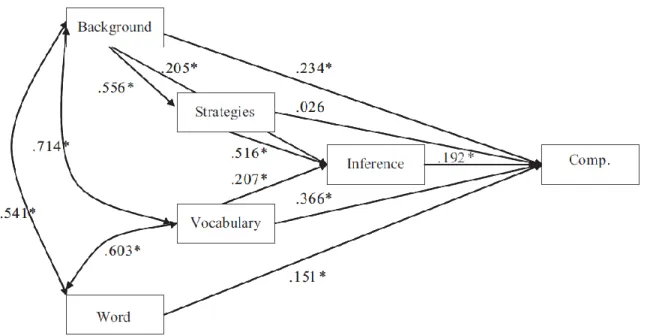
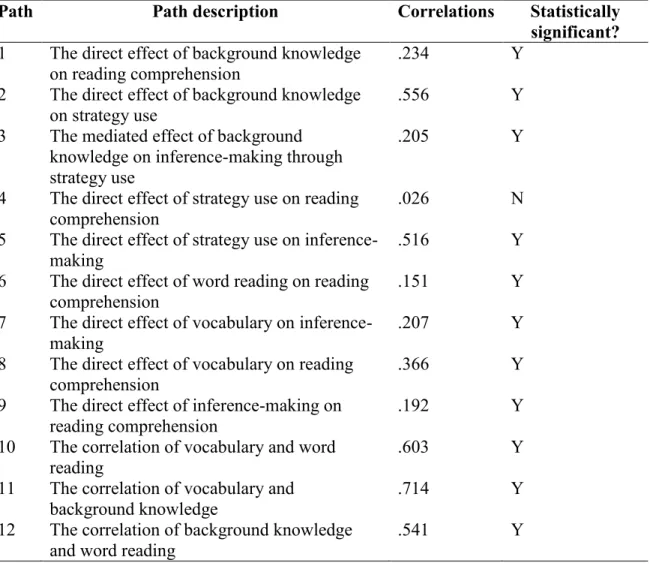
Cromley and Azevedo (2007) tested the fit of four variations of the DIME reading comprehension model to data from ninth-grade students. The researchers hypothesized the direct and mediated relationships among five components of reading comprehension, including background knowledge, vocabulary, inference-making,
strategy use, and word reading to reading comprehension (see Figure 2). Cromley and Azevedo’s findings are also presented in Table 2.
Figure 2. The DIME Reading Comprehension Model.
* Statistical significance at the .05 level
Note: Background = background knowledge, Word = word reading fluency, Comp = reading comprehension
Table 2. The DIME Reading Comprehension Model Findings
Path Path description Correlations Statistically
significant? 1 The direct effect of background knowledge
on reading comprehension .234 Y
2 The direct effect of background knowledge
on strategy use .556 Y
3 The mediated effect of background knowledge on inference-making through strategy use
.205 Y
4 The direct effect of strategy use on reading
comprehension .026 N
5 The direct effect of strategy use on
inference-making .516 Y
6 The direct effect of word reading on reading
comprehension .151 Y
7 The direct effect of vocabulary on
inference-making .207 Y
8 The direct effect of vocabulary on reading
comprehension .366 Y
9 The direct effect of inference-making on
reading comprehension .192 Y
10 The correlation of vocabulary and word
reading .603 Y
11 The correlation of vocabulary and
background knowledge .714 Y
12 The correlation of background knowledge
and word reading .541 Y
Components and Their Relation to Reading Comprehension
This study examined the relationship of background knowledge, motivation, vocabulary, inference-making, and sentence-level fluency with reading comprehension. Eight paths were modified from the DIME model (Cromley & Azevedo, 2007), and four additional paths were tested. Current research support for the relationships among components is discussed and followed with the proposed model and possible variations.
Direct paths to reading comprehension are discussed first, followed by direct paths between reading components, followed by indirect paths among components.
Background Knowledge and Reading Comprehension. In the 1980s, the impact of background knowledge on comprehension was widely studied based on schema theory. A schema is an organized set of understandings of knowledge that evolve with the addition of new information; schema theory proposes that readers use prior knowledge to understand and respond to what they read (R. C. Anderson, 1977; R. C. Anderson & Pearson, 1984; RAND Reading Study Group, 2002; Rumelhart, 1981). Schema theory espoused that “what you already know or don’t know about a topic can greatly influence your comprehension” (McCormick, 1987, p. 303). That is, readers bring personal experiences to the text to make the reading meaningful and applicable to everyday life, thereby redefining their schemata. The unique background experiences and information each reader brings to the text improves or possibly impairs the reader’s comprehension (McCormick, 1987; Pressley & Block, 2002).
In the DIME Model (Cromley & Azevedo, 2007), background knowledge was shown to have a direct effect (.234) on reading comprehension. Prior knowledge was also found to have indirect effects (.11) on reading comprehension mediated by strategy use and inference-making.
Sentence Fluency and Reading Comprehension. Students who struggle to read fluently report lower text comprehension because they expend extensive attentional resources on lower-level cognitive processes such as decoding fluently rather than on reading comprehension (Samuels, 1994; Stanovich, 1988). This is not surprising, since a
high correlation has been documented between oral reading fluency and reading comprehension (L S. Fuchs, Fuchs, Hosp, & Jenkins, 2001; L. S. Fuchs, Fuchs, & Maxwell, 1988; Hosp & Fuchs, 2005; Paris, Carpenter, Paris, & Hamilton, 2005; Wayman, Wallace, Wiley, Tichna, & Espin, 2007); however, lower direct correlations have been documented for adolescent readers (Jenkins & Jewell, 1993; Shinn, Knutson, Collins, Good, & Tilly, 1992; Torgesen, Nettles, Howard, & Winterbottom, 2005). A lower direct correlation between reading fluency and text comprehension was also reported by Cromley and Azevedo (2007); however, the DIME model reported a statistically significant path coefficient of .151 between word reading and text comprehension.
This study modified the DIME’s word identification path by analyzing data collected on the validated Test of Silent Reading Efficiency and Comprehension ([TOSREC]; Wagner, Torgesen, Rashotte, & Pearson, 2010). The TOSREC combines both sentence-level reading fluency and reading comprehension through verification questions about the truthfulness of the sentence. In a concurrent validity test of the TOSREC for first- through fifth-grade students, Johnson, Pool, and Carter (2011) found the high and statistically significant correlations (grade 1= .822, grade 2 = .831, grade 3 = .781, grade 4 = .324, and grade 5 = .798) of the TOSREC to oral reading fluency (ORF) for all but fourth grade in the fall administration. Similarly, Denton and colleagues (2011) reported comparable correlations of the TOSREC to ORF passage fluency (.61) for sixth, seventh, and eighth-grade students.
Vocabulary and Reading Comprehension. The relationship between vocabulary and comprehension has been widely studied and reported, and is especially important as students transition into secondary grades that place increasing emphasis on informational text (R. C. Anderson & Freebody, 1981; Hart & Risley, 2003; Hirsch, 2003; Kameenui, Carnine, & Freschi, 1982). There is a direct relationship between vocabulary and reading comprehension; readers must be able to understand the majority of words encountered to make sense of the text. Nagy and Scott (2000) reported that comprehension is contingent on understanding the meanings of 90-95% of words. One of the largest direct contributors to reading comprehension reported in the DIME Model is vocabulary (.366).Furthermore, vocabulary measures have been regarded as better predictors of reading comprehension than oral reading fluency (Espin & Foegen, 1996; Yovanoff, Duesbery, Alonzo, & Tindal, 2005).
Inference-making and Reading Comprehension. The complex ability to make inferences “requires that readers consider multiple elements of text simultaneously and relate those text elements to prior knowledge” and “consider simultaneously multiple mental representations” (Cartwright, 2009, p. 126). Readers who are unable to integrate information across texts with prior experiences or background knowledge demonstrate lower reading comprehension (Cain & Oakhill, 1999; Oakhill, Cain, & Bryant, 2003; Oakhill, Yuill, & Parkin, 1986). Cromley and Azevedo (2007) reported a statistically significant direct relationship between inference-making and reading comprehension (.192). In a four-year longitudinal study of seven- and eight-year olds, a path analysis by
Oakhill and Cain (2012) reported the ability to make inferences was predictive of reading comprehension four years later.
Motivation and Reading Comprehension. Although conventional wisdom suggests that motivation has a direct effect on comprehension, to date, researchers have been unable to support this hypothesis empirically (Baker & Wigfield, 1999; Guthrie, Wigfield, Metsala, & Cox, 1999). Despite the lack of empirical evidence, educational stakeholders still recommend that teachers focus on reading motivation. For example, the fourth recommendation of the IES Practice Guide to Improving Adolescent Literacy (Kamil et al., 2008) is to increase student motivation and engagement in literacy learning. This study attempted to provide additional support to the limited literature base by examining the direct relationship of motivation and reading comprehension of seventh and eighth graders as part of a multi-component model.
Vocabulary and Inference-making. If students do not understand the meaning of a word they encounter in text, it is logical that they are unlikely to make inferences or causal connections. A small literature base exists on this relationship (Kameenui et al., 1982; Medo & Ryder, 1993; Stahl, Jacobson, Davis, & Davis, 1989). However, Cromley and Azevedo (2007) reported a direct effect (.207) of vocabulary on inference-making.
Vocabulary and Sentence Fluency. Few would disagree with the premise that a reader must be able to accurately decode a word to understand its meaning from written text. Indeed, Cromley and Azevedo’s (2007) path analysis calculated a correlation of .603 between word reading and vocabulary. Similarly, Singer and Crouse (1981) noted a statistically significant loading of .40 for decoding on vocabulary for middle school
students. This study proposed a correlation of vocabulary with fluency similar to that of the DIME model by assessing students’ sentence-level fluency and comprehension using the TOSREC (Wagner et al., 2010). According to a validation study by Johnson and colleagues (2011), the TOSREC and ORF may be used interchangeably with no additional benefits.
Vocabulary and Background Knowledge. A strong direct relationship between vocabulary and background knowledge (.714) was reported in the DIME Model. Cromley and Azevedo’s findings (2007) are congruent with Stanovich and colleagues’ research, which noted a correlation between vocabulary and background knowledge for fourth-, fifth-, and sixth-grade students (Cunningham & Stanovich, 1991), eleventh-grade students (Cunningham & Stanovich, 1997), and undergraduate students (Stanovich, West, & Harrison, 1995).
Background Knowledge and Sentence Fluency. Cromley and Azevedo (2007) hypothesized and reported a quantitative correlation between background knowledge and word reading fluency (.541), based on Cunningham and Stanovich’s (1991) study, which reported a statistically significant correlation (.55) between background knowledge and word reading for 134 students grades four through six. This study proposed a similar correlation between background knowledge and sentence fluency utilizing the comparable TOSREC measure (Denton et al., 2011; Johnson et al., 2011).
Motivation, Vocabulary, and Reading Comprehension. Although not directly measured or reported widely, one could infer the important connections among motivation, vocabulary, and reading comprehension through deductive reasoning. That
is, motivation leads to an increased amount of reading; students who are motivated read three times as much as less motivated students (Guthrie & Wigfield, 1997). The majority of vocabulary is not acquired through direct instruction but in context, through wide and varied reading (Anderson & Armbruster, 1984; Nagy & Anderson, 1984; Nagy, Anderson, & Herman, 1987; Nagy, Herman, & Anderson, 1985; Read, 1986; Read & Hodges, 1982; Rice, Meyer, & Miller, 1988; Stanovich, 1986). Motivated readers are engaged in more text, leading to the incidental learning of new words that positively influences reading comprehension.
Motivation, Inference-making, and Reading Comprehension. The ability to make inferences, or read between the lines, is central to reading comprehension (Singer, 1994; Van den Broek, 1994). Struggling readers have consistently shown an inability or lower ability to infer meaning from text (e.g., Cain & Oakhill, 1999; Oakhill, 1982, 1984). A higher-level cognitive skill, inferential processing is required across all content areas and is one of the more difficult requirements adolescents face in reading because they must make assumptions based on textual evidence. That is, they must integrate literal information from the text with their own background knowledge to make sense of what they read.
The present study proposed an indirect relationship of inferential processing and reading comprehension mediated by motivation. Inference-making requires a higher level of cognitive processing and is a difficult skill to master. Motivation affords readers the ability to persist through difficult academic tasks (Larson, 2000; Maehr, 1984; Pintrich & Schrauben, 1992; Pintrich & Schunk, 1996; Wigfield, 1994; Wolters &
Rosenthal, 2000). This study empirically tested whether motivated students were more likely to persist in difficult academic tasks, specifically inference-making, and to perform better in reading comprehension.
Motivation and Background Knowledge. According to an extensive review of literature on prior knowledge (Dochy & Alexander, 1995), background knowledge has been found to be a multidimensional construct that includes different levels and categories of knowledge and has numerous but congruous definitions. Background knowledge, or the relationship of the reader’s skills and personal experiences to reading comprehension (Neisser, 1976) has been well documented (e.g., R. C. Anderson, 1977; R. C. Anderson & Pearson, 1984; RAND Reading Study Group, 2002; Rumelhart, 1981); however, to our knowledge, the relationship between background knowledge and experiences to motivation has not been empirically tested.
This study proposed a correlational relationship between background knowledge and motivation based on Neisser’s (1976) definition. Readers bring varying levels of skills and experiences to the text. Students’ academic experiences of success and failure are directly associated with their self-efficacy as readers (Harter et al., 1992; Wigfield, 1994).
Proposed Paths
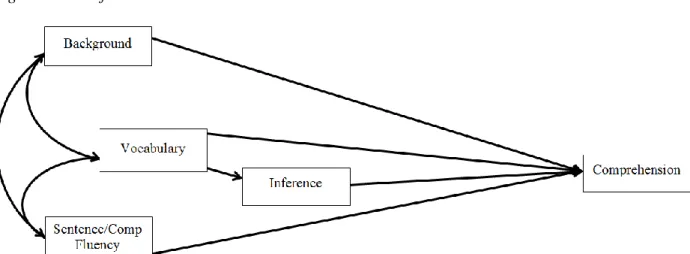
This study tested two variations of the Modified DIME model (see Figures 3 and 4) as well as two Multicomponent Models of Reading Comprehension that were variations of the DIME model (see Figures 5 and 6). The Multicomponent Model of Reading Comprehension proposes twelve direct and indirect relationships among
background knowledge, vocabulary, inference-making, sentence fluency, motivation, and reading comprehension. The four models tested in this study included:
1. Modified DIME Model 2: Sentence Fluency with Vocabulary (see Figure 3) 2. Modified DIME Model 3: Sentence Fluency on Vocabulary (see Figure 4) 3. Multicomponent Model 1 of Reading Comprehension: Vocabulary and
Inference on Motivation (see Figure 5)
4. Multicomponent Model 2 of Reading Comprehension: Motivation on Vocabulary and Inference; addition of Motivation with Sentence Fluency (see Figure 6)
Figure 4. Modified DIME Model 3.
CHAPTER III METHODS Research Design and Context
This study tested a priori models based on prevailing theory and literature and employed correlational analyses to examine the direct and indirect relations among multiple components. Components examined include motivation, vocabulary, sentence comprehension fluency, background knowledge, strategy use, and inference-making.
Data were from a larger intervention study of reading comprehension and were collected in September of the academic year prior to intervention. The study was conducted in a junior high school in Central Texas that serves 319 seventh- and eighth-grade students. The school demographics consist of 28.3% African American, 29.7% Hispanic, 37.4% White, 1.1% American Indian, and 3.4% Two or More Races. In addition, 73% of students were labeled economically disadvantaged, 49.9% were considered at risk, and 11.9% had special education placement.
Participants
The participants included 172 seventh- and eighth-grade students from 12 English Language Arts classes of three teachers who assented to participate. One general rule for the Structural Equation Modeling (SEM) assumption of adequate sample size is for the sample size to meet at least 15 cases per predictor variable (Stevens, 1996). This sample exceeded this general guideline with 172 cases and six predictors. Participants were 11-15 years old (M = 13.06, SD = .694) and were racially diverse (33% White, 42% Black, and 25% Hispanic). Of the 172 participants, 140 (81%) qualified for free
and reduced lunch, and eight (4%) students received special education services. These demographics were representative of the school as a whole.
Struggling readers were identified as students scoring at or below the 25th percentile using the normative percentile ranks on the Gates-MacGinitie reading comprehension subtest according to the fall administration in the scoring manual (MacGinitie et al., 2007). Based on normative data, seventh-grade students who had a raw score of 20 or less and eighth graders who scored at or below a raw score of 23 were considered to have scored in the bottom 25th percentile. A total of 77 struggling readers were identified from the total sample. Struggling readers scored a mean of 15.24 and standard deviation of 5.04 on the Gates-MacGinitie reading comprehension subtest. Materials and Measures
Written student assent and parental permission were required and obtained from all participants. Consent and assent forms may be found in the Appendix. Student demographic information provided by district personnel included age, race or ethnicity, gender, and special education status. Measures indicated with an asterisk are based on those used in Cromley and Azevedo’s DIME Model (2007).
Reading Comprehension.* The Gates-MacGinitie comprehension subtest (Level 7/9, Form S; MacGinitie et al., 2001) was administered to students. Comprised of 14 short passages and 48 multiple-choice questions, it is a nationally normed, paper-and-pencil test with questions from both narrative and informational texts, and questions that were both literal and inferential. The observed reliability was .91. The maximum raw score is 48.
Vocabulary.*Students’ general reading vocabulary was assessed using the vocabulary subtest (Level 7/9, Form S) from the Gates-MacGinitie Reading Test ([GMRT]; MacGinitie, MacGinitie, Maria, & Dreyer, 2001). The fourth edition of the GMRT is a nationally normed, 45-item, multiple-choice, paper-and-pencil test with a reported test-retest reliability score of .90 (MacGinitie, MacGinitie, Maria, & Dreyer, 2002). The maximum possible score is 45. The measure was used in the DIME model and the current study. However, unlike the Cromley and Azevedo (2007) study, which used 23 multiple-choice items from the measure, the entire measure of 45 items was administered in the current study. The observed reliability for the sample was Cronbach’s α = .83.
Sentence Comprehension Fluency. Unlike the DIME Model, which used a three-part word fluency composite of speed and accuracy fluency measures (letter-word identification and word attack subtest of the Woodcock Diagnostic Reading Battery (Woodcock, 1997) and a one-minute timed reading measure of accuracy), this study administered the TOSREC; (Wagner et al., 2010). A sentence verification assessment, the TOSREC is a 3-minute timed measure that requires students to read statements and evaluate the truthfulness of each sentence. It combines accuracy with speed to measure reading fluency and has been found to be a reliable measure strongly related to reading comprehension (Denton et al., 2011).
The TOSREC “requires a fluent recognition of printed words, ability to process grade-level appropriate sentence structure, knowledge of grade-level-appropriate vocabulary, adequate working memory capacity to process realistic sentences, the ability
to make appropriate inferences, and possession of relevant background knowledge” (Pro-Ed, 2012, para. 1). Form A was administered for both Levels 7 and 8.
Background Knowledge. To assess background knowledge, the study utilized the GMRT, a measure based on the Gates-MacGinitie reading passages (Barnes & Watkins, 2010), which required students to answer questions based on the version of the Gates-MacGinitie passages they read. The GMRT also assessed the reader’s knowledge of vocabulary pertinent to the Gates passages as well as related background knowledge by generating both a word and a world knowledge score. The measure consisted of 29 multiple-choice questions with three answer choices. The maximum possible score is 29. Reliability was calculated for this sample with a Cronbach’s α of .571 (M = 18, SD = 4.98).
Inference-making. Researchers modified the DIME model by including a researcher-developed 24-item, multiple-choice assessment to measure students’ reading comprehension, including their ability to make inferences based on two passages from the Adolescent Literacy Inventory ([ALI]; Brozo & Afflerbach, 2010). These passages were a narrative passage, “Barrio Boy” by Ernesto Galarza and an expository text, “A Portrait of Americans.” Lexile levels were calculated and guided the selection of these two passages that fell within grades 7 and 8 (880L to 1,010L; Stenner, Koons, & Swartz, 2009). The narrative passage was assigned a Lexile of 930L and the informational text a Lexile of 1,000L.
From the two passages, 31 questions were modified from the ALI to measure reading comprehension. Twenty-four questions were identified as inferential questions.
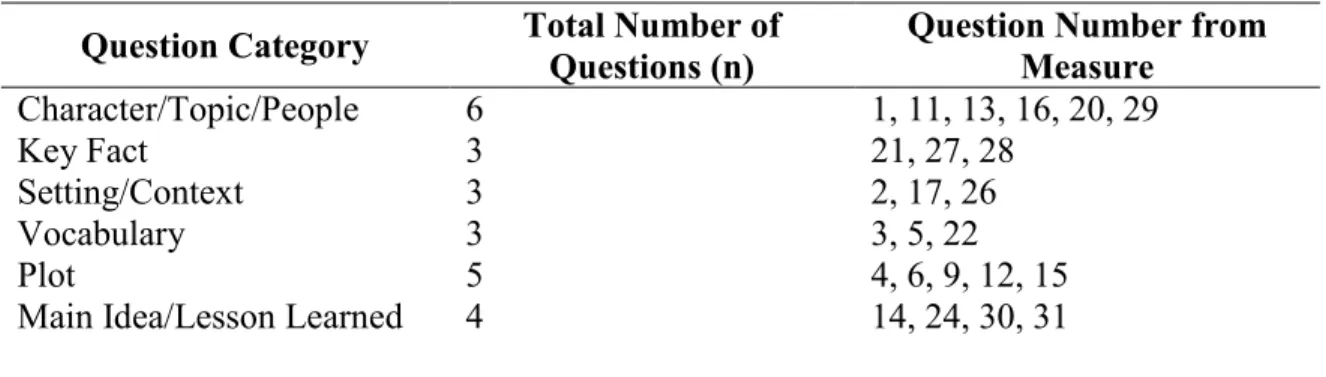
The 24 questions were categorized into the following six types of inferences (a) character, topic or people, (b) key facts, (c) setting or context, (d) vocabulary, (e) plot, and (f) main idea or lesson learned (see Table 3). According to basic descriptive on the inference questions, seventh- and eighth-grade students performed better on the narrative passage (74.03% and 75.40%, respectively) than the expository text (54.41% and 50.98%, respectively). Students read both passages and answered all 31 questions with four multiple-choice options. Of the 31 questions, 24 were analyzed in this study as the inference measure. One point was awarded for each correct answer, with a maximum possible score of 24 for the inference measure. Reliability was calculated for this sample with a Cronbach’s α of .71 (M = 19.72, SD = 5.39).
Table 3. Inference Measure Based on “Barrio Boy” and “A Portrait of Americans” Question Category Total Number of Questions (n) Question Number from Measure
Character/Topic/People 6 1, 11, 13, 16, 20, 29
Key Fact 3 21, 27, 28
Setting/Context 3 2, 17, 26
Vocabulary 3 3, 5, 22
Plot 5 4, 6, 9, 12, 15
Main Idea/Lesson Learned 4 14, 24, 30, 31
Motivation. This study purposefully selected items from a measure of motivation that best represented the construct of motivation. Thirteen of the Motivation to Read Survey’s (MRS; Wolters, Denton, York, & Francis) 54 questions were selected
and administered, grouped by social motivation (n = 3), intrinsic motivation (n = 4), extrinsic motivation (n = 3), and self-efficacy (n = 3). The measure posed personal questions and asked students to answer on a 5-point Likert scale ranging from “Not at all true of me” to “Very much true of me.” A sample question for intrinsic motivation read, “It doesn’t matter to my friends whether I’m a good reader or not.” Participants were asked to use the 5-point Likert scale to rate their personal beliefs of the amount of truth of the statement. The subset of items has yet to be validated for reliability, so an internal consistency test of reliability will be conducted and Cronbach’s α will be reported. Reliability was calculated for this sample with a Cronbach’s α of 0.79 (M = 37.1, SD = 8.04).
Procedure
In their regular classrooms, the students completed the following group-administered measures over two school days. One class period was unable to complete the TOSREC measure because of time constraints. Researchers attended a one-day training on standardized procedures, confidentiality, data handling, and reliability. Researchers used standardized administration instructions, and students were asked to answer the questions to the best of their ability. Neither assistance nor answers were provided to the participants. To ensure the security and integrity of the data, researchers remained in the classroom for the administration of all measures with the exception of the demographic information that was collected by the teacher on a later day.
CHAPTER IV
ANALYSES AND RESULTS Descriptive Analyses
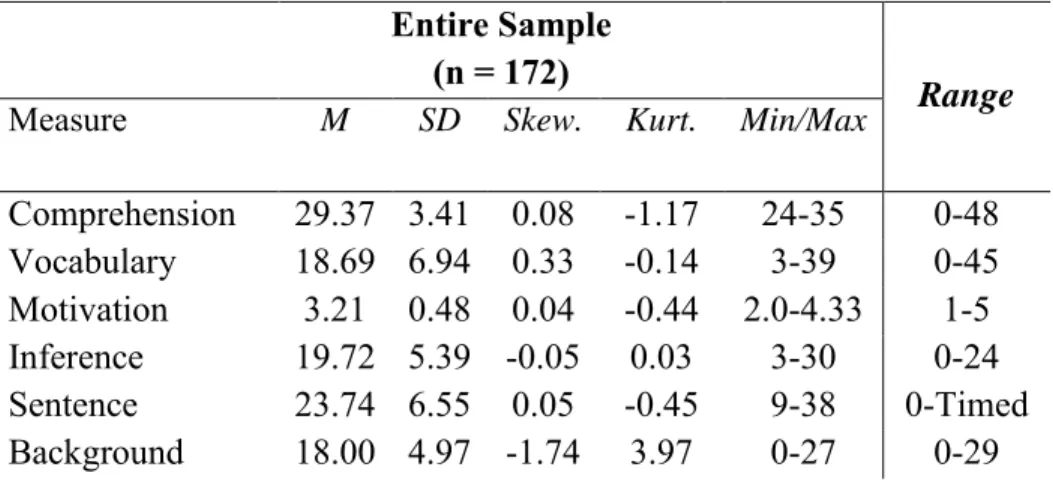
Descriptive analyses of the five components of reading comprehension (vocabulary, motivation, inference-making, sentence comprehension fluency, and background knowledge) and comprehension for the full student sample as well as the subset of struggling readers are reported in Table 4.
Table 4. Descriptive Analyses of Measures of Raw Scores Entire Sample
(n = 172)
Range
Measure M SD Skew. Kurt. Min/Max
Comprehension 29.37 3.41 0.08 -1.17 24-35 0-48 Vocabulary 18.69 6.94 0.33 -0.14 3-39 0-45 Motivation 3.21 0.48 0.04 -0.44 2.0-4.33 1-5 Inference 19.72 5.39 -0.05 0.03 3-30 0-24 Sentence 23.74 6.55 0.05 -0.45 9-38 0-Timed Background 18.00 4.97 -1.74 3.97 0-27 0-29
Table 4. Continued
Struggling Readers
(n = 77) Range
Measure M SD Skew. Kurt. Min/Max
Comprehension 15.24 5.04 -0.38 0.10 0-23 0-48 Vocabulary 14.90 5.20 0.23 -0.35 3-28 0-45 Motivation 3.15 0.51 0.34 -0.34 2.25-4.33 1-5 Inference 16.89 5.05 -0.42 -0.19 3-27 0-24 Sentence 22.02 5.46 -0.51 0.07 9-32 0-Timed Background 16.12 5.39 -1.27 1.85 0-23 0-29
Note: All reported scores are raw scores. Sentence = sentence comprehension fluency; Background = background knowledge; M = mean; SD = standard deviation; Skew = skewness; Kurt = kurtosis; Min/Max = minimum and maximum scores reported for sample; Range = range of possible scores for the entire measure.
Data Analyses
Simple bivariate correlations were calculated using SPSS. All components were significantly correlated at the .05 or .001 level with the reading comprehension measure excepting sentence comprehension fluency (see Table 5). The inference measure correlated significantly with all measures. With the exception of motivation and sentence comprehension fluency, all measures were significantly correlated with vocabulary.
Correlation Coefficient Variable 1 2 3 4 5 6 1. Comprehension 1.00 2. Inference .669** 1.00 3. Background .327** .214** 1.00 4. Motivation .168* .186* .130 1.00 5. Sentence .131 .172* .069 .100 1.00 6. Vocabulary .701** .570** .319** .087 .071 1.00
* Correlation is significant at the .05 level. ** Correlation is significant at the 0.01 level.
Note: Sentence = sentence comprehension fluency; Background = background knowledge.
Structural Equation Modeling. Structural equation modeling (SEM) was used to simultaneously examine the direct and indirect relations between components and reading comprehension outlined in both variations of the Modified DIME Models 2 and 3 and Multicomponent Models 1 and 2 of Reading Comprehension. Path analysis was used to measure the empirical estimation of the strength of the hypothesized relations among reading components tested using the statistical software MPlus Version 6.12 (Muthén & Muthén, 1998-2010). First, the hypothesized models were estimated using maximum likelihood and tested for goodness of fit. To determine the model fit, the following indices were calculated: chi square (χ2), Root Mean Square Error of Approximation (RMSEA), Comparative Fit Index (CFI), Standardized Root Mean Square Residual (SRMR), and r-squared (R2).
Research Question 1
Which Variation of the Modified DIME Models of Reading Comprehension had the Best Fit for the Full Sample of Seventh- and Eighth-grade Participants?
Cromley and Azevedo’s Model 2 tested the direct and indirect relationships among components of reading comprehension. In addition to eliminating the strategy measure, the modified Model 2 study substituted fluency and inference measures. All five of the direct path coefficients were statistically significant as well as the correlation between vocabulary and background knowledge.
Cromley and Azevedo’s Model 3 varied from Model 2 in that it tested a direct path from fluency to vocabulary rather than a correlation. The path was not found to be statistically significant, but the inclusion of the direct path changed the statistical relationship between background knowledge and vocabulary.
When tested for best fit, Modified DIME Model 2 of Reading Comprehension had a χ2 value of 3.369 with 2 degrees of freedom, and a p value of .185 (see Table 6). Chi square is considered a “badness of fit” index where a higher value indicates a poorer fit of the model with the data. The chi-square value for DIME Model 2 is low and is not statistically significant, which indicates a favorable fit. DIME Model 2 also had RMSEA Azevedo (2007). The modifications included eliminating the reading strategy measure and two substitutions (sentence fluency replaced word reading and a comparable measure of inference was substituted for that in the original model). Cromley and Azevedo tested four variations of the DIME model; however, the data from this study were only applicable to two of the four variations (Models 2 and 3) because the other two variations were dependent on the strategy measure not administered in the present study.
of .063, which is considered a reasonable amount of error. Values below .05 are considered good fit with minimal error; values between .05 and .08 are considered a fair fit with a reasonable amount of error, and those equal or above .08 indicate poor fit and an unreasonable amount of error (Browne & Cudeck, 1993). Additionally, this model had a CFI of .993, which is considered a favorable fit. Models with CFI values over .90 indicate reasonably good fit (Hu & Bentler, 1999). The SRMR was .029 which is considered a favorable fit because values below .10 are considered acceptable. The amount of variance for reading comprehension explained by the model was 63.1%; however, the R2 considers the model as a whole even if parts of the model have poor fit. Table 7 contains the standardized path coefficients, p values, and the statistical significance for all eight paths of the Modified DIME Model 2 of Reading Comprehension. These are also displayed in Figure 7.
Modified DIME Model 3 of Reading Comprehension had a higher and less favorable χ2of 17.657 with 3 degrees of freedom, and a p value of less than .001, indicating poor fit. DIME Model 3 had an RMSEA of .169, which is an unacceptable level of error, also indicating poor fit (Stage, Carter, & Nora, 2004). DIME Model 3 had a CFI of .935, which is considered a good fit. The SRMR was .110, which was higher than Model 2, but was considered an unfavorable fit because it was over the benchmark of .10. The amount of variance explained by Model 2 was 60.6%. The standardized path coefficients, p values, and the statistical significance for all seven paths of the Modified DIME Model 3 of Reading Comprehension are displayed in Table 8 as well as in Figure 8.