Correlations Among Availability of Information and
Communication Technology, ICT Skills, Perceived Ease-of-use
and Use Electronic Resources by Law Lecturers in Nigerian
Public Universities
Oyintola Isiaka Amusa
Institute for Human Resources Development, Federal University of Agriculture, P.M.B. 2240, Abeokuta, Nigeria Morayo I. Atinmo
Department of Library, Archival and Information Studies, University of Ibadan, Ibadan, Nigeria Abstract
Law lecturers occupy a vintage position in producing legal experts who will later constitute the bar and benches in the society. However, as global as the profession is, there seems to be existence of some challenges in electronic resources use by law lecturers in public universities in Nigeria. Previous studies on the issue largely focused on strategies for improving the use of ER with little consideration for the extent to which availability of Information and Communication Technology, ICT skills, and perceived ease-of- use could influence the use of ER. Therefore, the study investigated the influence of the availability of ICT, ICT skills (applications, text creation, access and manipulation, database, and the Internet Communication skills) and perceived-ease-of-use on the use of ER by law lecturers in public universities in Nigeria. Survey research design was adopted. Four hundred and twenty (420) law lecturers, 247(58.8%) male and 173(41.2%) female participated in the study. There were significant positive relationships among availability of ICT and use of electronic resources by law lecturers (r =0.21), and ICT skills and use of electronic resources (r=0.22) while perceived ease-of-use of ICT did not. Availability of ICT, ICT skills and perceived ease-of-use, jointly influenced the use of electronic resources (F (2,416) =4.90, R2=0.26). The relative contributions of the independent variables to the use of electronic resources were: availability of ICT (β=.14, t=2.01); ICT skills (β =.14, t=1.87) and perceived ease-of-use of ICT (β =0.20, t=.27). Availability of Information and Communication Technology, Information and Communication Technology skills and ease-of-use of Information and Communication Technology influenced the use of electronic resources by law lecturers in public universities in Nigeria. ICT and other basic infrastructure in appreciable quantity should be provided by the government and the management of the universities for use of the law lecturers and, Publicity of the acquired electronic resources and their contents. Keywords: Information and communication technology, ICT skills, Electronic resources, Perceived ease-of-use of ICT, Law lecturers in public universities, Nigeria.
Introduction
Application of information and communication technology cut across all spheres of human endeavour such as medicine, commerce, engineering, building construction, education, library services, and agriculture among others. In the academic, it has become a major tool for teaching, learning and research. To underscore the relevance of ICT, Kumar and Kaur (2005) posited that ICT has gone a long way in modernising the process of teaching and research in most universities and host of other human activities, especially library and information services. ICT has revolutionised the way information is gathered, stored and disseminated and it has brought about the globalization of information and knowledge. ICT has brought convenience, speed and accuracy into information access, storage, and dissemination. Whong and Mohammed (2014) stated that digital media have revolutionised information sources and advances in ICT have dramatically enhanced information processes.
Detlefsen, (2006) stated that in the era of computer, it is essential for individuals to develop skills and strategies for maneuvering, storing, and retrieval of electronic information. He referred to these as ICT skills.
ICT skills refer to aptitude and competencies appropriate for operating and exploiting the potentials of information and communication technology. Such skills include text creation, access and manipulation skills; database management and search skills; and the Internet communication skills. These skills are necessary to use electronic resources effectively. Electronic information sources are products of information and communication technology, as such; their maximum use is a factor of expertise on the side of the users. In other words, the ability to use electronic resources depends on basic and applied computer skills, knowledge of the available resources, and the techniques of using them.
Specific ICT skills propounded by Advance Technologies for Communications (ATC) (2015) are the skills needed to use efficiently the elementary functions of ICT to retrieve, access, store, produce, present and disseminate information, and to communicate and participate in collaborative networks via the internet. These skills are word processing using Microsoft Word, Excel and PowerPoint, e-mail, Internet search, social media,
texting using mobile technology and data knowledge of computer hardware. Other ICT skills are cross operating software understanding, protection against viruses. Similarly, ATC (2015) further categorised 21st Century information technology skills into four broad categories. These are ways of pondering and reflecting (creativity, critical thinking, problem solving, decision making and collaboration); ways of working (communication and collaboration); tools for working (information and communication technology, and information literacy); and skills for living in the world (membership of a community, life and career, and personal and social responsibility). These skills become necessary in the effective use of electronic information resources.
Electronic resources are products of information and communication technology; they are invaluable research tools which complement print-based resources in any traditional library. The emergence of electronic resources has tremendously transformed information handling and management in academic environments especially in academic libraries. Electronic resources provide access to information that might be restricted to the user due to barriers such as location and funds. Electronic resources also provide access to current information resource with the high frequency of up datedness. Through various techniques of searching, electronic resources provide extensive links to explore additional resources that are related to content and context. In addition, electronic resources are convenient to use since users are able to access them from the comfort of their homes at any time of the day. It is for these reasons, electronic resources are considered as an important resource forS teaching, research and training. Thus, most libraries and universities of the present day provide electronic resources for higher education and research.
Boumarafi (2010) observed that electronic resources are becoming more available worldwide, and its use is growing exponentially as more and more users are recognizing the potential that it offers in terms of access and dissemination. However, with the introduction of new tools for e-information searching and retrieval, users have to readjust their information-seeking behaviour to cope with the corresponding changes. Aina (2014) observed that the use of electronic resources makes accessibility, availability, searchability and research possible and also enjoys the unlimited capacity of a computer to store a large amount of up-to-date and relevant information. She further maintained that many users can access information simultaneously from a single electronic site from many locations, and copies of information can be delivered with electronic speed.
Ahmad (2008) stated that electronic legal information resources offer many advantages, the following being particularly noteworthy; in-depth searches of computer-held files can be carried out at a speed which no human can hope to match, the user is an active participant and can instantly adapt his request to the reality of what is actually in the reference file. Electronic databases can easily be re-searched using new clues, the user has easy access to an extremely wide range of indexes and databases, many of which may not be available locally. Databases searches online often offer a far greater number of access points than the corresponding printed indexes and there is almost no need for the irksome note taking so typical of many conventional searches.
Electronic resources have become widely accepted in legal education and practice. Their acceptability and use are also growing; they have exploded in popularity and use. According to Omekwu (2003), the use of digital technology has led to the migration of lawyer’s instrument of trade to electronic formats. Decisions of judges and other sources of information germane to the work of lawyers are now available in electronic format. Law reports, decisions of judges, textbooks, and case laws are now available in electronic formats and available online.
Perceived ease-of-use of information and communication technology is another factor that can influence the use of electronic information sources. Ease-of-use of information and communication technology is the extent to which the resources can be used with little or no constraints and their affordability. Affordability relates to the cost of using the ICT for desired purposes. This may be entirely free or at a payment of a token by the users. Davis (1989) conceived perceived ease-of-use as the degree to which a person believes that a particular system would be free of much effort. This follows from the definition of “ease” i.e. freedom from difficulty or considerable effort. An effort is a finite resource that a person may allocate to various activities for which he is responsible. All other things being equal, an application or electronic resource perceived to be easier to use than another may likely be accepted and used by users. Perceived usefulness and perceived ease-of-use are two conceptually independent constructs proposed by Technology Acceptance Model (TAM), to explain individual intention and readiness to use newly introduced technology. Perceived usefulness refers to the extent to which an individual believes that using a particularly new technology or system will enhance his or her productivity. Perceived ease-of-use has to do with the extent to which an individual believes that using a particularly new technology or system will be free of effort or stress.
Law is a collection of precepts creating obligations within the community to which they apply. Besides infliction of punishment in case of violation, law performs other functions other than penal. Law confers power on individuals to enter into contracts, forms companies, transfer property, make wills, and define social and power relationships. Law is a specialised and highly technical subject; it is a living discipline that keeps growing on a daily basis. Law by its characteristic nature is dynamic and ever growing. This non-static nature of law has made it to heavily rely on information resources. The professionals in the field of law are lawyers, who practice
law, and law lecturers, who teach law in tertiary institutions. Gottschalk and Karlsen (2009) described law lecturers as “professionals who have gained knowledge through formal education and through learning on the job. Law lecturers teach and conduct legal research in universities in Nigeria. These activities require the use of relevant, timely, and current legal information resources in both electronic and print formats. They operate in information rich environment because they need information to carry out their teaching, research, publishing, and consultancy services. In the words of Fowler (2007) “legal profession operates in an information intensive environment.” Anyaogu and Mabawonku (2014) described law lecturers as knowledge workers and social scientists that are invaluable to the nation because their discipline regulates human conducts and interactions human society. She further stated that the level of the law lecturers’ teaching and research productivity is likely to depend on the availability and utilisation of the various legal information resources.
Law is a learned profession; judges and other personnel in legal practice, and students rely on law reports, legal encyclopaedias, digests, codes, treatises for their job performance. However, these resources are today available not only in print form but also as electronic sources. As such, there are legal information sources in electronic formats. This development has made access to legal information easy; it has reduced the heavy dependence on legal information in print format, and it has encouraged self-education. To justify the adoption of e-resources on law Mwirigi (2010) asserted that the field of law is ever dynamic and print resources a times become obsolete as soon as they are printed. Hence electronic resources have become an integral component of library service.
Feather and Sturges (2003) stated that the growth of electronic sources of law has made substantial amount of primary and secondary source of materials more easily available to end users as the use of sophisticated search engines enables users to locate and retrieve legal information from online and sources.
However the use of these resources is likely to be influenced by certain factors among several user groups in the course of their job performance. These likely factors, as earlier discussed, are information and communication technology availability, ICT skills and perceived ease-of-use of ICT. The relationship among these factors (variables) in the context of this study goes thus; availability implies that universities must make ICT and electronic resources available in several brands to the users. Their contents must also be publicized by the library in order to prompt their use. Furthermore, electronic resources are products of information and communication technology. Consequently, users must have acquired ICT skills to be able to access and use them efficiently. Furthermore, perceived ease-of-use has to do with how the ICT and electronic resources can be easily exploited by the users. Ease-of-use is a multi-faceted issue concerning both the producers of ICT and the institution subscribing to them. From the part of the producers, there are issues about the user friendliness of the products, subscribers’ support services, and mode of obtaining new versions. Factors such as the location of the resources, facilities, cost of accessing their contents, and service periods are the issues from the subscribers’ end. Equally important is the training support provided by the library. Consequent upon the establishment of relationships among the variables in this study, the study focused on ICT availability, ICT skills, and perceived ease-of-use of ICT influence on the use of electronic resources by law lecturers in public universities in Nigeria. Statement of the problem
Electronic resources provide specific, exhaustive, expeditious dissemination of information to users. They offer a totally new environment, new resources and new services to the users. This relevance of electronic resources to legal education and practice has made the National Universities Commission (NUC) and the Council of Legal Education in Nigeria (CLEN) to make inclusion and integration of electronic resources (ER) on law in the collections of law libraries a major requirement for accreditation of law programmes in Nigerian universities (NUC Criteria for accreditation of Bachelor of Law programmes in Nigerian universities). This requirement of the two accrediting bodies has compelled faculties of law and the Law schools in Nigeria to acquire electronic legal information resources and integrate them into their law collections.
From observations done before the conception of this study and statistics on use of electronic resources by law lecturers, law lecturers are not extensively using these resources in the course of their duties. Reasons for this underutilisation may be due to inadequate ICT skills, non-availability of desired ICT and, difficulties in using them. Electronic information sources on law definitely present a challenge to law lecturers with no or limited skills in information technology and this constraint may result in the underutilisation of the resources and wastage of resources expended on acquiring them. By extension, underutilization of the resources may bring about low job productivity in the areas of teaching, research and publication, conference and seminar attendance among the law lecturers. Consequently, this study investigated the availability of information and communication technology, skills in ICT applications, and perceived ease-of-use ICT, influence on the use of electronic resources by law lecturers in universities in Nigeria.
Objectives of the study
communication technology (ICT), skills in using ICT, and perceived ease-of-use of ICT on the use of electronic resources (ER) bylaw lecturers in universities in Nigeria. Specific objectives of the study are to:
i. explore the relationship between availability of ICT and use of electronic resources by law lecturers in public universities in Nigeria;
ii. determine the relationship between ICT skills and use of electronic resources by law lecturers in public universities in Nigeria;
iii. determine the relationship between perceived ease-of-use and use of electronic resources by law lecturers in public universities in Nigeria and;
iv. ascertain the combined influence of availability of ICT, ICT skills and perceived ease-of-use on the use of electronic resources by law lecturers in public universities in Nigeria.
Hypotheses
The following null hypotheses (Ho) were tested at 0.05 level of significance:
Ho1: There is no significant relationship between availability of ICT and use of electronic resources by law lecturers in public universities in Nigeria.
Ho2: There is no significant relationship between ICT skills and use of electronic resources by law lecturers in public universities in Nigeria.
Ho3: There is no significant relationship between perceived ease-of-use of ICT and use of electronic resources by law lecturers in public universities in Nigeria.
Ho4: The combination of availability ICT, ICT skills and perceived ease-of-use of ICT do not have significant joint influence on the use of electronic resources by law lecturers in public universities in Nigeria.
Ho5: Availability of ICT, ICT skills and perceived ease-of-use do not have significant relative influence on the use of electronic resources by law lecturers in public universities in Nigeria. Scope of the study
This study covered all the law lecturers in public universities in Nigeria. These institutions and lecturers were studied because they constitute a part of a distinct system for the training of legal practitioners and researchers in Nigeria.
Electronic resources in this study are those subscribed to and made available by the institutions to their staff and students. Those available on Google Scholar, Yahoo search, and other open source platforms are excluded. Electronic resources that are of concern to this study include CD-ROM databases, online databases and others available via computer and networking facilities that are subscription based. The study is limited to finding the influence of availability of ICT equipment, skills in using ICT and, perceived ease-of-use of ICT equipment on the use of electronic resources by law lecturers in public universities in Nigeria. Law lecturers constitute a distinct user group in the field of information studies.
Literature Review
Kaman (2013) reported that the use of ICT in academic libraries has brought great advantage for its users as they open up opportunities for interoperability and information exchange. Users can access wide variety of information resources such as text, sound, and images according to their needs under one umbrella. He also concluded ICT has influenced the traditional library services in the process of acquiring, processing, string, retrieving and information delivery. Whong and Mohammed (2014) found that ICT are frequently applied in cataloguing and classification of information resources, selection of information resources, and maintenance of library statistics. They concluded that digital media have revolutionised information resources and the advances in ICT have dramatically enhanced information processes not only in the selection, ordering, processing, storage and retrieval of library information resources but also improved productivity. Furthermore, Whong and Mohammed (2014) reported that the uses of ICT in libraries have presented remarkable changes in the ways daily operations and services were done traditionally. It has identified new and active role for librarians and facilitate speedy library operations, services and access to easy delivery of information. Today physical location of libraries is less important as long as information is accessible.
Krubu and Osawaru (2010) reported that ICT has brought unprecedented changes and transformation to academic library and information services, reference services, document delivery services, current awareness services, inter library loan, and customer relation services. The impacts of ICT on information are characterized by changes in format, contents and methods of production, and delivery of in information products.
According to Douglas (1999), librarians have become expert technology users who teach computer applications in many capacities. Librarian had to learn to use the technology and then teach library users to effectively use them in accessing materials previously available in print. Aina (2004) asserted that the application of ICT to library services has brought tremendous improvements and made library services more
accessible. Specifically, ICT is being used for information handling such as storing, processing, and dissemination of information to users. Computers and telecommunication technologies allow access to a wide range of information resources, make possible high storage capacity, re-usability of data, flexibility in data manipulation and enhance cost effectiveness. Ogunshola (2004) also commented that information and communication technology (ICT) has brought a new format or vehicle for carrying information in the form of diskettes (floppy disc), CD-ROM, hard discs, and online databases. These formats have been added to the traditional media such as books, journals, and audio-visual media that libraries and information centres have been acquiring. This trend has re-defined service outlook and information seeking behavior of patrons of library and information services worldwide. He concluded that with ICT, several routine activities involved in collection development, readers’ services, serials management, and technical services are easily managed.
Zuberi and Ansari (2010) asserted that technology has penetrated all areas of life and the use of information and communication technology (ICT) has work procedures and approaches. Libraries use ICT for better services and satisfying several and different users’ needs. Libraries have transformed into digital and virtual environment that brought about transformation of traditional information sources such as books, journals and magazines into e-books, e-journals, and e-zines. This has raised the level of availability and dissemination of information globally. Electronic resources permit remote accessibility of information resources. Electronic resources solve information storage and information inaccessibility problems. Print sources are being digitized.
Tyagi (2011) concluded that law libraries can no longer depend on conventional information sources to cope with the latest development in their respective fields. This accounts for the reasons why law libraries worldwide have increased their holdings of electronic information sources and automated their operations. Mwirigi (2010) reported that over the years, due to the rise of technology, law libraries are now managing and housing more than just books; law libraries have transformed into digital and virtual that stock electronic books, electronic journals and magazines. Ukachi (2011) emphasized that the roles of reference law libraries have thus evolved in response to new societal and technological developments. Reference law libraries now use ICT to search for information, to communicate and satisfy patron’s reference and information needs. She further identified challenges to adoption and use of ICT in Nigeria. These among others are irregular power supply, limited duration of use and, inadequate number of facilities.
Olarunfemi and Mostert (2013) conducted a study on the ability of academic law libraries in Nigeria to provide access to ICTs and e-resources as part of their information service delivery. The study also investigated the readiness of the law lecturers and students to search retrieve and utilize e-resources. The study found out that ICTs are available, but that the information is insufficient in most of the libraries and E-resources were available in some of the law libraries and inaccessibility of ICTs was a serious constraint. Other challenges are lack of awareness of and easy access of e-resources, poor and erratic power supply, low bandwidth, lack of computers etc.
E-resources are recognised as being of great importance to academic law and law firms libraries. To meet the users need in the world of digital information, libraries must revise their modus operandi. The collection of law library automatically changes day by day with the change in user demands. Due to the revolution of information communication and technology, modern or higher institutions and organizations have started to subscribe to e-resources to improve their information services facilities. (Omekwu, 2007). Madukoma, Onuoha and Ikonne (2014) investigated the electronic resources information use behaviour of faculty of law members at Babcock University in Ogun state. The study established among others that faculty members use electronic resources available in the library. They were however faced with difficulties such as power fluctuations, inadequate orientation/training, and lack of awareness of electronic resources in the library. They in conclusion recommended that the library administration should provide modern technologies; create adequate awareness of electronic resources acquired in the library; provision of orientation/training of faculty members; and difficulty in navigating and searching databases.
For effective utilisation of electronic resources; Morris (2002) further identifies network, hardware and software compatibility, plus compliance with industry standards; adequate network availability, hardware and software resources and cost implications; availability of electrical and telecommunication lines and cost implications; availability of computer work stations, which includes ease-of-use for library staff and users; effectiveness and efficiency of retrieval or search engines and training implications for staff and patrons. Availability of the library based electronic resources to users in institutions has been identified as another component of the electronic information environment. Failure to meet these requirements means that access to and use of information by law lecturers will be a dream. Regular training programmes should be put in place to equip them with the necessary skills to explore the sources (Morris, 2002).
Kalbande, Shinde, and Ingle (2013) investigated the use of electronic resources on the collection of print and electronic sources, and awareness of e-resources among users. The study was conducted at the Mahatma Phule Agricultural University. The findings of the study revealed that the impact of e-resources was visible from the decrease in number of printed documents in comparison to the increase in number of electronic resources.
Consequently, the use of e-resources has increased in manifold, and the printed materials are being quickly replaced by e-resources. Also, Elavazhagan and Udayakumar (2013) examined the exposure to and measure the extent of use of e-resources by the faculty members and research scholars of BITS, Pilani. A survey method was used for the study. The findings revealed that the faculty members and research scholars are aware of the various e-resources, e-database and e-journals.
Kalbande, Shinde, and Ingle (2013) investigated the use of electronic resources on the collection of print and electronic sources, and awareness of e-resources among users. The study was conducted at the Mahatma Phule Agricultural University. The findings of the study revealed that the impact of e-resources was visible from the decrease in number of printed documents in comparison to the increase in number of electronic resources. Consequently, the use of e-resources has increased in manifold, and the printed materials are being quickly replaced by e-resources. Also, Elavazhagan and Udayakumar (2013) examined the exposure to and measure the extent of use of e-resources by the faculty members and research scholars of BITS, Pilani. A survey method was used for the study. The findings revealed that the faculty members and research scholars are aware of the various e-resources, e-database and e-journals.
Abdullahi and Haruna (2008) found that lack of basic knowledge of ICT is the second major constraint after the problem of erratic power supply to the use of ICT in the university libraries in Nigeria. Though the percentage that represents the hypothesis is low as compared to other constraints such as erratic power supply, networking, and availability of equipment etc., while the former research recorded 16.1%, the latter recorded 12%. (Saka and Abdulrahman,2008).)
Salaam and Adegbore, (2009) in his review of researches on e-resources, concluded that e-resources have been widely and rapidly accepted in academic spheres and academics in universities have widely accepted the use of electronic resources. Training was pursued by some academics to facilitate their use of the resources, while others learned to use the resources on their own. Most academics in universities have equally claimed they can use computer systems considerably. E-journals are the most used among the array of available e-resources. The Web, e-mail, and search engines follow e-journals in the rank of e-resources being used among academics in universities.
Databases and electronic journals are used by academics for both teaching, research and, extension services among many other uses. Academics have indicated satisfaction with their use of electronic resources and have committed their interest to the continuous use of e-resources because their use leads to better research and enhances dissemination of scholarly information. E-resources will continue to enjoy wider acceptance among academics as the future unfolds and barriers to their use are reduced.
Academics use electronic resources for diverse purposes as demonstrated in several literatures. Obaje and Camble (2008) reported that CD-ROMs are mostly used for literature searches during project/dissertation and thesis writing as well as in coducting personal studies and investigation by staff. Ugboma and Edewor (2008) found that e-mail is heavily used in provision of the following library and information services ordering, selection of relevant books and other materials, publishers and vendors relations. Other services include receiving and answering users' queries as well as receiving and mailing catalogues/bibliographies.
Academics at Obafemi Awolowo University, Ile-Ife, use electronic resources mostly for literature search in research and professional growth (Omotayo, 2010). There are however six reasons for using the resources. Users in the study use electronic sources in support of their study (70%) and teaching (59%). One-third of respondents used the sources for academic research. Eight-eight percent of medical science users accessed electronic information sources for study, followed by engineering (67%) and management studies (55%). (Kumar and Kumar, 2008)
Radijeng (2007) in his study on demand for electronic legal information at the University of Botswana reported that 83% of the respondents rated the value of e-legal information as high on their productivity. Further, all the respondents stated that the library should subscribe to more electronic information and on the question of which format they would prefer, print or electronic, 64% opted for electronic but also suggested that print should be retained due to the problems often experienced with electronic information. Those who opted for print stated that in the current circumstances print is more convenient. It is evident from the responses to the questions relating to the value of e-legal resources to the respondents that they value electronic information; there is a quest for more e-legal information. However, at the moment due to the current challenges associated with access to the electronic resources they would rather have print copies available as well.
Dean, C. E. and De Jager, K (2009) stated that electronic resources represent a large portion of many libraries' information resources. They discussed how and why international and South African librarians keep statistics for electronic resources, which statistics are kept, and what the issues and concerns are with regard to statistics for electronic resources. The responses were very similar. The concerns raised by both international and South African libraries were found to be about the continued lack of standardisation among publishers' reporting of statistics; the time-consuming nature of data collection; the reliability of usage data; the fact that data should be looked at in context; and the management of the data. A concern raised in South Africa but not in the
international literature is that some librarians do not understand the basic concepts of electronic resources usage statistics.
Methodology
This study adopted a survey research design because it reduces or arranges large amounts of data into numerical summaries that can be statistically analysed. It also provides valid and objective descriptions of the relationship between the variables studied. The variables of the study are independent variables (availability of ICT, ICT skills, and perceived ease-of-use of ICT); dependent variable (use of electronic information resources).
Population of the study
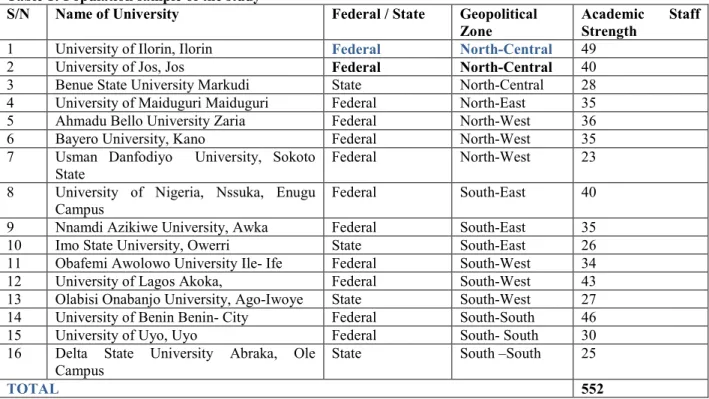
The population of this study was all the law lecturers in public universities in Nigeria. Sixteen federal and state universities were selected from the six geo-political zones of the country at the ratio of two federal to one state university (2:1). All the law lecturers in the selected universities constitute the respondents. Only one university was selected from the North East Zone, a Federal University. The selected one is the only university that offered law in the zone. The tSotal population of the study is all the law lecturers in the selected public universities which are five hundred and fifty-two (552). See Table 1.
Table 1: Population sample of the study
S/N Name of University Federal / State Geopolitical
Zone Academic Strength Staff
1 University of Ilorin, Ilorin Federal North-Central 49
2 University of Jos, Jos Federal North-Central 40
3 Benue State University Markudi State North-Central 28
4 University of Maiduguri Maiduguri Federal North-East 35
5 Ahmadu Bello University Zaria Federal North-West 36
6 Bayero University, Kano Federal North-West 35
7 Usman Danfodiyo University, Sokoto
State Federal North-West 23
8 University of Nigeria, Nssuka, Enugu
Campus Federal South-East 40
9 Nnamdi Azikiwe University, Awka Federal South-East 35
10 Imo State University, Owerri State South-East 26
11 Obafemi Awolowo University Ile- Ife Federal South-West 34
12 University of Lagos Akoka, Federal South-West 43
13 Olabisi Onabanjo University, Ago-Iwoye State South-West 27 14 University of Benin Benin- City Federal South-South 46
15 University of Uyo, Uyo Federal South- South 30
16 Delta State University Abraka, Ole Campus
State South –South 25
TOTAL 552
Data collection procedure and method of data analysis
Data collection for this study was accomplished through the questionnaire administered to the law lecturers in the sixteen (16) selected universities. Due to the geographical spread and distance in the locations of the institutions, the researchers employed the services of an assistant in every university selected. These assistants are librarians and their responsibilities were to administer and collect completed copies of the questionnaire.
All data obtained through the questionnaire were coded and analysed using SPSS Statistical Software. Frequency counts, Hypotheses were tested using Regression analysis.
Data Analysis
Demographic variables of the respondents
Age distribution of the respondents indicated that majority of the respondents were within their active service years. 170 respondents were between 31-40 years of age (40.5%); 136 respondents (32.4%) were between 51-60 years of age; respondents below 30years were 80 (19%) and; 34 respondents were above 60 years. Majority of the respondents, 271 (64.5) had master’s degree in law (LLM) as their highest academic qualifications and Barrister at law as professional qualification (BL). 50 respondents (11.9%) had PhD and BL; and 99 respondents (23.6%) had LLB and BL. This finding implied that the respondents are academically and professionally qualified to teach and research law in public universities in Nigeria.
individual. The respondents were quite experienced on the job. Majority of them, 148 respondents (35.2) had spent between 6-10 years; 112 respondents (26.7%) had between 11-15 years; 99 respondents (23.6%) had 5 years; 39 respondents (9.3%) had between 16-20 years and; others had between 21-30 years. Job status or rank indicates the position of an individual within the hierarchy of a discipline or profession. Their job statuses in descending order were: 48 professors (11.4%); 4 associate professors (1%); 10 senior lecturers (2.4%); 202 lecturers I &II (48.1%), 58 assistant lecturers (13.8%) and; 99 graduate assistants (23.3%).
The respondents cut across all the eight identified departments within faculties of law in the universities selected for the study. 128 respondents (30.5%) were from Private and Commercial Law; Public Law had 106 respondents (25.2%); Islamic and Sharia Law had 90 respondents (21.4%); Business Law had 30 respondents (7.1%); Criminal Law had 22 respondents (5.3%); International Law had 20 respondents (4.8%) and; Civil and Common Law had 10 respondents (2.4%).
The results of five hypotheses formulated for the study are as follows:
H01: There is no significant relationship between availability of ICT and use of electronic resources by law lecturers in public universities in Nigeria
Table 2: Correlation between availability of ICT and use of electronic resources
Variable Mean Std.
Dev.
N R P Remark
Use of EIR by Law Lecturers Availability of ICT equipment
20.4762 21.2667
7.4418
5.8199 420 .214** .002 Sig. ** Sig. at .01 level
It is shown in Table 4.19 that there is a positive significant relationship between the availability of ICT and use of electronic resources by law lecturers in public universities in Nigeria (r = .214, N= 420, P < .01).Hence, availability of ICT equipment in the universities had an influence on the use of electronic resources by law lecturers in the study.
The Null hypothesis is rejected.
Ho2: There is no significant relationship between ICT skill and use of electronic resources by law lecturers in public universities of Nigeria
Table 3: Relationship between ICT skills and use of electronic resources
Variable Mean Std.
Dev. N R P Remark
Use of EIR by Law Lecturers Skill in ICT application
20.4762 35.8762
7.4418
11.9302 420 .218** .001 Sig. ** Sig. at .01 level
It is shown on Table 4.20 that there is a positive significant relationship between ICT skills and use of electronic resources by law lecturers in public universities in Nigeria (r = .218, N= 420, P < .01). Hence, lecturers’ skills in ICT had influence on the use of electronic information resources.
The Null hypothesis is rejected.
H03: There is no significant relationship between perceived ease-of-use of ICT and use of electronic resources by law lecturers in public universities in Nigeria
Table 4: Relationship between perceived ease-of-use of ICT and use of electronic information resources
Variable Mean Std. Dev. N R P Remark
Use of EIR by Law Lecturers Perceived Ease of use of ICT
20.4762 41.1429
7.4418
9.1546 420 .116 .094 n.s.
It is shown on Table 4.21 that there is no significant relationship between perceived ease- of-use of ICT and use of electronic resources by law lecturers in public universities in Nigeria (r = .116, N= 420, P > .05).
Hence, perceived ease-of-use of ICT had no influence on the use of electronic resources by law lecturers. Thus the null hypothesis is accepted.
H04: There is no significant joint effect of availability of ICT, ICT skill and perceived ease-of-use of ICT on use of electronic resources by law lecturers in public universities in Nigeria
The joint contributions of the independent variables (availability of ICT, ICT skills and perceived ease-of-use of ICT) on the use of electronic resources by law lecturers in public universities of Nigeria are expressed below.
Table 5: Combined effects of independent variables on the use of electronic resources by law lecturers in Nigeria
R R Square Adjusted R Square Std. Error of the Estimate
.258 .067 .053 7.2418
A N O V A
Model Sum of Squares DF Mean Square F Sig. Remark
Regression Residual Total 771.049 10803.332 11574.381 3 206 209 257.016 52.443 4.901 .003 Sig.
Table 4.22 shows the joint contributions of the three independent variables to the prediction of the dependent variable i.e. use of electronic resources. The table also shows a coefficient of multiple correlation (R = .258 and a multiple R2 of .067). This means that 6.78% of the variance was accounted for by three predictor variables when taken together. The significance of the composite contribution was tested at P < .05. The Table also shows that the analysis of variance for the regression yielded F-ratio of 4.901 (significant at 0.05 level). This implies that the joint contribution of the independent variables to the dependent variable was significant and that other variables not included in this model may have accounted for the remaining variance.
Ho5: Availability of ICT, ICT skills and perceived ease-of-use do not have significant relative influence on the use of electronic resources by law lecturers in public universities in Nigeria.
Table 6:Relative contribution of the independent variables (availability of ICT, ICT skills and perceived ease-of-use of ICT) on use of electronic resources by law lecturers in public universities in Nigeria
Model Unstandardised Coefficient Stand. Coefficient T Sig. Remark B Std. Error Beta Contribution
(Constant)
Availability of ICT equipment Skill in ICT applications Perceived Ease of use of ICT
12.429 .190 9.285E-02 1.640E-02 2.686 .094 .050 .061 .149 .149 .020 4.626 2.012 1.868 .271 .000 .046 .063 .787 Sig. Sig. n.s. n.s. Table 4.23 revealed the relative contributions of the three independent variables to the dependent variable, expressed as beta weights, viz: availability of ICT (β = .149, P <.05), ICT skills (β = .149, P >.05), and perceived ease-of-use of ICT (β = .020, P >.05). Hence, while availability of ICT was significant, ICT skills and perceived ease-of-use of ICT were not.
Summary of findings
Factors that could enhance the use of electronic sources on by law lecturers in public universities in Nigeria were investigated in this study. This is with the main objective of finding solution the problem of underutilisation of the resources in faculties of law in public universities in Nigeria. Three of such factors, availability of ICT, Skills in using ICT and, perceived ease-of-use were identified and investigated. Arising from the analyses of the data and hypothesis testing are the following findings:
i. Availability of ICT equipment within the lecturers’ universities had influence on their use of electronic information resources.
ii. ICT skills in text creation, manipulation and access; database skills and; the Internet communication skills positively influenced the use of electronic resources by law lecturers. iii. Perceived ease-of-use of ICT equipment did not have influence on the use of electronic resources
by the law lecturers.
iv. The joint contributions of availability of ICT, ICT skills, and ease-of-use of ICT had significant contribution to the use of electronic resources by the law lecturers. That is, there was significant combined influence of the three independent variables on the use of electronic resources by law lecturers in universities in Nigeria.
v. Relative contributions of the independent variables revealed significant contribution of availability of ICT equipment while skill in ICT application and, ease-of-use were not.
Discussion of Findings
Relationship between availability of ICT equipment and use of electronic resources by law lecturers in public universities in Nigeria
The findings of this study posed that the relationship between availability of ICT equipment and use of electronic resources is significant. This implied that a relationship exist between availability of ICT equipment and the use of electronic resources by law lecturers in universities in Nigeria. This finding is in line with earlier studies by Fabunmi (2014), and Olorunfemi, Mostert and Ocholla (2013). The authors reported that ICTs are available, but that the information is insufficient in most of the libraries and E-resources were available in some of the law
libraries and inaccessibility of ICTs was a serious issue. Other issue/constraints are lack of awareness of and easy access of e-resources, poor and erratic electricity supply, low bandwidth, lack of computers etc.
Relationship between ICT skills and use of electronic resources by law lecturers in public universities of Nigeria
The result of the hypothesis tested indicates a positive correlation between skills in using ICT applications and use of electronic resources by law lecturers. Consequent upon this, the null hypothesis is rejected. This finding is in tandem with the data obtained from the respondents and the law librarians. This finding supports Fabunmi (2014) when he stated that online searching for information required some search skills that enable users to access accurate information needed. The search which is usually conducted by means of a keyboard and screen that communicate with computer systems that contain files of data can only be done by users with skills and some level of training.
Relationship between perceived ease-of-use of ICT and use of electronic resources by law lecturers in public universities in Nigeria
The results from the testing of the hypothesis confirmed that there is no significant positive correlation between perceived ease-of-use and use of electronic resources by law lecturers. This is as presented. This shows that the extent to which EIR can be easily accessed do not have influence on their use. As such, law lecturers do not consider ease-of-use as a factor in using EIR. This finding was confirmed by the information obtained from the law librarians.
Combined influence of independents variables on use of electronic resources by law lecturers in public universities in Nigeria
Regression analysis was used to test this hypothesis which produced multiple correlation R=.258 and a multiple R2 of .067 and, analysis of the variance for the regression yielded F-ratio of 4.901, which is significant at 0.05. This finding indicates that availability of ICT equipment; ICT skills and; perceived ease-of- use of ICT have combined effects on the use of electronic resources by law lecturers in Nigeria.
Contributions of the independent variables on use of electronic resources by law lecturers in public universities of Nigeria
The relative contributions of the three independent variables to the use of electronic resource revealed that availability of ICT equipment has significant contributions while ICT skills and perceived ease-of-use were not. This indicates that availability of ICT equipment will facilitate the use or electronic resources by the law lecturers. This is because the availability of the equipment and ER will prompt the lecturers to approach the faculties for exploitation and they may learn to use them through trial and error. The implication of this is that, provision of adequate and functional ICT equipment is crucial to the use of electronic information sources by law lecturers.
Conclusion
From the findings of the study, it can be concluded that availability of ICT and electronic resources, and ICT skills influence their use by law lecturers. However, perceived ease-of-use does not have positive impacts on the use of electronic resources by law lecturers in Universities in Nigeria.
Recommendations
Consquent upon the above findings and conclusion, the following recommendations are hereby made:
1. ICT and other basic infrastructure in appreciable quantity should be provided by the government and the management of the universities for use of the law lecturers in their respective universities. The existing ICT in the universities should be properly maintained and improved.
2. The Internet access and use are very crucial to the use of ER, as such, provision of the Internet facilities and robust bandwidth subscriptions should be made available and accessible to the lecturers by the individual management of the universities.
3. Facilities for electronic information services necessary to access ER should be located within easy reach or the faculties of the lecturers. This will provide easy access for the lecturers thereby encouraging them to exploit the resources.
4. Training and re-training programmes are necessary for the law lecturers to improve their skills in using ICT applications. These should be regularly done by the managements of the universities that offer law.
5. Basic information literacy skills with emphasis on skills on access, retrieval, downloading and printing of electronic resources should be regularly organised for the law lecturers. This will sharpen their skills on information searching and utilisation.
6. The law libraries should encourage the lecturers to access and use the available electronic resources by creating enough access points in their electronic libraries, provision of wireless access that can enable the lecturers to access ER from their offices, and provision of support services to assist in searching for, downloading and printing information; and laptop hire and maintenance services at a little or no cost.
7. Publicity of the acquired electronic resources and their contents should be ensured by the law librarians. The librarians can employ social networking tools such as Facebook, Google+, MySpace, blogs and Wikis to publicize the resources. More emphasis should be given to the Nigerian contents of the resources.
References
Abdullahi, Z. M. and Haruna, I. 2008. “Utilisation of information and communicationtechnology (ICT) for information service delivery in university libraries in Adamawa State”. The Information Scientist: An International Journal of Information and Communication Technology (ICT) 5 (2):26-27
Advance Technologies for Communications Conference 2015. IEEE Communications Society, University of Technology, Ho Chi Minh Vietnam, Oct. 14-16.
Ahmad S. 2008. “Computer in Library Management”. New Delhi: A. P. H. Published Corporation. Aina, L.O. 2004. “Library and Information Text for Africa”. Ibadan: Third world information. P. 314
Anyaogu, U and Mabawonku, I. 2014. “Legal information resources availability and utilisation as determinants of law lecturers’ research productivity in Nigerian universities”. Information and Knowledge management, 4 (9): 50-58.
Boumarafi, B. 2010. “Electronic resources at the University of Sharjah medical library: an investigation of students' information-seeking behavior”. Medical Reference Services Quarterly 29 (4): 349-362.
Davis, F.D 1989. “Perceived usefulness, perceived Ease of use and user Acceptance of Information Technology”. MIS Quarterly l13 (3):319-340.
Dean, C. E. and De Jager, K. 2009. “Statistics for electronic resources”. South African Journal of Library and Information science, 22 (3): 76-85.
Detlefsen, E. G. 1996. “Information seeking in electronic environments”. Bulletin of the Medical Library Association, 84 (4): 597-607.
Devchoudhary, G.B. 2007. “ICT and electronic library management and delivery within the traditionary library”. INFINET Center, Ahmedabad.
Douglas, G. V. 1999. “Professor Librarian: A model of the teaching Librarian of the future”. Computers in Libraries 19 (10): 24-26.
Elavazhagan, K. and Udayakumar, M.S. 2013. “Use of E- resources in the Bits, Plani- Hyderabad campus”: Study International Research: Journal of library &Information Science. 3 (3):470-479.
Encyclopedia Britannica 2006. Macropaedia (Knowledge In-depth) 10. Chicago: Encyclopaedia Britannica. 773 – 783.
Fabunmi, S.O. 2014. “Self-concept and browsing frequency as determinants of virtual technology use efficiency in select institutions in Nigeria”. Information and knowledge management, 5.4:20-26. Retrieved Aug. 17, 2011, from, www.iiste.org.
Feather, J. and Sturges, P. 2003. International encyclopedia of information and library Science, 2nd ed. London: Routledge.
Fowler, F. R. 2007. The Legal Profession and practice in United Kingdom, London, Brookyns Garner, B. A. 2004. Black’s law dictionary, 8thed. New York: West Publishing Co.
Gottschalk, P. and Kalsen, J. T. 2009. “Knowledge management in law firm business”. Journal of small Business and Enterprise Development, 16 (3):432-442.
Kalbande, D. T; Shinde, P.A. and Ingle, R. N. 2013. “Use of e- resources by the faculty members: a case study”. International Research: Journal of library & information Science 3 (3): 47-62.
Kaman, F. 2013. “Online real time: deciding whether to offer a real-time virtual reference service”. The Electronic Library 2 (3):240-246.
Krubu, D. E. and Osawaru, K. 2011. “The impact of Information and Communication Technology in Nigerian Libraries”. Library Philosophy and Practice. Retrieved March 12, 2013, from, www.digitalcommons,unl.edu/cgi/viewcontent.cgi/article=1602.
Kumar, G. T and Kumar, B.T.S. 2008. “Use of electronic information sources by the academic community: A comparative study”. International CALIBER 484 – 692.
Kumar, K. 2008. “Modern Components of Information Technology”. Information literacy in the Digital Age. New Delhi: Ess Publication: 158-166.
Kumar, R. and Kaur, A. 2005. “Internet and its use in the engineering college of Punjab India: A case study”. Webology 2 (40): 1 – 22.
Morris, A. 2002. “E-books: issues and effect on inter-Library loan. Inter lending and Document Supply: providing access through cooperation”. P. Connolly. Ed. Bostonspa: IFLA. 105-114.
Mwirigi, N. M. 2010. “Use of electronic library resources in academic libraries, challenges and opportunities: A case study of Kenya School of Law Library”. Retrieved Oct. 10, 2012, from http://slideshare.net/nelsonmwirigi.
Library”. The Information Scientist: An International Journal of Information and Communication Technology (ICT) 5 (1):7-8.
Ogunshola, L. A. 2004.”Nigerian university libraries and the challenges of globalization: The way forward”. Electronic journal of Academic and Special Librarianship, 5.2. Retrieved December 4, 2015 from www.southernlibrarianship.icaap.org/content/vo5no2/ogunshola.101.htm/
Olorunfemi, D.Y and Mostert, J. 2012. “Information seeking behaviour of law students in a developing country: A literature review”. SCECSAL XXTH Confercnce, Nairobi; SCECSAL.
Omekwu, C. O. 2003. Network Framework Factors, Features and Future for Legal Information Service Institutions in Nigeria. Paper presented at the 2003 Annual National Conference of Nigerian Association of Law Libraries, Ilorin, March 30 – April 4, 2003.18p.
Omekwu, C. O. 2007. Planning and Organizing Electronic Library of the Twenty-First Century. Paper presented at the Biennial National Workshop for Judicial Librarians, Merit House, Abuja, on 19-23 February, 2007. 22p.
Omotayo, B. O. 2010. “Access, use, and attitudes of academics toward electronic journals: A case study of Obafemi Awolowo University, Ile Ife”. Library Philosophy and Practice. Retrieved May 7, 2013, from http://unllib.unl.edu/LPP/omotayo.htm
Radijeng, K. F. 2007. “Demand for Electronic Legal Information at the University of Botswana”. Starr Workshop Papers(2007).Paper1. Retrieved May 7, 2010, from http://scholarship.law.cornell.edu/sw_ papers/1
Saka, K. A. and Abdulrahman, A. B. 2008. “Use of computer among library staff in fouruniversities of technology libraries in Northern Nigeria”. The Information Scientist: An International Journal of Information and Communication Technology (ICT) 5.2:60
Salaam, M.O., and Adegbore, A.M. 2010. Internet access and use by students of private universities in Ogun State, Nigeria. Library Philosophy and Practice. Retrieved May 10, 2010, from http://unllib.unl.edu/LPP/salaam-adegbore.htm
The New Standard Encyclopedia Vol. 10, Chicago: Ferguson Publishing Company, 2006, L-104 – L110
Tyagi S. 2011. “Usage of electronic resources in homoeopathic pharmacopoeia laboratory (HPL), India”. International Research: Journal of Library and Information Science 2 (1):170-181.
Ugboma, M. U. and Edewor, N. 2008. “Use of e-mail in library and information services provision in higher institutions in Delta State, Nigeria”. The Information Scientist: An International Journal of Information and Communication Technology (ICT) 5 (1):46- 47.
Ukachi, N. B. 2011. “Application of ICT and effective reference services: Nigerian academic libraries in focus”. Unilag Lagos: VDM Publisher.
Whong, F. M. and Muhammed, Z. 2014. “Application of Information and Communication Technology to library operations and routines in selected Nigerian federal university libraries”. The Information Manager 14 (1/2):29-37.
Zuberi, B. A and Ansari, N. 2010. “Use of electronic resources among academics at the University of Karachi.” Library Philosophy and Practice. Retrieved May 10, 2010, from, http://unllib.unl.edu/LPP/zuberi-ansari.htm.