THE IMPACT OF PERFORMANCE TARGETS ON
BEHAVIOUR: A CLOSE LOOK AT SALES FORCE
CONTEXTS
Dr Monica Franco-Santos
Prof Mike Bourne
AUTHORS:
Dr. Monica Franco-Santos is a Senior Research Fellow at the Centre for Business Performance, Cranfield School of Management. Her research broadly concerns the design, implementation, and management of performance measurement and incentive systems.
E-mail: [email protected]
Prof. Mike Bourne is Professor of Business Performance at the Centre for Business Performance, Cranfield School of Management. His current research activities are in the arena of corporate performance measurement and management, including the interface with the planning and budgeting process and performance related pay. E-mail: [email protected]
1. Overview
When we think about the impact of performance targets on behaviour the words “high but achievable” immediately spring to mind. We need to set targets at a high level to stretch staff, but the targets need to be perceived as achievable if the staff is going to accept the stretch. However, in real life the world is much more complex than this. At present, most organisations use performance targets for influencing the behaviour of their employees. The results these organisations obtain are not always the ones expected. There is often disquiet about whether performance targets have the right impact on people’s behaviour and organisational performance. This issue makes managers question the true value of performance targets as a motivational technique. For this reason, it is important that the use and effects of performance targets are reviewed in order to address the problems that management professionals are encountering.
This study reviews existing literature on target setting and undertakes four detailed case studies and a survey of 95 sales representatives to better understand the factors that affect managerial behaviour. The sales function was chosen, as it is known that in this environment performance targets are widely used.
The findings are as follows:
1. To be of practical value, performance targets have to be set within a wider framework of the organisation’s performance measurement system and the incentive system.
2. There are ten common issues associated with the target setting process that undermine its effectiveness. These range from issues with the data being used to set targets, through to the suitability of targets used and the way in which targets are communicated and agreed with sales people.
3. There are three factors that have an impact on the way sales people perceive target difficulty:
i. Having a clear idea of what their role and performance expectations are.
ii. Having a supportive organisation where risk-taking, continuous learning and improvement are encouraged; this promotes greater ownership of the targets, which in turn positively affects perceptions about how difficult these targets are.
iii. Being able to participate in the target-setting process.
The research explores each of these findings in more detail and provides a framework to support organisations in the target setting process – “The Target Setting Wheel”.
2. Objectives
There is a great amount of research looking at the impact of performance targets; however, there are still many gaps that require further investigation if we want to
inform managerial practice. The purpose of this study is to investigate three of these research gaps; namely:
(1) The impact of sales performance targets in relationship with sales forces’ incentive pay plans and performance measures.
(2) The key issues associated with target-setting processes.
(3) The effect of a set of organisational factors (role clarity, managerial and peers support, time availability, organisational cultural risk values, participation in target setting and work discretion) on sales people’s perception of the level of difficulty of their targets.
The first two objectives have been addressed using case study research. The third objective has been addressed using survey research.
3. Findings
Performance targets have been defined as “the objects or aims of managerial action” or as “borderlines that differentiate success from failure”. They are one of the most commonly used motivational tools in the corporate world. Nevertheless, little consensus exists regarding the true effects of performance targets on people’s behaviour and performance.
Some researchers stress the fact that performance targets are key mechanisms for improving motivation and organisational performance. Other researchers suggest that the use of performance targets can be detrimental for organisations as they generate stressful work environments, a low trust culture, data manipulation and financial performance losses. This lack of agreement is a hurdle for managers as it does not provide clear guidance about what to expect from the use of this managerial tool. In order to shed some light into the issues associated with performance targets and their impact on managerial behaviour and performance this study focuses on: the interrelations between performance targets, performance measures and incentive pay; key issues associated with the target setting process; and the factors that influence people’s perceptions about the difficulty of their targets., The findings are presented as follows.
3.1 The interrelation between performance targets, incentive pay and performance measures
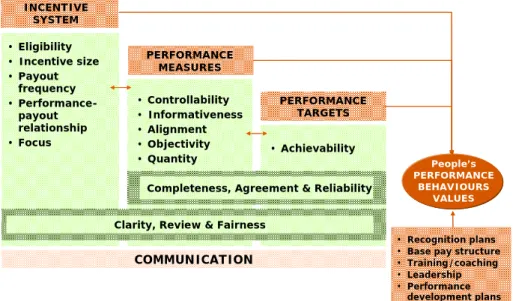
When looking at the effects of performance targets on behaviour it is important to focus on the way in which incentive pay is associated with the targets and on the characteristics of the performance measures for which targets are being set. The study finds that performance targets, incentive plans and performance measures cannot be considered in isolation as they are highly interrelated. The study shows the factors associated with sales incentive systems, performance measures and targets that have the greatest effect on people’s behaviour [see figure 1].
Figure 1. Key factors affecting people’s behaviour
A brief description of each factor is provided below.
Factors associated with the incentive system
Performance targets can be used alone but in sales environments they are typically linked to incentive plans. When linking performance targets to incentive pay the following aspects should carefully be considered for avoiding unexpected behaviours:
Eligibility: Everyone with the same role and influence over sales performance should be entitled to receive sales incentive pay.
Incentive size: The amount of money the firm has established as incentive pay for their sales people (normally calculated as a percentage of salary) should take into account internal equity levels and be in line with the incentive size that is typically used by peer companies. It should also consider how much influence sales people have over sales performance results. The higher the influence the larger the potential size of the incentive.
Payout frequency: The frequency of payout to sales people should be in line with the sales processes and strategic planning.
Performance-payout relationship: The way incentive payments are calculated and how they vary with measured performance needs to be aligned with the context in which the organisation operates, as it will have different effects on behaviour.
Focus: The proportion of sales people’s incentive pay that is linked to individual, business unit and/or organisational performance needs to be in line
• Eligibility • Incentive size • Payout frequency • Performance-payout relationship • Focus • Controllability • Informativeness • Alignment • Objectivity • Quantity • Achievability
Completeness, Agreement & Reliability Clarity, Review & Fairness
People’s PERFORMANCE
BEHAVIOURS VALUES
• Recognition plans • Base pay structure • Training/coaching • Leadership • Performance development plans INCENTIVE SYSTEM PERFORMANCE MEASURES PERFORMANCE TARGETS
Note: Factors are NOT located in order of importance. Equal importance is assumed.
COMMUNICATION • Eligibility • Incentive size • Payout frequency • Performance-payout relationship • Focus • Controllability • Informativeness • Alignment • Objectivity • Quantity • Achievability
Completeness, Agreement & Reliability Clarity, Review & Fairness
People’s PERFORMANCE
BEHAVIOURS VALUES
• Recognition plans • Base pay structure • Training/coaching • Leadership • Performance development plans INCENTIVE SYSTEM PERFORMANCE MEASURES PERFORMANCE TARGETS
Note: Factors are NOT located in order of importance. Equal importance is assumed.
with the way in which sales people work and the way in which sales tasks are interrelated.
Incentives review: Incentive systems need to be reviewed periodically, at least once every two years and every time there is a strategic change in the organisation, in order to keep it up to date and in line with market/industry practices.
Fairness: Incentive plans need to be perceived as fair by sales people.
Clarity: Sales people need to clearly understand what they are being paid for and how.
Communication: Sales people need to know how their incentive system works. The more transparency there is with incentive information the more satisfied sales people will be, which will have a direct effect on their behaviour.
Factors associated with the performance measures used
Performance targets are intrinsically related to performance measures. The selection of the most appropriate performance measures for compensation purposes is a critical decision managers must make. If a compensation system is based on the wrong measures dysfunctional behaviours may occur, which might be detrimental for organisational performance.
Two types of performance measures are typically used in sales contexts: behaviour-based measures and outcome-behaviour-based measures. Behaviour-behaviour-based measures have low measurability and are oriented towards the longer term, as their effects may not be fully realised until several years have passed. These characteristics make them less appropriate for target-setting purposes as specific and accurate targets are difficult to estimate. Examples of behaviour-based measures are: sales force product knowledge, relationship management and selling skills. Outcome-based measures have high measurability and are oriented towards the short-term as their impact can be fully realised during the incentive period. For this reason, these types of measures are more appropriate for target-setting purposes. Some examples of these measures are: sales revenues, profits, market share and sales growth from existing customers.
At present, most organisations use both types of measures in order to influence behaviour and performance.
When selecting performance measures, the following factors were found by the study to have the greatest effects on sales people’s behaviour:
Informativeness: Performance measures provide information to sales managers and sales people about the effect of sales people’s decisions and actions. It is important that the performance measures used for compensation purposes provide relevant information for decision-making to their users.
Controllability: The more control sales people have over their performance measures the more effective the measures will be.
Alignment: Performance measures need to be aligned with strategy in order to encourage the expected behaviours and avoid the well-known topic of “rewarding A, while hoping for B” (Kerr, 1995).
Objectivity: Measures used for pay purposes need to be perceived as objective by their users. Perceptions of subjectivity generate feelings of unfairness and may have detrimental effects on behaviour.
Quantity: In order to keep people focused, the number of performance measures used needs to be relatively small. Following Miller’s (1956) advice the magic number is five, plus or minus two.
Completeness: Measures used for performance evaluation and reward purposes need to reflect the key sales people’s performance dimensions (e.g. financial dimension, customer dimension).
Agreement: Sales people need to participate and accept the performance measures that are going to be used for assessing and rewarding their performance for better behavioural results.
Reliability: Sales people need to trust their performance data in order to behave appropriately. If performance data is distorted or manipulated this will have a negative effect on behaviour.
Measures review: Performance measures need to be reviewed periodically in order to make sure that they are still valid.
Clarity: Sales people need to understand how their performance measures are calculated and what they mean for better behavioural results.
Fairness: Sales people need to perceive that the performance measures used for assessing and rewarding their performance do not favour any particular territory, team or person for better behavioural results.
Communication: Sales people need to be aware of what their performance measures are, why they have been chosen and how they are calculated. The more transparency there is with performance measurement information the more satisfied sales people will be, which will have a direct effect on their behaviour.
Factors associated with the performance targets used
The study found some key factors that affect the effectiveness of targets. They are outlined below.
Achievability: Sales performance targets need to be perceived as achievable by their users. If they are perceived as unattainable, they negatively affect motivation.
Completeness: There are many factors that can affect sales people’s performance (e.g. environmental, individual, etc.) so it is important that management includes these factors when deciding on which targets to establish.
Reliability: The data used for setting targets must be reliable. If it is not, there is a high probability that targets will be perceived as unachievable or distorted. This perception will have a negative effect on sales people’s behaviour.
Agreement: Each sales person must accept and agree with his or her performance targets in order to be committed to delivering them. If targets are perceived to be given, sales people’s satisfaction with targets decreases and this affects their motivation to attain them.
Targets review: It is important that performance targets are periodically reviewed in order to keep being valid and achievable. It is also important that the
performance of sales people against targets is periodically reviewed and communicated as it has a direct effect on sales people’s behaviour.
Fairness: Sales people must perceive their targets to be fair and equitable –i.e. that the targets do not favour any particular territory, team or person.
Clarity: Sales people need to clearly understand their targets and how they are estimated as this seems to have a positive effect on their commitment with the targets and on their motivation to achieve them.
Communication: Performance targets need to be communicated clearly. Sales people need to know what the target is, how it has been calculated, who is
responsible for achieving them, how well are they doing against it, etc. The timing of the communication is also important. When performance targets are set they need to be communicated as soon as the target period starts and not later. Sales people’s performance against target needs to be communicated as often as possible.
In summary, the study finds that the use of performance targets, performance measures and incentive systems cannot be considered in isolation when examining the influence on sales people’s behaviour. They are all interrelated and their specific design must be aligned with the organisational and environmental conditions of the company if they are to positively influence behaviour.
3.2 Issues associated with target-setting processes
The research team looked in detail at the different target setting processes used by the participating companies. Overall, ten common issues that undermined the effectiveness of targets were found:
Forecast was mainly based on past performance - so people don’t over achieve when it will make the next year’s target so much harder.
Targets were allocated inappropriately across the sales force.
Targets were perceived to be too high or too low - too high de-motivates, leading to non-achievement - too low means paying bonus for poor performance.
Some targets were based on the wrong performance measures - This was often referred to as “hitting the target and missing the point”.
Targets were entirely based on financial indicators – even when factors such as customer relationships were absolutely critical.
The data analysis process on which targets were based was poor and lacked rigour.
Targets were not periodically reviewed – so were overtaken by events.
Targets were “given” to the sales people – so not creating ownership.
The interrelation between targets was not considered – causing inconsistency.
Agreed action plans were the exception and not the norm.
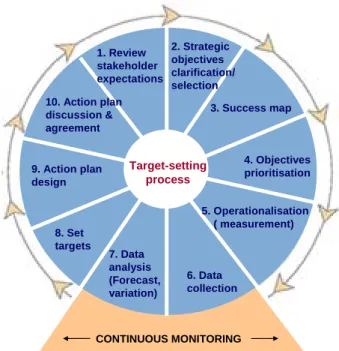
Based on the insights extracted from each of the companies target setting processes and on the knowledge obtained from the literature reviewed, the research team elaborated a specific ten-step model [see figure 2], which aims to improve the way performance targets are set.
Figure 2. The Target Setting Wheel
1. Review stakeholder expectations 2. Strategic objectives clarification/ selection 3. Success map 4. Objectives prioritisation 9. Action plan design 10. Action plan discussion & agreement Target-setting process 5. Operationalisation ( measurement) 6. Data collection 7. Data analysis (Forecast, variation) 8. Set targets CONTINUOUS MONITORING
1. Review stakeholder expectations - “what do they expect from this organisation?”
2. Strategic objectives clarification/selection - a few clear statements of what the organisation aims to achieve addressing those key stakeholders’ requirements. 3. Define the organisation’s success map – the cause and effect relationship that
describes how the organisation creates value to their stakeholders.
4. Prioritise objectives
5. Operationalisation - defining the KPIs to be used to measure each strategic objective.
6. Data collection - defining the data source, who measures and how often. 7. Data analysis - including both forecasting and capability analysis:
8. Set targets - deciding on specific performance targets for the organisation’s KPIs.
9. Action plan design - organisations need to spend time deciding on the actions that will help them achieve their targets.
10. Action plan discussion and agreement - Targets must be communicated together with the action plan for delivering the targets. The action plan MUST be discussed and agreed with those accountable for reaching the targets.
3.3 Factors influencing perceived target difficulty
Given the maxim “high but attainable”, it is important to understand the factors that influence perceived target difficulty. The study analysed the effects of six different factors that were thought to affect sales people’s perception of targets difficulty. The six factors were: role and performance clarity, time availability, decision-making autonomy, managerial and peer support, organisational cultural risk values, participation in the target setting process. Among these six factors only three helped people to perceive their targets as being less difficult and thus more achievable:
1. Having a clear idea of what their role and performance expectations are. 2. Having a supportive organisation where risk-taking, continuous learning and
improvement are encouraged; this promotes greater ownership of the targets, which in turn positively affects perceptions about how difficult these targets are.
3. Participating in the target-setting process.
Interestingly, management’s view of role and performance clarity often differed from the sales force. Similarly, management often believed that the sales force had participated to some extent in the target setting process, whilst the sales people simply perceived that they had been given their targets, often with little explanation of how they were set, why they were important or how they were to be achieved. In this respect, communication is an extremely important factor in the whole process and can help overcome many of the difficulties that can arise when things don’t turn out the way they were expected to.
The study also found that by increasing sales people’s work discretion or decision-making autonomy, management may negatively influence sales people’s perceptions about how attainable their targets are. This finding is somehow surprising as the expectation was to find a positive relationship between work discretion and sales
people’s perceptions about how attainable their targets were. This result might be explained if we take into consideration that in today’s sales environments sales people need to work in teams and with high support in order to meet their targets.
4. Conclusion
At present, most organisations use performance targets for influencing the behaviour of their employees. The results these organisations obtain are not always the ones expected as there are critical issues associated with the use of performance targets. In particular sales environments are currently experiencing great transformations (e.g. the complexity of sales roles is increasing, team selling is now a critical sales
capability as well as relationship selling, and customers are becoming more and more demanding).Most of these transformations are not being reflected in the type of performance targets and rewards that managers use to motivate their sales people. Most sales performance measurement and incentive systems still focus on the maximisation of product sales to meet short-term sales targets, and they assume that sales people are still “lone wolves” working autonomously in their own territories. The reality is somehow different. At present, most sales people work in teams where customer information must be produced and shared. Their roles are increasingly complex with goals that are not only to maximise product sales from a list of assigned customers but also to engage in profitable and satisfactory relationships with existing customers and to identify, attract and acquire new customers with high lifetime value. This new selling environment requires innovative ways of measuring performance, setting targets and designing incentive plans. The study proposes a new framework and a 10 step process that would help organisations meet the new selling
environments and set the type of targets that will generate the expected behaviours.
REFERENCES
Alexander Group (2004), Sources of Compensation Data Reference Guide, Alexander Group, Scottsdale, AZ,
Ambrose, M.L. and Kulik, C. (1999), 'Old Friends, New Faces: Motivation Research in the 1990s', Journal of Management, Vol. 25, pp. 231-292.
Anderson, E. and Oliver, R.L. (1987), 'Perspectives on Behavior-Based Versus Outcome-Based Salesforce Control Systems', Journal of Marketing, Vol. 51, No. 4, pp. 76-88.
Atkinson, J. (1974), Motivation and Achievement, V.H. Winston and Sons., Washington, D.C.
Atkinson, J.W. (1957), 'Motivational Determinants of Risk-Taking Behaviour', Psychological Review, Vol. 64, pp. 359-372.
Austin, R.D. (1996), Measuring and Managing Performance in Organizations, Dorset House Publishing Co., New York, NY.
Badovick, G.J. (1990), 'Emotional Reactions and Salesperson Motivation: An Attributional Approach Following Inadequate Sales Performance', Academy of Marketing Science, Vol. 18, No. 2, pp. 123-131.
Baiman, S. (1990), 'Agency Research in Managerial Accounting: a Second Look', Accounting, Organizations, and Society, Vol. 15, pp. 341-371.
Baiman, S. (1982), 'Agency Research in Managerial Accounting: a Survey', Journal of Accounting Literature, Vol. 2, pp. 154-213.
Bain, J., Keren, M., Miller, J. and Thornton, J. (1987), 'The Ratchet, Tautness and Managerial Behaviour in Soviet-Type Economies ', European Economic Review, Vol. 31, pp. 1173-1201.
Bourne, M., Neely, A.D., Mills, J.F., Platts, K. and Wilcox, M. (2000), 'Designing, Implementing and Updating Performance Measurement Systems', International Journal of Operations & Production Management, Vol. 20, No. 7, pp. 754-771.
Brown, S.P., Evans, K.R., Mantrala, M.K. and Challagalla, G. (2005), 'Adapting Motivation, Control and Compensation Research to a New Environment', Journal of Personal Selling & Sales Management, Vol. 25, No. 2, pp. 156-167.
Brown, P., Miller, J. and Thornton, J. (1994), 'The Ratchet Effect Coordination of Production in the Absence of Rent Extraction', Economica, Vol. 61, No. 241, pp. 93-114.
Busby, J.S. and Williamson, A. (2000), 'The Appropriate Use of Performance Measurement in Non- Production Activity - the Case of Engineering Design', International Journal of Operations & Production Management, Vol. 20, No. 3-4, pp. 336-358.
Campbell, D. (1979), 'Assessing the Impact of Planned Social Changed', Evaluation and Program Planning, Vol. 2, pp. 67-90.
Carson, P.P. and Carson, K.D. (1993), 'Deming Versus Traditional Management Theorists on Goal Setting: Can Both Be Right?', Business Horizons, Sep-Oct., pp. 79-84.
Chowdhury, J. (1993), 'The Motivational Impact of Sales Quotas on Effort', Journal of Marketing Research (JMR), Vol. 30, No. 1, pp. 28-41.
Cravens, D.W., Ingram, T.N., LaForge, R.W. and Young, C.E. (1993), 'Behavior-Based and Outcome-'Behavior-Based Salesforce Control Systems.', Journal of Marketing, Vol. 57, No. 4, pp. 47.
Cyert, R.M. and March, J.G. (1963), A Behavioral Theory of the Firm, Prentice-Hall, Englewood Cliffs, NJ.
Darmon, R.Y. (1997), 'Selecting Appropriate Sales Quota Plan Structures and Quota-Setting Procedures', Journal of Personal Selling & Sales Management, Vol. 17, No. 1, pp. 1-16.
Deming, E. (1990), Out of the Crisis, MIT Technology Centre for Advanced Engineering Study, Cambridge, MA.
Demski, J.S. and Feltham, G.A. (1978), 'Economic Incentives in Budgetary Control Systems', Accounting Review, Vol. 53, No. 2, pp. 336-359.
Eisenhardt, K.M. (1989), 'Agency Theory: an Assessment and Review', Academy of Management Review, Vol. 14, No. 1, pp. 57-74.
Eisenhardt, K.M. (1985), 'Control: Organizational and Economic Approaches', Management Science, pp. 134-149.
Fang, E., Palmatier, R.W. and Evans, K.R. (2004), 'Goal-Setting Paradoxes? Trade-Offs Between Working Hard and Working Smart: the United States Versus China', Journal of the Academy of Marketing Science, Vol. 32, No. 2, pp. 188-202.
Fang, E., Evans, K.R. and Zou, S. (2005), 'The Moderating Effect of Goal-Setting Characteristics on the Sales Control Systems-Job Performance Relationship', Journal of Business Research, Vol. 58, No. 9, Sep, pp.1214-1222.
Feltham, G.A. and Xie, J. (1994), 'Performance-Measure Congruity and Diversity in Multitask Principal-Agent Relations', Accounting Review, Vol. 69, No. 3, pp. 429-453.
Franco-Santos, M. & Bourne, M. C. S. & Huntington, R., (2004), “Executive pay and performance measurement practices in the UK”, Measuring Business Excellence, Vol. 8, No. 3, 5 – 11.
Frank, J.D. (1935), 'Individual Differences in Certain Aspects of the Level of Aspiration', American Journal of Psychology, pp. 119-128.
Gaba, A. and Kaira, A. (1999), 'Risk Behavior in Response to Quotas and Contests.', Marketing Science, Vol. 18, No. 3, pp. 417.
Garland, H. (1984), 'Relation of Effort-Performance Expectancy to Performance in Goal-Setting Experiments', Journal of Applied Psychology, Vol. 69, No. 1, pp. 79-84. Gibbs, M., Merchant, K.A., Van Der Stede, W.A. and Vargus, M.E. (2004), 'Determinants and Effects of Subjectivity in Incentives', Accounting Review, Vol. 79, No. 2, pp. 409-436.
Gregory, A.J. (2007), 'Target Setting, Lean Systems and Viable Systems: a Systems Perspective on Control and Performance measurement', Journal of the Operational Research Society, Vol. 58, pp. 1503–1517.
Greve, H. (1998), 'Performance, Aspirations and Risky Organizational Change', Administrative Science Quarterly, Vol. 43, pp. 58-86.
Greve, H.R. (2003), Organizational Learning from Performance Feedback: a Behavioural Perspective on Innovation and Change, Cambridge University Press, The Edinburgh Building, Cambridge, UK.
Holmstrom, B.R. (1979), 'Moral Hazard and Observability', Bell Journal of Economics, Vol. 10, pp. 74-91.
Hood, C. (2006), 'Gaming in Target World: The Targets Approach to Managing British Public Services', Public Administration Review, Jul/Aug, pp. 515-521. Indjejikian, R.J. (1999), 'Performance Evaluation and Compensation Research: An Agency Perspective ', Accounting Horizons, Vol. 13, No. 2, pp. 147-157.
Ittner, C.D., Larcker, D.F. and Meyer, M.W. (2003), 'Subjectivity and the Weighting of Performance Measures: Evidence Form a Balanced Scorecard', Accounting Review, Vol. 78, No. 3, pp. 725-758.
Ittner, C.D., Larcker, D.F. and Rajan, M.V. (1997), 'The Choice of Performance Measures in Annual Bonus Contracts', The Accounting Review, Vol. 72, No. 2, Apr, pp. 231-255.
Jensen, M.C. and Meckling, W.H. (1976), 'Theory of the Firm: Managerial Behaviour, Agency Cost and Ownership Structure', Journal of Financial Economics, Vol. 3, pp. 305-360.
Johnston, R., Fitzgerald, L., Markou, E. and Brignall, S. (2001), 'Target Setting for Evolutionary and Revolutionary Process Change', International Journal of Operations & Production Management, Vol. 21, No. 11, pp. 1387-1403.
Kahneman, D. and Tversky, A. (1979), 'Prospect Theory: an Analysis of Decision under Risk', Econometrica (Pre-1986), Vol. 47, No. 2, pp. 263.
Kaplan, R. and Norton, D. (2006), Alignment: Using the Balanced Scorecard to Create Corporate Synergies, Harvard Business School Press, Cambridge,
MA.
Kaplan, R.S. and Norton, D. (2004), Strategy Maps: Converting Intangible Assets into Tangible Outcomes, Harvard Business School Press, Boston, MA.
Kaplan, R.S. and Norton, D.P. (1996), The Balanced Scorecard – Translating Strategy into Action, Harvard Business School Press, US, Boston, Mass.
Kaplan, R.S. and Norton, D.P. (2001), The Strategy-Focused Organization: How Balanced Scorecard Companies Thrive in the New Business Environment, Harvard Business School Press, Boston, MA.
Kennerley, M.P. and Neely, A.D. (2002), 'A Framework of the Factors Affecting the Evolution of Performance Measurement Systems', International Journal of Operations & Production Management, Vol. 22, No. 11, pp. 1222-1245.
Kerr, S. (1995), 'On the Folly of Rewarding A, While Hoping for B', The Academy of Management Executive, Vol. 9, No. 1, pp. 7-14.
Lant, T. (1992), 'Aspiration Level Adaptation: An Empirical Exploration', Management Science, Vol. 38, pp. 623-644.
Latham, Gary P. (2004) 'The Motivational Benefits of Goal-Setting'. Academy of Management Executive, Vol. 18. No. 4, pp. 126-129.
Litzky, B.E., Eddleston, K.A. and Kidder, D.L. (2006), 'The Good, the Bad, and
the Misguided: How Managers Inadvertently Encourage Deviant Behaviors.', Academy of Management Perspectives, Vol. 20, No. 1, Feb., pp. 91-103.
Locke, E.A. and Latham, G.P. (1990), A Theory of Goal Setting and Task Performance, Prentice Hall, Englewood Cliffs, NJ.
Locke, E.A. (2004), 'Goal-Setting Theory and Its Applications to the World of Business', Academy of Management Executive, Vol. 18, No. 4, pp. 124-125.
Locke, E.A. (2004), 'Linking Goals to Monetary Incentives', Academy of Management Executive, Vol. 18, No. 4, pp. 130-133.
Lopes, L.L. (1987), 'Between Hope and Fear: the Psychology of Risk', Advances in Experimental Social Psychology, Vol. 20, pp. 255-295.
Manzoni, J.-F. (2002), 'Management Control: Toward a New Paradigm?', in Epstein, M.J. and Manzoni, J.-F. (Ed.), Performance Measurement and Management Control: a Compendium of Research, Elsevier Science Ltd., Kidlington, Oxford, UK, pp. 15-46. March, J.G. and Shapira, Z. (1992), 'Variable Risk Preferences and the Focus of Attention', Psychological Review, Vol. 99, No. 1, pp. 172-183.
Marchetti, M. and Brewer, G. (2000), 'The Art of Setting Sales Quotas', Sales & Marketing Management, Vol. 152, No. 4, pp. 101.
Meindl, J.R. and Ehrlich, S.B. (1987), 'The Romance of Leadership and the Evaluation of Organizational Performance', Academy of Management Journal, Vol. 30, No. 1, pp. 91-109.
Meyer, M.W. and Gupta, V. (1994), 'The Performance Paradox', Research in Organizational Behavior, Vol. 16, pp. 309-369.
Miller, G.A. (1956), 'The Magic Number Seven, Plus or Minus Two: Some Limits in Our Capacity for Processing Information', The Psychological Review, Vol. 63, pp. 81-97.
Moers, F. (2005), 'Discretion and Bias in Performance Evaluation: the Impact of Diversity and Subjectivity', Accounting, Organizations and Society, Vol. 30, No. 1, pp. 67-80.
Motowidlo, S.J., Loehr, V. and Dunnette, M.D. (1978), 'A Laboratory Study of
the Effects of Goal Specificity on the Relationship between Probability of Success and Performance', Journal of Applied Psychology, Vol. 63, No. 2, pp. 172-9.
Neely, A.D. (2002), Business Performance Measurement: Theory and Practice, Cambridge University Press, Cambridge, UK.
Neely, A.D., Adams, C. and Kennerley, M.P. (2002), The Performance Prism: the Scorecard for Measuring and Managing Business Success, Pearson Education Ltd., London, UK.
Nolan, T.W. and Provost, L.P. (1990), 'Understanding Variation', Quality Progress, May, pp. 2-10.
Otley, D.T. (1999), 'Performance Management: a Framework for Management Control Systems Research', Management Accounting Research, Vol. 10, No. 4, Dec, pp. 363-382.
Prendergast, C. and Topel, R. (1993), 'Discretion and Bias in Performance Evaluation', European Economic Review, Vol. 37, No. 2-3, pp. 355-365.
Ross Jr., W.T. (1991), 'Performance Against Quota and the Call Selection Decision', Journal of Marketing Research (JMR), Vol. 28, No. 3, Aug., pp. 296-306.
Salancik, G.R. and Meindl, J.R. (1984), 'Corporate Attributions as Strategic Illusions of Management Control', Administrative Science Quarterly, Vol. 29, pp. 238-254. Sands, S.S. (2000), 'Ineffective Quotas: The Hidden Threat to Sales Compensation Plans', Compensation & Benefits Review, Vol. 32, No. 2, pp. 35.
Schwepker, C.H.J. and Good, D.J. (2004), 'Understanding Sales Quotas: an Exploratory Investigation of Consequences of Failure', The Journal of Business & Industrial Marketing, Vol. 19, No. 1, pp. 39.
Shewhart, W.A. (1931-1980), Economic Control of Quality of Manufactured Product, ASQC, Milwaukee.
Simons, R. (2000), Performance Measurement and Control Systems for Implementing Strategy: Text and Cases, Prentice Hall.,
Walker, O.C., Churchill, G.A. and Ford, N.M. (1977), 'Motivation and Performance in Industrial Selling: Recent Knowledge and Needed Research', Journal of Marketing Research, Vol. 14, No. 2, May, pp. 156-168.
Winer, L. (1973), 'The Effect of Product Sales Quotas on Sales Force Productivity', Journal of Marketing Research, Vol. 10, No. 2, pp. 180.
Wiseman, R.M. and Gomez-Mejia, L.R. (1998), 'A Behavioral Agency Model of Managerial Risk Taking', Academy of Management Review, Vol. 23, No. 1, pp. 133-153.
Wotruba, T.R. (1989), 'The Effect of Goal-Setting on the Performance of Independent Sales Agents in Direct Selling', Journal of Personal Selling & Sales Management, Vol. 9, No. 1, pp. 22.
Wotruba, T.R. and Thurlow, M.L. (1976), 'Sales Force Participation in Quota Setting and Sales Forecasting', Journal of Marketing, Vol. 40, No. 2, pp. 11-16.
Zoltners, A.A., Sinha, P. and Lorimer, S.E. (2006), How to Design and Implement Plans That Work: The Complete Guide to Sales Force Incentive Compensation, American Management Association, New York, NY
FURTHER READING
Gould, S. and Murby, L. (2005), 'Effective Performance Management with the Balanced Scorecard’, Chartered Institute of Management Accountants, London
Mackay, A. (2004), ‘A Practitioner’s Guide to the Balanced Scorecard’, Chartered Institute of Management Accountants, London