DigitalCommons@USU
DigitalCommons@USU
All Graduate Theses and Dissertations Graduate Studies
5-2016
A Counting-Focused Instructional Treatment for Developing
A Counting-Focused Instructional Treatment for Developing
Number System Knowledge in Second-Grade: A Mixed Methods
Number System Knowledge in Second-Grade: A Mixed Methods
Study on Children's Number Sense
Study on Children's Number Sense
Jessica F. Shumway Utah State University
Follow this and additional works at: https://digitalcommons.usu.edu/etd
Part of the Education Commons
Recommended Citation Recommended Citation
Shumway, Jessica F., "A Counting-Focused Instructional Treatment for Developing Number System Knowledge in Second-Grade: A Mixed Methods Study on Children's Number Sense" (2016). All Graduate Theses and Dissertations. 4954.
https://digitalcommons.usu.edu/etd/4954 This Dissertation is brought to you for free and open access by the Graduate Studies at
DigitalCommons@USU. It has been accepted for inclusion in All Graduate Theses and Dissertations by an authorized administrator of DigitalCommons@USU. For more information, please contact
NUMBER SYSTEM KNOWLEDGE IN SECOND GRADE: A MIXED METHODS STUDY ON CHILDREN’S NUMBER SENSE
by
Jessica F. Shumway
A dissertation submitted in partial fulfillment of the requirements for the degree
of
DOCTOR OF PHILOSOPHY in
Education Approved:
Patricia S. Moyer-Packenham, Ph.D. Kerry Jordan, Ph.D.
Major Professor Committee Member
James Dorward, Ph.D. Ann M. Berghout Austin, Ph.D.
Committee Member Committee Member
Amy Bingham Brown, Ed.D. Beth L. MacDonald, Ph.D.
Committee Member Committee Member
Mark R. McLellan, Ph.D. Vice President for Research and Dean of the School of Graduate Studies
UTAH STATE UNIVERSITY Logan, Utah
Copyright © Jessica F. Shumway 2016 All Rights Reserved
ABSTRACT
A Counting-Focused Instructional Treatment for Developing Number System Knowledge in Second-Grade: A Mixed Methods Study on Children’s Number Sense
by
Jessica F. Shumway, Doctor of Philosophy Utah State University, 2016
Major Professor: Patricia S. Moyer-Packenham, Ph.D. Department: School of Teacher Education and Leadership
Instruction for developing students’ number sense is a critical area of research in mathematics education because of the role number sense plays in early mathematics learning. Specifically, number system knowledge has been identified as a key cognitive mechanism in number sense development. The purpose of this mixed methods study was to explore variations in second-grade students’ number sense development as they engaged in a counting-focused instructional treatment, geared towards developing number system knowledge, for differing amounts of time. Sixty second-grade students participated in number sense assessments and two students participated in in-depth, task-based interviews to provide quantitative and qualitative data to investigate the change and development of students’ number sense during the instructional treatment.
A generalized estimating equations (GEE) analysis showed an associated average increase in test scores for students participating in 9 weeks of the instructional treatment as compared to students participating in 3 weeks of the instructional treatment. This
indicated that the counting-focused instructional treatment influenced and changed students’ number sense. An important implication of this result is that it highlights the importance of number sense developing over time with multiple, connected experiences.
The in-depth analyses of two cases showed learning growth from pretest to posttest for a low-achieving and a high-achieving student. However, the two students’ number sense developed in different ways and their access of number system knowledge varied. Shifts in learning mainly occurred after 6 weeks of the instructional treatment and depended on the student’s existing use of number sense. The implication of this result is that the multiple access points and the high-ceiling of the instructional treatment
benefited low- and high-achieving students in this study.
Findings from this study showed that the counting-focused instructional treatment provided number sense learning opportunities for students from a wide range of abilities and backgrounds within the classroom setting. For many teachers, it is difficult to orchestrate differentiated, whole-class mathematics instructional activities due to their students’ wide-ranging mathematics abilities. This study identifies a promising
instructional practice for elementary mathematics teachers that can facilitate
opportunities for students to develop their number sense during whole-class mathematics instruction.
PUBLIC ABSTRACT
A Counting-Focused Instructional Treatment for Developing Number System Knowledge in Second-Grade: A Mixed Methods Study on Children’s Number Sense
Jessica F. Shumway
Instruction for developing students’ number sense is a critical area of research in mathematics education because of the role number sense plays in early mathematics learning. Specifically, number system knowledge has been identified as a key cognitive mechanism in number sense development. The purpose of this mixed methods study was to explore variations in second-grade students’ number sense development as they engaged in a counting-focused instructional treatment, geared towards developing number system knowledge, for differing amounts of time. Sixty second-grade students participated in number sense assessments and two students participated in in-depth, task-based interviews to provide quantitative and qualitative data to investigate the change and development of students’ number sense during the instructional treatment.
A generalized estimating equations (GEE) analysis showed an associated average increase in test scores for students participating in 9 weeks of the instructional treatment as compared to students participating in 3 weeks of the instructional treatment. This indicated that the counting-focused instructional treatment influenced and changed students’ number sense. An important implication of this result is that it highlights the importance of number sense developing over time with multiple, connected experiences.
posttest for a low-achieving and a high-achieving student. However, the two students’ number sense developed in different ways and their access of number system knowledge varied. Shifts in learning mainly occurred after 6 weeks of the instructional treatment and depended on the student’s existing use of number sense. The implication of this result is that the multiple access points and the high-ceiling of the instructional treatment
benefited low- and high-achieving students in this study.
Findings from this study showed that the counting-focused instructional treatment provided number sense learning opportunities for students from a wide range of abilities and backgrounds within the classroom setting. For many teachers, it is difficult to orchestrate differentiated, whole-class mathematics instructional activities due to their students’ wide-ranging mathematics abilities. This study identifies a promising
instructional practice for elementary mathematics teachers that can facilitate
opportunities for students to develop their number sense during whole-class mathematics instruction.
ACKNOWLEDGMENTS
I would like to begin by acknowledging and extending my gratitude to my committee members, Drs. Patricia Moyer-Packenham, Ann Austin, Kerry Jordan, Jim Dorward, Amy Brown, and Beth MacDonald, for their support and guidance throughout this project. Thank you for the time you invested in me! My most heartfelt thanks goes to my chair, Dr. Patricia Moyer-Packenham. I truly appreciate your unending support, invaluable mentorship, and depth and breadth of knowledge. It is impossible to quantify or express what I have learned from you over the last 6 years. I will always be grateful to Gwenanne for encouraging me to take the leap and move across the country to study with you! This experience with you, Patricia, has impacted my life in countless ways. Thank you for all you have done for me and my boys over the years.
Thank you Sundee, Ginger, Jenny, Kerry, and Barbara. You were instrumental in bringing this research to life! Sundee, your support and enthusiasm made this study possible. Ginger, Jenny, and Kerry, thank you for your time, flexibility, and willingness to participate in research. Barbara, always a sounding board, always full of excellent ideas and advice! The moment I walked into your office in 2011, we connected mathematically and otherwise, and many wonderful things have developed ever since.
A big thank you to the second-grade students who participated in the study. I learned so much from you! To my Bailey’s students, who are now in high school, this desire to learn more about how children develop number sense all started with you.
To my academic siblings: Arla, Katie, Jennifer, Stephen, Max, HyeKyoung, Marialuisa, Emma, Christina, and Kristy. Our shared experiences have formed a lasting
bond. I appreciate each and every one of you in a unique way. Throughout my program, I have been grateful to be surrounded by smart, thoughtful people who continuously push my thinking forward.
My parents, Phillip and Joellen, have always encouraged and supported me to pursue every educational opportunity possible and done everything in their power to make my dreams come true. This pursuit of a Ph.D. in education was no exception! I cannot even begin to list the many ways you made this possible for me and kept me sane! Grandma Betty, without your constant nourishment, both emotionally and with actual delicious food, I never would have made it through. To my sister, Jennifer, thank you for your empathetic ear. You are the best listener I know and compassionate beyond belief.
Finally, a most special thank you to my family! To my best friend, Ronen; thank you for being by my side through every adventure these last 16 years. These last 6 years have been our most eventful yet. Balancing home life and “dissertation land” was challenging. You made it doable and constantly reminded me it was doable (and
enjoyable!). I love you and am forever grateful for the ways you push me to excel and be the best I can be. To Benjamin, David, and Nathaniel, this dissertation is for you! I love you more than words can express.
CONTENTS Page ABSTRACT ... iii PUBLIC ABSTRACT ... v ACKNOWLEDGMENTS ... vii LIST OF TABLES ... xi
LIST OF FIGURES ... xiii
CHAPTER I. INTRODUCTION ... 1
Background of the Problem ... 2
Problem Statement and Research Questions ... 6
Significance of the Study ... 8
Definition of Terms ... 9
II. LITERATURE REVIEW ... 12
Conceptual Framework ... 13
A Conceptual Framework as a Lens for Research: Current Understandings of Number Sense and its Constructs ... 19
Reviewing the Literature: Number Sense Measures and Interventions ... 30
Literature Review Objectives ... 31
Literature Review Procedures ... 31
Number Sense Measures: Assessing Number Sense and Its Constructs ... 33
Number Sense Interventions and Programs ... 43
Building on the Current Knowledge in the Field ... 48
Research Questions ... 53
III. METHODS ... 55
Research Design ... 55
Experimental Variables ... 57
Participants and Setting ... 57
Sampling Procedures ... 60
Instructional Materials ... 64
Page
Procedures ... 70
Data Analysis ... 74
IV. RESULTS ... 83
Variations in Number Sense Development When Students Engage in Counting-Focused Instructional Treatments for Differing Amounts of Time ... 84
Qualitative Analyses of Variations in Number Sense Development ... 95
Variations in Number Sense Development for One Low-Achieving Student and One High-Achieving Student ... 101
Summary: Holistic Analysis ... 141
V. DISCUSSION ... 144
Participation in Counting-Focused Instructional Treatments and Variations in Number Sense Development ... 144
Variations in Number Sense Development for One Low-Achieving Student and One High-Achieving Student ... 147
Implications ... 151 Limitations ... 153 Future Research ... 154 Conclusion ... 156 REFERENCES ... 158 APPENDICES ... 166
Appendix A: Institutional Review Board (IRB) Certificate and Continuation Approval Document ... 167
Appendix B: Instructional Treatment Teaching Episodes ... 170
Appendix C: Sample Test Format ... 177
Appendix D: Task-Based Interview Question Guide ... 183
LIST OF TABLES
Table Page
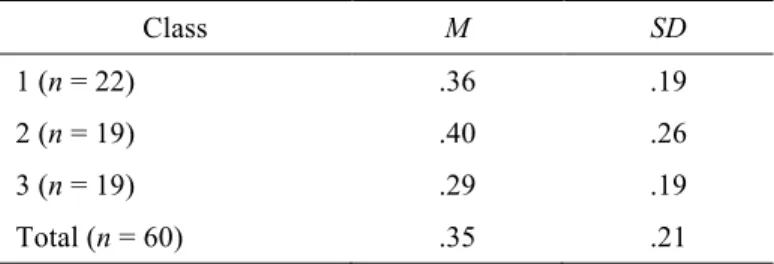
1. Data Analysis Overview ... 56 2. Demographic Characteristics of Participants ... 59 3. Mean Pretest Scores (in percentages) and Standard Deviations by Class ... 84 4. One-Way Analysis of Variance Summary Table for Pretest Scores and Six
Independent Variables ... 85 5. Spearman Correlations Among Pretest Scores and Demographic Variables .... 86 6. Mean Scores (in Percentages) and Standard Deviations at Each
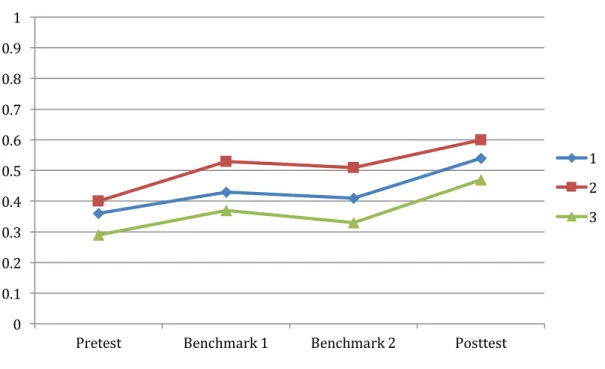
Measurement Point by Class ... 87 7. Generalized Estimating Equations (GEE) Results ... 90 8. Anna’s Strategies for Solving Fact Fluency Problems at Each
Measurement Point ... 105 9. Anna’s Transcript for Solving 12-8 from Pretest to Posttest ... 107 10. Anna’s Transcript for Solving 5+6 from Pretest to Posttest ... 109 11. Anna’s Transcript for Solving Separate Result Unknown Problems from
Pretest to Posttest ... 112 12. Anna’s Written Work for Solving Join Result Unknown Problems on the
Benchmark 2 and Posttest Assessments ... 114 13. Anna’s Transcript for Solving Join Result Unknown Problems on the
Benchmark 2 and Posttest Assessments ... 116 14. Anna’s Transcript for Placing Single-Digit Estimates on the Number
Line from Pretest to Posttest ... 118 15. Anna’s Transcript for Placing Estimates Close to 100 on the Number Line
from Pretest to Posttest ... 119 16. Anna’s Transcript for Placing Estimates Close to 50 on the Number Line
Table Page 17. Anna’s Correct and Incorrect Responses for Solving the Number Line
Tasks at Each Measurement Point ... 121 18. Anthony’s Transcript for Solving 6+8 from Pretest to Posttest ... 127 19. Anthony’s Transcript for Solving Multiplication Problems from Pretest to
Posttest ... 130 20. Anthony’s Transcript for Solving Story Problems on Benchmark 2 ... 131 21. Anthony’s Transcript for Solving Story Problems on the Posttest ... 132 22. Anthony’s Correct and Incorrect Responses for Solving the Number Line
Tasks at Each Measurement Point ... 133 23. Anthony’s Transcript for Placing Single-Digit Estimates on the Number
Line from Pretest to Posttest ... 134 24. Anthony’s Transcript for Placing Estimates Close to 100 on the Number
Line from Pretest to Posttest ... 135 25. Anthony’s Transcript for Placing Estimates Close to 50 on the Number
LIST OF FIGURES
Figure Page
1. Conceptual framework: Bridging approximate and symbolic number
systems for developing number sense ... 14
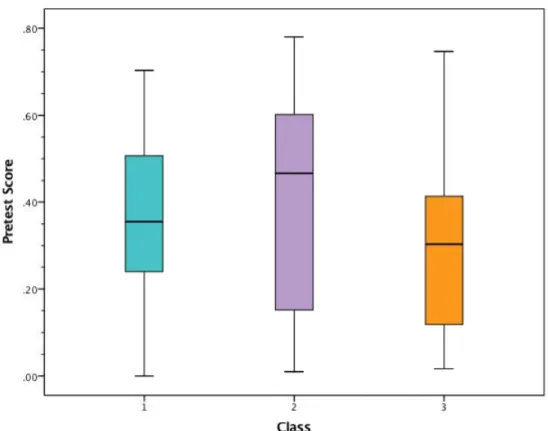
2. Box plots of student pretest scores by group (Classes 1, 2, and 3) ... 62
3. Pipeline staggered instructional treatment ... 71
4. Line graph of mean test scores by class across measurement points ... 88
5. Interaction plot for the Class*IEP interaction ... 92
6. Line graphs of Class 1’s individual student test scores across measurement points ... 93
7. Line graphs of Class 2’s individual student test scores across measurement points ... 94
8. Line graphs of Class 3’s individual student test scores across measurement points ... 95
9. Chart paper records of discussions from Teaching Episode 5 ... 96
10. Line graph of Anna’s test scores across measurement points ... 102
11. Line graph of Anna’s Computational Fluency scores across measurement points ... 103
12. Line graph of Anna’s Story Problem scores across measurement points ... 103
13. Line graph of Anna’s Number Line Task scores across measurement points ... 104
14. Work sample showing Anna’s use of dots to count from 0 to 33 to place 33 on the number line ... 118
15. Line graph of Anthony’s test scores across measurement points ... 124
16. Line graph of Anthony’s Computational Fluency scores across measurement points ... 124
Figure Page 18. Line graph of Anthony’s Number Line Task scores across measurement
points ... 125
19. Anthony’s written work for 81 and 84 on benchmark 2 and the posttest ... 136
20. Anthony’s written work for 64 and 61 on benchmark 2 and the posttest ... 137
21. Anthony’s written work for 24 and 39 on benchmark 2 and the posttest ... 139
22. Anthony’s counting journal entries highlight his new learning about counting by 100s as expressed in his posttest interview ... 141
CHAPTER I INTRODUCTION
“Well, I solved it really fast because I knew three 10s is 30 and three 5s makes 15 so that means Ms. Shumway has 45 cookies for the party.”
This was second-grader Sadia’s response to the following story problem. Ms. Shumway has 3 bags of cookies with 15 cookies in each bag. How many cookies does Ms. Shumway have for the party? Sadia decomposed the 15 into tens and ones (10 and 5) then used these friendlier numbers to solve for 3 bags of 15 cookies. She took the 10 and grouped “three 10s” together to make 30. Then, she grouped the three 5s together to make 15. Finally, Sadia composed the number 45 by combining the 30 and the 15 together. The description of Sadia’s cognitive process for solving the problem requires four sentences, yet in action, this process is quick, efficient, and employs deep
mathematical understanding. Sadia used her number sense to quickly solve the problem in her head. Big mathematics ideas based in number sense—such as decomposing numbers, place value ideas of tens and ones, unitizing, counting, patterns, and
relationships among numbers—are all embedded in Sadia’s strategy and explanation for this story problem. Sadia’s number sense approach to problem solving highlights a deeper conceptual understanding of mathematics and fluency with numbers and their relationships.
Education research indicates that number sense is a complex construct, and it involves many components including counting, numerical magnitude comparisons, estimation, number patterns, and the combination of amounts (Jordan, Kaplan, Olah, &
Locuniak, 2006; Locuniak & Jordan, 2008). Although number sense is a common term and is known to be important to students’ mathematics achievement (Chard et al., 2005; Jordan, Glutting, & Ramineni, 2010), there are few education research studies that examine instructional treatments focused on specific components of number sense. For example, a better understanding of the influence of a counting-focused instructional treatment on children’s number sense development could potentially contribute to teasing out the critical skills embedded in the complex definition of number sense. Such insight could contribute to designing early intervention programs, identifying effective
instructional practices, and extending the knowledge base of early number sense.
Therefore, the purpose of this study was to more closely examine the counting construct of number sense by exploring the variations in second-grade students’ number sense development as they engaged in a counting-focused instructional treatment for differing amounts of time.
Background of the Problem
In the opening vignette, Sadia’s explanation for solving three groups of 15 gives one snapshot of a student using her number sense to solve a story problem. Unlike the example of Sadia, many children lack the foundational number sense needed to succeed in mathematics. Although some children have strong understandings in mathematics computational procedures, they may not have the foundational number sense to truly understand the meaning behind the procedure. Lack of number sense is a factor in the troubling statistics regarding U.S. students’ mathematics achievement on international tests and the difficulties in recruiting students for Science Technology Engineering and
Mathematics (STEM) careers (Geary, Hoard, Nugent, & Bailey, 2013).
Number sense is the critical foundation for not only mathematics achievement in school but also for lifelong numeracy. Numeracy involves the ability to use and interpret quantitative information (Maclellan, 2012). Numeracy affects a person’s ability to handle the increasing quantitative demands of the modern economy (Hudson, Price, & Gross, 2009). Numeracy is also tied to adults’ employability and wages (Parsons & Bynner, 1997). Unfortunately, in the U.S., 22% of adults are functionally innumerate (Geary et al., 2013). With number sense being an important factor in a child’s path to numeracy, helping children develop number sense throughout their schooling is vitally important to their futures, both in terms of their jobs and daily life.
The good news is that mathematics education in the U.S. is moving in new directions that emphasize not only mathematics proficiency, but also mathematics understanding. The Common Core State Standards for Mathematics (CCSSM) aim to transform the country’s curriculum into a more focused and coherent set of standards (Common Core State Standards Initiative [CCSSI], 2010). As a result, deep and connected understandings of foundational number concepts and organizing principles, such as the structure of the number system, are being emphasized in the elementary mathematics standards (CCSSI, 2010; Confrey & Krupa, 2010). Although the CCSSM set grade-specific standards, the document does not define or specify how to teach foundational number concepts and how to provide number sense experiences.
Hence, number sense and instruction for developing number sense are critical areas of research in mathematics education because of the key role number sense plays in early mathematics development. Although the construct of number sense has been
described and studied since the early 20th century (e.g., Brownell, 1945; Dantzig, 1954), number sense has slowly, yet increasingly gained more attention by researchers and educators, especially in the last two decades (Berch, 2005; Resnick, Lesgold, & Bill, 1990). The field is particularly beginning to focus on studies finding that early development in number sense is critical to students’ later mathematics achievement (Chard et al., 2005; Jordan et al., 2006, 2010; Lago & DiPerna, 2010; Locuniak & Jordan, 2008). These important findings have led researchers to begin investigating interventions for early development in number sense.
Researchers are currently developing and testing interventions to improve preschool and kindergarten children’s early understanding of number (e.g., Clements, Sarama, Spitler, Lange, & Wolfe, 2011; Dyson, Jordan, & Glutting, 2013; Ramani & Siegler, 2008). While we know that early intervention for developing students’ number sense is important and interventions are being tested, there continues to be a lack of research on how various number sense constructs interact and impact children’s development of number sense, particularly in the grades beyond kindergarten. The cognitive psychology literature provides findings about mechanisms that facilitate early number learning. In particular, researchers have pinpointed key developments in
elementary grades, such as second grade. These findings in the cognitive psychology literature have the potential to inform the development of instructional interventions for elementary mathematics classrooms.
Cognitive psychologists have learned that a key development in early learning of number is the linking between children’s innate nonsymbolic number sense with the number words and Arabic numerals that represent quantities (Wilson, Dehaene, Dubois,
& Fayol, 2009). Another key mechanism is knowledge of the systematic relations among Arabic numerals and the skills in using this knowledge to solve arithmetic problems (Geary et al., 2013). First and second grades are a critical time for students to bridge innate understandings of number and symbolic cultural aspects of number that lead them to be successful in mathematics and develop strong numeracy for today’s society.
Integration of the non-symbolic number sense and symbolic systems of number is a key development in children’s understanding of number. The integration of these systems through verbal counting during first and second grades is thought to pave the way for refinement in numerical precision and understanding of the number system (Carey, 2001; Le Corre & Carey, 2007; Lipton & Spelke, 2005). Specifically, second-grade students must use the translation between symbolic and non-symbolic quantity to begin extending their understanding of the base-10 system and develop fluency with addition and
subtraction (CCSSI, 2010). This type of number sense knowledge makes formal
mathematics learning more accessible. Studies have found that having this knowledge in elementary school predicted better functional mathematical ability in adolescence (Geary et al., 2013).
Therefore, better understanding of number sense and its multiple constructs is important for mathematics education research. Overall, cognitive psychology research provides insights into the mechanisms that facilitate early quantitative learning. Mathematics education studies operationalize number sense, thereby, both providing insight into components of number sense that predict later mathematics achievement and allowing educators to better identify students at-risk for failure in mathematics. Both bodies of research provide a solid foundation for instructional intervention research.
More specifically, researchers suggest instructional intervention research that can reveal the extent to which early instruction in number sense relates to learning formal mathematics (Locuniak & Jordan, 2008). Within the broad construct of number sense, research has identified weaknesses in symbolic number sense as a key to learning difficulties in mathematics and as an area for future research (Geary et al., 2013; Jordan et al., 2010). Geary et al. proposed that intervention programs designed to help students understand systematic relationships between numbers could better prepare students for later employment, help them make wiser economic choices, and improve the future U.S. workforce.
Problem Statement and Research Questions
Cognitive psychology literature provides insights into the mechanisms that facilitate early quantitative learning, such as intuitive number sense, mapping of number words and symbols onto intuitive number sense, and understanding relationships among numbers. Cognitive psychology research on the processes involved in numerical
cognition has the potential to inform elementary mathematics instruction. While some instructional intervention research in preschool and kindergarten has been conducted by cognitive psychologists and educationalists, research is needed in elementary grades, such as second grade, when students are learning to link non-symbolic and symbolic understandings of quantity and learning systematic relationships among numbers (i.e., number system knowledge). Furthermore, much of the cognitive psychology intervention research was conducted in one-on-one, laboratory, or small group settings. Classroom-based research is needed in order to bridge understanding between numerical cognition
theory and classroom-based practices that provide children with opportunities to develop robust number sense.
Current mathematics education research shows that number sense predicts later mathematics achievement (Jordan et al., 2006, 2010; Lago & DiPerna, 2010; Locuniak & Jordan, 2008). Although number sense is a common term and is known to be important to students’ mathematics achievement, there are few studies that examine the role of
specific constructs of number sense in instructional interventions for improving
children’s number sense development. A better understanding of the influence of specific number sense constructs on children’s overall number sense development is needed. Research on specific number sense constructs could potentially contribute to teasing out the critical skills embedded in the complex definition of number sense, designing
instructional activities and programs, and extending the knowledge base of early number sense.
To address the gap in knowledge in the area of number sense research, this study examined a specific construct of number sense in the context of a quasi-experiment of an instructional treatment. Specifically, the purpose of the study was to investigate the counting construct of number sense and its influence on second-grade students’
development of number sense. This research examined the implementation of a counting-focused instructional treatment in second-grade classrooms that involved daily verbal counting and discussions about number system knowledge (i.e., symbolic number patterns and number relationships). Throughout the study, students’ number sense
achievement was measured by assessments of computational fluency, story problems, and number line estimations.
To understand the counting construct of number sense and its influence on students’ development of number sense, this study used an embedded mixed methods approach with quantitative and qualitative data collected before, during, and after
treatment instruction of second-grade students. The research questions guiding this study were:
Overarching Research Question: In what ways does a counting-focused instructional treatment (that focuses on patterns in the number system and relationships among numbers) influence, change, and develop second-grade students’ number sense (specifically, computational fluency, strategies for solving story problems, and number line estimation)?
1. What are the variations in number sense development when students engage in counting interventions for differing amounts of time (3 weeks, 6 weeks, and 9 weeks)?
a) What are the variations among three intact classes?
b) What are the variations for individual students within each class?
2. What are the variations in number sense development for one low-achieving student and one high-achieving student?
Significance of the Study
Research on number sense has the potential for providing teachers with an
understanding of how to build on students’ innate number sense while bridging the innate number sense with symbolic systems taught in schools. With a topic as complex and essential as number sense, children’s mathematics achievement in the elementary grades will be positively impacted as research on number sense instruction develops and
becomes better aligned with classroom practice. The application to teaching and learning in the classroom will be better linked to research as this study occurs in the area of number sense development and is set directly in second-grade classrooms.
Definition of Terms
The following key terms are defined for this study.
Number sense is defined from an educationist’s perspective, which takes a broader and more-inclusive approach. Number sense entails foundational understandings of quantities, number, relationships among numbers, and the number system. Children are born with intuitive number sense, which develops over time with experiences. This informal number sense develops into more formal number sense knowledge as children learn symbolic cultural tools to represent their informal sense of number. In this study, the term number sense encompasses number system knowledge, number sense access, and intuitive number sense (defined below) and is used in the context of an elementary classroom setting.
Intuitive number sense is the innate, evolutionary understandings of number, which entails the approximate number system and subitizing (defined below). Cognitive psychologists typically call this “the number sense” and define it as the ability to “quickly understand, approximate, and manipulate numerical quantities” (Wilson et al., 2009). I call it “intuitive number sense” to distinguish cognitive psychologists’ definition of number sense with the broader educationalist definition of number sense. Intuitive number sense is measured by non-symbolic quantity tasks that involve viewing, comparing, adding, or subtracting non-symbolic numerosities.
The Approximate Number System (ANS), also known as approximate representation of magnitude, is the foundational system that underlies the ability to nonverbally represent number (Halberda & Feigenson, 2008). It represents number
approximately and is thought to provide a foundation for arithmetic computation. It is measured by non-symbolic numerical discrimination tasks. I define it as a part of intuitive number sense.
Subitizing is the ability to quickly perceive a non-symbolic set of items less than 4 (Clements, 1999; Kaufman, Lord, Reese, & Volkmann, 1949). Cognitive psychologists refer to subitizing as a system for keeping track of small numbers of individual objects (Feigenson, Dehaene, & Spelke, 2004). Along with the ANS, the two systems make up intuitive number sense. It is measured by non-symbolic numerical discrimination tasks.
Number sense access is the linking between symbolic representations (e.g., number words and Arabic numerals) with their non-symbolic representation of quantity. Number sense access is measured by comparing the results from non-symbolic tests to those from tests involving symbolic stimuli.
Number system knowledge is the processing of Arabic numerals and understanding relationships among numerals (Geary et al., 2013). This includes understanding of relative magnitude of numerals, ordering of numerals, and the composition of numbers. Number system knowledge is measured by knowledge of the systematic relations among Arabic numerals (such as number line estimation tasks) and the use of this knowledge to solve arithmetic problems (e.g., computational fluency).
Counting for this study is used conceptually to encompass the rote counting sequence (verbal count words and/or numerals) and enumeration (i.e., counting objects), as well as an understanding of number, number patterns, number relationships, and the number system. Verbal counting and the discussions around counting are the foci of the instructional treatment in this study. While I acknowledge that the term counting
encompasses many components, for the purpose of brevity, I call the intervention a “focused instructional treatment,” using the broad term counting. The counting-focused instructional treatment will take place in second-grade classrooms, hence, the counting focus of the intervention will be on verbal counting and discussions about the relationships among numbers in these counting sequences.
Computational fluency, within this study, is the basic number combinations of single-digit addition and subtraction items (Baroody, Bajwa, & Eiland, 2009). In this study, it is assumed that fluency with the basic number combinations grows out of number sense (i.e., number sense perspective), and more specifically, number system knowledge (Geary et al., 2013).
CHAPTER II LITERATURE REVIEW
Researchers are finding that early number sense development is critical to
students’ later mathematics achievement (e.g., Geary et al., 2013; Jordan et al., 2010). A body of literature exists on number sense constructs, assessments, and instructional interventions. A systematic literature review for this study provided a research foundation for investigating how children learn number, how foundational understandings of number develop and are interconnected, and what teachers can do to support students’ early number sense development.
Number sense is a complex construct in mathematics education literature. It is multilayered and multifaceted, therefore, various researchers have different definitions for the term “number sense” (Berch, 2005; Jordan et al., 2006; Lago & DiPerna, 2010; Resnick et al., 1990). Education researchers generally acknowledge constructs of number sense as counting, number knowledge (such as numerical magnitude comparisons), estimation, number patterns, number relationships, and number transformations (such as the combination of amounts; Jordan et al., 2006; Locuniak & Jordan, 2008). Some researchers consider a child’s fluidity and flexibility with numbers, mental math, and ability to subitize to be critical components of number sense (Lago & DiPerna, 2010; Resnick et al.,1990). Cognitive psychologists describe humans’ and animals’ innate abilities of approximating number (discriminating quantities) and subitizing (recognizing and distinguishing small amounts) as “the number sense” (Dehaene, 1997; Halberda & Feigenson, 2008; Schleifer & Landerl, 2011). Both the education and cognitive
psychology views of the number sense construct consider it to be foundational in students’ learning and development of mathematics.
This literature review is organized into two major sections: (1) Conceptual Framework, and (2) Reviewing the Literature: Number Sense Measures and
Interventions. The first section reviews both cognitive psychology and mathematics education literatures in order to develop a theoretical understanding of the mechanisms for number sense and numerical cognition. The second section entails a systematic review of current empirical studies about preschool and elementary students’ number sense. The conceptual framework grounds the study theoretically while the systematic review of the literature places the research study within the broader number sense research context.
Conceptual Framework
This study was framed by both cognitive psychologists’ and mathematics education researchers’ conceptions of number sense. An understanding of students’ nonverbal and pre-school knowledge provides an important foundation for research on mathematics instruction that builds on students’ intuitive number sense. Bridging the intuitive number sense with symbolic systems taught in schools has important
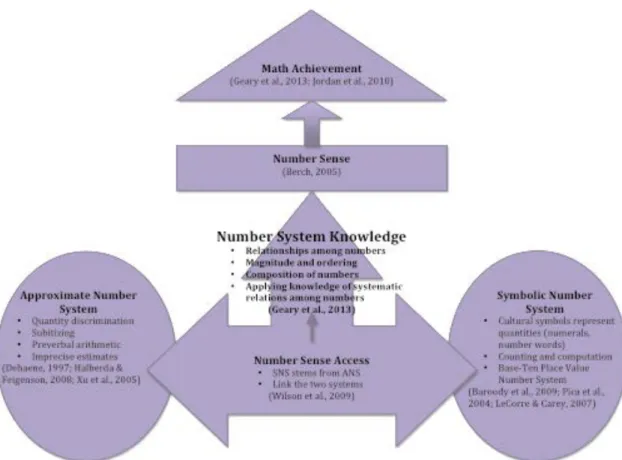
implications for mathematics education research. A conceptual framework (see Figure 1) that emphasizes the relationships of the intuitive number sense (defined and studied by cognitive psychologists) with the broader conception of number sense that is more closely tied to symbolic representations of quantities (mainly explored in mathematics education research) informed the analysis and synthesis of articles included in this
Figure 1. Conceptual framework: Bridging approximate and symbolic number systems for developing number sense.
literature review. The Approximate Number System (ANS) describes the intuitive number sense, which includes nonverbal and pre-symbolic notions of quantity (Dehaene, 1997; Halberda & Feingenson, 2008; Xu, Spelke, & Goddard, 2005). The Symbolic Number System (SNS) includes symbolic notions of number such as cultural symbols that represent quantities such as numerals, verbal counting, and place value concepts (Baroody, Eiland, & Thompson, 2009; Le Corre & Carey, 2007; Pica et al., 2004).
Figure 1 illustrates the conceptual framework for understanding the interactions and relationships between the ANS and SNS, indicating that Number Sense Access plays a key role in bridging the two systems as children develop their number sense (Wilson et
al., 2009). Number System Knowledge is developed as students bridge the ANS and SNS leading to more formal and abstract understandings of numbers and their systematic relationships (Geary et al., 2013). Number System Knowledge leads to the broad educationalist term Number Sense (Berch, 2005), which captures the components of number system knowledge and expands that definition to include applications of number sense within mathematics in general (leading to Math Achievement). The researcher for this study hypothesized that the symbiotic relationship and interaction between the ANS and the SNS is particularly important during children’s second-grade school year as they develop their number system knowledge, providing a solid foundation for further number sense development and mathematics achievement. Each of these terms within the
conceptual framework is described in detail below.
Nonverbal Mathematics: The Approximate Number System
Recent research indicates that humans, and other animal species, are endowed with an innate sense of number (Dehaene, 1997; Feigenson et al., 2004; Xu, Spelke, & Goddard, 2005). Studies showed that infants are able to subitize (recognize exact amounts of up to three objects), discriminate numerosities, and hold expectations about the outcomes of simple arithmetic (e.g., one more or one less). These capabilities are independent of language and are not taught or transmitted through culture (Feigenson et al., 2004; Pica, Lemer, Izard, & Dehaene, 2004). This intuitive number sense is
represented as the ANS oval of the graphic in Figure 1. For the purposes of this
conceptual framework, the term, Approximate Number System (ANS), refers to the early and intuitive abilities of subitizing, quantity discrimination, magnitude comparison, and
preverbal arithmetic. It has been argued that subitizing (i.e., object-file system) is
separate from the ANS (Feigenson et al., 2004), however, this debate is beyond the scope of this literature review. For ease of discussion, subitizing is included within the term ANS, although the researcher recognizes that some cognitive psychologists are finding that it is a core system distinct from the ANS.
The preverbal recognition of and discrimination between quantities is imprecise and is ratio-dependent; meaning, for example, that infants can discriminate between 8 and 24 objects, but cannot discriminate between 8 and 16 objects. Additionally, this early numerical knowledge is accessed across multiple modalities of input. For example, infants not only discriminate visual amounts, but also discriminate with the same ratios between amounts presented as sounds.
Cultural Symbols Representing Quantities: The Symbolic Number System
The right side of the conceptual framework graphic (see Figure 1), named the Symbolic Number System (SNS), refers to the part of number sense that is transmitted through cultural symbols of numerals and number systems, based in language, and formally taught in elementary school. While human infants are born with an innate sense of number, it takes children many years to learn verbal counting and the symbolic
representations of quantity.
There is evidence that between the ages of 3 and 5, children construct meaning to symbolic notations of quantity (Le Corre & Carey, 2007). They learn to map symbolic numbers (i.e., number words and numerals) onto their pre-existing notions of quantity based in the ANS (Le Corre & Carey, 2007; Pica et al., 2004; Siegler & Booth, 2004). As
this mapping of symbolic numbers takes place, the foundation for counting, exact
enumeration, and arithmetic is laid. An understanding of the base-ten place-value system, number patterns, and relationships among numbers becomes accessible to children. This is the groundwork for more formal and abstract mathematics.
The Role of Counting: Number Sense, Number Sense Access, and Number System Knowledge
The horizontal arrows linking the ANS and SNS in Figure 1 show a relationship between these two systems. It can be argued that the SNS stems from the ANS, as symbolic representations of quantities are mapped onto the pre-existing conceptions of quantity. However, there is evidence that the two systems function separately while also supporting the development of each other. Research indicates that the ANS continues to sharpen in acuity through the elementary years (Halberda & Feignenson, 2008)
simultaneous to the development of the SNS. This sharpening of the ANS results from maturity but also from experiences with symbolic numbers and with symbolic numbers combined with visual representations of quantities. As the ANS becomes more precise, the SNS also develops with improvement in children’s ANS acuity. Hence, the separate ovals represent the ANS and the SNS as two independent systems, while the horizontal arrows represent the symbiotic relationship between the systems.
In addition to highlighting the relationship between the ANS and the SNS, the horizontal arrows also highlight an important process that takes place as the two systems work together, labeled as “number sense access.” Wilson et al. (2009) emphasized that “a key development which must occur during human learning is the association between
non-symbolic number sense and the cultural symbols which represent number (e.g., number words and Arabic digits)” (p. 225). They referred to the conversion from nonverbal, nonsymbolic number knowledge to the culturally-based symbolic system for representing numbers as “number sense access.” The Wilson et al. study results suggested that many students with “low number sense” have difficulty with number sense access.
Building from the idea of number sense access, “number system knowledge” represents the further development of these culturally-based symbolic number
understandings. Number system knowledge is the processing of Arabic numerals and understanding relationships among numerals (Geary et al., 2013). This includes understanding of relative magnitude of numerals, ordering of numerals, and the
composition of numbers. Number system knowledge is measured by knowledge of the systematic relations among Arabic numerals (such as number line estimation tasks) and the use of this knowledge to solve arithmetic problems (e.g., computational fluency).
The number system knowledge aspect of the conceptual framework is where this study on the counting construct of number sense is centrally located. Verbal counting is set in the SNS, as it is a symbolic process, and it also accesses students’ ANS because counting associates number words and numerals with quantities. A verbal counting-focused instructional treatment has the potential for developing students’ number system knowledge, thereby improving students’ number sense (as represented in the vertical arrow connected to the number system knowledge horizontal arrows). As students’ number system knowledge improves, their number sense is strengthened, and students’ mathematics achievement increases (Jordan et al., 2006, 2010; Jordan, Kaplan, Locuniak, & Ramineni, 2007) as indicated by the arrow leading from number sense to mathematics
achievement in Figure 1.
A Conceptual Framework as a Lens for Research: Current Understandings of Number Sense and its Constructs
The conceptual framework for this study highlights the complexity of the number sense construct. It emphasizes the relationships of the innate number sense defined and studied by cognitive psychologists with the broader conception of number sense that is more closely tied to symbolic representations of quantities and explored in mathematics education research and practice. Recent discussion on the role of number system
knowledge in remedying “low number sense” (Geary et al., 2013; Wilson et al., 2009) is presented in this framework and could be a key element for research on the role of counting in developing students’ number sense. A better understanding of the influence of verbal counting on children’s number sense development (specifically, its influence on children’s understanding of estimation, computation, relationships among numbers, patterns in the number system, and place value) is needed and could potentially
contribute to and extend the research base on number sense. The conceptual framework in Figure 1 could serve as a tool for framing such studies, as proposed in this study. The conceptual framework was used to synthesize relevant research on current understandings of number sense and its constructs.
The aim of this next section is to review empirical studies with the primary purpose of understanding the construct of number sense, which mainly comes out of the cognitive psychology research, and more specifically from cognitive neuroscience and/or numerical cognition literature. These studies serve to identify and define the
psychological aspects of number sense and its constructs as well as explain how
children’s schemas for number sense develop as they are introduced to numbers in a more formal school setting. This section is organized around major topics of the conceptual framework (ANS, SNS, number sense access, number system knowledge, and number sense) and the framework is used to understand how the counting construct of number sense could potentially be a key factor in the concept of number system knowledge.
Number Sense in Mathematics Education and Cognitive Psychology
Researchers make a distinction between the conceptual definition of number sense and its operational definitions (Berch, 2005). Being a multifaceted construct, this
distinction emphasizes the complexity of number sense (conceptual definition) while providing a framework for researchers to utilize in order to assess number sense
(operational definitions). Even within these distinctions, researchers further distinguish number sense as either the broad, educational definition or as the more specific, cognitive psychology definition, both of which have conceptual and operational definitions.
The cognitive psychology conceptualization of number sense is based on the idea that humans and nonhuman animals are born with an ancient and evolutionary notion of number (Dehaene, 1997). This intuitive understanding of quantity involves the ability to quickly perceive small amounts (subitize), approximate numerical magnitudes, and comprehend simple number transformations (such as one more or one less; Dehaene, 1997; Feigenson et al., 2004; Halberda & Feigenson, 2008). This sense of number is nonverbal and nonsymbolic, and it is an innate internal cognitive process.
upon the nonverbal, nonsymbolic definition of number sense put forward by cognitive psychologists, but tends to also involve the symbolic representations and understandings of number acquired through formal and informal experiences. For example, much of the research on number sense in mathematics education is focused on the formal school experiences that promote counting, more detailed and exact representations of number, quantities tied to symbols, and number system concepts (e.g., Baroody, Eiland, & Thompson, 2009; Chard et al., 2005; Dyson et al., 2013; Jordan, Kaplan, Ramineni, & Locuniak, 2009; Lago & DiPerna, 2010; Locuniak & Jordan, 2008; Malofeeva, Day, Saco, Young, & Ciancio, 2004; Ramani & Siegler, 2008).
Rather than compare the methodologies of these studies, this section of the literature review will focus on synthesizing and interpreting the findings of current research. It is important to note that the methodologies of these studies mainly occur in laboratories, which is not as applicable to the practical applications of mathematics education research. A review of methodologies will be important in the analysis of intervention studies and is discussed in a subsequent section. The following sections are organized around the major components of the conceptual framework for the study: (1) nonverbal number knowledge, (2) symbolic number system, (3) number system
knowledge and number sense, and (4) the role of the counting construct of number sense.
Nonverbal number knowledge: Subitizing, Approximate Number System,
and early arithmetic. Human infants, children, and adults across all cultures as well as
some nonhuman animals possess an innate ability to conceptualize quantities (Xu et al., 2005). One system within this nonverbal number knowledge realm is the ANS, which is the internal cognitive system of magnitude representations. It is a nonverbal
representation of quantities (independent of symbols), operates across modalities (e.g., visual and auditory), and tends to hold imprecise approximations of number (often called analog magnitudes; Halberda & Feigenson, 2008; Pica et al., 2004). The imprecise approximations of number distinguish the ANS from counting and the use of symbols (such as number words or numerals) to represent quantities. Studies on the ANS are reviewed here as they have implications for the teaching and learning of number sense. Additionally, these studies lay the foundation for understanding how the ANS and SNS systems are separate yet interact as young children develop their number sense.
Xu et al. (2005) conducted a study on one aspect of this nonverbal number knowledge in infants. Their research investigated 6-month-old infants’ sense of approximate numerical magnitudes (i.e., ANS) through four experiments using a preferential looking method as infants were presented with numerosities in various visual-spatial displays. Prior research (Xu & Spelke, 2000) had demonstrated infants’ capacities for numerosity discrimination in the ratio of 8:15, hence, this study (Xu et al., 2005) tested infants’ abilities to discriminate larger numerosities. The results pointed to infants’ abilities to discriminate arrays of 16:32, but not 16:24, which supported previous research that numerosity discrimination depends on the set-size ratio. Additionally, results of the third and fourth experiments in the study showed that infants successfully discriminated the large-number displays (e.g., discriminating 16 from 32 dots), but not the small-number displays (e.g., discriminating one dot from two dots). The results were interpreted to mean that there are separate systems within this nonverbal number
knowledge with one representing large numerosities and one representing small numerosities.
While Xu et al.’s (2005) investigation into infants’ sense of approximate numerical magnitudes set the stage for understanding children’s innate abilities with number, Halberda and Feigenson (2008) extended this line of research to explore the developmental trajectory of children’s ANS beyond that of 6-month-old infants. Halberda and Feigenson investigated changes in 3-, 4-, 5-, and 6-year-old children’s ANS
representational acuity. Their purpose was to find out if the ANS continues to develop and “sharpen” (i.e., become more precise) even as children begin formal schooling. They conducted a cross-sectional design testing 16 participants in each of the four age groups plus a group of 16 adults. The numerical discrimination task involved a quick display of two sets of arrays (66 test trials). Halberda and Feigenson found that 3- to 6-year-old children are still developing the acuity of the ANS. The potential implications of this finding for teaching and learning in the school setting include educating teachers about the ANS development and how to enhance and build on children’s innate understandings of quantity (i.e., their number sense). Halberda and Feigenson argued that some of the sharpening of the ANS is likely due to maturation, but that experience also likely affects the development of the ANS. Changes in the ANS acuity impact children’s numerical discrimination abilities as well as their estimation of numerical magnitudes. The authors stated that, “the protracted nature of ANS development, spanning the period when symbolic mathematical instruction begins, has implications both for mathematics education and for our understanding of the interplay between individual experience and the ‘number sense’” (p. 1464). Because the nonverbal ANS plays a central role in mathematics throughout the human lifespan, understanding its development during children’s early school years is important to consider in number sense research.
Furthermore, understanding its development alongside and/or with children’s formal symbolic number instruction could positively impact teaching methods in young children’s mathematics classrooms.
Symbolic Number System: Number words, numerals, counting, and the
number system. Researchers, such as Xu et al. (2005) and Halberda and Feigenson
(2008) studied aspects of humans’ nonverbal, nonsymbolic understandings of number. Other research (Le Corre & Carey, 2007; Le Corre, Van de Walle, Brannon, & Carey, 2006; Pica et al., 2004) extended these findings on humans’ innate number sense abilities that develop through the lifespan and investigated the uniquely human aspects of number knowledge that involve language, symbols, and a counting system. The Le Corre and Carey; Le Corree et al.; and Pica et al. studies further highlight the interactions between the nonverbal and symbolic systems for understanding number and the implications for teaching and learning number sense in schools.
Pica et al. (2004) conducted their numerical cognition study with native speakers of Munduruku, a language used by members of an Amazonian tribe. Munduruku is a language that has number words for numbers 1 through 5, but does not have a count-based representation of number. Through a battery of numerical tests (e.g., magnitude comparisons, estimation tasks, and manipulation of exact numbers), Pica et al. (2004) found that the speakers of Munduruku had numerical approximation competence, as they were able to represent large numbers and understand the concept of relative magnitude. Hence, these results provided evidence that the ANS competencies are common across human cultures and are independent of language. However, Pica et al. also found that language plays a role in the emergence of more exact representations of number as well
as exact arithmetic. Munduruku speakers, without a count-based system, allowed approximate use of number words in the range of 3 to 5; whereas, English speakers use the number words and numerals in this range to refer to precise quantities. Additionally, the Munduruku speakers failed on the Manipulation of Exact Numbers task—results that were interpreted to mean that there is a distinction between approximate and exact mental representations of number and that language plays a special role in the emergence of exact arithmetic. Pica et al. concluded that beyond just the language for numbers, the lack of a counting system in the Munduruku language played a role in these results. They conjectured that the counting system in English (i.e., the exact one-to-one pairing of objects with sequence of number words) promotes a conceptual integration of the ANS, discrete object representations, and the verbal code.
Counting and number sense. To explore this role of verbal counting and how it is linked to the nonverbal nonsymbolic number knowledge, Le Corre and Carey (2007) and Le Corre et al. (2006) conducted studies to investigate how verbal counting principles are acquired. Some researchers claim that acquiring the verbal counting principles takes place as numerals in the counting sequence are mapped onto the ANS (e.g., Le Corre et al., 2006), while other researchers purport that innate non-verbal counting principles guide the development of counting skills (Gelman & Gallistel, 1978). In either case, both views recognize the long process and the complexity of learning the verbal counting sequence for young children. Since current empirical studies are testing this first view, known as the principles-after view, this literature review focuses on summarizing these recent empirical studies coming out of the Le Corre cognition laboratory.
experiments were conducted with children between the ages of 2- to 5-years-old to investigate their understanding of counting and how the nonverbal, nonsymbolic number knowledge supports the verbal number count and its principles. In both studies, a variety of numerical tasks were presented to the children. Based on initial tasks, children were divided into cardinal-principle-knowers (they know how counting works) and subset-knowers (they do not know how counting works) in order to compare the roles of this knowledge with children’s abilities to use verbal counting. Both studies’ results were interpreted to mean that the counting system is a new representational format for
children, meaning that counting is not an innate skill like the ANS. Le Corre et al. (2006) argued that the verbal count list had a long construction process in human history and this same type of construction process is witnessed in the studies involving children ages two to five as they construct understandings of verbal counting and its principles. Le Corre and Carey’s (2007) experiment with 2- and 3-year-old children showed that although many of the participants knew the count list up to ten, none of them could estimate a set of more than four objects. In other words, the children mapped the numerals 1 to 4 onto their innate sense of numerical magnitude, but then used numerals randomly when
estimating a set of objects in the range of 5 to 10. The researchers interpreted this to mean that the mapping of large numerals to the analog magnitudes of the ANS occurs after the acquisition of the counting principles. For example, their studies indicated that children develop the verbal count list around the age of three, then around 4½- years of age, they begin to map verbal number words onto the analog magnitudes of the ANS. These findings complement the findings of Pica et al.’s (2004) study, which indicated that the lack of a counting system in the Munduruku language did not impede their ANS, but did
prevent the Munduruku speakers from using their number words from 3 to 5 to assign meaning to discrete numbers. Pica et al. stated;
Around the age of 3, Western children exhibit an abrupt change in number processing as they suddenly realize that each count word refers to a precise quantity. This ‘crystallization’ of discrete numbers out of an initially approximate continuum of numerical magnitudes does not seem to occur in the Munduruku. (p. 503).
Number sense access, number system knowledge, and number sense. The
studies on the ANS, verbal number words, and counting system reviewed here
specifically investigated how the nonverbal, nonsymbolic number knowledge interacts or does not interact with the culturally-based symbols for quantity. While the debate on the ontology of the counting system continues to thrive in the cognitive psychology research, the critical aspect that informs the current study is that the two systems, the nonverbal, nonsymbolic system and the culturally based symbolic system, are separate yet support one another. Understanding the ways in which the ANS and SNS are linked is important for educators because students begin their formal schooling just as they begin to
understand and use the counting system. Wilson et al. (2009), in their number sense intervention study, highlighted the importance of understanding children’s nonsymbolic and symbolic understandings of number both separately and in the ways that they are linked. Their study involved the use of both symbolic and nonsymbolic measures of students’ numerical understandings, which led them to consider that the source of children’s low “number sense,” as the term is used in mathematics education, may actually be difficulty with number sense access, not difficulty with their innate number sense. Number sense access is the linking of symbolic representations to their
As children move beyond the early stages of knowing the verbal count list up to ten and mapping numbers onto larger quantities (LeCorre & Carey, 2007), number sense access continues to be important as they progress through the early school grades. These early years of school involve learning a longer count list (beyond 10), becoming more adept with precision of larger quantities, and beginning to link the counting sequences and counting principles to the larger base-ten place-value number system. Geary et al. (2013) have pinpointed number system knowledge, knowledge of these systematic
relations among Arabic numerals and using that knowledge in computation, as a predictor for children’s functional numeracy as they progress in their elementary mathematics learning.
The following section summarizes and synthesizes lines of research tied to children’s development of counting as they progress to more symbolic representations of number and how these representations are linked to their innate analog magnitudes from the ANS. This development has implications for children’s success with more advanced number knowledge, estimation, and number transformations such as arithmetic and mental math. It could be argued that number sense access and number system knowledge are at play in the following studies.
Counting and factors that affect its successful use. The Jordan et al. (2009, 2010) longitudinal correlational studies showed strong and significant relationships between students’ number sense and their mathematics achievement. Counting, along with number relationships and basic operations, was found to contribute to students’ success or lack of success in later mathematics (Jordan et al., 2010). Current empirical studies on counting, as it is tied to number sense, indicate the importance of counting to
students’ success in mathematics as well as factors that account for differences in children’s counting skills. For example, in Aunola, Leskinen, Lerkkanen, and Nurmi’s (2004) longitudinal study, counting ability was found to be a predictor for mathematics performance. Aunola et al. investigated the developmental dynamics of 5- and 6-year-old Finnish children’s mathematics performance as they transitioned from preschool to second grade. In an eye tracking study conducted on German children between ages 8 to 14, Schleifer and Landerl (2011) found that age was more important in performance on the counting tasks than it was in the subitizing tasks. Aunio et al. (2006) examined why students in early grades (ages 4-7) come to school with varying levels of number sense. They examined the influence of nationality, age, and gender on young children’s number sense by administering the Early Numeracy Measure, which measures general numerical skills (relational skills) and specific numerical skills (counting skills) to 130 Chinese children and 203 Finnish children. The researchers reported a difference in the counting skills between Chinese children and Finnish children, and that Finnish children’s number sense developed at a slower pace than that of the Chinese children. Therefore, Aunio et al. concluded that counting skills rely on culturally-based symbolic systems which require systematic and explicit teaching, which are characteristics of Chinese classrooms. The findings also suggested that language may have been another factor influencing the differences in Chinese and Finnish children’s test scores.
These studies suggest that age, language, and methods of teaching potentially impact students’ counting skills, thereby also affecting their number sense development. Each of these are important factors to be considered in mathematics teaching and
understandings of number sense and its constructs indicate that number sense is a complex construct and that different fields view and conceptualize it differently. The cognitive psychology research on number sense studies the psychological processes of number sense, which makes their literature a fruitful basis for mathematics education research. The next sections summarize, synthesize, and interpret literature on number sense measures and number sense interventions. Many of these studies come out of the mathematics education and special education fields. However, several studies (e.g., Geary, 2011; Siegler & Ramani, 2008; Wilson et al., 2009) illustrate the encouraging integration of cognitive psychology research with classroom research.
Reviewing the Literature: Number Sense Measures and Interventions
The purpose of the “Conceptual Framework” section of the literature review was to review studies that lead to a deeper understanding of the number sense construct and how the constructs are related and interact. The purposes of the sections that follow are to examine, synthesize, and interpret current empirical studies in the field of number sense research and discuss implications based on research conducted during the last 12 years. This section of the literature review presents the current state of knowledge on number sense assessments or measures and number sense interventions. The review is organized in the following sections: (1) Literature Review Objectives, (2) Literature Review
Procedures, (3) Number Sense Measures, (4) Number Sense Interventions and Programs, and (5) Building on Current Research. The final section presents the research questions that have emerged from and developed based on the current empirical research in the number sense field.
Literature Review Objectives
A systematic review of the literature (Kennedy, 2007) was conducted in order to lay the foundation for research on number sense and the impact of its various components on children’s development of number sense and their mathematics achievement. A search of the literature on the broad topic of number sense was necessary in order to understand the interrelatedness of the multiple components of the number sense construct and locate the areas needing further research. Both mathematics education research (general as well as special education) and cognitive psychology literature were searched in order to
understand the teaching and learning implications of number sense research as well as the cognitive learning processes that take place as students develop number sense. This literature review identified, analyzed, evaluated, synthesized, and interpreted empirical studies on the teaching, learning, and cognitive processes of number sense. The
objectives of this literature review were: (1) To describe the current state of research on number sense, specifically its constructs, how it is measured, and its impact on student learning and achievement; (2) To discuss the findings, strengths, and weaknesses in previous research, particularly in regard to the designs and methods of the studies; and (3) To draw conclusions based on this information and develop the research questions and methods for this study based on a thorough examination of the literature in the field.
Literature Review Procedures Databases and Keywords