© 2013. E. Venkateswara Reddy & Dr. E. S. Reddy. This is a research/review paper, distributed under the terms of the Creative Commons Attribution-Noncommercial 3.0 Unported License http://creativecommons.org/licenses/by-nc/3.0/), permitting all non-commercial use, distribution, and reproduction inany medium, provided the original work is properly cited.
Global Journal of Computer Science and Technology
Graphics & Vision
Volume 13 Issue 6 Version 1.0 Year 2013
Type: Double Blind Peer Reviewed International Research Journal Publisher: Global Journals Inc. (USA)
Online ISSN: 0975-4172 & Print ISSN: 0975-4350
By E. Venkateswara Reddy & Dr. E. S. Reddy
Acharya Nagarjuna University, India
Abstract -
Image segmentation is critical for many computer vision and information retrieval systems, and has received significant attention from industry and academia over last three decades. Despite notable advances in the area, there is no standard technique for selecting a segmentation algorithm to use in a particular application, nor even is there an agreed upon means of comparing the performance of one method with another. This paper, explores Rough-Fuzzy K-means (RFKM) algorithm, a new intelligent technique used to discover data dependencies, data reduction, approximate set classification, and rule induction from image databases. Rough sets offer an effective approach of managing uncertainties and also used for image segmentation, feature identification, dimensionality reduction, and pattern classification. The proposed algorithm is based on a modified K-means clustering using rough set theory (RFKM) for image segmentation, which is further divided into two parts. Primarily the cluster centers are determined and then in the next phase they are reduced using Rough set theory (RST). K-means clustering algorithm is then applied on the reduced and optimized set of cluster centers with the purpose of segmentation of the images. The existing clustering algorithms require initialization of cluster centers whereas the proposed scheme does not require any such prior information to partition the exact regions. Experimental results show that the proposed method perform well and improve the segmentation results in the vague areas of the image.Keywords :
uncertain images, RGB images, rough set, K-means algorithm.
GJCST-F Classification :
I.4.6
Image Segmentation using Rough Set Based Fuzzy K-Means Algorithm
Strictly as per the compliance and regulations of:
Image Segmentation using Rough Set based Fuzzy K-Means
Algorithm
Image Segmentation using Rough Set based
Fuzzy K-Means Algorithm
E. Venkateswara Reddy α& Dr. E. S. Reddy σ
Abstract - Image segmentation is critical for many computer
vision and information retrieval systems, and has received significant attention from industry and academia over last three decades. Despite notable advances in the area, there is no standard technique for selecting a segmentation algorithm to use in a particular application, nor even is there an agreed upon means of comparing the performance of one method with another. This paper, explores Rough-Fuzzy K-means (RFKM) algorithm, a new intelligent technique used to discover data dependencies, data reduction, approximate set classification, and rule induction from image databases. Rough sets offer an effective approach of managing uncertainties and also used for image segmentation, feature identification, dimensionality reduction, and pattern classification. The proposed algorithm is based ona modified K-means clustering using rough set theory (RFKM) for image segmentation, which is further divided into two parts. Primarily the cluster centers are determined and then in the next phase they are reduced using Rough set theory (RST). K-means clustering algorithm is then applied on the reduced and optimized set of cluster centers with the purpose of segmentation of the images. The existing clustering algorithms require initialization of cluster centers whereas the proposed scheme does not require any such prior information to partition the exact regions. Experimental results show that the proposed method perform well and improve the segmentation results in the vague areas of the image.
Generalterms : image processing, pattern recognition, segmentation.
Keywords : uncertain images, RGB images, rough set, K-means algorithm.
I.
Introduction
mage segmentation is one of the most challenging tasks in image analysis. It is also useful in the field of pattern recognition. Image mining deals with the extraction of implicit knowledge, image data relationship, or other patterns not explicitly stored in the images [5][6][7]. Image Segmentation is becoming more important for medical diagnosis process. Currently, development an efficient computer aided diagnosis system that assist the radiologist has thus become very interest, the aim being not to replace the radiologist but to over a second opinion [3, 4]. Consequently, the need of efficient research on features extracted and their role to the classification results
Author
α: Research Scholar, Acharya Nagarjuna University Guntur. E-mail : [email protected]
Author
σ:Principal, University College of Engineering, ANU, Guntur. E-mail : [email protected]
makes researchers to select features randomly as input to their systems. In image segmentation an image is divided into different regions with similar features. There are many different types of approaches of image segmentation. Edge-based method, region-based techniques and threshold-based techniques and so on. Images are partitioned according to their global feature distribution by clustering based image segmentation methods. In this paper, a image segmentation method based on K-means using rough set theory isproposed, in which pixels are clustered according to the intensity and spatial features and then clusters are combined to get the results of final segmentation. The paper is organized as follows. In section 2 rough set theory is described. In section 3 rough set based K-means algorithm is proposed. In section 4 we have shown the experimental results and in section 5 some conclusions have been made.
II.
Rough Set Concepts
Rough Set Theory was firstly introduced by Pawlak in 1982 [2][3] and is a valuable mathematical tool for dealing with vagueness and uncertainty [4]. Similar or indiscernibility relation is the mathematical basis of the Rough Set theory. The key concept of rough set theory is the approximate equality of sets in a given approximation space [2][3]. An approximation space A is an ordered pair ( , )U R whereUis a certain set called
universe, and that equivalence relationR⊂ ×U U is a
binary relation called indiscernibility relation; if x y, ∈U
any ( , )x y ∈R, this means that x and y are
indistinguishable in A; equivalence classes of the
( ) { : [ ] }
A X = x∈U x R ⊂ X ,
( ) { : [ ] }
A X = x∈U x RX ≠φ ,
I
Global Journal of Computer Science and Technology Volume XIII Issue VI Version I
23 (DDDDDDDD ) Year 013 2 F
Where[ ]xRdenotes the equivalence class of the
relation R containing element x. In addition, the set
,
relation R are called elementary sets (atoms) in A
(an empty set is also elementary), and the set of all atoms in A is denoted byU R/ . In the Rough Set
approach, any vague concept is characterized by a pair of precise concepts, that is the lower and upper approximation of the vague concept. Let X U be a subset ofU , then the lower and upper approximation of
( ) ( ) ( )
BNA X = A X −A X is called a boundary ofXinA
[2][3]. If setXis roughly definable inAit meansthat we
can describe the set X with some "approximation" by
defining its lower and upper approximation inA[3]. The
upper approximationA X( )means the least definable set inAcontaining the objects that possibly belong to the
concept, whereas the lower approximationA X( ) a) Reduction of Attributes
Discovering the dependencies between attributes is important for information table analysis in the rough set approach. In order to check whether the set of attributes is independent or not, it is a way to check every attribute whether its removal increases the number of elementary sets in an information system [6]. Let the S=( , , , )U Q V ρ be an information system and let
,
P R∈Q Then, the set of attributes P is said to be
dependent on set of attributes R in S (denotation R→P) iff INDR ⊆INDP, whereas the set of attributes
,
P R are called independent inSiff neither R→P nor P→R hold [2]. Moreover, finding the reduction of
attributes is another important thing. Let the minimal
subset of attributes R⊆ ⊆P Q such that
( )Y ( )Y
P R
η =η is called Y− reduct of P, and is denoted by RED ( ).P
Y then the intersection of allY−
reducts is called the Y−core of P. especially, the core is a collection of the most relevant attributes in the table [5] and is the common part of all reducts [6]
b) Fuzzy-Rough Sets
In many real-world applications, data is often both crisp and real-valued, and this is where traditional roughset theory encounters a problem. It is not possible in the original theory to say whether two attribute values are similar and to what extent they are the same; for example, two close values may only differ as a result of noise, but RST considers them as different as two values of a dissimilar magnitude. It is, therefore desirable to develop techniques which provide a method for knowledge modelling of crisp and real-value attribute datasets which utilise the extent to which values are similar. This can be achieved through the use of fuzzy-rough sets. Fuzzy-rough sets encapsulate the related but distinct concepts of vagueness (for fuzzy sets) and indiscernibility (for rough sets), both of which occur as a result of uncertainty in knowledge. A T-transitive fuzzy similarity relation is used to approximate a fuzzy concept X the lower and upper
mations are: U
( )
inf (
( , ),
( ))
P P R X R X yx
I
x y
y
µ
µ
µ
∈=
(1) U( )
sup (
( , ),
( ))
P P R X R X yx
T
x y
y
µ
µ
µ
∈=
(2) Here, I is a fuzzy implicator and T a t-norm. RPis the fuzzy similarity relation induced by the subset of features P:
( , )
{
( , )}
P a Rx y
T
a P Rx y
µ
=
∈µ
(3) (D) U/D( )
su p
( )
RP P POS R X Xx
x
µ
µ
∈=
(4) An important issue in data analysis is the discovery of dependencies between attributes. The fuzzy-rough dependency degree of D on the attributesubset P can be defined as:
(D) ' U
( )
(D)
| U |
RP POS x Px
µ
γ
=
∑
∈ (5) A fuzzy-rough reduct R can be defined as a minimal subset of features which preserves the depen-dency degree of the entire dataset ' '(D)
(D)
R C
γ
=
γ
The fuzzy k-means clustering algorithm
partitions data points into kclusters Sl (l = 1, 2,… k) and clusters Slare associated with representatives (cluster center) Cl. The relationship between a data point and
cluster representative is fuzzy. That is, a membership ui,j
∈ [0, 1] is used to represent the degree of belongingness of data point Xiand cluster center Cj.
Denote the set of data points as S = {Xi}. The FKM
algorithm is based on minimizing the following distortion.
, 1 1 k N m i j ij j i
J
u d
= ==
∑∑
With respect to the cluster representatives Cj and memberships ui,j, where N is the number of data points; m is the fuzzifier parameter; k is the number of
clusters; and dij is the squared Euclidean distance between data pointXi and cluster representative Cj. It is noted that ui,jshould satisfy the following constraint:
1, for i=1to N , 1 k ui j j∑= =
The major process of FKM is mapping a given set of representative vectors into an improved one
Global Journal of Computer Science and Technology Volume XIII Issue VI Version I
24 (DDDDDDDD ) Year 013 2 F . . .
Image Segmentation using Rough set Based Fuzzy K-Means Algorithm
.
( , )
a
R
x y
is the degree to which objects x and y are similar for feature a, and may be defined in many ways. In a similar way to the original crisp rough set approach, the fuzzy positive region can be defined as:through partitioning data points. It begins with a set of initial cluster centers and repeats this mapping process until a stopping criterion is satisfied. It is supposed that no two clusters have the same cluster representative. In the case that two cluster centers coincide, a cluster center should be perturbed to avoid coincidence in the iterative process. If dij< η, then ui,j= 1 andui,l = 0 for l ≠ j, where η is a very small positive number. The fuzzy k
-means clustering algorithm is now presented as follows. 1. Input a set of initial cluster centers SC0 = {Cj(0)} and
the value of ε. Set p = 1.
2. Given the set of cluster centers SCp, compute dij fori = 1 to N and j = 1 to k. Update memberships ui,j using the following equation:
1 1/ 1 1/ 1 , 1 1
(
)
m k m i j ij l dilu
d
− − − =
=
∑
If dij < η, set ui,j= 1, where η is a very small positive number.
3. Compute the center for each cluster using next equation below to obtain a new set of cluster representatives SCp+1. 1 1
X
( )
N m ij i i j N m ij iu
C
p
u
= ==
∑
∑
If ||Cj(p) − Cj(p −1)|| < ε for j = 1 to k, then stop, where ε > 0 is a very small positive number. Otherwise
set p + 1 → p and go to step 2.
The major computational complexity of FKM is from steps 2 and 3. However, the computational complexity of step 3 is much less than that of step 2. Therefore the computational complexity, in terms of the number of distance calculations, of FKM is O(Nkt), where
t is the number of iterations.
IV.
Proposed Method
Fuzzy k-means is one of the traditional algorithms available for the clustering. However this algorithm is crisp as it allows an object to be placed exactly in only one cluster. To overcome the disadvan-tages of crisp clustering fuzzy based clustering was introduced. The distribution of member is fuzzy based methods can be improved by rough clustering. Based on the lower and upper approximations of rough set, the rough fuzzy k-means clustering algorithm makes the distribution of membership function become more reasonable.
a) Rough Set Based Fuzzy K-Means Algorithm
Specific steps of the RFKM clustering algorithm are given as follows:
Step 1 : Determine the class number k (2<=k<=n), parameter m, initial matrix of member function, the upper approximate limit Ai of class, an appropriate
numberε > 0 and s = 0.
Step 2 : We can calculate centroids with the formula given below: n n m m ij j ij j 1 j 1
U X /
U
iC
= ==
∑
∑
(6) Step 3 : IfX
j∉
the upper approximation, then Uij = 0. Otherwise, update Uij as shown below:ij 2 k ij j 2 l=1 ij
1
U
d
1
,x
Rwi(
)
d
m-1
=
∈
∑
(7) Step 4 : If ( ) s+1| U
s−
U
||
<
ε
i. Obtain each Feature’s Membership Value
First, initial cluster centers {P1, P2… Pc} were generated by randomly choosing c points from an image point set. Where c∈ [cmin, cmax], cmin =2, cmax = n (n is the image pixels number). Each cluster centers Pi is represented by n numeric image features {Fi, i=1, 2,...n}. Then each feature Fiis described in terms of its fuzzy membership values corresponding to three linguistic fuzzy sets, namely, low (L), medium (M), and high (H), which characterized respectively by a π -membership function. 2 2 2 1 2 1 2 0 0 otherwise
( )
i i i i F c for F c i F c for F cF
λ λ λ λ λµ
− − ≤ − ≤ − − ≤ − ≤
=
Where λ is the radius of the π- membership function with c as the central point. To select the center c and radius λ. Thus, we obtain an initial clustering centers set where each cluster center is represented by a collection of fuzzy set.
ii. Constitute a Decision Table for the Initial cluster Centers Set
Definition 1 Degree of similarity between two different cluster centers is defined as:
1 ( ) n i i F n µ α=
∑
=Higher the value of the similarity, the closer the two clustering center is. Definition 2 in a same cluster centers set, if a cluster center has a same similarity value to another one, then they are called redundant cluster center each other. Proposition 1 If Aand Bare redundant cluster center each other, B and C are
Global Journal of Computer Science and Technology Volume XIII Issue VI Version I
25 (DDDDDDDD ) Year 013 2 F
redundant cluster center each other, then A, B and C belong to a same redundant cluster center, Viz.
A↔B, B↔C⇒ A↔B↔C
Based on what mentioned above, taking initial cluster centers as objects, taking cluster centers features Fi, the central point c and the radius λ as
conditional attributes, taking degree of similarity between two different cluster centers as decision attribute by computing the -membership function value, then a decision table for the initial cluster centers set can be constituted as follows:
T= <U,P∪R,C,D>
Where U= {xi, i=1, 2…m}, it denotes a initial cluster centers set; P∪R is a finite set of the initial cluster
center category attributes (where P is a set of condition
attributes, R is a set of decision attributes); C= {pi, i=1,
2…n} (where pi is a domain of the initial cluster center category attribute);
D:UⅹP∪R→C is the redundant information
mapping function, which defines an indiscernibility relation on U.
iii. Eliminating redundant cluster centers from the initial cluster centers set
Assuming D(x) denotes a decision rule, D(x)|P
(condition) and D(x)|R(decision) denote the restriction
that D(x) to P and R respectively, I and j denotes two
different cluster centers respectively, and other assumptions are as the same as what mentioned above. Based on what described above, the initial cluster centers set can be optimized by reduction theory according to the following steps:
1. Deducing the compatibility of each rule of an initial cluster center set decision table z If D(I)|P
(condition)= D(j)|P (condition) and D(i)|R
(decision)= D(j)|R (decision), then rules of an initial
cluster center set decision table are compatible; If D(i)|P (condition)= D(j)|P (condition), but D(i)|R (decision) ≠D(j)|R(decision), then rules of an
initial cluster center set decision table are not compatible.
2. Ascertaining redundant conditional attributes of an initial cluster center set decision table.
3. Eliminating redundant decision items from an initial cluster center decision table. For each condition attribute p carries out the process mentioned above
until condition attribute set does not change. As soon as redundant initial cluster centers in the initial cluster set is eliminated, a reduced cluster center set is used as the FCM initial input variance for image segmentation. To evaluate the quality of clusters, the Xie-Beni index was used.
2 2 1 1
/
min
c n ij i i j i ij i jx
v
n
XB
v
v
µ
= =−
=
−
∑∑
A smaller XB reflects that the clusters have greater separation from each other and are more compact.
Based on what descript above, now the procedure for Rough Sets based FKM image segmentation method can be summered as follows: Step 1 : Randomly initialize the number of clusters to c,
where 2 ≤ c≤√n and n is number of image points. Step 2 : Randomly chooses c pixels from the image data
set to be cluster centers.
Step 3 : Optimize the initial cluster centers set by Rough Sets.
Step 4 : Set step variable t=0, and a small positive
number ε.
Step 5 : Calculate (at t=0) or update (at t>0) the
membership matrix
U
=
{
u
k x,}
using equation (6). Step 6 : Update the cluster centers by equation (7). Step 7 : Compute the corresponding Xie-Beni index using equation (12).Step 8 : Repeat step 5-8 until 1
||
XB
t+−
XB
t||
<
ε
Step 9 : Return the bestXB and best center positions.
Experiment Results
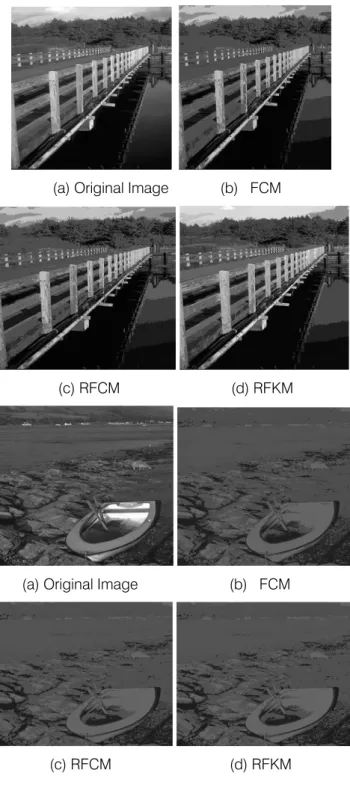
In this section, experimental results on real images are described in detail. In these experiments, the number of different types of object elements in each image from manual analysis was considered as the number of clusters to be referenced. They were also used as the parameter for FKM. The Xie-Beni index value has been utilized throughout to evaluate the quality of the classification for all algorithms. All experiments were implemented on PC with 1.8 GHz Pentium IV processor using MATLAB (version 9.0).
Global Journal of Computer Science and Technology Volume XIII Issue VI Version I
26 (DDDDDDDD ) Year 013 2 F
Image Segmentation using Rough set Based Fuzzy K-Means Algorithm
V. π
If an initial cluster center set decision table are compatible, then when p∈P and Ind(P)=Ind (P-p), pis a redundant attribute and it can be leaved out, otherwisepcan’t be leaved out.
If an initial cluster center set decision table are not compatible, then computing its positive region POS(P, R). If p∈P, when POS(P, R)=POS (P-p, D), then pcan be leaved out, otherwise pcan’t be leaved out.
(a) Original Image (b) FCM
(c) RFCM (d) RFKM
(a) Original Image (b) FCM
(c) RFCM (d) RFKM
Proposed algorithm applied on all the images shown above. This RFKM image segmentation method partitions into different regions exactly. Visually as well as theoretically our method gives better results other than state of the art methods like, FCM, RFCM. We present a clustering time of experiment for 2 experiments and shows that RFKM performs better than FCM and RFCM.
Table 1 : Table captions should be placed above the table
Average of the
XB index values Clustering time (in sec)
FCM 0.034024 13.64
RFCM 0.031578 6.48
RFKM 0.029197 5.92
Figure 1 : Clustering Time(in sec) for RFKM, RFCM,
FCM
VI.
C
onclusionsWe employed Rough Sets to FKM image segmentation. By reduction theory (the core of Rough Sets), the vagueness and uncertainty information inherent in a given initial cluster center set is analyzed, and those redundant initial cluster centers in the initial cluster set is then eliminated, the reduced initial cluster center set as input to FKM for the soft evaluation of the segments, this is very useful for overcoming the drawbacks of conventional FKM segmentation over-dependence on initial value. To evaluate the quality of clusters, the Xie-Beni index was used as the cluster validity index. Experimental results indicate the superiority of the proposed method in image segmentation.
References Références Referencias
1. Russo F. Edge detection in noisy images using fuzzy reasoning, IEEE transactions on instrument-tation and measurement, vol.47, no.5 1998, pp. 1102-1105.
2. HT Farrah Wong, Nagarajan Ramachandran et al. An image segmentation method using fuzzy-based threshold, International symposium on signal processing and its applications (ISSPA), August (2001), pp. 144-147.
3. Borji A. and Hamidi M. Evolving a fuzzy rule base for image segmentation, Proceedings of world academy of science, engineering and technology, vol. 22, July 2007, pp. 4-9.
4. A. Rakhlin and A. Caponnetto, “Stability of K-Means clustering”, Advances in Neural Information Processing Systems, MIT Press, Cambridge, MA, 2007, pp. 216–222. 0 5 10 15 RFKM RFCM FCM
Clusteing Time(in sec)
Clusteing Time(in sec)
Global Journal of Computer Science and Technology Volume XIII Issue VI Version I
27 (DDDDDDDD ) Year 013 2 F
5. A. Rui and J. M. C. Sousa, “Comparison of fuzzy clustering algorithms for Classification”, Interna-tional Symposium on Evolving Fuzzy Systems, 2006, pp. 112-117.
6. V. S. Rao and Dr. S. Vidyavathi, “Comparative Investigations and Performance Analysis of FCM and MFPCM Algorithms on Iris data”, Indian Journal of Computer Science and Engineering, vol.1, no.2, 2010 pp. 145-151.
7. Pawlak, Z. (1982). Rough sets. Internat. J. Comput. Inform. Sci., 11, 341–356.
8. Pawlak, Z. (1991). Rough sets: Theoretical aspects of reasoning about data, vol. 9 of System Theory, Knowledge Engineering and Problem Solving. Dordrecht: Kluwer.
9. Y. Yong, Z. Chongxun and L. Pan, “A Novel Fuzzy C-Means Clustering Algorithm for Image Thresh-olding”, Measurement Science Review, vol. 4, no.1, 2004.
10. K. Nirulata, S. Meher, “Skin Tumor Segmentation using Fuzzy c-means Clustering with Neighbour-hood Attraction”, Communicated to International Journal of Computers and Electrical Engineering. 11. X. Hui, J. Wu and C. Jian, “K-Means clustering
versus validation measures: A data distribution perspective”, IEEE Transactions on Systems, Man, and cybernetics, vol. 39, Issue-2, 2009, pp. 319-331.
Global Journal of Computer Science and Technology Volume XIII Issue VI Version I
28 (DDDDDDDD ) Year 013 2 F