Title
Defect detection on patterned jacquard fabric
Author(s)
Ngan, YT; Pang, GKH; Yung, SP; Ng, KP
Citation
The 32nd Applied Imagery Pattern Recognition Workshop,
Washington, DC., 15-17 October 2003. In Conference
Proceedings, 2003, p. 163-168
Issued Date
2003
URL
http://hdl.handle.net/10722/46407
Rights
©2003 IEEE. Personal use of this material is permitted. However,
permission to reprint/republish this material for advertising or
promotional purposes or for creating new collective works for
resale or redistribution to servers or lists, or to reuse any
copyrighted component of this work in other works must be
obtained from the IEEE.
Defect Detection on Patterned Jacquard Fabric
Henry Y.T. Ngan*, Grantham K.H. Pang*, S.P. Yung
†, Michael K. Ng
†*
Department of Electrical and Electronic Engineering,
†Department of Mathematics,
The University of Hong Kong, Pokfulam Road, Hong Kong.
Email:[email protected] Phone: 852-2857-8492 Fax: 852-2559-8738
Abstract
The techniques for defect detection on plain (unpatterned) fabrics have been well developed nowadays. This paper is on developing visual inspection methods for defect detection on patterned fabrics. A review on some defect detection methods on patterned fabrics will be given. Then, a new method for patterned fabric inspection called Golden Image Subtraction (GIS) is introduced. GIS is an efficient and fast method, which can segment out the defective regions on patterned fabric effectively. An improved version of the GIS method using wavelet transform is also given. This research result will contribute to the development of an automated fabric inspection machine for the textile industry.
1.
Introduction
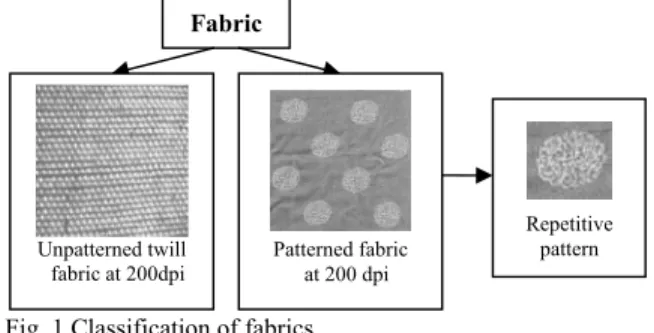
Defect detection by automated fabric inspection machine nowadays is only for plain and twill fabrics, which are called the ‘unpatterned’ fabrics. Many methods have been developed for on this kind of fabric. Examples are Gabor filters [1], Fourier Transform [2], Neural Network [3] and Wavelet Transform [4], [5], [6], [7], [8]. The existing automatic fabric detection methods can recognize around 95% of defects on the plain ‘unpatterned’ fabric. However, there has not been much research on patterned fabric so far. We define the ‘patterned’ fabric with repetitive patterned units on its design. Under the class of the ‘patterned’ fabric, there are still many categories among them.Defect detection on the patterned fabric is difficult due to the design of the repetitive pattern on fabric. Fabrics can be classified into two main categories, namely the non-patterned fabric and the patterned fabric. For the non-patterned fabric, the plain and twill fabric are two common examples. The patterned fabric and the non-patterned fabric are distinguished by the appearance of repetitive unit on fabric. For example, there can be a flower or graphic logo on the fabric. Figure 1 illustrates the classification of fabrics. In section 2, a new method for defect detection on patterned fabric is given. An extension of the method using wavelet transform is given in section 3. A summary with conclusions is finally presented in section 4. Lastly, conclusions are presented in section 5.
In this paper, a new defect detection method is developed and applied on one common kind of dot-patterned designed jacquard, which is shown in Figure 2. It has many repetitive units within the acquired image as our classification mentioned above. At this preliminary stage, three reference detective free samples were collected for training the threshold value and then used it to classify whether a testing image contains a defect. Only three reference samples are chosen at the training stage for the threshold value.
Fig 2. Dot-patterned designed
jacquard
Fig. 3 Sample of histogram Equalized defective free image
There are three reference images (e.g. see Fig. 3) and eight defective images images with Netting (D1, D2), Broken Yarns (D3, D4, D5), Oil Stains (D6, D7) and Knots (D8). (e.g. see Fig. 7) in the experiments. All images for reference and testing have 256 x 256 pixels with grey level scale and they are all processed with histogram equalization in order to get better contrast.
2. The Golden Image Subtraction (GIS) Method
In this section, the steps of GIS (Fig. 4) are described forFabric
Repetitive pattern
Fig. 1 Classification of fabrics
Unpatterned twill fabric at 200dpi
Patterned fabric at 200 dpi
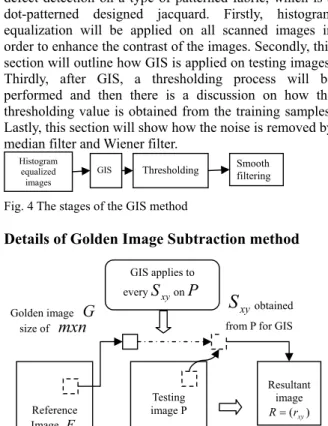
defect detection on a type of patterned fabric, which is a dot-patterned designed jacquard. Firstly, histogram equalization will be applied on all scanned images in order to enhance the contrast of the images. Secondly, this section will outline how GIS is applied on testing images. Thirdly, after GIS, a thresholding process will be performed and then there is a discussion on how the thresholding value is obtained from the training samples. Lastly, this section will show how the noise is removed by median filter and Wiener filter.
Fig. 4 The stages of the GIS method
Details of Golden Image Subtraction method
Fig. 5 Idea of the method of Golden Image Subtraction
A reference patterned fabric’s image
F
of size MxN is picked up and then a golden image G (gij ) with size ofmxn
pixels (larger than one repetitive unit) is obtained from that reference image. Using this golden image, the computer can perform the GIS method on the testing imageP
. For every subtraction done in the testing imageP
, it calculates the mean of sum of absolute value of all pixels in every subtracted image which ismxn
dimension. So, every
mxn
size subtracted image)
(
)
,
(
ij xy xyS
i
j
s
S
,,...,m
,i
,...,N-n
,y
,...M-m
where x
1
1
1
1
1
,...,n
and j
1
(0ndN,0mdM)will generate a valuer
xy. (See Fig. 5) We define this value as the Energy of Golden Image Subtraction,¦¦
m i n j ij ij xys
g
n
m
)
(r
R
1 11
(1)1
1
1
1
,...M-m
and y
,...,N-n
where x
As a consequence, after applying the methods of GIS on the entire testing image, it will return an)
1
(
)
1
(
M
m
x
N
n
matrix for the Energy ofGolden Image Subtraction, which defined as a resultant image,R rxy . Then, it will generate a plot of periodic hills and valleys if no defective region is found. Otherwise, there will be a subtle change in the plot if a defective region exists.
Thresholding
For a reference image, periodic hills and valleys will appear on the plot from resultant image
R
. A thresholded imageD
(
d
ij)
is defined as T if r T if r ij ij ij{
d
! d 1 01
1
1
,...,M-m
and j
N-n
where i
wherer
ijis the energy value of resultant image
R
andT
is the moderate threshold value. This image can be considered as a binary image and give the information on defects. A direct way to get the threshold value is to select the peak value of those hills and assume all hills have same peak in principle. For the defective samples, subtractions on defective area will make a distinguish jump on the plot as above. So, it will outline the defective region if a precise threshold value is known. Therefore, a training stage for obtaining the threshold value isessential.
The method to train threshold value is firstly to collect a large amountof reference
samplesFk where k 1,...,w, i.e.
w
reference samples. Using the same golden image, we process GIS onevery sample. In principle, we should obtain
,...,
and y
,...,M-m
) where x
(r
ȉ
kmax
xy1
1
1
1
n
N
, the maximum value of Energy of GIS of every reference samples fork
1
,
,
w
. However, there exists noises in those resultant imagesR
k,where
k
1
,
,
w
. Therefore, it needs to be eliminated by truncating some highest portion of peak values for each7
k.For example, the7
k will be 0.95 oforiginal peak value in
R
k if there is 5% noise. Afterward, averaging all the peaks (71,72, ,7w)will give us the moderate threshold value T, where)/w
T
...
T
(T
ȉ
1 2 w .Using this threshold value, the defective region can be found on a testing imageP
.De-noising process / Filtering process
After the threshold value is determined by the training samples, it can be used to threshold the testing images. As mentioned above, there will be some white impulse noises
Histogram equalized
images
GIS Thresholding Smooth filtering Reference Image F Golden image
G
size ofmxn
Testing image P Resultant image ) (rxy R xyS
obtained from P for GIS GIS applies toappeared when the testing image is passing a threshold value. So, we need to apply filtering techniques on thresholded image
D
in order to remove the noise and enhance the picture for defect onD
. After trying several types of filters, Median filter [14] is chosen. Median filter is effective in dealing with bipolar and unipolar impulse. With the help of an appropriate filter, the result of thresholded imageD
would be improved to an appreciated level.Results and Discussions
Fig.6 Filtered three reference images with median filter of size [5 5].
D1 Filtered D1 D2 Filtered D2 D3 Filtered D3 D4 Filtered D4 D5 Filtered D5 D6 Filtered D6 D7 Filtered D7 D8 Filtered D8
Fig. 7 Filtered eight defective images (D1 ,D2, …, D8) with median filter of size [5 5].
Using three reference images and eight defective images, the size of the golden image is 47 x 40, approximately equivalent to five repetitive units in the Dot-patterned designed jacquard. Using the method of GIS, it can segment out the defect from the background by a thresholding value. The final results are shown in Fig. 6 for reference images and Fig. 7 for defective images. The results showed the defects with larger areas, e.g., D4 and D5 (broken yarn) and with high contrast compared to the background, e.g. D6 and D7 (oil stain) giving the significant results. The defective regions could be illustrated after thresholding and smoothing filtering. For those defects, e.g., D1, D2, D3 and D8, with small size or with low contrast compared to the background, only GIS is not enough.
a b
c d
Fig 8 (a) Histogram equalized testing sample with brokenyarn. (b) Mesh diagram after GIS. (c) Thresholded
subtracted image (d)Using median filter of size[5 5] on thresholded image.
For more details, there is one sample from broken yarn from the testing images that are commonly found in the process of weaving jacquard. The results of these three samples are illustrated in Figures 8.
Effect due to noise levels in thresholded images
As mentioned above, by assumption, there is a small amount of noise existing in the thresholded image
D
. So, noise should be eliminated in order to give the best result on detecting for defects. Figure 9 shows that 10% noise level is the most appropriate level for the testing sample, broken yarn. If the noise level was adjusted to be too little,ie.1%, it would not give any result for defect detection. When the noise level is adjusted to 10%, the output would be the most outstanding among all. However, the noise level could not be assumed too high. Otherwise, the thresholded image would be in white colour since the threshold value might reach the middle level of hills and valleys of resultant image.
a
B b
c
Fig.9 Histogram equalized testing sample with
broken yarn. (a) 1% noise, (b) 5%noise, (c) 10% noise in thresholded image after using Median filter Effect due to Size of Golden image
a
b
c
Fig.10 Applying median filter on 10% noise thresholded image of broken yarn of pixel size (a) 25x15, (b) 35x28, (c) 47x40, golden images
Choosing a golden image is a key step for the GIS method. The size of golden image cannot be chosen too small. Without chosen a size bigger than or equal to a repetitive pattern, the detection would not be succeeded. Yet, if any size of golden image bigger than a repetitive pattern is chosen, the result would be similar with those only approximately same size of one repetitive pattern. Size in half(10x9), one(25x15), two(35x28) and five(47x40) repetitive units of golden image are tested and the size in 47x40 shows the best result. The results of choosing different sizes of repetitive unit are shown on Figure 10.
3. Combination of Wavelet Transform
(WT) and GIS
Fig.11 Combination of WT and GIS
From above results, it is shown that noise on the patterned fabrics is a big obstacle for our detection method in section 2. So, in order to tackle this problem, we rearranged our method 1 into a new procedure as shown
Histogram equalized images
WT
GIS Thresholding Smooth filtering
in Figure 11. Wavelet transform [5], [9] can be considered as a preprocessing tool as used to remove the noise impulse in scanned images. At this stage, its multiresolution and translation invariant properties are used and applied on the patterned fabric. It is a preprocessing tool is by selecting the first level approximation after the histogram equalized image passing Haar Wavelet Transform. The subimage of level 1 approximation is generated by passing by two low pass filters on the original image so that the noise on that subimage can be removed. Then, applying GIS on this image would enhance the detection result. From Section 2, a good golden image of size 47x40 size for GIS and 10% noise level for thresholding after GIS would generate a good result.
Fig. 12 Filtered three reference images with median filter of size [5 5].
D1 D2 D3 D4 D5 D6 D7 D8
Fig. 13 Filtered eight defective images (D1, D2,…,,D8) with median filter of size [5 5].
The resultant images of smooth filtering are shown in Fig.12 for reference images and Fig. 13 for defective images. It is impressive that eight defective images are detected. We conclude the result because the Haar wavelet’s low pass filter can retain useful information after smoothing the original images.
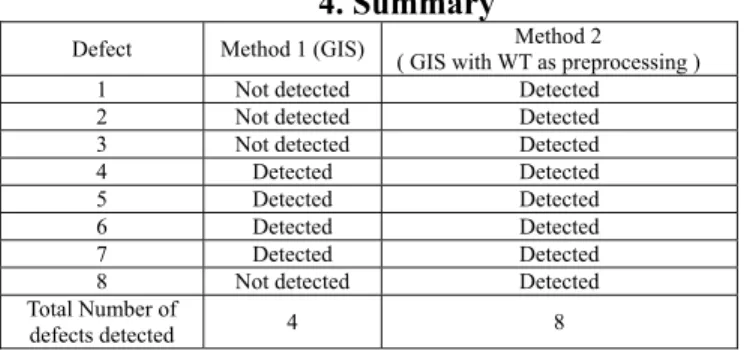
4. Summary
Defect Method 1 (GIS) Method 2 ( GIS with WT as preprocessing )
1 Not detected Detected
2 Not detected Detected
3 Not detected Detected
4 Detected Detected
5 Detected Detected
6 Detected Detected
7 Detected Detected
8 Not detected Detected
Total Number of
defects detected 4 8
Fig. 14 Comparison of the detection results from the two methods. Figure 14 summarized the two methods we investigated above and give us a clear idea that GIS should be combined with other methods in order to generate the best detection result. Method 2 can correctly detect all the defects and give outstanding outline for each defect. Finally, Figure 15 makes an overall conclusion for the two methods. (Method) Main idea Noise Level for threshold Complexity Comments for defect detection On dot-patterned jacquard
(1) GIS 10% Low Not successful
(2) Combination
of WT and GIS 10%
Higher, but still low since the algorithm is
simple and direct
Successful
Fig.15 Overall conclusion of the two methods addressed in this paper.
5. Conclusions
It can be concluded that the method of GIS is an effective way to detect defects on the periodic patterned fabric. With a moderate threshold value and an appropriate filter, a defect existing on testing sample can be found easily. Also, the size of golden image can be freely chosen by the user. It is useful in some cases if the repetitive unit is too small in some patterned fabric. The method of GIS can show both the shape and location of defect to the user. If we apply some pattern recognition techniques later on, we believe the classification of different defects can be easily achieved. On the other hand, there are some weaknesses for GIS. GIS cannot be applied on the right and bottom borders of the testing image. It is difficult to find a way to extend the border by suitable padding since the pattern of fabric sometimes is too complicated to be duplicated. The subtraction may also be done starting from the last pixel
of last row in a backward approach as a second time. However, in a real situation, the borders of fabric are not important for detection so that we can neglect this problem. To conclude, with the outstanding results of method two, the combination of GIS with Wavelet Transform, defect detection on the dot-patterned fabric provides a satisfactory result.
Acknowledgement:
S.P. Yung’s Research supported in part by a CRCG Grant 25500/301/01 and Michael K. Ng's Research supported in part by Hong Kong Research Grants Council Grant Nos. HKU 7130/02P and 7046/03P, and HKU CRCG Grant Nos. 10203501, 10203907 and 10204437.
References:
[1]A.Kumar, G.K.H., Pang, “Defect detection in textured materials using Gabor filters”, IEEE Trans. on Industry Applications, Vol.: 38 Issue: 2, Page(s) 425 -440, Mar-Apr 2002
[2] Chi-ho Chan, G.K.H. Pang, ”Fabric Defect Detection by Fourier Analysis,” IEEE Trans. on Industry Applications, Vol.36, No.5, Sept/Oct, 2000
[3] L.H. Hoffer, F. Francini, B.Tiribilli, and G.. Longobardi, “Neural networks for the optical recognition of defects in cloth,” Opt. Eng., Vol. 35, pp. 3138-3190, Nov. 1996
[4] G.Lambert, F.Bock, “Wavelet Methods for Texture Defect Detection,” Image Processing, 1997. Proceedings, International Conference on, Vol:3, 26-27Page(s): 201-204, Oct 1997.
[5] A. Latif-Amet, A.Ertuzun, A.Ercil, “An efficient method for texture defect detection: sub-band domain co-occurrence matrices,” Image and Vision Computing, Vol.18, pages 543-553, 1999
[6] Hamed Sari-Sarraf, James S.Goddard, “Vision System for On-Loom Fabric Inspection,” IEEE Trans. on Industry Applications, Vol. 35, No. 6, Page(s): 1252-1259, Nov/Dec 1999
[7] Xuezhi Yang, G.K.H.Pang, Nelson. Yung, “Fabric Defect Detect Classification Using Wavelet Frames and Minimum Classification Error Training,” Industry Applications Conference, 2002, 37th IAS Annual Meeting. Conference Record on the, Vol: 1, Page(s) 290-291, 13-18 Oct, 2002
[8] Xuezhi Yang, G.K.H.Pang, Nelson. Yung, “Fabric Defect Detection Using Adaptive Wavelet,” Acoustic, Speech and Signal Processing, Proceedings (ICASSP’01) 2001 IEEE Conference on Vol:6,7-11 May 2001, Page(s)3697-3700, 2001
[9]D.M.Tsai, Bo.Hsiao, “Automated surface inspection using wavelet rescontruction.” Pattern Recognition, Vol. 34, Page(s)1285-1305, 2001
![Fig. 7 Filtered eight defective images (D1 ,D2, …, D8) with median filter of size [5 5]](https://thumb-us.123doks.com/thumbv2/123dok_us/9675480.2849084/4.918.521.796.128.1013/fig-filtered-defective-images-d-median-filter-size.webp)
![Fig. 12 Filtered three reference images with median filter of size [5 5].](https://thumb-us.123doks.com/thumbv2/123dok_us/9675480.2849084/6.918.527.796.124.999/fig-filtered-reference-images-median-filter-size.webp)