Natalie Shlomo, Chris J. Skinner and Barry Schouten
Estimation of an indicator of the
representativeness of survey response
Article (Accepted version)
(Refereed)
Original citation:
Shlomo, Natalie and Skinner, Chris J. and Schouten, Barry (2012) Estimation of an indicator of
the representativeness of survey response.Journal of statistical planning and inference, 142 (1).
pp. 201-211. ISSN 0378-3758 DOI: 10.1016/j.jspi.2011.07.008 © 2012 Elsevier
This version available at: http://eprints.lse.ac.uk/39124/ Available in LSE Research Online: November 2011
LSE has developed LSE Research Online so that users may access research output of the School. Copyright © and Moral Rights for the papers on this site are retained by the individual authors and/or other copyright owners. Users may download and/or print one copy of any article(s) in LSE Research Online to facilitate their private study or for non-commercial research. You may not engage in further distribution of the material or use it for any profit-making activities or any commercial gain. You may freely distribute the URL (http://eprints.lse.ac.uk) of the LSE Research Online website.
This document is the author’s final manuscript accepted version of the journal article, incorporating any revisions agreed during the peer review process. Some differences between this version and the published version may remain. You are advised to consult the publisher’s version if you wish to cite from it.
Estimation of an Indicator of the Representativeness of Survey
Response
Natalie Shlomo1, Chris Skinner1, Barry Schouten2
1
Southampton Statistical Sciences Research Institute, University of Southampton, Southampton SO17 1BJ, United Kingdom
2
Statistics Netherlands, Henri Faasdreef 312, 2492 JP Den Haag, The Netherlands
Abstract
Nonresponse is a major source of estimation error in sample surveys. The
response rate is widely used to measure survey quality associated with nonresponse,
but is inadequate as an indicator because of its limited relation with nonresponse bias.
Schouten, Cobben and Bethlehem (2009) proposed an alternative indicator, which
they refer to as an indicator of representativeness or R-indicator. This indicator
measures the variability of the probabilities of response for units in the population.
This paper develops methods for the estimation of this R-indicator assuming that
values of a set of auxiliary variables are observed for both respondents and
nonrespondents. We propose bias adjustments to the point estimator proposed by
Schouten et al. (2009) and demonstrate the effectiveness of this adjustment in a
simulation study where it is shown that the method is valid, especially for smaller
sample sizes. We also propose linearization variance estimators which avoid the need
for computer-intensive replication methods and show good coverage in the simulation
study even when models are not fully specified. The use of the proposed procedures is
also illustrated in an application to two business surveys at Statistics Netherlands.
1. Introduction
One of the most important sources of estimation error in surveys is nonresponse. Survey organisations need indicators of such error for a variety of purposes, for example to compare different surveys, to monitor changes in a repeated survey over time or to monitor changes during the fieldwork of a single survey, perhaps to inform decisions such as when to end fieldwork. An indicator which is widely used for such purposes is the response rate, where a higher response rate is taken to indicate higher quality. However, there has been much recent empirical research (see e.g. Groves (2006), Groves and Peytcheva (2008), Heerwegh, et al. (2007) and references therein) which concludes that the response rate is insufficient as an indicator to measure the potential error arising from nonresponse. Since sample sizes are usually large in surveys, the squared bias component of mean squared error will typically dominate the variance component and hence it is desirable that the indicator reflect nonresponse bias. However, the empirical evidence suggests that the response rate is only a weak predictor of nonresponse bias. There is therefore much interest in survey organisations in the development of alternative indicators (Groves et al., 2008).
In this paper, we consider an indicator proposed by Schouten, Cobben and Bethlemem (2009, referred to hereafter as SCB). The basic idea is that nonresponse bias depends critically on the contrast between the characteristics of respondents and nonrespondents. This contrast can be assessed in terms of the probability of a unit responding to the survey. If all units in the population share the same probability of responding then no nonresponse bias will result and the response mechanism may be viewed as ‘representative’. The indicator proposed by SCB, termed the R-indicator (‘R’ for representativeness), measures the extent to which the response probabilities vary. An advantage of this indicator (shared by the response rate) for various practical applications is that it provides a single measure for the whole survey. It should be recognized that nonresponse bias is defined in relation to a specific population parameter (and hence one or more survey variables). Thus, for any one (multipurpose) survey there may be a very large number of nonresponse biases. It would be
feasible to construct indicators which are parameter-specific (Groves et al., 2008, Wagner, 2008), but here we suppose the requirement is for a single indicator for the whole survey.
Further discussion of the rationale and applications of the R-indicator is provided by Cobben and Schouten (2007) and Schouten and Cobben (2007) in addition to the paper by SCB. The purpose of this paper is to consider in more detail some of the estimation issues associated with the R-indicator. The R-indicator proposed by SCB is subject to bias arising from the estimation of the response propensities. The bias is particularly problematic for small sample sizes, and a bias adjustment is developed. In addition, we develop linearization variance estimators as an alternative to the method of bootstrapping proposed in SCB. We evaluate these procedures in a simulation study and demonstrate the application of these procedures to a real business survey.
We introduce the theoretical framework and define response propensities in Section 2. The R-indicator is defined at the population level in Section 3. The relation of the R-indicator to non-response bias is discussed in Section 4. Point estimation of the R-indicator using sample data is considered in Section 5. The bias of the point estimator and bias adjustment, variance estimation and confidence intervals are considered in Section 6. A simulation study and results of that study are described in Section 7 and results from a real dataset are demonstrated in Section 8. Finally, we conclude and discuss future work in Section 9.
2. Preliminaries and Response Propensities
We suppose that a sample survey is undertaken, where a sample s is selected
from a finite population U. The units in U are labelled i=1, 2,K,N, with the sizes of s and U denoted n and N , respectively. A probability sampling design is
employed, where s is selected with probability p s . The first order inclusion ( )
probability of unit i is denoted πi and = −1 i i
The survey is subject to unit nonresponse, with the set of responding units
denoted r , so r⊂ ⊂s U. We denote summation over the respondents, sample and population by Σr , Σs and ΣU , respectively. Let R be the response indicator i variable so that Ri =1 if unit i responds and Ri =0 , otherwise. Hence,
{ ; i 1}
r= ∈i s R = . Let X be a vector of auxiliary variables which may influence nonreponse, e.g. a vector consisting of age, gender, degree of urbanization of
residence area and the observed status of the dwelling for a household survey or the
type of business and the number of employees for a business survey.
We define the response propensity
ρ
i as the conditional expectation (under a model) of R given the values of specified variables, such as the auxiliary variables iabove, and survey conditions (Little, 1986, 1988). If it is necessary to clarify that the
conditioning is on a vector of variables X , for example, then we write:
( ) ( | ) i i E Rr i i i
ρ ρ
= X x = X =x to denote the conditional expectation of R given that i the vector of variables X for unit i takes the value i x . Herei Er(.) denotesexpectation with respect to the model underlying the response mechanism. We
assume that R is defined for each population unit i i∈U , so that nonresponse is what Rubin (pp. 30-31, 1987) refers to as ‘stable’, and
ρ
i is also defined for all i∈U. We also assume that the Ri for different units are independent, conditional on thespecified variables and survey conditions. We shall further assume that the sampling
design and the nonresponse process are ‘unconfounded’ (pp. 35-36, 1987) so that the
probability of selecting s remains ( )p s , whatever the values of the Ri, i∈U. Thus, it is assumed that nonresponse does not depend on the configuration of the sample.
The variation in the response propensities may be viewed as reflecting the
‘representativeness’ of the nonresponse. In SCB response is defined to be (strongly)
representative if the response propensities are the same for all units in the population, corresponding to the notion of missing completely at random (MCAR) (Little and
Rubin, p. 12, 2002) given the variables which are conditioned upon when defining
ρ
i. They define a representativeness indicator, termed the R-indicator and denoted Rρ, interms of the population standard deviation of the response propensities:
1 2
( 1) U( i U)
Sρ = N− −
∑
ρ ρ
− , where ρU =∑
Uρi/N . In order to facilitate the interpretation of the indicator, they define it in terms of Sρ as follows:Rρ = −1 2Sρ , (3.1)
where this transformation of Sρ ensures that 0≤Rρ ≤1 since it may be shown that (1 ) 0.5
U U
Sρ ≤ ρ −ρ ≤ . The value Rρ =1 indicates the most representative response, where the
ρ
i display no variation, and the value 0 indicates the least representative response, where theρ
i display maximum variation.4. Relation of R-Indicator to Non-response Bias
The R-indicator may also be motivated in terms of nonresponse bias. Suppose
that the target of inference is a population mean
θ
=N−1∑
U yi of a survey variable, taking value yi for unit i and observed only for i∈r. A standard design-weighted estimator of θ is ˆθ =∑
sd R yi i i/∑
sd Ri i. The bias ofˆ
θ
as an estimator of θ may be evaluated by taking expectations with respect to both the random samplingWe assume, for now, that the specified variables include y so that it may be treated i
as fixed. We then have:
ˆ ( ) / / r s r s i i i i i i i i i s i s i U i U E E θ E E d R y d R ρ y ρ ∈ ∈ ∈ ∈ = ≈
∑
∑
∑
∑
, (4.1) where in this caseρ
i =ρ
YX(yi,xi) is conditional on both Y and X and theapproximation is for large samples so that we take the first term only in the Taylor
expansion. In addition, we have used the assumption that the sampling and response
mechanisms are unconfounded. Hence the bias depends on nonresponse only via
ρ
i. It follows that ˆ ( ) i( i ) / i i U i U Biasθ
ρ
yθ
ρ
∈ ∈ ≈∑
−∑
=corr S Sρy ρ y/ρU, (4.2) where y ( 1) 1 ( i U)( i ) / y i U corrρ N −ρ ρ
yθ
S Sρ ∈ = −∑
− − and y2 ( 1) 1 ( i )2 i U S N − yθ
∈ = −∑
− .Expression (4.2) is also obtained in Bethlehem (1988) and Särndal and
Lundström (p.92, 2005). An upper bound for the absolute bias can thus be expressed
in terms of the R-indicator by
(1 ) ˆ | ( ) | / 2 y y U U R S Bias
θ
S Sρρ
ρρ
− ≤ = . (4.3) A standardized measure, which is free of y is given by:(1 ) 2 U R B ρ
ρ
− = . (4.4) 5. Estimation of R-indicatorWe suppose that the data available for estimation purposes consists first of the
variables), observed only for respondents. Secondly, we suppose that information is
available on the values ( 1, , 2,, , , )T i = x i x i xK i
x K of a vector
i
X of auxiliary variables for
all sample units, i.e. for both respondents and non-respondents. We refer to this as
sample-based auxiliary information. This is a key assumption and is natural if, for example, the variables making up x are available on a register. Other possible i
assumptions about the availability of auxiliary information are discussed in Section 9.
Sincey is only observed for respondents, the response propensity conditional i
on y is generally inestimable without further assumptions. Instead, we propose to i
take
ρ
i in the definition of Rρ in (3.1) as conditional on x , i.e. to set i( ) ( | ) i X i E Rr i i i
ρ ρ
= x = X =x .Nonresponse is missing at random, denoted MAR (Little and Rubin, p.12,
2002), if Ri is conditionally independent of yi given x . In this case, we have i
( | , ) ( | ) r i i i r i i
E R y x =E R x and
ρ ρ
i = X( )xi =ρ
YX( ,yi xi) and so yi may implicitly be included in the conditioning set. Hence the argument used to obtain the bias bound in(4.3) still applies if MAR holds. The bias bound and the R-indicator itself may,
however, be too conservative. If MAR holds then
ρ
Y( )yi =Er[ρ
X( ) |xi yi] and: var(ρ
i)=var[ρ
X( )]xi =var{ [Eρ
X( ) |xi yi]}+E{var[ρ
X( ) |xi yi]}=var[
ρ
Y( )]yi +E{var[ρ
X( ) |xi yi]} (5.1) The first term on the right hand side of (5.1) represents the variation of theconditional probabilities
ρ
Y(yi), which we should ideally like to use in the R-indicator if we are only concerned about nonresponse bias for a target parameter defined interms of yi alone. The second term represents additional variation which is unrelated
variability, i.e. noise, in the
ρ
i for that purpose. Kreuter et al. (2010) present examples of auxiliary variables which are predictive of nonresponse but only weaklypredictive of relevant y variables. In such cases, the second term in (5.1) may be i
relatively large and the R-indicator and its associated bias bound may be viewed as
too conservative. It is therefore desirable to select only those auxiliary variables
which are reasonably predictive of at least one of the y variables of key interest in i
the survey.
One special case occurs when nonresponse is missing completely at random
(MCAR) so that it is independent of both x andi y . In this case, both i
ρ
X( )x i andρ
Y( )yi are constant so that both terms on the right hand side of (5.1) are zero. Hence, there is no variability in theρ
i and this does, albeit in a degenerate way, capture the fact that there is nothing in the nonresponse process that will lead tononresponse bias for estimation related to y . i
If nonresponse is not MAR then (5.1) no longer holds. Instead,
ρ ρ
i = X( )x will irepresent a smoothed version of
ρ
YX( ,yi x and it is not necessarily the case that i) var(ρ
i) will be at least as large as var[ρ
Y( )]yi . Thus, we may fail to capture relevant features of the nonresponse process in theρ
i. In particular, if R is conditionally i independent ofx given i y then var[iρ
Y( )]yi will necessarily be at least as large as var(ρ
i), i.e. var[ρ
X( )]xi (following a parallel argument to the MAR case). It may be argued therefore that it is desirable to select the auxiliary variables constituting x iin such a way that the MAR assumption holds as closely as possible. In any case, it
must be emphasized that our definition of
ρ ρ
i = X( )x relates to a specific choice of iWe noted in Section 2 that we define the response propensity conditional on the
survey conditions that apply when the data are collected. We do not make this
conditioning explicit in our notation, but it is crucial to recognize this conditioning
since, as we noted in Section 1, one of the objectives of constructing R-indicators is to
be able to compare the representativeness of different surveys and such comparisons
becomes challenging when the definition of the response propensity for any one
survey is dependent on the conditions with which that survey has been implemented,
for example upon the modes of data collection, the choice of interviewers, the way
these interviewers were trained and work and the contact strategy. Even for a single
survey repeated at different points in time, such conditions may well not remain
constant.
5.1 Nonresponse models
In order to estimate the R-indicator, we first estimate the response
propensities,
ρ
i =E R( i|xi) . To do this, we assume thatρ
i depends on x in a iparametric way via:
g(
ρ
i)=xi'β, (5.2) where g(.) is a specified link function, β is a vector of unknown parameters and x imay involve the transformation of the original auxiliary variables for the purpose of
model specification. In particular, we shall consider the logit link function
( ) log[ /(1 )]
g ρ = ρ −ρ leading to the logistic regression model.
We propose to estimate β by pseudo maximum likelihood (Skinner, pp. 80-83,
1 [ ( ' )] 0 i i i i sd R g − − =
∑
x β x (5.3)where g−1(.)is the inverse of the link function. One reason for using the design
weights here is because the objective is to estimate an R-indicator which provides a
descriptive measure for the population.
The response propensity
ρ
i is then estimated by:1 ˆ
ˆi g ( i' )
ρ
= − x β . (5.4)5.2 Estimation of R-indicator
As in SCB, we propose to estimate Rρ by:
Rˆρ = −1 2Sˆρ , (5.5) where Sˆρ2 =(N−1)−1
∑
sdi(ρ ρ
ˆi− ˆU)2 , ρˆi is defined in (5.4), ˆρ
U =(∑
sdiρ
ˆi) /N and N may be replaced by∑
sdi if it is unknown. We refer to the estimator in (5.5) as the SCB estimator.6. Bias and Confidence Intervals
6.1 Bias and Bias Adjustment
We now consider the bias properties of the SCB estimator ˆRρ defined in (5.5).
We shall assume that the vector of auxiliary variables x is given so that no bias can i
arise from specifying the ‘wrong’ set of auxiliary variables. We note, nevertheless,
that the choice of auxiliary variables is a critical decision in practice and we shall
illustrate empirically in Section 7 how the R-indicator can depend on this choice.
We first consider defining the bias with respect to the sampling mechanism,
likelihood estimate ˆβ is approximately unbiased for the ‘census’ parameter βUwhich
solves:
∑
U[Ri−g−1(xi' )]β xi =0 (6.1) (Skinner, p. 82, 2003). The approximation here is with respect to an asymptoticframework, with a sequence of samples and populations with n and N increasing.
This census parameter implies a corresponding response propensity
ρ
iU =g−1(xi'βU)and R-indicator RρU , defined in terms of these propensities. We then have
ˆ ( )
s U
E Rρ ≈Rρ . The difference RρU −Rρ may be viewed as the bias arising from model misspecification.
Instead of defining the bias with respect to just sampling variation we could also
consider the response mechanism. In a parallel way, we may write E E Rr s(ˆρ)≈RρU0, where RρU0 is the R-indicator defined in terms of the response propensities
1 0 ( ' 0) iU g i U
ρ
= − x β and 0 Uβ is the solution of:
1 0 [ i ( i' )] i 0 U
ρ
g − − =∑
x β x . (6.2)where
ρ
i0 =E Rr( i|x is the true response propensity given i) x and we suppose that i0 ( i )
g
ρ
is not necessarily linear in x , as in (5.2), i.e. the latter model may be imisspecified. Thus, RρU0−Rρ may be viewed as the bias (with respect to both sampling variation and the response mechanism) arising from model misspecification.
We may expect that RρU RρU0 O Np( 0.5) −
− = so that there will usually be negligible difference in practice between the two measures RρU −Rρ or RρU0−Rρ of bias.
In principle, one might consider ways of assessing either of these measures of
those for some kind of non-parametric regression. We do not pursue this approach
further here, however. Instead we consider the finite sample biasE R(ˆρ)−RρU, treating U
Rρ as the parameter of interest, which is equivalent to assuming that the
nonresponse model in (5.2) is correctly specified. We might anticipate that the finite
sample bias of ˆRρ will be non-negligible, since ˆRρ is defined via the variance of
the ρˆi and we might expect sampling variation in these quantities to inflate this variance. We approximate this finite sample bias of ˆRρ by first considering the bias
of Sˆρ2 defined below (5.5).
We use the decomposition:
ˆ ˆ
ˆi U (ˆi i) ( i U) ( U s) ( s U)
ρ ρ
− =ρ ρ
− +ρ ρ
− +ρ
−ρ
+ρ ρ
− ,where
ρ
s =N−1∑
sdiρ
i and use the approximation Er(ρ
ˆi)≈ρ
i to obtain Er(ρ
ˆU)≈ρ
sand: 2 2 2 2 2 ˆ ˆ ˆ ˆ [( ) ] ( ) ( ) ( ) ( ) ˆ ˆ 2 ( , ) 2( )( ) ˆ ˆ ( ) ( ) ( ) 2( )( ) r i U r i i U s U r U i U i U s U r i U r i U s U i U s U E V V Cov V ρ ρ ρ ρ ρ ρ ρ ρ ρ ρ ρ ρ ρ ρ ρ ρ ρ ρ ρ ρ ρ ρ ρ ρ − ≈ + − + − + − − − − = − + − + − − − − It follows that 2 1 2 2 ˆ ˆ ˆ ( ) ( 1) { ( ) ( ) ˆ ( ) 2( )( ˆ )} r s i i U s i r i U s s U s U s s U E S N d d V N N N ρ ρ ρ ρ ρ ρ ρ ρ ρ ρ ρ − ≈ − − + − + − − − −
∑
∑
where ˆNs =∑
sdi.Taking expectation also with respect to the sampling design, we obtain:
2 2 1 2 ˆ ( ) s r E E Sρ ≈Sρ+ +A A (6.3) where 1 1 s{( 1) s i r(ˆi ˆU)} A =E N− −
∑
d V ρ ρ− 1 2 2 {( 1) [ ˆs( s U) 2( s U)( s ˆs U)]} A =E N− − N ρ ρ− − ρ ρ− Nρ −N ρBoth A and 1 A are terms of 2 O(1/ )n and, following standard linearization arguments,
we simplify these expressions by removing terms of lower order. First, A is 1
asymptotically equivalent to:
1
1 E Ns{ sd Vi r(ˆi)}
λ = −
∑
ρ .Turning to the termA , we may write 2
2 2
ˆ ( ) 2( )( ˆ ) {ˆ 2 }( ) 2( ˆ )( )
s s U s U s s U s s U s s U U
N
ρ ρ
− −ρ ρ
− Nρ
−Nρ
= N − Nρ ρ
− + N −Nρ ρ ρ
− and, ignoring terms of lower order, A is asymptotically equivalent to 22 1 2 Es{( s U) } 2 UEs{(N Nˆs 1)( s U)} λ ≈ − ρ ρ− + ρ − − ρ ρ− var ( ) 2 1cov (ˆ , ) s ρs ρUN s Ns ρs − = − + .
Replacing A and 1 A in (6.3) by 2
λ
1 andλ
2 respectively, we obtainλ λ
1+ 2 as the approximate bias of Sˆρ2. We thus propose as a bias-corrected SCB estimator of Rρ:1 2
R%ρ = − S%ρ. (6.4)
where S%ρ2 =Sˆρ2− −
λ λ
ˆ1 ˆ2 andλ
ˆ1 andλ
ˆ2 are estimators ofλ
1 andλ
2 respectively. An estimator ofλ
1 is 1 1 ˆ ˆ ˆ( ) i r i s N d V λ = −∑
ρ , where ˆ ˆ( ) r i Vρ
is an estimator of ˆ ( ) r iV
ρ
and N may be replaced by Nˆs if it is unknown. We propose to use the estimator Vˆ ˆr( )ρ
i given in the Annex. In the case of constant weights di =N n/ this gives: 1 2 1 1 ˆ ( ' )ˆ '[ ( ' )ˆ '] i i j j j i i s j s n h h λ − − ∈ ∈ =∑
∇ x β x∑
∇ x β x x x ,where ∇h(xi' )βˆ =exp(xi' ) /[1 exp(βˆ + xi' )]βˆ 2.
The second term
λ
2 may, in general, be estimated using design-based variance estimation methods. In the case of constant weights the term Nˆs is constant soλ
2reduces to λ2 = −Vs(ρs) . Under simple random sampling, we may write
1 1 2
2 (n N )Sρ
λ = − − − − . It follows that a bias corrected estimator of 2
Sρ in the case of
simple random sampling is:
2 2 1 1 2 1 2 1 1 2 ˆ ˆ ˆ (1 )ˆ ( ' )ˆ '[ ( ' )ˆ '] i i j j j i i s j s Sρ Sρ λ λ n− N− Sρ n− h h − ∈ ∈ = − − = + − −
∑
∇ x β x∑
∇ x β x x x % . (6.5)6.2 Standard Errors and Confidence Intervals
A linearization variance estimator for the SCB estimator ˆRρ is now derived in
terms of a variance estimator v S(ˆρ2) of Sˆρ2, assuming that a logistic regression model
is fitted and holds. From (5.5) and using linearization we have
2 ˆ2 ˆ
var[Rρ]≈Sρ− var(Sρ) . (6.6) To approximate var(Sˆρ2) we shall decompose the distribution of Sˆρ2 into the part
induced by the sampling design for a fixed value of ˆβ and the part induced by the
distribution of ˆβ. We take the latter to be ˆβ N( , )β Σ , where:
1 1
( ) var{ sd Ri[ i h( i' )] } ( )i
− −
=
∑
−Σ J β x β x J β (6.7)
and ( )J β =E{ ( )}I β is the expected information rather than the observed information in (6.7). These two choices of information are asymptotically equivalent (to first order)
but the expected information has the advantage that Σ does not depend on s.
We write
2 2 2
ˆ ˆ
ˆ ˆ ˆ
var(Sρ)=Eβ[var (s Sρ)] var [+ β E Ss( ρ)], (6.8)
where the subscript ˆβ denotes the distribution induced by ˆβ N( , )β Σ , which may be
interpreted as arising from the response process. Following usual linearization
2 1 2 ˆ ˆ var (s ) var [s i( i U) ] i s Sρ N− d
ρ ρ
∈ ≈∑
− β=βand, given the consistency of ˆβ for β (and for standard kinds of sampling designs),
we have approximately: 2 1 2 ˆ[var (s ˆ )] var [s i( i U) ] i s E Sρ N− d
ρ ρ
∈ ≈∑
− β . (6.9)Turning to the second component in (6.8), we may write:
2 1 2 ˆ ˆ ( ) ( ) s i U i U E Sρ N−
ρ ρ
∈ ≈∑
− β=β .As a linear approximation we have
ρ ρ
ˆi ≈ +i zi′(βˆ-β) where zi = ∇h(xi' )β xi. Hence2 2 ˆ ˆ ( ) ( ) 2 ( )( ) ( ) ˆ ˆ ( ) ( )( ) ( ) i U i U i U i U i U i U i U i U i U i U
ρ ρ
ρ ρ
ρ ρ
∈ ∈ ∈ ∈ ′ − ≈ − + − − ∑ ∑ ∑ ′ ′ +∑ − − − − β=β z z β-β z z β β β β z z where U N 1 U i − =∑
z z .In large samples, we assume that ˆβ is normally distributed so that ˆ(β−β) is uncorrelated with ˆ(β−β β)(ˆ−β) '. Hence, we have
2 ˆ ˆ ˆ ˆ ˆ var [E Ss( ρ)]≈4 ′ +var { [ (tr )( ) ]}′ β AΣA β B β-β β-β , (6.10) where 1 ( i U)( i U) i U N− ρ ρ ∈ =
∑
− − A z z , 1 ( i U)( i U) ' i U N− ∈ =∑
− B z - z z z and Σ is definedin (6.7). The second term involves the fourth moments of ˆβ which may also be
expressed in terms of Σ since ˆβ is assumed normally distributed.
The variance of Sˆρ2 may be estimated by the sum of the estimated components of
(6.8). The first of these appears in (6.9) and may be estimated by a standard
design-based estimator of var [s i( i U) ]2
i s
d
ρ ρ
∈ −
linear statistic var [s i] i s
u ∈
∑
and u is replaced by i di(ρ ρ
ˆi− ˆU)2 in the expression for the variance estimator. The second component of the variance appears in (6.10). Toestimate this term requires estimating A , B and Σ. First, z may be estimated by i
ˆ ˆi = ∇h( i' ) i
z x β x . Then A may be estimated by ˆ 1 i(ˆi ˆU)(ˆi ˆU) i s N− d
ρ ρ
∈ =∑
− − A z z , B may be estimated by ˆ 1 i(ˆi ˆU)(ˆi ˆU) ' i s N− d ∈ =∑
− − B z z z z , where zˆU =N−1∑
sdiz , and ˆi Σ may be estimated by a standard estimator of the covariance matrix of ˆβ.Finally, the variance of the SCB estimator ˆRρ may be estimated by plugging the
estimated variance of Sˆρ2 into (6.6) and replacing Sρ2 by Sˆρ2.
A confidence interval for Rρ with level 1−α is given by
2 2 0.5
/ 2 ˆ 1 2− S%ρ ±zα v S( ρ) .
7. Simulation Study of the Properties of the estimated R-indicators
7.1 Design of Simulation Study
In this Section, we carry out a simulation study to assess the sampling properties
of the estimation procedures described in Section 6. The study is based on repeated
samples drawn from a file (representing itself a 20% sample) from the 1995 Israel
Census. The file contains 753,711 individuals aged 15 and over in 322,411
households. The samples are drawn using designs intended to be similar to some
standard household and individual surveys carried out at national statistics institutes.
We use the following sample designs in the simulations:
• Household Survey – the sample units are households and all persons over the age of 15 in the sampled households are interviewed. Typically a proxy questionnaire
is used and therefore there is no individual non-response within the household. In
addition, we assume that every household has an equal probability to be included
in the sample.
• Individual Survey - the sample units are individuals over the age of 15. We assume equal inclusion probabilities.
For each type of survey, we carried out a two-step design to define response
probabilities in the population (census) file. In the first step, we determined
probabilities of response based on explanatory variables that typically lead to
differential non- response based on our experiences of working with survey data
collection. A response indicator was then generated for each unit in the population file.
In the second step, we fit a logistic regression model and generate a ‘true’ response
propensity for each unit in the population as predicted by the model. The dependent
variable for the logistic model is the response indicator and the independent variables
of the model the explanatory variables used in the first step (described below). This
two-step design ensures that we have a known model generating the response
propensities in the population and therefore can assess model misspecification besides
the sampling properties of the indicators.
The explanatory variables used to generate the response probabilities are the
following:
• Household Survey – Type of locality (3 categories), number of persons in household (1,2,3,4,5,6+), children in the household indicator (yes, no).
• Individual Survey – Type of locality (3 categories), number of persons in household (1,2,3,4,5,6+), children in the household indicator (yes, no), income
500 samples of size n were drawn from the Census population of size N at
different sampling fractions 1:50, 1:100, and 1:200. For each sample drawn, a sample
response indicator was generated from the ‘true’ population response probability. The
overall response rate was 82% for the household survey and 78% for the individual
survey. Response propensities and the R-indicator were then estimated from the
sample. Two choices of auxiliary variables were considered, first the ‘true’ variables
employed to generate the response propensities and, second, a simpler set of variables,
intended to represent a possible misspecified model.
7.2 Results
Simulation means of the SCB estimator ˆRρ, defined in (5.5), and its proposed
bias corrected version R%ρ, defined in (6.4), obtained from the 500 repeated samples
drawn for the Household Survey at different sampling rates and for two different
models are reported in Table 1. Corresponding results for the Individual Survey are
presented in Table 2. Also included in the tables is the percentage of Relative Bias
calculated from the simulation study as: 100{[
∑
500B=1(RˆρB −Rρ)/Rρ]/500} where RˆρB is the value ofRˆ computed for the Bth simulation sample and similarly for ρ R%ρ.[PLACE TABLE 1 HERE]
[PLACE TABLE 2 HERE]
The results for the ‘true’ model provide evidence of downward bias in the SCB
estimator, with the (absolute) size of the bias increasing as the sample size decreases.
This is as expected. Sampling error tends to lead to overestimation of the variability
R-indicator. We observe that the bias correction reduces the (absolute) bias of the SCB
estimator when the true model holds (although there is some evidence of
over-correction in Table 2 which does not disappear as the sample size increases). The bias
correction decreases (in absolute value) with the increase in sample sizes and tends to
stabilize the SCB estimator.
Using a less complex logistic model to estimate response probabilities results
in a ‘smoothing’ of the probabilities and hence an increase in the value of the
R-indicator. We include in Tables 1 and 2 values ofRρU0, which is the R-indicator for
the logistic model for the reduced set of auxiliary variables which best fits the
response propensities generated by the ‘true’ model (for the complete set of auxiliary
variables) in the population. Treating RρU0 as the parameter of interest, we observe
that the bias adjustment does reduce the (absolute) bias for the household survey but
not necessarily for the individual survey, where the bias correction can lead to
overestimation. The instability of the bias correction for the less complex set of
auxiliary variables is likely caused by the misspecification of the model. Since the
bias correction depends on the correct specification of the logistic model, it may not
perform quite so well in these cases.
The Relative Root Mean Square Errors (RRMSE) were also calculated from
the simulation study as: 100{ [ 500(ˆ ) /500]} 1 2 1
∑
= − − B R B RRρ ρ ρ but not presented in the
tables. There was no systematic evidence of the bias adjustment leading to larger
RRMSEs. For the Household Survey, the RRMSE was stable across the SCB and
proposed estimators for both types of models. For the Individual Survey, there was
types of models. This result is reflected by the Relative Bias that is presented in the
tables.
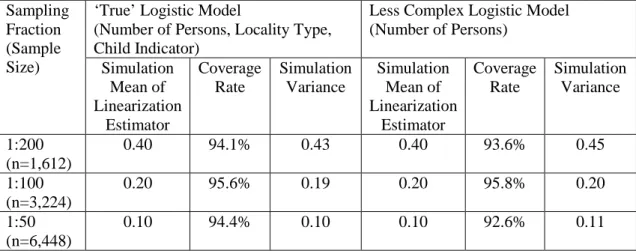
Simulation means of the linearization variance estimator (see Section 6.2) are
compared in Tables 3 and 4 with the simulation variances (calculated across the
replicated samples) of the SCB estimator for the household and individual surveys,
respectively. The tables also include the Coverage Rate defined as the percentage of
times that the trueRρ is included in the confidence interval calculated by the
linearization variance estimator: 100{[ 500 ( ˆ 2 var (ˆ ))]/500} 1
∑
B= I Rρ∈RρB ± B RρB where )ˆ (
varB RρB is the estimated linearization variance for the Bth simulation sample and I
is the indicator function.
[PLACE TABLE 3 HERE]
[PLACE TABLE 4 HERE]
The linearization variance estimator is seen to be approximately unbiased across the
range of conditions represented in these tables under the different sample sizes with
good coverage as seen by the coverage rate in the tables.
Figures 1 and 2 present box plots comparing the SCB estimator and its proposed
bias adjusted version for the Household and Individual Survey simulation respectively
when fitting the ‘true’ logistic regression model. The gains from the bias adjustment
are evident.
[PLACE FIGURE 1 HERE]
8. Application to Real Surveys
We demonstrate the use of R-indicators on business surveys undertaken for the
2007 Dutch Short Term Statistics (STS) for retail and industry. Table 5 provides a
brief description of the two surveys.
[PLACE TABLE 5 HERE]
In the table, the survey response rates are given for 15, 30, 45 and 60 days of
fieldwork. After 30 days STS needs to provide data for monthly statistics. We
examine both a complete set of auxiliary variables consisting of (i) business size class
(based on number of employees), (ii) business sub-type and (iii) VAT 2006 as
collected by the Tax Board and a reduced set consisting of just (i) and (ii). Table 6
provides the results of the unadjusted and bias adjusted R-indicators, 95% confidence
intervals and the standardized maximal bias (obtained by plugging estimated response
propensities into (4.4)) after 15, 30, 45 and 60 days of fieldwork for each of the
business surveys. Because of the large sample size, the bias adjustment had a small
impact.
[PLACE TABLE 6 HERE]
The samples for the business surveys are large and hence the confidence
intervals are reduced with widths between 1% and 1.5%. The R-indicator for STS
retail after 30 days fieldwork drops almost 7% when VAT is added to the auxiliary
information. For STS industry the decrease is much reduced. Apparently, the size of
VAT in the previous year does not relate to response very strongly. Without the VAT
information the retail respondents have a higher R-indicator than the industry
worse. STS retail shows a reduction in the R-indicator as the response rates increase
for the reduced set of auxiliary variables. The main survey item of the STS surveys is
monthly turnover (subdivided over different activities). As VAT in a previous year
can be expected to correlate strongly to turnover in the running year, it is important
that representativeness is good with respect to VAT. The main conclusion is that for
Industry, the R-indicator goes up after 30 days, suggesting response
representativeness is still improving and one would ideally wait longer than 30 days
before producing statistics. For Retail, the R-indicator is lower, suggesting that
response is less representative than for Industry, but there is very little change when
data collection is prolonged. Hence, it does not pay off to wait longer
than 30 days considering the composition of the response. The only reason to do so
would be that the risk of nonresponse bias as reflected by the maximal bias is still
decreasing as responses are coming in.
9. Discussion
In this paper we have considered a new indicator, called the R-indicator,
designed to reflect the potential estimation error arising from nonresponse. The
indicator is defined at the population level and we have developed methods for its
estimation using sample data, including methods of bias adjustment and variance
estimation. The approximate validity of these methods has been demonstrated via
simulation. We have also demonstrated how the indicator may be used in real
business surveys as well as social surveys. The bias adjustment is particularly
effective for small sample sizes. In addition, the variance estimation provides good
The indicator is defined with respect to a set of auxiliary variables. An
R-indicator cannot be viewed separately from the auxiliary vector X that was used to
define it. As such, indicator values should always be reported with reference to the
auxiliary variables. Consequently, when comparing multiple surveys within one
survey institute, over survey institutes or even over countries, one needs to fix the set
of auxiliary variables used for each of the surveys. There are two conflicting aims that
need to be balanced when selecting auxiliary variables in the comparison of different
surveys. On the one hand, it is desirable to choose auxiliary variables that are
maximally correlated with the variables of analytic interest in each survey. On the
other hand, the choice is constrained to the set of auxiliary variables that is available
for each of the surveys. The wider the scope of the comparison, the more restrictive
the availability of variables will be. Within one survey institute one is likely to use
one sampling frame, have access to the same register data and collect similar paradata
for surveys. Multiple countries, however, may have completely different traditions
and legislation, which will limit the set of auxiliary variables that is shared. More
discussion on the selection of auxiliary variables is in Schouten, Shlomo and Skinner
(2011).
A key assumption has been that these variables are measured on both
respondents and nonrespondents. This assumption may be reasonable in some survey
settings. For example, rich auxiliary information is available at Statistics Netherlands
from a population register. However, in other survey settings, the availability of
unit-level auxiliary information on nonrespondents may be very limited. Instead, aggregate
information on the population totals of auxiliary variables may be available. We are
Acknowledgements
This research was undertaken as part of the RISQ (Representativity Indicators for
Survey Quality) project, funded by the European 7th Framework Programme (FP7),
as a joint effort of the national statistical institutes of Norway, the Netherlands and
Slovenia and the Universities of Leuven and Southampton. We should like to thank
Li-Chun Zhang, Jelke Bethlehem, Mattijn Morren and Ana Marujo for their
Annex. Variance of ˆ
ρ
i for logistic regression modelFor the logistic regression model, write 1
( ) ( ) exp( ) /[1 exp( )]
hη =g− η = η + η . The estimating equations in (5.3) may then be expressed as:
[ ( ' )] 0
i i i i
sd R −h =
∑
x β x . (A1)Let ˆβ solve (A1). Then in large samples we may approximate the distribution of ˆβ
with respect to the sampling design (c.f. Skinner, pp. 80-83, 1989) by the distribution
of : 1 ˆ ( ) [ ( ) ] U U sd Ri i h i U i − ′ ≈ +
∑
− β β I β xβ x , (A2)where βU is defined in (6.1), ( )I β =
∑
sdi∇h(xi' )β x x is the information matrix and i i' ( ) ( ) / ( )[1 ( )]hη hη η hη hη
∇ = ∂ ∂ = − . In particular, the variance of ˆβ with respect to the sampling design is in large samples
1 1
ˆ
( ) ( ) { [ ( )] } ( )
s U s s i i i U i U
V β ≈I β −V
∑
d R −h x′β x I β − (A3) and, sinceρ
ˆi =h(xi' )βˆ from (5.4), we have2 ˆ 2 1 1 ˆ ( ) ( ) ( ) ( ) ( ) { [ ( )] } ( ) s i i U i s i i U i U s j j j U j U i j s V ρ h V h −V d R h − ∈ ′ ′ ′ ′ ′ ≈ ∇ xβ x β x = ∇ xβ x I β
∑
− x β x I β x (A4)This expression treats the response indicators Rj as fixed. To account for the
response mechanism also, we may write ρi0 =E Rr( i|x and i)
ˆ ˆ ˆ
var(ρi)=E Vr[ (s ρi)]+V Er[ s(ρi)] (A5) In large samples, we may write Es(ρˆi)≈h(xi'βU). Assuming ρi0 =E Rr( i|x , we i) may write βU =βU0 +O Np( −0.5) and V Er[ s(ρˆi)]=O N( −1). The first term in (A5) is generally of 1
( )
sampling fraction /n N may be treated as negligible. In this case an expression for
ˆ
var(
ρ
i) may be obtained by replacing βU in (A4) by βU0.References
Bethlehem, J.G. (1988). Reduction of nonresponse bias through regression estimation.
Journal of Official Statistics, 4, 251 – 260.
Cobben, F. and Schouten, B. (2007). An empirical validation of R-indicators.
Discussion paper, CBS, Voorburg.
Groves, R.M. (2006). Nonresponse rates and nonresponse bias in household surveys.
Public Opinion Quarterly, 70, 646-675.
Groves, R.M. and Peytcheva, E. (2008). The impact of nonresponse rates on
nonresponse bias: A meta-analysis. Public Opinion Quarterly, 72, 167-189.
Groves, R.M., Brick, J.M., Couper, M., Kalsbeek, W. Harris-Kojetin, F. Kreuter,
Pennell, B., Raghunathan, T., Schouten, B., Smith, T., Tourangeau, R., Bowers,
A., Jans, M., Kennedy, C., Levenstein, R., Olson, K., Peytcheva, E., Ziniel, S. and
Wagner, J. (2008). Issues facing the field: alternative practical measures of
representativeness of survey respondent pools. Survey Practice, October 2008
http://surveypractice.org/
Heerwegh, D., Abts, K. and Loosveldt, G. (2007). Minimizing survey refusal and
noncontact rates: Do our efforts pay off? Survey Research Methods, 1, 3-10.
Kreuter, F., Olsen, K., Wagner, J., Yan, T., Ezzati-Rice, T.M., Casa-Cordero, C.,
Lemay, M., Peytchev, A., Groves, R.M. and Raghunathan, T.E. (2010) Using
Non-response: Examples from Multiple Surveys. Journal of the Royal Statistical
Society, Series A, 173, 389-407.
Little, R.J.A. (1986). Survey nonresponse adjustments for estimates of means.
International Statistical Review, 54, 139-157.
Little, R.J.A. (1988). Missing-data adjustments in large surveys. Journal of Business
and Economic Statistics, 6, 287-301.
Little, R.J.A. and Rubin, D.B. (2002). Statistical Analysis with Missing Data. 2nd Ed.
Hoboken, NJ.: Wiley.
Rubin, D.B. (1987). Multiple Imputation for Nonresponse in Surveys. New York:
Wiley.
Särndal, C-E. and Lundström, S. (2005). Estimation in Surveys with Nonresponse.
Chichester: Wiley.
Schouten, B. and Cobben, F. (2007). R-indicators for the comparison of different
fieldwork strategies and data collection modes. Discussion paper 07002, CBS
Voorburg.
Schouten, B., Cobben, F. and Bethlehem, J. (2009). Indicators for the
representativeness of survey response. Survey Methodology, 35, 101-113.
Schouten, B., Shlomo, N. and Skinner, C.J. (2011). Indicators for monitoring and
improving representativeness of response. Journal of Official Statistics (to be
published). http://eprints.soton.ac.uk/158353/
Skinner, C.J. (1989). Domain means, regression and multivariate analysis. In Skinner,
C.J., Holt, D. and Smith, T.M.F. eds. Analysis of Complex Surveys, Chichester:
Skinner, C.J. (2003). Introduction to Part B. In Chambers, R.L. and Skinner, C.J.
Analysis of Survey Data, Chichester: Wiley.
Wagner, J.R. (2008). Adaptive survey design to reduce nonresponse bias. PhD
Table 1: Household Survey - Simulation Means of ˆRρ and its bias-corrected version, R%ρ and their percent relative bias (across 500 simulated samples) Sampling
Fraction (Sample Size)
‘True’ Logistic Model
(Number of Persons, Locality Type, Child Indicator) Rρ = 0.8780
Less Complex Logistic Model (Number of Persons) RρU0 =0.8842 SCBRˆρ ProposedR%ρ SCBRˆρ ProposedR%ρ Mean Relative Bias (%) Mean Relative Bias (%) Mean Relative Bias (%) Mean Relative Bias (%) 1:200 (n=1,612) 0.8700 -0.91 0.8813 0.38 0.8755 -0.98 0.8830 -0.14 1:100 (n=3,224) 0.8735 -0.51 0.8786 0.07 0.8801 -0.46 0.8834 -0.09 1:50 (n=6,448) 0.8749 -0.35 0.8765 -0.17 0.8807 -0.40 0.8814 -0.32
Table 2: Individual Survey - Simulation Means of ˆRρ and its bias-corrected version, R%ρ and their percent relative bias (across 500 simulated samples)
Sampling Fraction (Sample Size)
‘True’ Logistic Model
(Number of Persons, Sex, Age Groups, Income Groups, Locality Type, Child Indicator) Rρ =0.8767
Less Complex Logistic Model (Number of Persons, Sex and Age Groups) RρU0 =0.9023 SCBRˆρ Proposed R%ρ SCB Rˆρ Proposed R%ρ Mean Relative Bias (%) Mean Relative Bias (%) Mean Relative Bias (%) Mean Relative Bias (%) 1:200 (n=3,769) 0.8587 -2.05 0.8809 0.48 0.8941 -0.91 0.9073 0.55 1:100 (n=7,537) 0.8686 -0.92 0.8796 0.33 0.9008 -0.17 0.9072 0.54 1:50 (n=15,074) 0.8748 -0.22 0.8795 0.32 0.9029 0.07 0.9054 0.34
Table 3: Household Survey - Simulation mean of linearization estimator of variance of ˆRρ with coverage rate and, simulation variance (across 500 simulated samples) (10-3) Sampling Fraction (Sample Size)
‘True’ Logistic Model
(Number of Persons, Locality Type, Child Indicator)
Less Complex Logistic Model (Number of Persons) Simulation Mean of Linearization Estimator Coverage Rate Simulation Variance Simulation Mean of Linearization Estimator Coverage Rate Simulation Variance 1:200 (n=1,612) 0.40 94.1% 0.43 0.40 93.6% 0.45 1:100 (n=3,224) 0.20 95.6% 0.19 0.20 95.8% 0.20 1:50 (n=6,448) 0.10 94.4% 0.10 0.10 92.6% 0.11
Table 4: Individual Survey - Simulation mean of linearization estimator of variance of ˆRρ with coverage rate and simulation variance (across 500 simulated samples) (10-3) Sampling Fraction (Sample Size)
‘True’ Logistic Model
(Number of Persons, Sex, Age Groups, Income Groups, Locality Type, Child Indicator)
Less Complex Logistic Model (Number of Persons, Sex and Age Groups) Simulation Mean of Linearization Estimator Coverage Rate Simulation Variance Simulation Mean of Linearization Estimator Coverage Rate Simulation Variance 1:200 (n=3,769) 0.21 94.4% 0.23 0.19 94.8% 0.19 1:100 (n=7,537) 0.10 93.4% 0.11 0.09 92.4% 0.11 1:50 (n=15,074) 0.05 93.8% 0.05 0.04 92.1% 0.05
Table 5: Description of 2007 Dutch Business Surveys STS retail 2007 STS industry 2007 n=93,799 n=64,413 Response=49.5% (15days) Response=78.0% (30days) Response=85.8% (45days) Response=88.2% (60days) Response=48.8% (15days) Response=78.7% (30days) Response=85.7% (45days) Response=88.3% (60days) All businesses retail All businesses industry Stratified design on size class
and business type
Stratified design on size class and business type
unequal design weights unequal design weights Fieldwork 90 days Fieldwork 90 days
Paper + web Paper + web
Table 6: Unadjusted (top) and Bias-adjusted (bottom) R-indicators, 95% Confidence Intervals and Standardized Maximal Bias (formula 4.4) for Dutch Business Surveys using Reduced and Complete Sets of Auxiliary Variables
Survey
Reduced Set Complete Set
15d 30d 45d 60d 15d 30d 45d 60d Industry R 91.9% 92.1% 93.2% 93.3% 93.9% 94.0% 94.1% 94.2% 90.2% 90.5% 91.6% 91.8% 92.9% 93.1% 93.2% 93.3% CI 91.3-92.8 92.7-94.0 93.5-94.4 93.8-94.6 89.7-91.3 91.3-92.2 92.6-93.5 92.8-93.8 B 16.2% 8.5% 7.0% 6.6% 19.5% 10.4% 8.1% 7.6% Retail R 95.9% 96.1% 94.5% 94.6% 93.9% 94.0% 94.0% 94.1% 87.9% 88.1% 87.8% 87.9% 88.2% 88.3% 88.9% 89.0% CI 95.4-96.7 94.0-95.2 93.5-94.5 93.6-94.6 87.3-88.8 87.3-88.6 87.6-88.9 88.3-89.6 B 7.9% 6.9% 7.0% 6.7% 24.0% 15.5% 13.6% 12.5%
Figure 1: Household Survey Box plots for SCB ˆRρ and its Bias-Corrected Version, R%ρ for 500 simulated samples with 1:200, 1:100 and 1:50 sampling fractions - ‘True’ R-Indicator = 0.8780
Figure 2: Individual Survey Box plots for SCB ˆRρ and its Bias-Corrected Version, R%ρ for 500 simulated samples with 1:200, 1:100 and 1:50 sampling fractions - ‘True’ R-Indicator = 0.8767