Some pages of this thesis may have been removed for copyright restrictions.
If you have discovered material in Aston Research Explorer which is unlawful e.g. breaches
copyright, (either yours or that of a third party) or any other law, including but not limited to
those relating to patent, trademark, confidentiality, data protection, obscenity, defamation,
libel, then please read our Takedown policy and contact the service immediately
K
NOWLEDGE
-
CENTRIC
A
UTONOMIC
S
YSTEMS
ALINA PATELLI
Doctor of Philosophy
ASTON UNIVERSITY
April 2016
©Alina Patelli, 2016Alina Patelli asserts her moral right to be identified as the author of this thesis
This copy of the thesis has been supplied on condition that anyone who consults it is understood to recognise that its copyright rests with its author and that no quotation from the thesis and no information derived from it may be published without appropriate permission or acknowledgement.
Autonomic computing revolutionised the commonplace understanding of proactiveness in the digital world by introducing self-managing systems. Built on top of IBM’s structural and functional recommendations for implementing intelligent control, autonomic systems are meant to pursue high level goals, while adequately responding to changes in the environment, with a minimum amount of human intervention. One of the lead challenges related to implementing this type of behaviour in practical situations stems from the way autonomic systems manage their inner representation of the world. Specifically, all the components involved in the control loop have shared access to the system’s knowledge, which, for a seamless cooperation, needs to be kept consistent at all times.
A possible solution lies with another popular technology of the 21st century, theSemantic Web, and the knowledge representation media it fosters, ontologies. These formal yet flexible descriptions of the problem domain are equipped with reasoners, inference tools that, among other functions, check knowledge consistency. The immediate application of reasoners in an autonomic context is to ensure that all components share and operate on a logically correct and coherent “view” of the world. At the same time, ontology change management is a difficult task to complete with semantic technologies alone, especially if little to no human supervision is available. This invites the idea of delegating change management to an autonomic manager, as the intelligent control loop it implements is engineered specifically for that purpose.
Despite the inherent compatibility between autonomic computing and semantic technologies, their integration is non-trivial and insufficiently investigated in the literature. This gap represents the main motivation for this thesis. Moreover, existing attempts at provisioning autonomic architectures with semantic engines represent bespoke solutions for specific problems (load balancing in autonomic networking, deconflicting high level policies, informing the process of correlating diverse enterprise data are just a few examples). The main drawback of these efforts is that they only provide limited scope for reuse and cross-domain analysis (design guidelines, useful architectural models that would scale well across different applications and modular components that could be integrated in other systems seem to be poorly represented).
This work proposes KAS (Knowledge-centric Autonomic System), a hybrid architecture combining semantic tools such as:
• an ontology to capture domain knowledge,
• a reasoner to maintain domain knowledge consistent as well as infer new knowledge, • a semantic querying engine,
• a tool for semantic annotation analysis with a customised autonomic control loop featuring:
• a novel algorithm for extracting knowledge authored by the domain expert, • “software sensors” to monitor user requests and environment changes,
• a new algorithm for analysing the monitored changes, matching them against known patterns and producing plans for taking the necessary actions,
• “software effectors” to implement the planned changes and modify the ontology accordingly. The purpose of KAS is to act as a blueprint for the implementation of autonomic systems harvesting semantic power to improve self-management. To this end, two KAS instances were built and deployed in two different problem domains, namely self-adaptive document rendering and autonomic decision
the latter is a large scale, web-based system built to capture and manage knowledge sourced by an entire (relevant) community. The two problems are representative for their own application classes – namely desktop tools required to respond in realtime and, respectively, online decision support platforms expected to process large volumes of data undergoing continuous transformation – therefore, they were selected to demonstrate the cross-domain applicability (that state of the art approaches tend to lack) of the proposed architecture. Moreover, analysing KAS behaviour in these two applications enabled the distillation of design guidelines and of lessons learnt from practical implementation experience while building on and adapting state of the art tools and methodologies from both fields.
KAS is described and analysed from design through to implementation. The design is evaluated using ATAM (Architecture Tradeoff Analysis Method) whereas the performance of the two practical realisations is measured both globally as well as deconstructed in an attempt to isolate the impact of each autonomic and semantic component. This last type of evaluation employs state of the art metrics for each of the two domains. The experimental findings show that both instances of the proposed hybrid architecture successfully meet the prescribed high-level goals and that the semantic components have a positive influence on the system’s autonomic behaviour.
I dedicate this work to my mother, Carmen Patelli. When I am blindsided by what I think I want, she points out what I actually need.
The road so far would have been a lot harder without my father and engineering role model, Dinu Patelli. My deepest gratitude to my supervisor, Dr Hai Wang, my research collaborators (and friends), Dr Aniko Ekart, Dr Peter Lewis, Prof Ian Nabney, Dr Radu Calinescu and, last but not least, my PhD colleagues, Alex, Yanna, Sandra, Ana, Ali, Nick and Aman.
Contents
Abstract 2 Acknowledgments 4 Table of Contents 5 List of Abbreviations 8 List of Tables 9 List of Figures 10 1 Introduction 12 1.1 Problem Statement . . . 12 1.2 Research Questions . . . 151.3 Proposed Solution and Application Domains . . . 16
1.3.1 Self-adaptive Document Rendering . . . 16
1.3.2 Career-related Decision Support . . . 18
1.4 Research Objectives and Contributions . . . 19
2 Background 22 2.1 Autonomic Systems . . . 22
2.1.1 Structure . . . 24
2.1.2 Policies . . . 25
2.1.3 Applications and Evaluation . . . 30
2.1.4 Reflection and Open Issues . . . 32
2.2 Semantic Technologies . . . 34
2.2.1 Core Advantages . . . 35
2.2.2 The Semantic Stack . . . 36
2.2.3 Semantic Reasoning Services . . . 40
2.2.4 Ontology Engineering . . . 43
2.2.5 Applications and Evaluation . . . 48
2.2.6 Reflection and Open Issues . . . 52
2.3 Hybrid Approaches . . . 53
2.3.1 The Need for Hybrids . . . 53
2.3.2 Applications and Evaluation . . . 54
3 State of the Art 55 3.1 Autonomic Systems . . . 55
3.1.1 Monitor . . . 56
3.1.2 Analyse . . . 57
3.1.3 Plan and Execute . . . 58
3.1.5 Policy . . . 61 3.1.6 Middleware . . . 62 3.1.7 Reflection . . . 63 3.2 Semantic Technologies . . . 66 3.2.1 Ontology Extraction . . . 66 3.2.2 Semantic Reasoning . . . 67 3.2.3 Ontology Querying . . . 70 3.2.4 Reflection . . . 73 3.3 Hybrid Approaches . . . 75 3.3.1 Reflection . . . 78
4 A General Framework for Knowledge-centric Autonomic Systems 80 4.1 Rationale . . . 80
4.2 Architecture Description . . . 82
4.2.1 Onto++ Template . . . 83
4.2.2 Policy . . . 86
4.2.3 Managed Resource, Sensors and Effectors . . . 88
4.3 Tools . . . 88 4.3.1 Reasoner . . . 88 4.3.2 Knowledge Translator . . . 89 4.3.3 Monitor . . . 95 4.3.4 Analyse . . . 95 4.3.5 Plan . . . 97 4.4 Methodology . . . 99 4.5 Evaluation . . . 101 4.5.1 Problem Definition . . . 101 4.5.2 Business Drivers . . . 102 4.5.3 Architectural Plan . . . 102 4.5.4 Architectural Approaches . . . 102
4.5.5 Quality attributes and usage scenarios . . . 103
4.5.6 Architectural Approaches’ Analysis . . . 104
4.5.7 Additional Usage Scenarios . . . 105
4.5.8 Threats . . . 105
5 Autonomic Systems with State-featuring Ontologies 107 5.1 Application Domain . . . 107
5.2 Architecture Description . . . 108
5.2.1 SAR Ontology and KT . . . 109
5.2.2 Reasoner . . . 113
5.2.3 Policy . . . 115
5.2.4 Monitor, Execute and the Managed Resource . . . 117
5.2.5 Analyse . . . 117
5.2.6 Plan . . . 118
5.3 Implementation Scenario . . . 118
5.3.1 Setup and ontology learning . . . 118
5.3.2 Monitoring and analysis . . . 119
5.3.3 Planning . . . 120
5.3.4 Maintaining the plan bank . . . 120
5.3.5 Self-management support . . . 120
5.4 Evaluation . . . 121
5.4.2 Semantic Components Evaluation . . . 130
6 Autonomic Systems with State-less Ontologies 134 6.1 Application Domain . . . 134
6.2 Architecture Description . . . 136
6.2.1 CDS Ontology and KT . . . 136
6.2.2 Reasoner . . . 139
6.2.3 Policy . . . 140
6.2.4 Monitor, Execute and the Managed Resource . . . 141
6.2.5 Analyse . . . 141
6.2.6 Plan . . . 142
6.3 Implementation Scenario . . . 142
6.3.1 Policy Definition and Ontology Learning . . . 143
6.3.2 Monitoring, Analysis and Planning . . . 143
6.3.3 Self-management support . . . 146
6.4 Evaluation . . . 147
6.4.1 Autonomic Manager Evaluation . . . 147
6.4.2 Semantic Components Evaluation . . . 149
7 Conclusions 151 7.1 Contributions Overview . . . 151 7.2 Lessons Learnt . . . 152 7.3 Research Dissemination . . . 152 7.4 Future Work . . . 153 Bibliography 154
ABLE Agent Building and Learning Environment
ACME Architectural Description of Component-based Systems ACT Autonomic Computing Toolkit
ADL Architectural Description Language ANS Autonomic Nervous Systems
ATAM Architecture Trade-off Analysis Method CDS Career Decsion Support
CSS Cascading Style Sheets CWA Closed World Assumption
DAML DARPA Agent Modelling Language
DARPA Defence Advances Research Projects Agency DL Description Logic
ECA Event Condition Action
GATE General Architecture for Text Engineering GCG Good Careers Guide
GPAC General Purpose Autonomic Computing HTML Hyper Text Markup Language
IRI Internalised Resource Identifier JACS Joint Academic Coding System
KAoS Knowledgeable Agent-oriented System KAS Knowledge-centric Autonomic System KPAT KAoS Policy Administration Tool KT Knowledge Translator
MAPE-K Monitor Analyse Plan Execute - Knowledge
NN Neural Network
OE Ontology Engineering OL Ontology Learning
OOP Object Oriented Programming OWA Open World Assumption OWL Web Ontology Language
OWL-POLAR OWL-based Policy Language for Agent Reasoning PDDL Planning Domain Definition Language
ProProST Probabilistic Property Specification Templates RDF Resource Description Framework
RDFS RDF Schema
RIF Rule Interchange Format
SAR Self-Adaptive document Rendering SLA Service Level Agreement
SMART Specific Measurable Achievable/Agreed/Actionable Realistic/Relevant Timed SOC Standard Occupational Classification
SPARQL Simple Protocol and RDF Query Language SWRL Semantic Web Rule Language
URI Uniform Resource Identifier W3C World Wide Web Consortium xADL highly-eXtensible ADL XML eXtensible Markup Language
List of Tables
Table 1.1 Contributions to objectives mapping . . . 21
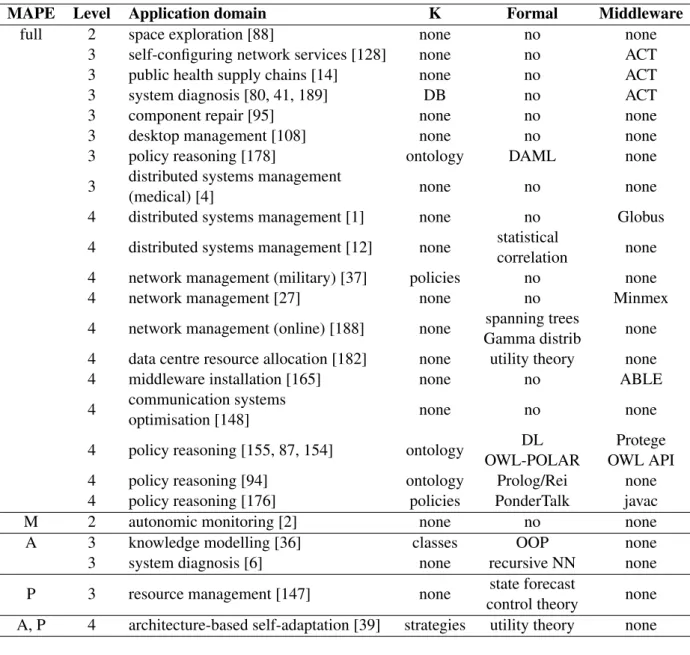
Table 3.1 Autonomic applications . . . 64
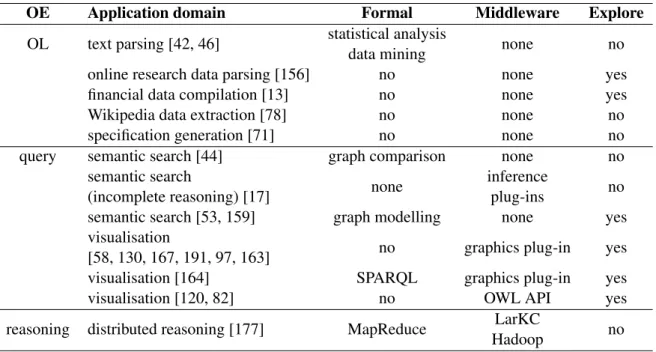
Table 3.2 Semantic applications . . . 73
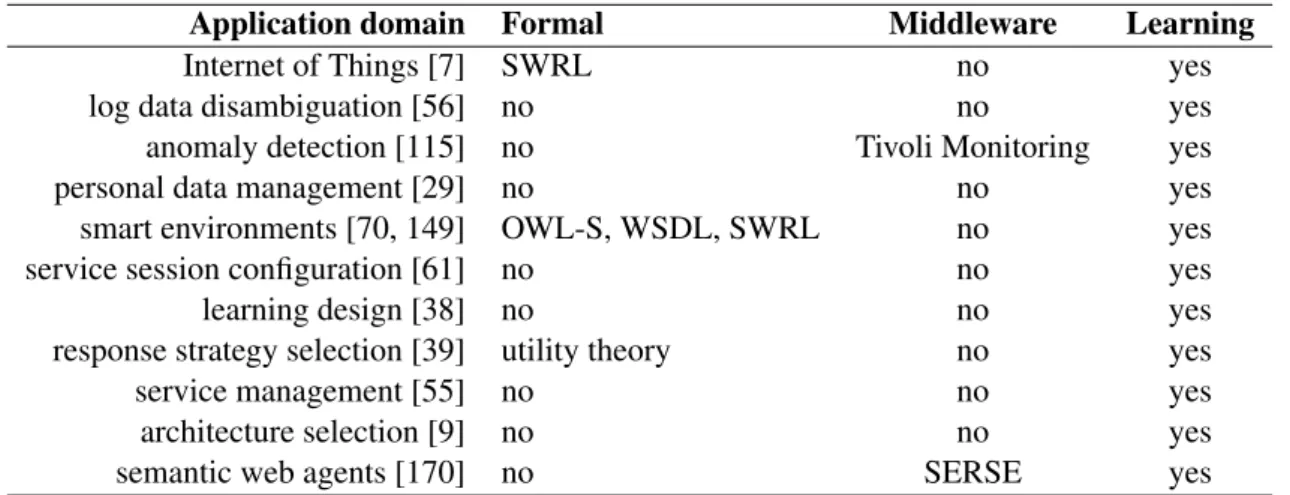
Table 3.3 Autonomic-semantic hybrid applications . . . 79
Table 4.1 The Knowledge Translator (KT) algorithm . . . 90
Table 4.2 Link hierarchy and associated properties construction . . . 91
Table 4.3 The analyse algorithm . . . 95
Table 4.4 The plan algorithm . . . 97
Table 4.5 The KAS methodology . . . 99
Table 4.6 KAS methodology - stage authors . . . 101
Table 5.1 KTthresholdsvalues - an example . . . 113
Table 5.2 SAR policy document - state utilities . . . 115
Table 5.3 SAR policy document - plan actions . . . 116
Table 5.4 SAR policy document - heuristics . . . 116
Table 5.5 KAS for SAR and trivial autonomic manager comparison plan length capped at 10 actions . . . 127
Table 5.6 KAS for SAR and database-supported autonomic manager comparison . . . 129
Table 6.1 CDS policy document - plan actions . . . 141
List of Figures
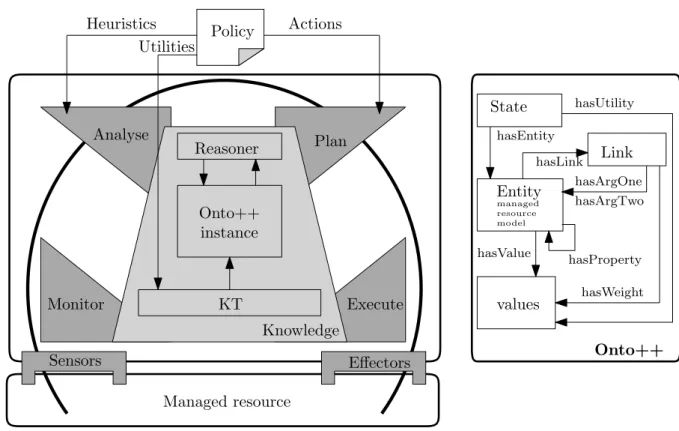
Fig. 1.1 The simplified architecture of a traditional autonomic computing element . . . 14
Fig. 2.1 The Semantic Web stack adapted from [84] . . . 37
Fig. 2.2 A SPARQL query to find East Sussex hotels . . . 38
Fig. 2.3 One entry in the SPARQL query result . . . 39
Fig. 2.4 Concept definitions from an ontology describing vacation destinations - based on these, the reasoner subsumesFrenchRivieraCity under NorthernMediterraneanCity . . . 40
Fig. 2.5 Concept definitions from an ontology describing vacation destinations - based on these, the reasoner infers that conceptItalianRivieraCityis unsatisfiable . . . . 41
Fig. 2.6 Concept definitions from an ontology describing vacation destinations - based on these, the reasoner infers that conceptsEuropeanCity, AsianCity andCityare synonyms . . . 42
Fig. 2.7 Individual definition from an ontology describing vacation destinations - based on this and the concepts in Fig. 2.4, the reasoner infers that Nice is a northern Mediterranean city . . . 42
Fig. 2.8 A reified multi-faceted property . . . 45
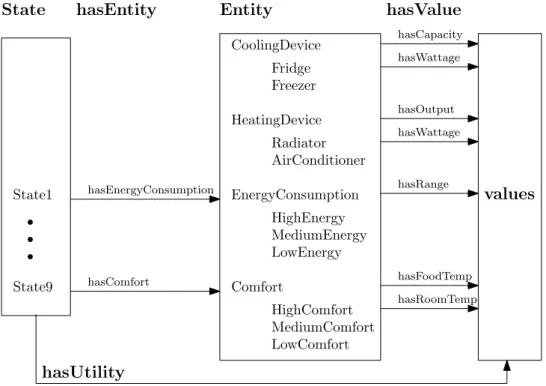
Fig. 4.1 KAS architecture - component view . . . 82
Fig. 4.2 The Onto++ instance modelling the smart environment . . . 85
Fig. 4.3 FridgeandAirConditionerconcept definitions . . . 86
Fig. 4.4 StateandState7concept definitions . . . 86
Fig. 4.5 HighEnergyandMediumComfortconcept definitions . . . 87
Fig. 4.6 Reification example . . . 93
Fig. 4.7 Statehierarchy example . . . 94
Fig. 5.1 KAS with state-featuring ontology - component view . . . 108
Fig. 5.2 State1concept definition . . . 109
Fig. 5.3 The SAR Ontology in more detail . . . 111
Fig. 5.4 TimeOfDayandEarlyMorningconcept definitions . . . 112
Fig. 5.5 TheStatehierarchy root . . . 112
Fig. 5.6 TheEntityhierarchy before (Asserted) and after (Inferred) subsumption (Protege ontology view, where hierarchies are displayed as indented lists) . . . 114
Fig. 5.7 TheCurrentTimeconcept definition . . . 115
Fig. 5.8 TheCurrentFocusandCurrentBatteryconcept definitions . . . 117
Fig. 5.9 TheState17concept definition . . . 118
Fig. 5.10 The KAS methodology instantiated in the SAR problem domain - the architecture tools are displayed in the centre and connected via linear arrows to show the sequence in which they are executed; the tools’ inputs and outputs are displayed on either side and connected via block arrows . . . 119
Fig. 5.11 A partial Entity Relationship Diagram describing the database equivalent to the Onto++ instance for SAR . . . 126
Fig. 6.1 KAS with state-less ontology - component view . . . 136
Fig. 6.2 Reification in the CDS ontology . . . 137
Fig. 6.3 Entityconcept definition . . . 138
Fig. 6.4 Linkconcept definition . . . 138
Fig. 6.5 BIOMOLECULAR SCIENCEconcept definition . . . 139
Fig. 6.6 A SPARQL query to support searching the CDS ontology . . . 140
Fig. 6.7 KAS with state-less ontology - component view . . . 143
Fig. 6.8 KAS for CDS front-end: searcher and visualiser . . . 144
Fig. 6.9 KAS for CDS front-end: tagger . . . 144
Fig. 6.10 KAS for CDS front-end: updater . . . 145
1
Introduction
1.1
Problem Statement
The beginning of the third millennium brings forward two remarkable challenges in the field of computing. The first is formulated by Tim Berners-Lee et al. in their May, 2001 article [23], where the authors observe the state of the web, analyse its limitations and suggest a foundational shift in its structure. More specifically, this seminal piece of work advocates the transformation of the web of documents, a heterogeneous collection of online resources chiefly meant for human consumption, into a
web of data, a network of uniformly formatted knowledge that can be processed by machines. This is made possible by annotating every piece of information on the web with metadata, namely small units of text (appropriately calledtags), expressed in some well structured language, meant to bring context to the resources they are attached to. By reading and interpreting these tags, machines are envisaged to break the syntactic barrier of processing information and become capable of understanding itsmeaning. This type of behaviour would bring about a new web, asemantic web. Later that same year, IBM publishes a manifesto [81] issuing a strong warning about the galloping increase of IT systems complexity and its backlash against the very heightened computing power it was meant to make possible. The proposed solution isautonomic computing, a biologically inspired model that promotesself-managingIT systems. Much like the human autonomic nervous system, self-managing IT structures are governed by a manager that takes care of low-end yet vital operations such as integration with other systems, download and installation of updates, protection against malware, etc. [101]. This would hide a significant portion of the IT system’s complexity from the human administrator who is thus allowed to invest energy in high level tasks such as goal/policy definition and business requirements management.
The semantic web and autonomic computing initiatives are connected by more than their date of birth. There has been significant work on integrating semantic technologies into the Internet of Things (IoT) application domain [190, 186, 16], that also makes use of autonomic elements – to provide just one example of research that bridges the gap between the two fields. To further support this compatibility claim, let us outline some of the key strengths and open challenges of both fields. As mentioned before, the semantic web can be practically realised by annotating online resources with metadata (semantic tags). Although some commercial applications, such as Flickr1or Delicious2, support manual tagging, given the size of the current web, an automated annotation solution would be preferable. To address that, the semantic research community suggested extracting annotations from ontologies
1https://www.flickr.com/ 2https://delicious.com/
[23, 78, 73, 8, 54, 191]. Ontologies are formal models of a given domain, usually written in a language from the Resource Description Framework (RDF3) family, such as the Web Ontology Language (OWL4). Some well known examples of ontologies are Google Knowledge Graph [159], supporting the right hand side display of the search engine’s results page, WordNet5, an English language lexicon, DBpedia6, organising structured Wikipedia information in a semantic format for better querying, OpenCyc7, an ambitious project to build a general ontology about everything in the world, etc. (other smaller, domain-oriented ontologies can be found in dedicated libraries [49]). This wide acceptance is driven by the main appeal of semantic technologies, stated below.
Ontologies are equipped with reasoners, semantic inference tools capable of automatically verifying the logical correctness of the knowledge base.
Thus, there is a way to formally guarantee that metadata is extracted from a logically consistent repository. However, the domains modelled by ontologies are dynamic, continuously changing by incorporating new information, modifying existing data and discarding obsolete records. In this context, an important challenge can be formulated, as follows.
Ontologies need to be (automatically) maintained to keep up with the frequent transformations of the knowledge domain they are modelling.
A similar analysis can be carried out for autonomic systems. Autonomic behaviour (a four-faceted concept [101] comprising self-configuration, self-optimisation, self-healing and self-protection) is achieved by plugging anautonomic manager into a traditional (legacy) IT system, also called the
managed resource (Fig. 1.1). The operation of the manager is based on a closed control loop with four stages: monitor, analyse, plan andexecute, all of which entail some level of interaction with a central repository ofknowledgeabout the system itself and its environment. This set-up is referred to as the MAPE-K loop and is widely used in both research (ranging from generic toolkits such as ABLE [24] and GPAC [32] to concrete solutions for dynamic resource management in distributed systems [1], smart home applications [172] and wireless sensor networks management [89]) and industry (IBM’s autonomic computing toolkit [91], Fujitsu’s organic computing architecture [98] and other successful implementations by Oracle, HP, Microsoft and Intel [103]). The lead advantage of the MAPE-K loop is that it allows any system based on it to manage change, that is, adapt to environment dynamics in order to continue achieving a set of goals prescribed in thepolicy document. In short, this is done by
monitoringthe environment viasensorsto detect changes, analysingthe acquired data by matching it against available models or previously detected patterns (usually, part of the systemknowledge),planning
a set of actions to respond to the changes andexecutingthose actions at a practical level viaeffectors. The lead advantage (included below) of autonomic systems is a direct consequence of this process.
3http://www.w3.org/RDF/
4http://www.w3.org/2001/sw/wiki/OWL 5http://wordnet-rdf.princeton.edu/ 6http://wiki.dbpedia.org/ 7http://www.opencyc.org/
Autonomic systems intrinsically maintain their knowledge base up-to-date with respect to changes in the environment.
Self-managing computing is performed in realtime, therefore, the MAPE components will access and modify the knowledge base concurrently. This gives rise to the following challenge.
Autonomic systems require a means to ensure that their knowledge repository is consistent (logically correct) at all times.
Policy
Analyse Plan
Monitor Knowledge Execute Sensor Effector Managed resource Symptom Change request Change plan
Fig. 1.1:The simplified architecture of a traditional autonomic computing element - adapted from [90]
By analysing the previously identified strengths and challenges, it is fairly straightforward to notice their overlap. One of the main open issues in semantic web research is the effective maintenance of ontologies as the domains they model are continuously changing. Autonomic systems are designed to accomplish just that: manage change whilst still optimally pursuing their prescribed goals. They are however hindered by the likelihood of their knowledge base becoming inconsistent due to concurrent access. Ontology reasoners are specifically built to prevent such a scenario by automatically verifying the logical correctness of the knowledge repository. This alignment between the semantic and autonomic fields invites further research into ways of combining the two technologies and thus improving them by enabling the exploitation of features from the complementary domain.
1.2
Research Questions
Knowledge is at the core of the autonomic control loop [90, 101], representing the manager’s model of its environment and of its inner state. As shown in Fig. 1.1, all MAPE components use the central repository of information,concurrently, to inform their operation. Thus, the knowledge model has to be kept in a logically consistent state as well as up to date with the changes in the manager’s environment and/or state. It follows naturally that the way knowledge is represented plays a key role in meeting those two requirements, however, there is limited focus in the literature on the systematic description of environment and inner state information. The existing approaches mainly fall under three categories.
• Knowledge is not permanently stored, instead, it is collected by sensors, during live operation, used to inform the MAPE components in the current stage of the control loop and then discarded [95, 165, 182].
• Knowledge is kept in some formal representation that usually takes the form of an architectural design language (ADL) [88, 110, 152, 50]. Specifically, an ADL representation decomposes knowledge in components linked by connectors, a graph-like structure that lends itself well to live updates and computationally inexpensive integrity checks.
• Knowledge resides inside the manager and informs the MAPE loop, as can be deduced from the overall system’s behaviour, but the details of knowledge storage and management are undisclosed [27, 108].
There are several problems stemming from the knowledge representation strategies above. Firstly, relying only on sensor data captured in the current cycle of operation implies that the manager cannot learn from past experience, thus it becomes challenging to improve the MAPE components based on patterns extracted from historical data. Secondly, using ADLs or other formal languages restricts access to the data layer, as the knowledge model becomes difficult to understand by non-experts. Finally, if the knowledge layer is used to underpin autonomic behaviour in some application-specific way that is too complicated/trivial to be described in the relevant paper, then the proposed solution is unlikely to be reused across different problem domains.
In contrast to these shortcomings, ontologies offer a more flexible and intuitive knowledge storage solution. In effect, semantic knowledge repositories inherently support learning [23, 158] - reasoners infer new information, in an unsupervised way, thus allowing the manager to base its decisions on a comprehensive pool of data. Moreover, ontologies are usually written in RDF, a light logical language based onhsubject,predicate,objectitriplets. Consequently, semantically stored knowledge lends itself well to being visually rendered as a graph [58, 130, 164, 82, 167, 185], making ontologies more intuitive to navigate by non-expert users. Ultimately, ontologies represent a versatile technology, used in a variety of problem domains (see 3.2), and enjoy a wide industry acceptance as standardised solutions for medium to large scale knowledge representation.
In light of these advantages, the research community has proposed hybrid architectures, fitting autonomic managers with semantic knowledge layers. The recurring theme of these contributions is highlighting the hybrid systems’ capacity to learn, that is, infer new information automatically [39, 149, 9] and use it to inform the autonomic control loop. On their quest to increase the acuity of
learning, the authors sometimes compromise good software engineering practices and seldom provide substantive design recommendations and/or lesson learnt, making it difficult to replicate the proposed hybrids in different problem domains. The evaluation of these semantically enhanced autonomic architectures is also in-house.
Given the state of the art summarised above, the main research question of this work involves the possibility of constructing effective, responsibly designed autonomic architectures, by storing the manager’s knowledge in an ontology. This can be further broken down into two sub-questions:
• how todesignan effective hybrid (autonomic and semantic) framework?
• how toimplementthe hybrid framework across different problem domains?
The first sub-question is approached in three stages. Firstly, a general purpose hybrid architecture, namely, an autonomic manager implementing a MAPE-K loop informed by an ontology, is proposed in chapter 4. The underpinning components are structured and assembled to meet the requirements, as presented in the literature, for obtaining effective autonomic behaviour. Secondly, the tools necessary to implement the architectural components are comprehensively described and implemented (chapter 4.3), to ensure the practicality of the suggested design. Thirdly, the methodology to assemble the architectural components coherently is provided in chapter 4.4, for the benefit of customising the suggested hybrid to other problem domains.
The second sub-question is addressed by building practical instances of the proposed hybrid architecture and deploying those in two different application domains - one where adaptability to the environment and speedy decision making are key (chapter 5) and one where domain knowledge is abundant, dynamic and community-curated (chapter 6).
1.3
Proposed Solution and Application Domains
In response to the research question formulated in the previous section, this work proposes a novel, hybrid autonomic architecture, where the knowledge centrepiece in Fig. 1.1 is replaced by an ontology. Since the focus of this research is on ways to exploit and enhance ontology properties (such as hierarchical structure [136], reasoning and querying capabilities [19], etc.) in order to improve the runtime performance of the autonomic ensemble, the suggested hybrid architecture can be viewed as knowledge-centric and is thus titled KAS (Knowledge-knowledge-centric Autonomic System). The KAS architecture was customised for and tested in two different application domains, the first one dealing with self-adaptive document rendering and the second with career related decision support.
1.3.1 Self-adaptive Document Rendering
In the first application domain (see chapter 5 for a detailed description), the legacy system is a traditional document in electronic format, meant to be presented in front of an audience. Specifically, what is being managed is not the content of the document (as that does not change throughout the presentation), but its appearance, namely the size of the fonts used and the brightness of the display. These features are captured within the ontology alongside information about the environment, such as the hour of the day and the audience’s level of focus as picked up by a camera. The goal of KAS in this context is to
ensure that the presentation of the document is well received by maintaining the audience’s focus at a satisfactory level. To exemplify the system’s operation, let us assume that it is 4 pm and that the detected level of audience focus is medium. Since that level is likely to drop even more in the late hours of the afternoon, KAS will automatically increase font size as well as screen brightness to make the contents of the presentation easier to take in.
Media content adaptation was selected as an application domain for two reasons: it is a relevant topic in recent research [52, 122, 144, 192] and several related open issues can be addressed via a joint autonomic/semantic approach, as embodied by KAS. These issues are briefly presented below:
• The media content adaptation problem is formulated, chiefly, with respect to device constraints (e.g., maximum allowed resolution) and network limitations (e.g., available bitrate) [122, 144, 192]. The consumption style of the media user, namely personal requirements/preferences affecting the quality of experience, is not sufficiently considered [52]. In contrast, the proposed KAS implementation takes into account the viewer’s level of concentration, as captured by sensors, and adjusts document rendering accordingly.
• In order to provide rendering devices with sufficient information for content adaptation, the A/V stream is accompanied bymanifest files[52] - containing technical specifications, such as required codecs and native resolution - or by metadata [192] - expressing precomputed relationships between various sets of adaptation parameters. There is no mention about the language/format used for representing this additional information, nor about the decryption process. Overall, the authors of manifest files and/or metadata are most likely domain experts with a solid technical knowledge of the problem environment. To open the content adaptation domain to application developers who are not necessarily versed in the theory of A/V physics, KAS is structured in a modular fashion, where each architectural component is easily configurable and semi-automated. • In [52], the authors argue that content adaptation techniques would benefit from aunified standard,
in terms of rationalising their development, maintenance and evolution. Moreover, [192] advocates thescalabilityof content adaptation frameworks, which should be applicable/extensible to a wide range of media delivery/rendering system architectures. KAS answers these two challenges, as the traditional infrastructure presented in Fig. 1.1 is astandards-based architectural building block(as described in [90]). Several such building blocks may be coupled together to create a multi-layered autonomic computing architecture (illustrated in [90], Figure 2) that can allegedly scale up to any business model.
The core KAS architecture in Fig. 1.1 (where the knowledge block is an ontology) had to be tailored in order to fit the requirements of the media content adaptation problem. One modification is the addition of a discretisation mechanism (implemented by KAS’s bespoke ontology learning algorithm) capable of classifying monitored data under several discrete categories, thus simplifying the definition of system states (theState hierarchy in Fig. 5.1). Another customisation involves the plan bank, a repository of known good quality plans, successful at driving the system to a state of increased utility (relative to the initial one). These plans are recycled when possible and improved when needed, demonstrating that KAS instances are capable of learning from their own experience. However, larger application domains may be difficult to model with aStatehierarchy of reasonable size and, on the other hand, may require
a more detailed ontology representation of the managed resource entities and properties, a reality that the KAS framework is flexible enough to support. To demonstrate that the proposed KAS architecture does scale up to problems of a larger size (and of a different nature altogether), a second practical scenario is introduced.
1.3.2 Career-related Decision Support
The second application domain (analysed at length in chapter 6) consists in an online career recommendations platform (https://gcg-test.codevate.com8). Information about different careers (e.g., the names of different professions and the number of associated jobs, standard higher education codes assigned to career domains, relationships between careers, employer and job seeker profiles, etc.) is stored in an ontology and presented to the end user in the form of a graph. Graph nodes represent professions whereas edges illustrate the (parent to child or sibling to sibling) relationships between them. This sets the platform apart from traditional job search engines, where results are displayed in a list, thus obscuring the relationships between careers and ultimately failing to give the end user a global perspective on the career universe.
The main features available for the job seeker are tagging visited webpages with concepts from the ontology, querying the ontology for access to a graph segment relevant to a search keyword, editing the ontology by adding/deleting career concepts along with their relationships and viewing a personal ontology containing the network of career concepts used as tags in the user’s browsing history. From an autonomic perspective, the career advice platform exhibits self-management (as a result of coupling it with an autonomic manager based on the KAS architecture) in that it monitors user requests such as ontology querying, editing or personal ontology generation, it analyses those requests in order to select the appropriate plan for action, it plans operations such as ontology classification (consistency verification) and segmentation (query running) and, finally, itexecutesthe plan to display the appropriate ontology view for the end user.
Large scale knowledge graph visualisation (with a focus on careers) was selected as an application domain for the following reasons:
• Career related knowledge is voluminous (sourced by companies’ websites, job search engines, statistics agencies9, etc.) and heterogeneous (each of the previously enumerated providers publishes job information in a different format). Considering a central ontology imposes a consistent knowledge representation (RDF/OWL), thus facilitating further semantic processing such as reasoning (to automatically infer implicit information) and logical validation (difficult to achieve otherwise, as logical conflicts may arise across separate career knowledge repositories, even if they are formally correct individually).
• Another consequence of career knowledge being scattered across several platforms is the loss of connections. For example, a front end developer job advert on indeed.co.uk requires 8Domain knowledge provided by Ralph Lucas with the Good Careers Guide; web interface built by David Bennett with
Codevate
9Statistical data about the UK higher education is available at https://www.hesa.ac.uk/, the American Institute
of Physics publishes data about employment in their field athttp://www.aps.org/careers/statistics/, general job statistics for the UK can be found athttp://ons.gov.uk/ons/taxonomy/index.html?nscl=Job+Statistics, etc.
specific computing skills. A simple way for the potential candidate to link those requirements to courses she may have taken in university (and therefore determine if she is eligible for the job) is tracking down the JACS classification for subjects such as computer science (I100) or software design (I310)10. Even if the candidate is aware of both publishers (indeed.co.uk for the job requirements and the HESA website for JACS information), other useful data, such as the average number of jobs in front end development currently available, may require supplementary effort to gather. A centralised ontology attaches all related information to the relevant career graph node (users can access the JACS classification and associated volume of job offers by expanding the COMPUTER SCIENCE node in the graph). This approach not only reveals the way careers are related (e.g., computer science to software design and front end developing) but also provides quick access to statistical data associated to nodes, thus giving the end user a global, connected view of the career domain.
• The field of careers is constantly changing with professions being introduced or redefined to reflect technological trends, business requirements or shifting views of the wider community with respect to which careers are most needed in the current professional context. The ontology captures all moving parts of the career domain by allowing job seekers, employers and other stakeholders to edit the ontology in light of their latest developments. Another facet of change management is the interactive nature of the platform. Rather than displaying a static list of job results like most traditional providers, the proposed service is autonomic, therefore responsive to explicit cues (e.g., user requests) as well as implicit ones (changing organisation profiles that may trigger a modification in the compatibility score of job seekers registered on the system).
In order to fulfil the requirements of the large scale knowledge graph visualisation application domain, the ontology component in the KAS architecture (the knowledge block in Fig. 1.1) has to communicate with several other modules pertaining to the online functionality of the system (see Fig. 6.1). This allows the platform to scale to a much larger problem domain than that of self-adaptive document rendering and cater to the wider group of career recommendations seekers. Beyond demonstrating the versatility of the KAS architecture, this high impact, large scale application domain also enabled public domain deployment (outside the research community, thus benefiting from feedback from a larger audience), sounder performance testing (6.4) and the involvement of industrial partners11 to keep development in line with realistic business needs.
1.4
Research Objectives and Contributions
The work briefly described in section 1.3 pursued the following SMART objectives in answer to the research questions proposed in 1.2:
O1 Develop a framework for a conceptual hybrid system combining autonomic principles (the MAPE-K loop) with semantic technologies (ontologies, semantic tagging and reasoning). The framework (and its problem-specific instances) will be evaluated both pre-implementation (using 10Codes retrieved fromhttps://www.hesa.ac.uk/content/view/102/143/1/8/
11Good Careers Guide http://gcgchangeworks.com/, Codevate https://www.codevate.com/ and Capgemini
the Architecture Trade-off Analysis Method – ATAM12 approach – detailed in 4.5) and post-implementation, by testing the performance of the resulting practical systems. This objective can be broken down as follows:
O1.1 Design the core KAS framework comprising an architectural blueprint, a set of tools to implement the various components of the proposed architecture and a methodology to describe the interactions between system modules and also act as a guide for application developers wishing to create bespoke KAS instances.
O1.2 Identify relevant application scenarios and create instances of the core framework to fit specific requirements of the chosen problems.
O1.3 Implement KAS instances by configuring and integrating all architectural components. O2 Analyse the hybrid architecture by measuring offline features suggested in the literature as well as
investigating the runtime performance of the implemented instances. The proposed analysis has three facets illustrated by the following sub-objectives:
O2.1 Evaluate KAS properties (such as design cohesion, learning capacity, domain knowledge coverage, etc. – see 5.4 and 6.4 for a complete list) employing metrics suggested in the literature. This will establish some common ground for comparing KAS against other autonomic and semantic platforms.
O2.2 Test the robustness of KAS implementations by running performance-oriented experiments and interpreting the numeric results.
O2.3 Reflect on the way autonomic and semantic principles influence the KAS architecture and implementation. Compile a set of lessons learnt from the development and experimentation process.
The pursuit of the objectives above has materialised in three types of contributions related to framework design, tool-supporting algorithms (along with their implementation) and analysis (offline, experimental and reflective). They are enumerated below:
D1 designof the KAS framework (architecture, tools and methodology);
D2 designof a KAS instance with a state-featuring ontology (Fig. 5.1);
D3 designof a KAS instance with a state-less ontology (Fig. 6.1);
I1 implementation for all autonomic and semantic components of the KAS instance with a state-featuring ontology;
I2 implementationfor all autonomic and semantic components of the KAS instance with a state-less ontology;
E1 experimentalperformance analysis of the KAS instance with a state-featuring ontology deployed on the self-adaptive document rendering application;
E2 experimentalperformance analysis of the KAS instance with a state-less ontology deployed on the career-related decision support application;
R reflectionon experimental results and overall development experience; synthesis of a set of lessons learnt during design and implementation (with focus on the impact of autonomic and semantic principles on platform building).
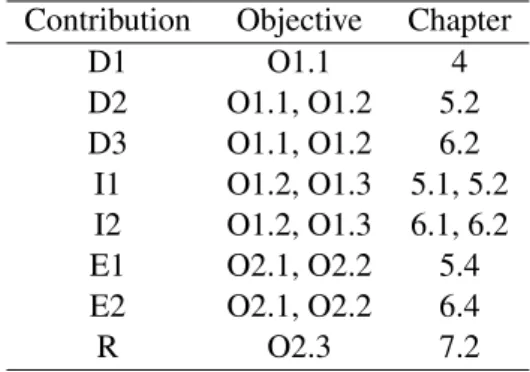
The mapping between the research objectives and the specific contributions of this work, along with the thesis chapter where the latter are discussed at length, is presented in Table 1.1.
Table 1.1: Contributions to objectives mapping
Contribution Objective Chapter
D1 O1.1 4 D2 O1.1, O1.2 5.2 D3 O1.1, O1.2 6.2 I1 O1.2, O1.3 5.1, 5.2 I2 O1.2, O1.3 6.1, 6.2 E1 O2.1, O2.2 5.4 E2 O2.1, O2.2 6.4 R O2.3 7.2
2
Background
This chapter sets the core vocabulary and facilitates a basic understanding of autonomic systems,
semantic technologiesandcrossover platformsincorporating principles and tools from both fields. The provided insight covers fundamental aspects such as structure, applications and open issues. Some general reflection is carried out to outline the need for and usage of hybrid architectures as well as the accompanying design challenges.
2.1
Autonomic Systems
The main purpose of autonomic computing is to partially shield the human operator from the complexity of IT systems functioning (and interacting) in the modern digital universe [101, 90]. The menial yet cumbersome tasks inherent to system administration can be made transparent to the human element in several ways: automatic system configuration based on operating conditions (a), proactive optimisation of resource use (b), unsupervised problem detection/diagnosis/correction (c) and intrinsic protection from threats (d). These can be easily assimilated to low level processes in the human body, for instance, contracting/dilating pupils in response to the intensity of light in the environment (a), increasing blood flow for better absorption of nutrients and oxygen (b), which also contributes to tissue regeneration and healing (c), and triggering the fight-or-flight reflex to respond to outside threats (d). If managed by the conscious mind, these vital yet minute operations would be our main preoccupation, hindering higher level, intellectual functions.
Fortunately, the human autonomic nervous system (ANS) is capable of effectively carrying out all previously mentioned tasks without conscious intervention. In computing, the equivalent of the ANS is theautonomic manager. When plugged into legacy systems (Fig. 1.1), it endows them with autonomic behaviour, giving rise to an autonomic computing element. An autonomic system (Fig. 2 in [90]) is formed of one or several autonomic elements in interaction and is characterised by one paramount quality: self-management. This is considered the essence of autonomic computing [101, 90] and essentially refers to IT systems’ capacity of proactively pursuing high level goals with little or no assistance from human operators. [90] best captures the essence of self-management by referring to it as the process of “using technology to manage technology”.
The autonomic manager facilitates four types of self-management, addressing each of the previously described facets of complexity: self-configuration (a), self-optimisation (b), self-healing (c) and self-protection (d). According to IBM [88], depending on the way the MAPE-K loop is implemented, the four autonomic properties may be attained to various degrees:
• basic- the computing system is merely amonitorof its environment and it is up to human operators to make configuration, optimisation, etc. decisions based on interpreting monitoring logs;
• managed - the computing system runs smart monitoring techniques by filtering out noise, organising collected data based on its source and analysing it to highlight patterns, thus simplifying the work of human operators;
• predictive- smart monitoring is followed by acomprehensive analysisof collected data resulting in a set of suggested actions for human operators to approve and execute;
• adaptive- the computing system proactively carries out the previously compiled set of actions in pursuit ofhigh level goals, mostly in the form of service level agreements (SLAs), stating the quality of service agreed upon by both providers and customers;
• autonomic- the computing system is capable of pursuing any prescribed goal (not just SLAs) in afully automatedway, thus completely relieving the human operator from system administration tasks.
Besides enabling a robust classification of self-managing systems based on their main attribute, autonomicity, the items in the list above may also be used for the qualitative evaluation of autonomic IT architectures in a comparable way (see 2.1.3).
Concretely, there exist several techniques [104] to implement self-management properties in practical systems. We provide a mapping of those techniques against the five levels of attainment introduced above:
• Hot swappingis a technique forself-configurationthat injects monitoring and diagnostic routines into live code. This operates on thepredictivelevel.
• Data clustering, a machine learning technique, is used to infer efficient registry settings, also a realisation ofself-configurationat thepredictive[105] andadaptive[24] levels.
• Control theory can potentially provide support for producing the desired system output, thus realisingself-optimisationat anadaptivelevel [125].
• Hardware and software redundancyis aself-healingmechanism, allowing the replacement of faulty components with back-up ones. The back-up components may be dynamically created [20], thus placing this technique on the adaptive level of attainment. A variant of this approach is
component level rebooting where the system unit affected by a failure rolls back to the latest known stable state and restarts. This places the system in thebasiccategory.
• Probes and sensorsare used to collect data about the system state and feed it into an engine that compares it against fault models and notifies system administrators about the result. This is a
self-healingtechnique that attains amanagedlevel of autonomicity.
• Self certifying alerts endorse self-protection. Specifically, the state of system components is periodically compared against known stable models. When anomalies are detected, their signatures are dispatched in the form of alerts to all other system components. A system equipped with this technique shows anadaptivelevel of autonomicity.
At any level of self-management attainment, we note the following advantages of introducing autonomic behaviour to IT systems [90]:
• the considerable reduction and potential elimination of tedious system administration labour performed by human operators;
• the reduction of the level of IT knowledge and skills required of human operators (ideally, the only human involvement with the autonomic process would be at policy level, for prescribing system goals and operation constraints, a task that only requires high level knowledge of the underlying architecture);
• the decrease in response time to critical situations, especially in environments where humans are unlikely to intervene in realtime (e.g., space exploration [180]);
• a potential standardisation of system management, provided that autonomic architectures continue to be developed under open standards (a comprehensive list of such standards, both well established and emerging, may be found in [90]).
2.1.1 Structure
An autonomic element (Fig. 1.1), namely a computing entity (hardware, software or a combination of the two) capable of some level of self-management, comprises anautonomic managergoverned by
policiesand connected to amanaged resourceviasensorsandeffectors. Each of the autonomic element’s components is presented in the following.
The Managed Resource, Sensors, Effectors
Themanaged resourceis any hardware (e.g., a cluster of computers in a network, an array of physical devices in a pervasive computing environment such as a smart home, etc.) or software (e.g., an operating system, an electronic resource such as a digital document, a database or a knowledge graph, etc.) entity that is not (but should be) capable of self-management. The state of the managed resource is exposed to other components (such as the autonomic manager) bysensors[90], either embedded (performance monitors, native to the operating system, relaying information such as CPU speed or HDD capacity) or external (bespoke monitoring software capable of detecting complex changes, such as edits in a document). Effectors are defined in [90] as interfaces that allow changing the state of the managed resource, by tuning parameters such as room temperature in a smart home or changing the size of text in presentation slides.
Policies
All the operations triggered by monitored changes and eventually leading to the actions implemented via effectors are regulated bypolicies. These are “behavioural constraints” [90, 102] guiding the otherwise independent operation of an autonomic element. Their main advantage is that they allow de-coupling high level requirements from system implementation [87, 174, 11], such that the former could (ideally) be modified without rewriting the latter. Traditional policy classification [102] relies on artificial intelligence metaphors, namely “reflective agents”, that merely implement the actions prescribed by their governing
policies, and “goal-oriented agents”, capable of devising their own actions in order to attain a given goal. Drawing on that parallel, Kephart and Walsh identify two types of policies:event-condition-action
(ECA) andgoalpolicies (with their enhanced variant,utility policies). The three types of policies, the formal languages they are formulated in as well as policy conflicts are discussed in section 2.1.2.
The Autonomic Manager
The autonomic manager facilitates the realisation of self-* properties by implementing the MAPE-K intelligent control loop. Themonitor phase is closely related to the operation of sensorswhereas the
executeone relies on effectors. Although displayed separately in Fig. 1.1, theanalyseandplanstages do not necessarily have dedicated hardware or software modules to support them. On the contrary, analysis and planning tasks are usually tightly coupled and interleaved (e.g., during incremental plan development, additional analysis is carried out to inform the selection of each new plan step). A more detailed discussion about analysis, planning and knowledge within the autonomic control loop is presented in the following.
• Analyse. The role of this component is to create models from monitored data, match them against known patterns and decide whether a change is needed to drive the system to a state where the prescribed objectives may be achieved [90]. The actual implementation of the analysis phase is either vaguely described in the literature or omitted altogether.
• Plan. During this stage, the autonomic system constructs the (sequences of) actions needed to achieve high level goals [90]. Thus, planning may be viewed as a search problem over the space of all possible sequences of actions derived from the autonomic system’s knowledge base [182, 88]. To address the challenge of automated planning in partially known environments, Srivastava et al. [165] suggest keeping records of previously executed plans and annotating them with metadata for potential reuse (giving rise to the idea of “plan life cycles”).
• Knowledge. The operation of the autonomic control loop relies strongly on the knowledge that the manager stores about itself (known data patterns used to analyse sensor input, previously utilised plans, policies, etc.), the managed resource (legacy architectural models or some other form of expert knowledge) and the outside environment (sensor logs). In order for the analyse and plan phases to run smoothly, the knowledge repository needs to be kept up to date with the changes in the system. Also, the chosen knowledge representation should support fast processing (information retrieval and analysis/reasoning) at runtime. In light of these requirements, it is recommended [88] to represent knowledge as a collection of components linked by connectors, restricted by constraints and described in a bespoke Architectural Description Language (ADL), such as Darwin [110, 88], ACME [152] or xADL [50].
2.1.2 Policies
ECA policiesexhaustively list all the actions that an autonomic system should take in a given context. For exemplification, consider the self-adaptive document rendering application introduced in section 1.3.1. A possible ECA would be:
When audience focus drops below the medium threshold event
AND
it is afternoon condition
THEN
increase font size and increase display brightness. action
The scenario that this policy describes is that of a presentation scheduled in the afternoon, where the area of exposed iris, recorded by room cameras and averaged over all members of the audience, corresponds to a previously defined level (i.e., medium) of focus. If this event-condition combination is detected, the autonomic system should increase the size of all text and the brightness of the display. Note that ECA policies formulated as above virtually eliminate the need for the analyse and plan phases of the MAPE-K loop. The autonomic manager is made aware of the two triggers that should be reported by the monitoring system at the same time (a camera feed pointing to a medium level of focus and the system clock indicating a time in the PM range), thus making any further analysis unnecessary. The ECA policy also provides a fully developed plan, namely the exhaustive set of actions that need to be performed (increase font size and increase display brightness). This reduces the control loop to just two phases: monitor and execute. The knowledge (what to modify, namely font size and display brightness) required by this simplified model is also contained in the policy.
Unfortunately, ECA policies have a major disadvantage, in that they may contradict each other, especially when prescribed in large numbers (as is the case with most realistic autonomic systems). Let us illustrate such a conflict by referring to the second application, presented in section 1.3.2. An ECA policy enforcing thecorrectnessof the knowledge base is:
When the knowledge graph is edited by a user event
AND
the author of the edit has a credibility score higher than 5 condition 1
AND
all reasoner checks pass condition 2
THEN
commit change to live server. action
This policy ensures that all modifications made to the knowledge base through the user interface are authored by reputable actors as well as logically consistent, as determined by the reasoner. Note that this policy does not provide a safeguard against semantic violations, for example, it will not reject an edit stating that GOOSE is a sub-career of PHYSICS, as long as it is consistently defined with respect to the ontology structure.
Another goal of the system is to offer the public a complete version of the careers ontology, one that captures the entire community’s views on the matter. Hence, acompletenessECA policy is defined:
When a user requests to view the knowledge graph or one of its sections event
THEN
The conflict between the correctness and completeness policies is subtle. Some of the users with a credibility score under 5 are new to the system and still building a reputation as trust-worthy editors, therefore their low rank is not necessarily a consequence of (semantically) bad edits suggested in the past. However, their proposals will be rejected according to the correctness policy. This inherently hinders the execution of the completeness policy, as the displayed knowledge will not reflect the views of new users from the careers community.
Goal policiesexpress the autonomic system’s objective, in other words, the desirable state that the system is meant to reach. The sequence of actions to be executed in order to achieve the prescribed objective is devised by the system rather than explicitly provided, as in the case of ECA policies. For instance, the policy for the document rendering scenario defined above can be reformulated as a goal policy.
Maintain audience focus at a medium level or above. goal
The correctness and completeness ECA policies for the careers network application can also be merged into one goal policy:
Maintain and display a correct and complete version of the knowledge graph. goal
In order to reach the final state prescribed by the goal policy, the autonomic system will independently analyse its knowledge base and plan the necessary actions, namely increase text size and adjust brightness, within the confines of available battery levels, for the first scenario and accept/display logically correct edits from all users with the appropriate credibility score for the second.
The main advantage of performing analysis and planning as distinct stages of the MAPE-K loop, rather than delegating to ECA policies, is that policy authors no longer need to prescribe the exhaustive list of actions necessary to fulfil a goal, as the autonomic system is capable of performing that task on its own. However, increasing the degree of system autonomicity via goal policies does carry a significant disadvantage, as compiling the sequence of actions during the planning phase is more computationally intensive than directly retrieving it from the body of ECA policies. Furthermore, goal policies are still affected by conflicts. To exemplify, consider the following two goal policies for the document rendering application:
Maintain audience focus at a medium level or above. goal
Maintain battery charge at a medium level or above. goal
Modifying the way slides are rendered (increasing brightness, in particular) during a presentation in order to capture the audience’s attention is likely to drain the battery at an accelerated rate. This makes the two policies above inherently conflicting. One way of resolving the contradiction is to assign a numerical value to each of the states described by the policies such that the system could unequivocally determine which one is more desirable.
Utility policiesdisambiguate system states by assigning a numerical score (utility) to each of them. In the example above, let us consider that a high/medium/low battery charge is associated to utility scores
1/2/3, whereas a low/medium/high level of audience focus is evaluated to scores 1/2/3 as well. In this case, the system attempts to maximise the focus-related utility and minimise the battery-related one, that is, maintain a high level of attention without taking up too much power. If that is not achievable (e.g., due to hardware constraints), one of the remaining three combinations allowed by the policies will be selected: medium focus with high battery charge, high focus with medium battery charge or medium focus with medium battery charge. The advantage of this approach is that utility policies are inherently conflictless [102]. The disadvantage lies with mapping the space of system states to that of utilities, a task requiring in-depth familiarity with the managed resource and its environment [88].
Given that all previously discussed policies have both advantages and disadvantages, it is argued [102] that autonomic systems should use a combination of all three types in order to strike a balance between a high level of autonomicity and sustainable resource consumption. In this context, strategies for deconflicting policies become important. Although some research, see [116], recommends this task be externalised, that is, addressed by the issuing communities (of domain experts) prior to policy deployment onto the autonomic system, the main body of work in the field promotes the idea that conflict detection and, in some cases, resolution should be automatically performed, at runtime, by the autonomic system itself. In what concerns ECA policy conflict resolution, the following general approaches are suggested [102]:
• assigning priorities, a technique allowing the application of policies in order of importance, ultimately similar to the utility-based approach;
• adding meta-policies meant to disable the trigger of all conflicting policies save one; more specifically, the action part of the meta-policy represents the negation of the conflicting policy’s condition;
• modifying the individual conflicting policies by transforming their condition into a conjunction of the existing one and the inverse of the conflicting policy’s condition.
In practice, due to the intricacy of policy interactions, these approaches have limited applicability, thus reducing conflict detection/resolution to spotting and resolving logical contradictions [11] (e.g., the same action is both forbidden and required by different policies). This call for a bespoke formal language to support policy description and analysis. Some of the widely usedpolicy languages and the way they support conflict detection/resolution are briefly discussed in the following.
The OWL-based Policy Language for Agent Reasoning, OWL-POLAR [155], describes policies in a format based on conjunctive formulae. Each policy has an activation condition, an action and an expiration condition. The actor executing the action as well as the action modality (obligatory, permitted or forbidden) are also specified. The example below shows how the ECA policy for the self-adaptive document rendering application would be formulated in OWL-POLAR:
When audience focus drops below the medium threshold event
AND
it is afternoon condition
THEN
increase font size and figure resolution by one unit each. action Focus(?f)∧isBelow(?f,medium)∧Time(?t)∧in(?t,pm)→ activation O?e:Effector(?e)?a1,?a2:increaseFont(?a1)∧increaseResolution(?a2)/ action
isAboveOrEqual(?f,medium) expiration
All formulae in the conjunction above are atomic assertions that either indicate a type - Focus, Time,
Effector, increaseFont, increaseResolution - or represent a relation - isBelow, in, isAboveOrEqual. All the symbols preceded by a question mark are variables, whereas mediumand pm are predefined constants. The expressions following a colon are constraints applied to the variables preceding it. Symbol
Oin the OWL-POLAR policy action represents the obligation modality, stating that the action following it is mandatory.
The supplementary effort of translating policies from natural language into conjunctive formulae is justified by the fact that OWL-POLAR policies are machine readable, thus can be automatically reasoned upon. To exemplify, [155] proposes two algorithms for policy reasoning: one for eliminating redundant policies (algorithm 1 in [155], based on a reasoning technique called subsumption) and one for anticipating policy conflicts (by utilising a type of reasoning called consistency checking, as illustrated by algorithm 2 in the same paper). Once detected, conflicts can be resolved by developing plans, at runtime, to activate the expiration conditions of all but one of the contradicting policies.
The Knowledgeable Agent-oriented System, KAoS [178, 28, 69], provides a graphical interface (the KAoS Policy Administration Tool, KPAT) to assist stakeholders with defining policies. This way, the translation of policies from natural language into DAML1, the formal language used internally by KAoS, is hidden from policy authors, thus simplifying their task. KAoS utilises a collection of high level ontologies, featuring specialised concepts for all policy components such as actions, actors and required resources. These concepts are appropriately instantiated to represent bespoke policies, forming an application specific ontology (for example, in the case of the self-adaptive rendering application, instances increaseFont and increaseResolution would be created for concept action). The ontology is afterwards used to detect policy conflicts via consistency checking and to assign policy actions to specific actors (enforcers, in KAoS terminology). Policy deconfliction is performed with respect to pre-set priorities. Although the acronyms are similar, KAoS is a concrete implementation of a policy management system and is not to be confused with KAS, the template architecture for autonomic systems hybridised with semantic technologies, proposed in chapter 4.
Rei [94] is a language built on top of Prolog that represents policies in a fashion similar to OWL-POLAR. More specifically, Rei policies have actors, actions and modalities such as allowed, forbidden, compulsory and dispensed (equivalent to postponed obligation). Like KAoS, Rei employs domain independent as well as problem-specific ontologies to represent policy components and detect conflicts. The latter are resolved by means of meta-policies and pre-set priorities.
2.1.3 Applications and Evaluation
Autonomic computing applications rage from full system implementations [80, 95, 1, 182, 155, 27] to bespoke practical realisations of the MAPE-K components (monitor [2], plan [39], analyse [36, 6]). A detailed analysis of state of the art contributions is provided in 3.1, however, to paint a picture of the range and diversity of autonomic applications, the major problem domains where such technologies are applied are given below2.
• space exploration: NASA ANTS [88] supports collaboration between asteroid belts probes; • distributed systems: load balancing and component repair [95], data collection frequency control
[2], dynamic resource management [1, 182, 150, 147], network compartmentalisation and assembly [27], network parameter estimation [131, 148, 6], medical services in the cloud [4]; • electronic personal assistants: PC performance improvement via operating system’s processes
management [108];
• web services configuration [124, 184];
• military and security-critical applications: hierarchical policy management [37]; • middleware [57, 117, 187];
• autonomic database management [3]; • data centre management [182].
Given the wide range and the increased diversity of autonomic applications, it is not surprising that a unified evaluation framework is yet to be formulated. The most common scenario is to test the performance of the autonomic system in the context of the application it was designed for. This does little in the way of enabling a rigorous performance comparison across a range of different systems. However, there exist a few proposals of general assessment criteria for autonomic systems that can be roughly classed as either qualitative or quantitative.
Qualitative Evaluation
Qualitative evaluation employs discrete, non-numeric scales for various system aspects [131]. IBM’s five levels of autonomicity (2.1) represent such a scale, used both in [88] and as one of the classification criteria in 3.1. Other qualitative metrics suggested in [131, 127, 113] are:
• architecture category: flat (horizontal) or hierarchical (vertical, where managers on a given level are coordinated by one situated on the level above),
• adaptation approach: the strategy the system employs to adapt to changes in its environment (can be policy based or utility function based),
2There is significant overlap between contributions: some papers should, in all fairness, be included in several categories.
This, as well as the abundance of evaluation criteria, makes it difficult to provide a clean classification of autonomic applications. A more thorough categorisation than that given here is attempted in chapter 3.
![Fig. 1.1: The simplified architecture of a traditional autonomic computing element - adapted from [90]](https://thumb-us.123doks.com/thumbv2/123dok_us/11082251.2994782/15.892.193.808.397.829/fig-simplified-architecture-traditional-autonomic-computing-element-adapted.webp)
![Fig. 2.1: The Semantic Web stack adapted from [84]](https://thumb-us.123doks.com/thumbv2/123dok_us/11082251.2994782/38.892.315.658.142.515/fig-semantic-web-stack-adapted.webp)