A Role Engineering Tool for Role-Based Access Control
Mark Strembeck
Institute of Information Systems, New Media Lab
Vienna University of Economics and BA, Austria
[email protected]
Abstract
Like every requirements engineering process, the process of role engineering for role-based access control depends signifi-cantly on human factors. For this reason, many elements of the process cannot be automated (or at most partially). Neverthe-less, tool support is necessary to cope with the complexity of the process and to efficiently handle the different interrelated artifacts used and produced during the role engineering pro-cess. In this paper, we present the design and implementation
of the XORETsoftware tool which provides tool support for
the scenario-driven role-engineering process. Furthermore,
XORETis capable to produce a policy rule set that can be
im-ported by theXORBACaccess control service.
1 Introduction and Motivation
Role engineering for role-based access control (RBAC, cf. [4]) is focused on the elicitation, specification, and mainte-nance of a policy rule set for RBAC. In other words,role engi-neeringfor role-based access control is the process of defining roles, permissions, constraints, and role-hierarchies (see [2]).
The scenario-driven role engineering process presented in [8, 13] is based on the scenario and goal concepts (see e.g. [1, 14]). With our work we essentially aim at a systematic role engineering methodology that is flexible enough to be appli-cable for arbitrary organizations and information systems. An important requirement for a role engineering methodology is the support of change management activities to ease the prop-agation of changes that occur within the information system or its environment into all security relevant models and finally into the policy rule set enforced by a concrete policy moni-tor. However, the intricacy of real world information systems and the respective models that are used and produced during role engineering activities cannot be conveniently handled via a “manually operated” paper-based process. Therefore, we need special purpose software tools that support role engineer-ing activities and facilitate the incorporation of changes into a configuration consisting of several RBAC related models.
In this paper, we present the design and implementation of the XORETsoftware tool which providestool support for the scenario-driven role-engineering process. It facilitates the
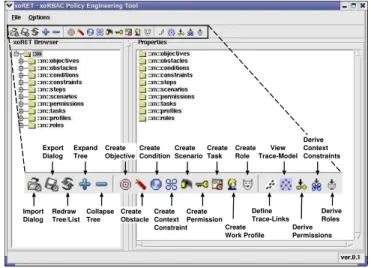
specification and inspection of trace-relations to ease change management activities, and it is capable to propose a (prelim-inary) policy rule set. Moreover, policy rule sets produced withXORETcan be directly imported by theXORBACaccess control service (see [7, 13]). The XORET role engineering tool consists of the XORETcore component and the XORET graphical user interface. XORETallows to create and main-tain the different objects that are used and produced during the scenario-driven role engineering process. Figure 1 shows the main window of the XORETtool. The foreground of this figure depicts and describes the toolbar located at the top of theXORETmain window. TheXORETtool is implemented in XOTcl [9] and Tcl/Tk [11]. Import Dialog Export Dialog Redraw Tree/List Expand Tree Collapse Tree Create Objective Create Obstacle Create Condition Create Context Constraint Create Scenario Create Permission Create Task Create Work Profile Create Role Define Trace-Links View Trace-Model Derive Permissions Derive Context Constraints Derive Roles
Figure 1. TheXORETGUI main window
The paper is organized as follows. In Section 2 we give an overview of the scenario-driven role engineering process. Sec-tion 3 then goes into detail about the static design-time struc-tures of theXORETcore component. The subsequent sections give a description of the XORET graphical role engineering tool. However, due to the page limitation we can only describe a fraction of the functionality provided byXORET. Thus, we focus on the definition of processes/scenarios (Section 4), the specification of trace-relations betweenXORETobjects and the inspection of the resulting trace model (Section 5). Further-more, in Section 6 we go into detail about the (automatic) derivation of a (preliminary) policy rule set for RBAC.
* 1..* 1..* * * * 0..1 1..* 1..* impedes contains derived from * linked to * * Scenario
Step Objective Obstacle
Permission Role ContextConstraint 1..* Condition * * linked to WorkProfile 1..* 1..* contains Task 1 contains derived from 1..* linked to 1..* *
assigned to derived from
1..* 1..* 0..1 * * 0..* * * contains 0..1 derived from * 0..*
Figure 2. xoRET: main class relations
2 Scenario-driven Role Engineering
This section gives an overview of the scenario-driven role engineering process (for a more detailed description see [8, 13]). We model usagescenariosof an information system and use these scenarios/processes to derive permissions. Each sce-nario is in essence an action and event sequence consisting of several steps, for example to describe the processing of a dam-age event in an insurance company. Thus, to perform a certain scenario, a subject needs to be equipped with the exact num-ber of permissions that are needed to complete each step of the respective scenario. Ataskconsists of several scenarios and awork profilecontains all tasks that a certain type of subject (e.g. a certain type of employee) is allowed to perform. In the further course of the role engineering process, work profiles are used to derive roles (see Section 6). Moreover, we apply
goalsandobstaclesto definecontext constraints(see [13]). In our approach, acontrol objectiveis a goal specified by the au-thority which is responsible for the operation of a particular system. Thereby, control objectives define acceptable system behavior as intended by the system authority (see also [12]). Like other goals, control objectives can be defined on different levels of abstraction. The permission catalog, the constraint catalog, and the work profiles are used to define a concrete pol-icy rule set for RBAC that is tailored to the needs of the corre-sponding information system (see also [12]). Furthermore, the role engineering process directly supports change management activities to allow for the correct and efficient propagation of changes into all (possibly) affected models (see also [8]).
3 xoRET: Static Design-time Structures
Figure 3 shows the classes of theXORETcore component. In particular, it contains ten “core classes” that represent the different artifacts which are needed to conduct the scenario-driven role engineering process (control objectives, obstacles, scenarios etc. - see also Section 2). Each core class is a
sub-class of thexoRETObjectclass. ThexoRETObjectclass
spec-ifies common methods for all of its sub-classes, e.g. for the definition of traceability links (see Section 5).
Facade, Factory, Manager
xoRETObject 1 * * * * *
Role Permission ContextConstraint Condition WorkProfile
Step Scenario Objective Obstacle
Task
xoRETManager *
*
* *
xoRET Core Component
*
Figure 3. Classes of theXORETcore component
At runtime, each object that is instantiated from one of the ten core classes is aggregated within anxoRETManagerobject
(see Figure 3). ThexoRETManagerclass serves asFacade(see
[5]) for theXORETcomponent. It hides internalXORET struc-tures and provides the external API ofXORETto other software components. Moreover, thexoRETManagerclass is aFactory
(see [5]) and is responsible for the creation and management of its aggregated objects. For example, it controls the instan-tiation of new objects, writes status messages to log-files (if logging is activated), and observes the definition of traceabil-ity links between differentXORETobjects.
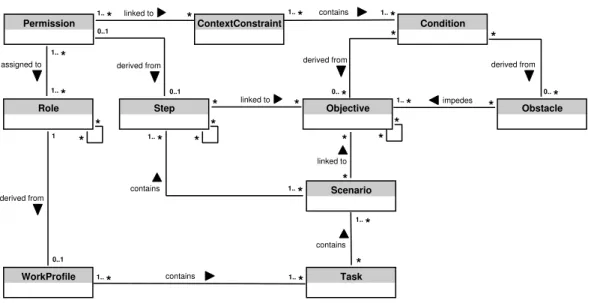
Figure 2 depicts the main relations among the tenXORET core classes in more detail. Scenario steps serve as a cen-tral means to derivePermissionobjects (see [8]). However,
steps describing system internal actions sometimes do not need to be mapped to explicit user-level permissions. Neverthe-less, depending on the intended abstraction level of the result-ing policy rule set, it may be sensible to also model
permis-Step graph Radiobuttons:
Edit, Select, Zoom List of all available
Step objects
Figure 4. TheXORETscenario creation dialog
sions pertaining to internal actions. Furthermore, to provide a flexible modeling environment,XORETallows to define addi-tionalPermissionobjects independent from scenario steps
-resulting in a0..1relation between thePermissionandStep
classes (see Figure 2). Similarly, work profiles are the primary means to derive (preliminary) roles. However, in the course of the role engineering process derived roles are adapted, redun-dant roles can be deleted, and additional roles may be defined independently from the work profiles (see [8]). In other words, not every role resulting from the role engineering process nec-essarily originates (directly) from a work profile.
Condition objects are associated with Objective or Obstacle objects (see also [12, 13]). In particular, each ObjectiveandObstacleobject contains a list of abstract
con-ditions that are represented by a short, descriptive, and infor-mal sentence respectively (e.g. “students may only edit their own exam”, or “date greater than 2006/01/01”). In a later step, these abstract conditions are used to derive placeholder
Conditionobjects (see Section 6). EachContextConstraint
object is linked to one or moreConditionobjects, and to one
or morePermissionobjects (see Figure 2). Beside the
(au-tomatically recorded) implicit trace relations betweenXORET objects, it is possible to define explicit traces (see Section 5).
4 Definition of Scenarios
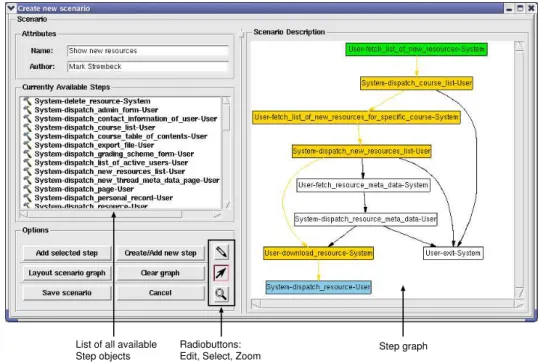
The scenario creation dialog shown in Figure 4 enables the definition ofXORETscenarios. The primary element of a XORETscenario/process is a directed graph of steps. Although not depicted in Figure 4, it is possible to define labels for the edges in a step graph (e.g. to specify guard conditions). The left hand side of Figure 4 shows a (scrollable) list of allStep
objects that are currently available. The right hand side shows the step graph of the current scenario/process. The step graph can be accessed via three different functions, each of which is activated through a respective radiobutton (see Figure 4):
• Thepencil-buttonactivates theeditmode which allows to addorremovesteps or edges.
• Thepointer-buttonactivates theselectmode. The select
mode, again, offers two distinct functions:
– First, one can choose a start node and an end node (by drawing a “virtual” edge between the two nodes) to find theshortest pathbetween two nodes (i.e. between two steps). In particular,XORET per-forms a breadth-first-search to find the shortest path and colors the affected nodes as follows: the start node is colored green, the end node is colored blue, and all intermediate steps and edges are colored yel-low. The example in Figure 4 shows the shortest path starting from the step “User, fetch list of new resources, from System” to the step “System, dis-patch resource, to User” (note that eachXORETstep consists of triplet including anactor, performing an
actiondirected at a specifictarget).
– Second, one can compute the spanning tree for one particular node in the step graph. The span-ning tree is computed, if, in select mode, a node is clicked without drawing an edge to another node. The spanning tree visualizes the reachability of other steps/nodes (i.e. it shows which nodes can be reached starting from a specific node).
As mentioned above, each XORET Scenarioobject
con-tains a graph structure. The nodes of this graph are steps which are connected via labeled edges. Labeled edges can be used to model guard conditions (conditional branches) for step transi-tions. Thus, we can specify simple linear step sequences as well as complex scenarios/processes with an arbitrary num-ber of fork and join points, and/or conditional branches be-tween steps. Therefore,XORETscenarios can model scenar-ios/processes on an arbitrary level of abstraction.
5 Trace Definition and Inspection
The trace-management dialog allows for the specification and deletion of explicit trace relations betweenXORETobjects (see Figure 5). The left hand side of the dialog offers five drop-down lists (comboboxes) allowing to define a specific trace re-lation. TheStart typecombobox chooses the object-type a spe-cific trace starts from. Depending on the selected start-type, the Start objectcombobox is filled with the names of all in-stances of the corresponding start-type. The same procedure is applied for theDestination typeandDestination objectboxes. TheTrace typebox offers a (extensible) list of trace-relations that can be established betweenXORETobjects.
List of all traces starting from the "start object"
Figure 5. TheXORETtrace management dialog
The addTraceRelation method shown in Figure 6
de-fines bidirectional trace relations between XORET objects. In XORET each trace-type is associated with a counterpart which defines the name of the corresponding opposite trace-direction. Examples for such trace-type pairs are: [sub-goal, super-goal],[contains, part-of], or [refines, refined-by]. The
tracetype counterparts instance variable is an array that
stores all validXORETtrace-type pairs. At any time, arbitrary new trace-type pairs can be defined via theaddTraceTypePair
method. To establish a bidirectional trace between two ob-jects the addTraceRelationmethod establishes two directly
opposed unidirectional traces.
xoRETManager instprocaddTraceRelation {sourcetype source
tracetype targettype target} {
if {[my isValidTraceType $tracetype]} {
if {[$source addTrace $tracetype $targettype $target]} { return [$target addTrace \
[my set tracetype_counterparts($tracetype)] $sourcetype $source] }
} return 0 }
Figure 6. TheaddTraceRelationmethod
EachxoRETObjectuses a number of internal arrays to store
trace relations. The name of a particular trace-array
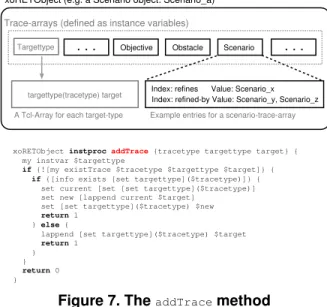
corre-sponds to the object-type (i.e. the class-name) of the target-objects that are referenced via this array (see Figure 7). Each array index represents a particular trace-type (e.g. contains, refines, part-of, owns), and the value stored at a specific in-dex position is a list consisting of one or more object-names. For example, a Scenario object Scenarioa may have sev-eral traces to otherScenarioobjects. Thus, the corresponding
trace-links are stored in an array named “Scenario” (cf. Figure 7). The traces depicted in Figure 7 define thatScenarioa re-finesScenarioxand is refined byScenarioyandScenarioz.
xoRETObject instprocaddTrace {tracetype targettype target} { my instvar $targettype
if {![my existTrace $tracetype $targettype $target]} { if {[info exists [set targettype]($tracetype)]} { set current [set [set targettype]($tracetype)] set new [lappend current $target]
set [set targettype]($tracetype) $new return 1
} else {
lappend [set targettype]($tracetype) $target return 1 } } return 0 } Objective Obstacle Targettype . . . .
Trace-arrays (defined as instance variables)
xoRETObject (e.g. a Scenario object: Scenario_a)
Scenario
Example entries for a scenario-trace-array A Tcl-Array for each target-type
Index: refines Value: Scenario_x Index: refined-by Value: Scenario_y, Scenario_z
targettype(tracetype) target
Figure 7. TheaddTracemethod
The lower part of Figure 7 shows theaddTracemethod
de-fined in thexoRETObject class. It receives three mandatory
input parameters -tracetype,targettype, andtarget. If the
respective trace does not already exist, the method adds the corresponding trace relation as discussed above.
An alternative option to specify trace relations between dif-ferent programming objects would be the definition of explicit trace-objects. However, in our experiences the above men-tioned procedure to store traces as array variables ofXORET objects has several advantages compared to explicit trace-objects. The array-based approach offers a straightforward way to query trace relations in many different ways, e.g. to fetch all traces associated with a particularXORETobject, or to fetch all traces of a particular trace-type pointing from a given object to otherXORETobjects of a certain object-type; for ex-ample, allfulfillstraces pointing fromScenarioato instances of theObjectiveclass. In contrast to that, it is, in the
gen-eral case, by far more complicated to perform similar queries in a set of explicit trace-objects (in general, one may either perform a brute force search traversing all trace-objects or de-fine a respective query-language). An advantage of individual trace-objects could be the definition of additional information attached to a trace-relation itself. Nevertheless, if required, this could also be integrated with the array-based approach.
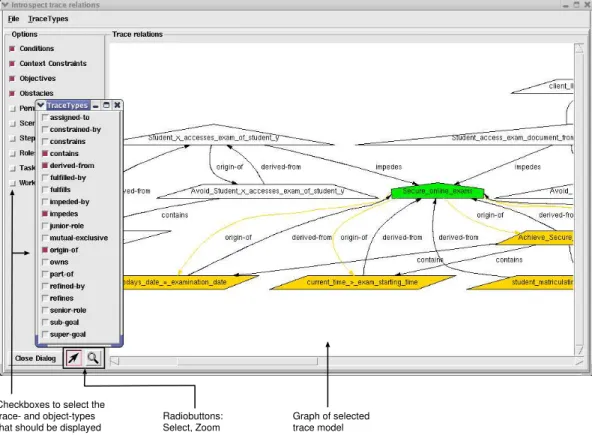
All trace relations together form the XORET trace model which can be visualized and inspected to analyze the depen-dencies betweenXORETobjects. The respective dialog allows
Radiobuttons:
Select, Zoom Graph of selectedtrace model Checkboxes to select the
trace- and object-types that should be displayed
Figure 8. TheXORETtrace model inspection dialog
to selectively display certain trace relations (see Figure 8). In particular, it allows to select the object types and the trace types to be visualized. Similar to the scenario definition dialog (see Section 4), the trace model dialog allows tozoomthe corre-sponding model, to compute thespanning treeof a particular node, or to compute theshortest pathbetween two nodes. The example depicted in Figure 8 shows the spanning tree for the control objective “Secure online exams”. InXORETthe span-ning tree is colored as follows: the start node is colored green and all reachable nodes, as well as the edges required for the spanning tree, are colored yellow.
6 Derivation of a Preliminary Policy Rule Set
Once the control objectives, obstacles, scenarios, tasks, and work profiles are defined, we can automatically derive a (pre-liminary) RBAC policy rule set (see also [8, 13]). In our approach an RBAC policy rule set consists of roles, permis-sions, context constraints, conditions, and the corresponding assignment relations. We now describe the XORET meth-ods that are applied to derive a preliminary policy rule set. The derivePermissionFromStepmethod (see Figure 9)re-ceives three mandatory parameters to identify the respective step (actor,action,target). It uses thelookupmethod
(de-scribed below) to determine the fully qualified name of the cor-respondingStepobject and to create a newPermissionobject,
if necessary. Subsequently, a[derived-from Step]trace is estab-lished between the twoPermissionandStepobjects.
xoRETManager instprocderivePermissionFromStep {actor action target} { set step [Step lookup 0 [self] $actor $action $target]
if {$step != "FAILED"} {
set perm [Permission lookup 1 [self] $action $target] # establish trace-link if necessary
if {![$perm existTrace derived-from Step $step]} { [self] addTraceRelation \
Permission [$perm name] derived-from Step [$step name] }
return 1 } return 0 }
Permission proclookup {create parent args} { set permname [eval join $args _]
set permission ${parent}::permissions::$permname if {[$parent existPermission $permission]} { return $permission
}
if {$create} {
return [Permission $permission -name $permname \ -operation [lindex $args 0] \ -object [lindex $args 1]] }
return FAILED }
}
Figure 9. Derive permissions from steps
The lookup method is defined as an object-specific proc
on each of the ten core classes (see Section 3). This method provides two functions depending on the value of thecreate
parameter. Figure 9 shows thelookupmethod defined for the Permissionclass. If thecreateparameter is set to0(false) the lookupmethod checks if a respective object exists and either
returns the fully qualified object name or the value “FAILED” (see Figure 9). In case thecreateparameter is set to1(true),
thelookupmethod creates a respective object, if necessary.
ThederiveRoleFromWorkProfilemethod is applied to
xoRETManager instprocderiveRoleFromWorkProfile {profile} { set profile [WorkProfile lookup 0 [self] $profile] if {$profile != "FAILED"} {
set role [Role lookup 1 [self] "Role [$profile name]"] # establish trace-link if necessary
if {![$role existTrace derived-from WorkProfile $profile]} { [self] addTraceRelation \
Role [$role name] derived-from WorkProfile [$profile name] }
# assign permissions if necessary
foreach p [my getPermissionsLinkedToWorkProfile [$profile name]] { if {![$role ownsPerm $p]} {
[self] permRoleAssign [$p name] [$role name] } } return 1 } return 0 }
Figure 10. Derive roles from work profiles
Figure 10). The name of the newRoleobject consists of the
respective work profile name with the prefix “Role”; so the name of a role derived from the “Teacher” work profile would be “Role Teacher” for instance. If necessary, a corresponding
Roleobject is created (via thelookupmethod), and a
[derived-from WorkProfile]trace-link is established. Subsequently, the
getPermissionsLinkedToWorkProfile method determines
the permissions linked to the respectiveWorkProfile object
(see Figure 10). To find the corresponding permissions the method follows the traceability links established between work profiles and tasks, tasks and scenarios, scenarios and steps, and steps and derived permissions (see also [8]). Finally, the re-spectivePermissionobjects are assigned to the (new) role.
xoRETManager instproc derivePreliminaryRoleHierarchy {} { # check for redundancies and add junior-role relations foreach r1 [my getRoleList] {
foreach r2 [my getRoleList] { if {$r1 != $r2} {
if {[[self] equalPermissions [$r1 name] [$r2 name]]} {
$r1 roleswithequalpermissions [concat [$r1 roleswithequalpermissions] $r2] $r2 roleswithequalpermissions [concat [$r2 roleswithequalpermissions] $r1] }
if {[[self] role1PermsSupersetOfRole2Perms [$r1 name] [$r2 name]]} { if {![$r1 hasJuniorRole $r2]} {
[self] addJuniorRoleRelation [$r1 name] [$r2 name] }
} } } }
# remove redundant junior-role relations [self] updateRoleHierarchy
# remove redundant permissions [self] removeRedundantPermissionsFromRoles }
Figure 11. Derive a preliminary role hierarchy
The derivePreliminaryRoleHierarchymethod (cf.
Fig-ure 11) automatically derives a (preliminary) role-hierarchy (or hierarchies). Two roles owning an identical set of per-missions may be redundant and are thus candidates for later refinement or deletion. In particular, eachRoleobject has a roleswithequalpermissionsinstance variable to store links
to “identical” roles (see Figure 11). For two distinct roles
r1 and r2, the role1PermsSupersetOfRole2Perms method checks if the permissions ofr2constitute a subset of the per-missions ofr1. In such a case, we say thatr1is greater than
r2(r1 > r2). If the method finds a respective pair of roles,r2 is defined as junior-role forr1. After the junior-role derivation procedure is finished, we remove redundant junior-role rela-tions and redundant permissions from each role.
To remove redundant junior-role relations the updateRoleHierarchy method invokes the removeRedundantSuperclassesmethod for eachRoleobject
xoRETManager instprocupdateRoleHierarchy {} { foreach role [my getRoleList] {
$role removeRedundantSuperclasses }
}
Role instprocremoveRedundantSuperclasses {} { set new [my info superclass]
foreach supercl [my info superclass] { foreach class [$supercl info heritage] { set index [lsearch -exact $new $class] #if class is in "my superclass" #and "my superclass heritage" if {$index != -1} {
#remove class from the superclass list of self set new [lreplace $new $index $index] }
} }
#set new superclass list [self] superclass $new }
Figure 12. Removing redundant role relations
aggregated by the correspondingXORETinstance (see Figure 12). In XORET and XORBAC roles are defined as classes which can be arranged in a class hierarchy to form a directed acyclic graph. The superclass relation between XOTcl classes is thus applied to straightforwardly define a role-hierarchy (for further details see [7]). TheremoveRedundantSuperclasses
method uses the XOTcl introspection mechanism (see also [9, 15]) to gain knowledge about the superclasses of the correspondingRoleobject. It then removes all roles from the
superclass list which are direct and indirect superclasses of the corresponding Roleobject at the same time (see Figure
12). Finally, it registers the new (redundance-free) superclass list for the respectiveRoleobject.
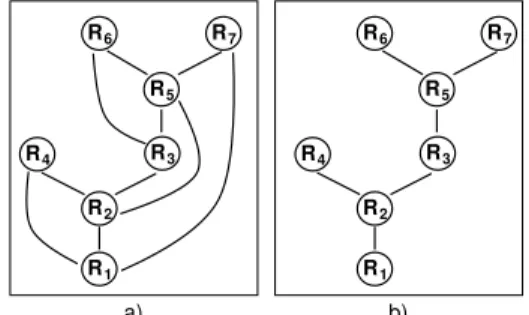
b) R1 R4 R2 R3 R7 R6 R5 R1 R4 R2 R3 R7 R6 R5 a)
Figure 13. Redundant inheritance relations
Figure 13a) depicts a hierarchy with redundant inheritance relations. In particular, the relations between the following role pairs are redundant[R1, R4],[R1, R7],[R2, R5], and[R3, R6]. For the example in Figure 13a) the updateRoleHierarchy
method removes all redundant inheritance relations resulting in the hierarchy depicted in Figure 13b).
The removeRedundantPermissionsFromRoles method
shown in Figure 14 identifies and revokes all permissions which are, at the same time, directlyandindirectly (through the role-hierarchy) assigned to aXORETRoleobject. In other
words, we revoke all permissions that are directly assigned to a role and are also inherited from its junior-roles. When this step is finished we have defined a preliminary role-hierarchy (see also Figure 11).
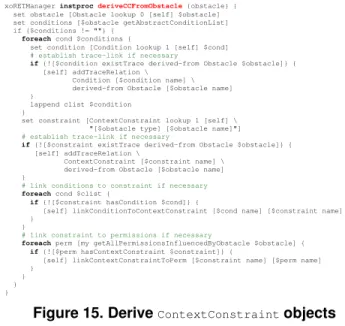
Figure 15 shows thederiveCCFromObstaclemethod which
objects from Obstacle objects (see also [12]). The
corre-sponding XORET method to derive context constraints from
Objectiveobjects (deriveCCFromObjective) is similar to the
derivation procedure for obstacles.
xoRETManager instprocremoveRedundantPermissionsFromRoles {} { foreach role [my getRoleList] {
foreach perm [$role getAllDirectlyAssignedPerms] { if {[$role ownsPermThroughInheritance $perm]} { $role revokePerm $perm
} } } }
Figure 14. Remove redundant permission-to-role assignment relations
The deriveCCFromObstacle method (cf. Figure 15)
re-ceives a mandatory parameterobstaclewhich identifies the
corresponding Obstacle object. In XORET each Obstacle
and each Objective object possess an instance variable to
store the abstract conditions that are associated with the re-spectiveObstacle(orObjective). In essence, this instance
variable is a Tcl list, and each list entry represents an ab-stract condition (see also [13]). For each abab-stract condition the deriveCCFromObstaclemethod creates a corresponding Condition object and establishes a [derived-from Obstacle]
trace-link, if necessary.
The deriveCCFromObstacle method then creates a ContextConstraint object (see Figure 15). The name
of the ContextConstraint object is determined from
the type and the name of the corresponding obsta-cle (an example of a respective ContextConstraint
name is “Avoid Access Before 2006 01 01”). In the next step, the Condition objects are linked to the (new) ContextConstraint(see Figure 15). Note that the
aforemen-tioned procedure specifies exactly one ContextConstraint
object which is linked to all Condition objects
de-rived from the corresponding obstacle. Afterwards, the
getAllPermissionsInfluencedByObstaclemethod uses the
trace-links between XORET objects to detect all permissions that are influenced by the respective obstacle (see Figure 16). Finally, the (new) ContextConstraint is linked to each of
these permissions (see Figure 15).
To find all permissions that are influenced by a certain obstacle, the getAllPermissionsInfluencedByObstacle
method first determines all Objective objects that are
linked to the corresponding Obstacle object via an
[impedes Objective] trace-link (cf. Figure 16). Then, the
getAllPermissionsPotentiallyNeededForObjective
method is called to determine the permissions that are needed to perform the scenarios/processes which are as-sociated with the respective objectives. In particular, the
getAllPermissionsNeededForScenariomethod traverses all Stepobjects linked to aScenarioand assembles a list of the Permisssion objects linked to these steps via an [origin-of
Permission] trace-link (see Figure 16). To assure that all
permissions needed for a particular scenario are found, the
getAllPermissionsNeededForScenario method recursively
xoRETManager instprocderiveCCFromObstacle {obstacle} { set obstacle [Obstacle lookup 0 [self] $obstacle] set conditions [$obstacle getAbstractConditionList] if {$conditions != ""} {
foreach cond $conditions {
set condition [Condition lookup 1 [self] $cond] # establish trace-link if necessary
if {![$condition existTrace derived-from Obstacle $obstacle]} { [self] addTraceRelation \
Condition [$condition name] \ derived-from Obstacle [$obstacle name] }
lappend clist $condition }
set constraint [ContextConstraint lookup 1 [self] \ "[$obstacle type] [$obstacle name]"] # establish trace-link if necessary
if {![$constraint existTrace derived-from Obstacle $obstacle]} { [self] addTraceRelation \
ContextConstraint [$constraint name] \ derived-from Obstacle [$obstacle name] }
# link conditions to constraint if necessary foreach cond $clist {
if {![$constraint hasCondition $cond]} {
[self] linkConditionToContextConstraint [$cond name] [$constraint name] }
}
# link constraint to permissions if necessary
foreach perm [my getAllPermissionsInfluencedByObstacle $obstacle] { if {![$perm hasContextConstraint $constraint]} {
[self] linkContextConstraintToPerm [$constraint name] [$perm name] }
} } }
Figure 15. DeriveContextConstraintobjects
seeks through the scenarios that are connected via a
[refined-by Scenario] trace. A similar procedure is performed in
the getAllPermissionsPotentiallyNeededForObjective
method which recursively visits all Objective objects
connected via a[sub-goal Objective]trace (see Figure 16).
xoRETManager instproc getAllPermissionsInfluencedByObstacle {obstacle} { set perms ""
foreach obj [$obstacle getAllTraceTargets impedes Objective] { set perms [concat $perms \
[my getAllPermissionsPotentiallyNeededForObjective $obj]] }
return [lsort -dictionary -unique $perms] }
xoRETManager instproc getAllPermissionsPotentiallyNeededForObjective {objective} { set perms ""
foreach scenario [$objective getAllTraceTargets fulfilled-by Scenario] { set perms [concat $perms [my getAllPermissionsNeededForScenario $scenario]] }
foreach obj [$objective getAllTraceTargets sub-goal Objective] { # recursively seek in sub-goals
set perms [concat $perms \
[my getAllPermissionsPotentiallyNeededForObjective $obj]] }
return [lsort -dictionary -unique $perms] }
xoRETManager instproc getAllPermissionsNeededForScenario {scenario} { set perms ""
foreach step [$scenario getSteps] {
set perms [concat $perms [$step getAllTraceTargets origin-of Permission]] }
foreach rs [$scenario getAllTraceTargets refined-by Scenario] { # recursively seek in refinement scenarios
set perms [concat $perms [my getAllPermissionsNeededForScenario $rs]] }
return [lsort -dictionary -unique $perms] }
Figure 16. Obstacles influence Permissions
The RBAC policy rule set that results from the derivation procedures described in this section serves as a basis for the specification of a refined and adapted policy rule set that can be applied to the corresponding information system. Further refinement procedures may include the definition of additional roles, the deletion of redundant roles, or the specification of additional context constraints for example. Moreover, the scenario-driven approach inherently supports change manage-ment activities. Thereby, it supports the managemanage-ment of RBAC policies and allows to tailor the policy rule set to changes on each relevant abstraction level (see also [8, 12]).
7 Related Work
In [10], Osborn et al. present the Role Graph Tool which supports the definition and administration of general RBAC role-hierarchies (directed acyclic graphs). The paper describes how they applied the tool to simulate RBAC policies in ACL-based Unix systems.
Kern et al. describe a commercial software tool (SAM Jupiter) that supports an RBAC variant called enterprise role-based access control model (ERBAC) [6]. An “enterprise role” is a role which subsumes access rights of several underlying software systems. For example, an enterprise role could pro-vide simultaneous membership in a certain Unix group, in a database-specific role (e.g. of DB2 or Oracle), and in a group defined in a groupware system. A subject assigned to an enter-prise role may thus receive several accounts in different soft-ware systems simultaneously. Thereby, enterprise roles allow for a centralized management of authorizations for resources located in several heterogeneous systems. Analogous features can also be integrated with existing standalone RBAC services, as XORBACfor example. For such an integration we espe-cially need an implementation level interface to map ERBAC-level assignments of system-specific permissions or grouping mechanisms to the corresponding target systems. Kern et al. especially describe an administrative concept for ERBAC.
Another software tool supporting an ERBAC model is the Role Control Center (RCC) presented by Ferraiolo et al. [3]. The RCC tool supports general role hierarchies, static separa-tion of duty constraints, and funcsepara-tions for permission review. It provides a feature called “role graph navigation”. The cor-responding navigation scheme demands that, at any time, one of the graph nodes is selected as “anchor”, RCC then displays the n-tiered upward and downward projections of this anchor. With respect to role-hierarchies, Ferraiolo et al. distinguish “containment” and “inheritance” relations between roles. The inheritance relation defines that a senior-role inherits permis-sions from its junior-role(s), while containment refers to mem-bership, i.e. all users of the senior-role are also users of the corresponding junior-role(s).
8 Conclusion
The scenario-driven role engineering process (see [8, 13]) supports the definition of a policy rule set for RBAC. In the course of the process, a permission catalog, a constraint cata-log, and definitions of work profiles are produced. These mod-els/documents serve as the foundation for the definition of a tailored policy rule set which consists of permissions, roles, and constraints. TheXORETtool presented in this paper, was explicitly developed to provide tool support for the scenario-driven role-engineering process. To support change manage-ment activities,XORETfacilitates the specification and inspec-tion of trace-relainspec-tions. Furthermore,XORETis capable to pro-duce a (preliminary) policy rule set that can be further refined and directly imported by theXORBAC[7, 13] component.
With our work we aim to provide an integrated and
tool-supported methodology to engineer, enforce, and maintain role-based access control policies. So far we described a sys-tematic role engineering approach (see [8]), and an approach to model access control relevant context information and to use requirements engineering techniques to engineer (and en-force) context-dependent access control policies based on con-text constraints (see [13]). Moreover, we implemented the XORBACaccess control service that can be used to enforce RBAC policies including context constraints (see [7, 13]). The XORETtool presented in this paper now provides tool support for the engineering and maintenance of role-based access con-trol policies including context constraints.
References
[1] J. Carroll, editor. Scenario-Based Design: Envisioning Work
and Technology in System Development. John Wiley & Sons,
1995.
[2] E. Coyne. Role engineering. InProc. of the ACM Workshop on
Role-Based Access Control, November 1995.
[3] D. Ferraiolo, G. Ahn, R. Chandramouli, and S. Gavrila. The Role Control Center: Features and Case Studies. InProc. of the ACM Symposium on Access Control Models and Technologies
(SACMAT), June 2003.
[4] D. Ferraiolo, R. Sandhu, S. Gavrila, D. Kuhn, and R. Chan-dramouli. Proposed NIST Standard for Role-Based Access Control. ACM Transactions on Information and System
Secu-rity (TISSEC), 4(3), August 2001.
[5] E. Gamma, R. Helm, R. Johnson, and J. Vlissides.
De-sign Patterns: Elements of Reusable Object-Oriented Software.
Addison-Wesley, 1995.
[6] A. Kern, A. Schaad, and J. Moffett. An Administration Con-cept for the Enterprise Role-Based Access Control Model. In
Proc. of the ACM Symposium on Access Control Models and
Technologies (SACMAT), June 2003.
[7] G. Neumann and M. Strembeck. Design and Implementation of a Flexible RBAC-Service in an Object-Oriented Scripting Language. InProc. of the 8th ACM Conference on Computer
and Communications Security (CCS), November 2001.
[8] G. Neumann and M. Strembeck. A Scenario-driven Role En-gineering Process for Functional RBAC Roles. InProc. of 7th ACM Symposium on Access Control Models and Technologies
(SACMAT), June 2002.
[9] G. Neumann and U. Zdun. XOTcl, an Object-Oriented Script-ing Language. InProc. of Tcl2k: 7th USENIX Tcl/Tk Confer-ence, February 2000.
[10] S. Osborn, Y. Han, and J. Liu. A Methodology for Managing Roles in Legacy Systems. InProc. of ACM Symposium on
Ac-cess Control Models and Technologies (SACMAT), June 2003.
[11] J. Ousterhout.Tcl and the Tk Toolkit. Addison-Wesley, 1994. [12] M. Strembeck. Embedding Policy Rules for Software-Based
Systems in a Requirements Context. InProc. of the IEEE In-ternational Workshop on Policies for Distributed Systems and
Networks (POLICY), June 2005.
[13] M. Strembeck and G. Neumann. An Integrated Approach to Engineer and Enforce Context Constraints in RBAC Environ-ments. ACM Transactions on Information and System Security
(TISSEC), 7(3), August 2004.
[14] A. van Lamsweerde. Goal-Oriented Requirements Engineer-ing: A Guided Tour. InProc. of the 5th IEEE International
Symposium on Requirements Engineering (RE), August 2001.