PDQCollections: A Data-Parallel Programming Model and
Library for Associative Containers
Maneesh Varshney
Vishwa Goudar
Technical Report #130004 Computer Science Department University of California, Los Angeles
April, 2013
ABSTRACT
Associative containers are content-addressable data struc-tures, such as maps, ordered maps, multimaps, sets etc., that are wide employed in a variety of computational prob-lems. In this paper, we explore a parallel programming paradigm for data-centric computations involving associa-tive data. We present PDQCollections - a novel set of data structures, coupled with a computation model (which we refer to as the Split-Replicate-Merge model) - that can effi-ciently exploit parallelism in multi-core as well distributed environments, for in-memory as well as large datasets. The distinguishing characteristics of our programming model are the design of data structure that inherently encapsulate par-allelism and the computation model that transforms the problem of parallelization to that of defining addition oper-ator for value data types. The PDQ design offers fundamen-tal benefits over traditional data structures: with memory-bound workloads, PDQ avoids locks and other forms of syn-chronization, and is able to significantly outperform lock-based data structures; with larger disk-bound workloads, PDQ does not use caches and avoids random disk access, and thus significantly outperform traditional disk-backed structures; and with distributed workloads, PDQ accesses remote data resources sequentially and only once, and is able to significantly outperform distributed data structures. We highlighted the distinguishing capabilities of PDQ library with several applications drawn from a variety of fields in Computer Science, including machine learning, data mining, graph processing, relational processing of structured data and incremental processing of log data.
1.
INTRODUCTION
Associative containers, also commonly referred to as hashes, hash tables, dictionaries or maps, are a cornerstone of pro-gramming template libraries. They provide standardized, robust and easy-to-use mechanisms to efficiently store and access key-value mappings. In this paper, we explore data-centric programming problems where either the input or the output or both are associative containers. Such com-putations are commonly employed in the fields of docu-ment processing, data mining, data analytics and machine learning, statistical analysis, log analysis, natural language processing, indexing and so on. In particular, we seek a
data-parallelprogramming framework for associative data, where the parallelism can scale from multi-core to distributed environments, the data can scale from in-memory to disk-backed to distributed storage and the programming paradigm
is as close as possible to the natural sequential programming patterns.
The problems of data parallelism with associative contain-ers are unlike from the index-based data structures such as the arrays and matrices. The most familiar parallel pro-gramming paradigm for the latter is theparallel for loop, as exemplified in OpenMP, Intel’s Thread Building Blocks (TBB) and Microsoft’s .NET Task Parallel Library (TPL). In this model, the index range of the for loop is partitioned and each partition of the range is assigned to a separate thread. However, this paradigm requires that the input to the computation (that has to be partitioned for paral-lelization) must be index-addressable. Secondly, as the out-puts generated by each thread must be protected against concurrent modifications, each thread must write data in non-overlapping memory regions or use critical sections or concurrent-safe containers. Maps are content-addressable, and consequently, can neither serve as input or output in a
parallel forcomputation. Furthermore, in the data-parallel programming context, the synchronization locks are con-tested often leading to a significant locking overhead, which we confirmed in our benchmarks. Finally, these libraries, are typically meant for shared-memory and memory bound workloads and offer little support or perform poorly with distributed systems and persistent data stores.
In our study of data-parallel programming paradigms, we did not discover any library or framework that can: (a) oper-ate on associative containers, (b) execute in shared memory multi-threaded as well as distributed contexts, (c) support data size that scales from in-memory to disk-backed, and (d) have parallelization constructs that are as close as possible to the natural sequential and object-oriented style of pro-gramming. Towards this last point, we note that the widely acclaimed Map-Reduce model, owing to the functional na-ture of the programming framework, does not provide to the programmers the familiar Abstract Data Type of associative containers.
In this paper, we present PDQCollections1 −a novel set of data structures, coupled with a computation model, for exploiting data parallelism in associative data sets. PDQ-Collections is a comprehensive library of collection classes that implement the native associative container interfaces: map, multimap, ordered map, ordered multimap, set, sorted set and others. We have also proposed a computation model, which we refer to as theSplit-Replicate-Merge(SRM) model, that transparently and efficiently supports and exploits
par-1
allelism in multi-core as well as distributed environments, over the data scales that range from memory-bound to disk-backed. We have shown an equivalence between the SRM and the map-reduce (MR) model by mutual reducibility, that is, any problem that can be solved by one model can be solved by another.
The distinguishing characteristic of our programming model isencapsulating the parallelism within the data struc-ture implementations(the PDQ Collections classes) rather than the program code. Object oriented programming en-courages encapsulating the distinguishing characteristics within the implementation of the objects, while providing famil-iar interfaces to the programmer. For example, Berkeley DB’s StoredMap abstracts the knowledge that the data is backed on disk, while providing the familiar Map interface; GUI libraries hide the platform specific characteristics be-hind the implementation, while providing the same widget interface; and the Remote Method Invocations hide the fact that the objects are remotely located. However, traditional approaches for data parallel programming have instead re-lied on modifying the computation code, either by extending the grammar of a language (e.g. the parallel for loop), or enforcing alternate paradigms (e.g. functional programming in Map Reduce).
By encapsulating parallelism within the data structures, the programming model is able to cleanly separate out the code for actual computation and the code for paralleliza-tion. Consider the analogy of Semaphores vs. Monitors: semaphores require introducing the logic of concurrencywithin
the code, as opposed to monitors where all logic is captured separately within the monitor object. Similarly, with our programming model, the logic of parallelism is not inter-spersed within the code, rather it is expressed separately. As a concrete example, we shall discuss the Frequent Pat-tern (FP) growth algorithm [1] in Section 5.2, where the input data is processed to generate a FP tree data struc-ture. The traditional methods of parallelism would require modifying this tree-generation code by embedding parallel constructs within the code. With our model, the program-mer only needs to separately define how to “add” two trees. We believe, our design choice lead to a cleaner separation of functionality, resulting in a flexible and robust system architecture.
The SRM computation model employs the divide-and-conquer strategy for parallelization. We have proposed a novel shared-nothing strategy for merging associative con-tainers, which obviates the need for any explicit or underly-ing synchronization, concurrent access or transactional pro-cessing. By avoiding locking overheads, PDQ containers significantly outperform the locking-based data structures, such asConcurrentMaps. The same strategy, when applied to disk-bound workloads, is a cache-free design and ensures that data is always read and written to disk sequentially. By avoiding cache-miss penalties and random disk seek over-heads, PDQ containers significantly outperform the tradi-tional disk-backed data structures, such as BerkeleyDB.
The PDQ collection classes are versatile in managing data over a wide range of scale. Initially, the data is stored in-memory, but as the size of the container grows, the data is transparently and automatically spilled over to the disk, where it is stored in a format most efficient for further pro-cessing. The disk-backed form of the container objects have the capability to store data on multiple disks, if present, to
improve the disk I/O speeds. They have a distributed im-plementation as well, where the data can be flexibly stored at common location (e.g. SAN, NFS) or in a distributed storage.
The rest of the paper is organized as follows: in Section 2 we provide a formal description of programming model and in Section 3 we discuss our implementation. We conduct a comparative design performance analysis study in Section 4 with concurrent data structures (for memory bound compu-tation), BerkeleyDBˆa ˘A´Zs StoredMap (for disk-backed com-putation) and Hazelcast (for distributed comcom-putation) to highlight the salient characteristics of our programming model that explains how PDQ significantly outperforms these tra-ditional data structures. We illustrate several applications of our PDQ in different fields of Computer Science in Section 5 and conclude in Section 6.
2.
DESIGN
In this section, we provide a formal description of pro-gramming model, including the data model, which formal-izes the problems that can be parallelized with our model, the Split-Replicate-Merge computation model, which describes the strategy for parallelism, and the programming APIs. We also show an equivalence with the Map Reduce programming model.
2.1
Data Model: Mergeable Maps
This section formalizes the data-centric problems that can be parallelized using our model. We begin by defining an associative container as a mapping function from key space
Kto value spaceV:
A:K→V
Different variants of associative containers can be inter-preted by adapting the semantics of the mapping function. For example, the container is amultimapif the value space
Vis a set of collection of values, or asetif a Boolean space.
Similarly, the container is an array if the key space K is
a range of natural numbers, or amatrix if a set of tuples. Other complex containers, such asgraphs, can similarly be interpreted.
Next we define a computation as a function with input in the domainI(which may be an associative container) to produce as output an associative containerA:
Cseq:I→A
We have explicitly formulated the computation to be a sequential function. For the sake of simplicity, we have also assumed only one input and one output for this computa-tion. The extension to the general case is trivial, and will be discussed later.
Our objective is to develop a data-parallel programming paradigm for this computation that simultaneously satisfies the following requirements:
1. the computation can be parallelized and scaled across multiple cores and processors, in shared-memory con-current as well as distributed processing contexts.
2. the parallel computation can handle input and output data that scales from memory-bound to disk-backed to distributed storage.
3. both forms of scaling (processing and data) can be achieved by using the unmodified sequential form of the computation.
We claim that the above requirements can be satisfied for the class of computation problems with inherent parallelism that can be formulated as follows:
IfI1⊂I, andI2 ⊂I, such thatI1∩I2=φ, andC(I1)→ A1,C(I2)→A2. Then the following must be equivalent:
C(I1∪I2)⇐⇒A1]mergeA2
Where the merge operator]mergeis defined as:
(A1]mergeA2)(k) = A1(k) ifk∈A1, k /∈A2 A2(k) ifk /∈A1, k∈A2 A1(k)⊕A2(k) otherwise
Here,⊕is some user-defined operator. It is required, how-ever, that this “add” operator is both commutative and as-sociative.
Intuitively, the above formulation specifies that the inher-ent parallelism in the computation is such that if partial results were obtained by processing partial inputs, then the result of the combined inputs can be produced by merging the partial outputs.
We shall later prove that this formulation of parallelism is equivalent to the map-reduce programming model, that is, any problem that can be solved by map-reduce can be for-mulated in this manner. Let us now review some examples to illustrate this model of parallelism in action.
Word Count: Given a document, find the number of times each word appeared in the document. The input is a list of words, and the output is a simple map of string to inte-gers. This problem can be parallelized since we can partition the input list into sublists, execute the word count program separately on each sublist, and merge the generated output maps by defining⊕as integer addition operator.
Inverted Index: Given a map of keys to a list of words (the input), generate a map of words to the list of keys that they belonged (the output). Although we have not yet discussed how the maps are partitioned, for now we imagine that the key space is partitioned and the sub-maps are created with key-value mappings for each partition, and the program to invert indices is executed separately on each sub-map. If we define⊕as thelist concatenation operator, the merged output will indeed be the inverted index of the original map.
Finding Average: Find the average from the list of num-bers. Since the average of averages is not the average, we need to define a custom data type with two fields,sum and
count. We also define the ⊕ operator for this data type that adds the two fields. The output of the computation is a “singleton” container, which contains only one element. The computation, then, takes as input a sublist of numbers and computes the result into this data type. These partial results are ‘added’ together to produce the final result.
2.2
Computation Model: Split, Replicate,
Merge
In this section we describe our parallel computation model, called the Split-Replicate-Merge model, to exploit paral-lelism for the class of problems identified in the previous section. As previously, for the sake of simplicity we assume the computation with single input and single output. The model executes as follows: the input is firstsplitted into M
partitions. The number of splits is atleast equal to the num-ber of processing units available, although it can be greater if it is desired that each partition should be of some manage-able size (for example, if each partition has to be processed entirely within memory). Next, the output data structure isreplicatedM times. Each replication is an initially empty data structure of same type as the output data container type. These splits and replicas are paired together, andM
instances of computation are executed (one for each pair) concurrently. Finally, the replicas, which now contain the results of the computation from the respective splits, are
merged to produce the final output. The following psuedo code outlines this process:
PDQRun(Cseq, i n p u t , o u t p u t ) {
SPLIT ( i n p u t ) → {spi, 1≤i≤M}
REPLICATE( o u t p u t ) → {rpi, 1≤i≤M} p a r a l l e l f o r( i : 1 to M) do
Cseq(spi, rpi)
end
o u t p u t ←UM
i=1rpi // Merge
}
Listing 1: The Split-Replicate-Merge Computation Model
Note that there is a single synchronization point in the entire model, which is the implied barrier at the end of the parallel for loop.
This model is easily extended to support multiple input and output parameters, as well as “shared” parameters. With multiple inputs, the implementation must ensure that each input generates equal number of splits, and the respective split from each input share the same keyspace. The multi-ple outputs are replicated, and later merged, independent of each other. The shared arguments are neither splitted nor replicated; the same copy of the object is provided to all the computation instances.
In section 3, we shall discuss efficient implementations for splitting and merging. We show that associative containers can be splitted in O(1) time, and the replicas can be merged in parallel as well. We shall also see how this computation model can be easily adapted to handle volumes of data and to operate in distribute execution mode.
2.3
Programming Model
Whereas the computation model described previously is meant to be transparent to the programmers, it is the gramming model, described herein, that is visible to the pro-grammers. This model describes how the computation must be coded for parallelization.
We describe the programming model by means of the Word Count program, outlined in Listing 2. Although the example shown is coded in Java SE 6, the model can be applied to any programming language that supports Ob-ject Polymorphism and function references, either as clo-sures, function pointers or functors, and, of course, a multi-threaded environment. 1 @ P a r a l l e l ( name=”w o r d c o u n t ” ) 2p u b l i c void w o r d c o u n t ( 3 @ArgIn j a v a . i o . F i l e R e a d e r i n p u t , 4 @ArgOut j a v a . u t i l . Map<S t r i n g , I n t e g e r> o u t p u t ) { 5 B u f f e r e d R e a d e r r e a d e r =new B u f f e r e d R e a d e r ( i n p u t ) ; 6 S t r i n g l i n e ; 7 f o r ( ( l i n e = r e a d e r . r e a d L i n e ( ) ) != n u l l) {
8 f o r ( S t r i n g word : l i n e . s p l i t ( ” ” ) )
9 i f ( ! o u t p u t . c o n t a i n s K e y ( word ) )
10 o u t p u t . put ( word , 1 ) ;
11 e l s e
12 o u t p u t . put ( word , o u t p u t . g e t ( word ) + 1 ) ;
13 } 14} 15 16 p u b l i c s t a t i c void main ( S t r i n g [ ] a r g s ) { 17 PDQ. s e t C o n f i g ( a r g s ) ; 18 F i l e R e a d e r i n p u t =new PDQFileReader ( f i l e n a m e ) ; 19 Map<S t r i n g , I n t e g e r> o u t p u t = 20 new PDQMap<S t r i n g , I n t e g e r>( I n t e g e r A d d e r ) ; 21 22 PDQ. run (t h i s, ”w o r d c o u n t ” , i n p u t , o u t p u t ) ; 23}
Listing 2: Word count using PDQCollections
The first segment of the code (lines1through14) is the actual computation. Notice that the method arguments are the native data types, and the method body is entirely se-quential. The@ArgInand@ArgOutJava annotations indi-cate that the arguments are split of the input and replication of output, respectively. The @Parallel annotation merely serves as a naming marker for the method, which we utilize to extract the method reference (java.lang.reflect.Method) using the Java reflection APIs. This is only a user-friendly way to name a method, other techniques such as function objects would have sufficed as well.
Next, we instantiate the objects for the computation - a
FileReaderas input, and aMapof String to Integer as
out-put. Here, instead of using the Java native classes, we create the input/output objects from the counterpart classes pro-vided by the PDQCollections library. The library includes the typical container data types: PDQMap,PDQMultimap,
PDQSortedMap,PDQSortedMultimap,PDQSet,
PDQSort-edSet,PDQListetc that implement the respective Java
in-terfaces; as well as File I/O classes, includingPDQFileReader
andPDQFileInputStreamthat subclass the respective Java
classes. The input object is instantiated at line18, while the output object in lines19-20. ThePDQMapis also provided with the⊕operator, in this case an Integer adder.
Observe this salient feature of our programming model: to parallelize a sequential program, the programmer only needs to replace the programming language’s native input/output container, or File I/O, classes with the counterpart classes from the PDQ library; while the actual computation code itself remains unmodified.
The parallel execution is invoked in line22where the ref-erence to the computation method and the input/output objects are passed to the PDQ library. This library call executes the Split-Replicate-Merge computation on the pro-vided arguments. The behavior of the computation model execution can be controlled by the configuration parameters, shown in line17.
2.4
Equivalence with the Map Reduce Model
Map-Reduce is a widely acclaimed programming model for processing large data sets. This is a functional-style model that processes data in two stages ofmap andreducephases. We show this model is equivalent to the SRM model by proving that the two models are reducible to each other.
Consider an arbitrary problem that can be parallelized with the map-reduce model. There exists, then, a map func-tion that transforms the key-value mappings of the input
into an intermediate list of mappings in a different domain: MAP : (k1, v1)→list(k2, v2)
This intermediate output is processed to collect all values for a given key together, and the key space is sorted. This serves as the input to the reduce function, which generates the final result:
REDUCE : (k2, list(v2))→list(k3, v3)
This problem can be formulated by the Split-Replicate-Merge model in two execution steps, as shown in Listing 3. In the first step, the input map is processed to produce
a SortedMultimapof intermediate values, which is further
processed in the second step to generate the output result.
@ P a r a l l e l ( name=” s t e p 1 ” ) void s t e p 1 (Map<K1, V1> i n p u t , S o r t e d M u l t i m a p<K2, V2> i n t e r m e d i a t e ) { f o r (k1, v1 i n i n p u t ) L i s t<K2, V2> l i s t = MAP(k1, v1) ; f o r (k2, v2 i n l i s t ) i n t e r m e d i a t e . add (k2, v2) ; } @ P a r a l l e l ( name=” s t e p 2 ” ) void s t e p 2 ( S o r t e d M u l t i m a p<K2, V2> i n t e r m e d i a t e , S o r t e d M u l t i m a p<K3, V3> o u t p u t ) { f o r (k2, l i s t v2 i n i n t e r m e d i a t e ) L i s t<K3, V3> l i s t = REDUCE(k2, l i s t v2) ; f o r (k3, v3 i n l i s t ) o u t p u t . add (k3, v3) ; }
void main (Map<K1, V1> o r i g i n a l I n p u t ) {
Map<K1, V1> i n p u t = new PDQMap<K1, V1>( o r i g i n a l I n p u t ) ; S o r t e d M u l t i m a p<K2, V2> i n t e r m e d i a t e = new PDQSortedMultimap<K2, V2>( ) ; S o r t e d M u l t i m a p<K3, V3> o u t p u t = new PDQSortedMultimap<K3, V3>( ) ; PDQ. run (t h i s, ” s t e p 1 ” , i n p u t , i n t e r m e d i a t e ) ; PDQ. run (t h i s, ” s t e p 2 ” , i n t e r m e d i a t e , o u t p u t ) ; }
Listing 3: Reducing SRM model to Map-Reduce
Conversely, consider an arbitrary problem that can for-mulated with our data and computation model, that is, the following method is defined:
SRM(Cseq f n , Map<K1, V1> i n p u t , Map<K2, V2> o u t p u t )
This problem can be reduced to the map-reduce model as follows: c l a s s Mapper { Map<K1, V1> i n p u t ; void map (K1 k , V1 v ) { i n p u t . put ( k , v ) ; } void f i n a l i z e ( ) { Map<K2, V2> p a r t i a l O u t p u t = REPLICATE( o u t p u t ) ; f n ( i n p u t , p a r t i a l O u t p u t ) ; f o r (k2, v2 i n p a r t i a l O u t p u t ) EMIT(k2, v2) } } c l a s s R e d u c e r { void r e d u c e (K2 k2, L i s t<V2> l i s t v2) { V2 sum = f o l d (⊕, l i s t v2) ; EMIT(k2, sum ) ; } }
In the mapper class, the key-values mappings are first col-lected into aMap. The output object is replicated, and the computation is invoked on these two objects. The mappings from the replica (which served as the output container for the chunk of input provided to this Mapper) are emitted to the reducer. At the reducer, the list of values for a key are aggregated together using the⊕operator, which is then emitted for the given key.
We have thus shown that that two programming mod-els can be emulated with each other and, consequently, are equivalent.
2.5
Related Work
Piccolo [2] is a data-centric programming model with a similar objective of parallel and distributed computing using associative containers. The system ensures execution local-ity by partitioning the input across machines with a user-specified partitioning function. While each process process-ing its partition locally to produce the correspondprocess-ing output, it also has access to global state. In other words, it can at-tain a globally consistent view of the value corresponding to an output key. Piccolo achieves this by introducing a user-specified accumulation function akin to our add operator. When called by the user, this operator can “accumulate” the values for a specific key across all processes. This differen-tiates the PDQ programming model from Piccolo’s. While Piccolo offers fine-grained access to global state, it requires user control over the merge procedure. On the other hand, PDQ executes the merge operation transparent to the user. PDQ also reduces the merge overhead partitioning the out-put across a SuperMap. Finally, in contrast to Piccolo that only supports, memory-constrained outputs, PDQ transpar-ently allows in-memory, out-of-core and distributed process-ing and output data structures.
3.
IMPLEMENTATION
Our primary goal for implementation is efficient process-ing of data by maximizprocess-ing the CPU utilization as well as by maximizing the disk I/O. Our implementation targets data sizes up to few terabytes, and optimized for multi-core systems and small to medium sized clusters. Concerns such as large scale cluster management, fault tolerance are not addressed. Our secondary goal is transparent parallelism, that is, the computation can be coded using programming language’s native data type and sequential style of program-ming, and does not require any modifications to language grammar. In the following, we describe our data structures that can transparently switch from memory bound, to disk-backed and distributed operational behavior. We have im-plemented our programming model as a library in Java SE 6.
3.1
Data Structures
The PDQCollections library provides a suite of data struc-ture implementations that are meant to be drop-in replace-ment for their counterpart native implereplace-mentations. These include the typical container data types that implement the
Map,Multimap,SortedMap,SortedMultimap,Set,
Sorted-Set, List and other interfaces, as well as File I/O classes, that inherit theFileReader andFileInputStreamclasses.
Recall the computation model outlined in Listing 1, where we discussed that the input containers are partitioned into splits, and that the output containers are first replicated,
and later these replicas are merged back. This behavior is enforced by requiring the input and output containers to implement the Splittable and Mergeable interfaces, re-spectively. The signatures of these two interfaces are shown below: i n t e r f a c e S p l i t t a b l e { I t e r a t o r<O b j e c t> s p l i t ( ) ; } i n t e r f a c e M e r g e a b l e { O b j e c t r e p l i c a t e ( ) ; void merge ( O b j e c t [ ] p a r t i a l s ) ; }
The splits of an input container and the replicas of an out-put container are objects of the same abstract data type as the respective input and output containers. In addition, the replicated objects are in-memory data structures. The col-lections classes support both interfaces, while the file reader classes only implement the Splittable interface.
3.1.1
PDQ Collections Classes
Recall that an associative container can be viewed as a mapping from key space to value space: A:K→V. If the
execution environment has N threads, then the key space is exhaustively divided into N non-overlapping subspaces and a delegate associative container is created for each of these key subspaces. In other words, the PDQ container is a wrapper aroundN associative containers, each managing a portion of the keyspace, as defined below:
AP DQ:fpdq(k) = fassoc1 (k) ifk∈K1 fassoc2 (k) ifk∈K2 .. fN assoc(k) ifk∈KN
whereK1,K2... KNare theNdivisions of the key space,
and fassoc1 , fassoc2 , ... fassocN are the N delegates. As an
example, in an execution environment with four threads, a
PDQMap wraps four java.util.HashMap delegates. For an
operation for a keyk(for example, get(), put(), contains(), etc), the key subspace Ki is identified that contains this key, and the operation is applied to the associated delegate
fassoci .
One simple strategy for partitioning the key space is by partitioning the hash code range of the keys, that is, a key
k will belong to subspace hash(k) moduloN. Although, it must be ensured that this hashing function is different from functions that may be used internally by the associative container (for example, HashMap).
There are several benefits to this wrapped delegates de-sign. First, theSplittable interface is trivially implemented: each delegates is a split! Notice that our approach is not to split the containerafterit is populated, rather to create the splitsbeforehand and populate them incrementally. This is an easier as well as an essentially zero-cost operation.
Secondly, this design allows for merging of the partial results in parallel. Each PDQ Collection implements the
Mergeableinterface, where the replicas themselves are wrapped collections of delegates. That is, for an execution environ-ment with N threads, the PDQ collection wraps N dele-gates, as shown below:
AP DQ:={D1, D2, ..., DN}
collection object will generateN replications, which them-selves wrapsN containers, as shown below:
R1 := {D1R1, D R1 2 , . . . D R1 N } R2 := {D1R2, D R2 2 , . . . D R2 N } . . . RN := {DRN 1 , D RN 2 , . . . D RN N }
whereRiis theithreplication, andDRi j is itsj
th
delegate. Now the merge operation can be applied in parallel by shuf-fling the replication delegates and grouping them according to the key subspace they manage. That is:
MERGE (AP DQ, [R1, R2 . . . RN] ) : p a r a l l e l f o r ( i : 1 t o N ) : Di←DR1 i ] D R2 i . . . ] D RN i
Similar parallelization benefits are achieved when the con-tainer data is stored on disk, as we shall see in Section 3.3. In this case, the various activities such as sorting, serialization and writing to disk can be applied in parallel.
3.1.2
PDQ File I/O Classes
The PDQ library provides replacements for thejava.iofile I/O classes. In particular, the PDQFileReader and
PDQ-FileInputStreamclasses support reading characters and bytes,
respectively, from files. Both implement theSplittable inter-face, and, therefore, can act as inputs to the computation. Similarly, the PDQFileWriter and PDQFileOutputStream
classes support writing characters and bytes, respectively, and implement theMergeableinterface.
The primary consideration in reading files is blocksize −
the size of the chunk of input that is processed by a sin-gle thread. The input file is partitioned into chunks of size
blocksizeeach, and these chunks serve as input splits to the computation. If the file contains variable length records, the splits coincide with record boundaries. Recall our implemen-tation goal which states that the compuimplemen-tation for each input split must happen within memory. It is, therefore, necessary to ensure that the blocksize must not exceed the limit where the output generated (for that split) cannot be entirely con-tained within memory. Since the exact limit is dependent on the processing environment, this parameter is user-defined.
The PDQ file output classes implement theMergeable in-terface by generating replicas that are standardjava.io out-put classes for files where the filename is appended with a part identifier (e.g.,filename.part0000).
3.2
Thread Pool Execution Mode
This section describes the PDQ library’s shared-memory parallel execution mode of the computation. As the name implies, the concurrency is achieved by thread pools, and we make use of thejava.util.concurrent.ThreadPoolExecutor
service for the thread pool creation and management. This execution mode is applicable when the output of the computation can be contained within memory. For a pool ofNthreads, the input is first split intoN partitions. If the input is a file, then the blocksize is automatically computed to create N chunks. The output containers are replicated
N times as well, and theN instances of computations are assigned to the thread pool. At this point, the main thread invokes the thread pool and waits until all threads within the pool complete, which can be viewed as an implied barrier for the main thread. Subsequently, the main thread shuffles the delegates of the replicas for merging, in accordance with the
f, input, output = [Da, Db]
loop [There are more splits] Get at most 2 splits
Thread Pool Execution (f, input, output)
[Externalize output?] Db <<Sort>> Da <<Serialize & Write to File>> <<External Merge>> opt Implied Barrier ref
Main Thread #1 Thread #2
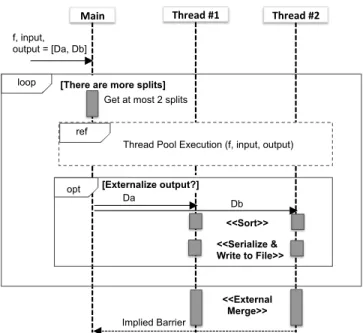
Figure 1: Sequence diagram for the disk-backed ex-ecution model for a pool of 2 threads
process described previously, and assign these merge tasks to the thread pool. There is a second implied barrier, at the end of which the partial results are merged back into the output containers.
As the cost of splitting, replicating and shuffling/distribut-ing delegates is essentially negligible, this execution mode effectively utilizes all the processing cores throughout the program execution.
3.3
Disk-backed Computation
The previous execution mode is extended to handle cases when the output of the computation is too large to fit in memory, thus necessitating the need to store the output data on to the disk. In the following description, we refer to the process of storing the output disk on disk asexternalization. The first difference from the memory-bound execution mode is that the number of the input splits, M, can be greater than the number of processing cores,N. In this case the computation unfolds in multiple iterations. In the first iteration, the firstNsplits are processed, in accordance with the thread-pool execution mode described previously; in the second iteration, the next N splits are processed similarly and the results from this iteration are merged back into the previously accumulated results. This process continues until allM splits are processed, at the end of which the accumu-lated result (obtained by merging partial results from each iteration) will be the final output of the computation.
At the some point, the accumulated results will be large enough to overflow the memory. Before reaching this state, we enforce externalization of memory contents to the disk, thus freeing up memory for further processing. At the end of each iteration, the library determines whether the memory contents must be externalized to the disk. In our implemen-tation, we check the currently available memory in JVM (via
the freeMemory() method of the java.lang.Runtime class)
and decide to externalize if it falls below a threshold. When externalizing the output container, each of the del-egates of the output container are externalized in parallel.
The process involves sorting the key space of the delegate container, if it was not already sorted, and serializing the key-value pairs to a flat file. We use the Java’s native serial-ization framework for externalizing data. At this end of this externalization step there will beNfiles on disk, which con-tains the memory contents of theN delegates respectively, with each file written in parallel. The next externalization step will write data into a new set ofN files.
When all theMsplits are processed, these files are merged into aMapfile. A mapfile is a file that stores a sorted list of key-value mappings along with anindex (typically kept in memory) that maps a subset of the keys to the offset within the file where they are located. To retrieve the value for a key, the index is consulted to locate the offset of the closest key, and then the file is read sequentially from that offset until the said key is located. Since the externalized files are already sorted on disk, theO(N) disk merge algorithm is used to merge them into the mapfiles. These mapfiles, subsequently, serve as the delegates for the output container. Figure 1 illustrates this execution mode as a sequence di-agram. The outer loop in the diagram represents the iter-ations, and the opt block represents the optional step of externalizing the delegates to disk.
Observe that the actual computation, at each iteration, is entirely memory bound. While the merged results may be externalized to the disk, the output data is always within memorywhilethe computation is being executed. This elim-inates any need for disk-based data structures, which are substantially more costly than the in-memory structures. This design also not employ any form of caching disk data within memory, and thus avoids caching relating scalability overheads. Finally, the data is always read and written se-quentially from the files, which also eliminates random disk seek overheads.
If multiple hard drives are available, the disk I/O can be further improved by storing the externalized files onto these multiple disks. In the thread pool environment with
N threads, each externalization step generatesN files, and at the end of the computation, there areN delegate mapfiles for the output container. These files can be spread across the hard drives, and given that the file I/O operations are par-allelized in our implementation, it follows that the data can be read or written simultaneously from all the hard drives.
3.4
Distributed Mode
In this final section, we describe our implementation strat-egy for distributed execution. As noted previously, our de-sign goal is catered towards small to medium sized clus-ters. The implementation follows a master-slave architec-ture, where the master executes the main application and requests the workers to participate in the computation. The main application jar file is added to the classpath of the workers to ensure the visibility of the classes that define the computation.
When the main program, executing at the master node, invokes the computation via thePDQ.run(...) method (see line22 in Listing 2), the PDQ library contacts the worker daemon processes and prepares for the distributed execu-tion. The master first notifies to each worker their unique
rank, which is a number between 1 and total number of work-ers. The workers use the rank to determine the portions of the input that they are responsible for processing. Subse-quently, the master serializes and transmits over the wire
the computation method and its input/output arguments. At this point, the workers have sufficient information to be-gin processing their share of the input. Each worker executes independently of others, and after processing its input, se-rializes and transmits the results back to the master. The master may choose to merge the results gathered from the workers either locally (if the data is small enough), or em-ploy the slaves again for distributed merge.
A brief note on sharing the input and output data: in simple cases, the master and workers may exchange the entire data set over the wire. This simple approach does not require any cluster configuration, however, it is not the most efficient method of sharing data, for example, it adds the serialization and deserialization overhead. Alternatively, the data may be stored on shared file system, for example, Network File System (NFS), or distributed file system, for example, Hadoop Distributed File System (HDFS). In this case, only the reference to the file needs to be shared.
4.
DESIGN ANALYSIS
In this section, we compare the PDQ programming model against representative data structures for the memory-bound, disk-bound and distributed computations. Our objective is to gain an insight into the fundamental nature of the PDQ computation model and illustrate the impact of our design choices towards overall performance of data-centric compu-tations. We are not interested in raw performance compar-isons between two systems, as those statistics vary widely based on parameters of implementation, programming style, efficiency of the libraries used (e.g., threading, serialization, networking). Instead, we wish to expose those salient char-acteristics of our model that makes the PDQ library consis-tently outperform traditional designs, irrespective of actual implementations under consideration.
The summary of our findings is as follows: with memory-bound workloads, the PDQ library avoids locks and any other form of synchronization, and thus significantly scales better with number of processing cores than the lock-based data structures, such as ConcurrentMap. For large disk-bound workloads, the PDQ library does not employ any form of caching and always accesses the disk with sequential read and write requests. In contrast, the disk-backed data structures, such as BerkeleyDB and KyotoCabinet, are two-tiered with in-memory cache for the on-disk B-tree, where the efficacy of the cache diminishes with smaller cache ratio. By avoiding the cache miss penalties and random disk seek overheads, the PDQ library significantly scales better with data size. Finally, with distributed workloads, the PDQ li-brary accesses remote data resources sequentially and only once, and is thus able to significantly outperform distributed data structures.
Single-host experiments were conducted on a machine host-ing a dual hyper-threaded 6-core Intel Xeon 2.30GHz pro-cessor with 32GB of memory and a 500GB of disk. The machine runs CentOS 6.3 with kernel version 2.6.32. For distributed experiments, we used a cluster of eight machines, each of which is comprised of two quad core Intel Xeon 2.33 GHz processors with no hyper-threading, 8GB memory and a 200GB hard drive, with CentOS release 5.8 and 2.6.18 ker-nel. The cluster nodes are connected with infiniband switch-ing as well as 100 MBps ethernet. All machines have Java Hotspot 1.6 runtime available.
● ● ● ● ● ● ● ● ● ● ● ● 2 4 6 8 10 12 0 2 4 6 8 Number of threads Speedup F actor
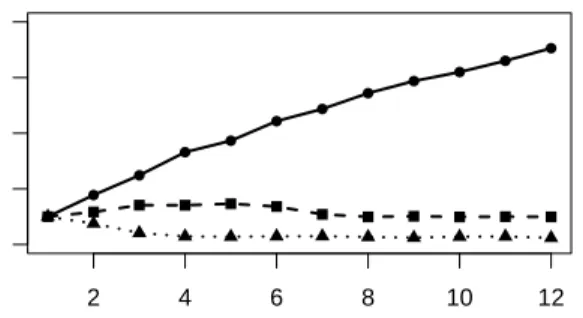
Figure 2: Scalability Performance with respect to sequential processing
4.1
Multi-Threaded Data Structures
We begin our analysis with the thread pool execution mode (section 3.2). “Term frequency” is one of the common application of maps, which counts the number of occurrences of each unique term in a document. An implementation, using the PDQ library, was discussed earlier in Listing 2, which we compare against the ConcurrentHashMap class from the java.util.concurrent package, as well as a critical section (using Java’ssynchronizedkeyword) around a
regu-larjava.util.HashMap. Our dataset comprised of a collection
of web documents containing a total of 300 million words, from a set of 5.2 million unique words [3]. We investigate how efficiently these three implementations exploit varying levels of concurrency.
We measure the performance as the ratio of parallel to se-quential execution time (factor speedup), which is shown in Figure 2 for the three implementations, for varying num-ber of threads ranging from 1 through 12. Notice that, regardless of the type of data structure selected, each of the k threads processed only 1/k of the input data. This implies that difference between the theoretic speedup fac-tor of k and the observed speedup can be attributed to the overhead of maintaining consistency of the output data (although, there are other factors in play as well, such as garbage collection, memory allocation, context switches etc, but we believe their contribution is relatively small). From the figure, we observe that the concurrent and synchro-nized maps are constrained by their lock-based approach to data consistency. This locking overhead is significant and in fact lead to a runtime degradation in comparison to se-quential data processing for this benchmark problem. In contrast, the divide-and-conquer approach of the PDQ li-brary offers an alternative mechanism to achieve data con-sistency, which we have shown to outperform locking-based consistency for data-centric computations. Furthermore, the PDQMaps don’t exhibit diminishing speedup with increas-ing number of threads as was observed with concurrent and synchronized maps.
4.2
Disk-backed Data Structures
To analyze the merits of the PDQ library in processing large datasets (Section 3.3) we compared it with embed-ded disk-based database implementations from Berkeley DB Java Edition (BDB JE) and Kyoto Cabinet (KC). To focus exclusively on the disk I/O performance, we have limited the benchmarks to single-threaded execution. In any case, we have shown previously that locking-based data
consis-tency (which is employed by BDB and KC) does not scale for data-centric computations.
“Reverse index” is another common application of mul-timaps, which creates a mapping from values to their keys in the original index. We used the dataset from DBpedia [4] which lists the URLs of English Wikipedia pages and the URLs of other Wikipedia web pages they point to. The re-verse index is a mapping from a page URL to URLs that
link to it. The input is a 21GB text file, where each line rep-resents one outgoing link and has the format “hurl of source
pagei ... hurl of linked pagei”. The input was read using
the PDQFileReader class, which automatically partitions
the input file, and the output was stored in a
PDQMul-timap object in case of the PDQ library,StoredMap object
in case of BDB and theDBobject for KC.
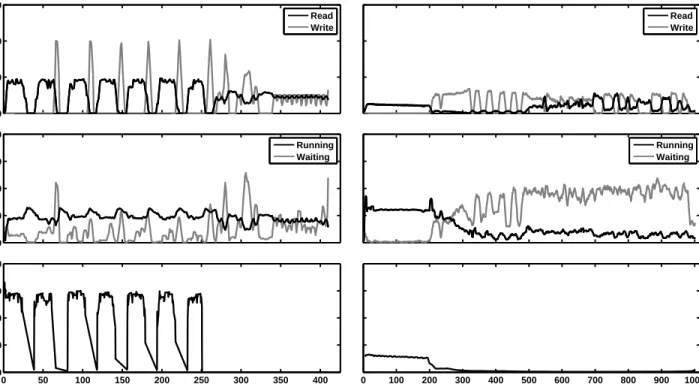
Figure 3 (next page) is a time series of the disk read and write activities (top plot), CPU utilization (middle plot) and rate at which the input data is processed, for both PDQ-Multimap (the left plots) and BDB StoredMap. In case of PDQMultimap, we can clearly observe the cycles of pro-cessing input (when the disk read rate and data propro-cessing rates peak) and externalizing the intermediate results to disk (when the disk write rate peaks while the CPU waits as no data processing occurs). Around the 300s mark, we observe this cycle ends and the external merge begins. During the external merge, data is read and written in rapid succession while CPU utilization observes a marked drop.
In contrast, the BDB StoredMap observes good perfor-mance only when the database is entirely contained in the memory cache. During the first 200 seconds, StoredMap utilizes the CPU well as data is read from the disk and pro-cessed at a high rate. Once the database is too large to fit in memory, we observe a spike in the disk write rate as the con-tents of the cache are flushed to disk. Subsequently, the disk read and data processing rates drop significantly and none of these performance markers improve over time. Once the database is too large to fit in memory, only portions of it can be stored in the cache at a time, and cache page swaps contribute substantially to disk I/O. This is verified by high percentage of time that CPU spends in “waiting” state. To summarize, once the size of output data exceeds the thresh-old of RAM, the StoredMap spends a lot of time bringing relevant data items from disk to cache and dumping stale cache entries to disk.
There is a second fundamental limitation of StoredMap which is not apparent from the previous plots. As the size of data on disk increases, the effectiveness of cache decreases (since a random entry is less likely to be found in cache) and consequently, the performance further degrades. This is verified in Figure 4 which shows that the execution time increases exponentially with the input data size. PDQMul-timap, in contrast, offered linear scalability.
4.3
Distributed Data Structure
We compared the distributed execution mode (Section 3.4) of the PDQ library against a distributed implementa-tion of the Map container type from Hazelcast [5]. The hazelcast map partitions the contents across the multiple JVMs based on the hashcode of the keys. The likelihood that a given key is present locally decreases in inverse pro-portion to the size of the cluster. Since the version of Hazel-cast we used only supported in-memory data, we used the same “Term frequency” benchmark problem that we
consid-0 50 100 150 PDQMap Disk Access (MBps) Read Write 0 20 40 60 80
Time Spent in CPU States (%)
Running Waiting 0 50 100 150 200 250 300 350 400 0 20 40 60 80 Time (s) Data Processing Rate (MBps) BDBMap Read Write Running Waiting 0 100 200 300 400 500 600 700 800 900 1000 Time (s)
Figure 3: Performance Comparison of PDQ and Berkeley DB (BDB) for Disk I/O Rate (top), CPU Utilization (middle) and Processing Rate (bottom)
1 2 3 4 5 6 7 0 50 100 150 Input Size (GB) Ex
ecution time (min)
PDQMap BDBMap
Figure 4: Scalability Performance of PDQMultiMap vs. Berkeley DB Map
ered for the thread pool execution mode.
Figure 5 shows the ratio of the execution time with Hazel-cast to PDQMap for varying size of cluster. In each case, the JVMs at each node executed the program on a single thread. The PDQMap outperforms the Hazelcast Map by a factor of 90, and the reason for this vast difference in performance turns out to be that Hazelcast is in fact limited by the effects of concurrent access. For a randomly distributed input, n−n1 (wheren is the size of cluster) access to a map entry will travel over the network and the proportion of such access increases as more nodes participate in the computation.
● ● ● ● ● ● ● ● 1 2 3 4 5 6 7 8 50 70 90 110 Number of Machines PDQ:Haz elcast Ex
ecution Time Ratio
Figure 5: Performance Comparison of PDQMap vs. Hazelcast
Notice that it is not just the amount of data transferred over the network that influences the performance, it is also the network access pattern. In case of Hazelcast map, re-mote data is accessed while the computation is being exe-cuted, which implies that the processor would remain idle while waiting for the remote data to be fetched. In contrast, the PDQMap transfers data only twice: first, the initial in-put workload is distributed by the master to the slaves, and secondly, by the slaves when they transmit their computed results back to the master. In between these two network access, the processors are fully occupied with computation and never wait for network activity. The figure 6 illustrates the breakdown of the execution times with PDQMap into four phases. As a summary, whereas distributed maps like
Number of Machines
Runtimes (s)
2 3 4 5 6 7 8 0 10 20 30 40 50 60 70 80Split and Distribute Input Local Split and Merge Gather Results Final Merge at Master
Figure 6: Breakdown of execution times for PDQMap by operation
Hazelcast arelatency-bound, the PDQMaps are throughput-bound. What makes this observation pressing is that it is easier to cater to network throughput bound operations. For example, the data can be compressed, faster network inter-connects may be used in the cluster, network parameters may be tuned and so on.
5.
APPLICATIONS
In this section, we illustrate several applications of our PDQ library in the different fields of Computer Science. The
k-Nearest Neighbor Classificationin Machine Learning and the FP Tree Growth Algorithm in Data Mining illustrate how the PDQ programming model transforms the problem of parallelization to that of “adding” data structures. The
PageRank algorithmfor Graph Processing illustrates the ef-ficient operation of PDQ data structures for large datasets in distributed environments. The PDQ programming model has a broad scope of applicability, which we illustrate by examples in the relational processing of structured-data and incremental processing of log data.
5.1
Machine Learning: k-Nearest Neighbor
based Classification
We consider the problem of handwriting recognition, and specifically, recognizing handwritten numerical digits. Our
training dataset consists of 42,000 images, where each im-age is 28x28 pixels and represents one handwritten digit [6]. Each of these images is correctly labeled with the repre-sented digit. The machine learning objective is stated as: given a new image, ascertain the digit it represents. We em-ploy the k-Nearest Neighbors based Classification approach, which employs the following steps: (a) represent each sam-ple item as a vector, (b) define distance between two vectors (we used the Euclidean distance), (b) determine thek vec-tors from the training samples that are closest to test vector, and (d) take the majority vote of labels of thesekselected samples.
We defined aLimitedPriorityQueuethat contains no more thankentries, that is, if a new entry is less than the
great-● ● ● ● ● ● ● ● ● ● ● ● 2 4 6 8 10 12 2 4 6 8 10 Number of Machines F actor Speedup
Figure 7: Parallel Speedup of k-Nearest Neighbor Computation
est entry in queue, the former is inserted and the latter is removed. To execute the computation in parallel, we simply need to define the ˆa ˘AIJaddˆa ˘A˙I operator for the
LimitedPri-orityQueueobjects, as shown below:
def add ( f i r s t , s e c o n d ) : r e s u l t = f i r s t . copy ( )
f o r d , l a b e l in s e c o n d : r e s u l t . i n s e r t ( d , l a b e l )
return r e s u l t
We can now split the input training data, and apply the k-Nearest computation for each split. Each computation would produce a LimitedPriorityQueue object, which we “merge” as shown above, which is the final result. The par-allel speedup on a 12-core machine, for varying number of processing threads, is shown in the Figure 7.
5.2
Data Mining: Frequent Itemset Discovery
Consider a retail store, where a customer purchases a set of items (a transaction). There are many such transactions, and we would like to determine which items are frequently bought together. The Frequent Pattern (FP) Tree growth algorithm is an efficient technique to discover the frequent itemsets. In the first phase of the algorithm, the input data is scanned and the FP tree is constructed, in the second phase the tree is mined for frequent item sets. We will focus on parallelization of first phase only.
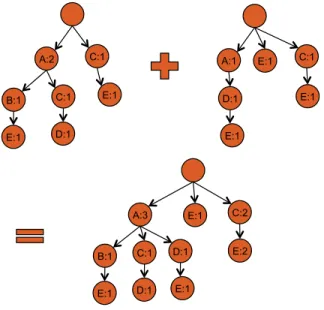
Our strategy for parallelizing FP tree construction would then be to figure out how to “add” two trees. We omit the details, and only give a brief sketch on a recursive strategy for addition. The recursive function takes as input two tree nodes, one from each tree, and is initially invoked with the root nodes of the two trees. For each child of the node from the first tree, we check if it is present in the second tree. If present, we fuse these two nodes and recursively apply the function for these two nodes; and if absent, we simply copy the subtree rooted at the child node. An example is shown in Figure 8 (header table and node links are omitted for clarity). The left tree was constructed for transactions
{A, B, E},{A, C, D}and{C, E}, while the transactions for
the right tree were{A, D, E},{E}and{C, E}.
We applied our implementation on a 1.4GB dataset of 1.7 million transactions with 5.2 million unique items, and
aver-A:2 E:1 D:1 E:1 C:1 B:1 C:1 A:1 E:1 E:1 E:1 D:1 C:1 A:3 E:2 D:1 E:1 C:1 B:1 C:2 E:1 D:1 E:1
Figure 8: Adding two FP Trees
age of 177 items per transaction [3]. With the parallelization strategy we were able to achieve a speedup of 5X on a 8-core machine.
5.3
Graph Processing: Pagerank Algorithm
If we represent the web as a directed graph, with webpages represented as nodes and links as edges, then the PageRank algorithm [7] can be used to generate weights for each node, which measures the relative importance of that web page.
We applied the algorithm on the Wikilinks dataset [4], which is a graph of all English Wikipedia pages along with internal page links (21 GB text file). We processed this raw data and created a Multimap, which consumed about 8GB, when serialized on disk. This dataset is too large to be completely processed in-memory. With this example, we highlight the capability of our associative container imple-mentations that can automatically and transparently tran-sition their behavior from in-memory to disk-backed as well distributed execution without requiring any code changes to the program.
Cluster Size Time per Iteration (min) Speedup
1 20:38
2 10:58 1.88X
4 5:04 4.06X
8 2:25 8.54X
Table 1: Speedup of PageRank algorithm on a Clus-ter
We executed the algorithm on a distributed cluster of ma-chines, the size of which ranged from 1 through 8. Since the computation is mostly I/O-bound, we spawned only one thread per machine. The following table shows the speedup with respect to the cluster size.
5.4
Relational Processing of Structured Data
Let us consider a motivating example from the DBLP repository [8] of academic publications in Computer Sci-ence. We extracted two database tables: paper (paperId, au-thorId), which lists all published papers and their authors,
and citations (paperId, citedpaperId), which lists citations for each paper. Equivalently, we can view them as mul-timaps ofpaperIdtoauthorId, andpaperIdtocitedpaperId, respectively. We chose multimaps, since each paper may have multiple authors, and may cite multiple papers.
Sometimes authors cite their own papers, or of their col-leagues. Colleagues are the researchers that an author has co-authored some paper with, or equivalently:
Ais-colleague-ofB⇔ ∃p,(p, A)∈paper∧(p, B)∈paper
We would like to find out, for each author, the percentage of papers they cited that were their own or of their colleagues (which should give us some insight into how clustered the re-search community is!). The following is an intuitive (but un-optimized) SQL statement to count the number of citations, for each author, that were their own or from colleagues:
SELECT a u t h o r , count( p a p e r ) FROM (SELECT a u t h o r , p a p e r , c o a u t h o r s , g r o u p c o n c a t ( c o a u t h o r s ) ASC FROM −− f o r each a u t h o r , t h e p a p e r s t h e y c i t e (SELECT p a p e r . u i d AS a u t h o r , c i t a t i o n . c i t e d p a p e r I d AS c i t e d p a p e r
FROM p a p e r INNER JOIN c i t e s
ONa u t h o r = c i t e d p a p e r ) ASY1
INNER JOIN
−− f o r each paper , i t s c o a u t h o r s e t
(SELECTP1 . p i d AS p a p e r , X1 . c o a u t h o r AS c o a u t h o r s
FROMp a p e r ASP1 INNER JOIN
−− f o r each a u t h o r , l i s t o f c o a u t h o r s
(SELECTP1 . a u t h o r I d AS a u t h o r ,
P2 . a u t h o r I d AS c o a u t h o r
FROMp a p e r ASP1 INNER JOIN p a p e r AS P2
WHEREP1 . p a p e r I d = P2 . p a p e r I d GROUP BY P1 . u i d , P2 . u i d ) ASX1 ONP1 . a u t h o r I d = X1 . a u t h o r GROUP BYP1 . p i d , X1 . c o a u t h o r ) ASY2 ONY1 . c i t e d p a p e r s = Y2 . p a p e r GROUP BY a u t h o r , p a p e r ) AS Z1 WHERE (SELECT f i n d i n s e t ( a u t h o r , C ) ) > 0 GROUP BY a u t h o r
In context of associative containers, we can imagine a data-flow programming paradigm where the data can be transformed using some set of relational operators. If A :
K→VandB :K→Tare two associative containers, then
we have defined for following operations (only a subset listed here, relevant for this problem):
Operation Definition reverse(A) :V→K v→k∈reverse(A)⇔k→v∈A join(A, B) : k→< v, t >∈join(A, B)⇔ K→<V,T> k→v∈A∧k→t∈B mix(A, B) :V→T ∃k∈v→t∈mix(A, B)⇔ K, k→v∈A∧k→t∈B
unique(A) :K→V remove duplicate values for each key
We omit the proof and only claim that each of these oper-ations can be parallelized by the PDQ library both in multi-core and distributed environments, for memory-bound as well as disk-bound workloads. We can now describe a coun-terpart sequence of data flow statements to compute the same result as the SQL statement, as shown in the follow-ing:
#T1 = ( Multimap from p a p e r s t a b l e ) #T2 = ( Multimap from c i t a t i o n s t a b l e )
T3 = r e v e r s e ( T1 ) # p a p e r s w r i t t e n by each a u t h o r
T4 = mix ( T1 , T1 ) # c o a u t h o r s f o r each a u t h o r
T5 = u n i q u e ( T4 ) # u n i q u e c o a u t h o r s f o r each a u t h o r
T6 = mix ( T3 , T5 ) # c o a u t h o r s e t f o r each p a p e r
T7 = u n i q u e ( T6 )
T8 = mix ( T2 , T1 ) # f o r each paper , a u t h o r s t h a t c i t e i t
T9 = j o i n ( T8 , T7 ) # f o r each paper , a u t h o r s t h a t c i t e i t # and t h e c o a u t h o r s e t o f t h i s p a p e r PDQ. run ( compute , T9 , r e s u l t ) # where , t h e ’ compute ’ f u n c t i o n i s d e f i n e d a s : def compute ( T9 , r e s u l t ) : f o r key , ( c i t i n g a u t h o r s , c o a u t h o r s ) i n T9 : f o r c i t i n g a u t h o r i n c i t i n g a u t h o r s : i f c i t i n g a u t h o r i n c o a u t h o r s : r e s u l t [ c i t i n g a u t h o r ] ++
5.5
Incremental Log Processing
In several contexts, logs are generated continuously (e.g. web traffic) and several statistics rely on cumulative pro-cessing of logs (e.g. top web pages visited). Propro-cessing the entire log dataset for these statistics, for every time a report is requested, may not be practical. Alternatively, statistics can be generated incrementally; however, in traditional pro-gramming approaches, custom code has to be developed for this purpose.
PDQ library offers a native and efficient mechanism for incremental processing of data. Recall that the our SRM computation model splits the inputs, creates replicas of out-put, applies computation to each split/replica pair, and fi-nally merges the replicas back to the output container. So far we had assumed that the output container is initially empty. However, if the output container has some data to begin with, the replicas will be merged into the existing data. Since the PDQ data structures are natively Serializable, in-cremental processing is easily accomplished, as illustrated below: def f i r s t r e p o r t ( i n p u t , o u t p u t ) : PDQ. run ( g e n e r a t e r e p o r t , i n p u t , o u t p u t ) s a v e F i l e ( o u t p u t , ” t i m e s t a m p 1 ” ) def i n c r e m e n t a l r e p o r t ( l a s t t i m e s t a m p , i n p u t s i n c e l a s t t i m e s t a m p ) : o u t p u t = r e a d F i l e ( ” t i m e s t a m p ” + l a s t t i m e s t a m p ) PDQ. run ( g e n e r a t e r e p o r t , i n p u t s i n c e l a s t t i m e s t a m p , o u t p u t ) s a v e F i l e ( o u t p u t , ” t i m e s t a m p ” + (++ l a s t t i m e s t a m p ) )
After producing the first report, the output is saved to disk; while for the subsequent reports, the previously saved report is loaded from disk and used as output.
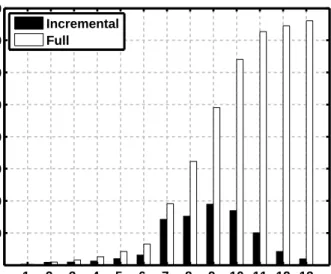
We used the WorldCup98 dataset [9] which is website re-quest logs over 92 days, from 30 servers in four countries. Each log entry is 20B and the total data set size is 26GB. A report was generated each week, and the Figure 9 shows the execution time of incremental processing each week, com-pared with full processing of data.
6.
CONCLUSION
We have presented PDQCollections, a library of associa-tive containers that inherently encapsulate parallelism and a computation model that transforms the problem of paral-lelization to that of defining addition operator for value data types. We provided the Data Model, which describes what
Incremental Full 1 2 3 4 5 6 7 8 9 10 11 12 13 0 100 200 300 400 500 600 700 800 Week Processing Time (s)
Figure 9: Comparison of Incremental processing of data against full processing
problems can be solved, the Split-Replicate-Merge Compu-tation Model, our strategy for parallelism, the Program-ming APIs and shown the equivalence with the Map Re-duce programming model. We have shown that the PDQ li-brary can efficiently exploit parallelism in multi-core as well distributed environments, for in-memory as well as large datasets. We discussed our implementation that included the data structure design, the thread pool execution mode for shared-memory and memory-bound workloads, the disk backed execution mode to handle computations when output data is too large to fit in memory and finally, the distributed execution mode for small to medium sized clusters.
Our comparative study with concurrent data structures (for memory bound computation), BerkeleyDB’s StoredMap (for disk-backed computation) and Hazelcast (for distributed computation) highlighted the salient characteristics of our model that explained how it significantly outperforms these traditional data structures. We also illustrated the applica-tion of our library in several fields of Computer Science.
7.
REFERENCES
[1] J. Han, J. Pei, and Y. Yin, “Mining frequent patterns without candidate generation,”SIGMOD, 2000. [2] R. Power and J. Li, “Piccolo: building fast, distributed
programs with partitioned tables,”OSDI, 2010. [3] C. Lucchese, S. Orlando, R. Perego, and F. Silvestri,
“Webdocs: a real-life huge transactional dataset,” [4] S. Auer, C. Bizer, J. Lehmann, G. Kobilarov,
R. Cyganiak, and Z. Ives, “DBpedia: A nucleus for a web of open data,”(ISWC/ASWC, 2007.
[5] Hazelcast, “http://www.hazelcast.com/.”
[6] Y. LeCun and C. Cortes, “MNIST handwritten digit database,”http://yann.lecun.com/exdb/mnist/. [7] L. Page, S. Brin, R. Motwani, and T. Winograd, “The
pagerank citation ranking: Bringing order to the web.,” tech. rep., Stanford InfoLab, 1999.
[8] M. Ley, “DBLP - some lessons learned,”PVLDB, 2009. [9] M. Arlitt and T. Jin, “1998 world cup web site access