D.Ed. Special Education
(Cerebral Palsy)
Syllabus
Norms, Regulations & Course Content
REHABILITATION COUNCIL OF INDIA
(Statutory Body Under Ministry of Social Justice & Empowerment)
B-22, Qutab Institutional Area
New Delhi – 110 016
2014
D.Ed.Spl.Ed. (CP), 2014 Rehabilitation Council of India
1 D.Ed.Spl.Ed.(CP)
1.0 Preamble
This course is designed to train personnel who are committed to work with children who have neurological disabilities (cerebral palsy). The course structure provides for a comprehensive understanding of the varied needs of children with neurological disabilities and to meet those needs in a special school and regular classroom. There are very few courses in the country to train persons to educate children with neurological disabilities, especially cerebral palsy. This course has been designed to meet this growing need in the country.
2.0 Nomenclature of the Course
D.ED. IN SPECIAL EDUCATION (CEREBRAL PALSY) 3.0 Overall Goal and Objectives of the Course
Goal and Objectives are set with special reference to children with neurological disabilities/ cerebral palsy.
3.1 Goal: To prepare special teachers who can provide services to children with cerebral palsy and their families from infancy to pre-vocational levels in the following settings:
1) Early intervention Programmes
2) Special Schools – Day Care/Residential 3) Integrated \ Inclusive Schools
4) Home Based Programmes
5) Community Based Rehabilitation Programmes 6) Pre-vocational Programmes
3.2 General Objective
To build knowledge and skills in the following areas:
1.Understand the areas of child development and how cerebral palsy and associated disabilities impact normal development.
2.Build partnerships with families of children.
3.Basic understanding of clinical and medical assessments and conditions to interpret findings 4.Assess the educational needs of children with cerebral palsy to provide appropriate
interventions.
5.Develop a team approach with families and related interactors (e.g., therapists, doctors, professionals) to provide the child a meaningful programme.
6.Adapting environments to maximize learning. 7.Knowledge of best practices in education
8.Develop indigenous assessment and educational materials.
9.Make appropriate transition and vocational plans for the adult lives.
10. Advocate for the rights of people who are Cerebral Palsy and their families.
11. Understand Governmental legislations and concessions provided to people with disabilities.
12. Need for teachers to develop self evaluation and professional ethics and standards on an ongoing basis. To be able to make and use aids for classroom instruction
D.Ed.Spl.Ed. (CP), 2014 Rehabilitation Council of India
2 14. To have the requisite skills to work in Institutional Based Rehabilitation (IBR) and
Community Based Rehabilitation (CBR) settings.
15. To be able to carry out specific physical, speech and language educational/ therapy programmes for children with multiple disabilities prescribed by and under the guidance of physical, speech and language therapists.
16. To develop an understanding about inclusive education and promote opportunities wherever possible.
3.0 Duration of the Course: The course duration will be two academic years comprising
of 220 working days (2640 hours, 1320 hours per academic year) for each year. This duration includes:
I year II year
Teaching and practicals 180 days 180 days
Educational tour 10 days 10 days
Tests and Examinations 30 days 30 days
4.0 Trainee Teacher Intake Capacity: Each training centre can admit a total of 25 candidates to the course. Maximum - 25 (per batch)
5.0 Medium of Instruction: Primarily English with need based translation support in Hindi and regional language of the state where TTC is based.
6.0 Teacher Student Ratio The minimum criterion of student teacher ratio is prescribed as 1:10, so ideally one teacher must be available per ten students.
7.0 Entry Requirements/Eligibility: Minimum qualification for admission is successful completion of 10+2 or Higher Secondary Examination or equivalent from a recognized Board of Education with minimum 50% marks.
8.0 Admission Procedure: Merit for admission to this course will be prepared from 100 marks. The division of the marks is as follows:
i. 50% weightage to 10+2 marks (50 marks)
ii. 10% to parents and siblings of the persons with disabilities (10 marks) iii. 10% to additional higher qualifications (10 marks)
iv. 10% to written examination (10 marks)
v. 20% to the interview (20 marks)
Total 100 marks 9.0 Minimum Attendance Required
Eighty per cent minimum attendance is required both in theory and practical to be eligible to appear in the term end examination.
D.Ed.Spl.Ed. (CP), 2014 Rehabilitation Council of India
3 10.0 Essential and Desirable Qualifications for Course Coordinator, Faculty and other Staff S. No. Staff Qualification 1 Course Coordinator
a. M.A. /M.Sc., with B.Ed.Spl.Ed (Locomotor and Neurological Disorder) with three years of experience
Or
M.A. /M.Sc., with D.Ed.Spl.Ed (CP) with 5 years of teaching experience b. Must have valid RCI registration
2 Lecturer-cum-Supervisor
a. M.A. /M.Sc., with B.Ed.Spl.Ed (Locomotor and Neurological Disorder) with three years of experience
Or
M.A. /M.Sc., with D.Ed.Spl.Ed (CP) with 5 years of teaching experience b. Must have valid RCI registration
3 Internal Faculty (Full Time / Part Time)
The Internal Faculty will consist of qualified Special Educators with degrees or Graduate Diplomas in Special Education, Physiotherapists, Speech Therapist, Social Workers with Degrees or Diplomas in respective branch, and a psychologist with a Master’s Degree or PhD in Psychology or Special Education. Each faculty must have minimum one year Teaching Experience
4. Visiting Faculty The External faculty will consist of medical specialists like pediatrician, Neurologist, Orthopaedician, Physiatrist, Visiting lecturers in Special Education, and in the field of rehabilitation.
Tutorial groups can be organized where 1 tutor is responsible for 3 –5 students.
All the position is to be fulfilled as per the norms of the RCI and reservations of the position as per the guidelines of Government of India.
11.0 Staff (Non teaching)
1. Computer Typist-cum-accountant 2. Librarian
3. Peon 4. Watchman
12.0 Minimum Requirement for Labs, Tools and Equipments 12.1 Library
The training centre should have a minimum of 10 books per subject covering the syllabus (as prescribed in the syllabus) and a minimum of 2 journals subscribed periodically pertaining to education of children with Cerebral Palsy. In addition, an equal number of books on general education, educational psychology, curriculum development, methods of teaching and methods
D.Ed.Spl.Ed. (CP), 2014 Rehabilitation Council of India
4 of evaluation should be available in the library as prescribed in the list of references given after each course paper.
13.0 Space for Conducting the Course 13.1 Space
Sl.No. Type of Facilities Area Remarks
1. Class Room – 2 40 sq. m. each
2. Class Room – 2 25 sq. m. each
3. Multipurpose Room/Hall -1 60 sq. m.
4. Library-1 60 sq. m. 5 Computers &
Internet 5. Toilet (Male-1, Female-1) 04 sq.m. each
6. Principal’s Room -1 15 sq. m.
7. Resource Room- 1 60 sq. m.
8. Staff Room-1 40 sq. m.
9. Office Room-1 25 sq. m.
10. Store Room-1 25 sq. m.
11. Lab. for Psychology/ICT-1 60 sq. m.
12. Hostel for Boys and Girls (Separately) - Optional 13. Playground for Outdoor games like
football, cricket, etc. If not available, then collaboration with nearby Institute/ University
500 sq. m.
13.2 Material Furniture for Staff
1. Full time staff Tables - 4
Chairs - 4
Cupboards (steel) 4
2. Visiting Staff Tables - 2
Chairs - 2
3. Computer Typist-cum-Accountant Table - 1
Chair - 1
4. Librarian Table - 1
Chair - 1
5. Peon Chair - 1
Stool - 1
1 Furniture and Equipment for the Office
1. Cupboards (Steel) 04
2. Filing Cabinet 01
3. Computer with Printer 01
4. Phone 01
D.Ed.Spl.Ed. (CP), 2014 Rehabilitation Council of India
5
6 .Wall Clock one each in every room
7. Fans two each in every room
8. Electrical fittings (lights etc) two each in every room 2 Furniture and Equipment for Classroom (for each year)
1. Tables (for students) 25
2. Chairs (for students) 25
3. Audio Visual equipments 01
4. Black Board 01
5. Teaching material (Demonstration) - Montessori set 01
- Kindergarten set 01
- Nursery set 01
- TLM as per requirement’ 01
3 Furniture for Library
1. Library cupboards 10 2. Library tables (large) 04 3. Library chairs 25
4. Furniture for demonstration class (to teach 6 children) 1. Tables 2. Chairs
3. Teaching Material 4. Programme plan material
14.0 Field visit: Visits will be arranged to various Special Rehabilitation Centres and Special Schools for about 10 days (5 days for each academic year). The teacher trainees will be required to submit report separately on each school visited.
15.0 Field/Block placement: 6 weeks of field/block placement (3 weeks per academic year) at a Community based rehabilitation center to be made mandatory.
16.0 Project/case study
1. Submission of 3 case studies in the 1st year and 2 case studies in the 2nd year is required. 2. Preparation of teacher learning material and 1 low cost assistive technology aid.
17.0 Examination Scheme: As per RCI's Scheme of Examination.
18.0 Certification as Registered Personnel: It is mandatory for every rehabilitation professional / personnel to obtain a “Registered Personnel / Professional Certificate” from the Rehabilitation Council of India to work in the field of special education in India. As continuous professional growth is necessary for the renewal of the certificate, the rehabilitation professional / personnel should undergo in-service programme periodically to update their professional knowledge.
D.Ed.Spl.Ed. (CP), 2014 Rehabilitation Council of India
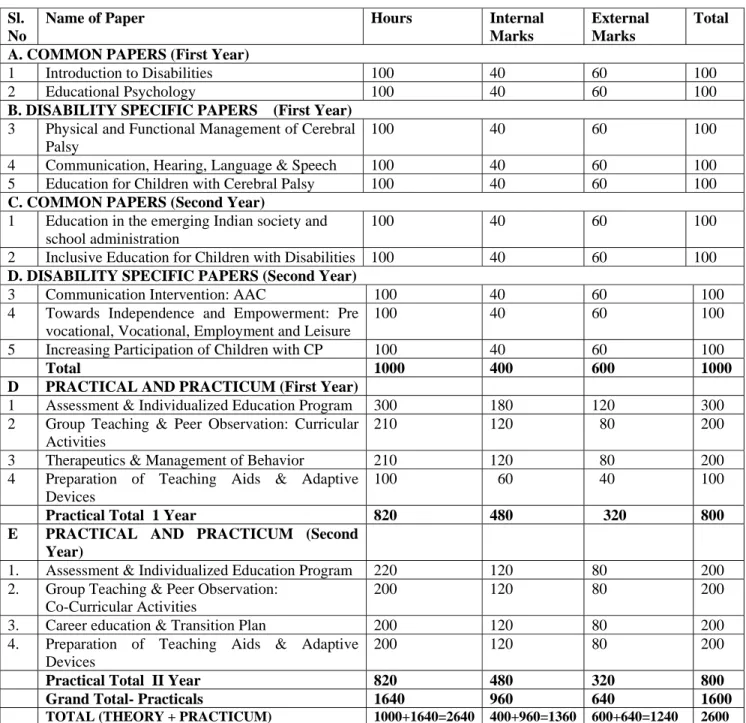
6 19.0 Scheme of papers (Theory and Practical) for both the years
Table I: Course Structure & Scheme of Examination Sl.
No
Name of Paper Hours Internal Marks
External Marks
Total A. COMMON PAPERS (First Year)
1 Introduction to Disabilities 100 40 60 100
2 Educational Psychology 100 40 60 100
B. DISABILITY SPECIFIC PAPERS (First Year)
3 Physical and Functional Management of Cerebral Palsy
100 40 60 100 4 Communication, Hearing, Language & Speech 100 40 60 100
5 Education for Children with Cerebral Palsy 100 40 60 100
C. COMMON PAPERS (Second Year)
1 Education in the emerging Indian society and school administration
100 40 60 100
2 Inclusive Education for Children with Disabilities 100 40 60 100
D. DISABILITY SPECIFIC PAPERS (Second Year)
3 Communication Intervention: AAC 100 40 60 100 4 Towards Independence and Empowerment: Pre
vocational, Vocational, Employment and Leisure
100 40 60 100 5 Increasing Participation of Children with CP 100 40 60 100
Total 1000 400 600 1000
D PRACTICAL AND PRACTICUM (First Year)
1 Assessment & Individualized Education Program 300 180 120 300 2 Group Teaching & Peer Observation: Curricular
Activities
210 120 80 200
3 Therapeutics & Management of Behavior 210 120 80 200 4 Preparation of Teaching Aids & Adaptive
Devices
100 60 40 100
Practical Total 1 Year 820 480 320 800 E PRACTICAL AND PRACTICUM (Second
Year)
1. Assessment & Individualized Education Program 220 120 80 200 2. Group Teaching & Peer Observation:
Co-Curricular Activities
200 120 80 200
3. Career education & Transition Plan 200 120 80 200 4. Preparation of Teaching Aids & Adaptive
Devices
200 120 80 200
Practical Total II Year 820 480 320 800 Grand Total- Practicals 1640 960 640 1600
TOTAL (THEORY + PRACTICUM) 1000+1640=2640 400+960=1360 600+640=1240 2600
Practical
• Full time teaching practice
• Teaching practice (school based, home based, CBR & inclusive setups)
• Individualized teaching
D.Ed.Spl.Ed. (CP), 2014 Rehabilitation Council of India
7 1st Year—(COMMON PAPER)
THEORY PAPER I: Introduction to Disabilities Total Marks: 100
Total hours: 100 Objectives:
After completion of this paper, the learner is expected to:
1. Understand the differences disability and functioning
2. Understand the educational needs of various categories of persons with disabilities. 3. Know the common causes and preventive aspects of different kinds of disabilities 4. Know the importance of early identification and intervention
5. Understand the importance of different agencies in human resource development
Unit 1: Understanding Disability (18 Hours)
1.1Historical development in understanding disability
1.2Emerging trends: Concept and Definition of Impairment, Disability, Handicap(ICIDH) and Functioning(ICF)
1.3Definition and Categories of Disability as per National laws 1.4Prevalence and demographic profile
1.5Causes and prevention of disability
Unit 2: Definition, types and educational needs of children with disabilities (18 Hours) 2.1. Hearing Impairment: Definition and types
2.2. Visual Impairment: Definition and types 2.3. Mental Retardation: Definition and types 2.4. Neuro–muscular: Definition and types
2.5. Autism Spectrum Disorder: Definition and types
Unit 3: Definition, types and educational needs of children with disabilities (18 Hours) 3.1. Mental Illness: Definition and types
3.2. Specific Learning Disabilities / Difficulties: Definition and types 3.3. Deafblindness: Definition and types
3.4. Locomotor Disabilities: Definition and types 3.5. Multiple Disabilities: Definition and types
Unit 4: Early Identification and intervention (18 Hours) 4.1Concept and need of early identification
4.2Screening and referral
4.3Involvement of parents and the community
4.4Role of special teacher/ educator in Early Intervention and related matters 4.5Models of Early Intervention- Home based and centre based
D.Ed.Spl.Ed. (CP), 2014 Rehabilitation Council of India
8 Unit 5: Human Resource in Disability Sector (18 Hours) 5.1 Concept and need of Human Resource in disability sector
5.2 Role of National Institutes 5.3 Role of International bodies 5.4 Role of NGOs and the Community 5.5 Status of Human Resource in India
Experiential Learning (10 Hours)
1. Prepare a checklist for identification of at least one disability.
2. The students are expected to visit at least two institutes for disabilities and observe children with disabilities learning, and submit a report of their observation.
Reference material:
1. Madhavan, T. Kayla, M. Naidu, S. Peshawaria, R and Narayan, J (1989) Mental Retardation – A Manual for Psychologists
2. Wallace, P.M. and Goldstein, J.M. (1944) An Introduction to Psychology (3rd Edition) Madison: Brown and Benchmark Publishing
3. Lindgren H (1988) Educational Psychology in the Classroom, Harper and Raw
4. Panda, KC (1997) Education and Exceptional Children, Vikas Publishing House, New Delhi
5. Smith, D.D, and Luckasan, R.(1992), Introduction to Special Education, Allyn and Bacon, Boston
6. Alan H. and Ravic R. (1998). Best and promising Practices in Developmental Disabilities, Texas, PRO – ED, Inc
7. Hegarty S. (2002). Education and Children with Special Needs in India: Sage Publications, India Pvt. Ltd.
8. Myron G. Eisenberg, Robert L. Glueckauf, Herbert H. Zaretsky (1999) Medical Aspects of Disability: A Handbook for the Rehabilitation
9. Arthur E. Dell Orto, Paul W. Power (2007) The Psychological and Social Impact of Illness and Disability
10.Vicki L. Schwean, Donald H. Saklofske (1999) Handbook of Psychosocial Characteristics of Exceptional Children
11.Seamus Hegarty, Mithu Alur (2002) Education and Children with Special Needs: From Segregation to Inclusion
D.Ed.Spl.Ed. (CP), 2014 Rehabilitation Council of India
9 1st Year—(COMMON PAPER)
PAPER–II: Educational Psychology
Total Marks: 100 Total Hours: 100 Objectives: After completion of this paper, the students are expected to:
1. Clearly delineate the nature of child development including delayed development.
2. Gain insights into various aspects of growth and development including personality development.
3. Acquire and apply knowledge about cognition and intelligence.
4. Demonstrate clear comprehension of different perspectives of learning.
5. Acquire knowledge of different behavior problems among children and their management. Unit 1: Psychology and Theories of Learning (18 Hours) 1.1Educational Psychology – Nature, Importance and Scope.
1.2Individual differences and methods of dealing with the differences
1.3Importance of principles of psychology for the educators of children with disabilities. 1.4Theories of Learning: Behaviorist (Classical & Operant), Social Learning (Bandura),
Cognitive Learning (Information Processing).
1.5Role of teacher and learner in different teaching-learning situations- Learning Styles and Learning in Constructivist Perspective
Unit 2: Nature of Child Development (18 hours) 2.1 Child Development: meaning and nature
2.2 Principles of growth and development
2.3 Significance of child development for special educators in understanding the learner with disability
2.4 Concept of developmental delay and / differences
2.5 Factors influencing development: heredity and environmental
Unit 3: Major Aspects of Development (18 hours) 3.1Physical and Motor Development: meaning, growth and maturation, gross and fine motor
development skills in infancy and pre-school children
3.2Social Development: meaning, significance, stages, psycho-social development 3.3Emotional Development: meaning, development of emotions at different stages 3.4Personality Development: meaning, definition and factors affecting
3.5Language Development: meaning and significance, bilingual and multilingual language situations, implications for teachers
Unit 4: Cognition and Intelligence (18 hours) 4.1Cognitive Development: Concept, Piaget's stages of cognitive development
4.2 Understanding socio-cultural difficulties and factors influencing cognition 4.3 Role of cognition in learning
4.4 Intelligence: meaning, definition and measurement of IQ. 4.5 Howard Gardner's theory of Multiple Intelligence
D.Ed.Spl.Ed. (CP), 2014 Rehabilitation Council of India
10
Unit 5: Behaviour Problems and Management (18 hours) 5.1 Common behaviour problems in children
5.2 Assessment of problem behaviour 5.3 Functional analysis
5.4 Behaviour management techniques
5.5 Planning, Implementation and Evaluation of Behavioural Management Programme
Experiential Learning (10 Hours)
The student learner is expected to observe problem behaviour of two children with disability and write a report.
Reference material:
1. Kaul, V (1993) Early Childhood Education Programme, New Delhi, NCERT
2. Madhavan, T. Kalyan, M. Naidu, S. Peshawaria, R and Narayan, J (1989) Mental Retardation – A Manual for Psychologists,
3. Muralidharan R (1990) Early Stimulation Activities for Young Children, New Delhi NCERT
4. Panda, KC (2001) Elements of Child Development (Sixth Revised Edition), Ludhiana Kalyani Publishers.
5. Sharma, P (1995) Basics on Development and Growth of a Child. New Delhi: Reliance Publishing House.
6. Sharma, R and Sharma, R (2002) Child Psychology Atlantic: New Delhi. 7. Mohan Mathew (1972) Child Psychology in Indian Perspective
8. Jan Borms (1984) Human Growth and Development
9. Madhavan, T. Kayla, M. Naidu, S. Peshawaria, R and Narayan, J (1989) Mental Retardation – A Manual for Psychologists
10.Wallace, P.M. and Goldstein, J.M. (1944) An Introduction to Psychology (3rd Edition) Madison: Brown and Benchmark Publishing
11.Lindgren H (1988) Educational Psychology in the Classroom, Harper and Raw
12.Panda, KC (1997) Education and Exceptional Children, Vikas Publishing House, New Delhi
13.Arthur E. Dell Orto, Paul W. Power (2007) The Psychological and Social Impact of Illness and Disability
14.Vicki L. Schwean, Donald H. Saklofske (1999) Handbook of Psychosocial Characteristics of Exceptional Children
D.Ed.Spl.Ed. (CP), 2014 Rehabilitation Council of India
11 First Year (Disability Specific Paper)
Paper III: Physical and Functional Management of Cerebral Palsy
100 Hours
100 marks Objectives:
On completion of this paper the trainees will be able to
1. Develop an understanding of sensory motor problems in children with CP
2. Demonstrate ability in identifying problems related to mobility, hand function, accessibility, postures, seating, and handling children with CP
3. Demonstrate competency in translating therapeutic techniques in functional terms in the classroom
4. Demonstrate competency in identifying specific behaviors related to sensory and communication problems
5. Demonstrate use of assistive devices in enhancing function in children with CP Unit 1: Introduction to Physiotherapy and Occupational therapy 10 hrs 1.1 Definition
1.2 Importance of Physiotherapy/Occupational therapy 1.3 Who needs Physiotherapy/Occupational therapy
Unit 2: Normal Motor Development 20 hrs
2.1 Developmental Milestones 2.2 Gross Motor Development 2.3 Fine Motor Development 2.4 Joints & Movements
2.5 Muscle Tone 2.6 Reflexes
2.7 Balance Reactions 2.8 Posture
Unit 3: Cerebral Palsy 20 hrs
3.1 Assessment
3.2 Muscle Tone
3.3 Primitive reflexes/Pathological reflexes 3.4 Associated problems and communications
Unit 4: Management techniques 30 hrs
4.1 Transdisciplinary / interdisciplinary and multi disciplinary approach to management of children with CP
4.2 Early intervention & Sensory stimulation 4.3 Positioning
4.4 Lifting & carrying
4.5 Facilitation of movements (incl. Orientation/Mobility Training etc for CP + VI /HI) 4.6 Balance exercises
4.7 Voluntary control exercises 4.8 Passive movements
4.9 Hydrotherapy 4.10 Group therapy
D.Ed.Spl.Ed. (CP), 2014 Rehabilitation Council of India
12 4.12 ADL
4.13 Therapy management for preschool adolescent and adults with CP
4.14 Other alternative approaches – Peto, Vojta, Conducive Education, NDT, Bobath, 4.15 Dance and movement, Pet, music, yoga therapy etc
4.16 Parent Training and Involvement
Unit 5: Sensory Integration 10 hrs
5.1 Definition and process
5.2 Sensory-motor problems in CP
5.3 Assessment of SI problems in classroom 5.4 Sensory integration activities in classroom
Unit 6: Types of Assistive Devices 10hrs
6.1 Low Cost Technology, High end Technology 6.2 Therapy aids
6.3 Mobility aids 6.4 Orthoses
6.5 Modification of aids for independent living 6.6 Maintenance of assistive devices
6.7 Strategies for functional use References
1. An Introduction to Neuro developmental disorders of children- Dr. A. Mervyn Fox- 2003- National Trust
2. Educating Children with multiple disabilities- Orlolve Sobsey. 3. Treatment of Cerebral Palsy and Motor Delay-Sophie Levitt-1997 4. Out of Sync Child-Sensory Integration-Carol Stock-1998
D.Ed.Spl.Ed. (CP), 2014 Rehabilitation Council of India
13 First Year (Disability Specific Paper)
Paper IV: Communication, Hearing, Language & Speech
100 hours 100 marks Objectives:
On completion of this paper the trainees will be able to
1. Differentiate between communication, language and speech
2. Understand the role of hearing in development of speech, language and communication 3. Identify common speech and hearing disorders
4. Assess children with CP
5. Meet communication, language and speech needs in a classroom
Unit 1: Communication 20 hrs
1.1 Definition & meaning of communication 1.2 Functions of communication
1.3 Features of good communication 1.4 Verbal & non-verbal communication 1.5 School age and above
1.6 Typical development of pre-symbolic communication
Unit 2: Hearing 10 hrs
2.1 Incidence in Cerebral palsy 2.2 Types of hearing loss
2.3 Screening; intervention options 2.4 Principles of learning to listen
2.5 Hearing aids – types, care, maintenance, trouble shooting
Unit 3: Language 20 hrs
3.1 Definition & meaning of language 3.2 Structure of language
3.3 Components of language
3.4 Receptive & expressive languages 3.5 Theories of language development 3.6 Stages of language development
3.7 Activities for developing pre-linguistic skills using AAC
Unit 4: Speech 20 hrs
4.1 Definition
4.2 Speech as overlaid function 4.3 Supra segmental aspects of speech
4.4 Feedback of speech through various sensory modalities 4.5 Speech sounds
4.6 Speech production
D.Ed.Spl.Ed. (CP), 2014 Rehabilitation Council of India
14
Unit 5: Speech and Hearing Disorders 15 hrs
5.1 Dysarthria and Dyspraxia 5.2 Articulation disorders 5.3 Phonological disorders 5.4 Fluency disorders 5.5 Voice disorders 5.6 Resonance Disorders
Unit 6: Assessment and Intervention 15 hrs
6.1 Speech and communication Assessment 6.2 Oral-motor Assessment
6.3 Feeding Assessment 6.4 Intervention strategies 6.5 Drooling and intervention 6.6 Feeding adaptations References:
1. Communication for the child with C.P- IICP
2. Language Disorders and Intervention Strategies- A Practical guide to the Teachers-Reddy, Lokanadha- 2006
D.Ed.Spl.Ed. (CP), 2014 Rehabilitation Council of India
15 First Year (Disability Specific Paper)
PAPER V: Education for Children with Cerebral Palsy
100 hours 100 Marks Objectives
On completion of this paper the trainees will be able to
1. Develop the understanding about the nature and scope of education 2. Describe the scenario of special education in India
3. Know the contemporary trends in special education 4. Write IEP for children with CP
5. Develop a behavior management program 6. Develop a record keeping system
Unit 1: Introduction to special education 10 hrs 1.1 General education 1.2 National Policy on Education 1.3 Introduction to Special Education 1.4 History of special education
Unit 2: Assessment 20 hrs
2.1 Assessment and purposes 2.2 Types of assessment
2.3 Role of assessment in instructional programs
2.4 Curriculum-based–Carolina–SPASTN, IICP or any other indigenously development format 2.5 Ecological
2.6 Behavioral 2.7 Functional
Unit 3: Instructional planning and evaluation 20 hrs 3.1 Writing an IEP (Individualized Education Programme)
3.2 Goals and objectives
3.3 Teachers effectiveness –Variables 3.4 Lesson planning and evaluation 3.5 Maintaining records and report writing 3.6 Time management and scheduling 3.7 Classroom arrangement – types
Unit 4: Early Intervention and early childhood special education 10 hrs 4.1 Approaches to early learning-Montessori, Kindergarten
4.2 Importance of play in early learning 4.3 Activity-based instruction
D.Ed.Spl.Ed. (CP), 2014 Rehabilitation Council of India
16 Unit 5: Curriculum development for academics 20 hrs 5.1 Reading, vocabulary, comprehension,
5.2 Spelling and written expression: writing and alternatives to writing 5.3 Maths
5.4 EVS 5.5 Creativity
Unit 6: Applied Behaviour Analysis 20 hrs
6.1 Definition of behaviour
6.2 Principles governing behaviour 6.3 Behavioral objectives
6.4 Behavior management in the classroom 6.5 Techniques in increase desirable behaviour 6.5.1 Antecedent control techniques:
a. Task analysis b. Shaping
c. Chaining d. Prompting
e. Modeling f. Fading
6.5.2 Consequence control techniques:
a. Reinforcement – Types, Schedules, Techniques b. Punishment – Types, disadvantages
6.6 Management of problem behaviors
6.6.1 Factors that maintain problem behaviors 6.6.2 Functional analysis
6.6.2 Functional communication training for problem behaviors 6.7 Data collection and graphing
References
1. Exceptional children- Introduction to Special education
2. Turnbull, A.P., Strickland, B. & Brantley, J.C. (1990): Developing and Implementing Individualized Education Program – Merrill, London
3. Special education- Marilyn Friend-2005 4. Special Education- SPASTN
5. Applied Behavioral Analysis in the Classroom-
6. Bluma, S.M., Shearer, M.S., Frohman,A.M. & Hillard, J.M. (1976): PortageGuide to Early Education – Portage project, Wisconsin
D.Ed.Spl.Ed. (CP), 2014 Rehabilitation Council of India
17 YEAR 1- PRACTICUM
Practical Paper I - Assessment and Individualized Education Program
300 Hours 300 Marks
Objectives
On completion of these practical, the trainee will be able to 1. Conduct functional assessment of persons with CP.
2. Plan, implement and evaluate individualized programme plans for persons with CP. 3. Select and make teaching aids appropriate for the training modules.
4. Coordinate own work with the work of other professionals
5. Prepare case study reports of the work done with persons having CP. Procedure
During the first year, the trainee is expected to develop, implement, and report, under supervision, IEPs for 3 students of both genders and various types of CP in the age group 0-15 years.
In the second year, the trainee will develop under supervision IEP for 3 students of varying gender and types of CP in the age group 15-21 years.
The trainee is expected to:
1. Collect background information including family background, birth and developmental
history, school history and any other significant information from parents. 2. Relate other reports, if any, such as that of psychologist, therapist, and medical
professionals for educational planning.
3. Choose the suitable educational assessment tool and conduct assessment of current level of functioning for each student.
4. Select goals and objectives for intervention, and prepare suitable TLM. 5. Implement program and evaluate learning of each student.
6. Submit a written report for each student. Note
1. The master trainer is expected to seek permission for doing IEP from the parents of the cases and only on consent from the parents should students be introduced to the trainee teachers.
2. List of materials for special educational assessment which the trainee teachers may use shall include:
• Assessment of Pre-learning skills
• Portage Checklist (Pre-school)
• Madras Developmental Programming Scheme (School)
• Functional Assessment Checklist (School)
D.Ed.Spl.Ed. (CP), 2014 Rehabilitation Council of India
18 3. A total of 50 hours of work must be devoted to each of the IEPs.
D.Ed.Spl.Ed. (CP), 2014 Rehabilitation Council of India
19 Practical Paper II: Group Teaching & Peer observation: Curricular Activities
210 Hours 200 Marks Objectives:
On completion of these practicals, the trainee will be able to:
1. Plan and implement lessons to meet the educational needs of students with CP and associated conditions in one to one or group settings
2. Evaluate the teaching learning outcomes and identify need for improvement in self and peers Procedure
1. The trainee is expected to design a total of 20 lessons under supervision in the areas of motor skill, language & communication, self help skills, social skills, functional academics, pre-vocational and vocational skills.
2. Before commencing the delivery of lessons, the trainee must observe a minimum of 5 lessons given by a senior special educator.
3. The trainee is expected to collect data on functioning level of the children through educational assessment and information provided by the teacher concerned.
4. Select suitable goals and specific objectives for individual child/group of children. 5. Design and submit each lesson plan for approval prior to implementation.
6. Implement the approved lesson with appropriate teaching–learning material.
7. Evaluate the learning of students, own performance during teaching and suggest measures for improvement.
8. File all lesson plans together with observer’s comments and marks for final submission. 9. A trainee must observe at least 5 lessons given by peers. This observation must be done
along with the master trainer.
10.Peer observations should be reported in prepared format and submitted to the master trainer.
Note
1. The 20 lessons should be evenly distributed over two years. At least 12 lessons should be given to students with CP, and the rest to students with associated conditions.
2. The master trainer should provide opportunities so that a trainee may plan and implement more than 20 lessons for practice and improvement of skills. While all practice lessons should be guided and approved, only 20 lessons will be assessed and marked.
3. The master trainer must give an orientation on peer observation to trainees and a peer observation format, which may be used during peer observation by the trainee.
4. Peer observation is learning process for a trainee and hence must be done while the master trainer is observing a lesson.
D.Ed.Spl.Ed. (CP), 2014 Rehabilitation Council of India
20 Practical Paper III: Therapeutics & Management of Behaviour
210 Hours 200 Marks Objectives
On completion of this practical, the trainee will be able to
1. Plan and implement suitable classroom activities relating to speech, language, or communication therapy including AAC, sensory integration and occupational therapy
2. Select and apply appropriate strategies to manage the behavioral concerns commonly seen in children with CP and associated conditions
Therapeutics
Speech, Language, and Communication Therapy and Physiotherapy and Occupational Therapy Procedure
1. The trainee is expected to observe 2 students in each of therapeutics using the observation schedule given by the concerned therapist in the Centre. Each trainee is also expected to write and submit an observation report on each case.
2. The trainee must select 2 students for each of the therapeutics i.e. speech, language and communication therapy, and physiotherapy, occupational therapy, and conduct the following under supervision:
• Observe children to assess for deficits using appropriate tools
• Analyze assessment data
• Plan suitable intervention program
• Implement program
• Evaluate outcome
3. Submit the report of work in a case study form. The intervention program should be appropriate for the family and community settings to which the child belongs.
Management of Behavior Procedure
1. The trainee may select students who have behavioral deficits. Whereas in the 1st year a minimum of 3 students with CP must be selected, in the 2nd year 3 students with associated conditions should be selected for management of problem behavior.
2. Under supervision the trainee should:
• Observe the child.
• Conduct functional analysis of behavior
• Select target behavior with suitable management strategies
• Implement behavioral management program in teaching sessions
• Maintain record of progress
3. Submit report on the intervention program with remarks and suggestions. The report should be in the form of a case study keeping the family setting of the child in perspective.
D.Ed.Spl.Ed. (CP), 2014 Rehabilitation Council of India
21 Practical Paper IV: Preparation of Teaching Aids & Adaptive Devices
100 Hours 100 marks Objectives
On completion of this practical, the trainee will be able to:
1. Design and prepare teaching learning materials to suit the needs of students with CP, 2. Develop culturally appropriate and low cost adaptive devices for communication and
independent living. Procedure
The trainee is expected to:
1. Develop teaching learning aids for IEP, Group Teaching (curricular and co-curricular activities) and career education and transition program.
2. Design age appropriate communication boards, picture cards, low cost sensory integration devices and adaptive devices for self-help skills.
3. Submit all teaching aids and devices for evaluation. Note:
The trainee may be allowed to seek guidance from concerned therapists and the master trainer to design adaptive aids and devices.
D.Ed.Spl.Ed. (CP), 2014 Rehabilitation Council of India
22
2
ndYear—(COMMON PAPER)
THEORY PAPER I: Education in the Emerging Indian Society and School Administration
Total Marks: 100 Total hours: 100 Objectives: After completion of this paper, the students are expected to:
1. Understand the different facets of education in India.
2. Describe various philosophies and their educational implications. 3. Appreciate the role of various agencies of education.
4. Know various significant legal policies initiative concerning education of children with disabilities.
5. Acquire proficiency in school-administration and documentation matters.
Unit 1: Nature and Emerging Priorities of Education (18 Hours) 1.1. Meaning, Definition and Scope of Education
1.2. Aims and objectives of general education and special education with reference to pre-primary and elementary level(Primary and upper primary)
1.3. Value education
1.4. Gender-equity (women’s education) with particular reference to special education 1.5. Prevocational education
Unit 2: Philosophies and Educational Implications (18 Hours) 2.1. Idealism
2.2. Naturalism 2.3. Pragmatism 2.4. Humanism
2.5. Implications of Educational Philosophies in special education
Unit 3: Agencies of Education (18 Hours)
3.1. Formal – special and regular schools
3.2. Informal – family, community and mass media
3.3. Open and distance education with reference to special education
3.4. Roles of governmental and non-governmental agencies in general and special education
3.5. Equalization of educational opportunities
Unit 4: Significant Legal/Policy Initiatives Concerning Education of Children with Disabilities (18 Hours) 4.1. United Nations Convention on the rights of Persons with Disabilities (UNCRPD) and Incheon Strategy
4.2. The Persons with Disabilities (Equal Opportunities, Protection of Rights and Full Participation) Act 1995/ Replacement Legislation
D.Ed.Spl.Ed. (CP), 2014 Rehabilitation Council of India
23 4.3. National Trust Act for Persons with Autism, Cerebral Palsy, Mental Retardation and Multiple Disabilities (1999)
4.4. National Policy for Persons with Disabilities (2006)
4.5. The Right of Children to Free and Compulsory Education Act (RTE) (2009) along with Amendment
Unit 5: Introduction to School Administration and Documentation (18 Hours) 5.1. Definition and principles of school organization and administration
5.2. Organization of Special School and Inclusive School 5.3. Duties and responsibilities of the head of school 5.4. Annual school plan and Preparation of time-table
5.5. Maintenance of school-record--progress report, cumulative record, case histories, Continuous and Comprehensive Evaluation (CCE)
Experiential Learning (10 Hours)
The student is expected to take up one of the important facets of education such as gender- equity, value education, prevocational education or any of the legal initiatives and develop a review of literature.
Reference material:
1. Ashok Kumar (1991) Current Trends in Indian Education. New Delhi: Ashish Pub. House 2. Garg, V.P. (1990) Development of Perspectives in India education. New Delhi:
Metropolitan Pub.
3. Agrawal, S.P. and J.C. (1994) Third Historical Survey of Educational Development of India. New Delhi: Concept Pub. Co.
4. Sharma, S.N. (1995) Philosophical and Sociological Foundation of Education. New Delhi: Kanishka.
5. Smt, D.D. and Luckasson (1992) Introduction to Special Education. Boston: Allyn and Bacon.
6. Nanda, V.K Education Emerging Indian Society
D.Ed.Spl.Ed. (CP), 2014 Rehabilitation Council of India
24 2nd Year—(COMMON PAPER)
THEORY PAPER II: Inclusive Education for Children with Disabilities
Total Marks: 100 Total hours: 100 Objectives:
On completion of this paper, the student-teachers will be able to: 1. Define inclusion
2. Relate inclusion to all aspects of life and service delivery 3. Discuss the advantages and potential challenges of inclusion
4. Understand and use the methods and strategies of enhancing/promoting inclusion 5. Describe the roles of the community and society in general for successful inclusion
Unit 1: Introduction to Inclusive Education (15 hours) 1.1. Understanding Inclusive Education: Meaning and Definition
1.2. Benefits of Inclusion
1.3. Difference between special, integrated and inclusive education 1.4. SSA, IEDSS and RMSA
1.5. Barriers to Inclusion: Systemic barriers, Societal barriers and Pedagogical barriers Unit 2: Accessing Inclusive Education (15 hours) 2.1. Fundamental elements of inclusive school
2.2. Strategies for making schools inclusive
2.3. Need for Curriculum differentiations and assessment
2.4. Classroom Management and Teaching Strategies – Cooperative Learning and Peer Tutoring
2.5. Physical accessibility of schools and Universal Design Model
Unit 3: Including Children with Disabilities in Education (15 hours) 3.1. Identifying special needs of children with disabilities
3.2. Curriculum Adaptations
3.3. Use of Technology, Teaching Learning Materialand Educational Aids 3.4. Continuous and Comprehensive Evaluation in Disabilities
3.5. Developing resource room and resource facilities
Unit 4: Networking for Inclusive Education (15 hours)
4.1. Developing partnerships with family
4.2. Developing partnership with school fucntionaries and peer gruop 4.3. Collaborative Teaching and team work
4.4. Mobilizing support for learners-role of voluntary organizations, community, special school, Health care professional and local bodies
D.Ed.Spl.Ed. (CP), 2014 Rehabilitation Council of India
25 Unit 5: Major components of successful change toward Inclusion (15 hours) 5.1 Communication
5.2 Interpersonal skills 5.3 Positive attitudes 5.4 Flexibility
5.5 Success Stories, Financial Resources and Infrastrcture.
Experiential Learning (25 Hours) (The students are expected to visit one inclusive setting and observe classroom teaching and prepare case studies of students with disabilities in this school.)
Reference material:
1. Fernandez, G., Koenig, C., Mani M.N.G., and Tensi, S. (1999). See with the Blind. Bangalore: Books for Change and CBM International.
2. ICEVI (1995). Proceedings of the Asia Regional Conference on “Reaching the Unreached”. Organized by the International Council for Education of People with Visual Impairment at Ahmedabad, India.
3. Jangira, N.K. and Mani, M.N.G. (1990). Integrated Education for the Visually Handicapped: Management Perspective. Gurgaon: Academic Press Rehabilitation Council of India (2000). Status Report on disability 2000.
4. Mani, M.N.G. (2001). Inclusive Education in Indian Context. Coimbatore, IHRDC
5. Murickan S.J.J, and Kareparampil, G. (1995). Persons with Disabilities in Society. Trivandrum: Kerala Federation of the Blind.
6. Mukhopadhyay, S. and Mani. M.N.G. (1999). Education of Children with Special Needs, Country Report, New Delhi: National Institute of Educational Planning and Administration.
7. Punani, B., and Rawal, N. (1993). Handbook: Visual Impairment. New Delhi: Asish Publishing House.
8. Awareness Package for Upper Primary teachers: NCERT, New Delhi, 2003
9. Inclusive Education : An Orientation Package for Teacher Educators. Department of Education of Groups with Special Needs, NCERT, New Delhi, 2002 (both in Hindi & English).
10. Planning and Managing Inclusive Education in the Indian Context. Department of Education of Groups with Special Needs, NCERT and UNESCO, 2004.
11. Assessment of Needs for Inclusive Education: Report of the First Regional Workshop of NCERT and UNESCO, 2000.
D.Ed.Spl.Ed. (CP), 2014 Rehabilitation Council of India
26 2nd Year- Disability Specific Paper
PAPER III: Communication Intervention- AAC
100 Hours 100 Marks Objectives:
On completion of this paper the trainees will be able to
1. Demonstrate knowledge of total communication needs of children
2. Demonstrate knowledge of the factors that support and impede communication 3. Demonstrate knowledge of a variety of aided, unaided communication systems 4. Design and facilitate use of communication systems and devices
5. Demonstrate strategies to incorporate AAC in the classroom
Unit 1: Introduction 05 hrs
1.1 Speech, Language, and Communication 1.2 Communicative Intent
1.3 Communication Modes 1.4 Behaviour as Communication
1.5 Developing Communication in Children
Unit 2: Overview of AAC 15 hrs
2.1 What is AAC? 2.2 Who needs AAC?
2.3 Risk Factors for Communication Impairment 2.4 Normal Speech and Language Development
2.5 Myths: Prerequisites, cognitive requirements, candidacy 2.6 Does AAC prevent speech development?
Unit 3: Choosing an AAC System 25 hrs
3.1 Assessment-Driven Intervention 3.2 AAC Assessment
3.3 Identifying child’s communication needs
a. Developmental and Ecological Approaches b. Using Ecological Inventories
3.4 Identifying child’s strengths
a. Areas for Assessment b. Communication
c. Cognitive Skills d. Intention, means-end, causality, symbols
e. Motor Skills f. Sensory Skills
g. Behaviour
3.5 Identifying obstacles/challenges to communication 3.6 Selection of Symbol System and Means to Communicate
a. Unaided/Gestural Systems: Gestures, Signs, Sign Language-Advantages and Disadvantages
b. Aided / Graphic Systems: Pictures, Photographs, PCS, Traditional Orthography --Advantages and Disadvantages
c. Tangible Systems: Objects, Parts of Objects, Textured Symbols d. Non-electronic Communication Displays: Boards, Books, Wallets
D.Ed.Spl.Ed. (CP), 2014 Rehabilitation Council of India
27 f. Selection Techniques: Direct Selection, Scanning, Exchange, Encoding
Unit 4: Designing Communication Displays 20 hrs
4.1 Selection of Vocabulary
a. Selection of Communication Functions to Teach b. Using Ecological Inventories for Vocabulary Selection 4.2 Communication Boards, Charts, Books, Wallets
a. Factors to Consider while Designing Communication Displays b. Factors to Consider for Display Access
c. Organizing Vocabulary for Efficient Access
Unit 5: Classroom Strategies for Communication using AAC 30 hrs 5.1 Naturalistic Teaching Methods
a. Milieu Language Teaching b. Incidental Teaching
c. Time Delay d. Mand-Model
5.2 Embedding communication in on-going activities I the classroom a. Routine Activities b. Planned Activities c. Free Play 5.3 Teaching Intentional Communication in routines
5.4 Teaching Initial Communication Functions
a. Requesting, Rejecting, Directing Attention 5.5 Teaching Communication Exchange
a. Initiating a conversation b. Maintaining a conversation 5.6 Strategies to Increase Participation
a. Choice-making b. Prompting
c. Fading prompts d. Prompt Hierarchies
e. Using Graphic Organizers, Visual Schedules, Calendar Boxes, Activity Schedules
Unit 6: Training Communication Partners 05 hrs
Training peers, parents and other partners References:
1. Alant, E. & Lloyd, L. L. (2005). Augmentative and Alternative Communication and Severe Disabilities: Beyond Poverty. London: Whurr Publishers
2. Musselwhite, C. R. & St. Louis, K. W. (1988). Communication Programming for Persons with Severe Handicaps: Vocal and Augmentative Strategies. Boston: College Hill
3. Reichle, J., York, J. & Sigafoos, J. (1991). Implementing Augmentative Communication: Strategies for Learners with Severe Disabilities. Baltimore. Paul H. Brooks
4. Warrick, A. & Kaul, S. (2002). Their Manner of Speaking. Calcutta: Indian Institute of Cerebral Palsy.
D.Ed.Spl.Ed. (CP), 2014 Rehabilitation Council of India
28 2nd Year- Disability Specific Paper
Paper IV: Towards Independence and Empowerment: Pre vocational, Vocational, Employment and Leisure
100 Hours 100 Marks Objectives:
On completion of this paper the trainees will be able to
1. Optimize the potential of people with cerebral palsy towards independence in adulthood 2. Demonstrate competency in teaching prevocational and vocational skills
3. Demonstrate competency in teaching functional academics
4. Demonstrate understanding of vocational rehabilitation and employment 5. Demonstrate understanding of adult living skills and leisure/recreation skills
Unit 1: Teaching Pre-Vocational Skills 20 hrs
1.1 Definition, needs, objectives 1.2 Assessment of skills
1.3 Types of skills & Task Analysis 1.4 Need for training
1.5 Methods of training
1.6 Aids & Adaptations for skill development
Unit 2: Teaching Functional / Basic Academics 20 hrs 2.1 Reading
2.2 Maths
2.3 Written expression
Unit 3: Vocational Rehabilitation / Employment 20 hrs 3.1 Definition
3.2 Employability–Career awareness/development & exploration Competencies 3.3 Models of employment-sheltered, partially supported, open employment 3.4 Assessment and modification of workstations
3.5 Setting up enterprises – technical / legal / financial aspects 3.6 New trends in Employment --cooperatives, SHGs etc
Unit 4: Adult Living Skills 20 hrs
4.1 Communication Competencies
4.2 Social & Interpersonal competencies (making friends, communicating appropriately) 4.3 Work place / Social behaviour
4.4 Home Economics – budgeting, shopping, housekeeping, 4.5 Safety Precaution – traveling independently
4.6 Life education training Grooming, hygiene, house keeping travel, mobility, Sex and marriage
4.7 Self Advocacy
Unit 5: Leisure / Recreation 20 hrs
5.1 Enhancing Abilities/Creativity – music/theatre/art 5.2 Developing Hobbies
5.3 Mobility Physical training–Fitness / skills / games Special Olympics, activities and exercises
5.4 Community recreation activities - Family and Youth Clubs References:
D.Ed.Spl.Ed. (CP), 2014 Rehabilitation Council of India
29 2nd Year- Disability Specific Paper
PAPER V: Increasing Participation of Children with CP
100 Hours 100 Marks Objectives
1. Develop an understanding about inclusive education 2. Develop and use assistive technology
3. Understand a range of service delivery options – home-based and community-based 4. Understand the needs of persons with severe/profound disabilities and their families Unit 1: Skills for general education teacher 20 hrs 1.1 Definition of Inclusion 1.2 Difference between integration and inclusion 1.3 Need for inclusion 1.4 Factors to implement inclusive education 1.5 Implementation of inclusive education 1.6 Classroom strategies
Unit 2: Assistive Technology to enable participation 15 hrs 2.1 Definition of Assistive Technology 2.2 Role of AT in Rehabilitation 2.3 Indications for Assistive Technology
2.4 AT for Feeding, Dressing, Toileting, Bathing, Mobility
2.5 AT for Communication 2.6 AT for Education & Vocation
Unit 3: Community Based Rehabilitation 35 hrs
3.1 Definition 3.2 History 3.3 Models of CBR 3.4 Components of CBR
a. Entry b. Community organization and mapping c. Networking of Local Resources d. Self Help Groups and formation of SHG’s e. Income Generating Activities: Recreation / Leisure skills.
f. Sustainability g. Advocacy
Unit 4: Home Based Rehabilitation 15 hrs
4.1 Definition 4.2 Need for home based programme
4.3 Alternatives to home based programme-clusters 4.4 Assessment of Child / Adult 4.5 Home Assessment 4.6 Community Support / Family 4.7 Programme Planning / Management 4.8 Leisure time Skill Training. 4.9 Parent empowerment
Unit 5: Severe /Profound Disabilities 15 hrs
5.1 Definition 5.2 Characteristics
5.3 Needs of Persons with Severe /Profound Disabilities 5.4 Family Needs 5.5 Quality of Life
References:
1. The exceptional child: Inclusion Early Childhood Education K.Eileen Allen-2005 2. Young Children with Special needs- Richard Gargiulo et al- 2005
3. Resources for educating children with diverse abilities: birth to eight: Penny low Deiner- 2005 4. Early childhood special education; Frank Bowe: 2004
5. Strategies for including children with special needs in early childhood settings: Diane klein et al: 2002
D.Ed.Spl.Ed. (CP), 2014 Rehabilitation Council of India
30 6.Bredkemp.S and Rosegrant.T. (1993).Reaching potentials: Appropriate Curriculum and
assessment: Vol 1 and 2- National Association for Education of Young Children, Washington, DC
7. Crowther.I., (2004).,Creating effective Learning environments: Thomson Learning Asia Pvt.Ltd: Singapore
D.Ed.Spl.Ed. (CP), 2014 Rehabilitation Council of India
31 YEAR II - PRACTICUM
Practical Paper I - Assessment and Individualized Education Program
220 Hours 200 Marks Objectives:
On completion of this practical, the trainee will be able to: 1. Conduct functional assessment of persons with CP.
2. Plan, implement and evaluate individualized programme plans for persons with CP. 3. Select and make teaching aids appropriate for the training modules.
4. Coordinate own work with the work of other professionals
5. Prepare case study reports of the work done with persons having CP. Procedure
In the second year, the trainee will develop under supervision IEPs for 2 students of varying gender and types of CP in the age group 15-21 years.
The trainee is expected to:
1. Collect background information including family background, birth and developmental
history, school history and any other significant information from parents. 2. Relate other reports, if any, such as that of psychologist, therapist, and medical
professionals for planning.
3. Choose the suitable educational assessment tool and conduct assessment of current level.
4. Select goals and objective for intervention, and prepare suitable TLM. 5. Implement program and evaluate learning.
6. Submit written report for each student. Note
1. The master trainer is expected to seek permission for doing IEP from the parents of the cases and only on consent from the parents should students be introduced to the trainee teachers. 2. List of materials for special educational assessment which the trainee teachers may use shall include:
• Assessment of Pre-learning skills
• Portage Checklist (Pre-school)
• Madras Developmental Programming Scheme (School)
• Functional Assessment Checklist (School)
• Any other assessments considered appropriate
D.Ed.Spl.Ed. (CP), 2014 Rehabilitation Council of India
32 YEAR II: Practical Paper II: Group Teaching & Peer observation: Co-curricular
Activities
200 Hours 200 marks Objectives:
On completion of this practical, the trainee will be able to:
1. Plan and implement lessons in co-curricular area meet the educational needs of students with CP and associated conditions in one to one or group settings.
2. Evaluate the teaching learning outcomes and identify need for improvement in self and peers.
Procedure
1. The trainee is expected to plan under supervision a total of 10 lessons in the areas of physical education, yoga, music, dance & movement, art & craft and games.
2. The 10 lessons must cover each of the co-curricular areas mentioned above.
3. The trainee must observe at least 5 lessons given by a senior special educator teaching the co-curricular activities.
4. The trainee is expected to consult the concerned class teacher about the appropriateness of a co-curricular activity for the selected group of children.
5. Each lesson plan must be approved by the master trainer prior to commencing of the lesson. 6. Implement the lesson with suitable T-L aids, evaluate self and learner’s performance, and
suggest measures for improvement
7. File all lesson plans with observer’s comments and marks for final submission.
8. The trainee is expected to observe at least 5 lessons in co-curricular areas given by a peer. 9. Peer observation reports must be submitted on a prepared format and submitted.
Note
1. The 10 lessons may be given in the second year. The lessons can be distributed so that at least 6 lessons are given to students with CP and the rest to those with associated conditions 2. The master trainer should ensure that trainee receives skill training in co-curricular
activities wherever required, e.g. yoga, dance & movement etc. 3. The trainee may give more than 10 lessons for enhancing competence. 4. Peer observation of a lesson must be done along with master trainer.
Practical Paper III - Career Education & Transition Plan
200 Hours 200 marks Objectives
On completion of this practical, the trainee will be able to:
1. Plan a career education program suitable for transition from school to work environment.
2. Implement the career education and transition program with students with CP. Procedure
The trainee is expected to select 2 students with CP above the age of 15 years and 1. Assess the current level of functioning in pre-vocational skills
2. Identify family and community needs
D.Ed.Spl.Ed. (CP), 2014 Rehabilitation Council of India
33 4. Develop career education and transition program
5. Implement and evaluate the program 6. Submit detailed report on each case.
The career education and transition programs may be spread over two years. The trainee may be given one case per year. The work must be done under supervision of the master trainer. YEAR II: Practical Paper IV - Preparation of Teaching Aids & Adaptive Devices
200 Hours 200 marks Objectives
On completion of this practical, the trainee will be able to:
1. Design and prepare teaching learning aids to suit the needs of students with CP
2. Develop culturally appropriate and low cost adaptive devices for communication and independent living.
Procedure
The trainee is expected to:
1. Develop teaching learning aids for IEP, Group Teaching (curricular and co-curricular activities) and career education and transition program.
2. Design age appropriate communication boards, picture cards, low cost sensory integration devices and adaptive devices for self-help skills.
3. Submit all teaching aids and devices for evaluation. Note
The trainee may be allowed to seek guidance from concerned therapists and the master trainer to design adaptive aids and devices.