Congressional Research Service ˜ The Library of Congress
CRS Report for Congress
Received through the CRS Web
The Department of Defense Rules for Military
Commissions: Analysis of Procedural Rules and
Comparison with Proposed Legislation and the
Uniform Code of Military Justice
Updated July 25, 2006
Jennifer Elsea
Legislative Attorney
American Law Division
Commissions: Analysis of Procedural Rules and
Comparison with Proposed Legislation and the Uniform
Code of Military Justice
Summary
November 13, 2001, President Bush issued a Military Order (M.O.) pertaining to the detention, treatment, and trial of certain non-citizens in the war against terrorism. Military commissions pursuant to the M.O. began in November, 2004, against four persons declared eligible for trial, but proceedings were suspended after a federal district court found one of the defendants could not be tried under the rules established by the Department of Defense. The D.C. Circuit Court of Appeals reversed that decision, Rumsfeld v. Hamdan, but the Supreme Court granted review and reversed the decision of the Court of Appeals. Military commissions will not be able to go forward until the Department of Defense revises its rules to conform with the Supreme Court’s Hamdan opinion or Congress approves legislation conferring authority to promulgate rules that depart from the strictures of the Uniform Code of Military Justice (UCMJ) and U.S. international obligations.
The M.O. has been the focus of intense debate both at home and abroad. Critics argued that the tribunals could violate the rights of the accused under the Constitution as well as international law, thereby undercutting the legitimacy of any verdicts rendered by the tribunals. The Administration responded by publishing a series of military orders and instructions clarifying some of the details. The procedural aspects of the trials were published in Military Commission Order No. 1 (“M.C.O. No. 1”). The Department of Defense also released two more orders and nine “Military Commission Instructions,” which set forth the elements of some crimes that may be tried, establish guidelines for civilian attorneys, and provide other administrative guidance. These rules were praised as a significant improvement over what might have been permitted under the M.O., but some argued that the enhancements do not go far enough, and the Supreme Court held that the amended rules did not comply with the UCMJ.
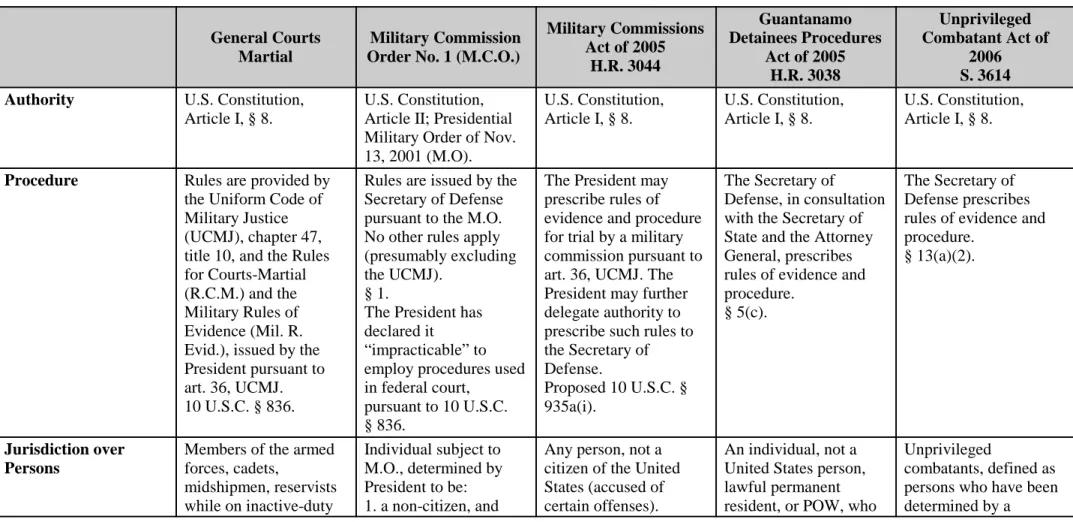
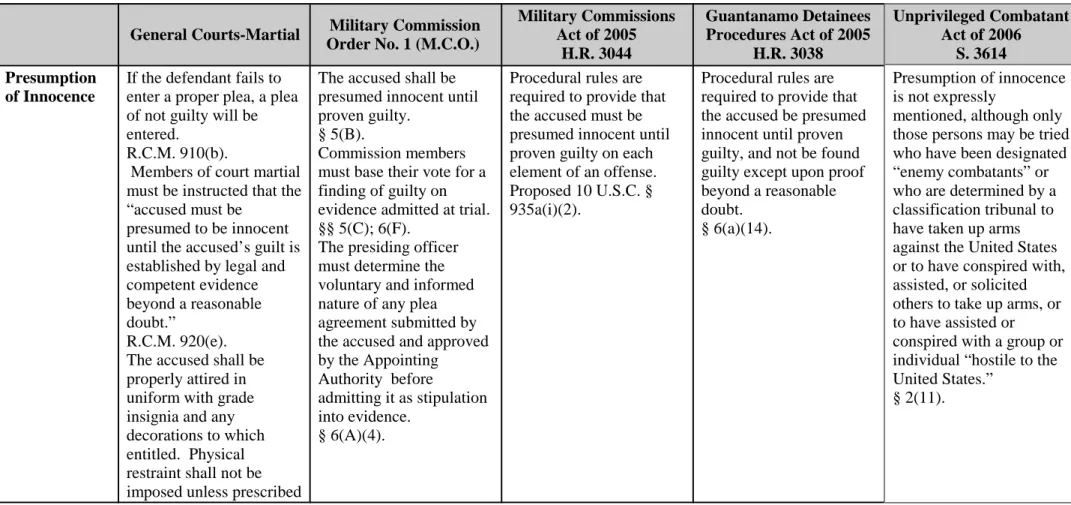
This report provides a background and analysis comparing military commissions as envisioned under M.C.O. No. 1 to general military courts-martial conducted under the UCMJ. A summary of the Hamdan case follows, in particular the shortcomings identified by the Supreme Court. The report provides an overview of relevant legislation (H.R. 3044, H.R. 3038, and S. 3614). Finally, the report provides two charts to compare the regulations issued by the Department of Defense to standard procedures for general courts-martial under the Manual for Courts-Martial and to proposed legislation. The second chart, which compares procedural safeguards incorporated in the regulations with established procedures in courts-martial, follows the same order and format used in CRS Report RL31262, Selected Procedural
Safeguards in Federal, Military, and International Courts, in order to facilitate
comparison with safeguards provided in federal court and international criminal tribunals.
Introduction . . . 1
Military Commissions: General Background . . . 2
Military Commissions at Guantánamo Bay . . . 2
Hamdan v. Rumsfeld . . . 5
Department of Defense Rules for Military Commissions . . . 10
Jurisdiction . . . 11
Composition and Powers . . . 18
Procedures Accorded the Accused . . . 19
Sentencing . . . 27
Post-Trial Procedure . . . 28
Role of Congress . . . 31
List of Tables
Table 1. Comparison of Courts-Martial and Military Commission Rules . . . 341 Rasul v. Bush, 124 S. Ct. 2686 (2004). For a summary of Rasul and related cases, see CRS
Report RS21884, The Supreme Court and Detainees in the War on Terrorism: Summary and
Analysis of Recent Decisions; CRS Report RS22466, Hamdan v. Rumsfeld: Military Commissions in the ‘Global War on Terrorism,’ by Jennifer K. Elsea.
2 Detention, Treatment, and Trial of Certain Non-Citizens in the War Against Terrorism
§1(a), 66 Fed. Reg. 57,833 (Nov. 16, 2001) (hereinafter “M.O.”).
3 P.L. 109-148, §1005(e)(1) amends 28 U.S.C. § 2441 to provide that “no court … shall have
jurisdiction to hear or consider … an application for … habeas corpus filed by … an alien detained … at Guantanamo Bay.” However, it creates new, albeit limited, jurisdiction in the D.C. Cir. to hear challenges of “any final decision of a Combatant Status Review Tribunal that an alien is properly detained as an enemy combatant” as well as reviews of “final decisions of military commissions,” which are discretionary unless the sentence is greater than ten years or involves the death penalty. DTA § 1005(e)(2-3).
4 Hamdan v. Rumsfeld, 548 U.S. __ (2006), rev’g 415 F.3d 33 (D.C. Cir. 2005). The Court
found that the DTA does not apply to Hamdan’s petition, which was an appeal of an interlocutory ruling rather than the final decision of a military commission, but did not resolve whether it affects other pending cases that fall under the DTA’s provisions regarding final review of Combatant Status Review Tribunals. Slip op. at 19, and n.14.
Military Commissions: Analysis of
Procedural Rules and Comparison with
Proposed Legislation and the Uniform Code
of Military Justice
Introduction
Rasul v. Bush, issued by the U.S. Supreme Court at the end of its 2003 - 2004
term, clarified that U.S. courts do have jurisdiction to hear petitions for habeas corpus on behalf of the approximately 550 persons detained at the U.S. Naval Station in Guantanamo Bay, Cuba, in connection with the war against terrorism,1 establishing a role for federal courts to play in determining the validity of the military commissions convened pursuant to President Bush’s Military Order (M.O.) of November 13, 2001.2 After dozens of petitions for habeas corpus were filed in the
federal District Court for the District of Columbia, Congress passed the Detainee Treatment Act of 2005 (DTA),3 revoking federal court jurisdiction over habeas
claims, at least with respect to those not already pending, and created jurisdiction in the Court of Appeals for the District of Columbia Circuit to hear appeals of final decisions of military commissions. The Supreme Court overturned a decision by the D.C. Circuit that had upheld the military commissions, Hamdan v. Rumsfeld,4
5 10 U.S.C. § 801 et seq.
6 See CRS Report RL31191, Terrorism and the Law of War: Trying Terrorists as War
Criminals before Military Commissions (providing a general background of U.S. history of
military commissions), by Jennifer Elsea.
7 See 10 U.S.C. § 818; 18 U.S.C. §2441.
8 See U.S. Army Field Manual (FM) 27-10, The Law of Land Warfare, section 505(e)
[hereinafter “FM 27-10”].
9 See W
ILLIAM WINTHROP,MILITARY LAW AND PRECEDENTS 841-42 (2d ed. 1920)(noting
that “in the absence of any statute or regulation,” the same principles and procedures commonly govern, though possibly more “liberally construed and applied”); David Glazier, Note, Kangaroo Court or Competent Tribunal?: Judging the 21st Century Military
commissions, such commissions must follow procedural rules as similar as possible to courts-martial proceedings, in compliance with the Uniform Code of Military Justice (UCMJ).5
Military Commissions: General Background. Military commissions are courts usually set up by military commanders in the field to try persons accused of certain offenses during war.6 They are distinct from military courts-martial, which
are panels set up to try U.S. service members (and during declared wars, civilians accompanying the armed forces) under procedures prescribed by Congress in the UCMJ. U.S. service members charged with a war crime are normally tried before courts-martial but may also be tried by military commission or in federal court, depending on the nature of the crime charged.7 All three options are also available
to try certain other persons for war crimes. Federal and state criminal statutes and courts are available to prosecute specific criminal acts related to terrorism that may or may not be triable by military commission.
Military commissions trying enemy belligerents for war crimes directly apply the international law of war, without recourse to domestic criminal statutes, unless such statutes are declaratory of international law.8 Historically, military commissions
have applied the same set of procedural rules that applied in courts-martial.9 Military Commissions at Guantánamo Bay. The President’s Military Order establishing military commissions to try suspected terrorists has been the focus of intense debate both at home and abroad. Critics argued that the tribunals could violate any rights the accused may have under the Constitution as well as their rights under international law, thereby undercutting the legitimacy of any verdicts rendered by the tribunals. The Administration initially responded that the M.O. provided only the minimum requirements for a full and fair trial, and that the Secretary of Defense intended to establish rules prescribing detailed procedural safeguards for tribunals established pursuant to the M.O. The procedural rules released in March 2002 were praised as a significant improvement over what might have been permitted under the language of the M.O., but some continued to argue that the enhancements do not go far enough and that the checks and balances of a separate rule-making authority and
10 See Letter from Timothy H. Edgar, ACLU Legislative Counsel, Military Commission
Order No. 1, March 21, 2002 (April 16, 2002), available at [http://www.aclu.org/National
Security/NationalSecurity.cfm?ID=10150&c=111] (last visited July 21, 2006); American College of Trial Lawyers, Report on Military Commissions for the Trial of Terrorists, March 2003 [hereinafter “ACTL”], available at [http://www.actl.com/AM/Template.cfm ?Section=All_Publications&Template=/CM/ContentDisplay.cfm&ContentFileID=63] (last visited July 21, 2006); ACTL, Supplemental Report on Military Commissions for the Trial of Terrorists, Oct. 2005, online at [http://www.actl.com/AM/Template.cfm?Section=Home &template=/CM/ContentDisplay.cfm&ContentID=2152] (last visited July 21, 2006).
11 The president of the National Association of Criminal Defense Lawyers (NACDL)
announced that NACDL “cannot advise its members to act as civilian counsel” because it deems the rules too restrictive to allow for zealous and professional representation on their part. See Lawrence Goldman, Guantanamo: Little Hope for Zealous Advocacy, NACDL CHAMPION, July 2003, at 4, available at [http://www.nacdl.org/public.nsf/Champion Articles/A0307p04?OpenDocument] (last visited July 21, 2006).
12 The Administration has not explicitly used this authority; instead, it says the prisoners are
being held as “enemy combatants” pursuant to the law of war.
13 See Bruce Zagaris, U.S. Defense Department Issues Order on Military Commissions, 18
No. 5 INT’L ENFORCEMENT L.REP 215 (2002) (citing comments by DoD chief counsel William J. Haynes II to a New York Times reporter).
14 See Neil A. Lewis, Two Prosecutors Faulted Trials For Detainees, N
EW YORK TIMES, August 1, 2005, at A1.
15 Department of Defense (“DoD”) documents related to military commissions are available
online at [http://www.defenselink.mil/news/commissions.html] (last visited July 24, 2006).
16 Reprinted at 41 I.L.M. 725 (2002). The most recent version was issued Aug. 31, 2005.
an independent appellate process are necessary.10 The release of the Military
Commission Instructions sparked renewed debate, especially concerning the restrictions on civilian attorneys,11 resulting in further modifications to the rules.
Critics noted that the rules do not address the issue of indefinite detention without charge, as appears to be possible under the original M.O.,12 or that the Department
of Defense may continue to detain persons who have been cleared by a military commission.13 The Pentagon has stated that its Inspector General (IG) looked into
allegations, made by military lawyers assigned as prosecutors to the military commissions, that the proceedings are rigged to obtain convictions, but the IG did not substantiate the charges.14
The Department of Defense (DoD) in 2003 released eight “Military Commission Instructions” (“M.C.I. No. 1-8”)15 to elaborate on the set of procedural rules to govern
military tribunals. Those rules are set forth in Military Commission Order No. 1 (“M.C.O. No. 1”), issued in March 2002 and amended several times since.16 The
instructions set forth the elements of some crimes that may be tried by military commission, establish guidelines for civilian attorneys, and provide other administrative guidance and procedures for military commissions. Additionally, Major General John D. Altenburg, Jr. (retired), the Appointing Authority for the commissions, issued several Appointing Authority Regulations, governing disclosure of communications, interlocutory motions, and professional responsibility.
17 See Press Release, Department of Defense, Secretary Rumsfeld Approves Changes to
Improve Military Commission Procedures (Aug. 31, 2005), available at [http://www.defenselink.mil/releases/2005/nr20050831-4608.html] (last visited July 21, 2006).
18 See Press Release, Department of Defense, President Determines Enemy Combatants
Subject to His Military Order (July 3, 2003), available at [http://www.defenselink.mil/ releases/2003/nr20030703-0173.html] (last visited July 21, 2006). According to the Defense Department, that determination is effectively “a grant of [military] jurisdiction over the person.” See John Mintz, 6 Could Be Facing Military Tribunals, WASH.POST, July 4, 2003, at A1. In 2004, nine additional detainees were determined to be eligible. See Press Release, Department of Defense, Presidential Military Order Applied to Nine more Combatants (July 7, 2004), available at [http://www.defenselink.mil/releases/2004/nr20040707-0987.html] (last visited July 21, 2006). In November 2005, five more detainees were charged. See Press Release, Department of Defense, Military Commission Charges Approved (November 7, 2005), available at [http://www.defenselink.mil/releases/2005/nr20051107-5078.html] (last visited July 21, 2006).
19 See John Mintz and Glenn Frankel, 2 Britons, Australian Among Six Facing Trial, W ASH. POST, July 5, 2003, at A13.
20 See Press Releases, Department of Defense, Statement on British Detainee Meetings and
Statement on Australian Detainee Meetings (July 23, 2003), available at [http://www.defenselink.mil/news/Aug2004/ commissions_releases.html] (last visited July 21, 2006).
21 See Press Release, Department of Defense, U.S. and Australia Announce Agreements on
Guantanamo Detainees (Nov. 25, 2003), available at [http://www.defenselink.mil/releases/ 2003/nr20031125-0702.html] (last visited July 21, 2006).
22
In August 2005, DoD amended M.C.O. No. 1 to make the presiding officer function more like a judge and to have other panel members function more like a jury. Under the new rules, the presiding officer was assigned the responsibility of determining most questions of law while the other panel members were to make factual findings and decide any sentence, similar to courts-martial proceedings. Other provisions were modified to clarify the accused’s privilege to be present except when necessary to protect classified information and only in instances where the presiding officer concludes that the admission of such evidence would not prejudice a fair trial and to require that the presiding officer exclude any evidence that would result in the denial of a full and fair trial from lack of access to the information.17
President Bush determined that twenty of the detainees at the U.S. Naval Station in Guantánamo Bay are subject to the M.O. and may consequently be charged and tried before military commissions.18 Six detainees declared eligible in 2003 included
two citizens of the U.K. and one Australian citizen.19 After holding discussions with
the British and Australian governments regarding the trial of their citizens, the Administration agreed that none of those three detainees will be subject to the death penalty.20 The Administration agreed to modify some of the rules with respect to
trials of Australian detainees21 and agreed to return the U.K. citizens, including the
two who had been declared eligible for trial by military commission, to Great Britain.22 The Administration agreed to return one Australian citizen, but another,
23 See Press Release, Department of Defense, Guantanamo Detainee Charged (June 10,
2004), available at [http://www.defenselink.mil/releases/2004/nr20040610-0893.html] (last visited July 21, 2006). Justice Stevens found for a plurality in the Hamdan case that “conspiracy” is not an “offense triable by military commission” within the meaning of the UCMJ.
24 Press Release, Department of Defense, Two Guantanamo Detainees Charged (Feb. 24,
2004), available at [http://www.defenselink.mil/releases/2004/nr20040224-0363.html] (last visited July 21, 2006). The two defendants are charged with “willfully and knowingly joining an enterprise of persons who shared a common criminal purpose and conspired with Osama bin Laden and others to commit the following offenses: attacking civilians; attacking civilian objects; murder by an unprivileged belligerent; destruction of property by an unprivileged belligerent; and terrorism.” One of the detainees filed for a writ of prohibition and writ of mandamus with the U.S. Court of Appeals for the Armed Forces (CAAF) in an effort to halt the military commission proceedings, but the CAAF dismissed the petition without prejudice in January, 2005. Al Qosi v. Altenburg, 60 M.J. 461(2005).
25 Press Release, Department of Defense, Additional Military Commission Charges Referred
(July 14, 2004), available at [http://www.defenselink.mil/releases/2004/nr20040714-1030.html] (last visited July 21, 2006).
26 344 F.Supp.2d 152 (D. D.C. 2004), rev’d 415 F.3d 33 (D.C. Cir. 2005), cert. granted 2005
U.S. LEXIS 8222 (Nov. 7, 2005).
27 10 U.S.C. §§ 801 et seq.
28 There are four Conventions, the most relevant of which is The Geneva Convention
Relative to the Treatment of Prisoners of War, August 12, 1949, 6 U.S.T. 3317 (hereinafter “GPW”).
murder by an unprivileged belligerent and aiding the enemy.23 One citizen from
Yemen and one from the Sudan were formally charged with conspiracy to commit certain violations of the law of war (and other crimes triable by military commission).24 Salim Ahmed Hamdan of Yemen, accused of providing physical security for Osama bin Laden and other high ranking Al Qaeda members and charged with conspiracy to attack civilians, commit murder by an unprivileged belligerent and terrorism,25 provided the Supreme Court its first opportunity to address the validity
of the military commissions.
Hamdan v. Rumsfeld
Salim Ahmed Hamdan, who was captured in Afghanistan and is alleged to have worked for Osama Bin Laden as a body guard and driver, brought this challenge to the lawfulness of the Secretary of Defense’s plan to try him for alleged war crimes before a military commission,26 arguing that the military commission rules and
procedures were inconsistent with the UCMJ27 and that he had the right to be treated
as a prisoner of war under the Geneva Conventions.28 U.S. District Judge Robertson
agreed, finding no inherent authority in the President as Commander-in-Chief of the Armed Forces to create such tribunals outside of the existing statutory authority, with which the military commission rules did not comply. He also concluded that the Geneva Conventions apply to the whole of the conflict in Afghanistan, including
29 344 F.Supp.2d at 161. 30 GPW art. 102.
31 344 F.Supp.2d at 158-59.
32 10 U.S.C. § 836 (procedures for military commissions may not be “contrary to or
inconsistent with” the UCMJ).
33 344 F.Supp.2d at 166.
34 See Brief for Appellants, Hamdan v. Rumsfeld, No. 04-5393 (D.C. Cir.). 35 Rumsfeld v. Hamdan, 415 F.3d 33, 39-40 (D.C. Cir. July 15, 2005). 36
under their protections all persons detained in connection with the hostilities there,29
and that Hamdan was thus entitled to be treated as a prisoner of war until his status was determined to be otherwise by a competent tribunal, in accordance with article 5 of the Third Geneva Convention (prisoners of war).
Interpreting the UCMJ in light of the Geneva Conventions, which permits the punishment of prisoners of war “only if the sentence has been pronounced by the same courts according to the same procedure as in the case of members of the armed forces of the Detaining Power,”30 Judge Robertson found no congressional authority
for Hamdan’s trial under the DoD’s rules for military commissions. Hamdan, he ruled, was not “an offender triable by military tribunal under the law of war” within the meaning of UCMJ art 21.31 Further, he found the rules established by DoD to be fatally inconsistent with the UCMJ, contrary to UCMJ art. 3632 because they give
military authorities the power to exclude the accused from hearings and deny him access to evidence presented against him.33
The government appealed, arguing that the district court should not have interfered in the military commission prior to its completion, that Hamdan is not entitled to protection from the Geneva Conventions, and that the President has inherent authority to establish military commissions, which need not conform to statutes regulating military courts-martial.34 The D.C. Circuit Court of Appeals
rejected the government’s argument that the federal courts had no jurisdiction to interfere in ongoing commission proceedings, but otherwise agreed with the government. Writing for a unanimous court, Judge Randolph reversed the lower court’s finding, ruling that the Geneva Conventions are not judicially enforceable,35
that even if they were, Hamdan is not entitled to their protections, and that in any event, the military commission would qualify as a “competent tribunal” where Hamdan may challenge his non-POW status, within the meaning of U.S. Army regulations implementing the Conventions.36
The appellate court did not accept the government’s argument that the President has inherent authority to create military commissions without any authorization from Congress, but found such authority in the Authorization to Use Military Force
37 Authorization for Use of Military Force (“the AUMF”), P.L. 107-40, 115 Stat. 224 (2001). 38 Hamdan, 415 F.3d at 37.
39 Johnson v. Eisentrager, 339 U.S. 763 (1950) (holding that the federal courts did not have
jurisdiction to hear a petition on behalf of German citizens who had been convicted by U.S. military commissions in China because the writ of habeas corpus was not available to “enemy alien[s], who at no relevant time and in no stage of [their] captivity [have] been within [the court’s] jurisdiction”). The Supreme Court, in Rasul v. Bush, declined to apply
Eisentrager to deny Guantánamo detainees the right to petition for habeas corpus. See Rasul at 2698 (finding authority for federal court jurisdiction in 28 U.S.C. § 2241, which
grants courts the authority to hear applications for habeas corpus “within their respective jurisdictions,” by any person who claims to be held “in custody in violation of the Constitution or laws or treaties of the United States”).
40 339 U.S. at 789 n.14.
(AUMF),37 read together with UCMJ arts. 21 and 36.38 The court interpreted art. 36
to mean that military commission rules have only to be consistent with those articles of the UCMJ that refer specifically to military commissions, and not that Congress meant to incorporate procedural rules for courts-martial into those applicable to military commissions. However, because the procedural rules to be used by the military commissions did not, in its view, affect jurisdiction, the court found it unnecessary to resolve the issue at the interlocutory stage of the case.
With respect to the Geneva Conventions, the D.C. Circuit cited to a footnote from the World War II Eisentrager39 opinion that expresses doubt that the Court
could grant relief based directly on the 1929 Geneva Convention:
We are not holding that these prisoners have no right which the military authorities are bound to respect. The United States, by the Geneva Convention of July 27, 1929, 47 Stat. 2021, concluded ... an agreement upon the treatment to be accorded captives. These prisoners claim to be and are entitled to its protection. It is, however, the obvious scheme of the Agreement that responsibility for observance and enforcement of these rights is upon political and military authorities. Rights of alien enemies are vindicated under it only through protests and intervention of protecting powers as the rights of our citizens against foreign governments are vindicated only by Presidential intervention.40
Judge Williams wrote a concurring opinion, agreeing with the government’s conception of the conflict with Al Qaeda as separate from the conflict with the Taliban but construing Common Article 3 to apply to any conflict with a non-state actor, without regard to the geographical confinement of such a conflict within the borders of a signatory state. Supreme Court nominee John G. Roberts concurred in the opinion without writing separately.
The Supreme Court granted review and reversed.
Before reaching the merits of the case, the Supreme Court dispensed with the government’s argument that Congress had, by passing the Detainee Treatment Act
41 P.L. 109-148, §1005(e)(1) provides that “no court … shall have jurisdiction to hear or
consider … an application for … habeas corpus filed by … an alien detained … at Guantanamo Bay.” The provision was not yet law when the appellate court decided against the petitioner, Hamdan v. Rumsfeld, 415 F.3d 33 (D.C. Cir. 2005), rev’d 548 U.S. __ (2006). At issue was whether this provision applies to pending cases. The Court found that the provision does not apply to Hamdan’s petition, but did not resolve whether it affects other cases that fall under the DTA’s provisions regarding final review of Combatant Status Review Tribunals. Slip op. at 19, and n.14.
42 Id. at 7. To resolve the question, the majority employed canons of statutory interpretation
supplemented by legislative history, avoiding the question of whether the withdrawal of the Court’s jurisdiction would constitute a suspension of the Writ of Habeas Corpus, or whether it would amount to impermissible “court-stripping.” Justice Scalia, joined by Justices Alito and Thomas in his dissent, interpreted the DTA as a revocation of jurisdiction.
43 10 U.S.C. § 821 (“The provisions of [the UCMJ] conferring jurisdiction upon
courts-martial do not deprive military commissions, provost courts, or other military tribunals of concurrent jurisdiction with respect to offenders or offenses that by statute or by the law of war may be tried by military commissions, provost courts, or other military tribunals.”). The Hamdan majority concluded that “compliance with the law of war is the condition upon which the authority set forth in Article 21 is granted.” Hamdan, slip op. at 63.
44 Hamdan, slip op. at 63-65.
45 GPW art. 3 § 1(d). The identical provision is included in each of the four Geneva
Conventions and applies to any “conflict not of an international character.” The majority declined to accept the President’s interpretation of Common Article 3 as inapplicable to the conflict with al Qaeda and interpreted the phrase “in contradistinction to a conflict between
of 2005 (DTA),41 stripped the Court of its jurisdiction to review habeas corpus
challenges by or on behalf of Guantanamo detainees whose petitions had already been filed.42 The government’s argument that the petitioner had no rights conferred
by the Geneva Conventions that could be adjudicated in federal court likewise did not persuade the Court to dismiss the case. Regardless of whether the Geneva Conventions provide rights that are enforceable in Article III courts, the Court found that Congress, by incorporating the “law of war” into UCMJ art. 21,43 brought the
Geneva Conventions within the scope of law to be applied by courts. The Court disagreed that the Eisentrager case requires another result, noting that the Court there had decided the treaty question on the merits based on its interpretation of the Geneva Convention of 1929 and that the 1949 Conventions were drafted to reject that interpretation.44 Justice Scalia, joined by Justices Thomas and Alito, dissented, arguing that the DTA should be interpreted to preclude the Court’s review.
In response to the holding by the court below that Hamdan, as a putative member of al Qaeda, was not entitled to any of the protections accorded by the Geneva Conventions, the Court concluded that at the very least, Common Article 3 of the Geneva Conventions applies, even to members of al Qaeda, according to them a minimum baseline of protections, including protection from the “passing of sentences and the carrying out of executions without previous judgment pronounced by a regularly constituted court, affording all the judicial guarantees which are recognized as indispensable by civilized peoples.”45 Although recognizing that
45 (...continued)
nations,” which the Geneva Conventions designate a “conflict of international character.”
Hamdan, slip op. at 67.
46 Id. at 70 (plurality opinion); Id. (Kennedy, J., concurring) at 10. Justice Stevens, joined
by Justices Ginsburg, Breyer, and Souter, further based their conclusion on the basis that M.C.O. No. 1 did not meet all criteria of art. 75 of Protocol I to the Geneva Conventions of 1949, adopted in 1977 (Protocol I). While the United States is not party to Protocol I, the plurality noted that many authorities regard it as customary international law.
47 Hamdan, slip op. at 27 (citing Congress’s powers to “declare War ... and make Rules
concerning Captures on Land and Water,” Art. I, §8, cl. 11, to “raise and support Armies,” id., cl. 12, to “define and punish ... Offences against the Law of Nations,” id., cl. 10, and “To make Rules for the Government and Regulation of the land and naval Forces,” id., cl. 14.).
48 P.L. 107-40, 115 Stat. 224 (2001). 49 Hamdan, slip op. at 30.
Common Article 3 “obviously tolerates a great degree of flexibility in trying individuals captured during armed conflict” and that “its requirements are general ones, crafted to accommodate a wide variety of legal systems,” the Court found that the military commissions under M.C.O. No. 1 do not meet these criteria. In particular, the military commissions are not “regularly constituted” because they deviate too far, in the Court’s view, from the rules that apply to courts-martial, without a satisfactory explanation of the need for such deviation.46
With respect to the authority to create the military commissions, the Court held that any power to create them must flow from the Constitution and must be among those “powers granted jointly to the President and Congress in time of war.”47 It
disagreed with the government’s position that Congress had authorized the commissions either when it passed the Authorization to Use Military Force (AUMF)48 or the DTA. Although the Court assumed that the AUMF activated the
President’s war powers, it did not view the AUMF as expanding the President’s powers beyond the authorization set forth in the UCMJ. The Court also noted that the DTA, while recognizing the existence of military commissions, does not specifically authorize them. At most, these statutes “acknowledge a general Presidential authority to convene military commissions in circumstances where justified under the ‘Constitution and laws,’ including the law of war.”49
In addition to limiting military commissions to trials of offenders and offenses that are by statute or by the law of war consigned to such tribunals, the UCMJ provides limitations with respect to the procedural rules that may be employed. Article 36 (10 U.S.C. § 836) authorizes the President to prescribe rules for “pretrial, trial, and post-trial procedures, including modes of proof, for cases arising under this chapter triable in courts-martial, military commissions and other military tribunals.” Such rules are to “apply the principles of law and the rules of evidence generally recognized in the trial of criminal cases in the United States district courts” insofar as the President “considers practicable” but that “may not be contrary to or inconsistent” with the UCMJ. In addition, rules made pursuant to this authority “shall be uniform insofar as practicable.” The President had determined with respect to the military commissions that “it is impracticable to apply the rules and principles
50 The government took the position that the “contrary to or consistent with” language
applies only with respect to parts of the UCMJ that make specific reference to military commissions.
51 The term “military tribunal” in the UCMJ should be interpreted to cover all forms of
military courts, encompassing courts-martial as well as military commissions.
52 Hamdan, slip op. at 59.
53 Id at 61. Regarding the defendant’s right to be present during trial, the Court stated,
“[w]hether or not that departure technically is ‘contrary to or inconsistent with’ the terms of the UCMJ, 10 U. S. C. §836(a), the jettisoning of so basic a right cannot lightly be
of law that govern ‘the trial of criminal cases in the United States district courts’” but made no determination with respect to the practicability of applying rules different from those that apply in courts-martial.50
The Court interpreted article 36 to provide the President discretion to determine which federal court rules need not be applied by various military tribunals51 due to
their impracticability. However, the Court read the uniformity requirement as according less discretion to the President to determine what is practicable when providing different rules for courts-martial, military commissions, and other military tribunals.52 Unlike the requirement for rules to track closely with federal court rules,
which the President need follow only insofar as he deems practicable, the Court reasoned, the uniformity requirement applies unless its application is demonstrably impracticable. Thus, less deference was found owing, and the Court found that the government had failed to demonstrate that circumstances make any courts-martial rules impracticable for use in military commissions. Further, the Court found that some of the rules provided in the Defense Department rules set forth in Military Commission Order No. 1 (“M.C.O. No. 1”), in particular the provision allowing the exclusion of the defendant from attending portions of his trial or hearing some of the evidence against him, deviated substantially from the procedures that apply in courts-martial in violation of UCMJ article 36.53
Department of Defense Rules for Military Commissions
M.C.O. No. 1 sets forth procedural rules for the establishment and operation of military commissions convened pursuant to the November 13, 2001, M.O. It addresses the jurisdiction and structure of the commissions, prescribes trial procedures, including standards for admissibility of evidence and procedural safeguards for the accused, and establishes a review process. The Hamdan Court found the rules insufficient to meet UCMJ standards and noted that the review process was not sufficiently independent of the armed services to warrant the Court’s abstention until the petitioner’s case was finally decided. M.C.O. No. 1 also contains various mechanisms for safeguarding sensitive government information, which the Court found problematic in that they could have permitted evidence to be withheld from the accused but nevertheless considered by the military commission. The
Hamdan Court left open the possibility that the rules established by M.C.O. No. 1
54 M.C.I. No. 1 at § 4.C.
55 M.C.I. No. 1 lists 10 U.S.C. § 898 as a reference. That law, Article 98, UCMJ,
Noncompliance with procedural rules, provides: Any person subject to this chapter who -
(1) is responsible for unnecessary delay in the disposition of any case of a person accused of an offense under this chapter; or
(2) knowingly and intentionally fails to enforce or comply with any provision of this chapter regulating the proceedings before, during, or after trial of an accused;
shall be punished as a court-martial may direct
56 P.L. 107-40, 115 Stat. 224 (2001) (authorizing military force against those who “planned,
authorized, committed, [or] aided” the Sept. 11 attacks or who “harbored such ... persons”).
57 M.O. § 1(e) (finding such tribunals necessary to protect the United States and for effective
conduct of military operations).
Other orders and instructions may also call for specific congressional approval to remain valid. M.C.O. No. 3, “Special Administrative Measures for Certain Communications Subject to Monitoring,” establishes procedures for authorizing and controlling the monitoring of communications between detainees and their defense counsel for security or intelligence-gathering purposes. M.C.O. No. 2 and 4 designate appointing officials.
M.C.I. No. 1 provides guidance for interpretation of the instructions as well as for issuing new instructions. It states that the eight M.C.I. apply to all DoD personnel as well as prosecuting attorneys assigned by the Justice Department and all civilian attorneys who have been qualified as members of the pool. Failure on the part of any of these participants to comply with any instructions or other regulations “may be subject to the appropriate action by the Appointing Authority, the General Counsel of the Department of Defense, or the Presiding Officer of a military commission.”54
“Appropriate action” is not further defined, nor is any statutory authority cited for the power.55 M.C.I. No. 1 also reiterates that none of the instructions is to be construed as creating any enforceable right or privilege.
Jurisdiction. The President’s M.O. has been criticized as overly broad in its assertion of jurisdiction, because it could be interpreted to cover non-citizens who have no connection with Al Qaeda or the terrorist attacks of September 11, 2001. It has been argued that the constitutional and statutory authority of the President to establish military tribunals does not extend any further than Congress’ authorization to use armed force in response to the attacks.56 Under a literal interpretation of the
M.O., however, the President may designate as subject to the order any non-citizen he believes has ever engaged in any activity related to international terrorism, no matter when or where these acts took place. A person subject to the M.O. may be detained and possibly tried by military tribunal for violations of the law of war and “other applicable law.”57
M.C.O. No. 1 does not explicitly limit its coverage to the scope of the authorization of force, but it clarifies somewhat the ambiguity with respect to the offenses covered. M.C.O. No. 1 establishes that commissions may be convened to try aliens who are designated by the President as subject to the M.O., whether
58 10 U.S.C. § 821.
59 10 U.S.C. §§ 904 and 906, respectively. The circumstances under which civilians accused
of aiding the enemy may be tried by military tribunal have not been decided, but a court interpreting the article may limit its application to conduct committed in territory under martial law or military government, within a zone of military operations or area of invasion, or within areas subject to military jurisdiction. See FM 27-10, supra note 8, at para. 79(b)(noting that treason and espionage laws are available for incidents occurring outside of these areas, but are triable in civil courts). Spying is not technically a violation of the law of war, however, but violates domestic law and traditionally may be tried by military commission. See id. at para. 77 (explaining that spies are not punished as “violators of the law of war, but to render that method of obtaining information as dangerous, difficult, and ineffective as possible”).
60 See, e.g., United States v. Schultz, 4 C.M.R. 104, 114 (1952)(listing as crimes punishable
under the law of war, in occupied territory as murder, manslaughter, robbery, rape, larceny, arson, maiming, assaults, burglary, and forgery).
61 See W
INTHROP, supra note 9, at 836. See NATIONAL INSTITUTE OF MILITARY JUSTICE,
ANNOTATED GUIDE:PROCEDURES FOR TRIALS BU MILITARY COMMISSIONS OF CERTAIN
NON-UNITED STATES CITIZENS IN THE WAR AGAINST TERRORISM 10-11 (hereinafter
“NIMJ”)(noting that civilians in occupied Germany after World War II were sometimes tried by military commission for ordinary crimes unrelated to the laws of war). Military trials of civilians for crimes unrelated to the law of war on U.S. territory under martial law are permissible only when the courts are not functioning. See Duncan v. Kahanamoku, 327 U.S. 304 (1945).
62 See id. (citing Ex parte Milligan, 71 U.S. (4 Wall.) 2 (1866)). Winthrop notes that the
captured overseas or on U.S. territory, for violations of the law of war and “all other offenses triable by military commissions.” Although this language is somewhat narrower than “other applicable law,” it remains vague. However, the statutory language recognizing the jurisdiction of military commissions is similarly vague, such that the M.C.O. does not appear on its face to exceed the statute with respect to jurisdiction over offenses. Justice Stevens, joined in that portion of the Hamdan opinion by only three other Justices, undertook an inquiry of military commission precedents to determine that “conspiracy” is not a valid charge. M.C.O. No. 1 does not resolve the issue of whether the President may, consistent with the Constitution, direct that criminal statutes defined by Congress to be dealt with in federal court be redefined as “war crimes” to be tried by the military, but the Hamdan decision may be interpreted to counsel against such an interpretation.
By statute, military tribunals may be used to try “offenders or offenses designated by statute or the law of war.”58 There are only two statutory offenses for
which convening a military commission is explicitly recognized: aiding the enemy and spying (in time of war).59 It appears that “offenses designated by the law of war”
are not necessarily synonymous with “offenses against the law of war.” Military tribunals may also be used to try civilians in occupied territory for ordinary crimes.60
During a war, they may also be used to try civilians for committing belligerent acts, even those for which lawful belligerents would be entitled to immunity under the law of war, but only where martial law or military government may legally be exercised or on the battlefield,61 where civilian courts are closed.62 Such acts are not necessarily
62 (...continued)
limitations as to place, time, and subjects were not always strictly followed, mentioning a Civil War case in which seven persons who had conspired to seize a U.S. merchant vessel at Panama were captured and transported to San Francisco for trial by military commission.
Id. at 837 (citing the pre-Milligan case of T.E. Hogg).
63 Hamdan, slip op. at 33-34.
64 See Leila Nadya Sadat, Terrorism and the Rule of Law, 3 W
ASH.U.GLOBAL STUD.L. REV. 135 (2004)(arguing that no armed conflict exists with respect to terrorists, making the law of war inapplicable to them).
65 The Geneva Convention Relative to the Treatment of Prisoners of War [hereinafter
“GPW”] art. 102 states:
A prisoner of war can be validly sentenced only if the sentence has been pronounced by the same courts according to the same procedure as in the case of members of the armed forces of the Detaining Power, and if, furthermore, the provisions of the present Chapter have been observed.
6 U.S.T. 3317. The Supreme Court finding to the contrary in In re Yamashita, 327 U.S. 1 (1946), is likely superceded by the 1949 Geneva Convention. For more information about the treatment of prisoners of war, see CRS Report RL31367, Treatment of “Battlefield
Detainees” in the War on Terrorism.
66 GPW art. 3 § 1(d). The identical provision is included in each of the four Geneva
Conventions and applies to any “conflict not of an international character.” The Hamdan majority declined to accept the President’s interpretation of Common Article 3 as inapplicable to the conflict with al Qaeda and interpreted the phrase “in contradistinction to a conflict between nations,” which the Geneva Conventions designate a “conflict of international character”. Hamdan, slip op. at 67. The Court did not expressly decide whether the Global War on Terror (GWOT) is international or non-international for the (continued...)
offenses against the law of war (that is, they do not amount to an international war crime), but are merely unprivileged under it, although courts and commentators have tended to use the terms interchangeably. Justice Stevens opined for the plurality that military commissions in the present circumstances have jurisdiction only for belligerent offenses and that martial law and military occupation courts will not serve as precedent for jurisdiction purposes.63
Some argue that civilians, including unprivileged combatants unaffiliated with a state (or other entity with “international personality” necessary for hostilities to amount to an “armed conflict”), are not directly subject to the international law of war and thus may not be prosecuted for violating it.64 They may, however, be
prosecuted for most belligerent acts under ordinary domestic law, irrespective of whether such an act would violate the international law of war if committed by a soldier. Under international law, those offenders who are entitled to prisoner of war (POW) status under the Third Geneva Convention [“GPW”] are entitled to be tried by court-martial and may not be tried by a military commission offering fewer safeguards than a general court-martial, even if those prisoners are charged with war crimes.65 In the case of a non-international conflict, Common Article 3 of the
Geneva Conventions protects even non-POWs from the “passing of sentences and the carrying out of executions without previous judgment pronounced by a regularly constituted court, affording all the judicial guarantees which are recognized as indispensable by civilized peoples.”66
66 (...continued)
purposes of the Geneva Convention, but merely that it is one or the other.
67 See N
ATIONAL INSTITUTE OF MILITARY JUSTICE,MILITARY COMMISSION INSTRUCTIONS
SOURCEBOOK 95 (2003) [hereinafter “SOURCEBOOK”]. DoD has not made public an exact account of who provided comments to the instruction, but some of them are published in the Sourcebook.
68 See M.C.I. No. 2 § 3(A) (“No offense is cognizable in a trial by military commission if
that offense did not exist prior to the conduct in question.”).
69 Crimes against the law of war listed in M.C.I. No. 2 are: 1) Willful Killing of Protected
Persons; 2) Attacking Civilians; 3) Attacking Civilian Objects; 4) Attacking Protected Property; 5) Pillaging; 6) Denying Quarter; 7) Taking Hostages; 8) Employing Poison or Analogous Weapons; 9) Using Protected Persons as Shields; 10) Using Protected Property as Shields; 11) Torture; 12) Causing Serious Injury; 13) Mutilation or Maiming; 14) Use of Treachery or Perfidy; 15) Improper Use of Flag of Truce; 16) Improper Use of Protective Emblems; 17) Degrading Treatment of a Dead Body; and 18) Rape.
70 Crimes “triable by military commissions” include 1) Hijacking or Hazarding a Vessel or
Aircraft; 2) Terrorism; 3) Murder by an Unprivileged Belligerent; 4) Destruction of Property by an Unprivileged Belligerent; 5) Aiding the Enemy; 6) Spying; 7) Perjury or False Testimony; and 8) Obstruction of Justice Related to Military Commissions. Listed as “other forms of liability and related offenses” are: 1) Aiding or Abetting. 2) Solicitation; 3) Command/Superior Responsibility Perpetrating; 4) Command/Superior Responsibility -Misprision; 5) Accessory After the Fact; 6) Conspiracy; and 7) Attempt.
71 Ordinarily, the charge of “aiding the enemy” would require the accused have allegiance
to the party whose enemy he has aided. DoD added a comment to this charge explaining that the wrongfulness requirement may necessitate that “in the case of a lawful belligerent, the accused owe allegiance or some duty to the United States or an ally or coalition partner...” such as “citizenship, resident alien status, or a contractual relationship with [any of these countries].” M.C.I. No.2 §6(A)(5)(b)(3). It is unclear what is meant by limiting the requirement to “a lawful belligerent.” It could be read to make those persons considered the “enemy” also subject to trial for “aiding the enemy,”as is the case with Australian detainee
Subject-Matter Jurisdiction. M.C.I. No. 2, Crimes and Elements for Trials by Military Commission, details some of the crimes that might be subject to the jurisdiction of the commissions. Unlike the rest of the M.C.I. issued so far, this instruction was published in draft form by DoD for outside comment. The final version appears to have incorporated some of the revisions, though not all, suggested by those who offered comments.67 The revision clarifies that the burden of proof is
on the prosecution, precludes liability for ex post facto crimes,68 adds two new war crimes, and clearly delineates between war crimes and “other offenses triable by military commission.”
M.C.I. No. 2 clarifies that the crimes and elements derive from the law of war, but does not provide any references to international treaties or other sources that comprise the law of war. The instruction does not purport to be an exhaustive list; it is intended as an illustration of acts punishable under the law of war69 or triable by
military commissions.70 “Aiding the enemy” and “spying” are included under the latter group, but are not defined with reference to the statutory authority in UCMJ articles 104 and 106 (though the language is very similar).71 Terrorism is also
71 (...continued)
David Hicks. See United States v. Hicks, Charge Sheet, available online at [http://www.defenselink.mil/news/Jun2004/d20040610cs.pdf] (last visited July 21, 2006).
72 18 U.S.C. § 2331 et seq. defines and punishes terrorism, providing exclusive jurisdiction
to federal courts. See id. at 35 (letter from National Association of Criminal Defense Lawyers (NACDL) noting that Congress has defined war crimes in 18 U.S.C. § 2441 with reference to specific treaties).
73 327 U.S. at 17 (“Obviously charges of violations of the law of war triable before a military
tribunal need not be stated with the precision of a common law indictment.”).
74 M.C.I. No. 2 § 6(18). One of the elements of the crime of terrorism is that the “accused
did not enjoy combatant immunity or an object of the attack was not a military objective.” Another element required that “the killing or destruction was an attack or part of an attack designed to intimidate or coerce a civilian population, to influence the policy of a government by intimidation or coercion, or to affect the conduct of a government.” The final version of the M.C.I. omits the reference to “affect[ing] the conduct of a government.”
defined without reference to the statutory definition in title 18, U.S. Code.72
Although the Supreme Court long ago stated that charges of violations of the law of war tried before military commissions need not be as exact as those brought before regular courts,73 it appears that the current Court will look more favorably on prosecutions where charges are fully supported by precedent.
It appears that “offenses triable by military commissions” in both the M.O. and M.C.O. No. 1 could cover ordinary belligerent acts carried out by unlawful combatants, regardless of whether they are technically war crimes. The draft version of M.C.I. No. 2 made explicit that
Even an attack against a military objective that normally would be permitted under the law of armed conflict could serve as the basis for th[e] offense [of terrorism] if the attack itself constituted an unlawful belligerency (that is, if the attack was committed by an accused who did not enjoy combatant immunity).
Thus, under the earlier draft language, it appeared that a Taliban fighter who attacked a U.S. or coalition soldier, or perhaps even a soldier of the Northern Alliance prior to the arrival of U.S. forces, for example, could be charged with “terrorism” and tried by a military tribunal.74
However, the final version of M.C.I. No.2 substituted the following language:
The requirement that the conduct be wrongful for this crime necessitates that the conduct establishing the offense not constitute an attack against a lawful military objective undertaken by military forces of a State in the exercise of their official duties.
The change appears to have eliminated the possibility that Taliban fighters could be charged with “terrorism” in connection with combat activities; however, under the DoD rules, such a fighter could still be charged with murder or destruction of
75 M.C.I. No. 2 § 6(19).
76 Under M.C.I. No. 2, the lack of combatant immunity is considered an element of some of
the crimes rather than a defense, so the prosecutor has the burden of proving its absence.
77 Whether the prisoners at Guantánamo Bay should be considered lawful combatants with
combatant immunity is an issue of some international concern. See generally CRS Report RL31367, Treatment of ‘Battlefield Detainees’ in the War on Terrorism. DoD’s original draft included the requirement that a lawful combatant be part of the “armed forces of a legitimate party to an armed conflict.” The Lawyers’ Committee for Human Rights (now known as Human Rights First or “HRF”) and Human Rights Watch (“HRW”) urged DoD to revise the definition in line with the Geneva Convention. See SOURCEBOOK, supra note 67, at 50-51 and 59. The revised version leaves ambiguous who might be a “lawful combatant.”
78 M.C.I. No. 2 § 4(B). The American Civil Liberties Union (ACLU) objected to this
provision in its comments on the DoD draft, remarking that it “not only places the ordinary burden on the accused to going forward with evidence that establishes affirmative defense, but it also appears to place an unprecedented burden on the accused to overcome the presumption that the defenses do not apply.” See SOURCEBOOK, supra note 67, at 69.
79 See W
INTHROP, supra note 9, at 773 (the law of war “prescribes the rights and obligations of belligerents, or ... define[s] the status and relations not only of enemies — whether or not in arms — but also of persons under military government or martial law and persons simply resident or being upon the theatre of war, and which authorizes their trial and punishment when offenders”); id at 836 (military commissions have valid jurisdiction only in theater of war or territory under martial law or military government).
80 It may be argued that no war has a specific deadline and that all conflicts are in a sense
indefinite. In traditional armed conflicts, however, it has been relatively easy to identify when hostilities have ended; for example, upon the surrender or annihilation of one party, an annexation of territory under dispute, an armistice or peace treaty, or when one party to
property “by an unprivileged belligerent”75 for participating in combat, as long as the
commission finds that the accused “did not enjoy combatant immunity,” which, according the to the instruction, is enjoyed only by “lawful combatants.”76 “Lawful
combatant” is not further defined. Inasmuch as the President had declared that all of the detainees incarcerated at Guantánamo Bay, whether members of the Taliban or members of Al Qaeda, are unlawful combatants, it appears unlikely that the defense of combat immunity would be available.77 It is unclear whether other defenses, such
as self-defense or duress, would be available to the accused. M.C.I. No. 2 states that such defenses may be available, but that “[i]n the absence of evidence to the contrary, defenses in individual cases are presumed not to apply.”78
Temporal and Spatial Jurisdiction. The law of war has traditionally applied within the territorial and temporal boundaries of an armed conflict between at least two belligerents.79 It has not traditionally been applied to conduct occurring
on the territory of neutral states or on the territory of a belligerent that lies outside the zone of battle, to conduct that preceded the outbreak of hostilities, or to conduct during hostilities that do not amount to an armed conflict. With respect to the international conflict in Afghanistan, in which coalition forces ousted the Taliban government, it appears relatively clear when and where the law of war would apply. The war on terrorism, however, does not have clear boundaries in time or space,80 nor
80 (...continued)
the conflict unilaterally withdraws its forces. See GERHARD VON GLAHN, LAW AMONG
NATIONS 722-730 (6th ed. 1992).
81 See Human Rights First, Trial Under Military Order, A Guide to the Final Rules for
Military Commissions (revised May 2006)[hereinafter “HRF”], available at [http://www.humanrightsfirst.org/us_law/PDF/detainees/trials_under_order0604.pdf]] (last visited July 21, 2006); Sadat, supra note 64, at 146 (noting possibly advantageous domestic aspects of treating terrorist attacks as war crimes, but identifying possible pitfalls of creating a new international legal regime).
82 M.C.I. No. 2 § 5(C). 83 Id.
84 See S
OURCEBOOK, supra note 67, at 38-39 (NACDL comments); id. at 51 (Human Rights
Watch (HRW) comments); id. at 59-60 (LCHR). However, M.C.I. No. 9 lists among possible “material errors of law” for which the Reviewing Panel might return a finding for further procedures, “a conviction of a charge that fails to state an offense that by statute or the law of war may be tried by military commission. ...” M.C.I. No. 9 § 4(C)(2)(b).
is it entirely clear who the belligerents are. The broad reach of the M.O. to encompass conduct and persons customarily subject to ordinary criminal law evoked criticism that the claimed jurisdiction of the military commissions exceeds the customary law of armed conflict, which M.C.I. No. 2 purports to restate.81 Any military commissions established to comply with Hamdan will likely have a better chance of withstanding court scrutiny if they are supported by ample precedent or explicit statutory definition.
A common element among the crimes enumerated in M.C.I. No.2 is that the conduct “took place in the context of and was associated with armed conflict.” The instruction explains that the phrase requires a “nexus between the conduct and armed hostilities,”82 which has traditionally been a necessary element of any war crime. However, the definition of “armed hostilities” is broader than the customary definition of war or “armed conflict.” “Armed hostilities” need not be a declared war or “ongoing mutual hostilities.”83 Instead, any hostile act or attempted hostile
act might have sufficient nexus if its severity rises to the level of an “armed attack,” or if it is intended to contribute to such acts. Some commentators have argued that the expansion of “armed conflict” beyond its customary bounds improperly expands the jurisdiction of military commissions beyond those that by statute or under the law of war are triable by military commissions.84 The Supreme Court has not clarified the scope of the “Global War on Terrorism” but seems to have demonstrated a willingness to address the issue rather than deferring to the President’s interpretation. The definition for “Enemy” provided in M.C.I. No. 2 raises similar issues. According to § 5(B), “Enemy” includes
any entity with which the United States or allied forces may be engaged in armed conflicts or which is preparing to attack the United States. It is not limited to foreign nations, or foreign military organizations or members thereof. “Enemy” specifically includes any organization of terrorists with international reach.
85 Seeid. at 38 (NACDL comments).
86 See id. at 98 (commentary of Eugene R. Fidell and Michael F. Noone). 87 M.C.O. No. 1 § 4(A)(3).
88 See 10 U.S.C. § 603, listed as reference (e) of M.C.O. No. 1.
89 M.C.O. No. 1 § 4(A)(4). See NIMJ, supra note 61, at 17 (commenting that the lack of a
military judge to preside over the proceedings is a significant departure from the UCMJ). A judge advocate is a military officer of the Judge Advocate General’s Corps of the Army or Navy (a military lawyer). A military judge is a judge advocate who is certified as qualified by the JAG Corps of his or her service to serve in a role similar to civilian judges.
90 See M.C.O. No. 1 § 3(C) (asserting jurisdiction over participants in commission
proceedings “as necessary to preserve the integrity and order of the proceedings”).
91 See 10 U.S.C. § 848.
92 See 10 U.S.C. § 847. It is unclear how witnesses are “duly subpoenaed;” 10 U.S.C. § 846
empowers the president of the court-martial to compel witnesses to appear and testify and
Some observers argue that this impermissibly subjects suspected international criminals to the jurisdiction of military commissions in circumstances in which the law of armed conflict has never applied.85 The distinction between a “war crime,”
traditionally subject to the jurisdiction of military commissions, and a common crime, traditionally the province of criminal courts, may prove to be a matter of some contention during some of the proceedings.86
Composition and Powers. Under M.C.O. No. 1, the planned military commissions consist of a panel of three to seven military officers as well as one or more alternate members who had been “determined to be competent to perform the duties involved” by the Secretary of Defense or his designee,87 and could include
reserve personnel on active duty, National Guard personnel in active federal service, and retired personnel recalled to active duty. The rules also permit the appointment of persons temporarily commissioned by the President to serve as officers in the armed services during a national emergency.88 The presiding officer is required to
be a judge advocate in any of the U.S. armed forces, but not necessarily a military judge.89
The presiding officer is vested with the authority to decide evidentiary matters and interlocutory motions, or to refer them to the commission or certify them to Appointing Authority for decision. The presiding officer has the power to close any portion of the proceedings in accordance with M.C.O. No. 1, and “to act upon any contempt or breach of Commission rules and procedures,” including disciplining any individual who violates any “laws, rules, regulations, or other orders” applicable to the commission, as the presiding officer saw fit. Presumably this power was to include not only military and civilian attorneys but also any witnesses who had been summoned under order of the Secretary of Defense pursuant to M.C.O. No. 1 § 5(A)(5).90 The UCMJ authorizes military commissions to punish contempt with a
fine of $100, confinement for up to 30 days, or both.91 Under the UCMJ, a duly
subpoenaed witness who is not subject to the UCMJ and who refuses to appear before a military commission may be prosecuted in federal court.92 To the extent that
92 (...continued)
to compel production of evidence, but this statutory authority does not explicitly apply to military commissions. The subpoena power extends to “any part of the United States, or the Territories, Commonwealth and possessions.”
93 M.C.I. No. 6. 94 Id. § 3(A)(7).
95 Cf United States v. Wiesen, 56 M.J. 172 (2001), aff’d on reconsideration, 57 M.J. 48
(2002)(noting that command relationships among participants in court-martial proceeding may give rise to “implied bias”).
96 Hamdan, slip op. at 11-16 (Kennedy, J. concurring).
97 See 10 U.S.C. § 836 (providing military commission rules “may not be contrary to or
inconsistent with [the UCMJ]”). But see In re Yamashita, 327 U.S. 1, 19-20 (1946)(finding Congress did not intend the language “military commission” in Article 38 of the Articles of (continued...)
M.C.O. No. 1 would allow disciplinary measures against civilian witnesses who refuse to testify or produce other evidence as ordered by the commission, M.C.O. No. 1 would appear to be inconsistent with the UCMJ.
One of the perceived shortcomings of the M.O. has to do with the problem of command influence over commission personnel. M.C.O. No. 1 provides for a “full and fair trial,” but contains few specific safeguards to address the issue of impartiality. Under the rules as presently written, the President would have complete control over the proceedings. He or his designee decide which charges to press, select the members of the panel, the prosecution and the defense counsel, select the members of the review panel, and approve and implement the final outcome. The procedural rules remain entirely under the control of the President or his designees, who are vested with authority to write them, interpret them, enforce them, and amend them at any time. All commission personnel other than the commission members themselves are under the supervision of the Secretary of Defense, directly or through the DoD General Counsel.93 The Secretary of Defense acted as the direct supervisor of Review Panel members.94 Originally, both the Chief Prosecutor and the Chief
Defense Counsel were to report ultimately to the DoD General Counsel, which led some critics to warn that defense counsel were insufficiently independent from the prosecution.95 DoD subsequently amended the instructions so that the Chief Prosecutor reports to the Legal Advisor to the Appointing Authority, but as Justice Kennedy noted in his concurring opinion, the concentration of authority in the Appointing Authority remains a significant departure from the structural safeguards Congress has built into the military justice system.96
The following sections summarize provisions of the procedural rules meant to provide appropriate procedural safeguards.
Procedures Accorded the Accused. The military commissions established pursuant to M.C.O. No. 1 have procedural safeguards similar to many of those that apply in general courts-martial, but the M.C.O. does not specifically adopt any procedures from the UCMJ, even those that explicitly apply to military commissions.97 The M.C.O. provides that only the procedures it prescribes or any
97 (...continued)
War, the precursor to UCMJ Art. 36, to mean military commissions trying enemy combatants). On the other hand, President Bush explicitly invoked UCMJ art. 36 as statutory authority for the M.O., and included a finding, “consistent with section 836 of title 10, United States Code, that it is not practicable to apply in military commissions under this order the principles of law and the rules of evidence generally recognized in the trial of criminal cases in the United States district courts.” M.O. § 1(g). However, the Supreme Court rejected the finding as unsupported by the record and read the “uniformity” clause of UCMJ art. 36 as requiring that military commissions must follow rules as close as possible to those that apply in courts-martial.
98 M.C.O. No. 1 § 1. 99 Id. § 10.
100 Id.; M.C.I. No. 1 § 6 (Non-Creation of Right). 101 M.C.O. No. 1 § 5(A).
102 Id. §§ 5(B-C); 6(F).
103 Id. §§ 4(A)(5)(a); 5(K); 6B(3). 104 Id. §§ 5(B) and 6(B). 105
supplemental regulations that may be established pursuant to the M.O., and no others shall govern the trials,98 perhaps precluding commissions from looking to the UCMJ
or other law to fill in any gaps. The M.C.O. does not explicitly recognize that accused persons have rights under the law. The procedures that are accorded to the accused do not give rise to any enforceable right, benefit or privilege, and are not to be construed as requirements of the U.S. Constitution.99 The accused has no
opportunity to challenge the interpretation of the rules or seek redress in case of a breach.100
The procedural safeguards are for the most part listed in section 5. The accused is entitled to be informed of the charges sufficiently in advance of trial to prepare a defense,101 shall be presumed innocent until determined to be guilty beyond a reasonable doubt by two thirds of the commission members,102 shall have the right
not to testify at trial unless he so chooses, shall have the opportunity to present evidence and cross-examine witnesses for the prosecution, and may be present at every stage of proceeding unless it is closed for security concerns or other reasons.103 The presumption of innocence and the right against self-incrimination will result in an entered plea of “Not Guilty” if the accused refuses to enter a plea or enters a “Guilty” plea that is determined to be involuntary or ill informed.104
Open Hearing. The trials themselves are to be conducted openly except to the extent the Appointing Authority or presiding officer closes proceedings to protect classified or classifiable information or information protected by law from unauthorized disclosure, the physical safety of participants, intelligence or law enforcement sources and methods, other national security interests, or “for any other reason necessary for the conduct of a full and fair trial.”105 DoD invited members of