1
Sánchez-Martín, M.; Chacón-Moscoso, S. y Sanduvete-Chaves, S. (201x). Potenciar la calidad en formación continua: una aplicación en el ámbito deportivo / Enhancing quality in training programs: an application in the sport area. Revista Internacional de Medicina y Ciencias de la Actividad Física y el Deporte vol. x (x) pp. xx. Pendiente de publicación / In press.
ORIGINAL
ENHANCING QUALITY IN TRAINING PROGRAMS: AN
APPLICATION IN THE SPORT AREA
POTENCIAR LA CALIDAD EN FORMACIÓN CONTINUA:
UNA APLICACIÓN EN EL ÁMBITO DEPORTIVO
Sánchez-Martín, M.1; Chacón-Moscoso, S.2, & Sanduvete-Chaves, S.31
Lecturer, University of Seville, Spain, [email protected] 2
Associate Professor, University of Seville, Spain, [email protected] 3
Assistant Professor, University of Seville, Spain, [email protected]
Spanish-English translator: Christopher Thompson, Florida State University [email protected]
ACKNOWLEDGMENTS OR FUNDING
This study is part of the results obtained in research projects SEJ2004-05360/EDUC, P06-HUM-01458 and PSI2011-29587, funded respectively by Spain’s Ministry of Education and Science, by Government of Andalusia ‘s Regional Ministry of Innovation, Science and Enterprise, and by Spain’s Ministry for Science and Innovation.
The authors greatly appreciate the comments received from Christopher Thompson. We believe that the quality and content of the paper have been substantially clarified as a result.
UNESCO code/ Código Unesco: 6105.99 Evaluación de programas/ Program evaluation; 5311 Organización y dirección de empresas/ Organization and Business Management.
Clasificación Consejo de Europa / Council of Europe classification: 1. Administración organización y gestión del deporte/ Administration organization and sport management.
Recibido 3 de agosto de 2012 Received August 3, 2012
Aceptado 29 de octubre de 2013 Aceepted October 29, 2013
ABSTRACT
In the field of education, specific or standard models of quality management are usually performed. Both alternatives have their advantages and disadvantages, but most educational organizations prefer to implement standard models which usually include some mismatches during their implementation. To address this situation, we propose an instrument that, when applied during the evaluation
2
processes of these organizations, facilitates the specification and improvement of the referents participation, usefulness and transparency. This creates a context that enhances the successful application of standard models. The instrument implementation is described in the needs assessment process of the Training Program Department in an Andalusian sports organization. Results are analyzed using key indicators before and after applying the instrument. Last, potential advantages are discussed.
KEY WORDS: Education, training program, quality management, sport
RESUMEN
En el ámbito educativo, la gestión de la calidad suele llevarse a cabo mediante la aplicación de modelos específicos para este ámbito o bien mediante modelos estándares. Ambas alternativas tienen sus ventajas e inconvenientes; sin embargo, la mayoría de las organizaciones educativas prefieren implantar modelos estándares que suelen conllevar ciertos desajustes durante su implementación. Para hacer frente a esta situación, en este trabajo se propone un instrumento que, aplicado durante los procesos evaluativos de estas organizaciones, facilita la especificación y mejora de la participación, la
utilidad y la transparencia, creando un contexto que favorezca la aplicación
exitosa de los modelos estándares de gestión. Se describe su aplicación en la evaluación de necesidades llevada a cabo en el Departamento de Formación Continua de una organización andaluza dedicada al ámbito deportivo; se analizan los resultados mediante indicadores clave antes y después de aplicar el instrumento; y se valoran las ventajas obtenidas.
PALABRAS CLAVE: Educación, formación continua, gestión de la calidad, deporte
INTRODUCTION
Applying a Total Quality Model (TQM) is one of the main objectives of most of organizations that desire to progress. This topic began to emerge in the industrial fields, but currently is a goal for any company. According to Abdi, Awan, and Bhatti (2008), 85% of companies adopt ISO-9000 as TQM, whose implementation increases sales, exports, profitability and the welfare of both the owner and employees.
Organizations dedicated to education, instead of producing goods, considered these models as an opportunity to focus more on the market, in the same way that other businesses have done (Liao, Chang, & Wu, 2010a). They began to apply a TQM without taking into account specific characteristics (Asif, Awan, Khan, & Ahmad, 2011). The educational field is multidimensional and complex. It can be interpreted differently by diverse users. Furthermore, their results, for example, can be tangible, intangible or the addition of value through exam scores, employment, earnings or satisfaction (Becket & Brookes, 2008).
3
Because of the characteristics presented by the field of education, there is currently no consensus on how to manage the quality effectively. As a result of this complexity, two main approaches to manage quality have been adopted (Becket & Brookes, 2008).
On one hand, there are contents, criteria, guidelines or models developed specifically for education. Some examples are the models of Regnier, Kopelow, Lane, and Alden (2005), Liao, Chang, and Wu (2010b), or the standard ISO/IEC 19796-1 for learning, education and training (Pawlowski, 2007). According to Becket and Brookes (2008), the greatest contribution of this kind of approach is the recognition of the importance of students’ learning experience in quality management initiatives and, as they have been developed specifically for the educational context, they are intended to be more compatible with the main role of education than industrial models. However, except a few cases such as the model by Srikanthan and Dalrymple (2004), most have been developed taking industrial models as reference. In addition, these approaches seem not to be having much acceptance in Europe (Ehlers, Hildebrandt, Görtz, & Pawlowski, 2005) and companies still prefer to apply standard models.
On the other hand, there are the standard models of quality management as ISO standards or EFQM model. These models have the advantage of adopting a strategic approach to measure quality and management, as well as the commitment to self-evaluate instead of using predetermined criteria and obtaining benefits on administration and services functions. However, to achieve this point, key requirements must be met during implementation, such as a high level of commitment, customer satisfaction and the definition of medium or long-term strategic objectives. Effective leadership and adequate levels of funding and human resources are also necessary (Becket & Brookes, 2008; Cruickshank, 2003).
Thus, despite the widespread and ongoing implementation of TQM in educational organizations such as universities or continuing training centers (Becket & Brookes, 2008; Kasperavičiut, 2011; Sakthivel & Raju, 2006), several studies confirm that there are difficulties when implementing these models in these contexts (Asif et al., 2011; Liao et al., 2010a; Pawlowski, 2007; Sirvanci, 2004). Several limitations and imbalances have been identified in the literature when applying these standard models (Domínguez & Lozano, 2005): I. The lack of proportionality between investment in effort and time respect to the improvement achieved. II. A greater interest in the image of the institution than in the quality of training (defined as the adequacy of such training to the real needs of the applicants). III. The difficulty of a direct application of standard models to organizations non-related to the goods production (Pawlowski, 2007; Van den Berghe, 1998), mainly due to the lack of specification of the objectives to be met, and the vertical structure of communication between employees (Boyer, 2003); and IV. Because the training quality is usually assessed essentially considering outcome criteria, the need to find alternatives to evaluate processes, transfer or impact, for instance (Andrés, 2005; Aragón, 2004; Dickerson, 2000; Domínguez & Lozano, 2005).
4
Moreover, we have observed other difficulties related to management, leadership, and the existing bureaucratic structures that undermine the implementation of the models. One such difficulty is the role of the student as a customer or co-producer at the system, and the impact that this has on quality measurement and management is discussed (Becket & Brookes, 2008).
A factor that makes worse this situation is the current socioeconomic context where every organization must minimize costs, especially those that are financed with public funds (e.g., most of the universities and training program centers -Martínez & Martínez, 2009- ). It is essential that organizations continue their commitment to quality, but from the basis of economic efficiency and taking into account the existing resource constraints.
In summary we can say that, despite the aforementioned limitations when implementing standard models, many organizations have relied on them, either directly adapted for use in education. Thus, the need to develop strategies to facilitate the successful implementation of consolidated models of quality management has arisen. These models have the potential to improve the quality of educational institutions and achieve continuous improvement, regardless of their limitations (Liao et al., 2010a).
The main contribution of this study is methodological and consists of providing an instrument to be used in evaluation processes of organizations, to foster a context conducive to the effective implementation of a TQM. This instrument is structured around three basic TQM references that facilitate proper functioning of a system: participation, usefulness and transparency. It has been argued that specification and improvement of these references will cause an enabling context for the application of a TQM in the addressed area, minimizing the discussed imbalances (Amo & Cousins, 2007).
As Pawlowski (2007) said, the proper fulfillment of stakeholders’ objectives and needs (which may well be user satisfaction, one of the primary objectives of companies to implement a TQM and closely linked to quality - Calabuig, Burillo, Crespo, Mundina, & Gallardo, 2010-) is the result of a participatory and transparent negotiation within an organization. Hence, the goal of these constructs is to promote a context that enhances and improves organizational quality.
Thus, participation is understood as the specification of different actions to carry out by those involved along an intervention (Chacón, Anguera, Pérez-Gil, & Holgado, 2002; Feterman & Wandersman, 2007); usefulness as the instrumental use of the evaluation results as a benchmark for decision making (Vedung, 1996; Weiss, 1979); and transparency as the availability and accessibility of information about the process (Anguera, Chacón, & Sánchez-Martín, 2008).
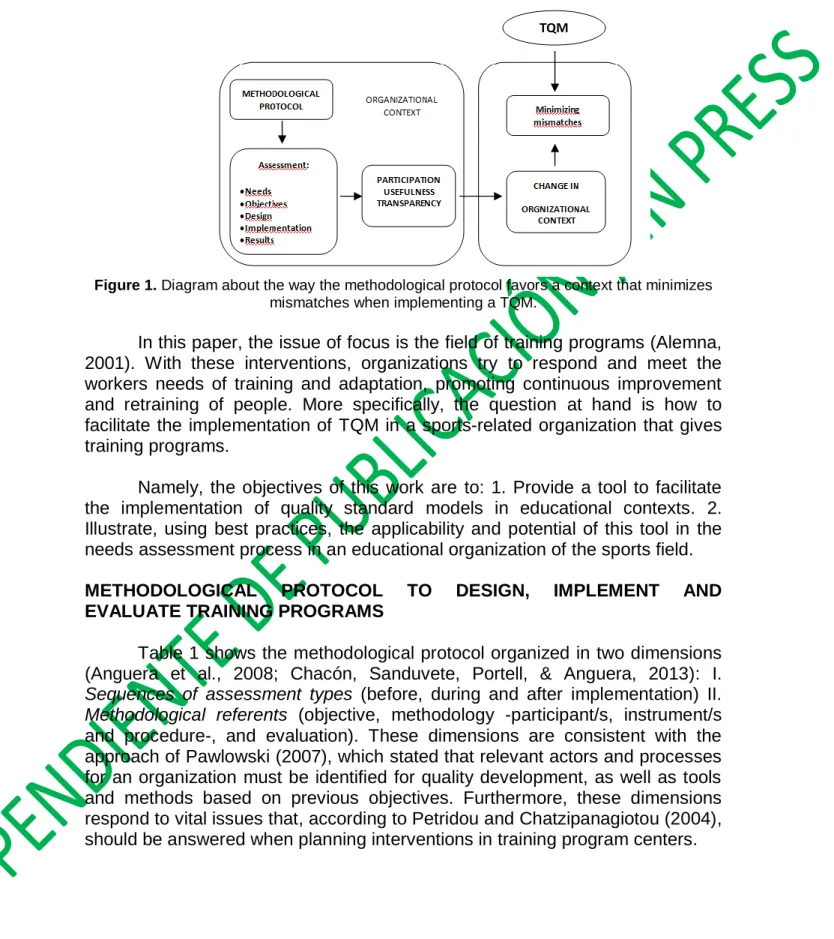
Our instrument is a methodological protocol, whose main objective is to facilitate the specification of all the organization processes. As a consequence,
5
the measurement of these three referents will enable their improvement and the creation of a favorable context for the implementation of a TQM (see Figure 1).
Figure 1. Diagram about the way the methodological protocol favors a context that minimizes mismatches when implementing a TQM.
In this paper, the issue of focus is the field of training programs (Alemna, 2001). With these interventions, organizations try to respond and meet the workers needs of training and adaptation, promoting continuous improvement and retraining of people. More specifically, the question at hand is how to facilitate the implementation of TQM in a sports-related organization that gives training programs.
Namely, the objectives of this work are to: 1. Provide a tool to facilitate the implementation of quality standard models in educational contexts. 2. Illustrate, using best practices, the applicability and potential of this tool in the needs assessment process in an educational organization of the sports field.
METHODOLOGICAL PROTOCOL TO DESIGN, IMPLEMENT AND EVALUATE TRAINING PROGRAMS
Table 1 shows the methodological protocol organized in two dimensions (Anguera et al., 2008; Chacón, Sanduvete, Portell, & Anguera, 2013): I.
Sequences of assessment types (before, during and after implementation) II.
Methodological referents (objective, methodology -participant/s, instrument/s
and procedure-, and evaluation). These dimensions are consistent with the approach of Pawlowski (2007), which stated that relevant actors and processes for an organization must be identified for quality development, as well as tools and methods based on previous objectives. Furthermore, these dimensions respond to vital issues that, according to Petridou and Chatzipanagiotou (2004), should be answered when planning interventions in training program centers.
6
Table 1
Methodological protocol to design, implement and evaluate training programs
Sequences of assessments types
Methodological referents
Objective Methodology Evaluation
Before
Needs assessment
Objectives assessments
Design assessments
During Implementation assessments After Results assessments
The implementation of the methodological protocol is considered part of the program evaluation process, essential in any organization that is dedicated to training programs (Hernández-Mendo, 2001). Its applied in a process of training needs (TTNN) assessment due to a practical question of space, and because this stage is considered essential to achieve competitiveness and services efficiency (De Diego, Fraile, & Boada, 2004). These concepts are intrinsically linked to participation and later user satisfaction. Nevertheless, the protocol could be implemented in any other evaluative stage.
The implementation was based on the theoretical model by Altschuld and Witkin (2000), adapted by Chacon, Lara, and Perez-Gil (2002). According to this model, the needs assessment process is formed by three successive stages: pre-evaluation, main evaluation and post-evaluation. In Table 2, this model is specified using the methodological protocol.
7
Next, we describe the implementation of the protocol in the needs assessment carried out in 2006 in order to design the 2007 Training Program in the Department of Training of a prestigious Andalusian sports organization, dedicated to promoting training, research, study, documentation and dissemination of Sciences of Physical Activity and Sport, and regarding nautical sports too (Chacón, Sanchez-Martín, Sanduvete, & Holgado, 2007).
METHODS
1. STAGE 1: Pre-evaluation
1.1. Objectives
1. Determine preexisting information about TTNN on the organization; in this case, the needs identified during the previous training program (2005); 2. Identify areas with more TTNN; and 3. Define potential sources to collect more types and amount of information.
Table 2
Methodological referents in needs assessment Methodological referents
Objective
Methodology
Evaluation Participants Instrument/s Procedure
Pre-eval. Determine preexisting information on needs. Identify areas of greatest need. Set limits and define potential sources to collect more information. Units from which existing needs are detected. Various instruments based on the type of needs to analyze, previous knowledge about them and the organizational context. It is common to use non-standardized instruments.
Collect existing needs. Organize information gathered.
Develop the technical report.
Plan next stage. Specify preliminary criteria for analyzing the needs assessment at the end of the process. Describe preexisting needs preliminarily. Main eval. Perform primary data collection (currently existing needs). Units from which existing needs are detected. Various instruments based on the type of needs to analyze, previous knowledge about them and the organizational context. It is common to use non-standardized instruments. Administer selected instruments. Collect and analyze data about existing needs.
Elaborate the technical report. Plan next stage. Set preliminary priorities to the final needs assessment. Describe preexisting needs preliminarily. Post-eval. Prioritize needs. Connect data previously collected with action plans to determine and implement. Units from previous stages. It is possible the participation of other relevant involved users. Instruments sufficiently objective to prioritize the identified needs, avoiding managing convenience criteria. Delineate final priorities and criteria for decision making. Weigh alternatives to address priority needs. Formulate action plans (considering assigned resources). Elaborate the technical report. Assess needs based on the prioritization criteria previously defined. Assess the process and results of the needs assessment.
8
1.2. Method
1.2.1. Participants. The sample consisted of 355 people who attended training activities (TTAA) from the previous training program. They were part of the Andalusian sports system; for example, graduates in Science of Physical Activity and Sport, teachers, or coordinators of sports programs. According to the organization guidelines, the gathering of the information was anonymous in order to encourage the participation of users and avoid social desirability in their responses.
1.2.2. Instruments. Satisfaction questionnaire. Data were obtained from an open response item from the questionnaire, specifically item 14 Propose other TTAA in which you would like to participate to enhance your performance in
your work (Chacón, Gómez, Sánchez-Martín, & Sanduvete, 2006).
1.2.3. Procedure. The technical team collected 149 different TTNN, including those requested in item 14 from satisfaction questionnaires administered in TTAA implemented during 2005 training program, and 5 TTAA planned for this program but not implemented. The management of the organization and technical team grouped TTAA according to their content in six knowledge areas established by the management (Management and Sports Administration, Sports Medicine, Sports Infrastructure, Sports Tourism, Sport and Physical Activity, and Training for Trainers). Later, the technical team transferred the procedure and published results in a report. Finally, the next stage was planned (among other tasks, the technical team prepared a questionnaire to be used in the main evaluation stage); and both direction and technical team agreed on the preliminary criteria for analyzing the needs assessment at the end of the process.
1.3. Evaluation
We described all TTAA requested by participants in the previous training program, along with the TTAA not implemented.
2. STAGE 2: Main evaluation
2.1. Objective
Collect existing TTNN in the organization during the development of the training program that was being implemented (2006).
2.2. Method
2.2.1. Participants. On one hand, the TTNN questionnaire was sent to 172 sports agents from Andalusia. They had the same characteristics as the participants in the pre-evaluation. They belonged to, for example, General Managements related to sports, Sports Institutions or Universities (in total, 15 different stakeholder groups). The 36 sport agents who answered the questionnaire formed part of the sample. On the other hand, 148 attendees to TTAA expressed their TTNN fulfilling the satisfaction questionnaire item 14
9
administered in TTAA implemented until May 15, 2006. This deadline was chosen to process the information and include it in the design of the new program. We involved to different types of participants in attempt to collect the highest and most varied amount of information. As in the previous stage, data collection was conducted anonymously.
2.2.2. Instruments. 1. Questionnaire to assess TTNN; it asked about the denomination of the proposal TN, degree of need (from 1 –the lowest- to 5 –the highest-), modality (in-person, distance, tele-training or another), usefulness/improvement in your job, target population and proponent (work and institution, organization or administration in which worked); and 2. Satisfaction
questionnaire. Data were obtained from Item 14 Propose other TTAA in which
you would like to participate to enhance your performance in your work.
2.2.3. Procedure. The technical team sent an e-mail with the questionnaire to assess TTNN to 172 Andalusian sports agents, asking for completion and forwarding. In parallel, TTNN voluntarily expressed by participants in the satisfaction questionnaire were collected. After the established period of time, a total of 153 TTNN were gathered. They were grouped by the management and technical team into the previously mentioned knowledge areas. Later, the technical team transferred the followed procedure and provided results in a report. Finally, the next stage was planned; among other tasks, the technical team prepared a questionnaire to prioritize TTNN, and preliminary priorities for the final needs assessment were established.
2.3. Evaluation
As in the previous stage, TTNN were described. In this case, the TTNN requested by the sports agents and the participants in the Training Program in 2006.
3. STAGE 3: Post-evaluation
3.1. Objective
Prioritize TTNN identified in previous stages, and connect them with the design of the Training Program in 2007.
3.2. Method
3.2.1. Participants. The sample was composed of 31 sports agents among the
same 172 who had the opportunity to participate in the main evaluation stage. The collected information was also processed anonymously.
3.2.2. Instruments. Questionnaire to prioritize TTNN. This listed the 302 TTNN
registered in previous stages, categorized in the cited knowledge areas. Participants were asked to prioritize the TN and determine the favorite city to give the designed TA.
10
3.2.3. Procedure. The technical team emailed the prioritization questionnaire to
the same sports agents who were taken into account in the previous stage. Participants were asked to prioritize a maximum of 10 TTNN from the knowledge area/s in which they were interested. Based on this information, TTNN to be attended in the Training Program in 2007 were decided.
After collecting the questionnaires, data were coded. Finally, based on the Dunn-Ranking’s scaling method (Sanduvete et al., 2009), the technical team obtained the list of prioritized needs and prepared a report in which the procedure was carried out and specified results.
3.3. Evaluation
After an overall assessment of the process and the obtained results, the management and the technical team verified that 106 TTAA had the same prioritization order than another. Nevertheless, these draws did not adversely affect the final decision making. The Plan was conformed following faithfully these results. The inclusion/exclusion criterion to be part of the Training Program in 2007 was, after applying the Dunn-Ranking’s method, to be in a position above the relative cutoff in each knowledge area. Specifically, the proportion of TTAA to offer in each area was obtained from the relative frequency of TTNN proposed and prioritized by areas. The management established that the Training Program should include a maximum of 60 TTAA given available resources.
Based on technical reports prepared throughout the process, two books were published by the organization (Chacón et al., 2007). They became part of the library of the organization, were sent to the potential agents, and were commented and discussed in a meeting about training.
4. MEASUREMENT OF REFERENTS
Once objectives, methodology and evaluation system used at each stage of the methodological protocol were discussed, the referents could be measured in a simple way. For the measurement of the referents participation,
usefulness and transparency, Table 3 shows a set of indicators developed
based on EFQM model adapted to the Andalusian Government (Consejería de Justicia y Administración Pública de la Junta de Andalucía, 2004). They are likely to be modified according to the specific evaluation process to be analyzed. The use of indicators is very common in both program evaluation and in the area of quality management, thus its use, in addition to be useful, enhances the convergence with TQM.
11
Table 3
Indicators to measure the referents
Specification Indicators
- Measuring actions
- If actions favored the response of potential stakeholders
P1. Number of actions specified and executed by the management
P2. Number of actions specified and executed by the technical team
P3. Number of data collected - If comprehensive information for
subsequent decision-making was collected from stakeholders
- If information was accurate enough to facilitate decision making
- If the final proposal matched with obtained data
U1. Number of instruments used
U2. Degree of accuracy in the results (number of draws)
U3. Degree of fit between the obtained results and the final proposal (% agreement)
- If a policy of equality was potentiated - Degree of diffusion of relevant information
T1. Number of stakeholder groups
T2. Number of publications on process and outcomes
T3. Number of process and results diffusion strategies
P: participation; U: usefulness; T: transparency
RESULTS
In Table 4, we quantify the indicators considered for the measurement of referents participation, usefulness and transparency, in the needs assessment process previously described (2006), where the methodological protocol was applied. The same is done for the previous needs assessment (2005), where the methodological protocol was not applied, although minimum guidelines were followed based on the theoretical model used in 2006 (Chacón et al., 2006).
Table 4
Quantification of indicators for measuring the referents in needs assessment in 2005 and 2006
INDICATOR 2005 2006
P1. Number of actions specified and executed by the management
P2. Number of actions specified and executed by the technical team
P3. Number of data collected
4 9 217+5 7 14 302+31
U1. Number of instruments used
U2. Degree of accuracy in the results (number of draws)
U3. Degree of fit between the obtained results and the final proposal (% agreement) 2 121 85 4 106 100
T1. Number of stakeholder groups
T2. Number of publications on process and outcomes
T3. Number of process and results diffusion strategies
9 3 2 15 2 3 P: participation; U: usefulness; T: transparency
12
We found improvements in nearly all the indicators measured: 1. Regarding participation: (P1 and P2) the number of specified and executed actions increased; (P3) in 2005, 217 data were collected in pre-evaluation and main evaluation, and 5 prioritizations in the post-evaluation; while in 2006, 149 TTNN were collected in pre-evaluation, 153 in the main evaluation (302 in total) and 31 prioritizations. 2. With respect to usefulness: (U1) in 2005, information was collected with two questionnaires (one common in pre-evaluation and main evaluation, and a different one in post-evaluation); while in 2006, we used four (one in pre-evaluation, two in the main evaluation and one in post-evaluation); (U2) the number of draws in the final prioritization decreased from 121 in 2005 to 106 in 2006; (U3) the degree of fit between the results obtained in post-evaluation and the final proposal for the training program increased from 85% to 100%. 3. Regarding transparency: (T1) the number of different stakeholder groups changed from nine to fifteen; (T3) the number of diffusion strategies increased from two (library and delivery to stakeholders) to three (the previous two, and meeting on training).
DISCUSSION AND CONCLUSIONS
Detected changes suggest that the implementation of the protocol enhances the specification and improvement of the referents participation,
usefulness and transparency. The reason seems clear: when processes are
specified and they become visible, you can see latent problematic more clearly, and organizations strive even more for minimizing or overcoming them. The consequence: the environment changes in training organizations in order to more appropriately implement TQM successfully and minimize mismatches that often occur during its implementation; concretely: 1. Effort and time devoted to tasks of quality management were balanced with improvements, since: I. The level of involvement and participation increased, reflected in the increase in both the number of specified tasks executed by management and technical equipment (consistent with those to be carried out by applying a TQM), and the responses in participants; II. The usefulness of the obtained results with the performed actions increased, because the information collected was more varied, accurate, and consistent with the final proposal. 2. The training quality and user satisfaction were enhanced, as the developed program was largely adjusted to the real needs of the employees: I. The high degree of participation
promoted a more exhaustive information collection; II. The variety and accuracy of the collected information allowed the increase of its usefulness, adjusting the final product greatly to this information. 3. The adaptation of TQM to the organization was promoted because objectives and actions were specified, and horizontal communication among employees was promoted: I. Increasing the
usefulness because of the program adjustment to the request of participants. II.
Increasing transparency, with the participation of different stakeholder groups, and the diffusion placed within the reach of anyone interested in information about the procedure and results.
The usefulness of this instrument has been made visible through good practice in needs assessment, a process that is not usually carried out and that implies, among other aspects, the active participation of users. According to
13
Liao et al. (2010b), quality management factors in higher education and training programs would focus on the customer, employee participation and teamwork, continuous improvement, recognition and reward, education and training, and leadership. Thus, through the analyzed process, it is evident that direction and focused work which has been carried out on most of the factors involved in quality management in education. It would be necessary to ensure the involvement of the management team in the aspects of recognition, reward and leadership, which are also essential for the proper implementation of TQM (Becket & Brookes, 2008).
This work is also in accordance with the main line of recent research in the sports management area, which has a basic aim to design specific measures on quality of service (Morales, Hernandez-Mendo, & Blanco, 2009) and customer satisfaction (Nuviala, Tamayo, Fernández, Pérez-Turpin, & Nuviala, 2011).
This article has attempted to demonstrate the methodological protocol usefulness, as an integral strategy in the evaluation process in organizations dedicated to training programs, to promote synergies that minimize mismatches to implement a TQM in these contexts. We consider this protocol to be a useful and adequate tool to implement in crisis situations because it maximizes the organization of resources, is easy to use, and complements with any other tool. An advice when using this instrument is to implement the protocol in the current organization situation in the desired assessment stage and, from there, define the objectives to be achieved by specifying them through the protocol again.
It should be noted that the methodological protocol was effectively applied in two other organizations dedicated to training programs. One of them is now accredited after implementing a recognized TQM.
REFERENCES
Abdi, S. N. A., Awan, H. M., & Bhatti, M. (2008). Is quality management a prime requisite for globalization? Some facts from the sports industry. Quality &
Quantity, 42(6), 821-833.
Alemna, A. A. (2001). Perception of continuing education for librarianship in Ghana. New Library World, 102(1), 44-48.
Altschuld, J. W., & Witkin, B. R. (2000). From needs assessment to action.
Transforming needs into solution strategies. Thousand Oaks, CA: Sage.
Amo, C., & Cousins, J. B. (2007). Going through the process: an examination of the operationalization of process use in empirical research on evaluation.
New Directions for Evaluation, 116, 5-26.
Andrés, M. A. (2005). Propuesta de indicadores del proceso de enseñanza/aprendizaje en la formación profesional en un contexto de gestión de calidad total [Proposal of indicators of the Teaching/Learning process in vocational education in a context of total quality management].
Revista Electrónica de Investigación y Evaluación Educativa, 11(1),
63-82. Retrieved from http://www.uv.es/relieve/v11n1/RELIEVEv11n1_4.htm Anguera, M. T., Chacón, S., & Sánchez-Martín, M. (2008). Bases
14
Chacón, & A. Blanco (Coords.), Evaluación de programas sociales y
sanitarios: un abordaje metodológico [Social and health program
evaluation. A methodological approach] (pp. 37-68). Madrid, Spain: Síntesis.
Aragón, L. (2004). La gestión de calidad en educación [Quality management in education]. Educar en el 2000, 8, 21-30. Retrieved from http://www.educarm.es/templates/portal/images/ficheros/revistaEducarm/ 9/revista8_03.pdf
Asif, M., Awan, M. S., Khan, M. K., & Ahmad, N. (2011). A model for total quality management in higher education. Quality & Quantity, 47(4), 1883-1904.
Becket, N., & Brookes, M. (2008). Quality management practice in higher education –what quality are we actually enhancing? Journal of
Hospitality, Leisure, Sport and Tourism Education, 7(1), 40-54.
Boyer, C. (2003). Calidad total y formación continua. Razones para una posición crítica. In VV.AA., Calidad y formación: binomio inseparable
[Quality and training: inseparable pairing] (pp. 137-143). Madrid, Spain: Instituto Nacional de Empleo.
Calabuig, F., Burillo, P., Crespo, J., Mundina, J. J., & Gallardo, L. (2010). Satisfacción, calidad y valor percibido en espectadores de atletismo [Satisfaction, quality and perceived value in spectators of athletics].
Revista Internacional de Medicina y Ciencias de la Actividad Física y el
deporte, 10(40), 577-593.
Chacón, S., Anguera, M. T., Pérez-Gil, J. A., & Holgado, F. P. (2002). A mutual catalytic model of formative evaluation. The interdependent roles of evaluators and local program practitioners. Evaluation, 8(4), 413-432. Chacón, S., Gómez, N., Sánchez-Martín, M., & Sanduvete, S. (2006).
Formación en el Instituto Andaluz del Deporte. Evaluación y diseño
[Training programs in the Regional Sport Institute in Andalusia: evaluation and design]. Vol. 1-4. Málaga, Spain: Instituto Andaluz del Deporte (Consejería de Turismo, Comercio y Deporte).
Chacón, S., Lara, A., & Pérez-Gil, J. A. (2002). Needs assessment. In R. Fernández-Ballesteros (Ed.), Encyclopedia of Psychological Assessment
(Vol. 2,pp. 615-619). London, England: Sage.
Chacón, S., Sánchez-Martín, M., Sanduvete, S., & Holgado, F. P. (2007).
Formación en el Instituto Andaluz del Deporte. Evaluación y diseño
[Training programs in the Regional Sport Institute in Andalusia: evaluation and design]. Vol. 1-4. Málaga, Spain: Instituto Andaluz del Deporte (Consejería de Turismo, Comercio y Deporte).
Chacón, S., Sanduvete, S., Portell, M., & Anguera, M. T. (2013). Reporting a program evaluation: Needs, program plan, intervention, and decisions.
International Journal of Clinical and Health Psychology, 13(1), 58-66.
Consejería de Justicia y Administración Pública de la Junta de Andalucía (2004). Modelo EFQM de excelencia en la Junta de Andalucía [EFQM excellence model in the Council for Andalusia]. Sevilla, Spain: Dirección General de Administración Electrónica y Calidad de los Servicios.
Cruickshank, M. (2003). Total quality management in the higher education sector: a literature review from an international and Australian perspective. TQM and Business Excellence, 14(10), 1159-1167.
15
De Diego, R., Fraile, A., & Boada, J. (2004). Training needs among sport technicians. Psicothema, 16(1), 84-87.
Dickerson, P. (2000). A CQI approach to evaluating continuing education: processes and outcomes. Journal for Nurses in Staff Development, 16(1), 34-40.
Domínguez, G., & Lozano, L. (2005). La calidad, más que una moda, un reto en la Europa de la sociedad del conocimiento: la mejora continua más allá de los modelos y las certificaciones (competencias de un formador que aseguran la calidad) [Quality, more than a fashion, a challenge in the Europe of the knowledge society: continuous improvement beyond the models and certifications (skills of a instructor that ensure quality)].
Revista Complutense de Educación, 16(1), 57-93.
Ehlers, U.-D., Hildebrandt, B., Görtz, L., & Pawlowski, J. M. (2005). Use and distribution of quality approaches in European e-learning. Thessaloniki, Greece: CEDEFOP.
Fetterman, D., & Wandersman, A. (2007). Empowerment evaluation: yesterday, today, and tomorrow. American Journal of Evaluation, 28(2), 179-198. Hernández-Mendo, A. (2001). Un cuestionario para evaluar la calidad en
programas de actividad física. Revista de Psicología del Deporte, 10, 179-196.
Kasperavičiut, R. (2011). Application of the European foundation for quality management excellence model in higher education institutions. Public
Policy and Administration, 10(3), 387-402.
Liao, S.-H., Chang, W.-J., & Wu, C.-C. (2010a). Exploring TQM-Innovation relationship in continuing education: A system architecture and propositions. Total Quality Management & Business Excellence, 21(11), 1121-1139.
Liao, S.-H., Chang, W.-J., & Wu, C.-C. (2010b). An integrated model for learning organization with strategic view: Benchmarking in the knowledge-intensive industry. Expert Systems with Applications, 37, 3792–3798.
Martínez, J. A., & Martínez, L. (2009). Percepción del empleado y del cliente en servicios públicos deportivos [Employee and customer perception in public sports services]. Revista Internacional de Medicina y Ciencias de
la Actividad Física y el Deporte, 9(34), 158-178.
Morales, V., Hernández-Mendo, A., & Blanco, A. (2009). Evaluating quality in sports organisations: an adaptation of the SERVQUAL model. Revista de
Psicología del Deporte, 18(2), 137-150.
Nuviala, A., Tamayo, J. A., Fernández, A., Pérez-Turpin, J. A., & Nuviala, R. (2011). Calidad del servicio deportivo en la edad escolar desde una doble perspectiva [Sport service quality at school age from a double perspective]. Revista Internacional de Medicina y Ciencias de la
Actividad Física y el Deporte, 11(42), 220-235.
Pawlowski, J. M. (2007). The quality adaptation model: adaptation and adoption of the Quality Standard ISO/IEC 19796-1 for learning, education, and training. Educational Technology & Society, 10(2), 3-16.
Petridou, E., & Chatzipanagiotou, P. (2004). The planning process in managing organisations of continuing education: the case of Greek vocational training institutions. The International Journal of Educational
16
Regnier, K., Kopelow, M., Lane, D., & Alden, E. (2005). Accreditation for learning and change: Quality and improvement as the outcome. The
Journal of Continuing Education in the Health Professions, 25,
174-182.
Sakthivel, P. B., & Raju, R. (2006). Conceptualizing total quality management in engineering education and developing a TQM educational excellence model. Total Quality Management, 17(7), 913–934.
Sanduvete, S., Barbero, M. I., Chacón, S., Pérez-Gil, J. A., Holgado, F. P., Sánchez-Martín, M., & Lozano, J. A. (2009). Métodos de escalamiento aplicados a la priorización de necesidades de formación en organizaciones [Scaling methods applied to set priorities in training programs in organizations]. Psicothema, 21(4), 509-514.
Sirvanci, M. B. (2004). Critical issues for TQM implementation in higher education. The TQM Magazine, 16(6), 382-386.
Srikanthan, G., & Dalrymple, J. (2004). A synthesis of a quality management model for education in universities. International Journal of Educational
Management, 18(4), 266-279.
Van den Berghe, W. (1998). Aplicación de las Normas ISO 9000 a la
enseñanza y la formación [Implementation of the ISO 9000 management
standards in teaching and training]. Luxembourg, Luxembourg: Centro Europeo para el Desarrollo de la Formación Profesional (CEDEFOP). Vedung, E. (1996). Utilización de la evaluación de programas. In R.
Fernández-Ballesteros (Ed.), Evaluación de programas. Una guía práctica en
ámbitos sociales, educativos y de salud [Programs evaluation. A
practical guide in social, education and health sectors] (pp. 321-338). Madrid, Spain: Síntesis.
Weiss, C. H. (1979). The many meanings of research utilization. Public
Administration Review, 39(5), 426-431.
Número de citas totales / Total references: 40 (100%)
Número de citas propias de la revista / Journal's own references: 3 (7,5%)