UC San Diego
UC San Diego Electronic Theses and Dissertations
Title
Providing Easy to Use and Fast Programming Support for Non-Volatile Memories
Permalink https://escholarship.org/uc/item/1j75v2pb Author Memaripour, Amirsaman Publication Date 2019 Peer reviewed|Thesis/dissertation
UNIVERSITY OF CALIFORNIA SAN DIEGO
Providing Easy to Use and Fast Programming Support for Non-Volatile Memories
A dissertation submitted in partial satisfaction of the requirements for the degree
Doctor of Philosophy in
Computer Science (Computer Engineering) by
Amirsaman Memaripour
Committee in charge:
Professor Steven Swanson, Chair Professor Ranjit Jhala
Professor Farinaz Koushanfar Professor Dean Tullsen Professor Geoffrey Voelker
Copyright
Amirsaman Memaripour, 2019 All rights reserved.
The dissertation of Amirsaman Memaripour is approved, and it is acceptable in quality and form for publication on micro-film and electronically:
Chair
University of California San Diego
DEDICATION
To those who have been there with me since the beginning of this journey.
And to those closest to me whose strength, kindness and patience
EPIGRAPH
Home is behind, the world ahead, and there are many paths to tread. Through shadows to the edge of night, until the stars are all alight. Then world behind and home ahead, we’ll wander back and home to bed. Mist and twilight, cloud and shade, Away shall fade! Away shall fade! — J. R. R. Tolkien
TABLE OF CONTENTS
Signature Page . . . iii
Dedication . . . iv Epigraph . . . v Table of Contents . . . vi List of Figures . . . ix List of Tables . . . xi Acknowledgements . . . xii Vita . . . xiv
Abstract of the Dissertation . . . xvi
Chapter 1 Introduction . . . 1
Chapter 2 Background and Motivation . . . 7
2.1 Non-Volatile Memories . . . 8
2.2 Programming with Non-Volatile Memories . . . 9
2.2.1 Programming Cost . . . 10 2.2.2 Performance Cost . . . 11 2.3 Failure-Atomicity Libraries . . . 12 2.4 Challenges of Annotations . . . 14 2.4.1 Programming Effort . . . 15 2.4.2 Correctness . . . 15 2.4.3 Code Reusability . . . 16
2.5 Absence of Compiler Support . . . 16
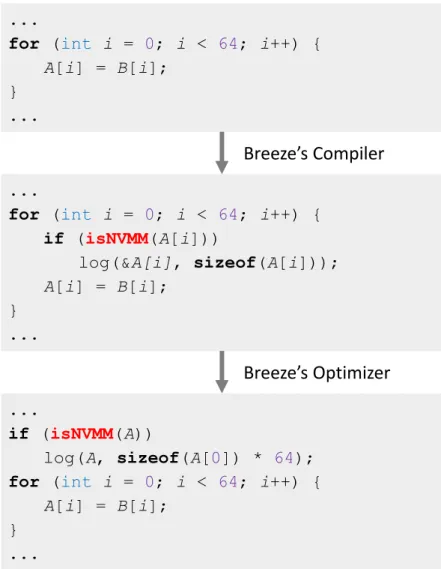
Chapter 3 User-Level Access to Non-Volatile Memories for Legacy Software . . . . 19
3.1 Design Overview . . . 21
3.1.1 Declaring Persistent Types and Pointers . . . 23
3.1.2 Atomic Sections . . . 25
3.1.3 Allocation . . . 25
3.1.4 Breeze’s Compiler . . . 28
3.2 Implementation . . . 29
3.2.1 Storage Layout . . . 29
3.2.2 Memory Allocation and Management . . . 30
3.2.4 Pre-Compiled Libraries . . . 32 3.2.5 Optimizations . . . 34 3.2.6 Pointer Safety . . . 36 3.2.7 Garbage Collection . . . 37 3.3 Evaluation . . . 40 3.3.1 Applications . . . 40 3.3.2 Test System . . . 41 3.3.3 Ease of Use . . . 41 3.3.4 Performance . . . 43 3.3.5 Recovery Time . . . 45 3.4 Related Work . . . 47 3.5 Summary . . . 49
Chapter 4 A Flexible, Optimizing Compiler for Non-Volatile Memory Programming 50 4.1 System Overview . . . 52 4.1.1 NVHooks Compiler . . . 54 4.1.2 Failure-Atomicity Runtime . . . 56 4.1.3 NVHooks-Aware Application . . . 58 4.1.4 Building Programs . . . 59 4.2 Compilation Passes . . . 59
4.2.1 Static Boundary Checks . . . 60
4.2.2 Merging Callbacks for Field Accesses . . . 61
4.2.3 Merging Callbacks for Loops . . . 64
4.2.4 Removing Redundant Access Tracking . . . 66
4.3 Evaluation . . . 67
4.3.1 Evaluation Setup . . . 68
4.3.2 Overhead of Automating Annotations . . . 70
4.3.3 Benefits of the Optimization Passes . . . 70
4.4 Related Work . . . 75
4.5 Summary . . . 76
Chapter 5 Easy and Fast Persistence for Volatile Data Structures . . . 77
5.1 Design Overview . . . 79
5.1.1 Pronto System Overview . . . 81
5.1.2 Using Pronto . . . 84
5.2 Implementation . . . 89
5.2.1 Asynchronous Semantic Logging . . . 90
5.2.2 Memory Allocator . . . 92 5.2.3 Periodic Snapshots . . . 92 5.2.4 Recovery Management . . . 93 5.2.5 Preprocessor . . . 94 5.3 Evaluation . . . 94 5.3.1 Testbed Setup . . . 95
5.3.2 Persistence for Volatile Data Structures . . . 95
5.3.3 NVM-Optimized Data Structures . . . 98
5.3.4 Optimizing Persistent Data Structures . . . 99
5.3.5 Comparing ASL against Undo-Logging . . . 100
5.3.6 Sensitivity Analysis . . . 101 5.3.7 Overhead of Snapshots . . . 102 5.3.8 Recovery Time . . . 103 5.4 Related Work . . . 104 5.5 Summary . . . 105 Chapter 6 Conclusion . . . 107 Bibliography . . . 110
LIST OF FIGURES
Figure 2.1: Latency breakdown of inserts to PMEMKV . . . 11
Figure 2.2: Annotating a volatile linked-list for PMDK . . . 15
Figure 2.3: Reducing the overhead of NVM libraries using compiler optimizations . . 18
Figure 3.1: The organization of Breeze . . . 22
Figure 3.2: An example of a volatile, singly linked-list . . . 23
Figure 3.3: Four steps of applying Breeze to legacy software . . . 24
Figure 3.4: Declaring persistent types and pointers using Breeze primitives . . . 25
Figure 3.5: Leveraging Breeze to perform transactional list operations . . . 26
Figure 3.6: Making the linked-list persistent using PMDK . . . 27
Figure 3.7: Storage layout of Breeze . . . 30
Figure 3.8: An example of Breeze’s instrumentation . . . 31
Figure 3.9: An example of using Breeze to instrument function calls . . . 34
Figure 3.10: Breeze’s optimizer can reduce the overhead of instrumentations . . . 35
Figure 3.11: Storage layout of the reference count activation records . . . 37
Figure 3.12: Measuring the average latency of Breeze’s allocator . . . 42
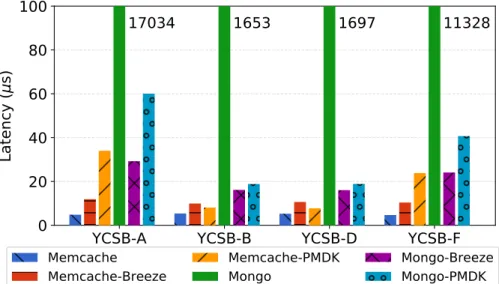
Figure 3.13: Measuring the latency of benchmark applications . . . 43
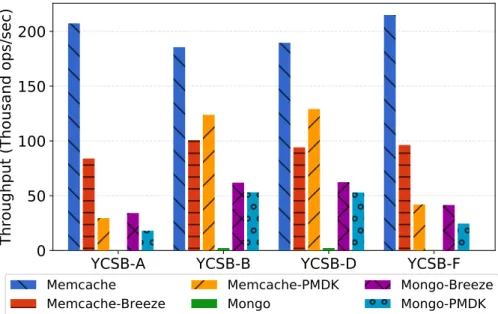
Figure 3.14: Average throughput of benchmark applications . . . 44
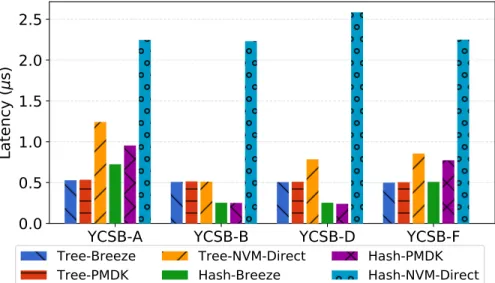
Figure 3.15: Measuring the latency of microbenchmarks . . . 45
Figure 3.16: Average throughput of microbenchmarks . . . 45
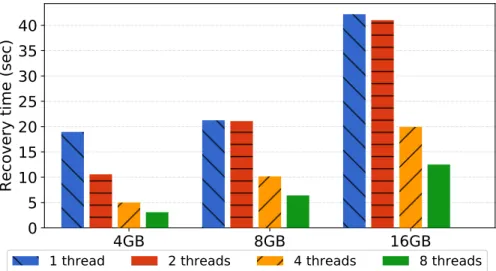
Figure 3.17: Measuring the recovery time of Breeze . . . 46
Figure 3.18: Analyzing Breeze’s worst-case recovery time . . . 46
Figure 4.1: NVHooks system overview . . . 53
Figure 4.2: An example of NVHooks’s instrumentations . . . 55
Figure 4.3: NVHooks uses function attributes to support pre-compiled code . . . 56
Figure 4.4: Sample adaptation layer for PMDK . . . 57
Figure 4.5: NVHooks obviates manual access tracking and pointer manipulation . . . . 58
Figure 4.6: Coalescing access tracking callbacks . . . 62
Figure 4.7: The coalesce-loops optimization pass . . . 63
Figure 4.8: Removing redundant access tracking callbacks . . . 65
Figure 4.9: The no-extra-tracking pass . . . 67
Figure 4.10: Measuring the overhead of automating annotations . . . 73
Figure 4.11: Evaluating NVHooks optimizations . . . 74
Figure 5.1: Communications between Pronto’s foreground and background paths . . . 82
Figure 5.2: Comparing the execution path of ASL against undo and redo logging . . . 83
Figure 5.3: Creating a persistent version of STL’s vector using Pronto . . . 86
Figure 5.4: Creating a persistent, concurrent hash-map using Pronto and STL’s map . . 89
Figure 5.5: Distribution of user and ASL threads over physical CPU cores . . . 91 Figure 5.6: The overhead of using Pronto to add failure-atomicity to volatile benchmarks 96
Figure 5.7: Measuring the throughput of the volatile and Pronto hash-maps . . . 97 Figure 5.8: Comparing PMEMKV against the Pronto versions of STL containers . . . 98 Figure 5.9: Evaluating the performance of the NVM-optimized version of RocksDB . . 99 Figure 5.10: Comparing the performance of Pronto against PMDK and KaminoTx . . . 100 Figure 5.11: Comparing the latency of asynchronous to synchronous semantic logging . . 101 Figure 5.12: Measuring the impact of data size on the overhead of Pronto’s snapshots . . 102
LIST OF TABLES
Table 2.1: Concurrency constraints of NVM libraries . . . 12 Table 3.1: Breeze provides a set of macros to declare persistent data types and pointers. 22 Table 3.2: The percentage of different operations in each YCSB workload. . . 41 Table 3.3: Configuration of the NVM emulation platform . . . 41 Table 3.4: Comparing Breeze against NVM-Direct and PMDK in terms of ease of use . 42 Table 3.5: The cost of adding Breeze and PMDK to MongoDB and Memcached . . . . 42 Table 4.1: NVHooks callback functions . . . 54 Table 4.2: The list of failure-atomicity runtimes used to evaluate NVHooks . . . 69 Table 5.1: Pronto’s programming interface . . . 85
ACKNOWLEDGEMENTS
I am grateful for the love and support of many incredible people who helped me throughout the long journey that led to writing this dissertation.
Writing this dissertation would not have been possible without the guidance of my adviser, Steven Swanson. I am especially thankful for his patience and kind support. His mentorship has helped me to grow academically and advance towards my career goals. I am grateful for numerous opportunities that came my way as a result of his hard work and dedication to nurturing students like me.
I want to express my appreciation to my committee members, Geoffrey Voelker, Dean Tullsen, Ranjit Jhala, and Farinaz Koushanfar, for their constructive feedback and guidance. Your suggestions have been an invaluable resource throughout this process.
I want to thank my colleagues at the Non-Volatile Systems Laboratory (NVSL). This dissertation is the product of hard work by many individuals, and their share in its success is no less than mine. I am thankful to Meenakshi Sundaram Bhaskaran and Michael Wei for their advise and feedback through the early years of my Ph.D. I am also grateful to Joseph Izraelevitz for his help and support on the Pronto and NVHooks projects. I wish to also thank Jian Xu, Jian Yang, Yiying Zhang, Lu Zhang, Juno Kim, Yi Xu, and the rest of the NVSL.
I wish to also express my gratitude to many wonderful people at UC San Diego, Microsoft Research, and Micron Technology. I mention a few as I find it difficult to name them all, but please know you are all immensely appreciated. Thanks to Anirudh Badam, Amar Phanishayee, and Karin Strauss for their mentorship and support during my time at Microsoft Research. Thanks to Ameen Akel, Ken Curewitz, Sean Eilert and many others at Micron Technology for their mentorship and friendship.
Finally, I want to express my great appreciation to my family and friends for sticking by my side regardless of the ups and downs. I am forever indebted to my family for their unconditional love and support. I would not have accomplished anything if it wasn’t for their
sacrifices. A very special word of thanks goes to Mia, who has been kind, patient, understanding, and supportive throughout the toughest days of this journey. I wish to also thank Hana for her genuine friendship over the years. Thank you, everyone, for believing in me!
Chapter 1, Chapter 2, and Chapter 3 contain material from “Breeze: User-Level Access to Non-Volatile Main Memories for Legacy Software”, by Amirsaman Memaripour and Steven Swanson, which appeared in the 36th International Conference on Computer Design (ICCD 2018). The dissertation author is the primary investigator and first author of this paper. The materials are copyright c2018 by Institute of Electrical and Electronics Engineers (IEEE).
Chapter 1, Chapter 2, and Chapter 4 contain material from “NVHooks: A Flexible, Optimizing Compiler for Non-Volatile Memory Programming”, by Amirsaman Memaripour, Yi Xu, Steven Swanson, and Joseph Izraelevitz which is submitted to the 25th Architectural Support for Programming Languages and Operating Systems (ASPLOS 2020). The dissertation author is the primary investigator and first author of this paper.
Chapter 1, Chapter 2, and Chapter 5 contain material from “Pronto: Easy and Fast Persistence for Volatile Data Structures”, by Amirsaman Memaripour, Joseph Izraelevitz, and Steven Swanson which is submitted to the 25th Architectural Support for Programming Languages and Operating Systems (ASPLOS 2020). The dissertation author is the primary investigator and first author of this paper.
Permission to make digital or hard copies of part of all of this work for personal or classroom use is granted without fee provided that copies are not made or distributed for profit or commercial advantage.
VITA
2010 Bachelor of Computer Engineering, Shahid Beheshti University
2012 Master of Computer Engineering,
Iran University of Science and Technology 2013-2019 Graduate Student Researcher,
University of California San Diego
2014 Internship, Micron Technology 2015 Internship, Microsoft Research 2016 Internship, Microsoft Research 2017 Candidate of Philosophy,
University of California San Diego
2017 Internship,
Microsoft Research
2017 Technology Management and Entrepreneurism Fellowship Program, Rady School of Management
2019 Doctor of Philosophy in Computer Science (Computer Engineering), University of California San Diego
PUBLICATIONS
Jian Xu, Juno Kim, Amirsaman Memaripour and Steven Swanson, “Finding and Fixing Perfor-mance Pathologies in Persistent Memory Software Stacks”, In the 24th International Conference on Architectural Support for Programming Languages and Operating Systems (ASPLOS), 2019. Amirsaman Memaripour and Steven Swanson, “Breeze: User-Level Access to Non-Volatile Main Memories for Legacy Software”, In the 36th International Conference on Computer Design (ICCD), 2018.
Daehyeok Kim, Amirsaman Memaripour, Anirudh Badam, Yibo Zhu, Hongqiang Harry Liu, Jitu Padhye, Shachar Raindel, Steven Swanson, Vyas Sekar and Srinivasan Seshan, “Hyperloop: Group-Based NIC-Offloading to Accelerate Replicated Transactions in Multi-Tenant Storage Systems”, In the Conference of the ACM Special Interest Group on Data Communication (SIGCOMM), 2018.
Jian Xu, Lu Zhang, Amirsaman Memaripour, Akshatha Gangadharaiah, Amit Borase, Tamires Brito Da Silva, Steven Swanson and Andy Rudoff, “NOVA-Fortis: A Fault-Tolerant Non-Volatile Main Memory File System”, In the 26th Symposium on Operating Systems Principles (SOSP), 2017.
Amirsaman Memaripour, Anirudh Badam, Amar Phanishayee, Yanqi Zhou, Ramnatthan Ala-gappan, Karin Strauss and Steven Swanson, “Atomic In-Place Updates for Non-Volatile Main Memories with Kamino-Tx”, In the 12th European Conference on Computer Systems (EuroSys), 2017.
Yiying Zhang, Jian Yang, Amirsaman Memaripour and Steven Swanson, “Mojim: A Reliable and Highly-Available Non-Volatile Memory System”, In the 20th International Conference on Architectural Support for Programming Languages and Operating Systems (ASPLOS), 2015.
ABSTRACT OF THE DISSERTATION
Providing Easy to Use and Fast Programming Support for Non-Volatile Memories
by
Amirsaman Memaripour
Doctor of Philosophy in Computer Science (Computer Engineering)
University of California San Diego, 2019
Professor Steven Swanson, Chair
Non-Volatile Memory (NVM) technologies, such as 3D XPoint, offer DRAM-like per-formance and byte-addressable access to persistent data. NVMs promise an opportunity for fast, persistent data structures, and a wide range of applications stand to benefit from the performance potential of these technologies. These potential benefits are greatest when applications access NVM directly via load/store instructions rather than conventional file-based interfaces. Directly accessing NVM presents several challenges. In particular, applications need guaranteed con-sistency and safety semantics to protect their data structures in the face of system failures and programming errors.
Existing methods for building persistent data structures require either in-depth code changes to an existing data structure or rewriting the data structure from scratch. Unfortunately, both of these methods are labor-intensive and error-prone.
Failure-atomicity libraries and programming language extensions can simplify this task. However, all the proposed solutions either require pervasive changes to existing software or incur unacceptable overheads to runtime performance. As a result, porting legacy applications to leverage NVM is likely to be prohibitively difficult and time-consuming.
This dissertation first presents Breeze, an NVM toolchain that minimizes the changes necessary to enable legacy code to reap the benefits of directly accessing NVM. In contrast to PMDK and NVM-Direct, Breeze reduces the programming effort of porting Memcached and MongoDB by up to 2.8×, while providing equal or superior performance.
Second, it introduces NVHooks, a compiler that automatically annotates NVM accesses and avoids disruptive and error-prone changes to programs. NVHooks reduces the cost of these annotations by applying novel, NVM-specific optimizations to their placement. For our tested benchmarks, NVHooks matches the performance of hand-annotated code while minimizing programmer effort.
Finally, it presents Pronto, a new NVM library that reduces the programming effort required to add persistence to volatile data structures. Pronto uses asynchronous semantic logging (ASL) to allow adding persistence to the existing volatile data structure (e.g., C++ Standard Template Library containers) with minor programming effort. ASL moves most durability code off the critical path. Our evaluation shows Pronto data structures outperform highly-optimized NVM data structures by a large margin.
Chapter 1
Introduction
For decades, computer architects have been in the pursuit of a fast, persistent, cost-effective storage technology that would fill the gap between the volatile memory hierarchy (e.g., CPU caches and memory) and the persistent storage, mainly comprising of hard-disk and solid-state drives. Non-Volatile Memory (NVM) technologies provide the means to fill this gap by offering comparable latency and bandwidth to volatile memory (e.g., DRAM) while delivering persistence, higher density, and lower cost per gigabyte.
NVMs expose user applications to low-cost persistence, essentially invalidating many assumptions concerning the storage hierarchy. In particular, NVMs are byte-addressable and can sit beside DRAM on the memory bus, allowing applications to avoid expensive system calls and directly access persistent data. As a result, programmers are no longer required to serialize data before sending it for persistence or deserialize it after reading the data back. Furthermore, writing to NVMs is orders of magnitude faster than solid-state drives and only takes a few microseconds to complete, while the performance of reading is almost equivalent to that of DRAM. The performance boost that NVMs offer obviates many buffering and grouping techniques (e.g., group commit) vastly used in many popular storage and database applications.
the most advantage of the performance potential of these memories. Direct access allows applications to issue load and store instructions to access persistent data; however, it introduces other challenges. In particular, programmers must carefully construct persistent data structures to ensure the durability and consistency of persistent data in the face of programming errors and system failures (e.g., power outages).
Due to the volatility of CPU caches, writes to persistent memory are not immediately durable unless flushed from the volatile caches (e.g., using cache-flush instructions). As discussed in [9] and [16], flushing cache-lines is an expensive operation, and applications often postpone such flushes to mitigate the performance penalties. Delaying flushes, however, could result in un-fortunate outcomes; a power outage, for instance, could tear writes to persistent memory, resulting in partially updated data structures. Computer scientists have proposed several approaches to ei-ther reduce the cost of these cache-flushes or make them unnecessary [16, 84]. To date, persistent caches are yet to be adopted by the processor manufacturers, while NVM-optimized cache-flush and memory-fence instructions are the only tools available to programmers to construct persistent data structures for NVMs [47].
Providing programmers with direct access to NVM also hardens ensuring the consistency of persistent data in the wake of a restart. Existing hardware only offers support for atomi-cally updating 64 bit NVM regions. Although the high-end Intel processors have well-defined constraints on the order in which they flush words of a cache-line, no commercial processor today provides support for arbitrary sized atomic writes to NVM. To ensure writes to persistent memory are atomic with respect to restarts (i.e., failure-atomic), programmers must adopt these hardware primitives to build failure recovery mechanisms (e.g., undo-logging or copy-on-write), a delicate and error-prone task. Furthermore, programmers must take special care in allocating and referencing persistent memory to avoid prevalent programming errors such as memory leaks and dangling pointers. These challenges stifle NVM programming and impede the adoption of these emerging technologies.
Failure-atomicity libraries (e.g., PMDK [44]) aim to reduce the challenges of building programs for NVMs by hiding the complexity and limitations of the hardware primitives under a set of flexible programming interfaces. To avoid the pitfalls of direct access, these libraries provide support for arbitrary sized failure-atomic updates to persistent data and an efficient transactional NVM allocator that prevents permanent memory leaks in the face of system failures. They also offer persistent naming to allow access to persistent data across programs’ restarts and support for remapping persistent pools after recovery.
These libraries, unfortunately, introduce new issues that impede the adoption of persistent programming. In particular, they often require programmers to annotate accesses to NVM, specify the boundaries of failure-atomic operations, and use library-specific APIs to manage persistent memory and write recovery code. These annotations require disruptive changes to existing programs, especially those with no persistence semantics, and are often misplaced or overused.
Failure-atomicity libraries require programmers to annotate accesses to persistent memory, and these annotations are cumbersome, introduce new programming errors, and disrupt code reusability. Libraries use these annotations to intercept NVM accesses, identify boundaries of failure-atomic operations, and manage persistent memory using NVM allocators. Annotating NVM accesses, in particular, require altering significant portions of the source code, a laborious and error-prone task.
Furthermore, programmers often misuse these annotations, by either missing to anno-tate some of the NVM accesses or unnecessarily annotating others. The challenges of us-ing annotations are prevalent enough that has motivated researchers to build NVM debuggus-ing tools [65, 53, 41]; however, these tools often fail to identify all instances of unnecessary or missed annotations. Note that missing to annotate a single write to NVM could result in recovering to an inconsistent state after a failure.
These libraries offer library-specific annotations and vary in their support for concurrent, failure-atomic writes to NVM. The differences in the syntax and semantics of these libraries
impede retargeting programs to different NVM libraries and inhibit constructing benchmarks that can evaluate multiple libraries. Chapter 2 provides more background on non-volatile memory technologies and studies the challenges of building programs for byte-addressable NVMs in more detail. It also motivates our research on reducing the programming effort of constructing applications for emerging NVM technologies.
This dissertation focuses on addressing the challenges of programming with NVMs and provides a collection of tools and techniques to facilitate building programs that access persistent memory via load/store instructions. These tools enable programmers to transactionally update persistent data while avoiding memory leaks and dangling pointers. Furthermore, they reduce the programming effort of constructing persistent applications with no or minor performance penalty through a series of NVM-specific compilation and optimization passes. Finally, the dissertation introduces a set of techniques that allow adding persistence to volatile, concurrent data structures with only a few lines of code.
In Chapter 3, we introduce Breeze that includes a user-level library as well as a compiler; it offers programmers with transactional access to NVM and reduces the changes to the source code required to enable failure-atomic, direct-access to NVM. Breeze ensures consistency of persistent data in the wake of a restart and reduces changes to the source code by automatically generating code for failure recovery, referential integrity, and garbage collection. Our experiments with both microbenchmarks and real-world applications (e.g., MongoDB [77]) show that Breeze reduces the programming cost of transforming existing programs to NVM-enabled versions. Furthermore, Breeze meets or exceeds the performance of other failure-atomicity libraries when adopted with our benchmark applications.
Next, we present NVHooks in Chapter 4. NVHooks minimizes the need for manual annotation of NVM programs. It automates the annotation of NVM accesses, allows failure-atomicity libraries to intercept those accesses without involving the programmer, and reduces the cost of retargeting NVM programs to new failure-atomicity libraries. Furthermore, NVHooks
offers a set of NVM-specific optimization passes that leverage the semantics of NVM annotations to minimize their performance overhead.
We introduce Pronto in Chapter 5, an NVM library that uses asynchronous semantic logging to transform operations on volatile data structures into failure-atomic operations. Instead of recording the details of how updates change persistent data structures, a semantic log records the arguments and completion order of the operations. Pronto plays back semantic logs after a restart to reconstructs the latest consistent state of persistent data structures. It also creates periodic snapshots to limit the overhead of replaying semantic logs during recovery. Our evaluations show that Pronto is easily adoptable by many popular, volatile data structure implementations (e.g., STL containers). Moreover, the resulting persistent data structures provide comparable performance to their volatile counterparts, while outperforming other failure-atomic variants.
Finally, we conclude this dissertation in Chapter 6 by summarizing its contributions, including a user-level library to facilitate adding failure-atomicity to legacy software, a series of NVM-specific compilation and optimization passes to reduce the programming effort of constructing persistent programs, and a new NVM library to transform concurrent, volatile data structures into failure-atomic ones.
Acknowledgments
This chapter contains material from “Breeze: User-Level Access to Non-Volatile Main Memories for Legacy Software”, by Amirsaman Memaripour and Steven Swanson, which appeared in the 36th International Conference on Computer Design (ICCD 2018). The dissertation author is the primary investigator and first author of this paper.
This chapter contains material from “NVHooks: A Flexible, Optimizing Compiler for Non-Volatile Memory Programming”, by Amirsaman Memaripour, Yi Xu, Steven Swanson, and Joseph Izraelevitz which is submitted to the 25th Architectural Support for Programming
Languages and Operating Systems (ASPLOS 2020). The dissertation author is the primary investigator and first author of this paper.
This chapter contains material from “Pronto: Easy and Fast Persistence for Volatile Data Structures”, by Amirsaman Memaripour, Joseph Izraelevitz, and Steven Swanson which is submitted to the 25th Architectural Support for Programming Languages and Operating Systems (ASPLOS 2020). The dissertation author is the primary investigator and first author of this paper.
Chapter 2
Background and Motivation
NVMs have introduced a new possibility for designing storage systems: Programs can have byte-addressable access to terabytes of persistent data at DRAM-like performance. In contrast to hybrid solutions such as battery-backed DRAM, NVMs (e.g., Intel DC Persistent Memory) offer higher capacity, lower cost per gigabyte, and marginally lower performance relative to DRAM. A recent study shows NVMs can deliver 76% of DRAM performance when running WHISPER, a benchmark suite comprising a series of persistent micro-benchmarks and applications [78, 51].
Several NVM technologies are available today or are expected to appear in the market in the next few years. These technologies present significant challenges to programmers, and researchers have proposed several systems to simplify programming for NVMs.
The rest of this chapter provides the background of this thesis. Section 2.1 reviews the basics of non-volatile memory technologies. Section 2.2 and Section 2.3 introduce the challenges of non-volatile memory programming and summarize the contributions of failure-atomicity libraries in facilitating NVM programming, respectively. Section 2.4 highlights the limitations of failure-atomicity libraries. Finally, Section 2.5 presents the motivation for NVM-specific compiler support and optimizations.
2.1
Non-Volatile Memories
NVMs promise to fill the gap between volatile memory and disks (both hard and solid-state) by offering byte-addressability, DRAM-like latency and bandwidth, and persistence [6, 89]. NVMs based on battery- or flash-backed DRAM [74] have been available for many years, and cheaper main memory modules based on 3D XPoint [73, 43] have entered the market recently [75, 48]. These emerging NVMs offer higher density, higher latency, and lower bandwidth [68, 13] than DRAM-based devices. Thus, we anticipate hybrid memory systems with both DRAM and NVM.
NVMs are fast enough to sit on the processor’s memory bus [4], providing software with direct access to NVM via load/store instructions. Programmers must bypass the storage stack (e.g., file systems) and directly access these devices to avoid the software overhead and fully exploit the performance benefits these devices offer [89]. Using the load/store interface exposes the full performance of NVMs, but it introduces a different set of challenges.
Since CPU caches are volatile, stores to non-volatile memory do not become durable until the cache writes back the affected data. Cache evictions are usually transparent to software, so programmers must use cache flush instructions to trigger write-backs and memory barriers to wait for the write-backs to complete [89, 3, 46]. Cache-flushes and memory barriers are necessary building blocks, but they do not suffice for providing the failure-atomicity that applications need to make use of NVM.
In general, for a user application to access NVM, it maps a corresponding NVM-resident file, also known as thepersistent pool, to a contiguous region in the program’s virtual address space (e.g., viammap()). In order to avoid collisions, ideally the persistent pool can be mapped at an arbitrary virtual address. As the virtual address of this mapping may change across program restarts, the virtual addresses of objects inside the mapped region are susceptible to change and not immutable. Thus, pointers within the pool could become invalid after a restart — relative
pointers are a common solution [86].
Programs can use store instructions to persistently write to NVMs, but the store is not persistent so long as it resides in the volatile cache. Moreover, stores need not reach NVMs in program execution order due to the reordering by the cache write-back policy. So, programmers must use special instructions to enforce the correct persist ordering for NVM writes.
Cache-flush and memory-barrier instructions allow programmers to control persistence and ordering of NVM writes. For example, on Intel CPUs, aclflushandsfencemust follow an NVM store to ensure its persistence, and stores are failure-atomic at the 8-byte granularity. Programmers and failure-atomicity library developers can use these hardware primitives to write software that provides more complex and custom persistence semantics.
Ordering writes into NVM is important. In a persistent stack, for example, the newly inserted element throughpush()must become persistent before the head pointer, which represents the top of the stack, points to it. If this order is violated, an inopportune crash could result in the head pointer pointing to uninitiated memory or partially written data.
2.2
Programming with Non-Volatile Memories
While atomic writes and cache control instructions are sufficient, in principle, to unlock NVM’s benefits, building complex, fault-tolerant, and highly concurrent data structures using those primitives is very challenging. In particular, programmers must address all the challenges that volatile data structures present, such as memory management and locking. Both of these areas are well-known sources of bugs and the resulting inconsistencies in the data structures will be permanent with NVM. Programmers must also reason carefully about the order in which updates occur and which updates may or may not be visible to other threads and after a failure. In this respect, building persistent data structures resembles building lock-free data structures, a notoriously tricky, subtle, and error-prone discipline.
NVM also introduces new classes of bugs that are at least as pernicious as memory management and locking errors. For instance, pointers from a non-volatile data structure to volatile memory are inherently unsafe, as are pointers between two independent NVM regions (e.g., two mmap’d files) [18]. Finally, NVM complicates locking, since the programmer or the system must ensure that all locks are released after a system failure.
The rest of this section reviews the challenges of NVM programming and highlights the performance and programming cost of constructing persistent applications.
2.2.1
Programming Cost
Bypassing the filesystem to directly access NVM via load/store instructions lets program-mers fully exploit the performance benefits of NVMs, but it introduces a series of challenges. Programs could lose part of an update to a persistent data structure during a system failure (e.g., power loss) because existing hardware does not support flushing multiple cache lines atomically: an ill-timed failure could cause permanent data inconsistency.
To avoid this issue, persistent data structures must be able to recover to a consistent state after a crash. NVM transaction libraries [69, 18, 95] embody the most common approach to ensure failure-atomicity of updates to a persistent data structure: fine-grain logging of how the data structure changes. Unfortunately, annotating existing data structures with these libraries is labor-intensive and error-prone as programmers are required both to annotate every persistent data update and reason about failure-atomic update boundaries. As an example, we had to rewrite almost all of a volatile B+Tree to make it persistent using Intel’s popular Persistent Memory Development Kit (PMDK) library [44]. For more complicated data structures in use today (e.g., those in the C++ Standard Template Library), adding all these annotations without error would be an extremely invasive change to the code base that is already very complex and highly-optimized for volatile operation. Indeed, the difficulty of correctly adding annotations has spawned research into new debugging tools for finding these errors [65, 53, 41, 100].
64
128
256
512
1024 2048 4096 8192
Value size (bytes)
0
25
50
75
100
Percentage of total
execution time
B-Tree Management
Failure-Atomicity
Figure 2.1: Latency breakdown of inserts to PMEMKV
2.2.2
Performance Cost
The cost of enforcing failure-atomic updates for NVM data structures is large. Logging for failure-atomicity libraries adds overhead in the form of stores to transaction metadata, additional cache-flushes, and memory barriers [102, 15]. Moreover, the cost of fine-grain logging scales with the complexity of persistent data structures. Logging also limits the processor’s ability to reorder instructions [84], further hurting performance.
To explore this cost, we measured it in PMEMKV [45], a persistent key-value store that uses a B-Tree and stores its last level in NVM [99]. PMEMKV uses the transaction facility in PMDK [44] to transactionally update the B-Tree.
We instrumented PMDK and PMEMKV to gather detailed latency numbers for inserting one million key-value pairs to PMEMKV using traces from YCSB [21]. Figure 2.1 reports the relative latency of managing the B-Tree data structure and ensuring its failure-atomicity (e.g., logging, persistent allocation, and transaction management) for value sizes ranging from 64 to 8192 bytes. Failure-atomicity increases the latency of insert operations by 26% to 106%.
Table 2.1:Concurrency constraints of NVM libraries:These libraries vary in their support for concurrent NVM access. Programs must comply with the concurrency constraints of a failure-atomicity library to use it.
NVM Library Locking Scheme Allows Persistent Writes outside Txs Atomics Allowed PMDK [86] 2PL No No Pangolin [100] 2PL No No Kamino-Tx [69] 2PL No No
Atlas [14] FASE Yes No
JUSTDO [49] FASE No Yes
iDO [63] FASE No Yes
NVthreads [39] FASE No No
(e.g., logging, cache-flushes, and barriers) on the critical path, so applications bear the full cost. Next, we modified PMEMKV to disable transaction management and logging. The modified version of PMEMKV does not ensure the durability and consistency of updates to the NVM-resident data, but still adopts PMDK’s persistent memory allocator for managing the last level of the B-Tree. Comparing the throughput of the modified and original versions of PMEMKV lets us estimate the performance boost that we can achieve by moving logging and transaction management off the critical path. We observe that the modified version (with no logging and transaction management) runs twice as fast.
2.3
Failure-Atomicity Libraries
NVM libraries aim to mitigate the challenges of direct access, but they introduce new issues that stifle persistent programming. They facilitate NVM programming by providing an interface to name and allocate persistent memory, run failure-atomic operations, and avoid dangling pointers (e.g., via swizzling persistent pointers).
It is common among NVM libraries to provide custom, library-specific APIs and annota-tions. For example, PMDK [86] requires programmers to annotate writes to NVM with callbacks to the library, NVthreads [39] relies on the page table to detect writes, and vNVML [17] requires
using itsnv write()API for all NVM writes. Despite the differences in the interface, they must address the challenges of direct access and provide the following:
• Support for arbitrary sized, failure-atomic updates to persistent data.
• An efficient, transactional memory allocator that avoids permanent memory leaks during system failures.
• Access to persistent data across programs restarts (e.g., by offering persistent naming).
• Support for remapping a persistent pool after restarts, preferably at an arbitrary virtual address to allow persistent heap relocation.
NV-Heaps [18], Mnemosyne [95], and NVM-Direct [12], are examples of these libraries that provide a similar set of core facilities.
First, they provide memory allocation and garbage collection mechanisms that are robust in the face of system failures. These eliminate memory leaks and dangling pointers. Second, NV-Heaps and NVM-Direct provide protections against creating unsafe pointers from non-volatile memory to volatile memory and between independent regions of non-volatile memory. Third, they provide atomic sections that let the programmer specify which operations move a persistent data structure from one consistent state to another, providing a more flexible atomicity primitive than the 64-bit stores that hardware provides natively. The atomic sections also provide a natural replacement for conventional locks and avoid a wide range of locking-based bugs.
All these systems also place strong constraints on how programmers write code. For instance, NV-heaps is a C++ library and requires that all objects inherit from a persistent object base class, and NVM-Direct adds syntax to C in order to distinguish between volatile and non-volatile pointers. These constraints are tolerable for developers writing new code, but it makes adapting existing code to use NVM very labor intensive. This is unfortunate, because there are many legacy applications that could benefit from NVM. These include applications like MongoDB
that use memory-mapped files as their persistent data store and applications like Memcached that use volatile data structures but could benefit from making those structures persistent.
These libraries also vary in their support for concurrent, failure-atomic writes to NVM and constrain the synchronization semantics of multithreaded programs. These constraints include the adopted locking scheme, application of atomic instructions on NVM, and updates to persistent data outside transaction boundaries. Table 2.1 summarizes these constraints. “2PL” stands for two-phase locking: the program cannot acquire a new lock after releasing any lock unless all locks are released [11]. A “FASE” (Failure-Atomic SEction) requires the program to never modify NVM without acquiring a lock, but the order of acquiring and releasing locks is not important. A data-structure, for instance, that writes to NVM outside critical sections (i.e., without holding any locks) could adopt Atlas, but it does not qualify to use PMDK.
The library-specific annotations and the difference in persistence semantics prevent programmers from retargeting programs to different NVM libraries. Furthermore, it inhibits constructing benchmarks that work with the majority of these libraries to allow programmers to compare their performance.
2.4
Challenges of Annotations
NVM libraries rely on programmers to annotate programs. These annotations are cumber-some, make programs error-prone, and can suppress code reusability. They enable the libraries to intercept NVM accesses, identify failure-atomic operations, and use persistent allocators to man-age NVM. In contrast to the application of library-specific APIs (e.g., to specify the boundaries of failure-atomic operations) that only requires changing small parts of programs, annotating NVM accesses requires rewriting significant portions of the code. For instance, we had to write or modify 720 lines of code to annotate a 629-line volatile B+Tree for PMDK.
1 struct Node {
2 int version;
3 char key[32];
4 TOID(struct Node) next; 5 };
6 void update(char ∗oldKey, char ∗newKey) {
7 TOID(struct Node) node = get_list_head();
8 while (strcmp( D RO(node) ->key, oldKey)){ 9 node = D RO(node) ->next;
10 }
11 if ( D RO(node) == NULL) return; 12 TX ADD FIELD(node, key);
13 memset( D RW(node) ->key, 0, 32); 14 D RW(node) ->version++;
15 TX ADD FIELD(node, key);
16 strcpy( D RW(node) ->key, newKey); 17 }
Figure 2.2: An example of annotating a volatile linked-list for PMDK: TOID creates a relative pointer of the specified type.D ROandD RWswizzle a pointer and return read-only and read-write pointers of the same type, respectively. TX ADD FIELDcreates an undo-log of the specified field.
2.4.1
Programming Effort
Annotating NVM accesses, in particular, imposes significant changes to programs. These annotations enable libraries to augment NVM accesses with additional logic, such as swizzling pointers and logging.
Figure 2.2 shows an example of these annotations for PMDK. The code is a portion of the update method for a persistent linked-list. PMDK uses the annotations, which are highlighted, to swizzle pointers and create undo-logs for NVM writes.
2.4.2
Correctness
It is easy to misuse these annotations. Programmers could either miss annotating some of the NVM accesses or unnecessarily annotate others. Figure 2.2 shows an example of both scenarios. Line 14 is an example of a missed annotation, which could result in data corruption.
Line 15 shows an instance of over-annotation, where the programmer annotates an NVM write that they already annotated at line 12.
The difficulty of using annotations has motivated research on NVM debugging tools [65, 53, 41]; however, these tools often fall short in identifying all unnecessary or missed annotations.
2.4.3
Code Reusability
Annotations also impede using pre-compiled, third-party libraries. Programmers must ensure every call into a third-party function accompanies the necessary annotations that describe how the function interacts with NVM.
Line 12 of Figure 2.2 provides an example of such annotations for memset(), where
TX ADD FIELD()instructs PMDK to create an undo-log of thekeyattribute. So long as these annotations provide an accurate description of how functions of the third-party library access per-sistent memory, it is safe for programmers to use them. Annotations can satisfy this requirement for many library functions commonly used by programmers (e.g.,strcpy()andmemset()).
Existing work offers an alternative to annotating calls into third-party libraries by using hardware support (e.g., page faults to detect NVM writes [39, 83]). However, these solutions impose considerable performance cost.
2.5
Absence of Compiler Support
Existing compilers treat NVM annotations the same as other callbacks into third-party libraries. Not exposing the semantics of these annotations to the compiler limits its ability to optimize them. Figure 2.3 shows how the compiler can use the semantics of NVM annotations to optimize the code. Once the compiler understands the semantics of the pointer swizzling function (i.e.,D RO()), it can reuse the swizzled pointer so long as its corresponding relative pointer does not change. In contrast to the original code, the optimized version requires up to 400% fewer
calls to the swizzling function.
Acknowledgments
This chapter contains material from “Breeze: User-Level Access to Non-Volatile Main Memories for Legacy Software”, by Amirsaman Memaripour and Steven Swanson, which appeared in the 36th International Conference on Computer Design (ICCD 2018). The dissertation author is the primary investigator and first author of this paper.
This chapter contains material from “NVHooks: A Flexible, Optimizing Compiler for Non-Volatile Memory Programming”, by Amirsaman Memaripour, Yi Xu, Steven Swanson, and Joseph Izraelevitz which is submitted to the 25th Architectural Support for Programming Languages and Operating Systems (ASPLOS 2020). The dissertation author is the primary investigator and first author of this paper.
This chapter contains material from “Pronto: Easy and Fast Persistence for Volatile Data Structures”, by Amirsaman Memaripour, Joseph Izraelevitz, and Steven Swanson which is submitted to the 25th Architectural Support for Programming Languages and Operating Systems (ASPLOS 2020). The dissertation author is the primary investigator and first author of this paper.
1 bool list_contains_duplicate_keys() { 2 TOID(struct Node) n = get_list_head();
3 // We can reuse D_RO(x) so long as the value of x does not change. 4 while ( D RO(n) ) {
5 TOID(struct Node) m = D RO(n) ->next; 6 while ( D RO(m) ) {
7 if (strcmp( D RO(n) ->key, D RO(m) ->key) == 0) {
8 return true; 9 } 10 m = D RO(m) ->next; 11 } 12 n = D RO(n) ->next; 13 } 14 return false; 15 } 1 bool list_contains_duplicate_keys() { 2 TOID(struct Node) n = get_list_head(); 3 const struct Node ∗np = D RO(n) ; 4 while (np) {
5 TOID(struct Node) m = np->next; 6 const struct Node ∗mp = D RO(m) ; 7 while (mp) { 8 if (strcmp(np->key, mp->key) == 0) { 9 return true; 10 } 11 mp = D RO(mp->next) ; 12 } 13 np = D RO(np->next) ; 14 } 15 return false; 16 }
Figure 2.3:Compilers can significantly reduce the overhead of NVM libraries by optimiz-ing the annotations (highlighted).This example extends the code from Figure 2.2 with a new function. The code on the top and the bottom are the original and the optimized, respectively.
Chapter 3
User-Level Access to Non-Volatile
Memories for Legacy Software
Emerging non-volatile main memory (NVM) technologies, such as Intel and Micron’s 3D XPoint [73, 43], offer DRAM-like performance but with higher density and lower cost-per-bit. Applicaitons such as databases and key-value stores could avoid serialization costs and improve response times by leveraging the performance, fine-grain access, and persistence that these memories offer.
Although NVMs promise orders of magnitude better performance compared to conven-tional hard and solid state disks, unleashing their potential is challenging. To maximize the performance benefits of NVM, applications should access them directly via load/store instructions rather than through conventional file-based interfaces. This requires programmers to construct persistent data structures that are resiliant in the face of system failures, avoid (persistent) memory leaks, prevent the creation of dangling pointers, and support multi-threaded operations.
Building these data structures is hard because it requires careful reasoning about the order in which updates to NVMs will become persistent. Since caches will remain volatile and processors can reorder stores, programmers must issue barriers and/or flush cache lines to enforce
the order in which updates become persistent to ensure data consistency. Applying these barriers correctly is challenging: excessive use leads to degraded performance [9, 99], but missing barriers can lead to data corruption.
Researchers have proposed several programming systems [18, 95, 12, 44] to hide this complexity from the programmer by providing library- or language-based mechanisms to manage and allocate NVM, define persistent data structures, and specify the atomic operations that transform those structures from one consistent state to another.
While these systems provide comprehensive solutions to many of the challenges that NVM programming presents, they offer limited support for porting existing programs and data structures to make use of NVM. Applying them to existing codes require pervasive changes and enormous programmer effort.
External libraries pose a particular problem, since, in the near term, they are unlikely to have been built with persistent memory in mind. Given these challenges, and without an alternative solution, it is likely that most legacy code will not fully benefit from the performance that NVM offers. This will, in turn, reduce the rate of adoption of NVM.
To address this problem, we propose Breeze, a toolchain that provides programs with transactional access to NVM and minimizes disruptive changes to the source code. The toolchain includes a user-level NVM library and a C compiler. Breeze minimizes changes to the source code by transparently providing failure recovery, referential integrity (i.e., ensuring that references point to valid data) and garbage collection. In contrast to existing systems for low-level languages (e.g., C), Breeze does not require programmers to explicitly create log entries before touching persistent objects or use specific pointer types to reference persistent memory. Also, it can recover leaked memory regions without help from the programmer. The toolchain offers a set of primitives to manage and update persistent memory regions and guarantees consistency of persistent data in the event of failures.
• The Breeze compiler automatically generates log entries for non-volatile data updates. • It lets programs use normal pointers to refer to perisstent data rather than “fat” or “swizzled”
pointers.
• It supports automatic garbage collection for persistent memory in C.
• It can generate log entries for changes that many third-party functions make to persistent memory.
We evaluate Breeze in terms of how extensively a programmer must modify a code base to make use of NVM and the performance it offers. To quantify this, we port two applications, MongoDB [77] and Memcached [31], as well as a B+Tree and a hash table to use Breeze. We find that Breeze requires fewer, simpler changes to the source code and meets or exceeds the performance of competing systems like NVM-Direct and PMDK.
The remainder of this chapter is organized as follows. Section 3.1 presents the architecture of Breeze while Section 3.2 describes its implementation in detail. Next, we evaluate ease of use and performance of Breeze in Section 3.3. Finally, Section 3.4 discusses related work and Section 3.5 provides a summary of this chapter.
3.1
Design Overview
Breeze provides existing programs with direct access to NVM and maintains consistency of persistent data while minimizing changes to the source code. The toolchain exposes a small set of interfaces to manage and update persistent memory regions transactionally. Programmers employ these interfaces to create/open memory-mapped files, define persistent data structures, specify persistent pointers, and transactionally create and modify instances of those structures.
Breeze exploits the definition of persistent structures and pointers to generate a set of C functions that will maintain reference counts and the referential integrity of persistent objects at
Transactions, garbage
collection, allocation, and
recovery management
Non-volatile Memory
Physical memory
allocation and mapping
Application
U
se
r-sp
ace
OS
HW
Figure 3.1: The organization of Breeze allows programs to bypass the operating system and directly read/write persistent data. Breeze, the green area, is responsible for transaction management, garbage collection, allocation and recovery management.
Table 3.1: Breeze provides a set of macros to declare persistent data types and pointers.
NVM_TYPE_ID(type) Returns type identifier fortype, a positive integer that is used for allocation purposes.
NVM_STRUCT This is an alternative tostructkeyword in order to declare persistent struc-tures.
NVM_PTR(type) Declares a persistent pointer of typetypein a persistent structure.
runtime. In order to provide failure consistency, the Breeze compiler creates undo-log entries for each write before performing it. The toolchain also lets programmers initiate, commit, and abort transactions. Finally, Breeze maintains consistency of persistent data throughout recoverable failures (e.g., power outages) and provides garbage collection.
In contrast to existing NVM programming systems, Breeze automates logging and garbage collection without requiring use of managed pointers or special support from the hardware [44, 12, 95, 18]. Figure 3.1 depicts how programs interact with Breeze during execution. Below, we illustrate Breeze’s interface by using it to convert a volatile linked-list (shown in Figure 3.2) into a persistent linked-list.
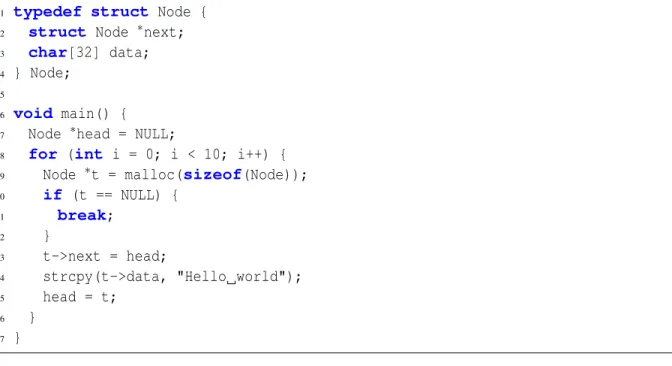
1 typedef struct Node { 2 struct Node ∗next; 3 char[32] data; 4 } Node;
5
6 void main() { 7 Node ∗head = NULL;
8 for (int i = 0; i < 10; i++) { 9 Node ∗t = malloc(sizeof(Node));
10 if (t == NULL) {
11 break;
12 }
13 t->next = head;
14 strcpy(t->data, "Hello world");
15 head = t;
16 } 17 }
Figure 3.2: This code creates a simple, volatile linked-list with 10 elements by adding new elements to the head of the list.
Applying Breeze to existing code comprises four steps (Figure 3.3). Programmers use the C macros from Table 3.1 to label persistent structures and pointers. Next, programmers define transaction boundaries and replace volatile memory management function calls with persistent counterparts. Then, Breeze’s compiler uses this information to log updates to NVM and generate code to recover from failures. Finally, programmers link the object files to Breeze’s user-level NVM library. Section 3.1.1, Section 3.1.2 and Section 3.1.3 provide examples of adding annotations, defining transaction boundraies and allocating NVM for the linked-list example. Section 3.1.4 presents the design of Breeze’s compiler.
3.1.1
Declaring Persistent Types and Pointers
The first step in adapting legacy code to use Breeze is annotating the data structures that will be persistent using the primitives in Table 3.1. Breeze feeds these annotations to its compiler in order to generate C functions that maintain reference count and referential integrity at
Declaring persistent types and pointers
Defining transaction boundaries and allocating NVM using Breeze APIs
Linking the object files to Breeze library
①
②
③
④
Compiling the code using Breeze
compiler
Figure 3.3: Four steps of applying Breeze to legacy software.
runtime and support failure recovery. It also exploits this information to prevent the creation of unsafe pointers from non-volatile to volatile memory and between non-volatile memory pools (i.e., contiguous regions of NVM that reside within memory-mapped files).
Figure 3.4 shows how we use these primitives for the linked-list example. The highlights show which lines needed to be changed to provide persistence.
The changes required to the code are modest. Breeze only requires annotating data structure declarations that only comprise a small portion of the source code, in order to provide pointer safety. In contrast to existing systems, Breeze does not require programmers to use special pointer types, inherit from a particular base class, or extend existing structures with new fields.
1 // declare persistent structure 2 typedef NVM STRUCT Node { 3 // declare persistent pointer 4 NVM PTR(struct Node) next; 5 char[32] data;
6 } Node;
Figure 3.4: Declaring persistent types and pointers using Breeze primitives.
3.1.2
Atomic Sections
Specifying actions that take a persistent data structure from one consistent state to another is a central requirement for a NVM programming system. This information, allows the system to restore the data structure to a consistent state in case of a failure. Breeze facilitates implementing ACID [36] transactions by providing atomicity, consistency and durability for all transactional updates to NVM. The toolchain automates logging and allows performing updates on the main version of persistent objects. Programmers are responsible for isolation, but, in most cases, legacy software already includes concurrency control. Breeze allows it to keep using the same mechanism.
Breeze allows programmers to declare transaction boundaries, and then it automatically generates undo-log entries for resulting atomic sections. Breeze’s transactional interfaces (Fig-ure 3.5) includenvm tx begin(),nvm tx commit()andnvm tx abort(). In contrast to other systems (e.g., Intel’s PMDK [44]), Breeze does not require the creation of log entries prior to updating NVM. Instead, the compiler generates necessary code to create undo-logs before every write to NVM. The design of Breeze’s compiler is presented in Section 3.1.4.
3.1.3
Allocation
Breeze provides programmers with primitives to create non-volatile pools and allocate persistent objects. Programmers usenvm pool create()andnvm pool open()to create and map a file containing a newly-initialized pool or map an existing pool into applications’ address
1 void main() {
2 size t pool size = (off t)1 << 20;
3 NVM POOL *pop = nvm pool create("/nvm/pool", pool size); 4 Node ∗head = NULL;
5 for (int i = 0; i < 10; i++) {
6 nvm tx begin(pop); // begin transaction
7 // allocate a new persistent object
8 Node *t = nvm alloc(pop, NVM TYPE ID(Node), sizeof(Node));
9 if (t == NULL) {
10 nvm tx abort(pop); // abort transaction
11 break;
12 }
13 t->next = head;
14 strcpy(t->data, "Hello world");
15 head = t;
16 // update the root pointer
17 nvm pool set root(pop, head);
18 nvm tx commit(pop); // commit transaction
19 }
20 nvm pool close(pop); 21 }
1 POBJ LAYOUT BEGIN(LinkList);
2 POBJ LAYOUT ROOT(LinkList, struct Node); 3 POBJ LAYOUT TOID(LinkList, struct Root); 4 POBJ LAYOUT END(LinkList);
5
6 typedef struct Node { 7 TOID(struct Node) next; 8 char[32] data;
9 } Node; 10
11 typedef struct Root { 12 TOID(struct Node) head; 13 } Root;
14
15 void main() {
16 size t pool size = (off t)1 << 20;
17
PMEMobjpool *pop = pmemobj create("/nvm/pool", POBJ LAYOUT NAME(LinkList), pool size, 0666);
18 TOID(Root) r = POBJ ROOT(pop, Root); 19 for (int i = 0; i < 10; i++) {
20 TX BEGIN(pop) { // begin transaction
21 // allocate a new persistent object
22 TOID(Node) t = TX ZALLOC(Node, sizeof(Node));
23 if (TOID IS NULL(t)) {
24 pmemobj tx abort(1); // abort transaction
25 }
26 D RW(t)->next = head;
27 strcpy(D RW(t)->data, "Hello world");
28 pmemobj persist(pop, D RW(t), sizeof(Node));
29 TX ADD(r); // create undo-log for root
30 D RW(r)->head = t;
31 pmemobj persist(pop, D RW(r), sizeof(Root));
32 }
33 TX END { } // commit transaction
34 }
35 pmemobj close(pop); 36 }
space, respectively. In case of failures, nvm pool open() also performs necessary recovery operations on the pool to ensure its consistency. Pools are self-contained and include all the information necessary for failure recovery.
Each pool has aroot pointerthat provides access to all the live objects in the pool. Persis-tent objects that are not reachable from theroot pointerare considered dead and are candidates for garbage collection. Programmers can modify the root pointer by callingnvm pool set root(). Programmers allocate space for persistent objects within a pool using nvm alloc(). Breeze provides transactional allocation and ensures allocated objects are reclaimed if the corre-sponding transaction aborts or the object is not referenced by any other persistent pointer.
The programmer can explicitly free a dead object withnvm free()(the call returns an error if the object is live). Callingnvm free()is not necessary, but it reduces the burden on the garbage collector.
Highlighted statements of Figure 3.5 shows how to use Breeze for the linked-list example from Figure 3.2 to create persistent pools, define atomic sections and transactionally allocate persistent objects.
When a program is finished with a pool, it can close the pool withnvm pool close(). This leaves the pool in a consistent state, so no recovery is necessary the next time an application opens it. Breeze closes all pools when the program exits.
3.1.4
Breeze’s Compiler
The Breeze compiler automatically inserts logging code and generates recovery code for data structures. Breeze’s compiler inserts logging code before each write to NVM. The compiler inserts a function call before each NVM write to invoke the undo-logging function implemented in Breeze’s user-level library.
NVM writes could also happen inside library functions. Breeze allows programmers to link the code to any pre-compiled library. The compiler inserts logging code before calling library
functions to create undo-log entries for NVM regions that the library function modifies. We describe the semantics and implementation details of Breeze’s compiler in Section 3.2.3.
In addition to automating the process of creating undo-logs, the compiler uses program-mers annotations introduced in Section 3.1.1 to generate code in order to maintain referential integrity of persistent objects, garbage collect unreachable regions and recover from failures. Section 3.2.6 and Section 3.2.7 discuss the role of Breeze’s compiler in maintaining referential integrity and performing garbage collection in more depth.
3.2
Implementation
We implemented Breeze as a C library and a C compiler under Linux. We have built Breeze’s compiler by extending the LLVM compiler infrastructure [59]. Breeze does not require special hardware support. Below we describe how Breeze lays out data in persistent pools, handles atomicity and data allocation, maintains referential integrity, and recovers from failures.
3.2.1
Storage Layout
Breeze organizes persistent objects into continuous regions of NVM called memory pools. We utilize filesystem’s naming mechanism to find memory pools after program restarts and
mmap()them to the program’s address space. Breeze requires the filesystem to provide direct access to NVM pages (i.e., DAX or page cache bypass) of memory-mapped files [61].
Memory pools are divided into six segments. The header segment, depicted in Figure 3.7, is the first page of a persistent memory pool and contains metadata about the pool as well as the offset of the root object.
Breeze stores programs’ data in the data segment located after the header segment. Breeze’s allocator is responsible for managing the data segment. The user-level library utilizes the next segments to store garbage collection data and the transaction log, discussed in Section 3.2.7
Pool
Size Header Size Data Size AddressBase UUID Version Generation Number ShutdownSafe Pointer Recovery Log OffsetRoot Magic Number Type ID Version Reference Count Generation Number Reserved Size
Figure 3.7: Storage layout of the pool header (top) and the object header (bottom).
and Section 3.2.3 respectively. In contrast to existing NVM programming systems such as PMDK and NVM-Direct, Breeze requires less space to store its metadata since it neither persists allocation tables nor stores additional information for persistent pointers [44, 12].
3.2.2
Memory Allocation and Management
Breeze provides transactional allocation semantics and avoids memory leaks through reference counting. Breeze’s user-level library implements a two phase protocol for allocat-ing/deallocating space for persistent objects:
• The library creates an undo-log entry in the pool’s transaction log area for allocation/free requests.
• If a transaction aborts, the library uses the undo-log entries to undo allocation/deallocation requests that correspond to the aborted transaction. The library discards the undo-log entries on transaction commit.
Breeze’s allocator uses per-thread allocation lists to minimize false sharing and cache contention [18]. It also organizes free persistent regions based on their sizes into different sub-lists in order to reduce allocation overhead and fragmentation [56].
Breeze does not store allocation state in persistent memory. Instead, it scans the pool during startup to find free regions and rebuild per-thread allocation lists. This enables faster allocation, and Breeze performs the recovery scan using multiple threads to minimize the cost. We also use the recovery scan to provide pointer safety and making sure persistent pointers remain valid throughout program restarts.
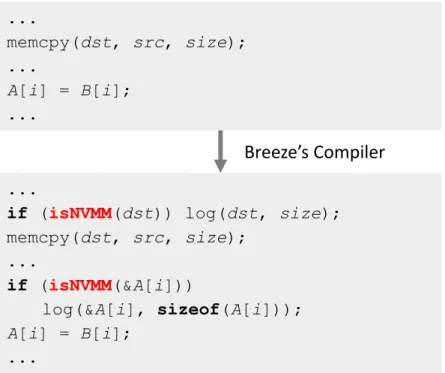
... memcpy(dst, src, size); ... A[i] = B[i]; ... ...
if (isNVMM(dst)) log(dst, size); memcpy(dst, src, size); ... if (isNVMM(&A[i])) log(&A[i], sizeof(A[i])); A[i] = B[i]; ...
Breeze’s
Compiler
Figure 3.8: Breeze’s compiler injects boundary check instructions before those memory writes the address of which is decided at runtime. The compiler does not add boundary checks before writes to heap-resident and stack-resident regions. During runtime, if the write operation aims to update a NVM region, Breeze’s undo-log function is invoked with the target address and size of the write operation.
3.2.3
Atomicity
Breeze’s compiler creates undo-log entries before allowing programs to modify persistent memory regions. In contrast to existing NVM systems that aim to provide easy to use atomicity, Breeze’s approach is applicable to all types of applications and does not require any hardware support, frequent switches between the user and kernel mode, or coarse-grain logging [39, 49, 102].
First, the compiler toolchain uses LLVM’s front-end (i.e.,clang) to generate LLVM IR code. Then, it identifies every instruction that could update a region of byte-addressable memory, either directly (e.g., store) or indirectly (e.g., function call). If the compiler has enough information about the memory region that the instruction updates to decide whether it resides in volatile or persistent memory, Breeze’s compiler ignores the instruction or generates undo-logging
code before the instruction, respectively. The undo-logging code calls to Breeze’s user-level library and provides its undo-log function with the address and size of the memory region. This function allocates space for the log entry, copies data from the memory region to the allocated space, ensures its persistence and updates the transaction metadata.
If the volatility or persistence of a memory region is unknown at compile time (e.g., func-tion arguments), the compiler inserts a call to Breeze’s user-level undo-logging funcfunc-tion before the instruction, however, a boundary check instruction precedes the function call to avoid unnecessar-ily invoking the undo-log function for volatile memory regions (see Figure 3.8). Breeze’s current implementation reserves a contiguous region of virtual address space for persistent memory pools at program startup and uses the lower-bound and upper-bound of this region to perform boundary checking. Figure 3.8 provides a brief explanation of how Breeze’s compiler works.
As long as programmers use Breeze’s compiler to compile the code, it can provide atomicity by inserting undo-logging code before the instructions that modify NVM. However, pre-compiled libraries can also modify persistent data and Breeze must log these changes as well. Section 3.2.4 explains how Breeze addresses this issue. We have also implemented a few optimization techniques to reduce the runtime cost of our atomicity technique. Section 3.2.5 briefly explains these techniques and offers insights for further optimizations.
3.2.4
Pre-Compiled Libraries
Breeze allows pre-compiled libraries to safely modify NVM, since recompiling third-party libraries is not always possible or desirable, especially for those libraries the source code of which is not publicly available. As the most majority of such library functions only modify memory regions referenced by pointers passed through their arguments, the compiler can insert logging code in user’s code and before the function call instruction. This technique enables Breeze to provide atomicity without requiring the programmer to recompile every piece of the program. Breeze’s current implementation logs changes to persistent data passed as arguments, which is all
![Table 3.5: Measuring the programming effort of incorporating Breeze and PMDK [44] with MongoDB [77] (Mongo) and Memcached [31] (Mcache) as an indicator of ease of use.](https://thumb-us.123doks.com/thumbv2/123dok_us/10173874.2919675/60.918.202.710.375.844/measuring-programming-incorporating-breeze-mongodb-memcached-mcache-indicator.webp)