E
LŻBIETAL
ITWINEK1, J
ERZYP
IĄTKOWSKI2, I
ZABELAD
OLNA1,
B
EATAK
OWALSKA−K
ROCHMAL1, A
NNAP
RZONDO−M
ORDARSKA1Tetracycline Resistance Mechanisms
of
Staphylococcus Aureus
Strains Isolated
from Patients in Wrocław*
Mechanizmy oporności na tetracyklinę u szczepów
Staphylococcus aureus
izolowanych od chorych z terenu Wrocławia
1Department of Microbiology, Silesian Piasts University of Medicine in Wrocław, Poland 2Institute of Genetics and Microbiology, University of Wrocław, Poland
Adv Clin Exp Med 2007, 16, 5, 619–628 ISSN 1230−025X
ORIGINAL PAPERS
© Copyright by Silesian Piasts University of Medicine in Wrocław
Abstract
Background.The mechanism of the antibacterial activity of tetracyclines consists in protein biosynthesis inhibi− tion. Resistance to these drugs is caused either by modification of tetracycline’s ribosomal target site or by the activity of efflux pumps which extrude the antibiotic from the bacterial cell. Reserpine is one of the known efflux pump inhibitors. It is unknown to what extent the efflux mechanism determines tetracycline resistance among the
S. aureus strains isolated from patients in Wrocław. The aim of this study was to identify transporters which remove
tetracycline from S. aureus cells.
Material and Methods.The level of tetracycline resistance was determined in S. aureusby serial antibiotic dilu− tions in solid media and by estimating MIC according to NCCLS guidelines. The tetracycline resistance genes
tet(K), tet(L), and tet(M), tet(O)were detected by PCR. Tetracycline accumulation in cells was measured using
a radioactively labeled form of it by a method described elsewhere.
Results.Of the tetracycline efflux pump genes, only tet(K)was identified. The second resistance determinant with regard to the frequency of occurrence wastet(M), wchich is responsible for a tetracycline target side modification In the strains with the efflux system, application of a pump inhibitor caused an increase in tetracycline accumula− tion in the cell. In contrast, the tetracycline cell concentration was decreased in the strains which did not possess the efflux mechanism.
Conclusions.In the patient−derived strains of S. aureus, efflux−dependent tetracycline resistance determined by the Tet(K) transporter was found to predominate. In the strains with a high level of tetracycline resistance, the trans− porter coexisted with Tet(M)protein, responsible for antibiotic target−site modification. A study using a radioiso− topic method indicated that another, as yet unknown pump for tetracycline removal exists in S. aureuscells (Adv Clin Exp Med 2007, 16, 5, 619–628).
Key words:antibiotic resistance, tetracycline, membrane transporters, tet(K), tet(M).
Streszczenie
Wprowadzenie. Mechanizm przeciwbakteryjnego działania tetracyklin polega na inhibicji biosyntezy białka. Oporność na tę grupę antybiotyków uS. aureusjest wywołana modyfikacją miejsca ich docelowego działania w ry− bosomie lub aktywnością pomp wyrzucających antybiotyk na zewnątrz komórki. Inhibitorem pomp jest m.in. re− zerpina. Nie ustalono, jak często mechanizm aktywnego wypływu decyduje o oporności na tetracykliny u szcze−
pów Staphylococcus aureusizolowanych od chorych z Wrocławia.
Cel pracy.Identyfikacja pomp usuwających tetracyklinę z komórek S. aureus.
Materiał i metody.Poziom oporności S. aureusna tetracyklinę określono metodą seryjnych rozcieńczeń antybio− tyku w podłożu stałym, ustalając wartość MIC antybiotyku wg zaleceń NCCLS. Obecność genów tet(K), tet(L)
oraz tet(M), tet(O)stwierdzono za pomocą techniki PCR. Wewnątrzkomórkową akumulację tetracykliny mierzo− no z użyciem znakowanego izotopowo antybiotyku wg metody opisanej przez Wondrack et al.
Tetracyclines comprise a group of bacteriosta− tic antibiotics which act as protein biosynthesis inhibitors by blocking aminoacyl−tRNA binding to a ribosomal acceptor site [1, 2]. Their broad antibacterial spectrum of action, involving both Gram−positive and Gram−negative bacteria, as well as the relatively low cost of therapy have been reasons for the excessive application of tetra− cyclines not only in humans, but also in animals and plants [1, 2]. A common negative consequence of the ubiquitous existence of sub−inhibitive con− centrations of these antibiotics in our environment currently observed is a decrease in their therapeu− tic efficiency. This is because some microorgan− isms have developed mechanisms of resistance to these compounds as a result of strong selective pressure and horizontal gene transfer, the primary source for which were probably Streptomyces as antibiotic bio−producers [2].
Staphylococcus aureus (SA) is a pathogenic species to humans which exhibits a high percent− age of tetracycline−resistant strains. This applies especially to methicillin−resistant SA strains (MRSA), in which a lack of tetracycline sensitivi− ty has been detected in over 75% of isolates, and to methicillin−sensitive strains (MSSA) isolated from both ambulatory and hospital patients among whom the resistance frequency attained no less than 15% [1].
So far, two main tetracycline resistance mech− anisms in Staphylococcus aureus have been described, each determined by the occurrence of mobile genetic elements such as plasmids and transposons [3]. The first is the efflux mechanism, which consists in active export of tetracycline from the cell with the assistance of the transport− ing proteins Tet(K) or Tet(L) located in the plasma membrane. These proteins, coded by the genes
tet(K)and tet(L), respectively, belong to the MFS transporter superfamily. Acting as a proton pump, they exchange the antibiotic/Mg+2 complexes in
the cytoplasm for H+ ions (antiport), which leads
to a decrease in the intracellular tetracycline con− centration and thus makes it difficult for the antibi− otic to attain the target sites located in ribosomes
[4–6]. The second mechanism governing tetracy− cline bacterial resistance is due to the ribosomal protection proteins Tet(M) and Tet(O), coded by the tet(M) and tet(O)genes, respectively. Attach− ment of either of these proteins to a ribosome dis− ables the antibiotic from attaching, thus preventing it from efficient protein biosynthesis inhibition. Both resistance mechanisms exhibit the inductive mode of action [2, 7].
The plant alkaloid reserpine as well as the compound carbonyl cyanide m−chlorophenyl hydrazone (CCCP) both restore the sensitivity of
S. aureusto tetracycline if the resistance is deter− mined by the efflux proteins coded by the tet(K)or
tet(L) genes [8, 9]. Unfortunately, these com− pounds are not applied in therapy because of their toxicity to the human organism. However, they are useful in in vitroresearch for determining to what extent the observed bacterial resistance is caused by the efflux mechanism [1].
The application of efflux inhibitors is justifi− able when the epidemiological situation regarding the resistance mechanisms in the population of tetracycline−resistant strains is known. Unfortu− nately, data about how frequently the efflux mech− anism occurs among S. aureusstrains have so far been very sparse in Poland. The aim of the study presented here was to test a series of tetracycline− resistant S. aureusstrains collected from hospital and ambulatory patients and to determine whether the efflux mechanism may be a significant cause of their resistance.
Material and Methods
One hundred twenty−nine strains were isolated as resistant or intermediate resistant to tetracycline from different materials (sputum, urine, upper and lower airway swabs, ear swabs, conjunctival sac swabs, wound swabs, genitourinary tract swabs) taken from patients from 2003 to 2004. The resis− tance level of S. aureus was determined by serial antibiotic dilutions in Mueller Hinton agar and MIC (minimum inhibitory concentration) estima− wowano zmniejszanie wewnątrzkomórkowego stężenia antybiotyku.
Wnioski.U szczepów S. aureusizolowanych z terenu Wrocławia dominującym mechanizmem oporności na tetra− cykliny jest aktywny wypływ antybiotyku zależny od transportera Tet(K). U szczepów wysoko opornych współ− występuje on z białkami Tet(M) modyfikującymi miejsce docelowego działania tej grupy antybiotyków. Badania izotopowe wskazują również na obecność w komórkach badanych szczepów innego nieznanego dotąd transporte− ra usuwającego tetracykliny (Adv Clin Exp Med 2007, 16, 5, 619–628).
tion according to the NCCLS guidelines [10]. The following criteria for tetracycline were used: MIC
≥16 µg/ml indicated a resistant strain, MIC = 8 µg/ml an intermediate−resistant strain, and and MIC ≤4 µg/ml a tetracycline−sensitive strain. The final MIC value was estimated on the basis of at least three measurements.
To identify strains with respect to resistance caused by the efflux pump, reserpine at a concen− tration of 20 µg/ml was applied as the pump inhibitor in media containing the antibiotic. The sensitive wild strains S. aureusATCC 29213 and
S. aureusATCC 25923 were used as a quality con− trol for the antimicrobial susceptibility testing.
The genetic tetracycline resistance determi− nants tet(K), tet(L), tet(M), and tet(O)were detect− ed using PCR. DNA was prepared as follows: three to five colonies from overnight culture on blood agar plates were suspended in 40 µl of dis− tilled water and boiled for 10 minutes. After cen− trifugation (13,000 rpm, 40 sec), the supernatant was applied as the DNA template (2.5 µl/reaction). Amplification was performed in the reaction mix− ture with a final volume of 50 µl according to the formula described previously [11] with modifica− tions using Tag PCR Core Kit (Qiagen). The res− pective primers, reaction conditions, and expected amplification product lengths are listed in Table 1. The initial denaturation was performed at 94°C for 3 min and the final elongation at 72°C for 5 min. The obtained products were separated, as shown in Fig. 1, in 1.2% agarose gel with ethidium bromide using the O’Range Ruler 200−bp DNA Ladder (Fermentas) as a molecular−weight marker.
Tetracycline efflux was measured by monitor− ing the antibiotic uptake into the log−phase S. aureuscells according to the formula described by Wondrack et al. [12]. The formula was modified in that after 30 min of antibiotic uptake, the reacting mixture was divided into two parts to which CCCP
or reserpine was added at final concentrations of 10 µg/ml and 20 µg/ml, respectively. The experi− ments were performed independently with three concentrations of radiolabeled tetracycline: 0.015 µg/ml, 0.044 µg/ml, and 0.15 µg/ml. The antibiot− ic, with a radioactivity of 1 Ci/mmol, was obtained from Perkin Elmer LAS, Inc. The radioactivity levels of filtered cells were counted by a Wallac 1409 Liquid Scintillation Counter and shown in CPMs (counts per minute).
Results
TheS. aureusstrains collected from microbio− logical laboratories in Wroclaw were tested for
Table 1. Primers and PCR conditions used to detect tetracycline resistance determinants
Tabela 1. Startery i warunki reakcji PCR zastosowane do wykrycia determinant oporności na tetracyklinę
Target gene Primer sequences No. of PCR PCR conditions PCR frag−
(Gen do− (Sekwencje startowe) cycles (Warunki reakcji PCR) ment size
celowy) (Liczba (Wielkość
cykli PCR) produktu
PCR)
tet(K) 5’ – TATTTTGGCT TTGTATTCTT TCAT – 3’ 35 1 min at 95°C, 1 min at 50°C, 1159 bp 5’ – GCTATACCTG TTCCCTCTGA TAA – 3’ 1 min 30 s at 72°C
tet(L) 5’ – ATAAATTGTT TCGGGTCGGT AAT – 3’ 35 1 min at 95°C, 1 min at 50°C, 1077 bp 5’ – AACCAGCCAA CTAATGACAA TGAT – 3’ 1 min 30 s at 72°C
tet(M) 5’ – AGTTTTAGCT CATGTTGATG – 3’ 35 1 min at 95°C, 1 min at 50°C, 1862 bp 5’ – TCCGACTATT TAGACGACGG – 3’ 1 min 30 s at 72°C
tet(O) 5’ – AGCGTCAAAG GGGAATCACT ATCC – 3’ 35 1 min at 95°C, 1 min at 55°C, 1723 bp
5’ – CGGCGGGGTT GGCAAATA – 3’ 1 min 30 s at 72°C
Fig. 1. Electrophoretic separation of PCR products for
an S. aureusstrain in which two tetracycline resistance
determinants, tet(K)and tet(M), were detected. M – molecular−weight marker. Lanes A–D: S. aureus43
their sensitivity to tetracycline and classified into several classes with respect to their resistance lev− els according to the scale described above. For the tetracycline−resistant strains, MIC values within the range of 16–128 µg/ml were obtained. Only one strain exhibited a lowered MIC value and was
The resistance experiment in the presence of reserpine allowed distinguishing strains which could be expected to have an efflux pump. This compound appeared to influence the tetracycline resistance levels of particular strains to different extents, which enabled classifying them into groups according to the criteria of: 1) the MIC obtained without reserpine and 2) the level of sen− sitivity restored by it (Table 3). The most numer− ous group (102 strains) comprised strains in which reserpine caused restoration of full sensitivity to tetracycline. Among these strains, the Tet(K) pump was identified as the only resistance deter− minant. A much smaller group of 22 strains was resistant and their MIC values were not modified by reserpine or modified very slightly (by factors of 2–4). These resistance phenotypes were caused by either the coexistence of more than one genetic determinant governing different resistance mecha− nisms or a mechanism connected only with the
tet(M) gene coding for the ribosome−protecting protein. The changes in MIC 50 values by reser− pine for particular classes of strains grouped according to their resistance levels show that the more times this compound decreases the resistance level, the lower the final MIC obtained.
Resistance MIC (µg/ml)1) No (%) of strains
phenotype (Liczba (%)
(Fenotyp szczepów) oporności)
R* 256 2 (1.5)
128 13 (10.1)
64 22 (17.0)
32 78 (60.5)
16 13 (10.1)
I* 8 1 (0.8)
1)MIC – minimal inhibitory concentration.
* according to the NCCLS guidelines: R – resistant (MIC ≥16 µg/ml), I – intermediate (MIC = 8 µg/ml), S – susceptible (MIC ≤4 µg/ml).
1)MIC – minimalne stężenie hamujące antybiotyku. * Według reguł NCCLS: R – oporny (MIC ≥16 µg/ml), I – zmniejszona wrażliwość (MIC = 8 µg/ml),
S – wrażliwy (MIC ≤4 µg/ml).
Table 3. Influence of reserpine on tetracycline resistance of S. aureusstrains
Tabela 3. Wpływ rezerpiny na tetracyklinooporność szczepów S. aureus
Phenotype MIC 50 MIC decrease No. (%) of strains Resistance determinants (Fenotyp) (µg/ml)3 (Zmniejszenie MIC) (Liczba (%) szczepów) (Determinanta oporności) T1 T + res2 T T + res
R* S* 32 0.125 256 × 4 (3.1) tet(K)
64 0.5 128 × 9 (6.9) tet(K)
32 0.5 64 × 22 (17.0) tet(K)
32 1 32 × 54 (41.9) tet(K)
16 1 16 × 12 (9.3) tet(K)
I* S 8 1 8 × 1 (0.8) tet(K)
R R 256 64 4 × 1 (0.8) tet(K), tet(M)
128 64 2 × 13 (10.0) tet(K), tet(M)
32 32 – 1 (0.8) tet(K), tet(M)
32 32 – 7 (5.4) tet(M)
1) Tetracycline. 2) Reserpine.
3) Minimal inhibitory concentration for ≥50% of strains.
* According to the NCCLS guidelines: R – resistant (MIC ≥16 µg/ml), I – intermediate (MIC = 8 µg/ml), S – sensitive (MIC ≤4 µg/ml).
1) Tetracyklina. 2) Rezerpina.
3) Minimalne stężenie hamujące dla ≥50% szczepów.
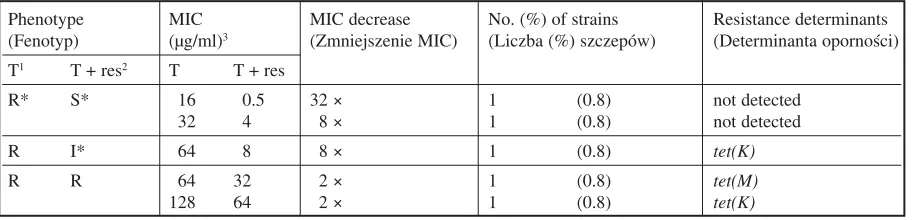
The phenotypes of five strains presented in Table 4 were unexpected. Two of the strains became susceptible to tetracycline in the presence of reserpine (MIC decreases by factors of 8 and 32) although no known genetic resistance determi− nant was recognized in those strains. Two other strains lacked tetracycline susceptibility in the presence of reserpine in spite of a detected Tet(K) pump and a decrease in the MIC value (by factors of 2 or 8).
The genetic analysis revealed that the majori− ty of the tetracycline−resistant strains (> 90%) which became more sensitive when reserpine was applied possessed an efflux pump−determining gene tet(K), which codes for the transporter pro− tein Tet(K). There was no other known tetracy− cline efflux pump gene identified in the tested strains. Tet(K) coexisted with Tet(M) in almost 12% of strains. This refers mainly to the strains having the highest resistance levels (MIC 128–256 µg/ml). The tet(L)and tet(O)genes were not iden− tified in any of the strains tested. In 6.2% of the strains only tet(M)occurred.
The results shown in Table 1 seem to provide satisfactory evidence for the existence of the tetra− cycline efflux mechanism in the collected strains of S. aureus. Direct evidence was obtained with the assistance of the radioisotopic method. In the first stage of experiments, three strains, i.e. 1) sen− sitive to tetracycline, 2) resistant to this antibiotic and possessing the efflux pump, and 3) resistant but lacking this pump, were tested for their cellu− lar ability to accumulate the radioactively labeled antibiotic in the presence or absence of reserpine.
The first was the wild type S. aureusATCC 25923 strain, the second the tetracycline−resistant
S. aureus133 strain in which tet(K)had been iden− tified, and the third the tetracycline−resistant
S. aureus105 strain lacking the pump. An antibi− otic concentration of 0.15 µg/ml was used in the reaction mixtures. The results of the tests are shown in Figure 2.
As can be inferred from the results in Figure 2a, the antibiotic accumulated in the wild−type strain in the absence of reserpine. A similar effect was observed in the resistant strain not possessing the efflux pump (Fig. 2c). This effect, however, was lowered by reserpine in both strains. An oppo− site effect was observed for the resistant strain (Fig. 2b) in which the pump is present: the intra− cellular antibiotic concentration did not rise with− in 10–40 min of incubation, although an increase was observed after 40 min. Reserpine stimulated the process of accumulation, unlike in the two other strains.
The inhibitory influence of reserpine on the tetracycline accumulation by the wild−type strain was intriguing. It was also interesting to determine why the antibiotic concentration rose significantly after 40 min of incubation. The question arises as to whether the extracellular concentration of the antibiotic is responsible for the rapid increase in its intracellular concentration. To answer this, experi− ments were performed in which the radioactively labeled tetracycline concentration was reduced to 0.044 µg/ml and another efflux pump inhibitor, CCCP, was applied instead of reserpine. It was interesting to find out if CCCP would exhibit a Tabela 4. Nieoczekiwana oporność na tetracyklinę u szczepów S. aureus
Table 4. Unexpected modes of resistance to tetracycline in S. aureusstrains
Phenotype MIC MIC decrease No. (%) of strains Resistance determinants
(Fenotyp) (µg/ml)3 (Zmniejszenie MIC) (Liczba (%) szczepów) (Determinanta oporności) T1 T + res2 T T + res
R* S* 16 0.5 32 × 1 (0.8) not detected
32 4 8 × 1 (0.8) not detected
R I* 64 8 8 × 1 (0.8) tet(K)
R R 64 32 2 × 1 (0.8) tet(M)
128 64 2 × 1 (0.8) tet(K)
1) Tetracycline. 2) Reserpine.
3) Because of the small number of strains, MIC 50 was not determined.
* According to the NCCLS guidelines: R – resistant (MIC ≥ 16 µg/ml), I – intermediate (MIC = 8 µg/ml), S – sensitive (MIC ≤ 4 µg/ml).
1) Tetracyklina. 2) Rezerpina.
3) Ze względu na małą liczbę szczepów nie oznaczono wartości MIC 50.
Fig. 2.Accumulation of tetracycline in cells of S. aureusstrains in the presence of reserpine: a– wild−type, sensitive to tetracycline, lacking the Tet(K) efflux pump; b– resistant, possessing the efflux pump; c– resistant, not possessing the efflux pump – another mechanism of resistance: Tet(M). The antibiotic concentration in the reaction mixture was 0.15 µg/ml
Ryc. 2. Akumulacja tetracykliny przez komórki S. aureus w obecności rezerpiny: a– typ dziki, wrażliwy na tetracy− klinę, niemający transportera Tet(K); b– oporny, mający pompę Tet(K) usuwającą ten antybiotyk; c– oporny, niema− jący tej pompy – inny mechanizm oporności: Tet(M). Antybiotyk w mieszaninie reakcyjnej występował w stężeniu 0,15 µg/ml
similar mode of inhibitory/stimulatory action as reserpine. Furthermore, if CCCP turned out to be able to identify the efflux system as effectively as reserpine, it should be more useful to consider the
obtained results because the molecular mechanism governing CCCP’s action is much better known than that of reserpine. The results of these experi− ments are shown in Figure 3.
0 500 1000 1500 2000 2500 3000 3500 4000 4500
0 10 20 30 40 50 60
w/o RES RES
time (min) czas (min)
0 500 1000 1500 2000 2500 3000 3500 4000 4500
0 10 20 30 40 50 60
w/o RES RES
time (min) czas (min)
0 500 1000 1500 2000 2500 3000 3500 4000 4500
0 10 20 30 40 50 60
time (min) czas (min)
w/o RES RES
a b c
Fig. 3.Accumulation of tetracycline in cells of S. aureusstrains in the presence of CCCP: a– wild−type, sensitive to tetracycline, lacking the Tet(K) efflux pump; b– resistant, possessing the efflux pump; c– resistant, not possessing the efflux pump – another resistance mechanism: Tet(M). The antibiotic concentration in the reaction mixture was 0.044 µg/ml
Ryc. 3. Akumulacja tetracykliny przez komórki S. aureus w obecności CCCP: a– typ dziki, wrażliwy na tetracyklinę, niemający transportera Tet(K); b– oporny, mający pompę usuwającą ten antybiotyk; c– oporny, niemający tej pompy – inny typ oporności: – Tet(M). Antybiotyk w mieszaninie reakcyjnej występował w stężeniu 0,044 µg/ml
S. aureus 25 923
(wild type)
0 300 600 900 1200 1500 1800 2100 2400 2700 3000
0 10 20 30 40 50 60
w/o CCCP CCCP
time (min) czas (min) CPM
S. aureus 133 (efflux)
0 300 600 900 1200 1500 1800 2100 2400 2700 3000
0 10 20 30 40 50 60
w/o CCCP CCCP
time (min) czas (min) CPM
S. aureus 105 (no−efflux resistance)
0 300 600 900 1200 1500 1800 2100 2400 2700 3000
0 10 20 30 40 50 60
w/o CCCP CCCP
time (min) czas (min) CPM
These results indicate that CCCP’s effect regarding antibiotic accumulation is almost identi− cal to that of reserpine. This compound reduced the tetracycline concentration inside the cells both in the wild−type strain (Fig. 3a) and in the resistant one with no efflux pump (Fig. 3c). As for the resis− tant strain with an active efflux system, CCCP sig− nificantly increased the antibiotic concentration inside the cells (Fig. 3b).
Even if a lower antibiotic concentration was applied, the antibiotic concentration inside the cells rapidly increased after 40 min of incubation. That is why the question arises whether this is only an extracellular tetracycline concentration−depen− dent effect or, perhaps, some other complex mech− anism governs this enhanced accumulation. To
answer this question, final supporting tests were performed using five strains differing in tetracy− cline resistance and efflux pump possession. The extra−cellular antibiotic concentration lowered again, this time to 0.015 µg/ml (Figs. 4 a–e).
As shown by the results gathered in Fig. 4, stimulation of antibiotic accumulation by CCCP occurred in each strain in which there was a Tet(K) efflux pump system (Figs. 4b, 4c). The strains lacking the efflux system reacted to CCCP in such a way that the antibiotic accumulation inside the cells significantly decreased (Figs. 4a, 4d, 4e). As for the range of accumulation after 40 min, a high− er increase in antibiotic concentration was noted in strain SA 150 (Fig. 4e), which had earlier been identified as resistant but lacking the efflux pump.
Fig. 4.Accumulation of tetracycline in cells of S. aureusstrains in the pres− ence of CCCP: a– wild−type, sensitive to tetracycline, lacking the Tet(K) efflux pump; b, c– resistant, possess− ing the efflux pump; d, e– resistant, not possessing the efflux pump – another resistance mechanism: Tet(M). The antibiotic concentration in the reaction mixture was 0.015 µg/ml
Ryc. 4. Akumulacja tetracykliny przez komórki S. aureus w obecności CCCP:
a– typ dziki, wrażliwy na tetracykli− nę, niemający transportera Tet(K);
b, c– oporny, mający pompę usuwają− cą ten antybiotyk; d, e– oporny, nie− mający tej pompy – inny typ oporno− ści: Tet(M). Antybiotyk w mieszaninie reakcyjnej występował w stężeniu 0,015 µg/ml
S. aureus 25 923 (wild type) 0 100 200 300 400 500 600 700 800 900 1000
0 10 20 30 40 50 60
w/o CCCP CCCP
time (min) czas (min) CPM
S. aureus 14 (efflux) 0 100 200 300 400 500 600 700 800 900 1000
0 10 20 30 40 50 60
w/o CCCP CCCP
time (min) czas (min) CPM
S. aureus 133 (efflux) 0 100 200 300 400 500 600 700 800 900 1000
0 10 20 30 40 50 60
w/o CCCP CCCP
time (min) czas (min) CPM
a b c
S. aureus 105 (no−efflux resistance) 0 100 200 300 400 500 600 700 800 900 1000
0 10 20 30 40 50 60
w/o CCCP CCCP
time (min) czas (min) CPM
S. aureus 150 (no−efflux resistance) 0 100 200 300 400 500 600 700 800 900 1000
0 10 20 30 40 50 60
w/o CCCP CCCP
time (min) czas (min) CPM
observed in strain SA 105, which was resistant but without the efflux system. In all experiments it was observed that after 10 min of incubation the antibiotic accumulation level in the strains pos− sessing an efflux pump was at least two times lower than in the remaining strains.
Discussion
The most frequent mechanism governing the resistance to tetracycline in the strains under investigation appeared to be the active efflux of the antibiotic performed by the Tet(K) pump (> 90% of strains). This can promote acquiring new resistance determinants (for example tet(M)) since the efflux system keeps a certain non−lethal level of antibiotic in the cells, which may favor the development of new resistance mechanisms. Most of the strains possessed only the efflux system as a resistance mechanism. The strains having the Tet(M) system occur infrequently and usually also possess the efflux system. All this would support the supposition that efflux is the original resistance mechanism promoting the selection of various other mechanisms. It is worth noting that presence of both systems (12% of strains) gives the highest level of resistance [1, 2].
The diverse influence of reserpine on the sen− sitivity of the tested strains to tetracycline proba− bly results from the fact that S. aureus strains dif− fer in the amount of genetic efflux determinant in their cells. The more copies of genes coding efflux proteins the cells possess, the higher their observed resistance level [13, 14]. This may explain why one of the strains having the tet(K)
gene was only intermediate resistant (MIC = 8 µg/ml). In this strain, reserpine lowered the MIC value only by a factor of eight. For much more resistant strains (MIC = 64–128 µg/ml, an expect− ed large number of copies), reserpine decreased MIC 128–256 times.
As for the strains which were still resistant after reserpine treatment, the ribosomal protecting mechanism (TetM) was present in all of them. In almost every strain the efflux system was also pre− sent. In these strains, reserpine did not influence the resistance to a significant degree. This may suggest that the ribosomeal protecting mechanism somehow dominates the efflux one.
The molecular study identified only the tet(K)
and tet(M)genes in the strains under investigation. There were no strains found in which tet(L) or
Table 4 compiles the results on untypical and unexpected types of strains. They indicate that reserpine changed two resistant strains to sensitive ones although a resistance−determining mecha− nism was lacking. This can be explained by the possible existence of another mechanism causing resistance to tetracycline, one that has not yet been discovered.
The mechanism governing tetracycline remo− val from S. aureus cells depends on the Tet(K) efflux pump, which exchanges the antibiotic for a proton in the antiport mode of translocation [16]. The concentration of antibiotic inside bacterial cells should be relatively low and stable when efflux is active. Since reserpine and CCCP are known to be efflux pump inhibitors, one could expect that in the presence of these factors the tetracycline concentration would increase during incubation inside resistant bacterial cells having the efflux system. CCCP interacts with the cell membrane as an ionophore which dissipates the proton gradient and lowers the proton motive force. This enables protons to move across the plasma membrane without the participation of ATP synthase [17].
The transport of tetracycline into the S. aureus
cells is dependent on the proton motive force, so CCCP should prevent the postulated active uptake of tetracycline into the cells [9]. The results of the experiments with the two higher concentrations of radiolabeled tetracycline support the hypothesis, showing a decreasing antibiotic accumulation in the strains devoid of the efflux pump. Ne− vertheless, the results obtained at the lowest extra− cellular antibiotic concentration throw a new light on the mechanism of tetracycline transport across the membrane. In the wild−type strain S. aureus
25923, the resistant strain SA 105 without the efflux pump, and another resistant strain, SA 150, not possessing the efflux system, the antibiotic concentration after treatment with CCCP signifi− cantly decreased with time inside the cells. This effect suggests that CCCP not only suppresses the system transporting tetracycline into the cells, but also stimulates a pump that removes this antibiot− ic in the extracellular direction.
the pump is apparently inactive. A combination of these two systems yields different phenotypes with regard to the sensitivity to tetracycline and the effect of reserpine and CCCP on the accumulation of the antibiotic over time. When only the Tet(K) pump acts, CCCP leads to a rise in the antibiotic’s accumulation because the pump is inhibited. In the absence of Tet(K) and the presence of the other pump, stimulated by CCCP, the concentration of the antibiotic decreases, as shown in Figs. 4 a, d, and e. The present authors postulate that the pump stimulated by CCCP is present in the wild−type sensitive strain, but is normally inactive. It is acti− vated by CCCP and reserpine.
Experiments performed with three different concentrations of radiolabeled tetracycline as well as the detection of the amount of antibiotic inside the cells over a 50−min period revealed one more interesting effect: after 40 minutes of cell incuba− tion in the presence of tetracycline at concentrations of 0.044 µg/ml and 0.15 µg/ml, the barrier keeping the antibiotic outside was destroyed, allowing the compound to flow massively into the cells.
The results shown in this paper could be an interesting basis for further investigations in which more detailed characteristics of the tetracycline transport process could be studied on chosen strains with the use of more sophisticated methods.
References
[1] Bryskier A: Tetracyclines. In: Antimicrobial agents – antibacterials and antifungals. Bryskier A (ed.), ASM Press, Washington DC 2005, 1st ed., pp. 642–651.
[2] Chopra I, Roberts M: Tetracycline antibiotics: mode of action, applications, molecular biology and epidemiolo− gy of bacterial resistance. Microbiol Mol Biol Rev 2001, 65, 232–260.
[3] Levy SB, McMurry LM, Barbosa TM, Burdett V, Courvalin P, Hillen W, Roberts MC, Rood JI, Taylor DE:
Nomenclature for new tetracycline resistance determinants. Antimicrob Agents Chemother 1999, 43, 1523–1524.
[4] Ginn SL, Brown MH, Skurray RA: Membrane topology of the metal−tetracycline/H+ antiporter TetA(K) from
Staphylococcus aureus. J Bacteriol 1997, 179, 3786–3789.
[5] Guay GG, Khan SA, Rothstein DM: The tet(K)gene of plasmid pT181 of Staphylococcus aureusencodes an efflux protein that contains 14 transmembrane helices. Plasmid 1993, 30, 163–166.
[6] Hirata T, Fujihira E, Kimura−Someya T, Yamaguchi A: Membrane topology of the Staphylococcal tetracycline efflux protein Tet(K) determined by antibacterial resistance gene fusion. J Biochem 1998, 124, 1206–1211.
[7] Connell SR, Tracz DM, Nierhaus KH, Taylor DE: Ribosomal protection proteins and their mechanism of tetra− cycline resistance. Antimicrob Agents Chemother 2003, 47, 3675–3681.
[8] Gibbons S, Udo EE:The effect of reserpine, a modulator of multidrug efflux pumps, on thein vitroactivity of tetracycline against clinical isolates of methicillin resistantStaphylococcus aureus(MRSA) possessing thetet(K) determinant. Phytother Res 2000, 14, 139–140.
[9] Hirata T, Wakatabe R, Nielsen J, Satoh T, Nihira S, Yamaguchi A:Screening of an inhibitor of the tetracy− cline efflux pump in a tetracycline−resistant clinical−isolate of Staphylococcus aureus743. Biol Pharm Bull 1998, 21, 678–681.
[10]National Committee for Clinical Laboratory Standard Institution: Methods for Dilution Antimicrobial Susceptibility Tests for Bacteria that Grow Aerobically; Approved Standard – Fifth Edition. NCCLS 2000, M7–A5.
[11] Trzciński K, Cooper BS, Hryniewicz W, Dowson HG:Expression of resistance to tetracyclines in strains of methicillin−resistant Staphylococcus aureus. J Antimicrob Chemother 2000, 45, 763–770.
[12] Wondrack L, Massa M, Yang BV, Sutcliffe J: Clinical strain of Staphyloccocus aureusinactivates and causes efflux of macrolides. Antimicrob Agents Chemother 1996, 40, 992–998.
[13] Reynolds E, Ross JI, Cove JH: Msr(A) and related macrolide/streptogramin resistance determinants: incomplete transporters? Int J Antimicrob Agents 2003, 22, 228–236.
[14] McDevitt D, Wann ER, Foster TJ:Recombination at the coagulase locus in Staphylococcus aureus: plasmid integration and amplification. J Gen Microbiol 1993, 139, 695–706.
[15] Schmitz FJ, Krey A, Sadurski R, Verhoef J, Milatovic D, Fluit AC:Resistance to tetracycline and distribution of tetracycline resistance genes in European Staphylococcus aureusisolates. J Antimicrob Chemother 2001, 47, 239–240.
[16] Jin J, Guffanti AA, Bechhofer DH, Krulwich TA: Tet(L) and tet(K) tetracycline−divalent metal/H+antiporters: characterization of multiple catalytic modes and a mutagenesis approach to differences in their efflux substrate and coupling ion preferences. J Bacteriol 2002, 184, 4722–4732.
T. Chałubińskiego 4 50−368 Wrocław Poland
Tel.: +48 691 05 25 62, 71 784 13 03 E−mail: [email protected]
Conflict of interest: None declared