DOI 10.1007/s00138-013-0577-y
O R I G I NA L PA P E R
A feature selection method using improved regularized linear
discriminant analysis
Alok Sharma
·
Kuldip K. Paliwal
·
Seiya Imoto
·
Satoru Miyano
Received: 1 January 2013 / Revised: 20 October 2013 / Accepted: 24 October 2013 / Published online: 9 November 2013 © Springer-Verlag Berlin Heidelberg 2013
Abstract
Investigation of genes, using data analysis and
computer-based methods, has gained widespread attention in
solving human cancer classification problem. DNA
microar-ray gene expression datasets are readily utilized for this
pur-pose. In this paper, we propose a feature selection method
using improved regularized linear discriminant analysis
tech-nique to select important genes, crucial for human cancer
classification problem. The experiment is conducted on
sev-eral DNA microarray gene expression datasets and
promis-ing results are obtained when compared with several other
existing feature selection methods.
Keywords
Linear discriminant analysis (LDA)
·
Regularized LDA
·
Feature/gene selection
·
Classification accuracy
1 Introduction
Feature selection methods play significant role in
identify-ing crucial genes related to human cancers. It helps in
under-standing the gene regulation mechanism of cancer
hetero-geneity. DNA microarray gene expression data, consisting
of several thousands of gene expression profiles, has been
used widely in the past for cancer classification problem
[
2
,
13
,
16
,
20
]. The high feature dimensionality (i.e., number
A. Sharma (B
)·S. Imoto·S. MiyanoLaboratory of DNA Information Analysis, University of Tokyo, Tokyo, Japan
e-mail: [email protected] A. Sharma·K. K. Paliwal
School of Engineering, Griffith University, Brisbane, Australia A. Sharma
School of Engineering and Physics, University of the South Pacific, Suva, Fiji
of gene expression profiles), compared to the low number
of samples, degrades the generalization performance of the
classifier and increases its computational complexity. This
problem is known as small sample size (SSS) problem [
11
].
These datasets along with feature selection methods provide
vital information and assistance in comprehending biological
and clinical characteristics. Since not all the genes are
asso-ciated to cancer classification task, it is necessary to remove
unimportant genes using feature selection or computational
data analysis methods.
Various feature selection methods have been developed [
3
,
4
,
7
,
9
,
12
,
13
,
15
,
21
,
23
–
25
,
27
–
31
,
36
,
37
,
39
,
41
,
43
,
44
],
which can be broadly categorized into two main groups: filter
methods and wrapper methods. The filter methods are
sifier independent whereas the wrapper methods are
clas-sifier dependent. Filter-based methods are computationally
economical and follow an open-loop approach: the
selec-tion of genes is independent of the classifier. Therefore, the
relevance of the extracted genes is obtained from a scoring
procedure that uses intrinsic properties of the genes’
expres-sion profiles. Wrapper-based methods (like SVM-RFE
1) can
provide high classification accuracy but are
computation-ally intensive and follow closed-loop approaches that depend
on the classifier for gene selection. Although wrapper-based
methods yield high classification accuracy, the gene sets they
select do not necessarily possess biologically or clinically
relevant attributes.
In this paper, we propose a feature selection method using
regularized linear discriminant analysis (RLDA) technique
[
10
]. This feature selection method falls under the filter
1 SVM-RFE [15] is a wrapper-based method. It is an iterative method which works backward from an initial set of features. The SVM aims to find maximum margin hyperplane between the two classes to minimize classification error using some kernel function.
method category as it does not require a classifier during
training process to select features.
RLDA technique is one of the few pioneering techniques
in the pattern classification literature. RLDA technique is
used in the cases where SSS exist. In RLDA, a small
per-turbation, known as the regularization parameter
α
, is added
to within-class scatter matrix S
W, to overcome SSS
prob-lem. The matrix S
Wis approximated by S
W+
α
I and the
orientation matrix is computed by eigenvalue decomposition
(EVD) of
(
S
W+
α
I
)
−1S
B, where S
Bis between-class
scat-ter matrix. RLDA has been applied in face recognition and
bioinformatics area [
5
,
6
,
14
]. In RLDA, it can be
computa-tionally expensive to find the optimum value of the
parame-ter
α
as heuristic approach (e.g. cross-validation procedure,
[
16
]) is applied. The value of the parameter could be sensitive
and noisy especially when the number of training samples is
scarce. In human cancer classification problem, the DNA
microarray gene expression datasets, usually have very
lim-ited number of training samples which could adversely affect
the classification performance of the RLDA technique.
In order to find the gene subset associated with human
can-cers, we first determine the value of
α
for RLDA technique
without using any heuristic approach. We call our procedure
as improved RLDA technique. We use improved RLDA
tech-nique recursively to obtain crucial genes important for cancer
classification task. The proposed feature selection method
has been applied on several DNA microarray gene
expres-sion datasets and promising results have been obtained.
In the past, SVM has also applied recursively in SVM-RFE
method [
15
] to select features. SVM-RFE is a wrapper-based
method. It is an iterative method which works backward from
an initial set of features. The SVM aims to find maximum
margin hyperplane between the two classes to minimize
clas-sification error using some kernel function. The selection of
features by SVM-RFE is computationally intensive. It has
some other drawbacks as well due to applying maximum
margin criterion between two classes [
46
]. On the other hand,
RLDA-based recursive feature selection method, separates
the two classes by (1) shrinking within class variance, and
(2) increasing the between class variance.
2 Basic descriptions
In this section, we describe the basic notations used in the
paper. Let X
= {
x
1,x
2, . . . ,x
n}
denote n training samples
(or feature vectors) in a d-dimensional space having class
labels
= {ω1, ω2, . . . , ω
n}
, where
ω
∈ {
1
,
2
, . . . ,
c
}
and c
is the number of classes. The dataset X can be subdivided into
c subsets X
1, X
2, . . .,X
c, where X
jbelongs to class j and
consists of n
jnumber of samples such that n
=
c
j=1n
j.
The data subset X
j⊂
X and X
1∪X
2∪· · · ∪X
c=
X. If
μ
j=
1
/
n
j∈
x is the centroid of X
jand
μ
=
1
/
n
∈
x
is the centroid of X, then the total scatter matrix S
T,
within-class scatter matrix S
Wand between-class scatter matrix S
Bare defined as [
8
,
18
,
19
,
33
–
35
,
45
]
S
T=
x∈X(
x
−
μ
)(
x
−
μ
)
T,
S
W=
c j=1 x∈Xj(
x
−
μ
j)(
x
−
μ
j)
T,
and S
B=
c
j=1n
j(
μ
j−
μ
)(
μ
j−
μ
)
T.
In SSS problem, d
>
n, which will make scatter matrices
singular. Let r
tbe the rank of S
Tmatrix. The eigenvector
decomposition of S
Tcan be given as
S
T=
[U
1,U
2]
T
0
U
T1U
T2,
(1)
where U
1∈
R
d×rtcorresponds to eigenvalues
T
and
U
2∈
R
d×(d−rt)corresponds to the zero eigenvalues. The
matrix U
1is the range space of S
Tand the matrix U
2is the
null space of S
T. Since the null space of S
Tdoes not contain
any discriminant information [
17
], the dimensionality can be
reduced from d-dimensional space to r
t-dimensional space
by applying principal component analysis (PCA) [
11
,
32
]
as a pre-processing step. The range space of S
Tmatrix,
U
1∈
R
d×rt, will be used as a transformation matrix. In the
reduced dimensional space the scatter matrices can be
com-puted by: S
W←
U
1TS
WU
1and S
B←
U
T1S
BU
1. After this
procedure S
W∈
R
rt×rtand S
B∈
R
rt×rtare reduced
dimen-sional within-class scatter matrix and reduced dimendimen-sional
between-class scatter matrix, respectively.
3 Improved RLDA technique for feature selection
In RLDA, the regularization of within-class scatter matrix S
Wis carried out by adding a perturbation term
α
to the diagonal
elements of S
W; i.e.,
S
ˆ
W=
S
W+
α
I. The addition of
α
will
make within-class scatter non-singular and invertible. This
would help to maximize the modified Fisher’s criterion
J
(
w
, α)
=
w
TS
Bw
w
T(
S
W+
α
I
)
w
,
(2)
where w
∈
R
rt×1is the orientation vector. In order to
avoid any heuristic approach in the determination of the
parameter
α
, we solve Eq.
2
in the following manner. Let
us denote function f
=
w
TS
Bw and a constraint function
g
=
w
T(
S
W+αI
)
w
−
c
=
0, where c
>
0 be any constant. To
find the constrained relative-maximum of function f under
constrained curve g, we can use the method of Lagrange
multipliers [
1
] as follows:
∂
f
∂
w
=
λ
∂
g
Table 1 Computation of the orientation matrix W using improved RLDA technique
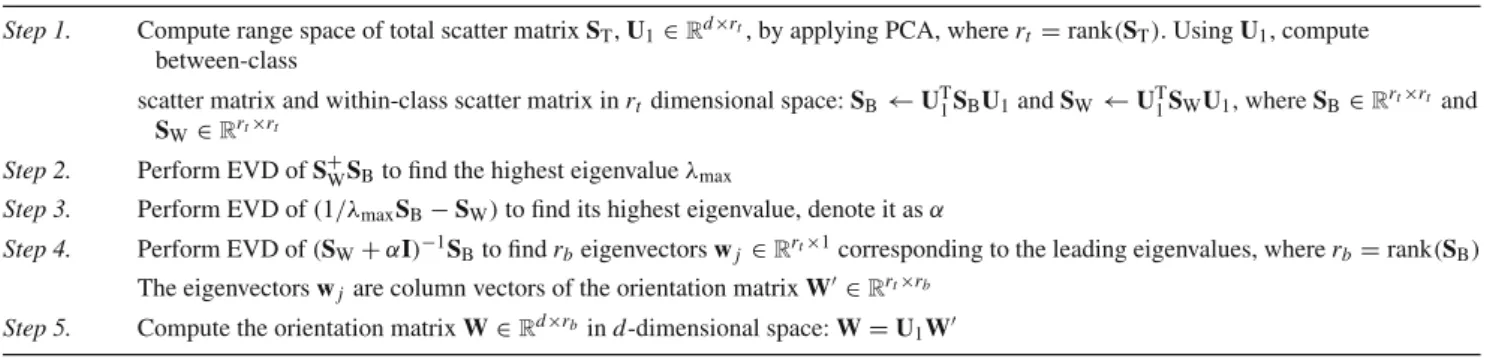
Step 1. Compute range space of total scatter matrix ST, U1∈Rd×rt, by applying PCA, where rt=rank(ST). Using U1, compute between-class
scatter matrix and within-class scatter matrix in rtdimensional space: SB←U1TSBU1and SW←UT1SWU1, where SB∈Rrt×rt and SW∈Rrt×rt
Step 2. Perform EVD of S+WSBto find the highest eigenvalueλmax
Step 3. Perform EVD of(1/λmaxSB−SW)to find its highest eigenvalue, denote it asα Step 4. Perform EVD of(SW+αI)−1S
Bto find rbeigenvectors wj∈Rrt×1corresponding to the leading eigenvalues, where rb=rank(SB) The eigenvectors wjare column vectors of the orientation matrix W∈Rrt×rb
Step 5. Compute the orientation matrix W∈Rd×rbin d-dimensional space: W=U
1W
where
λ
=
0 is the Lagrange’s multiplier. Equation
3
is
the Lagrange’s function where we are interested in finding
the parameters (w
, λ)
that maximizes function f under the
constrained curve g. Substituting f
=
w
TS
Bw and g
=
w
T(
S
W+
α
I
)
w
−
c in Eq.
3
, we get
2S
Bw
=
λ(
2S
Ww
+
2
α
w
),
or
1
λ
S
B−
S
Ww
=
α
w
.
(4)
The value of
α
w can be substituted in the constraint function
g, this will give us,
w
TS
Bw
=
λ
c
.
(5)
Also from the constraint function w
T(
S
W+
α
I
)
w
−
c
=
0,
we get w
TS
ˆ
Ww
=
c. Dividing this term in Eq.
5
, we get
λ
=
w
TS
Bw
w
TS
ˆ
Ww
.
(6)
We can observe the following things from Eq.
6
: 1) the
left-hand term is the Lagrange’s multiplier (in Eq.
4
), and 2)
the right-hand side is same as the Fisher’s modified criterion
defined in Eq.
2
. In order to obtain the value of
λ
in Eq.
6
,
we need to estimate
S
ˆ
W. If the matrix is not regularize (i.e.,
α
=
0
)
then
S
ˆ
W=
S
W. By this substitution, we can obtain
approximate value of
λ
by maximizing w
TS
Bw
/
w
TS
Ww.
Now to find the maximum value ow
TS
Bw
/
w
TS
Wwf, we
must have eigenvector w corresponding to the leading
eigen-value of S
−W1S
B. However, since S
Wis singular and
non-invertible, S
+Wcan be used in place of S
−W1, where S
+Wis the
pseudoinverse of S
W. From the EVD of S
+WS
B, we can find
λmax
which is the largest eigenvalue of S
+WS
B. The value of
λmax
can be substituted in Eq.
4
(where
λ
=
λmax)
, this will
enable us to find the value of
α
by doing EVD of
(
1λS
B−
S
W).
If r
b=
rank
(
S
B)then EVD of
(
1λS
B−
S
W)will give r
bfinite
eigenvalues. Since the leading eigenvalue will correspond to
the most discriminant eigenvector [
11
,
32
],
α
is taken to be
the leading eigenvalue. Once the value of
α
is determined,
the orientation vector w can be solved from
(
S
W+
α
I
)
−1S
Bw
=
γ
w
.
(7)
It can be shown from Lemma
1
that for improved RLDA
technique, its maximum eigenvalue is approximately equal
to the highest (finite) eigenvalue of Fisher’s criterion.
Lemma 1 The highest eigenvalue of improved RLDA is
approximately equivalent to the highest (finite) eigenvalue
of Fisher’s criterion.
Proof 1 From Eq.
7
,
S
Bw
j=
γ
j(
S
W+
α
I
)
w
j,
(8)
where
α
is the maximum eigenvalue of
(
1
/λmax
S
B−
S
W)(from Eq.
4
);
λmax
≥
0 is approximately the highest
eigen-value of Fisher’s criterion w
TS
Bw
/
w
TS
Ww (since
λmax
is
the largest eigenvalue of S
+WS
B)[
22
]; j
=
1
. . .
r
band
r
b=
rank
(
S
B). Substituting
α
w
=
(
1
/λmax
S
B−
S
W)w
(from Eq.
4
, where
λ
=
λmax)
into Eq.
8
, we get,
S
Bw
m=
γ
mS
Ww
m+
γ
m(
1
/λmax
S
B−
S
W)w
m,
or
(λmax
−
γ
m)
S
Bw
m=
0
where
γ
m=
max
(γ
j)
and w
mis the corresponding
eigen-vector. Since S
Bw
m=
0 (from Eq.
5
),
γ
m=
λmax
and
γ
j< λmax
, where j
=
m. This concludes the proof.
Corollary 1 The value of regularization parameter is
non-negative; i.e.,
α
≥
0 for r
w≤
r
t, where r
t=
rank
(
S
T)and
r
w=
rank
(
S
W).
Proof Please see Appendix C.
Computing Eq.
7
for all the values of
γ
will give the
ori-entation matrix W
∈
R
rt×rb,
having w as its column vectors.
The orientation matrix W is in r
t-dimensional space,
how-ever, it can be transformed to d-dimensional space by W
←
U
1W. Therefore, we get W
∈
R
d×rb. Let a column vector
w
∈
W be used to transform d-dimensional space to
one-dimensional space and x
∈
X be any feature vector, we have
y
=
w
Tx
,
or y
=
d i=1w
ix
i,
(9)
Table 2 The classification accuracy of various feature selection
methods using four distinct classifiers on the SRBCT dataset J4.8 (%) Naïve Bayes (%) kNN (%) SVM pairwise (%) Baseline accuracy 37 37 37 37 Information gain 68 68 90 90 Twoing rule 64 73 86 82 Sum minority 68 68 90 86 Max minority 46 78 90 90 Gini index 64 78 90 90 Sum of variances 54 64 90 86 t-statistic 54 64 90 86 One-dimensional SVM 54 64 90 86 Lasso 90 70 80 75 Filter MRMR 65 35 55 85 Improved RLDA 75 90 95 100
Table 3 The classification accuracy of various feature selection
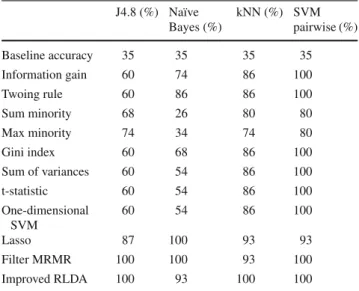
methods using four distinct classifiers on the MLL dataset J4.8 (%) Naïve Bayes (%) kNN (%) SVM pairwise (%) Baseline accuracy 35 35 35 35 Information gain 60 74 86 100 Twoing rule 60 86 86 100 Sum minority 68 26 80 80 Max minority 74 34 74 80 Gini index 60 68 86 100 Sum of variances 60 54 86 100 t-statistic 60 54 86 100 One-dimensional SVM 60 54 86 100 Lasso 87 100 93 93 Filter MRMR 100 100 93 100 Improved RLDA 100 93 100 100
where
w
iand x
iare the elements of w and x, respectively. It
can be envisaged that if
|w
ix
i| ≈
0 (where
| · |
is the absolute
value), then the i th element is not contributing for the value
of y in Eq.
9
; i.e., it can be discarded without sacrificing much
information. This concept can be extended for the orientation
matrix W and dataset X as
z
i=
rb k=1 n j=1|w
i kx
i j|
(10)
where i
=
1
,
2
, . . . ,
d. If z
i≈
0, then i th feature can be
discarded. Equation
10
can be applied recursively to discard
unimportant features as follows:
Table 4 The classification accuracy of various feature selection
methods using four distinct classifiers on the Acute Leukemia dataset J4.8 (%) Naïve Bayes (%) kNN (%) SVM pairwise (%) Baseline accuracy 71 71 71 71 Information gain 91 100 97 97 Twoing rule 91 97 97 97 Sum minority 91 97 97 97 Max minority 91 97 97 97 Gini index 91 97 97 97 Sum of variances 91 97 97 97 t-statistic 91 100 97 97 One-dimensional SVM 91 85 88 97 Lasso 91 94 85 91 Filter MRMR 65 71 74 86 Improved RLDA 94 94 85 100
Step 0. Define q
∈
(
n
,
d
)
2and set l
=
d.
Step 1. Compute W
∈
R
l×rb(see Table
1
).
Step 2. Compute z
iusing Eq.
10
for i
=
1
,
2
, . . . ,
l.
Step 3. Sort z
iin descending order; i.e., if s
=
sort
(
z
i)
then
s
1>
s
2>
· · ·
>
s
l.
Step 4. Discard least important feature corresponding to s
l.
Let the cardinality of the remaining feature set be
l
−
1 and data subset be X
l−1∈
R
l×n.
Step 5. Conduct X
←
X
l−1and l
←
l
−
1.
Step 6. Continue Steps 1-5 until l
=
q.
The above process will give q-features with the data subset
X
q∈
R
q×n, which can be used by a classifier to obtain
classification performance.
The computational requirement for Step 1 of the technique
(Table
1
) would be O
(
dn
2)
; for Step 2 would be O
(
n
3)
; for
Step 3 would be O
(
n
3)
; for Step 4 would be O
(
n
3)
; and, for
Step 5 would be O
(
dn
2)
. Therefore, the total estimated for
SSS case (d
n
)
would be O
(
dn
2)
. If the q features are
to be selected from the total d features then total estimated
computational complexity would be O
(
dn
2(
d
−
l
))
.
4 Experimentation
In this experiment, we have utilized three DNA microarray
gene expression datasets.
3The description of these datasets
is given as follows.
2 Since RLDA or Improved RLDA is a method for solving small sample size (SSS) problem, the value of q has to be in (n,d).
3 Most of the datasets are downloaded from the Kent Ridge Bio-medical Dataset (KRBD) (http://datam.i2r.a-star.edu.sg/datasets/ krbd/). The datasets are transformed or reformatted and made available
Table 5 The classification
accuracy as a function of the number of selected features of Improved RLDA and several feature selection methods using four distinct classifiers on the SRBCT dataset
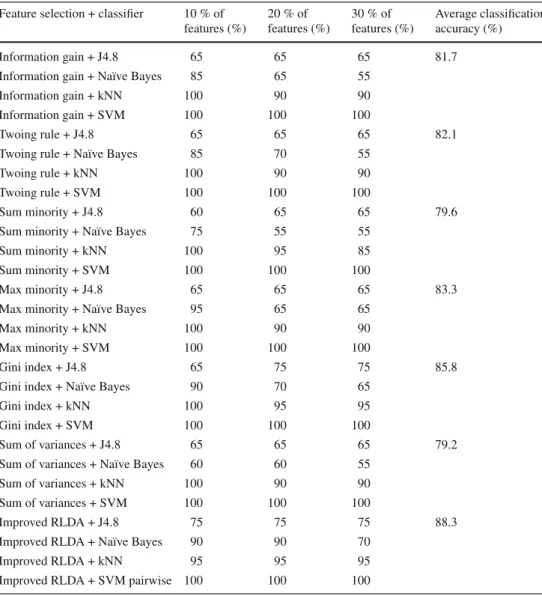
Feature selection + classifier 10 % of features (%) 20 % of features (%) 30 % of features (%) Average classification accuracy (%) Information gain + J4.8 65 65 65 81.7
Information gain + Naïve Bayes 85 65 55
Information gain + kNN 100 90 90
Information gain + SVM 100 100 100
Twoing rule + J4.8 65 65 65 82.1
Twoing rule + Naïve Bayes 85 70 55
Twoing rule + kNN 100 90 90
Twoing rule + SVM 100 100 100
Sum minority + J4.8 60 65 65 79.6
Sum minority + Naïve Bayes 75 55 55
Sum minority + kNN 100 95 85
Sum minority + SVM 100 100 100
Max minority + J4.8 65 65 65 83.3
Max minority + Naïve Bayes 95 65 65
Max minority + kNN 100 90 90
Max minority + SVM 100 100 100
Gini index + J4.8 65 75 75 85.8
Gini index + Naïve Bayes 90 70 65
Gini index + kNN 100 95 95
Gini index + SVM 100 100 100
Sum of variances + J4.8 65 65 65 79.2
Sum of variances + Naïve Bayes 60 60 55
Sum of variances + kNN 100 90 90
Sum of variances + SVM 100 100 100
Improved RLDA + J4.8 75 75 75 88.3
Improved RLDA + Naïve Bayes 90 90 70
Improved RLDA + kNN 95 95 95
Improved RLDA + SVM pairwise 100 100 100
SRBCT dataset [
20
] The small round blue-cell tumor
dataset consists of 83 samples with each having 2308 genes.
This is a four class classification problem. The tumors are
Burkitt lymphoma (BL), the Ewing family of tumors (EWS),
neuroblastoma (NB) and rhabdomyosarcoma (RMS). There
are 63 samples for training and 20 samples for testing. The
training set consists of 8, 23, 12 and 20 samples of BL, EWS,
NB and RMS, respectively. The test set consists of 3, 6, 6 and
5 samples of BL, EWS, NB and RMS, respectively.
MLL Leukemia dataset [
2
] This dataset has three classes
namely ALL, MLL and AML. The training set contains 57
leukemia samples (20 ALL, 17 MLL and 20 AML) whereas
Footnote 3 continuedby KRBD repository and we have used them without any further pre-processing. Some datasets which are not available on KRBD repository are downloaded and directly used from respective authors’ supplement link. The URL addresses for all the datasets are given in the Reference Section.
the test set contains 15 samples (4 ALL, 3 MLL and 8 AML).
The dimension of the MLL dataset is 12582.
Acute Leukemia dataset [
13
] This dataset consists of DNA
microarray gene expression data of human acute leukemia
for cancer classification. Two types of acute leukemia data
are provided for classification namely acute lymphoblastic
leukemia (ALL) and acute myeloid leukemia (AML). The
dataset is subdivided into 38 training samples and 34 test
samples. The training set consists of 38 bone marrow samples
(27 ALL and 11 AML) over 7129 probes. The test set consists
of 34 samples with 20 ALL and 14 AML, prepared under
different experimental conditions. All the samples have 7129
dimensions and all are numeric.
The classification performance of the proposed feature
selection method has been gauged by using the above
three datasets. Tables
2
,
3
and
4
show classification
accu-racy of the proposed method compared with several other
existing feature selection methods on the SRBCT, MLL
Table 6 The classification
accuracy as a function of the number of selected features of Improved RLDA and several feature selection methods using four distinct classifiers on the MLL dataset
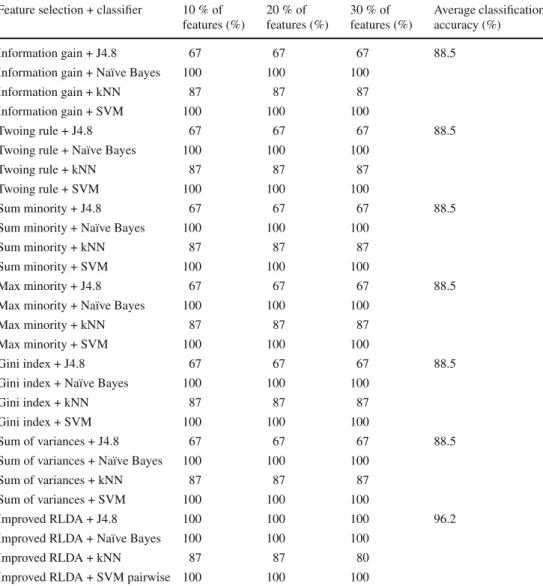
Feature selection + classifier 10 % of features (%) 20 % of features (%) 30 % of features (%) Average classification accuracy (%) Information gain + J4.8 67 67 67 88.5
Information gain + Naïve Bayes 100 100 100
Information gain + kNN 87 87 87
Information gain + SVM 100 100 100
Twoing rule + J4.8 67 67 67 88.5
Twoing rule + Naïve Bayes 100 100 100
Twoing rule + kNN 87 87 87
Twoing rule + SVM 100 100 100
Sum minority + J4.8 67 67 67 88.5
Sum minority + Naïve Bayes 100 100 100
Sum minority + kNN 87 87 87
Sum minority + SVM 100 100 100
Max minority + J4.8 67 67 67 88.5
Max minority + Naïve Bayes 100 100 100
Max minority + kNN 87 87 87
Max minority + SVM 100 100 100
Gini index + J4.8 67 67 67 88.5
Gini index + Naïve Bayes 100 100 100
Gini index + kNN 87 87 87
Gini index + SVM 100 100 100
Sum of variances + J4.8 67 67 67 88.5
Sum of variances + Naïve Bayes 100 100 100
Sum of variances + kNN 87 87 87
Sum of variances + SVM 100 100 100
Improved RLDA + J4.8 100 100 100 96.2
Improved RLDA + Naïve Bayes 100 100 100
Improved RLDA + kNN 87 87 80
Improved RLDA + SVM pairwise 100 100 100
and Acute Leukemia datasets, respectively.
4Four
classi-fiers from WEKA (
http://www.cs.waikato.ac.nz/ml/weka/
)
used are J4.8, Naïve Bayes, kNN (where k
=
1) and SVM
pairwise. The classification accuracy for the SRBCT and
MLL datasets is obtained from [
40
]. For all the datasets,
the features are ranked by Rankgene program [
38
]. The
Rankgene program computes the features for the following
feature selection methods: Information gain, Twoing rule,
Sum minority, Max minority, Gini index, Sum of variances,
t-statistic and one-dimensional SVM [
38
]. For all the datasets
150 genes are selected as selected by [
40
]. In addition, Lasso
[
42
] and filter MRMR [
26
] are used for feature selection. The
Lasso method deflates the collinearity effect on the features.
It produces sparse parameters that can be used to identify
4The cross-validation-based results are shown in Appendix A. The comparison of improved RLDA with different values of regularization parameter has been shown in Appendix B.
important genes. The number of features selected by Lasso
on SRBCT, MLL and Acute Leukamia is 38, 39 and 16,
5respectively. The filter MRMR method select features based
on maximal statistical dependency criterion based on mutual
information. It can be observed from Table
2
that the
pro-posed method achieves 75 % classification accuracy using
the J4.8 classifier; 90 % classification accuracy using the
Naïve Bayes classifier; 95 % classification accuracy using
the kNN classifier and 100 % classification accuracy by the
SVM pairwise classifier. In the three out of four cases, the
classification accuracy obtained by improved RLDA is the
highest. Similarly, the classification accuracy on the MLL
dataset (Table
3
) is the highest for improved RLDA in three
5 Note that for all the feature selection methods except Lasso method the number of selected features is 150 (in Tables2,3and4). The Lasso method itself obtains the optimal number of selected features and there-fore cannot be adjusted for a predefined number of selected features.
Table 7 The classification
accuracy as a function of the number of selected features of Improved RLDA and several feature selection methods using four distinct classifiers on the Acute Leukemia dataset
Feature selection + classifier 10 % of features (%) 20 % of features (%) 30 % of features (%) Average classification accuracy (%) Information gain + J4.8 91 91 91 90.6
Information gain + Naïve Bayes 97 100 100
Information gain + kNN 77 79 79
Information gain + SVM 97 94 91
Twoing rule + J4.8 91 91 91 89.1
Twoing rule + Naïve Bayes 94 97 97
Twoing rule + kNN 77 76 79
Twoing rule + SVM 97 91 88
Sum minority + J4.8 91 91 91 88.3
Sum minority + Naïve Bayes 94 97 97
Sum minority + kNN 77 73 73
Sum minority + SVM 97 91 88
Max minority + J4.8 91 91 91 89.2
Max minority + Naïve Bayes 94 97 97
Max minority + kNN 77 77 79
Max minority + SVM 97 91 88
Gini index + J4.8 91 91 91 88.0
Gini index + Naïve Bayes 94 97 97
Gini index + kNN 79 70 70
Gini index + SVM 97 91 88
Sum of variances + J4.8 91 91 91 89.2
Sum of variances + Naïve Bayes 94 97 97
Sum of variances + kNN 77 77 79
Sum of variances + SVM 97 91 88
Improved RLDA + J4.8 91 91 91 92.5
Improved RLDA + Naïve Bayes 97 100 100
Improved RLDA + kNN 88 79 82
Improved RLDA + SVM pairwise 97 97 97
out of four cases method when compared with several other
feature selection methods using four distinct classifiers. On
the Acute Leukemia dataset (Table
4
), the classification
accu-racy of improved RLDA is the highest for the J4.8 classifier
(94 %) and the SVM pairwise classifier (100 %). In total
of 12 cases (Tables
2
–
4
), improved RLDA is giving highest
results in eight cases. It can, therefore, be concluded that the
proposed method is exhibiting promising results.
Next, we considered different number of selected features
by Improved RLDA and several feature selection method,
and shown the evolution of the performance of the classifiers
with respect to the number of selected features. The results
are shown in Tables
5
,
6
and
7
. It can be observed from the
Tables
5
–
7
that in most of the cases the average
classifica-tion accuracy for Improved RLDA is consistently higher than
other feature selection methods.
Furthermore, we conducted experiments to see the
bio-logical significance of the selected features by the proposed
method. We use SRBCT data as a prototype to show the
biological significance using Ingenuity Pathway Analysis.
6The selected 150 features from the proposed algorithm are
6 Ingenuity Pathway Analysis (IPA) (http://www.ingenuity.com) is a software that helps researchers to model, analyze, and understand the complex biological and chemical systems at the core of life science research. IPA has been broadly adopted by the life science research community. IPA helps to understand complex ’omics data at multi-ple levels by integrating data from a variety of experimental platforms and providing insight into the molecular and chemical interactions, cel-lular phenotypes, and disease processes of the system. IPA provides insight into the causes of observed gene expression changes and into the predicted downstream biological effects of those changes. Even if the experimental data is not available, IPA can be used to intelligently search the Ingenuity Knowledge Base for information on genes, pro-teins, chemicals, drugs, and molecular relationships to build biologi-cal models or to get up to speed in a relevant area of research. IPA provides the right biological context to facilitate informed decision-making, advance research project design, and generate new testable hypotheses.
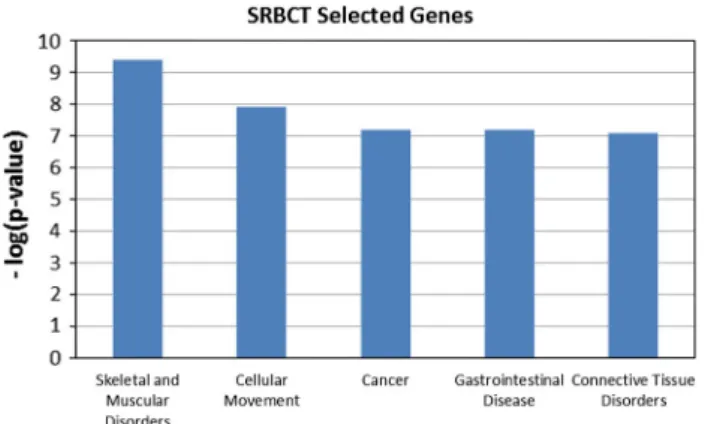
Fig. 1 Top five high-level biological function on selected 150 genes
of SRBCT by improved RLDA-based feature selection method
used for this purpose. Out of 150 genes, 10 genes were
found unmapped in IPA. The top five high-level biological
functions obtained are shown in Fig.
1
. In the figure, the
y axis denotes the negative of logarithm of p-values and
x axis denotes the high level functions. Since the cancer
function is of paramount interest, we investigated them
fur-ther. There are 61 cancer sub-functions obtained from the
experiment. Top 25 cancer sub-functions with significant
p-values are shown in Table
8
. In IPA, the p-value reflects the
enrichment of a given function to a set of focused genes.
The smaller the p-value is, the less likely that the
associ-ation is random, and the more significant the associassoci-ation.
In general p-values less than 0.05 indicate a statistically
significant, non-random association. The p-value is
calcu-lated using the right-tailed Fisher exact test (IPA, Available
at:
http://www.ingenuity.com
) [
28
,
29
]. In the table, the
p-values and the number of selected genes are depicted
cor-responding to the selected functions. The selected genes
by the proposed method provide significant p-values above
the threshold (as specified in IPA). This shows that the
features selected by the proposed method contain useful
information for discriminatory purpose and have biological
significance.
We have also carried out sensitivity analysis to check the
robustness of the proposed method. For this purpose, we use
the SRBCT dataset as a prototype and select top 100 genes.
After this selection, we contaminate the dataset by adding
Gaussian noise, then applied the method again to find the top
100 genes. The generated noise levels are 1, 2 and 5 % of the
standard deviation of the original gene expression values. The
number of genes which are common after contamination and
before contamination is noted. This contamination of data
and selection of genes are repeated 20 times. The average
number of genes over 20 iterations is depicted in Fig.
2
. It
can be observed from the figure that the proposed method is
able to capture the majority of the original genes in the noisy
environmental condition.
Table 8 Cancer sub-functions
Functions p value # Selected
genes Metastatic colorectal cancer 6.99E−08 12
Tumorigenesis 1.01E−07 62
Neoplasia 5.05E−07 59
Cancer 6.97E−07 58
Uterine cancer 2.87E−06 19
Benign tumor 3.75E−06 17
Leiomyomatosis 1.06E−05 12
Carcinoma 1.11E−05 47
Adenocarcinoma 1.81E−05 17
Gastrointestinal tract cancer 2.60E−05 24
Colorectal cancer 3.46E−05 22
Uterine leiomyoma 5.62E−05 10
Metastasis 6.11E−05 13
Genital tumor 6.69E−05 22
Prostate cancer 1.42E−04 16
Trisomy 8 myelodysplastic syndrome 2.25E−04 2 Central nervous system tumor 2.87E−04 10
Digestive organ tumor 3.21E−04 27
Breast cancer 3.41E−04 20
Brain cancer 4.28E−04 9
Leukemia 6.88E−04 11
Hematologic cancer 7.14E−04 14
Endometrial carcinoma 8.86E−04 8
Neuroblastoma 1.25E−03 5
Hematological neoplasia 1.38E−03 15
Endocrine gland tumor 1.42E−03 11
Tumorigenesis of carcinoma 1.54E−03 2
B-cell leukemia 1.68E−03 6
Entrance of tumor cell lines 2.04E−03 2
Endometrial cancer 2.12E−03 7
In order to check the sensitivity analysis with respect
to the classification accuracy, we contaminated the dataset
by adding Gaussian noise (as above) and selected 150
fea-tures using the improved RLDA technique. The
classifica-tion accuracy is obtained by using the SVM-pairwise
classi-fier. The results are shown in Table
9
. It can observed from
Table
9
that for low level noise the degradation in
classifi-cation performance is not enough. But when the noise level
increases the classification accuracy deteriorates (especially
on the MLL dataset and the Acute Leukemia dataset).
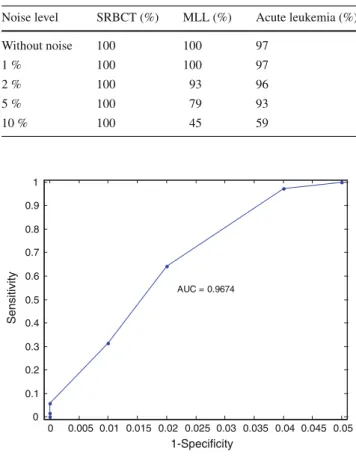
Next, we carried out experimentation to obtain ROC curve
and AUC analysis. For the ROC curve, we use
sensitiv-ity and specificsensitiv-ity as the two measures. The sensitivsensitiv-ity is
given as True Positive
/(
True Positive
+
False Negative
)
and
the specificity is given as True negative
/(
True Negative
+
False Positive
)
. We varied the noise level and select 150
84 86 88 90 92 94 96 98 100 1 2 3 4 5
Average number of common genes
Added noise in percentage
Fig. 2 Sensitivity analysis for the proposed feature selection method
on the SRBCT dataset at different noise levels. The y axis depicts the average number of common genes over 20 iterations and x axis depicts the added noise in percentage
Table 9 Sensitivity analysis with respect to classification accuracy on
the SRBCT, MLL and Acute Leukemia dataset
Noise level SRBCT (%) MLL (%) Acute leukemia (%)
Without noise 100 100 97 1 % 100 100 97 2 % 100 93 96 5 % 100 79 93 10 % 100 45 59 0 0.005 0.01 0.015 0.02 0.025 0.03 0.035 0.04 0.045 0.05 0 0.1 0.2 0.3 0.4 0.5 0.6 0.7 0.8 0.9 1 1-Specificity Sensitivity AUC = 0.9674
Fig. 3 The ROC curve
genes using improved RLDA and then use SVM-pairwise to
compute sensitivity and specificity. The ROC curve is shown
in Fig.
3
. This curve shows the trade-off between
sensitiv-ity and specificsensitiv-ity. The AUC provides the overall accuracy
and is a useful parameter for comparing the performance.
The high value of AUC parameter indicates high
accu-racy. The value of AUC is computed to be 0
.
9674 which is
promising.
5 Conclusion
In this paper, we presented a feature selection method using
improved regularized linear discriminant analysis technique.
Three DNA microarray gene expression datasets have been
utilized to see the performance of the proposed method. It
was observed that the method is achieving encouraging
clas-sification accuracy using small number of selected gene.
The biological significance has also been demonstrated by
performing functional analysis. Moreover, robustness of the
method was exhibited by conducting sensitivity analysis and
encouraging results are obtained. The sensitivity analysis
with respect to classification accuracy and ROC curve have
also been discussed.
Appendix A
In this section, we use cross-validation procedure to compute
average classification accuracy using four distinct classifiers
and the proposed feature selection method. Three datasets
have been used for this purpose are SRBCT, MLL and Acute
Leukemia. The classification accuracy using fold k
=
5 and
fold k
=
10 are given in Tables
10
,
11
and
12
. It can be
observed that the classification accuracy obtained by k-fold
cross-validation procedure is comparably similar to the
clas-sification accuracy obtained in Tables
2
-
4
.
Table 10 k-fold cross-validation using improved RLDA and four
dis-tinct classifiers on the SRBCT dataset
Fold J4.8 Naïve bayes kNN SVM pairwise
k=5 80 % 89 % 92 % 100 %
k=10 88 % 92 % 95 % 100 %
Table 11 k-fold cross-validation using improved RLDA and four
dis-tinct classifiers on the MLL dataset
Fold J4.8 Naïve bayes kNN SVM pairwise
k=5 91 % 94 % 94 % 95 %
k=10 87 % 93 % 95 % 97 %
Table 12 k-fold cross-validation using improved RLDA and four
dis-tinct classifiers on the Acute Leukemia dataset
Fold J4.8 Naïve bayes kNN SVM pairwise
k=5 91 % 97 % 87 % 94 %
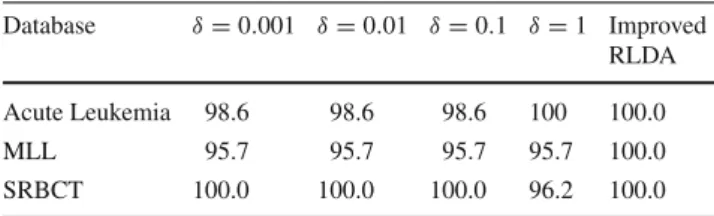
Table 13 Classification accuracy (in percentage) of RLDA and improved RLDA Database δ=0.001 δ=0.01 δ=0.1 δ=1 Improved RLDA Acute Leukemia 98.6 98.6 98.6 100 100.0 MLL 95.7 95.7 95.7 95.7 100.0 SRBCT 100.0 100.0 100.0 96.2 100.0
The highest classification accuracies obtained are depicted in bold fonts
Appendix B
In this appendix, we compare different values of
regulariza-tion parameter with the proposed improved RLDA technique.
In order to show this, we computed classification accuracy
on four different values of
α
for RLDA technique. These
are
δ
= [
0
.
001
,
0
.
01
,
0
.
1
,
1
]
, where
α
=
δ
∗
λW
and
λW
is
the maximum eigenvalue of within-class scatter matrix. We
applied threefold cross-validation procedure on a number of
datasets and shown the results in columns 2–5 of Table
11
.
The last column of the table denotes the classification
accu-racy using improved RLDA technique (Table
13
).
It can be observed from the table that the different
val-ues of the regularization parameter give different
classifica-tion accuracies and therefore, the choice of the regularizaclassifica-tion
parameter affects the classification performance. Thus, it is
important to select the regularization parameter correctly to
get the good classification performance. It can be observed
that for all the datasets, the proposed technique is exhibiting
promising results.
Appendix C
Corollary 1 The value of regularization parameter is
non-negative; i.e.,
α
≥
0 for r
w≤
r
t, where r
t=
rank
(
S
T)and
r
w=
rank
(
S
W).
Proof From Eq.
2
, we can write
J
=
w
TS
Bw
w
T(
S
W+
α
I
)
w
,
(11)
where S
B∈
R
rt×rtand S
W∈
R
rt×rt. We can rearrange the
above expression as
w
TS
Bw
=
J w
T(
S
W+
α
I
)
w
(12)
The eigenvalue decomposition (EVD) of S
Wmatrix
(assuming r
w<
r
t)
can be given as S
W=
U
2U
T,
where
U
∈
R
rt×rtis an orthogonal matrix,
2
=
2 w 0 0 0∈
R
rt×rtand
w
=
diag
(
q
12,
q
22, . . . ,
q
r2w)
∈
R
rw×rware
diago-nal matrices (as r
w<
r
t)
. The eigenvalues q
k2>
0 for
k
=
1
,
2
, . . . ,
r
w. Therefore,
S
W=
(
S
W+
α
I
)
=
UDU
T,
where D
=
2
+
α
I
or D
−1/2U
TS
WUD
−1/2=
I
(13)
The between class scatter matrix S
Bcan be transformed
by multiplying UD
−1/2on the right side and D
−1/2U
Ton
the left side of S
Bas D
−1/2U
TS
BUD
−1/2. The EVD of this
matrix will give
D
−1/2U
TS
BUD
−1/2=
ED
BE
T,
(14)
where E
∈
R
rt×rtis an orthogonal matrix and D
B
∈
R
rt×rtis a diagonal matrix. Equation
14
can be rearranged as
E
TD
−1/2U
TS
BUD
−1/2E
=
D
B,(15)
Let the leading eigenvalue of D
Bis
γ
and its corresponding
eigenvector is e
∈
E. Then Eq.
15
can be rewritten as
e
TD
−1/2U
TS
BUD
−1/2e
=
γ,
(16)
The eigenvector e can be multiplied right side and e
Ton left
side of Eq.
13
, we get
e
TD
−1/2U
TS
WUD
−1/2e
=
1
(17)
It can be seen from Eqs.
13
and
15
that matrix W
=
UD
−1/2E diagonalizes both S
Band S
W, simultaneously.
Also vector w
=
UD
−1/2e simultaneously gives
γ
and unity
eigenvalue in Eqs.
16
and
17
. Therefore, w is a solution of
Eq.
12
. Substituting w
=
UD
−1/2e in Eq.
12
, we get J
=
γ
;
i.e., w is a solution of Eq.
12
.
From Lemma
1
, the maximum eigenvalue of expression
(
S
W+
α
I
)
−1S
Bw
=
γ
w is
γ
m=
λmax
>
0 (i.e., real,
pos-itive and finite). Therefore, the eigenvectors corresponding
to this positive
γ
mshould also be in real hyperplane (i.e., the
components of the vector w have to have real values). Since
w
=
UD
−1/2e with w to be in real hyperplane, we must have
D
−1/2to be real.
Since D
=
2
+
α
I
=
diag
(
q
12+
α,
q
22+
α, . . . ,
q
r2w+
α, α, . . . , α)
, we have
D
−1/2=
diag
(
1
/
q
12+
α,
1
/
q
22+
α, . . . ,
1
/
q
2 rw+
α,
1
/
√
α, . . . ,
1
/
√
α).
Therefore, the elements of D
−1/2, must satisfy 1
/
q
k2+
α >
0 and 1
/
√
α >
0 for k
=
1
,
2
, . . . ,
r
w(note r
w<
r
t)
; i.e.,
α
cannot be negative or
α >
0. Furthermore, if r
w=
r
tthen
matrix S
Wwill be a non-singular matrix and its inverse will
exist. In this case, regularization is not required and therefore
α
=
0. Thus,
α
≥
0 for r
w≤
r
t. This concludes the proof.
References
1. Anton, H.: Calculus. Wiley, New York (1995)
2. Armstrong, S.A., Staunton, J.E., Silverman, L.B., Pieters, R., den Boer, M.L., Minden, M.D., Sallan, S.E., Lan-der, E.S., Golub, T.R., Korsemeyer, S.J.: MLL translocations
specify a distinct gene expression profile that distinguishes a unique leukemia. Nat. Genet. 30, 41–47 (2002). [Data Source1: http://sdmc.lit.org.sg/GEDatasets/Datasets.html] [Data Source2: http://www.broad.mit.edu/cgi-bin/cancer/publications/ pub_paper.cgi?mode=view&paper_id=63]
3. Banerjee, M., Mitra, S., Banka, H.: Evolutinary-rough feature selection in gene expression data. IEEE Trans. Syst. Man Cybern. Part C Appl. Rev. 37, 622–632 (2007)
4. Cong G., Tan K.-L., Tung A.K.H., Xu X.: Mining top-k cover-ing rule groups for gene expression data. In: The ACM SIGMOD International Conference on Management of Data, pp. 670–681 (2005)
5. Dai, D.Q., Yuen, P.C.: Regularized discriminant analysis and its application to face recognition. Pattern Recognit. 36(3), 845–847 (2003)
6. Dai, D.Q., Yuen, P.C.: Face recognition by regularized discriminant analysis. IEEE Trans. SMC 37(4), 1080–1085 (2007)
7. Ding, C., Peng, H.: Minimum redundancy feature selection from microarray gene expression data. J. Bioinf. Comput. Biol. 523–529 (2003)
8. Duda, R.O., Hart, P.E.: Pattern Classification and Scene Analysis. Wiley, New York (1973)
9. Dudoit, S., Fridlyand, J., Speed, T.P.: Comparison of discriminant methods for the classification of tumors using gene expression data. J. Am. Stat. Assoc. 97, 77–87 (2002)
10. Friedman, J.H.: Regularized discriminant analysis. J. Am. Stat. Assoc. 84(405), 165–175 (1989)
11. Fukunaga, K.: Introduction to Statistical Pattern Recognition. Aca-demic Press, London (1990)
12. Furey, T.S., Cristianini, N., Duffy, N., Bednarski, D.W., Schum-mer, M., Haussler, D.: Support vector machine classification and validation of cancer tissue samples using microarray expression data. Bioinformatics 16(10), 906–914 (2000)
13. Golub, T.R., Slonim, D.K., Tamayo, P., Huard, C., Gaasenbeek, M., Mesirov, J.P., Coller, H., Loh, M.L., Downing, J.R., Caligiuri, M.A., Bloomfield, C.D., Lander E.S.: Molecular classification of cancer: class discovery and class prediction by gene expression monitoring. Science 286, 531–537 (1999). [Data Source:http:// datam.i2r.a-star.edu.sg/datasets/krbd/]
14. Guo, Y., Hastie, T., Tibshirani, R.: Regularized discriminant analy-sis and its application in microarrays. Biostatistics 8(1), 86–100 (2007)
15. Guyon, I., Weston, J., Barnhill, S., Vapnik, V.: Gene selection for cancer classification using support vector machines. Mach. Learn.
46, 389–422 (2002)
16. Hastie, T., Tibshirani, R., Friedman, J.: The elements of statistical learning. Springer, NY (2001)
17. Huang, R., Liu, Q., Lu, H., Ma, S.: Solving the small sample size problem of LDA. Proc. ICPR 3, 29–32 (2002)
18. Huang, Y., Xu, D., Nie, F.: Semi-supervised dimension reduction using trace ratio criterion. IEEE Trans. Neural Netw. Learn. Syst.
23(3), 519–526 (2012)
19. Huang, Y., Xu, D., Nie, F.: Patch distribution compatible semi-supervised dimension reduction for face and human gait recogni-tion. IEEE Trans. Circuits Syst. Video Technol. 22(3), 479–488 (2012)
20. Khan, J., Wei, J.S., Ringner, M., Saal, L.H., Ladanyi, M., Wester-mann, F., Berthold, F., Schwab, M., Antonescu, C.R., Peterson, C., Meltzer, P.S.: Classification and diagnostic prediction of cancers using gene expression profiling and artificial neural network. Nat. Med. 7, 673–679 (2001). [Data Source:http://research.nhgri.nih. gov/microarray/Supplement/]
21. Li, J., Wong, L.: Using rules to analyse bio-medical data: a comparison between C4.5 and PCL. In: Advances in Web-Age Information Management, pp. 254–265. Springer, Berlin (2003)
22. Liu, J., Chen, S.C., Tan, X.Y.: Efficient pseudo-inverse linear dis-criminant analysis and its nonlinear form for face recognition. Int. J. Patt. Recogn. Artif. Intell. 21(8), 1265–1278 (2007)
23. Nie, F., Huang, H., Cai X., Ding, C.: Efficient and robust feature selection via joint l2,1-norms minimization, NIPS (2010) 24. Pan, W.: A comparative review of statistical methods for
discover-ing differentially expressed genes in replicated microarray experi-ments. Bioinformatics 18, 546–554 (2002)
25. Pavlidis, P., Weston, J., Cai, J. and Grundy, W.N.: Gene functional classification from heterogeneous data. In: International Confer-ence on Computational Biology, pp. 249–255 (2001)
26. Peng, H., Long, F., Dong, C.: Feature selection based on mutual information: criteria of max-dependency, max-relevance, and min-redundancy. IEEE Trans. Pattern Anal. Mach. Intell. 27(8), 1226– 1238 (2005)
27. Saeys, Y., Inza, I., Larrañaga, P.: A review of feature selection techniques in bioinformatics. Bioinformatics 23(19), 2507–2517 (2007)
28. Sharma, A., Imoto, S., Miyano, S.: A top-r feature selection algo-rithm for microarray gene expression data. IEEE/ACM Trans. Computat. Biol. Bioinf. 9(3), 754–764 (2012)
29. Sharma, A., Imoto, S., Miyano, S.: A between-class overlapping filter-based method for transcriptome data analysis. J. Bioinf. Com-putat. Biol. 10(5), 1250010-1–1250010-20 (2012)
30. Sharma, A., Imoto, S., Miyano, S., Sharma, V.: Null space based feature selection method for gene expression data. Int. J. Mach. Learn. Cybern. 3(4), 269–276 (2012). doi: 10.1007/s13042-011-0061-9
31. Sharma, A., Koh, C.H., Imoto, S., Miyano, S.: Strategy of finding optimal number of features on gene expression data. IEE. Electron. Lett. 47(8), 480–482 (2011)
32. Sharma, A., Paliwal, K.K.: Fast principal component analysis using fixed-point algorithm. Pattern Recognit. Lett. 28(10), 1151–1155 (2007)
33. Sharma, A., Paliwal, K.K.: Rotational linear discriminant analy-sis for dimensionality reduction. IEEE Trans. Knowl. Data Eng.
20(10), 1336–1347 (2008)
34. Sharma, A., Paliwal, K.K.: A gradient linear discriminant analysis for small sample sized problem. Neural Process. Lett. 27(1), 17–24 (2008)
35. Sharma, A., Paliwal, K.K.: A new perspective to null linear dis-criminant analysis method and its fast implementation using ran-dom matrix multiplication with scatter matrices. Pattern Recognit.
45, 2205–2213 (2012)
36. Sharma, A., Lyons, J., Dehzangi, A., Paliwal, K.K.: A feature extraction technique using bi-gram probabilities of position spe-cific scoring matrix for protein fold recognition. J. Theoret. Biol.
320(7), 41–46 (2013)
37. Sharma, A., Paliwal, K.K., Imoto, S., Miyano, S., Sharma, V., Ananthanarayanan, R.: A feature selection method using fixed-point algorithm for DNA microarray gene expression data. Int. J. Knowl. Based Intell. Eng. Syst. (2013, accepted)
38. Su, Y., Murali, T.M., Pavlovic, V., Kasif, S.: RankGene: identifica-tion of diagnostic genes based on expression data, Bioinformatics, pp. 1578–1579 (2003)
39. Tan, A.C., Gilbert, D.: Ensemble machine learning on gene expres-sion data for cancer classification. Appl. Bioinf. 2(3 Suppl), S75–83 (2003)
40. Tao, L., Zhang, C., Ogihara, M.: A comparative study of feature selection and multiclass classification methods for tissue classifica-tion based on gene expression. Bioinformatics 20(14), 2429–2437 (2004)
41. Thomas, J., Olson, J.M., Tapscott, S.J., Zhao, L.P.: An efficient and robust statistical modeling approach to discover differentially expressed genes using genomic expression profiles. Genome Res.
42. Tibshirani, R.: Regression shrinkage and selection via the lasso. J. R. Stat. Soc. B 58(1), 267–288 (1996)
43. Wang, A., Gehan, E.A.: Gene selection for microarray data analy-sis using principal component analyanaly-sis. Stat. Med. 24, 2069–2087 (2005)
44. Wu, G., Xu, W., Zhang, Y., Wei, Y.: A preconditioned conjugate gradient algorithm fo GeneRank with application to microarray data mining. Data Mining Knowl. Discov. (2011). doi:10.1007/ s10618-011-0245-7
45. Xu, D., Yan, S.: Semi-supervised bilinear subspace learning. IEEE Trans. Image Process. 18(7), 1671–1676 (2009)
46. Zhou, L., Wang, L., Shen, C., Barnes, N.: Hippocampal shape clas-sification using redundancy constrained feature selection. Medical Image Computing and Computer-Assisted Intervention, MICCAI 2010. In: Lecture Notes in Computer Science, vol. 6362, pp. 266– 273. Springer, Berlin (2010)
Author Biographies
Alok Sharma received the
BTech degree from the Univer-sity of the South Pacific (USP), Suva, Fiji, in 2000 and the MEng degree, with an academic excel-lence award, and the PhD degree in the area of pattern recog-nition from Griffith University, Brisbane, Australia, in 2001 and 2006, respectively. He was with the University of Tokyo, Japan (2010–2012) as a research fel-low. He is an Associate Prof. at the USP and an Adjunct Asso-ciate Prof. at the Institute for Inte-grated and Intelligent Systems (IIIS), Griffith University. He partici-pated in various projects carried out in conjunction with Motorola (Syd-ney), Auslog Pty., Ltd. (Brisbane), CRC Micro Technology (Brisbane), the French Embassy (Suva) and JSPS (Japan). His research interests include pattern recognition, computer security, human cancer classi-fication and protein fold and structural class prediction problems. He reviewed several articles and is in the editorial board of several journals.
Kuldip K. Paliwal received the
B.S. degree from Agra Univer-sity, Agra, India, in 1969, the M.S. degree from Aligarh Mus-lim University, Aligarh, India, in 1971 and the Ph.D. degree from Bombay University, Bom-bay, India, in 1978. He has been carrying out research in the area of speech processing since 1972. He has worked at a number of organizations includ-ing Tata Institute of Fundamental Research, Bombay, India, Nor-wegian Institute of Technology, Trondheim, Norway, University of Keele, U.K., AT & T Bell ratories, Murray Hill, New Jersey, U.S.A., AT & T Shannon Labo-ratories, Florham Park, New Jersey, U.S.A., and Advanced Telecom-munication Research Laboratories, Kyoto, Japan. Since July 1993, he has been a professor at Griffith University, Brisbane, Australia, in the School of Microelectronic Engineering. His current research interests include speech recognition, speech coding, speaker recognition, speech enhancement, face recognition, image coding, bioinformatics, protein
fold and structural class prediction problems, pattern recognition and artificial neural networks. He has published more than 300 papers in these research areas. Prof. Paliwal is a Fellow of Acoustical Society of India. He has served the IEEE Signal Processing Society’s Neural Networks Technical Committee as a founding member from 1991 to 1995 and the Speech Processing Technical Committee from 1999 to 2003. He was an Associate Editor of the IEEE Transactions on Speech and Audio Processing during the periods 1994–1997 and 2003–2004. He also served as Associate Editor of the IEEE Signal Processing Let-ters from 1997 to 2000. He was the editor-in-chief of Speech Com-munication Journal from 2005 to 2011. He is in the editorial board of IEEE Signal Processing Magazine. He was the General Co-Chair of the Tenth IEEE Workshop on Neural Networks for Signal Processing (NNSP2000).
Seiya Imoto is currently an Associate Professor of Human Genome Center, Institute of Medical Science, University of Tokyo. He received the B.S., M.S., and Ph.D. degrees in math-ematics from Kyushu University, Japan, in 1996, 1998 and 2001, respectively. His current research interests cover statistical analy-sis of high-dimensional data by Bayesian approach, biomedical information analysis, microar-ray gene expression data analy-sis, gene network estimation and analysis, data assimilation in biological networks and computational drug target discovery.
Satoru Miyano is a
Profes-sor of Human Genome Cen-ter, Institute of Medical Sci-ence, University of Tokyo. He received the B.S., M.S. and Ph.D. degrees all in mathematics from Kyushu University, Japan, in 1977, 1979 and 1984, respec-tively. His research group is developing computational meth-ods for inferring gene networks from microarray gene expression data and other biological data, e.g., protein-protein interactions, promoter sequences. The group also developed a software tool, Cell Illustrator, for modeling and sim-ulation of various biological systems. Currently, his research group is intensively working for developing the molecular network model of lung cancer by time-course gene expression and proteome data. With these technical achievements, his research direction is now heading toward a creation of Systems Pharmacology. He is Associate Editor of PLoS Computational Biology; IEEE/ACM Transactions on Computa-tional Biology and Bioinformatics; and, Health Informatics. He was Associate Editor of Bioinformatics during 2002–2006 and 2007–2009. He is Editor of Journal of Bioinformatics and Computational Biology; Lecture Notes in Bioinformatics; Advances in Bioinformatics; Jour-nal of Biomedicine and Biotechnology; InternatioJour-nal JourJour-nal of Bioin-formatics Research and Applications (IJBRA); Immunome Research; Theoretical Computer Science; Transactions on Petri Nets and Other Models of Concurrency (ToPNoC); and, New Generation Computing. He is Editor-in-Chief of Genome Informatics. He is recipient of IBM Science Award (1994) and Sakai Special Award (1994).