Social network, social trust and shared goals in organizational knowledge sharing
Wing S. Chow
*
, Lai Sheung Chan
Department of Finance and Decision Sciences, School of Business, Hong Kong Baptist University, Waterloo Road, Kowloon Tong, Hong Kong
1. Introduction
Today, a firm’s employees must share their knowledge; indeed, such activities have become a competitive necessity. However sharing is hard to ensure, because knowledge is generated and initially stored within the employees. Early initiatives in knowl-edge management focused on providing electronic databases, network systems, and software to encourage the distribution of knowledge but these mechanisms have proved far from satis-factory. More recent efforts have focused on socio-cognitive approaches to motivate behavior that would help in promoting knowledge sharing, including factors such as incentive rewards, trust, relationships, etc.
Knowledge sharing involves a set of behaviors that aid the exchange of acquired knowledge. A firm can be considered to be a social community creating, sharing and transferring explicit and tacit knowledge. The main objective of knowledge management is thus to turn individual knowledge into organizational knowledge [12,15]. But what makes organizational members willing to share their knowledge? Some studies have shown, by applying the theory of reasoned action (TRA), that success depends on a combination of volition and leadership. Extrinsic rewards, anticipated reciprocal relationships, a sense of self-worth, and organizational climate encourage sharing of knowledge; Wong et al.[25]suggested that building a long-term positive relationship with employees helped generate organizational knowledge. Ramasamy et al.[17]showed
statistically that relationship building played a significant role in knowledge sharing between organizations. Many authors have also theorized that social capital contributes to knowledge sharing, while research has shown that such behavior is based on employees’ volition to share and perceived social pressure from the organiza-tion. Thus, we wanted to consider whether social capital played the same role in both decision functions. And, if so, which social capital factors had the greater influence. The objectives of our study were thus to (1) study how to quantify social capital, and (2) develop a theoretical framework to confirm that social capital factors had a significant impact on knowledge sharing.
Our theoretical framework therefore examined the influence of the role played by social capital factors of organizational members that would increase or decrease their voluntary knowledge sharing, and influence it through behavioral change.
2. Theoretical background
Our model was based on social capital factors and the TRA model.
2.1. Knowledge
Knowledge can be considered eithertacitorexplicit. Here, we considered both to be equally important parts of organizational knowledge.
2.2. Social capital
Social capital exists in the relationships between people[16]. It has been used to explain a variety of pro-social behaviors, like A R T I C L E I N F O
Article history:
Received 17 January 2007
Received in revised form 13 February 2008 Accepted 5 June 2008
Available online 13 August 2008 Keywords:
Knowledge sharing Social capital
Theory of reasoned action Confirmatory factor analysis
A B S T R A C T
The aim of our study was to further develop an understanding of social capital in organizational-knowledge-sharing. We first developed a measurement tool and then a theoretical framework in which three social capital factors (social network, social trust, and shared goals) were combined with the theory of reasoned action; their relationships were then examined using confirmatory factoring analysis. We then surveyed of 190 managers from Hong Kong firms, we confirm that a social network and shared goals significantly contributed to a person’s volition to share knowledge, and directly contributed to the perceived social pressure of the organization. The social trust has however showed no direct effect on the attitude and subjective norm of sharing knowledge.
ß2008 Elsevier B.V. All rights reserved.
* Corresponding author. Tel.: +852 3411 7582; fax: +852 3411 5585. E-mail addresses:[email protected](W.S. Chow),
[email protected](L.S. Chan).
Contents lists available atScienceDirect
Information & Management
j o u r n a l h o m e p a g e : w w w . e l s e v i e r . c o m / l o c a t e / i m0378-7206/$ – see front matterß2008 Elsevier B.V. All rights reserved. doi:10.1016/j.im.2008.06.007
collective action and community involvement. Coleman [3] claimed that it helped in promoting actions between persons or corporations.
Social capital comes with many attributes have been collected into three clusters: structural, relational, and cognitive. The structural dimension [5] involves social and network relations whose connections define who can be reached and how; factors in this dimension measure the network pattern, density, connectiv-ity, and hierarchy[20]. Therelationaldimension describes the level of trust between people developed during interactions: norms, obligations, trust, and identification raise awareness of actors toward their collective goals. The cognitive dimension refers to resources increasing understanding between parties. Wasko and Faraj [24] claimed that knowledge sharing required shared understanding; for example, shared culture and goals were important factors.
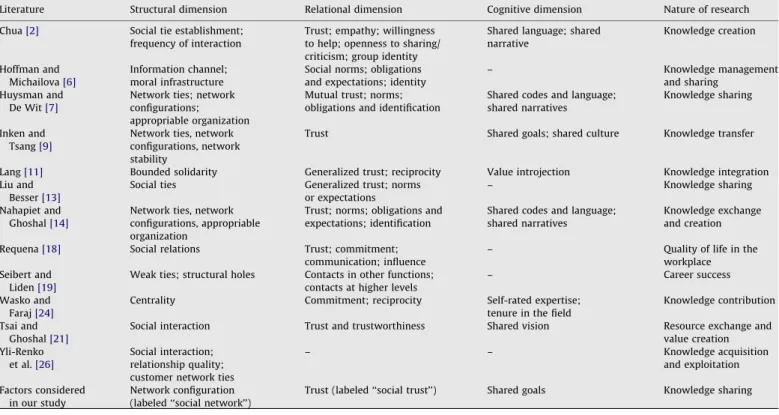
Table 1shows important literature in these three dimensions the last row indicates the equivalent social capital factor of our study. It is shows that network configuration, trust, and shared goals were used to measure the performance of the structural, the relational and the cognitive dimensions. We adopted these three social factors to represent the three dimensions of social capital with ‘‘network configuration’’ renamed as ‘‘social network’’ and ‘‘trust’’ as ‘‘social trust’’.
2.3. Theory of reasoned action (TRA)
TRA [4] states: (1) the more favorable the attitude of an individual toward a behavior, the stronger will be the intention of the individual to engage in the behavior; (2) the greater the subjective norm, the stronger the intention of the individual to perform the behavior; and (3) the stronger the intention of the individual to engage in a behavior, the more likely the individual will be to perform it. TRA has been successfully applied in many
research studies in social psychology, knowledge management, medical studies, and IT adoption[8].
3. The research model and hypotheses
Fig. 1shows our research model, which integrated social capital factors with the TRA. In an organizational context, people establish many direct contacts with others if the organizational structure is flat and decentralized. In our study, the social network provided increased opportunities for interpersonal contact. People had more positive feelings about sharing ideas and resources with those with whom they had developed a close relationship. This lead to our first hypothesis:
H1. The more extensive the social network among organizational members, the more favorable will be the attitude toward knowl-edge sharing.
Organizational members who had a more extensive social network with their colleagues would perceive greater social pressure for sharing their knowledge, because a good relationship results in high expectations of colleagues, including favorable actions. Thus, people who build a social network may be expected to share their knowledge. This lead to our second hypothesis: H2. The more extensive the social network among organizational members, the more favorable will be the subjective norm with respect to knowledge sharing.
Many studies have suggested that social trust or mutual trust among members is one of many factors critical to the success of knowledge sharing. Social trust in an organization improves interactions between colleagues; people want not only to learn from each other and share their knowledge. This lead to our third hypothesis:
Table 1
Literature involving social capital factors
Literature Structural dimension Relational dimension Cognitive dimension Nature of research
Chua[2] Social tie establishment;
frequency of interaction
Trust; empathy; willingness to help; openness to sharing/ criticism; group identity
Shared language; shared narrative Knowledge creation Hoffman and Michailova[6] Information channel; moral infrastructure
Social norms; obligations and expectations; identity
– Knowledge management
and sharing Huysman and
De Wit[7]
Network ties; network configurations;
appropriable organization
Mutual trust; norms; obligations and identification
Shared codes and language; shared narratives
Knowledge sharing
Inken and Tsang[9]
Network ties, network configurations, network stability
Trust Shared goals; shared culture Knowledge transfer
Lang[11] Bounded solidarity Generalized trust; reciprocity Value introjection Knowledge integration
Liu and Besser[13]
Social ties Generalized trust; norms
or expectations
– Knowledge sharing
Nahapiet and Ghoshal[14]
Network ties, network configurations, appropriable organization
Trust; norms; obligations and expectations; identification
Shared codes and language; shared narratives
Knowledge exchange and creation
Requena[18] Social relations Trust; commitment;
communication; influence
– Quality of life in the
workplace Seibert and
Liden[19]
Weak ties; structural holes Contacts in other functions; contacts at higher levels
– Career success
Wasko and Faraj[24]
Centrality Commitment; reciprocity Self-rated expertise;
tenure in the field
Knowledge contribution Tsai and
Ghoshal[21]
Social interaction Trust and trustworthiness Shared vision Resource exchange and
value creation Yli-Renko
et al.[26]
Social interaction; relationship quality; customer network ties
– – Knowledge acquisition
and exploitation Factors considered
in our study
Network configuration (labeled ‘‘social network’’)
H3. The greater the social trust among organizational members, the more favorable will be the attitude toward knowledge sharing. The level of social trust influences expectations of a colleague’s intention and behavior. Organizational members are thus more likely to expect those who are trustworthy to share their knowledge. This lead to our fourth hypothesis:
H4. The greater the social trust among organizational members, the more favorable will be the subjective norm with respect to knowledge sharing.
The presence of shared goals promotes mutual understanding and exchange of ideas. Shared goals can thus be considered the force that holds people together and lets them share what they know. Within an organization, shared goals can be achieved through cooperation and knowledge sharing[23]. This lead to our fifth hypothesis:
H5. The greater the shared goals among organizational members, the more favorable will be the attitude toward knowledge sharing. With collective goals, organizational members tend to believe that other employee’s self-interest will not affect them adversely and they all contribute their knowledge to help achieve their mutual goals. This lead to our sixth hypothesis:
H6. The greater the shared goals among organizational members, the more favorable will be the subjective norm with respect to knowledge sharing.
Personal attitudes toward a behavior are a significant predictor of intention to engage in that behavior and behavioral intention to share knowledge is determined by a person’s attitude toward knowledge sharing. This lead to our seventh hypothesis: H7. The more favorable the organizational members’ attitude toward knowledge sharing, the greater will be the intention to share knowledge.
The subjective norm influences people’s attitudes toward sharing knowledge; that is, people who perceive greater social pressure to share knowledge have a more positive attitude toward it. This lead to our eighth hypothesis:
H8. The greater the organizational members’ subjective norm with respect to knowledge sharing, the more favorable will be the attitude toward knowledge sharing.
The subjective norm is also the other important antecedent of behavioral intention. Many studies have reported that it has a strong and positive effect on the intention to perform a behavior. The impact of the subjective norm on the intention to share knowledge is also a significant influencing factor in knowledge sharing. This lead to our ninth hypothesis:
Fig. 1.Confirmatory factor analysis model and hypotheses.
Table 2
Demographic and organizational information of respondents*
Measure Items Frequency Percent
(a) Demographic information of respondents Gender Male 94 49.5 Female 96 50.5 Education Secondary 49 25.8 Undergraduate 67 35.3 Postgraduate 67 35.3 Missing 7 3.7 Work experience (in years) <1 1 0.5 1–5 67 35.3 6–10 50 26.3 11–15 37 19.5 16–20 14 7.4 >20 17 8.9 Missing 4 2.1
Position Top manager 14 7.4
Middle manager 84 44.2 Operational manager 84 44.2 Missing 8 4.2 Age 25 30 15.8 26–35 100 52.6 36–45 45 23.7 46–55 8 4.2 >5 3 1.6 Missing 4 2.1
H9. The higher the organizational members’ subjective norm with respect to knowledge sharing, the greater will be the intention to share knowledge.
4. Research methodology and analysis
To test the model, we adopted a survey method for data collection and examined the hypotheses using structural equation modeling (SEM) on the data.
4.1. Measurement and data collection
We developed measurement items by adopting measures that had been validated in prior studies, modifying them to fit our context of knowledge sharing.Appendix Aoutlines the definitions of the constructs, while Appendix B lists the questions.
For the construct of social network, three measurement items were derived from one question each from three studies[2,18,22]. The measurement items for shared goals were based on one question from[10]and two from[21]. The measurement items for the attitude toward knowledge sharing, the subjective norm with respect to knowledge sharing, and the intention to share knowl-edge were all adopted from [1] by simplifying their measuring items about the respondents’ normative beliefs on knowledge sharing into three items. The measurement ofintention to share knowledgewas composed of two items about the explicit knowl-edge and three about tacit knowlknowl-edge.
Respondents were asked to evaluate the significance of measurement items using a Likert scale of 1–5, where a value of 5 represented ‘‘strongly agree,’’ and 1 represented ‘‘strongly disagree.’’
The study sample consisted of Hong Kong managers randomly selected from the directory of D&B Key Decision Makers in Hong Kong 2004/05. Direct telephone conversations with representatives of these companies were first made to introduce our objectives o and to ask the names of appropriate persons to contact for the survey. A total of 136 companies agreed to participate and a total of 582 questionnaires were sent to each selected participant with a stamped return envelope. Two weeks later, a follow-up phone call was made to non-respondents to encourage their participationi. A total of 192 replies were returned, though two were incomplete and so discarded. Thus, 190 questionnaires were used for the data analysis, a response rate of 33%.Table 2shows the demographics of the respondents.
Respondents had obviously attained a significant degree of knowledge from their education and jobs.
4.2. Analysis methods
We first analyzed the convergent validity of constructs, the reliability of our measurement items, and determined the significance of the model using SEM.
Table 2 (Continued)
Measure Items Frequency Percent
(b) Organizational information
Type of industry Academic/education 10 5.3
Banking/finance/insurance 14 7.4 Computers/ tele-communications/ Networking 17 8.9 Electrics/electronics 11 5.8 Engineering/architecture 7 3.7 Manufacturing 17 8.9 Mass media/publishing 2 1.1 Medicine/health 3 1.6 Real estate 4 2.1 Restaurant/hotel 4 2.1 Retail/wholesale 8 4.2 Textile/garment 7 3.7 Transport/shipping/logistics 39 20.5 Utilities 3 1.6 Others 41 21.6 Missing 3 1.6 Size (number of employees) <100 56 29.5 100–249 16 8.4 250–499 7 3.7 500–999 15 7.9 1000–2499 26 13.7 2500 58 30.5 Missing 12 6.3 Operational period of the organization (in years) <1 14 7.4 1–5 47 24.7 6–10 19 10.0 11–15 13 6.8 16–20 14 7.4 >20 70 36.8 Missing 13 6.8 Market value of organizational assets (HK$ in million) <10 33 17.4 10–49.9 18 9.5 50–99.9 17 8.9 100–499.9 20 10.5 500–999.9 11 5.8 1000 37 19.5 Missing 54 28.4 Average organizational annual income (HK$ in millions) <10 39 20.5 10–49.9 33 17.4 50–99.9 10 5.3 100–499.9 23 12.1 500–999.9 8 4.2 1000 28 14.7 Missing 49 25.8 * Sample size = 190. Table 3
Scaling of reliability test
Constructs Measurement items Cronbach’sa Loading range Number of itemsa
Social network SN1, SN2, SN3 0.72 0.72–0.89 3(3)
Social trust ST1, ST2, ST3 0.79 0.80–0.85 3(4)
Shared goals SG1, SG2, SG3 0.77 0.79–0.85 3(3)
Attitude toward knowledge sharing AT1, AT2, AT3, AT4, AT5 0.91 0.82–0.88 5(5)
Subjective norm about knowledge sharing SU1, SU2, SU3 0.76 0.72–0.90 3(3)
Intention to share knowledge IN1, IN2, IN3, IN4, IN5 0.89 0.80–0.88 5(2,3)b
a
Final items (initial items).
b
4.2.1. Convergent validity
This occurs when all items measuring a construct load on a single one of them. We assessed each factor by performing within-scale factor analysis. This showed that all measurement items converged onto their constructs with each factor loading having a value higher than 0.7. All of our factors demonstrated unidimen-sionality. Furthermore, the five measurement items ofintent to share knowledge, which we initially proposed as two separate clusters of tacit and explicit knowledge, were highly corrected and all converged into a single factor. This result implied that organizational members did not see a different between explicit and tacit knowledge when they shared knowledge.
4.2.2. Reliability test of constructs
Cronbach’s alpha was used to assess the internal consistency of the proposed constructs. As a result, measurement item ST4 of social trust was dropped, leaving three measurement items for this construct.Table 3summarizes the loading ranges and
a
value foreach construct identified and used. All
a
s ranged from 0.72 to 0.91; these are greater than 0.7 and thus the constructs were considered reliable.4.2.3. Structural equation modeling
The test of the model was carried out using SEM, a con-firmatory factor analysis that tests a model and its validity simultaneously. LISREL 8.3 was used to perform the SEM analysis. We used this software to provide maximum likelihood estima-tion for all path values simultaneously. To test for data normality, we performed the skewness statistical tests. The skewness statistics for tested constructs all had negative values ranging from 0.334 to 0.168. The critical z-value was obtained by dividing the corresponding statistics by the standard errorsH(6/ n), where n represents the sample size. All critical z-values ranged from1.879 to0.945. Since these values did not exceed a critical value of1.96; we concluded that our data passed a data normality test.
We followed the recommended two-stage analytical proce-dures of SEM: the measurement and structural model were checked to ensure that the results were acceptable and consistent with the underlying conceptual model, and the structural path model was then examined to determine relations among the constructs and their significance.
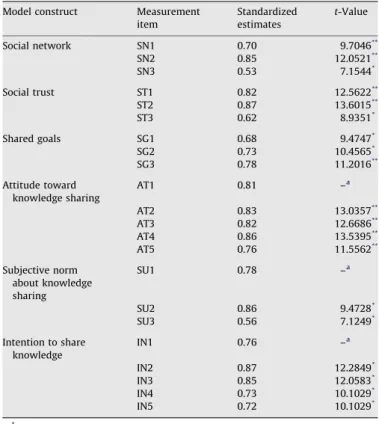
Table 4summarizes the results of the measurement model; these show that all six model constructs, namely social network, social trust, shared goal, attitude toward knowledge sharing, subjective norm regarding knowledge sharing, and intention to share knowledge were all valid measures of their respective constructs based on their parameter estimates and statistical significance.
Table 5shows the results of hypothesis testing of the structural relationships among the latent variables.Fig. 2depicts the final results of the measurement and structural models. To assess the Table 4
Summary results of the model constructs
Model construct Measurement
item Standardized estimates t-Value Social network SN1 0.70 9.7046** SN2 0.85 12.0521** SN3 0.53 7.1544* Social trust ST1 0.82 12.5622** ST2 0.87 13.6015** ST3 0.62 8.9351* Shared goals SG1 0.68 9.4747* SG2 0.73 10.4565* SG3 0.78 11.2016** Attitude toward knowledge sharing AT1 0.81 –a AT2 0.83 13.0357** AT3 0.82 12.6686** AT4 0.86 13.5395** AT5 0.76 11.5562** Subjective norm about knowledge sharing SU1 0.78 –a SU2 0.86 9.4728* SU3 0.56 7.1249* Intention to share knowledge IN1 0.76 –a IN2 0.87 12.2849* IN3 0.85 12.0583* IN4 0.73 10.1029* IN5 0.72 10.1029* * p0.10. ** p0.05
aValues were not calculated, because loading was set to 1.0 to fix construct
variance.
Table 6
Overall model fit indices
Fit index Scores Recommended cut-off
value from literature Absolute fit measures x2/d.f. 1.877** 2**;3*;5* GFI 0.85** 0.9**0;0.80* RMR 0.044** 0.05**;0.08* Incremental fit measures NFI 0.85* 0.90** AGFI 0.81** 0.90**;0.80* CFI 0.92** 0.90** Parsimonious fit measures
PGFI 0.66* The higher, the better
PNFI 0.72* The higher, the better
Acceptability: ** acceptable, * marginal.
Table 5
Summary results of the structural model
Path Description Hypothesis Path coefficient t-Value Results
SN–AT Social network!attitude toward knowledge sharing H1 0.24 2.84*
Supported
SN–SU Social network!subjective norm about knowledge sharing H2 0.27 2.65*
Supported
ST–AT Social trust!attitude toward knowledge sharing H3 0.06 0.68 Not supported
ST–SU Social trust!subjective norm about knowledge sharing H4 0.10 0.89 Not supported
SG–AT Shared goals!attitude toward knowledge sharing H5 0.37 3.82*
Supported
SG–SU Shared goals!subjective norm about knowledge sharing H6 0.31 2.72* Supported
AT–IN Attitude toward knowledge sharing!intention to share knowledge H7 0.44 5.15* Supported
SU–AT Subjective norm about knowledge sharing!attitude toward knowledge sharing H8 0.25 3.14*
Supported
SU–IN Subjective norm about knowledge sharing!intention to share knowledge H9 0.26 3.04*
Supported
*p
model fit, we applied eight measures from three perspectives: absolute fit measures (evaluated using
x
2/d.f.), goodness of fit index (GFI), and root mean square error (RMR); incremental fit were measured by the normal fit index (NFI), the adjusted goodness of fit index (AGFI), and the comparative fit index (CFI); and parsimonious fit measures were evaluated by the parsimo-nious goodness of fit index (PGFI) and the parsimoparsimo-nious normal fit index (PNFI).Table 6shows the overall fit indexes of our model. It shows that our model resulted in good results at the
x
2/d.f., GFI, RMR, AGFI, CFI, and marginal fitness levels for the indexes of NFI, PGFI, and PNFI. We concluded that our findings had reached an acceptable level and could be used to explain our hypotheses.HypothesesH1 and H5were supported, and showed that a higher level of social network and shared goals contributed to the willingness of organizational members to share knowledge.H7, H8, andH9were also supported. Our results also confirmed that social pressure imposed by coworkers and managers leads to knowledge sharing.
H2andH6, the relationship of social network and shared goals to the subjective norm on knowledge sharing, were also supported organizational members who felt pressure to share knowledge were those who had established a large social connection of employees with similar organizational visions or goals.
H3andH4were not supported.
Table 7 shows the direct, indirect, and total effects of all significant model constructs. Apparently social network and shared goals had indirect effects on the intention to share knowledge through the mediators of attitudes toward knowledge sharing and the subjective norm on knowledge sharing.
5. Discussions and implications
Our main objective was to understand the influence of social capital on organizational knowledge sharing. Our results revealed that: (1) organizational members did not distinguish tacit from explicit knowledge when they shared knowledge, (2) a social network and shared goals significantly contributed to attitudes toward knowledge sharing, (3) a social network and shared goals significantly contributed to the subjective norm on knowledge sharing; (4) social trust had no direct contribution to either attitudes toward knowledge sharing or its subjective norm though it influenced both attitude toward knowledge sharing and the intention to share knowledge; and (5) a social network and shared goals have indirect effects on the intention to share knowledge within the organization.
Management must develop a clear mission and goal so that everyone in the organization can appreciate and contribute knowl-edge[27]. Recruiting employees who share common interests and goals is a critical task for human resources departments. Social ties between colleagues are important and a good relationship will enhance knowledge-sharing behavior.
6. Conclusion and limitations
Our study was one of the first to provide empirical evidence about the influence of a social network, social trust, and shared goals on employees’ intention to share knowledge. It offers insights to practitioners on the value of social capital and reasons why people are or are not willing to engage in knowledge sharing within an organization.
Table 7
Direct, indirect and total effects of significant model constructs
Construct AT SU IN
Direct effect Indirect effect Total effect Direct effect Indirect effect Total effect Direct effect Indirect effect Total effect
SN 0.24 0.07 0.31 0.28 – 0.28 – 0.21 0.21
SG 0.36 0.08 0.44 0.31 – 0.31 – 0.27 0.27
AT – – – – – – 0.44 – 0.44
SU 0.25 – 0.25 – – – 0.26 0.11 0.37
We also found that social network and shared goals directly influenced the attitude and subjective norm about knowledge sharing and indirectly influenced the intention to share knowl-edge. Social trust did not play a direct role in sharing knowledge and organizational members do not differentiate between tacit and explicit knowledge when they share it.
This study has a few inherent limitations. First, we hypo-thesized only three social capital factors in our model; other social capital factors (such as shared organizational cultures, society network ties, and organizational network stability) may
also affect outcomes. Second, our research sample consisted only of organizational managers. Third, the data collection was limited to knowledge-sharing behavior within organizations in Hong Kong.
Acknowledgements
The authors would like to thank the Chairman of Editorial Board, Prof E.H. Sibley, and three anonymous reviewers for their valuable comments and suggestions.
Appendix A. Definitions of the constructs
Constructs Definitions References Number of itemsa
Social network The degree of contact and accessibility of one with other people [14,25] 3 (3)
Social trust The degree of one’s willingness to vulnerable to the actions of other people [14] 3 (4)
Shared goal The degree to which one has collective goals, missions and visions with other people [25] 3 (3)
Attitude toward knowledge sharing The degree of one’s favorable or positive feeling about sharing one’s knowledge [6,18] 5 (5) Subjective norm about knowledge sharing The degree of one’s perceived social pressure from important others to share
or not to share one’s knowledge
[6,18] 3 (3)
Intention to share knowledge The degree of one’s belief that one will engage in knowledge-sharing behavior [6,18] 5 (2,3)b a
Final item numbers (initial item numbers).
b
2 and 3 questions were originally used for measuringexplicitandtacitknowledge, respectively.
Appendix B. Questionnaire items
Constructs Items Statistics
Social network SN1. In general, I have a very good relationship with my organizational members Alpha = 0.72, mean = 3.53, S.D. = 0.61
SN2. In general, I am very close to my organizational members SN3. I always hold a lengthy discussion with my organizational members Social trust ST1. I know my organizational members will always try and help me out if I get
into difficulties
Alpha = 0.79, mean = 3.58, S.D. = 0.63
ST2. I can always trust my organizational members to lend me a hand if I need it ST3. I can always rely on my organizational members to make my job easier
Shared goals SG1. My organizational members and I always agree on what is important at work Alpha = 0.77, mean = 3.38, S.D. = 0.66
SG2. My organizational members and I always share the same ambitions and vision at work
SG3. My organizational members and I are always enthusiastic about pursing the collective goals and missions of the whole organization
Attitude toward knowledge sharing AT1. Sharing of my knowledge with organizational members is always good Alpha = 0.91, mean = 3.79, S.D. = 0.70
AT2. Sharing of my knowledge with organizational members is always beneficial AT3. Sharing of my knowledge with organizational members is always an enjoyable experience
AT4. Sharing of my knowledge with organizational members is always valuable to me AT5. Sharing of my knowledge with organizational members is always a wise move Subjective norm about knowledge sharing SU1. My chief executive officer (CEO) always thinks that I should share my knowledge
with other members in the organization
Alpha = 0.76, mean = 3.58, S.D. = 0.69
SU2. My boss always thinks that I should share my knowledge with other members in the organization
SU3. My colleagues always think that I should share my knowledge with other members in the organization
Intention to shared knowledgea IN1. I will share my work reports and official documents with my organizational members more frequently in the future#1
Alpha = 0.89, mean = 3.55, S.D. = 0.67
IN2. I will always share my manuals, methodologies and models with my organizational members in the future#1
IN3. I will always share my experience or know-how from work with my organizational members in the future#2
IN4. I will always share my know-where or know-whom at the request of my organizational members#2
IN5. I will always try to share my expertise obtained from education and training with my organizational members in a more effective way#2
a
These five items were initially proposed as two separable factors as explicit#1
and tacit#2
knowledge but were merged into a single factor by the factor analysis test.
References
[1] G.W. Bock, R.W. Zmud, Y.G. Kim, J.N. Lee, Behavioral intention formation in knowledge sharing: examining the roles of extrinsic motivators, social–psycho-logical forces, and organizational climate, MIS Quarterly 29 (1), 2005, pp. 87–111. [2] A. Chua, The influence of social interaction on knowledge creation, Journal of
Intellectual Capital 3 (4), 2002, pp. 375–392.
[3] J.S. Coleman, Social capital in the creation of human capital, American Journal of Sociology 94, 1988, pp. 95–120.
[4] M. Fishbein, I. Ajzen, Beliefs Attitude, Intention and Behavior: An Introduction to Theory and Research, Addison-Wesley Publishing Company, Philippines, 1975. [5] M.S. Granovtetter, in: N. Nohria, R. Eccles (Eds.), Networks and Organizations: Structure, Form, and Action, in Problems of Explanation in Economic Sociology, Harvard Business School Press, Boston, 1992, pp. 25–26.
[6] K. Hutchings, S. Michailova, Facilitating knowledge sharing in Russian and Chi-nese subsidiaries: the role of personal networks and group membership, Journal of Knowledge Management 8 (2), 2004, pp. 84–94.
[7] M. Huysman, D. de Wit, Practices of managing knowledge sharing: towards a second wave of knowledge management, Knowledge and Process Management 11 (2), 2004, pp. 81–92.
[8] H.L. Hsu, J.C.C. Lin, Acceptance of blog usage: the roles of technology acceptance, social influence and knowledge sharing motivation, Information & Management 45, 2008, pp. 65–74.
[9] A.C. Inkpen, E.W.K. Tsang, Social capital, networks, and knowledge transfer, Academy of Management Review 30 (1), 2005, pp. 146–165.
[10] D. Ko, K.J. Kirsch, W.R. King, Antecedents of knowledge transfer from consultants to clients in enterprise system implementations, MIS Quarterly 29 (1), 2005, pp. 59– 85.
[11] J.C. Lang, Social context and social capital as enablers of knowledge integration, Journal of Knowledge Management 8 (3), 2004, pp. 89–105.
[12] X. Li, A.R. Montazemi, Y. Yuan, Agent-based buddy-finding methodology for knowledge sharing, Information & Management 43, 2006, pp. 283–296. [13] A.Q. Liu, T. Besser, Social capital and participation in community improvement
activities by Elderly Residents in Small Towns and Rural Communities, Rural Sociology 68 (3), 2003, pp. 343–365.
[14] J. Nahapiet, S. Ghoshal, Social capital, intellectual capital, and the organizational advantage, Academy of Management Review 23 (2), 1998, pp. 242–266. [15] I. Nonaka, H. Takeuchi, The Knowledge-creating Company: How Japanese
Com-panies create the Dynamics of Innovation, Oxford University Press, Oxford, 1985. [16] C. Okoli, W. Oh, Investigating recognition-based performance in an open content community: a social capital perspective, Information & Management 44, 2007, pp. 240–252.
[17] B. Ramasamy, K.W. Goh, M.C.H. Yeung, Is Guanxi (relationship) a aridge to knowledge transfer? Journal of Business Research 59, 2006, pp. 130–139. [18] F. Requena, Social capital, satisfaction and quality of life in the workplace, Social
Indicators Research 61 (3), 2003, pp. 331–360.
[19] S.E. Seibert, R.C. Liden, A social capital theory of career success, Academy of Management Journal 44 (2), 2001, pp. 219–237.
[20] N.M. Tichy, M.L. Tushman, C. Fombrun, Social network analysis for organizations, Academy of Management Review 4, 1979, pp. 507–519.
[21] W. Tsai, S. Ghoshal, Social capital and value creation: the role of interfirm networks, Academy of Management Journal 41 (4), 1998, pp. 464–476. [22] A. Vaux, D. Harrison, Support network characteristics associated with support
satisfaction and perceived support, American Journal of Community Psychology 13 (3), 1985, pp. 245–268.
[23] J. Wagner, Studies of individualism-collectivism: effects on cooperation in groups, Academy of Management Journal 1995, pp. 152–172.
[24] M.M. Wasko, S. Faraj, Why should I share? Examining social capital and knowl-edge contribution in electronic networks of practice MIS Quarterly 29 (1), 2005, pp. 35–57.
[25] C.D. Wong, W.T. Wong, C. Hui, K.S. Law, The significant role of Chinese employees’ organizational commitment: implications for managing in Chinese societies, Journal of World Business 36 (3), 2001, pp. 326–340.
[26] H. Yli-Renko, E. Autio, H.J. Sapienza, Social capital, knowledge acquisition, and knowledge exploitation in young technology-based firms, Strategic Management Journal 22 (6/7), 2001, pp. 587–613.
[27] C.P. Yu, T.H. Chu, Exploring knowledge contribution from an OCB perspective, Information & Management 44, 2007, pp. 321–331.
Wing S. Chowis an associate professor of MIS in the School of Business, Hong Kong Baptist University. Dr. Chow published more than 70 papers in the journals and conference proceedings. His latest edited book is entitled ‘‘Multimedia Information Systems in Practice’’ published by Springer, 1999.
Lai Sheung Chanobtained the Bachelor of Business Administration from Hong Kong Baptist University in 2003 and the Master of Philosophy from the same university in 2007. Her research interest includes Information System Management and Knowledge Management.