Quality of Service Optimization of
Multimedia Traffic in Mobile
Networks
by
Suleiman Yusuf Yerima
A thesis submitted in partial fulfilment of the requirements for the degree of Doctor of Philosophy
in the
INTEGRATED COMMUNICATIONS RESEARCH CENTRE FACULTY OF ADVANCED TECHNOLOGY
UNIVERSITY OF GLAMORGAN/PRIFYSGOL MORGANNWG
i
Declaration of Authorship
I, Suleiman Yusuf Yerima, declare that this thesis titled, ‘Quality of Service Optimiza-tion of Multimedia Traffic in Mobile Networks’ and the work presented in it are my own. I can confirm that:
This work was done while in candidature for a research degree at University of Glamorgan
Where I have consulted the published works, this is always clearly attributed
Where I have quoted from the work of others, the source is always given. With the exception of such quotations, this thesis is entirely my own work
I have acknowledged all main sources of help
Where the thesis is based on work done by myself jointly with others, I have made clear exactly what was done by others and what I have contributed my-self
Signed:
--- Date:
---
Supervisor and Director of Studies:
Prof. Khalid Al-Begain.
Director of Integrated Communications Research Centre (ICRC), Faculty of Advanced Technology,
ii
Abstract
Mobile communication systems have continued to evolve beyond the currently deployed Third Generation (3G) systems with the main goal of providing higher capacity. Systems beyond 3G are expected to cater for a wide variety of services such as speech, data, image transmission, video, as well as multimedia services consisting of a combination of these. With the air interface being the bottleneck in mobile networks, recent enhancing technologies such as the High Speed Downlink Packet Access (HSDPA), incorporate major changes to the radio access segment of 3G Universal Mobile Telecommunications System (UMTS). HSDPA introduces new features such as fast link adaptation mechanisms, fast packet scheduling, and physical layer retransmis-sions in the base stations, necessitating buffering of data at the air interface which presents a bottleneck to end-to-end communication. Hence, in order to provide end-to-end Quality of Service (QoS) guarantees to multimedia services in wireless networks such as HSDPA, efficient buffer management schemes are required at the air interface.
The main objective of this thesis is to propose and evaluate solutions that will address the QoS optimization of multimedia traffic at the radio link interface of HSDPA systems. In the thesis, a novel queuing system known as the Time-Space Priority (TSP) scheme is proposed for multimedia traffic QoS control. TSP provides customized preferential treatment to the constitu-ent flows in the multimedia traffic to suit their diverse QoS requiremconstitu-ents. With TSP queuing, the real-time component of the multimedia traffic, being delay sensitive and loss tolerant, is given transmission priority; while the non-real-time component, being loss sensitive and delay tolerant, enjoys space priority. Hence, based on the TSP queuing paradigm, new buffer management algorithms are designed for joint QoS control of the diverse components in a multimedia session of the same HSDPA user. In the thesis, a TSP based buffer management algorithm known as the Enhanced Time Space Priority (E-TSP) is proposed for HSDPA. E-TSP incorporates flow control mechanisms to mitigate congestion in the air interface buffer of a user with multimedia session comprising real-time and non-real-time flows. Thus, E-TSP is designed to provide efficient network and radio resource utilization to improve end-to-end multimedia traffic performance. In order to allow real-time optimization of the QoS control between the real-time and non-real-time flows of the HSDPA multimedia session, another TSP based buffer manage-ment algorithm known as the Dynamic Time Space Priority (D-TSP) is proposed. D-TSP incorporates dynamic priority switching between the real-time and non-real-time flows. D-TSP is designed to allow optimum QoS trade-off between the flows whilst still guaranteeing the stringent real-time component’s QoS requirements. The thesis presents results of extensive performance studies undertaken via analytical modelling and dynamic network-level HSDPA simulations demonstrating the effectiveness of the proposed TSP queuing system and the TSP based buffer management schemes.
Keywords:Quality of Service; Multimedia traffic; Buffer management; High Speed Downlink Packet Access;Universal Mobile Telecommunication System; Priority queuing; Time priorities; Space priorities;
iii
Acknowledgements
I owe immeasurable gratitude to my supervisor, Prof. Khalid Al-Begain for his guidance, support, and mentoring which has been instrumental to the success of this research project. It was indeed a pleasure to work under your supervision.
I am very grateful to the University of Glamorgan for sponsoring this Ph.D. project through the Faculty of Advanced Technology studentship and the Overseas Research Students’ (ORS) scholarship award.
My profound thanks also goes to ICRC colleagues: Belal, Firas, Alhad, Chitra, Abdulsa-lam, Ismat, Kufre, Sharmini, Sahena, Ameya, and Al-Bara for their pleasant companionship which made research at ICRC fun.
Sincere appreciation to Belal Abuhaija for very stimulating discussions that added insights to the HSDPA aspects of the project.
I also wish to thank Kamish Malhotra for the many useful discussions that added value to my work.
Many thanks to Pat and Jenny, for their kind assistance.
Special thanks to all my friends too numerous to mention for their patience and under-standing. Lastly, not forgetting my family in Nigeria, to whom I remain forever indebted for their unending support and encouragement that kept me going during the difficult times.
iv
Contents
Declaration of Authorship………..i Abstract……….ii Acknowledgements………..iii List of Figures………..ix List of Tables………..xii Abbreviations………..xv Chapter 1 Introduction ... 11.1 Mobile communications evolution ... 1
1.2 Thesis motivation ... 7
1.3 Aim and objectives ... 8
1.4 Thesis contribution ... 9
1.5 Thesis outline ... 10
1.6 Author’s selected publications ... 11
Chapter 2 Buffer Management and Quality of Service ... 14
2.1 Introduction ... 14
2.2 Buffer management fundamentals ... 15
2.2.1 Classification by resource management ... 15
2.2.2 Classification by service differentiation strategy ... 18
2.2.3 Classification by granularity of priority assignment ... 21
2.3 Review of related work ... 21
2.3.1 Buffer Management in wireline networks ... 21
2.3.2 Buffer management in wireless networks ... 31
2.4 Service differentiation for QoS support in mobile networks ... 33
2.4.1 UMTS QoS classes ... 34
2.5 Mechanisms for QoS provisioning in Radio Access Network ... 36
2.5.1 Admission control ... 37
v
2.5.3 Benefits of RAN buffer management ... 41
2.6 Chapter summary ... 42
Chapter 3 The UMTS HSDPA System ... 43
3.1 Introduction ... 43
3.2 UMTS/HSDPA system architecture ... 44
3.3 HSDPA general description ... 46
3.4 The Radio Link Control protocol ... 48
3.5 HSDPA MAC architecture ... 50
3.6 HSDPA Physical Layer structure ... 51
3.6.1 High-Speed Downlink Shared Channel ... 52
3.6.2 High-Speed Shared Control Channel (HS-SCCH) ... 53
3.6.3 High-Speed Dedicated Physical Control Channel (HS-DPCCH) ... 54
3.6.4 HSDPA Physical Layer operation procedure ... 55
3.7 Data flow mechanism in HSDPA ... 57
3.8 Chapter summary ... 59
Chapter 4 The Time Space Priority Queuing System ... 60
4.1 Introduction ... 60
4.2 The Time-Space Priority queuing system ... 61
4.2.1 The TSP algorithm ... 64
4.3 Formulation of TSP analytical model ... 65
4.3.1 Basic system modelling assumptions ... 65
4.3.2 Analytical model ... 66
4.3.3 Weighted Grade of Service for TSP buffer threshold optimization ... 71
4.3.4 Description of TSP model in MOSEL-2 ... 72
4.3.5 Model validation using discrete event simulation ... 74
4.3.6 Numerical results of TSP analyses ... 74
4.4 Analytical engine for TSP buffer threshold optimization ... 84
vi
4.5.1 Formulation of analytical models for investigating priority queuing
schemes…...………. ……..87
4.5.2 Basic system assumptions and notations ... 88
4.5.3 The Markov models ... 89
4.5.4 Numerical Results and Discussions ... 91
4.6 Chapter summary ... 96
Chapter 5 Buffer Management for HSDPA Multimedia Traffic ... 97
5.1 Introduction ... 97
5.2 HSDPA QoS framework... 98
5.3 Buffer management algorithms in HSDPA MAC-hs ... 99
5.3.1 Functions of the MAC-hs buffer management algorithm ... 99
5.3.2 BMA role in MAC-hs PDU transmission scheduling ... 101
5.3.3 TSP buffer management algorithm in HSDPA ... 102
5.4 TSP buffer management algorithm performance study ... 103
5.5 Results and discussions ... 107
5.5.1 VoIP performance in the mixed traffic ... 107
5.5.2 FTP performance in the mixed traffic ... 109
5.5.3 Discussion of overall results ... 111
5.6 Chapter summary ... 111
Chapter 6 Enhanced Buffer Management for HSDPA Multimedia Traffic ... 113
6.1 Introduction ... 113
6.2 HSDPA Iub flow control ... 114
6.3 Enhanced buffer management scheme for multimedia QoS control ... 116
6.3.1 Motivation for E-TSP buffer management algorithm ... 116
6.3.2 The ETSP buffer management algorithm ... 118
6.4 End-to-end simulation model and performance evaluation ... 121
6.4.1 HSDPA simulation assumptions and configurations ... 122
6.4.2 Multi-flow end-user NRT end-to-end Performance ... 124
vii
6.4.4 Multi-flow end-user RT end-to-end performance ... 131
6.5 Chapter summary ... 132
Chapter 7 Dynamic Buffer Management for HSDPA Multimedia Traffic ... 133
7.1 Introduction ... 133
7.2 Optimized QoS control of UE RT and NRT flows in HSDPA ... 134
7.2.1 Incentives for optimized QoS control mechanisms in the TSP-based BM schemes ………134
7.2.2 The Dynamic Time-Space Priority (D-TSP) buffer management scheme………...136
7.3 D-TSP end-to-end performance evaluation I ... 140
7.3.1 Simulation configuration and performance metrics ... 140
7.3.2 NRT QoS in the multiple flow session ... 143
7.3.3 VoIP flow QoS in the multi-flow session. ... 146
7.3.4 HSDPA channel utilization ... 147
7.4 D-TSP end-to-end performance evaluation II ... 148
7.4.1 Buffer dimensioning ... 149
7.4.2 Performance metrics ... 150
7.4.3 End-to-end NRT throughput evaluation ... 150
7.4.4 RT streaming performance evaluation ... 152
7.5 Chapter summary ... 156
Chapter 8 Conclusions and Future Work ... 158
8.1 Summary of the thesis ... 158
8.1.1 Definition of a novel Time-Space Priority queuing system (TSP) ... 158
8.1.2 Definition of adaptive QoS control strategy based on buffer threshold optimization engine ... 160
8.1.3 Definition of flow control algorithm for HSDPA multimedia traffic ... 161
8.1.4 Definition of dynamic QoS optimization scheme for HSDPA multimedia traffic ………161
8.2 Suggestions for further research ... 162
viii
Appendix A Validation of Analytical Model by Simulation ... 172
A.1 Validation of results for (λRT = 2, 12 and 18) ... 172
A.2 Validation of results for (λNRT = 2, 6 and 9) ... 179
Appendix B HSDPA Model Development in OPNET ... 186
B.1 Design approach ... 186
B.2 Traffic source node implementation ... 187
B.3 UTRAN implementation ... 189
B.3.1 The TTI manager ... 192
ix
List of Figures
Figure 1.1 Number of telephone subscriptions and internet connections per 100 population,
world, 1990 – 2006 (Percentage). ... 1
Figure 1.2 Peak data rate evolution for WCDMA. ... 6
Figure 2.1 The Complete Buffer Partitioning scheme for two traffic classes ... 16
Figure 2.2 Complete Buffer Sharing (CBS) implements FIFO with Drop-Tail ... 16
Figure 2.3 Pushout replacement mechanisms: LIFD, FIFD and random. ... 17
Figure 2.4 Partial Buffer Sharing (PBS) scheme. ... 18
Figure 2.5 Precedence queuing or HOL priorities. ... 20
Figure 2.6 Typical locations of QoS management (RRM) functions in UTRA ... 37
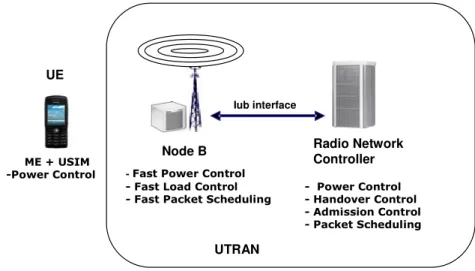
Figure 3.1 UMTS/HSDPA system architecture ... 45
Figure 3.2 HS-DSCH Protocol architecture ... 48
Figure 3.3 UE side MAC-hs Architecture (details) ... 50
Figure 3.4 Detailed Node B MAC-hs architecture with functional entities ... 51
Figure 3.5 The new channels introduced in release 5 for HSDPA operation ... 52
Figure 3.6 Code multiplexing example with two active users ... 53
Figure 3.7 HS-SCCH and HS-DSCH timing relationship ... 54
Figure 3.8 HS-DPCCH channel structure ... 55
Figure 3.9 Terminal timing with respect to one HARQ process ... 56
Figure 3.10 HSDPA User plane protocol stack ... 57
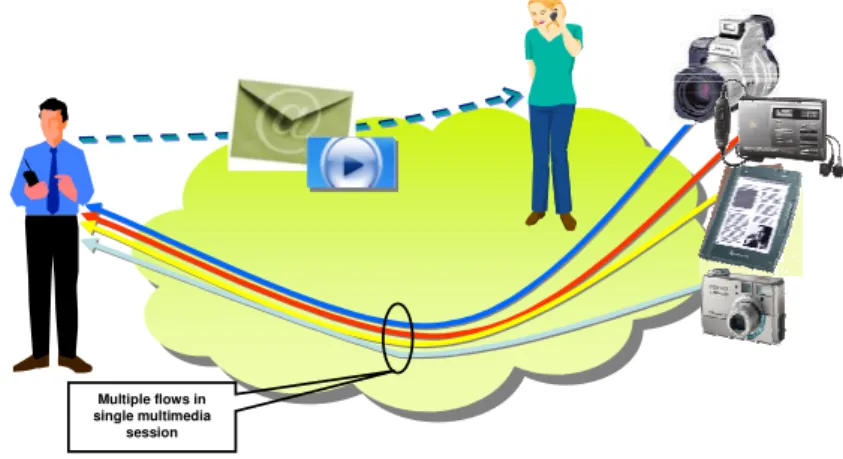
Figure 4.1 A multimedia session with multiple flows of diverse media: video, voice and data. . 62
Figure 4.2 The Time-Space Priority queuing mechanism ... 63
Figure 4.3 States denoting the head-of-line status represented by p and q in the TSP model ... 67
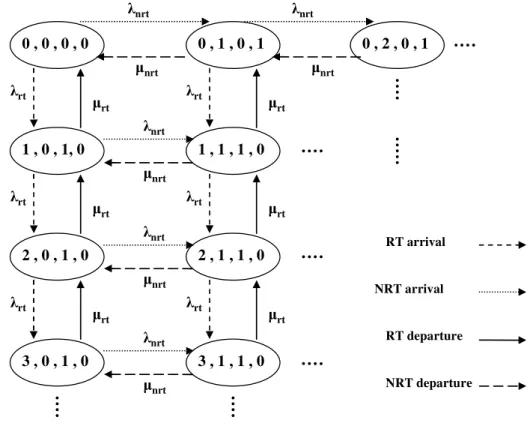
Figure 4.4 A section of the state space for the Continuous Time Markov Chain derived for TSP investigation ... 68
x
Figure 4.6 NRT mean queue length Vs R for λrt = 2, 12, and 18 ... 76
Figure 4.7 NRT mean delay Vs R for λrt = 2, 12, and 18 ... 76
Figure 4.8 RT loss (blocking) probability Vs R for λrt = 2, 12, and 18 ... 78
Figure 4.9 RT mean queue length Vs R for λrt = 2, 12, and 18 ... 78
Figure 4.10 RT mean delay Vs R for λrt = 2, 12, and 18 ... 78
Figure 4.11 NRT loss Vs R for λnrt = 2, 6, and 9 and µnrt = 10 ... 80
Figure 4.12 NRT mean queue length Vs R for λnrt = 2, 6, and 9 and µnrt = 10 ... 80
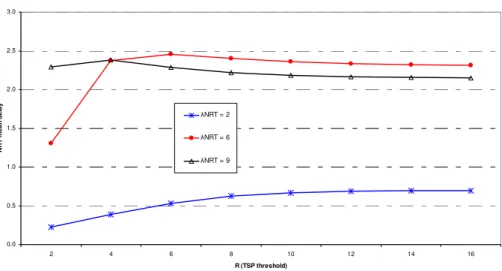
Figure 4.13 Mean NRT delay Vs R for λnrt = 2, 6, and 9 and µnrt = 10... 80
Figure 4.14 RT loss Vs R for λnrt = 2, 6, and 9 and µnrt = 10 ... 81
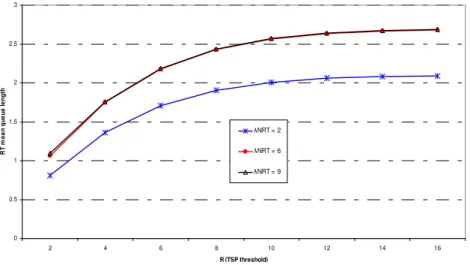
Figure 4.15 RT mean queue length Vs R for λnrt = 2, 6, and 9 and µnrt = 10 ... 82
Figure 4.16 Mean RT delay Vs R for λnrt = 2, 6, and 9 and µnrt = 10 ... 82
Figure 4.17 WGoS Vs R for λrt = 2... 83
Figure 4.18 WGoS Vs R for λrt = 12, and 18 ... 84
Figure 4.19 WGoS Vs R for λnrt = 2, 6, and 9 ... 84
Figure 4.20 Simplified diagram of proposed optimization engine for semi real-time optimization of the time space priority buffer threshold for HSDPA user session multimedia QoS control .... 85
Figure 4.21 Simplified model for investigating performance of the priority queuing mechanisms for mobile radio access network downlink end-user multimedia traffic ... 87
Figure 4.22 Mean RT delay vs. fraction of NRT arrivals in concurrent RT and NRT traffic for TSP, CBP, PBS, CBS queuing ... 93
Figure 4.23 RT packet loss probability vs. fraction of NRT arrivals in concurrent RT and NRT traffic for TSP, CBP, PBS, CBS queuing schemes ... 93
Figure 4.24 NRT packet loss probability vs. fraction of NRT arrivals in concurrent RT and NRT traffic for TSP, CBP, PBS, CBS queuing schemes ... 94
Figure 4.25 Overall packet loss probability vs. fraction of NRT arrivals in concurrent RT and NRT traffic for TSP, CBP, PBS, CBS queuing schemes ... 95
Figure 5.1 Logical hierarchy of UE1 multiplexed RT and NRT d flows’ in Node B MAC-hs ... 101
Figure 5.2 MAC-hs PDU structure ... 102
xi
Figure 5.4 VoIP mean delay Vs FTP download rate in UE with multimedia traffic ... 109
Figure 5.5 FTP loss Vs FTP download rate in UE with multimedia traffic ... 110
Figure 5.6 FTP mean delay Vs FTP download rate in UE with multimedia traffic ... 111
Figure 6.1 HSDPA flow control on the Iub interface. ... 115
Figure 6.2 HSDPA Iub interface flow control signalling procedure between RNC and Node B ... 116
Figure 6.3 Retransmission mechanisms in UMTS HSDPA for TCP based flows ... 117
Figure 6.4 HSDPA RAN with E-TSP buffer management utilizing the proposed credit allocation algorithm for per UE multi-flow Iub flow control ... 118
Figure 6.5 End-to-end HSDPA simulation set up ... 122
Figure 6.6 End-to-end NRT throughput at multimedia test UE with Complete Buffer Sharing for 1, 5, 10, 20 and 30 users utilizing the HSDPA shared channel ... 125
Figure 6.7 End-to-end NRT throughput at multimedia test UE with TSP buffer management for 1, 5, 10, 20 and 30 users utilizing the HSDPA shared channel ... 125
Figure 6.8 End-to-end NRT throughput at multimedia test UE with E-TSP buffer management for 1, 5, 10, 20 and 30 users utilizing the HSDPA shared channel ... 126
Figure 6.9 Average end-to-end NRT throughput at test UE Vs no. of users (CBS, TSP and E-TSP) ... 127
Figure 6.10 CBS VoIP UTRAN delay in test UE during multi-flow session ( 1, 5, 10, 20 and 30 users) ... 128
Figure 6.11 TSP VoIP UTRAN delay in test UE during multi-flow session. Identical results were obtained for E-TSP in all cases ... 130
Figure 6.12 Average UTRAN VoIP PDU delay at test UE Vs no. of users (CBS, TSP and E-TSP) ... 131
Figure 6.13 Average end-to-end VoIP PDU delay at test UE Vs number of users in cell. Results given for CBS (left), TSP (center) and E-TSP ... 132
Figure 7.1 TSP BM with dynamic time priority switching (D-TSP) ... 137
Figure 7.2 UE 1 NRT throughput for VoIP delay budget settings when utilizing the channel alone ... 144
Figure 7.3 UE 1 NRT throughput for VoIP delay budget settings with 5 users sharing channel ... 144
Figure 7.4 UE 1 NRT throughput for VoIP delay budget settings with 10 users sharing channel ... 145
xii
Figure 7.5 UE 1 NRT throughput for various VoIP delay budget settings with 20 channel users
... 145
Figure 7.6 UE 1 NRT throughput for various VoIP delay budget settings with 30 channel users ... 146
Figure 7.7 UE 1 NRT throughput for VoIP delay budget settings with 50 users sharing channel ... 146
Figure 7.8 VoIP PDU Discarded in the MAC-hs for UE 1 ... 147
Figure 7.9 UE 1 HSDPA channel utilization for the delay budget settings ... 148
Figure 7.10 End-to-end NRT throughput of UE1 for TSP, D-TSP (δ = 8, 16, 24, and 32 respectively) ... 151
Figure 7.11 RT PDU discard ratio vs. number of users ... 153
Figure 7.12 RT inter-packet playout delay for all E-TSP scenarios. ... 154
Figure 7.13 RT inter-packet playout delay for D-TSP δ= 24. ... 155
Figure 7.14 RT inter- packet playout delay for D-TSP δ= 32. ... 156
Figure B.1 Traffic source node model with RT and NRT source modules. ………….. ………188
Figure B.2 UTRAN Node model implementation ... 189
Figure B.3 RNC process model with RLC AM ARQ protocol ... 190
Figure B.4 Node B process model implementation ... 191
xiii
List of Tables
Table 2.1 Delay and loss priority assignment matrix ... 29
Table 2.2 UMTS QoS classes ... 36
Table 3.1 Comparison of fundamental properties of DCH and HS-DSCH ... 48
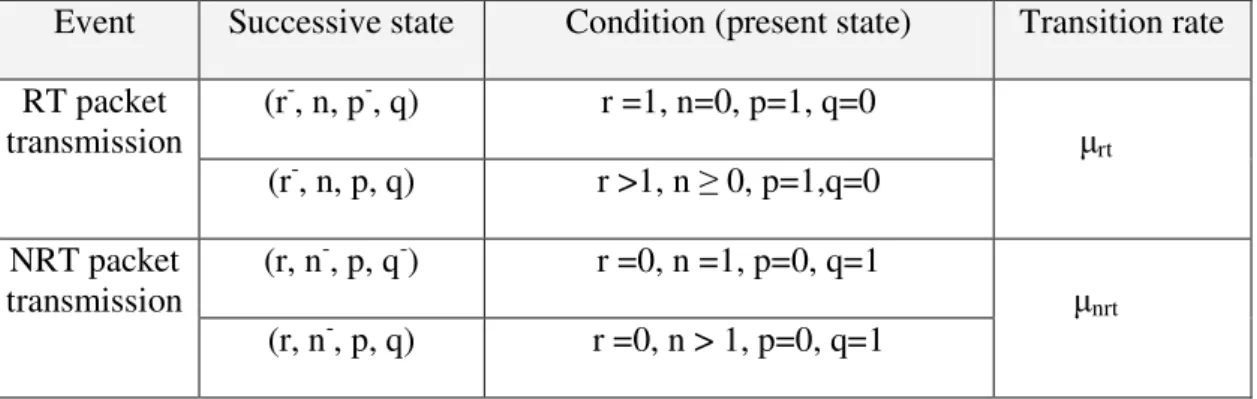
Table 4.1 Forward transitions from state X = (r, n, p, q) showing conditions and transition rates ... 70
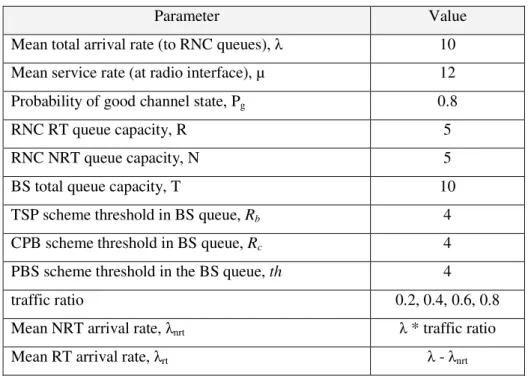
Table 4.2 Reverse transitions from state X = (r, n, p, q) showing conditions and transition rates 70 Table 4.3 Values of default parameters used in analytical models for comparative performance evaluation of the priority queuing schemes... 91
Table 5.1 Assumed AMC schemes and equivalent instantaneous bit rates per TTI ... 105
Table 5.2 HSDPA simulation parameters ... 106
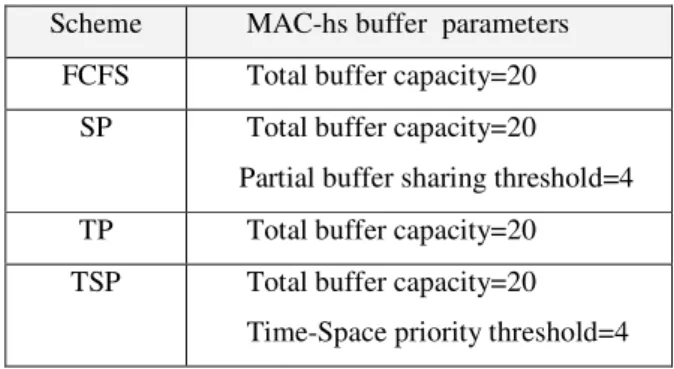
Table 5.3 Multimedia UE MAC-hs buffer parameters for simulation study... 107
Table 6.1 Summary of assumed simulation parameters ... 123
Table 7.1 HSDPA Simulation parameters ... 142
Table A.1 Validation of MOSEL results:- NRT loss (λRT = 2) ... 172
Table A.2 Validation of MOSEL results:- RT loss (λRT = 2) ... 173
Table A.3 Validation of MOSEL results:- NRT delay (λRT = 2) ... 173
Table A.4 Validation of MOSEL results:- RT delay (λRT = 2) ... 173
Table A.5 Validation of MOSEL results:- RT mean queue length (λRT = 2) ... 174
Table A.6 Validation of MOSEL results:- NRT mean queue length (λRT = 2) ... 174
Table A.7 Validation of MOSEL results:- NRT loss (λRT = 12) ... 174
Table A.8 Validation of MOSEL results:- RT loss (λRT = 12)... 175
Table A.9 Validation of MOSEL results:- NRT delay (λRT = 12) ... 175
Table A.10 Validation of MOSEL results:- RT delay (λRT = 12) ... 175
Table A.11 Validation of MOSEL results:- RT mean queue length (λRT =12) ... 176
xiv
Table A.13 Validation of MOSEL results:- NRT loss (λRT = 18) ... 176
Table A.14 Validation of MOSEL results:- RT loss (λRT = 18) ... 177
Table A.15 Validation of MOSEL results:- NRT delay (λRT = 18) ... 177
Table A.16 Validation of MOSEL results:- RT delay (λRT = 18) ... 177
Table A.17 Validation of MOSEL results:- RT mean queue length (λRT =18) ... 178
Table A.18 Validation of MOSEL results:- NRT mean queue length (λRT =18) ... 178
Table A.19 Validation of MOSEL results:- NRT loss (λNRT = 2) ... 179
Table A.20 Validation of MOSEL results:- RT loss (λNRT = 2) ... 179
Table A.21 Validation of MOSEL results:- NRT delay (λNRT = 2) ... 180
Table A.22 Validation of MOSEL results:- RT delay (λNRT = 2) ... 180
Table A.23 Validation of MOSEL results:- RT mean queue length (λNRT = 2) ... 180
Table A.24 Validation of MOSEL results:- NRT mean queue length (λNRT = 2) ... 181
Table A.25 Validation of MOSEL results:- NRT loss (λNRT = 6) ... 181
Table A.26 Validation of MOSEL results:- RT loss (λNRT = 6) ... 181
Table A.27 Validation of MOSEL results:- NRT delay (λNRT = 6) ... 182
Table A.28 Validation of MOSEL results:- RT delay (λNRT = 6) ... 182
Table A.29 Validation of MOSEL results:- RT mean queue length (λNRT = 6) ... 182
Table A.30 Validation of MOSEL results:- NRT mean queue length (λNRT = 6) ... 183
Table A.31 Validation of MOSEL results:- NRT loss (λNRT = 9) ... 183
Table A.32 Validation of MOSEL results:- RT loss (λNRT = 9) ... 183
Table A.33 Validation of MOSEL results:- NRT delay (λNRT = 9) ... 184
Table A.34 Validation of MOSEL results:- RT delay (λNRT = 9) ... 184
Table A.35 Validation of MOSEL results:- RT mean queue length (λNRT = 9) ... 184
Table A.36 Validation of MOSEL results:- NRT mean queue length (λNRT = 9) ... 185
xv
Abbreviations
1G First Generation
2G Second Generation
3G Third Generation
3GPP Third Generation Partnership Project
AC Admission Control
AM Acknowledged Mode
AMC Adaptive Modulation and Coding
AMPS Advanced Mobile Phone Service
ARQ Automatic repeat reQuest
ATM Asynchronous Transfer Mode
BAC Buffer Admission Control
BLER Block Error Rate
BMA Buffer Management Algorithm
BSC Base Station Controller
CBP Complete Buffer Partitioning
CBR Constant Bit Rate
CBS Complete Buffer Sharing
CDMA Code Division Multiple Access
CLP Cell Loss Priority
CN Core Network
CQI Channel Quality Indicator
CRC Cyclic Redundancy Check
CRNC Controlling Radio Network Controller
CTMC Continuous Time Markov Chain
DCH Dedicated Channel
DSCH Downlink Shared Channel
DT Discard Timer
D-TSP Dynamic Time-Space Priority
ECSD Enhanced Circuit Switched Data
EDGE Enhanced Data for Global Evolution
EGPRS Enhanced GPRS
ETSI European Telecommunications Standards Institute
E-TSP Enhanced Time-Space Priority
FACH Forward Access Channel
FDD Frequency Division Duplex
FIFD First-in-first-drop
xvi
FP Frame Protocol
FTP File Transfer Protocol
GBR Guaranteed Bit Rate
GGSN Gateway GPRS Support Node
GPRS General Packet Radio Service
GSM Global System for Mobile Communication
HARQ Hybrid Automatic Repeat reQuest
HOL Head-of-the-Line
HSCSD High Speed Circuit Switched Data
HSDPA High Speed Downlink Packet Access
HS-DPCCH High Speed Dedicated Physical Control Channel
HS-DSCH High Speed Downlink Shared Channel
HSPA High Speed Packet Access
HS-SCCH High-Speed Shared Control Channel
HSUPA High Speed Uplink Packet Access
IMT-2000 International Mobile Telecommunications 2000
IP Internet Protocol
IPv4 Internet Protocol version 4
IPv6 Internet Protocol version 6
ITU The International Telecommunication Union
LIFD Last-in-first-drop
LTE Long-Term Evolution
MAC Medium Access Control
MAC-hs MAC high speed
ME Mobile Equipment
MOSEL MOdelling Specification and Evaluation Language
MSC Mobile Switching Centre
NRT Non-real-time
PBS Partial Buffer Sharing
PDC Personal Digital Cellular
PDCP Packet Data Convergence Protocol
PDU Protocol Data Unit
PHY Physical Layer
PO Pushout
PS Packet Scheduling
QAM Quadrature Amplitude Modulation
QoS Quality of Service
QPSK Quaternary Phase Shift Keying
R99 Release 99
xvii
RAN Radio Access Network
RLC Radio Link Control
RNC Radio Network Controller
RNS Radio Network Subsystem
RRC Radio Resource Control
RRM Radio Resource Management
RT Real-time
SDU Service Data Units
SF Spreading Factor
SGSN Serving GPRS Support Node
SINR Signal-to-Interference-plus-Noise-Ratio
SMS Short Messaging Services
SPI Service Priority Indicator
SRNC Serving Radio Network Controller
TC Traffic Class
TCP Transmission Control Protocol
TDD Time Division Duplex
TDMA Time Division Multiple Access
TF Transport Format
TFCI Transport Format Combination Identification
TM Transparent Mode
ToS Type of Service
TSN Transmission Sequence Number
TSP Time-Space Priority
TTI Transmission Time Interval
UDP User Datagram Protocol
UE User Equipment
UM Unacknowledged Mode
UMTS Universal Mobile Telecommunications System
USIM UMTS Subscriber Identity Module
UTRA Universal Terrestrial Radio Access
UTRAN UMTS Terrestrial Radio Access Network
VBR Variable Bit Rate
VoIP Voice over IP
WCDMA Wideband Code Division Multiple Access
1
Chapter 1
Introduction
1.1
Mobile communications evolution
The increasing demand for packet data services in the mobile environment, coupled with the growing dependence on mobility, have been major driving forces in the evolution of mobile communications in the last few decades. Today, the number of mobile subscrib-ers worldwide far exceeds that of fixed line subscribsubscrib-ers (see Figure 1.1); while simultaneously, the Internet has also shown a phenomenal growth becoming widespread not only in corporate environments but also in households as well. The success of mobile communications, i.e. the ubiquitous presence it has established, and the emergence of the Internet points towards a tremendous opportunity to offer integrated services through a wireless network [1].
Figure 1.1 Number of telephone subscriptions and internet connections per 100 population, world, 1990 – 2006 (Percentage). Source: UN DESA, The Millennium Development Goals Report 2008 [2]
2
Mobile communications systems evolution is generally categorized into generations of development. The first-generation (1G) systems based on analogue technology were introduced into service in the 1980s and were designed to provide voice communications to the mobile user. Data support over 1G systems was very limited and began with the use of modems and facsimile terminals over Advanced Mobile Phone Service (AMPS) circuit-switched analog cellular telephone channels [3]. In this form of data communica-tion, the cellular network was not actually providing a data service, but simply a voice link over which the data modem or fax terminal could interoperate with a corresponding data modem or fax terminal in the office or service center [4].
Second-generation (2G) systems are characterized by digital technology. They in-clude systems such as GSM, PDC, cdmaOne (IS-95) and US-TDMA (IS-136). They are supported by international roaming agreements, allowing for the possibility of operating a mobile phone across national boundaries. With the introduction of 2G systems, in addition to digital voice telephony, a new range of low data rate digital services became available, including mobile fax, voice mail and short messaging services (SMS) [5]. As a result of open standardization, GSM became one of the most successfully deployed 2G systems worldwide. GSM was designed in the late 1980s by state-owned national telecommunications companies and harmonized for use throughout Europe [6]. The first systems started operating at 900 MHz (GSM900) in the early 1990s. This was followed by systems operating at 1900 MHz (GSM1900) in America and 1800 MHz (GSM1800) in other countries. GSM employs (Time Division Multiple Access) TDMA technology and uses 8 time slots on a 200 kHz wide carrier frequency. GSM900 has a total of 124 frequency channels, while GSM1800 has 374. According to estimates by the GSM Association, over 3 billion people across more than 212 countries and territories use GSM [7].
The early GSM standard known as GSM Phase 1 was published by the European Telecommunications Standards Institute (ETSI) in 1990. However, the data services provided by the initial GSM system are circuit-switched services, in which an assigned traffic channel is held in place until call termination. This is analogous to using a dialup modem in the public telephone network. The user data rates for GSM circuit-switched data were limited to 9.6 kbits/s [8]. The GSM circuit-switched data service was
subse-3
quently enhanced with High Speed Circuit Switched Data (HSCSD), specified as part of GSM Phase 2+ in 1996. HSCSD [9] allowed bundling of several time slots in addition to channel coding adaptation to the radio channel quality (i.e. 9.6 kbits/s per time slot or 14.4 kbits/s per time slot). Thus, HSCSD enables up to 57.6 kbits/s with four 14.4 kbits/s time slots; and, by combining eight GSM time slots the capacity can be increased to 115 kbits/s. In practice, the maximum data rate is limited to 64 kbits/s owing to limitations in the GSM network [10].
Soon after the first GSM networks became operational in the early 90s, it became evident that the circuit-switched bearer services were not particularly well suited for certain types of applications with “bursty” data traffic. The circuit-switched data services were not cost-effective for the customer using the service for connections to the Internet or corporate networks. Similarly, from the service provider’s perspective, the use of circuit-switched connections for carrying bursty traffic did not make efficient use of cellular network capacity. At the same time, customer demand for higher-rate data grew steadily as new software applications for mobile users entered the marketplace. These prompted the development of General Packet Radio Service (GPRS) [11], [12], [13], [14], as part of the GSM Phase 2+ specification which was approved by 1997. Signifi-cantly, unlike GSM and HSCSD which are circuit-switched, GPRS is a packet-switched system. The aim of GPRS is to provide Internet-type services to mobile users, bringing together the convergence of IP and Mobility. GPRS which can be considered as a stepping stone between GSM and third-generation UMTS is widely regarded as a 2.5G system.
GPRS makes use of the same radio interface as GSM but introduces a packet switched domain into the Core Network (CN) of GSM. The GPRS protocol dynamically allocates a time slot to various users so that they can alternately transmit data. With GPRS, a user is continuously connected but may only be charged for the data that is transported over the network. GPRS uses coding schemes to adapt channel coding to the quality of the radio channel (CS1: 9.05 kbit/s, CS2: 13.4 kbit/s, CS3: 15.6 kbit/s, CS4: 21.4 kbit/s) and is able to use several time slots per connection. GPRS can allow a maximum 171.2 kbit/s (CS4 with 8 time-slots) to be achieved. However, under more
4
realistic conditions (i.e. loaded network) the average user throughput of GPRS could range around 30 – 40 kbit/s [6].
Further evolution of cellular data services includes Enhanced Data for Global Evo-lution (EDGE), which builds upon the GPRS architecture. EDGE was introduced to meet the need for higher data rates for an expanding menu of service such as multimedia transmission which were beyond the capacity of deployed GSM/GPRS networks. In response to this market demand, the ETSI defined a new family of data services, built upon the existing structure of GPRS. This new family of data services was initially named Enhanced Data Rates for GSM Evolution, and subsequently renamed Enhanced Data for Global Evolution. While the primary motivation for the EDGE development was enhancement of data services in GSM/GPRS networks, EDGE can also be intro-duced into networks built to the IS-136 (US Digital Cellular) standard [15]. In Europe, EDGE is considered a 2.5 generation (2.5G) standard, providing a transition between 2G and 3G systems. As is the case with GPRS, a GSM network operator requires no new license to implement EDGE services in its network, since the 200-kHz RF channel organization of conventional GSM is reused with a different organization of logical channels within each RF channel.
EDGE enhances data service performance over GPRS in two ways. First, it replac-es the GMSK radio link modulation used in GSM with an 8-PSK modulation scheme capable of tripling the data rate on a single radio channel. Second, EDGE provides more reliable transmission of data using a link adaption technique, which dynamically chooses a modulation and coding scheme (MCS) in accordance with the current transmission conditions on the radio channel. The EDGE link adaptation mechanism is an enhanced version of the link adaptation mechanism used in GPRS [16], [17]. EDGE provides two forms of enhanced data service for GSM networks – Enhanced Circuit Switched Data (ECSD) for circuit switched services and Enhanced GPRS (EGPRS) for packet switched services. In each form of EDGE data service, there are provisions for combining logical channels (time slots) in the GSM transmission format to provide a wide menu of achiev-able data rates. The ETSI Phase 1 EDGE standard considers both ECSD and EGPRS services, with data rates of up to 38.4 kbit/s/time-slot and 60 kbit/s/time-slot respective-ly. Higher data rates can be achieved by combining logical channels; so for example, a
5
64 kbit/s service could be achieved by combining two ECSD channels. Rates over 400 kbit/s can be achieved for EGPRS [18].
Following the success of 2G systems worldwide, third-generation (3G) systems were introduced to provide global mobility with wide range of services including telephony, paging, messaging, Internet and broadband data. The International Telecom-munication Union (ITU) started the process of defining the standard for third generation systems, referred to as International Mobile Telecommunications 2000 (IMT-2000). In Europe, the 3G system was known as the Universal Mobile Telecommunications System (UMTS) and ETSI was responsible for its standardization process. In 1998 Third Gener-ation Partnership Project (3GPP) was formed to continue the technical specificGener-ation work for UMTS. In January 1998, ETSI selected Wideband Code Division Multiple Access (WCDMA) as the UMTS air interface [19]. Within 3GPP, WCDMA is called Universal Terrestrial Radio Access (UTRA) Frequency Division Duplex (FDD) and Time Division Duplex (TDD), the term WCDMA being used to cover both FDD and TDD operations [20]. UMTS WCDMA is a Direct Sequence CDMA system where user data is multiplied with quasi-random bits (called chips) derived from WCDMA Spread-ing codes. A chip rate of 3.84 Mcps is used which leads to a carrier bandwidth of approximately 5 MHz. While UMTS required a new spectrum for the WCDMA air interface, and introduced new radio network architecture, the core network infrastructure was the same as that of GSM/GPRS. UMTS enables both circuit-switched and packet-switched services.
The first full set of UMTS specifications was completed at the end of 1999, called Release 99 (R99), while the first commercial network was launched in Japan in 2001 and commercial use in Europe began in 2003. 3GPP specified important evolution steps on top of WCDMA known collectively as High Speed Packet Access (HSPA) for downlink in Release 5 and Uplink in Release 6. The Downlink solution, High Speed Downlink Packet Access (HSDPA) was commercially deployed in 2005 and the Uplink counter-part, High Speed Uplink Packet Access (HSUPA), during 2007 [20]. HSDPA is also referred to as a 3.5G wireless technology.
The work in this thesis focuses on multimedia traffic control and optimization in WCDMA HSDPA-UMTS networks to enhance end-to-end communication. UMTS R99
6
in theory enabled 2 Mbps, but gave 384 kbps in practice. HSDPA in Release 5 pushes the peak rates to 14.4 Mbps in the downlink. HSDPA achieves higher data rates and better spectrum utilization than UMTS R99 by introducing a number of modifications to the Physical (PHY) and Medium Access Control (MAC) layers of the UMTS Terrestrial Radio Access Network (UTRAN). These include the introduction of a new downlink common channel which allows time and code sharing on the WCDMA air interface, as well as adaptation of data transmission to user radio channel quality, i.e. link adaptation using adaptive modulation and coding schemes (AMC). Hybrid Automatic Repeat reQuest (HARQ) for physical layer retransmission is also included as well as fast packet scheduling, as new functionalities of the base station entity. A more detailed description of the HSDPA system will be presented in Chapter 3.
Further HSPA evolution, known as HSPA+, is specified in 3GPP Release 7 and its expected commercial deployment is scheduled for 2009. HSPA evolution in Release 7 brings a maximum 28 Mbps in the downlink and 11 Mbps in the uplink. In line with the vision towards realizing the fourth-generation (4G) systems requirements, 3GPP is also working to specify a new radio system called the Long-Term Evolution (LTE). Work on Release 7 and Release 8 solutions for HSPA evolution are expected to continue in parallel with LTE development. LTE is expected to push the peak rates beyond 100 Mbps in the downlink and 11 Mbps in the uplink by utilizing 20 MHz bandwidth. WCDMA peak data rate evolution from R99 to LTE is illustrated in Figure 1.2.
0.4 Mbps 0.4 Mbps 14 Mbps 0.4 Mbps 14 Mbps 5.7 Mbps 28 Mbps 11 Mbps LTE : 160 Mbps HSPA: 42 Mbps1 LTE: 50 Mbps 3GPP R99 3GPP R5 3GPP R6 3GPP R7
Downlink peak data rate
Uplink peak data rate
1Assuming 2 x 2 MIMO with 64 QAM
3GPP R8
7
1.2
Thesis motivation
3G systems, such as WCDMA UMTS, are designed for multimedia services which allow person-to-person communication to be enhanced with high quality images and video. Furthermore, access to information and services on public and private networks will be enhanced by the higher data rates and new communication capabilities of the 3G sys-tems. Unlike 2G systems which provided mainly speech services, one of the key requirements for 3G systems and beyond, is the capability to support multiplexing of services with different quality requirements on a single connection, e.g. speech, video and packet data [20]. Furthermore, the availability of higher data rates with the introduc-tion of 3.5G HSDPA, will enable developers to create content rich multimedia applications, typically consisting of a number of classes of media or data, with different Quality of Service (QoS) requirements being concurrently downloaded to a single user [21]. Thus, instead of the traditional traffic profile of a single media type per user session, such as voice only or data only, emerging mobile services would also be charac-terized by multiple media or flows per user session; for example VoIP speech and concurrent file download or real-time streaming audio and concurrent Internet browsing multiplexed in a single user connection. The diversity of traffic types and hence, differ-ent QoS requiremdiffer-ents in mobile connections with multiplexed services makes their joint QoS management an essential and critical challenge.
With the radio access interface being the bottleneck to end-to-end communication in mobile networks, HSDPA brings major changes to the WCDMA UMTS Radio Access Network (RAN) amongst which Packet Scheduling and retransmission control functio-nalities are moved to the base station (Node B) necessitating buffering of packets at the radio link interface [22]. In order to support connections with multiplexed services in HSDPA, 3GPP standards provides for allocation of separate base station data buffers with multiple priority queues for each user whilst also defining a priority handling
functionality [23]. These features can be exploited to facilitate differentiated QoS control. On the other hand, detailed algorithms and schemes to address packet schedul-ing and/or priority handling functionalities are excluded from the standards as open implementation-specific issues.
8
From the subscriber perspective, end-to-end QoS provisioning is a critical factor for high-quality multiplexed services on mobile systems. From the mobile operator perspec-tive, efficient network resource and radio link utilization while providing the end-user multiplexed services are crucial to enhancing capacity and increased revenue. These objectives can be met through control, management and QoS optimization of the various flows comprising the multiplexed services connection; and a very effective and viable solution which can readily employ existing 3GPP standardized mechanisms, is to incorporate buffer management strategies at the bottleneck radio link interface.
Hence, in a nutshell, the work in this thesis is motivated by the need for solutions to address the problem of differentiated control and Quality of Service optimization of mobile multimedia traffic with multiplexed services in 3.5G networks in order to en-hance end-user communications whist allowing efficient utilization of radio link and network resources. The thesis proposes novel buffer management schemes for the control, management and performance optimization of the differentiated multiplexed flows in the same multimedia session of a HSDPA mobile user.
1.3
Aim and objectives
The main aim of the project is to propose solutions that address the problem of opti-mized Quality of Service support for improved end-to-end performance of multimedia traffic within a user session and efficient resource utilization in 3.5G mobile systems using radio link buffer management.
Thus the objectives of the thesis are as follows:
1. To survey, study and understand existing queuing and buffer management solutions in order to analyze their applicability to QoS optimization of mul-timedia traffic with diverse classes of flows.
2. To develop and investigate multi-class (priority) queuing systems that can fulfill the requirement for joint QoS control of concurrent diverse flows within an end-user multimedia session in 3.5G mobile systems.
3. To evaluate the performance of the viable queuing systems using analytical and simulation models in order to gain further insight through in-depth ana-lyses.
9
4. To research, study and explore the options from 3GPP (UMTS/HSDPA) standard specifications which can be employed in the design of novel solu-tions for QoS optimization of the emerging multimedia services.
5. To develop new buffer management algorithms based on the viable queuing models and compatible with 3GPP standards to address the problem of mul-timedia traffic QoS support with efficient resource utilization at the ‘bottleneck’ radio interface of the 3.5G network.
6. To evaluate the impact of the new buffer management algorithms on end-to-end communication and system performance using dynamic system-level HSDPA simulation.
1.4
Thesis contribution
The main contributions of this thesis are as follows:
1. A novel queuing system known as Time-Space Priority (TSP) queuing is proposed as the core concept for the buffer management-based multimedia QoS control schemes for multiplexed flows in a downlink mobile connec-tion. With TSP, the multiplexed flows are classed into real-time (RT) and non-real-time (NRT) where RT packets enjoy time (transmission) priority but with a restricted buffer access to control the delay and jitter, while delay-tolerant NRT packets are given unrestricted buffer access i.e. space priority to minimize loss. Thus, unlike most existing priority queuing schemes where only a single priority criteria is used for differentiated flows i.e. space priori-ty or time prioripriori-ty, TSP combines both time and space priorities in a single queue discipline to suit the diverse QoS requirements of RT and NRT classes.
2. Stochastic-Analytic models are developed for Time-Space Priority queuing, providing an effective tool for studying the TSP performance under a range of traffic and system configurations, as well comparison of TSP with con-ventional priority queuing schemes. (Chapter 4).
10
3. A TSP-based QoS optimization function to allow semi real-time optimiza-tion of the radio link buffer is formulated and a conceptual framework for integrating the function into mobile networks is presented. (Chapter 4). 4. A new buffer management scheme termed Enhanced Time-Space priority
(E-TSP) is proposed for HSDPA radio link buffer management of end-user multimedia traffic with concurrent RT and NRT flows. In addition to basic TSP queuing, E-TSP incorporates a novel credit-based flow control algo-rithm designed to optimize radio link buffer queuing in response to the time-varying radio link quality and downlink channel load. The flow control algo-rithm mitigates buffer overflow thereby improving higher layer protocol performance resulting in end-to-end QoS enhancement of the NRT flow in the multiplexed traffic. E-TSP performance is evaluated via extensive sys-tem-level HSDPA simulations. (Chapter 6).
5. The concept of dynamic time priority switching (between the multiplexed flows) is introduced to time-space priority queuing. The idea is to exploit any residual QoS (i.e. delay) tolerance of the RT packets in order to switch time/transmission priority to NRT flow. This improves the fairness proper-ties of TSP queuing resulting in enhanced end-to-end NRT throughput without compromising the RT QoS requirements. Based on this idea, a new Dynamic Time-Space priority (D-TSP) buffer management scheme is pro-posed for HSDPA multimedia traffic QoS optimization in the base station buffer. D-TSP performance is evaluated via extensive system-level HSDPA simulations. (Chapter 7).
1.5
Thesis outline
The outline of the thesis organization is as follows:
Chapter 1: gives a brief introduction to mobile communications evolution, explains the
thesis motivation, the research aim and objectives and also outlines the main contribu-tions of the thesis. A list of selected author’s publicacontribu-tions in the literature through which various aspects of the work in this thesis have been disseminated is also included.
11
Chapter 2: discusses buffer management and QoS control, providing a review of the
existing priority queuing/buffer management schemes and other relevant related works in the open literature.
Chapter 3: provides description of the 3.5G HSDPA system in order to establish the
technological background to put the solutions proposed in this thesis into context.
Chapter 4: introduces the Time-Space priority (TSP) queuing concept together with
analytical model development using Markov chains. Performance analyses of TSP queuing are presented here, and also comparative performance analyses of TSP queuing with conventional priority queuing schemes are presented. A framework for TSP-based buffer optimization to facilitate semi real-time adaptive QoS control of the multiplexed flows in the HSDPA multimedia session also presented in this chapter.
Chapter 5: presents the TSP buffer management algorithm in HSDPA. TSP based
buffer management is also compared to conventional schemes via discrete event simula-tion of HSDPA system.
Chapter 6: presents the E-TSP algorithm together with the performance evaluation of
E-TSP to investigate its impact on multimedia traffic end-to-end performance using dynamic system-level HSDPA simulations.
Chapter 7: presents the D-TSP algorithm together with the performance evaluation of
D-TSP to investigate its impact on multimedia traffic end-to-end performance by means of dynamic system-level HSDPA simulations.
Chapter 8: draws the main conclusions of the thesis work and discusses areas for
possible future investigation.
1.6
Author’s selected publications
Journal Papers
1. A. I. Zreikat, S.Y. Yerima, K. Al-Begain “Performance Evaluation and Re-source Management of Hierarchical MACRO-/MICRO Cellular Networks
Using MOSEL-2” Wireless Personal Communications. Volume 44, Issue 2,
January 2008) Pages: 153 - 179 ISSN: 0929-6212.
2. K. Al-Begain, A. Dudin, A. Karzimirsky, S. Y. Yerima “ Investigation of
12
and its Application to HSDPA Mobile Systems” Computer Networks
Jour-nal (in press).
3. S. Y. Yerima and K. Al-Begain “Novel Radio Link Buffer Management Schemes for End-user Multimedia Traffic in High Speed Downlink Packet
Access Networks” (Submitted to Wireless Personal Communications).
Book chapter Contributions
4. K. Al-Begain, S.Y. Yerima, A. Dudin, V. Mushko “Novel buffer
Manage-ment Scheme for Multimedia Traffic in HSDPA” Section in Packet
Scheduling and Congestion Control chapter of the COST 290 Action book. (To be published as Springer Lecture Notes in Computer Science).
5. K. Al-Begain, S. Y. Yerima, B. AbuHaija “Packet Scheduling and Buffer
Management” contributed chapter in Handbook of HSDPA/HSUPA
Tech-nology. (To be published by CRC group Taylor and Francis, fall 2009). Conference proceedings
6. S. Y. Yerima, K. Al-Begain, “Analysis of M2/M2/1/R, N Queuing model for
Multimedia over 3.5G Wireless Network Downlink” Proceedings of the
Eu-ropean Modeling Symposium (EMS 2006), London, U.K. pp 79-83, ISBN: 0-9516509—9/978-0-9516509-3-6, September 2006.
7. S. Y. Yerima, K. Al-Begain, “Buffer Management for Multimedia QoS
control over HSDPA Downlink” 21st IEEE International Conference on
Ad-vanced Information Networking and Applications (AINA 2007), Niagara Falls, Ontario Canada. Volume 1, pp 912-917, ISBN: 0-7695-2647-3, May 2007.
8. S. Y. Yerima, K. Al-Begain, “An Enhanced Buffer Management Scheme
for Multimedia Traffic in HSDPA”. 1st IEEE International Conference on
Next Generation Mobile Applications, Services and Technologies (NGMAST 2007) Cardiff, Wales. pp 292-297, ISBN- 0-7695-2878-3 Sep-tember 12-14, 2007.
9. S. Y. Yerima, K. Al-Begain, “A Dynamic Buffer Management Scheme for
End-to-End QoS Enhancement of Multi-flow Services in HSDPA” 2nd
13
Services and Technologies (NGMAST 2008) Cardiff, Wales, 15-17 Septem-ber, 2008.
10. S. Y. Yerima, K. Al-Begain, “End-to-End QoS Enhancement of HSDPA
End-User Multi-flow Traffic Using RAN Buffer Management” 2nd
IFIP/IEEE International Conference on New Technologies, Mobility and Se-curity, (NTMS 2008) Tangier, Morocco, 5-7 November, 2008.
11. S. Y. Yerima, K. Al-Begain, “Dynamic Buffer Management for
Multime-dia Services in 3.5G Wireless Networks” International Conference of
Wireless Networks, IAENG World Congress on Engineering 2009, 1-3 July 2009. (Accepted with nomination for best paper competition)
Workshop/Symposia proceedings
12. S. Y. Yerima, K. Al-Begain,“ Performance Modeling of a Novel Queuing
Model for Multimedia over 3.5G Downlink Using MOSEL-2” Proceedings
of the 7th Annual Postgraduate Symposium on The Convergence of Tele-communications, Networking & Broadcasting (PG Net 2006), Liverpool, U.K. pp 254-259, ISBN 1-9025-6013-9, June 2006.
13. S. Y. Yerima, K. Al-Begain “Buffer Management for Downlink
Multime-dia QoS Control in HSDPA Radio Access Networks” Proceedings of the 1st
Faculty of Advanced Tech. Workshop, University of Glamorgan, U.K. pp70-74, ISBN: 978-1-84054-156-4 May 2007.
14. S. Y. Yerima, K. Al-Begain, “Performance Modeling of a Queue
Man-agement Scheme with Rate Control for HSDPA” Proceedings of the 8th
Annual Postgraduate Symposium on the Convergence of Telecommunica-tions, Networking & Broadcasting (PG Net 2007), Liverpool, U.K., June 2007.
15. S. Y. Yerima, “Evaluating ActiveBuffer Management for HSDPA
Multi-flow Services Using OPNET” Proceedings of the 3rd Faculty of Advanced
Tech. Workshop, University of Glamorgan, U.K. pp 6-11, ISBN: 978-1-84054-179-3 May 2008. (Won Faculty prize for best paper and the
14
Chapter 2
Buffer Management and Quality of
Service
2.1
Introduction
This chapter presents buffer management fundamentals from the viewpoint of Quality of Service control. A review of the literature related to buffer management in both wireline and wireless networks is presented. Most existing proposals fall either into space priority
or time priority buffer management, employing mechanisms to provide differentiated loss treatment to multiple flows in the former, or differentiated delay treatment in the latter.
The chapter also provides discussion on service differentiation and QoS mechan-isms with respect to mobile networks, particularly UMTS/HSDPA, since the buffer management schemes proposed in the thesis necessarily interact with these mechanisms.
2.2
Buffer management fundamentals
Buffer management is a fundamental technology to provide Quality of Service (QoS) control mechanisms, by controlling the assignment of buffer resources among different flows or flow aggregation according to certain policies [24]. Traditionally, buffer management has been used in the Internet to allocate memory space and link resources to various flows arriving at switches and routers; and because of its significant impact on traffic end-to-end performance, several buffer management schemes have been proposed in the literature. With the rapid growth of wireless Internet access and wireless packet-switched multimedia services, buffer management is increasingly becoming an impor-tant tool for QoS control in wireless access networks as well.
There are various ways of classifying buffer management schemes that can be found in the literature but the most common ones include:
a) Classification by resource management i.e. how the buffer space as a resource itself is shared amongst the different flows or services.
b) Classification by service differentiation i.e. according to way the different flows are handled or prioritized, usually with preferential treatment depending on ser-vice class in order to control a specific QoS parameter e.g. loss or delay.
c) Classification by granularity of priority handling i.e. implicit (call/session/connection level priority handling) or explicit (flow level priority handling).
2.2.1 Classification by resource management
From resource management viewpoint, buffer management schemes can be categorized into three classes namely, complete partitioning policy based (CBP), complete sharing policy based (CBS) and partial buffer sharing (PBS) policy based [25, 26].
Complete buffer partitioning (CBP) or complete partitioning is a buffer resource management policy that segments a given buffer space into multiple queues according to the differentiated classes of traffic, each of which corresponds to a single class. CBP, illustrated in Figure 2.1, is also referred to as dedicated buffer allocation in some works. In a CBP scheme, traffic belonging to one class cannot occupy the buffer space assigned to another class. CBP schemes can be either static or dynamic. In the case of static CBP,
the assigned buffer space is not adjusted with traffic load variation. On the other hand, dynamic CBP extends the static CBP by allowing buffer allocation adjustment according to changing traffic load. Because of the capability to adjust buffer allocation to traffic load, dynamic CBP schemes generally improve buffer utilization and reduce overall packet loss rate compared to static CBP.
CBP
Figure 2.1 The Complete Buffer Partitioning scheme for two traffic classes
The complete buffer sharing scheme (CBS) as shown in Figure 2.2, admits packets of any class into a shared buffer as long as there is available memory space. An arriving packet of any class is dropped (lost) when the buffer is full. CBS can achieve high buffer utilization because the entire buffer space is always occupied unless there is shortage of arriving packets. The drawback of CBS is that it suffers from lack of service differentia-tion and hence it lacks mechanism for fairness control. CBS is basically First-In-First-Out (FIFO) with drop-tail packet discarding when an arriving packet encounters a full buffer.
CBS
Figure 2.2 Complete Buffer Sharing (CBS) implements FIFO with Drop-Tail mechanism
The Push-out (PO) scheme enhances the FIFO and drop-tail mechanism of the CBS scheme to support service differentiation and hence multiple classes. PO is a typical CBS scheme which selectively discards the lowest-priority packets to allow an incoming higher priority packet to enter the buffer. A typical PO scheme allows any arriving packet to go into the queuing system as long as there is available space, while some packets (probably the arriving packet itself) must be selected to be discarded when the buffer is full. The main drawback of the PO schemes is computational complexity since
the lowest priority packet has to be ‘found’ before being overwritten by the higher priority packet. The simplest PO mechanism is to remove the tail packet of the lowest class when a packet needs to be discarded. This replacement strategy, which can be seen in Figure 2.3, is known as the Last in First Drop (LIFD). Other PO replacement strate-gies include the First in First Drop (FIFD) where the head packet of the lowest class is discarded to make room for the arriving packet; and the Random replacement strategy where a random packet of the lowest class is discarded in favour of the arriving packet.
Pushout Pushout Pushout LIFD FIFD RANDOM
Figure 2.3 Pushout replacement mechanisms: LIFD, FIFD and random.
Partial buffer sharing (PBS), as illustrated in Figure 2.4, controls packet loss rates of incoming traffic from different priority classes based on a threshold in the buffer. When the buffer level is below a predetermined threshold, PBS accepts both high priority and low priority packets but when the buffer level is over the threshold, low priority packets cannot access the buffer and are discarded. High priority packets continue to access the buffer until it is full. When the buffer is full, high priority packets will also be discarded despite the presence of low priority packets in the buffer. Because of its simplicity of implementation and high performance, PBS scheme has attracted much attention. Classical PBS schemes utilize a static threshold and optimal threshold selection can be a challenging problem. Moreover, a static threshold may lead to low buffer utilization and higher overall packet loss rates under changing network traffic. This is because arriving packets may still be discarded even when there is still some available buffer space. Static
threshold PBS schemes are studied in extensively in the literature for example see [27-34]. Dynamic threshold PBS schemes have also been proposed to address the potential buffer underutilization problem of static PBS schemes, e.g., [24, 35-38].
Dropping low priority arrivals beyond threshold
PBS
Figure 2.4 Partial Buffer Sharing (PBS) scheme.
Under a relatively balanced input condition, the CBS scheme can achieve a lower blocking probability (or overall packet loss rate) than CBP policy. When the inputs are unbalanced, however, the buffer space may not be efficiently used by the users. The PBS scheme provides a good trade-off between buffer utilization and blocking (loss) proba-bilities among the flows [39].
2.2.2 Classification by service differentiation strategy
From the viewpoint of service differentiation, buffer management schemes can be classified into space priority and time priority schemes. For finite buffer systems, a queuing strategy is composed of the service (selection) discipline and the buffer access control (BAC) discipline [40]. The former deals with the rule(s) of selecting the next packet(s) for transmission, while the latter is concerned with the rule(s) of accepting new arriving packets. Accordingly, priority queuing strategies can be broken down into two major types depending on where the priority rule is enforced:
• The service or time/delay or output priority discipline which mainly gives prefe-rential delay treatment to high-priority packets. Buffer management schemes under this category are known as time priority schemes. Time priority provides preferential treatment to some classes of traffic in order to control their end-to-end delay and jitter (delay variation). In the literature, time priority schemes are also called delay differentiated schemes [41].
• The buffer access or space or input priority discipline. This category provides pre-ferential loss treatment to high-priority packets, and schemes with such discipline are widely regarded as space priority schemes. Because space priority gives
prefe-rential access to buffer space to some classes of traffic in order to control the packet loss, they are also often known as loss priority mechanisms in the literature [41].
Generally speaking, in priority queuing systems, preferential treatment given to one service/traffic class is always achieved at the expense of other classes. In other words, a priority queuing strategy can decrease the loss probability and/or average delay for one class (compared with some alternatives) only by increasing the loss probability and/or average delay for another class (there is no free lunch) [40]. Nevertheless, introducing priority queuing mechanisms provide a flexible approach to provision QoS which results in better network resource utilization than dimensioning the network to satisfy the most stringent QoS requirements [42].
PBS is a typical space priority buffer management scheme because it provides pre-ferential access to the buffer space to high priority packets at the expense of lower priority packets using a threshold. Similarly, the PO scheme is regarded as a space priority scheme because it allows a packet of a high priority class to replace a lower priority class packet in the buffer thereby giving preferential loss treatment to one (high priority) flow at the expense of the other (low priority) flow. Thus, space priority me-chanisms fall into two major categories: threshold mechanisms and pushout mechanisms
[42]. In threshold mechanisms (such as PBS), arriving low priority packets are admitted only if some current queue length is smaller than a corresponding threshold. Pushout mechanisms on the other hand, allow the entire buffer space to be shared among the priority classes. As long as the buffer is not completely full, arriving priority packets of either priority are admitted. When the buffer is full, an arriving packet may be able to make room for itself by overwriting (pushing out) another packet that is already in the buffer.
Time priority schemes [43-47] provide the ability to control the process that outputs data from the buffers- the buffer scheduling mechanism. This provides a means to differentiate between delay as well as bit-rate requirements: just as some traffic are more time-sensitive, so also do some need greater transmission capacity. Examples of the most commonly referenced time priority mechanisms are Precedence Queuing,
Weighted Fair Queuing, and Round Robin Scheduling which are used to partition the service capacity amongst virtual buffers (partitions) [41].
Precedence queuing, as illustrated in Figure 2.5, is also called ‘Head-of-Line’ (HOL) priorities in IP. This is a static scheme in which each arriving packet has a fixed, pre-defined, priority level that it keeps for the whole of its journey across the network. In IPv4, the Type of Service (TOS) field can be used to determine the priority level, and in IPv6 the equivalent field is called the Priority Field. The scheduling operates as follows: packets of priority 2 will be served only if there are no packets of priority 1; packets of priority 3 will be served only if there are no packets of priorities 1 and 2, etc. Any such system, when implemented in practice will have to predefine P, the number of different priority classes. One problem with HOL priorities is that excessive high priority loading can potentially starve the lower priority queues, leading to unfair sharing of server capacity. Priority 1 buffer Priority 2 buffer Priority 3 buffer Priority P buffer server
Figure 2.5 Precedence queuing or HOL priorities.
With Round Robin scheduling, the scheduler looks at each virtual buffer in turn, serving one packet from each and passing over any empty virtual buffers. This ensures that all buffer queues get some share of the server capacity and that no capacity is wasted. However, because Round Robin shares out server capacity according to the number of packets, queues with shorter packets are penalized in favour of those with longer packets. Weighted Fair Queuing avoids this problem by assigning weights to the service of different virtual buffers.
![Table 5.1 Assumed AMC schemes and equivalent instantaneous bit rates per TTI [85]](https://thumb-us.123doks.com/thumbv2/123dok_us/10126887.2913428/123.892.293.656.318.503/table-assumed-amc-schemes-equivalent-instantaneous-rates-tti.webp)