Deanship of Graduate Studies
Al-Quds University
Syntactic Sugar Programming Languages' Constructs
Mustafa Sudqi Abed Al-Tamim
M.Sc. Thesis
Jerusalem – Palestine
Deanship of Graduate Studies
Al-Quds University
Syntactic Sugar Programming Languages' Constructs
Prepared By:
Mustafa Sudqi Abed Al-Tamim
B.SC from Bir-Zeit University, Palestine
Supervisor:
Dr. Rashid Jayousi
A thesis Submitted in Partial fulfillment of requirements for the Master
degree of Computer Science from Computer Science department of
Al-Quds University
Jerusalem – Palestine
Al-Quds University
Deanship of Graduate Studies
Computer Science Department
Thesis Approval
Syntactic Sugar Programming Languages' Constructs
Prepared By: Mustafa Sudqi Abed Al-Tamim
Registration No: 20714027
Supervisor: Dr. Rashid Jayousi
Master thesis submitted and accepted. Date: / / 2011
The names and signatures of the examining committee members are as follows:
1- Head of Committee: Dr. Rashid Jayousi Signature: ……….. 2- Internal Examiner: Dr. Raid Al-Zaghal Signature: ……….. 3- External Examiner: Dr. Mahmoud Saheb Signature: ………..
Jerusalem – Palestine
Dedication
To my parents, who guided me to success with their wisdom and guidance,
To my wife, the woman who supports and stands beside me,
To my brothers and sisters,
To my colleagues and friends at Al-Quds University
i
Declaration
I certify that this thesis submitted for the degree of Master is the result of my own research, except where otherwise acknowledged, and that this thesis (or any part of the same) has not been submitted for a higher degree to any other university or institution.
Signed
Mustafa Sudqi Abed Al-Tamim Date: / /2011
ii Acknowledgement
First of all, Praises and thanks always to Allah, The creator, who gave me
the power to complete this work.
Then, I’m heartily thankful for my supervisor Dr. Rashid Jayousi, without
his guidance, support, and encouragement, this thesis will not have been
possible.
Also, I owe my deepest gratitude to all professors and teachers at Al-Quds
University/Computer Science department for their support. And I want to
thank Dr. Raid Zaghal, Mr. Saeed Salah, and the students for their help in
executing the experiment.
I deeply express my sincere thanks to Professor Younis Amro, president of
Al-Quds Open University, who encouraged and helped me to continue my
study.
It’s my pleasure to thank Dr. Elias Dabit for his help in the questionnaire
design.
And I will not forget my employer “gSoft company” for their cooperation.
Lastly, I express my deepest thanks and blessing for my father, mother,
brothers and sister. Special thanks for my brother Riyad Al-Tamim for his
help. And I will not forget my wife and want to thank her for the inspiration
and patience.
iii
Abstract
Software application development is a daily task done by developers and code writers all over the world. A valuable portion of developers‘ time is spent in writing repetitive keywords, debugging code, trying to understand its semantic, and fixing syntax errors. These tasks become harder when no integrated development environment (IDE) is available or developers use remote access terminals like UNIX and simple text editors for code writing. Syntactic sugar constructs in programming languages are found to offer simple and easy syntax constructs to make developers' lives easier and smoother.
In this study we propose a new set of syntactic sugar constructs, and try to find if they really can help developers in reducing syntax errors, make code shorter, more readable, easier to write, and can help in debugging and semantic understanding.
Our methodology was to construct a new syntactic sugar constructs set extracted from existing programming languages' syntax in addition to other syntactic enhancements proposed by us, then we verified the efficiency of the new syntactic sugar constructs set through executing an exploratory case study with students and professional programmers.
The exploratory case study results showed positive indicators for using the new proposed syntactic sugar constructs set to write programs' syntax. They helped in reducing syntax errors, making the code more readable, easier to write, and to understand.
iv
تانسحملا
ةيوحنلا
لمجلل
ةيئانبلا
يف
تاغل
ةجمربلا
صخلملا
ملاعلا ءاحنا ةفاك يف نوجمربملاو نوروطملا ايب موقي ةيموي ةميم يى ةيقيبطتلا تايجمربلا ريوطت
،
و
لمجلا يف رركتم لكشب ةيحاتفم تاممك ةباتك يف نيجمربملا تقو نم وب سأب لا ءزج رديي
لأا حيحصتو جماربمل ةيبيكرتلا
،ةيبيكرتلا لمجلا ءانب يف ءاطخ
و
ميف ةلواحم
تلالاد
جماربلا
.
هذى
مايملا
ةبوعص رثكأ حبصت
كانى نكت مل اذإ
ةئيب
ةمماكتم ريوطت
ةحاتم
موقي امدنع وأ ،مادختسلإل
نوروطملا
نع جماربلا ريوطت ةلاح يف كلذكو ،ةطيسب صوصن تاررحم مادختسإب جماربلا ةباتكب
ا تايجمرب مادختسإب دعب
الثم سكينوي ليغشتلا ماظن يف امك يفرطلا لاصتلا
.
تدجوأ دقل
تانسحم
ةميسو ةطيسب ةيصن تابيكرت مدقتل ةجمربلا تاغل يف ةيبيكرتلا لمجلا ءانب
ليسأ نيروطملا ةايح لعجو
.
،كلذ ىمع ٌاءانب
حرتقن
نم ةديدج ةعومجم ةساردلا هذى يف
تانسحم
،ةيبيكرتلا لمجلا ءانب
ام ةفرعم لواحنو
لا هذى تناك اذإ
تانسحم
ءاطخلاا نم ليمقتلا يف مىاست
ةجمربلا تاغل يف لمجلا بيكرت لعجو ةيصنلا
و طسبا
عبتتلاو ةباتكلاو ةءارقمل ليساو ااحوضو رثكا
جماربلا تلالاد ميفو
.
ىمع موقت ةساردلا هذى يف ةعبتملا ثحبلا ةيجينم
إ
نم ةعومجم داجي
تانسحم
ةيبيكرتلا لمجلا ءانب
سملاو
ةمدختسملا ةجمربلا تاغل ضعب نم ةجرخت
،
نمو ،ةحرتقملا تانيسحتلا نم ددع ىلا ةفاضإ
ا هذى ةيلاعف نم ققحتلا ةلواحم مث
تانسحمل
للخ نم
إ
نم ددع عم ةيفاشكتسا ةلاح ةسارد ءارج
ةربخلا يوذ نيروطملاو نيسرادلا
.
مادختسا لوح ةحضاو ةيباجيا تارشؤم ةساردلا جئاتن تريظا دقلو
حم
تانس
ةيبيكرتلا لمجلا ءانب
لا هذى تدعاس دقلو ،تايجمربلا ةباتك يف
تانسحم
نم دحلا يف
ةيصنلا ءاطخلأا
بيكرت لعجو
ميفو عبتتلاو ةباتكلاو ةءارقمل ليساو ااحوضو رثكا ةجمربلا تاغل يف لمجلا
لا
تلالاد
.
v Table of Contents DEDICATION DECLARATION ... I ACKNOWLEDGEMENT ...II ABSTRACT ... III TABLE OF CONTENTS ... V LIST OF TABLES ... VI LIST OF FIGURES ... VII LIST OF APPENDICES ... VIII
CHAPTER ONE ... 1 INTRODUCTION ... 1 1.1 MOTIVATION ... 3 1.2 ORGANIZATION ... 4 CHAPTER TWO ... 5 LITERATURE REVIEW ... 5 2.1 INTRODUCTION ... 5
2.2 HISTORY OF PROGRAMMING LANGUAGES ... 5
2.3 SYNTACTIC SUGARS CONSTRUCTS REVIEW ... 16
2.4 SYNTAX ERRORS REDUCTION ... 29
2.5 CONTRIBUTION ... 31
CHAPTER THREE ... 33
CONSTRUCTS SELECTION AND ENHANCEMENTS ... 33
3.1 INTRODUCTION ... 33
3.2 CONSTRUCTS SELECTION METHODOLOGY ... 33
3.3 ABSTRACT CONSTRUCTS SELECTION ... 34
3.4 PROGRAMMING LANGUAGES STUDY AND CONSTRUCTS EXTRACTION ... 37
3.5 QUESTIONNAIRE DESIGN, DISTRIBUTION, COLLECTION, AND RESULTS ... 38
3.6 SYNTACTIC SUGAR CONSTRUCTS SET AND ENHANCEMENTS SELECTION ... 43
CHAPTER FOUR ... 46
EXPLORATORY CASE STUDY ... 46
4.1 INTRODUCTION ... 46
4.2 EXPLORATORY CASE STUDY EXPERIMENT ... 46
4.3 CASE STUDY DESIGN ... 47
4.4 NEW SYNTAX PARSER AND IDE ... 48
4.5 STUDENTS' CASE STUDY TRACK ... 50
4.6 PROFESSIONALS' CASE STUDY TRACK ... 52
4.7 DIFFICULTIES FACED DURING CASE STUDY EXECUTION ... 53
CHAPTER FIVE ... 55
EXPLORATORY CASE STUDY RESULTS ... 55
5.1 INTRODUCTION ... 55
5.2 STUDENTS' INTERVIEW RESULTS ... 55
5.3 STUDENTS PRACTICAL CASE STUDY RESULTS (PROGRAM WRITING) ... 57
5.4 PROFESSIONALS' SEMANTIC EXTRACTION CASE STUDY RESULTS ... 60
5.5 PROFESSIONALS' INTERVIEW RESULTS ... 61
5.6 OBSERVATIONS AND NOTES ... 63
CHAPTER SIX ... 65
CONCLUSION AND FUTURE WORK ... 65
6.1 FUTURE WORK ... 66
REFERENCES ... 67
APPENDICES ... 73
APPENDIX 1: PROGRAMMING LANGUAGES' EXTRACTED CONSTRUCTS SHEET ... 73
APPENDIX 2: THE DESIGNED AND DISTRIBUTED QUESTIONNAIRE ... 80
APPENDIX 3: SELECTED PROGRAMMING LANGUAGES' BRIEF DESCRIPTION ... 89
APPENDIX 4: ICT PROFESSIONAL POPULATION CALCULATION ... 91
APPENDIX 5: USERS‘ FEEDBACK INTERVIEW QUESTIONS ... 92
APPENDIX 6: STUDENTS' CASE STUDY EXPERIMENT PROGRAMS ... 93
APPENDIX 7: PROFESSIONALS' CASE STUDY EXPERIMENT PROGRAMS ... 94 APPENDIX 8: SELECTED AND ENHANCED CONSTRUCTS SET DETAILED DESCRIPTION100
vi List of Tables
Table. No. Table Name Page
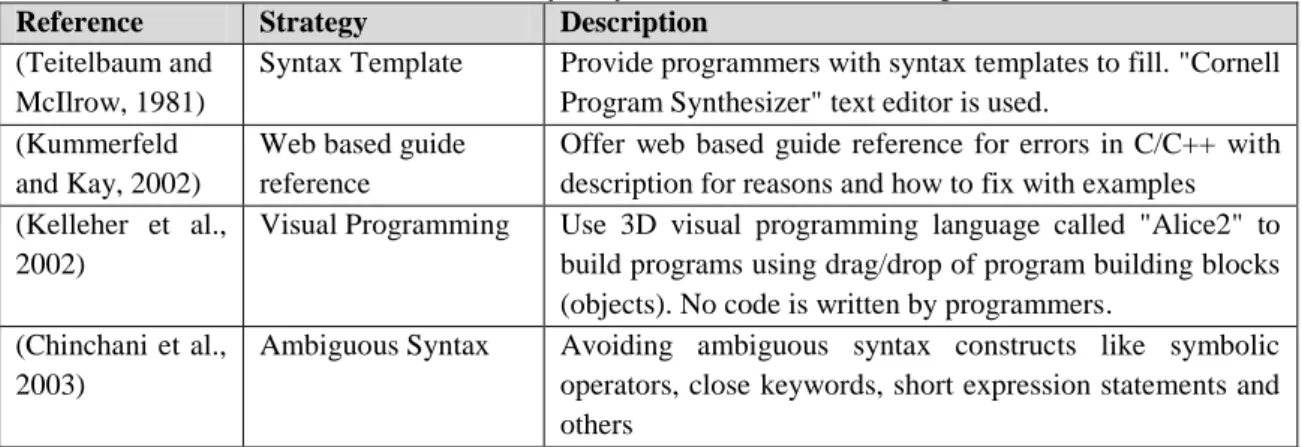
Table 2.1: Summary of syntax error reduction strategies ... 31
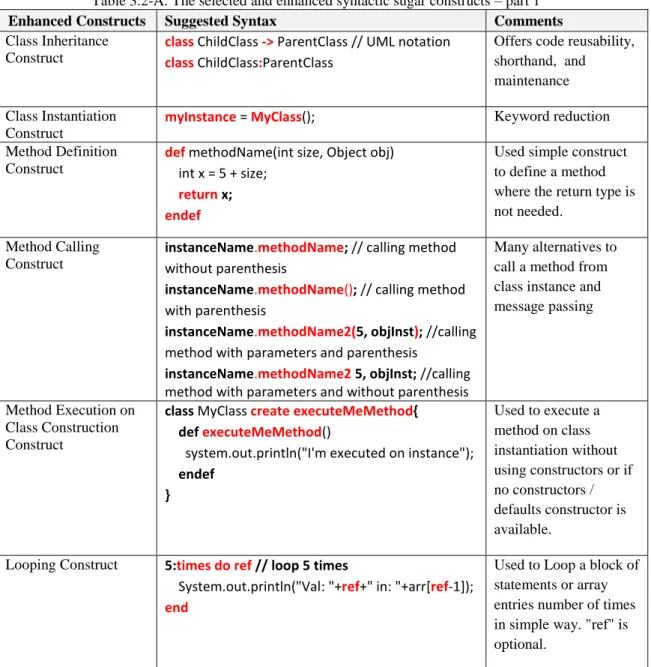
Table 3.2-A: The selected and enhanced syntactic sugar constructs – part 1 ... 44
Table 3.2-B: The selected and enhanced syntactic sugar constructs – part 2 ... 45
Table 5.3: Students answers on interview questions ... 55
Table 5.4: Semantic extraction results ... 61
vii List of Figures
Fig. No. Figure Name Page
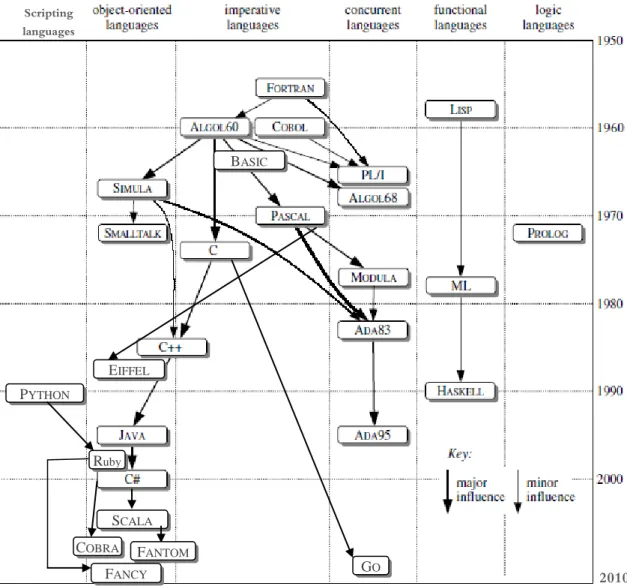
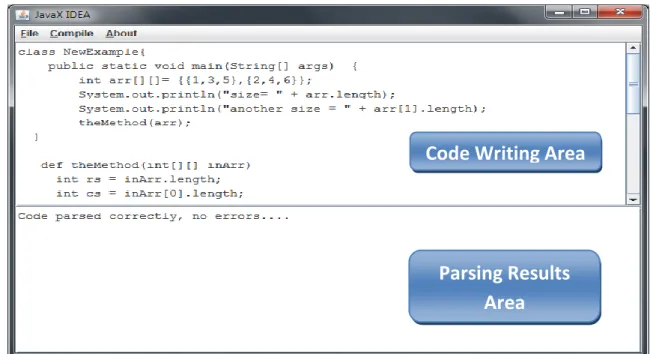
Figure 2.1: Important programming languages summary ... 7 Figure 4.2: New syntax IDE and parser tool ... 50 Figure 5.3: Students interview answers distribution ... 56 Figure 5.4: % of errors generated by using old and new constructs in each program .. 57 Figure 5.5: % of old and new constructs used in each program ... 58 Figure 5.6: Professionals interview answers distribution ... 62
viii
List of Appendices
Appendix No. Appendix Name Page
Appendix 1: Programming Languages' Extracted Constructs Sheet ... 73
Appendix 2: The Designed And Distributed Questionnaire ... 80
Appendix 3: Selected Programming Languages' Brief Description ... 89
Appendix 4: ICT Professional Population Calculation ... 91
Appendix 5: Users‘ Feedback Interview Questions ... 92
Appendix 6: Students' Case Study Experiment Programs ... 93
Appendix 7: Professionals' Case Study Experiment Programs ... 94
Appendix 8: Selected And Enhanced Constructs Set Detailed Description ... 100
1 Chapter One Introduction
Developing and writing software applications is a common daily activity done by thousands or even hundreds of thousands of developers and programmers as the demand on software applications is increasing to meet the technical revolution needs, which is involved in most trends in life.
Enterprise software applications development using programming languages (PL) requires a lot of code writing. Such applications have a lot of functionality and business logic for developers to focus on: functions, actions, use cases, and data processing that form the core of the application which offers the functionality to the users through application graphical interface or APIs (Application Programming Interfaces) (Mitchell, 2002). A valuable portion of developers‘ time is spent writing repetitive keywords and determining classes, methods, and code building blocks‘ scopes that can be ambiguous for them to follow up on and debug, which also may generate many of syntax errors that require extra effort to find and fix. Source code reading and semantic extraction by developers is not an easy task, especially when the code is huge and moved from one team to another, or is bought from 3rd party providers and the developers want to continue working on and customizing it.
Students who learn programming languages in universities and schools face similar issues in code ambiguity and syntax errors (Russell et al., 2009). Their issues with code sometimes cost them hours to fix certain syntax errors or to find logical ones because their experience is not mature enough to help them in code debugging and memorizing syntax keywords and complex structures. This enforces students to spend a portion of their time on syntax issues which can be saved and used to focus on application
2
functionality and logic as mentioned in (Kummerfeld and Kay, 2002): "Our own experience and observations of students indicates that students using an unfamiliar or new programming language waste considerable time correcting syntax errors."
Syntactic sugar enhancements on programming languages' syntax constructs is one of the approaches used to enhance syntax and help in making it more readable, easier to write, with less ambiguity. In this research, we study many programming languages through analyzing their syntax; studying it, and then offering a new suggested syntactic sugar constructs set where applicable. The set is composed of a mix from existing constructs obtained from the analyzed programming languages with a set of syntactic enhancement suggested by us. The purpose of the new syntactic sugar constructs set is to make programming language users' work easier, smoother, and less ambiguous, with fewer errors and more focus on application core functionality and less focus on code syntax and syntactic errors.
The questions we try to answer in this research: Do syntactic sugar constructs help in development with fewer syntax errors? Do they help with semantic extraction? Can they make code more readable and easier to write?
The research focuses on programming languages' syntax and how to enhance it by adding new syntactic sugar constructs for easier coding and compiling these enhancements to form a set of recommendations for programming language designers to make use of them while designing programming languages' syntax.
Research results showed positive indicators of using syntactic sugar in writing application source code.
3 1.1. Motivation
Through our work as software developers, team leaders, and guiding many students in their projects, we noticed that developers usually write a lot of repetitive keywords in specific parts of code like packages calling keywords, code segments and building blocks‘ scopes determination symbols, and many others, for example, the use of the curly braces ―{ }‖ symbols to determine classes, methods, expressions, and control statement (IF, FOR, WHILE…etc.) scopes in the same program building block. Using the same symbols can make it difficult to distinguish the method scope from its internal control statement scopes, especially in the case of missed opening or closing symbol.
These kinds of repeated keywords and ambiguous scopes consume part of developers‘ efforts and time especially when using a text mode development environment. The most important is that it can cause many syntax errors and make it hard to debug and understand the semantic.
This motivated us to search for syntactic constructs that help enhance programming language syntax to use fewer repetitive keywords, better scope determination symbols, better exception handling, more readable code with less writing efforts, and many other properties that make developers' work easier with more focus on business logic implementation.
Many researches were done and tools created to help generate source code automatically such as macros, annotations, IDE (Integrated Development Environments), and reverse engineering. These tools help save syntax writing efforts and minimize syntactic errors with hints to solve them. These tools eliminate part of the problem, but it is not useful in development environments that are dependent on text mode, where no visual user interface is available for the developers and they cannot use
4
IDEs and tools, as the case of the Linux or Unix command-line remote terminals or SSH command-line tools used for remote access.
We are targeting both novice and professional programming language users with focus on users who use remote or simple text mode editors, where no advanced IDE and code wizards are available.
1.2. Organization
Our methodology of finding a new syntactic sugar constructs set is explained in details throughout this thesis with all theoretical and technical details. An introduction to the subject and motivation with problem statement was introduced above; the rest of this thesis is organized as follows:
Chapter two is a literature review for the history of programming languages, and a review for syntactic sugars and their implementations. Chapter three discusses and explains our methodology in details, and the work done to obtain the syntactic sugar constructs set. Details of the exploratory case study done to validate the new constructs set are explained in chapter four. Chapter five presents and discusses the results obtained from executing the case study. Finally we conclude and discuss the future work in chapter six.
5 Chapter Two Literature Review 2.1Introduction
This chapter presents a review of the research areas related to the work done in this thesis.
We outline a historical review for the major and most popular programming languages development. In section two we present the done work related to syntactic sugars and form them in simple survey. Section three through light on work done to reduce syntax errors.
2.2History of Programming Languages
Programming language is a tool that includes a set of instructions and commands expressed through a well defined syntax that are programmers familiar with and used to form programs that can be executed by the computer in logical way producing efficient work proposed by the written program semantic. In other words, it is a medium of expression in the world of computer programming (Mitchell, 2002) (Collberg, 2005).
Each programming language has a syntax that is the form of the program and how it is written by programmer and parsed by the computer. The syntax is composed of declarations, expressions, commands, and constructs that are used to compose the program (Watt and Findlay, 2004) (Collberg, 2005).
The semantic in programming languages is the meaning of the program and the desired functionality of it when it is executed. Semantic is used to determine the programmer's desired functionality and how it is understood by the computer at execution time (Watt and Findlay, 2004) (Collberg, 2005).
6
Programming language paradigm expresses how the languages is designed to be used and in which domains. This also affects how programmers design their programs to solve certain problem. Each programming language can support one or more paradigms.
The most well known paradigms are: 1) Functional paradigm which depends on functions and their calls as main building construct. 2) Imperative paradigm which uses procedures, commands and variables. 3) Concurrent paradigm which supports the concurrent execution of commands and processes. 4) Logical paradigm which depends on facts and relations. 5) Object oriented paradigm where the object and class concepts are the core items in this paradigm, in addition to relations such as inheritance, composition, and aggregation. 6) Scripting paradigm, programming in this paradigm is simple, complete program is not needed and it uses high level commands, scripts can be executed and interpreted in simple and primitive environment like UNIX shell, DOS, or internet browsers (Watt and Findlay, 2004).
In this research, we focus on high level programming languages summarized in Figure 2.2. A high level programming language is a language that its programs are executed independently from machine. High level programming languages use compilers to convert programs to machine language or use interpreters (Watt and Findlay, 2004).
In the mean time, we have hundreds of high level programming languages that were developed over time since the first high level programming language was developed (Mitchell, 2002). In this chapter we review the most common programming languages over the last 60 years.
7
Figure 2.3: Important programming languages summary, adapted and updated from Watt and Findlay, 2004
The first popular high level programming language was FORTRAN. FORTRAN was developed at IBM around 1957 by a John Backus team and help from Peter Sheridan (Mitchell, 2002) (Sammet, 1996). FORTRAN was the first language used arrays, ordinal mathematical notation expressions, procedures, symbolic names for variables, and formatted inputs and outputs (Mitchell, 2002) (Watt and Findlay, 2004). It was good for mathematical and economical calculations (Nerlove, 2004) (Watt and Findlay, 2004). FORTRAN contains many limitations such as no recursion support, numbers storing in the memory was weak, and programmer may change a value by mistake if he was not careful (Mitchell, 2002). FORTRAN considered as imperative language. It was
Scripting languages PYTHON BASIC SCALA EIFFEL Ruby 2010 COBRA FANTOM GO FANCY
8
developed over time and many new versions were delivered, for instance FORTRAN77 at 1977, FORTRAN for Microsoft Dos operating system at 1982, and FORTRAN90 at 1990 which support object oriented paradigm (Nerlove, 2004).
In 1960, COBOL was founded by Grace Murray Hopper (Mitchell, 2002). It was used for business applications and commercial data processing (Mitchell, 2002) (Watt and Findlay, 2004). The designers tried to make its syntax English like (Mitchell, 2002). COBOL introduced data description concept that was used to build data types in successor languages (Watt and Findlay, 2004) and used the record data structure. COBOL considered to be imperative programming language, it suffered from low level flow control (Mitchell, 2002) (Watt and Findlay, 2004), and it did not support local variables, recursion, and dynamic memory allocation (COBOL, n.d.). COBOL gained many enhancements and improvements over time, the last version was COBOL2002 at 2002 which added support for object oriented features, user' defined functions, pointers, Boolean support, floating point support, XML manipulation, and many others (COBOL, n.d.).
The first functional programming language was Lisp; it was developed by the end of 1950s at MIT for artificial intelligence and symbolic computations (Mitchell, 2002). Lisp is considered as simple and flexible language for expressing logical expressions. Its main data structure is lists and it support recursive calls. Lisp continued developing over time and used widely: in 1960 Maclisp was developed at MAC MIT project, another version was released in 1970s by Guy Steele and Gerald Sussman adding new features to Lisp. The current Lisp that called common Lisp is a new version that offers complex object oriented primitives (Mitchell, 2002).
9
The general purpose imperative programming language ALGOL60 was designed by Alan Perlis, John Backus, and John McCarthy in the period 1958 to 1963 (Mitchell, 2002). ALGOL60 supported functions, recursion, block structure that allow declaring procedures and variables anywhere in the programs, and it offered better data structures representations (Mitchell, 2002) (Watt and Findlay, 2004). A new version of ALGOL was developed at 1968 called ALGOL68; this version supported declaring arrays to be of type integer, array, or procedure. Procedures in ALGOL68 can accept parameters and return values of type integer, array, or other procedures (Watt and Findlay, 2004). Many programming languages were developed on top of ALGOL, ALGOL formed programming languages family where all successors languages called ALGOL-LIKE languages (i.e. Pascal, C, ML) (Mitchell, 2002) (Watt and Findlay, 2004).
The simple imperative programming language BASIC was design in 1963 by John G. Kemeny and Thomas E. Kurtz at Dartmouth College (Nerlove, 2004) to offer simple, easy, and quick programming language for students. BASIC supported sound playing and graphics (Nerlove, 2004). Apple II was sold with BASIC support in 1977. BASIC was used in IBM PC DOS operating system in 1981-1982 and called at that time Quick BASIC. It was extended and used by Microsoft through Visual Basic (Sureau, 2010).
In 1964, George Radin at IBM, tried to combine ALGOL60, FORTRAN, and COBOL best features in one general purpose programming language called PL/1 (Nerlove, 2004). PL/1 considered being both imperative and concurrent programming languages. It introduced new concepts in programming like concurrency and exceptions low level forms. Because of the combination of many language features and paradigms, PL/1 was complex, difficult to implement, and huge. It didn‘t success on the long term (Watt and Findlay, 2004).
10
The first object oriented programming languages was SIMULA67 that design by O.-J.Dahl and K. Nygaard in 1967 (Mitchell, 2002). SIMULA67 introduced the concepts of o classes, inheritance, objects, dynamic lookup, and sub typing, SIMULA67 didn't supported encapsulation and abstraction (Mitchell, 2002) (Watt and Findlay, 2004). Many object oriented languages were developed depending on SIMULA67 and used its object oriented conceptual inspiration like C++ and SMALTALK (Mitchell, 2002) (Watt and Findlay, 2004).
PASCAL, the ALGOL-like imperative programming language, was developed around 1970 as successor for ALGOL60 (Watt and Findlay, 2004). PASCAL was simple and efficiently implemented and used in system development and programming languages curricula classes to teach programming languages (Nerlove, 2004). PASCAL offered rich simple set of control structures, data types (i.e. arrays, recursive types, records, Booleans, characters, enumerations, files) pointers, and procedures (Watt and Findlay, 2004).
SMALLTALK was developed as the first pure object oriented programming language at Xerox PARC in the 1970s (Mitchell, 2002). Everything in SMALLTALK was considered as object (values, control structures such as IF statement, commands) (Watt and Findlay, 2004). SMALLTALK was successor from SIMULA67, but it added many new features in object oriented such as message passing to objects, abstraction, access modifiers (public methods, and private instance variables) (Mitchell, 2002).
The first well-known programming language that design based on logic paradigm was PROLOG at 1973 by Philippe Roussel (Watt and Findlay, 2004) (Nerlove, 2004) (Mitchell, 2002). PROLOG at its beginning was weak and inefficient until it was
11
supported with new extra logical features and it still used in logic programming (Watt and Findlay, 2004).
Between 1972 and 1974, the evolutionary imperative programming language C was developed by Dennis Ritchie at AT&T Bell Labs (Nerlove, 2004) (Mitchell, 2002). C was created to be used in writing UNIX operating system (Watt and Findlay, 2004). In 1980, C became famous programming language because of its efficiency, simplicity, and flexibility, and it was used in developing software applications rather than UNIX operating system (Nerlove, 2004). C is ALGOL-like language and support blocks, recursive functions, and local variables declaration. But it is more restricted as it doesn‘t allow declaration of functions within nested building block; they must be outside the main program (Mitchell, 2002).
MODULA was developed lately 1970s by Niklaus Wirth as successor for PASCAL (Mitchell, 2002). MODULA considered as concurrent programming language (Watt and Findlay, 2004). The main feature MODULA offered over PASCAL was the module system which used to group related declaration sets in programming units (Mitchell, 2002).
The Meta language ML was designed by Robin Milner as part of developing a Logic for Computable Functions LCF project by the end of 1970s (Mitchell, 2002). ML mainly is a functional programming language but it support the imperative paradigm too as its syntax is ALGOL like (Mitchell, 2002) (Watt and Findlay, 2004). It allows inline functions creation within expressions, pass them to other functions as parameters and return them as results (Mitchell, 2002).
12
Another well know PASCAL successor was ADA, it was developed at early 1980s as an initiative by U.S. Department of Defense (DoD) to standardize their software around one language that support specific features such as real-time programming and usage of concurrent programming paradigm (Mitchell, 2002) (Watt and Findlay, 2004). ADA introduced packages, generic units, high level exceptions, and offered wide variety of data types (Booleans, characters, enumerands, integers, real numbers, records, arrays, discriminated records, objects (tagged records), strings, pointers to data, and pointers to procedures.) (Watt and Findlay, 2004). ADA was known by its reliability, robustness, and efficiency; it used in the development of critical systems such as aerospace (Watt and Findlay, 2004). Because of its high compiler cost, it was little used in universities, research, and civilian software market (Mitchell, 2002). ADA continued in development and the latest version was ADA95 in 1995 (Watt and Findlay, 2004).
An extension to C was implemented around 1984 by Bjarne Stroustrup at A Bell Laboratories to offer object oriented support in it, the extension formed new programming language called C++ and it inherit most of C language features and shortcomings (Mitchell, 2002) (Nerlove, 2004). C++ considered as imperative and object oriented language (Watt and Findlay, 2004). C++ became very popular and widely used language in many platforms applications such as UNIX, Apple MAC, and Microsoft Windows (Mitchell, 2002).
Eiffel is an object-oriented programming language designed by Bertrand Meyer in 1985 (Sureau, 2010) to produce robust software. Its syntax is keyword-oriented like ALGOL and Pascal tradition and it is strongly statically typed with automatic memory management (typically implemented by garbage collection) (Meyer, 2001). Eiffel
13
support programming by contract (usage of pre and post conditions in functions) (Sureau, 2010).
The pure functional programming language HASKELL was design around early 1990 by a large committee led by Simon Peyton Jones and John Hughes (Watt and Findlay, 2004). HASKELL was affected by ML. And it allows passing functions to other functions as parameters and returns them as results. It uses polymorphic functions, support algebraic types and very close to the mathematical disjoint-union notation (Watt and Findlay, 2004).
PYTHON is well designed and famous scripting languages design in 1991 by Guido Van Rossum (Sureau, 2010) (Watt and Findlay, 2004). PYTHON can support C libraries and object oriented feature. It can run within Java JVM (Sureau, 2010). Python was known as dynamic programming language with very clear readable syntax, intuitive object orientation, natural expression of procedural code, full modularity, supporting hierarchical packages, exception-based error handling, very high level dynamic data types, and extensive standard libraries and third party modules. The extensions and modules are easily written in C, C++ (or Java for Jython, or .NET languages for IronPython), and embeddable within applications as a scripting interface (About Python, n.d.).
Java (its first name was Oak) is a well known object oriented programming language developed at Sun Microsystems by James Gosling and others between 1990 and 1995 (Mitchell, 2002). Java is also suitable for concurrent programming and distributed environment. Its power appears in web development and writing applets which are small programs run within web pages (Watt and Findlay, 2004). Java came to simplify C++ and solve a number of problems in modern programming practices (Watt and
14
Findlay, 2004) (The Java Language, n.d.). Java Virtual Machine helped it to be platform independent and Java can run on any operating systems, hardware, and even small, portable, and imbedded devices (Watt and Findlay, 2004) (Mitchell, 2002). Java offered many new features to object oriented such as interfaces, abstract classes, and run time class loading, and it focused on security, efficacy, simplicity, high-performance, multithreading, and portability in its design (Mitchell, 2002) (The Java Language, n.d.).
The object oriented language C# was developed at 2000 by Microsoft systems; it is close to Java with minor changes that made it suitable for desktop applications (Watt and Findlay, 2004). C# is a type-safe, object-oriented language that is simple yet powerful, allowing programmers to build a breadth of applications. Combined with the .NET Framework (Getting Started with Visual C#, n.d.), a new version called Visual C# 2008 produced that enabled the creation of Windows applications, Web services, database tools, components, controls, and more (Getting Started with Visual C#, n.d.).
RUBY is a modern object oriented programming languages design as successor of PYTHON and PERL (Sureau, 2010) to offer clearer and more object oriented support (Sureau, 2010). RUBY design started in late 1990s by Yukihiro Matsumoto (Sureau, 2010). Yukihiro Matsumoto blended parts of his favorite languages (Perl, Smalltalk, Eiffel, Ada, and Lisp) to form a new language that balance functional programming with imperative and object oriented programming (About Ruby, n.d.).
The New modern programming language SCALA was developed in the programming methods laboratory at EPFL and released in 2004 (Odersky et al., 2006). SCALA considered as general purpose programming language that support the common programming patterns in type safe and elegant way (The Scala Programming Language, 2008). SCALA is JAVA-like languages. The code size produced by SCALA is
15
relatively short but hard to read as it uses a lot of symbols and inline functions declaration (Odersky et al., 2006). SCALA integrate the features of object oriented and functional paradigm (The Scala Programming Language, 2008).
In the literature, many programming languages were developed in the period between 2004 and 2010. These languages were not widely used and known. Most of them were extensions on top of exist languages like Java and Python to form frameworks for special needs, or create new high level general purpose programming languages to simplify the previous programming languages and offer new features (Timeline of programming languages, 2011).
In 2006, the object oriented programming languages COBRA was developed by Chuck Esterbrook to collect many features from many exist programming languages (PYTHON, C#, EIFFEL) and offer them in one language to support development by contract, static and dynamic binding, quality control, runtime performance and quick coding (Why Cobra, 2010).
The general purpose programming language FANTOM was developed in 2007 by Brian Frank and Andy Frank (Why Fantom, 2011). FANTOM is influenced by C#, JAVA, SCALA. It supports functional, concurrent, declarative, and object oriented programming. FANTOM offers static / dynamic binding, elegant programming APIs, and runtime portability on both Java and .NET platforms (Why Fantom, 2011).
GO is concurrent programming languages that developed at Google by Robert Griesemer, Rob Pike, and Ken Thompson in 2009 (The Go Programming Language, 2011). GO main purpose is to develop concurrent programs that make use of multi-core machines. GO offers runtime reflection and garbage collection in addition to a fast static
16
typing that affect program execution performance (The Go Programming Language, 2011).
In 2010, the work started on designing and developing a new pure object oriented programming language called FANCY by Christopher Bertels (About Fancy, 2011). FANCY is still under development and influenced by RUBY, SMALTALK, and others. Its current versions works under LINUX and MAC-OS, it supports dynamic typing and garbage collection (About Fancy, 2011).
2.3Syntactic Sugars Constructs Review
During our work in this thesis, we conducted a review for syntactic sugar construct previous work, this showed that no dedicated research area or surveys available in this field. We found out that the work done in this area was discrete efforts related to enhance certain languages syntax, or mentioning syntactic sugars as minor part of work done in other researches. In this review, we tried to collect the available related work done in syntactic sugar constructs and put them in a form of survey.
The term "Syntactic Sugar" was found by the British computer scientist Peter J. Landin (Mageed, 2010), this term describes making programming languages syntax user friendly and offer alternative syntactic expressions to language common constructs to be sweeter and written in simpler way without affecting the semantic (Mageed, 2010) (Golbreich and Wallace, 2008).
In 1985 Andrew Koenig proposed a new language called "Snocone" as an extension to the "SNOBOL4" text processing and pattern matching language (Koenig, 1985). Andrew introduced the new language by adding syntactic sugars to SNOBOL4 in order to make it easier to implement as SNOBOL4 control structure is old and complex, in
17
addition to the usage of blank character as operator which caused many syntactic troubles to programmers.
TEX language is unfamiliar formatter programming language that has complex and low level encoding construct syntax that make it difficult for usage (Laan, 1992), In 1992, the authors of TEX provided syntactic sugars to make the syntactic constructs about the loop, switch, array addressing, and keyword parameters closer to high level programming languages constructs such as Pascal in order to be easier for users.
In 1996, Roberto Ierusalimschy and his team introduced "Lua", the extendable language that offers ability to build extending application (Ierusalimschy et al., 1996). Extending applications are application that can be reconfigured and extended in production time. Lua offered the syntax and application program interface (API) needed for configuration. Lua provided set of syntactic sugars constructs for users to make code writing simpler. Examples (Ierusalimschy et al., 1996):
Method definitions using syntactic sugars: function object:method (params) ...
End
This is equivalent to the un-sugared syntax:
function dummy_name (self, params) ...
end
object.method = dummy_name
Method call sugared constructs written as receiver:method(params) This is equivalent to the un-sugared syntax: receiver.method(receiver,params)
18
In (Chiba, 1996), Shigeru Chiba introduced OpenC++ which is C++ extension offers meta-level program features interpreted by compiler at compile time. OpenC++ provided syntax sugar for matrix manipulation library to define matrix as an array with initialized values which was not possible in regular C++ (Chiba, 1996). A new kind of loop statement using "forall" notation to loop over all matrix entries in shorthand way was introduced too. Examples (Chiba, 1996):
To initialize array with double values, C++ use the following construct: double tmp[] = { 0.5, -0.86, 0, 0.86, 0.5, 0, 0, 0, 1 }; Matrix r = tmp;
In OpenC++ syntactic sugar construct, it can be:
Matrix r = { 0.5, -0.86, 0, 0.86, 0.5, 0, 0, 0, 1 }; To loop over matrix and initialize its entries, OpenC++ use:
r.forall(e){ e = 0.0; } While in C++ it must be:
for(int i = 0; i < N; ++i){ double& e = r.element[i]; e = 0.0;
}
Referring to the examples above, the matrix definition and initialization constructs in OpenC++ are shorter than and C++.
RhoStratego is a programming language developed by Eelco Dolstra in 2001 as part of his thesis work (Dolstra, 2001). RhoStratego is a language used to implement program transformation. This language used syntactic sugars to code un-ambiguity as described in (Dolstra, 2001) by replacing parentheses with angle brackets. Also, it provided syntactic sugar for congruencies, lists, and tuples. Examples on RhoStratego syntactic sugars (Dolstra, 2001):
19
Lists and tuples can be defined simply using the following syntactic sugar constructs: numbers = [1, 2, 3];
stuff = <42, "Foo", C 23>;
The unary tuples unambiguous notation was solved by using angle brackets instead of parenthesis (Dolstra, 2001). In addition, RhoStratego offered syntactic sugar constructs for complex expressions and patterns to be written in simpler and shorter way, for example:
The following construct
foo = C 123 -> "foo";
Is syntactic sugar form for this complex one:
foo = Decomp(x, y) -> (C -> 123 -> "foo") x y;
We can notice how sugars helped making the code shorter, simpler, and clearer.
FC++ is an extension library added to C++ to support functional programming (McNamara and Smaragdakis, 2003). In 2003, Brian and Yannis added new features to FC++ related to support lambda sublanguage. The authors used syntactic sugar in FCC++ to simplify functional notation and lambda calling constructs, for example (McNamara and Smaragdakis, 2003):
The de-sugared version of code: [1,2,3] ‘bind‘ (\x ->
[2,3] ‘bind‘ (\y ->
if not (x<y) then zero else unit (x+y) )) Can be replaced by the following syntactic sugar:
[ x+y | x <- [1,2,3], y <- [2,3], x<y ] -- results in [3,4,5]
20
Usage of syntactic sugar in FC++ made the constructs shorter and simpler for users to write and read.
In Scott Lystig Fritchie study (at 2003) of the performance of "in memory databases" implemented using ETS (Fritchie, 2003), and by comparing the results with 4 different data structures, he explained that a character representation was used as syntactic sugars to replace the ASCII characters representation to be more readable (Fritchie, 2003). For example, word "scott" is syntactic sugar representation for the ASCII characters list [115,99,111,116,116].
In 2004, Steve Freeman, Nat Pryce, Tim Mackinnon, and Joe Walnes in their paper Freeman et al., 2004, investigated using mock object in test driven development (TDD). Test driver development is a methodology where programmers define tests for their code functionality before implementing it, and start development until the test pass (Freeman et al., 2004). In their research, they used an open source framework called jMock (Freeman et al., 2004) that provides API for creating mock objects and specify how to invoke tests and to verify results with pass or fail criteria. jMock API itself considered as syntactic sugar implementation that can be used to create testing APIs and make test suite construction simpler. In this paper, the syntactic sugar concept was applied on framework API level and not only on simple syntactic constructs.
Christian Kirkegaard with his partners in (Kirkegaard et al., 2004) made a trial to make XML document manipulation easier, high level, and faster based on XPATH, they introduced new extension to Java called XACT (Kirkegaard et al., 2004). XACT was equipped with many syntactic sugar constructs that made XML manipulation easier for people who use XACT in order to use simple functions instead or writing complex constructs to achieve the same operations (Kirkegaard et al., 2004). The following
21
examples show some of syntactic sugars in XACT where the left operand is the syntactic sugar form and the right one is the de-sugared code needed to perform the same operation:
smash(xs) = xs.length>0 ? group(xs,.[false()])[0] : [[]] x.roots() = x.select(*) x.text() = smash(x.select(text())).toString() x.attribute(a) = smash(x.select(@a)).toString() x.has(p) = x.select(p).length>0 x.size() = x.roots().length x.delete(p) = x.gapify(p,g) x.apply(p,f) = x.gapify(p,g).plug(g,[]f(x.select(p)))
The "XQuery" language is used to query XML documents (Hidders et al., 2005). This language is powerful and its popularity was growing up. It suffered from complex syntax that made it hard to be used in research and education (Hidders et al., 2005). In 2005, the authors of (Hidders et al., 2005) created a new sub language based on "XQuery" called "LiXQuery". The new language offered simpler syntax using syntactic sugar to offer shorter constructs for common and certain expressions (i.e. The Empty Function, Quanti_ed Formula, FLWOR Expressions, Coercion), and to replace the complicated syntax in "XQuery" with "LiXQuery" constructs and make it suitable for research and education.
In Thomas Largillier work in (Largillier, 2005), two new syntactic sugars were added to C++ to simplify writing efficient and generic code transformers code in LRDE project (LRDE, n.d.). The transformation expression can be expressed in C++ syntax but they need clever programmers to be able to write them which costs time and produce complex, heavy and unnatural code. Because of these issues, Thomas offered new syntactic sugar constructs to help the developers. The first constructs was the usage of meta-tags with variables and classes to tell the compiler that values must be calculated
22
at compile time. The other one was virtual "typedefs" used to overwrite the statically typed variables in sub classes.
The Object Constraint Language (OCL) language used to describe UML rules (Süß, 2006), was extended by J¨orn Guy S¨uß in 2006 to have syntactic sugars as its concrete syntax is verbose and hard to be read (Süß, 2006). J¨orn extracted the new syntactic sugars from math and logic depending on positive results he got from using the syntactic sugars within workshop notes and formalized due to UML 1.4.2 standard (OMG, 2005). The new syntactic sugars were Unicode and Latex symbols that can be used within MS-word documents, HTML and other UML representation document format and tools.
Following is an example shows how collections in OCL are represented using the new sugar Latex and Unicode syntactic symbols (Süß, 2006):
Example one
Originals OCL Set: Set(X) Unicode syntactic Sugar: {X} Latex syntactic sugar: \{/ \} Example two
Originals OCL Sequence: Sequence (X) Unicode syntactic Sugar: [X]
Latex syntactic sugar: [ ]
Other examples for other constructs are available in (Süß, 2006).
In 2006, following to their work in (Freeman et al., 2004), Steve Freeman and Nat Pryce used syntactic sugars in Java based embedded domain specific languages (EDSL) to implement sugar methods to replace the Java noisy syntax and non domain related code
23
that used to create and set up domain specific objects (Freeman and Pryce, 2006). The idea was that the authors wanted to embed domain specific language within a general language to use its implementation, capabilities, and tools and not to build the domain specific language on top of the language. The authors used syntactic sugars to implement methods that provide domain specific functionality; these methods hide and encapsulate the complex general programming language code used to implement the desired functionality and used within the EDSL code.
In Java like languages (Java, Scala and C#), Philippe Altherr and Vincent Cremet described in their paper (Altherr and Cremet, 2006) many simple syntactic sugars used to reduce syntax complexity, make code shorter and cleaner such as omitting empty type parameters list in classes and methods, omitting empty arguments lists, and using special identifiers (_) for un-referenced parameters.
Example removing square brackets:
class A { val x: A val y: List[A] } The above construct is a syntactic sugar for the following:
class A[] { val x: A[] val y: List[A[]] }
In (Fruhwirth, 2007), Clemens Fruhwirth introduced Liskell, a new syntax for Haskell that provides programmers with a set of syntactic sugars to eases programming (Simple List, The Dispatcher Namespace, syntax sugar for defining macros "defmacro" and others). Using syntactic sugars provided, the code was shorted and became more readable. The following example shows how syntactic sugars affected the syntax complexity to be simpler (Fruhwirth, 2007):
The following un-sugared block:
24
Can be written in Liskell syntactic sugars as follows: (if ,guard ,action ,(trf-cond rest))
The same for macro definition, it can be done using a simple construct in Liskell: (defmacro (macro-name pts) body)
Thaís Batista and Maurício Vieira used syntactic sugars in their work (Batista and Vieira, 2007) within Aspect Oriented Programming language called RE-AspectLua, a new version of AspectLua. Syntactic sugar constructs were used to reduce number of code lines needed to define aspect interface and associating it with aspect points in the code, and make interface definition simpler (Batista and Vieira, 2007). Example shows how code becomes shorter:
aspectA = Aspect:new( {name = "Aspect A"} ) aspectB = Aspect:new( {name = "Aspect B"} ) ai1 = AspectInterface:new()
ai1:refinement( {name = 'interface1'}, {refine = 'abstractpointA',
action = advice1} )
ai2 = AspectInterface:new()
ai2:refinement( {name = 'interface2'}, {refine = 'abstractpointB',
action = advice2} ) aspectA:interface(ai1) aspectA:interface(ai2) aspectB:interface(ai1)
The above code using new syntactic sugars aspect interfaces will be as follows:
ai1 = AspectInterface:new_refinement( {name = 'interface1'}, {refine = 'abstractPointA',action = advice1} )
ai2 = AspectInterface:new_refinement( {name = 'interface2'}, {refine = 'abstractPointB',action = advice2} )
25
In (Liu et al., 2007), the bidirectional transformation language Bi-X was used in bidirectional input and output data transformations and synchronization. Bi-X can be used to define new functional languages with syntactic sugars for ease of use (Liu et al., 2007). For example, the usage of curly-braces "{}" is optional in some constructs like Boolean-value functions, the programmer can omit them. The syntax of any new language based on Bi-X is composed of set of core Bi-X syntax constructs and functions, the new language syntax is a simplified form of constructs that make it easy for user to define transformation rules using simpler and shorter constructs than using only Bi-X core functions.
Java programming language adds new features in each release to make programmers life easier (Kominetz, 2007). In Java 5, John Kominetz explained that Java offered the "FOR-EACH" looping construct that is useful to iterate over lists and collections instead of "ITERATE-WHILE" loop constructs. The "FOR-EACH" loop is much simpler and shorter than the traditional loop construct (Kominetz, 2007). According to Raja Kannappan, the latest release from Java "Java7" offered new set of features such as multi exception catch (Kannappan, 2010). The new constructs help programmers to write one catch block for many exception types like:
The old multi-catch form (Kannappan, 2010): try {
// Say some file parser code here... } catch (IOException ex) {
// log and rethrow exception } catch (ParseException ex) { // log and rethrow exception
} catch (ClassNotFoundException ex) { // log and rethrow exception
26 Can be replaced by:
try {
// Say some file parser code here...
} catch (IOException ex | ParseException ex | ClassNotFoundException ex) {
// log and rethrow exception }
Many other features were added such as supporting strings in selection statement cases, allow underscores in telephone numbers, credit cards, and social number, the ability to parse binary number from string, in addition to many other features mentioned in (Kannappan, 2010).
The W3C Web Ontology Language (OWL) is used by applications to process document data and present it for human benefit and readability (Golbreich and Wallace, 2008). OWL was extended with a new set of features provided in a new release called OWL 2 (Golbreich and Wallace, 2008). Two of the new features in OWL 2 were extra syntactic sugar added to make the common DisjointUnion and DisjointClasses patterns in OWL easier to write (Golbreich and Wallace, 2008). The usage of new syntactic sugar patterns DisjointUnion and DisjointClasses hides the complex DisjointWith patterns used to perform the same functionality.
Chieri and Atsushi work in (Saito and Igarashi, 2008) was to solve the problem of recursive classes-subclasses as they lost referencing and type safety because they referenced by name in the object tree. They solved the problem by proposing new lightweight polymorphism that support type safe recursive classes and added this solution to JAVA 5 as extension called Featherweight Java (.FJ). FJ extension related to nested classes, family-polymorphic methods, and relative path types were considered as syntactic sugars added to Java 5.
27
In (Haskell syntactic sugar, 2010), Haskell functional language used syntactic sugars for simplifying expressions and making syntax more readable and shorter. Example: For functions used in numbers manipulations, Haskell offered the following syntactic sugar constructs:
The original form: \x -> x + 2 The sugared from: (+2)
For lists:
The original form: 1:2:3:[] The sugared from: [1,2,3]
List comprehensions original form:
let ok (x,y) = if x < 2 then [x] else [] in concatMap ok foos The sugared from:
[ x | (x,y) <- foos, x < 2 ]
Many other examples are available in (Haskell syntactic sugar, 2010). The syntactic sugar constructs used changed HASKELL constructs to be more readable, easier to write, shorter, and well-formed.
In (Mageed, 2010), C# 3.0 was provided with new features to support LINQ functional paradigm. These features were classified as syntactic sugars that help in cutting down the repetitive code tediousness. The authors explained the new syntactic sugar features exist in C# 3.0 and how they can help supporting LINQ. The explained syntactic sugar features were implicitly typed local variables, automatic properties, object and collection initializing, anonymous types, extension methods, and lambda expressions (Mageed, 2010). These new syntactic sugar constructs aimed to make code length and objects initializing constructs shorter. The following examples shown in (Mageed, 2010):
In order to define a class called Person and create instance from it, the old C# code to achieve this is:
28
Using new C # 3.0 syntactic sugars, this can be done as follows:
Another example, to fill a list with instances of Person class using old C# syntax, user need to do the following:
29
While in new C# 3.0 syntactic sugar, this can be done as follows:
C# 3.0 constructs are shorter than old one but they appear harder to read and understand (Mageed, 2010). Other examples exist in (Mageed, 2010).
2.4Syntax Errors Reduction
Efforts to reduce and eliminate syntax errors were considered in many researches. The majority of these researches focused on students and novice programmers.
Teitelbaum and McIlrow in (Teitelbaum and McIlrow, 1981), proposed The "Cornell Program Synthesizer" text editor to help in reducing syntax errors through providing programmers with syntax templates for the constructs they want to write using command code. After the editor print the desired template (i.e. IF statement template), programmer has to fill the template with values and complementary statements (i.e. conditions and body statements). The programmer has to memorize the command codes for all constructs.
Sarah K. Kummerfeld and Judy Kay work in (Kummerfeld and Kay, 2002) offer simple way to help students in solving syntax compile-time errors in C/C++. They build a simple web based guide reference that explains the common compiler syntax errors with details on error description, expected reason, code examples, and how to correct it using an example. The authors validate this approach though preliminary experiment with simple size of students. They asked students to correct syntax errors in certain written programs. The results showed that the online reference guide helped novice
30
programmers in solving their errors more than experienced one. The same results were noticed for experienced programmers when they face errors they were not familiar with.
Another trend the authors in (Kelleher et al., 2002) followed to reduce syntax errors for novice programming students was by offering 3D visual programming language called "Alice2". The main propose of this language was to help learners to focus on program logic and execution and not on syntax writing, errors, and to minimize the set of syntax they need to memorize. Learners can easily build their programs using drag and drop tiles, objects, and relation, then execute the program and check results. They don't need to write the underlying code, it will be generated by Alice2 in the background.
The study done in (Chinchani et al., 2003) show that the popular programming languages syntactic features may cause logical errors and security breaches in program execution while the program syntax grammar is written correctly. For example, the usage of semicolon as complete statement in C can cause FOR loop to complete successfully but will not affect the loop body and cause logical error:
int x;
For(int i=0; i<100; 1++); // the ";" will prevent x from
x = x + i; // increment and cause wrong value
For(int i=0; i<100; 1++) // this is the correct code form
x = x + i;
Another example is the usage of symbolic operators in expression: int i , j, v ;
v = i > j ? i : j; // v will have int value which is correct
v = i > j ; i : j; // v will has Boolean value and cause program // fault because "?" is replaced with ";"
In Languages design, the authors advice to avoid ambiguous syntax constructs that depend on symbolic operators, short expression statements, week typing, similar
31
variable names with case sensitive, the similar or close key words and white spaces as they can cause logical errors and security breaches.
The following table summarizes approaches used to reduce syntax errors:
Table 2.1: Summary of syntax error reduction strategies
Reference Strategy Description
(Teitelbaum and McIlrow, 1981)
Syntax Template Provide programmers with syntax templates to fill. "Cornell Program Synthesizer" text editor is used.
(Kummerfeld and Kay, 2002)
Web based guide reference
Offer web based guide reference for errors in C/C++ with description for reasons and how to fix with examples (Kelleher et al.,
2002)
Visual Programming Use 3D visual programming language called "Alice2" to build programs using drag/drop of program building blocks (objects). No code is written by programmers.
(Chinchani et al., 2003)
Ambiguous Syntax Avoiding ambiguous syntax constructs like symbolic operators, close keywords, short expression statements and others
2.5Contribution
By referring to programming languages review in section 2.2 (Figure 2.4); we noticed that the mainly common programming languages paradigm used were the object oriented and imperative paradigms. Most of the modern programming languages focus on object oriented. Based on this we decided to focus on these two paradigms in our study.
All the related work described in syntactic sugars review (section 2.3) was focusing on enhancing certain syntax constructs partially in order to add support for specific concepts such as functional paradigm support in object oriented programming language, methods shorthand, interfaces, decrease code verbose and un-ambiguity, and adding new functionality or domain support to a programming language "DSL" (Altherr and Cremet, 2006) (Freeman et al., 2004). There was no proposal or work done to enhance the general programming languages common abstract syntax constructs using syntactic
32
sugars, and we didn‘t find previous study to measure syntactic sugars efficiency and if they achieve their proposed goals.
The trends used to reduce syntax errors focused on novice programmers. These trends provided code templates and error guide references (Kummerfeld and Kay, 2002) (Teitelbaum and McIlrow, 1981) to help in reducing the errors. Other trends changed the programming paradigm and offered 3D visual programming environment (Kelleher et al., 2002) to solve the problem, but 3D visual programming prevent programmers from practicing the real life programming experience and paradigms. In addition, most of the proposed trends used to reduce syntax errors don‘t work in simple and remote development environments, for example, the code template need IDE or rich editor to insert templates it in the code, the Web reference need internet connection, and the visual 3D need visualized environment and rich IDE to manipulate the objects, while syntax sugars can be useful and work in simple text and pure command line environment.
In our work, we tried to make enhancements using syntactic sugars on general level for the most common abstract constructs that are used in both object oriented and imperative programming languages. We propose using syntactic sugar to reduce syntax errors, reduction of repetitive keywords, better semantic extraction, code debugging, and make text based and remote development and development using simple editor easier for novice and expert programmers, which was not discussed previously. And we conducted an exploratory case study to measure the proposed syntactic sugar construct efficiency.
33 Chapter Three
Constructs Selection and Enhancements 3.1.Introduction
This chapter explains the technical and practical methodology we used to select and enhance the set of syntactic sugar constructs.
Constructs selection methodology depends on two factors: usability frequency and object oriented programming (OOP) Relevance. We determined the common abstract programming constructs (Mosses, 2005) that are classified under these factors. The abstract constructs are supported by set of actual syntactic constructs we extracted from 5 programming languages (PL).
We used a questionnaire designed using the extracted constructs to validate and select the syntactic constructs. Questionnaire results helped us in realizing new facts and improving our methodology to achieve our goals.
The following sections explain all of these steps in details.
3.2.Constructs Selection Methodology
This section explains the factors used in our methodology to select the constructs included within the research and to determine which of them to study, these factors are:
Usability frequency: by usability frequency we mean how much these constructs are used in writing programs. We tried to focus and select the most common and frequently used constructs which most programs, even simple programs with few lines, will use a set of them, for example control constructs (IF and SELECTION constructs), looping, methods, functions…etc.
34
OOP Relevance: OOP paradigm is now one of the common programming paradigms used by real application developers and in most university curriculums. This research aspired to cover the most common OOP abstract constructs: inheritance, collection iteration, modules and packaging, access modifiers, method overloading and riding, object instantiation and initialization, message passing, and exception handling.
We tried to cover the more common and most widely used programming languages constructs used by both professionals and students. This range of users makes the benefit of the research reach most programming language users. The final effect is most beneficial for programmers based on their professional level.
3.3.Abstract Constructs Selection
Programming syntactic constructs are built based on abstract constructs that are common between the majority of programming languages, but differ in their syntax and implementation as each programming language has its own different syntactic constructs which are obtained based on the abstract constructs.
For example, in any program, we need control constructs (conditional branching, looping…etc.). Looping and conditional branching show the abstract constructs as abstracted representation, while their implementation is different between PLs and expressed using syntactic constructs like the IF statement, FOR loop, WHILE loop and many others.
Below, we show the abstract constructs categories we selected for each concept depending on construct selection methodology factors described in the previous section: