http://journals.tubitak.gov.tr/botany/ © TÜBİTAK
doi:10.3906/bot-1402-63
Syntaxonomic analysis of the preforest and forest vegetation in the thermo- and
eumediterranean zone around Antalya Gulf, Turkey
Latif KURT*, Ali Osman KETENOĞLU, Yıldırım AKMAN, Ebru ÖZDENİZ, Fatoş ŞEKERCİLER, Ayşenur BÖLÜKBAŞI, Beste Gizem ÖZBEY
Department of Biology, Faculty of Science, Ankara University, Tandoğan, Ankara, Turkey
1. Introduction
The present study was carried out to determine and to complete and integrate the vegetational research around Antalya Gulf between the years 2010 and 2012.
In this study, preforest communities characterized by the species Olea europaea L., Ceratonia siliqua L., Quercus aucheri Jaub. & Spach, and mainly Pinus brutia Ten. were determined.
The red pine, a relic of Tethys, has a wide distribution in the thermo- and eumediterranean zones in Turkey. Outside Turkey, it extends to Syria, Lebanon, Israel, Cyprus, Crete, the Aegean Islands, Greece, Calabria (Italy), and the Black Sea coasts of Ukraine and Crimea.
Pinus brutia is a widespread species in the Amanus and Taurus ranges in the Aegean and Mediterranean regions of Turkey. There have been local communities of red pine on the distinct mother rocks in the southern parts of Northern Anatolia. From the climatic point of view, Pinus brutia extends from the semiarid towards the humid Mediterranean bioclimatic zone (Sakarya Valley, Nallıhan, and Afyon Banaz, annual rainfall of which varies
between 350 and 450 mm) in the districts with climatic characteristics of temperate and cool and annual rainfall of 600–800 mm in the Aegean and Mediterranean regions of Turkey (Atalay et al., 2008).
Pinus brutia, with a wide distribution in Turkey, extends on various mother rocks such as calcareous, marly, schist, flysch, igneous, and ultrabasic (serpentine, gabbro, and basalt) rocks (Atalay et al., 2008).
These climatic and geological peculiarities affect phytosociological composition of red pine communities (Akman et al., 1978). After the anthropogenic destruction of red pine forests it is replaced by Quercus coccifera L., Juniperus spp., and Olea europaea (Barbéro et al., 1976).
While the red pine communities in the thermomediterranean zone in the vicinity of Kemer-Finike have been included in Ceratonio-Rhamnion oleoidis Barbéro and Quézel 1979,those extending in the districts of Side and Alanya of Antalya Gulf are included in Andrachno-Quercion cocciferae Barbéro and Quézel 1979 belonging to Quercetea (etalia) ilicis Braun-Blanq. ex Molin. 1934.
Abstract: The aim of the current study was to reveal the syntaxonomical structure of Pinus brutia Ten. forests and the preforest
communities in the vicinity of Antalya Gulf. Of the preforest communities, Dorsytaecho hastatae-Oleutum oleastri ass. nova is
individualized as a paraclimax association. Although little is known about the syntaxonomy of the communities of cliff, rupicolous, and
mural communities in the thermomediterranean zone, these are connected with the classes Asplenietea trichomanis (Br.-Bl. in Meier
& Br.-Bl. 1934) Oberd. 1977 and Onosmetalia frutescentis Quézel 1964.In the west of the gulf, Phlomido bourgaei-Pinetum brutiae
Akman et al. 1998 and its three subassociations were determined: quercetosum aucheri subass. nova, phlomidetosum lyciae subass.
nova, and iridetosum unguiculariae subass. nova. The red pine communities in the western side of the gulf are included in
Ceratonio-Rhamnion oleoidis Barbero and Quézel 1979 of the order Pistacio lentisci-Rhamnetalia alaterni Rivas Martinez 1975belonging to the
class Quercetea ilicis Braun-Blanq. in Braun-Blanq., Roussine & Nègre 1952.Two new associations, Phlomido leucophtactae-Pinetum
brutiae ass. novaand Glycyrrhiza asymetrica-Pinetum brutiae ass. nova,which are rich in endemics, were determined particularly at the
eastern coastal zone of the gulf. These were included in the alliance Quercion calliprini (Zohary 1962) Quézel, Barbero & Akman 1978
of the order Pistacio lentisci-Rhamnetalia alaterni of Quercetea ilicis.
Key words: Syntaxonomy, thermo- and eumediterranean zone, Pinus brutia Ten., Quercetalia ilicis, Antalya, Turkey
Received: 20.02.2014 Accepted: 07.12.2014 Published Online: 04.05.2015 Printed: 29.05.2015 Research Article
2. Materials and methods
For the analysis of the vegetation, quadrats were taken and evaluated according to Braun-Blanquet (1964), and the modified scale of Barkman et al. (1964) was used for the combined valuation of abundance and cover.
The sizes of the quadrats were estimated by means of “minimal area” as 400–500 m2. The ecological data were
placed at the top of each quadrat on the phytosociological tables. Association tables were formed by grouping all the quadrats of identical or very similar floristic composition in one table. Thus, the associations in the study area were differentiated by means of floristic and structural examination. The International Code of Phytosociological Nomenclature was followed for naming the new syntaxa (Weber et al., 2000). Moreover, to categorize the syntaxa correctly, the relevant literature was used (Barbero and Quézel, 1976; Akman et al., 1978, 1979a, 1979b; Quézel et al., 1978, 1980, 1992).
2.1. Brief description of the study area
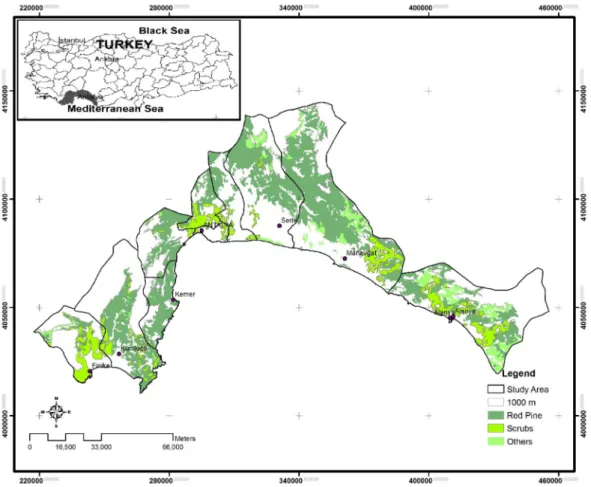
The study area is located on the west (Antalya-Kemer-Finike) and east (Antalya-Manavgat-Alanya) sides of the gulf. It includes thermo- and eumediterranean zones (Figure 1).
2.1.1. The districts on the western side of the gulf: Antalya-Kemer and Finike
The length of the area reaches 60–70 km. The geomorphology of the area covers a range called the Tahtalı Mountains and the front side of Beydağları. This range, the altitude of which rises over 2000 m, has been extended perpendicular to the sea by cutting of various deep valleys from north to south.
This special case allows the thermomediterranean climate to penetrate inwards. Therefore, the red pine forests rise up to 1600 m in this district, that is, on the Tahtalı and Beydağları mountains in Turkey and mix with the cedar forests, whereas these altitudes are occupied normally by only Pinus brutia forests. It is determined that the red pines in this district reach an altitude of 1800 m in small patches (Quézel and Pamukcuoglu, 1973). In the region, in the thermo- and eumediterranean even supramediterranean zones, red pines form healthy sites with 90% coverage and grow up to 15–20 m.
The region is dominated by slotted calcareous rocks of Cretaceous age and sometimes by ultrabasic rocks (particularly serpentine) around Kemer (Kalafatçıoğlu, 1973).
2.1.2. The districts on the eastern side of the gulf: Antalya-Manavgat-Alanya
According to the unpublished geological report by Akay and Uysal in 1985, this district covers an area extending parallel from the east of Antalya towards the coast and generally includes marly and marly calcareous rocks of eosen and neogen age. Some 70%–80% of the district is covered by forests and the rest by garrigue composed of Cistus creticus L., Satureja thymbra L., and Calicotome villosa (Poiret) Link mixed with Genista acanthoclada DC., whereas Cupressus sempervirens L. occupies an area of 400 ha on the hard calcareous mother rocks in the vicinity of Köprülü Canyon-Beşkonak, at altitudes of 600–500 m in the eumediterranean zone. It exhibits a real forest physiognomy and reaches a height of 20 m.
2.2. TWINSPAN classification and detrended correspondence analysis (DCA)
The program JUICE 7.0.97 was used to classify the quadrats. For the cluster analysis and dendrogram, modified TWINSPAN classification was applied using the presence/absence data and Sorensen dissimilarity index (Roleček et al., 2009).
For ordination, DCA from the vegan package in R Project (R foundation for statistical computing, R-2.10.1 version, Vienna, Austria) was used on presence/absence data to extract the main gradients in species composition.
2.3. Climate
Seven stations mostly located in the coastal regions were chosen to evaluate the climatic conditions. The stations from east to west were Alanya, Manavgat, Serik, Antalya, Kemer, Kumluca, and Finike. Among these, the stations at Serik, Kemer, and Kumluca record only precipitation data.
At the eastern side of Antalya Gulf, the annual mean precipitation is over 1000 mm (Antalya 1042.9 mm, Serik 1047.6 mm, Manavgat 1288.1 mm, Alanya 1102.7 mm). The precipitation at the western side is less than that at the eastern side (Kemer 818.0 mm, Finike 986.5 mm, Kumluca 1045.8 mm). The precipitation regime at the eastern side is W.A.Sp.Sm. (central Mediterranean regime) while it is W.Sp.A.Sm. (east Mediterranean regime) at the western side of Antalya.
Annual mean temperatures are generally the same, around 23.5–24.0 °C, in the coastal zones of the region. The mean temperatures in winter months do not fall below 10 °C.
The maximum temperature of the hottest months (July–August) is around 31–33 °C at the coastal zone. The minimum temperature of the coldest month (January) shows two variations: one is temperate and cool winter in Antalya (5.8 °C) and Manavgat (6.8 °C), and the other is a variant with warm winters in Finike (7.2 °C) and Alanya (7.7 °C).
These climatic data of the region indicate that the study area is under the effective control of a humid Mediterranean bioclimate with warm, temperate, and cool variants (Akman, 1982).
3. Results and discussion
Based on TWINSPAN and DCA results, preforest and forest vegetation units were identified around Antalya Gulf and, following the Braun-Blanquet approach, were classified under five associations and three subassociations.
TWINSPAN analysis:
The species were ordered according to their diagnostic value for individual clusters, expressed as fidelity. Using the presence/absence data and Sorensen dissimilarity index for the cluster analysis and dendrogram, modified TWINSPAN classification was applied. The data set of 61 quadrats was classified using TWINSPAN (pseudospecies cut levels 0-5-25 layers merged).
Three different groups were identified (Appendix Figure 1; on the journal’s website).
Group I: Pinus brutia communities in the eastern part of Antalya Gulf
1-Phlomido leucophtactae-Pinetum brutiae ass. 2- Glycyrrhizo asymetricae–Pinetum brutiae ass.
Group II: Pinus brutia communities in the western part of Antalya Gulf
Phlomido bourgaei-Pinetum brutiae ass. 3- Quercetosum aucheri subass. 4- Iridetosum unguiculariae subass. 5- Phlomidetosum lyciae subass.
Group III: Preforest communities in the western part of Antalya Gulf
6-Phlomidotum chimerae-lyciae ass.
7- Dorystaecho hastatae-Oleetum oleastri ass.
Ordination:
DCA was performed to determine the relation between the identified vegetation types and the main gradients in species composition (Appendix Figure 2; on the journal’s website).
Group I is characterized by Pinus brutia communities in the eastern part of Antalya Gulf, Group II is characterized by Pinus brutia forest communities, and Group III is characterized by preforest communities in the western part of Antalya Gulf.
3.1. Preforest vegetation
Of the preforestplant groups, Olea europaea and Quercus aucheri communities, and the cliff, rupicolous, and mural communities were researched for the first time in Turkey.
The climax plant cover of the thermo- and eumediterranean zone is red pine communities (Barbéro et al., 1990; Barbéro et al., 1998). After the destruction of red pine forests, olive and oaks develop as paraclimax communities. The preforestcommunities around Antalya Gulf are represented by the following associations:
Dorystaecho hastatae-Oleetum oleastri ass. nova
Ta bl e 1. P ref or es t co mm uni ties o f A nt al ya G ulf . Quadrat number 1 2 3 4 5 6 7 8 9 10 11 12 13 14 15 16 17 Presence Altitude (m) 50 40 50 70 80 70 50 50 60 60 60 100 150 30 40 15 15 Inclination (%) 60 50 60 70 70 60 50 60 70 70 60 35 40 35 30 30 30 Exposition S S SW S SW S S W S S S S S SW W SW SW
Area of the quadrat
(m 2) 50 50 50 50 50 50 50 50 50 50 50 50 50 50 50 50 50 Total coverage (%) 80 85 85 80 85 85 85 85 80 80 85 65 60 50 50 50 50 Substrat C C C C C C C C C C C C C srp srp srp srp
Characteristic and differential species of the associations
Dorystaecho hastatae-Oleetum oleastri
Olea europaea var. oleaster 22 33 33 22 23 12 23 22 12 22 22 11 12 . . . . 13 Ceratonia siliqua 11 22 22 22 22 22 23 22 22 22 . 23 22 . . . . 12 Dorstachas hastata 12 12 12 . 12 11 12 11 12 11 . . . . . . . 9 Quercus aucheri +1 . +1 . 11 . 11 12 11 . . . . 6 Phlomidetum chimerae-lyciae Phlomis chimerae . . . . . . . . . . . . . 22 12 22 22 4 Acantholimon ulicinum ssp . purpurescens . . . . . . . . . . . . . 11 11 +1 +1 4 Anthemis rosea ssp . carnea . . . . . . . . . . . . . 22 +1 12 12 4 Phlomis lycia . . . . . . . . . . . . . 12 . +1 +1 3
Cliff Plants Galium canum
ssp . antalyense . ++ 11 11 11 12 11 11 . +1 +1 +1 +1 . . . . 11 Ricotia sinuata . . . +1 +1 +1 +1 +1 +1 +1 . . . . . +1 . 8 Euphorbia hierosolymitana . . . +1 11 12 12 . . . . . . . . +1 5 Ptilostemon chamaepeuce . . +1 +1 . . . +1 . +1 . +1 . . +1 . . 6 Euphorbia austroanatolic a . . . 11 11 12 11 . . . . . . . . . . 4 Hypericum lanuginosum var. pestalozzae . +1 +1 . . . . . . . . . . +1 . . . 4 Hypericum pamphylicum +1 . . . . +1 +1 +1 . . . . . . . . . 4
Rupicol Plants Inula heterolepi
s +1 +1 +1 +1 +1 +1 +1 . +1 +1 . +1 +1 +1 . +1 +1 11 Origanum onites . . . +1 +1 +1 . +1 +1 +1 +1 . . . . . +1 8 Onosma strigossisimu m +1 . +1 . . +1 . +1 .+1 .+1 . . +1 +1 +1 +1 +1 11 Hypericum lanuginosum ssp. lanuginosum . . . . +1 . . . . . +1 +1 . . +1 +1 . 5 Stachys aleurite s +1 +1 . . . . +1 . +1 . . . . . . +1 +1 6 Nepeta phylloclamus . +1 +1 . . . . . . . . . . . . . . 2
Murale Plants Cymbalaria longipes
12 11 12 +1 11 . +1 +1 +1 +1 +1 +1 . +1 . . +1 13 Hyoscyamus aureus . +1 . +1 . +1 . . +1 . . . . . +1 . . 6 C = C alc ar eo us; S rp = S er pen tin e
Ta bl e 1. (C on tin ue d).
Characteristic species of the Order
Ceratonio-Rhamnion oleoidis Phagnalon graecum +1 +1 +1 +1 +1 11 12 +1 +1 . . 11 11 11 +1 +1 +1 14 Phlomis bourgaei 22 12 11 22 11 11 12 +1 12 11 . +1 +1 . +1 . . 13 Rubia tenuifolia +1 . +1 +1 . . +1 . +1 +1 . . . . +1 . . 7 Rhamnus oleoides ssp. graecus . . . . +1 +1 . . . . . . +1 +1 . +1 +1 6
Characteristic species of the Order
Pistacio-Rhamnetalia aleterni Pistacia terebinthus ssp. palaestina . . . +1 . +1 +1 . . 11 . . 12 . . . . 5 Piptatherum miliacea +1 . +1 +1 +1 . . . . .+1 +1 . . . 11 11 11 8 Myrtus communis 11 11 . . . 12 12 . . . . 12 12 . . . 11 7 Pistacia lentiscus +1 11 11 . . . +1 +1 +1 . . . . . +1 . . 7 Clematis circhosa . . . . +1 . . +1 . . +1 . . +1 . +1 . 5
Characteristic species of the Class and Order
Quercetea (etalia) ilicis
Euphorbia characias ssp. wulfenii +1 +1 11 11 12 12 +1 +1 11 +1 +1 +1 +1 +1 . +1 +1 17 Quercus coccifera +1 12 12 . . . . 12 12 12 . 12 11 12 . 22 22 13 Phillyrea latifolia . . . 22 22 22 22 11 11 12 . 12 +1 +1 +1 . 12 13 Arbutus andrache . . 11 11 11 . +1 . 11 11 . . . 11 +1 11 . 9 Cyclamen percicum . . +1 . +1 . . . . . +1 +1 . . . . +1 5 Smilax aspera . . . . . +1 +1 . . .11 11 . . . +1 . . 5
Characteristic species of the Class
Cisto-Micromerietea Calycatome villosa 11 11 11 . . . . +1 +1 +1 11 . . +1 +1 +1 +1 11 Micromeria myrtifolia . . . . . . . . +1 +1 +1 +1 +1 +1 . +1 +1 8 Cistus creticus . +1 +1 . . . . . . . . +1 +1 +1 . . +1 5 Cistus salviifolius . +1 +1 . . . . +1 +1 . . . . . +1 . . 5
Characteristic species of the Class
Quercetea pubescentis Styrax officinalis . . . . . 12 12 . 12 . . . 12 12 . 11 . 7 Rhus cotinus . . . . 11 . 11 . . . 11 . . . . . . 3
Companions Daphne gnidioide
s +1 +1 . . . . +1 +1 . . +1 +1 . +1 +1 +1 +1 11 Teucrium divaricatu m . . . +1 +1 +1 . . +1 . . . . +1 . +1 +1 8 Urginea maritima . . . . . . +1 +1 . . . . +1 . . +1 . 4 Teucrium poliu m +1 +1 +1 . . . . . . +1 +1 . . . . +1 . 6 Satureja thym bra . . . +1 +1 . . . . +1 . +1 . . . . . 4 Daphne serice a . . . . . . . . . . . . . +1 +1 . +1 3 Sarcopoterium spinosum . . . . . 12 12 . . . 12 . . . . . . 3 Coronilla parviflora . . +1 . . . . +1 +1 . . . . . . +1 . 4
Holotypus: Table 1; Quadrat: 5
The wild olive plants occupy the calcareous slopes with an inclination of 35%–70%, and on soils quite poor in organic matter. This type of vegetation is seen on a vast area between Antalya and Finike, in the west coastal zone of Antalya.
This association generally prefers south and southwest slopes at altitudes of 100–150 and 600–700 m.
Phlomidotum chimerae-lyciae ass. nova (Table 1) Holotypus: Table 1; Quadrat no: 16
The openings of preforest communities are characterized by Phlomis chimerae Boissieu, Phlomis lycia D.Don, Acantholimon ulicinum (Schultes) Boiss. var. purpurascens (Bokhari) Bokhari & Edmondson, and Anthemis rosea Sm.subsp. carnea (Boiss.) Grierson.
Rupicolous groups growing on the calcareous soils are represented by species such as Galium canum Req. ex DC. subsp. antalyense Ehrend., Onosma strigosissimum Boiss., Euphorbia austroanatolica Hub.-Mor. & M.S.Khan, Stachys aleurites Boiss. & Heldr.,and Nepeta phyllochlamys P.H.Davis. Other participants belong to upper syntaxonomical units.
The cliff communities developing on the travertines around Antalya are thermophilous and characterized by Euphorbia hierosolymitana Boiss., Ptilostemon chamaepeuce (L.) Less., Hypericum lanuginosum Lam. var. pestallozzae (Boiss.) Robson, and H. pamphylicum N.Robson & P.H.Davis.
From the syntaxonomical point of view, these cliff, rupicolous, and mural communities at the lower altitudes are connected with Asplenietea trichomanis and Onosmetalia frutescentis. Onosma strigossimum Boiss. has a close affinity to O. frutescens Lam. and is replaced by O. frutescens in the study area.
3.2. Forest vegetation
Sylvatic vegetation is in two groups: western and eastern sides of Antalya Gulf.
Pinus brutia forests between Antalya-Kemer and Finike at the western side of Antalya Gulf:
On the montane area extending in the north–south direction in this part of the gulf, Pinus brutia forests start to spread in the coastal zone and reach up to 1600 m, where they connect with the Cedrus libani A.Rich. forests.
In this part of the gulf, the following associations were determined:
Phlomido bourgaei-Pinetum brutiae Akman et al. 1998(Table 2)
Holotypus: Table 2; Quadrat no: 40
This association firstly was determined around Marmaris and Bodrum by Akman et al. (1998). In the study area it individualizes on the hard calcareous and ultrabasic rocks, particularly on the serpentine at altitudes of 50– 100 and 900–1000 m in the warm-humid Mediterranean bioclimatic zone.
The association is characterized by Phlomis bourgaei Boiss., Cupressus sempervirens, and Acer sempervirens L. Phlomis bourgaei is a widespread endemic species and extends towards to the presylvatic groups on hard calcareous blocks and serpentine rocks.
Phlomido bourgaei-Pinetum brutiae ass. includes four subassociations around Marmaris and Bodrum. In the study area it includes three subassociations in respect to altitude and the type of mother rock.
quercetosum aucheri subass. nova develops on the shallow terra rossa soils on the hard calcareous blocks of steep slopes (15%–60%) from the south towards the west. This subassociation is differentiated by Quercus aucheri, which has a very local distribution only in this region. Central Europe maintains a considerable diversity of dry-mesic oak forests, as their species composition changes along several environmental and geographical gradients (Roleček, 2005).
Holotypus: Table 2; Quadrat no: 40
phlomidetosum lyciae subass. nova individualized as thermophilous subassociation on the ultrabasic mother rocks at Kemer-Finike.
Holotypus: Table 2; Quadrat no: 51
iridetosum unguiculariae subass. nova prefers, apart from the previous ones, the humid and deep brown forest soils at altitudes of 500–550 and 1000–1100 m. It exhibits a mesomediterranean ecology. From the syntaxonomic point of view, Pinus brutia Ten. forests are included in the alliance Ceratonio-Rhamnion oleoidis of the order Pistacio lentisci-Rhamnetalia alaterni of the class Quercetea ilicis. Here the red pines develop as a climatic formation in respect to plant dynamism.
Holotypus: Table 2; Quadrat no: 56
The Eastern side of Antalya Gulf
Glycyrrhizo asymetricae-Pinetum brutiae ass. nova
(Table 3)
Holotypus: Table 3; Quadrat no: 25
The association localized on the eastern side of Antalya Gulf is characterized by regional endemic species such as Glycyrrhiza asymmetrica Hub.-Mor., Sideritis congesta P.H.Davis & Hub.-Mor., Thymus revolutus Čelak, and Phlomis lunariifolia Sm.
In the vicinity of Antalya-Manavgat-İncekum (Alanya), on the sea-facing slopes with brown forest soils derived of marly and marly calcareous rocks at 50–100 and 400–500 m in the warm humid Mediterranean zone, this association was first determined by Ayaşlıgil in 1987 within the boundaries of Köprülü Canyon National Park. The association determined here shows a high similarity ratio, more than 60%, in respect to floristic composition. The study by Ayaşlıgil is a PhD thesis and has not been
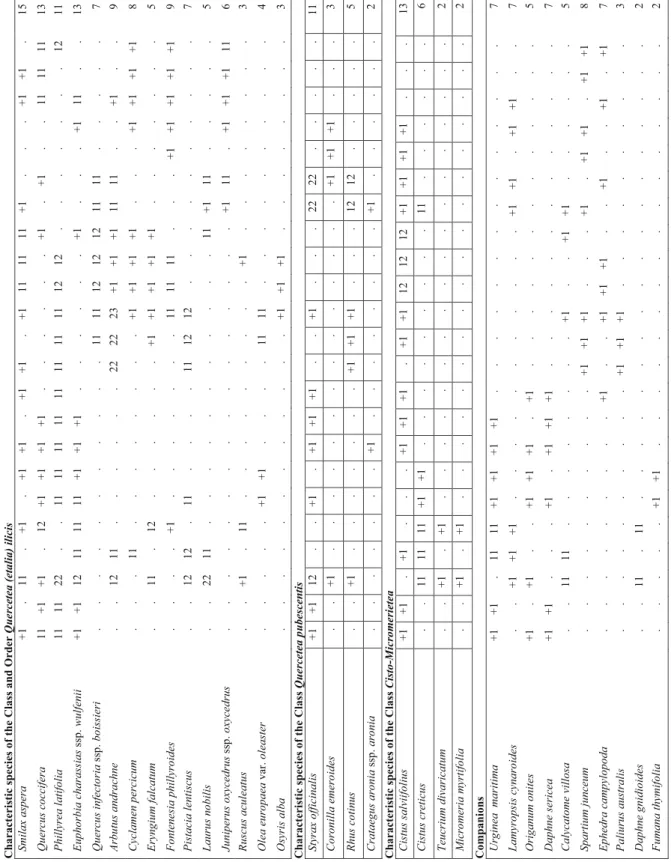
Ta bl e 2 . Pi nu s b ru tia as so ci at io ns w es t o f A nt al ya G ulf (a ro un d A nt al ya-K em er). Quadrat number 38 39 40 41 42 44 45 46 47 48 49 50 51 52 53 54 55 56 57 58 59 60 61 Presence Altitude (m) 60 70 50 20 33 0 50 70 70 70 75 40 30 20 30 40 40 50 0 55 0 50 0 50 0 55 0 55 0 11 00 Inclination (%) 60 50 60 3 15 60 60 50 50 55 40 15 20 40 45 40 5 15 20 40 65 40 30 Exposition N N S S S S SW N N NW S S S S S S N N N N N N N
Area of the quadrat (m
2) 40 0 40 0 40 0 4 00 40 0 40 0 40 0 40 0 40 0 40 0 40 0 40 0 40 0 40 0 40 0 40 0 40 0 40 0 40 0 40 0 40 0 40 0 40 0 Total coverage (%) 90 90 75 80 80 90 90 90 90 90 85 90 95 80 90 90 90 90 90 90 90 90 90 Substrat C C C C C C C C C C sr p sr p sr p sr p sr p sr p C C C sr p sr p C C
Characteristic and differential species of the association and subassociations
Pinus brutia-Phlomis bourgaei
(
Phlomido bourgaei-Pinetum brutiae)
Pinus brutia 45 44 33 34 33 44 44 44 44 44 44 44 45 44 44 34 44 4 4 44 44 44 44 44 24 Phlomis bourgaei . . +1 . . +1 +1 . . . +1 +1 +1 . +1 +1 . . +1 . +1 +1 +1 13 Cupressus sempervirenn s 11 11 . . 22 . . 11 11 . . . . . . . 11 . . 11 11 12 . 8 Asperula antalyensis . +1 +1 . +1 . +1 . +1 . . . . . . . +1 + 1 . +1 . . . 10 Acer sempervirens +1 +1 . 11 . . . +1 +1 +1 . . . . . . . . . +1 11 . . 7 Quercus aucher i (q uercetosum aucher i ) Phlomis lyci a ( phlomidetosum lyciae ) Iris unguiculari s ( iridetosum unguiculariae ) Erica sicula ssp . libanotica +1 . . . +1 . . . 12 . . . . . . . . . . . . . . 4 Quercus aucheri +1 +1 11 12 +1 . 11 . . 11 . . . . . . . . . . . . . 8 Phlomis lycia . . . . . . . . . . 12 11 12 +1 +1 +1 . . . . . . . 6 Iris unguiculari s . . . . . . . . . . . . . . . . +1 + 1 +1 +1 +1 +1 +1 7
Characteristic species of the Alliance
Ceratonio-Rhamnion oleoides*
and the Orde
r Pistacio-Rhamnetalia alaterni Myrtus communis 11 22 11 11 22 +1 11 23 11 11 . . +1 22 23 23 . . 12 . 12 . . 17 Pistacia terebinthus ssp . palaestina . . 12 . 11 12 12 . . . 11 12 11 11 12 11 +1 +1 . . . . +1 14 *Asparagus acutifoliu s . . +1 +1 11 . +1 . . . +1 +1 . . . . . . . . . . . 7 Ceratonia siliqua 11 11 12 . 12 . . 11 12 . +1 . 12 . . . . . . . . . . 7 Piptatherum miliacea . . 12 12 . . +1 . . . +1 . +1 . . . . . . . . . . 6 *Rhamnus oleoides ssp . graecus +1 . . 11 11 . . . +1 . . . +1 . +1 +1 . . . . . . . 7 Piptatherum coerulescens . . 12 . 11 . . . . . . . . . . . . . . . . . . 2 Clematis circhosa . . 12 . . . . . . . . . . . . . . . . . . . 2 Rubia tenuifolia . . . . . . . . . . . . . . . +1 . . . . . +1 . 2
Ta bl e 2. (C on tin ue d).
Characteristic species of the Class and Order
Quercetea (etalia) ilicis
Smilax aspera +1 . 11 . +1 . +1 +1 . +1 +1 . +1 11 11 11 +1 . . . +1 +1 . 15 Quercus coccifera 11 +1 +1 . 12 +1 +1 +1 +1 . . . . . . +1 . +1 . . 11 11 11 13 Phillyrea latifolia 11 11 22 . . 11 11 11 11 11 11 11 11 12 12 . . . . . . . 12 11 Euphorbia charassias ssp . wulfenii +1 +1 12 11 11 11 +1 +1 +1 . . . . . . +1 . . . +1 11 . . 13 Quercus infectoria ssp . boissieri . . . . . . . . . . . 11 11 12 12 12 11 11 . . . . . 7 Arbutus andrachne . . 12 11 . . . . . . 22 22 23 +1 +1 +1 11 11 . . +1 . . 9 Cyclamen percicum . . . 11 . . . . . . . . +1 +1 +1 +1 . . . +1 +1 +1 +1 8 Eryngium falcatum . . 11 . 12 . . . . . . +1 +1 +1 +1 +1 . . . . . . . 5 Fontenesia phillyroides . . . . +1 . . . . . . . 11 11 11 . . . +1 +1 +1 +1 +1 9 Pistacia lentiscus . . 12 12 . 11 . . . . 11 12 12 . . . . . . . . . . 7 Laurus nobilis . . 22 11 . . . . . . . . . . . 11 +1 11 . . . . . 5 Juniperus oxycedrus ssp . oxycedrus . . . . . . . . . . . . . . . . +1 11 . +1 +1 +1 11 6 Ruscus aculeatus . . +1 . 11 . . . . . . . . . +1 . . . . . . . . 3 Olea europaea var. oleaster . . . . . +1 +1 . . . . 11 11 . . . . . . . . . . 4 Osyris alba . . . . . . . . . . . . +1 +1 +1 . . . . . . . . 3
Characteristic species of the Class
Quercetea pubescenti s Styrax officinalis +1 +1 12 . . +1 . +1 +1 +1 . . +1 . . . 22 22 . . . . . 11 Coronilla emeroides . . +1 . . . . . . . . . . . . . . +1 +1 +1 . . . 3 Rhus cotinus . . +1 . . . . . . . +1 +1 +1 . . . 12 12 . . . . . 5 Crataegus aronia ssp . aronia . . . . . . . +1 . . . . . . . . +1 . . . . . . 2
Characteristic species of the Class
Cisto-Micromerietea Cistus salviifolius +1 +1 . +1 . . . +1 +1 +1 . +1 +1 12 12 12 +1 +1 +1 +1 . . . 13 Cistus creticus . . 11 11 11 +1 +1 . . . . . . . . . 11 . . . . . . 6 Teucrium divaricatu m . . +1 . +1 . . . . . . . . . . . . . . . . . . 2 Micromeria myrtifolia . . +1 . +1 . . . . . . . . . . . . . . . . . . 2
Companions Urginea maritima
+1 +1 . 11 11 +1 +1 +1 +1 . . . . . . . . . . . . . . 7 Lamyropsis cynaroides . . +1 +1 +1 . . . . . . . . . . . +1 +1 . +1 +1 . . 7 Origanum onites +1 . +1 . . +1 +1 +1 . +1 . . . . . . . . . . . . . 5 Daphne sericea +1 +1 . . . +1 . +1 +1 +1 . . . . . . . . . . . . . 7 Calycatome villosa . . 11 11 . . . . . . . . +1 . . +1 +1 . . . . . . 5 Spartium junceu m . . . . . . . . . . +1 +1 +1 . . . +1 . +1 +1 . +1 +1 8 Ephedra campylopoda . . . . . . . . . +1 . . +1 +1 +1 . . +1 . . +1 . +1 7 Paliurus australis . . . . . . . . . . +1 +1 +1 . . . . . . . . . . 3 Daphne gnidioides . . 11 . 11 . . . . . . . . . . . . . . . . . . 2 Fumana thymifolia . . . . . +1 +1 . . . . . . . . . . . . . . . . 2 C=Calcareous; Srp=Serpentine
Ta bl e 3 . Pi nu s b ru tia as so ci at io ns e as t o f A nt al ya G ulf (a ro un d A nt al ya-A la nya-B eş ko na k-K öp rü lü C an yo n). Quadrat number 18 19 20 21 22 23 24 25 26 27 28 29 30 31 32 33 34 35 36 37 Presence Altitude (m) 10 60 50 70 150 150 90 200 220 240 330 350 360 500 520 480 450 100 0 130 0 120 0 Inclination (%) 25 30 20 10 20 10 40 25 35 20 35 30 30 35 35 20 25 35 35 35 Exposition S S SW S S W W NW S N S NW S NE NE NW N SW W SW
Area of the quadra
t (m 2 ) 200 200 200 200 200 200 200 200 200 200 200 200 200 200 200 200 200 200 200 200 Total coverage (%) 60 70 75 80 85 60 80 80 90 80 75 80 70 80 75 70 80 75 80 70 Substrat M M M M C M C M M M C M C M C M C M C M C kn gk ng kn gk ng kn g kn g kn g
Characteristic and differential species of the associations
Pinus brutia-Glycyrrhiza asymmetrica
(
Glycyrrhizo asymetricae–Pinetum brutiae)
Pinus brutia-Phlomis leucophtacta
(Phlomido leucophtactae -Pinetum brutiae) Pinus brutia 33 34 34 33 44 44 34 44 44 44 44 44 44 44 34 44 44 44 34 44 20 Verbascum orgyale +1 . +1 . +1 11 . . +1 +1 . +1 +1 . . . . . . . 8 Sideritis congesta +1 . +1 . +1 +1 . +1 . +1 +1 . +1 . . . . . . . 8 Cupressus sempervirens +1 +1 +1 . +1 . 11 11 . . +1 11 +1 . . . . . . . 9 Phlomis lunariifolia +1 +1 +1 . +1 +1 . 11 11 +1 11 +1 +1 . . . . . . . 11 Lithodora hispidul a 12 12 12 12 . +1 +1 +1 +1 +1 +1 +1 +1 . . . . . . . 12 Glycyrrhiza assymetrica . +1 . . +1 +1 12 +1 +1 +1 +1 +1 +1 . . . . . . . 10 Onobrychis gracilis 12 11 12 11 . +1 +1 . +1 . +1 . . . . . . . . . 8 Thymus revolutus +1 +1 11 . . +1 +1 +1 . +1 . +1 +1 . . . . . . 9 Verbascum nudatum var. nudatum . . . . . . . . . . . . . +1 +1 +1 +1 +1 +1 +1 7 Eromopoa attalica . . . . . . . . . . . . . +1 . +1 +1 +1 . +1 7 Phlomis lecophracta . . . . . . . . . . . . . +1 +1 . +1 . +1 . 4
Characteristic species of the Alliance
Quercion calliprini Pistacia terebinthus ssp . palaestina . . 11 . . +1 . +1 . +1 +1 +1 . +1 . . +1 11 11 11 11 Arbutus andrache . . . +1 . . . . . . 12 11 11 . +1 +1 . 11 12 12 9 Eryngium falcatum +1 +1 . . . . . +1 +1 +1 +1 +1 +1 . +1 . . +1 . . 10 Fontanesia phillyroides . . . +1 . . . . +1 +1 +1 +1 . . . +1 . . +1 . 7 Rhamnus oleoides ssp . graecus +1 11 11 . . . . +1 . . . . . . . . . . . . 4
Ta bl e 3. (C on tin ue d).
Characteristic species of the Order and Class
Quercetea (etalia) ilicis
Quercus coccifer +1 +1 +1 +1 +1 . . +1 . . +1 . . . .+1 . +1 11 12 12 12 Piptatherum coerulescens +1 +1 +1 +1 +1 +1 . . . . . . . . +1 +1 +1 +1 . . 10 Cotinus cogyria . . . . +1 +1 . 11 +1 +1 .. . 11 . . . +1 +1 . . 8 Myrtus communis +1 +1 +1 . . . . +1 12 +1 12 +1 . . . . . . . . 8 Asparagus acutifolius . . . . +1 +1 . +1 +1 . +1 +1 . . . . . . . . 6 Olea europaea var. oleaster . +1 +1 12 . . . . . +1 +1 +1 . . . . . . . . 6 Osyris alba +1 +1 . . +1 +1 . . . . . . . +1 . +1 . . . . 6 Quercus infectoria ssp. boissieri . . . +1 . . . . . 11 . +1 . . +1 +1 +1 . . . 6 Smilax aspera . . . +1 . . . +1 +1 . . . . . +1 . . . . . 4 Pistacia lentiscus +1 . +1 12 . . . . . . . . . . . . . . . . 3
Characteristic species of the Class
Quercetea pubescenti s Styrax officinali s +1 +1 +1 . +1 +1 . +1 +1 +1 . . . +1 +1 +1 +1 +1 . . 13 Crataegus monogyna +1 +1 +1 . . . . . . . . . . . . . +1 . . . 4
Characteristic species of the Class
Cisto-Micromeriete a Cistus creticus +1 +1 +1 22 . +1 12 +1 . +1 +1 11 +1 . . +1 +1 +1 . +1 15 Micromeria myrtifolia +1 +1 +1 . . . . +1 . . +1 +1 +1 . +1 +1 +1 +1 . . 11 Genista acanthoclada 22 22 22 . . . 12 . . . . . . . . . . . . . 4 Satureja thymbr a . . . 12 +1 . . . . . . +1 +1 . . . . . . . 4 Teucrium divaricatu m +1 +1 +1 . . . . . . . . . . . . . . . . . 3
Companions Origanum onites
+1 +1 +1 +1 . . . +1 +1 . +1 . . . +1 . . . . . 7 Daphne sericea +1 . +1 +1 . . . . . +1 . . . . . +1 . . . +1 6 Fumana thymifolia ssp. thymifolia +1 +1 +1 +1 . . . . . . . . . . . . . . . . 4 Calycatome villosa +1 +1 +1 +1 . . . . . . . . . . . . . . . . 4 Sarcopoterium spinosum 11 11 11 . . . . . . . . . . . . . . . . . 3 Teucrium poliu m +1 +1 +1 +1 . . . . . . . . . . . . . . . . 4 Thymbra spicata . . . +1 . . +1 . . . . . . . . . . . . . 2
M=Marl; MC=Marly; Calcareous kng=Conglom
published. Due to its invalidity and unpublished position we prefer to name the association composed of our own quadrats as a new one (nomenclatural synonym according to ICPN: article 5 and 19).
Phlomido leucophtactae-Pinetum brutiae ass. nova
(Table 3)
Holotypus: Table 3; Quadrat no: 32
Pinus brutia also forms infrequent communities between 500 and 1300 m at the eastern side of Antalya Gulf. The coverage rate of community is 60%–70% even though the red pine individuals grow healthily on the easily degradable conglomerates. The diagnostic taxa of the association are Verbascum nudatum Murb.var. nudatum, Eromopoa attaica H.Scholz, and Phlomis leucophracta P.H.Davis & Hub.-Mor.
To the north of Manavgat and Alanya, in the vicinity of Akseki at altitudes of 1200–1300 m, this association is replaced by Phlomido aitidi-Pinetum brutiae Duran 1997 and the species such as Rhamnus nitidus Davis, Sideritis arguta Boiss. & Heldr., Phlomis lunariifolia,and P. leucopraeta P.H.Davis & Hub.-Mor. characterize the association. This association resembles the previous one in respect to floristic composition, but occupies areas of the supramediterranean zone.
It extends on the marly and marly calcareous and sometimes on the conglomerates at the eastern part of the gulf and is attached to the Quercion calliprini alliance of the order Pistacio-Rhamnetalia alaterni within the class Quercetea ilicis.
Within these two associations, the species of Quercetalia (etea) ilicis are rich. There have been also the species of Cisto-Micromerietea (Oberdorfer 1954) Barbéro-Quézel 1989 and many local endemic species particularly on marly and marly calcareous rocks.
In respect to plant dynamism, although the associations of red pine determined in the study, as in others of the Mediterranean region, reflect the actual climax physiognomy, they seem to develop towards the communities of xerophytic oaks. Xerophytic oaks have a wide distribution across the Mediterranean Basin (almost all xerophytic oak communities are rich in the species of Quercetalia (etea) ilicis)(Tsiourlis et al., 2009).
This study was carried out to provide an integrated approach to the work done in the Mediterranean region. The syntaxa determined are as follows:
Class: QUERCETEA ILICIS Blanq. in Braun-Blanq., Roussine & Nègre 1952
Order: PISTACIO LENTISCI-RHAMNETALIA ALATERNI Rivas Mart. 1975
Alliance: Ceratonio-Rhamnion oleoidis Barbero-Quézel 1979
Association: Dorystaecho hastatae-Oleetum oleastri ass. nova
Association: Phlomido chimerae-lyciae ass. nova
Association: Phlomido bourgaei-Pinetum brutiae Akman et al. 1998
Subassociation: quercetosum aucheri subass. nova Subassociation: phlomidetosum lyciae subass. nova Subassociation: iridetosum unguiculariae subass. nova Alliance: Quercion calliprini (Zohary 1962) Quézel, Barbero & Akman 1978
Association: Glycyrrhizo asymetricae-Pinetum brutiae ass. nova
Association: Phlomido leucophtactae-Pinetum brutiae ass. nova
The vegetation affected by the coastal conditions in the area occupies the thermomediterranean bioclimatic zone with warm winters and annual precipitation of about 1068–1288 mm.
The bioclimatic and geological heterogeneity are general characteristics of the Mediterranean region; therefore, although they are geographically very close, the floristic composition and then the syntaxa may change in very short distances due to the edaphic isolation.
The red pine forests have been included in the alliances Quercion calliprini and Ceratonio-Rhamnion oleoidis of the order Pistacio-Rhamnetalia alterni belonging to the class Quercetea ilicis from the phytosociological point of view.
The Phlomido leucophtactae-Pinetum brutiae, Glycyrrhizo asymetricae-Pinetum brutiae, and Phlomido bourgaei-Pinetum brutiae associations described in the eastern and western parts of Antalya Gulf are different from Junipero phoeniceae-Pinetum brutiae Akman et al. 1998 described in Muğla Province and Rhamno lycioidis-Pinetum brutiae Konstantinidis et al. 2012 described in Greece and the East Aegean Islands due to the ecological and geographical isolation created by the presence of local indigenous and rare species in the associations described here.
The preforest plant groups are also attached to the Ceratonio-Rhamnionoleoidis alliance of the order Pistacio-Rhamnetalia aleterni of the class Quercetea ilicis. These groups in the Central Mediterranean (Italy) have been represented by Oleo-Ceratonion and Cytision sessilifolii alliances (Allegrezza et al., 2006).
Within the associations, the characteristic species of Cisto-Micromerietea such as Calycotome villosa, Micromeria myrtifolia, Cistus creticus, C. salviifolius, Teucrium polium, Satureja thymbra, and Sarcopoterium spinosum are also rich.
References
Akman Y (1982). Climats et bioclimats méditerranéens en Turquie. Ecologia Mediterranea 8: 73–88 (in French).
Akman Y, Barbero M, Quezel P (1978). Contribution á l’etude de la vegetation forestiere d’Anatolie méditerranéenne. Phytocoe-nologia 5: 1–79 (in French).
Akman Y, Barbero M, Quézel P (1979a). Contribution á l’etude de la vegetation forestiere d’Anatolie méditerranéenne. Phytocoe-nologia 5: 189–276 (in French).
Akman Y, Barbero M, Quézel P (1979b). Contribution á l’etude de la vegetation forestiere d’Anatolie méditerranéenne. Phytocoe-nologia 5: 277–346 (in French).
Akman Y, Kurt L, Demiryurek E, Quézel P, Kurt F, Evren H, Kucu-koduk M (1998). Les groupements a Pinus brutia sur roches ultra-basiques et calcaires, dans la région de Marmaris et Bo-drum (Mugla), a l’étage thermo-méditerranéen du sud- ouest Anatolien (Turquie). Ecologia Mediterranea 24: 63–71 (in French).
Allegrezza M, Biondi A, Felici S (2006). A phytosociological analysis of the vegetation of the Central Adriatic sector of the Italian Peninsula. Hacquetia 5: 135–175.
Atalay I, Efe R, Soykan A (2008). Evolution and Ecological Properties of Taurus Mountains. In: Efe R, Cravins G, Öztürk M, Atalay I, editors. Environment and Culture in the Mediterranean Re-gion (Part 1). Newcastle, UK: Cambridge Scholars Publishing, pp. 3–37.
Barbéro M, Bonin G, Loisel R, Quézel P (1990). Changes and dis-turbances of forest ecosystems caused by human activities in the western part of the Mediterranean Basin. Vegetatio 87: 151–173.
Barbéro M, Chalabi N, Nahal I, Quezel P (1976). Les formations a coniferes Mediterraneens en Syrie littorale. Ecologia Mediter-ranea 2: 87–99 (in French).
Barbéro M, Loisel R, Quézel P, Richardson DM, Romane F (1998). Pines of the Mediterranean Basin. In: Richardson DM, editor. Ecology and Biogeography of Pinus. Cambridge, UK: Cam-bridge University Press, pp. 153–170.
Barbero M, Quézel P (1976). Les groupements forestiérs de Gréce centro-meridionale. Ecologia Mediterranea 2: 1–86 (in French).
Barkman JJ, Doing H, Segal S (1964). Kritische Bemerkungen und Vorschläge zur quantitativen Vegetationsanalyse. Acta Bot Neerl 13: 394–419 (in German).
Braun-Blanquet J (1964). Pflanzensoziologie. New York, USA: Springer Wien Press (in German).
Kalafatçıoğlu A (1973). Antalya Körfezi batı kısmının jeolojisi. Maden Tetkik ve Arama Enstitüsü Dergisi 81: 82–131 (in Turk-ish).
Quézel P, Barbéro M, Akman Y (1978). L’Interpretation phytoso-ciologique des groupements forestiers dans le basin Mediter-raneen Oriental. Documents Phytosociologiques 2: 329–352 (in French).
Quézel P, Barbéro M, Akman Y (1980). Contribution à l’étude de la végétation forestiére d’Anatolie septentrionale. Phytocoenolo-gia 8: 365–519 (in French).
Quézel P, Barbero M, Akman Y (1992). Typification de syntaxa décrits en région méditerranéenne orientale. Ecologia Medi-terranea 18: 81–87 (in French).
Quézel P, Pamukcuoglu A (1973).Contribution á l’étude phytoso-ciologique et bioclimatique de quelques groupements forest-iers du Taurus. Feddes Repertorium 84: 184–229 (in French). Roleček J (2005). Vegetation types of dry-mesic oak forests in
Slova-kia. Preslia 77: 241–261.
Roleček J, Tichý L, Zelený D, Chytrý M (2009). Modified TWINS-PAN classification in which the hierarchy respects cluster het-erogeneity. J Veg Sci 20: 596–602.
Tsiourlis G, Konstantinidis P, Xofis P (2009). Syntaxonomy and
synecology of Quercus coccifera Mediterranean shrublands in
Greece. J Plant Biol 52: 433–447.
Weber HE, Moravec J, Theurillat JP (2000). International code of phytosociological nomenclature. J Veg Sci 11: 739–768.
Appendix
Figure 1. TWINSPAN dendrogram of analysis of plant associations. [Group I: Pinus brutia communities in the east part of
Antalya Gulf (1- Phlomido leucophtactae-Pinetum brutiae ass., 2- Glycyrrhizo asymetricae–Pinetum brutiae ass.), Group II:
Pinus brutia communities in the western part of Antalya Gulf (3-4-5 Phlomido bourgaei-Pinetum brutiae ass.3- Quercetosum
aucheri subass. 4- Iridetosum unguiculariae subass.5- Phlomidetosum lyciae subass.),Group III: Preforest communities in the
western part of Antalya Gulf (6-Phlomidotum chimerae-lyciae ass. 7- Dorystaecho hastatae-Oleetum oleastri ass.)].
Figure 2. Ordination diagram from detrended correspondence analysis (DCA) showing plant associations [Group I: Pinus brutia communities in the eastern part of Antalya Gulf (1- Phlomido leucophtactae-Pinetum
brutiae ass.,2- Glycyrrhizo asymetricae–Pinetum brutiae ass.), Group II: Pinus brutia communities in the
west-ern part of Antalya Gulf (3-4-5 Phlomido bourgaei-Pinetum brutiae ass.3- quercetosum aucheri subass. 4-
iri-detosum unguiculariae subass. 5- phlomidetosum lyciae subass.),Group III: Preforest communities in the
west-ern part of Antalya Gulf (6- Phlomidotum chimerae-lyciae ass.7- Dorystaecho hastatae-Oleetum oleastri ass.)].
Western part of Antalya Gulf Group I: Eastern part of