Integrating Virtual Training into ESP Learning: A
Hybrid English for Policing Model
Zhongwen Liu
Liaoning Police Academy, Dalian, China Email: [email protected]
Abstract—To probe into a new foreign language learning model focusing on online interpersonal interaction
based on scenarios and facilitating students' proactive participation in the increasingly demanding work force, virtual training is integrated into face-to-face instruction and online English for Policing learning. The paper presents major ingredients of the program, including curricular framework, the development of the textbook, courseware, learning and virtual training network. Implementation example of the model in the classroom, in the sound lab and on the network is also illustrated. Findings show that the hybrid English for policing learning model promoted student learning motivation, interests and comprehensive abilities. Finally, feasibility of integrating virtual training into more disciplines of ESP (English for Specific Purposes) learning is discussed in view of the practice and results of its application in the specific curriculum of English for Policing.
Index Terms—virtual training, English for policing learning, hybrid model, web-mediated, curriculum
development, implementation
I. INTRODUCTION
English for Specific Purposes (hereinafter referred to as ESP) consists of English language teaching which is designed to meet specified needs of the learner; related in content (i.e. in its themes and topics) to particular disciplines, occupations and activities; centered on the language appropriate to those activities in syntax, lexis, discourse, semantics, etc., and analysis of this discourse; and in contrast with General English (Kristen Gatehouse, 2001). English for Policing is a part of ESP according to these absolute characteristics.
Liaoning Police Academy implemented 3-semester College English (English for General Purposes) learning followed by 2-semester English for Policing (English for Specific Purposes) for undergraduates in 2006. Innovative delivery methods of English for Policing have been designed, applied, tested and changed in the Academy where a hybrid model was adopted based on the research and findings home and abroad. Hybrid courses blend face-to-face interaction with online learning and customarily involve the delivery of curricular materials, access to resources, submission of assignments, project based learning, activities that support higher order thinking, and online discussions that may be asynchronous or synchronous in nature. In order for a class to be considered hybrid some actual student learning and learning assessment must occur online and a percentage of in-class time is forfeited to make up for the weight put on the online learning activities (Nicole & Retta, 2006). A study found that students who took all or part of their instruction online performed better, on average, than did those taking the same course through face-to-face instruction. Further, those who took “blended” courses—those that combine elements of online learning and face-to-face instruction—appeared to do best of all (Laura, 2010).
Students and teachers in the academy benefit from the vast amount of textual, audio or visual knowledge presented in online learning but problems of which also compelled us to probe into a new web-mediated virtual training. First, the common deficiency of most classroom computer assisted learning is the decrease of amount of interpersonal interaction, for one thing, dynamic content video, graphics, flash, and text will inevitably draw students’ attention especially when teachers and students have to concentrate on the screen from time to time, for another, larger desks, computer screens in a enlarged classroom will lead to a distracted interpersonal communications and interactions. Second, it’s hard for the students to sustain learning interests as a large proportion of time spent online for their own especially when they don’t see the connection between what they are learning and what they will do in the future. Third, most of the polytechnic or vocational college graduates nowadays are faced with the demanding requirements of high proficiency in English, especially in listening and speaking, and result analysis of College English Test band 4 constantly indicates their most vulnerable competence is listening comprehension. Last, with the development in technology, more and more students are expecting a personalized training to accommodate their career needs and make full use of their internet access account, computers, and even mobile phones. To facilitate students' proactive participation in the increasingly demanding work force and provide them opportunities to serve for English speakers in a global setting, Virtual training was designed and integrated into the hybrid English for policing leaning in 2009.
A. The Overall Framework
English for Policing Network (hereafter referred to as the Network) is developed for the hybrid model with the objective of making English for police learning instructive, practical and interesting. The classroom instruction is prior and the online training is secondary for the academy students. The leading role of the teacher and the central role of the students are played through the delicate arrangements of delivery method and content arrangement.
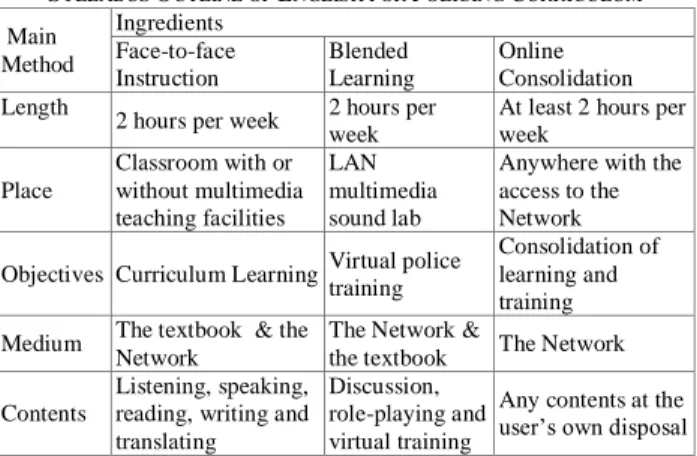
The syllabus outline is shown in Table 1, but virtual training, language learning and online consolidation are highly integrated and even in a face-to-face instruction, the computer and multimedia facilities are also utilized to improve interactions and language experiencing.
TABLE 1
SYLLABUS OUTLINE OF ENGLISH FOR POLICING CURRICULUM Main Method Ingredients Face-to-face Instruction Blended Learning Online Consolidation Length
2 hours per week 2 hours per week At least 2 hours per week Place Classroom with or without multimedia teaching facilities LAN multimedia sound lab
Anywhere with the access to the Network Objectives Curriculum Learning Virtual police
training
Consolidation of learning and training Medium The textbook & the
Network
The Network &
the textbook The Network Contents
Listening, speaking, reading, writing and translating
Discussion, role-playing and virtual training
Any contents at the user’s own disposal
This model provides students opportunities to learn collectively and interact directly in their classrooms and interact via virtual training platform or study by themselves at any suitable time and anywhere on the network with the assistance of other participants including their classmates, teachers, police experts, foreigners and visitors worldwide (Zhongwen Liu, 2011).
B. The Textbook for Classroom Instruction
A specific textbook English for Elite Police was written to meet the individual needs for the future police work. Most of the materials of the textbook are based on the author’s personal field interpreting practice and transcripts of police service and criminal investigation in the English speaking countries. Undergraduates in the academy can find corresponding topics to their majors in the book: Criminal Investigation, Criminal Science and Technology, Criminal Justice, Cyber Crimes Investigation, Traffic Administration, Security Protection, Police Administration and International Liaison.
The contents in every unit are designed in line with Learning-by-doing theory and arranged in a learning-training-learning sequence to provide students opportunities to apply knowledge into specific tasks as shown in Figure 1.
Figure 1. Sequence of segment delivery in a classroom instruction C. The Programs for Online Virtual Training
Virtual training emphasizes project-based collaborative interactions to enhance the student’s vocational skills and career success by experiencing potential working roles with sustained interests. It is a student-centered police service simulation training in English method with which participants conceive, develop and manage virtual police organizations to fulfill their duties and services on a global basis utilizing various web-mediated technologies. As a unique and innovative application of web technologies in real interpersonal interactions, virtual training allows students to act different virtual roles in designed scenarios.
The virtual training is based on scenarios designed normally at the end of each unit to practice all the knowledge learnt. A scenario contains one or more Chinese police officers and witnesses, victims, suspects or service recipients, time, place, plot and goals of a policing service or task. A scenario is retrieved with characters involved or keywords of
a policing service. A Chinese police officer is further classified as110 dispatcher; Community policing officer; Foreign affairs officer; Criminal investigation officer; Patrol officer; Traffic police officer; Criminal technology officer; Security protection officer; Cyber crimes police officer; Criminal justice officer; International liaison officer. Keywords of police service include offering help for tourists, dispatching a 110 call, establishing a criminal case, issuing a passport, investigating a crime, interrogating a suspect, asking a witness, checking a suspicious DUI and meeting a foreign delegation and so on.
A scenario is used for a virtual training like a play, a virtual press conference, a debate in the classroom instruction or an online virtual training.
Two programs are utilized for the online virtual training, one is developed by our research team with Dreamweaver, UltraISO, Visual JW and Visual Studio 2005 to realize the following functions: A student registers or logins with the username, password, creates or selects one scenario, set requirements for other roles, wait for a qualified participant to fulfill the designed service or task. They interact with textual, audio or visual communication in English.
Tencent QQ international 1.2, a popular free instant messaging in English and other foreign languages program, is also employed for the virtual training when there are participants available for a virtual training, partners login their own QQ account, change icons, nicknames or personal information, start training by typing, audio or visual chat till the targeted goals in a scenario are achieved.
D. The Network for the Consolidation
English for Policing Network consists of Login, Forum, Reflections, Assessment, Online Virtual Training and Curricular Learning including the courseware of English for Elite Police and theVisual-aural-oral transcripts developed as follows:
First, search with key words on Google or English police department websites to locate the original police transcripts, select those which contain typical, standard and daily policing expressions for each unit, download visual, audio or textual transcripts. Second, edit the visual or audio material with Ulead Video Studio to delete useless parts, add textual or audio explanations where necessary. The textual transcripts are acted or read by native English speakers and recorded with digital cameras or cr-cooledit audio recording software, edited with Ulead Video Studio to add explanations, images or decorations. Third, all the edited materials are linked to background information or discussion topics made with PowerPoint.
The network is utilized in the hybrid model with shifting emphasis on learning or training. III. CURRICULUM IMPLEMENTATION EXAMPLE
There are multiple individuals in the curriculum implementation, each playing a vital role in the learning and training process. The English teachers lead the whole program and combine various delivery mediums to carry out the hybrid learning with the assistance of teachers and experts in police administration, criminology and computer science.
The integrated hybrid English for policing learning model can be illustrated by the learning of Unit 7: TRAFFIC CONTROL AND SAFETY of English for Elite Police (Zhongwen Liu, 2009), the goal of which is to learn and apply English on traffic administration, DUI checking, improving road safety, conducting traffic collision investigations, and directing traffic during emergencies.
A. Computer Assisted Instruction in the Classroom
Course sessions make full use of face-to-face and multimedia-aided approaches to deliver different segments. The introductory speakers are from different policing backgrounds, including A Canadian who explains Citizens are co-producers of justice and the definition of Traffic Police to equip the students with basic beliefs for traffic police missions, a student who makes a presentation on the movie The Rush Hour to arouse the interests of the whole class on the subject, the teacher who first checks out the “suspected” students in the previous online study by asking them relevant questions, listens to their feedbacks and suggestions on the program, and then organizes the class to study basic words and expressions for activities in traffic control operations.
The follow-up segments are led by the teacher with the assistance of multimedia facilities like a computer, a projector, a screen and two loud speakers. The teacher reads and explains new words and phrases of the unit first, asks questions about goals, schedule and the outcomes of the training after watching the original traffic police training video. After listening to the conversation Drunk Driving and Traffic Control which covers checking of drunk driving, illegal parking, speeding and jaywalking, helping drivers to handle an accident and tourists to get to the destination, the students play different roles in the conversation with the computer, classmates or the teacher. Reinforcement tasks include discussion of DUI checking, writing practice of Police Emails followed by an Email writing task to be done after class and uploaded to the network for assessment, and translation of What to Do If You Are Involved in a Road Traffic Accident. Reading tasks include the case study of Paris Hilton Police Transcripts containing pattern expressions for dealing with speeding, the background information of Motor Vehicle and the time for funof three traffic police jokes.
The last part is the comprehensive virtual training in the form of a short play acted by two students based on:
The Scenario of Speeding: You are on traffic patrol on Zhongshan Road where you find a speeding driver. He is from New Zealand. You detain his driving license at last. Try to use the following as much as possible:
1. Can I see your driver's license and passport? 2. How fast do you think you were going?
3. Do you know what the speed limit is? You were going 15 kilometers over the speed limit. 4. Is this a rental car? You were driving too fast.
5. You broke the speed limit. I’m going to have to give you a ticket for the violation of speed limit.
The teacher normally give partners a few minutes to rehearse before selecting several groups to act in the front of the classroom, and ends the face-to-face virtual training with summary, comments and homework.
B. Virtual Training in the Sound Lab
Activities in the sound labs are student-centered, with the teacher being a supervisor or consultant present. A typical lab is equipped with a system to lecture and to monitor students studying on the LAN computers. Students can review the instruction videos or interact through LAN with other students and the teacher to train police expertise on the Network. They can also login and starts an online virtual training either in unit 7-scenarios-drunk driving or police officer-traffic policeman- drunk driving sequence to locate:
The Scenario of Drunk Driving: You are the traffic policeman who stops a British driver named Jack
Smith for a suspicious drunk driving. Take his license and detain his car after the breath test. Try to use the following as much as possible:
1. Can I see your license please? Do you know why I pulled you over? 2. Have you been drinking tonight? Blow the tester please.
3. Drunk driving is illegal in China. Can you get out of the car? 4. I’m afraid I’m going to have to take your license and detain your car. 5. I’m going to request some back up and a tow.
The teacher may use the grouping function of the control panel to select randomly two students to fulfill the task on the LAN computers, without knowing who is interacting with one another, students keep changing the virtual roles in the scenario with constantly changing dialogue contents.
The students may also login the online virtual training platform on their own, or login their QQ international accounts, copy the icons and character names to change icons and personal information, complete the designed scenario with typing, audio chat as shown in Figure 2:
Figure 2. “Jack Smith, the speeding driver” first types, then chats with the “Traffic Policeman” to fulfill the Scenario of Drunk Driving C. Self-paced Consolidation on the Network
Students may consolidate the learning after class on the Network. They may select the self-paced e-learning to watch videos, listen to records and finish the unread materials left in the classroom instruction. They may also visit relevant websites, download valuable materials, upload their homework, send e-mails to other participants when they are offline, share their reflections and voices on the forum online, reply and comment messages or feedbacks on the bulletin boards, assess themselves on the assessment section.
Students may select a live e-learning as well to take part in an online virtual training with synchronous interactions via the Network to train various police expertise in a changing environment with different people. In addition to policing virtual training, students are encouraged to play some desirable roles in other international law enforcement virtual organizations online. Other synchronous activities include police experts’ mentoring and English teachers’ e-coaching for the students (Zhongwen Liu, 2011).
IV. FINDINGS AND DISCUSSIONS
Findings of the hybrid model are based on the qualitative analysis of student survey, student reflections and feedbacks, interview, observation of classroom activity involvement and supervision of online training participation, and the quantitative analysis of quiz score and online learning assessment score. The outcomes of the two undergraduate classes of Grade 2007 majoring in Criminal Justice participating hybrid English for policing learning show:
A. Increased and Sustained Learning Interests
Most of students were more interested in the hybrid English for Policing learning compared with College English learning because “it’s more relevant to future work, more practical especially in the virtual training.”
The hybrid model is flexible and time effective for the students because they don’t have to complete all the learning in the classroom or on campus, more time is spent on listening and speaking practice with further practice done at the students’ own time online.
Three police jokes at the end of each unit brings students joys as well as professional knowledge, students often can’t wait to translate the jokes, reveal the puns or the metaphors, and most importantly, summarize the policing skills shown in these popular jokes. Links to Virtual Enterprise networks and Negotiation games provide students not only fun of electronic games but also practice of English in business and law enforcement.
B. Active and Relaxed Training Invlovement
Less motivated students traditionally have difficulty keeping up with the whole instruction process, distracted or isolated especially in an enlarged sound lab; the virtual training by two or more specific students allows no student to be idle, everybody has to play a role and get involved, anonymously or not. “The words and expressions are no longer something we learnt but something we can use.” “I feel great to be police officers in different fields; it’s also fun to be service recipients of all trades.”
The anonymous online virtual training makes the participant fell “relaxed because the other party doesn’t know me, I concentrate more on my English than on eye contacts and our interactions are based on English proficiency but not prejudice.” Teachers agree that interacting with the same student, his/her English proficiency and communicative skills shown in an online virtual training are better than that in a face-to-face interaction. Experiment of similar scenarios acted by the same student in front of the classmates and a computer shows that the nervousness in front of people leads to more mistakes or incoherent expression which is lessened when the speaker is seated with on one pay attention to him/her.
C. Improved English Proficiency and Overall Skills
Students improve their English proficiency, computer skills, internet literacy as well as team spirit through interacting with English speakers with different accents and from diverse cultural and social backgrounds on the Network. Their confidence grow after a period of communicating with these genuine service recipients whom they wouldn’t have met otherwise, which encourages the students to take part in more virtual training with improved English. D. Administrative and Technical Challenges and Solutions
Challenges we found during years of hybrid curriculum implementation are: first of all, what attitudes of the authorities towards a new pedagogy, technical barriers are to be overcome if the school authorities take a positive attitude to render financial and administrative supports with constancy; furthermore, how to coordination of participant responsibilities, the English teacher should play a leading role in the program to cooperate with police experts, computer teachers, sound lab staffs and administrative tutors to ensure the implementation of the course in and after class; last, how to meet the ever-changing student expectations, on one hand, the interests and enthusiasm for the whole learning process have to be aroused to sustain the students’ curiosity, on the other hand, hardworking and self-discipline have to be strengthened so as to achieve the program goals, the key of balancing lies in taking the students’ voices into account and assessing each student with quantitative and accepted criteria.
V. CONCLUSIONS AND PROSPECTS
From the tentative research and practice in integrating virtual training into the hybrid English for Policing learning, we found that virtual training especially online virtual training is feasible and advantageous to web-mediated ESP learning in view of the practical application of English in specific field. This paper suggests that a systematic framework is conceived first to set the principles of a learning model, textbook, courseware and network platform are developed accordingly or free online program is utilized to realize the overall goals. Project-based curriculum design not only includes traditional five elements of foreign language learning: listening, speaking ,reading, writing and translating, but also discussion, interpersonal and human-computer role-plays, case study, background information and jokes to strengthen training.
Online virtual training in a foreign language improves genuine vocational competence as well as foreign language proficiency in light of transferring future work setting via network to the curriculum process. It’s based on a
constructivist understanding of learning which sets a focus on the learners and their active role in constructing knowledge. Curriculum knowledge is acquired through active application and interaction within a virtual situation. In fulfilling every specific service or task, students are better motivated to learn knowledge; a motivated learning will inevitably result in work competence. As this beneficial cycle goes, the virtual training turns into real work competence. We are confident to apply virtual training in more disciplines of ESP learning, currently, Virtual Service Learning pedagogy is practiced in English for International Business, English for Tourism and English for Fashion Design in three universities within the province.
ACKNOWLEDGMENT
The author wishes to thank experts and judges of Liaoning Association of Higher Education for their support of the Exclusive Research Projects on Foreign Language Teaching and Learning Reform for Institutions of Higher Learning No. WYYB110103: A Study on the Application of Service-learning in WESP Teaching Models.
REFERENCES
[1] Kristen Gatehouse. (2001). Key Issues in English for Specific Purposes (ESP) Curriculum Development.The Internet TESL
Journal, 7.10,
[2] Laura Lloyd-Smith. (2010). Exploring the Advantages of Blended Instruction at Community Colleges and Technical Schools.
Journal of Online Learning and Teaching 6. 2, 508-515
[3] Nicole A. Buzzetoo-More & Retta Sweat-Guy. (2006). Incorporating the Hybrid Learning Model into Minority Education at a Historically Black University. Journal of Information Technology Education, 5, 153-164.
[4] Zhongwen Liu. (2009). English for Elite Police. Beijing: Press of Chinese People’s Public Security University, 11-39
[5] Zhongwen Liu. (2011). On the Development and Implementation of a Web-blended English Course for Police. Proceedings of
2011 IEEE 3rd International Conference on Signal Processing Systems, 532-534
[6] Zhongwen Liu. (2011). Application of Service-learning in a Web-based Virtual Policing in English Program. Proceedings of
2011 International Conference on Computer Engineering and Applications, 385-387
Zhongwen Liu: Born in Nov. 1969 in Dalian, China. BA of English, Liaoning Normal University, 1993, Master of Engineering, Dalian Maritime University, 2005.
He is an associate professor in Liaoning Police Academy, the author of English for Elite Police, Press of Chinese People’s Public
Security University, 2009 and 6 EI indexed papers. He coined VPIE and Virtual Service Learning pedagogies with research interest in web-mediated instructional technology.
Professor Liu is a member of IEEE, Program Committee member for several IEEE international conferences, and a candidate for the Police Liaison Officers of the Public Security Ministry of China.