Volume 2 | Issue 3 eP1089
Interprofessional Education: Using Live Simulation
to Enhance Collaboration and Communication
Gregory Chown, Suzanne Mader, Robyne Eisenhauer, John Lichtenwalner, Scott Batz© 2015 Chown et al. This open access article is distributed under a Creative Commons Attribution License, which allows unrestricted use, distribution, and reproduction in any medium, providing the original author and source are credited.
HIP is a quarterly journal published by Pacific University | ISSN 2159-1253 | commons.pacificu.edu/hip
Chown, G, Mader, S, Eisenhauer, R, Lichtenwalner, J, Batz, S. (2015). Interprofessional Education: Using Live Simulation to Enhance Collaboration and Communication.Health and Interprofessional Practice2(3):eP1089.
Interprofessional Education:
Using Live Simulation to Enhance
Collaboration and Communication
Gregory Chown
OTD, BHSc (OT), BA, CPAM Alvernia UniversitySuzanne Mader
MSN, RN Alvernia UniversityRobyne Eisenhauer
MSN, RN Alvernia UniversityJohn Lichtenwalner
PhD, MSW Alvernia UniversityScott Batz
MSN, RN Alvernia UniversityAbstract
The purpose of the simulation was to expose healthcare students in nursing, occupational therapy, and social work to the benefits of and barriers to interprofessional collaboration and communication through a live patient lab simulation. The interprofessional lab simulation was divided into three phases which included: 1) preparation through various teaching methods and lab simulation tours, 2) participating in the actual simulated case scenarios followed by interprofessional medical rounds and reflective exercises, and 3) group presentation of collaborative findings and discharge planning, and learning experiences. The collaboration between the professional program students aimed to link classroom teaching with clinical practice by fostering team work, problem-solving, communication, leadership, and critical thinking. Feedback from students was positive, where many indicated that more types of interprofessional experiences should be embedded throughout the programs and would be valuable for the development of important clinical skills.
Received: 07/15/2015 Accepted: 09/07/2015 Published: 11/09/2015
© 2015 Chown et al. This open access article is distributed under a Creative Commons Attribution License, which allows unrestricted use, distribution, and reproduction in any medium, provided the original author and source are credited.
Introduction
According to the World Health Organization (WHO) (2010), “Interprofessional education [IPE] occurs when two or more professions learn about, from and with each other to enable effective collaboration and improve health outcomes” (p. 13). Interprofessional collaboration and communication require students to have an understanding of the roles of other professionals in the delivery of patient care. Safe patient care requires communication and collaboration between members of all healthcare disciplines. The Joint Commission (2012) identified communication as a fundamental cause of errors in the healthcare environment.
The Institute of Medicine (IOM) in 2009 discussed the need for interprofessional communication and collaboration to promote safe patient care. “Just being around people from other professions is not enough. People need to work through problems together, often with the aid of a coach or facilitator” (IOM, 2009, p. 41). Simulation can provide a safe environment for students to explore, practice, and reflect upon patient outcomes based on their ability to communicate and collaborate across professional boundaries in a facilitated experience. Team work, problem-solving, communication, lead-ership, and critical thinking are skills utilized by healthcare professionals in daily practice.
Although students in professional programs of study have exposure during fieldwork to other healthcare professionals, courses are often taught only within the discipline. According to Moyers and Metzler (2014), “health profession entry-level education has occurred and, in many cases, continues to occur in discipline silos. As a result, the separate functioning of practitioners is perpetuated in spite of the demand for team collaboration as a major component of patient-centered care” (p. 502).
In order to foster participation between different health disciplines, an interprofessional lab simulation experience was created, allowing students to be submerged in a clinical situation and practice clinical reasoning skills within a safe environment. This teaching methodology has underpinnings in cognitive, constructivist, and social learning theories and can facilitate student learning. Simulation also enhances deeper thinking through reflection
(Rutherford-Hemming, 2012). Nagle, McHale, Alexander, and French (2009) discussed the effectiveness of simulation in promoting learning in communication and teamwork. “As learners work together to discuss their learning and share their experiences, they construct shared understanding and knowledge at higher levels. Clinical simulation can become part of global collaborative team education and communication training for health care teams” (Kaddoura, 2010, p. 514).
Application to Nursing
Interprofessional education is supported by the Amer-ican Association of Colleges of Nursing (AACN) in The Essentials of Baccalaureate Education for Professional Nursing Practice (AACN, 2008). Essential VI addresses the need for educational experiences for undergraduate nursing students that targets collaboration and comm-unication with other professionals. Nurses are often requested to coordinate interprofessional teams. Nurses provide a key leadership role in all healthcare settings to assess, identify, plan, and evaluate patient outcomes through collaboration with colleagues from all aspects of the healthcare delivery system.
Identified as an essential part of the educational experience, AACN (2008) accentuated the importance of interprofessional learning to provide safe nursing care. Realizing that healthcare is a complex system that requires multifaceted communication and conscious collaboration efforts to prevent omission and assure patient safety, interprofessional learning was identified as a corner stone for developing safe practices in novice nurses. Goals for the interprofessional simulation were developed in alignment with Essential VI and best practices related to communication, collaboration, and leadership.
In 2011, the Society for Simulation in Healthcare (SSH) and the National League for Nursing (NLN) identified an opportunity to enhance interprofessional education outcomes utilizing simulation to facilitate interprofess-ional education and practice. Both the Natinterprofess-ional League for Nursing Accrediting Commission (NLNAC) and the Commission of Collegiate Nursing Education (CCNE) address IPE in their nursing education accreditation documents supporting incorp-oration of simulation learning, especially when focusing on IPE, team work, and patient safety (Interprofessional Education Collaborative Expert Panel, 2011).
The development of clinical reasoning skills in nursing students is the cornerstone of healthcare education. Clinical reasoning allows for the application of didactic learning to patient care and allows the clinician to respond to varying clinical situations in a safe and effective manner. Learning clinical reasoning requires submersion in the clinical environment with the opportunity for the student to reflect on actions and outcomes (Koharchik, Cauti, Robb, & Culleiton, 2015). Furthermore, being able to work effectively as members of clinical teams, while in the student role, is a fundamental part of student learning. How to assist students in learning interprofessional competencies continues to be an issue for today’s educational programs. Effective at improving healthcare students’ knowledge and communication skills, simulation-based methodologies help to model the real world of clinical practice, where teamwork often happens asynchronously across time and space.
Application to Occupational Therapy
Occupational therapists must be able to work with multiple disciplines to ensure the best outcomes for clients. In order to practice with other healthcare providers, occupational therapy students need to develop important skills such as communication, problem-solving, teamwork, critical thinking, and leadership. Furthermore, students need to recognize the roles and benefits of other disciplines. These essential skills and knowledge should be developed early during the educational process through interprofessional education.
According to the 2011 Accreditation Council for Occupational Therapy Education (ACOTE®) Standards and Interpretive Guide Preamble, students upon graduation from an ACOTE® accredited master’s degree-level occupational therapy program must be “prepared to effectively communicate and work interprofessionally with those who provide care for individuals and/or populations in order to clarify each member’s responsibilities in executing components of an intervention plan” (American Occupational Therapy Association [AOTA], 2012, p. 1). Standard number B.4.1 from 2011 ACOTE® requires that students be able to consult with other professionals regarding screening and evaluation of clients in order to determine the need for occupational therapy intervention. Standard
num-ber B.5.20 requires students be able to“effectively interact through written, oral, and nonverbal communication with the client, family, significant others, colleagues, other health providers, and the public in a professionally acceptable manner” (AOTA, 2012, p. 26). Furthermore, standard B.5.21 requires that students upon graduation are able to “effectively communicate and work inter-professionally with those who provide services to individuals, organizations, and/or populations in order to clarify each member’s responsibilities in executing an intervention plan” (AOTA, 2012, p. 26).
Application to Social Work
Social workers apply the person-in-environment per-spective, focusing on the strengths of the client, to their daily collaboration with professionals in all aspects of the healthcare environment. Social workers can work with individuals, families, and the larger systems that impact the individual. In order to produce an effective intervention, social workers must develop a holistic and comprehensive understanding of the individual client. Interprofessional collaboration allows social workers to recognize the complex and dynamic factors that impact an individual client beyond the traditional biopsychosocial assessment.
Competency is a core professional value requiring social workers to continually expand their knowledge base and to practice within their areas of expertise (National Association of Social Workers, 2008). For social work practitioners today, competency no longer applies solely to the skills and knowledge base of their own profession, but also requires an understanding of how to maximize the effectiveness of other disciplines involved in the care of the client (Forrest & Derrick, 2010). This interprofessional experience provided these students with a foundational understanding of the critical need for social work practitioners to cooperate with other helping professionals. The social work students who participated in this interprofessional simulation were given an opportunity to witness the services that nurses and occupational therapists provide, as well as to appreciate the importance of collaboration among different disciplines. In the field, social workers often work on interprofessional teams providing a person-in-environment perspective to colleagues from nursing, occupational therapy, and other helping professions.
The Interprofessional Lab Simulation Experience
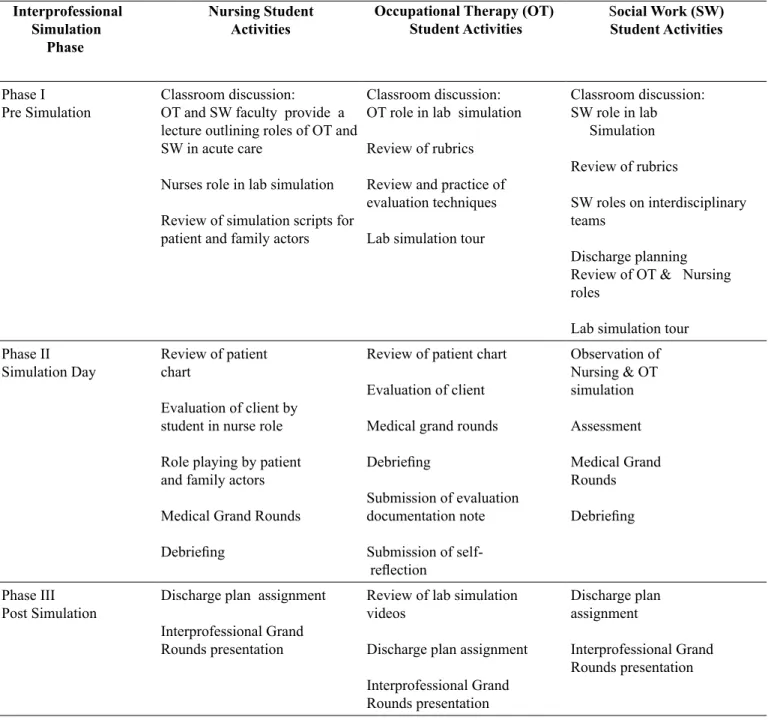
The interprofessional lab simulation experience occ-urred in three phases (see Table 1) which included: 1) Phase I: Orientation of Students to Simulation, 2) Phase II: Simulated Patient Encounter, and 3) Phase III: Interpofessional Grand Rounds Presentations. Within Phase II there were three distinct different learning experiences which involved the initial encounter with the simulated patient, medical rounds with the physician and finally the debriefing exercise. These three distinct
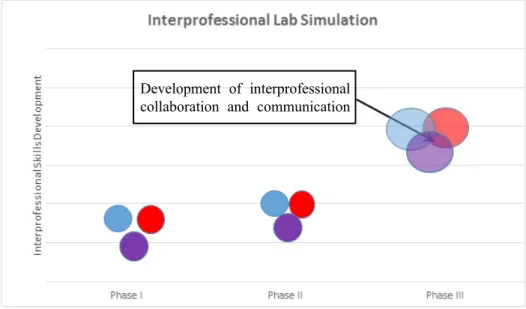
phases allowed for students over time to develop inteprofessional collaborative and communication skills along with increased interprofessional competence (see Figure 1, following page).
Phase I: Orientation of students to simulation
Each student received objectives for the activity prior to the scheduled simulation (see Table 2, following page). The goal for all student participants, regardless of their professional program affiliation was to contribute Table 1.Summary of the simulation experiences specific to each discipline
Interprofessional Simulation Phase
Nursing Student
Activities Occupational Therapy (OT) Student Activities SStudent Activitiesocial Work (SW)
Phase I
Pre Simulation Classroom discussion:OT and SW faculty provide a lecture outlining roles of OT and SW in acute care
Nurses role in lab simulation Review of simulation scripts for patient and family actors
Classroom discussion: OT role in lab simulation Review of rubrics Review and practice of evaluation techniques Lab simulation tour
Classroom discussion: SW role in lab Simulation Review of rubrics SW roles on interdisciplinary teams Discharge planning Review of OT & Nursing roles
Lab simulation tour Phase II
Simulation Day Review of patient chart Evaluation of client by student in nurse role Role playing by patient and family actors Medical Grand Rounds
Debriefing
Review of patient chart Evaluation of client Medical grand rounds
Debriefing Submission of evaluation documentation note Submission of reflection Observation of Nursing & OT simulation Assessment Medical Grand Rounds Debriefing Phase III
Post Simulation Discharge plan assignment Interprofessional Grand Rounds presentation
Review of lab simulation videos
Discharge plan assignment Interprofessional Grand Rounds presentation Discharge plan assignment Interprofessional Grand Rounds presentation
Figure 1.The projected development of interprofessional collaboration and communication skills over time
Blue = Occupational Therapy, Red = Social Work, Purple = Nursing
Table 2.Interprofessional objective summary of participating disciplines
Discipline Objectives
Occupational Therapy Use clinical reasoning to explain the rationale for & use of compensatory strategies when activities and tasks cannot be performed.
Provide recommendations & training in techniques to enhance functional mobility.
Explain safe & effective application of superficial thermal & mechanical modalities as a preparatory mea-sure to manage pain & improve occupational performance.
Explain the use of deep thermal & electrotherapeutic modalities as a preparatory measure to enhance occupational performance.
Grade & adapt the environment, tools, materials, occupations, & interventions to reflect the changing needs of the client, the sociocultural context & technological advances.
Select & teach compensatory strategies for clients. (AOTA, 2012) Social Work Advocate for client access to the services of social work.
Demonstrate professional behavior demeanor in behavior, appearance, & communication. Demonstrate effective oral & written communication skills.
Collect, organize, & interpret client data. Assess client strengths & limitations.
Select appropriate intervention strategies. (Council on Social Work Education, 2008)
Nursing Display knowledge & skills in leadership and patient safety in directing the collaborative professional team. Demonstrate communication & collaboration with other healthcare professionals.
Practice professionalism in the venue of promoting human dignity and patient-centered care. Provide safe & effective care to patients.
Respect the variations of care provided by other healthcare professionals. (American Association of Colleges of Nursing, 2008)
Development of interprofessional collaboration and communication
knowledge, skills, and values from their discipline to the assessment, treatment, and discharge of a client in a simulated scenario as part of an interdisciplinary team comprised of nurses, occupational therapists, and social workers.
The National League for Nurses ACES (Advancing Care Excellence for Seniors) unfolding case studies were selected for this interdisciplinary simulation. Shared, complimentary and individual professional objectives (Baker et al., 2008) were identified and considered in the development of the scenario format. There are several variations in this standardized library of scenarios. The following were selected: Ertha Williams with diagnosis of dementia, Alzheimer’s, and fractured right hip; Millie Larson with a diagnosis of urinary tract infection, confusion, and fractured C4/C5; and Red Yoder with a primary diagnosis of fractured right wrist and transient ischemic attack (National League of Nursing, 2014). All three scenarios were modified to accommodate occupational therapy and social work patient issues and concerns and guided by the objectives designed by the respective professional colleges (see Table 2).
Since nursing students played live patient and family roles in the simulation, as well as serving as providers of care, the assignments for the simulation experience varied from that of the occupational therapy and social work students. All disciplines received in class education before the simulation. Lectures by occupational therapy and social work faculty to nursing students prior to the simulation enhanced the understanding of the roles within those professions regarding patient advocacy, assessment, care planning, and care delivery. A period of time was also dedicated to questions and answers from the nursing students. Additionally, briefing of the scenario content and the obligations of each nursing student’s role in the live simulation were reviewed. Occupational therapy students reviewed and practiced physical, neurological, and cognitive evaluations. Students were provided rubrics on expectations during the simulation and classroom discussion focused on the purpose of the simulation and their inteprofessional roles.
Prior to the simulation, social work faculty oriented the social work students to the importance of inter-professional collaboration. In class, the students dis-cussed their experiences with other disciplines from
their field placements. Through this discussion, the students shared their understanding of the role of nurses and occupational therapists. The class also discussed the role of social workers on interprofessional teams. On these teams, social workers frequently assume case management responsibilities. Case managers connect their clients with the necessary resources in order to orchestrate services within a particular timeframe (Zastrow, 2013). This requires a thorough understanding of client needs from the perspective of each participating discipline. In order to effectively fulfill case management duties, a social worker must know the community resources, the client’s rights and preferences, the relevant policies, and the client’s insurance coverage (Zastrow, 2013). For the purposes of this experience, students focused on the social worker’s responsibility to develop a discharge plan. The faculty provided didactic instruction on discharge planning in order to clarify expectations regarding the interprofessional experience.
Several one hour orientation sessions were provided to the occupational therapy and social work students. These orientation sessions occurred during a portion of the dedicated class time. Student groups reported to the simulation lab and received a physical orientation to the lab. Occupational therapy students were invited to operate the hospital bed, explore the control room, equipment and safety options. Questions from students were encouraged and addressed. Nursing students did not attend the simulation lab orientation due to their previous level of exposure to simulation and nursing lab resources throughout their course of study.
Phase II: Simulated patient encounter
Initial encounter. On the day of the simulation exp-erience, occupational therapy students were permitted to bring any notes, pens, and assessment tools (i.e. goniometers). Upon arrival to the lab simulation, stud-ents were provided a scenario presented in the format of a typical inpatient chart. Information within the chart included physician and nursing notes and laboratory reports. Interdisciplinary groups (i.e., nursing and occupational therapy students working together) were provided 30 minutes to perform an evaluation of the client. Nursing students in the caregiver role initiated contact with the patient and family members and performed a focused physical assessment. Occupational
therapy students engaged in the scenario in a consulting role and evaluated the patient using occupational therapy assessment tools (i.e., physical, neurological, and cognitive testing).
Nursing students playing the roles of patient and family member were encouraged to interact dynamically and to ask questions of both the nursing and occupational therapy care providers. Questions posed by the sim-ulated patient and family focused on recovery of function, ability to return home, and current treatment. Each scenario, while following a similar script, evolved as student clinicians worked with the patient, family member(s), and interprofessional colleagues. Both student groups consulted each other at the bedside to answer questions posed by the patient and family that were not related to their area of expertise. The anxiety borne of being a novice practitioner and approaching a family’s tough questions encouraged the nursing and occupational therapy students to look to each other for support. A model of collaboration to meet the needs of the patient evolved.
As part of the scenario, each simulated patient developed dizziness when occupational therapy attempted to transfer the patient from bed to wheelchair as part of the required functional assessment by the student. This complication required assessment by both nursing and occupational therapy to determine the interventions needed to provide safe patient care. Collaboration requiring respect for the unique skills each profession brought to the experience, were brought forward during this problem solving phase. Occupational ther-apy relied on the nurse to intervene by assessing vital signs and overall patient status. Nursing inquired for the insight of occupational therapy on how to safely mobilize the patient within the constraints of the scenario. Furthermore, students had resources available such as an emergency phone to request for orders and assistance from a simulated attending physician.
The social work students observed the simulation via closed-circuit television, taking notes and working with their partner to identify the client’s current condition including physical, cognitive, and social domains. The limited size of the simulation laboratory, and the time constraint of the scenario, did not allow for a live interaction of the social work students with the family.
Social work students observed the family, patient, caregiver interactions and actively participated in the post simulation team meeting and debriefing. The social work students also identified the availability of caregiver support and were asked to establish, with feedback from the nursing and occupational therapy student par-ticipants, the client’s needs upon discharge.
Both nursing and occupational therapy students were videotaped throughout the simulation. The recording was shared with nursing, occupational therapy, and social work students and faculty for the purpose of debriefing and reflection of the scenarios. Occupational therapy students were evaluated on clinical performance during the scenario. Nursing students were not evaluated for clinical performance because of their mixed clinical and non-clinical roles in the scenario.
Interprofessional medical rounds. After completion of the scenario, occupational therapy, nursing, and social work students met in a conference room remote to the simulation laboratory for a simulated clinical team meeting. The clinical team meeting utilized a physician lead medical rounding model. The physician role was played by a senior level nursing faculty. Nursing students in the simulation group were asked to give an overview of the patient with each additional professional group providing input related to specific assessments and areas of identified concerns. The physician determined a discharge date and asked the interprofessional team of students to prepare the patient, through mutual goal setting and collaboration, for discharge.
Each interprofessional medical rounding session varied based on the assessments each student group brought to the forum. The physician actor facilitated assessment and collaboration through interprofessional dialogue and encouraged collaboration between the professional program student groups. Social work students were empowered to lead the group by identifying potential barriers to discharge and developing an action plan in order to meet the discharge date prior to completion of the meeting.
Debriefing. The debriefing session took place in a conference room at the completion of the inter-professional medical rounding meeting. The debriefing was facilitated by social work faculty. Fifteen minutes
were dedicated to this segment of the simulation. A significant degree of learning can occur during the debriefing as students are guided by the facilitator through intentional reflection of the simulated patient encounter (Lusk & Fater, 2013). Typical questions stated by the facilitator were; “How do you feel now that the scenario is over?”, “What went well during the scenario?”, and “What areas could you improve upon?” The goal of the debriefing was to assist students in recognizing areas of strength and weakness within the group as well as individually (Lusk & Fater, 2013). Students reflected on the experience sharing their different perspectives of the evolved events. Anxieties, successes, and areas for improvement were shared. The simulation experience concluded with the debriefing session.
After completion of the simulation, occupational therapy students documented their evaluation in the form of a SOAP note along with a one page reflection of the experience which was required to be submitted to the course instructor within 12 hours. To enhance debriefing, occupational therapy students reviewed the video of recorded lab simulation performance in the classroom the following week. Students and the course instructor provided constructive feedback regarding strengths of performance and areas for improvement relating to the role of the occupational therapist. Class discussion and feedback forms were utilized to assess the experience from the student’s perspective.
Phase III: Interprofessional grand rounds presentation
Once the simulation was completed, students were provided guidelines for developing and presenting of an interprofessional discharge plan as a collaborative outcome from the scenario. Discharge planning involves linking clients and their caregivers with the resources and services that exist outside of their present healthcare setting (Case Management Society of America [CMSA], 2010). An effective discharge plan relies on a team approach that includes not only the participating helping professionals, but also the client and their support system. A discharge plan details, in writing, what a client may need to maintain their current level of well-being or what may be needed to move to a different level of care (CMSA, 2010). The goal of the grand rounds presentation was to encourage
the application of the professional collaboration component of the simulation with the client and caregiver perspective to produce a discharge plan that would incorporate resources provided by all the professions represented in the scenario.
The scenario groups representing all three of the professional programs were given access to sharing documents through a Google Docs™ account. Nursing, occupational therapy and social work students developed individual plans of care traditional to their profession. Subsequently, the group formed a collaborative discharge plan focused on the highlighted needs of the patient by each profession that allowed for a collaborative outcome for the patient.
All nursing, occupational therapy, social work students, and faculty attended the grand rounds presentation one month after the simulation experience. Student groups were randomly picked to present their interprofessional plan of care for their patient. Each student presented a portion of the plan of care. PowerPoint® slides were developed for the presentation and submitted for evaluation to the faculty. Guidelines for the content of the slides were provided to each interprofessional student group. All students, regardless of their prof-essional program alliance, were evaluated within their associated course for the quality of the presentation, the PowerPoint® slides, and the interprofessional plan of care developed.
Implications for Future Interprofessional Experiences and Research
The interprofessional simulation provided the stud-ents with an introduction to professions other than their own and highlighted shared and differing bodies of knowledge within the scope of practice of each professional group. Nursing students discussed the simulation informally after the experience. Occupational therapy participated in class discussion and completed feedback forms for the experience. The occupational therapy students indicated they found the interprofessional experiences to be helpful. Many expressed the desire to have not only more of these types of assignments, but also to be embedded throughout the occupational therapy program. Social work students discussed the simulation with the faculty
in class after the experience. Social work students verbalized that while the experience was new for them, they found it useful and insightful into the roles of other professionals. Students found the experience helpful in sharing insights to discharge planning through the unique perspective of each student professional group. Future interprofessional simulations could be expanded to include additional professional students including physical therapy, athletic training, psychology and be-havioral health. Simulations utilizing alternate clinical environments including critical care and rehabilitation may be useful for students to experience changing and evolving roles both within and between profess-ions. Students with Art and Communication majors could be included to play expanded patient roles in the simulations and to work with production of the Interprofessional Grand Rounds. An interprofessional course to explore professional roles, client safety, and collaborative models may also be of benefit. Further research is needed to determine the types of interprofessional simulation that most enhance collaborative learning and the ability of students to apply skills learned to the bedside.
According to Moyers and Metzler (2014), “inter-professional education is the foundation for interprofess-ional collaborative practice” (p. 502). Simulated interprofessional experiences utilizing students from varying professional programs enhances exposure to interprofessional communication and collaborative practice. Continued and expanded interprofessional experiences in undergraduate education will increase collaborative practice and strengthen interprofess-ional communication. Enhanced opportunities for collaboration will increase student comfort with inter-professional communication. The goal is improved collaboration and communication between different professional caregivers to increase safety and care delivery at the bedside.
Conclusion
Interprofessional live patient simulation allowed for dynamic and evolving dialogue between all students regardless of their discipline background. Barriers to care delivery were raised and addressed in different ways by different members of the student healthcare team. Students benefited from exposure to the depth
and breadth of practice of their multidisciplinary student colleagues. Debriefing, an interdisciplinary team meeting and grand rounds presentation, allowed students to practice teamwork, collaboration, critical thinking, communication, and problem solving beyond the simulation environment. Students demonstrated an awareness of the roles of other professionals in the delivery of patient care while noting the similarities and differences between the plans of care each group developed for the patient.
Acknowledgements
Funding was received for each author via an innovation grant through Alvernia University. A special thank you to Dr. Vera Brancato for her feedback.
References
American Association of Colleges of Nursing. (2008). The essentials of baccalaureate education for professional nursing practice. Retrieved January 10, 2015 from http://www.aacn.nche. edu/education-resources/BaccEssentials08.pdf
American Occupational Therapy Association. (2012). 2011 Accreditation Council for Occupational Therapy Education (ACOTE®) Standards. American Journal of Occupational Therapy, 66(6, Suppl.), S6-S74. http://dx.doi.org/10.5014/ajot.2012.66S6 Baker, C., Pulling, C., McGraw, R., Dagnone, J. D., Hopkins-Rosseel, D., & Medves, J. (2008). Simulation in interprofessional education for patient-centered collaborative care. Journal of Advanced Nursing, 64(4), 372-379.
http://dx.doi.org/10.1111/j.1365-2648.2008.04798.x Case Management Society of America. (2010). Standards of practice for case management. Retrieved from http://www.cmsa. org/portals/0/pdf/memberonly/standardsofpractice.pdf Forrest, C., & Derrick, C. (2010). Interdisciplinary education in end-of-life care: Creating new opportunities for social work, nursing, and clinical pastoral education students. Journal of Social Work in End-of-Life & Palliative Care, 6, 91-116.
http://dx.doi.org/10.1080/15524256.2010.489224
Institute of Medicine. (2009). The future of nursing: Acute care. Washington, DC: National Academies Press.
Interprofessional Education Collaborative Expert Panel (2011). Core competencies for interprofessional collaborative practice: Report of an expert panel. Interprofessional Education Collaborative. Retrieved on January 10, 2015 from http://www. aacn.nche.edu/education=resources/IPECReport.pdf
Kaddoura, M. A. (2010). New graduate nurses’ perceptions of the effects of clinical simulation on their critical thinking, learning, and confidence. Journal of Continuing Education in Nursing, 41(11), 506-516.
http://dx.doi.org/10.3928/00220124-20100701-02 Koharchik, L, Cauti, L., Robb, M., & Culleiton, A. (2015). Supporting clinical reasoning. American Journal of Nursing, 115(1), 58-61.
http://dx.doi.org/10.1097/01NAJ.0000459638.68657.9b Lusk, J., & Fater, K. (2013). Postsimulation debriefing to
maximize clinical judgment development. Nurse Educator, 38(1), 16-19. http://dx.doi.org/10.1097/NNE.0b013e318276df8b Moyers, P. A. & Metzler, C. A. (2014). Interprofessional
collaborative practice in care coordination. The American Journal of Occupational Therapy, 68(5), 500-505.
http://dx.doi.org/10.5014/ajot.2014.685002
Nagle, B. M., McHale, J. M., Alexander, G. A., & French, B. M. (2009). Incorporating scenario-based simulation into a hospital nursing education program. The Journal of Continuing Education in Nursing, 40(1), 18-25.
http://dx.doi.org/10.3928/00220124-20090101-02
National Association of Social Workers. (2008). Code of ethics of the National Association of Social Workers. Washington, DC: Author.
National League for Nursing. (2014). Advancing care excellence for seniors unfolding case studies. Retrieved May 24, 2014 from http://www.nln.org/professional-development-programs/ teaching-resources/aging
Rutherford-Hemming, T. (2012). Simulation methodology in nursing education and adult learning theory. Adult Learning, 23(3), 129-137. http://dx.doi.org/10.1177/1045159512452848 The Joint Commission. (2012). National patient safety goals. Retrieved from http://www.jointcommission.org/ assets/1/6/2012_NPSG_HAP.pdf
World Health Organization. (2010). Framework for action on interprofessional education and collaborative practice. Geneva: Author. Retrieved from http://www.who.int/hrh/resources/ framework_action/en/
Zastrow, C. (2013). The practice of social work: A comprehensive worktext (10th ed). Belmont, CA: Brooks/Cole.
Corresponding Author
Gregory Chown, OTD, BHSc (OT), BA, CPAM Assistant Professor Occupational Therapy Alvernia University 400 Saint Bernardine Street Reading, Pennsylvania 19607 [email protected]