Vol. 1, No. 1, 2020 www.scholink.org/ojs/index.php/elsr
Original Paper
Student Evaluation of Teaching: Exploring Instructor and
Student Perspectives with Course Redesign
Abby Halston1*, Taylor Lum1 & Hans Chun1
1School of Education and Behavioral Sciences, Chaminade University, Honolulu, United States *Abby Halston, School of Education and Behavioral Sciences, Chaminade University, Honolulu,
United States
Received: June 6, 2020 Accepted: June 12, 2020 Online Published: June 19, 2020 doi:10.22158/elsr.v1n1p144 URL: http://dx.doi.org/10.22158/elsr.v1n1p144
Abstract
Student Evaluation of Teaching (SET), or instructor evaluations, is used as a significant instrument across the world to measure instructors teaching methods and course evaluations. With the lack of standardized SET across universities and institutions, this study gains insight into how instructors use and improve student evaluations and students’ views of how their feedback is utilized by posing questions to university students and faculty through focus groups and interviews. Data was gathered and recorded to interpret students’ perceptions with how instructors utilize the students’ evaluations and instructors’ perceptions of student evaluations and how the instructors use the students’ feedback. Results indicate that students and instructors have different values for student feedback and curriculum improvement. Implications of different values for student feedback and curriculum improvement include instructors not attempting to improve their teaching and course, students poorly rating their instructors, and students that may not be challenged due to possibly receiving a negative evaluation.
Keywords
student evaluations, course evaluations, instructor evaluations, higher education, course redesign 1. Introduction
Most universities use Student Evaluation of Teaching (SET), or instructor evaluations, to evaluate and give feedback on their instructors’ effectiveness with the course. Traditionally, many universities utilize a “cafeteria-style” with regards to sharing similar characteristics with their course evaluations. These characteristics include (1) a self-assessment with various open and closed-ended questions about the instructor’s teaching effectiveness and curriculum, (2) a question asking about “overall” effectiveness, (3) a comments section where students can elaborate about their instructor’s effectiveness and curriculum, (4)
the notion that the students’ feedback and comments are anonymous, (5) the evaluations are presented at the end of the term without the presence of their instructor, (6) these evaluations are summarized and presented to the instructors and departments to reveal the evidence of the effectiveness of instructors to make several institutional recommendations, (7) differences between students (e.g., GPA, year) and instructors (e.g., beginner, experienced) are not influenced in the analysis to determine effectiveness (Algozinne et al., 2004).
The use of student evaluations was initially introduced during the mid-1920s in the United States and Australia and then, in later years, reaching Asia and Europe (Algozzine et al., 2004; Macfadyen et al., 2016). Determining the strengths and weaknesses of the courses along with instructors promoting the overall direction of their teaching (also known as formative evaluation) is another use of SETs (Algozzine et al., 2004; Haladyna & Amrein-Beardsley, 2009). It also provides feedback on the teaching faculty staff ratings for tenure, promotion, and salary (known as summative evaluations) (Algozzine et al., 2004; Zhao & Gallant, 2012).
Due to the increasing interest in these instructor evaluations, research on student evaluations has increased with the intent to improve and expand the usage of SETs. Emery, Kramer, and Tian (2003) found that 600 colleges in the United States increased the use of student evaluations of teaching effectiveness from 29 percent to 86 percent. While in Canada, 94 percent of their universities use some method for students to evaluate faculty’s effectiveness (Saroyan & Amundsen, 2001). Individual institutions have prepared and developed student evaluation forms to modify to their institutional needs (Richardson, 2005).
SET provides a way to gain feedback about the instructor’s effectiveness in teaching and a measure for administration to use for teaching effectiveness (Macfadyen et al., 2016). It could also provide information about achieving learning goals and objectives, relating with the teacher, classroom components (i.e., homework, materials of instruction), and student and teacher communication (Zhao & Gallant, 2012). Institutions of higher education typically share commonalities in the structure of their SETs to determine the overall rating, course, and teaching effectiveness of the instructor (Algozinne et al., 2004). Usually, this evaluation is based on a rating scale from 1 to 5 (e.g., unsatisfactory to excellent, very poor to very good). Surveys consist of questions that ask about excitement, clearly speaking, preparedness, proper skills with the instructor’s teaching efforts (Barth, 2008).
Students’ ratings of teaching are a source of feedback to the instructors and administration (Macfadyen et al., 2016; Richardson, 2005). There are strengths and weaknesses in utilizing SETs to gain insight into students’ success with learning objectives and course evaluation. Strengths of SETs include giving the students a voice to give feedback about the course (e.g., homework, classroom instructions, teaching styles, student-teacher interactions), describing ways to improve the curriculum, and providing information about the success of learning goals and objectives. Weaknesses include, in some cases, the SET’s primary role in influencing administration’s decisions with promotions and tenures, the utilization of self-assessment in the SETs, and unconscious influence that summative evaluation may have with
formulating the course to fit these standards to obtain higher ratings (Chan et al., 2007). With these strengths and weaknesses of SETs, administration and faculty could determine how they could use this feedback to better their students, courses, and institution.
Student evaluations are an essential component in determining teaching effectiveness. Ratings of teaching effectiveness from students are a plausible resource compared to other sources (Zhao & Gallant, 2012). Studies examined student evaluation factors (i.e., organization, workload/difficulty, expected/fairness of grading, instructor liking/concern, perceived learning, instructor accessibility, and student-instructor relationship) that influence the overall course, instructor rating, and teaching effectiveness (Barth, 2008; Cohen, 2005). Marks (2000) discovered that instructors who had more challenging assignments and workloads garnered a negative effect. This factor affected the instructor’s rating because the student may feel they would not get a good grade. Barth (2008) suggested that instructors with demanding standards have a negative influence on their overall rating. Cohen (2005) found that the teacher and student relationship was not entirely related to the course evaluation. Organizational skills (i.e., excitement, clearly speaking, preparedness, and proper skills) represented good qualities for the instructor’s teaching. Students’ perception of their learning was also a significant factor that determined the importance of the course. Student perceptions affect the instructor’s overall rating of teaching effectiveness (Marks, 2000). Also, instructors that are willing to help and work with students have a positive overall score. These results suggest that the quality of instruction and willingness to help are significant factors that influence teachers’ ratings (Barth, 2008).
Prior studies share an understanding of the purpose and usefulness of SETs. However, more research is needed regarding the need for bridging the gap with how instructors improve their teaching and course effectiveness. This study examines how instructors use their student evaluations and students’ perceptions of the course. An analysis of the evaluation process from both the instructors’ and students’ points of view are utilized along with how it factors into changing the curriculum and instructors’ teaching effectiveness.
2. Method 2.1 Participants
The participants were students (N = 11) and instructors (N = 6) at a private university in the Pacific region. The ages of the student participants ranged from 18 to 35. Instructors’ ages ranged from 40 to 65. The students’ and instructors’ genders included individuals who identify as either male or female. The participants were asked by the principal investigators to voluntarily answer questions in focus groups with undergraduate and graduate students and individual interviews with instructors. The focus groups were about 60 minutes long, while the individual interviews lasted about 10-15 minutes. There was a total of two focus groups and six individual interviews. The participants received no compensation for their participation in the study.
2.2 Data Collection
All participants were recorded by one of the principal investigators and were asked seven questions in the focus groups and eight questions in the individual interviews. The focus groups responded to questions about the students’ perceptions of instructor evaluation assessment. The questions examined the purpose of the course evaluation, their opinion on how the instructor’s use course feedback, and whether the course evaluation form should be changed. Also, this study examined students’ perceptions of how instructors benefit from the student input on course feedback and whether students should be the ones to evaluate their instructors. This study also investigated the student’s suggestions of course improvement and their preference in completing course evaluations in-class via paper and pen/pencil or via online. The individual interview questions examined the faculties’ perceptions of student feedback and improvements in instruction. The interview questions consisted of the instructor’s utilization of student evaluations, their reactions to student evaluation feedback, and their major considerations when using student evaluations for improving their teaching. Lastly, this study investigated whether the questionnaire for feedback should be changed, suggested questions they would like to see on the form and whether instructors benefit from student input; in addition, this study examined whether the students should be evaluating the instructors and their recommendations on how to improve the process to better use student input. The questions were asked after completion of the Informed Consent for both students and instructors.
2.3 Data Analysis
Participants were recruited for this study by the principal investigators to be interviewed and to evaluate the participants’ (students and instructors) perceptions. A principal investigator asked two classes with one class of undergraduate students and another class with graduate students to participate in this study. Faculty members were also asked individually if they would like to participate in this study. Both students and faculty were informed that the purpose of the study was to gain feedback about their perceptions and utilizations of SETs with instructors.
Once all the participants verbally agreed to participate in this study, they were informed that the purpose of this study was to evaluate how instructors use student feedback. They were told that the focus would be about 60 minutes long, and the interview would last 10-15 minutes. They were informed that participation is voluntary and could be terminated at any time. The participants were also told that they would be recorded to analyze their answers and would receive no compensation. Furthermore, they also had to complete a demographics portion which inquired about their ethnicity, gender, age, classification (e.g., Faculty), and department affiliation. The participants then signed an Informed Consent.
Each focus group and individual interviews were recorded separately. Researchers created mostly open-ended questions so they participants could discuss their perspectives and concerns with SETs and instructors. Researchers asked a set of questions to evaluate their perceptions of student feedback and improvements on the student evaluation form. Each session took place in a classroom for the focus
groups and in the instructor’s office for the individual interviews, both on campus. After, the participants were thanked for their participation.
To analyze the qualitative data, the evaluation method of triangulation was utilized. Triangulation is used to combine multiple ways to test consistency among the different sources of data (Patton, 2002). All transcription was reviewed and coded by the researchers. Researchers used axial coding where researchers read the transcript and created open codes for each question, then formed and merged the significant categories, or themes, with the codes. The results of the focus group and individual interviews were reviewed, and the patterns of the responses were triangulated to determine the effects.
Student Questions Faculty Questions
What is the purpose of course evaluations? How do you utilize student evaluations? What is your perception on how instructor’s use
course feedback?
How do you react and use student evaluation feedback?
Should the course evaluation form questions be changed? Why?
What major considerations do you have when using student evaluations for improving your own teaching?
Do instructors benefit from student input on course feedback?
Do you think the questions on the student evaluation form should be changed? Why? Should students be the ones to evaluate their
instructors?
If student evaluations were to change, what types of questions would you like to see on the form? How could the course evaluation form be
improved? If so, what type of questions would you like to see on the form?
In what ways do instructors benefit from the student input?
Do you prefer to complete course evaluations in class via paper and pencil or complete course evaluations via online format?
Should the students be the ones to evaluate their instructor
Do you have any recommendations with this process to improve student input?
3. Results 3.1 Students
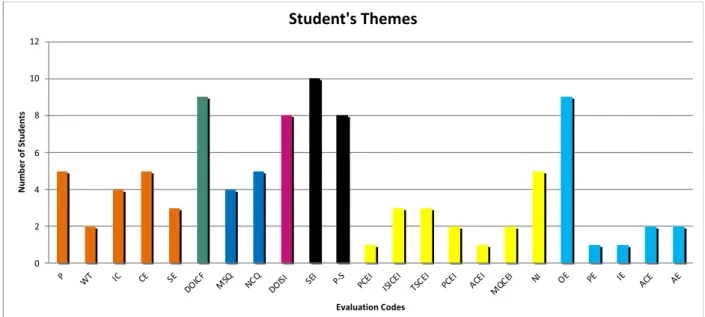
Undergraduate and graduate students participated in focus groups and were posed questions to give feedback on their perceptions of how instructors use the student evaluation forms. Four themes were established with their responses: overall experience, varied instructors, student evaluation, and recommendations. Most students thought that the purpose of course evaluation was to inform about the instructor’s performance and their course experience. Other students believe that the use of the course evaluation was to determine whether the course is worth taking, for the instructors to make improvements on the course, and to evaluate the student’s experience. While for the theme, varied instructors, most students believed that how instructors use the student’s feedback and whether instructors benefit from student feedback depends on the instructor. For the student evaluation theme, the researchers asked the students how student evaluation could be improved. The students suggested that the assessment could include evaluating the preparation of the instructor, interaction with students, teaching styles and values, personality, accessibility, and generally more questions. Students also suggested that there shouldn’t be any improvements in the questions. Besides, students preferred taking the student evaluation form online for the recommendations theme. They also indicated that they would like to receive the evaluation after the term finished; moreover, the students wanted to be marked anonymous in their assessments.
Figure 2. Each Question Was Coded and Split into Various Themes according to the Student’s Response to Each Question. Appendix A Displays a Table of the Interpretations of Codes and
Themes 0 2 4 6 8 10 12 P WT IC CE SE DOIC F
MSQ NCQ DOISI SEI P‐S PCEI ISICE
I TSCE I PCEI ACE I MQCE I NI OE PE IE ACE AE Num b er of Student s Evaluation Codes
Student's
Themes
3.2 Faculty
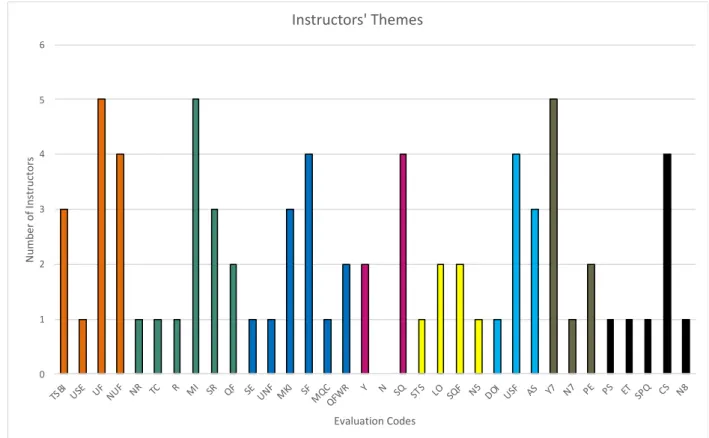
Faculty members also participated and answered questions in an interview. Seven themes were formed and analyzed with the faculty’s responses: the instructor’s experience, reactions, expectations, changes, input benefits, student evaluation, and recommendations. For the instructor’s experience theme, the researchers asked the faculty how they utilized student evaluations. Most instructors reported that they utilize student evaluations to improve their course (i.e., teaching, syllabi, books, and curriculum) and to use useful and not useful feedback. For reactions theme, some faculty react differently to student feedback by having no response. They also considered the student feedback or felt happy or disappointed when s/he received praise or not. Overall, most faculty indicated that they use student feedback to make improvements in their courses. They also shared that they value qualitative feedback or written responses to determine what has worked and hasn’t worked throughout their course experience. For the expectations theme, most faculty seemed to value positive and negative feedback from students so they could adjust in their teachings and courses. Faculty suggested more evaluations throughout the course and utilizing qualitative feedback or written responses to implement and improve the instructor’s teaching.
Researchers also asked the faculty if the questions of the student evaluation form should be changed and what changes to make in regard to the theme of change. Most faculty suggested specific, more straightforward questions to add to the evaluation form, such as questions about teaching techniques and strategies. Other faculty suggested inputting questions about their learning outcomes or specifically asking in the qualitative way how the course was useful. For input benefits theme, the researchers asked the faculty members how they benefit from student input. Most faculty members indicated that they benefit from student input through helpful feedback to improve their teaching and courses. They also noted that they adjust for the students because they are the consumers. For student evaluation theme, most instructors believe that students should be the ones to evaluate the instructors. The instructors also gave recommendations on how they could improve student evaluations by preparing students to distinguish useful feedback. They also suggested evaluating twice a term, adding more specific questions, and more.
Figure 3. Each Question Was Coded and Split into Various Themes according to the Instructor’s Response to Each Question. Appendix B Displays a Table of the Interpretations of Codes and
Themes 4. Discussion
The purpose of this study was to explore how instructors use student evaluations and student’s perceptions of how instructors utilize student feedback. While most studies have included only student input on course evaluations, the researchers included both students’ and instructors’ feedback on course evaluations. This study discovered that most instructors’ value useful feedback (e.g., likes or dislikes with assignments, what worked and did not work throughout the course) from students. By doing so, instructors could improve their instruction. They also value qualitative feedback, or written responses, by students to further grasp the reasons for the improvement in the instructor’s teaching and overall course. Most instructors suggested improvements to the course evaluation by implementing more specific, more straightforward questions. Instructors recommended that these questions could relate to the instructor’s teaching style, learning outcomes, and elaborating further suggestions in the qualitative feedback section. According to the students within this study, they believe that instructors’ willingness to use course feedback and whether they benefit from student input on course feedback depends on the instructor. They think that some instructors will improve their courses while others will not improve their instruction when given feedback. Due to these beliefs, most students feel that they should be the ones to evaluate instructors, including the instructor’s peers and supervisors. In regard to the adding or changing of
0 1 2 3 4 5 6 TSBI USE UF NUF NR TC R MI SR QF SE UNF MKI SFMQC QFWR Y N SQ STS LO SQF N5 DOI USF AS Y7 N7 PE PS ET SPQ CS N8 Nu mb er of In st ructo rs Evaluation Codes Instructors' Themes
questions in the course evaluation, some students indicated that implementation of more specific questions. Their recommendations were applying issues relating to the interaction and relationship of the instructor, preparation, accessibility, teaching style, values, and personality of the instructor. Students valued organizational skills (i.e., excitement, clearly speaking, preparedness, and proper skills) in their instructor’s teaching (Marks, 2000). Cohen (2005) also found that the participants considered the instructor’s explicit instruction of the material and teaching style to be necessary in course evaluation. The quality of education and willingness to help are essential factors to impact course evaluations. Therefore, these factors are seemingly crucial to various students in evaluating whether instructors have fulfilled specific teaching and course factors (Barth, 2008).
However, both instructors and students seem to have different perspectives on valuable feedback due to the gap or inconsistency between instructors’ and students’ representation of valued feedback. Students find evaluating the interaction and relationship of instructor, preparation, accessibility, values, and personality of the instructor to be necessary. They may want instructors to adhere to the small classroom setting to have a positive, close experience with their instructors. Instructors think that more questions relating to the instructor’s learning outcomes and further elaborating on suggestions in the qualitative feedback section can be more helpful in the student evaluation. Instructors may want to understand further how a student is learning and the effectiveness of the course. However, both students and instructors suggest inputting the instructor’s teaching style into the evaluation to potentially gain insight into the student’s likes and dislikes of the course. These findings are relevant because of previous experiences of instructors and students and their likes and dislikes of previous classes.
Some instructors also suggest a difference in feedback between undergraduate and graduate students. They believe that graduate students give better and more feedback compared to undergraduate students. This belief brings to the notion that instructors rely on feedback from graduate students but not too heavy on undergraduate feedback. Also, undergraduate and graduate students may have different experiences because graduate students have more involvement as they have been in school longer compared to undergraduate students. Therefore, it could be beneficial to explore mending these gaps of inconsistencies with instructors and students to better feedback and the course evaluation process. In this study, there were some implications with the different values of student feedback and curriculum improvement. An implication was students poorly rating their instructors due to the different values and views of the feedback. As noted by Marks (2000) and Barth (2008), instructors who give more challenging work tends to have negative ratings or effects because students feel that they will then have poor grades. With this interpretation, students could impact their instructors’ evaluations, and instructors may alter their teaching to fit the students’ standards to obtain better ratings. Also, with the differences in valued feedback and curriculum improvement, teaching and course improvement may not be changed by instructors, and students may not learn or obtain learning objectives. Therefore, these implications can severely affect students, instructors, and institutions of higher education.
5. Conclusion
This study explored how instructors use student evaluations and the student’s perceptions of how instructors use course evaluations. An attempt was made to explore and connect both students’ and instructors’ input on course feedback to improve teaching and the development of courses.
Instructors were asked to recommend ways to improve student input on course evaluations to gain insight and to further research. Recommendations included implementing qualitative feedback to each of the standardized questions. Another proposal included instructors preparing students to elaborate on improvements in the instructor’s teaching style and curriculum. Also, they suggested the option to evaluate twice a term to gain more data and feedback from students. An instructor even indicated for the evaluations to emulate Amazon ratings where they rate the instructor/course one out of five stars. Students could write a simple blurb about their likes and dislikes about the instructor/course. Another instructor suggested a type of grievance or governance group that could meet and voice their opinions to the dean. The instructor also suggested having students create questions to be implemented in the student evaluations. These recommendations could be implemented in further research to improve course evaluations, student feedback, and future courses/curriculums.
6. Limitations and Future Research
Though the internal validity of the study appears to be strong due to the use of the triangulation method, it had a limited sample size of both students and instructors. Also, the study has other limitations, such as potential investigator bias and small class sizes. Due to the method of triangulation, the researchers had to code and theme the results so specific results could have been interpreted differently due to investigator bias. Small class sizes were another limiting factor because attending a small class-oriented college could affect the student’s input compared to a student attending a larger school.
Further research is needed to better and further this study’s findings. This could include a larger sample size of students and instructors, including both undergraduate and graduate students. Future research could also compare the feedback and expectations from both small and large student populations. The location of the university is another factor that could be further researched, such as urban versus suburb located institutions. These future studies could help further understand the different perceptions of students and instructors, the use of student evaluations in various universities/institutions, and other factors that influence how instructors use student evaluations.
References
Algozzine, B., Beattie, J., Bray, M., Flowers, C., Gretes, J., Howley, L., … Spooner, F. (2004). Student Evaluation of College Teaching. CollegeTeaching, 52(4), 134-141. https://doi.org/10.3200/CTCH.52.4.134-141
Barth, M. M. (2008). Deciphering Student Evaluations of Teaching: A Factor Analysis Approach.
Journal of Education for Business, 84(1), 40-46S
Chan, C. K. Y., Luk, L. Y. Y., & Zeng, M. (2014). Teachers’ perceptions of student evaluations of teaching. Educational Research and Evaluation, 20(4), 275-289. https://doi.org/10.1080/13803611.2014.932698
Cohen, E. H. (2005). Student evaluations of course and teacher: Factor analysis and SSA approaches.
Assessment & Evaluation in Higher Education, 30(2), 123-136.
https://doi.org/10.1080/0260293042000264235
Emery, C. R., Kramer, T. R., & Tian, R. G. (2003). Return to academic standards: A critique of student evaluations of teaching effectiveness. Quality Assurance in Education: An International
Perspective, 11(1), 37-46. https://doi.org/10.1108/09684880310462074
Haladyna, T., & Amrein-Beardsley, A. (2009). Validation of a research-based student survey of instruction in a college of education. Educational Assessment, Evaluation & Accountability, 21(3), 255-276. https://doi.org/10.1007/s11092-008-9065-8
Macfadyen, L. P., Dawson, S., Prest, S., & Gašević, D. (2016). Whose feedback? A multilevel analysis of student completion of end-of-term teaching evaluations. Assessment & Evaluation in Higher
Education, 41(6), 821-839. https://doi.org/10.1080/02602938.2015.1044421
Marks, R. B. (2000). Determinants of Student Evaluations of Global Measures of Instructor and Course Value. Journal of Marketing Education, 22(2), 108. https://doi.org/10.1177/0273475300222005 Patton, M. Q. (2002). Qualitative research and evaluation methods. Thousand Oaks, Calif: Sage
Publications.
Richardson, J. T. E. (2005). Instruments for obtaining student feedback: A review of the literature.
Assessment & Evaluation in Higher Education, 30(4), 387-415.
https://doi.org/10.1080/02602930500099193
Saroyan, A., & Amundsen, C. (2001). Evaluating University Teaching: Time to take stock. Assessment
& Evaluation in Higher Education, 26(4), 341-353. https://doi.org/10.1080/02602930120063493
Zhao, J., & Gallant, D. J. (2012). Student Evaluation of Instruction in Higher Education: Exploring Issues of Validity and Reliability. Assessment & Evaluation in Higher Education, 37(2), 227-235. https://doi.org/10.1080/02602938.2010.523819
Appendixes
Appendix A: Code Interpretation of Students’ Themes
Student’s Themes Codes Interpretation
Overall experience P Instructor’s performance
WT Worth Taking
IC To make improvements of the course
CE Course experience
SE Student experience
Varied instructors DOICF Depends on instructor for instructor course feedback
MSQ More specific questions
NCQ No change in questions
DOISI Depends on instructor for student input on course feedback
SEI Students evaluate instructors
P-S Peers and Supervisors evaluate instructors Student evaluation PCEI Preparation of the instructor course evaluation
improvements
ISICEI Interaction with students and instructor course evaluation improvements
TSCEI Teaching style/values course evaluation improvements
PCEI Personality course evaluation improvements ACEI Accessibility course evaluation improvements
MQCEI More questions course evaluation improvements
NI No improvement
PE Paper evaluations
IE Indifferent evaluations
ACE After class is over evaluations
AE Anonymous evaluations
Appendix B: Code Interpretation of Instructors’ Themes
Instructor’s Theme Code Interpretation
Instructor’s Experience TSBI Teaching/syllabi/book/curriculum improvements
USE Understanding student’s experiences
UF Useful feedback (what worked)
NUF Not useful feedback (what didn’t worked)
Reactions NR No reaction
TC Takes into consideration (grain of salt) R Reacted (happy or disappointed)
MI Making improvements
SR Looks at specific responses (more critical/negative)
QF Qualitative feedback/written responses
Expectations SE Student expectations
UNF Unhelpful feedback
MKI Making improvements
SF Student feedback (Positive/Negative) MQC More evaluation throughout the course
QFWR Qualitative feedback/written responses
N No
SQ Specific/simpler questions (teaching techniques/strategies) STS Specific to teaching style
LO Understanding the learning outcomes
SQF Specific in the qualitative form (was it useful?)
N5 No
Student Input Benefits DOI Depends on the instructor
USF Useful feedback to improve teaching/courses
AS Adjustments for the students
Student Evaluation Y7 Yes
N7 No
PR Peer evaluations
Recommendations PS Prepping students
ET Evaluating twice a term
SPQ Specific questions
CS Creative suggestions (Amazon ratings/qualitative data with quantitative data)