1
STUDENT PROGRESSION – A MULTIFACETED PHENOMENON Richard Breakwell
Abstract
This study explored the progression of a cohort of first-year student nurses. A Model of Student Progression was designed based on a review of the student nurse attrition literature, Erikson’s and Chickering’s identity development theories and Tinto’s student integration model. The Model acted as a framework for the pragmatic, mixed-methods study’s design. Data (questionnaire, interview and exam board data) was analysed using descriptive statistics and thematic ‘interpretive description’. Findings indicated that some background and demographic factors had a significant link with end-of-year grades (ethnicity, religion, academic self-perception, and entry qualifications). Interviews highlighted themes affecting progress (student preparation for study, course expectations, support, motivation, integration and career choice). It was found that the Model provided a suitable framework for the study and that student progression is multifaceted and often belies a complex interaction of a range of influential factors.
Introduction
Nursing in the UK is facing a crisis. The supply of newly qualified nurses is not keeping up with workforce requirements (Buchan and Seccombe 2012). As nurses are leaving the profession they are not being replaced in sufficient numbers, in part because the next generation, undergraduate student nurses, are not completing programmes of study, or taking too long to do so. Consequently, the commissioners of student places in higher education, potential future employers and the universities who educate student nurses are increasingly turning their focus to identify what affects student nurse progression and what might be done to improve it.
As a nurse educator of several years’ experience, I am interested in what affects the progression of student nurses. In this paper I outline a cohort study that explored the progression of a group of first-year student nurses, in which I set out to answer two questions: (1) What factors affect the developmental progression of student nurses during the first year of their studies? and (2) Are these factors interrelated and mutually influential with regards to student progression? I will start by providing a brief summary of a Model of Student Progression (MoSP) I designed that acted as a framework for the study’s design. My main purpose in this paper, however, will be to present some of the findings of my study, discuss how they are related and, also, to begin to consider, somewhat tentatively, their potential implications for current educational practice.
A New Model of Student Progression
Student nurse progression has often been viewed through the narrow lens of student nurse attrition (Braithwaite, Elzubeir and Stark 1994; Coakley 1997; Urwin et al 2010; Eick, Williamson and Heath 2012). Indeed, student progression has often been regarded as synonymous with course continuation, but there is a broader view of student progression (Wray et al. 2012). It is the broader view of progression that was
2
adopted in my study, where progression is considered to extend beyond institutional and workforce goals of course completion and continuation; it considers the student’s own aspirations that may be go beyond grades and course progression points.
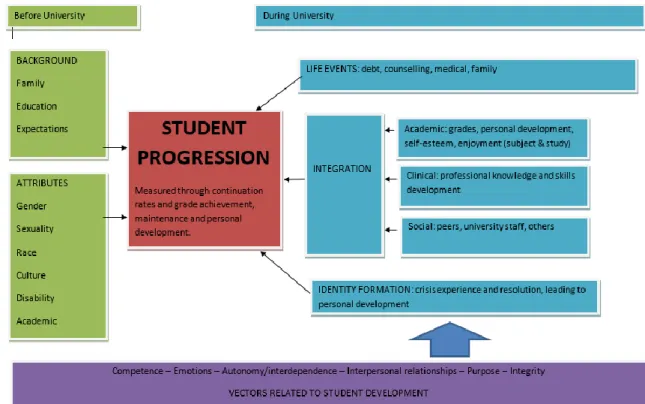
Thinking about student progression in this broader way, led me go beyond the attrition literature and to consider the wider psychosocial influences on student development and course progression. Two main theories seemed to appear in the literature: Chickering and Reisser’s (1993) theory of student identity development (informed by the earlier work of Erikson in 1968) and Tinto’s (1993) theory of student integration. The combination of my literature review that explored the factors affecting student nurse attrition and the work of the former theorists led to the design of the Model of Student Progression (MoSP) (Table 1).
Table 1: A new Model of Student Progression (MoSP)
The MoSP provided a framework with which to explore the student journey from pre-course admission through initial integration and the longer term pre-course experience. The Study’s Research Design – An Overview
A pragmatic, mixed-method design was chosen for the cohort study, with a range of data collection and analysis methods. Data was collected during the first year of the Bachelor of Nursing course using an initial questionnaire of student background information (59 student volunteers), an end-of-year interview for a purposively selected sample of 13 students, leaver questionnaires (two students) and end-of-year examination board data – components of the MoSP informed the questions in the questionnaires and interview schedules. Data was analysed using descriptive
3
statistics for quantitative data, thematic analysis and ‘interpretive description’ (Thorne 2008) for qualitative data to identify broad themes.
Table 2 provides an example of some of the initial entry data for five students.
Table 2: Examples of five students’ entry characteristics and end-of-year outcomes
Student number
3 28 42 95 106
Age 23 30 19 26 18
Gender Female Female Male Male Female
Country / race UK white British UK white British Somalia Black African UK white British UK white
Religion None Christian Muslim None Christian
Disability None None Non None None
Academic skill
Acceptable Acceptable Acceptable Good Good
Parents’ university?
Both Neither Neither One Neither
School State State State State / Private State
Entry
qualification
A levels Access course BTEC course
Degree A levels
Merit of
grades
ABB Merit Merit BBBC A*AD
No. GCSEs English maths 8 A A* 0 D D 6 C C 11 B B 10 AB A* University age (1) 10 14 11 Early teens 17 Nursing age (2) 20 7 16 24 17 Year 1 grade average 75% 56% 39% 74% Leaver Year 1 mark range 50-88 37-60 20-61 54-89 Leaver
Key: (1) Age first thought about going to university; (2) Age thought about studying nursing Findings – Before University Factors
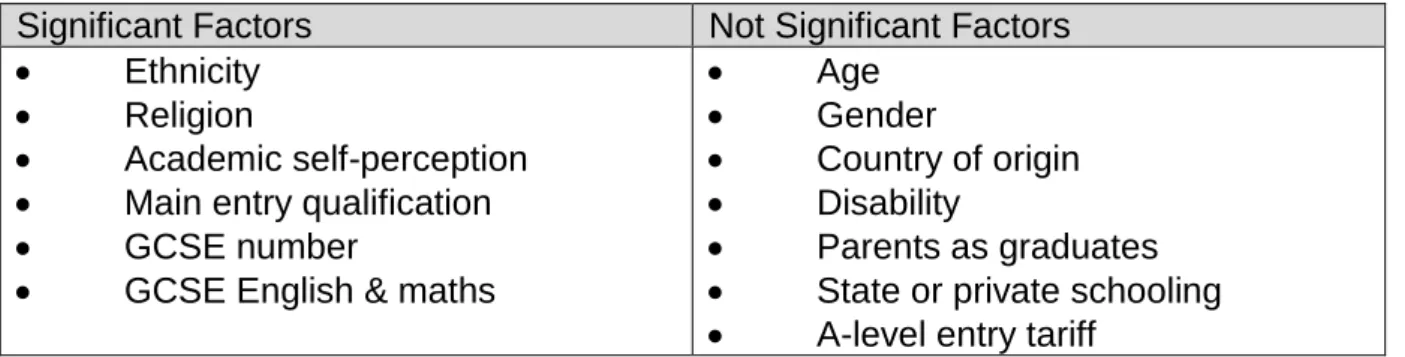
Initial questionnaire data identified factors that were statistically significant, or not, when compared with students’ first year grades (Table 3).
Table 3: Factors found to be significantly linked, or not, with end-of-year students’ grades
Significant Factors Not Significant Factors
Ethnicity
Religion
Academic self-perception
Main entry qualification
GCSE number
GCSE English & maths
Age
Gender
Country of origin
Disability
Parents as graduates
State or private schooling
4
Students’ questionnaire qualitative free-text comments indicated that students chose to study nursing for a number of reasons, with many students citing that they wanted to help people, because of the anticipated job satisfaction and as a second-choice option.
Qualitative comments also indicated that the students’ decision to study at the chosen university was frequently based on its reputation, campus and its location. Findings – During University Factors
Face-to-face interviews with individual students indicated that several of the components of the MoSP were often themes important for students.
Competence, especially academic competence, was a major theme mentioned by many students. This was especially important for students who had entered the course via non-traditional routes, e.g., BTEC and Access course. These students often felt unprepared for undergraduate study, expressing that there prior course had not provided them with the requisite skills or that they had received much greater support before. Expectations of support, however, was not limited to non-traditional students, with some A-level students expressing that they had not anticipated the high workload of their nursing course.
Social integration and support were mentioned by most students in some form during interviews and in the leavers’ questionnaires. The extent of a student’s integration related to whether they were a local student or not, if they had family commitments and their prior educational attainment. Students frequently discussed support networks and these varied, with students mentioning family, peers, local friends, and clinical and academic staff; however, no one source support seemed to standout, as it depended on the social and educational situation of the student. Importantly though, overall the underlying message imparted by the students in this cohort was that a significant other or others was necessary for the student to feel supported, motivated and integrated.
Other important themes elicited during interviews and questionnaires related to student identity and their sense of purpose. The student’s motivation to qualify as a nurse and their perception of their abilities as a student and nurse moderated their progression. Students with a strong desire to complete the course seemed more able to cope with some setbacks, whereas those with a less keen drive struggled more so – this was especially so for one leaver who realised she no longer wanted to be a nurse.
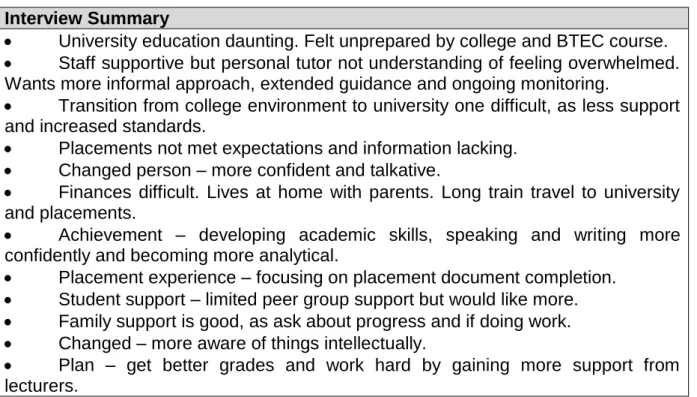
Tables 4 and 5 outline two student interviews, illustrating the difference between a male student entering the course via a non-traditional route and a student a more mature student who had traditional qualifications. The experience of these two students was markedly different, with Student 42 feeling less equipped to study the course and wanting more support, whilst Student 95 coped well with the demands of the course and he felt well-supported.
5
Table 4: Student 42’s interview summary Interview Summary
University education daunting. Felt unprepared by college and BTEC course.
Staff supportive but personal tutor not understanding of feeling overwhelmed. Wants more informal approach, extended guidance and ongoing monitoring.
Transition from college environment to university one difficult, as less support and increased standards.
Placements not met expectations and information lacking.
Changed person – more confident and talkative.
Finances difficult. Lives at home with parents. Long train travel to university and placements.
Achievement – developing academic skills, speaking and writing more confidently and becoming more analytical.
Placement experience – focusing on placement document completion.
Student support – limited peer group support but would like more.
Family support is good, as ask about progress and if doing work.
Changed – more aware of things intellectually.
Plan – get better grades and work hard by gaining more support from lecturers.
Table 5: Student 95’s interview summary Interview Summary
Course – enjoyed the course and found the academic work manageable, as completed a degree before and found the assessments manageable.
Placements – positive experiences, learnt a lot and had good mentors. Changed initial field of practice choice because of experiences and altered expectations.
Socially –worked before so replaced work relationships with new university friendships. Lives at home with parents and has continuing social network.
Finances – using savings from when working. Applied to do part-time work. Lives with parents and they help out and without their help would not do the course.
Achievements – passing the first year, good feedback from placement staff and developed clinical skills (quite confident now).
Academic – disappointed with some grades but pleased with others. Not as confident as anticipated. Quality of feedback varies.
Support – personal tutor (seen three times) and aware of other support systems. Placement mentors, others staff and students provide support, including practice placement managers and clinical link staff. Small number of students provide most support. Family also supportive – mother is a registered nurse.
Discussion
The cohort study enabled the initial research questions to be addressed, highlighting that a number of factors were influential for this group of students and their progress across the first year of their course. However, when all of the findings were pooled, it appeared that progression is often not related to isolated, individual factors, but it is the inter-relationship between factors that is important. Students can experience
6
difficulties during a course in one area but be sustained by another facet of the course. For example, students can struggle academically but feel positive about their clinical experiences, or a group of friends can encourage them when they are feeling low. However, some factors can be dominant, such as a lack of identification with a future career in nursing, although yet again, this can be moderated to some extent and influenced by others and their encouragement for the student to stay or leave. Several, new themes emerged during the course: preparedness, expectations, transition and support. Lack of preparedness for university study was mentioned by many students in this study. This not an uncommon theme in the literature. Andrew et al (2008), for example, found that students were not prepared for the science, theoretical level and financial burden of their course. Furthermore, O’Donnell (2011) found that students had difficulty with independent study and a lack of preparedness by their former course, and that unrealistic expectations was a key reason why students voluntarily withdraw from a course.
Transition was another newly emerging theme, as students either coped or struggled with the new life at university. Wilcox, Winn and Fyvie-Gauld (2005) describe this as transition from the old, pre-university life, to the new life. Some students in this study missed their old life and felt homesick, with others feeling more comfortable with their new roles and ways of living, although this seemed often related to levels of social integration and support.
Support is a theme mentioned by nearly all the students in this study. Tinto (1993) highlighted the importance of social integration, with Rudel (2006) expressing that peer support was crucial for course persistence – this is not surprising as many students have a high expectation of their social life at university (Whittaker 2008). However, several students in this study cited support from family and local, pre-university friends, which may reflect that student nurses experience pre-university social life differently to other students due to the nature of their course.
Recommendations
Students frequently mentioned a lack of preparedness for university study or university life, and this often related to levels of student expectation. Changes to the admissions process could help address lack of preparedness and help manage unrealistic expectations. Pre-course tests (Donaldson, McCallum and Lafferty 2010), requiring pre-course nursing experience (Wilson et al 2011), realistic open-day presentations (Rodgers et al 2013) and greater qualification selectivity (O’Donnell 2011) have been suggested to help manage preparation and expectation, although there are potential resource and equality issues with some of these suggestions. Risk identification and management during the admissions and transitional phase of a course have been recommended to help with student progression. Cameron et al (2011) suggest targeting ‘at risk’ students, McSherry and Marland (1999) more bespoke support systems, and Wray et al (2012) a more personalised approach. Again, however, such approaches as a more active personal tutor system would require greater resources (Watts 2011).
7
Conclusion
This study aimed to research the progression of a cohort of first-year student nurses using a new MoSP. A number of key factors emerged, illustrating that there are pre-course factors that are linked with academic achievement and transitional experiences that affect student progress. These learnings can inform future admissions, recruitment and first-year student support processes. However, it is perhaps time to go beyond factor and broad theme identification and adopt a more individualised research approach to truly understand how students are affected and influenced by their experiences of the first year of their programmes of study.
References
Andrew, S., Salamonson, Y., Weaver, R., Smith, A., O’Reilly, R., and Taylor, C. (2008) Hate the course or hate to go: semester differences in first year nursing attrition. Nurse Education Today, 28: 865-872.
Braithwaite, D.N., Elzubeir, M., and Stark, S. (1994) Project 2000 student wastage: a case study.
Nurse Education Today, 14: 15-21.
Buchan, J. and Seccombe, I (2012) Overstretched. Under-resourced. The UK Nursing Labour Market review 2012. London: Royal College of Nursing.
Cameron, J., Roxburgh, M., Taylor, J., and Lauder, W. (2010) Why students leave in the UK: an integrative review of international research literature. Journal of Clinical Nursing, 20: 1086-1096. Chickering, A.W., and Reisser, L. (1993) Education and Identity. 2nd edn. San Francesco: Jossey-Bass.
Coakley, A.L. (1997) Nurse education: attrition rates in the UK. Nursing Standard,11(48): 45-47. Donaldson, J.H., McCallum, J.J., and Lafferty, P. (2010). Can we predict successful completion of the common foundation at interview? Nurse Education Today, 30: 649-656.
Eick, S.A., Williamson, G.R., Heath. V. (2012) A systematic review of placement-related attrition in nurse education. International Journal of Nursing Studies, 49: 1299-1309
Erikson, E.H. (1968) Identity: Youth and Crisis. London: Faber & Faber.
McSherry, W. and Marland, G.R. (1999) Student discontinuations: is the system failing? Nurse Education Today, 19: 578-585.
O'Donnell, H. (2011) Expectations and voluntary attrition in nursing students. Nurse Education in Practice, 11: 54-63.
Rodgers, S., Stenhouse, R., McCreaddie, M., and Small, P. (2013) Recruitment, selection and retention of nursing and midwifery students in Scottish universities. Nurse Education Today, 33: 1301-1310.
Rudel, R.J. (2006) Non-traditional nursing students: the social influences on retention. Teaching and Learning in Nursing, 1: 47-54.
Thorne, S. (2008) Interpretive description. Walnut Creek: Left Coast Press.
Tinto, V. (1993) Leaving College: Rethinking the Causes and Cures of Student Attrition. 2nd edn. Chicago: The University of Chicago Press.
8
Urwin, S., Stanley, R., Jones, M., Gallagher, A., Wainwright, P., and Perkins, A. (2010) Understanding student nurse attrition: learning from the literature. Nurse Education Today, 30: 202-207.
Watts, T.E. (2011) Supporting undergraduate nursing students through structured personal tutoring: some reflections. Nurse Education Today, 31: 214-218.
Whittaker, R. (2008) Quality Enhancement Themes: The First Year Experience.Mansfield: Quality Assurance for Higher Education. Online at: http://www.enhancementthemes.ac.uk /docs/ publications/transition-to-and-during-the-first-year.pdf.
Wilcox, P., Winn, S., and Fyvie-Gauld, M. (2005) ‘It was nothing to do with the university, it was just the people’: the role of social support in the first-year experience of higher education. Studies in Higher Education, 30(6): 707-722.
Wilson, A., Chur-Hansen, A., Marshall, A., and Air, T. (2011) Should nursing-related work experience be a prerequisite for acceptance into a nursing programme? A study of students’ reasons for withdrawing from and undergraduate nursing at an Australian university. Nurse Education Today, 31: 456-460.
Wray, J., Barrett, D., Aspland, J., and Gardiner, E. (2012) Staying the course: factors influencing pre-registration nursing student progression into year 2 – a retrospective cohort study. International Journal of Nursing Studies, 49: 1432-1442.
Biography
Richard Breakwell, a lecturer in nursing at the University of Birmingham, has over 15 years’ experience, in various roles, of supporting nursing students during their studies. His increasing interest in student progression led to his commencing his doctoral studies and aim to research the undergraduate student experience.