SOCIALINIS DARBAS / SOCIAL WORK © Mykolo Romerio universitetas, 2020 © Mykolas Romeris University, 2020
ISSN 2029-2775 (online) http://socialinis-darbas.mruni.eu http://social-work.mruni.eu
SOCIAL WORK 2020, 18(1), p. 38–53.
SCHOOL CONFLICT MANAGEMENT PROGRAM
AS A TOOL TO IMPROVE SCHOOL SOCIAL CLIMATE:
LESSONS FOR LITHUANIA
Assoc. Prof. Dr. Gražina Čiuladienė Institute of Educational Sciences and Social Work
Mykolas Romeris University Ateities str. 20, LT-08303 Vilnius, Lithuania
E-mail: [email protected]
Prof. Marius Boboc Office of Academic Planning
Cleveland State University
2121 Euclid Avenue, Cleveland, Ohio 44115, USA E-mail: [email protected]
Submitted on 13 March 2020 Accepted on 23 April 2020
DOI: 10.13165/SD-20-18-1-03
Abstract
Constructive conflict management in education setting encompasses recognition that con-flicts are part of solutions, and usage of concon-flicts to enhance the quality of school life, teaching and learning. Contrary, by refusing to acknowledge that conflicts are possibility of solutions and by denying their existence schools might contribute to the development of school climate in which both students and teachers feel damaged. The evidence of unskilled conflict resolution processes in Lithuania’s schools has encouraged search of efforts to be taken by administrators and teachers for becoming more skilful in using constructive conflict procedures.
Ohio State (USA) highlighting peculiarities leading to success. The research question is such as: What are the peculiarities of effective CRE curriculum and its’ implementation?
There is a considerable evidence that CRE increases students‘ self-control, communica-tion skills, healthy interpersonal/ inner-group relacommunica-tions. However, conflict resolucommunica-tion edu-cation is to be addressed not only students, but as well as administrators, teachers, and parents. CRE training and practice are critical to increasing conflict management skills, and implementing a CRE program is an extremely complex process that demands considerable energy and time from adults involved. The Ohio model as an illustration of a good practice might be helpful in defining CRE, its components and issues of implementation, discussing the feasibility (infrastructure, needed support) in a culturally different context.
Keywords: conflict management, education, teacher-student relationship.
Introduction
The school climate seems to be a powerful factor in academic achievement. It is being emphasized in the pedagogical literature that for the success of education and positive school climate harmonious relationship between students and teachers based on mutual respect, understanding, kindness and cooperation are essential. Thus school administra-tors and teachers aim to create a safe, caring, respectful, and productive learning
environ-ment. However, collaboration goes hand-in-hand with conflict. The more group members
care about achieving the group‘s goals, and the more they care about each other, the more conflicts they suppose to experience. Moreover, development of children social, emotion-al, intellectuemotion-al, and moral skills occurs by working through disagreements (Sandy, 2001, p. 244). Thus, in order to achieve more effective interactions in educational setting, there is a need to pay more attention to conflict management. Conflict management is consid-ered to be a particularly helpful classroom management strategy to teachers as it is based on understanding of the student’s point of view and willing to sympathize with students expressing anxiety or distress in school situations (Jones, Ling, and Charlton, 1999). As a result, well-managed conflicts offer an opportunity to see a problem more clearly, acquire new ideas, and motivate change for the better; they add creativity, fun, and higher-level reasoning (School conflict management, 2002, p. 196-198).
When conflicts are managed destructively, they tend to result in frustration, anger, and hostility. Fields (1996, p. 329) cautions that not adequately resolved conflicts manifest themselves in a specific type of resistance (a refusal to cooperate; support without sub-stance; projected threat; deferring action; reducing the opponent’s power; redefining the relationship; and content manipulation).
(moderate increasing); 4) and ap. 4 percent has a high initial level of conflict that de-creases during the course of the school years (high decreasing). Other research indicates that on average one in seven students engages in moderate-high level conflict interactions with teacher (Spilt, Hughes, Wu, and Kwok, 2012). Teacher–student and student-student relationships dominated by destructive conflicts are negatively associated with student behavioral and affective engagement in learning.
The survey of Lithuania’s students evidently confirms the fact of conflicts presence in schools. For example, only 14.4 % of surveyed students strongly agreed assessing the statement „Over the past two months, I have not mocked the classmates“, and even less of students (only 6 %) agreed with statement „Over the past two months, my classmates have not mocked me“ (Annual Report, 2018). The results of rare qualitative and quanta-tive studies of conflict interaction (ex., Ciuladiene and Raudeliūnaite, 2016; Ciuladiene and Kairiene, 2017) have revealed insufficient competency to manage conflicts of teachers and students in Lithuania‘s schools. It is indicated that school staff tends to implement forcing strategy, resulting in adult-imposed solution. Similar, the Annual report (2018) reveals that there were only 8 % of students who strongly agreed that their opinion had been heard in the school; and one-third of students strongly agreed that collaboration and helpfulness were being encouraged in their schools. It seems that teachers attempt to over-power students insisting that their proposal to be implemented without any consideration of reservations. However, Jones, Ling and Charlton (1999, p. 64) claim that students are unlikely to reflect upon the situational appropriateness and acceptability of different types of behaviour when the teacher, acting as ‚expert‘, dictates rules and punishes infringe-ments of them. By adopting the role of expert teachers increase the child’s dependence upon adult help, reinforce external locus of control beliefs.
The evidence of unskilled conflict resolution in Lithuania’s schools encourage to look for efforts to be taken by administrators, teachers and students for becoming more skilful in using constructive conflict procedures. The idea of school-wide conflict resolution edu-cation is discussed in the article. Programs addressing conflict resolution are widely used in U.S. schools as they are viewed as effective tools to decrease violence or/and disruptive behaviors in school settings. There is a great variation in training organizations, in pro-grams and qualifications of people delivering these propro-grams. The selection of propro-grams is guided by the goals of the school, the resources available, the access to quality trainers and curricula. The aim of the article is to review of the practice of implementation of CRE programs in Ohio State of the United States of America. There is main research questions: What are the peculiarities of effective CRE curricula and implementation?
1. The impact of Conflict Resolution Education (CRE) programs
at school
The term „Conflict resolution education“(CRE) refers to „a spectrum of processes that utilize communication skills and creative and analytic thinking to prevent, manage, and peacefully resolve conflict“ (Evaluation Guide 2002, 1). Conflict resolution education programs are that incorporate effective, nonviolent problem-solving concepts into school wide policies and classroom curricula, teach skills that can be used to implement the posi-tive disciplinary procedures, and conduct conflict management skill building (Batton, 2002, p. 479). CRE programs aim to help individuals adopt effective conflict resolution techniques and reduce ineffective responses. They encourage seeing conflict as a natural part of life, to recognize the opportunity for growth and positive change, to take the time to cool down, to attack the problem and not the person, to articulate a point of view and listen to that of the other, and to think of creative win-win solutions. CRE related
programs‘ goalsare to encourage constructive resolution of interpersonal conflicts; to
fa-cilitate individual social or emotional growth and well-being, critical thinking, and school climate (Garrard & Lipsey, 2017).
On a school-level, CRE programs serve the institution in achieving a variety of actual goals: to create a safe learning environment; to create a constructive learning environ-ment; to improve classroom management, to create a constructive conflict community. All the goals are related to peaceful social interaction (Evaluation Guide, 2002, p.3). The research has been demonstrating the positive effects of CRE programs both for students and teachers. For example, Gerrard and Lipsey (2017) have conducted a meta-analysis of thirty-six studies to assess the overall effectiveness of CRE programs for reducing anti-social behaviours. The meta-analysis represented 4,971 children and adolescents in U.S. elementary, middle, and high schools and a diverse range of CRE programs and evalua-tive strategies. The CRE programs typically provided one to two hours of instruction per week over a period of one to four months for an average total of twelve hours (median ten, range one to forty-five hours). Researchers have concluded that CRE programs do reduce antisocial behaviours in schools. Noteworthy, the magnitude of the effect was relatively small for children aged nine and younger, conversely, larger effects were found for older students. However researchers also have emphasized that plausible tools to support im-plementation fidelity include a clearly articulates program manual, consistent training of service providers, and systematic monitoring of the transactions that take place between the CRE service providers and recipients.
an underlying disorder requiring another level of intervention (Lane-Garon, Yergat, and Kralowec, 2012). Forthun and McCombie (2011) evaluating the impact of crisis interven-tion training and implementainterven-tion have found the impact on the cognitive, emointerven-tional and behavioural responses of teachers to student misbehaviour. Training had its impact on re-ducing the endorsement of family environment causes – teacher, school and child factors were more often endorsed as a causal factor for the student‘s misbehaviour. Teachers who attribute the causes of a student‘s behaviours to characteristics inside their control are less likely to respond with frustration. Furthermore, trained teachers reported that they were much less likely to respond to the student’s misbehaviour with anxiety or stress, or with feeling angry or indifferent about the child. In addition, the trained educators were much less likely to refer students outside of the classroom (only 20% of the time compared with 40% of the time for the comparison group). As a result of training management strategies were challenged, for example, sending students to the principal‘s office was substituted with talking to the student; traditional detention has been replaced with other conse-quences, fewer „write-ups“ and more flexibility in managing disruptive behaviour. The researchers also have found that both transformation in the teacher-student relationship and transformation in student behaviour had occurred. For example, teacher‘s stopping and listening to the student‘s needs led to more trust from the students; previously disrup-tive students became more able to control their temper, be more respectful toward others and accept responsibility.
The research has indicated that CRE also increases positive attitudes toward school and academic achievement (Tricia and Kmitta, 2002). Developing conflict resolution skills not only empowers students to get along better with others but also gives them the tools they need to reach their full potential in mastering the required subject materials (Sandy, 2001, 244).
Schools were perceived to be safer as a result of the implementation of conflict man-agement programs. There is a piece of considerable evidence that CRE increases students‘ self-control, communication skills, healthy interpersonal/ inner-group relations (Tricia and Kmitta, 2002; Garrard and Lipsey, 2007).
It is important to mention that described in the article The School Conflict
Manage-ment program is one of plenty of available specific CRE programs aiming to prevent
un-necessary conflicts and achieve mutual agreement upon solutions. For example, The
Me-diation program aims to train a subgroup (cadre) of students in CRE specifically to assist
other students to resolve disputes using a prescribed process. Also, the Program for Young
Negotiators (PYN), The Peace Education Foundation (PEF), Teens, Crime, and Communi-ty (TCC) program are examples of CRE programs referring to positive youth development
by an enhancement of their skills and strengths. However, The School Conflict
Manage-ment program of the core of the research.
More recently, Social and Emotional Learning programs (SEL) have been used in
toward others; establishing and maintaining positive relationships and making respon-sible decisions (Barnes 2019, p. 600).
2. Research Methodology
The study analyzing The School Conflict Management Program implemented in the Ohio State was done during the short term research visit at Cleveland State University of the first author under the supervision of the second author. The case study is based on CRE instructional material analyses (Resource Guide, Administrator Guide, Evaluation Guide), research review, field visits, meetings with university faculty and people involved in CRE (for example, Jennifer Batton, the former director of education programs for the Ohio Commission on Dispute Resolution and Conflict Management). The main research method in order to answer the research question was the review of resource materials.
The choice of the Ohio Experience in implementing CRE model is reasoned by several arguments. First, the efforts introducing CRE in the schools in order to improve school social climate has their thirties years long history in Ohio where in the early 1990s the Ohio Commission on Dispute Resolution and Conflict Management together with the Ohio Department of Education exerted to create a state wide model based on perception of conflict resolution as a fundamental component of the state‘s multifaceted approach to creating safe and conducive to teaching and learning school environments (Batton, 2002).
Two state agenciesthe Ohio Department of Education (ODE) and the Ohio
Commis-sion on Dispute Resolution and Conflict Management (commisCommis-sion)jointed a
partner-ship (1994) aiming to assist schools in institutionalizing the skills and concepts of conflict management. Each school year the partnering agencies awarded competitive grants to Ohio‘s public schools to design, implement, and evaluate conflict resolution programs. One full-time commission staff person and one full-time ODE staff person administered all school-based conflict resolution efforts. In addition to these two full-time positions, general revenue funds supported Ohio‘s annual school conflict management grant pro-gram ($4,000 per school), training for school personnel, onsite consultation and technical assistance, resource materials, and independent evaluation projects.
Second, there are clear and well developed procedures in implementing state wide
CRE program. CRE program schools received two days long mandatory training for a
team of as many as eight staff of people. Teams included at least one administrator, three classroom teachers, and one other person, whether a curriculum advisor, a school psy-chologist, a school nurse, a school resource officer, a Safe and Drug-Free School coordina-tor, or a community volunteer. The training was focused on curriculum integration and
action planning. Moreover, selected school received eight hours of onsite consultation and
Third, there a rich training material has been created in order to effectively
imple-ment state wide CRE program in Ohio State. Resource Materials included three volumes
and video. Guides for the educators titled Resource Guide for Grades 7-12 involved
hun-dreds of age-appropriate lessons‘ plans organized by subject and grade level. Guides for
administrators or program coordinators covered such structural change topics as disci-plinary procedures, mission statements, conflict management as a classroom
manage-ment tool, parent information, bullying prevention, and so forth. Evaluation Guide titled
Evaluating Your Conflict Resolution Education Program: a Guide for Educators and Evalu-ators includes two hundred pages covering the steps of assessing and evaluation school conflict management programs. The volume consists of worksheets, questionnaires, and interview questions evaluation materials to be used by a school to evaluate program
ef-fectiveness and assess program impact at the building level. Videos for staff on seven
top-ics (1) understanding conflict, (2) understanding how emotions influence conflict, (3) improving communication skills, (4) reaching resolution, (5) conflict resolution as a class-room management tool, (6) conflict resolution and the link to academics, and (7) creating a comprehensive school conflict resolution program were also created. The video pre-sentation aimed both to assist with trainer consistency, and also to help the schools train additional staff after the grant period has ended.
3. The Peculiarities of School Conflict Management Program
Implemented in Ohio
The comprehensive approach. Due to a definition of conflict resolution as a philoso-phy (Batton, 2002, p. 480) the Ohio‘s model to institutionalize conflict resolution
educa-tion was based on a comprehensive approach. The assumption is that CRE must be seen
as an integral part of the educational process meaning that academic skills and social-emotional development are not separable. Controversially to curriculum integration ap-proach (embedded curriculum) process curriculum apap-proach is characterized by devot-ing specific time to teachdevot-ing the foundation abilities, principles, and one or more of the problem-solving processes of conflict resolution as a separate course, distinct curriculum, or daily lesson plan (Administrator Guide 2002, 334). However, the curriculum integra-tion approach was recommended due to the belief that acting in a comprehensive manner is essential in order to bring positive change.
A comprehensive approach to conflict resolution incorporated four levels of inter-vention: school culture, pedagogy, curricula, and student conduct. To positively affect
school culture, a comprehensive school conflict resolution program included a number of activities: parent involvement (training, volunteerism); collaborative decision making to address specific school needs; working together to set common goals and objectives / de-veloping community partnership; collaborative labour and management problem solving and decision making; establishing a school wide dispute resolution system to address con-flict arising between staff, administrators, parents, students, and teachers.
Comprehen-sive strategies related to pedagogy included cooperative learning; approaches to critical
instructional approaches; problem-based learning; positive discipline; social and
emo-tional learning strategies; classroom management techniques. The curricular intervention
involved the integration of conflict resolution across all subjects and includes multicul-tural education, integration into extracurricular activities, and other related programs
such as violence prevention, substance abuse, and character education. Student conduct
included implementing youth empowerment programs such as student government, peer mediation, or a student conduct plan using the premises of conflict management (Batton 2002, p.5-6).
Everyone participates. The comprehensive approach determines all community mem-bers to be taught. Otherwise, the child’s policy becomes, “This is what happens in school, and this is what happens at home and in the community” (Sandy 2001, p. 240). Adults (administrators, teachers, parents) are supposed to model effective conflict management skills. When adults have little knowledge of the principles and the processes of conflict resolution, a conflict resolution program is not likely to be sustained. The commitment and support of the administration, teachers, and parents appear to be universal success factors for conflict resolution education programs. Administrators provide leadership and support for programs in a variety of ways: use staff meetings and parent meetings to discuss programs and their benefits in relation to student/ adult outcomes; lead staff meetings and problem-solving sessions using conflict resolution processes; recognize pro-gram success during assemblies, school wide announcement, parent-teacher association meetings, school board meetings, and on other occasions, makes use of effective conflict management and the language of conflict resolution in the school and on the playground; teaches or co-teaches conflict resolution lessons in the classroom.
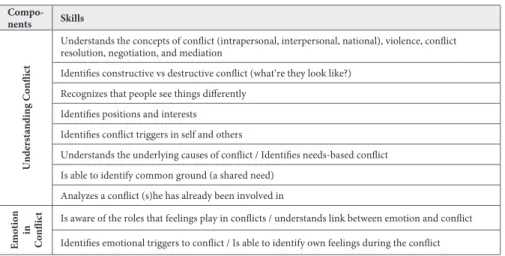
The complex content of the skill. The lessons included in Resource Guides for Grades 7-12 contributed to the nurture of concrete ability upon the conflict management skills framework (table 1).
Table 1. Concept / Skill Infusion Matrix
Compo-nents Skills
Understanding Conflict
Understands the concepts of conflict (intrapersonal, interpersonal, national), violence, conflict resolution, negotiation, and mediation
Identifies constructive vs destructive conflict (what‘re they look like?) Recognizes that people see things differently
Identifies positions and interests Identifies conflict triggers in self and others
Understands the underlying causes of conflict / Identifies needs-based conflict Is able to identify common ground (a shared need)
Analyzes a conflict (s)he has already been involved in
Emotion in Conflict
Compo-nents Skills
Emotion in Conflict
Uses questions to identify feelings (for self and others)
Is aware of feelings of other when a conflict arises / Is able to determine emotions of others by using non-verbal clues
Is aware of different ways to express anger / Expresses feelings in a constructive manner Is able to practice substituting moderate thoughts for angry thoughts as one way of reducing anger Is able to consider and express what lay beneath an instance of personal anger
Communication / Responding to conflict
Recognizes that needs can by satisfies by many appropriate and inappropriate behaviors Distinguishes between passive, aggressive, and assertive behavior
Appreciates possible benefits of different approaches to conflict Is able to define Win-Win, Win-Lose, and Lose-Lose resolution to conflict Personally evaluates how (s)he handles conflict
Matches conflict styles to the situation
Understands that language can influence perceptions of inclusion/ exclusion and affect potential for conflict escalation or de-escalation
Uses „I“ statements or paraphrasing that cool down conflict situations and open the door to resolution.
Is able to listen actively
Is aware of communication blockers and ways to counteract blockers Is able to express ideas, needs, and feelings in a positive way
Is able to help for other seeking for the ways of resolve a conflict (mediation) Facilitates group discussion to consensus
Problem solving
Stays more focused on a problem Is aware of the needs of others in a conflict
Summarizes the points of view of both participants in a conflict situation
Identifies a positive and appropriate brainstorming question that helps work toward resolution Identifies the main concerns of persons involved in a dispute
The lessons in the guide contained information for using collaborative skills in in-teraction with individual students, in working with the entire class, and in working with students whose behaviour has been problematic for them and others.
or literature textbooks are used as case studies to discuss and rehearse the concepts and strategies of constructive conflict resolution (Gerrard and Lipsey, 2017).
The Resource guide contains the material (lessons) that is not only subject-appropri-ate but also age-approprisubject-appropri-ate. Conflict serves different learning purposes according to the level of development (Sandy, 2001, p. 244). During the second and third years, it promotes children’s growing autonomy; between the ages of three and seven, it helps coordinate play and the forming of relationships with other children; in middle childhood, it helps children create and maintain peer friendships; in adolescence, it promotes searches for trustworthy friends (trust), teach to make decisions (autonomy), establish goals in life (initiative), take responsibility for personal ambitions and work quality.
4. Discussion: What lessons might be taken in Lithuania?
The study presents the practice of implementing School conflict management pro-grams at Ohio State (USA). The practice is considered as a good one and a challenging one (Batton, 2002). The case study also inspires some insights to be considered taking in mind the Lithuanian school education system. There are at least two „lessons“ to be taken into consideration.
First. School conflicts are to be managed constructively in order to create safe, or-derly and constructive learning environments. The school setting offers many experiences of managing conflict. However, it is not easy to disclose and resolve conflicts. For the Lithuanian administrators, educators and students becoming comfortable with conflict as an opportunity might be a quite challengeable procedure. It could be related to the tradition of Soviet time pedagogy to suppress conflicts in schools. Also, it could be related
to cultural characteristics. According to uncertainty avoidance dimension Lithuanians
would tend to avoid conflict more frequent, express less inclination to change, and be less tolerant of ambiguity than Americans as Lithuania scores higher in this dimension. The
uncertainty avoidance dimension relates to the level of anxiety in a society when confront-ed with unknown, strange situations. A large degree of uncertainty avoidance leads to a rather strong rule orientation (laws and regulations) and intolerance toward differences (Soeters, 1996, p. 238). In cultures with low uncertainty avoidance, individuals consider social conflict to be natural and inherent to daily life, and they tend to believe that social conflict can be approached constructively. In contrast, individuals in cultures with high uncertainty avoidance, tend to consider conflict as undesirable, feeling compelled to avoid it as much as possible (Hofstede, 2001).
Second. Conflict resolution education is to be addressed not only students, but as well as administrators, teachers, and parents. Ideal, all students, school personnel and parents would receive CRE training (Sandy, 2007). Incorporation of CRE fosters instruc-tional improvement capable of confronting uncomfortable situations openly (Hargreaves
and Elhawary, 2019).
The argument for teachers‘ training is that schools of education in Lithuania do not
coopera-tive, non-hurtful ways. When one does not have conflict management training, one tends to use the techniques, which are often inadequate. Denied, suppressed, or avoided con-flicts become destructive. Destructive concon-flicts can destroy effectiveness and relationships, sabotage work, delay and decrease teaching and learning efforts, and devastate individual commitment to an organization‘s goals (Administrator Guide, 2002, p. 198). Conflict man-agement programs have proven that the learners (both young people and adults) quickly learn to use effective problem-solving concepts and skills if they are allowed to practice the new skills, are encouraged to use their new skills in real-life situations. The finding of Fields (1996) emphases the need of conflict management training during initial teacher education as in his study the training program designed specifically for teachers to employ collabora-tive conflict management skills and strategies was the most beneficial in allowing to see the potential benefits of eliciting cooperation, rather than resorting to the use of power to over-come resistance. Thus, training doesn‘t necessarily lead to rapid changes in teachers such as having a dominant tendency toward collaborative processes in their approach to conflict.
Additionally, adults provide powerful dealing with conflict models for students. When
adults model effective behaviours in conflict situations, they present powerful teaching examples to students. Students‘ success in developing an awareness of the positive po-tential of conflict resolution is a consequence of the attempts exhibited by the adults in the school. The more students experience constructive approaches to conflict, the more likely they will internalize these behaviours (Administrator Guide, 2002, 471). The more these skills are adopted by both youth and adults, the more frequently they will be used as an alternative to fighting and violence. Students need consistent modeling of construc-tive conflict resolution skills by adults to overcome the competing messages which are portrayed by television, music and movies. There is a consistent need for the appropriate ways of responding are recognized and reinforced in schools. Successful CRE requires a shift from authoritarian to a collaborative school system.
Conclusions
School Conflict Management Program developed in Ohio cannot be transferred with-out considering the cultural differences between America and Lithuania, withwith-out modify-ing it to address the context of local school actual need. However, the practice of Ohio where the program has been taught and examined on a state wide basis for several decades communicates the clear messages: Lithuanian school may also benefit from implementing CRE based on comprehensive approach including the learning of administrators, teach-ers, students and parents.
References
Batton, J. (2002). Institutionalizing conflict resolution education: the Ohio model. Conflict Resolution Quarterly, 19 (4), 479– 494.
Barnes, T. N. (2019). Changing the landscape of social emotional learning in urban schools: what are we currently focusing on and where do we go from here? The Urban Review, 51, 599–637.
Blunk, E. M., Russell, E. M., and Armga, C. J. (2017). The role of teachers in peer con-flict: implications for teacher reflections. Teacher Development, 21 (5), 597–608. Ciuladiene, G., Kairiene, B. (2017). The
reso-lution of conflict between teacher and student: students’ narratives. Journal of teacher education for sustainability, 19 (2), 107-120.
Ciuladiene, G., Raudeliūnaitė, R. (2016). Peer mediation as tool to resolve school based conflicts: the opinion of an school staff (case study). EDULEARN16: Conference proceedings : 8th International conference on Education and new learning technolo-gies, p. 8915-8923.
Fields, B. A. (1996). A training programme for support teachers: collaborative consulta-tion and conflict management. Journal of In-Service Education, 22 (3), 325–334, DOI: 10.1080/0305763960220307
Forthun, L. F., and McCombie, J. W. (2011). The efficacy of crisis intervention training for educators: a preliminary study from the United States. Professional Develop-ment in Education, 37 (1), 39–54, DOI: 10.1080/19415257.2010.497005
Garrard, W. M. and Lipsey, M. W. (2007). Conflict resolution education and
anti-social behavior in U.S. schools: a meta-analysis. Conflict Resolution Quarterly, 25 (1), 9–38.
Goleman, D. (2009). Emocinis intelektas [Emo-tional intelligence]. Vilnius: Presvika. Gross, M. A., and Guerrero, L. K. (2000).
Managing conflict appropriately and ef-fectively: an application of the competence model to Rahim’s organizational conflict styles. The International Journal of Conflict Management, 11 (3), 200–226.
Hargreaves, E., and Elhawary, D. (2019). Pro-fessional development through mutually respectful relationship: senior teachers’ learning against the backdrop of hierar-chical relationships. Professional Develop-ment in Education, 45 (1), 46–58, DOI: 10.1080/19415257.2018.1500390
Hofstede, G. (2001). Culture‘s consequences: comparing values, behaviors, institutions, and organizations across nations. Thou-sand Oaks: Sage Publications.
Jones, K., Ling, Q. M., and Charlton, T. (1999). Professional development in response to problem behaviours in primary and special schools in Singapore. Journal of In-service Education, 25 (1), 55–68, DOI: 10.1080/13674589900200065.
Koepke, M. F., and Harkins, D. A. (2008). Con-flict in the classroom: gender differences in the teacher–child relationship. Early Edu-cation and Development, 19 (6), 843–864. Lane-Garon, P., Yergat, J., and Kralowec, Ch.
(2012). Conflict resolution education and positive behavioral support: a climate of safety for all learners. Conflict Resolution Quarterly, 30 (2), 197–217.
social-emotional learning gains: findings from the first large-scale panel survey of students. Journal of Educational and Be-havioral Statistics, 44 (5), 507–542. Mokyklų, vykdančių bendrojo ugdymo
pro-gramas, veiklos kokybė. Metinis pranešimas [Annual Report Quality of the schools pro-viding general education programs.], 2018. Vilnius: Nacionalinė mokyklų vertinimo agentūra.
Sandy, S. V. (2001). Conflict resolution educa-tion in the schools: „Getting There“. Con-flict Resolution Quarterly, 19 (2), 237–250. School conflict management. Administrator
guide. (2002). Columbus: Ohio Depart-ment of Education and Ohio Commission on Dispute Resolution & Conflict Manage-ment.
School conflict management. Evaluation guide. (2002). Columbus: Ohio Department of Education and Ohio Commission on Dis-pute Resolution & Conflict Management. School conflict management resource guide for
grades 7-12. (2002). Columbus: Ohio De-partment of Education and Ohio Com-mission on Dispute Resolution & Conflict Management.
Spilt, J. L., Hughes, J. N., Wu, J-Yu, and Kwok,
O-M. (2012). Dynamics of Teacher-Student Relationships: Stability and Change Across Elementary School and the Influence on Children’s Academic Success. Child De-velopment, 83 (4), 1180-1195. https://doi. org/10.1111/j.1467-8624.2012.01761.x Soeters, J. L. (1996). Culture and conflict: an
application of Hofstede‘s theory to the conflict in the former Yugoslavia. Peace and Conflict: Journal of Peace Psychology, 2 (3), 233–244.
Tricia, J. S. (2007). „Teach Your Children Well“: promising progress in conflict reso-lution and peace education. Conflict Reso-lution Quarterly, 25 (1), 1–8.
Tricia, J. S. and Kmitta, D. 2002. In: School con-flict management: evaluating your concon-flict resolution education program. Columbus: Ohio Department of Education / Ohio Commission on Dispute Resolution & Conflict Management.
Wang, C., Harrison, L., J., McLeod, Sh., Walk-er, S. & Spilt, J. L. (2018) Can teacher–child relationships support human rights to free-dom of opinion and expression, education and participation? International Journal of Speech-Language Pathology, 20,1, 133-141. DOI: 10.1080/17549507.2018.1408855
SCHOOL CONFLICT MANAGEMENT PROGRAM
AS A TOOL TO IMPROVE SCHOOL SOCIAL CLIMATE:
LESSONS FOR LITHUANIA
Assoc. Prof. Dr. Gražina Čiuladienė Mykolas Romeris University, Lithuania
Prof. Marius Boboc Cleveland State University, USA
Summary
School administrators and teachers aim to create a safe, caring, respectful, and pro-ductive learning environment. However, collaboration goes hand-in-hand with conflict. The more group members care about achieving the group‘s goals, and the more they care about each other, the more conflicts they suppose to experience. Moreover, development of children social, emotional, intellectual, and moral skills occurs by working through dis-agreements (Sandy, 2001, p. 244). Thus, in order to achieve more effective interactions in educational setting, there is a need to pay more attention to conflict management. Conflict management is considered to be a particularly helpful classroom management strategy to teachers as it is based on understanding of the student’s point of view and willing to sym-pathize with students expressing anxiety or distress in school situations (Jones, Ling, and Charlton, 1999).
The survey of Lithuania’s students evidently confirms the fact of conflicts presence in schools. The results of rare qualitative and quantative studies of conflict interaction (ex., Ciuladiene and Raudeliūnaite, 2016; Ciuladiene and Kairiene, 2017) have revealed insuf-ficient competency to manage conflicts of teachers and students in Lithuania‘s schools. It is indicated that school staff tends to implement forcing strategy, resulting in adult-imposed solution. The aim of the article is to review of the practice of implementation of CRE pro-grams in Ohio State of the United States of America. There is main research question: What are the peculiarities of effective CRE curricula and implementation? The dissemination of the Ohio CRE model might encourage efforts to implement conflict-management systems in school (or/and universities) in Lithuania. The description of the Ohio CRE model is taken to illustrate efforts needed to establish conflict resolution as a permanent fixture in the educa-tion system.
there a rich training material has been created in order to effectively implement state wide CRE program in Ohio State. The case study is based on CRE instructional material analy-ses (Resource Guide, Administrator Guide, Evaluation Guide), research review, field visits, meetings with university faculty and people involved in CRE (for example, Jennifer Batton, the former director of education programs for the Ohio Commission on Dispute Resolu-tion and Conflict Management). The main research method in order to answer the research question was the review of resource materials.
Conflict resolution education programs are that incorporate effective, nonviolent prob-lem-solving concepts into school wide policies and classroom curricula, teach skills that can be used to implement the positive disciplinary procedures, and conduct conflict manage-ment skill building (Batton, 2002, p. 479). On a school-level, CRE programs serve the in-stitution in achieving a variety of actual goals: to create a safe learning environment; to create a constructive learning environment; to improve classroom management, to create a constructive conflict community. The research has been demonstrating the positive effects of CRE programs both for students and teachers (ex., Gerrard and Lipsey, 2017; Forthun and McCombie, 2011). CRE holds as an underlying principle that students may misbehave for a variety of reasons, including that they are having a bad day, they are not been taught the appropriate skills, or they may have an underlying disorder requiring another level of intervention (Lane-Garon, Yergat, and Kralowec, 2012).
The study presents the practice of implementing School conflict management programs at Ohio State (USA). The practice is considered as a good one and a challenging one (Bat-ton, 2002). The case study also inspires some insights to be considered taking in mind the Lithuanian school education system. There are at least two „lessons“ to be taken into con-sideration. First. School conflicts are to be managed constructively in order to create safe, orderly and constructive learning environments. The school setting offers many experiences of managing conflict. However, it is not easy to disclose and resolve conflicts. For the Lithu-anian administrators, educators and students becoming comfortable with conflict as an op-portunity might be a quite challengeable procedure. Second. Conflict resolution education is to be addressed not only students, but as well as administrators, teachers, and parents. Ideal, all students, school personnel and parents would receive CRE training (Sandy, 2007). Incor-poration of CRE fosters instructional improvement capable of confronting uncomfortable situations openly (Hargreaves and Elhawary, 2019). The argument for teachers‘ training is that schools of education in Lithuania do not provide specific training in conflict manage-ment. As a result, managing conflict is difficult for educators because they have not been taught how to resolve differences in cooperative, non-hurtful ways. When one does not have conflict management training, one tends to use the techniques, which are often inadequate. Denied, suppressed, or avoided conflicts become destructive. Additionally, adults provide powerful dealing with conflict models for students. When adults model effective behaviours in conflict situations, they present powerful teaching examples to students. Students‘ success in developing an awareness of the positive potential of conflict resolution is a consequence of the attempts exhibited by the adults in the school.
to address the context of local school actual need. However, the practice of Ohio where the program has been taught and examined on a state wide basis for several decades communi-cates the clear messages: Lithuanian school may also benefit from implementing CRE based on comprehensive approach including the learning of administrators, teachers, students and parents.
Keywords: conflict management, education, teacher-student relationship.
Gražina Čiuladienė, Doctor of Social Sciences (Education Science 07S), Associate Professor, Mykolas Romeris University, Institute of Educational Science and Social Work. Research areas: conflict resolution and management, intercultural communication.