SYNCHRONIZATION-AVOIDING GRAPH
ALGORITHMS AND RUNTIME ASPECTS
Jesun Sahariar Firoz
Submitted to the faculty of the University Graduate School in partial fulfillment of the requirements
for the degree Doctor of Philosophy
in the School of Informatics, Computing and Engineering Indiana University
Accepted by the Graduate Faculty, Indiana University, in partial fulfillment of the requirements for the degree of Doctor of Philosophy.
Doctoral Committee Andrew Lumsdaine, Ph.D. Funda Ergun, Ph.D. Predrag Radivojac, Ph.D. Judy Qiu, Ph.D. John Feo, Ph.D. October 22, 2018
Copyright 2018 Jesun Sahariar Firoz
This thesis is dedicated to my mom, Rajvi Sultana, whose unwavering support and trust in me has been and always will be the beacon of hope for me.
Acknowledgements
The long journey of graduate studies would have been difficult if I have not met many amazing persons during this time.
First of all, I would like to thank my committee members: Andrew Lumsdaine, Funda Ergun, Predrag Radivojac, Judy Qiu, and John Feo for their time. Their valuable sugges-tions and unique perspectives have helped me to think differently.
Especially I would like to thank my advisor Dr. Andrew Lumsdaine for teaching me how to conduct scientific research by following proper methodologies. He always encourages new ideas. I am also thankful to him for allowing me to pursue my own research interest while providing me with timely feedback and guidance when I needed them the most. Even when I doubted myself, he always calmly shared his life experience to lift up our spirit and provided suggestions that would shed unique light to a situation. Thank you Andrew for giving me the opportunity to grow in such a nurturing environment and for encouraging curiosity.
During my affiliations with CREST (Center for Research in Extreme Scale Technologies) at IU and at PNNL, I was fortunate to collaborate with many outstanding people, who have helped me to grow as a student, as a developer, as a researcher and in general as a human being.
In particular, I would like to thank Marcin Zalewski, without whose guidance and unconditional support, this journey would not have been enjoyable. Our discussions were not only confined to research topics. We argued about the existence of God, history, financial markets, environmental issues, politics ( and the motivation for being a vegetarian among others). But most of all, I learned from him what to look for in a great person and this will motivate me to try to be a good person for the rest of my life. His patience and
dedication for our betterment, both personally and academically, will always remain as an inspiration. I consider him as my mentor in every aspect of my life.
Special thanks goes to Kelsey Shephard, whom I consider as a sister who always watches over us for our well-being and goes above and beyond to support us.
I would like to thank John Feo for giving me the opportunity to spend a year at Pacific Northwest National Lab to participate in one of most interesting projects I have worked on till now. Luke D’Alessandro taught me about many standard coding practices. Martina Barnas taught me about rigorous reporting of experimental results. Ezra Kissel explained many low-level network intricacies. I am grateful to each of them for their help.
I am thankful to my lab-mates for creating an enjoyable environment for learning. Special thanks go to Timur Gilmanov, Udayanga Wickramasinghe, Abhishek Kulkarni, Daniel Kogler, and Thejaka Kanewala for their companionship.
Finally I would like to thank my mom, my aunts, my cousins, and my uncles for cheering for me from across the ocean. Mom, I am only here because of you!
Jesun Sahariar Firoz
SYNCHRONIZATION-AVOIDING GRAPH ALGORITHMS AND RUNTIME ASPECTS
Massively parallel computers provide unprecedented computing power that is only ex-pected to grow. General-purpose Asynchronous Many-Task (AMT) runtimes exposes significant fine-grained parallelism. However, traditional Bulk-Synchronous Parallel (BSP) approach and variants thereof fail to utilize the full potential of AMT runtimes. In such ex-ecution model, parallel overheads may dominate exex-ecution time and hinder performance, especially in distributed memory settings. The synchronization overhead in particular is deeply rooted in the programming practice because it makes algorithms easier to design and implement. However, irregular applications such as graph algorithms can suffer performance bottlenecks due to the straggler effect induced by global and vertex-centric barriers. In the effort to eliminate barriers, we design and study unordered, data-driven graph algorithms, relying on optimistic (speculative) execution. Our design of algorithms allows work to be performed in any order, refining the result as the algorithm progresses. This flexibility in ordering facilitates parallel computation without global or vertex-centric synchronization. To avoid “wasted” work, our approach relies on local work prioritization.
However, performance of such algorithms is marred by two competing trends: on one hand, there is a substantial level of parallelism, which, on the other hand, necessitates runtime support with potentially high overhead and scheduling complexity. Specifically, the global work order obtained by local prioritization is susceptible to the interference from the runtime. As such, we also investigate important runtime aspects that influence the performance of graph algorithms.
In particular, we study the interaction between default runtime scheduling policies and synchronization-avoiding distributed graph algorithms. We propose plug-in scheduling policies in the application-layer for speculative graph algorithms that can provide feedback to the runtime to adjust the network progress frequency and flow of messages to the remote
destinations. These techniques are useful for unordered distributed graph algorithms that necessitate a balanced interleaving of communication and computation to achieve better performance.
Graph algorithms designed in different programming models have vastly different workload characteristics. In the final part of the thesis, we propose adaptivity of the runtime parameters such as message coalescing and flow control to adjust the “pressure points” in the runtime due to variable workload characteristics over the execution of an algorithm. Andrew Lumsdaine, Ph.D. Predrag Radivojac, Ph.D. Funda Ergun, Ph.D. Judy Qiu, Ph.D. John Feo, Ph.D.
Contents
List of Figures xii
List of Acronyms xvii
Chapter 1. Introduction 1
1.1. Techniques For Synchronization-avoiding Graph Algorithms 4 1.2. Context Matters: Distributed Graph Algorithms and Runtime Systems 6 1.3. Runtime Scheduling Policies for Synchronization-avoiding Graph Algorithms 6 1.4. Adaptive Runtime features for Distributed Graph Algorithms 8
1.5. Contributions 9
1.6. Thesis Organization 11
Chapter 2. Background 13
2.1. SSSP Algorithms 14
2.2. Connected Component Algorithms 18
2.3. Graph Coloring 18
2.4. Active Pebbles Support for Asynchronous Graph Execution 22
2.5. Ordering in Graph Algorithms 24
Chapter 3. Synchronization-Avoiding Graph Algorithms 26
3.1. Classification of Algorithms 26
3.2. Execution-time Ordering By Priority 27
3.3. Algorithms 28
3.4. Algorithmic Requirements 37
3.5. Implementation on AM++ Runtime 38
3.6. Experimental Results 42
3.7. Related work 69
3.8. Conclusion 75
Chapter 4. Context Matters: Distributed Graph Algorithms and Runtime Systems 76
4.1. Introduction 76
4.2. Analysis of DGAs 79
4.3. Our template in practice 87
4.4. Runtime Parameters of DGA Performance 92
4.5. Conclusions 103
Chapter 5. Runtime Scheduling Policies for Synchronization-avoiding Graph
Algorithms 105
5.1. Introduction 105
5.2. The Case for Custom Runtime Scheduler 108
5.3. Scheduling policies for Synchronization-avoiding Graph Algorithms 113
5.4. Experimental Results 118
5.5. Related Work 132
5.6. Conclusion 134
Chapter 6. Adaptive Runtime Features For Distributed Graph Algorithms 135
6.1. Introduction 135
6.2. Characteristics of Different Classes of Graph Algorithms 137
6.4. Adaptive Message Coalescing 148
6.5. Adaptive Flow Control 149
6.6. Experimental Results 150
6.7. Related Work 157
6.8. Conclusion 158
Chapter 7. Future Directions 160
7.1. Minimizing Synchronization In Dynamic Graphs Algorithms 160 7.2. Investigating Runtime Support For Dynamic Graphs 161 7.3. Supporting Multiple Algorithms to Run Simultaneously 162
7.4. Graph-Machine Learning Pipeline 163
Chapter 8. Conclusion 164
Bibliography 167
List of Figures
1.1 Vertex-centric barriers. 3
2.1 K-level asynchronous algorithm. 17
2.2 ∆-stepping algorithm . 17
3.1 Overview of Distributed Control (DC) coloring algorithm. 32 3.2 Two epoch execution models and the interleaving of work (blue) with AM++
progress (red). 40
3.3 Weak scaling results for SSSP algorithms with RMAT-ER input. 43 3.4 Weak scaling results for SSSP algorithms with RMAT-G input. 43 3.5 Weak scaling results for SSSP algorithms with Graph500 input. 44 3.6 Weak scaling results for SSSP algorithms with RMAT-B input. 44 3.7 Weak scaling results for connected component algorithms with RMAT-ER input. 47 3.8 Weak scaling results for connected component algorithms with RMAT-G input. 47 3.9 Weak scaling results for connected component algorithms with Graph500 input. 48 3.10 Weak scaling results for connected component algorithms with RMAT-B input. 48 3.11 Weak scaling results for coloring algorithms with RMAT-ER input (color count
16). 49
3.12 Weak scaling results for coloring algorithms with RMAT-Geinput. 50
3.13 Weak scaling results for coloring algorithms with Graph500 input. 51 3.14 Weak scaling results for coloring algorithms with RMAT-B input. 52 3.15 Strong scaling results for SSSP algorithms with Friendster input. 56
3.16 Strong scaling results for SSSP algorithms with Twitter input. 56 3.17 Strong scaling results for SSSP algorithms with sk2005 input. 57 3.18 Strong scaling results for SSSP algorithms with Graph500 input. 57 3.19 Strong scaling results for connected component algorithms with Friendster
input. 58
3.20 Strong scaling results for connected component algorithms with Twitter input. 58 3.21 Strong scaling results for connected component algorithms with sk2005 input. 59 3.22 Strong scaling results for connected component algorithms with Graph500 input. 59 3.23 Strong scaling results for coloring algorithms with Friendster input (155 colors). 60 3.24 Strong scaling results for coloring algorithms with sk2005 input (4511 colors). 60 3.25 Strong scaling results for coloring algorithms with Twitter input (1084 colors). 61 3.26 Strong scaling results for coloring algorithms with europe-osm input (4 colors). 61 3.27 Strong scaling results for coloring algorithms with Graph500 input (636 colors). 62 3.28 Strong scaling results for coloring algorithms with RMAT-ER input (15 colors). 62
3.29 Barrier overhead. 64
3.30 Workload statistics on 512 compute nodes with scale 31 graph. 66 3.31 From left-to-right: Distribution of vertices in different color bins of RMAT-ER,
RMAT-Ge, RMAT-B and Graph500 respectively for weak scaling results. 67
3.32 Comparison of SSSP algorithms with Friendster dataset. 70 3.33 Comparison of SSSP algorithms with Twitter dataset. 70 3.34 Comparison of SSSP algorithms with sk2005 dataset. 71 3.35 Comparison of connected component algorithms with sk2005 dataset. 71 3.36 Comparison of connected component algorithms with Friendster dataset. 72 3.37 Comparison of connected component algorithms with Twitter dataset. 72
4.2 Execution time of∆-stepping and DC on HPX-5 with two different bit transports (ISIR and PWC) and two different interconnects: InfiniPath QLE7340 (qib) and
Mellanox ConnectX-3 EN (mellanox). 92
4.3 Impact of send limit for ISIR network on the InfiniPath interconnect with 16 nodes and scale 23 graph for∆-stepping algorithm. 93 4.4 Effect of coalescing on DC SSSP algorithm with scale 31 graph (BR2). 95
4.5 DCBFS algorithm. 95
4.6 Effect of coalescing on DC BFS algorithm with scale 31 graph (BR2). 95 4.7 Effect of coalescing size onDCSSSP algorithm on a scale 31 graph (Edison). 96
4.8 Effect of asynchronous progress on BR2. 97
4.9 Effect of AM++ progress parameters. 100
4.10 Partial and full buffer statistics for 40 fastest(fastest to the left, slowest to the right) executions with coalescing size fixed at 100000 (on Edison, across different
batch jobs). 101
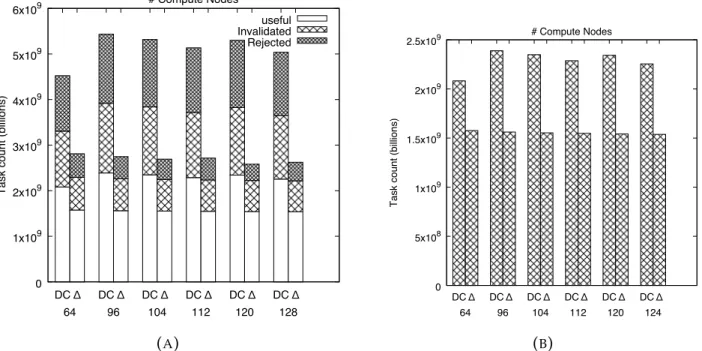
4.11 Work statistics for DC-SSSP and∆-stepping algorithm in AM++. (a) Useful,
invalidated, and rejected work.(b)Useless work. 102
5.1 A simplified diagram of the placement of and of the interaction between
application and runtime-level queues. 108
5.2 Weak scaling performance and work statistics of SSSP algorithms with Graph500
input. 121
5.3 Weak scaling result ofDCaf,fcSSSP and∆-stepping algorithms with Graph500
input. 122
5.4 Strong scaling result ofDCaf,fc SSSP and∆-stepping with Graph500 input. 122
5.5 Strong scaling result ofDCaf,fc,DCff,fc SSSP and∆-steppingnp with full USA
5.6 Weak scaling result ofDCaf,fc SSSP and∆-stepping with Random4-n graph
input. 124
5.7 Performance of coloring algorithms with Graph500 on 2 Cutter nodes (log scale execution time). All the algorithms achieve same color quality, hence total color
count is omitted. 125
5.8 Weak scaling results of coloring algorithms with Graph500 input. 125 5.9 Execution time and coefficient of variation (CoV) with send threshold 10000
forDCSSSP (CoVs shown at the top of clustered bars). We report individual problem execution time, probi, average time, and adjusted minimum and
maximum time from the standard deviation of execution time. 127 5.10 Variation of priority queue size and adaptive frequency over time inDCaf,fc
SSSP algorithm with Graph500 scale 27 input and with 8 nodes. 129 5.11 Statistics of different yield counts for weak scaling results forDCaf,fc SSSP
algorithm with Graph500 input 130
5.12 Relation between activity count and execution time ofDCaf,fc SSSP with full
USA road network with 16 compute nodes 131
6.1 Finding the sweet spot with adaptivity. 137
6.2 Heatmaps of task execution profile (rate) of different SSSP algorithms. The fluctuating task execution rates in∆-stepping and KLA SSSP algorithm are evident from the uneven stripes of work distribution pattern due to the straggler effects from synchronization. Moreover, at the end of each superstep, the task
execution rate gets slower. 139
6.3 Overview of the system stack for graph applications. 142 6.4 Candidate mechanisms to accelerate graph applications. 143 6.5 Heatmaps of message send rate of relaxed-synchronous SSSP algorithms. 144
6.6 Heatmaps of sending full message buffers of relaxed-synchronous SSSP
algorithms. 146
6.7 Distributed Control message sending profile. 147
6.8 Percent improvement of execution time in weak scaling with adaptive coalescing
for∆-stepping SSSP with Graph500 input. 152
6.9 Percent improvement of execution time in weak scaling with adaptive coalescing
for∆-stepping SSSP with RMAT-ER input. 152
6.10 Percent improvement of execution time in weak scaling with adaptive coalescing
for KLA SSSP with RMAT-ER input. 153
6.11 Percent improvement of execution time in weak scaling with adaptive coalescing
for CC SV with Graph500 input. 154
6.12 Percent improvement of execution time in weak scaling with adaptive flow
control for DC SSSP with Graph500 input. 155
6.13 Percent improvement of execution time in weak scaling with adaptive flow
control for DC SSSP with RMAT-ER input. 155
6.14 Percent improvement of execution time in weak scaling with adaptive flow
control for CC DC with RMAT-ER input. 156
6.15 Percent improvement of execution time in weak scaling with adaptive flow
List of Acronyms
AP: Active Pebbles . . . .31
GAS: Gather-Apply-Scatter . . . .45
SSP: Stale Synchronous parallel . . . .73
CSP: Communicating Sequential Process . . . .1
BSP: Bulk Synchronous Parallel . . . .1
CHAPTER 1
Introduction
Graphs and graph algorithms have long been an important part of fundamental com-puter science. Recently, graphs have received significant attention because of their utility to data analytics. As data analytics problems have exploded in size and complexity, the need for scalable graph algorithms has exploded along with them.
Although parallel graph computations have unique challenges [78], parallelization of graph algorithms is still typically accomplished using paradigms established long before the need for scalable graph algorithms emerged. Although these approaches ( Commu-nicating Sequential Process (CSP) , Bulk Synchronous Parallel (BSP) , Single Program, Multiple Data (SPMD) , et al) have proven to be highly effective for scientific computing and numerical linear algebra, they have proven to be much less effective for graph algo-rithms. Notably, relatively coarse compute-communicate phases are poorly matched to the fine-grained, irregular computation and communication structures exhibited by graph problems.
Moreover, graph algorithms, as described in the literature and in textbooks, are of-ten developed to optimally solve certain problems in a theoretically ideal setting. The subsequent prescription of data dependencies and ordering of operations leads to severe synchronization when these algorithms are parallelized. Some success has been achieved by relaxing synchronization (e.g., with∆-stepping for solving SSSP problems [85]), yet even with relaxed ordering [64], the scalability of these algorithms is still ultimately lim-ited by synchronization. In limlim-ited scale, asynchrony has been shown to be applicable for monotonically increasing or decreasing updates [114] that requires periodic global synchronization for termination detection.
Synchronization in graph computation is pernicious. Global synchronization barriers imposed by BSP approaches introduce thestraggler effect[64] where the whole distributed system must wait for the last straggler to move to the next step. The larger the system gets, the more pronounced the effect.
Additionally, we identify another kind of barrier encoded in certain graph algorithms, which we callvertex-centric barriers. This type of synchronization arises when an ordering is imposed on vertices before starting an algorithm execution, resulting in an implicit predecessor-successor relationship among vertices and all their neighbors, thus forming a
pre-execution Directed Acyclic Graph(DAG). Many graph algorithms depend on such vertex
ordering to determine which vertex to process first.
For example, the problem of finding an optimal coloring of a graph is NP-complete [53] . However, over the course of time, many heuristic parallel greedy algorithms, based on Luby’s [77] iterative maximal independent set computation, have been devised that perform well in practice. To make a trade-off between execution time and coloring qual-ity, greedy coloring algorithms apply different vertex ordering criteria when assigning priorities to vertices so as to decide which vertex to color first. In doing so, an implicit predecessor-successor relationship between a vertex and its neighbors is formed. This can be visualized as a directed acyclic graph (DAG), termed as priority DAG[18], with edges emanating from the predecessor(s) to the successor(s). Once the implicit DAG is created, most algorithms proceed in steps and traverse the DAG in aDAG-synchronous
fashion: each vertex in a sub-DAG waits until all its predecessors are colored and then color itself with an available color not taken by any of its predecessors. At the level of a single vertex, this resembles Bulk-synchronous-parallel (BSP) execution model, where an algorithm iterates through computation, communication, and synchronization steps.
In greedy coloring algorithms, waiting on a predecessor gives rise tovertex-centric
barrier/synchronization(Fig. 1.1). Vertex-centric barriers induce similar ramification as
global synchronization barriers in BSP approach, where the whole system must wait for a straggler before moving to the next step. A vertex with a large number of predecessors
… … … … Uncolored Vertex <latexit sha1_base64="68A4KNk3Ysq6s5ut+fmSO3hGt28=">AAADgHicZVLbThRBEJ1xvOB4A330pSPZqAngDC+iCQngBR7QILpAQm9IbU/Nboe+TLp7wLUzX+I/+e7f2DMs6kIlk5ycU11VZ6qGleDWZdnv+EZy89btO3N303v3Hzx8NL/w+MDq2jDsMy20ORqCRcEV9h13Ao8qgyCHAg+Hp+9a/fAMjeVafXOTCgcSRoqXnIEL1Mn8TyrAjJBQpbkqUDnSV11VLCglB2gcfidp2vun093N/e0PhA5LQoPoumyvOLDlkUFUjd8kXxkICCOQ98EBKIbL+WWtbiSuRiSU3xSjgN1YklIbsqfP0SzvwjnZNlCNbXMyv5itZF2Q6yCfgsVoGnsnC/EvWmhWyzAnE2DtcZ5VbuDBOM4ENimtLVbATmGExwEqkGgHvnPQkF5gim6SUgefHfv/Cw/S2okchkwJbmyvai35V+vNtHLl2sBzVdUOFbvoVNaCOE3anZCCG2ROTAIAFn4IZ4SNwQBzYXMpNajwnGkpQRWeliC5mBRYQi1c46ktL/FsUxt2gMV6PvBjFGfoZtz71qKtkAXWorOgbMv4nS41XAf5jDU2veMtLYqPQVmfVcgnLHgtBzM1JWdGt4baSboG/Af6taxpv9BGBJMtndIwcbjX65ezv73V+GyJ5KtrSyRr0nAB+dV9Xwf91ZU3K9mX1cWNrekpzEVPo2fRiyiPXkcb0U60F/UjFsfx8ziL8yRJXiavkvwi9UY8ffMkmonk7R8lZSF8</latexit>
<latexit sha1_base64="68A4KNk3Ysq6s5ut+fmSO3hGt28=">AAADgHicZVLbThRBEJ1xvOB4A330pSPZqAngDC+iCQngBR7QILpAQm9IbU/Nboe+TLp7wLUzX+I/+e7f2DMs6kIlk5ycU11VZ6qGleDWZdnv+EZy89btO3N303v3Hzx8NL/w+MDq2jDsMy20ORqCRcEV9h13Ao8qgyCHAg+Hp+9a/fAMjeVafXOTCgcSRoqXnIEL1Mn8TyrAjJBQpbkqUDnSV11VLCglB2gcfidp2vun093N/e0PhA5LQoPoumyvOLDlkUFUjd8kXxkICCOQ98EBKIbL+WWtbiSuRiSU3xSjgN1YklIbsqfP0SzvwjnZNlCNbXMyv5itZF2Q6yCfgsVoGnsnC/EvWmhWyzAnE2DtcZ5VbuDBOM4ENimtLVbATmGExwEqkGgHvnPQkF5gim6SUgefHfv/Cw/S2okchkwJbmyvai35V+vNtHLl2sBzVdUOFbvoVNaCOE3anZCCG2ROTAIAFn4IZ4SNwQBzYXMpNajwnGkpQRWeliC5mBRYQi1c46ktL/FsUxt2gMV6PvBjFGfoZtz71qKtkAXWorOgbMv4nS41XAf5jDU2veMtLYqPQVmfVcgnLHgtBzM1JWdGt4baSboG/Af6taxpv9BGBJMtndIwcbjX65ezv73V+GyJ5KtrSyRr0nAB+dV9Xwf91ZU3K9mX1cWNrekpzEVPo2fRiyiPXkcb0U60F/UjFsfx8ziL8yRJXiavkvwi9UY8ffMkmonk7R8lZSF8</latexit><latexit sha1_base64="68A4KNk3Ysq6s5ut+fmSO3hGt28=">AAADgHicZVLbThRBEJ1xvOB4A330pSPZqAngDC+iCQngBR7QILpAQm9IbU/Nboe+TLp7wLUzX+I/+e7f2DMs6kIlk5ycU11VZ6qGleDWZdnv+EZy89btO3N303v3Hzx8NL/w+MDq2jDsMy20ORqCRcEV9h13Ao8qgyCHAg+Hp+9a/fAMjeVafXOTCgcSRoqXnIEL1Mn8TyrAjJBQpbkqUDnSV11VLCglB2gcfidp2vun093N/e0PhA5LQoPoumyvOLDlkUFUjd8kXxkICCOQ98EBKIbL+WWtbiSuRiSU3xSjgN1YklIbsqfP0SzvwjnZNlCNbXMyv5itZF2Q6yCfgsVoGnsnC/EvWmhWyzAnE2DtcZ5VbuDBOM4ENimtLVbATmGExwEqkGgHvnPQkF5gim6SUgefHfv/Cw/S2okchkwJbmyvai35V+vNtHLl2sBzVdUOFbvoVNaCOE3anZCCG2ROTAIAFn4IZ4SNwQBzYXMpNajwnGkpQRWeliC5mBRYQi1c46ktL/FsUxt2gMV6PvBjFGfoZtz71qKtkAXWorOgbMv4nS41XAf5jDU2veMtLYqPQVmfVcgnLHgtBzM1JWdGt4baSboG/Af6taxpv9BGBJMtndIwcbjX65ezv73V+GyJ5KtrSyRr0nAB+dV9Xwf91ZU3K9mX1cWNrekpzEVPo2fRiyiPXkcb0U60F/UjFsfx8ziL8yRJXiavkvwi9UY8ffMkmonk7R8lZSF8</latexit>
Colored Vertex <latexit sha1_base64="M8dxIIlOpUwwugFaJbVcomKaD1A=">AAADfnicZVLLTttAFB2TPqj7ANplN6OiqF2QYLNpukAi6QMWtKK0ASQmQpPxdTJiHtbMGJqO/CH9qe77Ne3YhLaBkSwdnXMf5/recSG4dUnyK1pq3bl77/7yg/jho8dPVlbXnh5ZXRoGQ6aFNidjakFwBUPHnYCTwgCVYwHH4/O3tX58AcZyrb66WQEjSSeK55xRF6iz1R9EUDMBTJTmKgPlcJMDGSH4CIyDbziO2/9Ust8/3H2PyTjHJIiuceAVp6wzMQCq8n38hVFBgwH8LvinikEnva7VFOdqgkP5vpgE7KYS59rgA30JprNPL/GuocXUVmer60k3aR6+DdI5WEfzd3C2Fv0kmWalDD6ZoNaepknhRp4ax5mAKialhYKyczqB0wAVlWBHvpmgwu3AZI2TXIc5G/b/DE+ltTM5DpGSuqm9qdXkX6290MrlvZHnqigdKHbVKS8FdhrXG8EZN8CcmAVAWfghnGE2pYYyF/YWEwMKLpmWkqrMk5xKLmYZ5LQUrvLE5td4sakNO4BsOx35KYgLcAvT+3pEWwALrAVnqbI14/ea0HAb+BOUULVPB1pkH4Kyvajgj5DxUo4WakrOjK4Hqp00Dfh38L2kqr/QRoQhazomwXG41tuXc7g7qHyygdOt3gZOqjhcQHpz37fBcKv7ppt83lrfGcxPYRk9Ry/QK5Si12gH7aEDNEQM/Y7aUTfabEWtl61Oa/MqdCma5zxDC6/V+wNIlyGE</latexit> <latexit sha1_base64="M8dxIIlOpUwwugFaJbVcomKaD1A=">AAADfnicZVLLTttAFB2TPqj7ANplN6OiqF2QYLNpukAi6QMWtKK0ASQmQpPxdTJiHtbMGJqO/CH9qe77Ne3YhLaBkSwdnXMf5/recSG4dUnyK1pq3bl77/7yg/jho8dPVlbXnh5ZXRoGQ6aFNidjakFwBUPHnYCTwgCVYwHH4/O3tX58AcZyrb66WQEjSSeK55xRF6iz1R9EUDMBTJTmKgPlcJMDGSH4CIyDbziO2/9Ust8/3H2PyTjHJIiuceAVp6wzMQCq8n38hVFBgwH8LvinikEnva7VFOdqgkP5vpgE7KYS59rgA30JprNPL/GuocXUVmer60k3aR6+DdI5WEfzd3C2Fv0kmWalDD6ZoNaepknhRp4ax5mAKialhYKyczqB0wAVlWBHvpmgwu3AZI2TXIc5G/b/DE+ltTM5DpGSuqm9qdXkX6290MrlvZHnqigdKHbVKS8FdhrXG8EZN8CcmAVAWfghnGE2pYYyF/YWEwMKLpmWkqrMk5xKLmYZ5LQUrvLE5td4sakNO4BsOx35KYgLcAvT+3pEWwALrAVnqbI14/ea0HAb+BOUULVPB1pkH4Kyvajgj5DxUo4WakrOjK4Hqp00Dfh38L2kqr/QRoQhazomwXG41tuXc7g7qHyygdOt3gZOqjhcQHpz37fBcKv7ppt83lrfGcxPYRk9Ry/QK5Si12gH7aEDNEQM/Y7aUTfabEWtl61Oa/MqdCma5zxDC6/V+wNIlyGE</latexit> <latexit sha1_base64="M8dxIIlOpUwwugFaJbVcomKaD1A=">AAADfnicZVLLTttAFB2TPqj7ANplN6OiqF2QYLNpukAi6QMWtKK0ASQmQpPxdTJiHtbMGJqO/CH9qe77Ne3YhLaBkSwdnXMf5/recSG4dUnyK1pq3bl77/7yg/jho8dPVlbXnh5ZXRoGQ6aFNidjakFwBUPHnYCTwgCVYwHH4/O3tX58AcZyrb66WQEjSSeK55xRF6iz1R9EUDMBTJTmKgPlcJMDGSH4CIyDbziO2/9Ust8/3H2PyTjHJIiuceAVp6wzMQCq8n38hVFBgwH8LvinikEnva7VFOdqgkP5vpgE7KYS59rgA30JprNPL/GuocXUVmer60k3aR6+DdI5WEfzd3C2Fv0kmWalDD6ZoNaepknhRp4ax5mAKialhYKyczqB0wAVlWBHvpmgwu3AZI2TXIc5G/b/DE+ltTM5DpGSuqm9qdXkX6290MrlvZHnqigdKHbVKS8FdhrXG8EZN8CcmAVAWfghnGE2pYYyF/YWEwMKLpmWkqrMk5xKLmYZ5LQUrvLE5td4sakNO4BsOx35KYgLcAvT+3pEWwALrAVnqbI14/ea0HAb+BOUULVPB1pkH4Kyvajgj5DxUo4WakrOjK4Hqp00Dfh38L2kqr/QRoQhazomwXG41tuXc7g7qHyygdOt3gZOqjhcQHpz37fBcKv7ppt83lrfGcxPYRk9Ry/QK5Si12gH7aEDNEQM/Y7aUTfabEWtl61Oa/MqdCma5zxDC6/V+wNIlyGE</latexit> Vertex-Centric Barrier
<latexit sha1_base64="0cF1qQh7XLOw5yqY/UgypEYrbD0=">AAADhHicZVLbThRBEJ1hRXC9gT760pFsYiJLZlAiPmBgUeEBDaILJPSG1PbU7Hboy6S7B1w78y3+ke/+jT3DelmpZJKTU9VV50zVsBDcuiT5Gc+1bs3fXli807577/6Dh0vLj46tLg3DPtNCm9MhWBRcYd9xJ/C0MAhyKPBkeLFb508u0Viu1Rc3KXAgYaR4zhm4QJ0vfacCzAgJVZqrDJUjx2gcfu3uBmw4o5T0wBiOpt35W0MPdo723hE6zAkNxa7R4RUH1h0ZRFX5HfKZgYAgg7wNLkAx7KbT3qSRxdWIhO47YhSwG0uSa0MO9RWa7gFckT0DxdhW50sryVrSBLkJ0ilYiaZxeL4c/6CZZqUMOpkAa8/SpHADD8ZxJrBq09JiAewCRngWoAKJduAbBxXpBCZrlOQ6+GzYf194kNZO5DBUSnBj+3+uJv/kOjOjXL458FwVpUPFriflpSBOk3ovJOMGmROTAICFH8IZYWMwwFzYXpsaVHjFtJSgMk9zkFxMMsyhFK7y1Oa/8exQG3aA2VY68GMUl+hm3Pvaoi2QBdais6Bszfj9pjRcCPmIJVads54W2fuQ2ZrNkA+Y8VIOZnpKzoyuDdVKmgH8G/rNpKq/MEYEkzXdpkFxuNmbl3O016t8skrS9c1VklTtcAHp//u+Cfrra6/Xkk/rK9u96SksRk+ip9GzKI1eRdvRfnQY9SMWz8fP45fxRmuh1W29aG1cl87F0zePo5lovfkFnLojiw==</latexit><latexit sha1_base64="0cF1qQh7XLOw5yqY/UgypEYrbD0=">AAADhHicZVLbThRBEJ1hRXC9gT760pFsYiJLZlAiPmBgUeEBDaILJPSG1PbU7Hboy6S7B1w78y3+ke/+jT3DelmpZJKTU9VV50zVsBDcuiT5Gc+1bs3fXli807577/6Dh0vLj46tLg3DPtNCm9MhWBRcYd9xJ/C0MAhyKPBkeLFb508u0Viu1Rc3KXAgYaR4zhm4QJ0vfacCzAgJVZqrDJUjx2gcfu3uBmw4o5T0wBiOpt35W0MPdo723hE6zAkNxa7R4RUH1h0ZRFX5HfKZgYAgg7wNLkAx7KbT3qSRxdWIhO47YhSwG0uSa0MO9RWa7gFckT0DxdhW50sryVrSBLkJ0ilYiaZxeL4c/6CZZqUMOpkAa8/SpHADD8ZxJrBq09JiAewCRngWoAKJduAbBxXpBCZrlOQ6+GzYf194kNZO5DBUSnBj+3+uJv/kOjOjXL458FwVpUPFriflpSBOk3ovJOMGmROTAICFH8IZYWMwwFzYXpsaVHjFtJSgMk9zkFxMMsyhFK7y1Oa/8exQG3aA2VY68GMUl+hm3Pvaoi2QBdais6Bszfj9pjRcCPmIJVads54W2fuQ2ZrNkA+Y8VIOZnpKzoyuDdVKmgH8G/rNpKq/MEYEkzXdpkFxuNmbl3O016t8skrS9c1VklTtcAHp//u+Cfrra6/Xkk/rK9u96SksRk+ip9GzKI1eRdvRfnQY9SMWz8fP45fxRmuh1W29aG1cl87F0zePo5lovfkFnLojiw==</latexit><latexit sha1_base64="0cF1qQh7XLOw5yqY/UgypEYrbD0=">AAADhHicZVLbThRBEJ1hRXC9gT760pFsYiJLZlAiPmBgUeEBDaILJPSG1PbU7Hboy6S7B1w78y3+ke/+jT3DelmpZJKTU9VV50zVsBDcuiT5Gc+1bs3fXli807577/6Dh0vLj46tLg3DPtNCm9MhWBRcYd9xJ/C0MAhyKPBkeLFb508u0Viu1Rc3KXAgYaR4zhm4QJ0vfacCzAgJVZqrDJUjx2gcfu3uBmw4o5T0wBiOpt35W0MPdo723hE6zAkNxa7R4RUH1h0ZRFX5HfKZgYAgg7wNLkAx7KbT3qSRxdWIhO47YhSwG0uSa0MO9RWa7gFckT0DxdhW50sryVrSBLkJ0ilYiaZxeL4c/6CZZqUMOpkAa8/SpHADD8ZxJrBq09JiAewCRngWoAKJduAbBxXpBCZrlOQ6+GzYf194kNZO5DBUSnBj+3+uJv/kOjOjXL458FwVpUPFriflpSBOk3ovJOMGmROTAICFH8IZYWMwwFzYXpsaVHjFtJSgMk9zkFxMMsyhFK7y1Oa/8exQG3aA2VY68GMUl+hm3Pvaoi2QBdais6Bszfj9pjRcCPmIJVads54W2fuQ2ZrNkA+Y8VIOZnpKzoyuDdVKmgH8G/rNpKq/MEYEkzXdpkFxuNmbl3O016t8skrS9c1VklTtcAHp//u+Cfrra6/Xkk/rK9u96SksRk+ip9GzKI1eRdvRfnQY9SMWz8fP45fxRmuh1W29aG1cl87F0zePo5lovfkFnLojiw==</latexit>
FIGURE1.1. Vertex-centric barriers.
(straggler) impedes other vertices in the same level from advancing (straggler effect). Al-though this may not demonstrate itself as a problem in a shared-memory implementation, straggler effect can seriously limit performance of an algorithm in a distributed setting.
To alleviate the problem of straggler effect associated with global synchronization and vertex-centric barriers, we consider the class ofunorderedalgorithms with large available parallelism [63] that can be executedoptimistically(speculatively) [71]. Unordered algo-rithms allow tasks to be performed in any order and correctness is still guaranteed. This flexibility in ordering facilitates parallel computation without global or vertex-centric synchronization. However, too much speculation causes explosion of sub-optimal work. If results calculated in intermediate steps are sub-optimal and require updates too often, then performance suffers. Our objective is to formulate an algorithmic approach based on un-ordered execution to design synchronization-avoiding graph algorithms that demonstrate better performance while retaining good scalability.
Traditional BSP-like approach helps to execute an algorithm with optimal amount of work and performs least amount of useless work. While minimizing useless work is crucial in a sequential computation, it is the opposite of creating parallelism. Relaxing the constraints of work optimality, a graph can be explored optimistically correcting results as better information becomes available (giving rise to label-correcting algorithms). In avoiding synchronization, our approach relies on speculative (or optimistic) execution. As a consequence, synchronization-avoiding algorithms are necessarilylabel-correcting.
Our approach leverages an important observation: label-correcting algorithms can be classified according to whether or not the vertex property update (the label correction) is monotonic or non-monotonic. This classification can in turn be identified with the subsequent synchronization behavior of the algorithms in each category. Algorithms with monotonic updates (such as algorithms for solving single-source shortest paths or con-nected components) exhibit global synchronization, whereas non-monotonic algorithms (such as algorithms for vertex coloring) exhibit vertex-centric synchronization.
To support effective asynchrony in the communication framework, we employactive
messages[105], where messages are sent explicitly but receives are implicit. Here, since a
pre-registered receive handler knows a priori the address of user-level handler, it can directly extract the computation from a message and integrate it to the ongoing computation. There is no need for the endpoints to get involved as well as no collectives (gather, scatter etc.) are needed. In doing so, active messages (AM) eliminate software overhead of buffering and allow for more overlapping between communication and computation and expose more asynchrony.
1.1. Techniques For Synchronization-avoiding Graph Algorithms
We have developed algorithms that avoid global synchronization and vertex-centric barriers. To do so, our approach relies on the following supporting mechanisms:
(1) Adapting graph applications to execute graph operations optimistically (speculatively) in any order without affecting the correctness of the final result. Theseunordered algo-rithms refine the results as the algoalgo-rithms progress (hence label-correcting) and produce the correct result at the end,
(2) Expressing graph operations in terms of fine-grained active messages [105] and handlers with extended capabilities to send computations to the targets asynchronously (thus spawning asynchronous tasks at the targets),
(4) Exploiting the ability to invoke unbounded-depth active message handlers to chain computations,
(5) Guiding the computations with thread-local priority-metric(s) based ordering to navi-gate through a better execution trace,
(6) Applying runtime optimizations such as message coalescing, reduction and routing transparently, and
(7) Eliminating the need to buffer messages for computations with non-monotonic updates, so that the complete asynchronous execution does not increase memory requirement for buffering out-of-band messages (for example graph coloring).
Combining these ideas have several advantages. For example, unordered algorithms unveil maximum asynchrony and parallelism due to the independence of task execu-tion. Asynchronous spawning of tasks with active messages and relying only on atomic operations for vertex property updates avoid overheads associated with global and vertex-centric synchronization barriers and sophisticated (and expensive) vertex locking protocols. Functionally-flexible unbounded-depth active-message handlers propagate the computa-tion forward, rather than restricting themselves only in replying to the senders of the active messages. Additionally, due to the nature of graph structure, variable-length computation strands arise during the execution of a graph algorithm. Such computations can be chained easily with extended active messages.
Moreover, the active-message handlers can assist the runtime to decide whether to continue with application-level computation that can trigger more sends or whether to transfer control to the runtime for progressing the runtime (termed as flow control). Thread-local ordering prevents work explosion by minimizing execution of sub-optimal work while keeping the ordering overhead to a minimum by avoiding contentions on priority queue data-structures. Finally, runtime optimizations can be applied transparently: message reduction (caching) can eliminate redundant messages; message coalescing can bundle messages targeted for a particular destination to utilize the network bandwidth properly.
1.2. Context Matters: Distributed Graph Algorithms and Runtime Systems
The increasing complexity of the software/hardware stack of modern supercomput-ers makes undsupercomput-erstanding the performance of the modern massive-scale codes difficult. Distributed graph algorithms (DGAs) are at the forefront of that complexity, pushing the envelope with their massive irregularity and data dependency. We analyze the existing body of research on DGAs to assess how technical contributions are linked to experimental performance results in the field. We distinguishalgorithm-levelcontributions related to graph problems fromruntime-levelconcerns related to communication, scheduling, and other low-level features necessary to make distributed algorithms work. We show that the runtime is an integral part of DGAs’ experimental results, but it is often ignored by the authors in favor of algorithm-level contributions. We argue that a DGA can only be fully understood as a combination of these two aspects and that detailed reporting of runtime details must become an integral part of scientific standard in the field if results are to be truly understandable and interpretable. Based on our analysis of the field, we provide a template for reporting the runtime details of DGA results, and we further motivate the importance of these details by discussing in detail how seemingly minor runtime changes can make or break a DGA.
1.3. Runtime Scheduling Policies for Synchronization-avoiding Graph Algorithms
The performance of a distributed graph algorithm is deeply tied to the context of the underlying distributed software/hardware stack, here collectively referred to as the runtime. This thesis additionally explores the scheduling and runtime system support for executing unordered graph computations, where there is a substantial level of parallelism to exploit but one that also necessitates runtime support with potentially high overhead and scheduling complexity, such as optimistic (speculative) execution. The flexibility of ordering in unordered algorithms facilitates parallel computation without global or vertex-centric synchronization. To avoid “wasted” work, our approach relies on local work prioritization. However, the global work order obtained by local prioritization
is susceptible to the interference from the runtime. Such interference can delay timely delivery of messages containing better information. As a consequence, with sub-optimal work ordering, more time will be spent on correcting the speculative computation than on useful work.
Striking the balance between speculative computation and progressing the network to propagate better messages has to be done at the level of the graph algorithm, however communication and scheduling are aspects of the runtime. To bridge that gap, graph algorithms need runtime hooks to influence scheduling policies. To get better performance, the common case requires algorithm-specific and graph-type-specific scheduling policies. To provide appropriate scheduling on application-specific basis, application needs a plug-in mechanism to provide the best schedulplug-ing policies to the runtime.
To this end, it is imperative to distinguish runtime-leveltasksfrom application-level
work itemsand to make informed decision about executing tasks or executing work items
at any particular instance of time. Runtime-level tasks encompass scheduling lightweight threads, probing and progressing the underlying transport, and detecting termination. Application-level work items are generated by the application (for example relaxing a vertex distance). While executing an algorithm, a general-purpose runtime stack is respon-sible for timely delivery of work items from lower-level bit transport to the application level. Work items may pass through several lower-level buffers (runtime specific) to exit the runtime world and then be handed over to the application. For applications that are sensitive to work item delivery characteristics, the runtime must cooperate with the application to deliver optimal performance by reducing sub-optimal work.
To find a way to reduce semi-optimal work for unordered graph algorithms, we ask the question: are the scheduling policies encoded into the default runtime scheduler good enough to schedule tasks and work items for supporting optimistic parallelization? If not, can we improve scheduling of the application tasks by utilizing feedback from the application?
In this connection, we propose the concept of plug-in scheduling policies that augment the scheduler of the underlying runtime to adapt it to a specific application. We present several implementations of our approach in an asynchronous many-task runtime system (AMT), and we demonstrate that the implementation using a plug-in scheduling policy is the most efficient, outperforming other versions and even the well-known∆-stepping algorithm. We achieve the performance using two heuristics, flow controland adaptive
frequency of network progress, providing the evidence that adequate runtime support for
irregular distributed algorithms is vital for their performance.
Our contributions are to demonstrate combining an unordered computation with AMTs and to demonstrate the benefits of lifting and delegating some responsibilities to the domain experts by providing a plug-in scheduler in the underlying runtime.
1.4. Adaptive Runtime features for Distributed Graph Algorithms
Performance of distributed graph algorithms can benefit greatly by forming rapport between algorithmic abstraction and the underlying runtime system that is responsible for scheduling work and exchanging messages. However, due to their dynamic and irregular nature of computation, distributed graph algorithms written in different programming models impose varying degree of workload pressure on the runtime. To cope with such vastly different workload characteristics, a runtime has to make several trade-offs. One such trade-off arises, for example, when the runtime scheduler has to choose among alternatives such as whether to execute algorithmic work, or progress the network by probing network buffers, or throttle sending messages (termed flow control). This trade-off decides between optimizing the throughput of a runtime scheduler by increasing the rate of execution of algorithmic work, and reducing the latency of the network messages. Another trade-off exists when a decision has to be made about when to send aggregated messages in buffers (message coalescing). This decision chooses between trading off latency for network bandwidth and vice versa. At any instant, such trade-offs emphasize either on improving the quantity of work being executed (by maximizing the scheduler
throughput) or on improving the quality of work (by prioritizing better work). However, encoding static policies for different runtime features (such as flow control, coalescing) can prevent graph algorithms from achieving their full potential, thus can undermine the actual performance of a distributed graph algorithm . In this thesis, we also investigate runtime support for distributed graph algorithms in the context of two paradigms: variants of well-known Bulk-Synchronous Parallel model and asynchronous programming model. We explore generic runtime features such as message coalescing (aggregation) and flow control and show that execution policies of these features need to be adjusted over time to make a positive impact on the execution time of a distributed graph algorithm. Since synchronous and asynchronous graph algorithms have different workload characteristics, not all of such runtime features may be good candidates for adaptation. Each of these algorithmic paradigms may require different set of features to be adapted over time. We demonstrate which set of feature(s) can be useful in each case to achieve the right balance of work in the runtime layer. Existing implementation of different graph algorithms can benefit from adapting dynamic policies in the underlying runtime.
1.5. Contributions
Our contributions in this thesis are as follows:
• A new approach to developing scalable graph algorithms, based on eliminating global synchronization and vertex-centric barriers, and distributed termination detection that relies on four-counter based Sinha-kale-Ramkumar algorithm [103] (Chapter 3).
• Identification of two classes of algorithms (monotonic and non-monotonic) corre-sponding to two classes of synchronization (global and vertex-centric) (Chapter 3).
• Application of our approach to develop new algorithms for solving SSSP,
connected-components, and vertex coloring. The developed algorithms incor-porate the seven principles discussed in Sec. 1.1 and are implemented using the Active Pebbles model [110] (designed for fine-grained data-driven irregular
applications). We show that our algorithms outperform several baseline algo-rithms. Comparison of our algorithms with algorithms from the well-known Powergraph [55] framework shows significantly improved scalability. We also compare the performance of our algorithms with Gemini [115] distributed graph framework and Galois [91] shared-memory graph framework (Chapter 3).
• We show that runtime considerations are inseparable from algorithmic concerns in performance engineering of large-scale distributed graph algorithms. We identify, classify, and discuss two levels of distributed graph algorithms:
– Application-level aspects that authors identify as the main algorithmic contri-butions of their research.
– Runtime-level aspects that authors do not explicitly consider a part of the algorithm but that play a crucial role in the overall performance.
We argue that the whole system stack, starting with the algorithm at the top down to low-level communication libraries must be considered. With a set of carefully designed experiments of runtime features, we show how runtime can make or break an algorithm (Chapter 4).
• We demonstrate the benefits of lifting and delegating scheduling responsibilities from the runtime level to the domain experts in the application level by provid-ing a plug-in scheduler in the underlyprovid-ing runtime. With such minimal plug-in scheduling interface to the runtime, application programmer can provide effective feedback to the underlying runtime to achieve better performance for unordered algorithms (Chapter 5).
• We show that, based on the hints available in the application level, flow control and network progress frequency in the runtime can be regulated from the application level with the help of a plug-in scheduler to improve the execution profile of our algorithmic approach (Chapter 5).
• We identify a set of pressure-points in the lower stack of graph applications aka runtime. Based on graph algorithms’ characteristics, we demonstrate how
adapting dynamic policies to adjust these pressure-points can benefit such graph algorithms (Chapter 6).
• We demonstrate that adapting dynamic message aggregation policy can speedup graph algorithms that execute in a (relaxed) level-synchronous fashion (for exam-ple,∆-stepping [85] and K-level asynchronous (KLA) [60] single-source shortest paths algorithms) (Chapter 6).
• We show how dynamically adapting runtime-level flow control mechanism can boost performance of asynchronous graph algorithms that are based on optimistic parallelization (Chapter 6).
1.6. Thesis Organization
The rest of the thesis is organized as follows.Chapter 2discusses the baseline algo-rithms we consider for single-source shortest paths, connected components and graph (vertex) coloring problems. We also give a brief overview of the active pebbles model and how active pebbles model can be leveraged to design synchronization-avoiding graph algorithms. In addition, we discuss ordering of tasks at different levels in distributed graph algorithms.Chapter 3describes in details our approach for designing synchronization-avoiding graph algorithms. We demonstrate that our algorithms outperform well-known baseline algorithms discussed inChapter 2as well as the algorithms in the PowerGraph framework for several graph problems at larger scale. Chapter 4 presents evidence of impact of low-level transport, scheduler, and hardware, which we refer to as theruntime, on large-scale distributed graph algorithms. To strike a balance between communication and computation, our approach may require proper runtime support. Such support can be provided either as plug-in scheduling policies in the application layer or adapting runtime features on-the-fly in the runtime layer according to the workload. Chapter 5 focuses on the impact the runtime system - and, specifically, its scheduling policies - have on distributed-memory graph processing algorithms which avoid synchronization over-heads. There is a basic tension that arises between driving the progress of asynchronous
communication (task) and performing the work of the application (work item). To reduce such tension, proper scheduling policies are necessary for our synchronization-avoiding graph algorithms for better performance. We discuss in details how such policies can be enforced through plug-in schedulers. In addition, graph algorithms designed in different programming models have changing workload characteristics. A runtime has to consider trade-offs between optimizing throughput and minimizing message latency depending on the algorithm. To handle the varying workload, we propose adaptivity of different runtime features inChapter 6.Chapter 7discusses future directions for research. We summarize the contributions of this work and provide concluding remarks inChapter 8.
CHAPTER 2
Background
We denote an undirected graph with n vertices and m edges by G(V, E), where
V = {v1, v2, . . . , vn}andE = {e1, . . . , em}represent vertex set and edge set respectively.
Each edgeei ∈Eis an unordered pair{vj, vk}, vj, vk ∈V. In this thesis, we evaluate our
approach for three graph kernels: single-source-shortest paths, connected components and graph coloring. In this chapter, we briefly discuss the baseline algorithms we implemented to compare the performance of our algorithms with. We choose these algorithms as base-lines for comparison because these algorithms are formulated based on the observations on input graph structures and topologies. Although some variants of these algorithms, specially for SSSP, has been proposed recently [81,26], these variants heavily depend on graph pre-processing step [81] or system-specific optimizations (such as SPI library on BlueGene-Q machine in [26]). In addition, this chapter gives a brief overview of the Active Pebbles model and how this model supports asynchronous graph execution. Asynchro-nous execution of graph algorithms may result in the execution of sub-optimal work. We also discuss in this chapter how ordering in different spatial level can reduce sub-optimal work execution and can help in avoiding work explosion.
Hassan et al. [98] classify algorithms into two main categories oforderedandunordered
algorithms. Ordered algorithms require ordering of tasks for correctness whereas un-ordered algorithms do not depend on any order of tasks. Parallelizing un-ordered algorithms is challenging as the parallel execution must still maintain the ordering. On the other hand, unordered algorithms are easier to parallelize as tasks can be executed in any or-der. Furthermore, both of the kinds of algorithms may, in addition, rely ontask priority, where executing a task with the highest priority is either required (ordered algorithms) or beneficial (unordered algorithms).
2.1. SSSP Algorithms
Assume that each edge in graphGhas an associated cost (weight)>0. Insingle-source
shortest path (SSSP) problem, given a graph Gand a source vertexs, we are interested
in finding the paths with shortest weight (distance) betweens and all other vertices in the graph. The traditional greedy Dijkstra algorithm [39] employs a priority queue to always process one of the vertices with the best distance, ensuring work optimality. It is a “label-setting” algorithm, where the computed vertex distance is final. The algorithm is an ordered algorithm, and it must execute the tasks in the order dictated by their distances where a smaller distance is better. Dijkstra’s algorithm iswork optimal, performing the least amount ofuseless workthat does not update the distance of a vertex. Distributed Dijkstra’s algorithm requires a global priority queue to maintain the order, and even with Crauser’s et al. [36] improvements, the order imposed by the queue is inherently sequential.
While Dijkstra’s algorithm minimizes the amount of useless work, it is also the opposite of creating parallelism. Relaxing the constraints of work optimality, a set of active vertices in a graph can be explored speculatively and in parallel, correcting results as better information becomes available (giving rise to thelabel-correctingalgorithms). In the basic label-correcting SSSP algorithm, a task is a vertex-distance(v, d)pair that, when executed, updates the distance of the vertexv to the distancedifdis better than the current distance
dv forv. Such unordered algorithms can perform tasks in any order, but the further the
task execution order strays from the Dijkstra’s order, the more work is performed that then needs to beinvalidatedby updating the distances it produced with better new distances. Thus, the better the unordered algorithm approximates Dijkstra’s order, the less work it performs.
2.1.1. ∆-stepping Algorithm. The∆-stepping [85] algorithm approximates the ideal
priority ordering by arranging tasks (vertex-distance pairs) into distance ranges (buckets) of size ∆and executing buckets in order. Within a bucket, tasks are not ordered, and can be executed in parallel. After processing each bucket, all processes must synchronize
before processing the next bucket to maintain task ordering approximation. The more buckets (the smaller the∆value), the more time spent on synchronization. Similarly, the fewer buckets (the larger the∆value), the more sub-optimal work the algorithm generates because larger buckets provide less ordering.
∆-stepping SSSP algorithm is described inAlg. 1. The algorithm starts by putting sourceswith distance0into BucketB0. In each epoch (superstep)i, vertices within the distance rangei∆−(i+ 1)∆ from the source contained in a bucketBi are processed in
parallel by worker threads (Ln. 12). If a vertex distance is updated, the updated distance is propagated to all of its neighbors (Ln. 16). Processing a bucket may produce extra work (vertex-distance pair) for the same bucket or for the successive buckets. Worker threads cannot proceed to the next bucket unless all workers on each of the distributed node have finished processing vertices contained in the current bucket. This requires global synchronization barrier (which is implicit in the epoch). The message handlerexploreis responsible for putting a vertex in the appropriate bucket if the updated distance is better (Line10).
2.1.2. k-level Asynchronous (KLA) Algorithm. Ink-level asynchronous (KLA)
algo-rithm [60], within each superstepi, computation can proceed optimistically for vertices that are within the range of[(i−1)k, ik]levels from the root. Vertices that are reachable within these levels in a superstep can be processed in parallel. However, a global barrier is required after each superstep. The algorithm is shown inAlg. 2. The algorithm starts with two buckets, containing vertices within the range of((i−1)k, ik]and(ik,(i+ 1)k]to be processed in the current superstep and the next superstep respectively. The algorithm starts by processing vertices in the current bucket(Ln. 13) and sending the updates to its neighbors if a better distance has been found (Ln. 17). Once the update has been received, the algorithm decides whether this vertex will be processed in the current superstep or the next (Lns. 6–7) and put it in the appropriate bucket (Ln. 8).
KLA algorithm (Fig. 2.1) is based on graph topology (number of vertices inklevels that can be processed in parallel) whereas∆-stepping algorithm (Fig. 2.2) is based on graph
Alg. 1:∆-stepping Algorithm
In :GraphG =hV, Ei, sources, Parameter∆
∀v ∈V: owner[v]= rank that ownsv
Out :∀v ∈V: distance[v]= distance ofv
1 distance[v]← ∞, ∀v ∈V; 2 B ←set of buckets based on∆; 3 i←0;
4 enqueue(s,0)←Bi;
5 message handlerexplore(Vertexw, distanced)
6 ifd <distance[w]then
7 oldindex←D(w)/∆;
8 Boldindex ←Boldindex\w;
9 newindex←d/∆;
10 Bnewindex←Bnewindex∪wenqueuew→B;
11 whileB not emptydo
12 whileBi not emptydo
13 active message epoch
14 parallel foreachv ∈Bido
15 ifUpdatedistance[v]then
16 parallel foreachneighborwofvdo
17 d =distance[v] +weight(v, w);
18 sendexplore(w, d)toowner(w);
0 1 3 2 4 4 2 3 3 4 1 2 3 1 1 2 1 1 3 1 0 1 2 1 0 K=1 s
FIGURE 2.1. K-level asynchronous algorithm.
s 0 1 3 2 4 4 2 3 3 4 1 2 3 1 1 2 1 1 3 1 0 1 2 1 0 ∆ = 1 du dv 0 S
w
uv S : Sourcedu:Distance from source to u
wuv: weight between u and v
property (number of vertices that can be processed in parallel within current∆distance range). Both algorithms require global synchronization.
2.2. Connected Component Algorithms
A connected component (CC) of a graphGis a maximal subgraph ofGto contain a path between every pair of vertices in the subgraph. An algorithm for finding connected components discovers the component membership of each vertex in a graph. In prac-tice, two approaches are used for CC, namelyhooking-shortcuttingand label-propagation. Shiloach-Vishkin (SV) algorithm [102] for finding CCs is based on hooking-shortcutting. Initially each vertex belongs to its own individual component. In hooking phase , trees are hooked together if there exists an edge between them. Shortcutting flattens the trees by hooking them to one root per component. The algorithm requires global synchronization after each hooking and shortcutting phases. Recently, a variant of SV algorithm has been proposed in [65] where, at the beginning of execution, a parallel Breadth-first search (BFS) is executed from high-degree vertices to discover the largest component in the graph and then proceed with traditional SV algorithm for the rest of the computation. This algorithm has been shown to outperform multi-step algorithm proposed in [104]. We also implement BFS-based SV algorithm and call it parallel BFS (PBFS). All these algorithms require global synchronization.
Label propagation algorithms starts by initializing each vertex with an unique ID and propagates vertex labels based on minimum (maximum) label. Our algorithm differs from these algorithms as we prioritize labels during algorithm execution and do not assume any barriers in between accumulating labels (hence there is no superstep involved).
2.3. Graph Coloring
Avertex-coloringof a graphGfinds an assignment of color to each vertexvin vertex
set V such that no two adjacent vertices have the same color. The graph-coloring (GC) problem asks to find a vertex-coloring which uses as few colors as possible. The problem of finding an optimal coloring,χ(G), of a graph is NP-complete [53]. However, several
Alg. 2:SSSP Algorithm in KLA paradigm
In :GraphG =hV, Ei, sources, Parameterk ∀v ∈V: owner[v]= rank that ownsv
Out :∀v ∈V: distance[v]= distance ofv
1 distance[v]← ∞, ∀v ∈V,i←0;
2 B ←Set of two buckets, for vertices within the current level range and next level range based onk;
3 enqueue(s,0)←Bi;
4 kcurrent ←1;
5 message handlerexplore(Vertexw, distanced, levell)
6 newindex←lmod2;
7 currentindex←(k∗i)mod2;
8 ifd <distance[w] & currentindex!=newindexthen
9 enqueue(w, d, l)←Bnewindex;
10 else
11 enqueue(w, d, l)←Bcurrentindex;
12 whileB not emptydo
13 whileBi not emptydo
14 active message epoch
15 parallel foreachv ∈Bido
16 ifUpdatedistance[v]then
17 parallel foreachneighborwofvdo
18 d =distance[v] +weight(v, w);
19 kcurrent += 1;
20 sendexplore(w, d, kcurrent)toowner(w);
heuristics-based approaches work well in practice. A vertexv is called aGrundy vertexifv
is colored with the smallest color not taken by any neighbor. AGrundy coloringofGis one in which every vertex is a Grundy vertex [34]. A vertexv is calledproperly coloredif for all
i∈neighbor(v), color(i)6=color(v). Grundy coloring is a proper coloring of a graph. The
minimum number of colors (color classesorindependent subsets) needed to properly color a graphGis called thechromatic numberofG,χ(G)and is a NP-hard problem. Grundy coloring always results inkcolors whereχ(G)≤k ≤(Γ + 1)for a graphGwith maximum degree ofΓ. In this thesis, we are interested in Grundy coloring.
2.3.1. Ordering Heuristics. Since finding an optimal coloring is NP-hard, several
greedy algorithms have been designed. Such algorithms employ different vertex ordering heuristics [62] to decide which vertex to color first in different coloring algorithms. This ordering is fixed before the algorithm starts execution. We call thispre-execution ordering. For example, the first-fit heuristic [75] colors vertices in the order they appear in the input graph representation. The random ordering heuristic [66] colors vertices in a uniformly random order. The largest-degree-first ordering heuristic [107] colors vertices in the order of decreasing degree. The incidence-degree ordering heuristic [35] iteratively colors an uncolored vertex with the largest number of colored neighbors. The smallest-degree-last ordering heuristic [11,83] colors the vertices in the order induced by first removing all the lowest-degree vertices from the graph, then recursively coloring the resulting graph, and finally coloring the removed vertices. The saturation-degree ordering heuristic [20] iteratively colors an uncolored vertex whose colored neighbors use the largest number of distinct colors.
For both Jones-Plassmann and our algorithms, we consider first-fit and random order-ing heuristics to assign order to vertices for colororder-ing. In distributed settorder-ing, these heuristics have the lowest overhead and work well in practice with reasonable color quality. The resultant ordering is used to decide which vertex to color first. Imposing an ordering, in essence, creates a predecessor-successor relationship between vertices. In the following discussion, we refer to vertices with no predecessor asroots.
Alg. 3:Jones-Plassmann coloring algorithm
In :GraphG =hV, Ei,
∀v ∈V: owner[v]= rank that ownsv
1 procedureMain()
2 foreachv ∈V do
3 ifpredecessorCount[v]>0then
4 Allocate memory forpredecessorColors[v]based onpredecessorCount[v];
5 active message epoch
6 parallel foreachv ∈V do
7 ifowner[v] =this rankthen
8 Visit-root(v);
9 procedureVisit-root(Vertexr)
10 ifpredecessorCount[r] = 0then
11 color[r]←0;
12 parallel foreachneighborv ofrdo
13 ifid[v]>id[r]then
14 sendVisit(v,color[r])toowner(v);
15 message handlerVisit(Vertexv,Colorc)
16 predecessorColored[v]++;
17 predecessorColors[v][predecessorColored[v]]←c; 18 ifpredecessorColored[v] =predecessorCount[v]then
19 color[v]←f indM inAvailableColor(v);
20 parallel foreachneighborwofv do
21 ifid[w]>id[v]then
2.3.2. Jones-Plassmann Coloring algorithm. We have chosen Jones-Plassmann Color-ing algorithm as our baseline algorithm because only recently it has been proven to be efficient in distributed setting [101], both in terms of execution time and optimality of the result [35] . This algorithm is based on asynchronous push mechanism, where vertices push their states to the successors.
Jones-Plassmann algorithm (Alg. 3) works as follows: each vertex maintains a list of colors taken by the predecessors to keep track of how many predecessors have been colored so far (Ln. 4). The algorithm starts by assigning color 0 to the roots (Ln. 11) and sending out the information to all their successors (Ln. 14). When a vertex v finishes obtaining all predecessors’ colors (Ln. 18), it starts searching for a minimal available color. When it finds an available minimal color value, it assigns the color to itself (Ln. 19). If all the colors in the range0,1,2,· · · ,predecessorCount[v]−1are taken, the vertex assign predecessorCount[v]as its color. Once colored, the vertex sends its color information to all its successors (Ln. 22).
2.4. Active Pebbles Support for Asynchronous Graph Execution
Our main implementation of the baseline algorithms and our algorithms is based on the Active Pebbles model [110]. Rather that bringing in (pulling) data for computation, AP model sends the computation to the target where data is placed. The communication is based on fine-grained active messages (AM) that are calledpebbles. In an active mes-sage [105] framework such as in AP, mesmes-sages are sent explicitly but receives are implicit. Here, since a pre-registered receive handler knows a priori the address of user-level han-dler, the computation can be integrated with less software overhead. Active pebbles are unordered except by the termination detection. The granularity of graph operations in AP model can be as small as an operation on a vertex or an operation on an edge and thus can be expressed in their natural form.
AP model consists of two components: a programming model and an execution model.
targets. While fine-grained pebbles make it easier to intuitively express graph operations (such as vertex-state update) in AP model, runtime intervention is needed to ensure several optimizations. These optimizations constitute theexecution modelof AP and are implemented in the AM++ [108] runtime. These optimizations include message reduction (sender-side aggregation), message coalescing (receiver-side scatter) and active routing.
Since, in active pebbles model, computation is carried out on local data, challenges such as maintaining global memory consistency and designing sophisticated vertex locking protocol for concurrent updates are eliminated. Guaranteeing such memory consistency is required, for example in Powergraph [55], for both synchronous and asynchronous execution. AP model, on the other hand, only depends on local atomic operations available on native architecture to update a vertex property value. This is specially helpful for designing high-performance asynchronous unordered graph algorithms.
In addition to retaining AM features, AP model has a distinguishing feature: message handlers in AP can directly generate and send arbitrary messages to any destination, to unbounded depth. Also message handlers are not restricted only to send replies. This feature differentiates AP from other low-level active message system such as GASnet. This has an added benefit of eliminating the need for application-level message buffering. Irreg-ular application such as graph applications can have variable-length depth of computation during the execution of an algorithm. Such unbounded (variable-length) computation is well-represented by such extended active-message handler. In particular, asynchronous, unordered graph algorithms can trigger chained computation and AP message-handlers lend themselves naturally to such mode of computation by allowing arbitrary operations within handlers.
However, such added flexibility can complicate termination detection. To handle such arbitrary chains of nested messages, unlimited-depth termination detection algorithm is needed. Currently a four-counter based algorithm similar to the one proposed by Sinha, Kal’e and Ramkumar [103] (SKR) is implemented in the AM++ runtime.
An active pebble message spawns tasks asynchronously by executing a message han-dler on the rank where data resides. Currently the underlying transport of AM++ is based on MPI and the asynchronous send operations are implemented withMPI_Isends and MPI_Irecvs paired withMPI_Testsome.
2.5. Ordering in Graph Algorithms
Asynchronous execution of graph algorithms results in unordered label-correcting algorithms. However, such unrestricted execution of workitems can result in work ex-plosion and redundant work. To circumvent this problem, ordering can be imposed on tasks to decide which task to process first. To separate the notion of ordering from actual processing of a vertex state, recently Abstract Graph Machine (AGM) [46] has been pro-posed. An AGM represents a graph algorithm as two distinct components: aprocessing
function responsible for the actual computation on a vertex for a particular algorithm and
anorderingof the tasks that captures the order in which these computations are executed.
For example, in a Single-Source Shortest Path (SSSP) algorithm, tasks can be ordered based on the distance from the source. The work ordering relation is a strict weak ordering. This relation partitions tasks into ordered equivalence classes, where tasks (work) within an equivalence class can be executed in parallel in any order, however tasks within disjoint equivalence classes are executed according to an ordering imposed by the strict weak ordering relation.
Ordering can be enforced at different spatial levels of architecture such as globally on the whole distributed setting (Dijkstra’s priority queue for SSSP for example) , node-level (process), Non-Uniform Memory Access (NUMA) domain-level, and thread-level. While placing global ordering can be beneficial in terms of work optimality, this can seriously restrict the available parallelism. When combined with asynchrony, one would strive to find a suitable spatial level or composition of several levels for ordering. The reasonable level of ordering helps to find a good balance between the amount of work executed and available parallelism. With the right priority measurement, such ordering can be
adequate enough to approximate the global ordering but would not be too restrictive to limit parallelism. For example, a framework has been proposed in [46] that captures the essence of the spatial ordering aspect of an algorithm while leaving temporal scheduling aspect to the runtime such as active pebbles execution model.
2.6. Conclusion
In this chapter, we have discussed the baseline algorithms for three different graph kernels: Single-source shortest paths, connected components and graph coloring. We compare the performance of our algorithms with these baseline algorithms in the following chapters. Moreover, we have given an overview of Active pebbles model and have discussed how Active pebbles enables asynchronous graph execution with various runtime supports such as termination detection and unbounded-depth active message handlers.
CHAPTER 3
Synchronization-Avoiding Graph Algorithms
One of the main goals of this thesis is to design synchronization-avoiding graph algorithms. As discussed inChapter 1, many traditional approaches in designing graph algorithms suffer from straggler effect due to inherent global and vertex-centric barriers embedded in the algorithms. Such barriers can restrain an algorithm from unveiling the full potential of an underlying distributed runtime that supports fine-grained threading and asynchronous communication.
In an effort to avoid global synchronization and vertex-centric barriers, we combine Active Pebbles [110] asynchronous graph execution model with low-overhead thread-level ordering and design highly scalable unordered graph algorithms. For temporal scheduling we rely on active message based AM++runtime [108], whereas for spatial scheduling we rely on thread-level priority queues. In this chapter, we discuss our algorithms at length. We refer to these algorithms asDistributed Control(DC) algorithms.
3.1. Classification of Algorithms
Let us assume that an algorithm is evaluating a propertyP for vertices with each vertex
v’s property value denoted bypv. To design synchronization-avoiding, locally-ordered,
label-correcting algorithms, we broadly categorize them into two main classes: algorithms performing monotonic updates topv and algorithms performing non-monotonic updates
topv. In the monotonic update case,pv either monotonically increases or decreases. On the
other hand, non-monotonic property updates do not strictly increase or decreasepv. An
example of monotonic update is the SSSP problem where distance from the source to a vertex decreases as the algorithm progresses (or remains at∞if the vertex is disconnected from the source). Breadth-first search (BFS) can be considered as a special case of SSSP