E
S
E
A
R
C
H
R
E
P
R
O
R
T
I
D
I
A
P
Av. des Prés Beudin 20
IDIAP Research Institute
1920 Martigny − Switzerland www.idiap.ch Tel: +41 27 721 77 11 Email: [email protected]
P.O. Box 592 Fax: +41 27 721 77 12
Machine Learning for
Information Retrieval
David Grangier
1,2IDIAP–RR 08-34
2008 published in
Th`ese de l’ ´Ecole Polytechnique F´ed´erale de Lausanne (EPFL), no. 4088, Facult´e des Sciences et Techniques de l’Ing´enieur (STI).
Thesis Committee Members: Dr. Samy Bengio3, thesis advisor. Prof. Herv´e Bourlard1,2, thesis advisor.
Dr. Jean C´edric Chappelier2, internal expert. Dr. Yves Grandvalet4, external expert. Prof. Thomas Hofmann5,6, external expert.
1 IDIAP Research Institute, Martigny, Switzerland.
2 ´Ecole Polytechnique F´ed´erale de Lausanne (EPFL), Switzerland. 3 Google Inc., Mountain View, CA, USA.
4 Universit´e de Technologie de Compi`egne, France. 5 Google Inc., Z¨urich, Switzerland.
R ´esum ´e
Dans cette th`ese, nous explorons l’utilisation de techniques d’apprentis-sage automatique pour la recherche d’information. Plus pr´ecis´ement, nous nous int´eressons au probl`eme de l’ad-hoc retrieval qui consiste `a chercher les do-cuments pertinents `a une requˆete dans de grands corpus. Ce probl`eme est g´en´eralement r´esolu `a travers une tˆache d’ordonnancement. ´Etant donn´ee une requˆete, le syst`eme de recherche d’information ordonne les documents du cor-pus avec l’objectif de produire une liste ordonn´ee dans laquelle les documents pertinents apparaissent avant les autres.
Dans un contexte d’apprentissage automatique, nous nous sommes int´eress´es `
a proposer des algorithmes d’apprentissage qui puissent b´en´eficier de donn´ees d’entraˆınement afin d’identifier un ordonnateur capable d’atteindre une perfor-mance ´elev´ee pour des documents et des requˆetes non disponibles lors de l’ap-prentissage. Ce probl`eme pr´esente des d´efis nouveaux compar´e aux probl`emes traditionnels d’apprentissage automatique, tels que la cat´egorisation ou bien la r´egression. En effet, notre tˆache est un probl`eme d’ordonnancement, ce qui implique que la mesure de l’erreur pour une requˆete ne peut ˆetre exprim´ee comme la somme des coˆuts reli´es `a chaque document. ´Egalement, notre tˆache correspond `a un probl`eme d´es´equilibr´e puisque seulement une tr`es petite par-tie du corpus est pertinente pour chaque requˆete. De plus, l’ad-hoc retrieval
pr´esente un double probl`eme de g´en´eralisation puisque le mod`ele doit `a la fois ˆetre appliqu´e `a de nouveaux documents mais ´egalement `a de nouvelles requˆetes. Finalement, notre tˆache pr´esente aussi des contraintes d’efficacit´e de calcul puisque l’ad-hoc retrieval est g´en´eralement appliqu´e `a de grands corpus. L’objectif premier de cette th`ese est l’apprentissage discriminant de mod`eles pour l’ad-hoc retrieval. Dans ce contexte, nous proposons plusieurs approches bas´ees sur des machines `a noyaux ou sur des r´eseaux de neurones sp´ecifiquement
ii R´esum´e
adapt´es `a diff´erents probl`emes de recherche d’information. Les mod`eles pro-pos´es sont bas´es sur diff´erents algorithmes d’apprentissage en ligne permettant un apprentissage efficace sur de grands ensembles de donn´ees.
La premi`ere partie de ce document s’int´eresse `a la recherche d’informa-tion textuelle. Pour ce faire, nous adoptons une formulad’informa-tion classique de cette tˆache, et ordonnons les documents selon une estimation de leur similarit´e avec la requˆete. La mesure de la similarit´e entre textes est donc un aspect crucial dans ce cadre. Nous proposons donc une approche pour apprendre une mesure de similarit´e entre textes. Notre strat´egie d’apprentissage ne repose pas sur un large ensemble de requˆetes et de documents pertinents correspondants car ce type de donn´ees ´etant particuli`erement coˆuteux `a annoter est rare. Au lieu de cela, nous proposons d’utiliser un corpus hypertexte, dont les hyperliens fournissent une information de proximit´e s´emantique entre documents. Ce pro-tocole correspond donc `a un transfert d’apprentissage, o`u nous b´en´eficions de l’information fournie par les hyperliens pour am´eliorer la performance sur la tˆache de recherche d’information.
Ensuite, nous nous int´eressons `a un autre probl`eme de recherche d’informa-tion : la recherche d’images `a partir de requˆetes textuelles. Notre approche pro-pose d’optimiser un crit`ere li´e `a la performance d’ordonnancement. Ce crit`ere est d´eriv´e du crit`ere utilis´e dans notre travail pr´ec´edent concernant l’apprentis-sage de similarit´e textuelle. Ce choix conduit `a une approche d’apprentissage bas´ee sur la performance finale, mesur´ee sur la tˆache de recherche d’informa-tion. Notre approche est donc diff´erente des m´ethodes usuelles qui s’int´eressent g´en´eralement au probl`eme final indirectement, `a travers une tˆache d’annotation d’images. De plus, notre algorithme d’apprentissage s’appuie sur des travaux r´ecents concernant l’apprentissage en ligne de machine `a noyaux. Ainsi, nous obtenons un algorithme permettant un entraˆınement sur de grands ensembles de donn´ees et pouvant b´en´eficier de noyaux r´ecemment introduits pour la com-paraison d’images.
Dans la derni`ere partie de la th`ese, nous montrons que le crit`ere utilis´e dans les pr´ec´edents probl`emes consid´er´es peut ˆetre appliqu´e `a la tˆache de rep´erage de mots-cl´es (le rep´erage des mots-cl´es correspond `a la d´etection de mots-cl´es dans des s´equences de parole). Pour obtenir un formalisme d’ordonnancement, nous proposons un mod`ele qui doit produire une liste ordonn´ee d’enregistrements de parole en r´eponse au mot-cl´e soumis. Cette liste doit id´ealement placer les enregistrements contenant le mot-cl´e avant les enregistrements ne contenant pas le mot-cl´e. Il est int´eressant de constater que notre formalisme conduit `a un crit`ere maximisant directement l’aire sous la courbe ROC (Receiver
Opera-R´esum´e iii
ting Curve), qui est la mesure la plus commun´ement utilis´ee pour l’´evaluation des techniques de rep´erage de mots-cl´es. Ce crit`ere est ensuite utilis´e pour ap-prendre un mod`ele appropri´e `a cette tˆache s´equentielle. Ce mod`ele est appris grˆace `a un algorithme d´eriv´e de celui pr´ec´edemment introduit pour la tˆache de recherche d’image.
En conclusion, cette th`ese introduit des techniques d’apprentissage statis-tique pour la recherche d’information. Nous proposons des mod`eles d’appren-tissage pour plusieurs contextes multimodaux : la recherche de documents tex-tuels `a partir de requˆetes textuelles, la recherche d’images `a partir de requˆetes textuelles, ainsi que la recherche des s´equences de parole `a partir de mots-cl´es ´
ecrits. Nos solutions reposent sur des approches discriminantes et des algo-rithmes d’apprentissage au coˆut de calcul r´eduit. Dans tous les cas, nous faisons un parall`ele entre les m´ethodes propos´ees et l’´etat de l’art, puis nous mesurons l’am´elioration apport´ee grˆace `a des comparaisons exp´erimentales.
Mots-Cl´es : apprentissage automatique, recherche d’information, apprendre `
a ordonner, apprentissage discriminant, apprentissage en ligne, recherche de textes, recherche d’images, rep´erage de mots-cl´es dans les enregistrements vo-caux.
Abstract
In this thesis, we explore the use of machine learning techniques for in-formation retrieval. More specifically, we focus on ad-hoc retrieval, which is concerned with searching large corpora to identify the documents relevant to user queries. This identification is performed through a ranking task. Given a user query, an ad-hoc retrieval system ranks the corpus documents, so that the documents relevant to the query ideally appear above the others.
In a machine learning framework, we are interested in proposing learning algorithms that can benefit from limited training data in order to identify a ranker likely to achieve high retrieval performance over unseen documents and queries. This problem presents novel challenges compared to traditional learn-ing tasks, such as regression or classification. First, our task is a ranklearn-ing prob-lem, which means that the loss for a given query cannot be measured as a sum of an individual loss suffered for each corpus document. Second, most retrieval queries present a highly unbalanced setup, with a set of relevant documents accounting only for a very small fraction of the corpus. Third, ad-hoc retrieval corresponds to a kind of “double” generalization problem, since the learned model should not only generalize to new documents but also to new queries. Finally, our task also presents challenging efficiency constraints, since ad-hoc retrieval is typically applied to large corpora. The main objective of this thesis is to investigate the discriminative learning of ad-hoc retrieval models. For that purpose, we propose different models based on kernel machines or neural networks adapted to different retrieval contexts. The proposed approaches rely on different online learning algorithms that allow efficient learning over large corpora.
The first part of the thesis focus on text retrieval. In this case, we adopt a classical approach to the retrieval ranking problem, and order the text
docu-vi Abstract
ments according to their estimated similarity to the text query. The assessment of semantic similarity between text items plays a key role in that setup and we propose a learning approach to identify an effective measure of text similar-ity. This identification is not performed relying on a set of queries with their corresponding relevant document sets, since such data are especially expensive to label and hence rare. Instead, we propose to rely on hyperlink data, since hyperlinks convey semantic proximity information that is relevant to similarity learning. This setup is hence a transfer learning setup, where we benefit from the proximity information encoded by hyperlinks to improve the performance over the ad-hoc retrieval task.
We then investigate another retrieval problem, i.e. the retrieval of images from text queries. Our approach introduces a learning procedure optimizing a criterion related to the ranking performance. This criterion adapts our pre-vious learning objective for learning textual similarity to the image retrieval problem. This yields an image ranking model that addresses the retrieval prob-lem directly. This approach contrasts with previous research that rely on an intermediate image annotation task. Moreover, our learning procedure builds upon recent work on the online learning of kernel-based classifiers. This yields an efficient, scalable algorithm, which can benefit from recent kernels developed for image comparison.
In the last part of the thesis, we show that the objective function used in the previous retrieval problems can be applied to the task of keyword spotting, i.e. the detection of given keywords in speech utterances. For that purpose, we formalize this problem as a ranking task: given a keyword, the keyword spot-ter should order the utspot-terances so that the utspot-terances containing the keyword appear above the others. Interestingly, this formulation yields an objective di-rectly maximizing the area under the receiver operating curve, the most com-mon keyword spotter evaluation measure. This objective is then used to train a model adapted to this intrinsically sequential problem. This model is then learned with a procedure derived from the algorithm previously introduced for the image retrieval task.
To conclude, this thesis introduces machine learning approaches for ad-hoc retrieval. We propose learning models for various multi-modal retrieval setups, i.e. the retrieval of text documents from text queries, the retrieval of images from text queries and the retrieval of speech recordings from written keywords. Our approaches rely on discriminative learning and enjoy efficient training pro-cedures, which yields effective and scalable models. In all cases, links with prior approaches were investigated and experimental comparisons were conducted.
Abstract vii
Keywords: machine learning, information retrieval, learning to rank, discrim-inative learning, online learning, text retrieval, image retrieval, spoken keyword spotting
Acknowledgments
“Everything should be made as simple as possible, but not simpler.” Albert Einstein
The completion of this thesis was a great adventure, that would not have been possible without many people. I am grateful to them.
First, I would like to thank Samy Bengio, who supervised my research during the last four years. Samy introduced me to the exciting area of Machine Learning research. He has always been present for technical advice, even when commuting between Lausanne and Martigny (some regular commuters should now be proficient in Machine Learning). More importantly, Samy allowed me to conduct my research in a very friendly and playful environment. I am also grateful to Herv´e Bourlard, who made the IDIAP Research Institute a place where I could work with a lot of freedom. I further thank my colleagues at IDIAP, who brought me inspiration and essential social interactions.
I am very grateful to my family, that was supportive during this adventure (and before as well). In particular, I thank Elodie for encouraging me in periods of doubts and for calming me down in periods of over-enthusiasm...
Contents
1 Introduction 1
1.1 Motivations . . . 1
1.2 Organization & Contributions . . . 2
2 State-of-the-Art 5 2.1 Information Retrieval . . . 5
2.2 Machine Learning for Information Retrieval . . . 11
2.3 Conclusions . . . 20
3 Learning Text Similarity from Hyperlinked Data 23 3.1 LinkLearn . . . 24
3.2 Related Work . . . 28
3.3 Experiments and Results . . . 31
3.4 Conclusions . . . 37
3.5 Contributions . . . 38
4 Retrieving Images from Text Queries 39 4.1 Related Work . . . 41
4.2 Passive-Aggressive Model for Image Retrieval . . . 45
4.3 Text and Visual Features . . . 52
4.4 Experiments and Results . . . 55
4.5 Conclusions . . . 68
4.6 Contributions . . . 70
5 Discriminative Keyword Spotting 71 5.1 Related Work . . . 72
xii Contents
5.3 Experiments and Results . . . 85 5.4 Conclusions . . . 90 5.5 Contributions . . . 91
6 Conclusions and Perspectives 93
6.1 General Summary . . . 93 6.2 Potential Future Work . . . 95
A Appendix 97
A.1 Regularization in Passive-Aggressive through Early Stopping . 97 A.2 Dynamic Programming Procedure for the Discriminative Spotter 97
1
Introduction
1.1 Motivations
The history of Information Retrieval (IR) parallels the development of li-braries. The first civilizations had already come to the conclusions that efficient techniques should be designed to fully benefit from large document archives. As early as 5,000 years ago, the Sumerian librarians were already describing and categorizing official transaction records, legends and theological documents in indexes [Kramer, 1958]. Thematic indexes have then remained the main mean of accessing archived items for centuries. Only recently, IR has radi-cally changed with the advent of computers. Digital technologies provide a unified infrastructure to store, exchange and automatically process large doc-ument collections. The search for information consequently evolved from the manual examination of brief document abstracts within predefined categories to algorithms searching through the whole content of each archived document. Nowadays, automatic retrieval systems are widely used in several application domains (e.g. web search, book search or video search) and there is a constant need for improving such systems. In this context, Information Retrieval is an active field of research within Computer Science. This thesis is concerned with one of the main tasks of IR, the so-calledad-hoc retrieval task which aims at finding the documents relevant to submitted queries. This problem is generally formalized as a ranking problem: given a query, the retrieval system should rank the documents, so that the items relevant to the query appear above the others. In this context, we focus on machine learning to automatically identify effective ranking function from limited training data.
Machine Learning proposes and studies algorithms that allow computer systems to improve automatically through experience, i.e. from training data. Learning systems are commonly used for several perception tasks, such as
au-2 Introduction
tomatic face detection [Viola and Jones, 2001] or automatic speech recogni-tion [Rabiner and Juang, 1993]. The applicarecogni-tion of Machine Learning to ad-hoc retrieval is attractive, as it is difficult to hand-design effective ranking functions. Moreover, large collections of documents, which provide useful information for learning retrieval models, are readily available. The use of learning techniques for ad-hoc retrieval is however not straightforward, as this task presents sev-eral difficulties compared to traditional learning problems, such as regression or classification [Bishop, 2006]. First, our task corresponds to a ranking problem, which implies that the performance for a given query cannot be formalized as a sum of a measure of performance evaluated for each corpus document. Second, most retrieval queries present an highly unbalanced setup, with a set of relevant documents accounting only for a very small fraction of the corpus. Third, ad-hoc retrieval corresponds to a kind of “double” generalization prob-lem, since the learned model should not only encounter new documents but also new queries. Finally, our task also presents challenging efficiency constraints, since ad-hoc retrieval is typically applied to large corpora.
Certainly due to these obstacles, the Machine Learning community has only started devising specific solutions for retrieval ranking in the recent years (see next chapter) and learning techniques are not yet pointed to as potential tools in most reference books on Information Retrieval [Baeza-Yates and Ribeiro-Neto, 1999; Grossman and Frieder, 2004; Witten et al., 1999].
1.2 Organization & Contributions
The remainder of this document is divided into five chapters. Next chapter, Chapter2, introduces the necessary background on Information Retrieval and the application of Machine Learning to this domain. The following chapters (Chapter3, Chapter4and Chapter5) are dedicated to our contributions. Each chapter presents an ad-hoc retrieval problem and proposes a learning algorithm to benefit from available training data.
Chapter3 proposes an approach to learn a measure of similarity between texts from a hyperlinked corpus. Our approach assumes that hyperlinks convey information about document proximity, and it learns a measure assigning a higher similarity to linked documents than to unlinked do-cuments. In a transfer learning setup, we apply the learned measure on ad-hoc retrieval problems, to rank documents according to their similar-ity with respect to the query. These experiments show that our approach allows the retrieval problem to benefit from the proximity information
Organization & Contributions 3
encoded by the hyperlinks. Different aspects of this research have been published in [Grangier and Bengio, 2005a] and [Grangier and Bengio, 2005b].
Chapter4 focuses on ranking images with respect to text queries and intro-duces a discriminative model for this task. The model parameters are learned so that the relevant images should appear above the others in the final retrieval rankings. This approach contrasts with previous research that mostly relies on an intermediate task, automatic annotation, in or-der to address this problem. Our experiments over stock photography data show the advantage of focusing directly on the final task. This re-search has yield several publications [Grangier et al., 2006a,b; Grangier and Bengio, 2006, 2008].
Chapter5 formalizes the keyword spotting as a retrieval problem. This task, which aims at identifying whether a given keywords is uttered in a speech recording, is generally evaluated through the area under the receiver op-erating curve. We first show that maximizing this area is equivalent to ranking speech utterance so that the utterances containing the targeted keyword appear above the others. This allows us to apply the learning procedure introduced in the previous chapter to learn a model adapted to this sequential problem. This yields a discriminative keyword spotter that compares favorably with generative alternatives based on Hidden Markov
D. Grangier and S. Bengio. Inferring document similarity from hyperlinks. InACM Conference on Information and Knowledge Management (CIKM), pages 359–360, Bremen, Germany, November 2005a.
D. Grangier and S. Bengio. Exploiting hyperlinks to learn a retrieval model. InNIPS Workshop on Learning to Rank, pages 12–17, Whistler, Canada, December 2005b.
D. Grangier, F. Monay, and S. Bengio. Learning to retrieve images from text queries with a discriminative model. InInternational Workshop on Adaptive Multimedia Retrieval (AMR), pages 42–56, Geneva, Switzerland, July 2006a.
D. Grangier, F. Monay, and S. Bengio. A discriminative approach for the retrieval of images from text queries. InEuropean Conference on Machine Learning (ECML), pages 162–173, Berlin, Germany, September 2006b.
D. Grangier and S. Bengio. A neural network to retrieve images from text queries. In International Conference on Artificial Neural Networks (ICANN), volume 2, pages 24–34, Athens, Greece, September 2006.
D. Grangier and S. Bengio. A discriminative kernel-based model to rank images from text queries. IEEE Transactions on Pattern Analysis and Machine Intelligence (TPAMI)., 2008. (in press).
4 Introduction
Models. This work has resulted in the following publications, [Keshet et al., 2007a; Grangier and Bengio, 2007].
These chapters (Chapter3, Chapter4and Chapter5) hence correspond to re-viewed and published papers, which have been rewritten in a unified framework. Finally, Chapter6draws conclusions about this work and outlines potential fu-ture directions of research.
J. Keshet, D. Grangier, and S. Bengio. Discriminative keyword spotting. InInternational Workshop on Non-LInear Speech Processing (NOLISP), pages 47–50, Paris, France, May 2007a.
D. Grangier and S. Bengio. Learning the inter-frame distance for discriminative template-based keyword detection. InInternational Conference on Speech Processing (IN-TERSPEECH), pages 902–905, Antwerp, Belgium, August 2007.
2
State-of-the-Art
This chapter introduces some of the foundations of information retrieval and machine learning necessary to understand the rest of the dissertation work. The chapter begins with a discussion on information retrieval techniques and retrieval evaluation. It then moves to machine learning, and reviews how ma-chine learning techniques have been applied to information retrieval problems.
2.1 Information Retrieval
Information Retrieval (IR) is concerned with finding the documents that answer a specific information need within a given corpus. This task is generally addressed through document ranking: the user inputs their information need as a query, and the IR system outputs a ranking, in which the documents relevant to the query should appear above the others.
IR research studies different aspects of this problem, which can mainly be grouped into three categories: ranking functions, data structures and user in-terfaces. Ranking functions are concerned with estimating the relevance of a document with respect to a query, so that the documents can be ordered according to these estimates. Data structures are concerned with storing the corpus in a form that allows a fast estimation of the ranking function. User interfaces are concerned with designing an intuitive interface to query the sys-tem and to presents the resulting rankings. In this thesis, we focus solely on ranking functions.
In this section, we present the most common framework for ranking text documents from text queries, the vector space model. We then present how a similar framework can be used to retrieve other types of documents, such as images or speech recordings. Finally, we describe the standard methodology to evaluate retrieval systems.
6 State-of-the-Art
2.1.1 Text Retrieval in the Vector Space Model
In text retrieval applications, the user is interested in retrieving text docu-ments from a text query. For that purpose, an IR system typically performs a three-step process: text normalization, text representation and document ranking. Normalization removes any variability in the data that is not help-ful for retrieval. Indexing gives to each document and query a representation suitable to the ranking function. Ranking takes as input the query and the documents in their indexed form and ranks the documents according to the ranking function.
Normalization applies stopping and stemming to documents and queries. Stopping eliminates functional words (e.g. articles, conjunctions, pronouns) and othertopic neutralwords, which are considered useless for retrieval. Stem-ming substitutes each inflected form of a word by its stem (e.g. connected,
connection and connects will be replaced by connect). After normalization, documents and queries are available as sequences ofindex terms. The set of all index terms allowed by an IR system is called thevocabulary.
In the vector space model [Salton et al., 1975], indexing represents each document with abag-of-words vector. This representation neglects word order-ing and assigns each document a vocabulary-sized vector, the ith component
of a document vector being the weight of theithterm of the vocabulary in the
document. For a given documentd, this weightdi is computed from statistics
of the occurrence of term i in d and in the rest of the corpus. The weight-ing strategy is typically designed so that the terms that better describes the document content are assigned higher weights. Different strategies have been proposed for that purpose [Luhn, 1958; Salton and Buckley, 1988], including the populartf·idf weighting. In this case, the weightdiof termiin document
dis computed as
di=tfi,d·idfi,
where tfi,d refers to the number of occurrences of i in d, idfi = −log(ri)
refers to the inverse document frequency of term andrirefers to the fraction of
documents in the corpus that containi. On one hand,tfensures that the terms occurring frequently in a document are considered as better content descriptors than the terms occurring rarely. On the other hand,idfensures that the terms appearing in few documents receive high weights, as those terms are more discriminative to distinguish between the topics of the documents. Similarly to documents, queries are also assigned a vector representation, relying on the same weighting scheme. Further discussion on term weighting and the description of more refined weighting strategies is differed to Chapter3.
Information Retrieval 7
After indexing, ranking takes as input the indexed corpus D, along with the query vectorq, and outputs a ranking in which the documents relevant toq should appear above the others. In order to perform this ranking, each corpus documentdis assigned a score f(q, d) according to a ranking function f, and the documents of D are then ordered by decreasing scores. f hence measures the matching between a document and the query. Its output is commonly referred as the Retrieval Status Value (RSV) of a document with respect to the query [Baeza-Yates and Ribeiro-Neto, 1999]. In the context of the vector space model, the vector dot-product is commonly used as the ranking function, i.e.
∀(q, d)∈RT × RT, f(q, d) =q·d= T X i=1 qi di,
where T refers to the number of allowed terms, i.e. the vocabulary size. Also, the cosine similarity is often discussed in the literature [Baeza-Yates and Ribeiro-Neto, 1999; van Rijsbergen, 1979], which is actually equivalent to the vector dot-product if one considers normalizing the L2 norm of the document
vectors during indexing.
This dot-product RSV considers that the matching between a document and a query should be high when their vector representations have their high-est weights assigned to the same components. This means that the RSV of a document is high when the terms that best describe its content are also the terms that best describe the query content. This dot-product approach is simple and has shown to be effective in various retrieval contexts [Salton and Buckley, 1988; van Rijsbergen, 1979]. Furthermore, it offers a great ef-ficiency advantage, when the vector representation of documents and queries are sparse. In the case of tf·idf vectors, only the components corresponding to terms present in the document or query are non-zero. This means that the RSVs of all documents in the corpus can be computed efficiently by only exam-ining the components of the document vectors corresponding to the few query terms. Inverted indexes allows to quickly access to such data by storing, for each term i, the list of documents containing i along with the corresponding weights [Harman et al., 1992].
Relying on dot products of sparse vectors has however some drawbacks, including term mismatch and sub-optimal weighting. Term mismatch means that this approach does not take into account any correlation between terms: i.e. a query and a document with no term in common will be considered as completely unrelated, even if it is a possible to express the same topic using different terms, such as synonyms. Sub-optimal weighting means that the func-tion assigning the term weights is not the best possible funcfunc-tion relying on term
8 State-of-the-Art
occurrence statistics, when one is interested in maximizing the retrieval per-formance. In the context of machine learning for IR, different strategies have been proposed to circumvent those limitations. Discussion on these approaches is differed to Section2.2.
2.1.2 Retrieving Multimedia Documents
The previous section has presented an approach to search for text documents within large corpora. However, several application domains, such as broadcast news, stock photography or ancient manuscript archives, collect other types of documents in the form of audio recordings, images or videos and the application of retrieval techniques to non-textual data is hence of a great interest for such cases.
In order to search within non-textual datasets, different query interfaces have been devised. For instance, it has been proposed to search an image dataset by providing a query image [Smeulders et al., 2000], or a sketch [Ra-jendran and Shih-Fu, 2000]. However, such interfaces require a significant effort from the users, either to identify an image describing their needs, or to draw a query. Hence, text querying seems a better alternative from a user perspective. Also, most people are already used to efficiently search large textual corpora from text queries and would like to benefit from a similar interface to access to collections of pictures, audio recordings or videos, as illustrated by the de-sign choice of retrieval services like [YouTube] for videos, [Corbis] for images or [Google Book Search] for scanned documents.
In the case of text querying, popular retrieval approaches rely on the use of texts that can be extracted from the original data. Automatic Speech Recog-nition (ASR) [Jelinek, 1998], Optical Character RecogRecog-nition (OCR) [LeCun et al., 1998a] or image auto-annotation techniques (see Chapter4) extract text data that are then used by a text retrieval system as a proxy for the original media. This two-step process, i.e. text extraction followed by text retrieval, has several advantages. First, it allows to benefit from the abundant research performed for the context of text retrieval. It also benefit from well-established text extraction techniques [Bunke and Wang, 1997; Jelinek, 1998; LeCun et al., 1998a]. Indeed, approaches based on this scheme have shown to yield effective solutions [Garofolo et al., 2000; Smeaton et al., 2006], even when the extraction process introduces a significant amount of errors in the resulting text [Garo-folo et al., 1999; Vinciarelli, 2004]. Such a strategy is also appealing from an efficiency perspective since the costly text extraction operations are performed offline, i.e. before query submission, while only efficient text retrieval
opera-Information Retrieval 9
tions are performed online, i.e. after query submission, when the user interacts with the system.
However, these types of approaches also have some drawbacks, mainly be-cause the text extraction process has not been optimized specifically for re-trieval. For instance, speech recognizers are designed to achieve a low word error rate (the edit distance between the system output and and a manually-produced transcription). This objective is different from maximizing the per-formance of a retrieval system relying on ASR outputs. Indeed, alternative approaches relying on lattices, which summarize the confidence of the ASR sys-tem for several alternative transcriptions, are currently investigated [Mamou et al., 2007]. In this dissertation, Chapter4addresses this problem in the con-text of image retrieval and proposes a model which learns the parameters of the annotation model in order to maximize the retrieval performance.
2.1.3 Retrieval Evaluation
The goal of a retrieval system is to enable its users to access the relevant ma-terial of a given corpus through a querying interface. For that purpose, the output of an IR system given a query q is a ranking of documents in which the documents relevant toqshould appear above the others. Retrieval evalua-tions hence measure how close the obtained ranking is to this ideal condition. Different measures have been proposed to quantify this effectiveness. Most of them are based on precision and recall.
Precision and recall assume that the evaluated strategy has retrieved a set of documentsS(q) and compare this set to the set of relevant documentsR(q): precision is defined as the percentage of retrieved documents that are actually relevant:
Pr(q) = |R(q)∩S(q)|
|S(q)| (2.1)
while recall is defined as the percentage of relevant documents that have been retrieved:
Rec(q) = |R(q)∩S(q)|
|R(q)| . (2.2)
Precision and recall hence evaluate a set of retrieved documents S(q). For a retrieval ranking, they are measured at each rank n, considering that the set of retrieved documents S(q) corresponds to the documents ranked above positionn. These quantities, Prn(q) and Recn(q) measured at each rankn, can
then be summarized by a Precision versus Recall curve, which plots precision as a function of recall. This type of plot is generally reported in retrieval benchmarks, such as Text REtrieval Conference (TREC) [Voorhees, 2006], and
10 State-of-the-Art
can be useful to choose a system for different recall requirements. However, comparing curves is not a reliable way to compare retrieval approaches. As an alternative, different quantities have been defined, based on Prn(q) and
Recn(q). In the following, we introduce precision at top 10, break-even point
and average precision, which correspond to the most commonly used measures to evaluate IR systems [Baeza-Yates and Ribeiro-Neto, 1999].
Precision at top10 (P10) corresponds to Pr10. It evaluates the percentage
of relevant documents within the top 10 positions of the ranking. This is a widely-used measure, which evaluates the percentage of relevant material a user would encounter on the first 10–result page of a search engine. Although it is easy to interpret, this measure tends to overweight simple queries with many relevant documents when averaging over a query set. For such queries, it is easier to rank some relevant documents within the top 10, simply because the relevance set is larger and not because of any property of the ranking approach. One should also note that the optimum of this measure is lower than 100% for queries with less than 10 relevant documents.
Break-Even Point (BEP), also called R-Precision [Aslam and Yilmaz, 2005], measures the percentage Pr|R(q)| of relevant documents within the top
|R(q)|ranking positions, where|R(q)|is the number of relevant documents for the evaluated query q. Contrary to P10, this measure does not overweight queries with many relevant documents.
Average Precision(AvgP) is the primary measure used in retrieval bench-mark [Baeza-Yates and Ribeiro-Neto, 1999; Voorhees, 2006]. It corresponds to the average of the precision at each position where a relevant document ap-pears, AvgP(q) = 1 |R(q)| X d∈R(q) Prrk(q,d))(q),
whererk(q, d) is the rank of documentdfor queryq. It can also be shown that AvgP corresponds to the area under the Precision versus Recall curve [Buckley and Voorhees, 2000]. This means that AvgP also corresponds to the averaged precision performance, assuming a flat prior over the recall requirements.
The above presented measures, P10, BEP and AvgP, evaluate the perfor-mance over one query and are commonly averaged over a set of test queries, to estimate the expected performance the user will encounter when submitting a new query. This set of test queries is considered unavailable during system development. This avoids biasing design choices toward a specific set of eval-uation queries, which would makes the measured average a poor estimator of the expected performance over a newly submitted query.
Machine Learning for Information Retrieval 11
In this dissertation, we only consider binary relevance judgments, i.e. a document is either relevant or non-relevant, since it corresponds to the most common setup in the retrieval literature [Baeza-Yates and Ribeiro-Neto, 1999]. However, in some cases, human assessors further provide a gradual relevance judgment along with their binary decision. Different measures, such as Dis-counted Cumulative Gain [Jarvelin and Kekalainen, 2000], have been proposed to evaluate IR systems relying on this information. We refer to [Voorhees, 2001] for further discussion on this issue.
2.2 Machine Learning for Information Retrieval
Machine Learning (ML) studies algorithms that learn to solve data pro-cessing tasks given a limited set of data samples. For instance, some learning algorithms aim at removing noise from recorded speech, learning from a set of noise-free speech recordings [Attias et al., 2001], other approaches aim at discriminating between male and female faces in photographs, learning from a set of male and female face pictures [Moghaddam and Ming-Hsuan, 2002], etc. Learning approaches are widely-used in pattern recognition problem, such as speech recognition, fault detection or fingerprint recognition [Bishop, 2006], since the human process yielding the desired decision is difficult to formalize mathematically.
In this dissertation, we focus on the learning of ranking functions for IR systems. This means that we are interested in identifying a ranking functionf from aset of training data, such that its expected performance on a new ranking problem is high. Two main types of learning approaches have been applied in this context, supervised and unsupervised learning. In the case of supervised learning, the training data consist of both documents and queries along with the corresponding relevance assessments. This means that the learning procedure should generalize to a new ranking problem, while having access to the desired output on the training data. In the unsupervised case, the training data simply consists in a set of documents, without queries and relevance assessments. As the learning procedure has no access to examples of the desired strategy, it should discover some hidden structure of the data, from which it is possible to identify an effective ranking function.
In this section, we first review unsupervised approaches and we then present supervised approaches, as this order is more meaningful from a chronological perspective.
12 State-of-the-Art
2.2.1 Unsupervised Learning
The unsupervised learning of ranking functions only requires a set of documents for training, without queries and relevance assessments. This is appealing since large document corpora are readily available at virtually not cost, while the collection of queries and relevance assessments requires an expensive labeling process [Baeza-Yates and Ribeiro-Neto, 1999]. Therefore, several unsupervised models have been proposed in the literature. The following reviews the most influential approaches.
Latent Semantic Analysis
Latent Semantic Analysis (LSA) aims at modeling term correlation [Deerwester et al., 1990], to overcome the term mismatch problem (see Section 2.1.1). For instance, one of LSA’s goals is to assign a high RSV to a document which does not use any query term, but only related terms or synonyms. For that purpose, LSA assumes that the vocabulary-sized vectors actually originate from a lower dimensional space (k < T, the vocabulary-size), to which orthogonal noise has been added. Given a set ofntraining documents, represented as a matrix
D= [d1, . . . , dn]∈RT×n,
LSA solves the least square problem,
Dk= argminX:rank(X)=k ||D−X||22. (2.3)
and replaces D with Dk = [dk
1, . . . , dkn] as the “denoised” representation of
documents. The solution of Equation (2.3) can be found through Singular Value Decomposition (SVD), for which efficient iterative algorithms can be applied [Trefethen and Bau, 1997]. The original LSA paper [Deerwester et al., 1990] proposes to select k through validation, i.e. picking the k value which maximizes the performance over a set of development queries. It also devises a way to denoise test queries, which are not available when solving Problem (2.3). The substitution of D with Dk actually projects each document to a
k-dimensional subspace, and LSA hence assumes that the term mismatch prob-lem can be solved through linear projection. Rank lowering is expected to merge the dimensions corresponding to terms occurring often in similar con-texts. Previous works [Deerwester et al., 1990] have shown that this strategy can indeed improve retrieval results in some cases. However, LSA is rarely re-ported to improve performance when used alone and the LSA-derived RSV is often linearly combined [Dumais, 1995] to the standard RSV presented in Sec-tion2.1.1. There is however no guarantee that the solution of the least square
Machine Learning for Information Retrieval 13
problem (2.3) yields a better RSV according to standard retrieval measures, see Section2.1.3. Actually, some reported results [Hofmann, 2001] have shown worse IR performance with LSA than with the initial data.
Subsequently to LSA, other approaches based on linear algebra have been proposed [Kolda and O’Leary, 2004; Li and Shawe-Taylor, 2007; Tsuge et al., 2001; B. et al., 2003]. For instance, Kernel Canonical Correlation Analysis, KCCA [Li and Shawe-Taylor, 2007], relies on a bi-lingual corpus to learn a lower rank representation of the data. This approach takes a corpus where each document is available in two languages and recursively identifies pairs of directions in both language vector space. The pairs of directions are selected such that the projections of each document in both languages are maximally correlated. After this process, documents and queries can be projected onto the subspace spanned by the identified directions of the corresponding language, and this new representation is used for retrieval. Although KCCA has been introduced for bi-lingual retrieval, this approach has also shown to be useful for monolingual setup, since the measure of correlation among languages avoids modeling grammatical specificities of a language, but rather focuses on semantic terms [Vinokourov et al., 2003].
Besides linear algebra, several probabilistic models have also been proposed to model term correlation and solve the term mismatch problem, as explained in the following.
Probabilistic Latent Semantic Analysis
Probabilistic Latent Semantic Analysis, PLSA [Hofmann, 2001], proposes a probabilistic interpretation of the notion of topics in text documents to ad-dress the term mismatch problem. PLSA assumes that the documents can be decomposed as a mixture of aspects, where each aspect defines a multinomial over the vocabulary terms. In this model, documents and terms are considered as the observation of two discrete random variablesDandT. The occurrence of a term t in a documentd corresponds to the observation of the pair (t, d), which is modeled by the joint probability
P(t, d) =X
i
P(zi)P(t|zi)P(d|zi), (2.4)
where the discrete random variableZ, of valuesz1, . . . , zk, is called the aspect
variable. PLSA hence assumes that the term variable T is conditionally in-dependent from the document variable D, given the aspect variable Z. The parameters of the model, i.e. P(zi), P(t|zi), P(d|zi) for all aspectszi, all
14 State-of-the-Art
of the pairs (t, d) occurring in the training corpus, relying on the Expectation Maximization (EM) algorithm [Hofmann, 2001]. Similarly to LSA, the PLSA paper suggests to select the number of aspect k through validation and also devises an approach to estimate p(q|zi),∀i for a new query q, unavailable at
training time. In a retrieval context, PLSA then proposes to compute the RSV of a document dwith respect to queryq as
f(q, d) =X
i
P(zi|q)P(zi|d),
which corresponds to the expected likelihood kernel [Jebara and Kondor, 2003] between the aspect distributions in the document and in the query.
Several similarities can be found when comparing PLSA and LSA. Both models have been proposed to solve the term mismatch problem, by modeling the correlation between the occurrence of terms. Compared to LSA, PLSA relies on a probabilistic framework, which introduces normalization constraints on the parameters and replaces the mean square problem with a maximum likelihood problem. In fact, LSA aims at minimizing the Euclidean distance between the original data matrix and its lower rank surrogate, while PLSA aims at minimizing the Kullback-Leibler divergence between the empirical training distribution and the model distribution, as shown in [Hofmann, 2001]. There is no theoretical justification to prefer one criterion or the other in an IR con-text, i.e. in order to derive a ranking function which achieves higher retrieval effectiveness. It has however been shown that PLSA can be more effective than LSA on different corpora [Hofmann, 2001].
Besides this empirical advantage, the statistical framework of PLSA also al-lows systematic model combination in a Bayesian scheme, and the combination of several PLSA models relying on different numbers of aspects has shown to be effective [Hofmann, 2005]. The main drawback of PLSA is also related to its statistical foundation: PLSA derives its parameters from simple word counts and does not allow the direct use of more effective weighting scheme [Salton and Buckley, 1988] during learning, which is not the case for LSA.
Subsequently to PLSA, other latent topic models have been introduced [Blei et al., 2003; Gruber et al., 2007; Blei and Lafferty, 2005]. Latent Dirichlet Al-location, LDA [Blei et al., 2003], proposes a more consistent probabilistic ap-proach compared to PLSA. Instead of relying on a document-dependent mix-ture, the distribution of topics within a document is assumed to be sampled from a Dirichlet distribution shared across documents. This means that LDA is a true generative model from whichunseen documents can be sampled from the model. The dependency of topic distribution in documents introduced by
Machine Learning for Information Retrieval 15
the Dirichlet prior also allows better regularization of the model, compared to PLSA that requires modifications of the training procedure to avoid overfit-ting [Hofmann, 2001]. Building upon LDA, the Hidden Topic Markov Model, HTMM [Gruber et al., 2007], introduces a Markovian dependency between the latent topics generating successive words, which hypothesizes that subsequent words of a document are more likely to share the same topic. Correlated Topic Model, CTM [Blei and Lafferty, 2005], is a further example of a latent topic model. It introduces a dependency between topics, acknowledging that the presence of one latent topic might be correlated with the presence of another topic.
These models hence make different dependence assumptions to model term correlation, and then rely on maximum likelihood estimation for parameter learning. Parameter selection is hence not performed according to an objective related to the final retrieval problem. Like for the least square objective of LSA, there is no guarantee that the parameters maximizing the training data likelihood would achieve a high ranking performance. This problem is in fact generic to unsupervised learning: on one hand, unsupervised learning can ben-efit from plentiful unlabeled data, while, on the other hand, this framework does not strongly tie the learning objective and the final task performance. In the next section, we present the supervised learning framework, which has the opposite characteristics, since this framework requires training queries and relevance assessments to optimize a learning objective closely related to the retrieval performance.
2.2.2 Supervised Learning
In the recent years, information retrieval has enjoyed a rising interest from the web search companies. This resulted in higher budget for manual data anno-tation, i.e. the definition of queries and the assessment of document relevance. Consequently, different supervised approaches relying on this type of data have been proposed. In the following, we review the most influential models pro-posed in this context.
Pair Classification
Pair classification formalizes the learning of ranking functions as a binary clas-sification problem. Given a query q and a document d, the ranking function f should determine whether (q, d) is a positive pair, i.e. dis relevant toq, or a negative pair, i.e. dis not relevant toq. This formalization of the problem
16 State-of-the-Art
allows the retrieval community to benefit from the abundant research on the learning of classification models [Bishop, 2006].
This framework has been applied relying on different types of classifiers, such as neural networks [Mandl, 2000] or decision trees [Hatzivassiloglou et al., 1999]. However, this initial research did not foster a long term effort on pair classification for information retrieval. The lack of labeled data at that time might explain this failure. However, this framework also suffers two main weak-nesses, unbalanced classification and inter-query discrimination. Unbalanced classification refers to a binary classification problem for which one class is predominant. In the case of the classification of query/document pairs, the negative class is predominant and the positive pairs account only for a very small fraction of the whole pair set. For instance, TREC retrieval datasets present less than 1% positive pairs [Voorhees, 2006]. This characteristic is a problem for most classification approaches which aim at maximizing the classi-fication accuracy (the percentage of correctly classified pairs), since the useless model that always predicts the negative class would achieve more than 99% accuracy. In fact, problems with∼10% positive examples already constitute a challenging unbalanced classification setup, for which specific learning solutions are being devised [Grandvalet et al., 2005]. Inter-query discrimination refers to an intrinsic problem of the pair classification framework, which presents a more difficult problem to the classifier than the actual retrieval task. In this framework, the classifier should output a positive scoref(q, d)>0 for any pos-itive pair (q, d) and a negative scoref(q0, d0)<0 for any negative pair (q0, d0). However, in retrieval rankings, only the scores of the documents for the same query need to be compared (see Section 2.1.1), and there is hence no need to discriminate between (q, d) and (q0, d0), whenq0 6=q. In fact, this framework ignores that each query presents its own document classification problem, and attempts to solve all problems with the same classifier. In the following, we describe ordinal regression, which proposes to circumvent these shortcomings.
Ordinal Regression
Ordinal regression refers to the problem of predicting an ordering over a set of input items. Recommender systems is an instance of such a problem. In this case, the user orders their movies, books or music albums according to their preferences, and the system should predict a preference ordering over a large inventory of unseen items. Formally, the input to such a problem consists in a set of labeled training examples,
Machine Learning for Information Retrieval 17
where for alli,xiis vector from a spaceX, andyiis an integer preference value
between 1 and m. The labels express an order preference, i.e. given (xi, yi)
and (xj, yj),yi > yj means thatxi should be ranked above xj. The training
algorithm then learns a function,
h:X →R,
whose output should ideally indicate preference, i.e. for all (x, y) and (x0, y0) in X × {1, . . . , m},
y > y0 ⇔h(x)> h(x0).
For that purpose, solutions based on Support Vector Machines (SVMs) [Her-brich et al., 2000] and boosting [Freund et al., 2003] have been proposed. They both aim at minimizing an upper bound on the number of swapped training pairs, i.e. the number of training pairs (i, j) for which h(xi) ≤ h(xj) while
yi > yj.
The retrieval setup differs from this standard ordinal regression framework, since each query presents a different ordinal regression problem and the model needs to generalize to both new queries and new documents. Formally, an IR system should order the corpus documents such that the relevant documents appear above the others, for any query. This means that the ranking function f should satisfy,
∀q, ∀(d+, d−)∈R(q)×R(q), f(q, d+)> f(q, d−), (2.5) where R(q) refers to the relevant corpus documents and R(q) refers to the non-relevant corpus documents. The Ranking SVM model (RSVM) [Joachims, 2002] builds upon SVMs for ordinal regression [Herbrich et al., 2000] and in-troduces an approach to learn ranking functions for retrieval. In this model, the ranking function is parameterized as
∀(q, d), fw(q, d) =w·φ(q, d),
where w is a parameter vector from a space F and φ(q, d) is a vector of F
characterizing the matching betweenqandd. The parameter vector is selected as the solution of min w kwk 2 2+ C L RSVM(w;Q train), (2.6) where kwk2
2 is a regularizer, LRSVM(w;Qtrain) is a loss function defined from
a set of training queriesQtrain andC is a hyperparameter controlling the
reg-ularization strength. The loss corresponds to LRSVM(w;Qtrain) =
X
q∈Qtrain
18 State-of-the-Art
wherel(w;q) measures the loss on the ordinal regression problem corresponding to queryq, l(w;q) = X (d+,d−)∈R(q)×R(q) max 0,1−fw(q, d+) +fw(q, d−) .
This query specific loss is an upper-bound on the number of swapped pairs for the query ranking,
l(w;q) ≥ X
(d+,d−)∈R(q)×R(q)
1fw(q,d+)≤fw(q,d−)
since for all (q, d+, d−),
max 0,1−fw(q, d+) +fw(q, d−)
≥1fw(q,d+)≤fw(q,d−), where1· denotes the indicator function.
Hence, the optimization problem (2.6) selects the ranking function as a trade-off between minimizing LRSVM(w;Qtrain), which implies minimizing the
total number of swapped pairs over the rankings of all training queries, and hav-ing a regular model, with a small normkwk. The hyperparameterC controls this trade-off. This regularization scheme is introduced to preventoverfitting, i.e. the case where the model would achieve high ranking performance over the training data while performing poorly over unseen test data. In fact, the regu-larization strategy of the ranking SVM presents theoretical guarantees toward high generalization performance as discussed later in Chapter4.
Compared to pair classification, this ordinal regression framework presents several advantages. First, the training strategy does not rely on the classifi-cation error, but on the number of swapped pairs in rankings, which is more adapted to unbalanced setups [Cortes and Mohri, 2003] like retrieval. Second, losses such as LRSVMavoid comparing the output of the learned ranking
func-tion among queries, and hence does not suffer the inter-query discriminafunc-tion problem. In fact, RSVM and related approaches [Burges et al., 2005] have shown to yield high performance [Joachims, 2002; Schultz and Joachims, 2003; Burges et al., 2005] over various retrieval problems. On the negative side, the optimization of losses like LRSVM can become very costly for large document
sets, as it relie on a sum over the pairs of documents with different labels.
Direct Optimization of Ranking Measures
In the ordinal regression framework, the model parameters are selected to min-imize the number of swapped pairs in rankings, i.e. the number of times a
Machine Learning for Information Retrieval 19
non-relevant document appear above a relevant one. This strategy is directly derived from the definition of the retrieval ranking problem (2.5). However, the number of swapped pairs in a ranking is rarely used as a measure of re-trieval quality. Instead, measures such as P10, AvgP and BEP are generally used, see Section 2.1.3. Therefore, different approaches have been proposed to directly optimize such measures [Joachims, 2005; Yue et al., 2007; Le and Smola, 2007]. These approaches relies on the framework of SVM for structured prediction [Tsochantaridis et al., 2005] and maximize a convex lower bound on such measures.
Learning structured prediction aims at finding a mappinggwfrom an input spaceX to an output spaceY, given a labeled training set
Strain={xi, yi}Ni=1∈(X × Y)
N
. Learning is performed to minimize the loss
LStruct(gw, S) = N
X
i=1
∆(y, gw(xi)),
where ∆(y, y0)≥0 measures the cost of predictingy0 instead ofy. The struc-tured prediction framework is not tied to a specific type of cost but provides a generic framework to minimize any loss that can be formalized as LStruct. For
that purpose, the learning ofgw is reduced to learning a real valued function hwover the joint input-output space X × Z, andgw is defined as,
∀x∈ X, gw(x) = argmaxz∈Z hw(x, z). (2.7) The functionhw is parameterized as,
∀(x, z)∈ X × Z, hw(x, z) =w·Ψ(x, z),
where w is a parameter vector and Ψ(x, z) is a set of features extracted from (x, z). The parameter vectorw is selected as the solution of
minw kwk22+C N X i=1 ξi, (2.8) s.t. ∀i∈ {1, . . . , N}, ∀z∈ Z, hw(xi, zi)−hw(xi, z)≥∆(zi, z)−ξi, ξi≥0,
where C is an hyperparameter controlling the regularizer strength. In Prob-lem (2.8), it can be shown that the slack variablesξbound the cost, i.e.
20 State-of-the-Art
which means that the minimization of PN
i=1ξi yields the minimization of
LStruct(gw, S). Problem (2.8) can be solved efficiently through the cutting plane method [Tsochantaridis et al., 2005]. This technique iterates through the examples and requires to solve
max
z∈Zhw(xi, z) + ∆(zi, z). (2.9) at each iteration. Hence, structured prediction approaches should take care that both training and testing are computationally tractable. This means that the choice of Ψ and ∆ should take into account that the maximizations required by (2.7) and (2.9) can be solved efficiently.
For retrieval rankings, a structured prediction model takes as input a pair x = (q, D), composed of query q and a document set D, and outputs a per-mutation z over the elements of D. It aims at minimizing a cost ∆ equal to 1−M, where M corresponds to a standard retrieval measure such as P10, BEP [Joachims, 2005] or AvgP [Yue et al., 2007]. The choice of Ψ(q, D, z) makes the functionhw(q, D, z) decomposable, i.e.
φ(q, D, z) =X
d∈D
crk(z;d)φ(q, d),
whererk(z;d) refers to the rank of documentdassigned by permutationz,ciis
a weight specific to a rankiandφ(q, d) is a vector characterizing the matching betweenqanddlike for the RSVM. This definition implies that
hw(q, D, z) = w·Ψ(q, D, z) = w·X d∈D crk(z;d)φ(q, d) = X d∈D crk(z;d)w·φ(q, d) = X d∈D crk(z;d)fw(q, d),
wherefw(q, d) corresponds to the same function as for the RSVM. Furthermore, the weightscare selected as a decreasing function of the rank, i.e. ∀i < j, ci>
cj, which means that the maximization required to evaluateg,
gw(q, D) = argmaxz∈Z
X
d∈D
crk(z;d)fw(q, d),
can be performed by ranking {fw(q, d),∀d ∈ D} decreasingly, like for the RSVM. Hence, the structured prediction approach is identical to the RSVM at test time, only the training procedure differs. The main difficulty for applying structure prediction lies in the efficient resolution of (2.9) required for training.
Conclusions 21
Specific algorithms have been recently proposed to solve this problem for the optimization of various retrieval measures [Joachims, 2005; Yue et al., 2007; Le and Smola, 2007]. These solutions are however expensive. For instance, the SVM optimizing average precision requires a sort operation, i.e. O(|D|log|D|), to solve (2.9), which is costly for large datasets as this operation is performed at each training iteration.
SVMs for structure prediction is hence a way to optimize retrieval measures. Other approaches based on neural networks [Burges et al., 2006] or gradient boosting [Zheng et al., 2007] have also been proposed to maximize retrieval measures focussing on the first positions of ranking. Overall, these approaches are appealing, as their learning processes focus on the final goal [Vapnik, 1982]. However, training those models represents a costly optimization problem for large document sets. In practice, they are hence applied only to re-rank the best documents identified by another approach [Burges et al., 2006; Zheng et al., 2007].
2.3 Conclusions
This chapter has presented the background for Information Retrieval. It then introduced how Machine Learning has been applied to this domain, which is the core topic of this thesis. This chapter stresses that the first learning techniques specific to retrieval ranking have been introduced only recently, less than a decade ago. Since then, retrieval problems have increasingly received attention from the machine learning community, certainly due to the rising web search business. IR problems are however far from being solved, and several open issues remain. In the next chapters, we address some of these problems. First, Chapter 3 presents how term weighting functions can be learned from unlabeled text data with hyperlinks. Then, Chapter4 addresses the problem of retrieving images from text queries as a supervised ranking problem, which significantly differs from previous approaches based on automatic annotation. Finally, Chapter 5builds upon the discriminative strategy proposed in Chap-ter 4 to retrieve speech recordings from written keywords. This requires a model specifically tailored to the sequential nature of this problem. Finally, Chapter6 summarizes the contributions of the thesis.
3
Learning Text Similarity from Hyperlinked
Data
This chapter presents a method to infer an effective measure of similarity between text items from an unlabeled hypertext corpus. This method is of great interest in the context of text retrieval, where the assessment of similar-ity plays a crucial role. In order to produce a ranking in which the documents relevant to the submitted query appear above the others, IR systems generally rank documents according to the output of a ranking function that estimates the similarity between a query and a document, as explained in Chapter 2. The identification of an effective measure of similarity is hence of crucial im-portance to IR performance. This identification can be performed through supervised learning relying on a large set of queries with their corresponding relevant document sets. However, such data are scarce due to the high cost of relevance labeling. As an alternative, this chapter proposes to rely on abundant hyperlinked data for learning. Hyperlinks actually convey information about the semantic proximity of documents, and we hypothesize that this proximity information is close to the document/query relationships provided by relevance assessments.
In the following, we introduce a neural network,LinkLearn, which learns a similarity measure from the proximity information embedded in a hyperlinked corpus. The link information is used solely for supervision at training time. At test test time, the inferred function can be applied over any textual corpus, with or without hyperlinks. The parameterization of our network is based on the vector space model. LinkLearncomputes the similarity between two text itemsdandd0 as the dot-product between vocabulary-size vector, i.e.
f(d, d0) =d·d0.
In each vectord, theithcomponentdiis computed through aweighting function
24 Learning Text Similarity from Hyperlinked Data
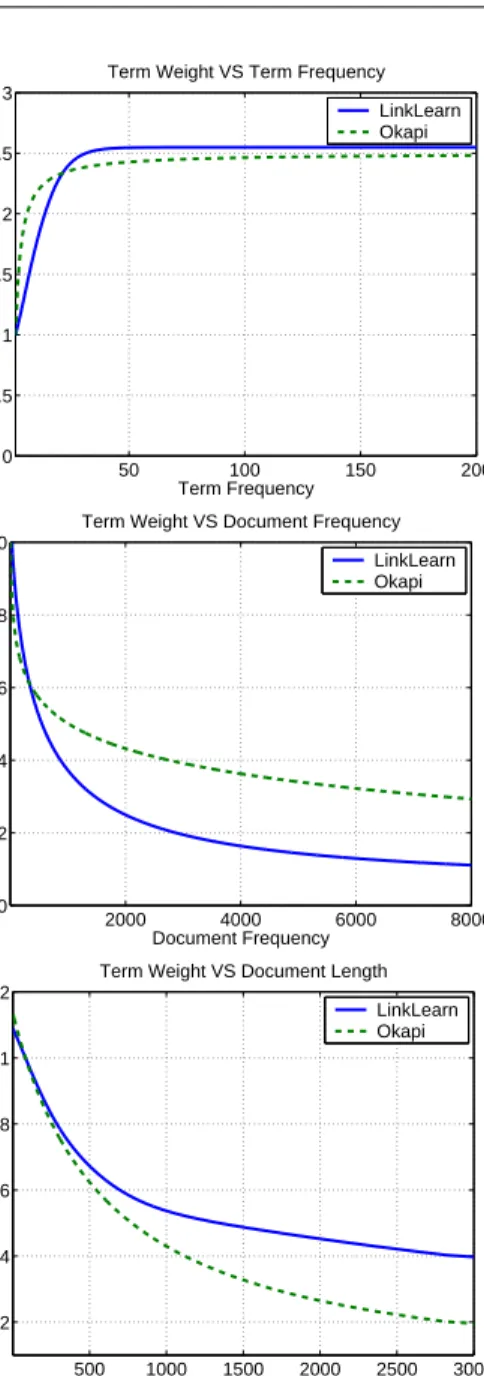
Traditionally, [Salton and Buckley, 1988; Robertson et al., 1994], the weighting function is hand-crafted to assign the highest weights to the terms that best describes the document content. Alternatively, LinkLearn introduces a para-metric weighting functiongw, whose parameters are learned from hyperlinked data.
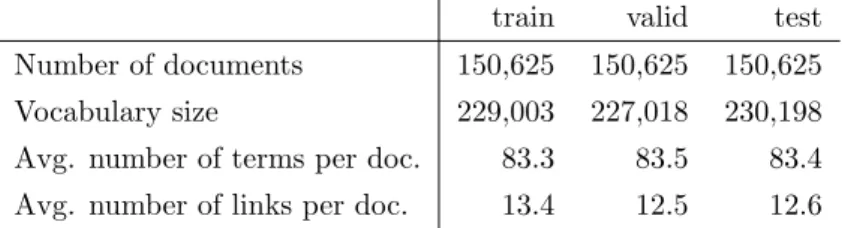
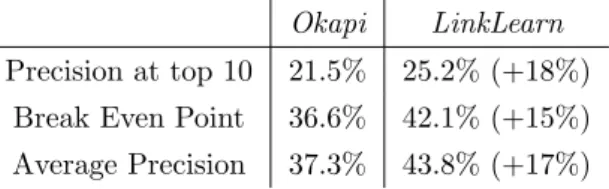
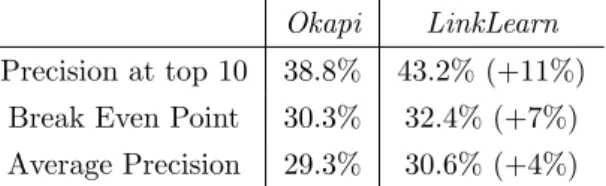
This approach has several advantages. First, the semantic relationships needed for training, hyperlinks, can be easily obtained without any additional labeling effort. For instance, the experiments presented in Section3.3 rely on the online encyclopediaWikipediato train our model. Second, the parameter-ization of LinkLearnallows for the use of fast techniques developed for sparse vector comparison (e.g. inverted index files [Harman et al., 1992]), and the model can hence be applied efficiently over large corpora (> 100,000 docu-ments). Finally, LinkLearn shows an empirical advantage when compared to state-of-the art weighting techniques, such as Okapi [Robertson et al., 1994]. For instance, we report +11% improvement for P10 when comparingLinkLearn
toOkapi over TREC-9 queries [Voorhees, 2000].
The remainder of this chapter is divided into four sections: Section3.1 intro-ducesLinkLearn, Section3.2relates our approach to previous work, Section3.3 presents the experiments and results and Section3.4draws some conclusions.
3.1 LinkLearn
LinkLearnaims at learning a measure of text similarity from a hyperlinked corpus. The learned model can then be applied to compare any text items, with or without hyperlinks. It can notably be used to compare documents and queries in the context of IR.
In the following, we first motivate the use of hyperlinks as an indicator of semantic proximity and present a brief overview of methods already taking ad-vantage of this characteristic. Then, we introduce the model parameterization and its training procedure.
3.1.1 Semantic Proximity of Hyperlinked Documents
The concept of hyperlink is inspired by encyclopedia cross-references: both provide authors with the possibility to refer to documents related to their writings. Even if hyperlinks may be used for other purposes (e.g. navigational links, advertising links, etc), it has been observed that they are mostly used for their primary goal [Davison, 2000]. This observation is also supported by previous research which relies on the semantic proximity of linked documents
LinkLearn 25
to improve the way document similarity is assessed.
In [Brin and Page, 1998], document expansion is performed using hyperlink information: the weight of a termiin a documentdis increased whenioccurs in documents pointing to d. This approach has shown to be especially useful in the case of short documents whose retrieval is difficult without these added terms [Brin and Page, 1998].
In [Richardson and Domingos, 2002], an alternative approach is adopted. The document/query similarity is computed iteratively relying on the following idea: the similarity between a document d and a query q should depend on the similarity between q and the documents linked with d. Hence, in this framework, a document which is connected to documents highly similar to q, will itself be assigned a higher similarity with respect to q. This approach extends of the PageRankalgorithm [Page et al., 1998] and hypothesizes that, among the documents having a content similar to the query, the most valuable are those which are referred to by the others.
Probabilistic Latent Semantic Analysis, PLSA [Hofmann, 2001], has also been extended to benefit from hyperlink data [Cohn and Hofmann, 2000]: a link to a document dis considered as a kind of additional termld and hence,
when computing document similarity, documents sharing pointers to the same references are considered closer.
The above approaches modify the way document similarity is computed, so that it considers linked web-pages as more likely to be about the same topic than unlinked ones [Davison, 2000]. Our proposed approachLinkLearnshares the same objective during training. However,LinkLearn aims at generalizing to non-hyperlinked data, and only relies on hyperlinks as indicators of semantic proximity for model learning. In that sense, our approach differs from previous work.
3.1.2 Model Parameterization
LinkLearn aims at identifying a parameter vectorw such that the measure of similarity
simw: (a, b)→simw(a, b),
generally considers linked documents closer than unlinked ones. For that pur-pose, this section introduces the parametric form of simw, while next section introduces the training procedure to selectw.
The parameterization of simwis inspired from ad-hoc approaches proposed for the vector space model, see Chapter 2. In LinkLearn, the similarity is