Aggregating Causal Judgments
! Richard Bradley LSE Franz Dietrich CNRS & UEA Christian List LSE April 30, 2014 AbstractDecision-making typically requires judgments about causal relations: we need to know the causal e§ects of our actions and the causal relevance of various environ-mental factors. We investigate how several individualsí causal judgments can be aggregated into collective causal judgments. First, we consider the aggregation of causal judgments via the aggregation of probabilistic judgments, and identify the limitations of this approach. We then explore the possibility of aggregating causal judgments independently of probabilistic ones. Formally, we introduce the problem of causal-network aggregation. Finally, we revisit the aggregation of probabilistic judgments when this is constrained by prior aggregation of qual-itative causal judgments.
1
Introduction
Decision making typically requires judgments about causal relations. Home owners need to know whether putting locks in their doors will make their houses more secure. Jurors need to know whether the accused is causally responsible for damages before they can assess whether he or she is legally responsible. Aid agencies need to know how the di§erent projects they can invest in will a§ect the lives of those they are concerned about; and so on. Opinions about the nature and strength of causal relations often di§er, even among experts. How to handle such diversity of opinion is the topic of this paper. We investigate the possibility of coherently aggregating di§erent causal judgments into a single one that may be applied to the decision problem at hand.
The basic set-up of this aggregation problem is the following. Individuals make judgments about both the nature of the causal relations between the variables in some set V = fV; W; :::g and the probabilities of these variables taking certain val-ues, unconditionally or conditionally on the values of other variables. The task is to
!Previous versions of this paper were presented at a Choice Group seminar at the LSE, 10/2006,
the 2006 conference of the Philosophy of Science Association, Vancouver, 11/2006, and the 2nd Philosophy of Biology at Dolphin Beach workshop, Kioloa, NSW, 8/2007. We thank the seminar and conference participants as well as two anonymous referees for very helpful comments and suggestions. This is a preprint of a paper published in Philosophy of Science 81(4): 491-515
DOI: 10.1086/678044
construct a single aggregate judgment on the causal relations between the variables and the relevant probabilities in a way that preserves, as much as possible, the in-formation contained in the individualsí judgments. For present purposes, we assume that individualsí judgments are coherent. More generally, one might allow (localized) incoherence in some of the individualsí judgments, or allow that individuals do not make judgments about all causal relations or all probabilities in question. Their judg-ments could be restricted to just certain variables relevant to the decision problem at hand, or further still, to just some subset of them or just one type of judgment: causal or probabilistic.
The causal judgments of individuals could be represented in a number of di§er-ent ways, but here we adopt the framework familiar from the work of Pearl [2000], Spirtes, Glymour, and Scheines [2000] (see also [1990]), and others, in which they are represented by Bayesian networks: directed acyclic graphs (DAGs) with associated conditional probabilities. We do not intend thereby to take a position on the nature of causal judgments, nor on the question of whether they can ultimately be analysed probabilistically.1 Anyone who holds the view that causal judgments are just features of probability judgments ñ for instance, that to judge thatX causesY is to hold cer-tain conditional probability judgments, such as that the conditional probability ofY
givenX exceeds its unconditional probability ñ is free to regard the Bayesian network representations as adding no information to the underlying probability judgments. In principle, we could also study the aggregation of causal judgments in another frame-work, for instance by representing causal judgments as counterfactual beliefs of the right kind.
A DAG represents an individualís qualitative judgment of causal relevance and irrelevance between variables. Her quantitative judgment of causal dependence is reáected in the associated conditional probabilities for the values of these variables, given the values of any variables on which they are directly causally dependent. The individualís unconditional probabilities for the values of the given variables can then be computed from their conditional probabilities together with the individualís un-conditional probabilities for the parent variables. Consider the following example, which we will use at various points in the discussion.
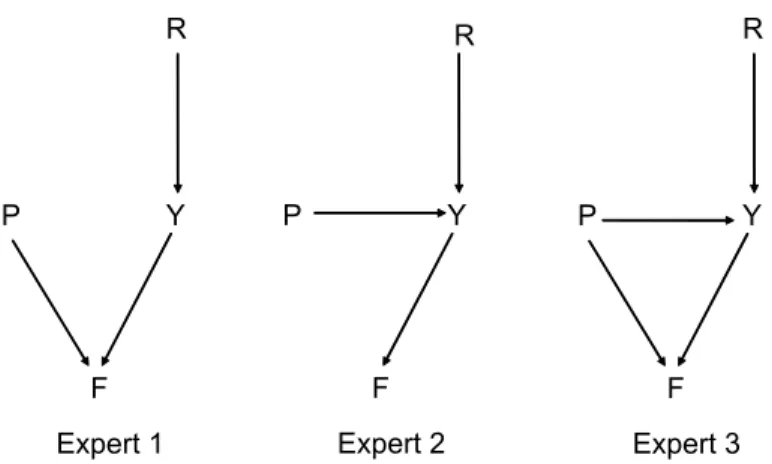
Example: Predicting famine. An aid agency wishes to do some advance planning for its famine relief operations and consults several experts in order to determine the risk of famine in a particular region. All agree that the relevant variables are
R: rainfall, Y: crop yields, P: political conáict, and of course F: famine. But they disagree both on the causal relations between the four variables and on the probabilities of the various values that these variables may take. All consider rainfall to be the main determinant of crop yield. However, while Expert 1 thinks that poor
1
R Y F P Expert 3 R Y F P Expert 2 R Y F P Expert 1
Figure 1: Expert causal judgments
crop yield and disruptive political conáict are the main causes of famine, Expert 2 thinks that the causal ináuence of political conáict on famine is indirect, via the e§ect of the disruption of agricultural production on crop yields. Expert 3 considers the relationship between political conáict and famine to be more complicated still, with political conáict both causing famine directly, by disrupting food distribution, and indirectly, through the ináuence on crop yields. These three opinions are represented in Figure 1 by a set of DAGs.
The fact that individuals make both causal and probabilistic judgments raises the question of whether aggregation of both kinds of judgments should be conducted all at once or in two stages. In Section 2, we focus on what we call one-stage aggrega-tion, in which only probability judgments are aggregated. This approach draws on the standard literature on probabilistic opinion pooling (as reviewed, e.g., by Genest and Zidek [1986]). It is motivated mainly by the thought that the probability judg-ments of individuals reáect their causal judgjudg-ments in various ways and hence that the problem of causal judgment aggregation may be solved by constraining probability aggregation so as to preserve the causal information contained in probability judg-ments. Our verdict on this possibility, however, is largely negative. In Sections 3 to 5, we therefore pursue an alternativetwo-stage approach, aggregating Örst the qualita-tive causal judgments represented by the DAGs (Section 3) and then the quantitaqualita-tive probabilistic ones (Sections 4 and 5), on the assumption that a consensus about the causal relations between variables has been reached. Our analysis builds on results from the literature on binary judgment aggregation, which combines ideas from social choice theory with ideas from logic.2
2
The formal logic-based analysis of binary judgment aggregation was introduced by List and Pettit [2002], [2004] and, in generalized form, by Dietrich [2007]. For a survey, see List and Puppe [2009].
2
One-stage aggregation
The problem of aggregating causal judgments has not received much attention, at least in the form presented here, but there is a vast literature on aggregrating expert opinions, mainly in statistics, and especially on aggregating expert probabilities. (As already mentioned, an excellent guide to that literature is the survey paper of Genest and Zidek [1986].) In this section, we draw on this literature to examine the possibil-ity of reasonable one-stage aggregation of several individualsí judgments. One-stage aggregation may be the only method available in cases in which individuals make no explicit causal judgments or their causal judgments are very incomplete. It is nat-ural, moreover, for those holding a probabilistic view about causation to rely on this method. But one-stage aggregation may also be motivated by the less controversial thought that the causal judgments of individuals are reáected in (even if they are not reducible to) the relations between the individualsí unconditional and conditional probabilities for the relevant events. If this is so, then even on a non-reductionistic view about causal judgments one may hope that probability aggregation could be con-strained in a manner which preserves the causal judgments implicit in probabilistic ones.
Broadly, there are three classical approaches to probability aggregation: linear pooling, geometric pooling, and supra-Bayesian approaches. The last approach is directed at a slightly di§erent problem to ours ñ namely that of how an individual expert should modify his judgments in the light of the expressed judgments of other experts ñ and so we can set it aside. The other two approaches assume that the expertsí opinions have reached an equilibrium state and that no further modiÖcation of their viewpoints will take place before the relevant decision has to be made.
Consider an opinion aggregation problem of the following form. A set ofevents is given (e.g., the event ìhigh political conáictî or ìlow political conáict and famineî), and the task is to merge the probability judgments of individuals 1; :::; n (the ìex-pertsî) on these events into an aggregate probability judgment on the events.3 So, we have to merge (individual) probability functions Pr1; :::;Prn into an (aggregate) probability functionPr. Many aggregation rules are imaginable. Formally, a proba-bility aggregation rule is a function that assigns to eachn-tuplehPr1; :::;Prni (called aproÖle) of individual probability functions an aggregate probability function Pr.
Of the various possible aggregation rules, linear pooling stands out for a variety of formal and conceptual reasons (e.g., Aczel and Wager [1980]; McConway [1981]; Lehrer and Wagner [1981]; and Dietrich and List [2007]). In particular, the following
3
Events can be identiÖed with subsets of a given set of possible worlds. In many formal results, the set of events considered (i.e., the domain of the individual probability functionsPr1; :::;Prnand the aggregate probability functionPr) forms analgebra: the negation (complement) of any event is also an event, and the disjunction (union) of any two events is an event too.
axiomatic argument can be given. Let us require the aggregation rule to satisfy two seemingly natural conditions:
Ind (Event-wise Independence) The aggregate probability of any given event X de-pends only on the individualsí probabilities of X (regardless of the individualsí probabilities of other events Y).4
ZP (Zero Preservation) The aggregate probability of any given eventXis zero when-ever all individuals give X zero probability.5
Applied to the event ìfamineî, for instance, Zero Preservation implies that famine is assigned an aggregate probability of zero if all individual experts assign a probability of zero to it. Event-wise independence implies that the aggregate probability of famine depends only on the probabilities that the individual experts assign to that event, not on the probabilities they assign to a certain level of crop yield, political conáict, etc. (This is not to deny, of course, that individuals form their judgments regarding famine in the light of their judgments on crop yield, political conáict etc.)
Perhaps surprisingly, the only aggregation rules satisfying these two conditions are linear pooling functions: the aggregate probability of any eventX is a (possibly weighted) arithmetic average of the individual probabilities ofX, i.e.,
Pr(X) =w1Pr1(X) +:::+wnPrn(X),
where the weights w1; :::; wn & 0 add up to one and are the same for all events X (Aczel and Wager [1980]; McConway [1981]).6 Examples of linear pooling functions are equal-weight averaging (w1 =:::=wn= 1=n) and dictatorial aggregation (some individualihas weightwi = 1 and all others have weight0).
The natural interpretation of these weights is in terms of judgmental competence, so that the choice of a particular linear pooling rule is dictated by considerations of the relative expertise of the individuals whose opinions are being sought. In this light, the fact that linear pooling rules assign weights to the opinions of individuals that are independent of the object of these opinions seems quite unsatisfactory, since individuals may be more or less expert on di§erent kinds of issues and it would seem natural to vary the weights on their opinions to reáect this. The aid agency would do well to consult climatologists, agriculturalists, and political scientists to reach a balanced view on the causes of famine, but in doing so it would be reasonable for it to give more weight to the climatologistsí probabilities for rainfall than to
4Formally, Pr(X) is a function of Pr
1(X); :::;Prn(X). This function may be a di§erent one for di§erent eventsX.
5Formally,Pr(X) = 0ifPr
1(X) =:::= Prn(X) = 0.
6
This result requires that the set of events considered forms an algebra (see footnote 3) and contains at least three events apart from the contradiction (empty set of worlds) and the tautology (set of all worlds). For a generalization, see Dietrich and List [2007].
the political scientistsí, but more weight to the political scientistsí probabilities for political conáict.7
Our main concern here, however, is with the question of whether linear pooling functions satisfactorily respect the causal knowledge of the individual experts. An in-dividualís causal judgments will be reáected in certain (unconditional or conditional) independencies in his or her probability judgments. For instance, if individual i be-lieves that events X and Y do not causally a§ect each other but have a common cause Z (and have no other common causes, except for those that a§ect X and Y
via Z), then he or she will takeX and Y to be probabilistically independent given
Z,8 because any probabilistic correlation betweenX and Y is ìscreened o§î by con-ditionalising on Z. A minimal requirement of respecting causal judgments is that at leastunanimously held causal judgments be reáected in the aggregate probability function Pr. That is, Pr should display at least those (conditional) independencies that are supported by unanimous causal judgments. For example, ifall individuals judgeXandY to be causally independent with common causeZ, then that indepen-dence judgment should be reáected in the aggregate probability function Pr. This motivates the following condition on probability aggregation:
IP (Independence Preservation) For any given eventsX; Y; Z, if all individuals judge
X and Y to be probabilistically independent given Z, then this conditional independence also holds under the aggregate probability function.9
Note that, by preserving all unanimous probabilistic independencies (conditional or unconditional), we may also preserve independencies that are not grounded in unanimous causal judgments. For instance, it may be that all individuals judge X
and Y to be independent given Z, but some do so on the grounds of judging that
X indirectly causesY throughZ, others on the grounds of judging thatY indirectly causesX throughZ, still others on the grounds of judging that X,Y, andZ are en-tirely causally disconnected. Even in this case of causal disagreement, Independence Preservation requires the preservation ofprobabilistic conditional independence. The purely probabilistic informational basis of one-stage aggregation does not allow us to distinguish between di§erent motivations (causal or other) behind probabilistic inde-pendencies. Without explicit causal information, all we can do is to use Independence Preservation to preserve all unanimous causal judgments, at the cost of preserving even those conditional independencies that are not causally motivated.
It turns out, however, that Independence Preservation is violated by all linear pooling functions (unless some individualigets maximal weightwi= 1) and thus by
7See Bradley [2000] for further discussion of this issue. On problems with the assignment of
di§erentiated expert rights, see also Dietrich and List [2008].
8
Formally,Pri(XYjZ) = Pri(XjZ) Pri(YjZ).
9
Formally, if, for all individuals i, Pri(Z) >0and Pri(XYjZ) = Pri(XjZ) Pri(YjZ), then also
all non-dictatorial probability aggregation rules satisfying Event-wise Independence and Zero Preservation. This fact, proven in Genest and Wagner [1984], can be il-lustrated using our earlier example.10 Suppose the aid agency consults a couple of experts in order to determine the risk of famine in a particular region and that both experts agree that famine is caused by a combination of drought (the event of rain-fall R below some critical threshold) and political instability (the event of political conáict P above some critical threshold), which undermines local solutions to poor crop yields. Furthermore, they agree that these two factors are both causally and probabilistically independent, at least in the short term. But they disagree on the probability of drought and of political instability. Since neither speaks with greater authority than the other, the aid agency calculates its probabilities for these events by taking the linear average of the judgments of the two experts.
Let D and I, respectively, denote the occurrence of drought and political insta-bility in the region andDI their concurrence. Let Pr1, Pr2, andPr, respectively, be the probability functions of Expert 1, Expert 2, and the aid agency. Since pooling happens by averaging, the aid agency will assign the following probabilities:
Pr(D) = Pr1(D) + Pr2(D)
2 , Pr(I) =
Pr1(I) + Pr2(I)
2 ,
Pr(DI) = Pr1(DI) + Pr2(DI)
2 =
Pr1(D) Pr1(I) + Pr2(D) Pr2(I)
2 ,
where the last identity uses the expertsí judgments that D and I are independent. These independence judgments are preserved if and only if Pr(DI) = Pr(D) Pr(I), i.e., if and only if
Pr1(D) Pr1(I) + Pr2(D) Pr2(I) 2 = Pr1(D) + Pr2(D) 2 ' Pr1(I) + Pr2(I) 2 .
By multiplying both sides of this equation by4, developing the product on the right-hand side, and simplifying, it follows that
Pr1(D) Pr1(I) + Pr2(D) Pr2(I) = Pr1(D) Pr2(I) + Pr2(D) Pr1(I) , Pr1(D)(Pr1(I))Pr2(I)) = Pr2(D)(Pr1(I))Pr2(I))
, (Pr1(D))Pr2(D))(Pr1(I))Pr2(I)) = 0.
The latter can hold only if Pr1(D) = Pr2(D) orPr1(I) = Pr2(I); i.e., if the experts
agree on the probability of drought or of political instability ñ which is not the case by assumption. So equal-weight linear pooling violates Independence Preservation. Similar violations can be constructed for non-equal weights (unless one individual i
gets maximal weightwi= 1).
1 0
Relatedly, Spirtes, Glymour, and Scheines [2000] observe that if we mix two or more probabil-ity distributions that each display certain conditional independence relations, the resulting mixture may fail to display those conditional independence relations. In particular, if we take two or more probability distributions that are each compatible with the same DAG (satisfying the causal Markov condition), their linear mixture may not be compatible with that DAG.
While we have focused on linear pooling as a way of aggregating probability judgments, the di¢culty with preserving causal insights at the aggregate level is a very general one. Genest and Wagner [1984] have shown that Independence Preservation is violated by many (linear or non-linear) probability aggregation rules, including geometric averaging, the most prominent alternative to linear averaging. Thus the di¢culty of preserving causal knowledge is not an artifact of requiring Event-wise Independence (a condition violated for instance by geometric averaging).
Genest and Wagner [1984] interpret this Önding as evidence that Independence Preservation is not a reasonable condition. We would not like to go so far. In our view, those unanimous independence judgments that are grounded in unanimous
causal judgments about the world should not be overruled. We take Genest and
Wagnerís impossibility Önding not as a reason to abandon the goal of preserving judgments of independence, but as a reason to move to a two-stage approach that explicitly takes qualitative causal judgments into account.
3
Two-stage aggregation: the qualitative stage
Under our proposed two-stage approach to aggregation, qualitative causal judgments are aggregated Örst, and quantitative, probabilistic ones only subsequently. Fur-thermore, the latter are aggregated in a way that di§ers from standard probability aggregation, namely in a way that is constrained by the qualitative causal judgments formed at the Örst stage. This two-stage approach will satisfy a version of Indepen-dence Preservation restricted to unanimously heldcausal independencies.
As before, let V = fV; W; :::g be a (Önite) non-empty set of variables. In our example of the aid agency above, V contains the variables R (rainfall), Y (crop yields), P (political conáict), and F (famine). How can we represent qualitative judgments on how the variables in V are causally interrelated? Let us introduce a binary predicate symbol c to represent a causal relevance relation on V, where, for any two variablesV and W inV, we write V cW to mean thatV is directly causally relevant to W. (For brevity, we speak of ìcausal relevanceî, but we mean ìdirect
causal relevanceî.11) In the case of the aid agency, an expert who thinks that rainfall is causally relevant to crop yield whereas political conáict is not would hold that
RcY but not thatP cY. A causal relevance relationcis calledacyclic if, for any Önite sequenceV1; V2; : : : ; Vk of variables in V, it is not the case that
V1cV2; V2cV3; : : : ; Vk!1cVk andVkcV1:
A causal relevance relationcinduces adirected graph whose vertices are the variables inVand whose edges (arrows connecting vertices) are deÖned as follows: for any two
1 1If we wanted to use our formal framework to capture indirect as well as direct causal relationships,
variables V and W inV, there is an edge from V in the direction of W if and only ifV cW. This graph is adirected acyclic graph (DAG) ifc is an acyclic relation.12
A Bayesian network is a DAG with associated conditional probabilities: each
variable in the graph is endowed with a conditional probability distribution given its parents in the graph. In this section, however, we set this quantitative information aside and focus on qualitative features of the DAG alone. In particular, we investigate how a group of individuals can arrive at an aggregate judgment on what the causal relevance relationc between the variables inV is.
Consider a group of nindividuals, labelled1,2, ..., n, each of whom holds a par-ticular judgment on the nature of the causal relevance relation between the variables in V. We write ci to denote the causal relevance relation according to individual
iís judgment. A combination of causal relevance relations across the n individuals is called aproÖle and denoted hc1; c2; :::; cni. A causal judgment aggregation rule is a function that assigns to each proÖle hc1; c2; :::; cni (in some domain of admissible proÖles) a single aggregate causal relevance relationc.
To give some examples of causal judgment aggregation rules, consider the class of threshold rules. A threshold rule, with threshold k (where 1* k*n), assigns to each proÖle hc1; c2; :::; cni the causal relevance relation c deÖned as follows: for any two variablesV and W inV,
V cW ,at leastkindividuals haveV ciW.
Examples of threshold rules are themajority rule (k= n+12 ), theunion rule (k= 1) and theintersection (or unanimity) rule (k=n).
Are these satisfactory causal judgment aggregation rules? It is easy to see that each of these three rules has a considerable defect. The majority and union rules fail to ensure acyclicity of the aggregate causal relevance relation, even when all individuals hold acyclic such relations. To see this, suppose the aid agency consults three experts, with the following individual judgments. They all agree that rainfall is causally relevant to crop yields, but they disagree on the causal relations between the other variables. Expert 1 thinks that crop yields are causally relevant to famine, which is causally relevant to political conáict. Expert 2 thinks that famine is causally relevant to political conáict, which is causally relevant to crop yields. Expert 3 thinks that political conáict is causally relevant to crop yields, which is causally relevant to famine. In consequence, the causal relevance relation generated by the majority rule violates acyclicity: the relation contains a cycle from crop yields to famines to political conáict to crop yields. It is obvious that the union rule has the same defect. The intersection (or unanimity) rule, by contrast, ensures acyclicity of the aggregate causal relevance relation, but may generate a sparse or even empty such relation, with few
1 2Note that our deÖnition of acyclicity also rules out cycles of lengthk= 1, i.e., we cannot have
variables deemed causally relevant to any others, whenever there are disagreements between the experts.
Although threshold rules are particularly salient examples of causal judgment aggregation rules, they are by no means the only ones. So let us adopt an axiomatic approach and look for rules satisfying certain conditions.
UD (Universal Domain) The causal judgment aggregation rule accepts as admissible any logically possible proÖle of acyclic causal relevance relations.
AC (Acyclicity) The aggregate causal relevance relation is always acyclic.
UB (Unbiasedness) For any two variables V and W inV, the aggregate judgment
on whether V is causally relevant to W depends only on individual judgments on whether V is causally relevant to W (the independence requirement), and the aggregation rule is neutral between whether or not this is the case (the
neutrality requirement).13
ND (Non-Dictatorship) There does not exist a Öxed individual such that, for every admissible proÖle of causal relevance relations, the aggregate causal relevance relation is the one held by that individual.
Although these conditions may seem natural at Örst sight, they are mutually inconsistent.
Theorem 1 If V contains three or more variables, there exists no causal judgment aggregation rule satisfying UD, AC, UB, and ND.
This result follows from an impossibility theorem by Dietrich and List [2010] concerning the aggregation of binary judgments on logically connected propositions. Qualitative causal judgments in the sense investigated here are simply binary (ìtrueî / ìfalseî) judgments on propositions of the form ìvariable V is (or is not) directly causally relevant to variable Wî, where di§erent such propositions constrain each other via the acyclicity constraint on causal relevance. For example, the set of propo-sitions fìV is directly causally relevant to Wî, ìW is directly causally relevant to
Uî, and ìU is directly causally relevant to Vîg is logically inconsistent relative to the acyclicity constraint. From the theory of judgment aggregation, we know that the aggregation of binary judgments on logically connected propositions is subject to a family of impossibility results broadly similar to Arrowís impossibility theorem on preference aggregation, as surveyed in List and Puppe [2009] and, more recently, List [2012]. Our present theorem belongs to this family of results. What are the possible escape routes from this impossibility?
1 3
Formally, for anyV andW inVand any admissible proÖleshc1; c2; :::; cniandhc!1; c!2; :::; c!ni, if [for alli,V ciWif and only if notV ci!W] then [V cW if and only if notV c!W]. This formal statement is slightly weaker than the informal one in the main text but implies it under UD and AC.
The Örst route: relaxing universal domain. We may use a causal judgment aggregation rule that accepts, as admissible input, not all logically possible proÖles of acyclic causal relevance relations, but only those that meet an additional structural condition: namely proÖles which, informally speaking, reáect a certain amount of co-hesion across di§erent individualsí causal judgments. The additional structural condi-tion on proÖles might be such that the majority rule, or perhaps some other threshold rule, never generates an aggregate causal relevance relation violating acyclicity. In this case, the majority rule or threshold rule in question could be employed on this restricted domain of admissible proÖles. We consider two structural conditions of this kind.
Temporal-order restriction. Suppose the individuals agree on the temporal order in which the events captured by the variables inVoccur. Suppose further they agree that a variable V can be causally relevant to another variable W only if V strictly precedesW in this temporal order. Call any proÖle of causal relevance relations that is consistent withsome such agreementtemporal-order restricted. Formally, a proÖle is temporal-order restricted if there exists some weak order of the variables in V (a reáexive, transitive, and connected binary relation onV) such that, for every pair of variablesV andW inV, if some individual judgesV to be causally relevant toW (i.e., someiholds V ciW) then V strictly precedes W in that order. For any such proÖle, the causal relevance relation generated by any threshold rule is acyclic, no matter how low or high the threshold is. The temporal constraint on what causal relevance judgments are deemed admissible guarantees the absence of any causal cycles at both the individual and aggregate levels.
Unidimensional alignment. Another structural condition on proÖles that ensures
acyclical causal judgments at the aggregate level ñ here under the majority rule (or any threshold rule with a higher threshold) ñ isunidimensional alignment (List [2003]; for generalizations, see Dietrich and List [2010]). A proÖle of causal relevance relations is calledunidimensionally aligned if the individuals can be linearly ordered from left to right such that, for each pair of variablesV and W inV, the individuals who hold that V is causally relevant to W (i.e., the individuals i with V ciW) are all to the left or all to the right of those who hold that V is not causally relevant to W (i.e., the individuals i who do not have V ciW).14 For any unidimensionally aligned proÖle, the causal relevance relation generated by the majority rule is acyclic and coincides with the causal relevance relation held by the median individual with respect to the left-right ordering of the individuals. (Or, if the number of individuals is even, it coincides with the intersection of the causal relevance relations held by the two median individuals.)
1 4This allows that, for some pairs of variables, the individuals a¢rming causal relevance are to the
It is an empirical question whether a group of experts ñ either before or after a period of joint deliberation ñ exhibits su¢cient agreement in their causal judgments to meet the condition of temporal-order restriction or that of unidimensional align-ment. The kind of temporal agreement required for temporal-order restriction seems empirically plausible at least in some situations.
The second route: relaxing acyclicity. A logically possible way to avoid the impossibility result of Theorem 1 is to give up the requirement that the aggregate causal relevance relation be acyclic. This, however, would constitute a major depar-ture from the consensus on the nadepar-ture of causal relations, which are widely held to be acyclic (Pearl [2000]).
The third route: relaxing unbiasedness. We may use a causal judgment ag-gregation rule that violates the condition of unbiasedness. There are two ways of relaxing this condition.
A neutrality relaxation. If we relax the neutrality part of unbiasedness, there can exist pairs of variables V and W in V such that the aggregation rule is not neutral between whether or notV is causally relevant to W. Examples of causal judgment aggregation rules violating neutrality are threshold rules with any thresholdkdi§erent from simple majority. It can be shown that a threshold rule is guaranteed to generate an acyclic causal relevance relation if and only if the thresholdkexceeds mm!1n, where
mis the number of variables in V.
Let us explain why this constraint on the threshold is su¢cient to ensure acyclicity. Suppose, for a contradiction, that a threshold rule with a threshold k above mm!1n
generates a cyclical causal relevance relation. There must then exist an admissible proÖlehc1; c2; :::; cni of individually acyclic causal relevance relevance such that
V1cV2; :::; Vm0!1cVm0; and Vm0cV1;
where c is the aggregate causal relevance relation and V1, V2, ..., Vm0 are distinct
variables inV, with 2*m0 *m.15 Given the deÖnition of our threshold rule, there must be at leastkindividuals withV1ciV2; at leastk individuals withV2ciV3; and so on. LetN1, N2, ...,Nm0 be the sets of individuals iwith V1ciV2; V2ciV3; ..., Vm0cV1,
respectively. Sincekexceeds mm!1n, each of these sets must contain more than mm!1n
individuals. But, for combinatorial reasons, any m or fewer subsets of size greater than mm!1n from a set of n individuals must have a non-empty intersection. For example, any two or fewer subsets of size greater than 12n must have a non-empty intersection; any three or fewer subsets of size greater than 23nmust have a non-empty
1 5Aggregate cycles of length1(whereV cV for some variableV inV) could never occur under any
intersection; and so on. Sincem0 *m, this implies that there must exist at least one individualiwho is contained in all ofN1,N2, ...,Nm0, and he or she must then have
V1ciV2; :::; Vm0!1ciVm0; and Vm0ciV1:
But this contradicts individual acyclicity, which completes the argument.
Conversely, if the thresholdk does not exceed mm!1n, it becomes possible to con-struct an admissible proÖlehc1; c2; :::; cni of individually acyclic causal relevance re-lations such that, for some set of distinct variablesV1,V2, ..., Vm0, each of V1cV2, ...,
Vm0!1cVm0, and Vm0cV1 is a¢rmed by k or more individuals. For such a proÖle, the
intersection of the relevant setsN1,N2, ..., Nm0 is empty, and hence the presence of
a cycle in the aggregate causal relevance relation does not conáict with acyclicity in the individual relations. Formally, our necessary and su¢cient condition for acylicity (namely a threshold k above mm!1n) can be derived from a characterization of con-sistent (but possibly incomplete) quota rules in judgment aggregation (Dietrich and List [2007]; the present combinatorial argument builds on a result in List [2001], ch. 9).
Note that if the set of variablesV is inÖnite, only the intersection (or unanimity) rule guarantees acyclicity at the aggregate level. However, if V is Önite, then a supermajority rule with a suitably high threshold is su¢cient. A problem with this approach, as noted above, is that it may lead to sparse or even empty aggregate causal relevance relations unless the disagreement between experts is limited.
An independence relaxation. If we relax the independence part of unbiasedness,
there can exist pairs of variables V and W in V such that the aggregate judgment on whetherV is causally relevant toW depends not only on individual judgments on whetherV is causally relevant toW but also on individual judgments involving other variables. Examples of causal judgment aggregation rules violating independence are
sequential priority rules (adapted from List [2004]) anddistance-based rules (adapted from Pigozzi [2006] and Miller and Osherson [2009]). Under a sequential priority rule, the di§erent possible pairs of variables are considered one by one in a given order (which may be chosen, for example, by some criterion of epistemic priority). On each pair of variablesV; W, the aggregate judgment is then determined as follows:
(i) If the question of whether V is causally relevant to W is constrained (in light of the acyclicity requirement) by the aggregate judgments on pairs of variables considered earlier in the given order, then the aggregate judgment onVís causal relevance to W is derived from those earlier constraints.
(ii) If it is not constrained in this way, then the aggregate judgment on Vís causal relevance to W is made by applying some voting method, such as majority voting, to the individual judgments on V vis-‡-vis W.
This approach guarantees acyclicity of the aggregate causal relevance relation, but at the expense of path-dependence: the order in which causal judgments are made on di§erent pairs of variables may determine what the aggregate causal relevance relation will look like. An agenda setter on a committee of experts may strategically exploit this feature of the causal judgment aggregation rule by proposing an order of priority among di§erent pairs of variables that is likely to give rise to aggregate causal judgments that he or she wants the committee to make.
Under a distance-based rule, we Örst deÖne a distance metric between causal relevance relations. For instance, we could deÖne the distance between two relations
candc0to be the number of ordered pairs of variablesV; W on whichcandc0disagree, i.e.,d(c; c0) =jf(V; W)2V2 :V cW <V c0Wgj. (This is the Hamming distance.) We then deÖne the aggregate causal relevance relation for any given proÖlehc1; c2; :::; cni as an acyclic causal relevance relationc that minimizes the total distance from the individual causal relevance relations, i.e., where Pi=1;:::;nd(c; ci) is minimal. Since there need not be a unique such distance-minimizing relation c, we may require an additional rule for breaking ties. Distance-based rules can be interpreted as generating compromise causal relevance relations.
In some cases, a rather signiÖcant departure from independence (as a property of the aggregation rule) may be desirable. Suppose, for instance, that all individuals agree that there is a causal path from V1 to V2, but di§erent individuals disagree
about the intermediate variables along this path. Some think that the path goes fromV1 toV3 toV2; others think it goes fromV1 toV4 toV2; still others think it goes fromV1 toV5 toV2; and so on. In such a case, no single causal link between any pair
of variables is accepted by more than a small minority of the individuals. If we used a causal judgment aggregation rule satisfying independence, say a threshold rule with a majority or even sub-majority threshold, we could end up with an empty aggregate causal relevance relation here, without any causal links at all. This would fail to do justice to the fact that all individuals agree thatV1 is at least indirectly causally
relevant to V2. We do not o§er a concrete proposal on how to handle such cases,
but mention it in order to illustrate why a signiÖcant relaxation of independence may sometimes be justiÖed.16
The fourth route: relaxing non-dictatorship. A Önal way to avoid the impos-sibility result of Theorem 1 is to allow the aggregate causal relevance relation to be determined by an antecedently Öxed individual: a ìdictatorî. But since we are nor-mally interested in the information contained in the causal judgments of more than one individual, this is not generally an attractive solution to our aggregation problem. Sometimes, however, it may be an acceptable compromise to appoint a trusted expert as the ìdictatorî for arriving at qualitative causal judgments ñ in the form of a DAG
1 6
ñ while continuing ìdemocraticallyî when it comes to determining the associated quantitative probability information at the second stage of our two-stage approach.
Concluding remark Which of the di§erent possible escape routes from the impos-sibility result of Theorem 1 is compelling depends on details of the decision problem at hand, the nature of the disagreements between the experts, the level of trust we place in them, whether we are worried about possible agenda manipulation, and other factors. In the next section, we assume that through one of the identiÖed routes ñ excluding that of relaxing acyclicity ñ a ìconsensusî on a causal relevance relation and thereby on a DAG has been achieved, and we turn to the question of how the associated conditional probabilities can be determined.
4
Preliminaries to the quantitative stage
We have analysed how a group can arrive at an aggregate judgment on the qualitative causal relations between variables. We now assume that such an aggregate causal judgment has been reached through one of the routes just discussed and suppose that the group seeks to make an aggregate probability judgment (about the variables taking various values) that is compatible with the given aggregate causal judgment.
In its most general form ñ ignoring for the moment the causal judgment ñ a prob-ability judgment can be represented by a joint probprob-ability function over the variables inV. For simplicity, we assume that each variable can take Önitely, or countably in-Önitely, many possible values. For example, we may distinguish between a particular number of possible levels of conáict. Let us label the variables V1; :::; Vm. A joint probability function Prassigns a probability Pr(v1; :::; vm) &0 to each combination
(v1; :::; vm) of values of these variables, where the sum of the probabilities is 1. The joint probability Pr(v1; :::; vm) can be factorised into the product of condi-tional probabilities:17 Pr(v1; :::; vm) = Pr(v1) Pr(v2jv1) Pr(v3jv2; v1)- - -Pr(vmjvm!1; :::; v1) = m Y j=1 Pr(vjjv1; :::; vj!1): (1)
In our famine example, where V1; V2; V3; V4 are the levels of rainfall, crop yield,
po-1 7In this expression, the conditional probability Pr(v
jjv1; :::; vj#1) can be derived from the joint
probability functionPrvia the formula Pr(vjjv1; :::; vj#1) =
Pr(v1;:::;vj)
Pr(v1;:::;vj!1) (wherePr(v1; :::; vj) and
Pr(v1; :::; vj#1) are marginal probabilities derived fromPr), provided that Pr(v1; :::; vj#1) 6= 0. If
Pr(v1; :::; vj#1) = 0, thenPr(vjjv1; :::; vj#1)can be viewed either as undeÖned or as a primitive not
derived from the functionPr. Under both interpretations, the factorisation(1)is still possible even if somePr(v1; :::; vj#1)is zerowhatever value is substituted forPr(vjjv1; :::; vj#1)(because some other
litical conáict, and famine, we have
P(v1; v2; v3; v4) =P(v1)P(v2jv1)P(v3jv1; v2)P(v4jv1; v2; v3).
When is the probability judgment expressed byPrcompatible with a given causal judgment? Recall that a causal judgment takes the form of a particular directed acyclic graph (DAG) over the variables V1; :::; Vm, with an arrow from Vj toVk just in caseVj is considered causally relevant toVk(VjcVk). For any variableVj, we write
P A(Vj) to denote the list of Vjís parent variables in the graph, and we write pa(Vj) to denote any list of values of these parent variables.18
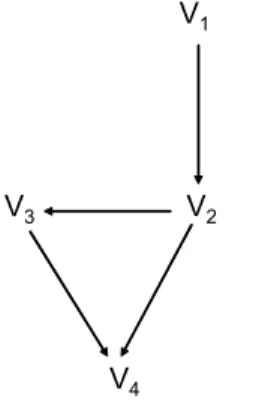
For instance, suppose that the consensus DAG in our famine example is as shown in Figure 2: no variable is causally relevant to rainfall (V1); only rainfall (V1) is
causally relevant to crop yield (V2); only crop yield (V2) is causally relevant to political
conáict (V3); but both crop yield (V2) and political conáict (V3) are causally relevant to famine (V4). Then P A(V1) contains no variable, P A(V2) contains precisely V1, P A(V3)contains precisely V2, and P A(V4) contains both V2 and V3.
V2
V4
V1
V3
Figure 2: An illustrative aggregate causal judgment in the famine example
Without loss of generality, suppose the variables V1; :::; Vm are labelled such that those with no parent come Örst, those with a parent but no grandparent come next, those with a grandparent but no great-grandparent come thereafter, and so on. If the original labelling V1; :::; Vm does not have this property, we can simply relabel the variables appropriately and replace the factorisation (1) by one using the new labelling. So the parents of any variableVj come before Vj.19 But of course not all ofV1; :::; Vj!1 need to be causally relevant toVj. For instance, in our famine example
V2 but notV1 is (directly) causally relevant to V3. Since causally irrelevant variables
should have no e§ect onVj, the conditional probability Pr(vjjv1; :::; vj!1) should be insensitive to the non-parental values amongv1; :::; vj!1. In other words, it should be
1 8So pa(V
i)is any instantiation ofP A(Vj).
1 9
sensitive only to the sublistpa(Vj)of v1; :::; vj!1. Formally,
Pr(vjjv1; :::; vj!1) = Pr(vjjpa(Vj)). (2) We say that the probability judgmentPriscompatiblewith the given aggregate causal judgment if identity (2) holds for every variable Vj and every combination of values
v1; :::; vj with Pr(v1; :::; vj!1) 6= 0. (This compatibility requirement is the ordered
Markov condition, which is, in turn, equivalent to the parental Markov condition: any variable is independent of its non-descendants given its parents.20) The joint probability(1) then reduces to
Pr(v1; :::; vm) = m
Y
j=1
Pr(vjjpa(Vj)). (3)
For instance, in our famine example,
P(v1; v2; v3; v4) =P(v1)P(v2jv1)P(v3jv2)P(v4jv2; v3).
5
Two-stage aggregation: the quantitative stage
As we seek to reach an aggregate probability judgment that is compatible with the aggregate causal judgment, the probability function Prshould satisfy the decompo-sition (3). This requirement is usually violated by standard, one-stage probability aggregation, where the individual probability functions
Pr1(v1; :::; vn); :::;Prn(v1; :::; vn) (4) are directly merged into an aggregate probability function Pr(v1; :::; vn). On our proposed two-stage approach, by contrast, Pris explicitly constructed so as to meet the necessary decomposition requirement.
Let the aggregate causal relevance relation (the ìconsensusî DAG) be given, and consider the decomposition constraint(3) relative to that relation. The quantitative stage of our approach now consists in
(i) determining each factor of the decomposition,Pr(vjjpa(Vj)), through separate probability aggregation, and
(ii) computing the joint probability function Pr(v1; :::; vm) as the product of these separately determined factors.
2 0
There are multiple equivalent ways to deÖne ìcompatibilityî ofPrwith the DAG. In addition to the ordered Markov condition and the parental Markov condition, a third deÖnition (chosen by Pearl) is given in terms of the validity of the decomposition(3). On the equivalence of these deÖnitions, see Theorems 1.2.6 and 1.2.7 in Pearl [2000].
More formally, foreveryvariableVjinVandevery combinationpa(Vj)of parental values, we merge the individual conditional probability functions
Pr1(vjjpa(Vj)); ::;Prn(vjjpa(Vj)) (5) into an aggregate conditional probability functionPr(vjjpa(Vj)). These separate ag-gregation exercises can each be performed, for example, by linear or geometric pooling. In our famine example, this involves
merging Pr1(v1); ::;Prn(v1) into Pr(v1);
for any Öxedv1, merging Pr1(v2jv1); ::;Prn(v2jv1) into Pr(v2jv1);
for any Öxedv2, merging Pr1(v3jv2); ::;Prn(v3jv2) into Pr(v3jv2); for any Öxedv2; v3, merging Pr1(v4jv2; v3); ::;Prn(v4jv2; v3) into Pr(v4jv2; v3).
(6) The present approach has several distinctive properties, to which we now turn.
Compatibility with causal judgments. The aggregate probability functionPr, given by (3), is automatically compatible with the aggregate causal relevance re-lation, represented by the appropriate DAG. In particular, Pr respects the causal Markov condition: any variable Vj is probabilistically independent of all its causal non-descendants given its causal parents. In our famine example,Prmakes political conáict independent of rainfall conditional on crop yield,21 and famine independent of rainfall conditional on crop yield and political conáict.22 The causally motivated conditional independencies are thus respected, whereas other conditional independen-cies may or may not arise. By contrast, standard one-stage probability aggregation does not generally produce an aggregate probability judgment that is consistent with any prior judgments of causal relevance.
Preservation of causal (conditional) independencies. What about the preser-vation of unanimously held independencies between variables (both conditional and unconditional ones)? Suppose, for example, that all individuals consider variables
Vj and Vk probabilistically independent given Vl.23 Does the aggregate probability judgment preserve this conditional independence? As we have seen, for standard probability aggregation methods the answer is usually negative. Under our approach, by contrast,causal conditional independencies are preserved. To see why, suppose all individuals judgeVj andVkto be probabilistically independent givenVl because of a unanimous agreement thatVjís only causal parent is Vl and that Vk is not a causal descendant of Vj. Then the aggregate probability judgment respects this indepen-dence: according toPr,Vj and Vk are also probabilistically independent given Vl.24
2 1 Formally,Pr(v1; v3jv2) = Pr(v1jv2) Pr(v3jv2). 2 2Formally,Pr(v 1; v4jv2; v3) = Pr(v1jv2; v3) Pr(v4jv2; v3). 2 3 Formally,Pri(vj; vkjvl) = Pri(vjjvl) Pri(vkjvl). 2 4 Formally,Pr(vj; vkjvl) = Pr(vjjvl) Pr(vkjvl):
The reason is that, so long as a ìreasonableî causal judgment aggregation rule is used at the Örst stage of our two-stage process, we will have arrived at an aggregate causal relevance relation that reáects the unanimous opinion on the causal relations between
Vj; Vk; Vl; the second stage then leads to a probability function that is compatible with this aggregate causal relevance relation.25
Variable expert weights In contrast to one-stage linear or geometric pooling of probabilities, our approach is compatible with the assignment of di§erent weights to di§erent expertsí judgments so as to reáect their di§erent levels of competence on the relevant issues. Once the consensus DAG for the causes of famine is given, for instance, greatest weight can be assigned to the climatologistís judgment in the aggregate probability for rainfall (Pr(v1)), to the agriculturalistís judgment in the
aggregate conditional probability for crop yield, given a level of rainfall (Pr(v2jv1)), and to the political scientistís judgment for the aggregate conditional probability for political conáict, given crop yields (Pr(v3jv2)). In the limit, an aggregate judgment on the probability of famine might be constructed using only the consensus DAG and the judgments of the relevant expert on each variable. But as the literature on epistemic democracy shows, there can be advantages to consulting a range of opinions provided that all who are consulted are su¢ciently competent. Instead, the two-stage method can be used to optimise the balance between competence and diversity of opinion by suitable assignment of weights in the aggregation of probabilities for each variable.
Complexity reduction. Our two-stage approach subdivides an m-dimensional probability aggregation problem into several one-dimensional ones. Rather than ag-gregating joint probability functions over the vector V1; :::; Vm (of the form (4)), we aggregate conditional probability functions of a single variable Vj (of the form (5)). But we face several such aggregation problems, namely one for each variableVj and each Öxed combination of parent valuespaj(Vj). This is less demanding on the side of individual inputs, as long as the aggregate DAG is not too rich in causal connec-tions. To illustrate this complexity reduction, consider our famine example again, and suppose for simplicity that each variable can take only two values, i.e., there are only two levels of rainfall, two levels of crop yield, and so on. If we were to aggregate the joint probability functions Pri(v1; v2; v3; v4) directly, each individual would have
2 5
Note that unanimously held conditional independencies that are not causal (i.e., which are not implied by the structure of the DAG, together with the Markov condition) are not generally preserved under our approach. However, in the important special case in which all individuals hold the same DAG (i.e., the causal structure is not in dispute) and satisfyfaithfulnessin relation to their probability judgments, there will not be any unanimously held independencies between variables (conditional or unconditional) that are not implied by the DAG, and hence all such unanimous independencies will be preserved in the aggregation (assuming the unanimous DAG is also the aggregate DAG). We are grateful to an anonymous referee for pressing this point.
to submit24)1 = 15probability values (there are24 possible combinations of values
(v1; v2; v3; v4), but once the probabilities of24)1of them are speciÖed, the remaining
probability is given by one minus the sum of the rest). Specifying any one of these 15 probabilities is hard in practice: what, for example, is the probability of a combi-nation of high rainfalland low crop yieldand low political conáictand high famine? Under our approach, by contrast, each individual has to submit only probabilities or conditional probabilities ofsingular events, like the probability of high rainfall or the conditional probability of high crop yield given low rainfall. The number of required probabilities is smaller than 15 in our example. Using(6), we can see that it equals
4 X
j=1
ìnumber of possible values ofVj minus 1î 'ìnumber of possible parent valuespa(Vj)î
= (2)1)'1 + (2)1)'2 + (2)1)'2 + (2)1)'22 = 1 + 2 + 2 + 4 = 9.
Types of informational input. Our approach not only reduces the complexity of the aggregation problem; it also uses a di§erent informational input, compared to one-stage probability aggregation. First, we use the additional information of the individualsí qualitative causal judgments ñ the information aggregated at the Örst stage of our two-stage process. Second, an interesting question arises about the nature of the probabilistic input used at the second stage. Consider a variableVjwith parents
P A(Vj) in the aggregate causal relevance relation (DAG). Since that relation is the result of the aggregation of individual causal relevance relations, some individuals may not agree that the variables listed in P A(Vj) are the correct causal parents of
Vj. They may think instead that not all of these variables are causally relevant to
Vj or that some other variables are relevant, despite not being included in P A(Vj). But then, what does such an individualís conditional probability Pri(vjjpa(Vj)) ñ the informational input at the second stage ñ represent? For instance, individual 1ís causal relevance relation may be of the form V1 ! V2 ! V3, while all other
individualsí causal relevance relations may be of the form V1 ! V2 V3, which might then also become the aggregate relation. Here, individual 1 disagrees with everyone else about both P A(V2) and P A(V3): How should we interpret individual 1ís conditional probabilitiesPr1(v2jpa(V2))and Pr1(v3jpa(V3))at the second stage of
our two-stage aggregation process? Similarly, what is someone supposed to answer to the question ìhow probable is high political conáict given low crop yield?î if he or she actually thinks that famine rather than crop yield is causally relevant to political conáict?
There are at least three possible interpretations of an individualís conditional probabilities in such cases: an evidential, acausal, and a hypothetical one. We begin
with a discussion of the Örst two interpretations. To give an informal example, sup-pose for a moment that, according to individualiís qualitative causal judgment, the variables in P A(Vj) are not causally relevant to Vj but nonetheless probabilistically
correlated withVj. Then, if Pri(vjjpa(Vj))represents an evidential conditional prob-ability, its value is sensitive topa(Vj) (by probabilistic dependence), whereas if it is understood as a causal conditional probability, its value does not depend on pa(Vj) (by causal independence). More generally, an evidential conditional probability repre-sents an agentís belief, given a particularevidential supposition (here the supposition that the values of the variables in P A(Vj) are pa(Vj)). A causal conditional proba-bility represents an agentís belief, given a particular counterfactual supposition (its content again being that the values of the variables inP A(Vj)arepa(Vj)). This causal conditional probability can be understood as resulting from supposing an external in-tervention in our system that sets the values of the variablesP A(Vj) topa(Vj). The two kinds of conditional probability take the same value ifP A(Vj)consists of the cor-rect causal parents according to individual iís qualitative causal judgment, but may di§er in general.
Formally, in the evidential case, Pri(vjjpa(Vj)) is a standard conditional proba-bility, which can be derived from individual iís joint probability function over the variables using Bayesís rule.26 In the causal case, Pri(vjjpa(Vj)) can be calculated as follows (and is sometimes denotedPri(vjjjpa(Vj)) or Pri(vjnpa(Vj)) to mark the di§erence; see also Pearl [2000]).
(i) Modify individual iís causal relevance relation by deleting relevance links from any variable to any of the variables inP A(Vj). So, the variables inP A(Vj)have no parents left (intuitively, they are set by an external intervention).
(ii) Modify the probability assignment to the variablesP A(Vj)by letting them take the valuespa(Vj)with probability one (unconditionally, since these variables no longer have any parents).
(iii) Relative to this new ìpost-interventionî Bayesian network, compute the prob-ability that Vj takes the value vj in the usual way. This probability then co-incides with the causally understood conditional probability Pri(vjjpa(Vj))(=
Pri(vjjjpa(Vj))) of the initial Bayesian network.27
2 6Provided thatPr (pa(V
j))6= 0.
2 7
To be precise, this causal conditional probability measures the possibly indirect causal e§ect of the variablesP A(Vj)onVj, according to individualiís judgment. There may be such an e§ect even if none of the variables in P A(Vj) are directly causally relevant to Vj according to individual iís DAG, sinceVj may depend on these variables indirectly. Note that P A(Vj) contains the parents ofVj according to the aggregate DAG; these need not be parents of Vj according to individualiís DAG. If we wanted to deÖne adirect causal conditional probability of vj, givenpa(Vj), according to individual iís DAG, we would have to re-do the calculation described in steps (i) to (iii) with the set of variablesP A(Vj) replaced by its subset consisting only of variables that are also parents
Let us now turn to the third possible interpretation of the individualsí conditional probabilities submitted at the second stage of our two-stage aggregation process: the
hypothetical interpretation. Here, individuals are asked to entertain the hypothesis that the aggregate causal relevance relation is correct and to express conditional probabilities based on this hypothesis. It is unclear, however, whether and how
Pri(vjjpa(Vj))can be derived from the individualsí Bayesian networks. This raises a number of challenges for future research.
6
A Önal challenge
The Örst stage of our two-stage approach restricts the second by requiring the ag-gregate probability function to display certain conditional independencies mandated by the aggregate causal relevance relation. Roughly, the fewer causal links are ac-cepted at the Örst stage, the more probabilistic independencies are enforced at the second stage. In the extreme case in which no variable is deemed causally relevant to any other variable, the second stage produces an aggregate probability judgment according to which every variable is probabilistically independent of every other. Ac-cepting few causal connections has the advantage of reducing the complexity of the probability aggregation problem at the second stage but the potential disadvantage of over-restricting the admissible probability assignments. This restriction is prob-lematic when the sparse set of accepted causal links between variables is not a result of the individuals believing in sparse causal links but a result of a causal judgment aggregation rule setting a high threshold for the acceptance of causal links.
We are thus faced with a trade-o§ between (i) the goal of reducing the complexity of the probability aggregation problem (achieved via a high threshold for accepting causal links between variables) and (ii) the goal of representing causal e§ects between variables when there are such e§ects (achieved via a low threshold for accepting causal links). We have argued that a high threshold for accepting causal links may help to prevent a cyclical aggregate causal relevance relation, whereas in other situations, particularly if the variables can be put into a temporal order, even a low threshold (perhaps lower than the majority threshold) guarantees acyclicity. We leave it as a challenge for future research to come up with causal judgment aggregation rules that perform well on both aspects of this trade-o§: being neither too permissive nor too restrictive in accepting causal links while avoiding cyclical causal judgments.
ofVj according toiís DAG. This subset may be empty, in which case thedirect causal conditional probability ofvj, givenpa(Vj), coincides with the unconditional probability ofvj.
References
[1980] AczÈl, J., and C. Wagner. 1980. ìA characterization of weighted arithmetic means.îSIAM Journal on Algebraic and Discrete Methods 1: 259-260. [2007] Bradley, R. 2007. ìReaching a Consensus.î Social Choice and Welfare 29(4):
609-632.
[2007] Dietrich, F. 2007. ìA generalised model of judgment aggregation.î Social
Choice and Welfare 28(4): 529-565.
[2007] Dietrich, F., and C. List. 2007. ìJudgment aggregation by quota rules: major-ity voting generalized.îJournal of Theoretical Politics 19(4): 391-424.
[2008] Dietrich, F., and C. List. 2008. ìA liberal paradox for judgment aggregation.î
Social Choice and Welfare 31(1): 59-78.
[2010] Dietrich, F., and C. List. 2010. ìThe impossibility of unbiased judgment ag-gregation.îTheory and Decision 68(3): 281-299.
[2010] Dietrich, F., and C. List. 2010. ìMajority voting on restricted domains.î
Jour-nal of Economic Theory 145(2): 441-466.
[2007] Dietrich, F., and C. List. 2007. ìOpinion pooling on general agendas.î Working paper, London School of Economics.
[1984] Genest, C., and K. Wagner. 1984. ìFurther Evidence against Independence Preservation in Expert judgment Synthesis.îTechnical Report 84-10, Dept. of Statistics and Actuarial Science, University of Waterloo.
[1986] Genest, C., and J. V. Zidek. 1986. ìCombining Probability Distributions: A Critique and Annotated Bibliography.îStatistical Science 1(1): 113-135. [1981] Lehrer, K., and C. Wagner. 1981.Rational Consensus in Science and Society,
Dordrecht: Reidel.
[2001] List, C. 2001.Mission Impossible? The Problem of Democratic Aggregation in the Face of Arrowís Theorem. DPhil thesis, Oxford University.
[2002] List, C., and P. Pettit. 2002. ìAggregating sets of judgments: an impossibility result.îEconomics and Philosophy 18(1): 89-110.
[2004] List, C., and P. Pettit. 2004. ìAggregating sets of judgments: two impossibility results compared.îSynthese 140(1-2): 207-235.
[2003] List, C. 2003. ìA Possibility Theorem on Aggregation over Multiple Proposi-tions.îMathematical Social Sciences 45(1): 1-13; see also the corrigendum in
[2004] List, C. 2004. ìA Model of Path-Dependence in Decisions over Multiple Propo-sitions.îAmerican Political Science Review 98(3): 495-513.
[2012] List, C. 2012. ìThe theory of judgment aggregation: An introductory review.î
Synthese 187(1): 179-207.
[2009] List, C., and C. Puppe. 2009. ìJudgment aggregation: a survey.î In Oxford
Handbook of Rational and Social Choice, ed. P. Anand, C. Puppe, and P.
Pattanaik, 457-482, Oxford: Oxford University Press.
[1981] McConway, K. J. 1981. ìMarginalization and Linear Opinion Pools.îJournal of the American Statistical Association 76(374): 410-414.
[2009] Miller, M. K., and D. Osherson. 2009. ìMethods for distance-based judgment aggregation.îSocial Choice and Welfare 32(4): 575-601.
[2006] Pauly, M., and M. van Hees. 2006. ìLogical constraints on judgment aggrega-tion.îJournal of Philosophical Logic 35(6): 569-585.
[2000] Pearl, J. 2000.Causality: Models, Reasoning and Inference. Cambridge: Cam-bridge University Press.
[2006] Pigozzi, G. 2006. ìBelief merging and the discursive dilemma: an argument-based account to paradoxes in judgment aggregation.îSynthese 152(2): 285-298.
[1990] Glymour, C., P. Spirtes, and R. Scheines. 1990. ìIndependence Relations Pro-duced by Parameter Values in Causal Models.î Philosophical Topics 18(2): 55-70.
[2000] Spirtes, P., C. Glymour, and R. Scheines. 2000. Causation, Prediction and
Search, 2nd ed., Cambridge MA: MIT Press.
[1982] Wagner, C. 1982. ìAllocation, Lehrer Models, and the Consensus of Probabil-ities.îTheory and Decision 14(2): 207-220.
[1985] Wagner, C. 1985. ìOn the Formal Properties of Weighted Averaging as a Method of Aggregation.îSynthese 62(1): 97-108.