80
COMMUNITY PLANNING AS A METHOD OF REGIONAL
DEVELOPMENT IN THE SOCIAL SECTOR IN PRACTISE
ON EXAMPLE OF PARDUBICE CITY
Jan Mandys, Michaela Černajová
Abstract: Social policy is one of the cornerstones of public policies that directly or indirectly affect all citizens. Due to the transformation processes in this field in the last five years, taking place in the Czech Republic, we can say that there has been a strengthening of regional policies (regional and municipal) as implementers of local social policy. The paper discusses the method of community planning of social services as a tool of regional development in the light of experience with this method in Pardubice in the context of the ongoing preparations for the second community plan. The paper draws attention to the dilemmas of basic principles of this method in practice. The study uses data from the current research on the situation of social services in the city of Pardubice, which was conducted for the purpose of decision-making processes in the regional social policy. Keywords: Community Planning, Social Policy, Regional Development, Research, Social Services.
JEL Classification: I38, Z13, Z18.
Introduction
Regional development dimension into the problem reflects in particular by the public administration has a duty to strive for that region, which is managed, was constantly in equilibrium, it means, that it should be the place where people like to live and where they can meet all their needs. Besides the standard instruments of decision policies can be used for regional management of their decision-making processes (social policy planning) two basically the same method, medium or community planning. Law No. 108/2006 Coll., about social services as amended, imposes an obligation to plan regions. In the case of municipalities, it is only a recommendation to create plans. This paper will deal only by dale community planning at the level of municipalities.
Community planning is practically the only way in which the public can participate in the development activities of the municipality (place where they live). In order to plan development activities relevantly, it is necessary for their formation have adequate data (information) base. This base in case monitored area (town Pardubice) can be seen from our perspective for the insufficient and also that existing resources are not fully used efficiently. Public administration must constantly deal a range of problems and it does not have the necessary financial resources for creation of specific analysis. Creation of regional social policy is influenced by the political program of the ruling parties, and must succeed with many requirements of other resorts as for example culture, sport, education, health, etc. The majority of society often does not see social policy as an attractive and therefore it is not prospective also for political representation and even though it concerns a growing number of people who have found themselves in a difficult social situation.
This paper describes the issue of compliance of selected principles of community planning with a focus on the involvement of the public and users of social services. The
81
public and the users are key attributes of the entire system, but presented results say that their engagement is problematic. According to the relevant community planning methodologies involvement in these two components of the system can be considered as the basic and most important principle of the described method.
1 Statement of a problem – Community planning
The mission of community planning is ensuring the availability of social services. Relevant items are detection of the state of provision of social services in the area and also the needs that are not filled. These two parameters are compared with the quantity of financial resources that the municipality spends on social services. In the process of consulting each other community plan develops, which is a consensus between what is possible and what has been marked as required or preferred. Community planning is a method that can be at the level of municipalities or counties plan social services to meet local specificities and needs of individual citizens [10].
Community plan is generated in the process of mutual consultation and it is consensus between what is possible and what has been marked as required or preferred. Community planning is cyclical, spiraling repetitive process, involving a community.
In case those social services are not planned in the region it brings with it usually [13]:
• The service user is dependent on the offer provider, which may not reflect its specific needs.
• User is only passive recipient without the participation in the creation of system of social service.
• Public financial resources are directed to the social sector without knowledge of the specific needs of service users.
• There is not the possibility of evaluating the accuracy of social policy, the quality of social services, and evaluation of the effectiveness expended public finances. There is research study what Acosta a Toro [1] realized in which shows needs of homeless people. This study shows that social policy no always reflects the reality. In general, we can say that society thinks that the homeless need the following: housing, food and work. This study shows that the primary need is not in the opinion of respondents living, but quite different, society unexpected needs. The first is physical security. It means not only shelter from inclement weather, but also protection against aggressive attacks - a homeless person has against the common person 150 times more probability to die a violent death [4], living in the ranking was on the fourth place, work on the eighth and even free food up to sixteenth place. The output of planning is not only its own community plan, but also a system of communication between users, providers and authorities of social services. This system, if it is functional, enables simplified approach to information and increases the ability of the municipality to react to change of social environment on their territory.
1.1 The principles of community planning
The principles of community planning can be viewed from two perspectives. The first is an exhaustive list of principles that created methodologists of community planning and in all publications are practically the identical, the only difference between their list and detail of the description: [6, 14, 12, 15] In particular there are following principles:
partnership
and financial resources, work with information, process formation of community plan is as important as the resulting document, taking into account the already established and proven cooperation, compromise between wishes and possibilities, cyclicality.
The second principle from our view we regard the principle of the triad. Usually triad means interested parties in process of community planning. This is the [12]:
•
•
•
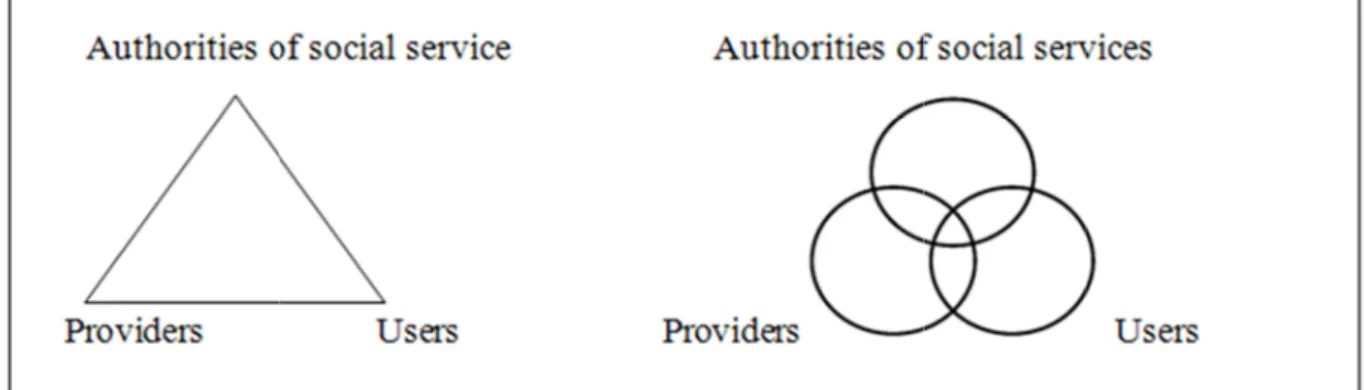
The triad is depicted in two ways. Either as a triangle or as interconnected circles: Fig. 1: The triad
Very simply
interested parties in the community, where planning is focused and this principle will be further discussed.
2 Community planning in practise
Zatloukal
includes as well as employers and methodologists of community planning always talk about the involvement of other entities. Therefore, he considers the concept of "triad" for misleading and he points out rightly that in planning there are also participate experts, representatives of institutions, who work closely with social providers of social services (police, doctors, offices, etc.), relatives, the public and also users,
of social services.
2.1 Community planning in Pardubice
The chapter deals with the practical fulfillment of the principles of community planning using the example town of Pardubice.
Pardubice
about 18 % inhabitants of the entire Pardubice region. Community planning takes place partnership between all participants, involving the local community, searching new human and financial resources, work with information, process formation of community plan is as important as the resulting document, taking into account the already established
oven cooperation, compromise between wishes and possibilities, cyclicality.
The second principle from our view we regard the principle of the triad. Usually triad means interested parties in process of community planning. This is the [12]:
The contracting
a source of financial resources which finance social services. Another can be labor offices through active employment policy.
Providers:
institutions or private subjects. To some extent this group includes employers, who create new jobs.
Users: final beneficiaries
The triad is depicted in two ways. Either as a triangle or as interconnected circles: Fig. 1: The triad
simply, we can say that the basic principle of this method is the involvement all interested parties in the community, where planning is focused and this principle will be further discussed.
Community planning in practise
Zatloukal [15] is critical to the concept of “triad”. He emphasizes the fact that the triad includes as well as employers and methodologists of community planning always talk about the involvement of other entities. Therefore, he considers the concept of "triad" for misleading and he points out rightly that in planning there are also participate experts, representatives of institutions, who work closely with social providers of social services (police, doctors, offices, etc.), relatives, the public and also users,
of social services.
Community planning in Pardubice
The chapter deals with the practical fulfillment of the principles of community planning using the example town of Pardubice.
Pardubice as a statutory town is among the ten larg
about 18 % inhabitants of the entire Pardubice region. Community planning takes place between all participants, involving the local community, searching new human and financial resources, work with information, process formation of community plan is as important as the resulting document, taking into account the already established
oven cooperation, compromise between wishes and possibilities, cyclicality.
The second principle from our view we regard the principle of the triad. Usually triad means interested parties in process of community planning. This is the [12]:
The contracting authorities:
a source of financial resources which finance social services. Another can be labor offices through active employment policy.
Providers: nongovernmental organizations, organizations established institutions or private subjects. To some extent this group includes employers, who create new jobs.
final beneficiaries
The triad is depicted in two ways. Either as a triangle or as interconnected circles:
, we can say that the basic principle of this method is the involvement all interested parties in the community, where planning is focused and this principle will be
Community planning in practise
[15] is critical to the concept of “triad”. He emphasizes the fact that the triad includes as well as employers and methodologists of community planning always talk about the involvement of other entities. Therefore, he considers the concept of "triad" for misleading and he points out rightly that in planning there are also participate experts, representatives of institutions, who work closely with social providers of social services (police, doctors, offices, etc.), relatives, the public and also users,
Community planning in Pardubice
The chapter deals with the practical fulfillment of the principles of community planning using the example town of Pardubice.
as a statutory town is among the ten larg
about 18 % inhabitants of the entire Pardubice region. Community planning takes place between all participants, involving the local community, searching new human and financial resources, work with information, process formation of community plan is as important as the resulting document, taking into account the already established
oven cooperation, compromise between wishes and possibilities, cyclicality.
The second principle from our view we regard the principle of the triad. Usually triad means interested parties in process of community planning. This is the [12]:
authorities:
a source of financial resources which finance social services. Another can be labor offices through active employment policy.
nongovernmental organizations, organizations established institutions or private subjects. To some extent this group includes employers, who create new jobs.
final beneficiaries, services,
The triad is depicted in two ways. Either as a triangle or as interconnected circles:
, we can say that the basic principle of this method is the involvement all interested parties in the community, where planning is focused and this principle will be
Community planning in practise
[15] is critical to the concept of “triad”. He emphasizes the fact that the triad includes as well as employers and methodologists of community planning always talk about the involvement of other entities. Therefore, he considers the concept of "triad" for misleading and he points out rightly that in planning there are also participate experts, representatives of institutions, who work closely with social providers of social services (police, doctors, offices, etc.), relatives, the public and also users,
Community planning in Pardubice
The chapter deals with the practical fulfillment of the principles of community planning using the example town of Pardubice.
as a statutory town is among the ten larg
about 18 % inhabitants of the entire Pardubice region. Community planning takes place
82
between all participants, involving the local community, searching new human and financial resources, work with information, process formation of community plan is as important as the resulting document, taking into account the already established
oven cooperation, compromise between wishes and possibilities, cyclicality.
The second principle from our view we regard the principle of the triad. Usually triad means interested parties in process of community planning. This is the [12]:
authorities: municipalities, local governments, etc. They are a source of financial resources which finance social services. Another can be labor offices through active employment policy.
nongovernmental organizations, organizations established institutions or private subjects. To some extent this group includes employers,
, services, public.
The triad is depicted in two ways. Either as a triangle or as interconnected circles:
, we can say that the basic principle of this method is the involvement all interested parties in the community, where planning is focused and this principle will be
Community planning in practise
[15] is critical to the concept of “triad”. He emphasizes the fact that the triad includes as well as employers and methodologists of community planning always talk about the involvement of other entities. Therefore, he considers the concept of "triad" for misleading and he points out rightly that in planning there are also participate experts, representatives of institutions, who work closely with social providers of social services (police, doctors, offices, etc.), relatives, the public and also users,
Community planning in Pardubice
The chapter deals with the practical fulfillment of the principles of community planning
as a statutory town is among the ten larg
about 18 % inhabitants of the entire Pardubice region. Community planning takes place between all participants, involving the local community, searching new human and financial resources, work with information, process formation of community plan is as important as the resulting document, taking into account the already established
oven cooperation, compromise between wishes and possibilities, cyclicality.
The second principle from our view we regard the principle of the triad. Usually triad means interested parties in process of community planning. This is the [12]:
municipalities, local governments, etc. They are a source of financial resources which finance social services. Another can be labor offices through active employment policy.
nongovernmental organizations, organizations established institutions or private subjects. To some extent this group includes employers,
public.
The triad is depicted in two ways. Either as a triangle or as interconnected circles:
, we can say that the basic principle of this method is the involvement all interested parties in the community, where planning is focused and this principle will be
[15] is critical to the concept of “triad”. He emphasizes the fact that the triad includes as well as employers and methodologists of community planning always talk about the involvement of other entities. Therefore, he considers the concept of "triad" for misleading and he points out rightly that in planning there are also participate experts, representatives of institutions, who work closely with social providers of social services (police, doctors, offices, etc.), relatives, the public and also users,
The chapter deals with the practical fulfillment of the principles of community planning
as a statutory town is among the ten largest cities in the Czech Republic. It´s about 18 % inhabitants of the entire Pardubice region. Community planning takes place between all participants, involving the local community, searching new human and financial resources, work with information, process formation of community plan is as important as the resulting document, taking into account the already established
oven cooperation, compromise between wishes and possibilities, cyclicality.
The second principle from our view we regard the principle of the triad. Usually triad means interested parties in process of community planning. This is the [12]:
municipalities, local governments, etc. They are a source of financial resources which finance social services. Another can be
nongovernmental organizations, organizations established institutions or private subjects. To some extent this group includes employers,
The triad is depicted in two ways. Either as a triangle or as interconnected circles:
, we can say that the basic principle of this method is the involvement all interested parties in the community, where planning is focused and this principle will be
[15] is critical to the concept of “triad”. He emphasizes the fact that the triad includes as well as employers and methodologists of community planning always talk about the involvement of other entities. Therefore, he considers the concept of "triad" for misleading and he points out rightly that in planning there are also participate experts, representatives of institutions, who work closely with social providers of social services (police, doctors, offices, etc.), relatives, the public and also users, providers and authorities
The chapter deals with the practical fulfillment of the principles of community planning
est cities in the Czech Republic. It´s about 18 % inhabitants of the entire Pardubice region. Community planning takes place between all participants, involving the local community, searching new human and financial resources, work with information, process formation of community plan is as important as the resulting document, taking into account the already established
oven cooperation, compromise between wishes and possibilities, cyclicality.
The second principle from our view we regard the principle of the triad. Usually triad means interested parties in process of community planning. This is the [12]:
municipalities, local governments, etc. They are a source of financial resources which finance social services. Another can be
nongovernmental organizations, organizations established institutions or private subjects. To some extent this group includes employers,
The triad is depicted in two ways. Either as a triangle or as interconnected circles:
Source: [2; 15]
, we can say that the basic principle of this method is the involvement all interested parties in the community, where planning is focused and this principle will be
[15] is critical to the concept of “triad”. He emphasizes the fact that the triad includes as well as employers and methodologists of community planning always talk about the involvement of other entities. Therefore, he considers the concept of "triad" for misleading and he points out rightly that in planning there are also participate experts, representatives of institutions, who work closely with social providers of social services providers and authorities
The chapter deals with the practical fulfillment of the principles of community planning
est cities in the Czech Republic. It´s about 18 % inhabitants of the entire Pardubice region. Community planning takes place between all participants, involving the local community, searching new human and financial resources, work with information, process formation of community plan is as important as the resulting document, taking into account the already established
oven cooperation, compromise between wishes and possibilities, cyclicality.
The second principle from our view we regard the principle of the triad. Usually triad
municipalities, local governments, etc. They are a source of financial resources which finance social services. Another can be
nongovernmental organizations, organizations established by institutions or private subjects. To some extent this group includes employers,
The triad is depicted in two ways. Either as a triangle or as interconnected circles:
Source: [2; 15]
, we can say that the basic principle of this method is the involvement all interested parties in the community, where planning is focused and this principle will be
[15] is critical to the concept of “triad”. He emphasizes the fact that the triad includes as well as employers and methodologists of community planning always talk about the involvement of other entities. Therefore, he considers the concept of "triad" for misleading and he points out rightly that in planning there are also participate experts, representatives of institutions, who work closely with social providers of social services providers and authorities
The chapter deals with the practical fulfillment of the principles of community planning
est cities in the Czech Republic. It´s about 18 % inhabitants of the entire Pardubice region. Community planning takes place between all participants, involving the local community, searching new human and financial resources, work with information, process formation of community plan is as important as the resulting document, taking into account the already established
The second principle from our view we regard the principle of the triad. Usually triad
municipalities, local governments, etc. They are a source of financial resources which finance social services. Another can be
by institutions or private subjects. To some extent this group includes employers,
Source: [2; 15]
, we can say that the basic principle of this method is the involvement all interested parties in the community, where planning is focused and this principle will be
[15] is critical to the concept of “triad”. He emphasizes the fact that the triad includes as well as employers and methodologists of community planning always talk about the involvement of other entities. Therefore, he considers the concept of "triad" for misleading and he points out rightly that in planning there are also participate experts, representatives of institutions, who work closely with social providers of social services providers and authorities
The chapter deals with the practical fulfillment of the principles of community planning
est cities in the Czech Republic. It´s about 18 % inhabitants of the entire Pardubice region. Community planning takes place
83
in Pardubice since 2006. For process of community planning there were originally formed five working groups according to the target groups of users of social services. Actually there are seven working groups [9]:
Our opinions will be based on the results of the research "The situation in the social services in Pardubice", which was created for the purpose of development and decision -making activities in the territory [10]. The research was divided into the following basic parts: the socio-demographic analysis of the monitored area, poll survey among the public, poll survey among representatives of Pardubice, questionnaire survey among users of social services.
There were 827 respondents participated in the study, including:
• The city council of Pardubice: 18 respondents,
• public: 384 respondents,
• providers of social services: 72 registered services and unregistered related activities,
• users of social services: 353 respondents.
For statistical evaluation was performed using the methods of systems engineering. System engineering typically uses a wide range of methods and sources, since they deal with complex, non-trivial problems. These sources and methods are constantly evolving, reflecting technological progress. Despite this constant evolution is one of the results of problem-solving model studied reality. This could be interpreted, modified and conclusions should serve as a support material such as effective implementation of social services. At this stage we use as statistical methods (statistical analysis tools) and data-mining modeling techniques. Basic characteristics of data-mining are that it is derived from the analysis of the content data, rather than a pre-specified by the user or researcher. Furthermore derive only descriptive characteristics, but also predictive. Their advantages for the issue in detail for example. [5; 7; 8.].
For the main parts of the study we selected parts of the study that related a survey among the public and users of social services. To support our argument, however, we will use the information from the respondents - representatives of the city.
3 Problem solving
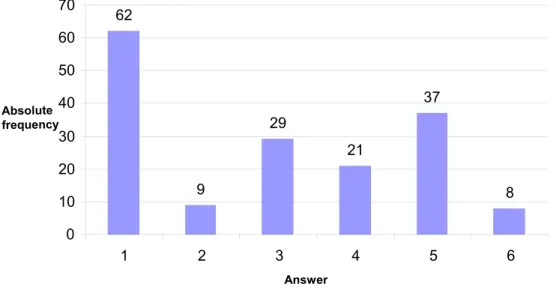
The public needs necessary information to participate to some process of activity. The study shows that the most respondents (193) told that they have never heard about community planning. 103 respondents told that they have heard about community planning but them don´t know what it means. This fact is a clear signal that it is necessary to promote community planning, not only to extend the working groups with representatives of the public, but also system of social services at the municipal level should be propagated. The next picture shows information sources that respondents use to get information about community planning.
84
Fig. 2: The resources of information about community planning for the public
1 = From the Town hall newsletter; 2 = From the Town hall; 3 = From the internet; 4 = From the family; 5 = From the friends; 6 = Another answer.
Source: [10, p. 65]
In this regard it shows that most respondents received information about community planning in the Town Hall newsletter. This fact is clear stimulus to give adequate scope to this newspaper. The natural relational network of respondents (friends and family) works very well. The using of the internet ranked as the 3rd. It assumes targeted interest in the area or respondent found information accidentally during watching other website which are connected with community planning.
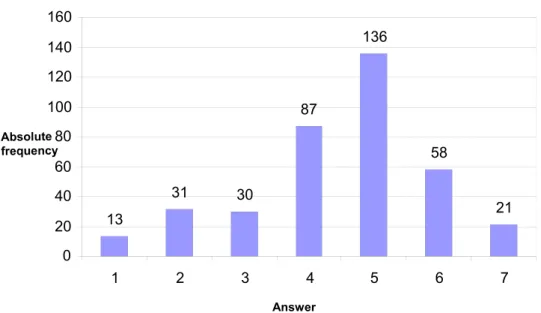
Total 223 respondents (from the total number 384) don´t want to participate to community planning, because they think that it´s waste of time (87 respondents) or they don´t have a time to participate (136 respondents). 58 respondents actually don´t want to participate, but if they had adequate information, they would think about participate at community planning. In this point there is some scope for intensive information campaign that it can induce public to participate to social life. This potential is hidden in the 136 respondents, who say they don´t have a time. Due to low informing what community planning is, we can assume that even a part of this group of respondents would think to find some time to participate.
62 9 29 21 37 8 0 10 20 30 40 50 60 70 1 2 3 4 5 6 Answer
85
Fig. 3: Interest of public to participate to community planning
1 = Yes, I think it´s useful; 2 = Yes, I want have an information; 3 = Yes, I can influence things around me; 4 = No, it´s waste of time, nothing will change; 5 = No, I don´t have a time for this; 6 = No, but if I had needed information, I would think about it.; 7 = Another answer.
Source: [10, p. 66]
The results show that 74 respondents are interested in the process of participation. The motive is the feeling usefulness of community planning and to influence the life around themselves. 31 respondents would like to be participated because they want information about social sphere.
There is important question. Do respondents think that they will need s social services in future? The resulting answers are shown in the following picture, where it is evident that the majority of respondents aware that every person can ever in your life need a social network. 13 31 30 87 136 58 21 0 20 40 60 80 100 120 140 160 1 2 3 4 5 6 7 Answer
86 Fig. 4: Thinking about future using services
1 = No, I don´t think that the similar situation could occur; 2 = I have never thougth about the similar question; 3 = The respondent noc not answer; 4 = Yes, everyone is a potential client; 5 = Yes, when I will be in high age; 6 = Yes, in case that…
Source: [10, p. 69]
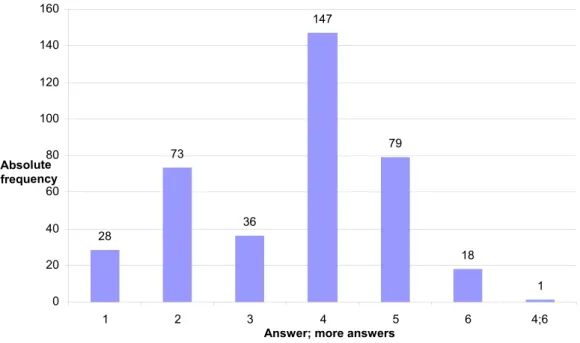
Just as the public user is a key element of the triad. Like the public, user’s don´t have much information about community planning. Only 94 respondents have some information about community planning. 44 respondents haven´t heard and doesn´t want to be interested, 135 respondents said that they have never heard about community planning.
Fig. 5: Knowledge of users about community planning
1 = Yes; 2 = Yes, a little; 3 = rather no; 4 = No, respondent has never heard about it; 5 = No, respondent doesn´t want to be interested; 6 = Other, please, tell us.
Source: [10, p. 69]
There it is necessary for the interpretation of the previous result to add what sources respondents have use for getting information. If they have any, there are in particular other
28 73 36 147 79 18 1 0 20 40 60 80 100 120 140 160 1 2 3 4 5 6 4;6
Answer; more answers
35 59 75 135 44 3 0 20 40 60 80 100 120 140 1 2 3 4 5 6 Answer
87
sources (respondents have information about community planning from social services that they use), The Town Hall newsletter, friends and the internet.
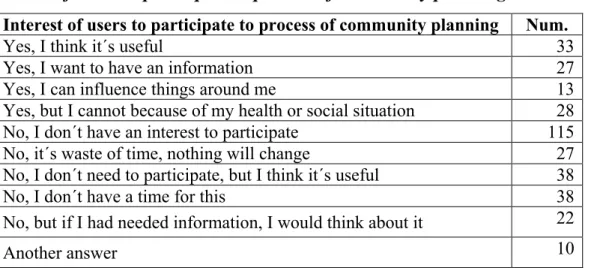
The main question of the analysis is question about interest of users to be member of work group. All 240 respondents from total 351 (2 respondents didn´t answer) don´t want to participate to process of community planning. 22 respondents from them would think about participate, if they had information. The most respondents (115 respondents) noted they lack of interest. 38 respondents gave their support to community planning although their lack of interest to active participates.
Tab. 1: Interest of users to participate to process of community planning
Interest of users to participate to process of community planning Num.
Yes, I think it´s useful 33
Yes, I want to have an information 27
Yes, I can influence things around me 13
Yes, but I cannot because of my health or social situation 28
No, I don´t have an interest to participate 115
No, it´s waste of time, nothing will change 27
No, I don´t need to participate, but I think it´s useful 38
No, I don´t have a time for this 38
No, but if I had needed information, I would think about it 22
Another answer 10
Source: [10, p. 69]
As public, users answered that they don´t have a time to go to working groups and also they think it´s waste of time because nothing will change. Only 13 respondents see possibility to affect things around themselves in community planning. Regarding number of respondents we can say it isn´t significant number of answers, but about 30 respondents would like to participate. They cannot participate because of their bad health disposition or bad life situation. The results of analysis shows some respondent participate in community planning, some respondents don´t know how they should answer and they don´t choose any variant of answer, some respondents would like to go to working group but they don´t know what they should do here. These results show that there is some expanse for bigger medialization of community planning.
Considering triad we have to mention political aspekt - Authorities of social services. There are 39 respondents. Representatives should reflect the research knowledge of their constituents. According to their views about social sphere public interests as follows (arranged one after another according to the order): sport, transport and healthcare, environment, culture, education, employment opportunities, social affairs, safety in the municipality
From these results we can see, that it´s very difficult to satisfy basic principle of community planning. The basic principle of community planning is participating all of interested subjects. The results of the analysis bring much knowledge to sphere of regional development at social policy.
We can state very simply that analysed region has a potential of participate more target groups. This participate have to be targeted given to that people are interested in social sphere especially when they need it. It means, when they feel to be affected with adverse
88
social situation. The emphasis has to be put to relevant information resources and also political support this sphere is important.
4 Discussion
Although the principles of community planning was undergone of critic we can note conclusively that in reality we don´t have another relevant method of planning of social policy at the regional level. It depends on how this method is conceived, what continuity to other strategic planning in the municipality or region is.
The systematic and adequate informative campaign through relevant sources of information is the starting point increasing public participation and other subjects. The presented results it may see that high publicity of community planning is the solution to increase the involvement of other parties On the other hand, the results show us a underlying aspect in the interpretation that ordinary citizen considers as potential user of social services in many cases, but they will resolve their situation in most cases when the situation will come. This fact confirms the statement particularly existing users. Based on observed, so we can note that adequate information about community planning can help not only the enlarged membership of working groups, but also to help people threatened social exclusion to a better and easier orientation at the beginning of solutions to their problems. Political situation is also very important aspect. In other words - activity of councillors. The results of the analysis show that political interest in social problems isn´t so high.
Conclusion
We think important failing of method of social planning - unwillingness important elements (public and user of social services) of define system to participate to planning. The only solution is dogmatically insisting on methodological procedures of the process, but flexibly adjusts the process according to the real conditions in the environment. However, this procedure requires "understanding" authority, managing authority which supports community planning. The system should be set up as a partnership rather than as two rival parties of opinion.
Although the presented results of research show little interest in public participation in community planning, the existence of the process considered for regional social policy as a key. The public is considered to be potential users of social services, and this reasoning clearly defines the order that the public has of the entire system. It is a feeling ensure further safety of citizens without the right to make their anticipated future situation and specially prepared for her. Given the results of research among users of social services in the context of the public interest, then we can conclude that the primary principle of the community planning process is the openness of the process, without pressure on the components of system to be personally involved. Openness is therefore a key attribute of the functioning of the system and its effectiveness must be based on the skills of professionals involved and clearly defined expectations and ideas of local social policy, which informs the public through their elected representatives.
Acknowledgement
This article was created with support of the Student Grant Competition number SGFES01/2013 Scientific-research activities in the area “Economic Policy and Administration”.
89
References
[1] ACOSTA, O., TORO, P., A. Leťs Ask the Homeless People Themselves: a Needs Assessment Based On a Probability Sample of Adults. In American Journal of Community Psychology, Vol. 28, No. 3; 2000; s. 343 – 366. ISSN 1573-2270.
[2] CENTRUM KOMUNITNÍ PRÁCE. O komunitním plánování. [Online], Available at WWW: <http://www.komunitniplanovani.com/kp-o-komunitni-planovani_2/
[accessed 22. 04. 2013] (in Czech)>
[3] ČESKÝ STATISTICKÝ ÚŘAD. Počet obyvatel v obcích České republiky k 1. 1. 2012. [Online], Available at WWW:
<http://www.czso.cz/csu/2012edicniplan.nsf/t/00002BD91A/$File/13011203.pdf [accessed 22. 04. 2013] (in Czech)>
[4] HRADECKÁ, V., HRADECKÝ, I. Bezdomovství – extrémní vyloučení. Praha, Naděje, 1996, str. 63. ISBN 80–902292–0–4 (in Czech)
[5] KAŠPAROVÁ, M. - KŘUPKA, J. - JIRAVA, P. Modelling of Selected Attributes in the Region. In Proceeding of the Conference Regional features of the functioning and interaction of the recreation industry and industrial sector. Sochi: Optima, 2010. s. 8-16. ISBN 978-5-91789-024-1.
[6] Kolektiv autorů. Průvodce procesem komunitního plánování. [Online] MPSV. Praha, 2004. Available at WWW: <http://www.mpsv.cz/cs/847 [accessed 20. 04. 2013] (in Czech)>
[7] KŘUPKA, J. - KAŠPAROVÁ, M. - JIRAVA, P. Modelování kvality života pomocí rozhodovacích stromů. E+M Ekonomie a Management, 2010, vol. 13, no. 3, s. 130 -146. ISSN: 1212-3609. (in Czech)
[8] KŘUPKA, J. - MANDYS, J. - JIRAVA, P. - KAŠPAROVÁ, M. Problematika věkové diskriminace v kontextu rozhodovacích procesů veřejné správy na regionální úrovni. In Systémové konflikty. 1. vyd. Pardubice: Univerzita Pardubice, 2011. 14 s. ISBN 978-80-7395-441-3. (in Czech)
[9] MAGISTRÁT MĚSTA PARDUBICE. Historie komunitního plánování sociálních služeb v Pardubicích. [Online] Available at WWW:
<http://www.pardubice.eu/urad/radnice/magistrat/odbory-magistratu/osv/komunitni -planovani/historie-kp.pdf [accessed 22. 04. 2013] (in Czech)>
[10] MANDYS, J., JIRAVA P., KAŠPAROVÁ, M., KŘUPKA, J., DUPLINSKÝ, J. Situace v sociálních službách na území města Pardubice. Závěrečná výzkumná zpráva. Pardubice: Univerzita Pardubice, 2012. 191 s. (in Czech)
[11] Ministerstvo PRO MÍSTNÍ ROZVOJ ČR. Strategie udržitelného rozvoje české republiky. Praha: MMR [Online], 2006. Available at WWW:
<http://www.mmr.cz/Regionalni-politika/Koncepce-Strategie/Strategie-regionalniho -rozvoje-Ceske-republiky-na [accessed 20. 04. 2013] (in Czech)>
[12] PROGRAMOVÝ TÝM PROJEKTU EQUAL 0076. Deset kroků procesem komunitního plánování. Metodický sešit 1: Deset základních kroků v procesu komunitního plánování a příprava prostředí pro pořízení komunitního plánu. Ústí nad Labem: Centrum komunitní práce. 2006. 60 s. (in Czech)
90
[13] ROSECKÝ, D.; ORINIAKOVÁ, P. Komunitní plánování sociálních služeb. Plzeň. Centrum pro komunitní práci; 2003. Available at WWW:
<http://socialnirevue.cz/media/docs/Rosecky_Oriniakova_Komunitni_planovani_socia lnich_sluzeb.pdf [accessed 22. 04. 2013] (in Czech)>
[14] SKŘÍČKOVÁ, Z. Metodiky pro plánování sociálních služeb. Centrum pro komunitní práci. Praha, 2007. ISBN 978-80-869002–44-9 (in Czech)
[15] ZATLOUKAL, L. Plánování rozvoje sociálních služeb metodou komunitního plánování. Olomouc: Univerzita Palackého, 2008. 187 s. (in Czech)
Contact Address
Mgr. Jan Mandys, Ph.D.
University of Pardubice, Faculty of Economics and Administration, Institute of Administrative and Social Sciences
Studentská 95, 510 32 Pardubice, Czech Republic E-mail: [email protected]
Phone number: (+ 420) 466 036 171
Ing. Michaela Černajová
Univerzity of Pardubice, Faculty of Economics and Administration, Studing specialization: Economics of Public Sector
E-mail: [email protected]
Received: 29. 04. 2013
Reviewed: 07. 06. 2013, 04. 07. 2013 Approved for publication: 13. 08. 2013