integrated framework for implementing technology
roadmapping in industry. PhD thesis, University of
Nottingham.
Access from the University of Nottingham repository:
http://eprints.nottingham.ac.uk/12654/1/PhDThesis-SGMPdeCavin2012.pdf Copyright and reuse:
The Nottingham ePrints service makes this work by researchers of the University of Nottingham available open access under the following conditions.
· Copyright and all moral rights to the version of the paper presented here belong to
the individual author(s) and/or other copyright owners.
· To the extent reasonable and practicable the material made available in Nottingham
ePrints has been checked for eligibility before being made available.
· Copies of full items can be used for personal research or study, educational, or
not-for-profit purposes without prior permission or charge provided that the authors, title and full bibliographic details are credited, a hyperlink and/or URL is given for the original metadata page and the content is not changed in any way.
· Quotations or similar reproductions must be sufficiently acknowledged.
Please see our full end user licence at:
http://eprints.nottingham.ac.uk/end_user_agreement.pdf
A note on versions:
The version presented here may differ from the published version or from the version of record. If you wish to cite this item you are advised to consult the publisher’s version. Please see the repository url above for details on accessing the published version and note that access may require a subscription.
School of Mechanical, Materials and
Manufacturing Engineering
AN INTEGRATED FRAMEWORK FOR
IMPLEMENTING TECHNOLOGY ROADMAPPING
IN INDUSTRY
By
SHIRLEY GISELA MEJIA PANTOJA DE CAVIN,
MSc, BSc (Hons.)
Thesis submitted to the University of Nottingham for the degree of Doctor of Philosophy
Managing technological change in business is difficult. Especially for organisations in technology-based sectors where they are required to rethink and redesign their strategies to ensure they remain competitive in evolving markets. These organisations are focusing their attention on the use of managerial tools and methodologies to help generate a successful business plan. One such tool is Technology Roadmapping (TRM), whose main objective is the alignment of companies’ strategies towards the fulfilment of their business objectives and goals. A better understanding of TRM has resulted in organisations adopting this methodology into their business practices while others perceive its implementation as a complex process requiring a vast amount of information. An adequate framework facilitating the implementation process is lacking.
Therefore, in order to address these needs, and driven by the gaps identified in the literature, an integrated framework supporting organisations in the task of implementing technology roadmapping is developed in this research. It is composed of three major elements. Firstly, the implementation lifecycle, that guides users through activities for implementation and application in their organisations. Secondly, an integrated data-knowledge structure composed of a set of models where data, information and knowledge from the market, product, technology, and R&D stages are identified. And finally, an integrated software tool, based on the structure and a selected roadmapping approach, which supports the execution of processes and activities during a roadmapping exercise.
The framework is tested and validated in a series of case studies in the aerospace industry. The initial studies, conducted during the development of the framework, allowed refinements and improvements to be implemented prior to the second set of case studies, following the completion of this framework. The results from the case studies confirm the feasibility and usability of applying the developed framework into practice as well as providing recommendations for future work.
Journal Publications
Pending
Gindy, N.N.Z., Arman, H., Cavin, S. and Morcos, M. (2011) “Evaluations and visualisation tools to support technology roadmapping and R&D decisions”.
Conference Publications
Published
Gindy, N.N.Z, Arman, H. and Cavin, S. (2009), “Linking R&D investment strategies to business needs: strategic technology alignment roadmapping
(STAR)”, Portland International Conference on Management of Engineering and Technology (PICMET '09), Portland, 2-6 August.
Mathew, S., Mejia-Pantoja, S., Hill, I. and Gindy, N.N.Z (2007) “An Integrated Approach to Operational Disturbances in an Aerospace Production System”. ICRM Paper Conference 2007.
Poster
Mejia-Pantoja, S., Hodgson, A. and Gindy, N.N.Z (2007) “Flexible Data-Knowledge Structure for Technology Roadmapping”. Integr8or – UK Doctoral Conference 2007.
ACKNOWLEDGEMENTS
I would like to express my deepest gratitude and appreciation to the following people for their support during my research studies.
Firstly, I would like to thank my supervisor Professor Nabil Gindy, who supported and guided me throughout the whole research process. My gratitude is immense to him. Thanks for the opportunity to work with him and his research group, for sharing his knowledge, and for his understanding.
Special thanks to the Engineering and Physical Sciences Research Council (EPSRC) for their financial support.
My deepest gratitude goes to my colleagues from the Strategic Technology Alignment (STA) group. Special thanks to: Dr. Husam Arman, for his support, and contributions to my research; Mr. Allan Hodgson for providing me with useful inputs to my work; to Dr. Maged Morcos and Dr. Mohammad Kabli, whose support is very much appreciated; to Mr. Cliff Fowkes, for his collaboration during the case studies. It was a pleasure and a valuable experience to work with all of them.
Also special thanks to Lesley Gray, and to the members of Department of Mechanical, Materials and Manufacturing Engineering of the University of Nottingham for their help and assistance.
I would like to express my profound gratitude to my parents, Raul and Jacinta, for their love, support, words of advice and encouragement in every stage of my life, their example of life is invaluable. Thanks to my sisters Jessica and Jacqui, for their love, and constant support.
My gratitude and infinite love to my lovely daughter Sophie, she is the light in my life and the reason for me to try to be a better person every day, her patience and understanding, considering her age, surprises me every day.
Finally, special thanks to: my father-in-law and mother-in-law, Victor and Mary, for their support; and to my husband Ian, for his collaboration and contribution to the completion of my studies.
ABSTRACT ... i
LIST OF PUBLICATIONS ... ....ii
ACKNOWLEDGEMENTS... ... ...iii
CONTENTS ...iv
LIST OF FIGURES ...viii
LIST OF TABLES...xi
ABBREVIATIONS...xii
1. Introduction...1
1.1 Overview ...1
1.2 Research Objectives and Questions...2
1.2.1 Research Objectives... 2
1.2.2 Research Questions ... 3
1.3 Research Scope... 4
1.4 Structure of the thesis... 5
1.5 Summary of Chapter... 6
2. Literature Review... 7
2.1 Overview ...7
2.2 Technology and Technology Management...7
2.2.1 Technology...7
2.2.2 Technology Management...8
2.3 Technology Roadmapping (TRM)...10
2.3.1 Definition...10
2.3.2 Technology Roadmapping: Why is it important?...13
2.3.3 Technology Roadmapping: Aspects... ...14
2.3.4 Technology Roadmapping: Mission and Goals...18
2.3.5 Technology Roadmapping: Components...19
2.3.6 Technology Roadmapping: Approaches...22
2.3.7 Technology Roadmapping: Classification...23
2.3.8 Technology Roadmapping: Formats... ...23
2.3.9 Technology Roadmapping and disruptive technologies...26
2.3.10 The role of Information Technology in Technology Roadmapping...28
2.3.11 Major Technology Roadmapping methodologies...31
2.3.11.1European Industrial Research Management Association (EIRMA)...31
2.3.11.2T-Plan...35
2.3.11.3The North-western University School of Technology Roadmapping...38
2.3.11.4Summary of three methods...41
2.3.12 Technology Roadmapping Applications in Industry...42
2.3.12.1Motorola...42
2.3.12.2General Motors...44
2.3.13 Strategic Technology Alignment Roadmapping (STAR) methodology...47
2.3.13.1Definition...47
2.3.13.2STAR Phases... ...49
2.4 Data and Knowledge Structure...53
2.4.1 Knowledge: Definition...53
2.4.2 Knowledge: Management...54
2.4.3 Representation of knowledge structure...55
2.4.4 Methods applied to knowledge structure... 57
2.4.5 Knowledge-base or data-base...63
2.4.6 Knowledge-based systems...63
2.5 Technology Roadmapping Tools...67
2.5.1 Graphical Modelling System (GMS)... 67
2.5.2 RoadMap Global Planning System (Geneva Forecasting Engine)...70
2.5.3 Web-based Intelligent Forecasting System (WIFS)...73
2.5.4 Vision Strategist and Vision Reporter (Alignent Software )... 75
2.5.5 Other tools available...77
2.6 Conclusions: Gaps in the literature...79
2.7 Summary of Chapter...80
3. Development of an integrated framework for implementing technology roadmapping...81
3.2.3 Research method...84
3.2.4 Case study method...86
3.2.5 Multiple case studies... ...89
3.2.6 Research methods applied in this thesis...89
3.3 Integrated technology roadmapping framework and its implementation...93
3.3.1 What are the objectives for the integrated technology roadmapping structure?... ...93
3.3.2 The participants in the implementation of an integrated technology roadmapping structure...94
3.3.3 What is required for the integrated technology roadmapping structure?... 95
3.3.4 Integrated Technology Roadmapping Structure Lifecycle...96
3.3.5 Integrated Technology Roadmapping Structure Representation...97
3.3.6 Integrated Technology Roadmapping Structure Software Tool...101
3.3.7 Integrated Technology Roadmapping Structure: Case Studies... .102
3.4 Summary of Chapter...103
4. Integrated Technology Roadmapping Structure Lifecycle...104
4.1 Overview...104 4.2 Identification...105 4.3 Justification...112 4.4 Collection of Knowledge/Information/Data...116 4.5 Formalisation of Knowledge/Information/Data...129 4.6 Implementation...136 4.7 Application...142 4.8 Summary of Chapter...146
5. Integrated Technology Roadmapping Structure Representation...147
5.1 Overview...147
5.2 Integrated Technology Roadmapping Structure Representation: Introduction...147
5.3 Market Strategy Knowledge Structure (KS) Model...149
5.3.1 What is the Market Strategy KS Model?...149
5.3.2 The Basis of the Market Strategy KS Model...149
5.3.3 Entities in the Market Strategy KS Model...151
5.3.4 Links in the Market Strategy KS Model...154
5.3.4.1The Generic Market View...154
5.3.4.2The Roadmapping Market View...156
5.3.5 Links of the Market KS model to other KS models...160
5.4 Product Strategy Knowledge Structure (KS) Model...160
5.4.1 What is the Product Strategy KS Model?...160
5.4.2 The Basis of the Product Strategy KS Model...160
5.4.3 Entities in the Product Strategy KS Model...162
5.4.4 Links in the Product Strategy KS Model...164
5.4.4.1The Generic Product View...164
5.4.4.2The Roadmapping Product View...167
5.4.5 Links of the Product KS model to other KS models...169
5.5 Technology Strategy Knowledge Structure (KS) Model...170
5.5.1 What is the Technology Strategy KS Model?...170
5.5.2 The Basis of the Technology Strategy KS Model...170
5.5.3 Entities in the Technology Strategy KS Model...172
5.5.4 Links in the Technology Strategy KS Model...175
5.5.4.1The Generic Technology View...175
5.5.4.2The Roadmapping Technology View...178
5.5.5 Links of the Technology KS model to other KS models...186
5.6 Research and Development (R&D) Strategy Knowledge Structure (KS) Model...187
5.6.1 What is the R&D Strategy KS Model?.. ...187
5.6.2 The Basis of the R&D Strategy KS Model...187
5.6.3 Entities in the R&D Strategy KS Model...189
5.6.4 Links in the R&D Strategy KS Model.. ...191
5.6.4.1The Generic R&D View...191
5.6.4.2The Roadmapping R&D View...193
5.6.5 Links of the R&D KS model to other KS models.. ...197
5.7 Summary of Chapter...197
6. Integrated Technology Roadmapping Structure Software Tool...198
6.1 Overview...198
6.6 Technology Strategy Stage...202
6.6.1 Overview... ...202
6.6.2 Product/Product Group Priority...205
6.6.2.1Product or Product Group Priority: Methods of Prioritisation...209
6.6.3 Requirements Capture.. ...212
6.6.4 Technology Benchmarking... ...217
6.6.5 Technology Forecast (Watch).. ...221
6.6.6 Technology Priority.. ...224
6.7 Research and Development Strategy...227
6.7.1 Overview...227
6.7.2 Strategic Fit (“Green Star”).. ...230
6.7.3 Project Inputs...241
6.7.4 Project Assessment.. ...248
6.7.5 Project Portfolio Optimisation.. ...256
6.8 Summary of Chapter...266
7. Integrated Technology Roadmapping Structure: Case Studies...267
7.1 Overview...267
7.2 Testing and Validation Objectives...268
7.3 Case Study Large-Sized Manufacturing Company...270
7.3.1 Company Overview...270
7.3.2 Application of the integrated technology roadmapping structure and software tool...271
7.3.2.1Company Requirements...271
7.3.2.2Activity Plan...272
7.3.2.3Implementation: Pre-Workshops Sessions...272
7.3.2.4Implementation: Workshop 1 – Application of the Technology Strategy...280
7.3.2.5Implementation: Workshop 2 – Application of the R&D Strategy...289
7.4 Case Study Medium-Sized Manufacturing Company...298
7.4.1 Company Overview...298
7.4.2 Application of the integrated technology roadmapping structure and software tool...298
7.4.2.1Company Requirements...299
7.4.2.2Activity Plan...299
7.4.2.3Implementation: Pre-Workshops Sessions...300
7.4.2.4Implementation: Workshop 1 – Application of the Product-Technology Strategy...305
7.4.2.5Implementation: Workshop 2 – Application of the R&D Strategy...313
7.5 Case Study Workshops for organisations of several manufacturing companies...320
7.5.1 Overview...320
7.5.2 Objectives...320
7.5.3 Midlands Aerospace Alliance (MAA) workshops...321
7.5.3.1Overview...321
7.5.3.2Activity Plan...322
7.5.3.3Workshops Description...323
7.5.3.4Summary of outputs...326
7.5.4 National Advisory Committee for Aerospace Manufacturing (NACAM) workshops...326
7.5.4.1Overview...326
7.5.4.2Activity Plan...327
7.5.4.3Workshops Description...329
7.5.4.4Summary of outputs...332
7.5.5 Workshops Benefit and Conclusions... ...332
7.6 Feedback, limitations and recommendations from case studies...334
7.7 Lessons learned and conclusions...346
7.8 Summary of Chapter...349
8. Conclusions...350
8.1 Overview...350
8.2 Discussion...350
8.3 Conclusions...352
8.4 Contribution to theory and practice...358
8.5 Future research...361
8.6 Summary of Chapter...363
Appendix B... ...373
Appendix C...374
Appendix D...375
Figure 1.1: Research Scope: Implementation Framework for Technology Roadmapping...4
Figure 1.2: Structure of thesis...5
Figure 2.1- Non-linear roadmap heuristic (Strauss et al, 1998)...16
Figure 2.2 - Multilayer roadmaps (Phaal, 2003)...24
Figure 2.3 - Bars roadmaps (Phaal, 2003)...24
Figure 2.4 - Table roadmaps (Phaal, 2003)...24
Figure 2.5 - Graphical roadmaps (Phaal, 2003)...25
Figure 2.6 - Pictorial representation (Phaal, 2003)...25
Figure 2.7 - Flow chart representation (Phaal, 2003)...26
Figure 2.8 - Links between product plans and technical plans in TRM (EIRMA, 1997)...31
Figure 2.9 - TRM flow (EIRMA, 1997)...34
Figure 2.10 - Generic TRM (EIRMA, 1997)...34
Figure 2.11 - Generic technology roadmapping (Phaal et al., 2001)...35
Figure 2.12 - T-Plan workshops (Phaal et al., 2003)...36
Figure 2.13 - T-Plan standard and customized approaches (Phaal et al., 2003)...37
Figure 2.14 - Technology roadmapping template (Albright and Kappel, 2003)...39
Figure 2.15 - Evolution of roadmapping in Motorola (Richey and Grinnell, 2004)...44
Figure 2.16 - The GM technology roadmapping format (Grossman, 2004)...45
Figure 2.17 - The STAR methodology framework (Gindy et al., 2009)...49
Figure 2.18 - Levels of representation in a knowledge base (Gaines et al., 1992)...56
Figure 2.19 - Example of frame (Gordon, 1999)...58
Figure 2.20 - Example of semantic networks: describe an electrical heater (Gordon, 1999)...58
Figure 2.21 - Particularity (Chow and Yeung, 1995)...59
Figure 2.22 - Specificity (Chow and Yeung, 1995)...59
Figure 2.23 - Bipolarity (Chow and Yeung, 1995)...60
Figure 2.24 - Aspect of knowledge of (Entity “E”) (Wainwright, 2001)...61
Figure 2.25 - Knowledge mapping (Gordon, 1999)...62
Figure 2.26 - Schematic diagram for the process of building a KBS (Tretheweya et al., 1998).64 Figure 2.27 - Strategic level map of the structure of AKRI knowledge (Gordon, 2000)...66
Figure 2.28 - GMS framework (Office of Naval Research, 2006)...68
Figure 2.29 - GMS example (Zurcher and Kostoff, 1997)...70
Figure 2.30 - RoadMap GPSTM Structure...72
Figure 2.31 - Geneva expert system forecasting...73
Figure 2.32 - WIFS system architecture, (Xiang et al., 2001)...75
Figure 2.33 - Vision Strategist...76
Figure 2.34 - Collaborate on strategic planning information (Vision Strategist)...77
Figure 3.1 - Research types from the viewpoint perspective (Kumar, 1999)...82
Figure 3.2 - Research questions linked to each research strategy (Yin, 2003) ...85
Figure 3.3 - Research techniques and methods...90
Figure 3.4 - Application of the research method in this thesis design...92
Figure 3.5 - Participants in the implementation...95
Figure 3.6 - Integrated Technology Roadmapping Structure Lifecycle...96
Figure 3.7 - Types of formats of knowledge in an organisation...98
Figure 3.8 - Sample of a View...99
Figure 3.9- Sample of an Entity ...99
Figure 3.10 - Sample of Sub-Entity ...100
Figure 3.11 - Sample of Links...101
Figure 3.12 - Integrated Technology Roadmapping Software Tool...102
Figure 4.1 - Integrated Technology Roadmapping Structure Lifecycle...104
Figure 4.2 - Identification Stage...106
Figure 4.3 - Sections of interest for Organisation A ...108
Figure 4.4 - Sections of interest for Organisation B...109
Figure 4.5 - Justification Stage ...112
Figure 4.6 - Selection of a “champion” ...114
Figure 4.7 - Collection Stage ...117
Figure 4.8 - Sample of collection form for Market Strategy ...120
Figure 4.9 - Sample of collection form for Product Strategy ...121
Figure 4.13 - Examples of three organisations ...132
Figure 4.14 - The entity “Market Segment...133
Figure 4.15 - Transference of structure into a knowledge repository...135
Figure 4.16 - Implementation Stage ...137
Figure 4.17 - Updating the structure...139
Figure 4.18 - Application Stage...143
Figure 5.1 - The Generic Market View...155
Figure 5.2 - Generic Market View for a Cross Country bicycle ...156
Figure 5.3 - The Roadmapping Market View...157
Figure 5.4 - Roadmapping Market View for a Cross Country bicycle...159
Figure 5.5- The Generic Product View...165
Figure 5.6 - Generic Product View for a Cross Country bicycle...167
Figure 5.7 - The Roadmapping Product View...168
Figure 5.8 - Roadmapping Product View for a Cross Country bicycle...169
Figure 5.9 - The Generic Technology View...175
Figure 5.10 - Generic Technology View for a Cross Country bicycle...177
Figure 5.11 - The TRM View for Tech. Requirements Capture...178
Figure 5.12 - The TRM View for Tech. Requirements Capture for a Cross Country bicycle..180
Figure 5.13 - The TRM View for Tech. Benchmarking...181
Figure 5.14 - The TRM View for Tech. Benchmarking for a Cross Country bicycle...182
Figure 5.15 - The TRM View for Technology Watch...183
Figure 5.16 - The TRM View for TW for a Cross Country bicycle...184
Figure 5.17 - The TRM View for Technology Forecast...185
Figure 5.18 - The TRM View for Technology Forecast for a Cross Country bicycle...186
Figure 5.19 - The Generic R&D View...191
Figure 5.20 - The Generic R&D View for a Cross Country bicycle...193
Figure 5.21 -The Roadmapping R&D View...194
Figure 5.22 - The Roadmapping R&D View for a Cross Country bicycle...196
Figure 6.1 - Integrated Technology Roadmapping Structure Tool...198
Figure 6.2 - Stages of the Integrated Technology Roadmapping Software Tool...200
Figure 6.3 - Technology Strategy Stage: Processes...204
Figure 6.4 - Product/Product Group Priority: Initial Requirements...205
Figure 6.5 - Selection of product/product groups...206
Figure 6.6 - Addition of new product/product group...206
Figure 6.7 - Methods of prioritisation...207
Figure 6.8 - Prioritisation Output...208
Figure 6.9 - Prioritisation by “Pair-wise comparisons”...210
Figure 6.10 - Pair-wise comparison results...210
Figure 6.11 - Prioritisation by “Voting”...211
Figure 6.12 - Prioritisation by “Direct ranking”...212
Figure 6.13 - Initial Requirements: Prioritised Products...213
Figure 6.14 - Requirements Capture: Selection of technologies...214
Figure 6.15 - Requirements Capture: Search of technologies...215
Figure 6.16 - Requirements Capture: Selected Technologies...216
Figure 6.17 - Initial Requirements: Selection of technologies...218
Figure 6.18 - Technology Benchmarking: Competitive Assessment Board...219
Figure 6.19 - Technology Benchmarking: Assessment of a technology...220
Figure 6.20 - Technology Forecast (Watch): Initial Requirements...222
Figure 6.21 - Technology Forecast (Watch): Technology Timeline Board...223
Figure 6.22 - Technology Priority: Methods of prioritisation...225
Figure 6.23 - Technology Priority: Prioritisation of results...226
Figure 6.24 - Technology Priority: Prioritisation Chart...227
Figure 6.25 - R&D Strategy Stage: Processes...229
Figure 6.26 - R&D Strategy Stage: Strategic Fit...230
Figure 6.27 - R&D Strategy Stage: Historical Data Analysis...233
Figure 6.28 - R&D Strategy Stage: Charts displaying historical data...234
Figure 6.29 - Strategic Fit: Scales for Technology Priority...235
Figure 6.33 - Strategic Fit: Products or Product group’s priority...238
Figure 6.34 - Strategic Fit: Technology Summary...239
Figure 6.35 - Strategic Fit: The Green Star...240
Figure 6.36 - R&D Strategy Stage: Project Inputs...242
Figure 6.37 - Project Inputs: General details...244
Figure 6.38 - Project Inputs: Economics and intangibles details...245
Figure 6.39 - Project Inputs: Product and technological details...246
Figure 6.40 - Project Inputs: Probability of success details...247
Figure 6.41 - Project Assessment: Initial Requirements...249
Figure 6.42 - Project Assessment: Evaluation Grid...252
Figure 6.43 - Types of evaluation maps...253
Figure 6.44 - Sample of project attractiveness map ...253
Figure 6.45 - Sample of E, T and S values per project map...254
Figure 6.46 - Sample of Investment per type of product map...254
Figure 6.47 - Sample of T vs. E with investment map...255
Figure 6.48 - Project Portfolio: Setting of constraints and limits...258
Figure 6.49 - Project Portfolio: Optimisation results...260
Figure 6.50 - Project Portfolio: Optimisation maps...261
Figure 6.51 - Sample of project attractiveness map ...261
Figure 6.52 - Sample of E, T, and S map...262
Figure 6.53 - Sample of Technology vs. Economics map...263
Figure 6.54 - Sample of Product Type map...263
Figure 6.55 - Sample of Base, Key, Pacing and Emerging map...264
Figure 6.56 - Sample of Technology Readiness Level map...264
Figure 7.1 - Activity Plan: Case Study Large-Size Company...272
Figure 7.2 - Sample of collecting forms...275
Figure 7.3 - Areas of interest for this case study ...277
Figure 7.4 - Prioritisation methods...282
Figure 7.5 - Product Prioritisation Results ...282
Figure 7.6 - Summary of selected technologies...283
Figure 7.7 - Definition of strategic fit statement...286
Figure 7.8 - Project attractiveness ...292
Figure 7.9 - Technology vs. economics map ...293
Figure 7.10 - Project attractiveness of optimum portfolio...294
Figure 7.11 - Project attractiveness E, T, and S of optimum portfolio...295
Figure 7.12 - Technology category map for optimum portfolio...295
Figure 7.13 - Activity Plan: Case Study Medium-Size Company ...300
Figure 7.14 - Areas of interest for case study ...303
Figure 7.15 - Product priority results ...307
Figure 7.16 - Technology benchmarking for case study...308
Figure 7.17 - Setting of product maturity (K1) scale ...310
Figure 7.18 - Setting of technology category (K2) scale...310
Figure 7.19 - Setting of technology maturity (K5) scale...311
Figure 7.20 - Project attractiveness for optimum portfolio...316
Figure 7.21 - Project attractiveness E, T, S for optimum portfolio...317
Figure 7.22 - Technology category map for optimum portfolio...317
Figure 7.23 - Activity Plan: Case Study MAA workshops...322
Figure 7.24 - Workshop sample of technology prioritisation...325
Figure 7.25 - Activity Plan: Case Study NACAM workshops...328
Figure 7.26 - Workshop’s sample of technology prioritisation...330
Table 2.1 – Technology Management Processes (Gregory, 1995)...9
Table 2.2 - Techniques available (Xiang et al. 2001)...77
Table 2.3 – More techniques available (Xiang et al. 2001)...78
Table 4.1 – List of questions for Market Strategy...126
Table 4.2 – List of questions for Product Strategy...126
Table 4.3 – List of questions for Technology Strategy...127
Table 4.4 – List of questions for Research and Development Strategy...127
Table 6.1 - List of entities/link-entities for the Product/Product Group Priority...208
Table 6.2 - List of entities/link-entities for the Requirements Capture...217
Table 6.3 - List of entities/link-entities for the Technology Benchmarking ...221
Table 6.4 - List of entities/link-entities for the Technology Forecast (Watch) ...224
Table 6.5 - List of entities/link-entities for the Technology Priority...227
Table 6.6 - List of entities/link-entities for the Strategic Fit (“Green Star”)...241
Table 6.7 - List of entities/link-entities for the Project Inputs...248
Table 6.8 - List of entities/link-entities for the Project Assessment...255
Table 6.9 - List of entities/link-entities for the Project Portfolio Optimisation...265
Table 7.1 - Summary for the integrated Technology Roadmapping Lifecycle...343
Table 7.2.a - Summary of testing results for the Integrated TRM Structure...344
Table 7.2.b - Summary of testing results for the Integrated TRM Structure...344
Table 7.3.a - Summary of testing results for the Integrated TRM Software tool...345
AHP Analytical Hierarchy Process DB Data Base
DTI Department of Trade and Industry
EIRMA European Industrial Research Management Association EITM European Institute of Technology Management
ES Expert Systems FK Foreign Key GM General Motors
IMTI Integrated Manufacturing Technology Initiative IT Information Technology
KBS Knowledge-based Systems KB Knowledge Base
KMS Knowledge Structure mapping KPC Key Product Characteristics KS Knowledge Structure
MAA Midlands Aerospace Alliance
MOKA Methodology for Knowledge Based Engineering Applications MOD Minister of Defence
NACAM National Advisory Committee for Aerospace Manufacturing NASA National Aeronautics and Space Administration
OO Object Orientated
QFD Quality Function Deployment R&D Research and Development SME Small & Medium Enterprise SOA State-Of-the-Art
SWOT Strengths, Weaknesses, Opportunities and Threats STA Strategic Technology Alignment
STAR Strategic Technology Alignment Roadmapping TRL’s Technology Readiness Levels
TRM Technology Roadmapping
TRP Technology Requirements Planning TW Technology Watch
1.
Introduction
1.1Overview
The increasing rate of change in technology, complex governmental regulations, new economic challenges and extreme competitive pressures in industries are making techniques such as technology roadmapping vital for organisations aiming at improving their efficiency, effectiveness and success in targeted markets. Technology roadmapping aims for the alignment of the companies’ strategies, which include market, product, technology and research and development strategies, towards the fulfilment of their business goals and objectives. Hence it is perceived as a managerial tool which could provide useful support to business performance; however constraints, such as the perceived complexity involved in implementing its processes, and the resources required, seem to prevent companies from adopting it. Added to this, the data, information and knowledge involved in a technology roadmapping can be vast and sometimes difficult to manage as several researchers have stressed.
Therefore there is a need for facilitating the implementation and use of this approach in practice. This requires the development of a data-knowledge that helps organisations in the effective use of technology roadmapping. The research described here implies that a well-defined data-knowledge structure could help the management of the data, information and knowledge present in a technology roadmapping process; this structure could be adapted to suit different types of organisations.
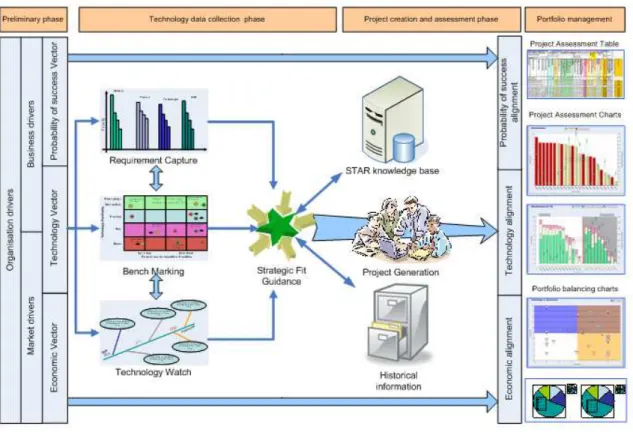
As a result of this research, a framework that aims to support organisations with the implementation of technology roadmapping is elaborated. The framework includes, firstly, an implementation lifecycle, which describes, through a set of stages, the aspects to be considered for adequate implementation of technology roadmapping within an organisation. Secondly, a comprehensive data-knowledge model structure, covering the major sections of technology roadmapping (market – product – technology - research and development) and requirements of a specific methodology. For this research study the Strategic Technology Alignment
Roadmapping (STAR®) methodology, developed at the University of Nottingham (Gindy et al., 2009), was selected, and finally, the development of a computer-based system to support the framework tested in industrial scenarios.
This work serves as a proactive tool which combines different sources and tools from technology roadmapping (TRM) and knowledge management and provides support for organisations during the implementation and use of TRM in their business activities.
1.2 Research Objectives and Questions
1.2.1 Research Objectives
This thesis aims to achieve a number of objectives, which concentrates around the main research objective, which is the development of an integrated framework for implementing technology roadmapping in industry.
One important aim is the identification and examination of the elements associated with the implementation of technology roadmapping in organisations. This includes targeting information related to the major areas of the technology roadmapping process; market, product, technology and R&D. This leads to the production of a well-structured lifecycle that serves as a supporting guidance during the implementation of TRM.
This is followed by the investigation of the methods and techniques supporting the development of an effective data-knowledge structure and software tool for technology roadmapping, which enhances the understanding and use of the methodology at company level; the outcome of which is the development of a comprehensive data knowledge structure which groups and links the identified information elements.
The final objective is the testing of the guidance, data knowledge structure in industrial scenarios, using the system tool developed as part of this research, based on the data knowledge structure and the STAR® methodology.
1.2.2 Research Questions
The research questions are derived from the research objectives and answering them will mean that the objectives will have been addressed.
In order to be able to handle the topic, the main research questions formulated were as follows:
• How an effective and useful implementation framework could be designed in order to cover the different areas of technology roadmapping processes in the most effective way and what are the criteria that should be considered for testing the resulting outcome in real scenarios?
As a consequence of the main research question, additional questions must be answered to define this topic in depth:
1. What are the components of an effective and useful implementation framework for technology roadmapping and how is best to test this approach? 2. What are the requirements and activities which should be considered when
implementing the technology roadmapping approach in an organisation? 3. Which technology roadmapping methodology should be considered for this
research?
4. How can we identify the elements of data/information/knowledge involved in a technology roadmapping process?
5. Is the integration of elements of data/information/knowledge of a technology roadmapping process achievable in a workable data/knowledge structure? 6. What are the characteristics of an integrated data-knowledge structure that is
comprehensive and adaptable to different types of organisations?
7. Does the development and use of a software tool facilitate the application of technology roadmapping in industry, and what characteristics should this tool have?
8. Is the integration of different techniques, tools and processes in an integrated software tool feasible for technology roadmapping?
9. What are the potential benefits of the development of an implementation framework to organisations that wish to use technology roadmapping?
1.3 Research Scope
The research scope is defined using the four levels for technology roadmapping proposed by the European Industrial Research Management Association (EIRMA) (1997). These are Market, Product, Technology and Research and Development (R&D) and the STAR® methodology. This includes developing practical implementation guidance, designing a comprehensive knowledge structure including the all four levels, and finally developing a software tool based on this structure and the selected methodology mainly concentrating in activities related to the Technology and R&D strategies. The detailed outline of the research scope is illustrated in Figure 1.1.
TIME >
Roadmap generic structure, from (EIRMA, 1997)
R&D programes R&D programes Technology Technology Product Product Market Market R&D 1 R&D 4 R&D 3 R&D 5 R&D 6 R&D 2 T1 T2 T3 T5 T4 P2 P3 P4 P5 M1 P1 M2 M3 Comprenhensive data-knowledge structure for TRM
Software tool for TRM (inc. activities for Technology and R&D
strategies) Technology Roadmapping STAR methodology Uni. of Nottingham Implementation guidance for TRM (Technology Roadmapping Methodology)
Integrated Framework for Implementing Technology Roadmapping
Figure 1.1: Research Scope: Integrated Framework for Implementing Technology Roadmapping.
1.4 Structure of the thesis
The research presented in this thesis is divided in eight chapters, as illustrated in Figure 1.2 and briefly described in this section.
Chapter 1 Introduction Chapter 2 Literature Review Chapter 3 Chapter 4 Development of an Integrated Framework for implementing Technology Roadmapping
Chapter 5
Integrated Technology Roadmapping Structure Lifecycle
Chapter 6 Integrated Technology Roadmapping Structure Representation Chapter 7 Integrated Technology Roadmapping Software Tool
Chapter 8
Integrated Technology Roadmapping Framework: Case Studies Conclusions Research Objectives and Questions Research Scope Technology and Technology Management Technology Roadmapping and Tools Data and Knowledge Structure Gaps in the Literature Research Design and Methodology
Integrated Framework and its implementation
Stages: Identification. Justification, Collection, Formalisation, Implementation and Application
Knowledge Structure: Market Strategy. Product Strategy, Technology Strategy, and R&D Strategy
Scope and Definitions Technology Strategy Processes R&D Strategy Processes Case 1: Large-sized Manufacturing Company Case 2: Medium-sized Manufacturing Company Case 3: Organisations NACAM and MAA
Feedback and Conclusions Discussion and Conclusions Contribution to
Theory and Practice Future Research
Figure 1.2 Structure of thesis
Following the initial chapter, an in-depth coverage of the literature related to areas of this research is discussed in Chapter 2. The analysis of this review has led to the development of the work presented in the following chapters.
Chapter 3 describes the research design and methodology which applies to this work. The introductory description of the complete research framework and an overview of definitions applied to this work are also presented in this chapter. The components of the complete research framework are described in detail in chapters 4, 5 and 6.
Chapter 4 describes, in detail, the developed practical guidance, which is divided in a set of stages, where the author explains the elements and processes involved during the implementation of technology roadmapping based on this research framework.
In Chapter 5, the knowledge base structure developed, as part of this research framework, is presented, along with a detailed description of its component data models and elements.
Chapter 6 contains the description of the software tool which incorporates the features described in previous chapters which is based on the comprehensive data-knowledge structure and a chosen technology roadmapping methodology, STAR, which has been tested and validated in case studies.
The testing and validation of the research work was carried out through a series of case studies, which are described and analysed in Chapter 7.
The thesis culminates with Chapter 8, which discusses the research findings, summarises the conclusions and research contributions, and finally presents suggestions for future research.
1.5 Summary of Chapter
This chapter provided the introductory elements of this research work. The main focus of this chapter was the presentation of the research objectives, and the research questions that this research aims to answer. The main research question -“How an effective and useful implementation framework could be designed in order to cover the different areas of technology roadmapping processes in the most effective way, and what are the criteria that should be considered for testing the resulting outcome in real scenarios?” covers the major area of study targeted by this thesis, followed by a set of other research questions that complement it. The research scope was also presented here, with an explanatory description of the areas covered in this work, finally followed by the presentation of the thesis structure and a brief description of each chapter.
2.
Literature Review
2.1Overview
This chapter aims to describe the concepts and work carried out using the Technology Roadmapping approach and its applications in industry. The contributions of different authors involved in the development of this approach are discussed here, along with definitions supporting this research work.
The chapter is divided into six sections, which includes the concepts related to Technology, Technology Management, Technology Roadmapping, and concepts concerning the development of data and knowledge structure. The final section discusses gaps in the literature which form the basis of the work presented in this thesis.
2.2 Technology and Technology Management
2.2.1 Technology
Technology is a term which has been used in several research works, and many definitions have been applied to the term. The definition provided by Phaal (2003) should be considered most suitable for this research. For Phaal (2003) “technology is seen as a type of knowledge which may be embodied in a physical artefact, where the key characteristic of technology with more general knowledge is that technology is applied and focusing in the “know-how” of the organisation”. Treating technology as a type of knowledge will help organisations to manage it effectively. Technology knowledge comprises “explicit” knowledge, which can be articulated together (e.g. manuals, user guides) with physical manifestations (e.g. equipment), and “tacit” knowledge, which cannot be articulated and relies on training and experience (e.g. welding skills).
Technology is important because it is considered as a source of competitive advantage in organisations (Phaal et al., 2003), which is widely accepted by practitioners, governments and academic, and therefore is important to understand
the specific technologies and the ways in which organisations can manage this resource in the best way.
It is crucial in the topic of technology, to understand when the conversion of science to technology is needed, and this will happen, according to Zurcher and Kostoff (1997) when the following three elements are present:
- Information about the science must exist and be readily available to potential users.
- The need for the converted science (technology) must exist.
- When one or more entrepreneurs who recognise the need, understand the relationships between the need and the science, and will obtain the necessary resources and accept the risks in the development of the science, and are available to lead the development.
2.2.2 Technology Management
Technology Management as defined by The European Institute of Technology Management (EITM, 2008) “addresses the effective identification, selection, acquisition, development, exploitation and protection of technologies (product, process, and infrastructural) needed to maintain and grow a market position and business performance in accordance with the company’s objectives”. Phaal (2003) suggested “technology management” should target processes needed to maintain products and services to the market, and it should deal with aspects of integrating technological issues into business decision making. This is directly relevant to a number of business processes, including strategic development, innovation, new product development and operations management, and therefore an “ideal” technology management should aim to achieve a balance between market ‘pull’ and technology ‘push’.
Taking the EITM definition of technology management two important themes are highlighted (Phaal, 2003):
- Establishing and maintaining the linkages between technological resources and company objectives is of vital importance and represents a continuing
challenge for many firms. It requires effective communication and knowledge management and this should be supported by appropriate tools and processes. - An effective technology management requires a number of management
processes and the EITM definition includes five processes as described by Gregory (1995): identification, selection, acquisition, exploitation and protection of technology.
Gregory (1995) proposed that management of technology should be summarised in five generic processes which are shown in Table 2.1:
1. Identification Identify technologies which
are (or may be) of importance to the business
e.g. Technology assessment, pre-selection framework,
technology/market scanning, information management
2. Selection Select technologies that should
be supported by the organisation
e.g. Technology forecasting, benchmarking, decision criteria and process, monitoring/ improvement
3. Acquisition Acquisition and assimilation of
selected technologies
e.g. Internal R&D, licensing & joint ventures, organisation change, project management, technology insertion
4. Exploitation Exploitation of technologies to
generate profit or other benefits
e.g. Customer-supplier network, incremental development, product management, complementary assets
5. Protection Protection of knowledge and
expertise embedded in products and manufacturing systems
e.g. Identify options, establish strategy, monitor effectiveness
Table 2.1 – Technology Management Processes (Gregory, 1995)
The advantage of Gregory’s approach according to Phaal et al. (2001) is its generality to be suitable to all technology management activities within the firm.
A useful approach to the Gregory’s model has been done by Skilbeck and Cruickshank (1997), proposing to link the framework with the business activities, and identified three levels where technology management should be applied: - Corporate level, which is the network view, applied to manage technology across the firm.
- Business level, which is the external view, applied to gain competitive advantage with the use of technology.
- Operational level, which is the internal view, applied to optimise internal processes.
An important observation by Gregory (1995) regarding this topic is that strategy is only of value if mechanism for its implementation and renewal are in place; therefore it is important to design a framework that accepts the technology management issues, and uses a range of tools and techniques to support the implementation of strategy. This approach is useful and is applied to the research presented in this thesis.
2.3 Technology Roadmapping (TRM)
2.3.1 Definition
In the last ten years the interest in technology roadmaps and its processes has increased considerably and several examples applied in industry of technology roadmaps can be found in the public domain. This aspect has increase the extension and diversification of the meaning of technology roadmapping, and therefore finding a single definition that integrates the whole purpose of technology roadmapping is not an easy task. However the definitions provided by researchers, presented in this thesis, complement each other in certain aspects and provide a more concise understanding of what exactly Technology Roadmapping is.
One of the most representative definitions of technology roadmapping comes from Motorola’s Robert Galvin who states that a “roadmap is an extended look at
the future of a chosen field of interest composed from the collective knowledge and imagination of the brightest drivers of the field”.
According to the European Industrial Research Management Association (EIRMA) (1997), a technology roadmap provides a framework for discussion between the component functions of a business such as marketing, manufacturing and technical which leads to a conscious integration of all aspects of technology into business strategy. Another interesting definition of roadmapping comes from Alignent (2006), who defines “Roadmapping” as the practice of creating time-based representation of information designed to support a specific objective or decision process. When used as part of strategic planning operation, roadmapping can foster innovation by forecasting the elements needed to address future technological needs or market demands.
Zurcher and Kostoff (1997) states “the roadmap or graphical model is a selected set of requirements, links and R&D projects that describes the state of technology development and potential transfer in a coherent area”. Price et al (2004) defines technology roadmapping as “a process that enables the collection and representation of technological and commercial information associated with a particular industrial sector”. Technology roadmapping process can be used as a valuable tool to capture data and represent a vision of the future, in order to support strategic technology planning at several levels.
For Bucher (2003) “Technology roadmapping is the process of creating, communicating and actively using technology roadmaps. This process brings different organisations perspective such as marketing, production, R&D, and finance. Technology roadmaps are generally manifested in a number of program elements or levels superimposed upon a timeline. Roadmaps are living documents and are constantly evolving as circumstances change”.
And finally for Phaal (2003), “technology roadmapping” represents a powerful technique for supporting technology management and planning in the firm. Roadmaps enable the evolution of markets, products and technologies to be explored and the linkages between them. Phaal (2003) explains that roadmapping
has been used widely in industries, such as Motorola who developed this approach more than 20 years ago, in order to support integrated product-technology planning, and more recently to support national and sector ‘foresight’ initiatives. The main difference between roadmapping and other business processes such as strategic planning, portfolio management, new product development, competitor analysis, benchmarking, project management, etc is that roadmapping is the only one that provides a bridge between organisations, functions, processes and time. (Alignent, 2006)
Price et al (2004) describes a set of aspects to consider in a technology roadmapping process:
- Identify the need for a technology roadmap in the organisation.
- Identify the technology drivers and market demands that need to be incorporated in the technology roadmap.
- The roadmaps should include data from people from different areas. - The data collected in the roadmap must be subject to a rigorous evaluation. - The roadmap must be needs driven.
Technology roadmapping, as a process which integrates several business areas, requires the support and resources of the organisation into which it is intended to be applied. Imposing restrictions, such as those detailed below, may reduce the impact and benefits of this approach in the organisation:
- Lack of support for technology roadmapping due to the lack of knowledge of the process.
- Insufficient allocation of human resources into the process. - Lack of a suitable method for the data collection.
- Failure to communicate the future planning activities of the organisation to its members.
- Failure to capture relevant data.
2.3.2 Technology Roadmapping: Why is it important?
According to Bucher (2003), the interest for roadmapping could be as a consequence of a series of developments such as: ever-shortening product development cycle times (as greater coordination is needed), speed (the fast eat the slow), decision-making in organizations was increasingly being distributed to business unit and product managers, the complexity of technology and their development, which implies companies should focus on core technologies and their use across product lines.
Phaal (2003) indicates that the importance of technology roadmapping as method in industries is due to “its great potential to support the development and implementation of business, product and technology strategies”. He identified the characteristics of technology roadmaps:
- Most of the benefits identified in technology roadmapping are based on the processes rather than the roadmap itself; as the process provides the opportunity of bring together people from different business areas to share their information.
- The generic roadmapping approach has great potential for supporting business strategy and planning.
- The most effective way to express the roadmaps is in the graphical form.
- Roadmaps should be multi-layers, as this reflects the integration of technology, product and commercial aspects in the firm.
- Roadmaps should explicitly show the time dimension, which is important to ensure the effective synchronisation of technological, product, service, business and market developments.
- Software has an important role to play in supporting the application of roadmapping in the enterprise. However the software itself cannot produce good roadmaps as it relies on human input. An important aspect in roadmapping is the share of knowledge and the development of a common vision of where the company is going.
But “which benefits does technology roadmapping provide to companies?” Below is a short list to consider (Alignent, 2006):
- Reduce research and development (R&D) costs - Increase revenues from new technology
- Identify emerging opportunities more easily - Keep track of competition more easily
- React to changing market conditions quickly. - Improve long-term forecasting
Equally important for an organisation is “when is it ideal for an organisation to use technology roadmapping as a method?” According to Alignent (2006) in the following situations is recommended:
- Deploying a new technology - Entering a new market
- Seeking to create alignment between multiple divisions or business segments - Serving a market where customer demands change frequently
- Losing market share to competitors.
2.3.3 Technology Roadmapping: Aspects
Technology roadmapping could be analysed from different perspectives. Bucher (2003) in his thesis provides very useful information in this area, some of which is considered in this thesis for the purposes of this research.
a. Technology roadmapping and “technology intelligence”:
According to Tschirky (2003) “technology intelligence” involves all activities supporting decision-making of technological and management concerns using relevant information on technological facts, trends, opportunities and threats. Thus, the technology monitoring and technology forecasting are important issues. For Porter et al. (1991) “technology intelligence is the (technological) observation of the environment for pertinent information”. This aspect is fundamental to the
Technology roadmapping methodology since the technology itself and the information should be useful to the organisation. Technology forecasting assesses the signals and events in accordance with business strategy. Some authors define it as a way to deal with causal elements where the effect of interest is new technologies and incremental or discontinuous changes in existing technologies (Bucher, 2003).
b. Technology roadmapping and “strategic technology planning”:
Strategic technology planning could be useful for the technology roadmapping planning mission. Mintzberg (1994) defines it as a formalised procedure to produce an articulated result, in the form of an integrated system of strategic technological decisions. While, scenario planning helps to highlight the implications of future systematic discontinuities, helping managers identify the nature, timing and implications of a range of changes; this could be done by developing different scenarios of possible futures and using indicators to help companies recognise and respond to emerging situations before their competitors (Shoemaker,1995).
Roadmapping is more useful when there is a growth phase of a product or market, or when the product or process technology is the recognised basis of competition (Bucher, 2003). Strauss et al. (1998) proposed “a carefully designed and implemented combination of these two technology methods (technology roadmapping and scenario planning) points towards the best of both worlds”, as illustrated in Figure 2.1 with their non-linear roadmapping heuristic. Bucher (2003) suggested the combination of both methods is not as easy in practice, for that Strauss et al. (1998) indicates that in order to blend these two methods it is important first to resolve a number of classical structural strategic/operational and macro/micro perspective and time-horizon differences.
Figure 2.1- Non-linear roadmap heuristic (Strauss et al, 1998)
c. Technology roadmapping and “strategic technology decision-making”
Mintzberg et al (1976) described “strategic decisions” as decisions that are novel, complex and open-ended. A decision is called “strategic” when they established the direction of the firm and most likely have involved a major part of the management team. Regarding technology Tschircky (2003) distinguished three strategic decisions (“Trilogy of strategic technology decisions”):
- “Which technologies?” This question comes from an extensive analysis of current and future products relating major technologies that determines the product performance and process technologies required for product manufacture and infrastructure operation. This analysis is based on technology intelligence activities such as a branch-overlapping search of current technology, technology forecasting and technology assessment.
- “Make or Buy?” The technologies are available through acquisition, collaboration with other firms or in-house development.
- “Keep or Sell?” The technologies should be available exclusively to our company or open to other companies.
Technology Roadmapping through a decision-making perspective has value when the roadmaps contribute to the decision. Otherwise its value is reduced. Therefore “the challenge for technology roadmapping is to act as a selective, systematic source of information that focuses the organisation’s attention on critical decision” (Bucher, 2003).
d. Technology roadmapping and “technology marketing”
In the future, technology-based companies will be faced with more technology buy- or sell-decisions than previously. This process of buy- and sell is defined as “technology marketing”. In the technology marketing, technology is considered as a product itself, and the strategic decisions of technology acquisition or technology exploitation (sell-buy) are considered fundamental in the technology marketing area (Tschircky (1994), Bucher (2003)).
Technology acquisitions should be considered when:
- Faster development. Due to the pressures of time delays in development which should be avoided, the use of externally available technological know-how should be consider to bring products to market more quickly.
- Cost and risk reduction. Technology acquisition helps to reduce cost and risk of R&D investments.
- Learning from others. Allow to access other’s technological know-how, through long-term alliances, collaborative R&D, buying competitors’ products, and others.
Technology exploitation should be considered when: - Faster access to external technology resources.
- Additional profit, generating value through the intellectual property (IP) of the firm.
- Faster learning in R&D.
- Improvement of reputation and image, an image of a string technology provider, with an outstanding R&D section.
Technology roadmapping should enable the alignment and coordination through the supply chain, especially the technological supply chain, playing an important
role in technology marketing. Petrick (2002) provides the concept of interorganisational roadmapping as it facilitates the integration and learning across teams, projects, products, technologies and organizational boundaries.
Synergy and leveragability are two important aspects of knowledge sharing across organisational boundaries and should be considered in technology roadmapping. Synergy results when the cooperation provides additional value from interdependent knowledge sharing, cooperative sharing produces more knowledge for each firm by knowing the other’s information. Lever agility occurs when one party can take additional advantage of the technological knowledge beyond the specified cooperation (Petrick, 2002).
e. Technology roadmapping and “strategic technology control”
According to Schendel and Hofer (1979) the last task in the strategic management process is that of strategic control, and it focuses on two questions. Is the strategy is being implemented as planned, and, are the results produced by the strategy the intended results.
Technology roadmapping as a device of control, as Kappel (2001) describes is to understand (forecasting aspect of technology intelligence), to persuade (planning and decision-making), to synchronize (includes decision-making, marketing and control).
2.3.4 Technology Roadmapping: Mission and Goals
According to Bucher (2003) the mission of technology roadmapping is “to improve the quality of technology decisions and to align technology-related action. It is important that technology roadmapping aligns the following functions: Technology management function, such as technology intelligence, planning, decision-making, marketing, and control, and business functions, such as R&D, production, marketing, and finance”. He compiled the most important goals of technology roadmapping in the following list:
- Established linkage and integration, the linkage between today’s technology, investment alternatives and future products, linking these alternatives to corporate strategic goals and to future customer needs. Integration should be across all business and management functions.
- Improve communication and interaction, by reaching cross-functional alignment and consensus among decision-makers and stimulate learning and supporting work in the cross-functional process way.
- Focus on technology planning, technology roadmapping is supposed to help to identify and focus strategy with product development on the few most important elements of success.
- Improve the quality of technological decision-making. Technology roadmapping plays an important role in the formulation of an integrated “market-product-technology” strategy.
- Coordinate and align technology-related projects and processes. This refers to improved R&D performance, including reduced market, time-to-money, and costs by coordinating technology development for multiple business groups, and achieving a greater competitive edge.
2.3.5 Technology Roadmapping: Components
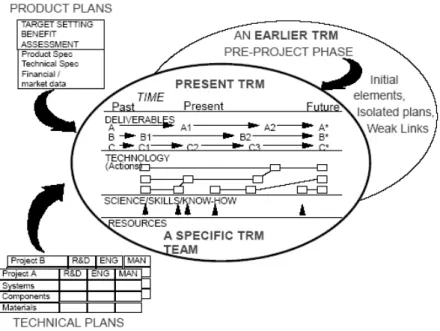
EIRMA (1997) describes technology roadmapping (TRM) as a living document that constantly evolves as circumstances change. TRM is different from a project plan with its precisely defined milestones and objective to deliver a completely specified outcome.
The main components of a generic TRM are (EIRMA, 1997): - Time: this is the prime parameter of the working group.
- Deliverables: these are the desired or expected performance characteristics of the product or process with intermediate targets.
- Technologies: the groupings and interactions of technologies needed to obtain the deliverables.
- Skills/Science/Know-how: they are required to deliver technologies - Resources: such as human, intellectual, physical and financial assets.
Technology roadmaps comprise a time-based chart linking technology development/ investment to product/services and business/market drivers (Wells et al., 2004). The recommended timescales typically vary from two to ten years, depending of the nature of the organisation and the approach given to the technology roadmaps (Price et al., 2004).
Two dimensions are important in building up roadmaps (Phaal et al., 2004):
a. Time, this is a key feature with a scale depending on the organisation and the purpose of the roadmap. The value of this dimension in business terms is in the tangible value of “time-to-market” in terms of product and technology.
b. Layers. Consider as the vertical axis of the technology roadmapping chart. It consists of several layers and sub-layers designed to meet the particular needs associated with the roadmapping activity. These should be reasonably independent of one another, and the definition of each layer should be consistent in time so the development and evolution can be mapped over the full period of the roadmap:
-The top layer, related to trends and drivers that define the goals or purpose of the roadmapping activity, and specifically include the external market and industry trends and drivers.
-The bottom layer relates to the resources needed to respond the trends and drivers, including knowledge-based resources such as technology, skills and competences, as well as finance, partnerships and facilities.
-The middle layer, is related to tangible systems developed to respond to the trends and drivers (top layer), and may also be related to engineering, systems and organisational capabilities, and represents the “know-what should this be know how” dimension of the knowledge.
During the building of technology roadmaps the input of experts in different levels of development such as the participation of a “champion” or leading person in a group should be considered. Zurcher and Kostoff (1997) indicate its importance in the process of planning, developing and distribution of the roadmaps, especially if the roadmaps reflects potential payoff in the roadmaps.
They describe the contribution of, and what to consider when selecting champions:
(1) The more champions, the better the support for the science conversion.
(2) The greater the interest of the champion the more likely the project to proceed. (3) The greater the influence of the champion, the more likely the research conversion will be pursued.
EIRMA (1997) suggests possible inputs for a TRM exercise such as the internal and external circumstances (audit/benchmarking), and future requirements and possibilities (foresight/options). The outputs from a TRM will include gap analysis of the future requirements and current capabilities, time scheduling of activities, possible project activities, potential products and processes accessible from the technology, synergies across the technical activities and the commercial activities, improvements in processes for team working and communications, implications for current and future resources, the TRM as a working document in the organisation.
Well et al. (2004) also suggests technology roadmaps could be technology driven or needs driven but the most powerful ones are those combining both.
It is important for a roadmap to consider the following issues (Phaal et al., 2004): a. Context, expand aspects of the interest in roadmapping with any constraints
affecting the approach adopted, such as ownership of the business problem, scope, focus, aims, resources, participants and information.
b. Architecture, structure of the roadmap in timeframe (horizontal axis), and layers (business structure).
c. Process, which include a ‘macro’ level (broad steps needed in the short-medium and long-term) and ‘micro’ level associated with the short term and particular agenda.
The two key elements for customisation according to Phaal et al (2004) are: architecture and process, both of which should be considered in parallel. The process is also iterative and will continue until all parties agree with the outcome.
2.3.6 Technology Roadmapping: Approaches
Kostoff and Schaller (2001) identified two approaches to technology roadmapping: the expert- and computer- based approaches.
- Expert- based approach, this approach refers to team(s) of experts who identify and develop attributes of the roadmap. It is important that the appropriate experts should be employed to develop the roadmap, although they become fully aware of the roadmap once it is completed, and iterative process should be applied in this case. The team of experts should consist of researchers, developers, marketers and others with relevant knowledge of the overall roadmap theme so they can develop the framework. In some cases external assistance is required in order to develop credible roadmaps. The key element using this approach is the knowledge and experience of the participants as they should identify relationships within network and the quantity and qualitative evolution technology.
- Computer- based approach; this approach refers to large databases that describe science, technology, engineering and end-products. These databases should include published papers, reports, memoranda, letters, presentations, graphics, and even movies. Research, technology, engineering and product areas are identified through the use of generic computerised methodologies, including computational linguistics and citation analysis. Their relative importance is estimated and quantified and their relationships and linkages to other areas are identified and quantified.
The contrast of computer-based approach with the expert- based approach is that the computer- based approach has greater “objectivity”. It does not have the preconceived limitations, constraints, biases or personal and organizational agendas of the experts. Most of the computer-based computational linguistics studies focus on the “structural relationships” among science and technology disciplines and programs, since this was the main objective and because the database sources tended to contain much of this type of information. However there is a still work to be done in this area.