University of Huddersfield Repository
Kroll, Ehud and Koskela, Lauri Explicating concepts in reasoning from function to form by twostep innovative abductions Original Citation Kroll, Ehud and Koskela, Lauri (2016) Explicating concepts in reasoning from function to form by twostep innovative abductions. Artificial Intelligence for Engineering Design, Analysis and Manufacturing, 30 (02). pp. 125137. ISSN 08900604 This version is available at http://eprints.hud.ac.uk/28084/ The University Repository is a digital collection of the research output of the University, available on Open Access. Copyright and Moral Rights for the items on this site are retained by the individual author and/or other copyright owners. Users may access full items free of charge; copies of full text items generally can be reproduced, displayed or performed and given to third parties in any format or medium for personal research or study, educational or notforprofit purposes without prior permission or charge, provided: • The authors, title and full bibliographic details is credited in any copy; • A hyperlink and/or URL is included for the original metadata page; and • The content is not changed in any way. For more information, including our policy and submission procedure, please contact the Repository Team at: [email protected]. http://eprints.hud.ac.uk/1
Explicating concepts in reasoning from function to form by two-step innovative abductions
Ehud Kroll (corresponding author) Faculty of Aerospace Engineering
Technion – Israel institute of Technology Technion City Haifa 32000 Israel phone: (972)544830879 e-mail: [email protected] Lauri Koskela
Department of Civil and Structural Engineering Aalto University
Finland and
School of Art, Design and Architecture University of Huddersfield
UK
Short title: Two-step innovative abductions
No. of manuscript pages: 30
No. of tables: 1
2
Explicating concepts in reasoning from function to form by two-step innovative abductions
Abstract
The mechanism of design reasoning from function to form is suggested to consist of a two-step inference of the innovative abduction type. First is an inference from a desired functional aspect to an idea, concept or solution principle to satisfy the function. This is followed by a second innovative abduction, from the latest concept to form, structure or mechanism. The intermediate entity in the logical reasoning, the concept, is thus made explicit, which is significant in following and understanding a specific design process, for educating designers, and to build a logic-based computational model of design. The idea of a two-step abductive reasoning process is developed from the critical examination of several propositions made by others. We accept the notion of innovative abduction in design, as opposed to science’s explanatory abduction, and we adopt a previously proposed two-step process of abductive reasoning. However, our model is different in that the two abductions used follow the syllogistic pattern of innovative abduction. In addition to using a schematic example from the literature to demonstrate our derivation, we apply the model to an existing, empirically derived method of conceptual design called “parameter analysis”, and use two examples of real design processes. The two synthetic steps of the method are shown to follow the proposed double innovative abduction scheme, and the design processes are presented as sequences of double abductions from function to concept and from concept to form, with a subsequent deductive evaluation step.
3
1. Introduction
It is widely accepted that design begins with a function, a need to be satisfied, and terminates with form, a description of a proposed artifact–a blueprint for its manufacture that includes the composition, shape, materials, dimensions, etc. But how exactly does form follow function? What is the type of reasoning involved? Where does the form come from? Is the form inferred directly from the function using some sort of rule set? Are there any intermediate steps in the reasoning that are more or less explicit?
1.1 Some approaches to function-form reasoning
Ullman (1992, p. 140) states that reasoning from function to form is done by a double mapping process: first from function to concept, and then from concept to form. His method for conceptual design then follows the German-school systematic design (Pahl & Beitz, 1984), which prescribes a comprehensive functional decomposition stage, followed by finding working principles (concepts) for the various subfunctions and combining them into an overall concept (the principal solution) with the help of a morphological chart. The working principles usually consist of “physical effects + form”, while the principal solution is defined as an idealized representation of the structure that defines those characteristics that are essential for the functioning of the artifact (Roozenburg, 1993). Many variations on this approach appear in widely used design textbooks, including those by Otto & Wood (2000) and Ulrich & Eppinger (2007). Borrowing from AI and search techniques, this approach may be regarded as working “breadth-first” because the comprehensive functional decomposition stage has to be completed before moving on to the next level—the morphological chart—and this in turn has to be completed for all the subfunctions before initiating the stage of combining working principles into overall concepts.
In contrast, other design paradigms emphasize the sequential and iterative character of applying the reasoning from function to form. Suh’s axiomatic design framework consists of the functional space and the physical space (Suh, 1990). The former contains functional requirements (FRs) and the latter, design parameters (DPs). Mapping FRs into DPs is the core of the design process; but because there can be many mapping techniques, the design axioms provide the principles to be satisfied by the mapping to produce good designs. Suh does not expand on how solution concepts or ideas are generated; rather, he uses many examples of design problems and their solution ideas to support the notions of FRs, DPs and the two axioms. The important point, however, is that the function to form mapping is applied
4
repeatedly: new functional requirements are constantly generated from previous design parameters, and so on.
Another framework, function-behavior-structure or FBS (Gero & Kannengiesser, 2004), identifies several processes within design, such as transforming functional requirements into expected behaviors, transforming expected behaviors into solution structures, deriving actual behaviors from structures, comparing derived with expected behaviors, and responding to unsatisfactory behaviors by reformulating the design space (changing the structure, behavior or function). These design steps are again applied repeatedly, as with Suh’s model. Also common to the axiomatic design and FBS models is that they do not use the notion of ‘concept’, in the sense of underlying solution ideas, as an explicit constituent of the reasoning process. This may be due to the fact that these models are descriptive—they tell how design is carried out in practice—so they emphasize what is apparent to an outside observer of designers: needs (functions) are turned into physical solutions, while the ideas (concepts) remain implicit, in the designer’s mind.
1.2 The parameter analysis method of conceptual design
Parameter analysis (PA), the conceptual design method discussed in this article, is different from the other method in that it makes the concepts the pivot about which the design process revolves. Contrary to systematic design, but similar to axiomatic design and FBS, PA presents the design process as a repeatedly applied sequence of steps, not a single pass through major stages. PA originally started as an empirically derived descriptive model, in which the designer moves back and forth between the space of ideas (concept space) and the space of physical realizations (configuration space) (Li et al, 1980). It was later developed onto a prescriptive model, facilitating the intra-space mental movement by three distinct steps (Kroll et al. 2001; Kroll, 2013): parameter identification (PI) corresponds to finding a “parameter” (concept, idea) for resolving a functional issue with the evolving design. This concept is mapped into form by the creative synthesis (CS) step, and the last configuration is tested by
an evaluation (E) step. This last step often results in new functional issues (unsatisfactory or
undesirable behavior) to be resolved, so the process continues until an acceptable solution has been reached.
In previous work (Kroll & Koskela, 2015) we studied the method of PA from the perspective of the proto-theory of design, which is based on the method of geometric analysis, as suggested by Aristotle. It was concluded that certain design “moves” could be explained as being deductive, some as regressive, but others were more difficult to cast in this framework
5
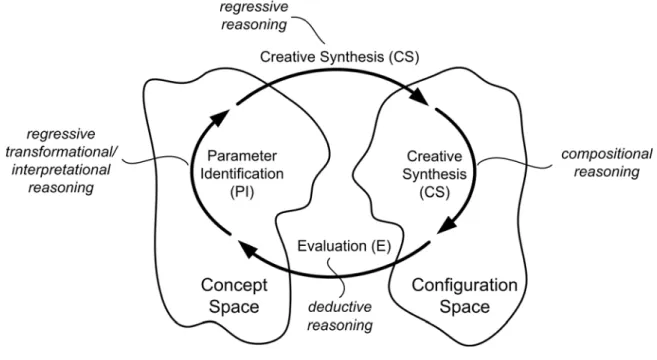
and were characterized as being compositional or transformational/interpretational. As shown in Figure 1, deductive reasoning (the E step) is used to infer behavioral aspects from the evolving configuration, from which a functional aspect to be addressed next is derived. This function is the input to PI, where a concept, idea (“parameter”) is sought to satisfy it, and this is often done by transforming the problem or interpreting it in a different way. Once a concept has been identified, another regressive inference takes place to create a configuration, hardware representation, form that realizes the concept. The second CS step in Figure 1 represents composition—the integration of the last configurational solution in the overall form of the design artifact. The main focus of the current paper is on the PI and first CS steps, as they stand for the core operations in design: reasoning from function to concept, and reasoning from concept to form, respectively.
[Figure 1 here]
PA is unique in that it places the most emphasis on the PI step. The reasoning at the conceptual level is claimed to be so important, that “parameters”—ideas, concepts, operating principles, underlying physical effects, etc.—have to be stated explicitly. The E step is considered second in importance, because it involves abstracting from a particular problem to new functional issues at the conceptual level. The actual step of giving form to the design, CS, is ranked the least important, as intermediate configurations are needed mostly to facilitate the evaluation, and any unsatisfactory characteristic of a configuration will be mended in the next cycle. So, although the outcome of the design process is certainly a configuration, the philosophy of PA is that the reasons, justifications and derivations behind the configuration are indispensable when it comes to presenting a design solution or studying the process of designing.
The following two examples of PA processes are reproduced below from (Kroll, 2011) and (Kroll et al., 2014), respectively. They represent design processes that are different in nature. The first is “linear” in the sense of pursuing a single fundamental concept and incrementally improving it, while in the second, various technologies are explored until a breakthrough takes place and a totally new concept emerges.
6
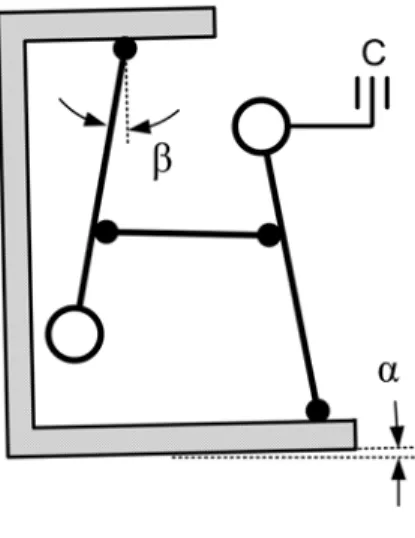
A device was needed for measuring very small angles of tilt of the ground with respect to the local gravity vector. The inventor’s account of his thought process as PA follows, with Figure 2 showing a schematic of the design:
PI1: A simple pendulum can be used to measure tilt.
CS1: A very long device, of the order of 50 m, will be required for the small angles that
need to be measured.
E1: This is too long. A physically short pendulum (~0.5 m) that behaves as if it’s long is needed.
PI2: A simple pendulum being displaced laterally can be thought of as a spring, that is, producing a restoring force proportional to the displacement. Stating that the pendulum needs to be very long is equivalent to requiring a very soft spring (small spring constant k). But how can a small k be obtained when the physical dimensions
should be kept small? Let’s use the difference between two large spring constants (short pendulums) to yield a small k (effectively long pendulum). This requires a negative spring, i.e., one that produces a force in the direction of the disturbance, and this can be provided by unstable devices such as an inverted pendulum.
CS2: The configuration consists of two coupled pendulums, one simple and one inverted; the resultant spring constant is made small but positive, thus producing the desired high sensitivity while being stable.
E2: This may work, but friction in the joints needs to be reduced to ensure the required sensitivity.
PI3: Minimize friction by using rolling contact instead of sliding.
CS3: Flexural hinges with near-zero resistance are implemented in the joints.
E3: Displacement measurement, also without friction, is needed.
PI4: Use a non-contact technology for displacement measurement
CS4: A capacitor-type sensor is added to the design.
E4: …
7
Example 2: Designing decelerators for airborne sensors
The means of decelerating airborne sensors for monitoring air quality and composition was needed. The sensors were to be released at about 3,000 m from a container carried by a light aircraft, so compact packing was required, and stay in the air for at least 15 minutes. A partial description of the designers’ PA process follows:
PI1: Deceleration can be produced using a flexible parachute.
CS1: A 150-mm dia. hemispherical parachute, connected to the sensor with cords.
E1: Drag force is ok and compact packing can be done by folding, but the parachute may not open because there isn’t enough “pull” on it, and the cords may tangle.
PI2: A rigid parachute may be used to generate the drag force, eliminating the deployment problem.
CS2: A 150-mm diagonal square pyramid with the sensor rigidly attached.
E2: Drag force is ok but compact packing is impossible because these configurations cannot nest inside each other.
PI3: Use a frame + flexible sheet construction that can fold like an umbrella, and use a spring for opening.
CS3: Lightweight skeleton made of plastic or composite with “Saran wrap” stretched and glued onto it. Hinges and slides allow folding. A spring facilitates opening.
E3: Drag force and compact packing are ok, but this structure is unreliable and expensive to manufacture because of the many moving parts.
PI4: Looking at the problem from an energy viewpoint instead of producing retarding force, the sensor’s potential energy can be dissipated over a longer distance by a smaller drag force. Use a small spiraling glider.
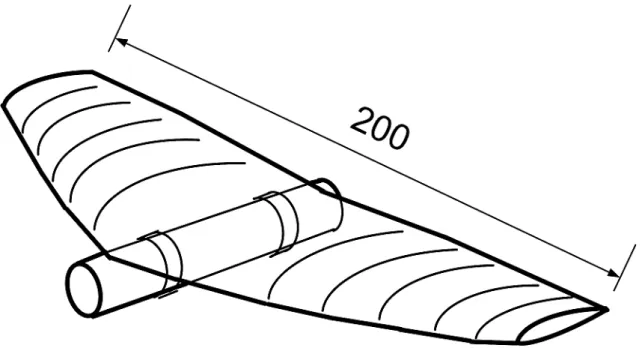
CS4: Wings with a span of 200 mm and a small twist to produce a 30-m diameter spiral trajectory. The wings are made of Styrofoam and the sensor attached with plastic clips, as shown in Figure 3.
E4: …
8 1.3 Summary
PA is a practical method that has been taught and practiced for over two decades. The examples demonstrated the type of reasoning that takes place: PI represents reasoning from function (what should be done to satisfy a need or to improve an evolving design) to concept (“parameter” in PA terms, which is the idea, technology, physical principle, etc.) to be used to attain the functional goal. CS starts with the latest concept and seeks to realize it in form, what is called “configuration” in PA. In addition to these two regressive reasoning steps, E is clearly deductive, of the “given structure, find behavior” type. But how can we characterize the PI and CS steps better in terms of the entities and reasoning involved so as to improve our understanding of the function to form reasoning in design? To answer this question, we need to consult a logic-based framework.
2. Design abduction
Regressive and transformational inferences in design are of particular interest as they involve heuristic reasoning and intuition, notions that are sometimes associated with the type of inference called abduction. For example, abductive reasoning has been identified with the notions of intuition (Cross, 2006, p. 33), creativity and subconscious activities (Dew, 2007). Of course, abduction has for long been discussed in philosophy of science, where an ongoing debate exists regarding its exact nature.
Peirce (1994) is attributed with proposing that abduction is a form of “synthetic” reasoning (together with induction, but different from the “analytic” reasoning of deduction), while focusing on scientific explanation. Researchers still disagree on the exact nature of induction (Vickers, 2013) and certainly on abduction. Schurz (2008) presents a thorough classification of abduction patterns, all of which are “special patterns of inference to the best explanation”. He identifies many types of abduction based on three dimensions. The main dimension is the type of hypothesis (conclusion) abduced. The other two are the type of evidence to be explained and the cognitive mechanism driving the abduction. Schurz refers to “the official Peirce abduction schema” as “factual abduction” of the following structure:
Known Law: IF Cx THEN Ex
(1)
Known Evidence: Ea has occurred
_________________________________________________________________________________________________________________________________
9
Investigations of abduction in relation to design have mostly been carried out by scholars in design theory and artificial intelligence. Both streams of research are briefly outlined in the following. In design theory, March (1976) seminally suggests that abduction, which he calls “productive reasoning”, is the key mode of reasoning in design. He also points to the confusion and misunderstanding created by not distinguishing between scientific and design hypotheses, and between logical propositions and design proposals. Whereas the goal of science is to establish general laws, he says, design is concerned with realizing a particular outcome. The pattern of abduction proposed by March is: from certain characteristics that are sought, and on the basis of previous knowledge and models of possibilities, a design proposal is put forward.
Roozenburg (1993) discusses in depth the question whether the reasoning towards a tentative description of a design follows the conventional view on abduction, or whether it should be defined differently. He argues that the commonly presented view, especially in artificial intelligence literature, deals with “explanatory abductions”, which are good for diagnosis or troubleshooting, but that the core of design reasoning follows another type of abduction, for which he proposes the terms “innovative abduction” and “innoduction” (Roozenburg, 1995). In fact, says Roozenburg (1993), Habermas distinguished between explanatory abduction as in (1) and innovative abduction, in which the law is not known and needs to be inferred together with the presumed reason for the evidence, and it was March who did not make that distinction.
A more recent paper by Dorst (2011) proposes yet another view on design abduction. It claims that there are two types of abduction relevant to design: abduction-1 which follows a similar pattern to (1), and abduction-2 which is comparable to Roozenburg’s innoduction. Furthermore, Dorst suggests chaining these two inferences into a single reasoning step, which is the core of ‘design thinking’. In spite of Roozenburg’s introduction of the concept of innovative abduction and Dorst’s adoption of it, some design scholars still maintain Peirce’s view and try to apply his “process of scientific inquiry”, consisting of cycles of abduction, deduction, and induction, to the area of design (e.g., Pauwels et al., 2013).
In artificial intelligence oriented research on design abduction, the emphasis has been on computable abduction models. To some extent this work is overlapping with and influenced by design theory research on abduction. For example, Goel (1998) proposes to extend (and complicate) March’s model if we wish to use it in knowledge-based systems. His argument is based on the fact that the laws (also called rules or knowledge) can have different logical natures; for example, universal or statistical, and this affects the meaning of the abduction
10
pattern. However, the influential work led by Takeda et al. (1990) on design abduction is based on original insights into design, and the connection to Peirce’s seminal work on abduction in science seems looser. Abduction is defined as a process making integrated hypotheses and theories to explain given facts (Takeda, 1994), a definition that goes beyond Schurz’ classification of abduction (Tomiyama et al., 2003). Analogical reasoning is applied for computationally supporting abduction (Takeda et al., 2003).
To conclude, it seems that abduction has the potential to explain design moves in which new solutions are created, in general, and the PI and CS steps of PA in particular. For that purpose, we shall now examine both Roozenburg’s and Dorst’s models.
3. Roozenburg’s model of a single innovative abduction
3.1 The syllogistic form
Science’s explanatory abduction, also called “presumption of fact”, is actually a reversal of deduction, says Roozenburg (1993). In deduction we have the following logical expression:
p q (a given rule, IF p THEN q)
(2) p (p is a given fact, a case or cause)
_________________________________________________________________________________________________________________________________ q (q is the conclusion, the result)
and reversing it gives:
p q (a given rule, IF p THEN q)
(3) q (q is a given fact, a result)
_________________________________________________________________________________________________________________________________ p (p is the conclusion, the case or cause)
Expression (3) is the definition of explanatory abduction, similar to (1), where the conclusion is a plausible cause. According to Roozenburg, pattern (3) is not the main reasoning form in design, where the only given is a desired result, and both the rule and the cause need to be discovered. His innovative abduction therefore follows the pattern:
11 q (q is a given fact, a desired result)
(4) _________________________________________________________________________________________________________________________________
p q (a rule to be inferred first, IF p THEN q)
p (p is the conclusion, the cause, that immediately follows)
Pattern (4) is the real abduction in design because it represents reasoning from a function, a desired result or purpose, to form and use. Form and use are the ‘principal solution’, the structure of the artifact and its way of use that define its function.
3.2 Demonstration: designing a kettle
Roozenburg demonstrates innovative abduction through the example of designing the first ever kettle. The purpose, function, is to boil water. The mode of action (defined as ‘using laws of nature to produce a desired effect’), or functional behavior, is heating the bottom of the kettle and conducting the heat to the water inside. This will be facilitated by the way of use (also called ‘actuation’) of filling the kettle with water and placing it on a burner. Finally, to allow all this, the kettle must have a specific form: hemisphere with opening at the top and metal construction.
Now that there are four distinct entities involved in the reasoning (function, mode of action,
way of use, and form), Roozenburg groups together form and way of use into one entity,
claiming that they always go hand in hand, so he writes:
form + way of use mode of action function (5)
or in other words: hemisphere and metal + fill with water and place on burner heat bottom of kettle and conduct heat to the water inside boil water.
Next, the intermediate result (mode of action) in expression (5) can be omitted, so what is left is:
form + way of use function (6)
or: hemisphere and metal + fill with water and place on burner boil water.
The function (boil water) is given in design, says Roozenburg. What needs to be designed
is usually considered to be the form (hemisphere and metal). But a description of form is not enough to predict the behavior which fulfills the function. The behavior (mode of action)
12
depends on form but also on the way of use. So, the designer needs to develop ideas on way of use together with form. It follows that the “kernel of design” is the reasoning from function to
form + way of use. This, according to Roozenburg, follows the same pattern of reasoning as
Habermas’ innovative abduction, expression (4), if we define p as the combined description of
form + way of use:
q boil water (the only given is the function)
(7) _________________________________________________________________________________________________________________________________
p q IF hemisphere and metal + fill water and place on burner THEN boil water (IF form + way of use THEN function; the rule to be inferred first) p hemisphere and metal + fill water and place on burner (form + way of
use; the second conclusion)
The meaning of the last logical inference is that if you want to boil water, you need to ‘discover’ the first conclusion (hemisphere and metal form + filling water and placing on burner way of use boil water function), and immediately you will get the second conclusion (hemisphere and metal form + filling water and placing on burner way of use). The second conclusion constitutes the principal solution to the design problem.
3.3 Is a single abduction enough?
The question regarding Roozenburg’s claim is whether the designer who wants to boil water can generate the ‘rule’ in the first conclusion directly, without reasoning about the mode of
action (heating the bottom of the kettle and conducting the heat to the water inside) first.
Roozenburg’s description does not include the mode of action explicitly, assuming perhaps that somehow the designer has gained the insight on using this specific mode of action, which is the main characteristic of the principal solution, and now proceeds according to pattern (7). Roozenburg’s presentation of abduction can be modified to expression (8), where the underlined addition of the mode of action, the operating principle, makes it explicit:
13
q boil water by heating the bottom of a container and conducting the heat to the water (function and mode of action)
(8) _________________________________________________________________________________________________________________________________
p q IF hemisphere and metal + fill water and place on burner THEN boil water by heating the bottom of a container and conducting the heat to the water (the first conclusion)
p hemisphere and metal + fill water and place on burner (the second conclusion)
But this raises two new questions: (a) where did the mode of action come from in the first place, and should it not be an explicit abductive step by itself in the description of the “kernel of design”? and (b) does pattern (8) represent what really happens during design?
3.4 From single to double abductions
To answer these questions, let us try to imagine the thought process while designing (the first ever) kettle. We need to design a device to boil water (but in a certain context, of having at our disposal a burner, and the boiled water will be used to make tea, as opposed for example to generating steam in a sauna). What operating principle can we use? Here is an idea: we need some sort of container that can be filled with water and placed over the burner. Then the bottom of the container will be heated, and the heat will be conducted to the water inside (note that we came up with a mode of action – heating the bottom of the water container and conducting the heat to the water, and way of use – filling the container with water and placing it on the burner). Now that we have decided on these (mode of action + way of use), we ask ourselves what form we should give the device to work properly (that is, a form that when used as intended – filled with water and placed on burner – will result in the intended mode of
action, conducting the heat to the water). The answer now is, use a hemisphere with opening
at the top and make it out of metal.
The reasoning above is clearly from function to mode of action + way of use first, followed by reasoning from mode of action + way of use to form. Roozenburg represents this process as a single innovative abduction, wherein the mode of action is implicit, so it gives the impression that the main idea (mode of action) is not part of the abduction at all. Moreover, Roozenburg combines way of use with form into a single entity, as if they are inseparable.
A more correct way to represent the above reasoning process may be by a two-step or double innovative abduction to capture the fact that two distinct inferences are carried out:
14 1st step:
q boil water (the function)
(9) _________________________________________________________________________________________________________________________________
p q IF fill water and place on burner so heat is conducted to water THEN boil water (the first conclusion: way of use + mode of action
function)
p fill water and place on burner so heat is conducted to water (the second conclusion: way of use + mode of action)
2nd step:
q fill water and place on burner so heat is conducted to water (the newly generated way of use + mode of action is now the given)
(10) _________________________________________________________________________________________________________________________________
p q IF hemisphere with opening and metal THEN fill water and place on burner so heat is conducted to water (the first conclusion: form way
of use + mode of action)
p hemisphere with opening and metal (the second conclusion: form)
To summarize, the above two-step reasoning allows inferring from function to an idea, concept or solution principle (showing as way of use + mode of action) first, and from that principle, to the form. In general we can say that each innovative abduction reasoning step of pattern (4) involves two entities, p and q, but design reasoning should involve four entities:
function, mode of action, way of use, and form. And although we claim that mode of action
and way of use seem to frequently show together, so they can be counted as one entity, the
three remaining entities still require two inferences, not one. What Roozenburg did is actually leaving out mode of action and grouping form and way of use into one entity, claiming that together they are the sought solution, so he could reduce the problem to a two-entity single abduction.
Support for the insight that four entities should be involved in describing design reasoning can be found in the work of Zeng and Cheng [19], which Roozenburg claims arrived at similar conclusions to his. Zeng and Cheng argue that design reasoning involves three entities: form, function and environment, and that the environment consists of two entities:
15
actions of nature are his way of use, then we have a one-to-one correspondence of the four
entities.
4. Dorst’s model of double abduction
4.1 The syllogistic form
Dorst (2011) also must have realized that a single abduction cannot explain ‘design thinking’. His presentation of abduction revolves around the following logical expression:
what (the artifact) + how (the working principle) value (aspired) (11) in which the (aspired) value is always given. If the how is also given, the designer generates the what by a so-called abduction-1, which is precisely the explanatory abduction of pattern (3). Dorst calls this case “conventional (‘closed’) problem-solving that designers often do”. If, however, the how is not given, then this is a more ‘open’ problem for which the designer needs to decide on both the working principle and the artifact. This is accomplished by
abduction-2, as in pattern (4), which is the same as Roozenburg’s innovative abduction.
Abduction-2 is carried out by first developing or adopting a ‘frame’ (after Schön), which is a
“general implication that by applying a certain working principle we will create a specific value”. With the help of framing, abduction-2 takes place according to the following pattern:
q (q is the given desired value)
(12) _________________________________________________________________________________________________________________________________
p q (IF how THEN value, the first conclusion) p (how, the second conclusion)
When a possible or promising frame has been proposed and the how is known, says Dorst,
abduction-1 can take place to design the what, the artifact.
4.2 What type of second abduction?
Let us now apply Dorst’s double-step reasoning process (abduction-2 followed by abduction-1) to Roozenburg’s kettle example. Surely, the value in expressions (11) and (12) corresponds
to function, and the what in (11) corresponds to form (Dorst calls it the ‘object’ or ‘thing’).
The how, therefore, must stand for the way of use + mode of action (also to be in agreement with Zeng and Cheng on having four entities involved in design reasoning). If we set value =
16
“boil water” as the only known fact, abduction-2 may yield a possible working principle, a how, which is the following way of use + mode of action: “fill water and place on burner so heat is conducted to water”. So far this is identical to expression (9).
Now we need to design the what, or form, and Dorst suggests that this will be done by
abduction-1 because we know the value and how in expression (11). For abduction-1 to take
place according to pattern (3), however, the conclusion should appear as the premise of the given rule, and this does not seem to be the case here. The what is still unknown (recall that this is the first kettle ever), and of course this is why this kind of explanatory abduction cannot be the main form of reasoning in design. The only possibility is to use abduction-2 again, starting with the only known, the how found in the previous step, and using it as the given to seek a “rule” to tie together a what (form) to this how (working principle), and therefore inferring that what. The resulting inference is identical to expression (10).
5. The double innovative abduction in parameter analysis
Having modified Roozenburg’s and Dorst’s models of reasoning from function to form to two
innovative abduction (or abduction-2) inferences, as in (9) and (10), allows us to compare this
model with PA. As explained and demonstrated earlier, PI is reasoning from a functional aspect to a solution principle, which is equivalent to the first innovative abduction as in (9). The solution principle (concept) consists of way of use + mode of action. The second step is CS, where the reasoning begins with the solution principle derived in PI and ends with a configuration, structure, or form, as in (10). Overall we obtain the double mapping function
concept form.
The examples of PA described in Section 1.2 can easily be presented as such double abductions. The cycles of double innovative abductions—corresponding to the PI and CS steps with the deductive E step occurring after each cycle—as applicable to Example 1 is shown by expressions (13) to (20):
PI1:
q measure tilt (the function; specified by the need definition)
(13) _________________________________________________________________________________________________________________________________
p q IF a simple pendulum is used THEN tilt can be measured (the first conclusion: way of use + mode of action function)
p a simple pendulum (the second conclusion: way of use + mode of action)
17 CS1:
q a simple pendulum (the newly generated way of use + mode of action is now the given)
(14) _________________________________________________________________________________________________________________________________
p q IF the pendulum is 50 m long THEN the required resolution will be obtained (the first conclusion: form way of use + mode of action) p a 50-m long pendulum (the second conclusion: form)
At this point E1 concludes that the pendulum is too long, and a short pendulum that behaves as if it were long is needed. This becomes the given function to be realized in the next cycle:
PI2:
q a short pendulum that behaves as if it were long
(15) _________________________________________________________________________________________________________________________________
p q IF a long pendulum is like a soft spring THEN the difference between two large spring constants will give a long-pendulum behavior
p small difference between two large spring constants
CS2:
q small difference between two large spring constants
(16) _________________________________________________________________________________________________________________________________
p q IF two short pendulums, one simple and one inverted, are coupled THEN a small difference between their spring constants will be obtained p two short pendulums, simple and inverted, coupled by a hinged crossbar
E2 now deduces that for the device to work properly, joint friction needs to be reduced:
PI3:
q reduce joint friction
(17) _________________________________________________________________________________________________________________________________
p q IF rolling contact replaces sliding THEN friction is reduced p rolling contact instead of sliding
18 CS3:
q rolling contact instead of sliding
(18) _________________________________________________________________________________________________________________________________
p q IF flexures are used THEN rolling contact replaces sliding p flexures
E3 now comes up with a new problem, of measuring the displacement without friction, so the process continues:
PI4:
q displacement measurement without friction
(19) _________________________________________________________________________________________________________________________________
p q IF a non-contact measurement technique is used THEN no friction will be present
p non-contact measurement technique
CS4:
q non-contact measurement technique
(20) _________________________________________________________________________________________________________________________________
p q IF capacitor-type sensor is used THEN a non-contact technique is implemented
p capacitor-type sensor
Similarly, Example 2 can be presented as the following sequence of pairs of innovative abductions with deductive evaluations between each pair: The first given function, decelerating airborne sensors, led to abducing the concept of flexible parachutes (PI1), which in turn produced a specific form (CS1) by a second abduction. Evaluation showed a potential deployment problem, so its elimination became the next function. The designer now abduced the concept of rigid parachutes (PI2) and a particular form of such structure (CS2), but discovered the problem with compact packing. The next cycle of double innovative abductions (PI3 and CS3) shows the inference of an “umbrella” concept and the corresponding configuration, followed by deducing that the latest structure was unreliable and expensive. The last PA cycle, comprising PI4 and CS4, is a breakthrough in the design process because a totally new concept (spiraling glider) emerged and was realized as a specific hardware description.
19
6. Discussion
Table 1 summarizes the different terms used by the four models of this paper for clarification of their starting point, intermediate entities, and end point. There are four fundamental units involved in the reasoning, for which we may adopt the terms function, way of use, mode of
action, and form. Some models use other names for these entities, but a bigger difference is in
how they are sometimes grouped together, made implicit, or serve a different role.
[Table 1 here]
We propose that reasoning from function to form may be productively modelled in terms of two creative leaps, each requiring an abduction-2/innovative abduction reasoning step. The first infers the solution principle to be used to attain the desired function, and the second infers the artifact that can utilize the solution principle. The pattern of abductions involved is very different from explanatory abduction, so having a special name for this kind of reasoning seems justified.
Solution principle or concept is comprised of way of use + mode of action. The mode of
action is much more fundamental to the reasoning than the way of use. In fact, way of use may
be trivial in many cases, so it may not appear in the description of the inferences. For instance, PI1 in Example 1 only specifies “a simple pendulum” as the concept (way of use +
mode of action). But this is understandable when it comes to designers’ reasoning: a simple
pendulum implies hanging a weight on a string or rod that are hinged onto some frame (way
of use) and the mode of action is the self-alignment of the pendulum with the gravitational
field while the frame is being tilted with the ground, so an angle identical to the ground’s inclination is formed between the frame and pendulum. Similarly, decelerating the sensor by a parachute (PI1 in Example 2) is the obvious way of use + mode of action in the overall setting of the design task: it unequivocally means that if the sensor is attached to the parachute with cords and both are released in midair (way of use), then drag force due to air resistance will be generated to slow down the “fall” (mode of action). The way of use of filling water and putting the water-filled kettle over a burner is also trivial, because the initial problem statement should have involved a burner as the source of thermal energy (and not, for instance, electricity) and the purpose of boiling the water (for making tea we may want to contain the boiled water, as opposed to producing steam in a sauna).
20
In contrast to the sometimes hidden presence of the way of use, the importance of explicitly including the mode of action in the inference cannot be overstated. When the designer thinks in conceptual terms about physical and working principles, the designed artifact will be based on a solid ideational foundation. Alternative working principles may be thought of, the rationale of the design will be captured better for possible use in the future, and deeper understanding of the problem domain will be gained by the designer. For instance, the understanding of pendulum physics is what brought about the analogy between a pendulum and a spring (both generate a restoring force proportional and opposite to the displacement (PI2 in Example 1). Understanding the physics of work (force times distance) is what led to the breakthrough in the decelerators’ design, when realizing that vertical descent presumes a distance equal to the release altitude, but this could be modified to spiraling descent. Similarly, the choice of metal construction in the form of the kettle may be modified when explicating the mode of action—heating the bottom and conducting the heat to the water inside—perhaps by looking for materials with high thermal diffusivity or combining a heat conducting material for the bottom and a heat insulating material for the sides of the kettle.
Dorst (2011) specifically refers to this issue. When describing the pattern of abduction-2 as in (11) he says: “students and other novice designers can be seen to almost randomly generate proposals for both the ‘how’ and the ‘what’, and then seek to find a matching pair that does lead to the aspired value”. In our experience, the issue is not the random trial-and-error process, but rather an attempt to reason from function (aspired value) directly to form (the what), without the intermediate step of reasoning about the concept (the how).
Having proposed a double innovative abduction/abduction-2 model, we may ask whether
explanatory abduction/abduction-1 exists in design at all. While March and some other
researchers seem to refer to only this type of abduction in the context of design, we have shown that both generating a concept (working principle) and an artifact (form) require abductive reasoning with only one fact, the desired value, as a given. In both cases a rule needs to be inferred first, and the premise of the rule immediately follows. The two inferences do not share the same desired value: when generating a working principle, the value is the
function; when generating the form, the value is the working principle of the previous step.
However, we can imagine situations where the working principle is taken as a given, resulting in abduction of pattern (3) occurring. These seem to be cases in which the problem situation is so familiar to the designer that the working principle is taken for granted and becomes implicit in the reasoning. For example, a structural engineer who regularly designs apartment buildings may specify an I-section (form) for the ceiling-support beam (implied function of
21
carrying bending loads) directly, without consciously thinking of the working principle of increasing the section’s second moment of area by placing most of the material away from the neutral axis.
But the above argument does not necessarily imply that innoduction/abduction-2 occur only in innovative design situations. Pattern (4) of reasoning, in which the ‘rule’ part (be it
concept function or form concept) is not considered a given, can in fact take place in
two very different circumstances. First, in the more routine design situations, many applicable ‘rules’ may exist in the designer’s repertoire, and the abductive step is required to select among them. For example, this may apply to the ceiling-support beam case, when the design requirements are slightly changed and the designer recalls form concept rules concerning also C-sections and rectangular-tube sections. Magnani (1995) has called this kind of inference, where one selects from a set of known rules, selective abduction. Second, in what may be termed “innovative design” situations, the ‘rule’ simply does not exist (either in the particular designer’s mind, or universally) and needs to be ‘discovered’. For example, if the ceiling-support beam is required to also provide an easy or aesthetic connection to glass walls, the designer may invent a new section shape that is different from ‘standard’ or existing shapes. Inference of a new concept function rule seems even more innovative, as it implies discovering a new working principle to satisfy a function. Consider for example the first time houses were built out of shipping containers, or the still-futuristic concept of getting to space with an elevator.
Clearly, the present work is not intended to be the definitive and complete treatment of abduction in design. Just as understanding of abduction in philosophy and other areas still evolves, researchers in design have to develop further understanding of this fundamental notion. In doing so, problems originating both from understanding of abduction in science, and from the adoption of abduction in design have to be overcome. In general, while especially March’ and Roozenburg’s treatments of abduction can be considered seminal and have stimulated further research, they leave room for several critical remarks. These are not meant to downplay the value of the early treatments but rather emphasize the generative value of them.
The central motivation for defining abduction, from Aristotle to Peirce, has been to cover for logical inferences that cannot be classified as either inductions or deductions. However, this demarcation is made challenging by the situation that still it is not at all clear what induction is, as stated by Vickers (2013): “attempting to define induction would be more difficult than rewarding”. Further, Vickers contends that there is no comprehensive theory of
22
sound induction, no set of agreed upon rules that license good or sound inductive inference, nor is there a serious prospect of such a theory. That induction is not a settled concept makes it indeed difficult to gauge what is outside induction and deduction.
However, there is more to abduction than revealed in logical analysis. Already from Peirce onwards, abduction has been connected to intuition and creativity. There has been much research on these two phenomena as such, but there seems to have been very little scholarly attention specifically on the creative and/or intuitive aspects of abduction. These connections need to be cultivated and expanded for added understanding. Indeed one question is whether we need to set criteria regarding or at least acknowledge its intuitive and creative character when defining abduction. In recent literature, Hoffman (1999) seems to have moved into this direction. In this context, two further questions arise: Is all creativity in science or design channeled through abductive inferences? Is creative abduction always based on intuition?
With its origin in the scientific method, the main type of abduction has generally been identified as backwards (regressive) reasoning, essentially through guessing, from consequences to hypothetical causes (in opposition to induction and deduction). In design, regressive and deductive inferences along means-ends hierarchies are prominent forms of reasoning. However, there are also other mental moves, such as decomposition and composition, as well as transformation (Koskela et al., 2014). Can we recognize cases in these other design moves that are in essential respects similar to abduction, that is, creatively pinpoint a solution candidate or at least the direction to it? This important question is closely related to the call for classification of different types of design abduction, to be presented below.
In discussions on abduction in philosophy of science, there is a fixation to the syllogistic form of abduction, although already Peirce (1994) downplayed syllogism as “the lowest and most rudimentary of all forms of reasoning”. Schurz (2008) cogently argues that there exist rather different kinds of abduction patterns; while some of them enjoy a broad discussion in the literature, other important patterns have been neglected. This fixation to the syllogistic form of abduction has been inherited to treatments of design abduction. The far more common way of conceptualizing design as moves along means-ends hierarchies (Hughes, 2009) is rarely analyzed from the perspective of abduction. To the same effect, Niiniluoto (1999) discusses the foundational role geometrical analysis has played as a model of reasoning in science, covering also abductive inferences in that analysis. However, the philosophical discussions on abduction rarely acknowledge this. The same complaint can be presented regarding the literature on design abduction.
23
The generic juxtaposition of the terms explanatory abduction and innovative abduction, as suggested by Roozenburg (under influence from Habermas), is not the best possible, as in science all abductions target explanation. The terms selective abduction and creative
abduction, suggested by Magnani (1995), are better in this respect, although as Magnani
himself concedes through his examples, the borderline between these is fluid.
Although schematic examples are often good for purposes of presentation and demonstration, the advancement of scientific understanding on abduction requires the examination of abduction-like inferences in design as they occur in practice. Perhaps, in this way, a thorough classification, as done by Schurz (2008) for scientific abductions, could be carried out for design abductions. Interestingly, already the work of Takeda et al. (2003) has challenged the completeness of Schurz’ classification from a design viewpoint. The attempt of Ullah et al. (2012) to connect the notion of “classical abduction” as in (3) to the C–K Theory of design is another example of research endeavoring to interpret abduction from a design viewpoint. They conclude that conceiving a creative (“undecided” relative to existing knowledge) concept is more complex than abduction, being a motivation-driven process. Motivation here consists of a “compelling reason”—why a certain concept is pursued, and an “epistemic challenge”—seeking new knowledge.
Conclusion
It has been proposed here to modify the general model of design reasoning from function to form to the following two-step inference of the innovative abduction type that explicitly includes the concept, solution principle, in it:
1st step:
q given: function
(21) _________________________________________________________________________________________________________________________________
p q first conclusion: IF concept THEN function p second conclusion: concept
2nd step:
q given: concept
(22) _________________________________________________________________________________________________________________________________
p q first conclusion: IF form THEN concept p second conclusion: form
24
This double innovative abduction model can enhance our understanding of design reasoning and contribute to design education and developing computational models in design. Dong et al. (2015), for example, seem to have adopted it to analyze the concept selection stage in design. Additionally, we showed how the parameter identification and creative synthesis reasoning steps in the PA conceptual design method correspond to the above two steps.
References
Cross, N. (2006). Designerly Ways of Knowing. London: Springer.
Dew, N. (2007). Abduction: a pre-condition for the intelligent design of strategy. Journal of
Business Strategy 28(4), 38–45.
Dong, A., Lovallo, D., & Mounarath, R. (2015). The effect of abductive reasoning on concept selection decisions. Design Studies 37, 37–58.
Dorst, K. (2011). The core of ‘design thinking’ and its application. Design Studies 32, 521– 532.
Gero, J.S., & Kannengiesser, U. (2004). The situated function-behaviour-structure framework.
Design Studies 25, 373–391.
Goel, V. (1988). Complicating the ‘logic of design’. Design Studies 9(4), 229–234.
Hoffman, M. (1999). Problems with Peirce’s concept of abduction. Foundations of Science 4, 271–305.
Hughes, J. (2009). Practical reasoning and engineering. In Philosophy of Technology and
Engineering Sciences (Meijers, A., Ed.), pp. 375–402. Amsterdam: Elsevier.
Koskela, L., Codinhoto, R., Tzortzopoulos, P., & Kagioglou, M. (2014). The Aristotelian proto-theory of design. In An Anthology of Theories and Models of Design (Chakrabarti, A., & Blessing, L., Eds.). London: Springer.
Kroll, E. (2013). Design theory and conceptual design: contrasting functional decomposition and morphology with parameter analysis. Research in Engineering Design 24(2), 165–183. Kroll, E., Condoor, S.S., & Jansson, D.G. (2001). Innovative Conceptual Design: Theory and
Application of Parameter Analysis. Cambridge: Cambridge University Press.
Kroll, E., & Koskela, L. (2015). Applying the proto-theory of design to explain and modify the parameter analysis method of conceptual design. International Journal of Design
25
Kroll, E., Le Masson, P., & Weil, B. (2014). Steepest-first exploration with learning-based path evaluation: uncovering the design strategy of parameter analysis with C–K theory.
Research in Engineering Design 25(4), 351-373.
Li, Y.T. (1976). Sensitive tiltmeter. US Patent 3,997,976.
Li, Y.T., Jansson, D.G., & Cravalho, E.G. (1980). Technological Innovation in Education and
Industry. New York: Van Nostrand Reinhold.
Magnani, L. (1995). Creative processes in scientific discovery. European Journal for High
Ability 6(2), 160–169.
March, L. (1976). The logic of design and the question of value. In The Architecture of Form (March, L., Ed.), pp. 1–40. Cambridge: Cambridge University Press.
Niiniluoto, I. (1999). Defending abduction. Philosophy of Science, S436–S451.
Otto, K., & Wood, K. (2000). Product Design: Techniques in Reverse Engineering and New
Product Development. Upper Saddle River: Prentice-Hall.
Pahl, G., & Beitz, W. (1984). Engineering Design: A Systematic Approach. 1st English edition. London: The Design Council.
Pauwels, P., De Meyer, R., & Van Campenhout, J. (2013). Design thinking support: information systems versus reasoning. Design Issues 29(2), 42–59.
Peirce, C.S. (1994). Collected papers of Charles Sanders Peirce, Vol. 7: Science and
Philosophy. Cambridge, MA:Harvard University Press.
Roozenburg, N.F.M. (1993). On the pattern of reasoning in innovative design. Design Studies 14, 4–18.
Roozenburg, N.F.M., & Eekels, J, (1995), Product design: fundamentals and methods. Chapter 4. Chichester: John Wiley & Sons.
Schurz, G, (2008), Patterns of abduction. Synthese 164, 201–234.
Suh, N.P. (1990). The principles of design. New York: Oxford University Press.
Takeda, H. (1994). Abduction for design. In Formal Design Methods for CAD (Gero, J.S., & Tyugu, E. Eds.), pp. 221–244. Amsterdam: North-Holland.
Takeda, H., Sasaki, H., Nomaguchi, Y., Yoshioka, M., Shimomura, Y., & Tomiyama, T. (2003). Universal abduction studio–proposal of a design support environment for creative thinking in design. Proc. 14th Int. Conf. Engineering Design (ICED’03), Stockholm, August 19–21.
Takeda, H., Veerkamp, P., Tomiyama, T., & Yoshikawa, H. (1990). Modeling design processes. AI Magazine 11(4), 37–48.
26
Tomiyama, T., Takeda, H., Yoshioka, M., & Shimomura, Y. (2003). Abduction for creative design. Proc. ASME 2003 Design Engineering Technical Conf. (DETC’03), pp. 543–552, Chicago, September 2–6.
Ullah, A.M.M.S., Rashid, M.M., & Tamaki, J. (2012). On some unique features of C–K theory of design. CIRP Journal of Manufacturing Science and Technology 5, 55–66.
Ullman, D.G. (1992). The Mechanical Design Process. New York: McGraw-Hill.
Ulrich, K., & Eppinger, S. (2007). Product Design and Development. 4th edition. Boston: McGraw-Hill.
Vickers, J. (2013). The problem of induction. In The Stanford Encyclopedia of Philosophy
(Zalta, E.N., Ed.), Spring 2013 edition, URL =
http://plato.stanford.edu/archives/spr2013/entries/induction-problem/.
27
Table 1. Terminology used by the different models.
Model Starting point Intermediate entities Final outcome
Roozenburg function (also purpose, desired result)
mode of action (also using laws of nature, functional behavior)
principal solution = form (also structure) + way of use (also actuation) Zeng & Cheng function environment = laws of nature +
actions of nature
form
Dorst (aspired) value how (also working principle) what (also artifact) Parameter Analysis (this paper) function (also need)
“parameter” (concept, solution principle, way of use + mode of action)
28
Figure 1. The parameter analysis process consists of repeatedly moving between concept space and configuration space by applying parameter identification (PI), creative synthesis (CS) and evaluation (E). Adapted from (Kroll & Koskela, 2015).
29
Figure 2. A schematic of the tiltmeter with input angle producing a response where >>
. The large circles are weights, small solid circles are flexural hinges, the lines represent stiff rods, and C is a differential capacitor transducer. Adapted from (Li, 1976).
30