Hybrid Heterogeneous Transfer Learning through Deep Learning
Joey Tianyi Zhou
†, Sinno Jialin Pan
‡, Ivor W. Tsang
§,
and
Yan Yan
]†Nanyang Technological University, Singapore ‡Institute for Infocomm Research, Singapore §University of Technology, Sydney, Australia ]The University of Queensland, Australia
†[email protected],‡[email protected],§[email protected],][email protected]
Abstract
Most previous heterogeneous transfer learning methods learn a cross-domain feature mapping between hetero-geneous feature spaces based on a few cross-domain instance-correspondences, and these corresponding in-stances are assumed to be representative in the source and target domains respectively. However, in many real-world scenarios, this assumption may not hold. As a result, the constructed feature mapping may not be precise due to the bias issue of the correspondences in the target or (and) source domain(s). In this case, a classifier trained on the labeled transformed-source-domain data may not be useful for the target transformed-source-domain. In this paper, we present a new transfer learning frame-work called Hybrid Heterogeneous Transfer Learn-ing(HHTL), which allows the corresponding instances across domains to be biased in either the source or tar-get domain. Specifically, we propose a deep learning approach to learn a feature mapping between cross-domain heterogeneous features as well as a better fea-ture representation for mapped data to reduce the bias issue caused by the cross-domain correspondences. Ex-tensive experiments on several multilingual sentiment classification tasks verify the effectiveness of our pro-posed approach compared with some baseline methods.
Introduction
Transfer learning or domain adaptation is a new machine learning paradigm, which aims to transfer knowledge ex-tracted from an auxiliary domain, i.e., a source domain, where sufficient labeled data are available, to solve learning problems in a new domain, i.e., a target domain, with little or no additional human supervision (Pan and Yang 2010). Re-cently, more and more attention has been shifted from ferring knowledge across homogeneous domains to trans-ferring knowledge across heterogeneous domains where the source and target domains may have heterogeneous types of features (Yang et al. 2009).
Different from homogeneous transfer learning, which as-sumes that the source and target domain data are repre-sented in the same feature space of the same dimensional-ity (Blitzer, McDonald, and Pereira 2006; Pan, Kwok, and Yang 2008), and thus the domain difference is only caused Copyright c 2014, Association for the Advancement of Artificial Intelligence (www.aaai.org). All rights reserved.
by bias in feature or data distributions, heterogeneous trans-fer learning allows the source and target domains to be rep-resented in different feature spaces. There are many real-world applications where heterogeneous transfer learning is crucial. For instance, many Natural Language Processing (NLP) tasks, such as named entity recognition, coreference resolution, etc., highly rely on a lot of annotated corpora and linguistic or semantic knowledge bases to build precise classifiers. For English, annotated corpora and knowledge bases are widely available, while for other languages, such as Thai, Vietnamese, etc., there are few resources. In this case, heterogeneous transfer learning is desirable to transfer knowledge extracted from rich English resources to solve NLP tasks in other languages whose resources are poor.
Most existing approaches to heterogeneous transfer learn-ing aim to learn a feature mapplearn-ing across heterogeneous fea-ture spaces based on some cross-domain correspondences constructed either by labels (Kulis, Saenko, and Darrell 2011) or a translator (Dai et al. 2008). With the learned feature mapping, instances can be mapped from the target domain to the source domain or the other way round. In this way, source domain labeled data can be used to learn an ac-curate classifier for the target domain. There is a common assumption behind these methods that the selection of the instance-correspondences to learn the feature mapping is
un-biased. In other words, the cross-domain corresponding
in-stances are assumed to be representative in the source and target domains respectively. However, in many real-world scenarios, this assumption may not hold, which means that the selected corresponding instances may be biased and able to represent neither the source nor target domain data.
Taking cross-language document classification as a mo-tivating example, which is illustrated in Figure 1(a), the objective is to learn a text classifier on documents in one language (e.g., German) only with a set of annotated En-glish documents. To apply heterogeneous transfer learn-ing methods to solve this task, one can simply construct German-English document-correspondences by translating some German documents into English by Google translator. However, thewordbookof the translated English documents may be quite different from that of the original English doc-uments. For instance, the German word “betonen” is lated into the English word “emphasize” by Google trans-lator. However, in an original English document, its
stolz proud
... ...
betonen emphasize
... ...
target domain source domain
glucklich¨ happy
sie you
(a) Case I: target corresponding instances are not biased
... ...
wohlklingend euphonious
target domain source domain
... ...
missbrauchen misusing
wegdrehen turn away
dies this
(b) Case II: target corresponding instances are biased Figure 1: Hybrid Heterogeneous Transfer Learning.
sponding word is “highlight” or “stress”. This is referred to as the “bias” issue in word-distribution between the trans-lated documents and the original ones in the target domain. In this case, a feature mapping learned on such correspon-dences may not be effective.
As a second example as shown in Figure 1(b), we consider a multilingual sentiment classification task, where our task is to automatically classify overall sentiment polarities of songs reviews in German given labeled books reviews in En-glish, and some unlabeled pairs of songs reviews in German and their English translations. Though one can make use of the German-English review-correspondences to learn a fea-ture mapping from English to German, the labeled books reviews in English after transformation may not be useful to learn an accurate sentiment classifier for songs reviews in German. The reason is that, opinion and topic words used on different types of products can be very different (Li et al. 2012). In the context of this example, the “bias” between the transformed source domain data and the target domain data is caused by the difference of product domains.
Motivated by the above observations, we propose a new heterogeneous transfer learning framework called “hybrid heterogeneous transfer learning” (HHTL) to ensure knowl-edge transfer across heterogeneous domains to be effective even though the cross-domain correspondences are biased. Specifically, the HHTL framework consists of two main components: 1) learning a heterogeneous feature map be-tween the source domain labeled data and the target un-labeled domain, and 2) discovering a latent representation to reduce the distribution bias between the transformed tar-get domain unlabeled data and source domain labeled data. Thereafter, standard classification methods can be applied on the source domain labeled data with the latent representa-tion to build a target classifier effectively. We present a deep learning method to simultaneously learn a feature transfor-mation from the target domain to the source domain, and two mappings from lower-level features to higher-level features in the source and target domains respectively.
Note that the proposed HHTL framework is different from multi-view learning (Blum and Mitchell 1998), where fully correspondences between two views of data are required, and corresponding labels of the correspondences are as-sumed to be available in general. In HHTL, no label infor-mation of the cross-domain instance-correspondences is re-quired. Moreover, in HHTL, labeled data is only assumed to
be available in the source domain, while the goal is to learn a classifier to be used in the target domain.
Related Work
Homogeneous transfer learning aims to improve models’ generalization ability across different domains of the same feature space. Learning a good feature representation for dif-ferent domain data is crucial to homogeneous transfer learn-ing. For instance, Pan et al. (2011) proposed a dimension-ality reduction method, namely transfer component Analy-sis (TCA), to learn a low-dimensional space where the dis-tance in distributions between a source domain and a tar-get domain can be reduced. Raina et al. (2007) proposed a self-taught learning framework based on sparse coding to learn high-level features for transfer learning. Recently, deep learning techniques have been proposed for transfer learning. Glorot, Bordes, and Bengio (2011) applied stack denoised autoencoder (SDA) to learn hidden feature rep-resentations for cross-domain sentiment classification. In a follow-up work, Chen et al. proposed a variation of SDA for transfer learning, namely marginalized SDA (mSDA), which has been shown to be more effective and efficient.
Heterogeneous transfer learning aims to transfer knowl-edge across different feature spaces. Most methods for het-erogeneous transfer learning aim to learn a common feature representation based on some correspondences between do-mains such that both source and target domain data can be represented by homogeneous features. Specifically, one can learn two different feature mappings to transform the source domain and target domain data to a latent feature space re-spectively (Shi et al. 2010; Prettenhofer and Stein 2010; Wang and Mahadevan 2011; Duan, Xu, and Tsang 2012). Alternatively, one can learn an asymmetric transformation to map data from one domain to another domain (Kulis, Saenko, and Darrell 2011; Zhou et al. 2014). Moreover, there are many methods (Dai et al. 2008; Wang and Mahade-van 2009) proposed to learn the mappings by incorporating instance correspondences between domains. Deep learning techniques have also been proposed to heterogeneous fer learning (Socher et al. 2013), where knowledge is trans-ferred from text to image based on a lot of text-image corre-spondences through deep learning. Our proposed framework can be considered as a more general case of heterogeneous transfer learning, where the bias of the correspondences be-tween the source and target domains is considered.
A Deep Learning Approach
Problem Formulation
Given a set of target domain unlabeled dataDT={xTi}ni=11 ,
a set of source domain labeled dataDS={(xSi, ySi)}
n2
i=1,
and an additional set of pairs of source and target domain un-labeled data, namely parallel data,DC ={(x(c)Si,x
(c) Ti)} nc i=1, wherexSiorx (c) Si is inR dS⇥1, andx Tiorx (c) Ti is inR dT⇥1. Our objective is to learn weight matricesWS andWT to
project the source domain labeled data and the target do-main unlabeled data to hidden representations,WSXS and
WTXT, respectively, and a feature mappingGto map data
from the target domain feature space to the source domain feature space,1 such that the difference between the
origi-nal source domain data and the transferred target domain data is small. With the learned weight matricesWS,WT
and the feature mappingG, one can train a classifierf from {(WSXSi, ySi)}
n1
i=1, and make prediction on a target
do-main unlabeled datax⇤
T by applyingf(G(WTX⇤T)).
As discussed in the two examples of cross lan-guage/lingual text mining, on one hand, the selection of cor-responding instances in the source domain is always biased in general. This is because the corresponding instances in the source domain are not randomly selected based on the source domain data distribution but based on the selection of the corresponding instances in the target domain. On the other hand, the selection of the corresponding instances in the target domain can be either: 1) unbiased, e.g., in the ex-ample of cross language document classification, one can apply Google translator on a set of randomly selected doc-uments in German to construct correspondences; or 2) bias, e.g., in the example of cross lingual sentiment classification, a set of reviews in German to be used to construct correspon-dences are about books while our target is to learn a senti-ment classifier on music reviews. In the following sections, we will address these two problems through the proposed hybrid heterogeneous transfer learning framework.
High-Level Homogeneous Feature Learning
Inspired by the motivations and promising results of self-taught learning and deep learning in domain adapta-tion (Raina et al. 2007; Glorot, Bordes, and Bengio 2011; Chen et al. 2012), to address the bias issue in either the source domain only or both the source and target domains caused by instance shift or feature mismatch, we propose to apply Stacked Denoised Autoencoder (SDA) (Vincent et al. 2008) on the source domain data, i.e., the source domain la-beled data and the source-domain corresponding unlala-beled data2, and the target domain data, i.e., the target domain
unlabeled data and the target-domain corresponding unla-beled data, to learn high-level representations. Specifically, SDA firstly randomly sets some values of source domain
1Alternatively, one can learn a feature mappingG>to map data from the source domain to the target domain.
2In practice, if there is an additional set of unlabeled data in the
source domain, one can use it as well for high-level feature learn-ing. However, in this paper, for simplicity in description, we do not assume that additional source domain unlabeled data is available.
features to be 0, which is referred to as a “corruption” of source domain data. In total, one can obtainmdifferent cor-ruptions. After that SDA tries to learn high-level features by reconstructing these mcorruptions. For example,
Ger-man word “betonen” is translated to“emphasize” by using Google Translator. However in human writings, one may use the words “proud” and “like” instead. SDA aims to recon-struct the machine translated word “emphasize” by using the words “proud” and “like”. Therefore, the learned high-level features have capability to reduce data or feature bias.
In particular, we adopt a recently proposed method named Marginalized Stacked Denoised Autoencoder (mSDA) for high-level feature learning on homogeneous features. mSDA is an extension of SDA, which simplifies the reconstruction from two-level encoder and decoder to a single mapping. The reasons why we use mSDA are two folds: 1) the ef-fectiveness of mSDA has been shown in homogeneous do-main adaptation problems (Chen et al. 2012), and 2) com-pared to the standard SDA method, mSDA has proven to be much more efficient. For simplicity in presentation, follow-ing the notations used in (Chen et al. 2012), we absorb a constant feature into the feature vector as xS = [x>S 1]>
or xT = [x>T 1]>, and incorporate a bias termb within
the weight matrix as W = [W b]. We further denote XS = [X>S XcS>]> the union source domain data, and
XT = [X>T XcT>]>the union target domain data.
Firstly, for the source domain data, we apply mSDA on XS to learn a weight matrix WS 2 R(dS+1)⇥(dS+1) by
minimizing the squared reconstruction loss as follows,
m X i=1 XS WSX (i) S 2 F, (1)
whereX(i)S denotes thei-th corrupted version ofXS. The
solution to (1) depends on how the original features are cor-rupted which can be explicitly expressed as follows, WS =PQ 1 with Q=XeSXe>S and P=XbSXe>S, (2)
whereXbS = [XS XS · · · XS]denotes the m-times
re-peated version ofXS, andXeS is the corrupted version of b
XS. In general, to alleviate bias in estimation, a large
num-ber ofmover the training data with random corruptions are
required, which is computationally expensive. To address this issue, mSDA introduces a corruption probability pto
model infinite corruptions, i.e.,m ! 1. Define a feature
vectorq = [1 p,· · ·,1 p,1]> 2 RdS+1, whereq
i
rep-resents the probability of a feature indexed byi“surviving”
after the corruption. Thus, we can obtain the expectation of (1), and its solution can be written analytically as
WS =E[P]E[Q] 1, (3) whereE[P]ij=Sijqj,S=XSX>S, and E[P]ij = ⇢ Sijqiqj, ifi6=j, Sijqi, otherwise. (4)
AfterWS is learned, the nonlinearity of features is injected
together with the reconstruction weights WS, mSDA
ap-plies a nonlinear squashing-function, e.g., the hyperbolic tangent functiontanh(·), on the outputs of mSDA, HS =
tanh(WSXS), to generate nonlinear features.
Feature Learning for Source and Target Domains
The above process can be recursively done by replacingXS
withHS to obtain a series of weight matrices{WkS}’s for
each layer of feature learning. Similarly, for the union target domain dataXT, we can recursively apply mSDA to learn a
series of reconstruction weights{Wk
T}’s and generate
high-level nonlinear features for each layer of feature learning, similarly. Note that when there is no data or feature bias in the target domain, one can simply setWT to be the identity
matrix of the dimensionalitydT+ 1, and replacetanh(·)by
the identical function, respectively.
Heterogeneous Feature Mapping
So far, in a specific layer k of feature learning, we have
learned a pair of reconstruction weightsWS,k andWT,k,
and higher-level feature representationsHS,k andHT,kfor
the union source and target domain data respectively. By denotingH(c)S,kandH
(c)
T,k the higher-level feature
represen-tations of the cross-domain corresponding instances in the source and target domains respectively, we now introduce how to learn a feature mapping across heterogeneous fea-turesH(c)S,kandH
(c) T,k.
Specifically, in layer k, we aim to learn a feature
trans-formationGk 2R(dS+1)⇥(dT+1), where a bias term is
in-corporated within the transformation, by minimizing the fol-lowing objective,
kHS,k GHT,kk2F+ kGkk2F, (5)
where > 0 is a parameter of the regularization term on Gk, which controls the tradeoff between the alignment of
heterogeneous features and the complexity ofGk. It can be
shown that the optimization problem (5) has a closed form solution which can be written as follows,
Gk = (HS,kH>T,k)(HT,kH>T,k+ I) 1, (6)
whereIis the identity matrix of the dimensionalitydT + 1.
Prediction by Stacking Layers
By defining the total number of layersKof deep learning,
one can recursively apply mSDAs and the heterogeneous feature mapping learning algorithm on the source and tar-get domain data in each layer to generate different levels of features and feature transformations between heteroge-neous features. After learning high-level features and feature mappings, for each source domain labeled instancexSi, by denotinghSi,kits corresponding higher-level feature repre-sentation in thek-th layer, we can define a new feature
vec-torzSi by augmenting its original features and high-level features of all layers as zSi = [h>Si,1· · ·h
>
Si,K]
>, where
hSi,1=xSi. We then apply a standard classification algo-rithm on{zSi, ySi}’s to train a target classifierf. For mak-ing a prediction on a target domain instance x⇤T, we first
generate its higher-level feature representations{h⇤T,k}Kk=1,
whereh⇤T,1 =xT, of each layer by using the weight
matri-ces{WT,k}Kk=1, whereWT,1=I, and do the feature
aug-mentation,zT = [(G1h⇤T,1)>· · ·(GKh⇤T,K)>]>. Finally,
we apply the learned classifierf onzT to make prediction
f(zT). The reason that we augment different layers of
fea-tures for both training and testing is because we aim to incor-porate additional high-level features to alleviate the bias for both two domains without losing original feature informa-tion. The overall algorithm is summarized in Algorithm 1.
Algorithm 1Hybrid Heterogeneous Transfer Learning.
Input: target domain unlabeled data DT = {xTi}
n1
i=1,
source domain labeled dataDS ={(xSi, ySi)}
n2
i=1,
cross-domain parallel data,DC ={(x(c)Si,x
(c) Ti)}
nc
i=1, a feature
corruption probabilitypin mSDA, a trade-off parameter
, and the number of layersK.
Initializations: XS = [XS X(c)S ],XT = [XT X(c)T ],
HS,1=XS,HT,1=XT, and learnG1by solving
min G1 kH
(c)
S,1 G1H(c)T,1kF2 + kG1k2F. fork= 2, ..., K do
1: Apply mSDA onHS,k 1andHT,k 1:
{WS,k,HS,k}=mSDA(HS,k 1, p),
{WT,k,HT,k}=mSDA(HT,k 1, p).
Note: if there is no data or feature bias in the target domain, simply setWT,k=I, andHT,k=XT.
2: Learn heterogeneous feature mappingGk:
min Gk kH (c) S,k GkH(c)T,kk 2 F + kGkk2F. end for
Do feature augmentation on source domain labeled data ZS= [H>S,1 · · · H>S,K]>,
and train a classifierfwith{ZS,YS}.
Output:f,{Gk}Kk=1,{WS,k}Kk=2, and{WT,k}Kk=2.
Experiments
In experiments, we verify the proposed framework on sev-eral cross-language classification tasks in terms of classifi-cation accuracy, impact of layers and parameter sensitivity.
Experiment Setting
Dataset The cross-language sentiment dataset (Prettenhofer and Stein 2010) comprises of Amazon product reviews of three product categories: books, DVDs and music. These re-views are written in four languages: English (EN), German (GE), French (FR), and Japanese (JP). For each language, the reviews are split into a train file and a test file, including 2,000 reviews per categories. We use the English reviews in the train file as the source domain labeled data, non-English (each of the other 3 languages) reviews in a train file as target
domain unlabeled data. Moreover, we apply Google trans-lator on the non-English reviews in a test file to construct cross-domain (English v.s. non-English) unlabeled parallel data. The performance of all methods are evaluated on the target domain unlabeled data.
Baselines In our heterogeneous transfer learning setting, no labeled data is provided for the target domain. Most HTL methods which require target domain labeled data cannot be used as baselines. Therefore, we only compare the proposed HHTL framework with the following baselines:
• SVM-SC: We first train a classifier on the source domain labeled data and then predict on the source domain paral-lel data. By using the correspondence, the predicted labels for source parallel data can be transferred into target par-allel data. Next, we train a model on the target parpar-allel data with predicted labels to make predictions on the tar-get domain test data. We name this baseline as the SVM-Source-Correspondence transfer (SVM-SC).
• CL-KCCA: We apply Cross-Lingual Kernel Canonical
Component Analysis (CL-KCCA) (Vinokourov, Shawe-Taylor, and Cristianini 2002) on the unlabeled paralle data to learn two projections for the source and target lan-guages, and then train a monolingual classifier with the projected source domain labeled data.
• HeMap: We apply heterogeneous Spectral Mapping
(HeMap) (Shi et al. 2010) to learn mappings to project two domain data onto a common feature subspace. How-ever, HeMap does not take the instance correspondence information into consideration.
• mSDA-CCA: We apply Multimodal Deep
Learn-ing (Ngiam et al. 2011) to learn a shared feature repre-sentation for “multimodal” domains. In experiments, for the fair comparison, instead of using RBM for high-level feature learning, we adopt mSDA and conduct CCA on the correspondences between domains in same layers. For all experiments, we employ the linear support vec-tor machine (SVM) (Fan et al. 2008) with default pa-rameter settings. We use the cross-validation to adjust the model parameters. Specifically, we choose from {0.01,0.1,1,10,100} for HHTL, choose corruption prob-abilitypfrom{0.5,0.6,0.7,0.8,0.9}for mSDA from, and fix the number of layers used in mSDA to be 3. We tune the parameterfor CL-KCCA (see (5) in (Vinokourov,
Shawe-Taylor, and Cristianini 2002)), mSDA-CCA, and the pa-rameter for HeMap (See (1) in (Shi et al. 2010)) from {0.01,0.1,1,10,100}. In this paper, we employ the deep learning network to learn better high-level feature represen-tations. Due to the cost of memory and computation, we only study 3 layers. And due to the limit of space, we only re-port the results of 1 and 3 layers, denoted by HHTL(1) and HHTL(3), respectively. For the mSDA-CCA, we only report the results with a 3-layer structure.
Performance Comparison
We evaluate the performance of proposed methods under two learning settings: 1) learning with unbiased target corre-spondence instances, and 2) learning with biased target cor-respondence instances.
Table 1: Learning with unbiased target correspondence in-stances: comparison results in terms of testing accuracy (%).
Target SVM-SC CL-KCCA HeMap mSDA-CCA HHTL(1) HHTL(3) FR 73.10 75.50 50.23 74.89 74.01 82.50 GE 73.05 75.00 49.83 76.53 73.08 82.70 JP 65.50 66.82 51.30 68.19 66.12 75.56
Learning with unbiased target correspondence instances
In this setting, we consider a data bias in the source domain. During the training process, all the original English reviews that consist of 3 categories are used as the source domain labeled data, and non-English reviews are considered as tar-get domain data. We randomly choose 2,000 non-English reviews of all the categories, and translate them to English to form the parallel data. The remaining non-English reviews form the unlabeled target data. The averaged results in terms of accuracy on the reviews of each non-English language over 10 repetitions are reported in Table 1.
From Table 1, we can observe that the proposed HHTL method with 3 layers outperforms all the other baselines sig-nificantly. The reason is that HHTL benefits a lot from learn-ing the high-level features which can alleviate the data bias between the translated and original reviews in the source domain. Besides, the performance of CL-KCCA and SVM-SC is much better than HeMap. The inferior performance of HeMap is caused by the fact that HeMap discards the valuable corresponding information in training. Moreover, mSDA-CCA performs slightly better than CL-KCCA, and much better than all the other baselines because of the pow-erful representations learned by the deep structure. However, it still performs worse than HHTL because the representa-tions learned by mSDA-CCA are based on the biased corre-spondences. From the results, we can also see that the per-formance of all the methods in the Japanese domain is much worse than that in the other two language domains. It is due to the fact that Japanese is more different from English com-pared to German and French. French and German all come from the similar family of languages in the West. Thus they share many similar words with English, while Japanese be-longs to the family of Eastern languages. Therefore, it is more difficult to transfer knowledge from the English do-main to the Japanese dodo-main.
Learning with biased target correspondence instances
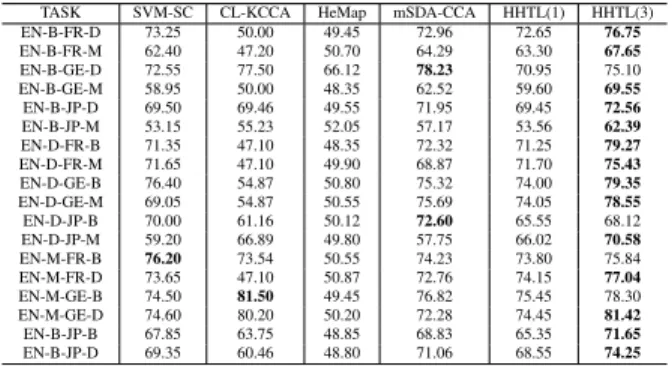
In this setting, we focus on cross-language cross-category learning between English and the other 3 languages. For the comprehensive comparisons, we construct 18 cross-language cross-category sentiment classification tasks as follows: FR-D, FR-M, GE-D, EN-B-GE-M, EN-B-JP-D, EN-B-JP-M, B, EN-D-FR-M, EN-D-GE-B, EN-D-GE-EN-D-FR-M, EN-D-JP-B, EN-D-JP-EN-D-FR-M, EN-M-FR-B, EN-M-FR-D, EN-M-GE-B, EN-M-GE-D, EN-B-JP-B, EN-B-JP-D. For example, the task EN-B-FR-D uses all the Books reviews in French in the test file and its English translations as the parallel data, the DVD reviews in French as the target language test data, and original English Books reviews as the source domain labeled data.
The results are summarized in the Table 2. This setting is more challenging than the previous one due to larger data bias after feature transformation. Therefore, the perfor-mance of all target languages is dropped compared to that
λ
(a) Accuracy v.s. (b) Accuracy v.s.p (c) Accuracy v.s.ncon GE Figure 2: Parameter Analysis.
Table 2: Learning with biased target correspondence in-stances: comparison results in terms of testing accuracy (%).
TASK SVM-SC CL-KCCA HeMap mSDA-CCA HHTL(1) HHTL(3) EN-B-FR-D 73.25 50.00 49.45 72.96 72.65 76.75 EN-B-FR-M 62.40 47.20 50.70 64.29 63.30 67.65 EN-B-GE-D 72.55 77.50 66.12 78.23 70.95 75.10 EN-B-GE-M 58.95 50.00 48.35 62.52 59.60 69.55 EN-B-JP-D 69.50 69.46 49.55 71.95 69.45 72.56 EN-B-JP-M 53.15 55.23 52.05 57.17 53.56 62.39 EN-D-FR-B 71.35 47.10 48.35 72.32 71.25 79.27 EN-D-FR-M 71.65 47.10 49.90 68.87 71.70 75.43 EN-D-GE-B 76.40 54.87 50.80 75.32 74.00 79.35 EN-D-GE-M 69.05 54.87 50.55 75.69 74.05 78.55 EN-D-JP-B 70.00 61.16 50.12 72.60 65.55 68.12 EN-D-JP-M 59.20 66.89 49.80 57.75 66.02 70.58 EN-M-FR-B 76.20 73.54 50.55 74.23 73.80 75.84 EN-M-FR-D 73.65 47.10 50.87 72.76 74.15 77.04 EN-M-GE-B 74.50 81.50 49.45 76.82 75.45 78.30 EN-M-GE-D 74.60 80.20 50.20 72.28 74.45 81.42 EN-B-JP-B 67.85 63.75 48.85 68.83 65.35 71.65 EN-B-JP-D 69.35 60.46 48.80 71.06 68.55 74.25 shown in Table 1. Our proposed method HHTL still per-forms much more stable and better than the other 3 baselines except for a few tasks. This is because that our proposed method can largely reduce the data bias by generating the more powerful and higher-level features for both the source and target domains, which can lead to better cross-language mappings in each layer.
Impact of Layers in the HHTL Structure
As shown in Table 2, the more layers are used, the better per-formance is achieved. SVM-SC manifests comparable re-sults with HHTL using 1 layer, where the learned high-level features are not sufficiently useful. However, with increas-ing number of layers, HHTL can enhance the cross-language classification performance by generating more useful and higher-level features that alleviate the data bias.
Parameter Sensitivity Study
The proposed method has two parameters to tune: 1) the tradeoff parameter , and 2) the feature corruption proba-bilityp. Besides these, the number of correspondences nc
from the parallel data may also affect the performance of cross-language classification. In this section, we conduct a series of experiments to study the sensitivity issues of the parameters, ,pandnc.
In the first experiment, we aim to analyze how perfor-mance changes with varying values of in the range of [0.001,0.01,1,10,100]withp = 0.7andnc = 50. From
Figure 2(a), we can observe that the performance is stable when is no more than 10. Besides, we set = 0.01,
nc = 50and varypin the range of[0.5,0.6,0.7,0.8,0.9].
The results of all the target languages are illustrated in
Fig-ure2(b). We can see that corruption probability cannot be either too large or too small to achieve good performance. On one hand, if we corrupt many features, the original fea-ture information will be discarded a lot, resulting in failure of discovering powerful hidden features in higher layers by reconstructions. On the other hand, if we only corrupt a few features, the high-level hidden features recovered from the original features always tends to be similar to the original ones. In this case, we cannot learn informative hidden fea-tures for knowledge transfer.
In the second experiment, we study the influ-ence of the size of the unlabeled parallel data ([50,250,500,750,1000,1250,1500,1750]) to the overall performance of HHTL. The results for German are reported in Figure 2(c).3 All the methods which use the unlabeled
parallel data consistently outperform HeMap, which dis-cards the correspondence information. Nevertheless, HTLL performs the best and achieve more stable improvement with increasing size of parallel data. Different from HTLL, the accuracies of CL-KCCA and SVM-SC almost stop increasing when the size of parallel data is larger than 750. The reason is that the impact of domain distribution mis-match hinders the improvement of the overall performance even though with more correspondences. mSDA-CCA performs even worse than SVM-SC and CL-KCCA when the number of correspondences is smaller than 750. This is because that the multimodal deep learning method requires sufficient correspondence data between two modalities to learn reliable feature representations. Though mSDA-CCA outperforms other baselines when nc is larger than 750,
it still performs much worse than HHTL. All the results demonstrate the effectiveness and robustness of HHTL for cross-language sentiment classification.
Conclusions
In this paper, we have proposed a Hybrid Heterogeneous Transfer Learning (HHTL) framework to transfer knowl-edge across different feature spaces and simultaneously cor-rect the data bias on the transformed feature space. Based on the framework, we proposed a deep learning approach. Extensive experiments demonstrated the superiority of the proposed method on several multilingual text mining tasks.
3Due to the limit of space, we only report the results on German.
Acknowledgments
This research was in part supported by the Australian Re-search Council Future Fellowship FT130100746.
References
Blitzer, J.; McDonald, R.; and Pereira, F. 2006. Do-main adaptation with structural correspondence learning. In
EMNLP, 120–128. ACL.
Blum, A., and Mitchell, T. M. 1998. Combining labeled and unlabeled sata with co-training. InCOLT, 92–100.
Chen, M.; Xu, Z. E.; Weinberger, K. Q.; and Sha, F. 2012. Marginalized denoising autoencoders for domain adapta-tion. InICML.
Dai, W.; Chen, Y.; Xue, G.-R.; Yang, Q.; and Yu, Y. 2008. Translated learning: Transfer learning across different fea-ture spaces. InNIPS, 353–360.
Duan, L.; Xu, D.; and Tsang, I. W. 2012. Learning with augmented features for heterogeneous domain adaptation. In
ICML.
Fan, R.-E.; Chang, K.-W.; Hsieh, C.-J.; Wang, X.-R.; and Lin, C.-J. 2008. LIBLINEAR: A library for large linear classification.J. Mach. Learn. Res.9:1871–1874.
Glorot, X.; Bordes, A.; and Bengio, Y. 2011. Domain adap-tation for large-scale sentiment classification: A deep learn-ing approach. InICML, 513–520.
Kulis, B.; Saenko, K.; and Darrell, T. 2011. What you saw is not what you get: Domain adaptation using asymmetric kernel transforms. InCVPR, 1785–1792.
Li, F.; Pan, S. J.; Jin, O.; Yang, Q.; and Zhu, X. 2012. Cross-domain co-extraction of sentiment and topic lexicons. In
ACL, 410–419.
Ngiam, J.; Khosla, A.; Kim, M.; Nam, J.; Lee, H.; and Ng, A. Y. 2011. Multimodal deep learning. InICML, 689–696. Pan, S. J., and Yang, Q. 2010. A survey on transfer learning.
IEEE Trans. Knowl. Data Eng.22(10):1345–1359.
Pan, S. J.; Tsang, I. W.; Kwok, J. T.; and Yang, Q. 2011. Domain adaptation via transfer component analysis. IEEE
Trans. Neural Netw.22(2):199–210.
Pan, S. J.; Kwok, J. T.; and Yang, Q. 2008. Transfer learning via dimensionality reduction. InAAAI, 677–682.
Prettenhofer, P., and Stein, B. 2010. Cross-language text classification using structural correspondence learning. In
ACL, 1118–1127.
Raina, R.; Battle, A.; Lee, H.; Packer, B.; and Ng, A. Y. 2007. Self-taught learning: transfer learning from unlabeled data. InICML, 759–766.
Shi, X.; Liu, Q.; Fan, W.; Yu, P. S.; and Zhu, R. 2010. Transfer learning on heterogenous feature spaces via spec-tral transformation. InICDM, 1049–1054.
Socher, R.; Ganjoo, M.; Manning, C. D.; and Ng, A. Y. 2013. Zero-shot learning through cross-modal transfer. InNIPS, 935–943.
Vincent, P.; Larochelle, H.; Bengio, Y.; and Manzagol, P.-A. 2008. Extracting and composing robust features with denoising autoencoders. InICML, 1096–1103.
Vinokourov, A.; Shawe-Taylor, J.; and Cristianini, N. 2002. Inferring a semantic representation of text via cross-language correlation analysis. InNIPS, 1473–1480. Wang, C., and Mahadevan, S. 2009. A general framework for manifold alignment. InAAAI Fall Symposium: Manifold
Learning and Its Applications.
Wang, C., and Mahadevan, S. 2011. Heterogeneous domain adaptation using manifold alignment. InIJCAI, 1541–1546. Yang, Q.; Chen, Y.; Xue, G.-R.; Dai, W.; and Yu, Y. 2009. Heterogeneous transfer learning for image clustering via the socialweb. InACL/IJCNLP, 1–9.
Zhou, J. T.; Tsang, I. W.; Pan, S. J.; and Tan, M. 2014. Heterogeneous domain adaptation for multiple classes. In