Enabling BYOD through Secure Meta-Market
∗Alessandro Armando
Security and Trust Fondazione Bruno Kessler
Via Sommarive, 18 Trento, Italy
[email protected]
Gabriele Costa
DIBRIS - University of GenoaVia all’Opera Pia, 13 16145, Genova (Italy)
[email protected]
Alessio Merlo
E-Campus University Via Isimbardi, 10 22060, Novedrate (Italy)[email protected]
Luca Verderame
DIBRIS - University of Genoa Via all’Opera Pia, 13 16145, Genova (Italy)
[email protected]
ABSTRACT
Mobile security is a hot research topic. Yet most of availa-ble techniques focus on securing individual applications and therefore cannot possibly tackle security weaknesses stem-ming from the combined use of one or more applications (e.g. confused deputy attacks). Preventing these types of attacks is crucial in many important application scenarios. For instance, their prevention is a prerequisite for the wi-despread adoption of the BYOD paradigm in the corporate setting.
To this aim, in this paper we propose a secure meta-market which supports the specification and enforcement of security policies spanning multiple applications. Moreover, the meta-market keeps track of the security state of devices and— through a functional combination of static analysis and co-de instrumentation techniques—supervises the installation of new applications thereby ensuring the enforcement of the security policies. Also, we developed a prototype implemen-tation of the secure meta-market and we used it for valida-ting a wide range of popular Android applications against a security policy drawn from the US Government BYOD Se-curity Guidelines. Experimental results obtained by running the prototype confirm the effectiveness of the approach.
Categories and Subject Descriptors
D.4.6 [Operating Systems]: Security and Protection— In-formation flow controls; D.2.4 [Operating Systems]: Soft-ware/Program Verification
∗
This work has been partially funded by the Italian PRIN projectSecurity Horizons(no. 2010XSEMLC).
Permission to make digital or hard copies of all or part of this work for personal or classroom use is granted without fee provided that copies are not made or distributed for profit or commercial advantage and that copies bear this notice and the full citation on the first page. Copyrights for components of this work owned by others than ACM must be honored. Abstracting with credit is permitted. To copy otherwise, or republish, to post on servers or to redistribute to lists, requires prior specific permission and/or a fee. Request permissions from [email protected].
WiSec’14,July 23–25, 2014, Oxford, UK.
Copyright 2014 ACM 978-1-4503-2972-9/14/07 ...$15.00. http://dx.doi.org/10.1145/2627393.2627410.
Keywords
Application Meta-Market; Android Security; Formal Verifi-cation; Code Instrumentation;
1.
INTRODUCTION
The world-wide spread of smartphones and tablets as well as the emerging “Bring Your Own Device” (BYOD) para-digm are pushing mobile devices towards a professional use. Many device manufacturers are thus considering the develo-pment of architectural solutions supporting the use of per-sonal devices in corporate environments, e.g., Apple1, Sam-sung2, Blackberry3, Huawei4. Yet, the level of protection offered by current mobile operating systems does not allow to cope with the complexity and the stringent security re-quirements arising in corporate environments. As a matter of fact, business activities carried out on mobile devices can handle valuable resources on platforms where users, which cannot be expected to understand all the security implica-tions, are likely to install harmful applications.
The current trend for mobile code distribution is based on application markets. Markets allow users to browse and in-stall myriads of applications. A centralized application re-pository offers some advantages for the security assessment as the market can implement procedures for the analysis and testing of the mobile code. However, the most popular markets offer very limited security guarantees (see for in-stance [31, 41, 39]).
In this paper we propose a security-enabled application mar-ketplace, namely meta-market, which enforces BYOD se-curity policies through analysis and monitoring of mobile applications. The meta-market masks the actual applica-tion markets by mediating all the applicaapplica-tion installaapplica-tion requests. A fruitful combination of static and dynamic tech-niques is used to check whether the applications comply with the organizational security policy. More in detail, the meta-market supports: (i) the definition of fine-grained security
1 http://www.apple.com/ipad/business/it/byod.html 2http://www.samsung.com/global/business/mobile/ solution/security/samsung-knox 3 http://it.blackberry.com/business/software/bes-10.html 4http://enterprise.huawei.com/en/solutions/byod/ byod-mobility/index.htm
policies, (ii) the static verification of applications against the security policy and(iii) the runtime monitoring of ap-plications failing the verification step.
We present an implementation of the meta-market5which
deals with Android-based devices and supports the security assessment of the Google Play application market against corporate BYOD policies. To assess the effectiveness of our approach, we applied our meta-market to check the com-pliance of 860 Android applications taken from the Google Play store. Applications are validated against a real world BYOD security policy (extracted from the US Government BYOD Security Guidelines [17]) expressed in ConSpec [2], a well-known security specification formalism. The expe-rimental results confirm the effectiveness of the proposed approach.
Structure of the paper. In Section 2 we discuss the state-of-the-art of the security assessment of mobile applications and some related work. Section 3 introduces the formal application and security framework adopted in this paper. In Section 4 we present the techniques and logical workflow of the proposed meta-market solution. Then, in Section 5 we describe our prototype implementation and in Section 6 we report and discuss the experimental results. We conclude in Section 7 with some final remarks and future research directions.
2.
RELATED WORK
Recent researches on the security of mobile devices outline that malware are appearing more and more frequently in of-ficial application markets. In [41] the authors systematically evaluate the malware affecting Android OS which have been discovered in the last years. Also, they check the presence of malware in application markets and they consider whe-ther most used anti-virus applications succeed in detecting them. They find that all the application markets they in-spected contain several malware instances and, even worse, anti-viruses very often fail in discovering them.
The weakness of application markets security checks is also reported by Wang et al. [39]. Briefly, they developed a me-thod for injecting malicious control flows in the application code. Applying their technique, they could modify and sub-mit an iOS application to the Apple Store. After passing the review process of the market, the application carrying illegal instructions was successfully published. These works indicate that security mechanisms adopted by application markets are far from being sufficient to guarantee that the applications they deploy are safe for the user’s device. Furthermore, the basic security mechanisms offered by mo-bile OSes seem to be inadequate for providing actual security guarantees, e.g., see [21]. Moreover, OSes implementations are not immune to vulnerabilities. Indeed, some of them ha-ve been already identified and fixes haha-ve been proposed, e.g., see [8]. Clearly, unsafe applications acquired from markets can exploit these weaknesses to perform disruptive attacks. Several proposals advocate extensions to the native Android security mechanisms (e.g., permissions system and applica-tion sandboxing). For instance, in [29] the authors present an enhancement of the basic Android permission system, while in [42] the authors suggest new privacy-related securi-ty policies for protecting users’ personal data. Similarly, [11]
5Further information can be found at
http://www.ai-lab.it/byodroid/
presents a mixed static and dynamic approach for both de-tecting suspicious patterns in an installing application and, possibly, running it in a sandboxed environment.
A few approaches where security activities are carried out by the application market have been proposed. Among them, Google Bouncer6is a malware detector running on the Goo-gle Play store. However, it has been recently shown how it can be easily circumvented [31].
All the proposals listed above, although indirectly dealing with security policies, do not support user-defined security policies. In this respect, [19] presents Kirin, a local servi-ce servi-certifying that an application under installation complies with user-defined security rules. Similarly, Saint [32] assigns privileges to applications at install time and monitors them at run time. Although both systems use security rules which can be arbitrarily complex, they still refer to the existing, in-sufficient set of permissions7. Since these are coarse-grained
and informally defined, building security mechanisms on top of them is rather controversial.
A different approach is theSecurity-by-Contract[16] (SxC). SxC is an integrated framework exploiting several techni-ques for granting that a mobile application respects the po-licy of the device running it. Roughly, application develo-pers attach a contract to their code throughproof-carrying code [30]. After downloading the application, the mobile platform automatically verifies the correctness of the con-tract, i.e., whether it effectively models the application. If the check succeeds, the application is validated by compa-ring its contract against the platform policy, e.g., viamodel checking [12]. If one of these two steps fails, i.e., whenever the contract is incorrect or the policy is not fulfilled, the application is rejected, otherwise it is installed. Software in-stalled in this way is proved to never violate the policy. Although the Security-by-Contract prevents the execution of dangerous mobile code, it hardly copes with the current market-based distribution paradigm. In fact, the SxC ta-sks executed on the mobile device, i.e., contract validation and model checking, are non trivial. In particular, model checking requires heavy computation which may take long time and rapidly exhaust the device resources. Moreover, proof-carrying code significantly increase the size of the mo-bile code (as it injects proof annotations). Larger software packages would require extra storage space, which is usually non-free, on actual application markets.
Our proposal aims at effectively enforcing fine-grained BYOD security policies. Unlike the approaches listed above, our solution is designed to apply to the current market-based application distribution paradigm without executing cum-bersome tasks on resource-constrained mobile devices.
3.
SECURITY FRAMEWORK
Our approach relies on formal descriptions of the appli-cation behavior and the policy specifiappli-cation. In particular, two aspects are crucial under our assumptions, i.e., mode-ling the interactions among applications and the specifica-tion of fine-grained BYOD policies. A convenient abstrac-tion of the behavior of a program is provided by its execu-tion trace [1], representing the sequence of security-relevant operations it performs. In this respect, security policies
6
http://googlemobile.blogspot.it/2012/02/android-and-security.html
7
are defined as temporal properties over an execution trace. Below we present our history-based application and policy modeling frameworks.
3.1
Mobile Application Framework
Mobile code is typically distributed in the form of cation packages. For instance, a package may contain appli-cation code and resources (e.g., audio files and pictures). A common way to represent the behavior of a piece of code is by building itscontrol flow graph(CFG). Briefly, a CFG is a data structure representing all the possible execution flows of a program. It basically consists of states and transitions. States denote linear, i.e., jumps-free, fragments of code. In contrast, transitions represent (un)conditional jump instruc-tions that correspond to computational branches. CFGs can be extracted from assembly code [13] as well as intermediate languages like the Java bytecode [3].
In [10] a proof system allowing to prove that a CFG complies with a security specification is discussed. A similar approach is not viable under our assumptions. Here, we are interested in considering BYOD policies regulating the behavior of the mobile device as a whole. In principle, illegal executions may involve more than one application. This is typical of well-known privilege escalation attacks, e.g., based on the application collusion and confused deputy problems [23]. Hence, we follow a different approach. In particular, we translate the CFG into a correspondinghistory expression, i.e., a process algebraic representation of a set of execu-tion traces. The procedure resembles the one in [9] with some crucial differences. First of all, we adopt an exten-ded version of history expressions which has been specifical-ly designed for Android applications (see [6] for a detailed presentation). These history expressions can represent the
inter-process communication (IPC) which is a common me-chanism of interaction among applications running on mo-bile devices. In this way we capture the possible flows of information among applications.
3.2
Policy Specification
Several policy specification languages have been presented for defining temporal properties over the execution traces. Among them, temporal logics, e.g., LTL [33], are a major proposal. Briefly, they extend first-order logic with tempo-ral modalities, e.g., saying that a certain property will hold on a certain trace segment.
Automata-based formalisms have similar features and are also widely adopted. For instance, each LTL formula can be efficiently translated into a corresponding B¨uchi auto-maton [22] which accepts a trace if and only if it satisfies the original formula. Security automata [35] behave simi-larly. Intuitively, a security automaton defines an abstract controller which reads the elements of an execution trace. As far as the next symbol is accepted by the automaton, it respects the policy. Security automata have been also used for defining the formal semantics of some policy specification languages like PSLang [20] and ConSpec [2]. In particular, ConSpec has been specifically designed for high level lan-guages, e.g., Java, which makes it suitable for the Android environment.
For the sake of presentation, we do not provide a full de-scription of the ConSpec syntax and semantics. Here, we simply provide the basic intuition about the language and its features. A ConSpec policy consists of a security state
and a list ofsecurity rules. The state contains a set of varia-bles representing the configuration of the policy. Variavaria-bles have a scope defining how they behave on multiple targets, e.g.,session means that the variable is reinitialized at eve-ry execution of an application (see [2] for further details). Moreover, rules define how the state changes when a certain security-relevant operation is evaluated. In order to give a basic intuition, we propose the following ConSpec policy.
1 S E C U R I T Y S T A T E 2 S E S S I O N Str [ 1 1 ] a g e n c y _ h o s t = " a g e n c y . gov /"; 3 S E S S I O N Obj a g e n c y _ u r l = n u l l ; 4 S E S S I O N B o o l c o n n e c t e d = f a l s e ; 5 6 /*( R1 ) No d o w n l o a d of b u s i n e s s d a t a on d e v i c e */
7 A F T E R Obj url = j a v a . net . URL . < init >( Str [ 6 4 ] s p e c ) 8 P E R F O R M 9 ( s p e c . c o n t a i n s ( a g e n c y _ h o s t ) ) - > { a g e n c y _ u r l := url ; } 10 E L S E - > { s k i p ; } 11
12 A F T E R Obj url = j a v a . net . URL . < init >( Str [0] p r o t o c o l , Str [ 6 4 ] host , Nat [0] port , Str [0] f i l e ) 13 P E R F O R M 14 ( h o s t . c o n t a i n s ( a g e n c y _ h o s t ) ) - > { a g e n c y _ u r l := url ; } 15 E L S E - > { s k i p ; } 16 17 B E F O R E j a v a . net . URL . o p e n C o n n e c t i o n () 18 P E R F O R M 19 ( t h i s . e q u a l s ( a g e n c y _ u r l ) ) - > { c o n n e c t e d := t r u e ; } 20 E L S E - > { s k i p ; } 21 22 B E F O R E j a v a . io . F i l e O u t p u t S t r e a m . w r i t e ( int i ) 23 P E R F O R M 24 (! c o n n e c t e d ) - > { s k i p ; } 25 26 /* ( R2 ) " W h e n in Doubt , D e l e t e it Out " */ 27 A F T E R Obj f i l e = j a v a . io . F i l e . c r e a t e T e m p F i l e () 28 P E R F O R M 29 ( t r u e ) - > { f i l e . d e l e t e O n E x i t () ; } 30 31 /* ( R3 ) No t r a n s f e r of s e n s i t i v e d a t a 32 to non - a g e n c y d e v i c e s */ 33 B E F O R E a n d r o i d . b l u e t o o t h . B l u e t o o t h S o c k e t . g e t O u t p u t S t r e a m () 34 P E R F O R M 35 (! c o n n e c t e d ) - > { s k i p ; }
The policy encodes three clauses8informally stated in the US Government BYOD security guidelines [17].
Intuitively, the first group of rules (R1) says that users can-not store sensitive data on their device. We encoded this behavior by means of four rules. The first two (lines 7 and 12) say that after an application creates aURLobject, the po-licy checks whether it points at some sensitive data sources (here we identify it with the"agency.gov/"path). If this is the case (lines 9 and 14), the policy stores theURLreference in the variableagency_url, otherwise (lines 10 and 15) the operation is simply allowed (skipcommand). The third rule (line 17) is triggered before a URL is used to create a data connection. If theURLis the same stored inagency_url (li-ne 19), the policy state changes by setting the connected
8
flag to true, which means that the application has accessed to sensitive data. Finally, according to the fourth rule (line 22), the target can write on local files only ifconnected is false (following a default-deny approach, the policy blocks an operation whenever none of its rules apply to it). In ad-dition, rule (R2, line 27) states that temporary data, which could include sensitive information, must be deleted at the end of each application session. To do that, right after the creation of every temporary file, the policy requires the in-vocation ofdeleteOnExit()(line 29). Eventually, rule (R3, line 33) exploits the same flag connected used in (R1) to decide whether to disable the Bluetooth output streaming for an application which might have accessed a sensitiveURL. Again, when evaluating the Bluetooth operation, if the ru-le does not apply, i.e., if connected is true, the action is blocked.
4.
META-MARKET PARADIGM
In this section we present the architectural aspects of the
meta-marketsoftware distribution model. In particular, we explain how it provides formal security guarantees. Then we give a detailed description of the meta-market components and their behavior.
4.1
Formal Security Assessment Workflow
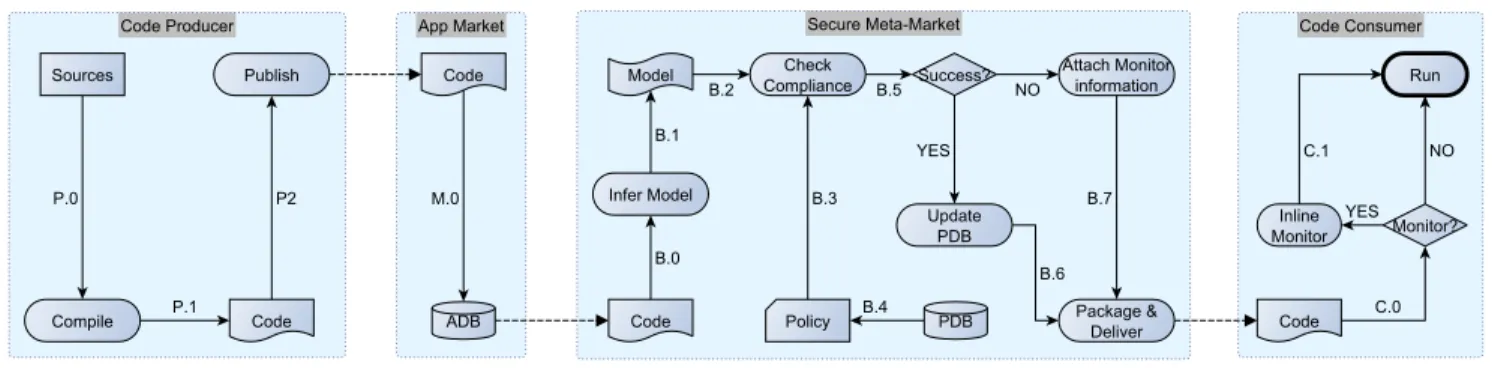
Intuitively, our proposal consists in moving most of the security assessment steps and logic on a meta-market. The meta-market holds the security policies of one or more or-ganizations, e.g. private companies or public agencies, and its customers are the organizations’ members, e.g. the em-ployees of a company. For simplicity, in the rest of the paper we assume the meta-market to handle a single policy of a single organization. Figure 1 shows the code deployment workflow in the meta-market paradigm.
Code producers compile their applications and publish them through a standard application market. An application mar-ket simply implements a database of applications that regi-stered devices can browse. Then, the meta-market interacts with an application market by passing the customers re-quests, e.g. to obtain the list of applications. In this way, the meta-market is totally transparent to the application market, which handles standard user sessions. Also, it only requires minor extensions of the user’s device, which only needs to mount a dedicated installer (as most of the appli-cation markets do).
Our model works as follows. Code producers compile (P.0) and generate mobile applications9 (P.1). Then, they pu-blish their applications (P.2) on a standard application mar-ket which stores (M.0) the software packages in a database (ADB).
When a code consumer requires an application from the meta-market, the corresponding code package is retrieved. Then, a model extraction procedure is applied to the co-de (B.0) to generate an application moco-del (B.1). Since the model is extracted from the mobile code, no further valida-tion is required (as needed, for instance, by the Security-by-Contract approach [16]). Hence, the model can be directly passed (B.2) to a verification process which checks its com-pliance against the security policy (B.3). Security policies are retrieved (B.4) from a policy database (PDB) handling
9For the sake of brevity, we do not distinguish here between
applications and their code.
policy instances customized over the devices’ configuration. More details about this aspect are discussed in Section 4.2. If the verification succeeds (B.5→YES) the policy databa-se is updated and the application is delivered to the udataba-ser’s device with no further action (B.6). Otherwise (B.5→NO), the meta-market attaches monitoring information to the ap-plication (B.7). Mainly, monitoring information consists of a digital signature which will be used by the code consu-mer to obtain a correct instrumentation of the application as detailed in Section 4.2. When the consumer receives a mobile application package, she checks whether it was mar-ked for monitoring (C.0). If this is the case, before installa-tion the mobile device instruments the applicainstalla-tion package with security checks by using information attached by the meta-market (C.1). Otherwise, it is directly installed.
4.2
Meta-Market Components and Activities
The workflow of the secure meta-market is obtained by a fruitful combination of techniques we describe in the follo-wing.
Model validity.
Model-based verification systems rely on the validity of models. Indeed, fake or incorrect models can compromise the whole verification process. To be valid, a model mu-st denote (at leamu-st) every security-relevant behavior of the application it refers to. For instance, since in [16] the appli-cation model is created by an untrusted producer, it must be validated at consumer-side.
Model validation is a non-trivial task. To reduce the con-sumer’s overhead, a possible solution is model-carrying co-de [37] (MCC). MCC is a variant ofproof-carrying code[30] in which a piece of code, i.e. the mobile application, is in-strumented with the steps of a proof of compliance against its own model. Although the proof instrumentation allows for a faster validation, it significantly increases the size of the software package [30]. Such a growth depends on the proof size and poorly fits with large scale distribution para-digms. Moreover, as model extraction is performed without knowing the consumers’ policies, applying this method re-quires to generate inclusive, large models. Clearly, larger models exacerbate the problem of instrumenting and sto-ring the model-carrying packages.
In our approach, the verification process takes place on the meta-market. Thus, application models can be generated locally with some clear advantages. Mainly, to obtain cor-rect models the system just needs to rely on a sound model extraction procedure and validity proofs must be neither generated nor verified10. Moreover, being aware of the po-licy, the meta-market can extract models that only refer to the policy-relevant operations. In this way, models do not contain irrelevant information and their size is substantially reduced.
Policy compliance verification.
Policy compliance is the central activity of the secure ap-plication deployment process. Model checking [12] can be suitably applied to verify whether a given model satisfies a formal specification, i.e., a security policy. Models and speci-fications are often given as (labeled) transition systems (see,
10The model extraction program can be verified and tested
Figure 1: The meta-market software distribution workflow.
e.g. [26]) and temporal logic formulae, e.g., linear-time tem-poral logic [33], respectively. Several model checkers have been proposed in the last decades and many of them have been successfully applied to verification the correctness of real systems, e.g., see for instance [40, 27, 28].
Nevertheless, in some cases solving the model checking pro-blem can be extremely hard and model checkers poorly sca-le over the size of their search space (see [36] for a survey). More specifically, it is well known that model checkers suffer from the state explosion problem [38], that is the exponen-tial growth of the search space due to the representation of concurrent agents. Since they can run in parallel, mitiga-ting this issue is crucial for applying model checking to the verification of mobile applications.
A first step consists in using previous analysis results in order to avoid repeated instances of the same model chec-king problem. This approach can be effectively supported by centralizing the use of the model checking process in the proposed market architecture. In particular, the meta-market disposes of both the security policy and the applica-tion models. Hence, the system can store verificaapplica-tion results and check whether a given instance was already considered in the past without running the model checker again. Al-though this approach can avoid repetitions of cumbersome computations, it does not reduce the complexity of the mo-del checking.
A further optimization derives from including platform-specific aspects in the model generation process as it is has been proposed in [6] for the Android inter-process communica-tion (IPC) framework.
Briefly, IPC defines application-level primitives for data and control flow composition. Each IPC function abstracts low-level operations which actually implement the communica-tion. Hence, IPC-based communications can be modeled as simple messages over reserved channels. Since the IPC me-chanisms also rules the application life-cycle, we can avoid concurrency in many models. For more details on the An-droid IPC and its formalization we refer the reader to [6]. A similar reasoning can be applied to other mobile platforms, e.g., see [5].
Moreover, we upper-bound the model checking phase, i.e., we force the model checker to terminate after a finite num-ber of steps (visited states or amount of time). Setting a threshold guarantees the model checker to terminate within a fixed time but introduces a third analysis outcome, i.e., the timeout. A similar approach is also adopted in [18]. In
this way, the meta-market prevents indefinitely long execu-tions which would be unacceptable in the workflow outlined above. The meta-market treats a timeout as a verification failure and marks the application for security instrumenta-tion and monitoring. Clearly, this may cause false positives, i.e., harmless applications being monitored. Hence, the ti-me threshold is a parati-meter that need to be carefully con-sidered to obtain a reasonable trade-off. In Section 6 we describe how we deal with timeouts in our implementation. We will discuss in detail the advantages of adopting runtime monitoring below, at the end of this section.
Partial policy evaluation and storage.
As we outlined in the previous paragraph, models and po-licies play a central role for the feasibility of model checking-based validation. In particular, the security state of each mobile device is evaluated against the models of the instal-led applications. This implies that the meta-market must keep track of all the set of installed applications for each device. Also, these records must be updated whenever a device installs or removes an application. Hence, we use a
direct acyclic graph (DAG) to represent device configura-tions and their dependencies [7]. For instance, consider the DAG depicted in Figure 2. NodeRis the root configuration denoting the original policy. The installation of applications
A1,A2 andA3 leads to a new configurationN (solid path).
Also, installing the three applications in a different order can generate a different path from R to N (dashed path). Eventually, installing applicationA4on a device being
asso-ciated to N can cause the migration to a different configu-ration (nodeM). This happens only ifA4 does not violate
the policy holding in N, i.e.,φ. Summing up, each device is associated to a node, e.g., N. The node corresponds to a record containing the current policy of the device, e.g.,
φ, the set of installed applications, e.g., {A1, A2, A3}, a
li-st of applications known to be safely inli-stalled (pointing to the corresponding node), e.g., A4 → M, and a set of
ap-plications that are known to violate the policy of the node, e.g.,{A5}. The implementation and the management of the DAG is done through a relational database as described in Section 5.3.
Beside implementation, the way device configurations are encoded must be carefully considered. Observe that a me-re list of application models can be very inefficient. In-deed, consider a device which already installed applications
meta-market uses the models of the installed applications, i.e.,C1, . . . , Ck, to represent the configuration of the device,
the model checking problem to be solved for validating A
through its modelCisC1|. . .|Ck|C|=φ. Whereφis the
security policy and|the parallel model composition opera-tor. As we discussed above, the complexity of this problem rapidly grows whenkincreases.
Figure 2: Policy data structure. R N M A1 A2 A3 A4 A3 A2 • φ {A1, A2, A3} A4→M {A5}
In [4] Andersen presents partial model checking (PMC). Roughly, PMC consists in partially evaluating a specification against a model. In a nutshell, given one or more modelsC1 | . . .|Ckand a formulaφ, PMC returns a new formulaφ0such
that for everyC
(C1|. . .|Ck)|C|=φif and only ifC|=φ 0
Moreover, in [4] the author reports experimental results sho-wing that PMC outperforms model checking when dealing with a model resulting from the parallel composition of smal-ler models. This is mainly due to a number of simplification techniques which can be applied for simplifying a formula. Hence, relying on PMC we just need to associate each device to its customized policy, i.e., the policy which has been par-tially evaluated against the device’s configuration. When a new application is evaluated for installation, its model can be directly model-checked against the customized policy. If the verification is successful the model is included in the configuration via PMC, i.e., a new policy is obtained by partially evaluating the old one against the model.
For these reasons, we exploit PMC in the policy customi-zation and device configuration management processes of the meta-market workflow. Further details about the PMC framework adopted in the meta-market are provided in Sec-tion 5.3.
Application instrumentation and monitoring.
Mobile application monitoring is a consolidated techni-que for enforcing policy compliance at runtime. Several im-plementations appeared in the literature, also running on mobile, resource-constrained devices [15, 14]. Typically, a monitoring environment consists of apolicy decision point
(PDP) and manypolicy enforcement points (PEPs). The
Listing 1: A fragment of instrumented code.
URL url ;
PDP . c h e c k B e f o r e (" j a v a . net . URL . < init > ", a d d r );
try {
url = new URL ( a d d r ); } c a t c h( E x c e p t i o n e ) {
PDP . c h e c k E x c e p t i o n
,→(" j a v a . net . URL . < init > ",e , a d d r );
t h r o w e ; }
PDP . c h e c k A f t e r (" j a v a . net . URL . < init > ", url , a d d r );
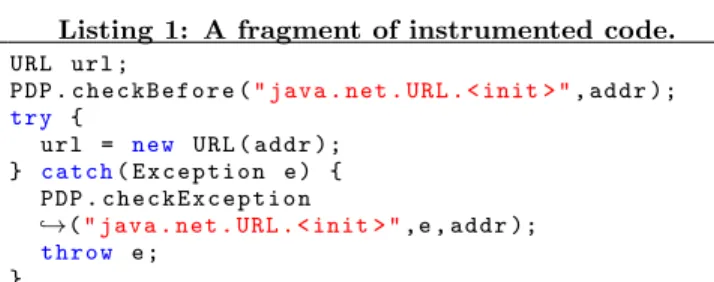
PDP holds the security policy and the current security state, the PEPs control invocations to critical operations. When an application attempts to perform a security-relevant ac-cess, a corresponding PEP is activated. The PEP triggers the PDP which checks the security state and policy and grants or rejects the permission. Finally, the PEP enforces the PDP’s response by allowing or blocking the requested access.
Monitoring environments may differ for the PEPs deploy-ment strategy. Traditionally, two strategies exist, i.e., cu-stomizing the execution environment and instrumenting the application code. In both cases, the PDP is installed as a background service. For our purposes, PEP instrumentation is the best option. As a matter of fact, platform customi-zation requires heavy modification of the mobile devices in order to replace/rewrite system components. For instance, for virtual machine-based systems, e.g., Java/Android, the customization consists in replacing the standard VM with a new one including the PEPs. On the contrary, under the same assumptions, the application instrumentation is much less invasive. Indeed, it only requires to slightly modify the intermediate code, i.e., the VM instructions, of the applica-tion. For a more detailed discussion about the PEP inlining for mobile applications see [14].
We implement instrumentation directly on the mobile de-vice. As described in Section 4.1, mobile devices may re-ceive applications to be instrumented. In this case, the in-strumentation procedure injects instructions implementing the PEPs. These instructions wrap security-relevant invoca-tions. In Listing 1 we show a code fragment obtained by in-strumenting the instructionUrl url = new URL(addr). Me-thods checkBefore, checkException and checkAfter im-plement the PEP logic by requesting authorizations to the PDP. Briefly, they interrupt the code execution and alert the PDP about the ongoing operation and its parameters. The PDP evaluates the action according to the current se-curity state. The evaluation changes the sese-curity state and produces a return value for the PEP, i.e.,allow ordeny. If the PEP receives anallow signal, the execution is resumed, otherwise it throws a security exception. We refer the inte-rested reader to [34] for further details.
Clearly, application instrumentation invalidates the original software signature and, since most mobile OSes, e.g., An-droid and iOS, do not allow for the installation of unsigned contents, a new, valid one must be computed. For this rea-son, the application package to be instrumented contains the original code together with an instrumentation signature. The signature is computed by the meta-market and only ap-plies if the application is modified in the right way. After the
instrumentation, the signature is attached and the applica-tion installed. Moreover, the signature prevents from illegal instrumentation which could modify the code in arbitrary ways.
5.
META-MARKET IMPLEMENTATION
In this section we present a prototype implementation of the market. The current implementation of the meta-market is meant to interact with the Android software de-velopment and distribution framework and adopts all tech-niques previously discussed. In the following we assume the code receiver to be an Android device and the application market to be Google Play.
5.1
Model Extraction
Models are extracted directly from the application byte-code. The (Dalvik) bytecode is the intermediate language interpreted by the standard Android virtual machine, na-mely the Dalvik Virtual Machine (DVM). The application code is typically written in Java and then compiled in Dal-vik bytecode. Actually, application packages consist of com-pressed Dalvik bytecode and resources, like audio files and pictures. Occasionally, application packages may also carry native code, i.e., libraries of machine-executable procedures. Although we do not present it below, the same approach can be applied for that kind of code (e.g., see [13]).
Basically, the model extraction process consists in building a CFG representing the behavior of the application. The CFG generation is a widely adopted technique [3] and se-veral tools support the CFG extraction for bytecode. To this aim, we adopt Androguard11, a state-of-the-art Android package analyzer and CFG extractor. Unfortunately, An-droguard extracts large and non optimized CFGs and we had to customize the tool for our specific purpose. Brie-fly, we implemented ad-hoc procedures for optimizing the CFG construction in terms of generated nodes and transi-tions. Part of this activity consists in pruning those parts of a CFG which do not refer to any security-relevant method.
5.2
Model Checking
Application validation is carried out through model chec-king. Although several model checkers exist, we opted for Spin [24] since it offers some practical advantages. Spin has been applied to the verification of a plethora of practical ca-se studies in ca-several different contexts (ca-see [27] for a survey). In terms of reliability, Spin has been included in industrial verification activities as reported, for instance, in [28]. Mo-reover, Spin includes features for optimizing the use of CPU and memory. For instance, since version 5 Spin supports multicore computation [25]. Pragmatically, this allows Spin to perform better when running on powerful hardware, as we assume for a server hosting the meta-market.
The specification language for Spin is Promela. Hence, we implemented a translator to convert the CFGs extracted from application packages into corresponding Promela spe-cifications. The definition of Promela specifications from transition systems or state machines is a quite consolidated technique, see [27]. However, in our context two aspects re-quire more attention, i.e., IPC facilities and policy encoding. Roughly, each component of an application results in a sub-graph of the overall CFG. Since components pass each other
11
https://code.google.com/p/androguard/
the control state through internal IPC messages, their sub-graphs should not be considered as concurrent agents. In fact, we model special IPC channels in the Promela speci-fication for simulating these interactions. Briefly, this ap-proach prevents many states, representing impossible confi-gurations, from being considered by the model checker. Mo-reover, since IPC can also occur among different applica-tions, we apply a similar reasoning to interface components, i.e., those that can be invoked by other applications. Such components are known through the application interface de-finition contained in its manifest file.
Usually, Promela specifications contain both the system and the property for the model checker. For instance, a LTL for-mula defined over the agents’ states can be (automatically) translated into an invariant, i.e., aneverclaim, and applied to the Promela agents. However, the properties we want to verify here are related to the messages sent from applica-tions to the platform, i.e., the system calls. Hence, we are interested in evaluating sequences of messages, rather than the states of the Promela agents. For this reason, we direc-tly encode the policy as an extra Promela agent. Clearly, this step relies on the formal definition of the transitional semantics of the ConSpec policy language.
The Promela agent obtained from the policy represents an abstract controller reading the abstract traces generated by the model. If the application model carries some policy-violating behavior, the policy controller reaches a faulty sta-te causing Spin to report an error. In that case, the output contains the trace of transitions which can be mapped back to the application code in order to locate the illegal flow.
5.3
Policy Management and Partial
Evalua-tion
In Section 4.2 we highlighted the advantages of applying partial model checking to the partial evaluation of security policies. Also, we described the importance of an efficient organization of mobile devices configurations. Below, we provide technical details about these two aspects.
Partial policy evaluation.
We implemented a partial model checking tool from scratch. Indeed, at the best of our knowledge, no implementations of the algorithm presented in [4] are publicly available. Beside the mere implementation details, two aspects must be con-sidered: transition system and policy representations. As a matter of fact, the procedure defined in [4] uses finite tran-sition systems as modeling formalism. Our approach direc-tly generates transition systems from CFGs. In fact, CFGs correspond to transition systems having a fixed, maximum branching degree, i.e., two.
Policy conversion is slightly more complex. Indeed, partial model checking deals with equational µ-calculus specifica-tions. However, since theµ-calculus is extremely expressive, it is possible to express ConSpec policies in that formalism. These aspects required us to develop proper compatibility components, but they lay out of the scope of this work. The partial model checking mainly applies to the policy ma-nagement process. This part is not included in our current experimental activity. As a matter of fact, it heavily de-pends on the specific application scenario and it can only be evaluated against a real BYOD environment or via its appli-cation usage statistics. Future developments include setting up this kind of environment.
Database design and management.
The secure meta-market uses a database for storing da-ta on the security configuration of the registered devices. Mainly, installation and removal of applications are the two activities impacting the security state of a device. In ge-neral, we expect the meta-market to handle an arbitrary amount of devices, each of them running a set of applica-tions. The number of devices may vary according to several factors, e.g., the size and purpose of the organization adop-ting the meta-market. In addition, the number and the kind of mobile applications changes from device to device. Ac-cording to recent statistics, it seems reasonable to assume that devices install dozens of applications12.
Considering the situation depicted in Figure 2, we have that node N is represented by a corresponding row in a table calledpolicy instance. The entry forN refers to agreen list
table which includes A4. Similarly, A2 and A3 belong to
the green list tables associated to other two entries of po-licy instance. These two represent nodes in which the in-stallation ofA2 (A3, respectively) is legal and leads to the
configuration of nodeN.
The dimension of the configurations DAG and database can rapidly increase with the number of devices and applications. This might negatively impact the scalability of the meta-market. For coping with this issue, we introduces simplifi-cation techniques based on heuristics. For the time being, we included two of them in our prototype, i.e., equivalence-based and frequency-equivalence-based node elimination. The former consists of an asynchronous process which visits the DAG looking for pairs of nodes referring to equivalent policies, i.e., such that they are satisfied (violated, resp.) by exactly the same traces. If such a pair exists, the process starts a procedure for collapsing them in a single record. Further-more, the frequency-based elimination looks for nodes which are rarely used, e.g., because some of the applications they refer to no longer exist. Again, when one of these nodes is discovered, the process decides whether to remove it and, eventually, reorganize part of the DAG accordingly. Other heuristics can be also considered and included (notice that some could also be context-dependent).
5.4
Client-side components
Below we discuss the components and technologies hosted by the mobile devices registered to the meta-market.
Meta-market client application.
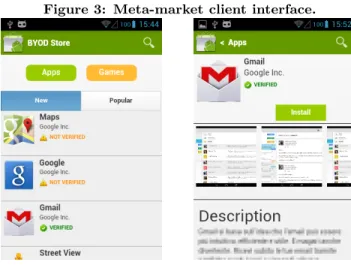
The meta-market client application provides access to the application installation/removal operations through a user interface which mostly resembles those of standard market client applications. Figure 3 depicts the client GUI in two different activities: applications browsing and application description. Briefly, the client is responsible for providing the user with details about the security of the available ap-plications, e.g., green,verifiedlabels identify secure appli-cations. Also, it mediates the operations usually carried out by the application market clients, e.g., contents purchasing and refunding procedures13.
12
http://www.phonearena.com/news/The-average- global-smartphone-user-has-downloaded-26-apps_id47160
13
Clearly, some of these tasks could need to be slightly recon-sidered before integration in the meta-market. For the time being, our prototype does not support purchase refunding.
When the user selects an application for installation, the meta-market client triggers the request and, consequently, the meta-market workflow. Eventually, the meta-market returns a software package which, depending on the veri-fication outcome, can require security instrumentation and monitoring. We describe these two activities of the client application in the next paragraph.
Figure 3: Meta-market client interface.
Application instrumentation and monitoring.
As discussed in Section 4.2, PEP inlining is a well kno-wn approach for enabling the security monitoring of mobile applications. Hence, some directions for implementing the instrumentation of Android application bytecode are viable. The current implementation of the meta-market relies on a modified version ofRedexer [34] for instrumentation. Rede-xer is an OCaML implemented suite including several featu-res for the assessment of some specific aspects of the Android application security, e.g., privilege exploitation analysis. Al-so, Redexer includes Dalvik bytecode parsing and rewriting facilities which we isolated and imported in our prototype. Although not designed for running on Android platforms, it can be ported by means of the Java native interface14. Brie-fly, the instrumentation is carried out by defining a visitor
which inspects the bytecode and injects PEP instructions as described in Section 4.2. Eventually, the instrumented appli-cation is repackaged for installation. The PDP component is implemented as a background Android service running a policy interpreter. The service receives messages from the PEP instrumented in running applications. These messa-ges are converted into events feeding the policy interpreter. Then, the interpreter simulates a corresponding step in the policy and returns a value representing the policy state, i.e., eitherallow or deny, as discussed in Section 4. An imple-mentation of a ConSpec policy interpreter for mobile devices can be found in [14].
6.
EXPERIMENTAL RESULTS
We applied the implementation of the meta-market to test the compliance of a large number of real-world applications against an instance policy, extracted from the US Govern-ment BYOD security guidelines presented in [17].
14See https://sites.google.com/site/keigoattic/
Roughly, experiments consist in performing multiple instal-lation requests from the client application running on an emulated device. The meta-market reacts by running its workflow for achieving a policy-compliant installation. We evaluate the performance of each component taking part in the meta-market activity.
In the remaining of this section we discuss the experimen-tal setup and test cases (Section 6.1), we provide resul-ts (Section 6.2) and, eventually, we critically discuss them (Section 6.3).
6.1
Experimental setup
The meta-market has been deployed on an Intel Quad-Core i7-2770 @ 3.40 GHz architecture, with 16 GB RAM and 1TB of hard drive, running Ubuntu Server 12.04 64bit. The server is also equipped with Java JDK 1.7.0 40 and Androguard 1.3 we customized for the model extraction. The meta-market client runs on an emulated Nexus 4 device mounting an ARM v7 CPU @ 1.5 GHz and 2 GB RAM. We used the meta-market to analyze a group of 860 An-droid applications taken from the“top selling free”chart of the Google Play store. They include the most downloaded applications belonging to heterogeneous categories, e.g., bu-siness, entertainment and games.
In our experiments we considered the BYOD security poli-cy given in Section 3 Also, we applied a time threshold of 300 seconds to the execution of each instance of the model checker. .
6.2
Results
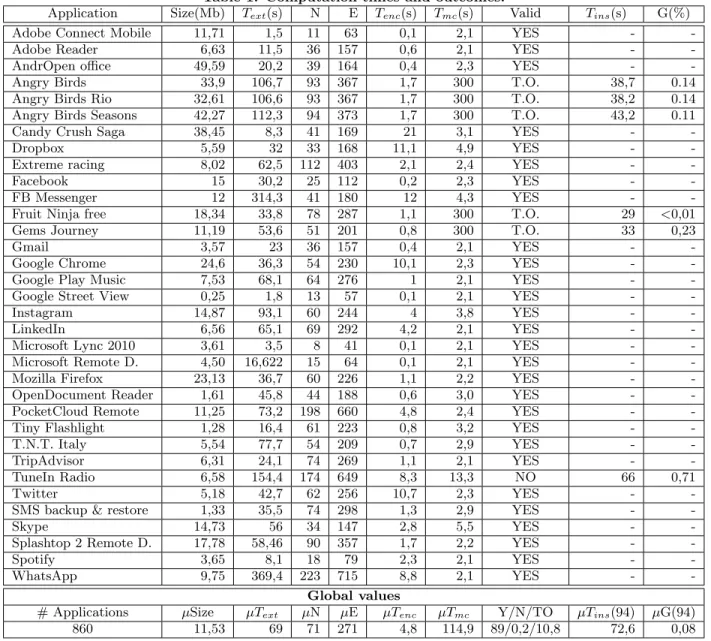
We measure the time needed for each operation carried out by the meta-market server and client. Table 1 shows an ex-cerpt of the experimental results15. A detailed explanation of each experimental phase is provided below.
Model extraction.
At first, the meta-market extracts the model of each ap-plication, using our customization of the Androguard tool. The CFG is generated parametrically w.r.t. the system ac-tion expressed in the security policy and all inter-applicaac-tion communications. Then, the server performs an optimization step consisting in simplifying the CFG by pruning unreacha-ble nodes. ColumnTextreports the time needed (in seconds)
for the generation of the final CFG while the size of the mo-del is given in terms of number of nodes (column N) and edges (column E).
Promela encoding and model checking.
As explained in Section 5.2, the use of the Spin model checker passes through two consecutive phases, i.e., Promela encoding and verification. The duration of the encoding phase for each application is listed under Tenc in Table 1.
The duration of the model checking verification step is repor-ted in columnTmc. Moreover, we provide in columnValid
the outcome of the model checker. We write YES to denote that the application successfully passed the verification, NO for the applications failing the verification, and Time Out (T.O.) for analysis that reached the time threshold.
15The complete results can be accessed online at
http://www.ai-lab.it/byodroid/experiments.html.
Application instrumentation.
Application instrumentation is performed when the model checking fails in validating the application. The instrumen-tation execution times are reported underTins in Table 1.
Moreover, since instrumentation may enlarge the original di-mension of the software packages, we also report the package size change (column G), in percentage.
6.3
Discussion
The global values in Table 1 summarizes the overall sta-tistics of our experiments. Although preliminary, the ex-perimental results are promising. As a matter of fact, the meta-market validates more than 89% (column Y/N/TO) of applications within an average time of about 3 minutes (µText+µTenc+µTmc). The remaining 11% (i.e. 94
appli-cations), being rejected or leading to a time out, was succes-sfully instrumented. The instrumentation process took an average time of 72 seconds (columnµTins) and slightly
en-larges the application packages by less than 0,1% on average (columnµG).
It is worth noticing that our experiments have been carried out on a prototype implementation which can be further op-timized. For instance, the definition of an optimized model extraction tool (different from Androguard) may reduce the extraction time; moreover, memory caching or task concur-rency can improve the global performance.
Furthermore, consider that the meta-market validation is immediate when an application has been already checked in the current configuration. Hence, if devices share significant set of applications, we expect to observe a drastic increment of the skipped analysis phases.
7.
CONCLUSION
We have presented a mobile application distribution sy-stem based on the notion of meta-market. The meta-market lays between standard, public application markets and the mobile devices. In practice, the meta-market guarantees that applications deployed on mobile devices do not violate a given security policy. This result is obtained by imple-menting a security workflow including model extraction and formal verification steps. When the verification rejects the application, the deployment process leads to the instrumen-tation of the potentially dangerous code. Instrumented code is then monitored for avoiding illegal behavior.
The whole system has been designed to be transparent to the users, the application developers, and the application mar-kets. We have experimentally assessed the feasibility of the approach by testing the performance of an implementation of the meta-market on a large number of popular Android applications for both leisure and work. For the experimenta-tion, a real world BYOD security policy taken from the US Government guidelines has been modeled. Eventually, we showed that the meta-market succeeds in detecting applica-tions which can violate the security policy and in sanitizing them. All the activities carried out by the meta-market ha-ve been measured in terms of time and resources in order to witness the feasibility of our approach under realistic as-sumptions.
Future directions of this research include the extension of the experimental activity. Indeed, a crucial aspect of the meta-market is its capability to scale over a large number of devices and applications. In particular, we need to define new tests for showing the effectiveness of the PMC
compo-Table 1: Computation times and outcomes.
Application Size(Mb) Text(s) N E Tenc(s) Tmc(s) Valid Tins(s) G(%)
Adobe Connect Mobile 11,71 1,5 11 63 0,1 2,1 YES -
-Adobe Reader 6,63 11,5 36 157 0,6 2,1 YES -
-AndrOpen office 49,59 20,2 39 164 0,4 2,3 YES - -Angry Birds 33,9 106,7 93 367 1,7 300 T.O. 38,7 0.14 Angry Birds Rio 32,61 106,6 93 367 1,7 300 T.O. 38,2 0.14 Angry Birds Seasons 42,27 112,3 94 373 1,7 300 T.O. 43,2 0.11 Candy Crush Saga 38,45 8,3 41 169 21 3,1 YES -
-Dropbox 5,59 32 33 168 11,1 4,9 YES -
-Extreme racing 8,02 62,5 112 403 2,1 2,4 YES -
-Facebook 15 30,2 25 112 0,2 2,3 YES -
-FB Messenger 12 314,3 41 180 12 4,3 YES -
-Fruit Ninja free 18,34 33,8 78 287 1,1 300 T.O. 29 <0,01 Gems Journey 11,19 53,6 51 201 0,8 300 T.O. 33 0,23
Gmail 3,57 23 36 157 0,4 2,1 YES -
-Google Chrome 24,6 36,3 54 230 10,1 2,3 YES -
-Google Play Music 7,53 68,1 64 276 1 2,1 YES - -Google Street View 0,25 1,8 13 57 0,1 2,1 YES -
-Instagram 14,87 93,1 60 244 4 3,8 YES -
-LinkedIn 6,56 65,1 69 292 4,2 2,1 YES -
-Microsoft Lync 2010 3,61 3,5 8 41 0,1 2,1 YES - -Microsoft Remote D. 4,50 16,622 15 64 0,1 2,1 YES - -Mozilla Firefox 23,13 36,7 60 226 1,1 2,2 YES - -OpenDocument Reader 1,61 45,8 44 188 0,6 3,0 YES - -PocketCloud Remote 11,25 73,2 198 660 4,8 2,4 YES - -Tiny Flashlight 1,28 16,4 61 223 0,8 3,2 YES -
-T.N.T. Italy 5,54 77,7 54 209 0,7 2,9 YES -
-TripAdvisor 6,31 24,1 74 269 1,1 2,1 YES -
-TuneIn Radio 6,58 154,4 174 649 8,3 13,3 NO 66 0,71
Twitter 5,18 42,7 62 256 10,7 2,3 YES -
-SMS backup & restore 1,33 35,5 74 298 1,3 2,9 YES -
-Skype 14,73 56 34 147 2,8 5,5 YES -
-Splashtop 2 Remote D. 17,78 58,46 90 357 1,7 2,2 YES -
-Spotify 3,65 8,1 18 79 2,3 2,1 YES -
-WhatsApp 9,75 369,4 223 715 8,8 2,1 YES -
-Global values
# Applications µSize µText µN µE µTenc µTmc Y/N/TO µTins(94) µG(94)
860 11,53 69 71 271 4,8 114,9 89/0,2/10,8 72,6 0,08
nent in improving the verification and management of lar-ge, i.e., involving several applications, device configurations. Moreover, we want to apply the meta-market to real BYOD scenarios. As a matter of fact, the behavior and perfor-mances of some meta-market components, e.g., the partial model checker, can depend on the specific environment it has to deal with. For instance, the average number of ap-plications per device and their occurrences may affect the database management. Moreover, we plan to investigate dif-ferent instances of BYOD policies involving various aspects of the security of mobile devices. Among them, contextual policies, e.g., those referring to the geographical location of the device, need further investigation. Indeed, they may be useful for some kind of organizations.
Furthermore, we plan to research on the possibility of inclu-ding novel optimization heuristics for the policy database management. We already investigated double implication and low frequency. Other approaches might include cy inclusion/implication, i.e., using a more restrictive
poli-cy which, for some reason, is more convenient or easier to handle. We believe that this represents a problem of gene-ral interest and it could be interesting to consider “garbage collection” techniques for this kind of policy management systems.
8.
REFERENCES
[1] M. Abadi and C. Fournet. Access Control based on Execution History. InProceedings of the 10th Annual Network and Distributed System Security Symposium, pages 107–121, 2003.
[2] I. Aktug and K. Naliuka. ConSpec – A formal language for policy specification.Science of Computer Programming, 74(1-2):2–12, Dec. 2008.
[3] A. Amighi, P. de Carvalho Gomes, and M. Huisman. Provably Correct Control-Flow Graphs from Java Programs with Exceptions. InFormal Verification of Object-Oriented Software, volume 26 ofKarlsruhe Reports in Informatics, pages 31–48, Karlsruhe,
Germany, October 2011. Karlsruhe Institute of Technology.
[4] H. R. Andersen. Partial Model Checking (Extended Abstract). InIn Proceedings, Tenth Annual IEEE Symposium on Logic in Computer Science, pages 398–407. IEEE Computer Society Press, 1995. [5] Apple Inc. Secure Coding Guide, 2012.
https://developer.apple.com/library/ios/ documentation/Security/Conceptual/ SecureCodingGuide/SecureCodingGuide.pdf, accessed on 4-Dec-2013.
[6] A. Armando, G. Costa, and A. Merlo. Formal modeling and reasoning about the android security framework. In C. Palamidessi and M. Ryan, editors,
Trustworthy Global Computing, volume 8191 of
Lecture Notes in Computer Science, pages 64–81. Springer Berlin Heidelberg, 2013.
[7] A. Armando, G. Costa, A. Merlo, and L. Verderame. Bring your own device, securely. InProceedings of the 28th Annual ACM Symposium on Applied Computing, SAC ’13, pages 1852–1858, New York, NY, USA, 2013. ACM.
[8] A. Armando, A. Merlo, M. Migliardi, and L. Verderame. Breaking and fixing the android launching flow.Computers & Security, 39, Part A(0):104 – 115, 2013. 27th IFIP International Information Security Conference.
[9] M. Bartoletti, G. Costa, P. Degano, F. Martinelli, and R. Zunino. Securing Java with Local Policies.Journal of Object Technology, 8(4):5–32, June 2009.
[10] F. Besson, T. Jensen, D. Le M´etayer, and T. Thorn. Model checking security properties of control flow graphs.J. Comput. Secur., 9(3):217–250, Jan. 2001. [11] T. Blasing, L. Batyuk, A.-D. Schmidt, S. Camtepe,
and S. Albayrak. An Android Application Sandbox system for suspicious software detection. InMalicious and Unwanted Software (MALWARE), 2010 5th International Conference on, pages 55–62, 2010. [12] E. M. Clarke, Jr., O. Grumberg, and D. A. Peled.
Model checking. MIT Press, Cambridge, MA, USA, 1999.
[13] K. D. Cooper, T. J. Harvey, and T. Waterman. Building a control-flow graph from scheduled assembly code. Technical report, Department of Computer Science, Rice University, 2002.
[14] G. Costa, F. Martinelli, P. Mori, C. Schaefer, and T. Walter. Runtime monitoring for next generation Java ME platform.Computers & Security,
29(1):74–87, 2010.
[15] L. Desmet, W. Joosen, F. Massacci, K. Naliuka, P. Philippaerts, F. Piessens, and D. Vanoverberghe. The S3MS .NET Run Time Monitor.Electronic Notes in Theoretical Computer Science, 253(5):153–159, Dec. 2009.
[16] L. Desmet, W. Joosen, F. Massacci, P. Philippaerts, F. Piessens, I. Siahaan, and D. Vanoverberghe. Security-by-contract on the .NET platform.
Information Security Technical Report, 13(1):25–32, Jan. 2008.
[17] Digital Services Advisory Group and Federal Chief Information Officers Council. Bring Your Own Device – A Toolkit to Support Federal Agencies Implementing
Bring Your Own Device (BYOD) Programs. Technical report, White House, August 2013. Available at
http://www.whitehouse.gov/digitalgov/bring-your-own-device.
[18] N. Dragoni, F. Massacci, T. Walter, and C. Schaefer. What the heck is this application doing? - A security-by-contract architecture for pervasive
services.Computers & Security, 28(7):566 – 577, 2009. [19] W. Enck, M. Ongtang, and P. McDaniel. On
lightweight mobile phone application certification. In
Proceedings of the 16th ACM conference on Computer and communications security, CCS ’09, pages 235–245, New York, NY, USA, 2009. ACM.
[20] U. Erlingsson.The Inlined Reference Monitor
Approach to Security Policy Enforcement. PhD thesis, Ithaca, NY, USA, 2004.
[21] A. P. Felt, E. Chin, S. Hanna, D. Song, and D. Wagner. Android permissions demystified. In
Proceedings of the 18th ACM conference on Computer and communications security, CCS ’11, pages 627–638, New York, NY, USA, 2011. ACM.
[22] P. Gastin and D. Oddoux. Fast LTL to B¨uchi Automata Translation. InProceedings of the 13th International Conference on Computer Aided
Verification, CAV ’01, pages 53–65, London, UK, UK, 2001. Springer-Verlag.
[23] N. Hardy. The Confused Deputy: (or Why Capabilities Might Have Been Invented).SIGOPS Oper. Syst. Rev., 22(4):36–38, Oct. 1988.
[24] G. Holzmann.The Spin model checker.
Addison-Wesley Professional, first edition, 2003. [25] G. Holzmann and D. Bosnacki. The design of a
multicore extension of the spin model checker.IEEE Transactions on Software Engineering,
33(10):659–674, 2007.
[26] R. M. Keller. Formal verification of parallel programs.
Communications of the ACM, 19(7):371–384, July 1976.
[27] R. V. Koskinen and J. Plosila. Applications for the SPIN Model Checker – A Survey. Technical Report 782, Turku Centre for Computer Science,
Lemmink¨aisenkatu 14 A, 20520 Turku, Finland, September 2006.
[28] B. Long, J. Dingel, and T. N. Graham. Experience Applying the SPIN Model Checker to an Industrial Telecommunications System. InProceedings of the 30th International Conference on Software
Engineering, ICSE ’08, pages 693–702, New York, NY, USA, 2008. ACM.
[29] M. Nauman, S. Khan, and X. Zhang. Apex: extending android permission model and enforcement with user-defined runtime constraints. InProceedings of the 5th ACM Symposium on Information, Computer and Communications Security, ASIACCS ’10, pages 328–332, New York, NY, USA, 2010. ACM.
[30] G. C. Necula. Proof-carrying code. InProceedings of the 24th ACM SIGPLAN-SIGACT symposium on Principles of programming languages, POPL ’97, pages 106–119, New York, NY, USA, 1997. ACM. [31] J. Oberheide and C. Miller. Dissecting the Android
Bouncer. InSummerCon, June 2012.
[32] M. Ongtang, S. McLaughlin, W. Enck, and
P. McDaniel. Semantically Rich Application-Centric Security in Android. InProceedings of the 2009 Annual Computer Security Applications Conference, ACSAC ’09, pages 340–349, Washington, DC, USA, 2009. IEEE Computer Society.
[33] A. Pnueli. The temporal logic of programs. In
Proceedings of the 18th Annual Symposium on Foundations of Computer Science, SFCS ’77, pages 46–57, Washington, DC, USA, 1977. IEEE Computer Society.
[34] N. Reddy, J. Jeon, J. A. Vaughan, T. Millstein, and J. S. Foster. Application-centric security policies on unmodified Android. Technical Report UCLA TR 110017, University of California, Los Angeles, Computer Science Department, July 2011.
[35] F. B. Schneider. Enforceable security policies.ACM Trans. Inf. Syst. Secur., 3(1):30–50, Feb. 2000. [36] Ph. Schnoebelen. The Complexity of Temporal Logic
Model Checking. In Ph. Balbiani, N.-Y. Suzuki, F. Wolter, and M. Zakharyaschev, editors,Proceedings of the 4th Workshop on Advances in Modal Logic (AIML’02), pages 481–517. King’s College Publications, 2003.
[37] R. Sekar, V. Venkatakrishnan, S. Basu, S. Bhatkar, and D. C. DuVarney. Model-carrying code: a practical approach for safe execution of untrusted applications.
SIGOPS Operating Systems Review, 37(5):15–28, Oct. 2003.
[38] A. Valmari. The state explosion problem. InLectures on Petri Nets I: Basic Models, Advances in Petri Nets. The volumes are based on the Advanced Course on Petri Nets, held in Dagstuhl, September 1996, pages 429–528, London, UK, UK, 1998. Springer-Verlag. [39] T. Wang, K. Lu, L. Lu, S. Chung, and W. Lee. Jekyll
on iOS: When Benign Apps Become Evil. In
Proceedings of the 22nd USENIX Security Symposium, pages 559–572, 2013.
[40] J. Yang, P. Twohey, D. Engler, and M. Musuvathi. Using model checking to find serious file system errors.
ACM Transactions on Computer Systems, 24(4):393–423, Nov. 2006.
[41] Y. Zhou and X. Jiang. Dissecting Android Malware: Characterization and Evolution. InProceedings of the 2012 IEEE Symposium on Security and Privacy, SP ’12, pages 95–109, Washington, DC, USA, 2012. IEEE Computer Society.
[42] Y. Zhou, X. Zhang, X. Jiang, and V. W. Freeh. Taming information-stealing smartphone applications (on Android). InProceedings of the 4th international conference on Trust and trustworthy computing, TRUST’11, pages 93–107, 2011.