Fluid Dynamics Applications on a Grid
Youssef Mesri
* —Hugues Digonnet
** —Hervé Guillard
**Smash project, Inria-Sophia Antipolis, BP 93, 06902 Sophia-Antipolis Cedex, France {Youssef.Mesri,Herve.Guillard }@sophia.inria.fr
**CEMEF, Ecole des mines de Paris, BP 207, 06904 Sophia-Antipolis Cedex, France {[email protected]}
ABSTRACT.The problem of partitioning unstructured meshes on a homogeneous architecture is largely studied. However, existing partitioning schemes fail when the target architecture intro-duces heterogeneity in resource characteristics. With the advent of heterogeneous architecture as the Grid, it becomes imperative to study the partitioning problem taking into account the heterogeneous platforms. In this work, we present a new mesh partitioning scheme, that takes into account the heterogeneity of CPU and networks. Our load balancing mesh partition strat-egy improves the performance of parallel applications running in a heterogeneous environment. The use of these techniques are applied to some model problems in CFD. Experimental results confirm that these techniques can improve the performance of applications on a computational Grid.
RÉSUMÉ.La parallélisation des méthodes de volumes ou d’éléments finis repose sur des tech-niques de décomposition de domaines qui imposent un partitionnement de maillage préalable aux calculs. Ce problème a été largement étudié pour des architectures homogènes où tous les CPU sont identiques et reliés par un réseau rapide. Avec l’émergence d’architectures hétéro-gènes de type grilles de calcul constituées d’ une aglomération de clusters et de processeurs géographiquement distribués et reliés par des réseaux hétérogènes, il est devenu prímordial de re-éxaminer ce problème en prenant en compte les caractéristiques de ces plate-formes en terme de CPU et de réseau. Dans ce travail, nous présentons un nouveau schéma de partitionnement de maillages, prenant en compte l’ hétérogéneité des CPU et du réseau. Cette stratégie d’équili-brage de partitions améliore les performances des applications tournant dans un environement de type grille.
KEYWORDS:Grid computing, mesh partitioning, Distributed computing, Load balancing, perfor-mance study.
MOTS-CLÉS :Maillages non-structurés, Méthodes éléments finis, volumes finis, Partitionnement de maillages, Calcul sur Grille, Calcul distribué, équilibrage de charge
1. Introduction
Computer simulations are becoming increasingly important as the only means for the design and interpretation of many different process. The scope and accuracy of these simulations are severely limited by available computational power, even using to-day’s most powerful supercomputers. We can break through these limits by si-multaneously harsening multiple networked supercomputers running single massively parallel simulation to carry out more complex and high-fidelity simulations. This is the basic idea that, since the mid 1990s, made developed the so-called computational grid. Computational grid concept provides the means for coordinated resource sharing and problem solving in dynamic, multi-institutional virtual organizations. The Grid con-cept extends older concon-cepts of distributed computing such as the cluster-computing, but in contrast to older systems the Grid allows resources to be allocated to computing needs on an ad hoc basis.
In the last years there was a wide-spread acceptance of Grid computing that bring to growth of several projects. One of them is the MecaGRID1 project between
IN-RIA Sophia Antipolis, CEMEF(Centre de mise en forme des materiaux de l’Ecole des Mines de Paris-Sophia Antipolis), and the IUSTI(Institut Universitaire des sys-temes Thermiques et Indistriels) in Marseille. The aim of the project is to build a computational grid devoted to fluid dynamics applications, using a set of clusters in-terconnected by a wide area network. Mesh applications are a class of problems that requires such high-end computational power since performance must be scalable into hundreds of processors considering the current technology ([BAR 99]),([DJO 00]). The successful deployment of compute-intensive applications in a grid environment such as the Grid of the MECAGRID project, involves efficient partitioning on a truly heterogeneous distributed architecture which makes no assumptions on the computing resources. As more remote resources are added, the heterogeneity of the computing platform also grows.
In this paper, we demonstrate how diversity in the architecture characteristics affects the efficiency of mesh partitioning.
In the literature, they are several algorithms for solving the graph partitioning problem for homogeneous architecture models. Partitioning schemes such as Metis ([KAR 98]), Chaco ([HEN 94]), and Jostle([WAL 98]) employ multilevel strategies but fail to ad-dress the limitations imposed by heterogeneity in the underling system. These parti-tioning scheme assume the processing speed of the computing resources to be uniform and the communication network connecting the resources to be of equal capacity. We propose a heterogeneous partitioner, called MeshMigration that takes into account the architecture characteristics. MeshMigration generates a high quality partition and provides a load balance on each processor of the heterogeneous architecture. We have tested MeshMigration with realistic meshes and results shown that our approach provides an efficient partitioning on a grid platform and minimize the application ex-ecution time.
This paper is organized as follows: In section 2, we describe the workload model,
lowed by a model of distributed heterogeneous architectures in section 3. In section 4, we formally define the partitioning problem. Section 5 discusses Meshmigration, the proposed local heterogeneous partitioner and its complexity analysis. In section 6, we experimentally study the performance of MeshMigration for realistic workloads. Finally in section 7, we will describe preliminary experimental results for a finite ele-ment code executed on the Grid.
2. Workload model
Computational fluid dynamics (CFD) applications usually operate on a huge set of application data associated to unstructured meshes. For this reason CFD problems represent a significant part of high performance supercomputing applications. Finite element and finite volume methods use unstructured meshes. However, depending on the characteristics of the discretization method, the work flow graph representing the application can be either the nodal graph (mesh nodes), dual graph(mesh element), the combination of both, or some special purpose presentation. In this work based on the previous work of ([BAS 00]), we consider the combined graph for modeling the FE and FV application.
We represent the application as a weighted undirected graphW = (V(W), E(W)),
which we will call theworkload graph. Each vertexv has a computational weight ω(v), which reflects the amount of the computation to be done atv. An edge between
verticesuandv, denoted{u, v}, has a computational weightω({u, v}), which reflects
the data dependency between them.
3. Heterogeneous architecture model
Partitioning applications onto heterogeneous architecture such as a Grid environ-ment requires a special model architecture that reflects both heterogeneous resource characteristics and also non-homogeneous communication network between these dif-ferent resources.
The machine architecture can be represented as a weighted undirected graphA= (V(A), E(A)), which we will call the architecture graph. It consists in a set of
vertices V(A) = {p1, p2, ..., pn}, denoting processors, and a set of edgesE(A) =
{{pi, pj}|pi, pj ∈P}, representing communication links between processors. Each
processorphas a processing weightsp, modeling its processing power per unit of
computation. Each link has a link weightvpq, that denotes the communication
band-width per unit of communication between processorspandq.
In this work, we will assume that the machine architecture can be represented by a complete graph, that is we will assume that given any two processorspandq, there
always exist a path connecting them even if they are not directly connected by a phys-ical link. In this case, the weight of the edge{p, q}will be evaluated as the minimum
instance the communication weights matrix corresponding to the adjacent architecture graph. 10 10 10 10 1 2 2 2 P1 P2 P3 P4 P5 P6 P6 Architecture graph C= × 10 10 10 1 1 1 10 × 10 10 1 1 1 10 10 × 10 1 1 1 10 10 10 × 1 1 1 1 1 1 1 × 2 2 1 1 1 1 2 × 2 1 1 1 1 2 2 × (1) Communication Matrix 4. Partitioning Problem
We consider a workload graphW(V(W), E(W))which represents the applica-tion, and a architecture graphA(V(A), E(A))which represents the Grid. On a com-putational grid, the machine architecture is heterogeneous both for network and pro-cessors. So we consider the characteristics of architecture graph to define the par-titions. A mapping of a workload graph onto a architecture graph can be formally described by:
m : V(W)−→V(S) (2) wherem(v) =p, if the vertexvofW is assigned to processorpofA.
In order to evaluate the quality of a mapping, we define two cost models: one for estimating the computational cost and the other one for the communication cost eval-uation.
4.1. Computational cost
For each mapping of the workload graph onto the architecture graph we can esti-mate the computational cost as follows: If a vertexvis assigned to a processorp, the
computational cost is given bytv
p = ω(v)/sp, that is the ratio of the computational
weight of v per the processing weight ofp. Computational cost estimates the time
4.2. Communication cost
The communication cost is introduced when we have a data communication trans-fer between two diftrans-ferent nodes in the target graph. Suppose{u, v} ∈ E(W) and
u∈V(W)is assigned to processorpandv ∈V(W)is assigned to processorq. The
data is transfered from the local memory ofpto the local memory ofqvia message
passing. In this case, the communication cost is given bycu,v
pq =ω({u, v})/vpq, that
is the ratio of the communication weight of edge{u, v}per the link weight between
pandq. The communication cost represents the time units required for data transfer
between the verticesuandv.
4.3. Cost function
Letm : V(W) −→ V(A)be a mapping of W(V)ontoV(A), the weight of
subgraph assigned to a processorpinV(A), is just the sum of the weights of the
vertices in the subgraph: C(p, m) = P
v∈V(A),m(v)=pω(v). For allpinV(A), the
computational time is given bytp= C(p,m)sp , whereC(p, m)is defined above andsp
is the processing weight.
Let{p.q} ∈E(A), we define the communication cost associated to the processorsp
andqas: C({p, q}, m) = X m(u)=p m(v)=q {u,v}∈E(W) cu,vpq
The total communication time associated to processorpis defined by:
C(p, m) =P
i∈V(A)6=pC({p, q}, m). To evaluate the quality of the mapping, we
de-fine a cost function as follows:Φ(W, A, m) :=T+CwhereT =t t
1, . . . , tcard(V(A))
andC =t C(1, m), . . . ,C(card(V(A)), m). The definition of the graph
partition-ing problem is to find a partition (mapppartition-ingm) which minimizes the cost function
Φ(W, A, m). Clearly, the problem is extensible to the classical graph partitioning
and task assignment problem, and it is well known that this problem is NP-complete. In the next section, we describe the iterative algorithm chosen to minimize this cost function and find the efficient partitioning.
5. Heterogeneous local method of parallel repartitioning
MeshMigration is a graph/mesh repartitioning scheme developed for heteroge-neous architectures such as the Grid. We employ a local method of parallel repar-titioning developed during the DRAMA project ([BAS 00]).
The principal steps of this strategy are the followings:
- Form disjoint pair of processors that will present an important gain for the cost func-tion (see secfunc-tion 5.2).
- Optimization the mapping on each pair formed: This optimization is performed by transferring vertices (elements and nodes) from one processor to another by using the notion of strip migration (see section 5.1).
- The two previous steps are iterated as long as we are able to globally optimize the partition.
5.1. Strip migration
Let(p, q)be two processors and let
Ip.q ={{u, v} ∈E(W)/m(u) =p and m(v) =q}be the interface between the
processorspandq. For anywsuch thatm(w) =p(resp.q) the topological distance
ofwfrom the interface is defined as the shortest path betweenwand a vertex of the
interface in the mesh nodal graph (if wis a node of the mesh) or in the mesh dual
graph (ifwis an element). We then define, a strip as the set of nodes and elements
that have the same topological distance from the interface. The optimization of the partition is then performed by transferring strips from processorpto processorqin
order of increasing topological distance and as long as this transfer improves the cost function.
5.2. Formation of processor pairs
The goal of this algorithm is to perform a parallel and automatic clutch of pro-cessors. It provides the maximum pairs of processors which consent to optimize the partitions.
If we consider a pair of processors(p, q), the cost function of initial partition between pandqis given by: F0|pq = max(tp, tq) +C({p, q}, m) whereC({p, q}, m) =
C({q, p}, m). To improve the initial partition, we evaluate the cost function strip per
strip as long as we find the best strip associated to the minimum of the cost function onp, denotedFminp and onq,Fminq .
Then, we define a Friendship function between the processorspandqwhich is given
by the maximal potential gain:
Friendship(p, q) =maxF0|pq−Fminp , F0|pq−Fminq
(3) The first pair of processors formed is given by:
Friendship(p, q) =max(Friendship(i, j)), for alliandjinV(A).
The migration between p and q is determined as follows:
if (F0|pq−Fminp ) > (F0|pq−Fminq )(resp. (F0|pq−Fminp ) < (F0|pq−Fminq )), the
elements and nodes having a distance lower than the best strip distance associate to
5.3. Partitioning strategy
In order to provide an efficient partitioning in a grid environment, we introduce a hierarchical view-point in this algorithm. We define two architecture levels in the target graph: level one is the set of processors, and the second is the set of clusters. Then, the partitioning is carried out in two stages:
1- We consider a grid composed by several clusters. We decompose the mesh in order to assign one partition to each cluster taking into account the bandwidth of communi-cations layers between these various clusters. The decomposition takes place via the relationship defined in the previous paragraph. We denoteNnumbers of clusters and G={C0, ..., CN−1}the set of clusters. Formally:
Letpandqtwo processors in the architecture graph,p∈Ciandq∈Cj: if Ci6=Cj
Friendship(p, q) =maxF0|pq−Fminp , F0|pq−Fminq
else Friendship(p, q) = 0
(4)
2- We denoteΠ = {π0, ..., πN−1}, the set of the sub-domains mapped onG. For
every partitionπiassigned to the clusterCi={pi0, ..., piI−1}, where I the number of
processors ofCi, we re-partitionedπion the set of processors ofCi:
For everypandqtwo processors on the architecture graph,p∈Ciandq∈Cj: if Ci=Cj
Friendship(p, q) =maxF0|pq−Fminp , F0|pq−Fminq
else Friendship(p, q) = 0
(5)
The strategy adopted reduces the complexity of the algorithm.
6. Performance results
In this section, we present practical results of the proposed heterogeneous par-titioning method on a grid environment. For our experiments, we consider a jet in cross-flow(JICF) mesh often used to simulate fluid dynamics phenomena (e.g. in-jections for cooling systems, jets for V-STOL aircraft, exhaust of vehicles). This mesh(3D) consists of 400 thousand nodes and 3.8 millions elements(tetrahedral). In table 1, we show a set of results obtained from a set of architecture graph. We use two clusters, pf machines(processor speed 1GHz, bandwidth intra-cluster 100Mb/s) and nina machines (processor speed 2GHz, bandwidth intra-cluster 1Gb/s), the bandwidth between two clusters is 100Mb/s. The number of processors varies from 2 to 32 pro-cessors. The parameters used in this table are described as follows:
files) needed by the MeshMigration partitioner. Φ: cost function
M ax(M in)elements: the maximum(minimum) number of elements for all partitions.
λ= max(tp)
min(tp): the load imbalance, wheretp=
C(p,m)
sp . To simplify the presentation of
the results, we considerC(p, m) =nb_Elp, where nb_Elp is the number of elements assigned to processor p. We have a balanced load whenλ'1.
Partitioner Cost functions 1pf-1nina 2pf-2nina 4pf-4nina 8pf-8nina 16pf-16nina
Φ 1.37232e+06 699951 352804 266230 893602 PT(seconds) 589.562 639.762 856.102 967.167 1155.21 Max elements 1166697 585120 293254 148427 75106 Homog. Min(tp) 486123.75 243800 122189.16 61844.58 31294.16 Min elements 1166194 581132 288675 143497 75066 Max(tp) 1166194 581132 288675 143497 75066 λ 2.39 2.38 2.36 2.32 2.39 Φ 805537 421440 217025 137211 59278.7 PT(seconds) 339.615 390.888 465.138 739.666 758.149 Max elements 1648787 847293 427327 221036 114330 Heterog. Max(tp) 686994.58 353038.5 178052.91 92098.33 47637.5 Min elements 684104 328452 166263 78630 40720 Min(tp) 684104 328452 166263 78630 40720 λ 1.004 1.07 1.07 1.17 1.17
Table 1. Comparison between Homogeneous and Heterogeneous partitioning, for the
JICF test case partitioned in 2 to 32 processors
From the table 1, we can extract the following remarks: - About cost function (Φ):
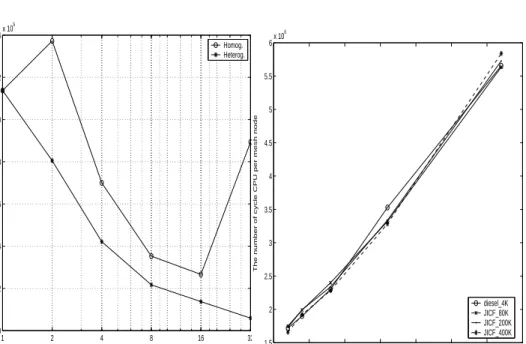
The homogeneous partition does not optimize the cost function, because the homo-geneous partitioner does not takes into account the machine architecture. Otherwise, while increasing the number of processors, the number of interfaces between parti-tions increases, furthermore, the produced communication penalize the homogeneous approach too much. However, the heterogeneous approach significantly decreases the cost function that estimates the execution time. The figure[figure 1], clearly shows the variation of the cost function in the two homogeneous and heterogeneous cases according to the number of processors.
- About the time partitioning (PT) and load balancing:
The strip migration method used in the heterogeneous approach allows to accelerate the partitioning time as it is shown in the table 1. It is also possible to see the efficiency of our approach on the level of the load balancing, the parameterλis nearly equal to
one for the heterogeneous partitions, but not balanced for the homogeneous partitions. After the comparison of the heterogeneous and homogeneous methods, we study now,
1 2 4 8 16 32 0 2 4 6 8 10 12 14x 10 5 Number of processors Function cost Homog. Heterog.
figure 1: Evaluation of the cost function 0 5 10 15 20 25 30 35 1.5 2 2.5 3 3.5 4 4.5 5 5.5 6x 10 6 Number of processors
The number of cycle CPU per mesh node
diesel_4K JICF_80K JICF_200K JICF_400K
figure 2: Four different mesh sizes
the scalability of our approach. We present test meshes with different size: a diesel_4K mesh with 4 thousand nodes, a JICF_80K mesh with 80 thousand nodes, a JICF_200K mesh with 200 thousand nodes and a JICF_400K mesh with 400 thousand nodes. We compute the partitioning time (PT) needed to partitioning different meshes on a ar-chitecture when the number of processors varies from 2 to 32 processors, then we compute the ratio of the number of CPU cycles per the number of nodes for each mesh.
In figure [2], we show the curves that represent the number of CPU cycles needed to process one node according to the number of processors. It is seen that all curves are linear and almost identical, that means that, independently of the type and size of mesh, there is a linear behavior of the partitioner: the partitioning cost is linear ac-cording to the number of partitions (number of processors) and also linear acac-cording to the number of mesh nodes. This result, allows to predict the necessary time for partitioning any other type of mesh and for any number of partitions.
In figure [3.1],[3.2] and [3.3], we present the JICF_400K mesh partitioned on 16 par-titions, 8 partitions assigned to nina cluster and 8 partitions assigned to pf cluster. The used architecture graph is composed of 8 nina machines and 8 pf machines.
In this figure, we observe that interfaces between the two sites is reduced at the inter-section between the pipe and the rectangle, there is therefore a strong minimization of the communications on a weak link (in relation to the intra-sites networks) moreover,
figure 3.1: Heterogeneous partitioning, for the JICF test case partitioned in 16 processors(8 nina, 8 pf)
figure 3.2: 8 Partitions in nina cluster figure 3.3: 8 Partitions in pf cluster the load is balanced on each processor.
7. Experimentation of a finite element code on the grid
In order to validate this approach, we run a simple finite element code. This code solves the Stokes equations in a domainΩ:
∇.(2η(v))− ∇p = 0
with the boundary conditions : p = p0 on Γin p = 0 on Γout v = 0 on Γ−Γin−Γout (7) These equations are solved using the mixed-element P1+/P1 (linear interpolation over the elements for the velocity and the pressure with a bubble interpolation for the ve-locity). The bubble unknown is condensed and lead to a global linear system with only 4 unknowns per node of the mesh representing the domainΩ. The mesh is partitioned using the partitioner previously detailed, this partition allows us to distribute the lin-ear system over the processors. The resolution is then done in parallel with the PETSc library using a conjugate residual resolution with a incomplete LU preconditioner.
The table 2 compares the results obtained on the JICF(400K) test case when using 32 processors ( 16 PF and 16 NINA ) with homogeneous and optimized partitions.
PF-NINA results Nb iter 927 Resolution (s) 339.97 Assembling (s) 9.40651 Solver (s) 349.37 Total (s) 349.42 Homogeneous partition PF-NINA results Nb iter 850 Resolution (s) 174.22 Assembling (s) 6.61217 Solver (s) 180.83 Total (s) 180.86 Optimized partition
Table 2. Influence of an optimized partition against an homogeneous one
This shows that we are able to reduce the calculation time of about 50% by con-sidering the characteristics of the grid.
8. Conclusion
In this paper, we have presented a new graph/mesh partitioner, called MeshMi-gration, for partitioning workloads graph onto heterogeneous architecture graph. This mesh partitioner algorithm execute in parallel and we have shown that his execution time is linear with respect to the number of processors and the size of the mesh. We have also shown that optimized load balancing strategies improves the performance of the applications executed on a heterogeneous environment.
Acknowledgements
This work has been performed in the framework of the ACI-GRID 2002 MecaGrid of the French Ministry of Research.
9. References
[BAR 99] BARNARDS., BISWASR., SAINIS., VAN DERWIJNGAARTR., YARROW M.,
ZECHTERL., FOSTER I., LARSSON O., “Large-scale Distributed Computational Fluid
Dynamics on the information Power Grid using Globus”, 7th symp. on the Frontiers of Massively Parallel Computation, Annapolis, MD, Feb 1999, p. 60-67.
[BAS 00] BASERMANNA., MAETENB., ROOSED., FINBERGJ., LONSDALEG., “Dynamic
load balancing of finite element applications with the DRAMA library”, vol. 25(2), 2000, p. 83-98.
[DJO 00] DJOMETRIM., BISWAS R., VAN DERWIJNGAARTR., YARROWM., “Parallel
and Distributed Computational Fluid Dynamics: Experimental Results and Challenges”, vol. 1970, Bangalore, India, Dec 2000, p. 183-193.
[HEN 94] HENDRICKSONB., LELANDR., “The Chaco User’s Guide, version 2.0”, Technical
report sand94-2692, 1994, Sandia National Laboratories.
[KAR 98] KARYPISG., KUMAR V., “MeTiS: A software package for partitioning
unstruc-tured graphs, partitioning meshes, and computing fill-reducing orderings of sparse matri-ces, version 4.0”, report , 1998, University of Minnesota, Dept. of Computer Science and Engineering.
[WAL 98] WALSHAWC., “Parallel Jostle Userguide,and V. Kumar”, report , 1998, University