OVERCURRENT RELAY SETTING BY USING ADAPTIVE TECHNIQUE
PARISA ESMAILI
A project report submitted in partial fulfilment o f the requirements for the award from the degree o f Master o f Engineering (Electrical-Power)
Faculty o f Electrical Engineering Universiti Teknologi Malaysia
iii
iv
ACKNOW LEDGEMENT
In preparing this thesis, I was in contact with lots from people, researchers, academicians, and practitioners. They have contributed towards my understanding and thoughts. In particular, I wish to express my sincere appreciation to my main thesis supervisor, Prof. Ir. Dr. Abdullah Asuhaimi bin Mohd Zin, for encouragement, guidance, critics and friendship. W ithout his continued support and interest, this thesis would not be as written.
I also like to express my apperception Librarians at UTM also deserve special thanks for their assistance in supplying the relevant literatures.
My sincere appreciation also extends to all my colleagues and others who have provided assistance at various occasions. Their views and tips are beneficial indeed. Unfortunately, it is not possible to list all from them in this limited space. I am grateful to all my family members.
v
ABSTRACT
As cost-effective protection relays, Overcurrent (OC) relays are used as the main protection equipment in distribution grids and backup protection for distance relays in transmission and sub-transmission lines. Basically, two parameters are considered as OC relays settings: pickup currents ( Ipick up ) and Time Setting Multiplier (TSM). Hence, the objective in the coordination problem o f OC relays is to determine Ipick up and TSM o f each relay. These methods can be classified into two different approaches: Off-line and On-line coordination approaches. By analyzing all faults, abnormal operating conditions, and system contingencies as well-known as Off-line coordination techniques, several methods have been developed to solve coordination problem o f OC relays. However, the response o f relays would not be satisfactory in a condition which has not been included the analysis earlier. Meaning that, required short circuit currents due to any fault that occurred in grid cannot be adjusted to the coordination problem o f OC relays. Therefore, the risk o f occurring mal-operation or miss-coordination becomes high. In order to achieve a robust protection scheme, the OC relays settings must be updated regarding to any change which results into new topology o f the grid. In this thesis, a reliable protection scheme is achieved by implementing the proposed adaptive protection algorithm. For this purpose, the idea o f employing the Thevenin equivalent circuit is utilized to check the power grid operation for any change continuously. By applying the proposed technique, the accurate settings o f overcurrent relays in distribution network are determined. As a result, the proposed adaptive protection algorithm can avoid the unnecessary blackouts in distribution network and provide reliable and sensitive protection scheme.
vi
ABSTRAK
Untuk perlindungan geganti yang efekttif, geganti arus lebihan (OC) digunakan sebagai alat perlindungan utama dalam grid agihan dan perlindungan sokongan untuk geganti jarak dalam penghantaran dan sub-talian penghantaran. Pada dasarnya, dua parameter yang dianggap sebagai tetapan geganti arus lebihan iaitu : Arus Ambilan (PS) dan Masa Tetapan Pengganda (TSM). Oleh itu, objektif dalam masalah penyelarasan daripada geganti arus lebihan ialah untuk menentukan Masa Tetapan Pengganda bagi setiap geganti. Kaedah-kaedah ini boleh diklasifikasikan pada dua pendekatan yang berbeza iaitu: Penyelarasan talian tertutup dan talian terbuka. Dengan menganalisa semua kerosakan, keadaan operasi yang tidak normal, dan sistem luar jangkaan yang dikenali sebagai teknik penyelarasan talian tertutup, beberapa kaedah telah dicapai bagi menyelesaikan masalah penyelarasan geganti arus lebihan. Walaubagaimanapun, keadaan tindak balas geganti kurang memuaskn, dimana analisa kerosakan tidak dimasukkan lebih awal. Ini bermakna arus litar pintas diperlukan kerana kerosakan yang berlaku dalam grid tidak dapat diselaraskan dengan masalah penyelarasan geganti arus lebihan (OC). Oleh itu, risiko untuk berlakunya ‘mal-operasi’ atau ‘miss-penyelarasan’ menjadi tinggi. Untuk mencapai satu skim perlindungan teguh, tetapan geganti arus lebihan mestilah dikemaskini berdasarkan sebarang perubahan kepada keputusan baru topologi grid. Dalam tesis ini, skim perlindungan yang boleh dipercayai dicapai dengan melaksanakan algoritma perlindungan penyesuaian yang telah dicadangkan. Bagi tujuan ini, idea bagi menggunakan Litar Setara Thevenin digunakan untuk menyemak operasi kuasa grid bagi apa-apa perubahan secara berterusan. Dengan menggunakan teknik yang dicadangkan, tetapan tepat geganti arus lebihan dalam rangkaian agihan ditentukan. Hasilnya, algoritma perlindungan penyesuaian yang dicadangkan boleh mengelakkan kerosakan dalam pengedaran rangkaian dan menyediakan skim perlindungan yang boleh dipercayai dan sensitif.
viii
CHAPTER TITLE PAGE
DECLARATION ii
DEDICATION iii
ACKNOW LEDGEMENTS iv
ABSTRACT v
ABSTRAK vi
TABLE OF CONTENTS vii
LIST OF FIGURES xi
LIST OF TABLES xiv
LIAT OF ABBREVIATION xvi
LIST OF APPENDIX xvii
1 INTRODUCTION 1 1.1 Overview 1 1.2 Problem Background 2 1.3 Objective o f Study 4 1.4 Scope o f Study 4 1.5 Research Significant 5 1.6 Thesis Outline 5 2 LITERATURE REVIEW 6 2.1 Introduction 6 2.2 Overcurrent Relays 7
2.2.1 Types o f Overcurrent Relays 7
ix
2.2.1.1 Instantaneous Overcurrent Relays (Define
Current Relay) 7
2.2.1.2 Define Time Overcurrent Relay (DT
Relays) 8
2.2.1.3 Inverse Time Overcurrent Relay
(IDMT Relay) 8
2.2.1.4 Main and Backup Protection Zones 10
2.3 Off-line Coordination 12
2.3.1 Conventional Approaches 12
2.3.2 Optimization Approaches 13
2.3.2.1 Linear Programming Techniques 14 2.3.2.2 Intelligence Based Optimization Methods 15
2.3.2.2.1 Genetic Algorithm 16
2.3.2.2.2 Particle Swarm Optimization 17
2.4 On-line Coordination 19
2.5 Adaptive Protection Scheme 22
2.6 Summary 24
3 RESEARCH METHODOLOGY 25
3.1 Introduction 25
3.2 Research Frame W ork 26
3.3 Case study: IEEE-14 Bus Test System 27 3.4 Proposed Adaptive Protection Algorithm 28 3.5 Operating Scenario for IEEE-14 Bus Power Grid 29 3.6 Thevenin Equivalent Circuit o f Power Grid 32 3.7 Distribution System and Overcurrent Protection Scheme 36
3.7.2 The 230/20 kV Test Radial Distribution System
Configuration 36
3.8 Short Circuit Current Level Calculation 37 3.9 Normal Inverse Time Overcurrent Relay Setting
Procedure 38
x
4 RESULT AND DISCUSSION 40
4.1 Introduction 40
4.2 The Thevenin Equivalent Impedances under Normal
Operating Condition 41
4.2.1 Load Flow Analysis 43
4.2.3 Sampling Procedure under Normal Operating
Condition 45
4.3 The Thevenin Equivalent Impedances after loads
Connection 48
4.3.1 Sampling Procedure after Loads Connection 49 4.4 The Thevenin Equivalent Circuit after Compensators
Connection 53
4.5 The Thevenin Equivalent Circuit under Unexpected
Change 54
4.5.1 Sampling Procedure when G8 is taken out o f use 55 4.6 Overcurrent Relays setting in Radial Distribution System 59 4.7 Short Circuit Current Calculation under Normal
Operating Condition 60
4.7.1 Overcurrent Relay Setting under Normal
Operating Condition 61
4.8 Short Circuit level and Overcurrent Relays Settings after
Loads Connection 63
4.8.1 Short Circuit level and Overcurrent Relays
Settings after G8 Disconnection 65
4.9 Results Discussion 67
4.9.1 Different Values o f the Thevenin Equivalent
Impedances 67
4.9.2 Affected Short Circuit Currents 69 4.9.3 Proposed Adaptive Overcurrent Relays Settings 70
4.10 Summary 71
5 CONCLUSIONAND FUTURE W ORK 72
xi
5.2 Future Work: Protection Issues in Microgrids 73
5.2.1 Active Distribution Networks 74
5.2.2 Implementing o f Adaptive Protection Approaches
as a Solution in Microgrids Protection Issues 75
REFERENCES Appendix A-B
76 81-98
xii
LIST OF TABLES
TABLE NO. TITLE PAGE
2.1 Values o f a and K determine the degree o f inverse in
the IDM curves 10
4.1 Initial values o f voltage, impedance, line and
load currents in pu 44
4.2 Voltage on buses 2, 3,4,5,7 and 9 during sampling
under normal operating condition in pu 45
4.3 Currents from buses 2, 3 and 5 into the bus 4 during
sampling under normal operating condition in pu 46 4.4 Currents from bus 4 into the buses 7 and 9 during
Sampling under normal operating condition in pu 46 4.5 Load current, and load impedance during sampling
under normal operating condition in pu 47
4.6 Voltage on Buses 2, 3,4,5,7 and 9 during sampling after
loads connection in pu 50
4.7 Currents from buses 2 and 5 into the bus 4 during
sampling after loads connection in pu 50
4.8 Currents from bus 4 into the buses 3,7and 9 during
sampling after loads connection in pu 51
4.9 Load and line currents during sampling after Loads
connection in pu 51
4.10 Load impedance during sampling after loads connection
in pu 52
xiii
G8 disconnection in pu 56
4.12 Currents from bus 2 and 5 into the bus 4 during
sampling after G8 disconnection in pu 56
4.13 Currents from bus 4 into the bus 3,7and 9 during
sampling after G8 disconnection in pu 57
4.14 Load and line currents during sampling after G8
disconnection in pu 57
4.15 Load impedance during sampling after G8
disconnection in pu 58
4.16 CT Ratio, nominal and short circuit currents for
breakers under normal operating condition 61 4.17 Overcurrent relay setting data under normal operating
xiv
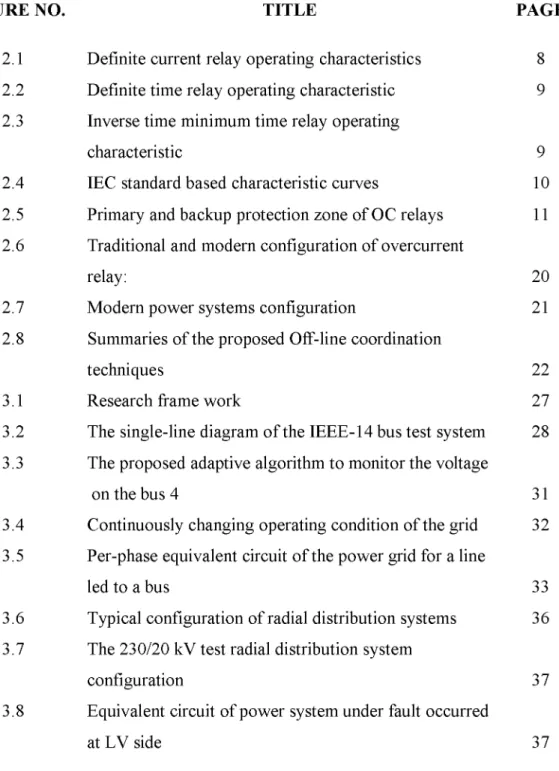
FIGURE NO. TITLE PAGE
2.1 Definite current relay operating characteristics 8 2.2 Definite time relay operating characteristic 9 2.3 Inverse time minimum time relay operating
characteristic 9
2.4 IEC standard based characteristic curves 10
2.5 Primary and backup protection zone o f OC relays 11 2.6 Traditional and modern configuration o f overcurrent
relay: 20
2.7 Modern power systems configuration 21
2.8 Summaries o f the proposed Off-line coordination
techniques 22
3.1 Research frame work 27
3.2 The single-line diagram o f the IEEE-14 bus test system 28 3.3 The proposed adaptive algorithm to monitor the voltage
on the bus 4 31
3.4 Continuously changing operating condition o f the grid 32 3.5 Per-phase equivalent circuit o f the power grid for a line
led to a bus 33
3.6 Typical configuration o f radial distribution systems 36 3.7 The 230/20 kV test radial distribution system
configuration 37
3.8 Equivalent circuit o f power system under fault occurred
at LV side 37
xv
4.1 simulated IEEE-14 bus test system in POWERWORLD 41 simulator under normal operating condition
4.2 Power flow direction to/ from Bus 4 under normal
operating condition in POWERWORD simulator 42 4.3 Workspace o f power flow analysis in POWERWORLD
simulator 43
4.4 Simulated IEEE-14 bus test system in POWERWORLD simulator after loads connection
Simulator after Loads Connection 48
4.5 Power flow direction to/ from the bus 4 after
loads connection in POWERWORLD simulator 49 4.6 Simulated IEEE-14 bus test system in POWERWORLD
simulator after compensation 53
4.7 Simulated IEEE-14 bus test system in POWERWORLD
after G8 disconnection 54
4.8 Power flow direction to/ from the bus 4 after
G8 disconnection in POWERWORLD simulator 55 4.9 Connection o f 230/20 kV-distribution system to the
IEEE-14 bus power grid 59
4.10 Simulated 14-bus test system and its connected radial
distribution network after load connection 64 4.11 CT Ratio, nominal and short circuit currents for
breakers after loads connection 64
4.12 Overcurrent relay setting data after loads connection 65 4.13 Simulated 14-bus test system and its connected radial
distribution network after G8 disconnection 66 4.14 CT Ratio, nominal and short circuit currents for
breakers when G8 disconnected 66
4.15 Overcurrent relay setting data when G8 disconnected 67 4.16 Different values o f the Thevenin impedance under
continuously changing operating condition o f the grid 68 4.17 Different short circuit levels under different operating
xvi
5.1 Active distribution networks configuration 74 5.2 Simulated 230/20 active distribution network in
xvii
LIST OF APPENDICES
APPENDIX NO. TITLE PAGE
A IEEE-14 Bus Test System Data 81
xviii
LIST OF ABREVIATIONS
OC - Overcurrent
TSM - Time Setting Multiplier
PS - Plug Setting
LP - Linear Programming
MINLP - Mixed Integer Non-Linear Programming SCADA - Supervisory Control and Data Acquisition
HV - High Voltage
IDMT - Inverse Define Minimum Time
DT - Define Time
NLP - Non-Linear Programming
IBFS - Initial Basic Feasible Solution
GA - Genetic Algorithm
POS - Particle Swarm Optimization CGA - Continuous Genetic Algorithm
OF - Objective Function
NM - Nelder-Mean
DUT - Dominant Utilization Topology ILP - Interval Linear Programming D G - Distributed Generation
LV - Low Voltage
CHAPTER 1
INTRODUCTION
1.1 Overview
In the presence o f increasing industrial developments and consequently growing energy consumption, importance o f accessing to reliable electricity widely has been attention [1]. In addition to reliability, it is compulsory to generate sufficient amount o f electric power to transmit on a continuous basis where systems efficiency depends on continuous electricity accessing [2]. To achieve this, protection system associated with the power system must be able to identify and compensate any effects or fails in the system which leads to long term blackouts [3]. Otherwise, more delays required to restore the system to its normal operating in case o f blackout or damage to equipments which is costly. Furthermore, utilization o f the suitable protective equipment is fundamentally important in terms o f safety and minimizing damages on the electrical devices. To achieve this, protective relays such as overcurrent relays must promptly clear any fault with disconnecting as few components as possible.
As cost-effective protective relays, overcurrent relays (OC) have been employed in distribution system. Usually, these relays are the main protection
2
devices in distribution grids and backups for distance relays in transmission and sub transmission lines [4]. Basically, two parameters are considered as OC relays settings: pickup currents ( I p iCk - U p) and Time Setting Multiplier (TSM). Hence, the objective in the coordination problem o f OC relays is to determine Ipick - u p and TSM o f each relay [5]. In order to prevent any mal-operation or miss-coordination, overcurrent relays must adjust with accurate values o f pick up current and time dial setting.
1.2 Problem Background
Several methods that have been developed to solve coordination problem o f OC relays can be classified into two different approaches: Off-line and On-line coordination approaches. Traditionally, conventional approaches have been applied to solve coordination problem o f OC relays [10-16]. Since these approaches encountered with problems for complex and interconnected networks, optimization techniques introduced to overcome the mentioned problems [17-18]. These optimization techniques can be divided into linear and non-linear techniques. In linear techniques, pickup currents assumed to be known. Thus, the Linear Programming (LP) is employed only to minimize operating time [19-22]. Since, overcurrent relays coordination problem is a Mixed Integer Non- Linear Programming (MINLP), LP techniques have limitations in term o f low number o f restrictions. This leads to introduce non-linear technique or intelligence based optimization methods. Considering the nonlinearity effects and integer variables in problem formulation are the major benefits o f the intelligent based optimization methods [23-24]. Genetic algorithm (GA) and Particle Swarm Optimization (PSO) have been presented as two powerful tools in order to solve this complex optimization problem [25-34].
3
However the optimization techniques presented reliable performance in order to solve coordination problem, these protection techniques are in relation to the concept o f pre-determinism which involves analysis o f all faults, abnormal operating conditions, and system contingencies. In protection scheme based on pre determinism concept, the response o f relays would not be satisfactory in a condition which has not been included the analysis earlier [4-9]. Meaning that, required short circuit currents due to any fault that occurred in grid cannot be adjusted to the coordination problem o f OC relays. Therefore, the risk of occurring mal-operation or miss-coordination becomes high.
In order to achieve a robust protection scheme, overcurrent relays must be adjusted by new settings. For this purpose, microprocessor based relays have been employed in order to introduce adaptive protection scheme [35-37]. In this manner, a Supervisory Control and Data Acquisition (SCADA) system checked the system for any alterations continuously. As mentioned above, in protection scheme based on pre-determinism concept, the response o f relays would not be satisfactory due to uncertainties. Although, the proposed centralized adaptive protection approaches have been provided good solution for this problem, the coordination process depends on the monitoring performance o f SCADA system.
In this thesis, a reliable protection scheme is achieved by implementing the proposed adaptive protection algorithm. According to the proposed algorithm, new setting for the overcurrent relays can be obtained regarding to any change in topology o f the grid. The method is an On-line technique and based on the Thevenin equivalent circuit o f the grid that seen from each bus. This provides a monitoring capability which removes any dependency on SCADA system performance. In this thesis, proper settings o f overcurrent relays that adjusted in a High Voltage (HV) substation are determined by employing proposed adaptive protection algorithm.
4
1.3 Objective of Study
The objectives o f this study are as follow.
1. To obtain the Thevenin equivalent circuit parameters for the test system
2. To determine the required short circuit currents for accurate setting o f overcurrent relays in HV substation by applying obtained Thevenin equivalent circuit parameters.
3. To propose new accurate setting o f overcurrent relays in HV substation due to any changes in grid topology (add/remove equipment).
1.4 Scope of Study
To achieve the research objectives, the following scopes will be covered:
1. Thevenin equivalent circuit is derived only for one bus. 2. IEEE 14-bus system is considered as case study.
3. MATLAB and POWERWORLD software are employed in this study. 4. Only HV substation relays are considered for finding accurate setting.
5. Changes in grid topology such as add new equipments or take out o f use o f equipments are considered
5
1.5 Research Significant
The main significant in this work is to propose accurate settings for OC relays in order to solve coordination problem regarding to any change in grid topology.
1.6 Thesis Outline
This thesis is prepared in five chapters as follow.
Chapter 1: Describe on the problem background and statement, objectives, scopes and significances o f the study.
Chapter 2: Reviews some related works done by previous investigators on conventional and optimization methods to solve the coordination problem o f OC relays.
Chapter 3: Specifies the research process employed in this thesis.
Chapter 4: First, the Thevenin equivalent circuit impedances are obtained for test system under different operating conditions. Then, required short circuit current levels are calculated by applying different values o f the Thevenin impedances regarding to each operating condition. Finally, the accurate settings o f each OC relays in test radial distribution network are determined according to the different values o f short circuit current levels.
REFRENCES
[1] Painthakar, Y. G. and Bhide, S. Fundamentals o f Power System Protection,
5th edition. New Delhi: Prentice-Hall o f India Private Limited, 2007.
[2] Yesansure, T. M. and Arora, T. G. (2013). Numerical Quadrilateral Distance relay, International Journal o f Innovative Research in Science, Engineering and Technology, 2(7), 2920-2927.
[3] Li, S., Ding, M.and Du, S. (2009). Transmission Loadability With Field Current. IEEE Transaction on Power Delivery, 24(4), 2142-2149.
[4] Ojaghi, M., Sudi, Z., Faiz, J., and Member, S. (2013). Implementation o f Full Adaptive Technique to Optimal Coordination o f Overcurrent Relays. IEEE Transactions on Power Delivery, 28(1), 235-244.
[5] Sung, B. C., Lee, S. H., Park, J., and Meliopoulos, A. P. S. (2013). Adaptive Protection Algorithm for Overcurrent Relay in Distribution System with DG. J E le ctr Eng Technol, 8(2013), 805-814.
[6] Urdaneta, A. J., and Perez, L. G. (1997). Optimal Coordination o f Directional Overcurrent Relays Considering Daynamic Changes in The Network Topology. IEEE Transaction on Power Delivery, 2(4), 1458-1464.
[7] Singah,J. (2013). Adaptive Coordination for Power System Protection: Issue & Benefits. International Journal o f Electrical, Electronics and Data Communication, 1(6), 30-32.
[8] Orduna, E., Garces, F., and Handschin, E. (2003). Algorithmic-Knowledge- Based Adaptive Coordination in Transmission Protection. IEEE Transaction on Power Delivery, 18(1), 61-65.
[9] Abdelaziz, A., Talaat, H.E., Nosseir, A., and Hajjar, A. A.(2002). An Adaptive Protection Scheme for Optimal Coordination o f Overcurrent Relays. Electric Power Systems Research, 61(1), 1-9.
77
[10] Albrecht, R. E., Nisja, M. J., Feero, W. E., Rockefeller, G. D., and Wagner, C. L. (1964).Digital Computer Protective Device Co-ordination Program:I- General Program Description. IEEE Transactions on Power Apparatus and Systems, 83(4), 402-410.
[11] Thangaraj, R., Pant, M., and Deep, K. (2010). Optimal Coordination o f Overcurrent Relays Using Modified Differential Evolution Algorithms.
Engineering
Applications o f Artificial Intelligence, 23(5), 820-829.
[12] Knable, A.H.(1969).A Standardised Approach to Relay Coordination. IEEE WinternPower Meeting. Proc : IEEE,58-62.
[13] Bapeswaea Rao, V. V, and Sankara Rao, K. (1988). Computer Aided Coordination
o f Directional Relays: Determination o f Break Points. IEEE Transactions on Power Delivery, 3(2), 545-548.
[14] Dwarakanath, M and Nowitz, L. (1980). An Application o f Linear Graph Theory for Coordination o f Directional Overcurrent Relays. In Erisman, A.M, Neves, K.W &Dwarakanath, M. H(Ed) In Electric Power Problems: Mathematical
Challenge.(pp.104-114). Philadelphia: SIAM.
[15] Jenlins, L., Khincha, H. P., Shivakumar, S., and Dash, P. K. (1992). An Application o f Functional Dependencies to the Topological Analysis o f Protection Schemes. IEEE Transaction on Power Delivery, 7(1), 77-83. [16] Chattopahyay,B., Sachdev, M. S., and Ow, C. S. N. (1996). An On-line Relay
Coordination Algorithm for Adaptive Protection Using Linear Programming Technique. IEEE Transaction on Power Delivery, 11(1), 165-173.
[17] Hussain, M. H., Musirin, I., and Abidin, A. F. (2013). Computational Intelligence Based Technique in Optimal Overcurrent Relay Coordination: A Review. The International Journal o f Engineering and Science (IJES), 2(1),
1-9.
[18] Urdaneta, A. J., Nadira, R., and Jimdnez, L. G. P.(1988). Optimal Coordination o f Directional Overcurrent Relays in Interconnected Power Systems.IEEE Transaction on Power Delivery, 3(3), 903-911.
[19] Bedekar, P. P., Bhide, S. R., and Kale, V. S. (2009). Optimum Time Coordination o f Overcurrent Relays using Two Phase Simplex Method.
78
International Journal o f Electrical and Computer Engineering, 4(12), 774 778.
[20] Bedekar, P.P. and Kale, V.S. (2009). Optimum Time Coordination o f Overcurrent Relays in Distribution System Using Big-M ( Penalty ) Method.
WSEAS TRANSACTIONS on POWER SYSTEMS, 4(11),341-350.
[21] Bedekar, P.P., Bhide, S.R. and Kale, V.S. (2009). Optimum Coordination o f Overcurrent Relays in Distribution System Using Dual Simplex Method. In 2th International Conference on Emerging Trends in Engineering and
Technology (ICETET).16-18 December. Nagpur, India.555-559.
[22] Bedekar, P.P., Bhide, S.R. and Kale, V.S. (2010). Optimum Coordination o f Overcurrent Relay Timing Using Simplex Method. Electric Power
Components and Systems, 38(10), 1175-1193.
[23] Zeienldin, H., EL-saadany, E.F. and Salama, M.A. (2004). A Novel Problem Formulation for Directional Overcurrent Relay Coordination. In Large Engineering Systems Conference on Power Engineering. 28-30 July. Halifax, Canada :IEEE .48-52.
[24] Noghabi, A.S., Mashhadi, H.R. and Sadeh, J. (2010). Optimal Coordination o f Directional Overcurrent Relays Considering Different Network Topologies Using Interval Linear Programming. IEEE Transaction on Power Delivery,
25(3), 1348-1354.
[25] So, C. et al.(1977). Application o f Genetic Algorithm to Overcurrent Relay Grading Coordination. In 4th International Conference on Advances in
Power System Control, Operation and Management. 11-14 November. Hong
Cong, China: IEEE, 283-287.
[26] Razavi, F., Abyaneh, H. A., Al-Dabbagh, M., Mohammadi, R., and Torkaman, H. (2008). A New Comprehensive Genetic Algorithm M ethod for Optimal Overcurrent Relays Coordination. Electric Power Systems Research, 75(4), 713-720.
[27] Bedekar, P.P. and Bhide, S.R. (2011). Optimum Coordination o f Directional Overcurrent Relays Using the Hybrid GA-NLP Approach. IEEE Transaction on Power Delivery, 26(1), 109-119.
[28] Bedekar, Prashant P., and Bhide, S. R. (2011). Optimum Coordination o f Overcurrent Relay Timing Using Continuous Genetic Algorithm. Expert Systems with Applications, 38(9), 11286-11292.
79
[29] Kennedy, J., and Eberhart, R. (1995). Particle swarm optimization. In
Proceedings o f IC N N ’95 - International Conference on Neural Networks , 4(1), 1942-1948.
[30] Zeineldin, H.H., El-Saadany, E.F. and Salama, M.M. a. (2006). Optimal Coordination of Overcurrent Relays Using a Modified Particle Swarm Optimization. Electric Power Systems Research, 76(11), 988-995.
[31] Bashir, M., Taghizadeh, M. and Mashhadi, R. (2010). A New Hybrid Particle Swarm Optimization for Optimal Coordination o f Over Current Relay. In
International Conference on Power System Technology. 24-28 October.
Hangzhou, China, 1-6.
[32] Liu, A. and Yang, M., (2012). A New Hybrid Nelder-Mead Particle Swarm Optimization for Coordination Optimization of Directional Overcurrent Relays. Mathematical Problems in Engineering.
[33] Noghabi, A. S., Mashhadi, H. R., and Sadeh, J. (2010). Optimal Coordination of Directional Overcurrent Relays Considering Different Network Topologies. IEEE Transactions on Power Delivery 25(3), 1348-1354.
[34] Noghabi, A.S., Mashhadi, H.R. and Sadeh, J. (2010). Optimal Coordination of Directional Overcurrent Relays Considering Different Network Topologies Using Interval Linear Programming. IEEE Transaction on Power Delivery, 25(3), 1348-1354.
[35] Phadke, A. G., and Horowitz, S. H. (1990). Adaptive Relaying. IEEE Computer Applications in Power, 3(3), 47 - 51.
[36] Venkateshmurthy, B. S., and Venkatesh, V.V . (2013). Advanced Numerical Relay Incorporating The Latest Features Which Can Compute The Interfacing With The Automation Using DSP. Engineering, Computers & Applied Sciences (JEC&AS), 2(1), 4-7.
[37] Al-Nema, M., Bashi, S., and Ubaid, A. (1986). Microprocessor-Based Overcurrent Relays. IEEE Transaction on Industrial Electronic, 33(1), 49 51.
[38] Tegou, L., Polatidis, H., and Haralambopoulos, D. (2007). Distributed Generation with Renewable Energy Systems: the Spatial Dimension for an Autonomous Grid. The 47th Conference o f the European Regional Science Association(ERSA),29-2 August. France, Paris,1-20.
80
[39] Chattopadhyay B., Sachdev M. S., and Sidhu T. S. (1991). Adaptive Relaying for Protecting a Distribution System: Afeasibility Study. IEEE Western Canada Conference on Computer, Power and Communications Systems in a
Rural Environment. 29-30 May. Canada:IEEE. 20-25.
[40] Jampala, A.k., Venkata, S.S. and Damborg, M.J. (1989). Adaptive Transmission Protection: Concept and Computational Issues. IEEE Transaction on Power Delivery, 4(1), 177-185.
[41] INTERNATIONAL STANDARD IEC 60255-151, Inverse-Time Characteristic Equations for Overcurrent Relays, First edition 2008-2009.