Calhoun: The NPS Institutional Archive
Theses and Dissertations Thesis Collection
2014-09
Development of a web-based periscope
simulator for submarine officer training
Bastos, Ricardo S.
Monterey, California: Naval Postgraduate School
NAVAL
POSTGRADUATE
SCHOOL
MONTEREY, CALIFORNIA
THESIS
This thesis was performed at the MOVES Institute Approved for public release; distribution is unlimited DEVELOPMENT OF A WEB-BASED PERISCOPE SIMULATOR FOR SUBMARINE OFFICER TRAINING
by
Ricardo S. Bastos September 2014
Thesis Co-Advisors: Amela Sadagic
REPORT DOCUMENTATION PAGE Form Approved OMB No. 0704–0188 Public reporting burden for this collection of information is estimated to average 1 hour per response, including the time for reviewing instruction, searching existing data sources, gathering and maintaining the data needed, and completing and reviewing the collection of information. Send comments regarding this burden estimate or any other aspect of this collection of information, including suggestions for reducing this burden, to Washington headquarters Services, Directorate for Information Operations and Reports, 1215 Jefferson Davis Highway, Suite 1204, Arlington, VA 22202-4302, and to the Office of Management and Budget, Paperwork Reduction Project (0704-0188) Washington, DC 20503.
1. AGENCY USE ONLY (Leave blank) 2. REPORT DATE September 2014
3. REPORT TYPE AND DATES COVERED
Master’s Thesis
4. TITLE AND SUBTITLE
DEVELOPMENT OF A WEB-BASED PERISCOPE SIMULATOR FOR SUBMARINE OFFICER TRAINING
5. FUNDING NUMBERS
6. AUTHOR(S) Ricardo S. Bastos
7. PERFORMING ORGANIZATION NAME(S) AND ADDRESS(ES)
Naval Postgraduate School Monterey, CA 93943-5000
8. PERFORMING ORGANIZATION REPORT NUMBER
9. SPONSORING /MONITORING AGENCY NAME(S) AND ADDRESS(ES)
N/A
10. SPONSORING/MONITORING AGENCY REPORT NUMBER
11. SUPPLEMENTARY NOTES The views expressed in this thesis are those of the author and do not reflect the official policy or position of the Department of Defense or the U.S. Government. IRB Protocol number NPS.2014.0065-IR-EM2-A.
12a. DISTRIBUTION / AVAILABILITY STATEMENT Approved for public release; distribution is unlimited
12b. DISTRIBUTION CODE
A
13. ABSTRACT (maximum 200 words)
This thesis addresses the instructional gap existent between the theoretical instruction that is typically delivered in the classroom and the hands-on training in periscope simulators. In those navies that adopt the “eyes-only” or “perisher” technique for training of periscope depth safety rules, the submarine officers need to gain knowledge and master a series of skills and abilities prior to the training sessions in periscope simulators. This work suggests and explores the use of web-based simulation as a tool to diminish this gap, applying the concept of part-task training to enable the delivery of better-prepared officers to the simulator phase of training and better leverage the time spent at a full-scale simulator. To test this concept, a prototype web-based periscope simulator was developed, and a usability study was conducted among the body of students of the Naval Postgraduate School. The findings revealed that most of the participants were receptive to web-based simulation for training, and that it is a viable and promising field, but some technical caveats were identified. Although this thesis focused on the periscope simulation, the concept can be extended and applied for other domains in which a similar gap can be found between theory and hands-on training.
14. SUBJECT TERMS
training simulations, web-based simulation, periscope simulator, submarines, training, part-task training, open source, Brazilian Navy
15. NUMBER OF PAGES 157 16. PRICE CODE 17. SECURITY CLASSIFICATION OF REPORT Unclassified 18. SECURITY CLASSIFICATION OF THIS PAGE Unclassified 19. SECURITY CLASSIFICATION OF ABSTRACT Unclassified 20. LIMITATION OF ABSTRACT UU
NSN 7540–01-280-5500 Standard Form 298 (Rev. 2–89)
Approved for public release; distribution is unlimited
DEVELOPMENT OF A WEB-BASED PERISCOPE SIMULATOR FOR SUBMARINE OFFICER TRAINING
Ricardo S. Bastos
Lieutenant Commander, Brazilian Navy B.S., Brazilian Naval Academy, 2001
Submitted in partial fulfillment of the requirements for the degree of
MASTER OF SCIENCE IN MODELING, VIRTUAL ENVIRONMENTS AND SIMULATION
from the
NAVAL POSTGRADUATE SCHOOL September 2014
Author: Ricardo S. Bastos
Approved by: Amela Sadagic, Ph.D. Thesis Co-Advisor
Christian Darken, Ph.D. Thesis Co-Advisor
Christian Darken, Ph.D.
Chair, MOVES Academic Committee Peter J. Denning, Ph.D.
ABSTRACT
This thesis addresses the instructional gap existent between the theoretical instruction that is typically delivered in the classroom and the hands-on training in periscope simulators. In those navies that adopt the “eyes-only” or “perisher” technique for training of periscope depth safety rules, the submarine officers need to gain knowledge and master a series of skills and abilities prior to the training sessions in periscope simulators. This work suggests and explores the use of web-based simulation as a tool to diminish this gap, applying the concept of part-task training to enable the delivery of better-prepared officers to the simulator phase of training and better leverage the time spent at a full-scale simulator. To test this concept, a prototype web-based periscope simulator was developed, and a usability study was conducted among the body of students of the Naval Postgraduate School. The findings revealed that most of the participants were receptive to web-based simulation for training, and that it is a viable and promising field, but some technical caveats were identified. Although this thesis focused on the periscope simulation, the concept can be extended and applied for other domains in which a similar gap can be found between theory and hands-on training.
TABLE OF CONTENTS
I. INTRODUCTION...1
A. RESEARCH PROBLEM AND MOTIVATION ...1
B. RESEARCH QUESTIONS ...6 C. SCOPE ...6 D. TECHNICAL APPROACH ...7 E. THESIS CONTRIBUTIONS ...8 F. THESIS STRUCTURE ...8 II. BACKGROUND ...11
A. THE PERISCOPE TECHNIQUES...11
1. Safe Depth ...12
2. “Go Deep Circle” ...13
3. “All Round Look” Interval ...15
4. “Look” Intervals ...16
B. COGNITIVE ASPECTS IN PERISCOPE-DEPTH OPERATIONS ...17
1. Naturalistic Decision Making...17
2. Situation Awareness...18
3. The Influence of Stress ...22
C. CHAPTER SUMMARY ...25
III. LITERATURE REVIEW ...27
A. INTRODUCTION...27
B. THE USE OF SIMULATIONS FOR SUBMARINE OFFICER TRAINING ...27
1. Simulations for Training ...27
2. Simulations Applied to Submarine Officer Training ...29
C. USES OF WEB-BASED SIMULATION AND WEB-BASED LEARNING ENVIRONMENTS ...30
1. Definitions ...31
2. The Evolution of Web-Based technology ...32
3. WBLE Advantages...32
4. WBLE Disadvantages ...33
a. Psychological Drawbacks of WBLE...34
b. Technical Caveats ...35
c. Human-Computer Interaction Limitations ...35
d. Health Issues ...37
5. Pedagogical Factors of WBLE ...37
6. Adaptive and Intelligent Tutoring Systems ...38
7. WBLE Effectiveness Findings ...39
D. CHAPTER SUMMARY ...41
IV. TASK ANALYSIS ...43
A. DESCRIPTION OF THE MISSIONS ...44
2. Anti-Surface Warfare ...47
3. Secondary Operations ...48
4. Evolution to Periscope Depth ...48
5. Anti-submarine Warfare ...48
B. COGNITIVE TASK ANALYSIS (CTA) ...48
1. Hierarchical Task Analysis (HTA) ...50
2. Critical Cue Inventory (CCI) ...56
C. SELECTION OF TASKS...58
D. MEASURES AND STANDARDS OF PERFORMANCE ...58
E. LEARNING OBJECTIVES ...60
F. REQUIREMENTS ...60
1. Purpose...60
2. Users Demographics ...61
3. User System Environment ...61
4. Limitations ...61 5. Functional Requirements ...62 6. Non-functional Requirements ...62 G. CHAPTER SUMMARY ...63 V. PROTOTYPE DEVELOPMENT ...65 A. TECHNOLOGY ...65 a. HTML5 ...66 b. JavaScript ...66
c. Cascading Style Sheets (CSS) ...66
d. WebGL ...67 e. JavaScript Libraries ...69 f. Blender ...69 g. Gimp ...70 B. MODELS ...70 1. Periscope Screen...70 2. Environment Model ...72
3. Ships and Aircrafts Models ...73
C. GRAPHICAL USER INTERFACE (GUI) ...73
1. Scoring and User Feedback...75
D. CHAPTER SUMMARY ...76
VI. USABILITY STUDY ...77
A. DESIGN OF THE EXPERIMENT ...77
1. The Modified Mission ...78
2. Participant Recruitment ...82
3. Post-Session Survey ...83
B. RESULTS ANALYSIS ...84
1. Participants’ Background ...84
2. Online Habits ...84
6. Open-Ended Questions ...91
7. General Analysis ...91
VII. CONCLUSIONS AND FUTURE WORK ...93
A. CONCLUSIONS ...93
B. FUTURE WORK ...94
APPENDIX A. SURVEY RECRUITMENT SCRIPT ...97
APPENDIX B. SURVEY CONSENT ...99
APPENDIX C. SURVEY QUESTIONS ...101
APPENDIX D. SURVEY RESULTS ...117
LIST OF REFERENCES ...129
LIST OF FIGURES
Figure 1. Safe depth calculations (from North Atlantic Treaty Organization, 2002,
pp. 2–13). ...13
Figure 2. Calculation of the Go Deep Circle. ...14
Figure 3. GDC reduction by sectors. ...15
Figure 4. Example of mental calculation of a contact’s course, based on visual estimation of the angle on the bow. ...20
Figure 5. A Dynamic Model of Situated Cognition (from Shattuck & Miller, 2004, p. 660). ...22
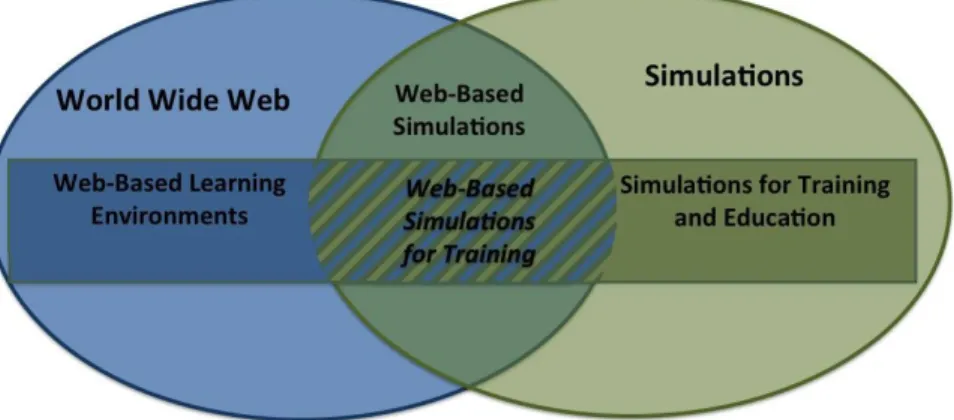
Figure 6. Venn diagram contextualizing WBS for training. ...31
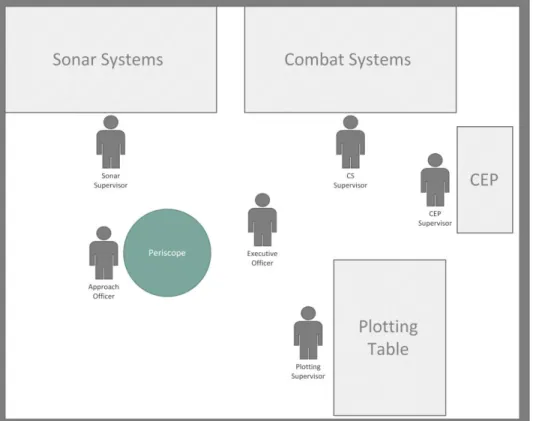
Figure 7. Positioning of the Section Tracking Party in the Control Room and at the Attack Trainer Simulator. ...45
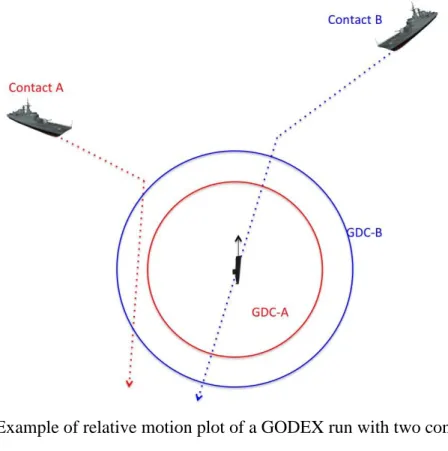
Figure 8. Example of relative motion plot of a GODEX run with two contacts. ...47
Figure 9. Hierarchical tasks tree diagram for the GODEX mission. ...50
Figure 10. Summarized procedural diagram for GODEX mission. ...51
Figure 11. Hierarchical diagram of sub-tasks’ tree for the ARL task. ...52
Figure 12. Cross browser support for WebGL as of August 2014 (from Deveria, 2014). ...67
Figure 13. The periscope screen display. ...71
Figure 14. Simulation of the image lagging of a periscope stadimeter. ...72
Figure 15. WEBS main menu...74
Figure 16. Routine of preload checks performed by WEBS. ...79
Figure 17. The main menu of the modified mission. ...80
Figure 18. Example of tutorial task. ...81
Figure 19. Feedback table presented at the end of ARL task. ...82
Figure 20. Summary of Likert scale mean values for the user experience with WEBS. ..86
Figure 21. Summary of Likert scale mean values for the user self-reported preparedness regarding simulator training. ...88
Figure 22. Summary of Likert scale mean values for the user’s propensity to adopt web-based trainings. ...90
LIST OF TABLES
Table 1. Example of ARL Interval calculation. ...16
Table 2. Example of relevant data perceived by the SO. ...19
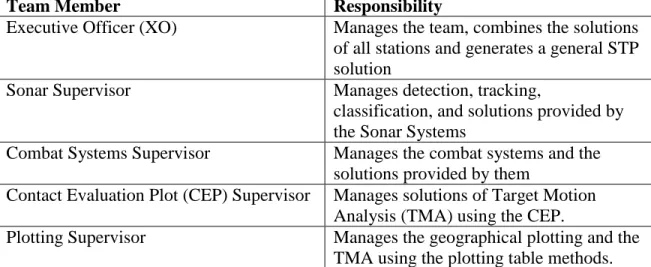
Table 3. Main responsibilities of the key members in the Section Tracking Party. ...44
Table 4. Detailed description of tasks. ...53
Table 5. Critical Cue Inventory for making a visual search. ...57
Table 6. Critical Cue Inventory for reporting results. ...57
Table 7. Measures of performance for the All Round Look Part-Task Training. ...59
Table 8. List of hardware with WebGL disabled by factory settings. ...68
Table 9. List of keyboard controls used in the ARL mission. ...75
LIST OF ACRONYMS AND ABBREVIATIONS
2D two-dimensional
3D three-dimensional
AO Approach Officer
ARL All Round Look
ASW anti-submarine warfare
AT Attack Trainer
BNSF Brazilian Navy Submarines Force
BNSS Brazilian Navy Submarine School
CBT computer-based training
CCI Critical Cue Inventory
CO Commanding Officer
CSS Cascading Style Sheets
GDC Go Deep Range
GIMP GNU Image Manipulation Program
GNU GPL GNU General Public License
GODEX Go-Deep Range Exercise
GPU Graphics Processing Unit
GUI Graphical User Interface
HTA Hierarchical Task Analysis
HTML Hypertext Markup Language
HVU Higher Value Unit
IRB Institutional Review Board
ITS Intelligent Tutoring System
JSON JavaScript Object Notation
KSA knowledge, skills and abilities
MOP measures of performance
NDM Naturalistic Decision-Making
NPS Naval Postgraduate School
OPORD Operation Order
PTT part-task training
RMC Rapid Mental Calculations
RPD Recognition-Primed Decision
SD safe depth
SMCC Submarine Command Course
SO Submarine Officer
SPA Submarine Patrol Area
STP Section Tracking Party
SW submarine warfare
TADMUS Tactical Decision-Making Under Stress
TMA Target Motion Analysis
VRBS virtual-reality-based Simulation
WBLE web-based learning environment
WBS web-based simulation
WEBS Web-based Periscope Simulator
ACKNOWLEDGMENTS
This thesis was the result of long 27 months of study and personal dedication, but I was not alone in this enterprise. I must express my gratefulness for my wife, Aline, who followed me closely on each step of this journey, always offering me the best support, and keeping everything else going like clockwork, so that I could afford to remain dedicated to only my studies. All my best projects bear her indelible mark.
I would also like to recognize the efforts of my mother, Nair, in offering me the best education possible. Without you, none of this would have happened.
All my efforts could be misdirected without the wise guidance of Amela and Chris, my advisors. Thank you, Amela, for all your time, dedication, patience, and valuable advice, even during your vacations. Thank you, Chris, for presenting me with otherwise hard subjects of modeling and simulation in such a didactic and passionate way. Now I am an enthusiast as well.
It is way easier to walk on an open trail, so I must thank Claudio Coreixas, for giving the example and leading the way, besides all support provided.
I would be remiss if I did not express my gratitude to the fellow submariners from the Brazilian Navy who were always ready to give me feedback and provide valuable data, especially LCDR Wladimir, LCDR Braslavsky, LT Freitas, LT Vieira, and CPO Emilson.
My acknowledgment also goes to the contemporary Brazilian students in NPS. Thanks to each and every one of you for all the support and exchange of information. Your friendship was the best thing you brought in your luggage. A special thanks to Daniel, Rogers, Paulo, Régis, Marcos Siu, Renato, and Marcus Takahashi.
At last, I must never forget that this priceless opportunity came through lines so tangled that it is impossible for me to fail to recognize the intervention of God.
I.
INTRODUCTION
A. RESEARCH PROBLEM AND MOTIVATION
The training of a submarine officer (SO) is a long, costly, and continuous process. Due to the complexity and danger involved in submarine operations, there is a set of basic knowledge, skills, and abilities (KSA) that must be developed by the officers to a minimum acceptable standard before they can be assigned to any role in the operational environment. Most of the topics that need to be learned by a trainee involve a proper utilization of the equipment and resources of the submarine. This fact would intuitively elect the submarine itself as the best learning tool. Indeed, in most navies, a considerable part of the training is performed aboard an actual submarine. However, there are some drawbacks that make it very difficult or even unfeasible to conduct courses relying on the use of actual equipment. Here are several factors that need to be considered before deciding on where and how to conduct that training:
Space: The space aboard a submarine is scarce, and generally it accommodates only the room necessary for the crew to live and work amid equipment, especially in conventional submarines. Generally, each individual, who is predominantly the trainee in a deployment condition, represents one fewer bunk, decreasing the comfort of the crew. Very often it is just not feasible to have an entire cohort aboard, forcing more than one submarine to be deployed as learning tool for the phases of practice at sea. Even if the training can be conducted with the submarine ashore, the lack of space can represent an inconvenience for both the trainees and the crew.
Stress of the equipment: The SO trainees must be prepared for the harshest possible situations; however, although the submarine equipment is made to eventually support extreme conditions of operation, using the same equipment repeatedly in those conditions for training purposes could reduce the life cycle of, cause costly damage to, and reduce the reliability of the equipment.
Costs: The costs involved in training conducted aboard will not be limited to those related to the equipment maintenance and eventual repair. Since the training requires the submarine to be at sea, considering the case in which the submarine is assigned only for training, the cost can grow sharply. That cost will involve the costs to maintain the whole crew, fuel, etc. These operational costs are multiplied to each unit at sea, and they
grow even larger when the exercise requires the presence of surface ships, aircrafts, and other submarine units, as is the case for periscope tactics training.
Danger: Underwater operations always represent high risks. Although the trainees generally are “shadowed” by experienced instructors, their instruction will often require the submarine to be put in dangerous situations where any flaw can be hard to control and reverse.
These drawbacks are considerably minimized if not completely removed by using simulators to teach the trainees before sending them to a final practical phase aboard the submarine. In Brazilian Navy Submarine School (BNSS), these simulators, called Attack Trainers (AT), are used to teach and train tactical maneuvers. They are built as full mock-ups of the submarine Command Room (henceforth referred to as “Control Room”), with the main sensors and equipment reproduced on a one-to-one scale. During the course of their career, Brazilian Navy SOs are submitted to at least three main courses in which they use those AT to build the KSA necessary to participate in a Submarine Command Course (SMCC): Basic Submarine Specialization Course, Preparation for the Duty of Periscope and Sound, and Submarine Operations for Officers. All these courses are developed in three different environments: classroom, AT, and aboard a submarine at the sea.
In the Basic Submarine Specialization Course, the students have their first contact with the subject of submarine safety and submarine operations, but the focus is mostly in theory. The newly graduated SO is not qualified for service in the Control Room as the Officer of the Deck (OOD). Although they have this first contact with theory, SOs do not practice in the tactical procedures, and have contact with the AT only as observers. The practical phase aboard is focused on the operation of equipment in preparation for the qualifying test.
In the next course, the Preparation for the Duty of Periscope and Sound, SOs are prepared to be qualified as OODs. This is generally the first opportunity in which they will use the AT. In this course the students need to apply the knowledge they obtained in the previous course. At the end of the course the students have a phase at sea, but with the
submarine operating alone; the focus is on the maintenance of safety, not in submarine warfare (SW) actions.
The third course, Submarine Operations for Officers, aims to expand the KSA acquired during the second course, focusing on tactical operations in SW. For the sea phase the trainees are required to plan, design, and execute SW operations in conditions similar to wartime scenarios. Besides the participation of a submarine, anti-submarine warfare (ASW) ships and aircrafts are mobilized for the sea phase in this course.
After those three courses, generally at the rank equivalent to Lieutenant-Commander (O4) or Lieutenant-Commander (O5), SOs are enrolled in an SMCC. Most officers do the SMCC at BNSS, and some are sent to complete this course in other allied navies. Different from the previous courses, the SMCC does not have the focus on teaching new topics. The classroom phase is treated as a refresher for the entire content learned during the whole career.
This series of courses and education is spread over nearly fifteen years of an SO’s career. Each course is a pre-requisite to the next one, but they can be separated by a time frame of several years. In the intervals between courses, each officer is responsible for keeping up the KSA previously acquired. Those assigned to the unit next to BNSS can ask for extra training at the AT; those training opportunities will be subject to the tight schedule of regular courses and maintenance. The officers serving in units far from the BNSS will have to find another way to prepare, but never with the help of a similar three-dimensional (3D) simulation.
Most of the KSA needed to match the exigency of the practical phases in the courses require lengthy practice, generally more than the timeframe allotted for the course itself. Despite the advantages brought by the use of simulators, they are not always available for those in need of training, for reasons such as schedule or geographic limitation. Even when simulators are available for extra training, extending the hours of their use could mean an increase of the costs of operation. A web-based learning environment (WBLE) would help minimize those drawbacks by offering an always-available tool for training, which users could adapt to their own schedule.
The criteria considered to appoint Commanding Officers (COs) of ships are similar in most navies. However, unlike on the surface ships, to be the CO of a submarine, an SO has to satisfy the common criteria and he also has to pass through the last test to compete for a command post: it is necessary to be approved in the SMCC. This last step involves a course that takes about three to four months, with small cohorts of up to six candidates. The exact format may vary from one navy to another, but it is very often a course with a high rate of failure. Due to those high rates of failure, the SMCC is commonly known as “The Perisher.” There is only one chance for the future submarine Commanding Officers to perform this course, thus it is the ultimate test in the officer’s career as a submariner. Failing SMCC means that the officer will never serve aboard the submarine.
All those characteristics can turn the SMCC into a daunting prospect for a long time; all prospective COs know they must be prepared when the time comes, for they will have only one chance. Although the theoretical knowledge and tactical skills are necessary to perform well in this course, the main objective of SMCC is not to teach those subjects, but to test if the candidates are able to keep acting as expected under a warlike situation, when they are pressed by time and the threats are presented to them. The tools to succeed in SMCC are built during the officer’s career, whether with other courses or with the daily hands-on practice while on duty at the sea. The courses generally have phases of traditional classroom lectures, simulator practice, and final tests at the sea. The simulator is where SOs have the first opportunity to connect the knowledge and skills from the various sources. Some set of KSA necessary to begin training at the simulator cannot be developed during class time—they rely on massive amounts of information that needs to be acquired through a self-study. While the theory is taught in the classroom, each student still must find additional time to memorize the techniques and practice the rapid mental calculations (RMC) that they will be required to perform in seconds at the simulator training session. Once the students arrive at the simulator, they are expected to have practiced those KSA to a minimum acceptable level of proficiency; otherwise, it will be very difficult, sometimes impossible, to execute the
A shared understanding among those who have participated in such courses is that the trainee who masters the basic skills is not guaranteed to perform well, but the one who fails to master them, generally has a very bad overall performance, or may even fail the courses. The causes for bad preparation vary. Some trainees arrive without proper preparation because their current assignment did not provide them with enough spare time to practice. Others begin the courses unprepared because they did not have the right guidance, or the method that they had created to practice was not efficient, even though they worked very hard. Perhaps an even worse case is the students who do not fail the course, but who learned concepts by heart without really understanding them. After some time, the long list of memorized rules, if those did not include critical thinking and deep analysis, will be more difficult to recall, and the officer will gradually return to lower levels of readiness. Being that the objective of this kind of training is to improve the efficiency of the manpower, such deterioration of level of readiness only guarantees that this objective will not be achieved.
Following the evolution and widespread use of personal computers and the Internet, the use of distance learning WBLE is expanding nowadays. They arose as good solutions for professionals with a tight work schedule who are unable to invest time in more traditional forms of education. Driven by these facts, this thesis suggests the use of web-based simulation as a tool to be offered to SOs, to fill this gap between classroom lectures and simulator, taking advantage of the possibility to deliver 3D simulations using the web browsers and web technology. The objective is to create an effective and efficient WBLE that will be used by the SOs to guide and optimize their preparation time. The WBLE will illustrate very similar conditions and scenarios the students will be exposed to in the simulator when they take the training. The benefit of this approach is to allow trainees to form a solid basis before they begin the courses. The expectation is that students, once they have practiced different procedures and scenarios in WBLE, will be able to take the best of their simulator training session and focus their efforts on the development of more advanced skills, such as situational awareness and decision making. The web-based simulation could also help those SOs serving abroad, or the SOs who spend long periods of time outside the submarine; both groups need to remind themselves
of the concepts and recall their skills in preparation for the return to the submarine or for enrollment in an SMCC.
B. RESEARCH QUESTIONS
The issues exposed in the previous sections led to the following research questions:
1. What are the advantages of using a web-based 3D simulation?
2. What are the main knowledge, skills, and abilities (KSA) necessary for the performance of the Approach Officer (AO) and his role in a submarine, which can be either developed or improved with the help of a tactical periscope simulator?
3. Which of those KSA could be improved with the help of a WBLE, without the direct help of an instructor and outside the classroom environment? 4. Do WebGL compatible web-browsers have the resources to fully support a
web-based 3D simulation?
5. What are the usability issues of a web-based 3D simulation (efficiency, effectiveness, and user satisfaction with the user interface)?
C. SCOPE
The thesis focuses on the training of periscope techniques using simulators; a goal is to identify the opportunities for delivering training using web-based periscope simulation. This type of training would represent a bridge between classroom teaching and training in the full-scale periscope simulators.
A prototype of a Web-based Periscope Simulation developed using open-source web-based technology is used to conduct a usability study and identify possible issues of this type of technology and training modality.
D. TECHNICAL APPROACH
To meet the proposed objectives, the following four-step approach has been adopted for this thesis work: literature review, task analysis, prototype development, and usability study.
In the first phase, a literature review will be conducted about the use of 3D simulations to teach SO and about the characteristics of web-based instruction. The objective is to gather knowledge available in literature about the benefits, issues, and limitations involved in the combination of 3D simulations, WBLE, and training, regarding the formation of SOs.
To expand and particularize the understanding of the task of the operator, a task analysis is conducted about the tasks and training sessions performed at the periscope simulator in BNSS. The main objective of the task analysis is to list the KSA needed for an SO to perform correctly at the periscope. In addition, task analysis is used to establish performance metrics and identify tasks suitable to be implemented and trained on in the WBLE. Most of the references needed to perform a thorough task analysis of the majority of the missions performed at the periscope are classified. In this thesis, only one mission has its task analysis reproduced, providing the level of detail that can be found in ostensive publications.
Based on the task analysis, the requirements for the WBLE prototype are defined. Observing the requirements defined in the previous phase, a prototype is developed to implement those tasks in a web-based environment. The main technology used for development is WebGL, an open-source JavaScript API, that allows rendering 3D graphics within Internet browsers, without the need for any plug-in or installation in the user’s computer.
In the last phase, the usability of the prototype is tested; test subjects were able to access a version of the prototype published on a website and complete a survey about their experience. The usability study aims to assess the usability of the human-computer interface built, identifying the points of strength and weaknesses, collect insight about the
feasibility of the technology for wide distribution, and gather the subjective opinion of the average Internet user about this modality of training.
E. THESIS CONTRIBUTIONS
The main contribution of this thesis is a series of understandings related to a possible application of the web-based 3D simulations in military training. The data about the viability and utility of a 3D web-based simulation for training was gathered and analyzed for more detailed insights. The results of the survey provided insights about the user’s online habits and their acceptance of web-based training.
The study also collected and organized a set of understandings about the cognitive processes and the mindset of AOs during SW operations, particularly for the operation of diesel-electric submarines on periscope depth (PD)—a depth in which it is possible for a submerged submarine to raise the periscope mast over the sea surface.
The WebGL software standard used to develop the prototype training simulation, allows 3D rendering in the web-browser without the need for any software installation. However, the WebGL standard is currently not completely supported on all hardware and software platforms available on the market. The data and knowledge we collected about this standard and the results of our usability study allowed us to highlight the advantages and limitations of this technology, and to give the insights about the feasibility of a wide distribution of simulations that would use this technology.
F. THESIS STRUCTURE
This thesis is organized as follows:
Chapter I states the problem addressed, presents the motivation for the study, names the objectives of this thesis, and describes the methodology adopted to approach the problem and reach the objectives stated.
Chapter II provides the background information necessary to better understand the problem stated. The peculiarities and difficulties of SW within the scope of this thesis are explained in more detail, discussing the cognitive aspects and mental models for decision
Chapter III consists of a literature review divided in two parts. The first part presents the results of a review about the use of 3D simulations for submarine training, discussing the suitability and efficiency of those simulations as training tools. In the second part, an analysis is made about the characteristics of WBLE regarding the advantages, disadvantages, and peculiar pedagogical aspects of it.
Chapter IV describes the missions performed at BNSS AT, and presents the task analysis conducted in one main mission to identify the tasks that would be suitable for implementation in a WBLE. The learning objectives and measures of performance (MOP) are then identified for these tasks to finally list the requirements for designing the WBLE.
Chapter V outlines how the Web-based Periscope Simulator (WEBS) was designed and prototyped.
Chapter VI discusses the design, execution, and results of a usability study to test the WEBS prototype.
II.
BACKGROUND
The Web-Based Periscope Simulation (WEBS) focuses on the training of SOs for techniques to be used at PD; this chapter briefly introduces some concepts behind these techniques. A basic comprehension of some periscope techniques will be indispensable to analyze the missions executed at PD, and this chapter will also help readers understand the cognitive processes related to the scope of this thesis.
A. THE PERISCOPE TECHNIQUES
The techniques used for operation of the periscope were developed as a trade-off: the goal was to maximize information acquisition with the least possible submarine indiscretion. Some of these techniques began to be developed as early as World War I, when most submarine attacks were performed within the visual range, in a very close approach to surface ships. Modern submarine weapons and sensors have ranges beyond the horizon, making it very unlikely that a submarine will get as close to surface vessels (contacts) as was typically the case until World War II. However, the skills necessary to maneuver a submarine safely in the presence of several surface contacts, using only stopwatches and mental agility, remain valuable for the training of a submarine CO (White, 1993). Some periscope techniques are still applicable nowadays, either because they are still useful in the modern SW scenario, or because they help to instill in the SO the mentality of safety and self-confidence. Furthermore, they are also valuable to teach mental models. Even though nuclear submarines have a different employment doctrine, the experience with courses like the SMCC, where those techniques are covered, represent an opportunity to observe the inside of diesel-electric submarines and understand the mindset of a conventional submarine CO (Steketee, 2004).
The periscope is the only sensor capable of providing a complete set of data about the tactical situation around the submarine in a matter of a few seconds. However, as an optical sensor, it has all limitations naturally imposed by the light spectrum. The range of a periscope is geometrically limited at sea due to the Earth’s curvature, and it is susceptible to atmospheric conditions influencing visibility. Besides, at PD the submarine
is made more vulnerable to counter-detection by ASW surface and air units. However, despite those disadvantages, periscopes continue to be of paramount importance to ensure the safety to the dived submarine, and to collect or confirm tactical information.
Due to the inherent margin of errors and uncertainty of other passive sensors, the periscope is the only sensor able to resolve with conviction the potentially questionable data sets acquired by other sensors. The operator is able to collect reliable information about the surrounding tactical situation in a matter of seconds, calculate the geographical position of the submarine and reveal the identity of targets. The information collected by a periscope usually can be used right away, because they are useful without the need of further processing (other than human interpretation).
1. Safe Depth
The concept of safe depth (SD) is a theoretical base that drives most of the other safety calculations for a submarine at PD. It is the depth at which the submarine can transit within a safe distance from the keel to the sea bottom while still allowing ships to safely pass over the fin (see Figure 1). The Standardization Agency for North Atlantic Treaty Organization (NATO) defines SD in a following way:
A submarine is said to be at Safe Depth when its keel depth is such as to provide the required separation between the top of the fixed structure of the submarine and the lowest point of any ship, other submarine assigned to a higher layer, towed ASW device and/or helicopter sonar systems allowed in the orders for the exercise. When more than one towed device is being used in the exercise, Safe Depth applies to the deepest device being employed. (North Atlantic Treaty Organization [NATO], 2002)
Figure 1. Safe depth calculations (from North Atlantic Treaty Organization, 2002, pp. 2–13).
Thus, the SD will depend on the types of ships expected to be navigating on a given Submarine Patrol Area (SPA) to which the submarine was assigned or in part of a transit route.
2. “Go Deep Circle”
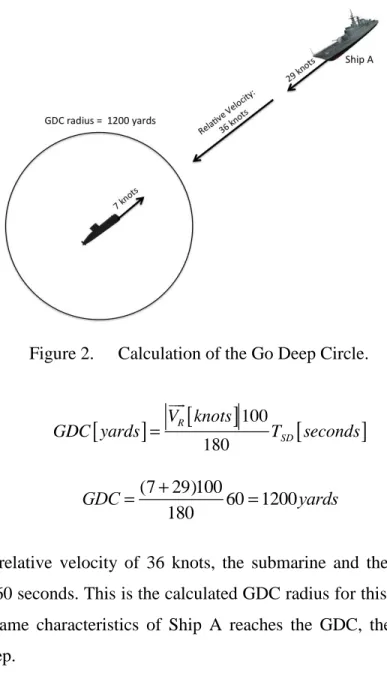
For a given SD calculated, each submarine class will need a certain amount of time to go deep according to its rate of descent (movement from PD to SD). The Go Deep Circle (GDC) is a locus of the distances measured from the submarine. It represents the distance that can be covered by a surface ship while the submarine is diving from PD to SD. In Figure 2 there is an example of a GDC calculation.
In periscope drills conducted for the safety phase of courses, the trainees are required to do RMC to figure out the GDC of new contacts. Aiming to exemplify the cognitive load imposed on the mind of the AO by RMC, the calculations for the situation in Figure 2 will be detailed: the submarine in this example takes a time TSD equal to 60
seconds to go deep, travels with a speed of seven knots, and is observing the Ship A, which develops a maximum speed of 29 knots. GDC calculation always considers the worst-case situation to build a buffer of safety. For the given example, the submarine and the Ship A are on the same line, moving toward each other. The relative velocity of approach is the vector sum of the Ship A and submarine velocities.
Figure 2. Calculation of the Go Deep Circle.
(1)
(2)
With a relative velocity of 36 knots, the submarine and the ship will approach 1,200 yards in 60 seconds. This is the calculated GDC radius for this class of ship. If any ship with the same characteristics of Ship A reaches the GDC, the submarine will be forced to go deep.
While this calculation renders more safety, it extends the worst-case to the whole
GDC= (7+29)100
decrease the GDC by sectors, aiming to confer more flexibility to the submarine, while still keeping it safe. The mathematical fundament to reduce the GDC by sectors is exemplified in Figure 3. However, the exact way it is applied can be different in each navy, and is generally based on classified publications.
Figure 3. GDC reduction by sectors.
In this example, in order to create a reduced GDC sector, the submarine velocity vector was projected 45 degrees to each side, and this value was extended to the rear sector, as shown in Equation (4) Ship B has a maximum speed of 25 knots.
(3)
(4)
3. “All Round Look” Interval
The All Round Look (ARL) is a basic periscope technique. It consists of turning the periscope all the way around to quickly obtain situation awareness about the environment above the sea surface. The periscope mast is raised to execute the technique
and lowered just after completing it. The whole movement must be executed as fast as possible to minimize the exposure of the periscope mast, but slow enough to make sure that all visible contacts between the submarine and the horizon will be detected.
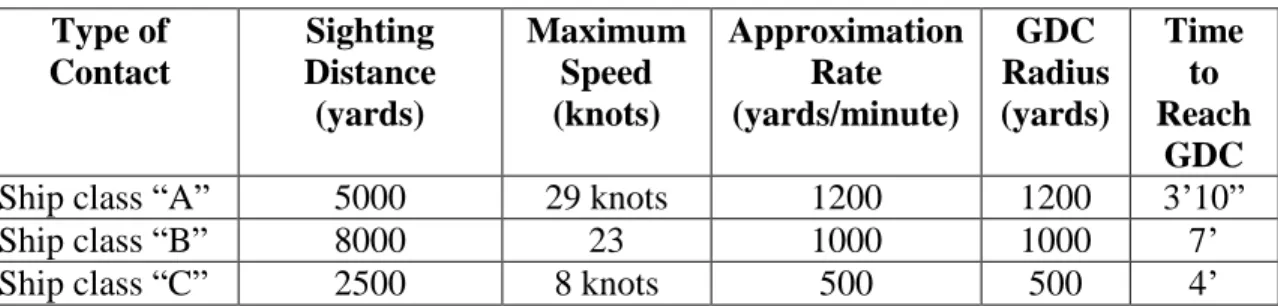
To calculate the acceptable time interval between two ARL’s, the worst-case is considered: a new contact appears just after the periscope looks toward its direction. This contact is not detected and approaches the submarine with its maximum speed on the closest approach distance. The time it takes for this contact to reach the GDC perimeter must be greater than the maximum interval between two consecutive ARLs, in order to ensure that it will be seen before reaching the GDC.
If more than one type of contact is expected for a given SPA, the smallest interval will be assumed (shown in Table 1). For the simplicity the example one can consider the submarine traveling at seven knots and having the same SD for the three different classes of ships, taking exactly one minute to go deep. Therefore, for the example in Table 1, the ARL interval to be considered is three minutes and ten seconds.
Table 1. Example of ARL Interval calculation. Type of Contact Sighting Distance (yards) Maximum Speed (knots) Approximation Rate (yards/minute) GDC Radius (yards) Time to Reach GDC
Ship class “A” 5000 29 knots 1200 1200 3’10”
Ship class “B” 8000 23 1000 1000 7’
Ship class “C” 2500 8 knots 500 500 4’
4. “Look” Intervals
After a new contact is detected, periscope observations can obtain further data, such as the classification, distance, speed, and course of that contact. Knowing the exact distance of the contact and a point in time, it is possible to calculate how much time this contact would take to reach the GDC and jeopardize the submarine using the same reasoning as ARL intervals. This calculated amount of time is known as look interval
observation this LI will be updated accordingly. One of the abilities required from trainees in some submarine courses is to be able to mentally calculate and control several LIs and the ARL interval at the same time, using separate stopwatches (White, 1993).
B. COGNITIVE ASPECTS IN PERISCOPE-DEPTH OPERATIONS
This section analyzes the main aspects of AO cognition during the approach phase; different cognitive theories will be leveraged to provide this understanding. A full comprehension of the cognitive processes that occur while the AO is addressing an operational situation is needed to understand the benefits that WBLE adds to an individual’s training.
An act of planning the approach of the submarine towards an objective represents a strenuous cognitive workload for the AO. This is especially the case when the approach has to be made on PD and in shallow waters. The AO is pressed by time and a sense of jeopardy. The decisions must be made relying on information with a high level of uncertainty aggregated. The situation can change dynamically, yet the decisions must be taken upfront, betting on predictions of future situations. The objective of this section is to analyze the existing theories about the cognitive processes of an AO in this environment and its specific conditions.
1. Naturalistic Decision Making
The characteristics of the situations in which the AO has to make decisions are: time constraints, high uncertainty, high risk, a complex and dynamically changing environment, ill-defined and competing goals and sub-goals. All of this makes the domain related to the naturalistic decision-making (NDM) theory (Kirschenbaum, 2001). In the classic decision-making model, it is assumed that the decision maker generates a list of courses of actions and then chooses the best solution in the list of possible solutions. While doing that, the decision maker is conducting a thorough analysis of all available information and considering all hypotheses under the cost-benefit criterion. This framework of decision making turns out to be unrealistic for emergent situations and harsh environments (Hutchins, 1996). On the other hand, NDM theory rests on the belief
that the decision maker passes through a more naturalistic process of perception, comprehension of the situation, and generation of appropriate responses (Klein, 2008).
Amid the NDM theories, perhaps the best known and best fit for the submarine problem, is the recognition-primed decision (RPD). The RPD theory relies on two key concepts: situation assessment and mental simulation (Klein, 1993). In RPD, the decision maker assesses the situation to identify a satisfactory course of action, and then evaluates the option through mental simulation, rather than making cost-benefit comparisons on all available options (Klein, 1993). In situation assessment, when presented with a new problem that needs to be solved, people use their previous experience with similar past situations, recognize patterns and match with the features of the current problem. They automatically recall and adapt information learned from the previous known situation to help solve the current problem. When they are faced with a new problem for which they have no similar experiences in the past, they will consciously use mental simulation to understand the problem and create viable solutions (Shattuck & Miller, 2006).
Analyzing the decision-making process of a submarine approaching, Kirschenbaum (2001) found that the AO “uses his expertise to recognize and instantiate appropriate schema. He uses this schema as the basis for action in an interactive feedback loop” (p. 203). This feedback loop is based on two mechanisms: (1) common information-gathering strategies and (2) shallow goal stack that allows the AO to rapidly adapt to changes on the situation (Kirschenbaum, 2001).
2. Situation Awareness
Situation Awareness (SA) in the scope of SW can be defined as the understanding that an AO has about the current tactical situation and the possible developments or consequences in a close future. In other words, in order to support the process of decision making, the AO builds a mental model in his or her mind. Endsley (1995) proposes the division of the SA process into three major hierarchical phases:
1. Perception of pertinent data in a time and space frame 2. Comprehension of the perceived data
3. Projection of a near future situation
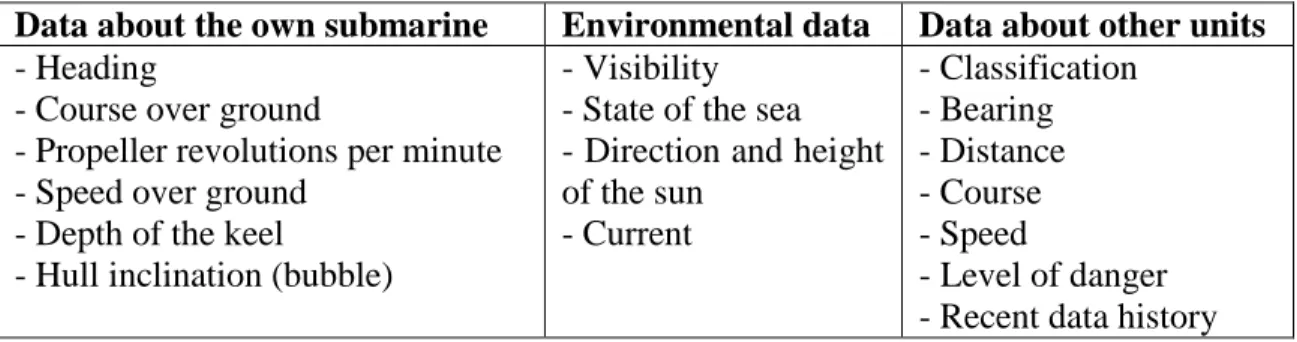
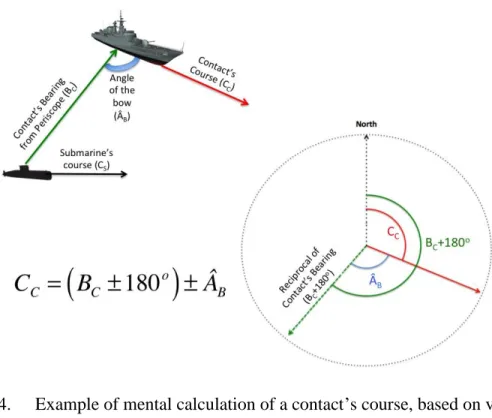
In the context of PD operations, the first phase represents the collection of data relevant to the situation by the SO. These data are about the own submarine, the environment, and the other units detected. Table 2 lists some of the most common data collected by the AO in PD operations. As noted by Kirschenbaum (2001), most traditional models consider that all the necessary data will be available in this phase to support the individual in building his or her SA. However, in the domain of SW, each iteration of data collection is likely to render only a subset of the necessary data, forcing the AO to rely on estimations and suppositions to complete the necessary operation. Even the data successfully obtained can be misleading due to the large amount of noise added by environmental sources, a common occurrence for information from the sonar. Furthermore, most data about other units cannot be used in the raw form of collection. To become useful, some data need additional mental or computational processing. For example, to obtain the course of a surface ship using the periscope, the AO collects and inverts the ship’s bearing, visually estimates its angle on the bow (AOB), and mentally calculates the course as the sum or subtraction of these two values, as shown in Figure 4.
Table 2. Example of relevant data perceived by the SO.
Data about the own submarine Environmental data Data about other units
- Heading
- Course over ground
- Propeller revolutions per minute - Speed over ground
- Depth of the keel
- Hull inclination (bubble)
- Visibility - State of the sea - Direction and height of the sun - Current - Classification - Bearing - Distance - Course - Speed - Level of danger - Recent data history
The second phase consists of building a mental model of the current situation; the loose elements collected previously are put together and combined according to existing patterns learned by the AO. The pieces of information that have been obtained are
combined to gain a full meaning, converging to an interpretation of what is possibly happening. Unlike some other domains, a domain of SW is characterized by the existence of a high degree of uncertainty. Even the decisions to manoeuver the submarine may affect the accuracy of data, increasing or decreasing the level of uncertainty (McKenna & Little, 2000). The lack of data and the errors introduced by estimations and noise, force the AO to frequently build a mental model of the situation consisting of a best guess rather than a complete and clear comprehension of data. It is similar to the assembling of a jigsaw puzzle with missing pieces. In spite of the uncertainty, experienced AOs use their mental models to confirm or disregard the solutions from the computer and the data calculated by the Submarine Tracking Party (STP) (Kirschenbaum, Trafton, Schunn & Trickett, 2013).
Figure 4. Example of mental calculation of a contact’s course, based on visual estimation of the angle on the bow.
The AO derives the projection of the future status using his understanding of the current tactical situation. This is the highest level of SA to be achieved (Endsley, 1995, p. 37). The projection into the future situation is especially important for conventional diesel-electric submarines. Due to the speed disadvantage when compared to most surface vessels, diesel-electric submarines must make decisions and act in advance, betting on a prediction. This level of SA must be achieved in a timely manner if the goal is to make correct decisions and to position the submarine favorably for the upcoming action. Any delay or miscalculation can cause the mission to go irrecoverably wrong. Particularly complex in this domain is the fact that the situation is dynamically changing. Noise and dynamic changes in attitude are deliberately introduced by the surface units, as they try to deceive the submarine solutions (Ehret, Benjamin, Gray & Kirschenbaum, 1997).
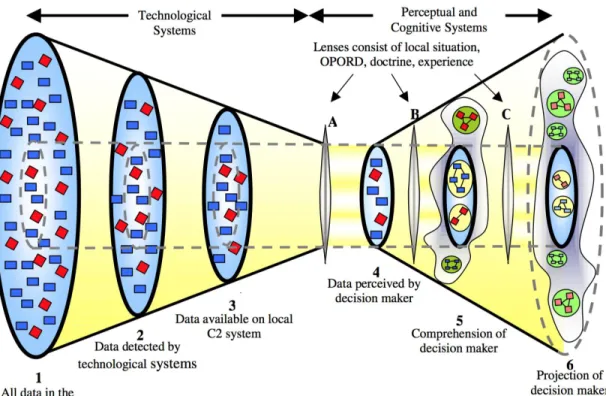
The human perception is intertwined with the system sensing of the environment throughout the process of SA building; the AO uses information processed both by humans (the own AO and the SAP) and by machines. A good model for cognitive processes like this was proposed by Shattuck and Miller (2004), as illustrated in Figure 5. In this figure, we can see how the whole set of data from the environment arrives to the AO already sieved by the sensory capacity of the system (represented by oval 2), which limits detection, and by the selective displaying of detected information (oval 3), as some information may be misjudged or considered irrelevant by the system or by the human operator.
Figure 5. A Dynamic Model of Situated Cognition (from Shattuck & Miller, 2004, p. 660).
Once the information reaches the AO, it will be subjected to what the model names “lenses.” Those lenses are, in this context, the local situation, Operational Order (OPORD), doctrine and experience. The local situation will lead the AO to pay more or less attention to a determined set of information; this set is judged to be more important or urgent to the current situation. The OPORD represents the superior orders, the mission assigned to the submarine, and the doctrine is a general set of guidelines within which the AO was taught to act. Finally, the experience recalls past activities that the AO may have practiced before that bear similarities to the current situation (Shattuck & Miller, 2004).
3. The Influence of Stress
Stress is a constant factor accompanying submarine operations, and it is essential to understand how stressful situations can influence the cognitive process. There are many sources of stress for the AO: the characteristics of the submarine with all the risks
decisions that may have harsh consequences, a constant uncertainty of information, a time pressure, a need to execute several parallel tasks, etc. The conditions faced by the AO match those listed for the Tactical Decision-Making Under Stress (TADMUS) project, conducted by the United States Navy (Cannon-Bowers, Salas & Grossman, 1992):
Multiple information sources: The AO must manage the information that he or she collects from the periscope, the information available from the other sensors and the information generated by the STP.
Incomplete, conflicting information: Different stations of the STP frequently diverge about the solutions found.
Rapidly changing, evolving scenarios: The opposing forces purposely insert dynamic changes to their behavior, to difficult the action of the submarine.
Requirement for team coordination: The AO is the conductor of the STP.
Adverse physical conditions: An approach on PD can be very physically demanding, as the AO must successively raise and lower the periscope.
Performance pressure: The AO is the capital decision maker, and the responsibility for the success or failure of the mission is on his shoulders.
Time pressure: An AO is under time pressure during all the execution of an approach.
High work/information load: Besides being responsible for the processing of a high load of information and decision-making, the AO still has to care about the safety of the submarine and the aspects concerning the management and leadership of the crew.
Auditory overload/interference: Most of the information is received verbally by the AO.
Threat of hostile engagement: Both for real operations and for exercises, where the surface units play figurative enemies.
One’s concentration and selective attention can be severely compromised under high stress, impairing the individual’s performance and significantly affecting the ability to perform decision making (Entin & Serfaty, 1990). Courses like the SMCC are designed to push the trainees up to the edge, forcing them to face their own limitations, and helping them to improve their decision-making ability under pressure (Forster, 1996). One of the approaches for the training of decision making under stress is part-task training (PTT). PTT consists of decomposing a more complex task into components that can be separately trained (Wightman & Lintern, 1985). Kirlik, Fisk, Walker and Rothrock (1998) list some lessons learned from their research about the use of PTT to train dynamic decision making:
To train high-level cognitive skills and decision-making, ensure that the individuals have mastered the perceptual and motor skills that they will need in order to interact with the environment.
A good approach to train these basic perceptual and motor skills is PTT.
The components of an overall complex task when identified and trained to the level of automaticity help to alleviate high-workload situations.
The automation of components of a task turns its performance more reliable despite of the insertion of stress into the situation.
PTT must be supplemented with the training of the full-task.
However, Klein (1996) draws attention to the fact that stressors can either disrupt or improve performance. He highlights that the natural adaptations to stress should not be suppressed, since these adaptations frequently focus the human effort on the selection of simpler and more robust decision strategies. Instead, training should focus on preparing decision makers to handle the pressure imposed by external factors, such as time constraints.
C. CHAPTER SUMMARY
This chapter presented the main background information to help understand the cognitive processes and mental models developed by AOs in PD operations. Some technical concepts were detailed to stress the mental calculations used in periscope techniques, and give a dimension of the cognitive load to which trainees are submitted during periscope drills. Next, the cognitive processes of PD operations were analyzed under the light of existing cognitive theories, explaining how it is suitable to NDM theories, the SA building process, and the influence of stress on cognition, highlighting the use of PTT as an approach to facilitate the execution of complex tasks in stressful environments.
III.
LITERATURE REVIEW
A. INTRODUCTION
The literature review performed in this chapter is divided into two parts: (1) an examination of established literature about the general aspects of simulations for training, giving emphasis to its application specifically for SO training, and (2) review of the characteristics, benefits, and caveats of the WBLE. The aim of this literature review is to answer the first research question: what are the advantages of using a web-based 3D simulation?
B. THE USE OF SIMULATIONS FOR SUBMARINE OFFICER
TRAINING
The definition of a simulation, according to the United States Department of Defense is: “a method for implementing a model over time” (Department of Defense, 1994). Inside this definition, simulations can assume diverse formats and be used for several different objectives. Respecting the boundaries of the scope of this thesis, the literature review will be focused on computer-based 3D simulations used for training, especially when applying self-paced learning approaches, discussing their general characteristics, advantages, and disadvantages.
1. Simulations for Training
Among the computer-based simulations used for training, we are particularly interested in those that use virtual reality technology. Virtual reality, often called ‘virtual environments,’ is an interface paradigm using computers and human-computer interfaces to create the effect of an interactive 3D world (Bryson, 1996). Brooks (1994) cites four components of virtual reality:
Real immersion – world is life size.
Real time – viewpoint changes as eyes move.
Real space – concrete or abstract 3D worlds
Virtual reality based simulations (VRBS) have been successfully used for training in several domains, such as aircraft pilot SA, space telepresence for astronauts, and the training of future submariners (Stone, 2002). Facilities with computer-based simulations working with full-scale replicas of equipment have been used for all sorts of complex skills training, from vehicle operation to infantry training. These simulations are especially useful for military applications (Salas & Cannon-Bowers, 2001).
As training tools, simulations are able to offer advantages when compared to traditional classroom teaching, since they can be built to put the trainee in situations and conditions very similar to those one would face in the real world (Chung, 2003). Evidence has been found that simulations are effective for teaching complex skills, and that, in training with simulations, there is effective transfer of skills (Salas & Cannon-Bowers, 2001), as in the work cited from Gopher, Well, and Bareket (1994), in which the skills were transferred from a computer game-based simulation to real flight. One of the reasons why simulations are found more valuable in contrast with other training delivery methods is that in simulations the trainee can experience the actual performance of a job and its immediate response (Kindley, 2002) while not being exposed to the real risks or costs of the real situation (Becker & Parker, 2009).
Some of the benefits of training simulations, as cited in literature, that can be directly applicable to the training of periscope tasks are:
Cost savings: The costs to deploy a submarine involve high numbers, considering the maintenance of equipment, personnel, and the deployment of surface and air units to support exercises (Orlansky, Dahlman, Hammon, Metzko, Taylor, & Youngblut, 1994; Thompson, Carroll, & Deaton, 2009).
Replication of a large collection of standardized scenarios in a controlled situation: Trainees can be presented with a large range of different scenarios of the real world beyond those presented in the curriculum. This is especially interesting to present the trainees with situations that would represent high risk for human lives or equipment if performed in real situations (Thompson et al., 2009).
Time savings: Simulations can compress the time of lengthy operations, helping the trainee to make the link between the action and consequence.
the exercise to another can take a long and unfruitful time that can be compressed with the use of simulations (Chung, 2003).
Creation of a blame-free environment in which to make mistakes: Mistakes made by the learner, when in a safe and blame-free environment, can be a powerful learning mechanism (Hills, 2003). In exercises performed at sea with the real equipment, the trainees tend to be more limited in their actions due to their fear of real mistakes and their consequences.
However, despite of all those advantages, it is important to keep in sight that simulations are nothing but a tool (Salas & Burke, 2002). The simple use of a simulation for training is not a guarantee of improved learning (Salas & Cannon-Bowers, 2001) (Salas & Cannon-Bowers, 2001). Moreover, the advances in fidelity and resolution do not necessarily carry the same improvement in training quality. In short, the simulations share the same design issues and risks of negative training as any other training tool (Salas, Bowers, & Rhodenizer, 1998).
2. Simulations Applied to Submarine Officer Training
These characteristics of simulations intuitively suggest the use of simulations for submarine training. Simulations have already been a part of submarine training for a long time; they have been combined with years of learning in the classroom and experiences at sea (Kirschenbaum, 1989). The application of VRBS in submarine training facilitates the building of complex mental models necessary for the effective use of periscope techniques before the trainees encounter large simulators with the mock-up instrumentation. In spite of possible technology limitations, such as visual fidelity and auditory realism, the benefits added by the use of simulations outweigh the negative aspects encountered in those systems (Vincenzi, Hays, & Seamon, 2003).
Indeed, computer-based simulations have been widely used for several submarine trainings, both at the individual and team levels (Jones, 2008). For the objectives of this thesis, particularly interesting are the applications of simulations designed for training using personal computers. Those simulations are generally cost effective and focused on PTT, rather than the training of a full and complex mission involving the convergence of various KSA. Some examples of these smaller simulations found in literature include:
Submarine Ship Control Training Program: A cost-effective simulation implemented on personal computers for self-paced learning of the principles of submarine ship handling (Biegel, Brown, Mason, & Poland, 1998).
Bottom Gun: A game-based application developed to train visual estimations of the AOB and the distance of surface contacts using a periscope simulation (Garris & Ahlers, 2001).
Web-based Maritime Training Environment: The paper describes the development of a web-based simulation (WBS) modeled and developed to get around the high costs and low availability of full-scale maritime simulators (Cui, Yicheng, Xiuwen, & Yong, 2004).
Submarine Onboard Training (SOBT): Among a list of simulations used for submarine crew’s training cited, the work elaborates how a course originally designed for four weeks of classroom and laboratory training, was reduced to a one-week laboratory course. In that example a classroom portion of the training was replaced by a self-paced training onboard. The training was a part of the SOBT program (Jones, 2008).
Adaptive Training System for Submarine Periscope Operations: The researchers evaluated the effectiveness of a periscope simulation in association with an adaptive training system used for training of basic periscope skills (Landsberg, Mercado, Van Buskirk, Lineberry, & Steinhauser, 2012).
A remarkable feature of those simulations was the application of self-paced learning. In a field experiment with novice computer users, Simon and Werner (1996) found that self-paced learning rendered higher cognitive learning and skill demonstration than the lecturing approach.
C. USES OF WEB-BASED SIMULATION AND WEB-BASED
LEARNING ENVIRONMENTS
This section presents information from the literature about the use of WBS for training. The evolution of WBS is briefly discussed, citing the evolution of the tools that currently enable its implementation on web browsers. Advantages and disadvantages of WBLE are discussed, stressing the main human factors to be considered in WBLE. Since the aspects related specifically to simulations were discussed in the previous section, this