Glasgow Theses Service http://theses.gla.ac.uk/
Al-Shuaily, Huda (2013) SQL pattern design, development & evaluation
of its efficacy. PhD thesis, University of Glasgow.
http://theses.gla.ac.uk/4632
Copyright and moral rights for this thesis are retained by the author
A copy can be downloaded for personal non-commercial research or
study, without prior permission or charge
This thesis cannot be reproduced or quoted extensively from without first
obtaining permission in writing from the Author
The content must not be changed in any way or sold commercially in any
format or medium without the formal permission of the Author
When referring to this work, full bibliographic details including the
author, title, awarding institution and date of the thesis must be given
1
SQL Pattern Design, Development &
Evaluation of its Efficacy
Huda Al-Shuaily
Submitted in fulfilment of the requirements for the Degree
of Doctor of Philosophy
School of Computing Science
College of Science and Engineering
University of Glasgow
September 2013
2
Declaration
I declare that this thesis was composed by myself and that the work contained therein is my own, except where explicitly stated otherwise in the text.
3
Abstract
Databases provide the foundation of most software systems. This means that system developers will inevitably need to write code to query these databases. The de facto language for querying is SQL and this, consequently, is the language primarily taught by higher education institutions. There is some evidence that learners find it hard to master SQL.
These issues and concerns were confirmed by reviewing the literature and establishing the scope and context. The literature review allowed extraction of the common issues in impacting SQL acquisition. The identified issues were confirmed and justified by empirical evidence as reported here. A model of SQL learning was derived. This framework or model involves SQL learning taxonomy, a model of SQL problem solving and incorporates cross-cutting factors.
The framework is used as map to the design of a proposed instructional design. The design employed pattern concepts and the related research to structure SQL knowledge as SQL patterns. Also presented are details on how SQL patterns could be organized and presented. A strong theoretical background (checklist, component-level design) was employed to organize, present and facilitated SQL pattern collection.
The evaluation of the SQL patterns yielded new insight such as novice problem solving strategies and the types of errors students made in attempting to solve SQL problems.
SQL patterns, as proposed as a result of this research, yielded statistically significant important in novice performance in writing SQL queries.
A longitudinal field study with a large number of learners in a flexible
4
Acknowledgements
All thanks and praises go to Allah, the Almighty and the Merciful, for granting me the wisdom and the health to complete this work. I bear witness that there is no true guidance but the guidance from Allah. Alhamdulillah.
I would like to acknowledge the help and the supervision provided to me by Dr. Karen Renaud. Her direct involvement and encouragement throughout the study influenced the positive progress and made me a stronger and better researcher.
I would like to thank all those who have shared their knowledge and provide me with a constructive feedback at some stage of this research. Professor Ray Welland, Dr. Richard Cooper, and Dr. Quintin Cutts.
I would like to thank my sisters who took care of my children while I was diving in this research. Samyia, Tahani , Asma, Fatma, and Thuriay. It is a long journey and I am grateful to have had a supportive family.
To the Ministry of Manpower, I would like to express my gratitude for my scholarship, without this PHD would have been possible.
5
Dedication
To my mother and father for their sincere prayers and patience;
To my best friend, my husband khalfan for his continuous love and
support;
To my future, my heart, my lovely children: Osama, Reenad,
Qusay and Sama for the life they bring to our life.
6
Table of Contents
Abstract ... 3
1. Chapter 1: Introduction ... 21
1.2 Applying patterns to enhance SQL learnability ... 22
1.3 Thesis Statement ... 23
1.3.1 Objective 1: Identifying impediment that imped SQL novice Learning Performance ... 24
1.3.2 Objective 2: SQL Patterns Design and Development ... 26
1.3.3 Objective 3: The impact of SQL Patterns on Learner’s Performance 27 1.4 Research Contribution ... 28
1.4.1 A model of SQL Learning ... 28
1.4.2 Set of efficacious patterns ... 28
1.5 Dissertation Structure... 29
2. Chapter 2: SQL Learnability ... 32
2.1 Introduction ... 32
2.2 How Students Learn: A Learning Taxonomy ... 34
2.2.1 Computer Science Learning Taxonomy ... 36
2.2.2 Learning Taxonomy in SQL Teaching and Learning ... 38
2.3 How Students Learn: A Cognitive Theory in Learning SQL ... 42
2.3.1 Overview of Cognitive Model of Instruction ... 42
2.3.2 Cognitive Models in Learning SQL ... 42
2.3.3 Summary ... 48
2.4 SQL Instructional Materials Review ... 49
2.4.1 SQL Teaching Texts ... 51
2.4.2 SQL Teaching Tools ... 57
2.4.3 Summary ... 63
2.5 SQL Content Review ... 64
2.5.1 Comparison between SQL and other Query Language ... 66
2.5.2 Comparison between SQL and Natural Language ... 71
2.5.3 Augmented Use of One Query Language and Database Structure ... 75
7
2.6 Instructional Theory Review ... 79
2.6.1 General Principles of Instructional Design ... 80
2.6.2 Theory and Research Related to Computer Science Learning ... 83
2.7 Chapter Summary ... 85
3. Chapter 3: A Review of the Literature on Patterns’ Design, Organization and Usability ... 89
3.1 Introduction ... 89
3.2 Patterns Definition ... 90
3.3 Patterns History ... 92
3.3.1 Patterns in Architecture Design ... 92
3.3.2 Patterns in Software Engineering ... 93
3.3.3 Patterns in HCI ... 94
3.3.4 Patterns in Education ... 94
3.3.5 Anti-patterns ... 95
3.4 Patterns Structure and Format ... 96
3.4.1 Alexander’s Patterns Structure “Alexandrian form” ... 97
3.4.2 Software Engineering Patterns Structure ... 99
3.4.3 Human Computer Interaction (HCI) Patterns Structure ... 99
3.4.4 Pedagogical Patterns Structure ... 101
3.4.5 Summary ... 102
3.5 Patterns Collection and Organization ... 104
3.5.1 Patterns Collection in Architecture ... 104
3.5.2 Patterns Collection in Software ... 105
3.5.3 Patterns Collection in HCI ... 105
3.5.4 Patterns Collection in Education ... 108
3.5.5 Summary ... 109
3.6 Patterns Usability ... 110
3.7 Patterns Efficacy in Education ... 111
3.7.1 The Review Design... 112
3.7.2 Past Experimental Work ... 115
3.7.3 Review Summary ... 125
3.8 Patterns and the Cognitive Load Theory ... 127
8
4. Chapter 4: Research Methodology and Approach ... 131
4.1 Introduction ... 131
4.2 Research Setting ... 132
4.3 Research Strategy ... 133
4.4 Research Design... 134
4.4.1 Identify SQL impediments that get in the way of Learning Performance ... 136
4.4.2 Development of SQL patterns ... 136
4.4.3 Assess the efficacy of the designed SQL patterns ... 138
4.5 Objective 1: Methodology Design ... 138
4.5.1 Research Questions ... 138
4.5.2 Tasks Definitions and Measurement ... 140
4.5.3 Tasks Development ... 141
4.5.4 Results Analysis ... 147
4.6 Objective 2: Methodology Design ... 148
4.6.1 Research Questions ... 149
4.6.2 Tasks Definitions and Measurement ... 149
4.6.3 Task Developments ... 151
4.6.4 Results Analysis ... 161
4.7 Objective 3: Methodology Design ... 161
4.7.1 Research Questions ... 162
4.7.2 Tasks Definitions and Measurement ... 163
4.7.3 Experiment’s Variable and their Measurement ... 164
4.7.4 Task Development ... 165
4.7.5 Experiment Setups (environments and materials) ... 172
4.7.6 Results Analysis ... 174
4.8 Chapter Summary ... 175
5. Chapter 5: Analysis of SQL Learning Performance Objectives... 177
5.1 Introduction ... 177
5.2 Data Collection ... 178
5.2.1 Semi-structured Interview... 180
5.2.2 Ability to Solve SQL Problems... 183
9
5.2.4 Students’ Questionnaire ... 189
5.2.5 SQL Comprehension ... 191
5.3 Analysis Strategy ... 194
5.4 The Analysis of Learner’s Characteristics ... 195
5.4.1 Learner’s Personal Attitude towards Learning SQL ... 195
5.4.2 Learners’ Previous Knowledge and Experience ... 198
5.4.3 Learner’s Problem Solving Abilities ... 201
5.4.4 Summary of the Characteristic of Novice Learners ... 207
5.5 The Analysis of SQL Language Features ... 209
5.5.1 SQL Nature ... 209
5.5.2 SQL Syntax ... 210
5.5.3 SQL Content ... 213
5.5.4 Summary of SQL Features and their Relation to SQL Learning ... 214
5.6 Analysing the Influence of SQL Learning Methods and Approaches ... 215
5.6.1 SQL Curriculum Design ... 217
5.6.2 SQL Query Comprehension ... 219
5.6.3 SQL Query Formulation and Translation ... 220
5.6.4 SQL Query Writing ... 222
5.6.5 Summary ... 224
5.7 Discussion and Interpretation ... 225
5.8 A Model of SQL Learning ... 229
5.8.1 Cognition and Mental Models ... 231
5.8.2 SQL Learning Taxonomy ... 234
5.8.3 Cross-Cutting Factors ... 236
5.9 Chapter Summary ... 236
6. Chapter 6: SQL Patterns Design and Development ... 239
6.1 Introduction ... 239
6.2 The Motivation for Using Patterns as an Instructional Material ... 241
6.3 SQL Patterns Identification Process ... 243
6.3.1 Problem Solving Strategy Identification via Mining ... 245
6.3.2 Problem Solving Strategy Identification through Observation ... 248
6.3.3 SQL Patterns Identification through Expert Observation ... 251
10
6.4 SQL Patterns Structuring Process... 261
6.4.1 SQL Patterns Format (Phase 1) ... 263
6.4.2 SQL Patterns Format (Phase 2) ... 269
6.4.3 SQL Patterns Format Phase 3 ... 273
6.5 SQL Patterns Organization Process ... 277
6.5.1 Checklist Approach ... 278
6.5.2 Patterns’ Graphical Representation ... 279
6.5.3 Discussion ... 286
6.5.4 Summary ... 287
6.6 SQL Patterns’ Evaluation Process ... 288
6.6.1 Evaluation of Phase 1 of SQL Patterns Design ... 288
6.6.2 Evaluation of Phase 2 of SQL Patterns Design ... 291
6.6.3 Evaluation of Phase 3 of SQL Patterns Design ... 292
6.7 Chapter Summary ... 292
Chapter 7: ... 295
7. The impact of SQL Patterns on Learner Performance ... 295
7.1 Introduction ... 295
7.2 Experimental Setups ... 297
7.3 The impact of SQL Patterns in Knowledge Acquisition ... 299
7.3.1 Students’ Understanding of SQL Tested Concepts Prior to the Experiment ... 299
7.3.2 The Impact of Patterns in Students’ Understanding of SQL Concepts in Response to the Experiment ... 300
7.4 The Impact of SQL Patterns in Problem Solving Skills ... 303
7.4.1 Query formulation and translation. ... 304
7.5 The Impact of SQL Patterns in Intermediate Attempts ... 307
7.5.1 Decision tree ... 307
7.5.2 Overview of learners’ strategy ... 309
7.5.3 Participant Attempts: Collection, Classification and source Identification ... 315
7.6 The impact of SQL pattern in Participants’ Performance at Query Writing 323 7.7 SQL Pattern Usability ... 328
11
7.8 Results Analysis ... 332
7.8.1 The Impact of SQL pattern on knowledge Acquisition ... 332
7.8.2 The impact of SQL pattern in problem solving strategy ... 335
7.8.3 The Impact of SQL Patterns in Intermediate Attempts ... 338
7.8.4 The impact of SQL patterns in Query writing ... 344
7.9 Discussion and Recommendation ... 347
7.9.1 SQL Acquisition ... 348
7.9.2 Problem solving skills ... 349
7.9.3 Error analysis ... 353 7.9.4 SQL Patterns Usability ... 360 7.10 Summary ... 361 8. Chapter 8: Conclusion ... 364 8.1 Research Contribution ... 364 - A model of SQL learning ... 364
- Set of efficacious SQL patterns ... 364
8.2 Achievement of Thesis Statement’s Objectives ... 365
8.3 Future Work ... 367
- Teaching Practice ... 367
- Pattern Design and Development ... 368
List of References ... 370
Appendix A: The Semi-structured Interview ... 401
Appendix B: Problem Analysis and Synthesis Task ... 403
Appendix C: Online questionnaire- Academic ... 404
Appendix D: Learning SQL – Questionnaire ... 406
Appendix E: Comprehension Task ... 407
Appendix F: Expert Observation Task ... 408
Appendix G: SQL Patterns Evaluation Task one ... 409
Appendix H: SQL Patterns Evaluation Task – Pre-test ... 411
Appendix I: SQL Patterns Evaluation Task – Post-test ... 413
Appendix J: SQL Patterns Evaluation Task –Questions ... 417
Appendix K: SQL Patterns Evaluation Task – Tutorial ... 421
Appendix L: SQL Patterns Evaluation Task – consent Form ... 425
Appendix M: SQL Patterns Evaluation Task – SPSS Form ... 426
Appendix N:SQL Patterns Evaluation-Usability Questionnaire ... 430
Appendix O: SQL Patterns Evaluation –Ethical clearance ... 432
12
List of Tables
Table 1.1: Research Question 1.1 ... 24
Table 1.2: Research Question 1.2 ... 25
Table 1.3: Research Question 1.3 ... 25
Table 1.4: Research Question 2 ... 26
Table1.5: Research Questions, Question 3 ... 27
Table 2.1: Form Used in The Review ... 52
Table 2.2: Tools Review Rating (1-5) ... 59
Table 2.3: List of Literature Resources for Comparisons Between SQL and Other Query Language ... 66
Table 2.4: Research Conducted to Compare SQL and Natural Languages ... 71
Table 2.5: Summary of the Research Conducted to Augment the Use of Query Language and Database Structure. ... 75
Table 3.1: Patterns Element ... 96
Table 3.2: Pedagogical Patterns Structures [122] ... 101
Table 3.3 : The Published Experimental Research in The Field of Teaching HCI Patterns ... 115
Table 4.1: Research Questions Align with RQ 1 ... 139
Table 4.2: Research Methods used for Research Question 1 ... 142
Table 4.3: Main Components of Semi-Structured Interview ... 143
Table 4.4: Student’s Questionnaire ... 147
Table 4.5: Research Questions Align with RQ 2– SQL Patterns Design Process . 149 Table 4.6: Research Methods Used for Research Question 2 ... 153
Table 4.7: Time Spent with Novice SQL Learners ... 155
Table 4.8: The Questions Used to Direct the Unstructured Observation. ... 156
Table 4.9: Research Questions – The Effect of SQL Patterns in Learners’ Performance ... 162
Table 4.10: Research Methods Used for Research Question 3 ... 165
Table 4.11: The Tests Used in The Experiment ... 167
Table 5.1: Research Methods Employed ... 179
13
Table 5.3: Result of the Online Questionnaire, SQL Misconception ... 189
Table 5.4: Response to Question 5 in student’s Questionnaire ... 191
Table 5.5: Participant’s Task Analysis Results **.Correlation Significant at the 0.01 Level (2- Tailed) ... 193
Table 5.6: Participants’ Response Towards SQL Experience ... 198
Table 5.7: Participants’ Response Towards Problem Solving ... 203
Table 5.8: Correlation Between Solving Simple SQL Problems and Complex SQL Writing ... 203
Table 5.9: Participant’s Response to SQL Nature ... 210
Table 5.10: Participant’s Response to SQL Syntax ... 212
Table 5.11: Participant’s Response to SQL Content ... 213
Table 5.12: Results on the Agreement on SQL Concepts Difficulties ... 214
Table 5.13: Participant’s Response to SQL Learning Experience ... 215
Table 5.14: Participant’s Response in Relation to SQL Query Formulation and Translation ... 220
Table 5.15: Participant’s Response in Relation to SQL Query Writing ... 223
Table 6.1: Time Spent with Novice SQL Learners ... 248
Table 6.2: Example Illustrating Problem Based Learning Steps ... 264
Table 6.3: Patterns Structure in Phase 1 ... 265
Table 6.4: An Example of a Pattern at Phase-1 Development ... 267
Table 6.5: An Example of a Pattern at Phase 2 Development ... 272
Table 6.6: Pattern Structure at Phase 3 Development ... 274
Table 6.7: Patterns’ Structure at Phase 3. ... 276
Table 6.8: Checkilist and Related Patterns-Example 1 ... 284
Table 6.9: Checkilist and Related Patterns-Example 2 ... 285
Table 7.1 : Research Question 3 ... 296
Table 7.2: Chapter Structure ... 296
Table 7.3 : The numbers of students who participated in the tree tests in both groups ... 298
14
Table 7.5: Percentage of Students’ Response in the Pre-test and Summary of Independent-Sample t-test (control group N=48, Experimental group N= 35 note:
* not significant at 0.05) ... 300
Table 7.6: Participants’ Results in the Post-test ... 300
Table 7.7: : Percentage of Students’ Response in the Post-test and Summary of Independent-Sample t-test ... 301
Table 7.8: Paired-Sample Test ... 302
Table 7.9: Marking Schema for Sample Answer to Problem Formulation and Translation ... 305
Table 7.10: Problem Solving Task ... 305
Table 7.11: Number of Participants Submitted doc for Analysis and Synthesise 305 Table 7.12: The Average of each Question ... 306
Table 7.13: Participant Performance Matrix ... 310
Table 7.14: Example of the Number of Attempts Per Question ... 312
Table 7.15: Number of Attempts per Question-Control Group ... 312
Table 7.16: Number of Attempts per Question-Patterns Group ... 314
Table 7.17: The Error Classification Compare to other Research ... 318
Table 7.18: Example of Error Source Identification ... 320
Table 7.19: Source of Error ... 321
Table 7.20: Completeness Rubric ... 324
Table 7.21: The Classification of the Correctness of the Final Attempt. ... 324
Table 7.22: Query Correctness Rubric ... 325
Table 7.23: Examples of Error Weight ... 325
Table 7.24: Participants Problem Solving Performance Scores ... 326
Table 7.25: The Mean Score of Satisfaction ... 329
Table 7.26: Mean, Median & Mode of Variables ... 330
Table 7.27: SQL concepts examined in the experiment ... 333
Table 7.28: Example of Control Group Problem Solving Strategy ... 340
Table 7.29: Error Frequency ... 341
Table 7.30: Example of the Most Common Errors ... 343
Table 7.31: Overall Participants’ Performance ... 345
15
List of Figures
Figure 1.1: Research Objectives ... 23
Figure 1.2: Dissertation Structure ... 29
Figure 2.1: Learning Taxonomies ... 35
Figure 2.2: Taxonomy of Task Types in Computing (Adapted from [46]) ... 37
Figure 2.3: CS Learning Taxonomy ... 38
Figure 2.4: Shneiderman Five Tasks and The Related Task in Learning Taxonomy ... 39
Figure 2.5: Spiral Model for Learning through Construction ... 40
Figure 2.6: Query Writing Model Adapted Reisner [57] ... 43
Figure 2.7: Query Writing Model Adapted from Mannino’s [58] ... 43
Figure 2.8: Three-Stage Cognitive Model Adapted from Ogden [59] ... 43
Figure 2.9: SQL Cognitive Model ... 45
Figure 2.10: The Practice Stage of SQL Learning Taxonomy ... 46
Figure2.11: The Level of Knowledge Rate (0-5) within the Reviewed Book ... 57
Figure 2.12: Example of Comprehension Knowledge ... 54
Figure 2.13:Example of Debugging Task [68] ... 55
Figure 2.14: Example of "why" Knowledge [68] ... 56
Figure 2.15: Tools review Result ... 63
Figure 2.16: ADDIE Core Elements [103] ... 84
Figure 2.17: Instruction Design Model [104] ... 81
Figure 2.18: Employing Instructional Design Model [104] in This Dissertation ... 82
Figure 2.19: Problem Solving Approach Adapted from Quilici J.H., & Mayer R. E. [107] ... 84
Figure 3.1 :Pattern’s Definition [115] ... 90
Figure 3.2: A Sample of a Pattern by Alexander et al. [116] ... 101
Figure 3.3: Patterns Common Elements ... 106
Figure 3.4: An Example Class Structure of an Ontology for Usability [181] ... 108
Figure 3.5: Teaching UI, Pattern Language (TUI) [171] ... 109
Figure 3.6: The Review Form ... 114
16
Figure 4.2: A Framework for CRM Designed to Facilitate Teaching [206] ... 134
Figure 4.3: A Spiral CRM Framework for Research Methods Designed to Achieve the Intended Goals Adapted from [206] ... 135
Figure 4.4: Sequence of the Research Methods (Research Question 1) 145
Figure 4.5: Question Used as Part of Task Analysis ... 145
Figure 4.6: SQL Knowledge Identification Process ... 150
Figure 4.7: SQL Patterns Design Process ... 151
Figure 4.8: SQL Pattern’s Design Phases ... 152
Figure 4.9: Expert Observation Task ... 161
Figure 4.10: Instructional Materials Elements. ... 159
Figure 4.11: Research Instruments Used for Research Question 3 ... 166
Figure 4.12: Experiment Steps ... 176
Figure 4.13: Experiment Program ... 174
Figure 5.1: Research Methods Sequences ... 184
Figure 5.2: learners’ Knowledge Rating ... 180
Figure 5.3: Students Rating of the Difficulties of SQL Concepts ... 182
Figure 5.4: Query Formulation Related Task ... 183
Figure 5.5: Teacher’s Level of Experience with SQL ... 184
Figure 5.6: Do you believe a Solid Grounding in Set Theory Helps Students Understand Database Concepts? ... 185
Figure 5.7: Participant’s Level of Knowledge and Experience with SQL ... 190
Figure 5.8: Analysis of Results Relating to SQL Query Comprehension ... 192
Figure 5.9: Task Analysis Results ... 193
Figure 5.10: CS Learning Taxonomy (right) and its Related Kind of Knowledge (left) ... 205
Figure 5.11: Participant’s Response to SQL Syntax ... 215
Figure 5.12: CS Learning Taxonomy………220
Figure 5.13: Cognitive Model of Query Learning ………..228
Figure 5.14: SQL Problem Solving – The Practice Stage of SQL Learning Taxonomy ... 228
17
Figure 5.15: A Model of SQL Learning ... 231
Figure 5.16: The Role of Schemata in Problem Solving (left) and a Trial and Error Approach (right) ... 232
Figure 5.17: Transfer Approach ... 233
Figure 5.18: SQL Learning Taxonomy ... 235
Figure 6.1: A Model of SQL Learning ... 240
Figure 6.2: SQL Patterns Design Process ... 241
Figure 6.3: IRPLane Identification Process by Wania [310]... 244
Figure 6.4: SQL Iterative Pattern Design Phases ... 245
Figure 6.5: Mining Process ... 246
Figure 6.6: Patterns Identification Through Novice Observation 253
Figure 6.7: Novice Strategies in Problem Solving ... 250
Figure 6.8: Expert Observation Process ... 252
Figure 6.9: Expert Observation Task ... 252
Figure 6.10: Snapshot of the Cognitive Activities Performed by Experts ... 254
Figure 6.11: Expert Cognitive Activities ... 255
Figure 6.12: Expert Problem Solving [318] (left) and SQL Acquisition on Expert Model (right) ... 256
Figure 6.13: Typical Expert Actions (left) and Novice Actions (right) ... 258
Figure 6.14: Knowledge Within Pattern ... 259
Figure 6.1: SQL Learning Taxonomy……… 272
Figure 6.16: : Essential Pattern Section and Their Writing Order [322] ... 269
Figure 6.17: Expert Problem Solving [318] (left), A SQL Learning Model (right)……… 277
Figure 6.18: Graphical Representation……….. 283
Figure 6.19: Level 0 SQL Patterns’ Representation ... 281
Figure 6.20: Level 1 SQL Patterns Representation ... 281
Figure 6.21: Level 2 of Patterns Presentation ... 282
Figure 6.22: Level 0 SQL Pattern Representation... 283
Figure 6.23: Level 1 of Pattern Presentation ... 283
18
Figure 6.25: Deploying Patterns ... 285
Figure 6.26: Deploying Patterns……… 289
Figure 6.27: Problem Solving Using the Pattern Collection (adapted from Luseau’s design Model [327]) ... 287
Figure 6.28: ExperimentProcedures...302
Figure 7.2: Novice Problem Solving Task... 303
Figure 7.3: Analysis & Synthesise Stages ... 304
Figure 7.4: The Average of PSS-Control (left), The Average of PSS-experiment (right) ... 306
Figure 7.5: A sample of a decision Tree ... 309
Figure 7.6: The Number of Questions Solved by Students………. 316
Figure 7.7: Number of Students among the Question Type ... 311
Figure 7.8: Students Strategy in Solving the Questions ... 312
Figure 7.9: The Number of Questions Solved by Students ... 313
Figure 7.10: Number of Students among the Question Type ... 313
Figure 7.11: Students Strategy in Solving the Questions ... 314
Figure 7.12: A Snapshot from the Tool ... 316
Figure 7.13: A Snapshot of the Collected Queries from the Tool ... 316
Figure 7.14: Classification of Human Errors adapted from Reason [337] ... 317
Figure 7.15: Error Classification Model ... 318
Figure 7.16: Error Classification Process ... 319
Figure 7.17: SQL Errors from SQL Nature and Cognition Perspective………..326
Figure 7.18: Average of Question Completion-Control ... 326
Figure 7.19: Average of Question Correctness-Control ... 327
Figure 7.20: Average of Question Completion- Experiment ... 327
Figure 7.21: Average of Question Correctness- Experiment ... 328
Figure 7.22: Usability Measurements ... 328
Figure 7.23: Time Required Understanding Patterns ... 330
Figure 7.24: Which Part was More Helpful in problem solving? ... 331
Figure 7.25: Which Part was More Helpful in SQL Acquisition? ... 332
Figure 7.26: Paired Samples Test (Sig.2 tailed), ... 333
19
Figure 7.28: Example of Error in Query Formulation ... 337
Figure 7.29: Sample Answer for Question 4 ... 337
Figure 7.30: Number of Student who Specify the Correct Pattern ... 337
Figure 7.31: Problem Solving Process ... 343
Figure 7.32: Both Groups Performance at Query Writing ... 345
Figure 7.33 : Time Allocation per Question ... 346
Figure 7.34: Time Distribution Pattern ... 347
Figure 7.35: The Effect of Patterns in SQL Acquisition ... 348
Figure 7.36: Participant Analysis Skill ... 349
Figure 7.37 : The Role of Schemata in Problem Solving in Expert and Novice .. 350
Figure 7.38: problem solving model(top), teaching problem solving oppsitly (bottom) ... 351
Figure 7.39: Trial and Error Strategy ... 354
Figure 7.40: Two Error: Rule-Based & Syntax……….361
Figure 7.41: Multiple errors ... 357
Figure 7.42: SQL syntax... 358
Figure 7.43: Participant Comments ... 360
20
Associated Publications
As a result of this work, there were nine associated peer-reviewed publications. These were as follows:
[1] H. Al-Shuaily, K. Renaud, " Exploring and Explaining SQL Errors” (submitted for review).
[2] H. Al-Shuaily, K. Renaud, "SQL pattern Organization and Presentation” accepted in the 1st workshop on Patterns Promotion and Anti-patterns Prevention (PPAP), Collocated with the 17th European Conference on Software Maintenance and Reengineering (CSMR 2013), Genova Italy (2013).
[3] H. Al-Shuaily, K. Renaud, "SQL Pattern Design and Development”. ” (submitted for review).
[4] H. Al-Shuaily, K. Renaud, "A Model of SQL Learning” accepted in 10th World Conference on Computers in Education(WCCE),Torunm, Poland (2013).
[5] H. Al-Shuaily, "Analyzing The Influence Of SQL Teaching and Learning Methods and Approaches? In 10th workshop on Teaching, Learning and Assessment in Database, UK, HEA (2012).
[6] H. Al-Shuaily, "SQL Patterns " Euro PLOP, Irsee, Germany (2011).
[7] H. Al-Shuaily, K. Renaud."A REVIEW ON THE USE OF PATTERNS IN COMPUTER SCIENCE EDUCATION" . The International Conference of Education, Research and Innovation, Madrid, Spain iCERi 2010.
[8] H. Al-Shuaily, K. Renaud, "SQL Patterns- A New Approach for Teaching SQL " In 8th workshop on Teaching, Learning and Assessment in Database, Dundee, UK, HEA (2010).
[9] K. Renaud, H. Al-Shuaily, R. Cooper, "Facilitating Efficacious Transfer of Database Knowledge and Skills" Proc. of The 26th British National Conference on Databases BNCOD 2009, pp.25-38.
21
1.
Chapter 1: Introduction
It is important for information technology practitioners to be able to query databases, since databases can be found under the hood of just about every major computer application, providing access to essential corporate information [1]. Querying is achieved by writing SQL, in the vast majority of cases. If this is done poorly it affects performance across the entire application.
Query and database manipulation were listed among the set of core database skills that students need to master. Database knowledge and skills are vital to organizations and companies. Some European surveys found that this is the skill that companies consider to be most lacking in new IT graduate recruits [2].
SQL is taught at most universities. Yet novices tend to be rather poor at writing SQL. It is worth understanding why. There are various views about SQL learnability that were explored in the literature. Mitrovic [3] points out that although SQL is simple and highly structured, students still have difficulties learning it. Researchers have attempted to identify the factors that affect SQL learning and use. Some of these factors can be termed human factors [4-6], while others can be related to the physical teaching environment and the type of task [6]. The impact of query language features was investigated in terms of learning and using the language [4, 5, 7-9]. Many studies attribute these difficulties to the nature of SQL as a declarative language, arguing that it is fundamentally different from the other programming languages that students have to learn [3, 10-12]. The effect of the teaching method was also studied by Schlager et al. [13].
While these different aspects undoubtedly contribute to the difficulties students experience with SQL, there is no agreement, so far, on how to go about remedying the situation.
22
This dissertation embarks on a journey to resolve the issues associated with SQL learnability. The literature suggests that the symptoms of this problem revolve around: the characteristics of the learner, the features of the language and the methods utilized in transferring the knowledge. The dissertation will build on the literature in order to develop a more accurate understanding of the problem, and will present a remedy designed in the light of this new understanding, and evaluated in real classrooms.
1.2 Applying patterns to enhance SQL learnability
Patterns are a widely accepted mechanism for supporting knowledge transfer. Patterns were first adopted in education to teach architecture students about aspects of urban design [14]. In Software Engineering [15, 16] both recommended using patterns to teach novices. Astrachan et al. [16] argued that patterns should form an essential part of the undergraduate Computer Science curricula.
Patterns traditionally structure knowledge in such a way that they can transfer best practice from experts to novices. Schlager and Ogden [13] found that incorporating a cognitive model in the form of expert user knowledge into novice instruction enhances learning, and this is essentially the rationale for patterns of any kind. This research therefore sets out to examine whether the use of SQL patterns during instruction could help novice SQL learners.
The term “SQL patterns” was coined by Faroult and Robson in [17]. They stated that the SQL patterns in their book were specifically produced for professional SQL developers who need to solve complex problems using common SQL idioms. However, the novice learner cannot utilize these particular patterns because of their limited knowledge and experience in writing SQL.
It cannot be assumed that SQL patterns can be designed and developed in exactly the same way as other more well-established patterns, so there is a need to carefully align SQL pattern design and development with what has been learnt
23
about the characteristics of the novice learner, the features of the SQL language and the methods utilized in transferring SQL knowledge.
1.3 Thesis Statement
SQL learners encounter well-documented difficulties that impair the SQL acquisition process. The purpose of this research is to determine whether SQL patterns can play a role in improving SQL acquisition by novices. Hence the thesis statement is:
It is possible to create SQL patterns which improve SQL learning by novices. The thesis statement is broken down into three objectives as follows, each of which is addressed in an interrelated manner in this thesis.
1. To identify SQL impediments that that imped SQL novice learning performance
2. To design and develop SQL patterns as informed by these research findings.
3. To assess the efficacy of the designed SQL patterns.
24
The interrelation between these objectives is shown in Figure 1.1. Each objective has an input and an output. The output is used as input to the following objective.
The thesis statement will be proven if the patterns designed do indeed address the difficulties that are experienced by students, and this will be measured by the experiment and evaluation. The following subsections explore these objectives in details.
1.3.1 Objective 1: Identifying impediment that imped SQL novice
Learning Performance
Objective 1 aims to investigate the issues in learning SQL reported in the literature. These issues will be extended and corroborated by surveys with teachers and students, conducted as part of this research. The results will then be interpreted in the context of learning and cognitive theories and reviews of problem solving. These analyses will enable a separation of reported learning challenges specific to SQL from more generic challenges. There are three research questions that are related to this objective (see Table 1.1, Table 1.2 and Table 1.3).
Table 1.1: Research Question 1.1
Research Question 1.1: What are the effects of the following novice SQL learner characteristics?
Results and
analysis Research methods
1 Personal attitude toward learning
SQL Section 5.4.1 Semi-structured interviews Student- questionnaire’s
Online questionnaire Section 4.5.3.
2 Previous knowledge and
experience Section 5.4.2 3 Problem solving skills Section 5.4.3
25
Table 1.2: Research Question 1.2
Table 1.3: Research Question 1.3
Research Outcome
The main outcome of objective 1 is “A model of SQL learning”. This model presents the performance objectives to be used as a map to facilitate the Instructional Design objective which will be described in section 5.8.
This model is based on a new interpretation of SQL acquisition as being influenced by cross-cutting human factors, the nature of SQL itself, learning theory (SQL learning taxonomy) and cognitive science (development of mental model throughout the learning process).
Research Question 1.2: What are the effects of the following aspects of SQL language?
Results and analysis
Research methods
1 The declarative nature of SQL Section 5.5.1 Literature review in chapter 2 Semi-structured, interviews and online questionnaire online questionnaire all in section 4.5.3
2 The syntax of SQL Section 5.5.2 3 The content of SQL Section 5.5.3
Research Question 1.3: What is the impact of the current teaching methods and approaches in the following aspects of learning SQL?
Results and analysis Research methods
1 Novices’ ability in reading and
comprehension of SQL queries (query comprehension)
Section 5.6.2 Comprehension task in Section 4.5.3
2 Novices’ ability to understand the given
scenario (query formulation) Section 5.6.3 Cognitive task in Section 4.5.3 3 Novices’ ability to translate the given
problem (query translation)
4 Novices’ ability to write non-trivial query (query writing), which is the application of their knowledge
26
1.3.2 Objective 2: SQL Patterns Design and Development
Objective 2 of the research aims to identify the design of a new instructional material, building on the results of objective 1, “A model of SQL learning”. The model was ideal as a launching pad for the investigation into potential SQL patterns. Moreover, patterns concepts and related research, covered in chapter 3, are employed to structure and organize SQL patterns. The following are the related research questions:
Table 1.4: Research Question 2
Research Outcome
Objective 2 of the research contributes toward formulating the strategy of the design and the development of SQL patterns as instructional material that employs both pattern knowledge and the understanding of all the different factors that influence SQL learnability. Thus, SQL designed pattern and development has provided the guidance to inform pattern content, which should ultimately serve as the link between the task requirement and the generic pattern.
No Research Question 2 SQL patterns design and development process
Results and
analysis Research methods 1 How should SQL patterns be
defined and what should they contain?
section 6.2 Literature review in chapter 3
2 How should SQL patterns be
identified? Section 6.3 Text mining observation : novices & experts Section 4.6.3
3 How should SQL patterns be
structured? Section 6.4 Literature review in chapter 3 shepherding process 4 How can SQL patterns be
27
1.3.3 Objective 3: The impact of SQL Patterns on Learner’s
Performance
Objective 3 aims to carry out an experiment with novices to determine whether SQL patterns help them in mastering SQL skills. The impact of SQL patterns on SQL knowledge acquisition is examined and the efficacy of SQL patterns assessed in terms of how well it supports SQL problem solving.
Table1.5: Research Questions, Question 3
Research Outcome
The research general outcome at this stage is to determine how effective SQL patterns can be when compared to the traditional way of teaching SQL. There are five specific contributions of this study:
- Evaluating and confirming SQL misconceptions.
- Understanding of learners’ strategy during problem solving. - The impact of the SQL pattern in query correctness.
- Attempts analysis which is employed to understand the reasons behind the errors, which learners commit during problem solving. - Evaluate the patterns usability.
Research Question 3: What is impact of SQL patterns in learners’
performance?
Results and analysis Research methods
1 Do SQL patterns improve SQL
knowledge acquisition? Result in section 7.3 Analysis in section 7.8.1 Pre-test Post-test Section 4.7.4 2 Do SQL patterns improve the
following aspects of novices’ performance?
Problem solving test Query writing test Section 4.7.4 A Problem solving Result in section 7.4
Analysis in section 7.8.2 B Intermediate attempts Result in section 7.5
Analysis in section 7.8.3 C Query writing Result in section 7.6
Analysis in section 7.8.4 3 How have participants felt about
28
1.4 Research Contribution
This research will enhance the understanding of the problem encountered in teaching SQL as well as the effects of using SQL patterns in education, and will help to develop interactive methods for using them during knowledge transfer. The following are the main research contributions:
1.4.1 A model of SQL Learning
The research will contribute to the theoretical knowledge of the problems encountered when learning to express queries in SQL and will provide an empirical evidence of the stated issues. The research contribution is extended in how SQL knowledge can be identified, recorded, reviewed and used, especially in novice education.
1.4.2 Set of efficacious patterns
The research employed patterns concepts and the related research to structure SQL knowledge and called it SQL patterns. The research aims to contribute by formulating an approach defining the design of SQL patterns; focusing on maximizing the efficacy of SQL patterns in transferring experts knowledge, especially for the novice learner, arguably the most important target audience. In addition to the development of completely new SQL patterns, there were further contributions in this respect, precisely the following:
1 SQL patterns design strategy: The research employed pattern concepts and other related research to structure SQL knowledge.
2 SQL patterns organization and presentation model: the collection of SQL patterns use a method based on the concept of checklist and component-level design, adapted from the field of software development.
3 SQL patterns evaluation: the research contributed by determining how effective SQL patterns compared to the normal teaching of SQL. The
29
interaction with students in their approach to SQL patterns has yielded some knowledge that has not been documented until now such as problem solving strategy and the type of errors that students attempts during solving the task.
Some of these contributions have resulted in publications in peer-reviewed conference proceedings, namely [18-22].
1.5 Dissertation Structure
Figure 1.2: Dissertation Structure
Chapter 2 - SQL Learnability: is dedicated to the literature in learning difficulties associated with SQL. This is initiated with a thorough literature review on teaching database courses in general and SQL in specific. Then it is followed by an analysis of how students solve problems. The chapter also covers a review on the empirical studies evaluating the ease-of-use of SQL compared with other query languages and natural languages.
30
Chapter 3 - A Review of the Literature on Patterns’ Design, Organization and Usability: covers patterns history, structure, organization, and usability as available in the literature. The chapter also covers a review on the empirical studies on using patterns in education.
Chapter 4 - Research Methodology and Approach: this chapter includes a description of the research structure and how this research has been conducted. Moreover, the chapter provides insight into the structure of the research and the research framework and the use of combined research approaches (quantitative and qualitative) and different tools.
Chapter 5 – Analysis of SQL Learning Performance Objectives: it explores the cross-cutting factors that might influence entry-level undergraduate student’s performance in learning SQL. It covers the different diagnostic tasks which were used in this research to explore novice’s attitude and cognitive factors.
Chapter 6 - SQL Patterns Design and Development: It covers the processes that were involved in SQL patterns identification. It provides a review of different methods on patterns identification and elaborates the used research methods in SQL patterns recognition. This chapter also covers the wisdom behind SQL patterns format and organization approaches.
Chapter 7 – The Impact of SQL Patterns on Learner Performance: this chapter reports the results of the research methods used in this research based on the experiment used to evaluate the effect of using SQL patterns in learning SQL concepts.
Chapter 8 - Conclusion: this final chapter concludes the study by giving an overview of all chapters discussed in this thesis. It also summarizes the main results and lists future research paths.
31
SQL Knowledge and skills
Chapter 2
SQL Learnability
2.1: introduction
2.2: Learning
Taxonomy
2.3: Cognitive Theory in
Learning SQL
Instructional design literature recommended by
Osguthorpe [32]
2.4: SQL
Instructional
Material Review
2.5: SQL Content
Review
2.6: Instructional
Theory Review
2.7: Chapter Summary
32
2.
Chapter 2: SQL Learnability
This chapter reviews how students learn by discussing the literature on learning taxonomies, and the constructive and cognitive theory of learning. This is done by elaborating three different kinds of literature searches namely: SQL instructional materials review; SQL content review; and instructional theory review.
2.1 Introduction
Database theory and query languages have been taught for a long time and can be considered an established area. Therefore, the basic concepts that a novice should master are well established. There are many good and widely used textbooks on the subject [23-27]. There have been several congresses and publications in which Database teaching is addressed [28] [29, 30] and the annual international workshop TLAD (2003-2012). Most of these publications address the question of which aspects should be covered, or the methodologies that can be used by both the educators and the researcher.
It is only in the last few years that some publications have appeared in which the objectives of Database courses are presented as a set of skills [2]. Computing Curricula by Shackelford et al. [31] summarizes a list of skills that Computing professionals should acquire. The EUCIP report (EUCIP 2007) describes professional profiles in Computing as a set of skills. Both include a list of specific skills related to Databases, under the Database Management profile. The list of the skills is a summary considering not only the skills collected from EUCIP [2, 31] but also those that emerge from the author’s personal experience and the interpretation of existing literature in Database teaching. Database knowledge and skills are vital to organizations and companies. Some European surveys found
33
that this is the skill that companies consider to be most lacking in new IT graduate recruits [2].
Many researchers have attempted to identify the factors that influence SQL learning and use. They often conclude with general statements about the ease-of-use. Human factors have been identified as one of the important sources of information to determine the predict success in learning and using SQL [32]. However, according to Yen and Scamell [33]:
“Few researchers have formally acknowledged the importance of the learning process for a query language either in its language level or in its user interface. As a consequence, another direction for future research is to address the question: how much instruction is required in different languages in order to achieve the same level of competence?” (P.406)
The research reported in this dissertation answers Yen and Scamell [33] call. To do that, a review of the literature related to SQL teaching and learning is presented. Moreover, the chapter evaluates the type of instruction commonly used to deliver SQL contents and skills. In addition, it investigates the type of instruction that is required in SQL in order to achieve a level of competence as required by Yen and Scamell.
Before discussing the research in SQL teaching and learning, it is important to look at the teaching, learning and instruction general terms. According to Mayer [34]:
“Teaching and learning are inevitably connected processes that involve the fostering of change within the learner”(p.8).
Mayer argues that all learning involves connecting new information to previous knowledge; therefore, it is also important to help learners develop knowledge structures that can support the acquisition of this new knowledge. This support
34
might be achieved with well-designed teaching instruction. Instruction can be defined as something that educators design and implement to promote learning [34]. Examples are: lectures, educational games, text-books, or web-based presentations. The systematic design process of instruction is called Instructional Design (ID) [35].
Instructional design starts first by identifying the learners performance problems, as identified from the literature and the research methodology applied As stated by Morrison et al. [35]. There are three types of literature searches that can inform an instructional design process according to Osguthorpe [36]:
- An instructional materials review, - A content review, and
- An instructional theory review.
However, before exploring these three areas, a general review on teaching and learning theory and processes involved in learning SQL is conducted first. This chapter continues by reviewing how students learn by discussing the literature on learning taxonomies (section 2.2) and the constructive and cognitive theory of learning SQL (section 2.3). This is followed by elaborating the three types of literature searches identified by Osguthorpe [36]; namely: SQL instructional materials review (section 2.4); SQL content review (section 2.5); and instructional theory review (section 2.6). The chapter conclude a summary (section 2.7).
2.2 How Students Learn: A Learning Taxonomy
Learning taxonomies presents a model of a set of levels of cognitive engagement with material being learned. These taxonomies are used in the course design and assessment to ensure that teaching and assessment strike the right balance between the knowledge (course content) and skills (such as syntheses and evaluation).
35
Bloom [37] proposed a taxonomy which classified forms of learning. He identified six levels of learning, and argued that upper levels should not be attempted before lower levels had been mastered. His taxonomy is shown in Figure 2.1.a.
Anderson et al., [38] proposed an updated version of Bloom’s taxonomy to correspond with the way learning objectives are typically described as cognitive activities, as shown in Figure 2.1.b. They removed the synthesis level, and added a new “creating” level at the top of the pyramid. They also emphasized the activity-based nature of each phase or the cognitive aspect of each stage by changing from nouns to verbs. For example, replacing the term “knowledge” with its related cognitive task “Remembering”. Gorman [39] proposed a simplified taxonomy, as shown in Figure 2.1.c, with just four levels.
Figure 2.1a: Bloom’s Taxonomy Figure 2.1b: Anderson and
Krathwhol’s Taxonomy Figure Taxonomy 2.1c: Gorman’s
Figure 2.1: Learning Taxonomies
When one examines these three taxonomies, a number of similarities emerge. Gorman’s “What” aligns with Bloom’s “Knowledge” and Andersen & Krathwhol’s “Remembering” levels. It is the declarative knowledge that refers to memory for facts or events.
36
Gorman’s “How” aligns with the “Comprehension” of the other taxonomies. It is the procedural knowledge that is encoded declaratively first, then translated into procedures [40]. Gorman’s “When” or Judgment can imply “Application”, and “Analysis”. “Evaluation of the task judgment includes recognizing that a problem has similar features to one whose solution path is known and knowing when to apply a particular procedure [39].
Gorman’s top level is “Why” or Wisdom, which aligns Anderson and Krathwhol’s “Creating” levels. According to Gorman [39], “wisdom is the ability to reflect on what someone is doing, and, if required, to come up with a new course of action”.
This part provides an abstract source for the other parts of the research when exploring the different kinds of knowledge that SQL learners must have. These different types of cognitive activities or knowledge type are discussed and referred to throughout different parts of this dissertation.
2.2.1 Computer Science Learning Taxonomy
Computer Science educators applied these taxonomies in the same ways as other fields. According to Cutts et al.[41]:
“Learning taxonomies are important for computing education because they give the community a vocabulary to use when discussing student understanding and learning – and curriculum supporting it” (p. 65)
The applicability of various learning taxonomies to Computer Science (CS) has been explored by researchers [42-45]. Lahtinen [45], in particular, investigated whether a subject-specific taxonomy would be of more use to CS instructors than the existing generic ones. He reported that Bloom’s cognitive activities were indeed applicable to computing generally.
37
Figure 2.2: Taxonomy of Task Types in Computing (Adapted from [46])
Bower et al. [46] proposed a taxonomy of task types in computing, as shown in Figure 2.2 above. It focuses on process-based rather than content-based learning. They argue that it is important that students at an early stage of their education are encouraged to perform tasks that foster higher order thinking.
This led the way towards a more abstract approach, since Computing is essentially a skill-based subject. The three stages of Bloom, which constitute application of principles, are particularly important. Thus, it is possible to argue that several other characteristics apply specifically to CS as a discipline. Learners in CS learn by doing; problem solving is the essence of CS. Therefore, any proposed taxonomy in CS education must highlight problem solving skills at its core. Many researchers recommend incorporating problem solving as a primary learning activity [47-51].
Self-reflect tasks Solve-a-problem tasks Meet-a-Design-Specification tasks Evaluate tasks Provide-a-model tasks Provide-an-example tasks Prediction tasks Debugging tasks Comprehension tasks Declarative tasks
38
Figure 2.3: CS Learning Taxonomy
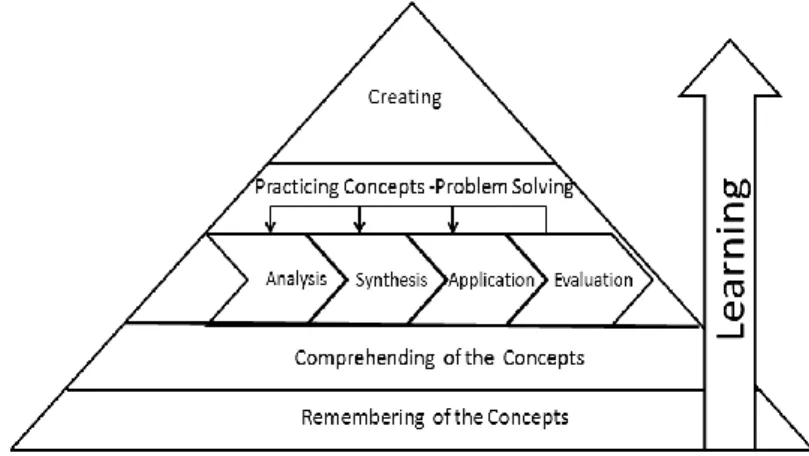
Figure 2.3 shows the learning taxonomy that presents CS problem solving process as a core concept of learning. In addition, the three highest Bloom categories (higher thinking processes) are not ordered hierarchically as suggested by Niemierko [52]. Here, it is suggested that analysis, synthesis, application, and evaluation abilities are achieved iteratively during problem solving process within a context specific application of underlining principles. This is supported by Taxonomy of task type in computing (see Figure 2.2) that focuses on process-based. The highest-level “Creating” as proposed by Gorman is the ability to abstract the knowledge and come up with a new course of action such as solving a novel problem or unfamiliar scenario.
2.2.2 Learning Taxonomy in SQL Teaching and Learning
Shneiderman [7] highlighted five tasks that one can apply to provide a query to retrieve information for the database. The following are the five tasks:
1. Learning the syntax and semantics of the function specification. He argues that a typical goal at this stage is to reduce the time of learning.
2. Composition of the syntax required to perform the required function. Composition includes writing a query or formulating a natural language query.
3. Comprehension of function syntax composed by someone else. It is often necessary to read syntax composed by others for learning or other
39
purposes. Easily composed syntax may not be easy to comprehend. Comprehension is often a component of others.
4. Debugging of syntax or semantics written by others or by the users. The main purpose of the debugging is to correct errors. Shneiderman [7] said that debugging requires comprehension and composition ability but includes other complex cognitive skills. He suggested that query language debugging will require novel debugging strategies. The central problem will be to provide users with feedback to help them determine whether the semantics of the function they invoke correspond with their intentions.
5. Modification of a query written by oneself or others. Existing database queries will often be the basis of new queries. This task requires composition and comprehension skills as well.
Shneiderman’s [7] focus was on the human factors aspects of database interactions and how to facilitate the use of query language. However, in this research, the focus is on how to facilitate the learning of SQL. Looking at the five tasks mentioned, it was possible to relate them to learning theory and organize them into a level of learning taxonomy (see Figure 2.4 a. and Figure 2.4 b).
Figure 2.4a: Bloom Taxonomy Figure 2.4 b: Shneiderman five tasks Figure 2.4: Shneiderman Five Tasks and The Related Task in Learning Taxonomy Renaud et al. [53], on the other hand, examined theories of learning such as those of Bloom and Gorman and noted that the reason students sometimes have
40
difficulty applying database skills, such as SQL, is that they do not master the required knowledge, or understand the basic concepts correctly. The authors argue that it is thus very important to convey core knowledge first so that students can construct skills (such as SQL) up on top of that core knowledge [53]. They proposed a pedagogical pattern called “Teaching SQL based on Gorman’s Taxonomy”.
Renaud’s [53] approach might be criticized in one aspect, that the suggested waterfall approach in delivering the course material might incorporate possibility of feeling bored by a lengthy period of learning concepts before the application of these concepts. In addition, they need to practice the learnt concepts within the skills-oriented teaching.
Figure 2.5 a: Bloom Taxonomy as a Spiral Taxonomy [54] (left),
Figure 2.5 b: Learning Through Knowledge Construction (right)
Figure 2.5: Spiral Model for Learning through Construction
Pollock et al. [55] describe an approach based on cognitive principles that teaches students information in isolated portions when teaching all concepts together would make it too complex to understand in its entirety. This approach
41
is often used for material, which is complex, and they argue that one can reduce the complexity and cognitive load by teaching concepts in an isolated fashion with maximum interactivity. This approach appears to be particularly suitable for SQL teaching since students need to have internalised a number of inter-related concepts in order to embark on and master SQL skills.
One can argue that, it is possible to enhance the proposed approach by Renaud
et al.[53] through changing it to a spiral taxonomy as suggested by Fuller et al.
[54] arguing that learning is knowledge construction. Hence, learning should not only go directly from bottom to top (what to why), but by seeing each round as thoroughly learning some new pieces of information, which is then used as a basis for the next round topic (see Figure 2.5, right). For example, teaching part of SQL knowledge, then examining the learner‘s understanding of the taught concepts, the student learns how to apply it for different concepts. Later on, learner’s knowledge can be evaluated through involvement in a bigger scenario where many concepts need to be applied.
This research aims to provide a comprehensive emphasis on the practical part of learning taxonomy that is done through problem solving. From the personal observation, students consume a lot of unnecessary time and effort solving each query problem depending on its complexity or occasionally not solving it at all. Thus, it is crucial to understand why students are consuming unnecessarily more time and effort, and why they sometimes give up or end up solving it incorrectly. Are there any deficiencies in transferring the knowledge or skills in one of these levels in the taxonomy, or is it a lack in the problem solving strategy knowledge? These questions might be answered by relating them to cognitive psychology literature. The next section discusses the cognitive aspects in SQL teaching and learning. It presents the different research and models in cognitive activities in solving SQL queries.
42
2.3 How Students Learn: A Cognitive Theory in Learning
SQL
If learning is knowledge construction, it is essential to understand the kind of knowledge that learners constructs. Educational and cognitive psychologists generally distinguish between a number of different types of knowledge, including facts, concepts, procedures, strategies, and beliefs [38, 56].
This section presents a review on aspects of cognitive science and educational psychology. In addition, it highlights the related research in SQL teaching and learning. Thus, this part could provide a conceptual basis for use in the other parts of the research when discussing the related cognitive research and instructional design of SQL education for novices.
2.3.1 Overview of Cognitive Model of Instruction
Significant learning happens when learners engage in correct cognitive processing during learning such as mentally organizing relevant information into a coherent structure, and integrating representation with each other and with prior knowledge retrieved [34]. The focus is on the cognitive aspects in learning SQL, as discussed next.
2.3.2 Cognitive Models in Learning SQL
Some studies provide a cognitive perspective on how the data model and query language influences learners’ query performance. Reisner [57] proposed a process where a user will generate a set of lexical items and also generate a query template, followed by the merging of the lexical items with the template to generate the final query (see Figure 2.6).
43
Figure 2.6: Query Writing Model Adapted Reisner [57]
Figure 2.7: Query Writing Model Adapted from Mannino’s [58]
Mannino [58] proposes a two-step model: from problem statement to database representation, and from the database representation into a database query language statement, as illustrated in Figure 2.7.
Figure 2.8: Three-Stage Cognitive Model Adapted from Ogden [59]
The model in Figure 2.8 presents an alternative three-stage cognitive model of database query proposed by Ogden [59]:
44
• Query formulation (stage 0): decide what data they need to solve the problem. One example is: “I need to know the average salary of employees who work in the sales department.” This stage relies on knowledge of the application domain.
• Query translation (stage 1): use the output from stage 0 as input, and decide what elements of the data model are relevant, and what the necessary operations are. One example of the output of this stage is: “The employee relation is needed, the column salary is to be selected, and the average to be calculated and a restriction of working in the sales department must be specified on column department. The output of this stage usually retained mentally by experts but written down by novices.
• Query writing (stage 2): write the query in SQL. For the example in the previous stage, to translate into SQL, would be: “select AVG (salary) from employee where…” This stage is heavily dependent on the particular query language syntax and semantics.
Through studying and analyzing these models, it is possible to say that, as individual model, they do not particularly mirror learner cognition and learning stages. They only show the abstract tasks that one can be involved in. Commonly, SQL novices seem to lack a deep understanding of the language construct and the way in which such constructs are used to solve problems [60], which suggests that Mannino’s model [58] might more accurately depict an expert’s processes than that of a learner. Novices often lack strategic knowledge - i.e. the ability to apply syntactic and semantic knowledge to solve novel problems [61]. Strategic knowledge supports stage 0 and stage 1 of the model in Figure 2.8, and without it, a novice might very well go straight to stage 2, to the detriment of learning and the query quality.
By comparing relevant elements from these models, it is possible to propose a new model that combines elements from Mannino [58] and Ogden [59] models and includes the cognitive science representation of solving problem. In addition, the model highlights the presence of instructional materials.
45
Cognitive psychologists think of a problem as consisting of an initial state and a goal state, and to solve a problem a person must perform some action (operators) to move from initial state to goal state [62]. Therefore, it is possible to consider the” problem statements” in Mannino model as the initial state and the “query language statements” as the goal state. In addition, the three cognitive processes in Ogden [59] model can be used as the set of operators to move from initial to goal state. Figure 2.9 shows this model to solve SQL problems.
Figure 2.9: SQL Cognitive Model
This leads to investigate other skills, knowledge or tools that need to be available to learners during the process of SQL acquisition. Moreover, the action or process (operators) that happened between exposing students to the problem and presenting the final query is missing. Ogden [59] model presents those as actions or tasks. Integrating these models helps depict how students solve SQL problems.
As a result, the proposed model in Figure 2.9 was enhanced by adding another cognitive process called Evaluation. One could say any problem solver should evaluate the work that has been carried at different stages.


![Figure 2.5 a: Bloom Taxonomy as a Spiral Taxonomy [54] (left),](https://thumb-us.123doks.com/thumbv2/123dok_us/10982586.2986126/41.892.161.840.473.924/figure-a-bloom-taxonomy-as-spiral-taxonomy-left.webp)