Openly accessible at http://www.european-science.com/jaelt 1
A Comparative Study of the Effects of Three Different Pre-Listening Tasks at
Intermediate and Advanced Levels
Somaiyeh Molavi1
, Davoud Kuhi 2 1Maraghe Azad University, Maraghe, Iran; 2Islamic Azad University, Maragheh Branch, Iran
Received for publication: 10 November 2017. Accepted for publication: 23 January 2018. Abstract
Listening comprehension involves the simultaneous understanding the interlocutors’ accent or pronunciation, grammar and vocabulary, and meaning comprehension. Thus, English learners have difficulty in comprehending the spoken language and they need some external support like pre-listening tasks. The purpose of pre-pre-listening task is to make the listeners activate their relevant background knowledge and get any help needed for completing the task. Despite the extensive number of studies on different tasks, slight attention is paid to comparing the effects of pre-listening tasks on learners’ pre-listening comprehension at different proficiencies. To this end, the present study investigates the comparison among the effects of three different pre-listening tasks, including lexical support, content support, and telling the main purpose of listening on the improvement of learners’ listening comprehension at intermediate and advanced levels. To meet the objectives of the study, four classes from each level were selected and randomly assigned into one control and three experimental groups. Each experimental group was given one kind of pre-listening task before the post-tests. One-way ANOVA was used to analyze the data. After scoring the tests and analyzing the mean scores, significant differences were found among the effects of the three pre-tasks. The most facilitative pre-listening tasks at intermediate and advanced levels were lexical support and content support, respectively. Informing the learners of main purpose of listening was the least effective pre-task at both levels. It can be concluded that there might be no one single kind of pre-listening task appropriate for all learners. A variety of factors such as context of instruction, learners’ ages and their proficiency levels can affect the teacher’s choice of pre-task types.
Key Words: listening comprehension, content-support, pre-listening task Introduction
The term communication’ implies two conversion processes of creating a meaningful message and recreating that message. To recreate the message from spoken language, it is needed for the learner to have some shared linguistic knowledge ability by which the learner takes part in the cycle of communication. As a means of encoding the intended meaning, listening skill has been one of the focal centers of researchers’ interest. Underwood (1989) has defined listening as the activity of paying attention to and trying to get meaning from something we hear. Regarding the fundamental role of listening in Second Language Acquisition (SLA), Rost (1994) pointed out that listening is vital in the language classroom because it provides input for the learner. Without understanding input at the right level, any learning simply cannot begin.
In a foreign language environment, L2 learners are usually deprived of opportunities for sufficient input because their native language dominates most of their communication. Consequently, L2 learners are often confronted with a number of difficulties when listening to the target language. Therefore, listening is stressful for many L2/FL students, (Chang and Read, 2006).
Somaiyeh Molavi1, Davoud Kuhi
Openly accessible at http://www.european-science.com/jaelt 2 Rather than plunging students directly into the listening task without any introduction to it, FL/L2 listeners need to be tuned in as before listening they know what to expect, both in general and for particular tasks (Underwood, 1989). In other words, L2 learners need some external support while listening to assist them to better comprehend the listening material.
In the same vein, the present study investigates the comparison among the effects of three different pre-listening tasks, including lexical support, content support, and telling the main purpose of listening on the improvement of learners’ listening comprehension at intermediate and advanced levels.
Significance and the purpose of the study
Despite the difficulties learners face in listening comprehension, slight attention is paid to listening in many language classes. One of the reasons for lack of attention is that most teachers prefer to focus on observable product of learners rather than internal processes of comprehending. However, it should be kept in mind that without understanding a language the learners cannot produce any product (Chastain, 1988).
All these facts lead to the idea that to make students successful listeners, the teacher should support the learners according to their needs, goals, and situation in which they perform. To reach some optimal degree of comprehension, pre-listening tasks have been demonstrated to be helpful in performing different activities (Rost, 1990).
Despite the large number of studies about listening comprehension and pre-listening tasks, a relatively few studies take into account the effects of different pre-listening tasks comparatively. Thus, the purpose of the present study is to investigate the comparison of the effects of three different pre-listening tasks, namely, lexical support, content support, and telling the learners about the main reason for listening on learners’ improvement of listening comprehension across two proficiencies of intermediate and advanced. In other words, the current study consists of three dimensions, including a) exploring the comparison of the effects of three different pre-listening tasks at intermediate level, b) exploring the comparison of the effects of three different pre-listening tasks at advanced level, and c) the similarities and differences among the effects of three pre-listening tasks across proficiencies.
Research Questions
Research question 1: Are there any significant differences among the effects of three
different pre-listening tasks on improving learners’ listening comprehension at intermediate level?
Research question 2: Are there any significant differences among the effects of three
different pre-listening tasks on improvement of learners’ listening comprehension at advanced level?
Research question 3: What are the similarities and differences among the effects of three
different pre-listening tasks on improving learners’ listening comprehension at intermediate and advanced level?
Background of the study
Traditionally, listening was considered as a passive skill with no active processing in it, but now it is considered as an active skill processing any linguistic input (Lynch and Mendelsohn, 2002). By the late 70s, listening proficiency was not viewed as peripheral unimportant skill anymore. Celce-Murcia (1995) states that the importance of listening comprehension in language learning and language teaching has moved from the status of incidental and peripheral importance to the status of significance and central importance. Listening was paid attention and was considered as a critical element in designing language learning syllabuses in the 1980s. In this period,
Openly accessible at http://www.european-science.com/jaelt 3
communicative language teaching (CLT) emphasized the importance of this skill in language learning. As communication was considered an ultimate goal by itself, listening turned out to be one of the means a learner can use to reach the goal.
The cognitive view of language learning sees listening comprehension as being basically the same as reading comprehension and consequently pedagogical practices have been very similar. In a typical lesson, there are pre-activities, while activities, and post activities. However, listening is a bit different from reading. For instance, students can skim a text quickly to get a good idea what it’s about, but listeners cannot skim. The language comes rushing in at them. Listening must be done in real time; there is no second chance, unless, of course, the listener specifically asks for repetition. When students read, cognates, words that are similar in two languages, help understanding. However, while cognates may look alike on the page, their sounds may be quite different and they may be less useful while listening. Listening also involves understanding all sorts of reductions of sounds and blending of words. There are false starts and hesitations to be dealt with (Brown, 2006). In a study that compared reading and listening in a foreign language, Lund (1991) found that readers recalled more details than listeners, and that listeners, while understanding a lot of the main ideas, had to fill in the blanks in their understanding by guessing at context. Again, with the words rushing in and the student having no control, these findings make sense.
According to Chastain (1988), listening occupies a position of prerequisite importance to which teachers and students direct a greater attention to achieve communication goals’ (p. 193). Terrell (1983), suggest that listening comprehension is not only necessary in language production, but can also be of itself sufficient for production to take place spontaneously. Thus, this skill is one of the crucial means which listener uses to learn a second language. In the realm of listening instruction and assessment, there are numerous studies that look at enhancing listening comprehension through various means of support, such as visual aids, advance organizers, captions, etc. Most of these forms of support have been found to facilitate listener comprehension and also to have some positive psychological effects on listeners’ learning. To reach some optimal degree of comprehension, pre-listening tasks have been demonstrated to be helpful in performing different activities (Rost, 1990).
Pre-task studies carried out in EFL (English as a foreign language) and ESL (English as a second language) contexts take a variety of forms, including textual/contextual cues (Dixon, 1991), aural descriptions (Dixon, 1991) (Herron, 1994), picture (Herron et al., 1995), vocabulary (Chung and Huang, 1998) and question preview (Chung, 2002), and written descriptions (Wilberschied and Berman, 2004). In a study, Herron (1994) studied the effect of a single pre-task on the listening comprehension of 38 beginning-level French learners. In the experimental condition, the teacher read aloud six sentences describing major scenes in a video before viewing this. In the control condition, participants just viewed the video without any teacher intervention. Results showed that participants who had access to the pre-task prior to viewing the video scored significantly better than those who were not provided with any advance introduction of relevant concepts.
Herron et al. (1995) compared the effect of two pre-task conditions on students’ retention of information in French videos. The two pre-task conditions were: a) Description Only, and b) Description plus Picture. In the Description Only Condition, the teacher read aloud six sentences that summarized major scenes in the upcoming video. In the Description plus Picture condition, the teacher read aloud the six sentences and showed pictures related to the sentences. The result showed that the visual support of the second condition significantly improved students’ comprehension of the video.
Chung and Huang (1998) studied the effects of three aural pre-tasks on student comprehension of L2 video-taped material. 160 low-intermediate Chinese students of English were
Somaiyeh Molavi1, Davoud Kuhi
Openly accessible at http://www.european-science.com/jaelt 4 the participants of their study. They viewed three video programs with three different advance organizers: (a) main characters, (b) vocabulary and (c) main characters plus vocabulary. The result showed that under the vocabulary condition, participants performed better at comprehension than under the other two conditions; this finding highlighted that the presence of unfamiliar vocabulary was the most critical factor for listening comprehension. The surprising finding of this study was that students performed least satisfactorily under the combined condition.
Chang and Read (2006) examining the effect of different types of support on the listening comprehension of Tai students found that providing general information about the topic of lectures was more effective than other support types such as vocabulary instruction, repetition of input and reviewing the listening questions.
An overview of the literature showed that almost all previous studies supported the use of pre-tasks as an effective strategy in facilitating listening comprehension. Overall, previous findings supported the use of advance organizers in facilitating EFL student’s listening comprehension.
Although authors argue that pre-listening activities have positive effects on L2/FL learners’ listening comprehension, the review of the research indicates that there is not any comprehensive experimental study investigating the comparison of the effects of three different pre-listening tasks across proficiencies. Therefore, the present study aims to investigate the comparison among the effects of three different pre-listening tasks on the improvement of learners’ listening comprehension across two proficiencies, namely, intermediate and advanced.
Methodology
Subjects
A sample of 160 learners including 98 females and 62 males participated in this study. Their ages at intermediate level varied from 14 to 19 and at advanced level from 20 to 28 years. Each class consisted of 20 learners. The English proficiency of the learners, as measured by an in-house placement test, was either intermediate or advanced. Besides considering these levels based on the institutes’ criteria, a Test of English as a Foreign Language (TOEFL) was administered and the results of the test were taken as the researcher’s criterion to guarantee homogeneity of the learners at the level they had been assigned to. In order to persuade the learners to participate in listening the teacher promised them to give extra marks in class participation.
Context of the study
This study was conducted in a private English language teaching (ELT) school in Tabriz. Thus, the context of language learning was an EFL situation. In this primarily meaning-oriented language schools English was taught at 6 proficiency levels, with intermediate and advanced representing levels 4 and 6 respectively. The classes met three times a week, and every session lasted 90 minutes.
Materials
The first testing material utilized in this study was an actual TOEFL proficiency test administered in 2003 by ETS in order to establish the learners’ homogeneity and to make sure that they were at the same proficiency level at the outset of the study. The test included three sections of listening comprehension, structure, and reading comprehension. Due to lack of time and ease of administration, 70 items were selected, including 20 listening items, 30 structure items, and 20 reading items.
The second testing material was a listening comprehension test which was consisted of a text and multiple-choice questions which were prepared in accordance with the text and assessed cognitive capabilities of the students. The listening comprehension test was administered as a pre-test to make sure that the learners were at the same level regarding their listening proficiency.
Openly accessible at http://www.european-science.com/jaelt 5
The main listening materials (post-tests) were 10 topic-based recorded lectures (five for each level) taken from the books of listening extra by Miles Craven, Person to Person by Jack C. Richards and David Bycina, and Discussions A-Z by Adrian Wallwork. The lectures were appropriate for intermediate and advanced learners and they consisted of some topic-based listening texts and recorded lectures followed by 5 multiple-choice questions and a cloze test with 5 blank spaces. Some topics selected for listening comprehension post-tests were thinking green, beauty perception, personality, money and wedding costumes, etc.
Although the literature is full with emphasis on the authenticity of materials (Oxford, 1993; Rubin, 1994; Schmitt- Rinehart, 1994), the researcher tried to provide non-authentic listening materials. The reason for choosing non-authentic listening pedagogic materials was to keep the value of the materials.
Design of the study
The present study investigates the comparison among the effects of three different pre-listening tasks on the improvement of learners’ pre-listening comprehension across two proficiencies, namely, intermediate and advanced. For this reason, four classes from each proficiency level were selected (totally 8 classes- 4 intermediate and 4 advanced). Then, the classes were randomly assigned to one control and three experimental groups and each experimental group received one type of pre-listening tasks. In order to investigate the research questions developed to meet the objectives of the study, a quasi-experimental design with a pre-task, treatment, post-test order was adopted. To be more specific, the treatments were of three kinds, namely, lexical support, content support and informing the learners about the main purpose of listening to the lectures. Lexical support consisted of a list of new vocabularies containing in the listening material plus their pronunciations and meanings. Content support was in the form of statements giving some information about the content of the upcoming lectures. The goal of this pre-task was to activate the learners’ pre-existing knowledge and to offer a general view about the forthcoming data. And in the third treatment the learners were told about the purpose of listening (telling the learners whether they are going to listen to get the main idea of the lecture or listening for details). One of the experimental groups received lexical support; the second one received content support; and the third one told about the main purpose of listening. The control groups in each proficiency level did not receive any treatment.
Procedure
At the outset of the study a TOEFL proficiency test was administered in order to make sure that the learners were at the same proficiency level. Moreover, a pre-test of listening comprehension was conducted to guarantee the homogeneity of participants in their listening skill and also to measure their listening proficiency. Then the four classes of each proficiency level were randomly assigned into one control and three experimental groups. Each experimental group was given one kind of pre-listening task as follows:
One of the experimental groups in each proficiency received lexical support (a glossary of unknown words along with their meanings and pronunciations) before the listening test. The glossary of unknown words was given one session before the listening test and the teacher pronounced the words before the administration of the listening comprehension test. According to Chang (2007), giving the glossary some time before the listening test has more positive effects on the use of pre-tasks than offering them just before the test. A session after giving the first type of pre-task (glossary of unknown vocabularies), the post-test containing the vocabularies was administered. The test was consisted of a text to be listened followed by 5 multiple-choice questions and a cloze test with 5 missing words. The learners listened to the text twice and the questions were given to them in two steps. In other words, they listened to the text for the first time, and then they
Somaiyeh Molavi1, Davoud Kuhi
Openly accessible at http://www.european-science.com/jaelt 6 received the multiple-choice questions and were asked to answer them along with listening to the text for the second time. After that they received the cloze test and completed it without listening. The purpose of offering the cloze test after listening was to prevent the learners from being aware of the listening text.
The second group received content support (a written summary of the listening material giving general information about the content of the forthcoming listening). This type of pre-task was given just 10 minutes before taking the tests. The aim of content support was to activate the listeners’ pre-existing knowledge and offer a general view about the forthcoming data. It was taken into account not to give detailed information in the summaries; the learners were given only general information about the main points discussed in the listening material.
Finally, the third experimental group was informed of the main purpose of listening (listening for main ideas or listening for details). The process of conducting listening tests was the same at both proficiency levels. Due to the difference between the qualities of pre-tasks, the offered times for working on the pre-tasks were different. However, the control groups received the same listening tests without any treatments.
The total process of offering treatments and post-tests took 6 weeks. After scoring the tests and analyzing the mean scores, a one-way ANOVA was used to analyze the comparison of the effects of the treatments on the learners’ listening comprehension. The results and discussion of the obtained data are presented in the next chapter.
In this chapter, the findings of the study are presented in terms of the research questions and hypotheses raised in chapter one. To find out the differential effects of the pre-tasks, the results of the post-tests among three experimental groups and the control groups were compared. First, the mean scores are demonstrated in tables and figures. Then, the results obtained from ANOVA analysis are presented.
Statistical analysis
In order to provide simple summaries about the sample and represent comprehensive information about the quantitative analysis of obtained data, descriptive statistics were implemented. Simply stated, descriptive statistics summarize raw scores and are used trough data analysis in a different number of ways. They refer to means, ranges and dispersion of the scores from central tendency.
Besides descriptive analysis, inferential statistics would be provided to make more powerful inference from the obtained data. Based on the research questions and the design of this experiment, having four groups in each level, one-way ANOVA was applied to compare the mean scores of these groups. To answer the research questions and test the hypotheses, a one-way ANOVA was computed by the SPSS software represented as follows.
Testing the first hypothesis
The first research question deals with exploring the significant differences among the effects of three different pre-listening tasks on improvement of learners’ listening comprehension at intermediate level. As stated in previous sections, before the experiment, a pre-test of listening comprehension was conducted to guarantee the homogeneity of participants in their listening skill and to measure their listening proficiency. As discussed above, to summarize the obtained data in a clear and simple way, descriptive statistics are provided. Table 1 represents each group’s mean scores and standard deviations below.
Openly accessible at http://www.european-science.com/jaelt 7
Table 1. Descriptive statistics for pre-test mean scores for learners at intermediate level
Groups N Mean Std. Deviation Std. Error
Vocab group 20 4.3000 1.26074 .28191
Content group 20 4.1500 .98809 .22094
Purpose group 20 3.7500 1.11803 .25000
Control group 20 3.5500 .75915 .16975
Total 80 3.9375 1.07142 .11979
As it can be seen from the man scores in Table 1, the participants’ listening proficiency was statistically similar before the experiment. Thus, it can be concluded that the four groups of vocabulary, content, purpose and control were homogeneous at the beginning of the study.
Table 2. Results of ANOVA for pre-test mean scores for learners at intermediate level
Group Sum of Squares df Mean Square F Sig.
Between Groups Within Groups Total 7.238 3 2.413 2.197 .095 83.450 76 1.098 90.688 79 Based on the Table 2, ANOVA on the pre-test scores revealed no significant difference among the four groups’ performance in LC test. In other words, the mean differences of the groups were not statistically significant. This can be proved by p value which is higher than alpha level of significance (α=0.05, p=0.095, p>α). After being sure of groups’ homogeneity, it was time to offer the pre-tasks in the planned schedule described earlier.
One of the experimental groups in each proficiency received lexical support, a glossary of unknown words along with their meanings and pronunciations, before the listening test. The glossary of unknown words was given one session before the listening test and the teacher pronounced the words before the administration of the listening comprehension test. The second group received content support, a written summary of the listening material giving general information about the content of the forthcoming listening. This type of pre-task was given just 10 minutes before taking the tests. Finally, the third experimental group was informed of the main purpose of listening, listening for main ideas or listening for details. To find out the differential effects of the three pre-tasks the results of post-tests among three experimental groups and the control group were compared. To demonstrate the differences statistically, Table 3 is provided.
Table 3. Descriptive statistics for post-test mean scores for learners at intermediate level
Groups N Mean Std. Deviation Std. Error
Vocab group 20 47.0500 1.63755 .36617
Content group 20 39.5500 2.03845 .45581
Purpose group 20 32.7500 2.46822 .55191
Control group 20 19.9000 1.80351 .40328
Total 80 34.8125 10.24027 1.14490
The results indicated that there were significant differences among the four groups’ mean scores after providing the pre-tasks. According to the mean scores, all three experimental groups
Somaiyeh Molavi1, Davoud Kuhi
Openly accessible at http://www.european-science.com/jaelt 8 outperformed the control group. It means that the three pre-listening tasks improved intermediate learners’ listening comprehension. However, as clear, their effects were different. The mean scores of the vocabulary group were higher than the other experimental groups. Comparing the content and purpose groups, the content groups’ mean score was higher than that of the purpose group. Therefore, regarding mean scores, that pre-listening task of lexical support had the greatest effect on intermediate learners’ listening comprehension improvement.
To compare the four group means and to determine whether there was a statistically significant difference among the three pre-tasks, the post-test scores were submitted to ANOVA analysis. The results are presented in table 4.
Table 4. Results of ANOVA for post-test mean scores for learners at intermediate level
Group Sum of Squares df Mean Square F Sig. Between Groups Within Groups 7976.737 3 2658.913 657.269 .000 307.450 76 4.045 Total 8284.188 79
The results illustrated that the level of significance is less than alpha level (p=0.000, α=0.05, p<α). Therefore, the difference among the three pre-listening tasks is statistically significant. Thus, the first null hypothesis was rejected and the alternative hypothesis was confirmed. In other words, different pre-listening tasks had different effects on learners' listening comprehension.
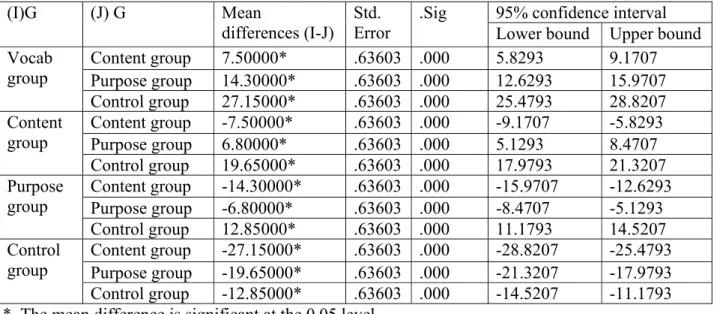
Although the significance was approved by ANOVA, in order to know exactly which mean scores were significantly different from other ones, applying a more indicative tool was needed. Accordingly, the post hoc test was conducted to compare the mean scores of the groups and to determine whether there was a significant difference among the effects of the three different pre-listening tasks. The mostly used post hoc test in psychology and behavioral sciences is Tukey Honestly Significant Difference (HSD) Test shown in Table 5.
Table 5. Tukey post hoc test for learners at intermediate level
(I)G (J) G Mean differences (I-J) Std. Error Sig . 95% confidence interval
Lower bound Upper bound Vocab group Content group 7.50000* .63603 .000 5.8293 9.1707 Purpose group 14.30000* .63603 .000 12.6293 15.9707 Control group 27.15000* .63603 .000 25.4793 28.8207 Content group Content group -7.50000* .63603 .000 -9.1707 -5.8293 Purpose group 6.80000* .63603 .000 5.1293 8.4707 Control group 19.65000* .63603 .000 17.9793 21.3207 Purpose group Content group -14.30000* .63603 .000 -15.9707 -12.6293 Purpose group -6.80000* .63603 .000 -8.4707 -5.1293 Control group 12.85000* .63603 .000 11.1793 14.5207 Control group Content group -27.15000* .63603 .000 -28.8207 -25.4793 Purpose group -19.65000* .63603 .000 -21.3207 -17.9793 Control group -12.85000* .63603 .000 -14.5207 -11.1793
Openly accessible at http://www.european-science.com/jaelt 9
The results of multiple comparisons by the post hoc test revealed that all three pre-listening tasks had supportive roles on intermediate learners’ listening skill. It can be demonstrated by the level of computed P value (0.000) which is less than alpha level (0.05). However, comparing the differences revealed that lexical support had the most supportive role in comparison with other pre-listening tasks.
Testing the second hypothesis
The second research question was concerned with differences among the effects of three different pre-listening tasks on improvement of learners’ listening comprehension at advanced level. Before the experiment, a pre-test of listening comprehension was conducted to guarantee the homogeneity of the learners regarding their listening proficiency in advanced groups. The mean scores obtained from the pre-test turned out to be close to each other with respect to the correct-answered items. In this stage of study, the expected homogeneity should have been proved to continue the experiment. For this aim, the obtained results from pre-tests were analyzed by descriptive statistics. In order to show the analyzed data in a comprehensive and representative way the mean scores and the standard deviations for each group are presented in Table 6.
Table 6. Descriptive statistics for pre-test mean scores for learners at advanced level
Groups N Mean Std. Deviation Std. Error
Vocab group 20 4.4500 .51042 .11413
Content group 20 4.3500 .67082 .15000
Purpose group 20 4.4500 .60481 .13524
Control group 20 4.5000 .51299 .11471
Total 80 4.4375 .57023 .06375
The mean scores demonstrated the four groups’ similarities regarding their listening comprehension ability. Thus, the results obtained before the experiment met the researcher’s expectations.
To find out an objective understanding of the differences in the advanced learners’ performance in pre-test and compare group means by analyzing variance estimates, ANOVA was conducted on the pre-test scores. Table7 demonstrates the differences among groups vividly.
Table 7. Results of ANOVA for pre-test mean scores for learners at advanced level
Group Sum of Squares df Mean Square F Sig.
Between Groups .238 3 .079 .236 .871
Within Groups 25.450 76 0.335 .335
Total 25.688 79
As presented in table 7, there was no significant difference among the four groups’ mean scores (α=0.05, p=0.871, p>α). In other words, the expected homogeneity was materialized over the result of test. After the results of the test, experimental groups were provided with the pre-listening tasks. The process of providing pre-pre-listening tasks and post-tests was the same as that of the intermediate level. To find out the differential effects of the pre-tasks, the results of the post-tests among the four groups were compared.
Somaiyeh Molavi1, Davoud Kuhi
Openly accessible at http://www.european-science.com/jaelt 10 Table 8. Descriptive statics for post-test mean scores for learners at advanced level
Groups N Mean Std. Deviation Std. Error
Vocab group 20 44.8500 .93330 .20869
Content group 20 48.2500 .91047 .20359
Purpose group 20 35.5000 1.60591 .35909
Control group 20 24.2000 1.39925 .31288
Total 80 38.2000 9.47268 1.05908
The results showed that there were differences among the four groups’ post-test mean scores after providing the pre-tasks. According to the mean scores, the experimental groups outperformed the control group and this result supported the effective role of pre-listening tasks on advanced learners’ listening comprehension. However, the effect of different pre-listening tasks was not the same. Although the difference between the vocabulary and content group was minor, the content groups’ mean score was the highest. It means that offering content support had the most important effect on learners’ listening skill. Despite the fact that informing the learners about the purpose of listening improved their performance on post-tests, it had the least important effect.
To compare group means and determine whether there were significant differences in the effects of three different pre-listening tasks statistically in the advanced level, the post-test scores were submitted to ANOVA analysis with between-group factor. The results are represented in table 9.
Table 9. Results of ANOVA for post-test mean scores for learners at advanced level
Sum of Squares Df Mean Square F Sig.
Between Groups 6970.300 3 2323.433 1.490E3 .000
Within Groups 118.500 76 1.559
Total 7088.800 79
According to the Table 9, the difference among the three pre-listening tasks is statistically significant because the computed p value was less than alpha level (α=0.05, p=0.000, p<α). Therefore, the second null hypothesis was rejected and the alternative one was confirmed. It means that there are significant differences among the effects of three different pre-listening tasks on improvement of learners’ listening comprehension at advanced level.
Likewise intermediate groups, despite the fact that p value was significant in the analysis of variance, the work is not over yet. A significant p value illuminates only that the means are not all equal. To know exactly which means were significantly different from the other ones, the researcher needed to examine the numbers more carefully. Accordingly, there should be a comparison among the four groups’ mean scores. For this reason, a Tukey post hoc test was conducted. Tukey’s HSD was designed for a situation with equal sample sizes per group and it is used in conjunction with an ANOVA to find means that are significantly different from each other. The results are provided in Table 10.
Openly accessible at http://www.european-science.com/jaelt 11
Table 10. Tukey post hoc test for learners at advanced level
(I) G (J) G Mean
Difference (I-J)
Std. Error Sig. 95% Confidence Interval Lower Bound Upper Bound Vocab group Content group -3.40000* .39487 .000 -4.4372 -2.3628 Purpose group 9.35000* .39487 .000 8.3128 10.3872 Control group 20.65000* .39487 .000 19.6128 21.6872 Content group Vocab group 3.40000* .39487 .000 2.3628 4.4372 Purpose group 12.75000* .39487 .000 11.7128 13.7872 Control group 24.05000* .39487 .000 23.0128 25.0872 Purpose group Vocab group -9.35000* .39487 .000 -10.3872 -8.3128 Content group -12.75000* .39487 .000 -13.7872 -11.7128 Control group 11.30000* .39487 .000 10.2628 12.3372 Control group Vocab group -20.65000* .39487 .000 -21.6872 -19.6128 Content group -24.05000* .39487 .000 -25.0872 -23.0128 Purpose group -11.30000* .39487 .000 -12.3372 -10.2628 As presented in Table 10, the results of the Tukey revealed that the three experimental groups outperformed the control group, and the difference among the effects of pre-listening tasks was significant. Analyzing mean differences demonstrated that content support among the other pre-tasks had the greatest effect on advanced learners’ performance in post-tests.
Testing the third hypothesis
This section deals with the performance of the two levels’ participants. However, as the tests and pre-listening tasks were selected according to the participants’ level of proficiency, comparing statistically the data obtained by two different levels was not rational. For this reason, the third research question and hypothesis would be discussed descriptively.
Similarities and differences
According to what was discussed, all the three pre-listening tasks had significant effects on the improvement of intermediatelearners’ listening comprehension. However, based on the obtained results, the extent to which they enhanced the learners’ listening skill was not the same. Providing lexical support, a glossary of unknown vocabularies, had the most significant role on intermediate learners’ performance. Content support was the second effective pre-listening task at this level. And finally, making the learners aware of the purpose of listening played the least supportive role.
Somaiyeh Molavi1, Davoud Kuhi
Openly accessible at http://www.european-science.com/jaelt 12 Regarding the advanced level, although the pre-task of lexical support had a significant effect on participants’ listening comprehension, its effect was not the most significant one. Here, the content support group outperformed the other ones. In spite of the fact that purpose group’s mean scores in post-tests were better than those of the control group; its effect was not as strong as the other two pre-listening tasks.
Discussion
Generally, the present study provides further support to the effective and facilitative role of pre-listening tasks on learners’ performance on the listening post-tests. Four classes from intermediate level and four classes from advanced level were selected. Then, the classes were randomly assigned to one control and three experimental groups and each experimental group received one type of pre-listening tasks. The foregoing results provide the following answers to the three research questions.
Research question 1: Are there any significant differences among the effects of three
different pre-listening tasks (lexical support, content support, and the main purpose of listening) on improving learners’ listening comprehension at intermediate level?
The results indicated that there were significant differences among the effects of three different listening tasks. The listening task of lexical support comparing to the other pre-tasks was found to be the most effective one to improve the intermediate learners’ listening comprehension. This finding is in contrast with Elkhafaifi (2005) and Ching-Shyang Chang’s (2007) studies who found that vocabulary preparation prior to a listening comprehension test did not significantly affect students’ performance on the listening test.
Further, the results of the present study are not in line with the study carried out by Chang and Read (2006) in which neither high nor low level learners had benefited from the vocabulary instruction they received immediately before the test was administered. The different results might be due to the time factor because the students had very little time to practice the vocabulary before a test was administered, however, in the present study, the glossary of unknown words was given one session before the listening test and the learners had enough time to practice them. Moreover, the ineffectiveness of lexical support in listening comprehension can be attributed to the lack of automatic processes, as Buck (2001) notes “when second language learners learn some new element of a language, at first they have to pay conscious attention and think about it; that takes time, and their use of it is slow.”
According to what was mentioned about the effective role of the vocabulary support, the results of this study parallels the findings obtained in Tsui and Fullilove (1998) who supported the low proficient learners’ use of bottom-up processing.
Research question 2: Are there any significant differences among the effects of three
different pre-listening tasks (lexical support, content support, and the main purpose of listening) on improving learners’ listening comprehension at advanced level?
With regard to the advanced level, the most facilitative pre-listening task was the content support. Therefore, availability of general prior knowledge about the content of the forthcoming lectures could free some mental resources and direct the learners towards less developed lower level listening processing. Obtaining such a result might be due to the advanced learners’ use of top-down processes better than the intermediate learners who are better in bottom-up processes (Tsui & Fullilove, 1998). The Similar findings were also reported in Tusi and Fullilove’s study (1998) where it was showed that more skilled language listeners were more likely to fix their initial non-matching schema. Another difference in the use of different processes may be related to age. As Bialystok
Openly accessible at http://www.european-science.com/jaelt 13
(1994) suggests, adults tend to extend existing categories (i.e. not notice small differences), while children notice differences and tend to create new categories accordingly.
The results also support Chang and Reads’ (2006) findings examining the effect of different types of support on the listening comprehension of Thai students which stated that providing general information about the topic of lectures was more effective than other support types such as vocabulary instruction, repetition of input and reviewing the listening questions. Further, the present study is a support to Dixon (1991) who investigated the effects of a written textual pre-task and a contextual visual aid on FL listening comprehension on 198 college students. Results indicated that the students with a written textual pre-task performed better in listening comprehension than those with a visual cue or no cue at all.
However, the findings of the present study contrast with Sarandi’s (2010) research in which the effect of content related information on upper-intermediate language learners’ performance on listening comprehension questions was investigated. The statistical analysis of the data revealed that the content related information did not improve experimental group‘s performance.
Research question 3: What are the similarities and differences among the effects of three
different pre-listening tasks (lexical support, content support, and the main purpose of listening) on improving learners’ listening comprehension at intermediate and advanced level?
As mentioned earlier, the third research question would be discussed descriptively. First, regarding the similarities, the only similarity among the effects of the pre-tasks across proficiencies was in the case of purpose pre-task since it had the least supportive role in listening improvement at both levels. Comparing to the other two types of pre-listening tasks, informing the learners of the main purpose of listening was done orally and no written information about the forthcoming lectures were included in this pre-task. Thus, the finding about its effects on the improvement of the learners’ performance was not surprising since it did not provide any help concerning the content, the vocabularies or the structure of the lectures.
On the other hand, comparing the roles of pre-listening tasks brought out differences in the performance enhancement across two proficiencies. The most facilitative pre-listening task at intermediate and advanced levels were lexical support and content support respectively. Concerning these results, the present research is in line with the studies which found differences in the effects of different pre-tasks across proficiencies (Chang & Read, 2006; Chiang & Dunkel, 1992). The difference between the effects of lexical support and content support at intermediate and advanced levels might be because of the utilization of top-down or bottom-up processes by learners of different proficiencies.
Conclusion
It can be concluded that there might be no one single kind of pre-listening task appropriate for all learners. A variety of factors such as context of instruction, learners’ ages and their proficiency levels can affect the teacher‘s choice of pre-task types. Accordingly, the teachers should not be overly concerned as to whether students perform better with one kind of pre-task than another, but rather with learners’ levels, needs and motivation. The thing that is of primary importance is that, through having access to the findings of different studies, English language teaching practitioners become informed teachers in order to become on the spot decision makers. Ultimately, in order to decrease the Learners’ mental burden and help them understand listening materials better, teachers require knowledge about different kinds of pre-listening tasks and their effects on the improvement of learners’ listening comprehension.
Somaiyeh Molavi1, Davoud Kuhi
Openly accessible at http://www.european-science.com/jaelt 14 Implications of the study
The findings of the present study lend support to the current paradigm in language teaching in which focus on form and meaning receive fair attention. In fact, the tendency among syllabus designs to include both formal categories and meaning categories is also an indicative of the implications that this study can have.
Pedagogical implications
In terms of pedagogical implication, one might not expect these findings to be generalized to other instructional contexts. Listening skill being one of the problematic areas of learning has been the focal center of attention for some researchers recently. The current study provides support for the incorporation of focus on form into the context of meaning-focused instruction. From the pedagogical point of view, the findings of the present study can complement SLA research by helping to create a broader understanding of the different pre-listening tasks.
Implications for teacher training centers
The most important implication of the current study for language classes has to do with the type of pre-tasks employed in classrooms to support learners’ confidence and positive attitude toward listening tasks. Another point pertains to the type of texts used in classrooms. Culturally loaded materials require more topic related knowledge than other materials. The other factor contributing to the cycle of task performance is selection of pre-listening tasks according to the learners’ proficiencies. It also provides insights for language teachers and syllabus designers to incorporate a range of pre-listening tasks and change the weight of listening lessons from testing listening to teaching listening so that they could support language learners to enhance their listening performance.
Implications for course designs
It is clear that an efficient course book can pave the way for an effective teaching, especially for novice teachers. Even the organization of the content and tasks indirectly gives hints about the effective way of learning for students. In other words, teaching intervenes through the syllabus.
Limitations of the study
Inevitably there are a number of important limitations to the current study. One of the most important limitations concerns the time span which was not sufficient for learners to concentrate well enough on the listening tasks to help them transfer processed information into responding the questions. Obviously, a clearer picture of how different pre-listening tasks influence learners listening comprehension may have been demonstrated during a longer period of time. Furthermore, as mentioned before, only two levels of proficiency i.e. intermediate and advanced were taken into consideration, therefore the findings cannot be extrapolated to other proficiency levels. A further limitation of this study was that there was no control over the participants’ background knowledge with regard to the provided pre-listening tasks. It‘s not clear how far the collected data might have been affected by the learners’ own background knowledge during the study. One of the other significant factors impossible to control was the age of the participants.
Suggestions for further research
Further research is still needed to shed more light on the issues contributing to this area of research. Considering the limitations of this study, further research studies are suggested to replicate this study at elementary level as well as the two proficiency levels examined in this study. There is also a need to investigate other types of pre-listening tasks regarding the specific needs of learners in different situations. Moreover, the factor of time on pre-listening phase can be another element. Allowing the learners to focus more on lexical items and transfer them into the listening texts in a
Openly accessible at http://www.european-science.com/jaelt 15
predetermined time span can be addressed in other studies. Providing learners with sufficient time may help them become familiar with the pronunciation, relate the lexical items to the aural texts and have time to think about what strategy to use.
References
Bialystok, E. & Hakuta, K. (1994). In Other Words: The Science and Psuchology of Secod-Language Acquisition. New York: Basic Books.
Bowen, D. (1986). TESOL techniques and procedures. London: Newbury House Publication.
Brown, S. (2006). Teaching listening. . Cambridge: Cambridge University Press.
Buck, G., (2001). Assessing Listening. Cambridge: Cambridge University Press.
Celce Murcia, M. (1995). Discourse analysis and teaching of listening. In G. Cook and B. Seidlhofor (Eds.), Principles and Practices in Applied linguistics: Studies in the honor of H.G. Widdoson. Oxford: Oxford University Press.
Chang, C.-S., & Read, J. (2006). The effects of listening support on the listening performance of EFL learners. TESOL Quarterly, 40, 375–397.
Chastain, K. (1988). Developing second language skills: Theory and practice. USA: Harcourt
Javanovich Press.
Chiang, C. C., & Dunkel, P. (1992). The effect of speech modification, prior knowledge, and listening proficiency on EFL lecture learning. TESOL Quarterly, 26, 345–374.
Chung, J.M. (2002). The effects of using two advance organizers with video texts for the teaching of listening in English. Foreign Language Annals, 32 (3), 295-308.
Chung, J.M., & Huang, S.C. (1998). The effects of three aural advance organizers for video viewing in a foreign language classroom. System, 26 (4), 553-565.
Dixon, R. (1991). Listening comprehension: textual, contextual, cognitive, and affective considerations. In: Paper presented at the Annual Central States Conference on Language Teaching (23rd, Indianapolis, IN, March 21-24).
Elkhafaifi, H. (2005). The effect of prelistening activities on listening comprehension in Arabic learners. Foreign Language Annals, 38, 505–513.
Herron, C. (1994). An investigation of the effectiveness of using an advance organizer to introduce video in the foreign language classroom. The Modern Language Journal, 78 (2), 190-198.
Herron, C., Hanley, J., & Cole, S. (1995). A comparison study of two advance organizers for introducing beginning foreign language students to video. The Modern Language Journal, 79 (3), 387-395.
Lund, R. (1991). A comprehension of second language listening and reading comprehension. The Modern Language Journal, 75, 196–204.
Lynch, T. & Mendelsohn, D. (2002). Listening. In N. Schmitt (Eds.), An introduction to applied linguistics (pp. 193-210). New York: Oxford University Press.
Oxford, R. (1993). Research update on L2 listening. System, 21 (2), 205-211
Robin, W. & Gou, N. (2006). An investigation of factors influencing English listening
comprehension and possible measures for improvement. Retrieved from
http://www.aare.edu.au/05pap/guo05088.pdf.
Rost, M. (1990). Listening in Language Learning. Longman, London.
Rost, M. (1994). Introducing Listening. Penguin Books, London
Sarandi, H. (2010). Content related support and listening comprehension: Some limitations. Procedia Social and Behavioral Sciences, 2, 5605–5611.
Tsui, A.B., & Fullilove, J. (1998). Bottom-up or top-down processing as a discriminator of L2 listening performance. Applied Linguistics, 19 (4), 432–451.
Somaiyeh Molavi1, Davoud Kuhi
Openly accessible at http://www.european-science.com/jaelt 16 Underwood, M. (1989). Teaching listening. London: Longman
Wilberschied, L., & Berman, P. (2004). Effect of using photos from authentic video as advance organizers on listening comprehension in an FLES Chinese class. Foreign Language Annals, 37 (4), 534-540.