Document downloaded from:
This paper must be cited as:
The final publication is available at
Copyright
http://dx.doi.org/10.1016/j.engappai.2014.06.003
http://hdl.handle.net/10251/40614
International Federation of Automatic Control (IFAC)
Heras Barberá, SM.; Botti Navarro, VJ.; Julian Inglada, VJ. (2014). Modelling dialogues in
agent societies. Engineering Applications of Artificial Intelligence. 34:208-226.
Modelling Dialogues in Agent Societies
Stella Heras, Vicente Botti, Vicente Juli´an
Departamento de Sistemas Informaticos y Computacion Universitat Politecnica de Valencia Camino de Vera s/n 46022 Valencia (Spain)
Abstract
Besides the simpler ability to interact, open multi-agent systems must include mechanisms for their agents to
reachagreementsby taking into account their social context. Argumentation provides multi-agent systems with
a framework that assures a rational communication, which allows agents to reach agreements when conflicts of opinion arise. In this paper, we present the dialogue protocol that agents of a case-based argumentation framework can use to interact when they engage in argumentation dialogues. The syntax and semantics of the argumentation protocol are formalised and discussed. To illustrate our proposal, we have applied the protocol in the context of a
water market. By using our dialogue protocol, agents represent water users that are able to explore different water
allocations and justify their views about what is the best water distribution in a certain environment.
Keywords: Agreement Technologies, Argumentation, Multi-Agent Systems
1. Introduction 1
Large scale computer systems can be viewed in terms of the entities that participate in them, offering and
2
consuming services (Luck and McBurney, 2008). Open Multi-Agent Systems (MAS), whose software agents are
3
able to interact with each other to solve complex tasks and reach agreements as the outcome of their interactions,
4
has proven to be a very appropriate paradigm to implement these type of systems (Huhns et al., 2005)(Ossowski,
5
2013)(del Val et al., 2014). Furthermore, argumentation theory provides MAS with a framework that assures
6
rational communication and allows agents to reach agreements when conflicts of opinion arise. However, agents
7
that use an argumentation framework to argue also need a protocol to communicate, to interchange their arguments,
8
and to be able to reach agreements.
9
Considerable research has been performed on the design of artificial agent communication languages, such as the
10
Knowledge Query and Manipulation Language (KQML)1from DARPA, and theAgent Communications Language
11
(FIPA ACL)2from the IEEE Foundation for Intelligent Physical Agents. These languages provide agents with high
12
flexibility of expression. However, in a dialogue, agents can have too many choices of what to utter in each step
13
of the conversation. Therefore, this flexibility can also be an important downside if it gives rise to a state-space
14
explosion and leads agents to engage in never-ending dialogues (McBurney and Parsons, 2009, Chapter 13).
15
A possible solution for this problem consists of limiting the allowed set of utterances for each step of the dialogue
16
by defining the agent communication protocol by means of adialogue game(Hamblin, 1970)(MacKenzie, 1979).
17
Dialogue games are a concept from argumentation theory and game theory that has been applied in MAS to
18
structure the dialogue between agents with different points of view. Formal dialogue games are interactions among
19
several players (agents in our case) where each player moves by making utterances in accordance with a defined
20
set of rules. A wide range of approaches that formalise interaction protocols by using different dialogue games
21
have been published (McBurney and Parsons, 2002a).
22
However, to our knowledge no research has been done to propose a dialogue game that is based on case-based
23
knowledge resources that agents can use to manage agreement processes in agent societies. Reasoning with cases
24
is especially suitable where there is a weak (or even unknown) domain theory, but acquiring examples encountered
25
Email address:[email protected](Stella Heras, Vicente Botti, Vicente Juli´an) 1www.cs.umbc.edu/research/kqml/
2
www.fipa.org/repository/aclspecs.html
in practice is easy. Many argumentation models for MAS produce arguments by applying a set of inference
26
rules (Amgoud et al., 2000)(Augusto and Simari, 2001)(Verheij, 2009). Rule-based systems require eliciting an
27
explicit model of the domain (Prakken, 2010). In open MAS, the domain is highly dynamic and the set of rules that
28
model it is difficult to specify in advance, even if these rules are domain-specific inference rules that are intended to
29
represent domain knowledge. However, tracking the arguments that agents put forward in argumentation processes
30
can be relatively simple. Therefore, these arguments can be stored as cases that are codified in a specific case
31
representation language that different agents are able to understand (e.g., an ontological language (Jurisica et al.,
32
2004)). This approach makes possible to develop case-bases reducing the knowledge-acquisition bottleneck. With
33
case-bases, agents are able to performlazy learningprocesses on argumentation information. For complex and
34
highly dynamic systems, this is easier than using a rule-based system.
35
Another important problem with rule-based systems arises when the knowledge-base must be updated (e.g.,
36
adding new knowledge that can invalidate the validity of a rule). Updates involve checking the knowledge-base
37
for conflicting or redundant rules. Case-based systems are easier to maintain than rule-based systems since, in the
38
worst case, the addition of new cases can give rise to updates in some previous cases, but it does not affect the
39
correct operation of the system, even though it can have an impact on its performance.
40
Therefore, in this paper, we present a dialogue game protocol that agents can use in a case-based argumentation
41
framework to interact with each other when they engage in dialogues. This protocol includes a syntax as the set
42
of defined locutions that agents can use to engage in argumentation processes, the combinatorial properties of
43
locutions, and the rules that govern the dialogue. We also provide theoperationalsemantics of the locutions. This
44
semantics views each locution as a transition in an abstract state-machine that represents the possible stages that
45
can be reached during the dialogue.
46
The structure of this paper is as follows: Section 2 introduces a running example that clarifies the type of
47
problems that we want to solve with our argumentation approach; Section 3 briefly introduces our case-based
48
argumentation framework for agent societies; Section 4 shows the syntax and operational semantics of the protocol
49
and provides a discussion on its properties; Section 5 develops the running example in a dialogue among several
50
agents in a water market that is controlled by our protocol; Section 6 analyses related work and compares it with
51
our proposal; and Section 7 summarises the contents of this paper.
52
2. The Water Market Scenario 53
As in human societies, agents in agent societies have a social context that can impose on them a set of norms
54
to obey, a preference order regarding a set of values that agents can promote with their actions, and a set of
55
dependency relations that link them. By the mere fact of belonging to a group, an agent may have to comply with
56
the norms of the group or to act in a way that promotes the values that the group prefers. Similarly, an agent
57
that is under contract with another agent to provide it with a service is committed to accepting requests from the
58
contracting party that it might never accept otherwise. To clarify this point, let us assume a real scenario where the
59
social context of agents has a decisive influence on the agents’ behaviour.
60
The example scenario consists of a water market where a societySof agents that represent different users must
61
reach an agreement over a water-right transfer. This scenario was introduced in themWaterprototype (Botti et al.,
62
2009b)(Botti et al., 2009a)(Botti et al., 2010)(Garrido et al., 2009). Fresh water will be the ”gold” of the 21st
63
century (Honey-Roses, 2007). Only 3% of the Earth’s water is salt free. Of that 3%, approximately 2.7% is frozen
64
in polar ice caps or deep underground. This leaves only 0.3% of all the water on the planet available for human
65
use (Schneider, 1996). Water scarcity is especially problematic in dry climates such as the Mediterranean. Spain
66
already suffers from severe water shortages (Honey-Roses, 2007)(Panayotou, 2007). During the last few years, a
67
dramatic change in the Spanish Water Law has given rise to many water problems. Spain needs to improve its water
68
management in order to meet the needs of different types of users (e.g., farmers, cities, and private companies) and
69
to deal with its severe water scarcity problems.
70
In this scenario, agents are users of a river basin that can buy or sell their water rights to other agents. A water
71
right is a contract with the basin administration authority that specifies the rights that a user has over the water of
72
the basin (e.g., the maximum volume that the user can use, the price that the user must pay for the water, or the
73
district where the water right is located3). For instance, a particular water right could allow its holder to pump up
74
to 10 m3of water per day during the next cotton season. It is possible to consider both the seller and the buyer as
75
3Following the Spanish Water Law, a water right is always associated to a district.
grouped entities (instead of having only one member playing the role of seller/buyer, a set of members may join
76
together to participate in the market on a larger scale). For instance, a given seller has a water right of 2 m3per day,
77
which is clearly insufficient for a buyer that needs 10 m3 of water. If more sellers are grouped together it would
78
be possible to have water rights to fit the requirement of the buyer, which analogously can be grouped in a larger
79
buyer entity. Now, the stakeholders of this scenario will need to take into consideration the seller/buyer entity and
80
model the interactions among the particular members of each entity.
81
Our domain scenario assumes that several users are arguing to reach an agreement over a water-right transfer. In
82
this scenario, agents can play the following roles (Giret et al., 2010):
83
• Water User: a water-right holder of the basin, for instance, a farmer.
84
• Buyer: a Water User that wants to transfer its right and or buy a transportation resource.
85
• Seller: a Water User that wants to purchase rights and or sell a transportation resource.
86
• Third party: a Water User that can be affected by a water-right transfer agreement.
87
• Basin regulating authority (Basin Administrator): the Basin Administration representative that can authorize
88
a water-right transfer agreement.
89
• Jury: the referee entity for problems among the contracting parties and (possibly) third parties of a water-right
90
transfer agreement.
91
Let us propose a concrete example for this scenario, where two agents that play the role of buyers and represent
92
farmers (F1 andF2) in a group (the river basinRB) are arguing to decide over a water-right transfer agreement
93
that will grant an offered water right of a farmerF3 playing the role of seller to another farmer. Figure 1 shows a
94
graphical representation of this scenario.
95 BA F1 F2 RIVER BASIN RB ValPref = SO < EC < J Farmer <Ch Farmer Farmer <Pow BasinAdministrator
BasinAdministrator BA ValPref = SO < EC < J
Farmer F1
ValPref = SO < J < EC ValPref = EC < J < SOFarmer F2
F3
F4
Figure 1: Water Market Scenario
Here, a basin administrator (BA) controls the process and makes a final decision. The behaviour of the basin is
96
controlled by a certain set of normsNRB. The society commands a charity (Ch) dependency relation between two
97
water users (farmers) (Farmer <Ch Farmer) and a power (Pow) dependency relation between an administrator
98
(basin administrator), and a buyer (farmer) (Farmer<PowBasinAdministrator). A power relation of an agent over
99
another agent establishes a hierarchy for them, committing the second agent to accept the orders and requests of
100
the first agent. A charity relation establishes a relationship of equality between two agents. Farmers usually prefer
101
to reach an agreement before taking legal action in order to avoid the intervention of a jury (J). Also,F1 prefers
102
to improve its economy (EC) over the intervention of a jury and this intervention over promoting the solidarity
103
between users (SO) (S O< J<EC). F2 prefers solidarity over the intervention of a jury and this over economy
104
(EC <J<S O). By default,BAadopts the value preference order of the basin (which promotes saving money in
105
each transfer over being supportive of the personal needs of the basin users) and tries to avoid the intervention of
106
a jury in any case (S O<EC <J).
107
This is a complex scenario that requires an argumentation framework and an underlying dialogue protocol that is
108
able to take into account the social context of agents to be able to properly manage the argumentation process. For
109
instance, at a certain point of the argumentation dialogue, the BA could put forward an argument that attacks the
110
argument that a farmer has brought up to justify that it should be the beneficiary of the water-right transfer. If the
111
social context of these agents is not considered, obviously the farmer would try to rebut the attack. However, this
112
would violate the norms of the basin, that commits the farmers to accept the arguments of the administrator, even
113
if these arguments do not promote the farmers’ preferences. Furthermore, the agent that acts as basin administrator
114
could personally prefer the intervention of a jury in spite of taking the responsibility to make a final decision
115
about who should be the beneficiary of the transfer. However, as the basin representative, it has to adopt the value
116
preference order of the basin and put forward as many arguments as possible to avoid the intervention of a jury in
117
the agreement process, which might increase the financial costs of the process. Therefore, agents need to be able
118
to engage in an argumentation process in order to reach an agreement on the final beneficiary of the transfer.
119
3. Case-based Argumentation Framework 120
In the PhD work developed in (Heras, 2011), a case-based argumentation framework that takes into account
121
the social context of agents was proposed. Our framework has been implemented as an argumentation API in
122
theMagentix2 agent platform, which provides new services and tools that allow for the secure and optimised
123
management of open MAS (which is publicly available athttp://www.gti-ia.upv.es/sma/tools/magentix2/). In this
124
section, we briefly introduce the elements of this framework. Specifically, our framework consists of several
125
knowledge resources that the agents can use to generate, select, and evaluate arguments following a reasoning
126
process to perform these tasks as well as a dialogue protocol that allow agents to reach agreements by performing
127
this argumentative reasoning, which is the focus of this paper. The knowledge resources proposed in the framework
128
are:
129
A database of argumentation schemeswith a set of argumentation schemes (Walton et al., 2008), which
rep-130
resent stereotyped patterns of common reasoning in the application domain where the framework is
imple-131
mented. An argumentation scheme consists of a set of premises and a conclusion that is presumed to follow
132
from them. Also, each argumentation scheme has an associated set of critical questionsthat represent
po-133
tential attacks to the conclusion supported by the scheme. The concrete argumentation schemes to be used
134
depend on the application domain. For instance, the water-right transfer domain could include a scheme that
135
represents a common pattern of reasoning in the agent societyStthat the basin administrator follows and that
136
changes the value preference order of the basin in case of drought (inspired in Waltons’s argument for an
137
exceptional case(Walton et al., 2008)):
138
Major Premise: If the case of x is an exception, then the value preference order of the basin can
139
be waived and changed byEC <St
RB J< St
RBS Oin the case of x.
140
Minor Premise:The case of drought is an exception.
141
Conclusion: Therefore, the value preference order of the basin can be waived and changed by
142
EC<St RB J<
St
RBS Oin the case of drought.
143
A case-base with domain-casesthat represent previous problems and their solutions. Agents can use this
knowl-144
edge resource to generate their positions in a dialogue and arguments to support them. Also, the acquisition
145
of new domain-cases increases the knowledge of agents about the domain under discussion. The domain
146
case-base of the farmers in our example will store information about previous water-right transfer processes
147
and their outcome (who the beneficiary was and under what terms). For instance, let us assume that a farmer
148
agentF2 is granted a water-right transfer from its original ownerF3 to promote solidarity, since it needs an
149
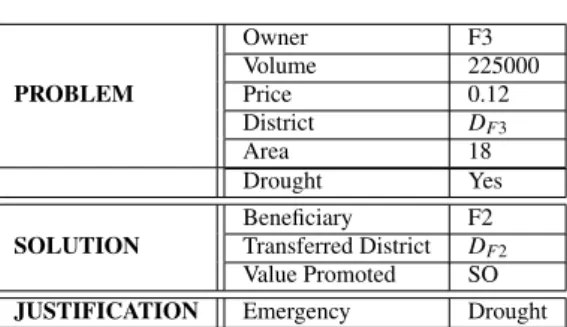
Table 1: Domain-CaseC2 PROBLEM Owner F3 Volume 225000 Price 0.12 District DF3 Area 18 Drought Yes SOLUTION Beneficiary F2 Transferred District DF2 Value Promoted SO JUSTIFICATION Emergency Drought
urgent irrigation of its land during a drought. The volume of water transferred is of 225.000 liters at a price of
150
0.12 Euros per liter andDF3has an area of 18 acres. Therefore,F2 will store in its case-base the domain-case
151
C2 (shown in Table 1) to represent the knowledge gained from this interaction4.
152
A case-base with argument-cases that store previous argumentation experiences and their final outcome.
153
Argument-cases have three main objectives: they can be used by agents 1) to generate new arguments; 2)
154
to strategically select the best position to put forward in view of past argumentation experiences; and 3) to
155
store the new argumentation knowledge gained in each agreement process, improving the agents’
argumen-156
tation skills. The case-base of argument-cases of the farmers of the water-right transfer scenario will store
157
information about the arguments that these farmers put forward to be selected as beneficiaries of the transfer
158
in previous agreement processes. For instance, let us assume that in a new dialogue with the basin
admin-159
istrator of a groupG, the argument of F2 supporting its candidacy as beneficiary of the transferF2tr was
160
rejected (for instance, since in this river basin economic values prevail over solidarity and the administrator
161
prefers to authorize the transfer to another irrigator). Thus, the farmer agentF2 would store in its case-base
162
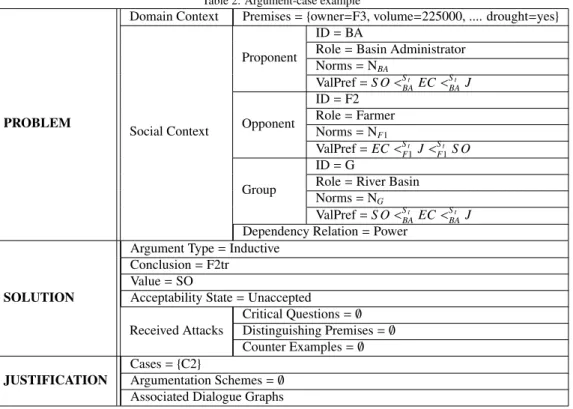
an argument-case representing the knowledge that it has gained about this transaction (see Table 2 for an
163
example).
164
We use ontologies as the representation language for the knowledge resources of our framework. Specifically, we
165
assume that domain-cases are instances of a domain-dependent ontology. Argumentation schemes are represented
166
by using theArgument Interchange Format (AIF)ontology, as proposed in (Rahwan et al., 2011). Also, to represent
167
argument-cases, we have created a case-based argumentation ontology, calledArgCBROnto5.
168
The structure of domain-cases and the specific set of argumentation schemes that an argumentation system that
169
implements our framework has depends on the application domain. Argument-cases are the main structure that we
170
use to computationally represent arguments in agent societies. In addition, their structure is generic and
domain-171
independent. Therefore, in this section, we focus on explaining the argument-case structure. Argument-cases have
172
the same three possible types of components that usual cases of CBR systems have: the description of the state of
173
the world when the case was stored (Problem); the solution of the case (Conclusion); and the explanation of the
174
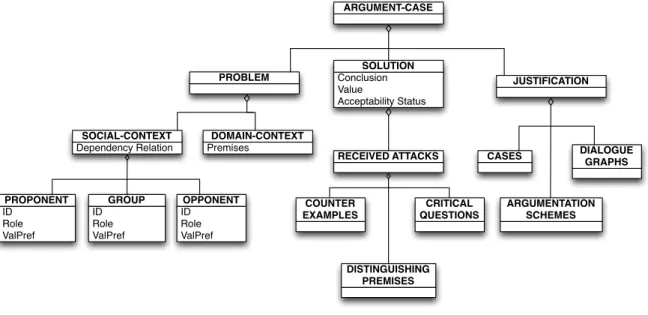
process that gave rise to this conclusion (Justification). Figure 2 shows the generic structure of an argument-case.
175
The problem description has adomain contextthat consists of thepremisesthat characterise the argument. In
176
addition, if we want to store an argument and use it to generate a persuasive argument in the future, the features
177
that characterise itssocial contextmust also be kept. The social context of the argument-case includes
informa-178
tion about theproponentand theopponentof the argument and about theirgroup. Moreover, we also store the
179
preferences (ValPref) of each agent or group over the set ofvaluesthat are pre-defined in the system. Finally,
180
thedependency relationbetween the proponent’s and the opponent’s roles is also stored. In our framework, we
181
consider three types of dependency relations as defined in (Dignum and Weigand, 1995): Power, when an agent
182
has to accept a request from another agent because of some pre-defined domination relationship between them;
183
Authorisation, when an agent has signed a contract with another agent to provide it with a service and hence, the
184
contractor agent is able to impose its authority over the contracted agent, andCharity, when an agent is willing
185
4This is based on the example developed in section 5
5The complete specification of the ArgCBROnto ontology can be found at:
http://gti-ia.dsic.upv.es/∼vinglada/docs/Sitio web/ArgCBROnto.html.
Table 2: Argument-case example
PROBLEM
Domain Context Premises={owner=F3, volume=225000, .... drought=yes}
Social Context
Proponent
ID=BA
Role=Basin Administrator Norms=NBA ValPref=S O<St BAEC< St BA J Opponent ID=F2 Role=Farmer Norms=NF1 ValPref=EC<St F1J< St F1S O Group ID=G
Role=River Basin Norms=NG
ValPref=S O<St
BAEC< St
BA J
Dependency Relation=Power
SOLUTION
Argument Type=Inductive Conclusion=F2tr
Value=SO
Acceptability State=Unaccepted Received Attacks Critical Questions=∅ Distinguishing Premises=∅ Counter Examples=∅ JUSTIFICATION Cases={C2} Argumentation Schemes=∅
Associated Dialogue Graphs
to answer a request from another agent without being obliged to do so. For instance, as pointed out above, in the
186
water-rights transfer scenario, the basin administrator has a power dependency relation over the farmers, while
187
they have a charity relation with each other.
188
Theconclusionof the case, thevaluepromoted, and theacceptability statusof the argument at the end of the
189
dialogue are stored in the solution part. The acceptability status shows if the argument was deemedacceptable,
190
unacceptable, or undecidedin view of the other arguments that were put forward in the agreement process. In
191
addition, the conclusion part includes information about the possibleattacksthat the argument received during
192
the process. These attacks could represent the justification for an argument to be deemed unacceptable or else
193
reinforce the persuasive power of an argument that, despite being attacked, was finally accepted. Specifically,
194
arguments in our framework can be attacked by putting forwarddistinguishing premisesorcounter-examplesto
195
them, as proposed in (Bench-Capon and Sartor, 2003), and also by questioning the validity of the conclusion drawn
196
from an argumentation scheme by instantiating acritical question.
197
Let us assume that we have a set of cases denoted asC, a set of premises denoted as F, a problem to solve
198
denoted asP(characterised by a subset of the premises ofF), and a functionvaluec(x) that returns the value of a
199
premisex∈Fin a casec∈C.
200
Definition 3.1(Distinguishing Premise). A distinguishing premise x with respect to a problem P between two
201
cases c1,c2 ∈ C is defined as: ∃x ∈ c1∧@x∈ P | ∃x ∈ c2∧valuec1(x) , valuec2(x)or else,∃x ∈ c1∧ ∃x ∈
202
Pmidvaluec1(x)=valueP(x)∧@x∈c2, where P⊆F, x∈F and c1,c2 ∈C.
203
Otherwise stated: a premise that does not appear in the description of the problem to solve and has different
204
values for two cases or a premise that appears in the problem description and does not appear in one of the cases.
205
For instance, in our example, if the problem specification does not include a premise that indicates that there is
206
drought in the river basin, the premiseDroughtofC2 can be used by another agent to attack an argument ofF2
207
that includesC2 as piece of evidence to supportF2 position.
208
Definition 3.2(Counter-Example). A counter-example for a case c1 ∈C with respect to a problem P is another 209
case c2∈C such that: acceptable(c2)∧ ∀xi∈c2∩P|valuec2(xi)=valueP(xi)∧ ∀xi∈c1|(∃xi∈c2∧valuexi(c2)= 210
valuexi(c1))∧conclusion(c2),conclusion(c1) 211
ARGUMENT-CASE Conclusion Value Acceptability Status SOLUTION PROBLEM JUSTIFICATION Dependency Relation SOCIAL-CONTEXT Premises DOMAIN-CONTEXT ID Role ValPref OPPONENT ID Role ValPref PROPONENT ID Role ValPref GROUP RECEIVED ATTACKS DISTINGUISHING PREMISES COUNTER EXAMPLES DIALOGUE GRAPHS CASES CRITICAL QUESTIONS ARGUMENTATION SCHEMES
Figure 2: Structure of an Argument-Case
Otherwise stated: a counter-example for a case is a previous case (i.e., domain-case or an argument-case that
212
was deemed acceptable), where the problem description of the counter-example matches the current problem to
213
solve and also subsumes the problem description of the case, but proposing a different solution. In our example,
214
a counter-example forC2 would be another domain-case that represents the situation where a similar transfer (in
215
terms of quantity of water, price, land extension, area, etc.) was assigned to another beneficiary.
216
Definition 3.3. A critical question is a question associated with an argumentation scheme that represents a
poten-217
tial way in which the conclusion drawn from the scheme can be attacked.
218
Critical questions can be classified aspresumptionsthat the proponent of the argumentation scheme has made
219
orexceptionsto the general inference rule that the scheme represents (Prakken et al., 2005). In the case of
pre-220
sumptions, the proponent has the burden of proof if the critical question is asked, whereas in the case of the
221
exceptions the burden of proof falls on the opponent that has questioned the conclusion of the scheme. Therefore,
222
if the opponent asks a critical question, the argument that supports this argumentation scheme remains temporally
223
rebutted until the question is conveniently answered. This characteristic of argumentation schemes makes them
224
very suitable to devise ways to attack the conclusions drawn from other agents. For instance, in our example the
225
argument-scheme presented in this section could include an exception to capture the fact that for a specific river
226
basin, the case of drought is not considered as an exception. Therefore, if an agent can provide pieces of evidence
227
to rise and justify this exception, the conclusion of the argument-case would be invalidated and the value preference
228
order of the associated basin would remain unchanged.
229
Finally, the justification part of an argument-case stores the information about the knowledge resources that
230
were used to generate the argument represented by the argument-case (the set of domain-cases, argument-cases,
231
and argumentation schemes). In addition, the justification of each argument-case has an associated
dialogue-232
graph(or several), which represents the dialogue where the argument was proposed. In this way, the sequence of
233
arguments that were put forward in a dialogue is represented (storing the complete conversation as a directed graph
234
that links argument-cases). This graph can be used later to improve the efficiency in an argumentation dialogue in
235
view of a similar dialogue that was held in the past.
236
As pointed out above, in our framework, agents can generate arguments from previous cases (domain-cases and
237
argument-cases) and from argumentation schemes. However, note that the fact that a proponent agent uses one or
238
several knowledge resources to generate an argument does not imply that it has to show all this information to its
239
opponent. The argument-cases of the agents’ argumentation systems and the structure of the actual arguments that
240
are interchanged among agents is not the same. Thus, arguments that agents interchange are defined as tuples of
241
the form:
242
Definition 3.4(Argument). Arg ={φ,v,{S}}, whereφis the conclusion of the argument, v is the value that the
243
agent wants to promote with it, and S is a set of elements that support the argument (support set).
244
This support set can consist of different elements, depending on the purpose of the argument. On one hand, if the
245
argument provides a potential solution for a problem, the support set is the set of features (premises) that represent
246
the context of the domain where the argument has been proposed (those premises that match the problem to solve
247
and other extra premises that do not appear in the description of this problem but that have also been considered to
248
draw the conclusion of the argument) and, optionally, any knowledge resource used by the proponent to generate
249
the argument (domain-cases,argument-cases, orargumentation schemes). Also, a supporting argument promotes
250
the value promoted by the position that it justifies. On the other hand, if the argument attacks the argument of
251
an opponent, the support set can also include any of the allowed attacks in our framework (critical questions,
252
distinguishing premises, orcounter-examples). In our framework, we assume that an attack argument promotes the
253
value promoted by the position that it tries to defend (if an agent has generated it to rebut an attack on its supporting
254
argument) or otherwise, an attack argument promotes the agent’s most preferred value over the set of values that is
255
pre-defined in the system (if an agent has generated it to attack the position of other agent).
256
For instance, in the water-right transfer domain, Arg = {F2tr,S O,{C2}}, would represent the argument that
257
farmer F2 has generated by using its domain-case C2 to justify that it should be the beneficiary of the transfer
258
(F2tr) to save his crop in a drought emergency (promoting solidarity (SO)).
259
4. Dialogue Game Protocol 260
To formalise the protocol that agents use to engage in argumentation processes by using our framework, we
261
follow adialogue gameapproach. Dialogue games are interactions between two or more players, where each
262
player ’moves’ by making statements that follow a pre-defined set of rules (McBurney and Parsons, 2002a).
Dia-263
logue games are a specific type of games fromgame theorythat are different from the classical games studied in
264
Economics, in the sense that the profits or losses for the victory or defeat are not considered. Another important
265
difference is that, in dialogue games, the participants are not able to model the potential moves of other
partici-266
pants by using an uncertainty measure, for instance, a probabilistic measure. These characteristics make dialogue
267
games a methodology that is suitable for modeling the interactions among heterogeneous agents in a dynamic
268
environment.
269
Specifically, we follow the dialogue game approach proposed in (McBurney and Parsons, 2002b) and extended
270
in (McBurney and Parsons, 2009). This approach is prospective (intended to model systems in order to represent
271
reality and that do not exist yet), which fits the objective of most open MAS. Other approaches for formalising
272
dialogue systems have been reviewed in (Prakken, 2006) (specifically, formal systems for persuasion dialogue).
273
However, most of these proposals are retrospective (intended to reconstruct/explain what happened in a dialogue,
274
using a legal dispute as typical example). Furthermore, they assume a consistent and presupposedcontextthat
275
represents fixed and indisputable knowledge that cannot be changed during the dialogue. This assumption cannot
276
be made in open MAS where heterogeneous agents with partial knowledge about the context of the dispute can
277
enter or leave the system (and hence the dialogue) at any time.
278
Throughout this paper, we assume that a set of agents with different positions (points of view) are arguing to
279
reach an agreement to solve a complex problem. Thus, our basic notion of agreement consists of a solution for a
280
generic problem that several agents must solve. At this level of abstraction, we assume that this is a generic problem
281
of any type (e.g., resource allocation, classification, prediction, etc.) that could be described with a set of features.
282
However, different notions of agreement can be found in the literature of agreement technologies (Carrascosa and
283
Rebollo, 2009). First, we introduce the notation that we use in defining the protocol. Subsequently, the protocol
284
syntax and semantics are presented. Finally, we provide a discussion on the protocol properties.
285
4.1. Notation
286
In our dialogue protocol we follow the standard that views utterances as composed by two layers: an internal
287
layer that represents thetopicsof the dialogue and an external layer that consists of thelocutionsor performatives
288
that define the allowed speech acts. On one hand, we assume that the topics of the inner layer can be represented
289
with well-formed formulae of the Description Logic (DL)SHOIN(D) (Horrocks and Patel-Schneider, 2004),
290
which forms the basis of the Web Ontology Language OWL-DL. As pointed out above, we have designed an
291
ontology calledArgCBROnto to define the representation language of arguments and argumentation concepts.
292
Ontologies provide a common vocabulary to understand the structure of information among different software
293
agents. In addition, ontologies allow assumptions about the domain to be made explicit, which facilitates to change
294
these assumptions as new knowledge about the domain is acquired. The high dynamism of the domains where open
295
MAS operate gives rise to many changes in the domain knowledge that agents have available. Therefore, they must
296
be able to efficiently handle the consequences of these changes. On the other hand, we use the standard operators
297
and axioms ofmodal logicsof knowledge and belief (Shoham and Leyton-Brown, 2009, Chapter 13) to define the
298
semantics of locutions.
299
In DLs, the important notions of the domain are described byconcept descriptions, which are expressions that
300
are built from atomicconcepts(unary predicates) and atomicroles(binary predicates relating concepts) using the
301
concept and role constructors provided by the specific DL. The semantics of DLs is given in terms ofinterpretations
302
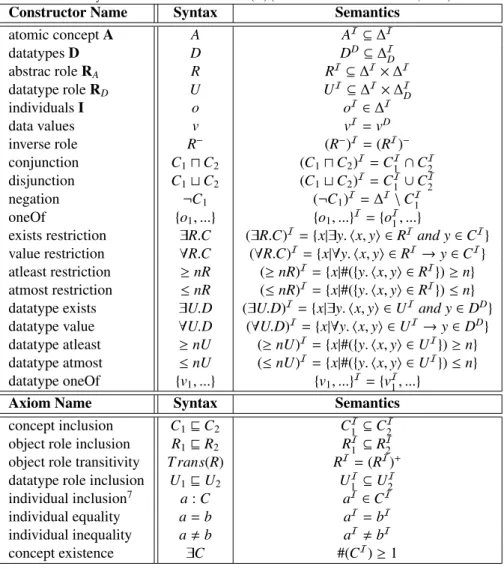
(Baader et al., 2007). Table 3 shows the syntax and semantics of the constructors ofSHOIN(D), using Roman
303
upper-case letters to representconcepts,datatypes, androlesand Roman lower-case letters to representindividuals
304
anddata values.
305
Table 3: Syntax and Semantics ofSHOIN(D) (Horrocks and Patel-Schneider, 2004).
Constructor Name Syntax Semantics
atomic conceptA A AI⊆∆I datatypesD D DD⊆∆I D abstrac roleRA R RI⊆∆I×∆I datatype roleRD U UI⊆∆I×∆ID individualsI o oI∈∆I data values v vI=vD inverse role R− (R−)I=(RI)− conjunction C1uC2 (C1uC2)I=CI1 ∩CI2 disjunction C1tC2 (C1tC2)I=CI1 ∪CI2 negation ¬C1 (¬C1)I= ∆I\C1I oneOf {o1, ...} {o1, ...}I={oI1, ...}
exists restriction ∃R.C (∃R.C)I={x|∃y.hx,yi ∈RIand y∈CI}
value restriction ∀R.C (∀R.C)I={x|∀y.hx,yi ∈RI→y∈CI}
atleast restriction ≥nR (≥nR)I={x|#({y.hx,yi ∈RI})≥n}
atmost restriction ≤nR (≤nR)I={x|#({y.hx,yi ∈RI})≤n}
datatype exists ∃U.D (∃U.D)I={x|∃y.hx,yi ∈UIand y∈DD}
datatype value ∀U.D (∀U.D)I={x|∀y.hx,yi ∈UI→y∈DD}
datatype atleast ≥nU (≥nU)I={x|#({y.hx,yi ∈UI})≥n}
datatype atmost ≤nU (≤nU)I={x|#({y.hx,yi ∈UI})≤n}
datatype oneOf {v1, ...} {v1, ...}I={vI1, ...}
Axiom Name Syntax Semantics
concept inclusion C1vC2 CI1 ⊆CI2
object role inclusion R1vR2 RI1 ⊆R
I 2
object role transitivity T rans(R) RI=(RI)+
datatype role inclusion U1vU2 UI1 ⊆U2I
individual inclusion7 a:C aI∈CI
individual equality a=b aI=bI
individual inequality a,b aI
,bI
concept existence ∃C #(CI)≥1
Like description logic,SHOIN(D) uses concept descriptions to build statements in a DL knowledge baseK(the
306
analogue of an ontology in OWL-DL), which typically comes in two parts:terminological (TBox), andassertional
307
(ABox). In the TBox, we can describe the relevant notions of an application domain by stating properties of
308
concepts and roles and relationships between them. For instance, the notions of agents and arguments are defined
309
in our argumentation framework with the concepts ofAgentandArgumentof the ArgCBROnto and the following
310 axioms: 311 S ocialEntityvT hing 312 9
AgentvS ocialEntity
313
ArgumentvT hing
314
Thepropertiesof an argument are defined with the roleshasConclusion,promotesValue, andhasS upportS et
315
and the following axioms and value restrictions:
316
Argumentv ∀hasConclusion.Conclusion
317
Argumentv ∀promotesValue.Value
318
Argumentv ∀hasS upportS et.S upportS et 319
which state that arguments can have three properties that relate them to objects of the classConclusion,Value,
320
andS upportS et. Correspondingly, the ABox represents the concrete data of the databaseK, with the individuals
321
of concepts (instances) and their properties. For instance, the ABox of the ArgCBROnto ontology can include an
322
argumentargthat promotes a valuesolidarity:
323
Argument(arg)
324
promotesValue(arg,solidarity)
325
On the other hand, the syntax of the external layer of utterances (locutions) is the same syntax as proposed in
326
(McBurney and Parsons, 2004):
327
locution(as, φ) orlocution(as,ar, φ) 328
whereAgent(as) (the sender) and Agent(ar) (the receiver) are individuals of the Agentconcept andφ is the
329
content of the utterance. The first locution is addressed to all participants in the dialogue, whereas the second is
330
specifically sent toAgent(ar). We denote the set of well-formed formulae inSHOIN(D) asD. Then,φ∈ Dcan
331
represent statements about problems to solve, evidence about the world, or different types of arguments. Also,
332
we denote the set of individuals members of the conceptArgument asAsuch that ∀arg ∈ A,Argument(arg).
333
Therefore,Φis said to be an argument in support ofφifΦ ∈ A/Φ `+ φ. Correspondingly, Φis said to be an
334
argument againstφifΦ∈ A/Φ`−φ.
335
Also, agents makepropositional commitments(also known as dialogical commitments) with each locution that
336
they put forward. Therefore, if an agent asserts a locution and another agent challenges it, the first agent has the
337
commitment to provide reasons (or arguments) to justify the validity of that assertion or else, it has to retract it.
338
All commitments made by an agent during the dialogue are commonly stored in an individual database called
339
commitment store (CS)(Hamblin, 1970) (there is one commitment store per agent), which is accessible by other
340
agents that are engaged in a dialogue with the agent.
341
As pointed out above, we follow the standard notation ofmodal logicsof knowledge and belief described in
342
(Shoham and Leyton-Brown, 2009, paper 13). Thus, we use the modal operators
343
Kiφ: “Agentaiknowsφ”
344
Biφ: “Agentaibelieves thatφis true”
345
Cgφ: “φis common knowledge for any agent in the groupgif any agent of the group knows it and knows that it
346
is common knowledge”
347
and the modal connective
348
♦φis satisfied now ifφis satisfied either now or at some future moment.
349
Note that here we make a distinction between what agentsknow(which is considered to be true) and what agents
350
believe(which forms part of the mental state of an agent and may be true or not). For instance, all farmers
351
that belong to the river basin society of our exampleknowthat the basin administratorbelievesthat avoiding the
352
intervention of a jury will save costs in the water-right transfer process. The farmers know what the administrator
353
believes. However, this doesn’t necessarily mean that the basin administrator’s opinion is appropriate and, in
354
fact, any farmer can believe that promoting other values may be more appropriate. Therefore, the opinion of the
355
administrator is subjective and depends on its knowledge; however due to the administrator’s power dependency
356
relation over farmers, the farmers have to accept the administrator’s point of view.
357
In addition, as proposed in (McBurney and Parsons, 2004), we use the following simplified elements ofFIPA’s
358
communicative act library specification8:
359
Done[locution(as, φ), preconditions] 360
which indicates thatlocution(as, φ) (or correspondinglylocution(as,ar, φ)) has been put forward by agentas
(ad-361
dressed to agent(s)ar) with contentφand that the specifiedpreconditionshold before this utterance and
362
Feasible[condition, locution(as, φ)] 363
which means that ifconditioncan take place,locution(as, φ) (or correspondingly locution(as,ar, φ)) will be put
364
forward by agentas(addressed to agent(s)ar) with contentφ.
365
Further notation that we use throughout this paper includes the following:
366
as: theAgent(as) sender of the locution.
367
ar: theAgent(ar) receiver of the locution.
368
argi: anArgument(argi) of anAgent(ai). 369
S Si: theS upportS et(S Si) of theArgument(argi) that has put forward anAgent(ai).
370
CSi: the commitment store of anAgent(ai).
371
q: theProblem(q) under discussion.
372
pi: theS olution(pi) (or position) proposed by anAgent(ai) to solve theProblem(q).
373
4.2. Protocol Syntax
374
In this section, we provide the syntax of the communication protocol that the agents of our argumentation
frame-375
work follow. Therefore, we present the elements of the dialogue: the set of allowedlocutions, thecommencement
376
rules, thecombination rulesthat govern the course of the dialogue, thecommitment rulesthat define the
commit-377
ments that each agent makes when it utters each locution and how these commitments can be combined, therules
378
for speaker order, and thetermination rules. The dialogue game presented in this section is aimed at providing a
379
communication protocol for agents that engage in an agreement process. This process can be viewed from several
380
perspectives: as acollaborative deliberation, where all agents select the best solution for a problem at hand and
381
do not perceive any reinforcement or reward if their position is selected as the final solution to be applied; as a
ne-382
gotiation, where agents try to convince other agents to apply their solution as the best one for solving the problem
383
(with individualutility functionsthat increase their perceived utility); or as apersuasion, where each agent tries
384
to persuade the rest of the agents to change their opinions and support its solution as the best option to solve the
385
problem.
386
Locutions
387
The set of allowed locutions of our dialogue game are the following:
388
• L1: open dialogue(as, φ), where φ is a problem q to solve in the system application domain. With this 389
locution, an agent as opens the argumentation dialogue, asking other agents to collaborate or negotiate to
390
solve a problem that the agent has been presented with.
391
• L2: enter dialogue(as, φ), where φ is a problemq to solve in the system application domain. With this 392
locution, an agentasengages in the argumentation dialogue to solve the problem.
393
• L3: withdraw dialogue(as, φ), whereφis a problemqto solve in the system application domain. With this 394
locution, an agentasleaves the argumentation dialogue to solve the problem.
395
8http://www.fipa.org/specs/fipa00037/SC00037J.html
• L4: propose(as, φ), whereφis a positionp. With this locution, an agentasputs forward the positionpas its 396
proposed solution to solve the problem under discussion in the argumentation dialogue.
397
• L5: why(as,ar, φ), whereφcan be a position por an argumentarg ∈ A. With this locution, an agentas
398
challenges the positionpor the argumentargof an agentar, asking it for a supporting argument.
399
• L6: noCommit(as, φ), whereφis a positionp. With this locution, an agentaswithdraws its position pas a 400
solution for the problem under discussion in the argumentation dialogue.
401
• L7: assert(as,ar, φ), whereφcan be an argumentarg∈ Athat supports a position, another argument, or an 402
objectively verifiable evidence about the system application domain. With this locution, an agentas sends
403
to an agentar an argument or an evidence that supports its position or a previous argument thatar has put
404
forward.
405
• L8: accept(as,ar, φ), whereφ can be an argumentarg ∈ Aor a position pto solve a problem. With this 406
locution, an agentas accepts the argumentargor the position pof an agentar. Also, this locution can be
407
used at the end of the dialogue to inform all agents about the final position agreed upon as the best position
408
to solve the problem. In that case,ardenotesallindividuals that belong to the conceptAgent, except for the
409
senderas(all: ∀ai,ai,as/Agent(ai)). 410
• L9: attack(as,ar, φ), where φ is an argument arg ∈ A of an agentas. With this locution, an agent as 411
challenges an argument of an agentarwith its argumentarg.
412
• L10:retract(as,ar, φ), whereφis an argumentarg∈ A. With this locution, an agentasinforms an agentar 413
that it withdraws the argumentargthat it put forward in a previous step of the argumentation dialogue.
414
Commencement Rules
415
The dialogue starts when an agentasis presented with a new problemqto solve. First, the agent tries to solve
416
it by using its own knowledge resources. Then, it opens a dialogue with other agents by sending them the locution
417
open dialogue(as,ar,q), wherearcan be any agentaithatasknows. After that,aienters in the dialogue by posing 418
the locutionenter dialogue(as,q) (whereas=ai). After that, ifaihas been able to find a solution forq, it proposes
419
this initial position pto solve the problemqwith the locution propose(as,p) (whereas =ai) and waits for the
420
challenges of other agents or for other position proposals. Otherwise,aican challenge the positions of other agents
421
engaged in the dialogue with the locutionwhy(as,ar,p) (whereas=ai).
422
Rules for the Combination of Locutions
423
The rules for the combination of locutions define which locution can be put forward at each step of the dialogue
424
game. Figure 3 represents a state machine with the possible stages of our dialogue game protocol. As shown in
425
the figure, the protocol has three main stages: theopeningstage, where the agent that initiates the dialogue opens
426
the argumentation process to solve a problem; theargumentationstage, where agents argue to reach an agreement
427
about the best solution to apply to solve the problem; and theclosingstage, where the final decision about the
428
position selected to solve the problem is reported to all agents that have participated in the dialogue. The stages of
429
our dialogue game and the rules for the combination of locutions in each stage are presented below.
430
open_dialogue(as, q) accept(as, all, p)
OPENING STAGE ARGUMENTATION STAGE CLOSING STAGE
Figure 3: State Machine of the Dialogue Game
Opening Stage: 431
The opening stage commences when an agentas wants to establish an agreement process with other agents
432
to solve a problemqthat it has been faced with. Then, it uses the locutionopen dialogue(as,q) to start the dialogue.
433
434
Argumentation Stage: 435
R1 R2 R3 R4 R5 R6 R7 withdraw_dialogue(as, q) propose(as, p) withdraw_dialogue(aj, q) why(as,ar, p) noCommit(as, p)
assert(as, ar, arg) accept(as, ar, arg)
attack(as, ar, arg)
retract(as, ar, arg)
assert(as, ar, arg)/ [arg = CQ ∧
CQ.type = presumption]
why(as,ar, arg)/ [arg = CQ ∧
CQ.type = exception] retract(as, ar, arg)
R8 assert(as, ar, arg)
retract(as, ar, arg) attack(as, ar, arg) /
[arg = DP ∨ CE]
enter_dialogue(as, q)
attack(as, ar, arg) accept(as, ar, p)
noCommit(as, p)
retract(as, ar, arg)
retract(as, ar, arg) why(as,ar, p)
Figure 4: State Machine of the Argumentation Stage
The argumentation stage follows the opening stage. Here, agents argue to reach an agreement about the solution
436
to apply to the problemq. As shown in Figure 4, this stage is divided into a set of substages whose activation is
437
defined by the following rules (for reasons of clarity, substages are labelled with the name of the rule that applies
438
in each case):
439
• R1: Once the dialogue has been opened, any agent that has been informed about it can enter in by using the
440
locutionenter dialogue(as,q).
441
• R2:After entering the dialogue, an agent can propose its positionpto solve the problemqby putting forward
442
the locution propose(as,p). Alternatively, the agent can challenge the positions of other agents engaged in
443
the dialogue (without its own position being proposed) with the locutionwhy(as,ar,p). Also, in this substage,
444
the agent can withdraw from the dialogue by using the locutionwithdraw dialogue(as,q).
445
• R3:In this substage, an agent that has proposed its positionpto solve the problemqcan be asked by another
446
agent for an argument to support this position with the locutionwhy(as,ar,p). Also,pcan be accepted by an
447
agent engaged in the dialogue, who reports to the proponent agent with the locutionaccept(as,ar,p).
Fur-448
thermore, the proponent agent can withdraw its positionpwith the locutionnoCommit(as,p). Alternatively,
449
it can leave the dialogue with the locutionwithdraw dialogue(as,q).
450
• R4: After being asked for an argument to support its positionp, an agent can use its knowledge resources to
451
provide the requester agent with this argumentargby means of the locutionassert(as,ar,arg). Alternatively,
452
it can withdraw its position pby using the locutionnoCommit(as,p).
453
• R5: An agent that has received a support or an attack argument from another agent can use its knowledge
454
resources to create an attack argumentargand send it to the other agent with the locutionattack(as,ar,arg).
455
Also, the agent can accept the supporting argument and report to the other agent with the locution
456
accept(as,ar,arg), wherearg is the supporting argument received. In its turn, an agent that has asserted 457
the argumentargcan withdraw it with the locutionretract(as,ar,arg).
458
• R6: When an agent receives an attack argument from another agent, it analyses the type of the attack and
459
can use its knowledge resources to try to rebut the attack. Therefore, if the attacking argumentargwas a
460
distinguishing premise or a counter-example (arg = (DP∨CE)), the agent can distinguish the argument
461
of the other agent with other distinguishing premise or else counter-attack with another counter-example by
462
using the locutionattack(as,ar,arg). If the attacking argument was a critical question of the type presumption
463
(arg=CQ∧CQ.type=presumption), the agent can use its knowledge resources to create and show the other
464
agent an argumentargwith evidence that supports that presumption by using the locutionassert(as,ar,arg).
465
Finally, if the attacking argument was a critical question of the type exception (arg = CQ∧CQ.type =
466
exception), the agent can ask the other agent for an argument to support this critical question by stating the
467
locutionwhy(as,ar,arg). Alternatively, if the agent cannot rebut the attack, it can retract its argument with
468
the locutionretract(as,ar,arg). In its turn, any agent that has asserted the argumentargcan withdraw it with
469
the locutionretract(as,ar,arg). 470
• R7:If an agent is asked by another agent to provide a supporting argument for its critical question of the type
471
exception, this agent must use the locutionassert(as,ar,arg) to assert an argumentargwith evidence to
sup-472
port this critical question attack or else retract the attack by putting forward the locutionretract(as,ar,arg).
473
• R8: Once an agent has been provided by another agent with evidence that supports the other agent’s critical
474
question of the type exception, the fist agent can retract its argumentargand report to the other agent with the
475
locutionretract(as,ar,arg) or else can try to generate an attack argumentargfor the other agent’s argument
476
and send it the locutionattack(as,ar,arg).
477
Also, note that any agent can withdraw its position at any stage of the dialogue. It implies that there is a transaction
478
labelled with the locutionnoCommit(as,p) from substagesR5...R8 to substageR2. However, these substages do
479
not appear in Figure 4 for reasons of clarity.
480
481
Closing Stage: 482
The closing stage can be activated at any time in the dialogue by the agentaithat opened it. This stage is reached
483
by putting forward the locutionaccept(as,all,p) (whereas=ai), which informs all the participating agents about
484
the final positionp agreed upon as the solution for the problemq. Here, the commitment store of all agents is
485
deleted.
486
Commitment Rules
487
As pointed out above, agents makedialogical commitmentswith each locution that they put forward. These
488
commitments are stored in an individual commitment database calledcommitment store (CS). Also, the
inclu-489
sion of a new commitment in the commitment store can make previous commitments be inconsistent or invalid.
490
The commitment rules that define the commitments associated with each locution and how their inclusion in the
491
commitment store affects previous commitments are presented below.
492
• CR1:The locutionenter dialogue(as,q) gives rise to the creation of the commitment storeCSsof the sender
493
agent.
494
• CR2:The locution propose(as,p) inserts the positionpinto the commitment storeCSsof the sender agent.
495
If there is a previous position inCSs, this position is replaced with the new positionp. Thus, only one position
496
can prevail in any commitment store.
497
• CR3: The locutionwithdraw dialogue(as,q) deletes the commitment storeCSs of the sender agent. This
498
implies that the final agreement is only taken among the agents that remain listening in the substagesR2 or
499
R3. Also, agents cannot withdraw the dialogue before withdrawing any position that they have proposed with
500
the locutionnoCommit(as,p).
501
• CR4: The locutionaccept(as,ar,p) inserts the position pinto the commitment storeCSs of the sender. If
502
there is a previous position inCSs, this position is replaced with the new positionp.
503
• CR5:The locutionnoCommit(as,p) deletespfrom the commitment storeCSsof the sender.
504
• CR6:The locutionwhy(as,ar,p) commits the receiver to provide the sender with a supporting argumentarg
505
for por else to withdrawpwith the locutionnoCommit(as, p).
506
• CR7: The locutionassert(as,ar,arg) inserts the argumentargin the commitment storeCSsof the sender.
507
Also, commitment stores cannot have inconsistent arguments. Therefore, if the conclusion of arg
con-508
tradicts the conclusion of a previous argument stored in CSs, the sender cannot put forward the locution
509
assert(as,ar,arg) before deleting the inconsistent argument fromCSswith the locutionretract(as, ar, arg) ad-510
dressed to any agent that is maintaining a dialogue with the sender. Furthermore, ifargincludes in its support
511
set an argumentation scheme with a critical question of the type presumption, the locutionassert(as,ar,arg)
512
commits the sender to provide evidence to support this argument if another agent attacks it with the locution
513
attack(as,ar,arg), whereargincludes such critical question, or else to retract the argument. 514
• CR8:The locutionaccept(as,ar,arg) inserts the argumentarginto the commitment storeCSsof the sender. 515
Again, commitment stores cannot have inconsistent arguments. Therefore, if the conclusion ofargcontradicts
516
the conclusion of a previous argument stored inCSs, the sender cannot put forward the locutionassert(as, ar,
517
arg)before deleting the inconsistent argument fromCSs with the locutionretract(as, ar, arg)addressed to
518
any agent that is maintaining a dialogue with the sender.
519
• CR9:The locutionretract(aj,ak,arg) deletes the argumentargfrom the commitment storeCSjofaj.
520
• CR10: The locutionattack(as,ar,arg) inserts the argumentargin the commitment storeCSsof the sender. 521
As pointed out above, commitment stores cannot have inconsistent arguments. Therefore, if the
conclu-522
sion of arg contradicts the conclusion of a previous argument stored inCSs, the sender cannot put
for-523
ward the locution attack(as,ar,arg) before deleting the inconsistent argument fromCSs with the locution
524
retract(as,ar,arg) addressed to any agent that is maintaining a dialogue with the sender. Also, ifargincludes 525
an argumentation scheme with a critical question of the type exception, the locutionattack(as,ar,arg)
com-526
mits the sender to provide an evidence to support this attack if another agent challenges this exception with
527
the locutionwhy(as,ar,arg), or else to retract it.
528
• CR11: The locutionaccept(as,all,p) (all : ∀ai,ai ,as | Agent(ai)) deletes the commitment stores of all 529
agents that are still participating in the dialogue (including the initiator). This is a special case of commitment
530
rule that grants the initiator to manage the commitment stores of other agents and ensures an ordered
termi-531
nation of the dialogue. Thus, we assume the existence of a normative level that all participants agree upon
532
before they are able to enter in the dialogue.
533
Rules for Speaker Order
534
During the dialogue, agents take turns putting forward locutions. Each time an agentas sends a locution to
535
another agentar, it waits for an answer fromar. However, any agent can hold parallel argumentation dialogues
536
with several agents. Thus, in each of these dialogues, the argumentation succeeds as a two-party dialogue between
537
two agents, one agent sending a locution to the other agent and waiting for a response. Nevertheless, the locution
538
open dialogue(as,q) is received by all agents of the societySt. The locutionsaccept(as,all,p),propose(as,p), 539
noCommit(as,p) andwithdraw dialogue(as,p) are received by all of the agents that are engaged in the dialogue. 540
With these locutions, the sender agent does not expect any response.
541
In this dialogue game protocol, we assume that all participating agents can always see the positions of the other
542
agents by looking at their commitment stores. Also, when two agents are engaged in a dialogue, each agent has full
543
view to the commitment store of the other agent. In this way, these agents can see the commitments associated to
544
the arguments of their partners, but other agents can only see to the positions proposed by each agent in the dialogue
545
(which are also stored in the commitment stores). This preserves the privacy of the arguments that an agent puts
546
forward in its argumentation dialogue with another agent. Note that if an agent wants to ask other agents for an
547
opinion about an argument that it has received, it simply has to send those agents the argument, as if the argument
548
was its own. This simple rule allows us to use the same dialogue game to govern collaborative deliberations,
549
persuasion dialogues, and negotiations. In the collaborative deliberations, all agents follow the common objective
550
of proposing the best solution for a problem at hand. Therefore, there are no agents interested in trying to take
551
advantage of the information interchanged between other agents to obtain a greater benefit with the final agreement
552
reached. However, this could be the case in a persuasion or a negotiation, where each agent tries to persuade other
553
agents to change their point of view or tries to increase its perceived utility value with the final agreement, thereby
554
using any extra information about other agents’ knowledge and preferences in order to achieve that.
555
Termination Rules
556
The normal termination of the dialogue occurs when the argumentation process ends with all participating agents
557
having proposed a prevailing position or having accepted the position of another agent. Then, agents may reach
558
a decision about the final solution for the problem under discussion. In the ideal case, only the position of one
559
participating agent prevails, while the other agents have withdrawn theirs and accepted this position by using
560
the locutionaccept(as,ar,p). However, if at the end of the dialogue more than one position is still undefeated,
561
agents can use a voting mechanism (selecting the position most accepted) or a random selection to decide the final
562
outcome of the agreement process.
563
In any case, the agentaithat opened the dialogue is responsible for reporting to all participating agents the final
564
position p that has been selected as solution for the problemqat hand, by using the locution accept(as,all,p)
565
(whereas = ai). To avoid infinite dialogues, agents cannot put forward the same argument twice during a dia-566
logue with another agent, unless new pieces of evidence are available. Furthermore, a maximum time to reach an
567
agreement can be established and agents must accept a position among those available at that moment to solve the
568
problem.
569
Note that agents can maintain several parallel dialogues with other agents. Thus, once an agent has entered in the
570
argumentation process with the locutionenter dialogue(as, q), it remains waiting to propose a position in substage
571
R2 or listening to incoming locutions of other agents in substageR3. Then, the specific dialogue with an agent that
572
has asked another agent for a supporting argument for its positionpcontinues the subsequent substages, but the
573
agent still remains inR3 listening to other requests. Finally, the locutionnoCommit(as,p) commits the sender to
574
terminate any dialogue that it has started to defendp.
575
4.3. Semantics
576
In this section, we provide the formal semantics for the locutions of our dialogue game protocol. This semantics
577
provides a common understanding about the properties of the communication language between agents. There
578
are different methods for providing a communication language with a semantics (Tennent, 1991), for instance, the
579
operationalapproach followed in this paper.
580
Operational semantics views the dialogue game protocol as an abstract state machine and precisely defines the
581
transitions between states. These transitions are triggered by the utterance of each locution. However, from some
582
stages, an agent can utter different locutions following differentagent decision mechanisms, which are reasoning
583
mechanisms that agents can use to choose the locution to utter in the next step of the dialogue among a set of
584
candidates. These mechanisms depend on the knowledge that agents can infer from their knowledge resources or
585
even on the specific design of agents. For instance, agents that are designed to be more competitive and, if possible,
586
always put forward attack arguments or agents that are designed to remain listening and only engage in a dialogue
587
if their positions or arguments are attacked. Figure 5 shows the decision mechanisms that agents can use in each
588
substage of the argumentation stage of our protocol. For purposes of clarity , the arrows labelled with the decision
589
mechanismD8(presented below) from substagesR5,R6,R7, andR8to substageR2are omitted in the figure.
590 R1 R2 R3 R4 R5 R6 R7 D3: withdraw_dialogue(as, q) D4: propose(as, p) D3: withdraw_dialogue(aj, q) D5: why(as,ar, p) D6: noCommit(as, p)
D6: assert(as, ar, arg) D9: accept(as, ar, arg)
D9: attack(as, ar, arg)
D13: retract(as, ar, arg)
D11: assert(as, ar, arg)/ [arg = CQ ∧ CQ.type = presumption]
D11: why(as,ar, arg)/ [arg = CQ ∧ CQ.type = exception] D11: retract(as, ar, arg)
R8 D12: assert(as, ar, arg)
D12: retract(as, ar, arg) D11: attack(as, ar, arg) /
[arg = DP ∨ CE]
D2: enter_dialogue(as, q)
D13: attack(as, ar, arg) D5: accept(as, ar, p)
D8: noCommit(as, p)
D7: retract(as, ar, arg)
D10: retract(as, ar, arg) D4: why(as,ar, p)
D1: open_dialogue(as, q)
D12: close_dialogue(as, all, p)
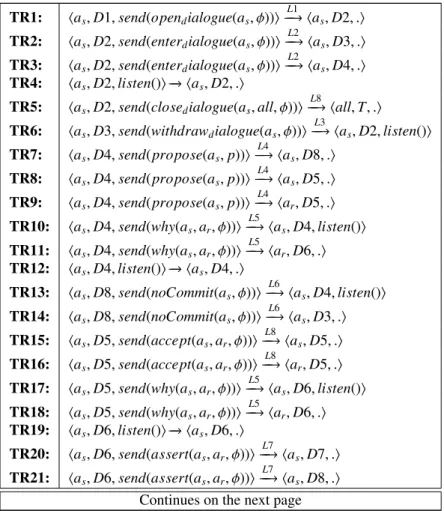
Figure 5: Decision Mechanisms of the Dialogue Game
To define the transition rules of our protocol we follow the notation of (McBurney and Parsons, 2004):
591
hai,K,oi 592
whereaiis an agent,Kis a decision mechanism (or the terminal stateT), andois the output of the mechanismK
593
(send a locution or remain listening to incoming locutions). Some transitions are labelled with the locutions that
594
trigger them while others (which occur between the mechanisms of a single agent) remain unlabeled. Also, if no
595
specific output is invoked, we denote this by a period in the third parameter of the triple (hai,K, .i).
596
Specifically, we have identified the following decision mechanisms:
597