Influence of Granulocyte-Macrophage
Colony-Stimulating Factor or Influenza
Vaccination on HLA-DR, Infection and
Delirium Days in Immunosuppressed Surgical
Patients: Double Blind, Randomised
Controlled Trial
Claudia Spies1☯*, Alawi Luetz1☯, Gunnar Lachmann1, Markus Renius1, Clarissa von Haefen1, Klaus-Dieter Wernecke2, Marcus Bahra3, Alexander Schiemann1,
Marco Paupers1, Christian Meisel4
1Department of Anesthesiology and Intensive Care Medicine, Campus Charité Mitte and Campus Virchow-Klinikum, Charité–Universitätsmedizin, Berlin, Germany,2Sostana GmbH, Berlin, Germany,3Department of General, Abdominal and Transplantation Surgery, Charité–Universitätsmedizin Berlin, Campus Virchow-Klinikum, Berlin, Germany,4Institute of Medical Immunology, Charité–Universitätsmedizin Berlin, Campus Virchow-Klinikum, Berlin, Germany
☯These authors contributed equally to this work.
Abstract
Purpose
Surgical patients are at high risk for developing infectious complications and postoperative delirium. Prolonged infections and delirium result in worse outcome. Granulocyte-macro-phage colony-stimulating factor (GM-CSF) and influenza vaccination are known to increase HLA-DR on monocytes and improve immune reactivity. This study aimed to investigate whether GM-CSF or vaccination reverses monocyte deactivation. Secondary aims were whether it decreases infection and delirium days after esophageal or pancreatic resection over time.
Methods
In this prospective, randomized, placebo-controlled, double-blind, double dummy trial set-ting on an interdisciplinary ICU of a university hospital 61 patients with immunosuppression (monocytic HLA-DR [mHLA-DR]<10,000 monoclonal antibodies [mAb] per cell) on the first day after esophageal or pancreatic resection were treated with either GM-CSF (250μg/m2/ d), influenza vaccination (Mutagrip 0.5 ml/d) or placebo for a maximum of 3 consecutive days if mHLA-DR remained below 10,000 mAb per cell. HLA-DR on monocytes was mea-sured daily until day 5 after surgery. Infections and delirium were followed up for 9 days a11111
OPEN ACCESS
Citation:Spies C, Luetz A, Lachmann G, Renius M, von Haefen C, Wernecke K-D, et al. (2015) Influence of Granulocyte-Macrophage Colony-Stimulating Factor or Influenza Vaccination on HLA-DR, Infection and Delirium Days in Immunosuppressed Surgical Patients: Double Blind, Randomised Controlled Trial. PLoS ONE 10(12): e0144003. doi:10.1371/journal. pone.0144003
Editor:Sachin Yende, University of Pittsburgh, UNITED STATES
Received:July 11, 2015 Accepted:November 11, 2015 Published:December 7, 2015
Copyright:© 2015 Spies et al. This is an open access article distributed under the terms of the
Creative Commons Attribution License, which permits
unrestricted use, distribution, and reproduction in any medium, provided the original author and source are credited.
Data Availability Statement:Due to legal restrictions imposed by the Ethics Committee of the Landesamt für Gesundheit und Soziales Berlin (LaGeSo) and the data protection commissioner of the Charité, public sharing of study data with other researchers or entities is not allowed. Requests may be send [email protected]. Funding:Funding provided by Deutsche Forschungsgemeinschaft (DFG SP432-1),http://
was increased after vaccination (p = 0.003).
Conclusion
Treatment with GM-CSF in patients with postoperative immune suppression was safe and effective in restoring monocytic immune competence. Furthermore, therapy with GM-CSF reduced duration of infection in immune compromised patients. However, influenza vacci-nation increased duration of delirium after major surgery.
Trial Registration
www.controlled-trials.com ISRCTN27114642
Introduction
Postoperative infections and delirium occur in up to 50% of high-risk patients undergoing
high-risk surgery requiring intensive care unit (ICU) and prolonged hospital stay [1–6].
Surgi-cal inflammatory stress can cause delirium and immune suppression [7–10]. Postoperative
immune suppression increases the risk for infections and delirium [11–13].
Immune suppression can be measured by a decreased level of human monocyte leukocyte
antigen-DR receptor (mHLA-DR) expression on monocytes [12], a hallmark of monocyte
deactivation associated with impaired innate and adaptive immune responses [14,15].
Pro-longed downregulation of mHLA-DR has been associated with worse outcomes such as
infec-tious complications, severe sepsis and increased mortality in ICU patients [16–19].
Several studies have demonstrated that suppressed mHLA-DR could be restored by admin-istration of vaccination or Granulocyte-Macrophage Colony-stimulating factor (GM-CSF)
[20–27]. Our research group found an increase in mHLA-DR after influenza vaccination in
patients with untreated cancer of the upper aero-digestive tract [23] and after preoperative
vac-cination [28]. Others found the normalization of the immunoregulatory index and the
stimula-tion of the phagocytic funcstimula-tion in the absence of essential influence on the level of HLA-DR
+ expression [29]. GM-CSF was known to restore reduced mHLA-DR in patients after cardiac
surgeryex vivo[25] as well asin vivoin patients with sepsis [24,26,27]. However, whether
GM-CSF or vaccination restore HLA-DR after major surgery in immunosuppressed patients is not known.
The primary aim of the study was to investigate the effect of postoperative treatment with GM-CSF or influenza vaccination on mHLA-DR expression. Secondary endpoints were the number of infection and delirium days.
study design, data collection and analysis, decision to publish or preparation of the manuscript. The specific roles of these authors are articulated in the‘author contributions’section.
Competing Interests:Deutsche
Forschungsgemeinschaft DFG SP432-1,http://www.
dfg.de/. The funders had no role in study design, data
collection and analysis, decision to publish, or preparation of the manuscript. Charité -Universitätsmedizin Berlin (www.charite.de). The funders had no role in study design, data collection and analysis, decision to publish, or preparation of the manuscript. See ICMJE Statistical analysis has been supervised by Professor Klaus-Dieter Wernecke, PhD, former head of the Institute of Medical Biometry at Charité - Universitätsmedizin Berlin and owner of Sostana GmbH. The authors confirm that it does not alter the authors' adherence to all PLOS ONE policies on sharing data and materials.
Materials and Methods
Study Participants and Design
The first patient was enrolled on October 26, 2008. However, due to technical issues including the payment process, the first acceptance of the corresponding ISRCTN application was delayed (December 05, 2008). As a consequence 4 patients were included in the study before acceptance of the trial registration. The authors confirm that all ongoing and related trials for this drug/intervention are registered.
Patients with immune suppression on day 1 after esophageal or pancreatic resection (pod1)
were included in this prospective, randomized, placebo-controlled, double-blind, double dummy trial. Immune suppression was defined as reduced mHLA-DR levels of less than
10,000 monoclonal antibodies (mAb) per cell [12]. Patient enrollment was from October 2008
to April 2011. Patients were included if they were scheduled for elective esophageal or
pancre-atic surgery and had a mHLA-DR expression10,000 antibodies per cell on pod1. Exclusion
criteria were acquired or congenital blood cell disease, leukemia, autoimmune diseases, aller-gies to GM-CSF or the influenza vaccine, chemotherapy or radiotherapy within the last 28 days, proven infection within the last 7 days, infection with HIV or hepatitis B or C, pharmaco-logical immune suppression within the last 4 weeks, unstable angina pectoris, untreated
arrhythmia, thromboembolic events, cachexia, thrombocytopenia (100,000 /μl), neutropenia
(1,500 /μl), anemia (hemoglobin8 g/dl), hyperbilirubinemia (>2 g/dl), creatinine>1.5
g/dl, aspartate aminotransferase (AST) or alanine aminotransferase (ALT) above 90 U/I, preg-nancy or lactation, or participation in a German Drug Law (AMG) one month before and dur-ing the study.
A total of 319 patients scheduled for esophageal or pancreatic surgery were screened. Of these, 235 did not fulfil inclusion criteria or refused to participate and 84 patients gave their written informed consent to participate. Of the 84 patients who consented, 21 patients had to be excluded for the following reasons: 18 patients were not immune suppressed after surgery, 1
patient’s operation was cancelled, in 1 patient pancreatic resection was not performed and 1
patient had abnormal preoperative laboratory values which were not available preoperatively and therefore delayed after surgery. The remaining 63 patients were immune suppressed and were randomized according to the study protocol. Two of the patients were excluded (major protocol violations) after randomization because one patient was inadvertently unblinded (pla-cebo group) and one patient died of multiorgan failure after receiving study medication for 12.5 h (GM-CSF group, no causal relation to the study drug). Three additional patients were randomized due to these two dropouts of the initially planned 60 patients. Finally, 61 patients
were included in data analysis (Fig 1). There were 23 minor protocol violations of inclusion
cri-teria and 1 minor protocol violation regarding termination of the study medication. The study was approved by the Ethics Committee of the Landesamt für Gesundheit und Soziales Berlin (LaGeSo), Germany (ref ZSEK15287/08) on September 01, 2008. This clinical trial meets the requirements set out by the ICH-GCP, Declaration of Helsinki and the German Drug Law (AMG). Written informed consent was obtained from patients.
Randomization and Treatment with Study Drugs
For blinding, consecutively numbered (randomization numbers) closed envelopes were used, which contained the assignment to the therapy. In case of adverse reactions, severe
deteriora-tion of patient’s state or other unforeseen events the patient and/or the physician had to be
unblinded. A list with the randomization numbers and instructions for treatment was available only to the study statistician and the local pharmacy. The medications were prepared by an
independent medically qualified person, who covered all medications for blinding. This person was otherwise not involved in this study.
GM-CSF was administered intravenously (i.v.) and vaccination subcutaneously (s.c.). To
avoid bias, we applied a“double dummy”design: after inclusion patients were randomized in
permutated blocks of six to receive either GM-CSF i.v. and 0.9% sodium chloride (NaCl) s.c., vaccination with the haemagglutinin antigens of the influenza virus s.c. and NaCl i.v. or
pla-cebo (NaCl i.v. and NaCl s.c.). Starting onpod1, study drugs were administered as follows:
• GM-CSF group: 1 s.c. syringe with 0.5 ml of 0.9% NaCl and 1 perfusor syringe with 24 ml of
sargramostim(Leukine, Bayer Health Care, LLC. Seattle, WA 98101, USA)250μg/m2body surfacein 0.9% NaCl (1 ml/h i.v.)
• Vaccine group: 1 s.c. syringe with0.5 ml of influenza vaccine(Mutagrip 2009/2010, Sanofi Pasteur MSD GmbH, Leimen, Germany), 1 perfusor syringe with 24 ml of 0.9% NaCl (1 ml/ h i.v.)
• Placebo group: 1 s.c. syringe with 0.5 ml of 0.9% NaCl, 1 perfusor syringe with 24 ml of 0.9% NaCl (1 ml/h i.v.)
Fig 1. Consort diagram.dBs, day before surgery.dOs, day of surgery.pod, postoperative day. doi:10.1371/journal.pone.0144003.g001
All patients were treated with the study medication for 24 hours. If mHLA-DR levels
remained below 10,000 mAb per cell on day 2 and day 3 (pod2andpod3) after surgery,
admin-istration of the study drugs was continued for a maximum of 72 hours (Fig 2).
Physicians in charge were unaware of group assignments and provided treatment without interference by the researchers. All patients received standard perioperative treatment
accord-ing to our standard operataccord-ing procedures [30].
Flow Cytometry and Measurement of Soluble Mediators
Blood samples were drawn daily starting on the day of surgery (dOs) until day 5 after surgery
(pod5) for measurement of mHLA-DR expression, leukocytes, C-reactive protein (CRP),
pro-calcitonin (PCT) and interleukin 6 (IL-6).
For detailed information see (S1 Methods).
Clinical Outcome Parameters
During the follow-up period until day 9 after surgery (pod9), we measured infections according
to CDC and ATS for pneumonia [31,32], incidence of delirium using the Delirium Detection
Score (DDS, [6]) with a DDS>3, hospital and ICU stay and disease severity using the
follow-ing scores: Acute Physiology and Chronic Health Evaluation II (APACHE-II), Sequential Organ Failure Assessment (SOFA), Simplified Acute Physiology Score-II (SAPS-II) and Thera-peutic Intervention Scoring System (TISS)-28. All adverse and serious adverse events that
occurred within 9 days after surgery were followed up until day 30 after surgery (Fig 2).
Statistical Analysis
Data were summarized using arithmetic mean ± standard deviation (SD), median [25%, 75% quartiles], or frequency [%], as appropriate. Since this was an exploratory pilot study, sample size calculations were not performed. Due to the distribution of the data, tests were performed using non-parametric methods.
For the primary endpoint mHLA-DR, infection duration, and delirium duration, differences among treatment groups on the first and second postoperative days (pod1 and pod2) were assessed using the Kruskal-Wallis test followed by pairwise comparisons using the Mann-Whitney test. Differences within treatment groups between pod1 and pod2 (pre and post treat-ment) were assessed using the paired Wilcoxon test. Basic patient characteristics and post intervention characteristics were evaluated for group differences using the Kruskal-Wallis test for continuous variates and the Fisher exact test for categorical variates.
All tests were two-tailed. Statistical significance was declared at the 0.05 level. Since this is an exploratory analysis, no adjustments for multiple testing were carried out. All calculations were performed with IBM SPSS Statistics, Version 19, and SAS (Version 9.1) software.
Results
Study Population and Study Groups
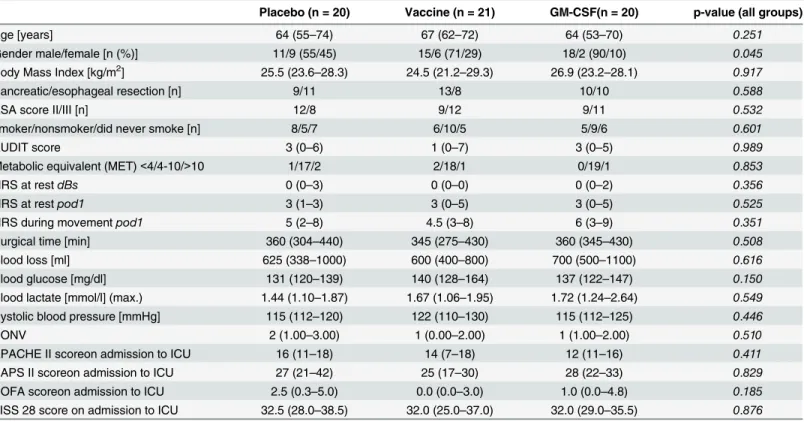
Basic patient characteristics did not differ between groups except for gender (p = 0.045) (Table 1). In the GM-CSF group, study medication was given to all patients onpod1, to 1
patient onpod2, and to 3 patients onpod3. In the vaccination group, study medication was
given to all patients onpod1, to 20 patients onpod2and to 15 patients onpod3. In the placebo
group, study medication was administered in all patients onpod1andpod2as well as in 17
Primary endpoint (mHLA-DR)
HLA-DR was increased compared to placebo (p<0.001) and influenza vaccination
(p<0.001) onpod2(Fig 3andTable 2). Differences between groups with respect to pre-post
(pod1–pod2) were seen for patients who received GM-CSF compared to those who received
vaccination (p<0.001) and placebo (p<0.001;Table 2).
Secondary endpoints (infection and delirium, infection days and delirium
days)
Fewer infection days were seen in the GM-CSF-treated patients (p<0.001) after surgery (Fig
4;Table 3) compared to placebo.
Fig 2. Flow diagram.dBs, day before surgery.dOs, day of surgery.pod, postoperative day.*Study drug treatment for a maximum of 3 consecutive days (pod1–pod3) depending on mHLA-DR expression. doi:10.1371/journal.pone.0144003.g002
Table 1. Basic patient characteristics and pre-interventional course.Continuous quantities in median (25%-75% percentiles), frequencies with n (%); NRS, Numeric Rating Scale;dBs, day before surgery;pod1, day 1 after surgery; ASA, American Society of Anesthesiologists; AUDIT score, Alcohol Use Dis-orders Identification Test; PONV, postoperative nausea and vomiting; APACHE, Acute Physiology and Chronic Health Evaluation; SAPS, Simplified Acute Physiology Score; SOFA, Sequential Organ Failure Assessment; TISS, Therapeutic Intervention Scoring System; ICU, Intensive Care Unit.
Placebo (n = 20) Vaccine (n = 21) GM-CSF(n = 20) p-value (all groups)
Age [years] 64 (55–74) 67 (62–72) 64 (53–70) 0.251
Gender male/female [n (%)] 11/9 (55/45) 15/6 (71/29) 18/2 (90/10) 0.045
Body Mass Index [kg/m2] 25.5 (23.6–28.3) 24.5 (21.2–29.3) 26.9 (23.2–28.1) 0.917
Pancreatic/esophageal resection [n] 9/11 13/8 10/10 0.588
ASA score II/III [n] 12/8 9/12 9/11 0.532
smoker/nonsmoker/did never smoke [n] 8/5/7 6/10/5 5/9/6 0.601
AUDIT score 3 (0–6) 1 (0–7) 3 (0–5) 0.989
Metabolic equivalent (MET)<4/4-10/>10 1/17/2 2/18/1 0/19/1 0.853
NRS at restdBs 0 (0–3) 0 (0–0) 0 (0–2) 0.356
NRS at restpod1 3 (1–3) 3 (0–5) 3 (0–5) 0.525
NRS during movementpod1 5 (2–8) 4.5 (3–8) 6 (3–9) 0.351
Surgical time [min] 360 (304–440) 345 (275–430) 360 (345–430) 0.508
Blood loss [ml] 625 (338–1000) 600 (400–800) 700 (500–1100) 0.616
Blood glucose [mg/dl] 131 (120–139) 140 (128–164) 137 (122–147) 0.150
Blood lactate [mmol/l] (max.) 1.44 (1.10–1.87) 1.67 (1.06–1.95) 1.72 (1.24–2.64) 0.549 Systolic blood pressure [mmHg] 115 (112–120) 122 (110–130) 115 (112–125) 0.446
PONV 2 (1.00–3.00) 1 (0.00–2.00) 1 (1.00–2.00) 0.510
APACHE II scoreon admission to ICU 16 (11–18) 14 (7–18) 12 (11–16) 0.411
SAPS II scoreon admission to ICU 27 (21–42) 25 (17–30) 28 (22–33) 0.829
SOFA scoreon admission to ICU 2.5 (0.3–5.0) 0.0 (0.0–3.0) 1.0 (0.0–4.8) 0.185 TISS 28 score on admission to ICU 32.5 (28.0–38.5) 32.0 (25.0–37.0) 32.0 (29.0–35.5) 0.876 doi:10.1371/journal.pone.0144003.t001
Duringpod1topod9, infection was seen in 11 patients in the placebo group, in 9 patients in the vaccine group and in 8 patients in the GM-CSF group. Pneumonia was the most frequent type of infection (n = 18) followed by sepsis (n = 6), wound infection (n = 5), urinary tract infection (n = 3) and other infections (n = 2). These results did not differ between groups. Delirium days were increased after influenza vaccination compared to the other groups
(p = 0.003 and p = 0.007) after surgery (Fig 5;Table 3).
For the period ofpod1topod9, delirium rate did not differ significantly between groups (11
patients in the placebo group, 14 patients in the vaccine group and 12 patients in the GM-CSF group).
Leukocytes increased onpod2after stimulation with GM-CSF and differed significantly
from placebo (p = 0.003;Fig 6). Temperature, CRP, PCT and IL-6 did not show any significant
differences between the groups.
There were no significant differences in intra- and other postoperative parameters or in postoperative pain, postoperative nausea and vomiting or in ICU scores on admission
Fig 3. Monocytic HLA-DR (mHLA-DR) over time.Immediately before surgery (dOs) until day 5 after surgery (pod5) between groups.
doi:10.1371/journal.pone.0144003.g003
Table 2. Monocytic HLA-DR (mHLA-DR) on day 1 (pod1)and day 2(pod2)after surgery. Paired Wilcoxon Test (pod1 versus pod2): Placebo:
p = 0.0027; Vaccination: p = 0.013; GM-CSF: p<0.001; Overall (Kruskal-Wallis):pod1: p = 0.667;pod2: p<0.001;pod1–pod2: p<0.001; IQR: Interquartile Range.
Mean Standard deviation Median IQR p-values (Mann-Whitney)
pod1 1 vs. 2 1 vs. 3 2 vs. 3 1: Placebo 6,688 1,805 6,709 2,707 0.906 0.426 2: Vaccination 6,740 1,614 6,777 2,287 0.467 3: GM-CSF 6,306 2,272 6,080 4,062 pod2 1 vs. 2 1 vs. 3 2 vs. 3 1: Placebo 5,712 1,853 5,668 2,759 0.633 <0.001 2: Vaccination 5,643 2,294 5,448 3,372 <0.001 3: GM-CSF 62,566 34,975 61,257 34,021 pod1–pod2 1 vs. 2 1 vs. 3 2 vs. 3 1: Placebo 976 1,730 1,146 3,005 0.876 <0.001 2: Vaccination 1,097 1,748 1,278 2,828 <0.001 3: GM-CSF -56,260 33,910 -54,649 33,541 doi:10.1371/journal.pone.0144003.t002
(Table 1). In addition, maximum of SOFA and TISS 28 score as well as time on ventilator, ICU
and hospital length of stay did not significantly differ between the groups (Table 4).
No study drug-related serious adverse events, adverse drug-related reactions, unexpected adverse reactions or suspected unexpected severe adverse reactions were observed. A detailed
documentation of the safety data is given in (S1 Data).
Discussion
The major finding of this study was that GM-CSF treatment after surgery in immune compro-mised patients increased mHLA-DR expression and decreased the number of infection days whereas influenza vaccination increased the number of delirium days after major surgery. To
the best of our knowledge, there have been no studies that investigated postoperativein vivo
biomarker-guided administration of GM-CSF or vaccination in immune compromised surgical patients.
Fig 4. Number of infection days.From day 1 (pod1, before intervention) until day 9 after surgery (pod9). Between all three groups: p = 0.001. Placebo vs. GM-CSF: p<0.001. Placebo vs. vaccination: p = 0.068. Vaccination vs. GM-CSF: p = 0.044.
doi:10.1371/journal.pone.0144003.g004
Table 3. Infection and delirium days (DDS>3).Overall (Kruskal-Wallis):Infection days: p = 0.001;Delirium days (DDS>3): p = 0.004; IQR: Interquartile Range.
Mean Standard deviation Median IQR p-values (Mann-Whitney)
Duration of Infection (days) 1 vs. 2 1 vs. 3 2 vs. 3
1: Placebo 1.35 1.982 0.00 3 0.068 <0.001
2: Vaccination 1.05 1.883 0.00 2 0.044
3: GM-CSF 0.74 1.807 0.00 0
Duration of Delirium (days) 1 vs. 2 1 vs. 3 2 vs. 3
1: Placebo 0.6222 1.1194 0.00 1 0.003 0.737
2: Vaccination 0.9788 1.3247 0.00 2 0.007
3: GM-CSF 0.5556 0.8471 0.00 1
Several previous studies have demonstrated that GM-CSF can improve immune responses
in immunosuppressed patients bothex vivoandin vivo. Börgermann et al. showed that
decreased mHLA-DR expression could be restored by GM-CSFex vivoin patients undergoing
cardiopulmonary bypass [25]. The same group demonstrated that GM-CSF also increasesex
vivoendotoxin-induced monocyte cytokine release in immunosuppressed trauma patients
[33]. In recent open-label and randomized trials, we and others have shown that GM-CSF
treatment can restore innate immune responses in adult patients with severe sepsis-associated
immunosuppression and in children with multiple organ dysfunction syndrome [24,26,34].
In accordance with previous studies, we observed an immediate increase of mHLA-DR to pre-operative or even supernormal levels in patients with surgery-induced immunosuppression on
Fig 5. Number of delirium days (DDS>3).From day 1 (pod1, before intervention) until day 9 after surgery (pod9). Between all three groups: p = 0.004. Placebo vs. GM-CSF: p = 0.737. Placebo vs. vaccination: p = 0.003. Vaccination vs. GM-CSF: p = 0.007.
doi:10.1371/journal.pone.0144003.g005
Fig 6. Leukocytes over time.From day of surgery (dOs) until day 5 after surgery (pod5) between groups. Leukocytes significantly increased on pod2 (p = 0.003) after stimulation with GM-CSF.
the 1stday after administration of GM-CSF. This increase most likely relies on an induction of
key molecules in the class II MHC pathway of monocytes [35]. However, mHLA-DR levels
rapidly decreased when GM-CSF treatment was discontinued which is likely due to the short half-life of GM-CSF and replacement of circulating monocytes from the bone marrow pool. Noteworthy, on the fifth day after surgery it decreased to levels comparable to the placebo group (mHLA-DR was over 10,000 mAb/cell but still depressed compared to preoperative lev-els). GM-CSF treatment also increased the postoperative leukocyte counts while other markers of inflammation and infection such as temperature, CRP, PCT and IL-6 remained unaffected. These data are in accordance with previous studies, which showed no effect of GM-CSF
treat-ment on the infection parameters PCT and IL-6 in critically ill patients [24,26,34].
Recent studies suggested that influenza vaccination could also increase suppressed mHLA-DR expression. Haining et al. demonstrated increased mHLA-DR expression after
influenza vaccination in children after hematopoietic stem cell transplantation [20]. We
showed similar effects in patients with upper aerodigestive tract cancer [23]. In contrast, in the
same study influenza vaccination failed to significantly prevent downregulation of mHLA-DR
expression when the vaccine was administered pre-operatively [23]. Thus, in conjunction with
the current study demonstrating no beneficial effect of post-operative influenza vaccination in immunosuppressed surgical patients, vaccination at least with influenza vaccine did not appear to be an effective immunostimulatory treatment approach either to prevent or to reverse sur-gery-induced immunosuppression. After influenza vaccination, healthy volunteers showed a significant increase in the frequency of H1N1-specific IL-4+CD4+ T cells after vaccination.
However, healthy volunteers also showed an increase in IFN-γ+CD4+ T cells after vaccination
despite the fact that no significant changes in HLA-DR- and CD86 expression from before to after vaccination were observed. In addition, the cytokine profile after administration of
vac-cine showed that healthy controls had significantly greater levels of fractalkine, IFN-γ, MCP-3,
interleukin 1β, interleukin 6, and MIP-1α[36] i.e. they had a higher inflammatory cytokine
load that might have influence on microglial activation and delirium days [37].
A recent meta-analysis of 12 randomized controlled trials including 2,380 patients by Bo et al. analyzed the effect of GM-CSF on clinical outcome parameters in sepsis. GM-CSF was
demonstrated to significantly increase the reversal rate of infections in sepsis patients [38]. In
addition, Hall et al. found a significant reduction in secondary infectious complications in
criti-cally ill children under GM-CSF treatment [34]. However, until now no study has shown a
decreased rate of nosocomial infections in surgical patients at risk after treatment with
GM-CSF. In our study, the infection days after surgery were significantly lower under GM-CSF treatment compared to placebo and vaccination group. Nevertheless, despite the fact that the infection days were decreased up to day 9 after surgery, the total number of infections did not differ between groups. These data suggest that GM-CSF treatment may mitigate the severity and duration but may not prevent the development of post-operative infectious episodes. How-ever, given that GM-CSF best protected patients from infections up to day 5 after surgery,
short-term immunostimulatory treatment may not be sufficient. In addition, mortality and comorbidity endpoints other than infection were not influenced by GM-CSF. However, the current study was not powered to assess these endpoints. Thus, additional studies are needed to determine the most effective duration of immunostimulatory treatment regimens and appropriate biomarker signatures indicative for sustained recovery of immune function and improved clinical outcome.
Another finding of our study is that vaccination increased the number of delirium days. The
number of delirium days is positively associated with increased 1-year mortality [39,40]. To
the best of our knowledge, there is currently no study that describes a risk for delirium after
influenza vaccination at all [41–43] aside from one case report [44]. However, the pathogenesis
of delirium is still not clearly understood. Some studies suggest that systemic inflammation may affect cholinergic and immune system are of major relevance in the development of
delir-ium [45–47]. Hingorani et al. [48] and Clapp et al. [49] showed that vaccination leads to a
sys-temic inflammatory response which is associated with endothelial dysfunction. However, they used salmonella typhi vaccination. Thus, we hypothesize that in our study influenza vaccina-tion most likely induced a systemic inflammavaccina-tion which increased the risk of delirium perhaps
due to disruption of the blood-brain barrier [37,50,51]. Influenza vaccination may have
nega-tive effects on delirium that might be related to unspecific inflammatory stimulation and should be investigated in further studies.
This study has several limitations. First, study drugs were administered only for a maximum of 3 days. The effect of longer duration of therapy is unclear. Second, we observed small differ-ences in univariate analyses for gender between the groups, but this was only descriptive because multivariate analysis is not considered appropriate in that setting and would not show
any difference. Third, the threshold level for mHLA-DR (10,000 mAb/cell) used to select
patients with severe surgery-induced immunosuppression for immunostimulatory therapy in this study is unclear. Previous studies have suggested using a mHLA-DR threshold between 5,000 and 10,000 mAb/cell as an indicator of severely impaired immune function in critical ill
patients [12,24,52]. However, it is currently unclear whether single cut-off values for
mHLA-DR can be applied to identify best patients at risk with different entities of
trauma-asso-ciated immunosuppression. It was recently demonstrated that mHLA-DR levels of<20,000
mAb/cell were associated with the development of pneumonia in patients with severe stroke
[53]. Thus, further studies are needed to determine outcome-relevant thresholds for
biomark-ers of immune competence in order to optimize the risk-benefit profile of immunostimulatory therapeutic approaches to overcome severe immunosuppression in critical illness. Fourth, the use of influenza vaccine might have been insufficient to treat the HLA-DR response despite the fact that proinflammatory stimulation might have increased delirium. A potential improve-ment would be to use a vaccine known to increase HLA-DR response such as vaccination
against hepatitis B [54]. Finally, we observed patients for 9 days after surgery for infections.
Infections occurring after this time were not prospectively documented and could not be evalu-ated. Furthermore, in this study we included patients after pancreatic and esophageal resection.
Conclusions
Postoperative application of GM-CSF significantly increased HLA-DR expression on mono-cytes and decreased the duration of infection after surgery in patients undergoing esophageal or pancreatic surgery. Postoperative influenza vaccination had no influence on post-surgical immunosuppression but increased the number of delirium days. Further studies are warranted to evaluate the benefit of immunostimulatory therapy with GM-CSF to improve clinical out-come. The negative effects of influenza vaccination on cognition should be investigated as well.
S2 Protocol. Translation of study protocol (synopsis).
(DOC)
S1 Checklist. CONSORT Checklist.
(DOC)
S1 Diagram. CONSORT Flow Diagram.
(DOC)
Acknowledgments
We are very grateful to Kathrin Scholtz for monitoring this study, to the sub investigators Lilit Sargsyan, Ulrike Wittkowski for their help to temporarily conduct this clinical trial, Johannes Kurth, Anja-Vanessa Philippeit, Dominik Stöber, Fatima Yürek, Julia Schäfer, Carolyn Geipel, Kay Dittrich, Sara Schillo, Siven Relindise and Annegret Winkler for data collection and help with the data base.
Author Contributions
Conceived and designed the experiments: CDS MR AL. Performed the experiments: MR AS MP GL. Analyzed the data: CDS GL AL KW. Contributed reagents/materials/analysis tools: CVH CM MB. Wrote the paper: CDS AL GL KW.
References
1. Geffers C, Sohr D, Gastmeier P. Mortality attributable to hospital-acquired infections among surgical patients. Infection control and hospital epidemiology: the official journal of the Society of Hospital Epide-miologists of America. 2008; 29(12):1167–70. Epub 2008/11/19. doi:10.1086/592410PMID:
19014317.
2. Angus DC, Linde-Zwirble WT, Lidicker J, Clermont G, Carcillo J, Pinsky MR. Epidemiology of severe sepsis in the United States: analysis of incidence, outcome, and associated costs of care. Critical care medicine. 2001; 29(7):1303–10. PMID:11445675.
3. Dasgupta M, Dumbrell AC. Preoperative risk assessment for delirium after noncardiac surgery: a sys-tematic review. Journal of the American Geriatrics Society. 2006; 54(10):1578–89. doi: 10.1111/j.1532-5415.2006.00893.xPMID:17038078.
4. Radtke FM, Franck M, Schneider M, Luetz A, Seeling M, Heinz A, et al. Comparison of three scores to screen for delirium in the recovery room. British journal of anaesthesia. 2008; 101(3):338–43. Epub 2008/07/08. doi:10.1093/bja/aen193PMID:18603528.
5. Radtke FM, Franck M, Schust S, Boehme L, Pascher A, Bail HJ, et al. A comparison of three scores to screen for delirium on the surgical ward. World journal of surgery. 2010; 34(3):487–94. Epub 2010/01/ 13. doi:10.1007/s00268-009-0376-9PMID:20066416.
6. Luetz A, Heymann A, Radtke FM, Chenitir C, Neuhaus U, Nachtigall I, et al. Different assessment tools for intensive care unit delirium: which score to use? Critical care medicine. 2010; 38(2):409–18. doi:10. 1097/CCM.0b013e3181cabb42PMID:20029345.
7. Delgado-Rodriguez M, Gomez-Ortega A, Llorca J, Lecuona M, Dierssen T, Sillero-Arenas M, et al. Nos-ocomial infection, indices of intrinsic infection risk, and in-hospital mortality in general surgery. The Journal of hospital infection. 1999; 41(3):203–11. Epub 1999/04/16. PMID:10204122.
8. Hensler T, Hecker H, Heeg K, Heidecke CD, Bartels H, Barthlen W, et al. Distinct mechanisms of immu-nosuppression as a consequence of major surgery. Infection and immunity. 1997; 65(6):2283–91. PMID:9169765; PubMed Central PMCID: PMC175317.
9. Wakefield CH, Carey PD, Foulds S, Monson JR, Guillou PJ. Changes in major histocompatibility com-plex class II expression in monocytes and T cells of patients developing infection after surgery. The Brit-ish journal of surgery. 1993; 80(2):205–9. PMID:8443652.
10. Weimann K, Zimmermann M, Spies CD, Wernecke KD, Vicherek O, Nachtigall I, et al. Intensive Care Infection Score—A new approach to distinguish between infectious and noninfectious processes in intensive care and medicosurgical patients. The Journal of international medical research. 2015. doi: 10.1177/0300060514557711PMID:25850686.
11. Spies CD, von Dossow V, Eggers V, Jetschmann G, El-Hilali R, Egert J, et al. Altered cell-mediated immunity and increased postoperative infection rate in long-term alcoholic patients. Anesthesiology. 2004; 100(5):1088–100. Epub 2004/04/29. PMID:15114205.
12. Docke WD, Hoflich C, Davis KA, Rottgers K, Meisel C, Kiefer P, et al. Monitoring temporary immunode-pression by flow cytometric measurement of monocytic HLA-DR eximmunode-pression: a multicenter standard-ized study. Clinical chemistry. 2005; 51(12):2341–7. doi:10.1373/clinchem.2005.052639PMID: 16214828.
13. Heymann A, Radtke F, Schiemann A, Lutz A, MacGuill M, Wernecke KD, et al. Delayed treatment of delirium increases mortality rate in intensive care unit patients. The Journal of international medical research. 2010; 38(5):1584–95. Epub 2011/02/12. PMID:21309472.
14. Spies CD, Kern H, Schroder T, Sander M, Sepold H, Lang P, et al. Myocardial ischemia and cytokine response are associated with subsequent onset of infections after noncardiac surgery. Anesthesia and analgesia. 2002; 95(1):9–18, table of contents. Epub 2002/06/29. PMID:12088935.
15. Haupt W, Riese J, Mehler C, Weber K, Zowe M, Hohenberger W. Monocyte function before and after surgical trauma. Digestive surgery. 1998; 15(2):102–4. Epub 1998/12/09. PMID:9845570.
16. Wu JF, Ma J, Chen J, Ou-Yang B, Chen MY, Li LF, et al. Changes of monocyte human leukocyte anti-gen-DR expression as a reliable predictor of mortality in severe sepsis. Crit Care. 2011; 15(5):R220. doi:10.1186/cc10457PMID:21933399; PubMed Central PMCID: PMC3334765.
17. Lukaszewicz AC, Grienay M, Resche-Rigon M, Pirracchio R, Faivre V, Boval B, et al. Monocytic HLA-DR expression in intensive care patients: interest for prognosis and secondary infection prediction. Crit-ical care medicine. 2009; 37(10):2746–52. doi:10.1097/CCM.0b013e3181ab858aPMID:19707128. 18. Landelle C, Lepape A, Voirin N, Tognet E, Venet F, Bohe J, et al. Low monocyte human leukocyte
anti-gen-DR is independently associated with nosocomial infections after septic shock. Intensive care medi-cine. 2010; 36(11):1859–66. doi:10.1007/s00134-010-1962-xPMID:20652682.
19. Schinkel C, Sendtner R, Zimmer S, Faist E. Functional analysis of monocyte subsets in surgical sepsis. The Journal of trauma. 1998; 44(5):743–8; discussion 8–9. PMID:9603073.
20. Haining WN, Evans JW, Seth NP, Callaway GD, Wucherpfennig KW, Nadler LM, et al. Measuring T cell immunity to influenza vaccination in children after haemopoietic stem cell transplantation. British journal of haematology. 2004; 127(3):322–5. doi:10.1111/j.1365-2141.2004.05204.xPMID:15491293. 21. Blazevic V, Trubey CM, Shearer GM. Comparison of in vitro immunostimulatory potential of live and
inactivated influenza viruses. Human immunology. 2000; 61(9):845–9. Epub 2000/10/29. PMID: 11053627.
22. Gorse GJ, Patel GB, Belshe RB, National Institute of A, Infectious Diseases HIVVTN. HIV type 1 vac-cine-induced T cell memory and cytotoxic T lymphocyte responses in HIV type 1-uninfected volunteers. AIDS research and human retroviruses. 2001; 17(12):1175–89. doi:10.1089/088922201316912781 PMID:11522187.
23. Spies CD, Kip M, Lau A, Sander M, Breuer JP, Meyerhoefer J, et al. Influence of vaccination and sur-gery on HLA-DR expression in patients with upper aerodigestive tract cancer. The Journal of interna-tional medical research. 2008; 36(2):296–307. PMID:18380940.
24. Meisel C, Schefold JC, Pschowski R, Baumann T, Hetzger K, Gregor J, et al. Granulocyte-macrophage colony-stimulating factor to reverse sepsis-associated immunosuppression: a double-blind, random-ized, placebo-controlled multicenter trial. American journal of respiratory and critical care medicine. 2009; 180(7):640–8. Epub 2009/07/11. doi:10.1164/rccm.200903-0363OCPMID:19590022. 25. Borgermann J, Friedrich I, Scheubel R, Kuss O, Lendemans S, Silber RE, et al.
Granulocyte-macro-phage colony-stimulating factor (GM-CSF) restores decreased monocyte HLA-DR expression after car-diopulmonary bypass. The Thoracic and cardiovascular surgeon. 2007; 55(1):24–31. PMID:
17285470.
26. Nierhaus A, Montag B, Timmler N, Frings DP, Gutensohn K, Jung R, et al. Reversal of immunoparalysis by recombinant human granulocyte-macrophage colony-stimulating factor in patients with severe sep-sis. Intensive care medicine. 2003; 29(4):646–51. Epub 2003/02/22. PMID:12595977.
30. Spies C KW, Kastrup M, Melzer-Gartzke C, Zielke H. SOPs in Intensivmedizin und Notfallmedizin: Alle relevanten Standards und Techniken für die Klinik. Stuttgart, Georg Thieme Verlag. 2013.
31. Horan TC, Gaynes RP, Martone WJ, Jarvis WR, Emori TG. CDC definitions of nosocomial surgical site infections, 1992: a modification of CDC definitions of surgical wound infections. American journal of infection control. 1992; 20(5):271–4. Epub 1992/10/01. PMID:1332552.
32. American Thoracic S, Infectious Diseases Society of A. Guidelines for the management of adults with hospital-acquired, ventilator-associated, and healthcare-associated pneumonia. American journal of respiratory and critical care medicine. 2005; 171(4):388–416. PMID:15699079.
33. Lendemans S, Kreuzfelder E, Waydhas C, Schade FU, Flohe S. Differential immunostimulating effect of granulocyte-macrophage colony-stimulating factor (GM-CSF), granulocyte colony-stimulating factor (G-CSF) and interferon gamma (IFNgamma) after severe trauma. Inflammation research: official jour-nal of the European Histamine Research Society [et al]. 2007; 56(1):38–44. PMID:17334669. 34. Hall MW, Knatz NL, Vetterly C, Tomarello S, Wewers MD, Volk HD, et al. Immunoparalysis and
nosoco-mial infection in children with multiple organ dysfunction syndrome. Intensive care medicine. 2011; 37 (3):525–32. doi:10.1007/s00134-010-2088-xPMID:21153402.
35. Hornell TM, Beresford GW, Bushey A, Boss JM, Mellins ED. Regulation of the class II MHC pathway in primary human monocytes by granulocyte-macrophage colony-stimulating factor. Journal of immunol-ogy. 2003; 171(5):2374–83. Epub 2003/08/21. PMID:12928384.
36. Egli A, Humar A, Widmer LA, Lisboa LF, Santer DM, Mueller T, et al. Effect of Immunosuppression on T-Helper 2 and B-Cell Responses to Influenza Vaccination. The Journal of infectious diseases. 2015; 212(1):137–46. doi:10.1093/infdis/jiv015PMID:25589334.
37. Hughes CG, Patel MB, Pandharipande PP. Pathophysiology of acute brain dysfunction: what's the cause of all this confusion? Current opinion in critical care. 2012; 18(5):518–26. doi:10.1097/MCC. 0b013e328357effaPMID:22941208.
38. Bo L, Wang F, Zhu J, Li J, Deng X. Granulocyte-colony stimulating factor (G-CSF) and granulocyte-macrophage colony stimulating factor (GM-CSF) for sepsis: a meta-analysis. Crit Care. 2011; 15(1): R58. doi:10.1186/cc10031PMID:21310070; PubMed Central PMCID: PMC3221991.
39. Pisani MA, Kong SY, Kasl SV, Murphy TE, Araujo KL, Van Ness PH. Days of delirium are associated with 1-year mortality in an older intensive care unit population. American journal of respiratory and criti-cal care medicine. 2009; 180(11):1092–7. doi:10.1164/rccm.200904-0537OCPMID:19745202; PubMed Central PMCID: PMC2784414.
40. Patel SB, Poston JT, Pohlman A, Hall JB, Kress JP. Rapidly reversible, sedation-related delirium ver-sus persistent delirium in the intensive care unit. American journal of respiratory and critical care medi-cine. 2014; 189(6):658–65. doi:10.1164/rccm.201310-1815OCPMID:24423152.
41. Greenberg DP, Robertson CA, Noss MJ, Blatter MM, Biedenbender R, Decker MD. Safety and immu-nogenicity of a quadrivalent inactivated influenza vaccine compared to licensed trivalent inactivated influenza vaccines in adults. Vaccine. 2013; 31(5):770–6. doi:10.1016/j.vaccine.2012.11.074PMID: 23228813.
42. Forrest BD, Steele AD, Hiemstra L, Rappaport R, Ambrose CS, Gruber WC. A prospective, random-ized, open-label trial comparing the safety and efficacy of trivalent live attenuated and inactivated influ-enza vaccines in adults 60 years of age and older. Vaccine. 2011; 29(20):3633–9. Epub 2011/03/29. doi:10.1016/j.vaccine.2011.03.029PMID:21440036.
43. Vellozzi C, Burwen DR, Dobardzic A, Ball R, Walton K, Haber P. Safety of trivalent inactivated influenza vaccines in adults: background for pandemic influenza vaccine safety monitoring. Vaccine. 2009; 27 (15):2114–20. Epub 2009/04/10. doi:10.1016/j.vaccine.2009.01.125PMID:19356614.
44. Boutros N, Keck BP. Delirium following influenza vaccination. The American journal of psychiatry. 1993; 150(12):1899. PMID:8238653.
45. Cerejeira J, Nogueira V, Luis P, Vaz-Serra A, Mukaetova-Ladinska EB. The cholinergic system and inflammation: common pathways in delirium pathophysiology. Journal of the American Geriatrics Soci-ety. 2012; 60(4):669–75. doi:10.1111/j.1532-5415.2011.03883.xPMID:22316182.
46. Hala M. Pathophysiology of postoperative delirium: systemic inflammation as a response to surgical trauma causes diffuse microcirculatory impairment. Medical hypotheses. 2007; 68(1):194–6. PMID: 16979300.
47. Murray C, Sanderson DJ, Barkus C, Deacon RM, Rawlins JN, Bannerman DM, et al. Systemic inflam-mation induces acute working memory deficits in the primed brain: relevance for delirium. Neurobiology of aging. 2012; 33(3):603–16 e3. doi:10.1016/j.neurobiolaging.2010.04.002PMID:20471138; PubMed Central PMCID: PMC3200140.
48. Hingorani AD, Cross J, Kharbanda RK, Mullen MJ, Bhagat K, Taylor M, et al. Acute systemic inflamma-tion impairs endothelium-dependent dilatainflamma-tion in humans. Circulainflamma-tion. 2000; 102(9):994–9. PMID: 10961963.
49. Clapp BR, Hingorani AD, Kharbanda RK, Mohamed-Ali V, Stephens JW, Vallance P, et al. Inflamma-tion-induced endothelial dysfunction involves reduced nitric oxide bioavailability and increased oxidant stress. Cardiovascular research. 2004; 64(1):172–8. doi:10.1016/j.cardiores.2004.06.020PMID: 15364625.
50. van Gool WA, van de Beek D, Eikelenboom P. Systemic infection and delirium: when cytokines and acetylcholine collide. Lancet. 2010; 375(9716):773–5. doi:10.1016/S0140-6736(09)61158-2PMID: 20189029.
51. Terrando N, Eriksson LI, Ryu JK, Yang T, Monaco C, Feldmann M, et al. Resolving postoperative neu-roinflammation and cognitive decline. Annals of neurology. 2011; 70(6):986–95. doi:10.1002/ana. 22664PMID:22190370.
52. Cheron A, Floccard B, Allaouchiche B, Guignant C, Poitevin F, Malcus C, et al. Lack of recovery in monocyte human leukocyte antigen-DR expression is independently associated with the development of sepsis after major trauma. Crit Care. 2010; 14(6):R208. Epub 2010/11/26. doi:10.1186/cc9331 PMID:21092108; PubMed Central PMCID: PMC3220028.
53. Harms H, Prass K, Meisel C, Klehmet J, Rogge W, Drenckhahn C, et al. Preventive antibacterial ther-apy in acute ischemic stroke: a randomized controlled trial. PloS one. 2008; 3(5):e2158. doi:10.1371/ journal.pone.0002158PMID:18478129; PubMed Central PMCID: PMC2373885.
54. Evans TG, Hasan M, Galibert L, Caron D. The use of Flt3 ligand as an adjuvant for hepatitis B vaccina-tion of healthy adults. Vaccine. 2002; 21(3–4):322–9. PMID:12450708.