ECTREE: AN EXTENDED TREE INDEX STRUCTURE
FOR ATTRIBUTED SUBGRAPH QUERIES
Jun Luo
A thesis in
The Department of
Computer Science and Software Engineering
Presented in Partial Fulfillment of the Requirements
For the Degree of Master of Applied Science(Software Engineering) Concordia University
Montr´eal, Qu´ebec, Canada
May 2012 Jun Luo, 2012
Concordia University
School of Graduate Studies
This is to certify that the thesis prepared
By: Jun Luo
Entitled: ECTree: An Extended Tree Index Structure for Attributed Subgraph Queries
and submitted in partial fulfillment of the requirements for the degree of
Master of Applied Science(Software Engineering)
complies with the regulations of this University and meets the accepted standards with respect to originality and quality.
Signed by the final examining committee:
Chair Dr. B. Jaumard Examiner Dr. T. Eavis Examiner Dr. N. Shiri Supervisor Dr. G. Butler Approved
Chair of Department or Graduate Program Director
20
Dr. Robin A. L. Drew, Dean
Abstract
ECTree: An Extended Tree Index Structure for Attributed Subgraph
Queries
Jun Luo
Graphs are popular data structures for modeling complex data types, especially graphs with attributes for gene sequences, protein structures, chemical compounds, protein interaction networks, social networks, etc. There is a need for managing such graph data and providing efficient querying tools. In the graph mining realm, the problem lies in indexing a large number of graphs for fast retrieval. Indexing at-tributed graphs and using atat-tributed queries can provide faster response time and more refined results.
This thesis focuses on extending an existing index to support attributed graph indexing and providing subgraph querying access to the extended index. The aim is to find a way such that the labels of the graphs as well as the attributes of the graphs are indexed at the same time. A query format is provided to query the extended index on the attributes with flexibility which allows intervals to be used. In addition, regular expressions and label groups are used as query labels so that multiple queries that have similar structures can be combined as a single query. This also benefits in that a query graph does not have to use fixed labels. We also introduce a vertex degree-attribute based vector to capture both the features of a data graph and a query graph. A novel pruning method is proposed and implemented so that the pruning based on the degree-attribute vectors can still be adopted even when it is not clear how to define a histogram pruning for the query graphs that use non-fixed labels. All the techniques presented in our work are validated through experiments on both real and synthetic datasets.
Dedication
The completion of this thesis would not have been possible without the help of a lot of people. It is all those people who offered support when I was in need that bring me this far. I would like to express my most sincere gratitude to them.
First and foremost, I want to thank my supervisor Dr. Gregory Butler for his support, guidance and encouragement, as well as his knowledge and patience, which allowed me to see a clearer picture of my study and to avoid costly mistakes through-out my Master’s program.
I offer my deep appreciation to the members of my advisory committee: Dr. Brigitte Jaumard, Dr. Nematollaah Shiri and Dr. Todd Eavis.
I also give special thanks to my wonderful colleagues: Dr. Stephen C. Barrett for his help, with whom I learned what research really means, and also his demonstration of how to write a “beautiful” thesis; Dr. Yue Wang for her help in leading me into the graph mining realm; Faizh Aplop who always helps me discuss and solve the difficulties that I have in my study.
Moreover, I am truly thankful to my friend Dayal Dasanayake who helped me correct the thesis, as well as his persistent support on my way to obtain a Master’s degree; My grateful thanks to my uncle Guohui Zheng and my aunt Ying Zhao for taking care of me in every possible way in life; I thank my good friend Qinghuan Li, who always tells me I will make it and cheers me up whenever I feel down.
Last but not least, I give my deepest gratitude to my parents for their continuous encouragement and unquestioning love.
Contents
List of Figures viii
List of Tables x 1 Introduction 1 1.1 Graph Data . . . 2 1.2 The Problem . . . 3 1.3 Contributions . . . 3 1.4 Thesis Organization . . . 4 2 Background 5 2.1 Graph Databases . . . 5
2.2 Subgraph Query and Matching . . . 6
2.2.1 Subgraph and Subgraph Query . . . 6
2.2.2 Graph Isomorphism and Subgraph Isomorphism . . . 7
2.3 The Filtering-and-Verification Framework . . . 9
2.3.1 The False-Positive Rate in Candidate Answer Set . . . 11
2.4 Dead Space in Graph Merging . . . 11
2.5 Closure-Tree Index . . . 13
2.5.1 Graph Representation . . . 13
2.5.2 The Graph-Closure Method . . . 14
2.5.3 Building the CTree and Querying . . . 16
2.5.4 Histogram-Based Pruning in CTree . . . 18
3 ECTree: the Extended Closure-Tree for Subgraph Queries 22
3.1 Extending the Vertices with Attributes . . . 22
3.1.1 An Example in the SDF Format . . . 23
3.1.2 Data Representation in ECTree . . . 24
3.2 Vertex Merging . . . 25
3.2.1 Merging Two Vertices . . . 26
3.2.2 Merging A Vertex and A Vertex-Closure . . . 28
3.2.3 Merging Two Vertex-Closures . . . 29
3.3 Building the ECTree . . . 30
3.3.1 Data Graph Mapping . . . 30
3.3.2 An ECTree Building Example . . . 31
3.4 A Query Graph Format for ECTree . . . 31
3.5 Query Matching . . . 34
3.5.1 Matching a Query Vertex and a Data Vertex . . . 34
3.5.2 Matching a Query Graph and a Data Graph . . . 36
3.6 Conclusion . . . 38
4 Optimizations for ECTree 39 4.1 A More Flexible Query Format . . . 39
4.1.1 Using Regular Expressions on Query Labels . . . 40
4.1.2 Label Groups . . . 42
4.1.3 Implementation . . . 44
4.2 A Novel Pruning Method for ECTree . . . 46
4.2.1 The Degree-Attribute Feature Vector . . . 46
4.2.2 The Pruning Strategy . . . 49
4.3 Conclusion . . . 54
5 Validation 55 5.1 Experiment Setup . . . 55
5.2 Effectiveness of the Index . . . 58
5.3 The New Query Label . . . 60
5.4 The Pruning Power . . . 62
7 Conclusion 72 7.1 Summary of Contributions . . . 72 7.2 Limitations . . . 73 7.3 Future Work . . . 74 Bibliography 75 Appendices 82
A Meaning of Values in SDF Atom Block 83
B Related Algorithms 85
B.1 Counting Different Labels and Finding New Bindings . . . 85 B.2 Adding Attributes to Non-Attributed Graphs . . . 87 B.3 Generating Query Sets for Synthetic Datasets . . . 88
List of Figures
1 Varieties of graph data . . . 2
2 An example of a graph and its subgraph . . . 7
3 Two isomorphic graphs . . . 8
4 The filtering-and-verification framework as a pipe and filter system . . 10
5 An example showing the dead space . . . 12
6 The graph data and query format in CTree . . . 13
7 Computing a graph-clousre . . . 15
8 A CTree . . . 16
9 The label pruning in CTree . . . 20
10 Alanine in SDF format . . . 23
11 Data structure of ECTree . . . 25
12 Merging two label-matched vertices . . . 26
13 Merging two non-label-matched vertex . . . 28
14 Merging a vertex and a vertex-closure . . . 29
15 Merging two vertex-closures . . . 30
16 Computing a graph-closure in ECTree . . . 32
17 Examples of interval sets . . . 33
18 Matching a query vertex and a non-closure data vertex . . . 34
19 Two intervals showing the concept of Minimum-Absolute values . . . 35
20 Two chemical structures as queries . . . 41
21 The merged query Q3 . . . 42
22 A query Q4 showing the label groups . . . 43
23 A matching example for label groups . . . 44
24 DA feature vectors for data graphs . . . 48
26 A graph and its supergraph . . . 50
27 The DA-Pruning examples . . . 52
28 The testing process as a pipe-and-filtering framework . . . 57
29 Filtering time cost . . . 59
30 NCI subset verification statistics using CTree and ECTree . . . 60
31 Overall time cost . . . 61
32 Four queries and a combined query . . . 62
33 DA-Pruning on different attribute densities . . . 63
34 Overall time cost enhance rate using DA(d)-Pruning . . . 64
List of Tables
1 Graph matching comparison using different matching strategies . . . . 12
2 Notations . . . 37
3 Feature vector comparison . . . 51
4 Query sets statistics . . . 57
5 Time cost to build index . . . 58
6 Comparison of querying methods 1 . . . 61
7 Comparison of querying methods 2 . . . 65
8 Enhancement rates using DA(d)-Pruning on synthetic datasets . . . . 67
Chapter 1
Introduction
Along with the improvement of technology in biology and its related realms comes large volumes of different kinds of data. The Human Genome Project (HGP) is one of the projects with a primary goal of determining the sequence of chemical base pairs which make up DNA and to identify and map the approximately 20,000 to 25,000 genes of the human genome [Gen] [Kru01]. Each gene contains a long sequence made up of hundreds or even thousands of ‘genetic words’, which means the HGP also brings about a fast growing need for the analysis of biological data. The focus of recent biology related realms has shifted from the technology itself, via generating data, to the management of the huge amount of data. By management we mean collecting the data into databases, organizing them according to needs and finally finding the information needed from the databases.
There are multiple types of data that are involved in biology-related realms: gene sequences, protein structures, chemical compounds, protein interaction networks, etc. They naturally have the basic features of a graph: a set of vertices and a set of edges, and thus can be easily modeled as graphs. More broadly speaking, graphs have been widely used to model various types of data, such as flight networks [AEP09], XML data and queries [FGMP09], and social networks [BK09]. No matter what type it is, since graphs form a complex and expressive data structure, we need efficient and effec-tive methods for representing graphs in databases, manipulating and querying them [AW10]. A key issue is that the data management software needs to be easy–to–use, yet provides fast response time [BWWZ06].
1.1
Graph Data
In bioinformatics and cheminformatics, graphs have been used to represent complex data types [HS06], such as protein structures (Figure 1(a)), metabolic pathways (Fig-ure 1(b)), chemical compounds (Fig(Fig-ure 1(c)) and gene struct(Fig-ures (Fig(Fig-ure 1(d)).
(a) Protein structure of S. pombe pop2p dead-enylation subunit [Deb]
(b) NAD metabolism pathway [Vic]
(c) Guanosine monophosphate [Cac] (d) Gene [Rav]
Figure 1: Varieties of graph data
The graphs that model different types of data can have different meanings on the vertices and edges. For example, a metabolic pathway is modeled as a set of enzymes, chemicals (also called metabolites) and reactions, where the edges are the connections
between metabolites. The vertices for a single chemical compound could be the atoms in the compound, and the edges are the bonds between the atoms.
1.2
The Problem
There has been a lot of work related to graph database management. We review some of the major and/or latest works in Chapter 6. By studying varieties of graph data indexes that are effective and efficient for the graph queries, we find that most graph database indexes focus only on vertex-labeled and/or edge-labeled graphs, while in general, there has been lack of studies on graph data indexes which can handle vertices with attributes on index building, querying, as well as studies on flexible query formats and corresponding optimization strategies.
Although the essential components of a graph are the vertices and the edges, in many cases we can find that a graph may contain more information on the vertices and the edges. For example, the transformation between two metabolites may have certain conditions; an atom may have isotopes and a charge on it. This thesis aims at developing an effective graph data index to organize small graphs with both label indexing and attribute indexing, and to provide graph queries that have extended features such as attributes on vertices. A small graph is defined as a graph with less than 100 nodes [BV99]. In this thesis, we define it as a graph with less than 15 nodes. In previous work, the query graphs have fixed labels which allows no flexibility. Querying two similar graphs would be more efficient if there is a way to combine those queries into one query. Thus we aim at providing a flexible query format for our new index and developing a pruning method for the new query format as well.
1.3
Contributions
The contribution of this thesis can be classified as follows:
Study of merging numerical attributed graphs and extension of the tree index structure for additional attributes. We implemented the CTree index in C++ and extended the index to support numerical attributes in both indexing and querying. Our approach reveals that the indexing on both labels and attributes
is faster in terms of querying response time than indexing on only labels for attributed graphs.
A query format to query the extended index with flexibility on the attribute part, with non-fixed query labels supported which uses regular expression. The new query format also allows queries with similar graph structure to be com-bined into a single query.
A pruning method that works when the vertex labels are non-fixed or unknown. The new pruning is based on the degree and attribute information of vertices on data and query graphs. We proposed the method and implemented it to test its pruning power.
1.4
Thesis Organization
The rest of this thesis is organized as follows: Chapter 2 introduces the background knowledge necessary for understanding the work in this thesis. Chapter 3 illustrates the extension of the Closure-Tree [HS06] graph index. Chapter 4 describes a query format combined with regular expression and a pruning method based on the vertex degree and attributes. Chapter 5 provides validations of our work in Chapters 3 and 4. Chapter 6 discusses the related work to this thesis. Chapter 7 gives a conclusion and discussions for the future work.
Chapter 2
Background
This chapter gives the background knowledge which is necessary to understand the described problem and related solutions in the following chapters.
2.1
Graph Databases
In past decades, the focus of the genome project has shifted from technology de-velopment to data management. As more data is generated, data analysis becomes more essential. A graph database supports data analysis with appropriate database management [GBL95].
By definition, a graph database model is a model such that data structures for the schema and instances are modeled as graphs or generalizations of them, and data manipulation is expressed by graph-oriented operations and type constructors [AG08]. An SQL database [Mel96] addresses a many-to-many relationship with a join table that could be huge when the relationship is complex and might lead to unwieldy, long, incomprehensible SQL statements as well as unpredictable performance [Wig]. Comparing to relational databases, a graph database is designed to represent and query this type of information, so it models the data more naturally.
The essence of a graph database lies in what qualifies as a node, and what qual-ifies as an edge [Wan10]. A typical graph data model allows simple labels on the nodes. The labels are usually numbers or strings and are the main recognition of the nodes. Still, a node can contain some other attributes which are encoded by means of “additional attributes” that are data values of various types. For example, a person
has a name, as well as other information such as sex, age, nationality, and so on. A graph database may contain many small graphs, such as a graph database for chemical compounds [NCI], or, a graph database can contain a small number of large complex graphs. For example, each of the Carbohydrate Metabolism pathway dataset [KEG] could be a large graph that contains hundreds of metabolites and connections. Thus, the main purpose of the graph databases is to find a proper way to model the graph data so as to better serve the consequential graph data mining phase.
2.2
Subgraph Query and Matching
2.2.1
Subgraph and Subgraph Query
A commonly asked type of question mentioned in [CG70] is to find whether a given chemical compound is a subcompound of a further specified compound, given the structural formulas. In graph theory, this type of problem is generalized as to find whether a given graph is a subgraph of another graph. We denote a graph G as
G V, E where V is the vertex set andE is the edge set. The formal definition for a
Subgraph is given here [BL]:
Definition 1 Subgraph
A graphG V , E is a subgraph of another graphG V, E if and only if
V V and
E E
According to Definition 1, we can see that a graph G V, E is also a subgraph of itself.
The task of a Subgraph Queryis to find graphs which contain a specified graph as a subgraph. Subgraph queries are widely applied for graph data mining and are important in bioinfomatics and cheminfomatics because scientists frequently ask ques-tions such as: is a specified metabolism pathway contained in this set of metabolism pathways? Or, how many chemical compounds that develops potential cancer contain this particular chemical substructure? A considerable amount of research has been done into finding a subgraph in a set of graphs of a graph database. Some recent
researches on subgraph mining algorithms can be found in [PLM08], [WC10] and [FB08].
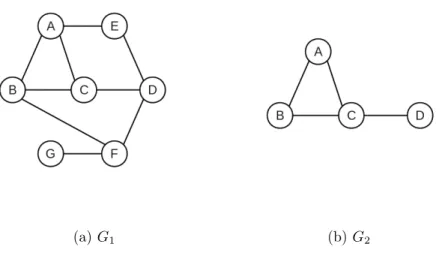
Figure 2 gives a simple example showing a graph G1 (Figure 2(a)) and one of its subgraphs G2 (Figure 2(b)). If graph G2 is used as a subgraph query and graph G1
is a graph in the database being queried, then G1 should be returned as one of the query results.
(a)G1 (b)G2
Figure 2: An example of a graph and its subgraph
2.2.2
Graph Isomorphism and Subgraph Isomorphism
Two graphs, G1 and G2, are the same if it is possible to redraw one of them, say
G2, so it appears identical to G1. In graph theory, the term isomorphic is used to describe graphs that are the same but are models of different situations. If two graphs
G1 and G2 are equivalent graphs, they are referred as isomorphic graphs [Cha85]. The process of graph matching is to determine whether two graphs are isomorphic or not. For instance, the graph G1 and G2 in Figure 3 (extracted from [Cha85]) are isomorphic. If two graphs G1 and G2 are isomorphic, we say G1 is isomorphic to G2
and that G2 is isomorphic to G1.
Attributes of vertices are denoted by attr v . The definition for Graph Map-ping, Graph Isomorphism and Isomorphic Graphs are given below [HS06]
(a) G1 (b)G2
Figure 3: Two isomorphic graphs
[Cha85]:
Definition 2 Graph Mapping
A mapping between two graphs G1 and G2 is a bijection φ : G1 G2, where (i) v V1, φ v V2, and (ii) e v1, v2 E1, φ e
φ v1 , φ v2 E2.
Definition 3 Graph Isomorphism and Isomorphic Graphs
A graph isomorphism from G1 to G2 is a graph mapping φ from G1 to
G2 such that (i) v V1, φ v V2 and attr v attr φ v and (ii)
e E1, φ e E2 and attr e attr φ e . Two graphs G1 and G2 are isomorphic if a graph isomorphism exists from G1 to G2. Graph isomor-phism is symmetric.
Given the definition of isomorphic graphs, the definition of Subgraph Isomor-phic and Subgraph Isomorphism can then be given as follows.
Definition 4 Subgraph Isomorphic and Subgraph Isomorphism
A graphG1is subgraph isomorphic to another graphG2ifG1is isomorphic to a subgraph of G2. A subgraph isomorphism exists between G1 and
G2 if G1 is subgraph isomorphic to G2. Subgraph isomorphism is not symmetric.
The subgraph isomorphism problem has long been proved to be NP-complete using a reduction from 3-SAT involving cliques [Coo71]. There has been a lot of research into finding a fast algorithm for subgraph isomorphism decision. Early research in [Ull76] proposed exact subgraph isomorphism algorithms which are devised for both graph isomorphism and subgraph isomorphism and are still some of the most commonly used algorithms for exact graph matching today. (The subgraph isomorphism algorithm described in [Ull76] is used in this thesis.) [Epp95] proposed a linear time method to solve the subgraph isomorphism problem in planar graphs for any pattern of constant size. [CFSV04] demonstrated an algorithm, namely VF2, for isomorphism problems when matching large graphs. A state-of-the-art subgraph isomorphism algorithm called QuickSI is introduced in [SZLY08].
Having the definition of subgraph isomorphism, when referred to a subgraph of a graph, we can simply say: a graphG V, E is a subgraph of another graphG V , E
if G is subgraph isomorphic to G under graph mapping φ.
In this thesis, SubgraphIsomorphism G1, G2 is used to refer to the subgraph isomorphism test to determine whether or not a graph G1 is a subgraph of another graph G2.
2.3
The Filtering-and-Verification Framework
Though much research has been done into accelerating the process of subgraph iso-morphism test, the time cost for this process is still heavy. Thus, a direct comparison of a query graph to each of the graphs in the dataset using a subgraph isomorphism algorithm is very inefficient. Different graph indexes for graph databases are used to decrease the number of subgraph isomorphism tests for graph queries and therefore gain a better performance in terms of time cost.
Most graph database indexes follow a common framework called Filtering-and-Verification [ZCZ 08], as shown in Figure 4.
The filtering step firstly builds an index using the graphs in the dataset. Then the index is used to eliminate some false results (usually most of the false results) and produces a candidate set. The last step is to use the expensive subgraph isomorphism test to verify the candidate set and obtain the final result set [CKNL07]. Since the candidate set is much smaller than the original dataset, it is more efficient to use an
Figure 4: The filtering-and-verification framework as a pipe and filter system
index than naive sequential scan.
There has been a lot of research about graph indexes using the filtering-and-verification framework. [HLPY10] categorized them into two main types depending on whether they use frequent graph mining. A frequent graph mining algorithm is an algorithm that discovers all subgraphs which occur frequently in the database, with the motivation that these are the subgraphs with a statistically significant amount of occurrences in the database [NK04].
Mining Based Approaches is the first category. The main process of building the index in this category is to extract subgraphs as features in order to obtain a set of feature graphs. Each feature graph is associated with a list of graph IDs which contain this feature graph as a subgraph. In the query process, the candidate graphs are obtained by finding features associated with the posting lists and intersecting the lists. A subgraph isomorphism test is used to refine the candidates to get the final result [HLPY10].
Non-Mining Based Approaches is the second category. Graph indexing and query processing methods in this category do not share the same features. Graph-Grep [SWG02], Summarization graph [ZCZ 08] and Closure-Tree [HS06] are in this category. We will introduce the Closure-Tree in Section 2.5 which forms a basis for our work.
2.3.1
The False-Positive Rate in Candidate Answer Set
In the filtering phase, the false-positive rate is the probability of categorizing a nega-tive result into the candidate set. Statistically, assumeSC is the candidate answer set
for a query Q after filtering, the result set SR is obtained after verifying Qwith SC,
we have the false-positive rate FP = SC SR
SC . In contrast, the true-positive rate TP
= SR
SC . The false-positive rate can be reduced by selecting some proper filtering
meth-ods, thus to reduce the size of the candidate answer set to speed up the verification process.
2.4
Dead Space in Graph Merging
Graph merging is an operation for a set of graphs, sayS, to merge them into a single graphGM erge, in a way that all the graphs inS are subgraphs of the generated graph
GM erge: g S, g is subgraph-isomorphic to GM erge.
Graph merging has an obvious feature for subgraph mining: if a query graph GQ
is a subgraph of one of the graphs in the set S, say G1, then GQ is a subgraph of
the merged graph GM erge. This is equal saying that, if GQ is not a subgraph of the
merged graph GM erge, then GQ is not a subgraph of any of the graphs in the set S.
This kind of organization of graphs benefits the subgraph mining process because if
GQ is not a subgraph ofGM erge, then no further test is needed to examine each of the
graphs in S, and thus the execution times of the expensive subgraph-isomorphism test is reduced to 1 from up to S.
To use the benefits of graph merging there is a price to be paid in terms ofDead Space. The dead space of a merged graph Gmerge is the space inside Gmerge but
contains no graphs that are in the graph set S [HLPY10]. We use an example in Figure 5 to explain the concept of dead space. Gmergecan be obtained by mergingG1
(Figure 5(a)) and G2 (Figure 5(b)). It is obvious that Gmerge satisfies the condition
that bothG1andG2are its subgraphs. There are two simple query graphsGQ1(Figure
5(d)) and GQ2(Figure 5(e)), both of which are not subgraphs of any of the graphs in
S. Table 1 shows a comparison of numbers of subgraph isomorphism tests executed using G1 and G2 as query graphs in different graph matching strategies.
(a)G1 (b)G2 (c)Gmerge
(d)GQ1 (e)GQ2
Figure 5: An example showing the dead space
of subgraph-isomorphism test is even larger than naive sequential scan of the dataset. Because GQ2 is a subgraph of Gmerge but is not a subgraph of G1 or G2, thus we
considerGQ2 to be a graph in the dead space of Gmerge. There are many more sample
graphs that are in the dead space of Gmerge which make the merged graph somehow
inefficient. The larger the dead space ofGmergeis, the less graph matching can benefit
from graph merging.
The solution to reducing the dead space is to merge only the graphs that are similar in terms of vertices, edges and the structures. The definition for the term
Query Graph Naive Sequential Scan Graph Merging Pre-process
GQ1 2 1
GQ2 2 3
Graph Similarity as well as related calculation methods are given in [He07].
2.5
Closure-Tree Index
In this section, we introduce the previous work in [HS06].
2.5.1
Graph Representation
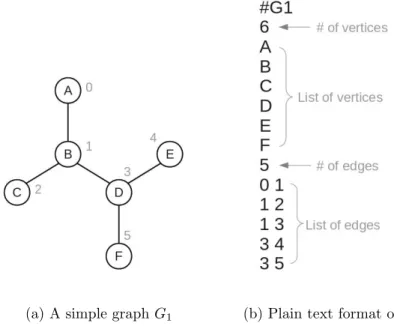
The Closure-Tree (CTree) index is a graph database index for a large number of small graphs which adopts a plain text format for representations of both data graphs and query graphs. Figure 6(a) shows a simple graphG1 that contains six vertices and five edges. Figure 6(b) shows the plain text format representation of graph G1.
(a) A simple graphG1 (b) Plain text format ofG1
Figure 6: The graph data and query format in CTree
Each graph entry starts with a ‘#’, and is followed by the components: graph name, number of vertices, list of vertex labels, number of edges, list of edges. The vertices are numbered starting from 0 in the internal representation, which correspond to the numbers in the edge list. The labels of the vertices are limited to alphabetic letters. In the edge list, the order of the two numbers appearing in a line shows the
direction of an edge. However, throughout the thesis, we use only undirected graphs for both data and query graphs, thus each line in the edge list is recognized as an undirected edge.
An undirected graphG is denoted asG V, E , where V is the vertex set and E is the edge set.
2.5.2
The Graph-Closure Method
In the CTree index, every tree node is a graph or a special kind of graph which is called a graph-closure. Every CTree node contains structural information of all its descendants. Graph-Closure is introduced to capture the structural features of a set of graphs or graph-closures. [HS06] gives the concepts of vertex-closure, edge-closure and a new definition of graph mapping below:
Definition 5 Vertex Closure and Edge Closure
The closure of a set of vertices is a generalized vertex whose attribute is the union of the attribute values of the vertices. Likewise, the closure of a set of edges is a generalized edge whose attribute is the union of the attribute values of the edges.
To ensure each vertex and edge have a corresponding element in the mapped graph, dummy vertices/edges are introduced and have a special label ε as their attribute.
Definition 6 Graph Mapping
A mapping between two graphs G1 and G2 is a bijection φ : G1 G2, where (i) v V1,φ v V2, and at least one ofv and φ v is not dummy, and (ii) e v1, v2 E1, φ e φ v1 , φ v2 E2, and at least one of
e and φ e is not dummy.
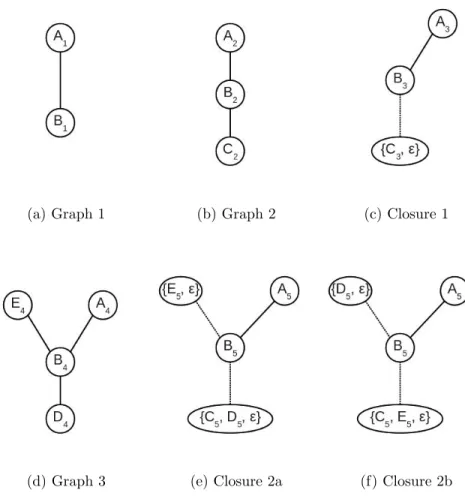
Figure 7 demonstrates an example of constructing a simple CTree. The subscript of each label is used to differentiate vertices in different graphs.
Firstly, Closure 1 is computed from Graph 1 and Graph 2. Note that vertex A, vertex B and edge A, B are common structures between these two graphs. Vertex
C and edge B, C in Graph 2 are not common structures. Vertex C is mapped to a dummy vertex ε and put into a vertex closure C, ε . Edge B, C is mapped to
(a) Graph 1 (b) Graph 2 (c) Closure 1
(d) Graph 3 (e) Closure 2a (f) Closure 2b
Figure 7: Computing a graph-clousre
a dummy edge ε and put into an edge closure B, C , ε . A dotted line implies an edge-closure. Dummy vertices are used so that every vertex has a corresponding element in the other graph.
Next, in Figure 7(e), Closure 2a is computed from Closure 1 and Graph 3 using the same method. Here the concept of a graph-closure under mappingφ is introduced [HS06].
Definition 7 Graph Closure under Mapping φ
The closure of two graphs G1 and G2 under a mapping φ is a generalized graph V, E where V is the set of vertex closures of the corresponding vertices andE is the set of edge closures of the corresponding edges. This
is denoted byclosure G1, G2 .
In Figure 7(d), vertex E4 is mapped to ε, vertex D4 is mapped to C, ε in (c). If D4 is mapped to ε, then the final constructed graph-closure will be (f). [HS06] developed a graph mapping method calledN eighbor Biased M apping (NBM) which maximizes the common structures between two graphs. After NBM, the obtained mapping can be used to merge two graphs, say G1 and G2, into a new generalized graph G3. The process is denoted asG3 Closure G1, G2 .
In the plain text representation format, a graph-closure always has an ID null. A vertex-closure or an edge-closure hasnull following the vertex label or edge numbers indicating that it is a closure. Following the edge list, a graph-closure further has one line indicating how many entries of graphs/graph-closures it has.
2.5.3
Building the CTree and Querying
The graph-closures for a graph dataset are computed recursively level by level. The graph-closure on the top level contains the structural information of all the graphs in the dataset and is the root of this CTree. The constructed tree structure is called a
Closure-Tree (CTree). The CTree building algorithm is shown in Algorithm 1 [HS06].
Algorithm 1: BuildCTree(S, M)
input : A set of graphs S, the maximum number of entries for each graph-closure M
output: A CTree tree
ClosureSet P artition S ;
if ClosureSet 1 then
tree.Root ClosureSet 1
else
tree.Root M akeClosure ClosureSet ;
return ctree;
FunctionPartition(S)
input : A set of graphs S
output : A set of graph-closures C
if S M then return M akeClosure S ; else S1 S i i 1, S2 ; S2 S i i S2 1, S ; C1 partition S1 ; C2 partition S2 ; if C1 C2 M then return C1 C2 ; else C1 M akeClosure C1 ; C2 M akeClosure C2 ; return C1 C2; FunctionMakeClosure(C)
input : A set of graphs C
output : A graph-closure G if C 1 then G C 1 ; return G; else G C 1 ; for i 2 to C do G Closure G, C i ; return G;
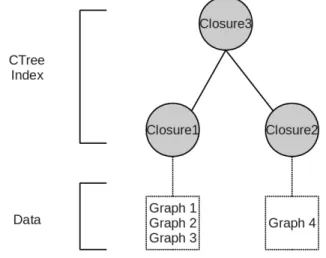
Figure 8 shows a CTree computed from the graphs in Figure 7. Closure3 is the root of this CTree which has a depth of 2. Each graph-closure is a node in the CTree, and each leaf CTree node (Closure1, Closure2) contains graph entries only, while each non-leaf CTree node (Closure3) only contains CTreeNode entries. In order to maintain that only leaf CTreeNodes contain graph entries, Graph4 is firstly transformed into a graph-closure and then participates in further computing.
In order to distinguish the use of ‘vertex’ and ‘node’, the term ‘node’ is used when we refer to the tree index, The word ‘vertex’ is used when we refer to the graphs in a dataset.
In the graph query process, if a CTree node fails a sub-graph isomorphism test with the query graph, then no children nodes need to be further tested, and thus this node and all its descendants are pruned. If the pruning happens at a relatively higher level of the index tree, then more descendant nodes are likely to be pruned and therefore reduce the query time significantly. CTree uses a P seudo Subgraph Isomorphism
test to prune unwanted nodes and uses the subgraph isomorphism test of [Ull76] to further filter the candidate graph list. The query graphs have the same structure and format as the data graphs. The query process is shown in Algorithm 2 from [HS06].
2.5.4
Histogram-Based Pruning in CTree
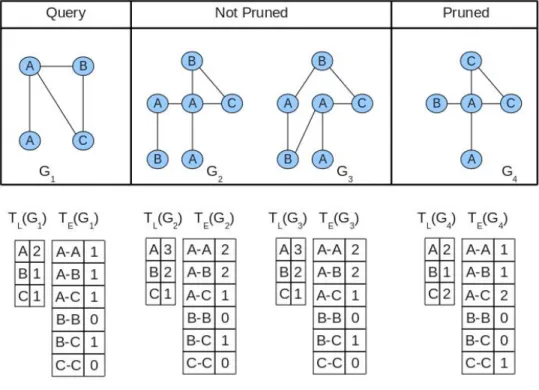
In CTree, a histogram-based method is used as a simple pruning before the structural pruningPseudo-Subgraph Isomorphismtest [HS06]. The pruning starts by calculating the histogram-feature of each graph in the dataset. Assume a query graph G1 and a data graph G2 need to be tested. The pruning proceeds in the following steps:
1. Record the number of appearance of each different vertex labels in an array TL to get TL G1 and TL G2 . Also record the number of
appearance of edges in an arrayTE to getTE G1 and TE G2 . Note
that TL G1 TL G2 TL, and TE G1 TE G2 TE .
2. if i 1, TL G1 , such thatTL G1 i TL G2 i , prune G2.
3. if i 1, TE G1 , such that TE G1 i TE G2 i , prune G2.
This pruning can also be applied to prune graph-closures because a graph-closure is a generalized graph.
Algorithm 2: QueryCTree(query, tree)
input : A query graph query, a CTreetree
output: A set of graphs that contain query as a subgraph
CS V isit(query, tree.Root) ;
Ans empty ;
foreach G CS do if SubIsomorphic(query, G) then
Ans Ans G ;
return Ans;
FunctionVisit(query, node)
input : A query graph query, a CTree node node
output : A graph set CS CS empty;
foreach child c of node do
G the graph or graph closure at c;
if PseudoSubIsomorphic(query,G) then if G is a database graph then
CS CS G ;
else
CS CS V isit(query,c);
A pruning example is shown in Figure 9. G2 and G3 both survived the pruning with G1 as a query graph. But G1 is not a subgraph of G3 and G3 is not pruned, which means the pruning is conservative. G4 is pruned because TE G4 does not
satisfy the requirements.
Figure 9: The label pruning in CTree
2.6
Regular Expressions
A regular expression is the term used to describe a codified method that provides a concise and flexible means for matching strings of text [ZYT]. It is usually used to give a concise description of a set of strings without having to list all elements. The IEEE POSIX [IEE] released the Basic Regular Expressions (BREs) along with an alternative standard called Extended Regular Expressions (EREs). BREs provided a common standard which is adopted as the default syntax of many Unix regular expression tools. Most of such tools also provide additional features.
The GNU C Library [GNU] provides regular expression tools which follow the POSIX.2 standard with support of EREs. We adopt this tool and use EREs in Section 4.1. Detailed introduction of regular expressions can be found in [Goo05] and [Fri97].
Chapter 3
ECTree: the Extended
Closure-Tree for Subgraph Queries
Using a tree structure in a graph database index allows efficient subgraph structure mining. Section 2.5 introduced Closure-Tree (CTree) which adopts a tree structure in substructure graph mining. However, considering that the labels may not be the only attribute that a vertex can have, CTree is not able to index vertices with additional attributes other than vertex labels.
We adopt the CTree index structure to capture common structures in graphs and focus on subgraph queries, meanwhile, we extend it with additional integer attributes on the vertices.
This chapter is organized as follows: Section 3.1 presents our extensions on the vertex attributes. Section 3.2 discusses the vertex merging methods after the exten-sions. Section 3.3 shows the building process of the ECTree. Section 3.4 gives a query format for the ECTree. Section 3.5 discusses the matching between a query graph and a data graph.
3.1
Extending the Vertices with Attributes
The existing CTree provides access to subgraph mining focusing on vertex labels and edge relations. However, actual graphs could contain more information on the vertices than only the labels. For example, chemical compounds, social networks, etc. have additional information of different types on each vertex. In this section, we firstly
demonstrate an example of a chemical structure that has both label attributes and numerical attributes. Then we show our method to represent it as a graph in plain text format.
3.1.1
An Example in the SDF Format
SDFstands for structural-data file. It is one of a family of chemical-data file formats developed by MDL [DNH 92]. The SDF format is a text-based format for representing chemical compounds, in which the structural information and associated data items for one or more compounds are contained. An SDF format chemical consists of some header information, a connection table containing the atom info, the bond connections and types, followed by some sections of more complex information. The file format can be V2000, V3000 or a combination of both [Sym].
(a) ISIS/Draw version of Alanine
(b) Connection table of Alanine [Sym]
Figure 10: Alanine in SDF format
Figure 10(a) shows a chemical compound Alanine[NC05] drawn from a chemical structure drawing program called ISIS/Draw [LWSO04]. Figure 10(b) shows the connection table (CTab) of Alanine.
The first line is the counts line which specifies the number of atoms, bonds, and atom lists, the chiral flag setting, and the CTab version. Line 2-7 shows the atom
block which specifies the atomic symbol and any mass difference, charge, stereochem-istry and associated hydrogens for each atom. Line 8-12 shows the bond block which specifies the two atoms connected by the bond, the bond type and any bond stereo-chemistry and topology (chain or ring properties) for each bond. The last 3 lines are the property block that is provided for future expandability of CTab features, while maintaining compatibility with earlier CTab configurations. Detailed meaning of the values of the atom properties can be found in Appendix A.
We adopt the atom names as vertex labels, the property lists as vertex attributes and the bonds as edges in our ECTree index.
3.1.2
Data Representation in ECTree
We begin by transformingAlanine into the graph shown in Figure 11(a). Besides the vertex label, each vertex further has three more integer attributes adopted from 10(b). In order to store these additional attributes in text format, three positions after each vertex label are added, separated by a “ ”, shown in Figure 11(b). The numbers of integer attributes on each vertex are the same and can be defined according to actual use of the dataset.
Here we give the definitions of data attribute vector, data vertex and data graph:
Definition 8 Data Attribute Vector, Data Vertex and Data Graph
A data attribute vector is a vector that contains only integers as its ele-ments. A data vertex is a vertex that has a data attribute vector as its attribute vector. A data graph is a graph that contains only data vertices. The data attribute vector Λv of a data vertexv is formally defined here:
Λv a1, a2, ..., an , ai Z, i 1, n (1)
Each element ai of Λv is an attribute value of the data vertex v. All the graphs
from a dataset are always used as data graphs. Since a graph-closure is treated as a generalized graph, all graph-closures are data graphs.
There are some reasons that we define the data attribute vector to contain only integer numbers but not other data types such as string or boolean. Firstly, if the attribute contains strings, then the strings have to be matched exactly in the vertex
(a) The graph format ofAlanine (b) Text representation of (a)
Figure 11: Data structure of ECTree
mapping phase, which is not any different than having an extra label. Secondly, a pruning method can be developed with the numbers as attributes, this is discussed later in Section 4.2. Thirdly, in the validation chapter (Chapter 5), the datasets use only integers as attributes of the vertices. Besides, it is very simple to extend the attributes to real numbers if there is need.
3.2
Vertex Merging
The vertex matching phase in building a CTree is very simple: to check whether two vertices have the same label or not, if they do, then the two vertices match, otherwise they do not match. We define the label-matching for two data vertices in ECTree as follows: two data vertices label-match if these two data vertices have the same label. Now we consider the attribute vector of a vertex. In CTree, if two vertices are label-matched, there is no additional operations for merging them. In ECTree, we need to modify the vertex merging strategy so that the label-matched vertices or the non-label-matched vertices which are made into a vertex closure still capture necessary information for the later querying phase. CTree uses each graph-closure as
a “bounding box” of constituent graphs which contains discriminative information of their descendants [ZYY07]. We want our index to inherit the feature of “bounding box” on the attributes as well, thus the merging methods of vertex/vertex-closures are taken into account.
There are three different cases to discuss in the vertex merging phase: i) merg-ing two vertices, ii) merging a vertex and a vertex-closure, iii) merging two vertex-closures. We firstly ignore the integer attributes and map two graphs using Neighbor Biased Mapping, then we consider each of the merging cases separately in detail. In this section, we only discuss the merging methods, the graph mapping method
Neighbor Biased Mapping is adopted from [HS06].
3.2.1
Merging Two Vertices
The main purpose of the closure-tree structure is to reuse common sub-structures. Therefore the merging of two or multiple vertices is a very frequent operation. Merging multiple vertices can be composed of a series of operations of merging two vertices, so we only discuss binary operations here.
Figure 12 shows two vertices va and vb that have the same label. The merged
vertex from two label-matched vertices is a vertex with the same label. va andvb are
merged intovmergedshown in Figure 12(c). For each attributeai invmerge, we set it to
the maximum absolute value at the same position of the merging vertices. Λvmerged 1
= M ax Λva 1 , Λvb 1 =M ax 5, 3 = 5.
(a)va (b)vb (c)vmerged Figure 12: Merging two label-matched vertices
If a vector Λv needs to be merged from multiple vectors Λv1, ...,ΛvM, M 1, we
Equation 2: (Note that when the notation A is used, if A is a set, then A is the cardinality of A; if A is a number, then A is the absolute value ofA.)
M erge Λv1, ...,ΛvM M ax Λvi 1 i 1, M , ..., M ax Λvi n i 1, M (2)
Since the attribute vector of the merged vertex is the absolute ceiling of the all merging vertices, we denote it by a comparison operator “ ”: Λvmerged Λvi,
i 1, M . The definition for the operator “ ” between two data attribute vectors are given in Equation 3. (Note that we have Λva Λvb Λ )
Λva Λvb Λva i Λvb i , i 1, Λ (3)
According to Equation 2 and 3, it can be inferred that:
M erge Λv1, ...,ΛvM Λvi, i 1, M (4)
Next we take a look at the merging of two non-label-matched vertices. The merged vertex from two non-label-matched vertices is a vertex-closure which has a list of attribute vectors of each of the vertex included in the merging. The structure of a vertex-closure in ECTree index has two parts: a label set and an attribute vector list. We further discuss two subcases in vertex merging.
The first subcase is that a vertex v is mapped to a dummy vertex vε. Figure
13(a)(b)(c) shows that a vertex va is mapped to a dummy vertex vε and they are
both added to a vertex-closure vmerged. A dummy vertex in ECTree has the same
label as in CTree: ‘ε’, and has an empty attribute vector Λ . When a vertex v is added to a vertex-closure vmerged, the label of v is added to the label set of vmerged,
each attribute in the vertex attribute vector ofv is transformed into the corresponding absolute value, and then the attribute vector is added to the attribute vector list of
vmerged. If the vertex to be added is a dummy vertex, the label ‘ε’ is added to the
label set of vmerged and Λ is added to the attribute vector list of vmerged.
The second subcase is that a vertex v1 is mapped to another vertex v2 which has a different label. Both labels of v1 and v2 are added to the label set of vmerged, and
all attributes of vectors of v1 and v2 are transformed into the corresponding absolute value and added to the attribute vector list of vmerged. Figure 13(d)(e)(f) shows an
Assume the number of distinctive labels in a graph database is D, the upper bound for the size of a vertex-closure in the ECTree index is D 1 because of a possible dummy vertex.
(a)va (b)vε (c)vmerged
(d)vb (e)vc (f) vmerged Figure 13: Merging two non-label-matched vertex
3.2.2
Merging A Vertex and A Vertex-Closure
In this case, we merge a vertex v and a vertex-closure vc into a new vertex-closure.
There are two possible subcases: 1) the vertex-closurevclosure contains a vertex label
that is the same as the label of v, 2) the vertex-closure vclosure does not contain any
vertex label that is the same as the label of v.
In subcase 1), the merging vertex v has a same label l (l ‘B’ in Figure 14(a)) of one of the labels in the vertex-closure vclosure, we update the vertex attribute
vector Λl in the vertex-closure using the attribute vector Λv according to Equation
2: Λl new M erge Λl,Λv . If the label of the merging vertexv is ε, then the merged
vertex-closurevmerged is the same as the merging vertex-closure vclosure, no operations
are needed. An example of the merging is shown in Figure 14(a)(b)(c).
In subcase 2), the process is similar to merging two unmatched vertices but to replace one vertex by a vertex-closure in this case. An example is shown in Figure
(a)va (b)vclosure (c)vmerged
(d)va (e)vclosure (f) vmerged Figure 14: Merging a vertex and a vertex-closure
14(d)(e)(f).
3.2.3
Merging Two Vertex-Closures
In this case, two vertex-closures vclosure1 and vclosure2 are merged into a new
vertex-closure vmerged. We still have two possible subcases: 1) the two vertex-closure label
sets do not have any vertex labels in common, 2) the two vertex-closure label sets have some vertex labels in common. The first subcase is similar to merging two unmatched vertices, we simply add the labels and corresponding attribute vectors into a new vertex-closure, no further operations are needed. We mainly discuss the two steps in merging two vertex-closures that have same labels. Assume L1 is the label set of vclosure1, L2 is the label set of vclosure2.
Step 1:
if the common label l ‘ε’: add l to the label set of vmerge, add Λl new
M erge Λl1,Λl2 to the attribute vector list, l1 l2 L1 L2, l1 L1,l2 L2.
if the common label l ‘ε’: add ε to the label set of vmerge, add Λ to the
Step 2, l L1 L2 L1 L2 , add l to the label set of vmerge and add Λl to the
attribute vector list.
(a)vclosure1 (b)vclosure2 (c)vmerged Figure 15: Merging two vertex-closures
An example of this case is shown in 15, vclosure1 and vclosure2 have two labels in
common: l1 = ‘B’ and l2 = ‘C’, while ‘ε’ and ‘D’ are not common labels. Thus we use Equation 2 to calculate the new attribute vector in vmerge: Λmerged l1 =
M erge Λclosure1 l1,Λclosure2 l1 , Λmerged l2 = M erge Λclosure1 l2,Λclosure2 l2 . ‘ε’ and
‘D’ are directly added to the list of attribute vectors without any operations.
3.3
Building the ECTree
We modified the data representation of a graph in the dataset, thus the structure of a graph-closure and its computing method have to be modified accordingly. Since the structure of edges and edge closures are not modified, the corresponding methods do not need modifications. We focus on our new methods of computing graph closures in this section.
3.3.1
Data Graph Mapping
In CTree, there is no distinguishment between mapping two data graphs and mapping a query graph and a datagraph. We will introduce the mapping between a query graph and a data graph for ECTree in Section 3.4.
In order to make two graphs G1 and G2 into a graph-closure C, it is necessary to find a possible graph mapping φ initially from G1 to G2. In ECTree, we get the graph mapping φ by using Neighbor Biased Mapping, ignoring the attributes of the vertices; then each mapped pair of vertices/vertex-closures are merged using previous described methods.
We do not do exact matching for data graph mapping for the following reasons. Firstly, the possibility for two vertices in two graphs to have the exact same label and attributes is very low; secondly, we still maintain the clustering feature of the tree index using the vertex merging methods.
3.3.2
An ECTree Building Example
The process of building graph-closures is the process of building an ECTree. We show an example of building a graph-closure from three graphs in a dataset in Figure 16.
Firstly Closure 1 is computed from Graph 1 and Graph 2. For vertex C in Graph 2, there is no corresponding vertex so it is mapped to a dummy vertex ε, both of them are put into a vertex-closure C, ε .
Next we compute Closure 2a from Closure 1 and Graph 3 using the same method, as shown in Figure 16(e). Figure 16(f) shows Closure 2b which is computed from Closure 1 and Graph 3 as well but using a different graph mapping. Graph mappings can be obtained using different graph mapping algorithms, but for a chosen algorithm, the mapping obtained between two graphs is unique. Ideally, the mapping method should maximize the common structure and attributes of the two graphs. Since we did not find a proper mapping algorithm for attributed graphs, the NBM [HS06] method is used.
3.4
A Query Graph Format for ECTree
Just like CTree, we can also use a data graph as a query graph. For instance, to query the substructure as shown in Figure 11(a), the representation in Figure 11(b) can simply be used as a query. However, in ECTree, we focus on the graph data mining of the attributes of the vertices, the use of the format of the data graphs as query graphs is too simple and does not make full use of the new index. We introduce
(a) Graph 1 (b) Graph 2 (c) Closure 1
(d) Graph 3 (e) Closure 2a (f) Closure 2b
Figure 16: Computing a graph-closure in ECTree
a query format for ECTree that allows more flexible queries in terms of the attributes of vertices.
Firstly, we allow the use of intervals to appear in the query graphs. An integer interval is made up of two integers and two brackets. An open or close bracket means the integer at that side is not included in the interval, while a square bracket means the integer at that side is included in the interval.
Two or more intervals can be used together to make up more complex intervals. Some examples of interval sets are shown in Figure 17(a): I1 0,1 , I2 4, 2 ,
I3 1,2 2,3 4,5 , I4 9. There is only one relational operator “ ” union supported between the intervals. Since there is only one relational operator, we omit
it in the representation and by default, it is implied that the union operation is used between all the intervals using together.
(a) Four intervals (b) A graph with intervals
Figure 17: Examples of interval sets
Therefore, [-2,2] (5,7] is written as [-2,2](5,7] in plain text format. I3 is written as
I3 1,2 2,3 4,5 . I4 can both be written as 9 orI4 9,9 . But if a single integer valuei is unioned with other intervals, it has to be written in the form of i, i . E.g, 5 [6.8] should be written as [5,5][6,8]. Figure 17(b) shows a query graph Q which uses the intervals in the graph attribute vectors.
In addition to the integer intervals described above, we use the symbol ‘*’ to replace the interval , . The symbol ‘*’ cannot be unioned with any other interval(s). E.g., the plain text format of the query vertex ‘D , [-2,-2]’ is written as ‘D [-2,-2]’.
In contrast to Definition 8, we give the definitions for Query Attribute Vector, Query Vertex and Query Graph here:
Definition 9 Query Attribute Vector, Query Vertex and Query Graph
A query attribute vector is a vector that contains integer interval sets as its elements. A query vertex is a vertex that has a query attribute vector
as its attribute vector. A query graph is a graph that contains query vertices.
Let Ii, i 1, n be a set of integer intervals, we denote the query attribute vector
Λv as follows:
Λv I1, I2, ..., In (5)
3.5
Query Matching
In this section, we discuss the query matching for ECTree graph index. We have demonstrated different formats of the query graphs and the data graphs as well as the methods to make the graph-closures in ECTree. There are two different cases in the query matching: matching a query with a non-closure graph and a graph-closure. In both cases, we assume the mapping φ between a query graph and a data graph is obtained by using the graph mapping algorithm Neighbor Biased Mapping from [HS06].
3.5.1
Matching a Query Vertex and a Data Vertex
There are two cases to discuss: 1) matching a query vertex and a data vertex in a non-closure graph, 2) matching a query vertex and a data vertex in a graph-closure. In the first case, a query vertexvQmatches a data vertexvD in a non-closure graph
if ΛvD i ΛvQ i , i 1, ΛvQ . This is easy to understand because a non-closure
data vertex is in the vertex set of a non-closure graph which is in the original dataset. An example is shown in Figure 18. vQ matches vD1 but does not match vD2.
(a)vQ (b)vD1 (c)vD2
Figure 18: Matching a query vertex and a non-closure data vertex
For simplification, we define the operator “ ” between a query attribute vector and a data attribute vector of a non-closure vertex in Equation 6:
Λ Λ Λ i Λ i , i 1, Λ (6) In the second case, since the attribute vector of a vertex-closure is the absolute ceiling of all the attribute vectors in the closure, we only compare the values in the data attribute vector to the minimum absolute values of the intervals in the query vector. We denote the minimum absolute value within a interval set I by Min-Absolute(I) = M in i i I . E.g., in Figure 19(a) Min-Absolute(I) = i2, in Figure 19(b) Min-Absolute(I) = 0. Here the definition of the operator “ ” between a query attribute vector and a data attribute vector of a graph-closure is given in Equation 7.
Λ Λ Λ i Min-Absolute Λ i , i 1, Λ (7)
We take a look at the two examples in Figure 19. Assume I i1, i2 i3, is an interval set in a query attribute vector Λ I , i1 i2 i3, i2 i3. d1 0, d2
0, d2 d1 are two values in two different data attribute vector Λ1 = d1 and Λ2 d2 . In Figure 19(a), the query interval requires the value of the data attribute falls in the interval set I, but for Λ1, the value can only fall within d1, d1 which means all the values of the attribute of the vertices in the vertex-closure are within d1, d1
thus cannot match I. In this case, only Λ2 satisfies the condition. In Figure 19(b), the value ‘0’ is included in the interval set I, therefore the minimum absolute value within I is ‘0’. Sinced1 0 and d2 0, they both satisfy the condition.
(a) (b)
We sum the matching between a query attribute vector Λv
Q and a data attribute
vector ΛvD as follows:
Λ Λ Λ i Λ i , i 1, Λ vQisnon-closure Λ i Min-Absolute Λ i , i 1, Λ vQis a closure
The modified vertex mapping algorithm is shown in Algorithm 3.
Algorithm 3: VertexMapping Modified(v1, v2)
input : A query vertex v1, a data vertexv2
output: A boolean value, trueif mappable, false if not
if label of v1 does not match label of v2 then return false;
Λ attribute vector of v1 ; Λ attribute vector of v2 ;
if v2is from a graph-closure then for i 1 to Λ do k Min-Absolute Λ i ; if Λ i k then return false ; else for i 1 to Λ do booleanb false; interval set I Λ i ; for j 1 to I do if Λ i I j then b true; break; if b is false then return false; return true;
3.5.2
Matching a Query Graph and a Data Graph
Based on our discussion in the previous subsection, we define the subgraph matching as follows:
A query graph GQ VQ, EQ matches a data graphGD VD, ED if GQ is
subgraph-isomorphic to GD under graph mappingφ and v VQ,Λv Λφ v .
When a query graph is compared to a data graph, the histogram pruning is used firstly, followed by the Pseudo Subgraph Isomorphism test, and finally the subgraph isomorphism test. Assume GQ is a query graph and GD is a data graph, Table 2
shows the descriptions of the symbols to be used.
Symbol Description
n1 the number of vertices in GQ
n2 the number of vertices in GD
d1 the maximum vertex degree inGQ
d2 the maximum vertex degree inGD
l the pseudo compatibility level defined for the
PSI pruning [HS06]
M the time complexity of maximum cardinality
matching for bipartite graphs
a the number of vertex attributes
Table 2: Notations
The worst case complexity for the histogram pruning in ECTree is the same as CTree: O n21 , since all calculations are one-time-cost and pre-processed. The PSI pruning algorithm for ECTree has a worst case complexity of O ln1n2 d1d2 M d1, d2 aM n1, n2 [HS06]. The pseudo compatibility level is defined before querying and can be adjusted. Hopcroft and Karp’s algorithm [HK71] finds a maxi-mum cardinality matching in O n2.5 time.
Here we do some further discussions aboutExact MatchingandInexact Match-ing. When we match a query vertex vQ and a data vertex vD1 from a non-closure
graph, we use exact matching. That is, the attribute values of ΛD1 need to be
in-cluded in the corresponding intervals of ΛQ. When we match a query vertex vQ and
a data vertex vD2 from a graph-closure, we use inexact matching which means the
attribute values of ΛD2 do not have to exactly match the corresponding intervals of
ΛQ, but just be larger than the corresponding absolute minimum values. There are a few reasons why we do not use exact matching:
graph-closures at each level will cost a huge amount of space and thus make the index very large.
On time consumption, if we store a list for each position in an attribute vector, then matching a query attribute vector and a data attribute vector will be very trivial and the time cost can be unacceptable. At a relatively higher level, the lists in the attribute vectors can be very long and hard to update.
The dead space in graph merging needs to be considered as well. Even if a query graph and a graph-closure are matched using exact matching, there is no guarantee that there are answer graphs under the branch of this graph-closure because the matched graph could be in the dead space.
3.6
Conclusion
In this chapter, we have provided description of our extended closure-tree that man-ages graph data with integer attributes on the vertices, based on the original CTree index. ECTree is a graph index that specifies the queries on the vertex attributes and at the same time provides very flexible formats of queries in terms of the at-tributes. We discussed the new merging and matching methods in ECTree for the new structure of both data and query graphs which is very different from the CTree index.
The ECTree index inherits the feature of CTree: graph clustering hierarchically. An ECTree node is the clustering of both the structure and the attribute of its descendents.