Privacy Preserving Data Mining,
Evaluation Methodologies
Igor Nai Fovino and Marcelo Masera
The Institute for the Protection and Security of the Citizen provides research-based, systems-oriented support to EU policies so as to protect the citizen against economic and technological risk. The Institute maintains and develops its expertise and networks in information,
communication, space and engineering technologies in support of its mission. The strong cross-fertilisation between its nuclear and non-nuclear activities strengthens the expertise it can bring to the benefit of customers in both domains.
European Commission Joint Research Centre
Institute for the Protection and Security of the Citizen Contact information
Address: Via E Fermi I-21020 Ispra (VA) ITALY E-mail: [email protected] Tel.: +39 0332786541 Fax: +39 0332789576 http://ipsc.jrc.ec.europa.eu/ http://www.jrc.ec.europa.eu/ Legal Notice
Neither the European Commission nor any person acting on behalf of the Commission is responsible for the use which might be made of this publication.
Europe Direct is a service to help you find answers to your questions about the European Union
Freephone number (*): 00 800 6 7 8 9 10 11
(*) Certain mobile telephone operators do not allow access to 00 800 numbers or these calls may be billed.
A great deal of additional information on the European Union is available on the Internet. It can be accessed through the Europa server http://europa.eu/
JRC JRC42699 EUR 23069 EN ISSN 1018-5593
Luxembourg: Office for Official Publications of the European Communities © European Communities, 2008
Reproduction is authorised provided the source is acknowledged Printed in Italy
Privacy Preserving Data Mining, Evaluation
Methodologies
Igor Nai Fovino, Marcelo Masera
16th January 2008
Contents
Introduction 5
1 State of the art 7
1.1 Evaluation, State of The Art . . . 7
1.2 Considerations . . . 10 2 Operational parameters 13 2.1 Efficiency . . . 13 2.2 Scalability . . . 14 2.3 Hiding failure . . . 15 2.4 Complexity . . . 15 3 Privacy Level 17 3.1 The Privacy Evaluation in PPDM . . . 18
3.2 The Privacy Level Measure . . . 20
4 Data Quality 27 4.1 Data Quality in the Context of PPDM . . . 28
5 Information Driven Data Quality Schema 31 5.1 The Information Quality Model . . . 31
5.2 Data Quality Evaluation of AIS . . . 33
5.3 The Evaluation Algorithm . . . 33
6 Evaluation Framework 37
6.1 A three-steps framework for the evaluation of PPDM algorithms 39
7 Conclusions 43
Introduction
IntroductionSeveral data mining techniques, incorporating privacy protection mecha-nisms, have been developed based on different approaches. For instance, various sanitization techniques have been proposed for hiding sensitive items or patterns that are based on removing reserved information or inserting noise into data. Privacy preserving classification methods, instead, prevent a miner from build-ing a classifier able to predict sensitive data. Additionally, privacy preservbuild-ing clustering techniques have been recently proposed, which distort sensitive nu-merical attributes, while preserving general features for clustering analysis.
Given the number of different privacy preserving data mining (PPDM) tech-niques that have been developed over the last years, there is an emerging need of moving toward standardization in this new research area, as discussed in [67]. We believe that one step toward this essential process is the definition of a frame-work identifying the various parameters which characterize a PPDM algorithm, thus making it possible to assess and compare such techniques according to a fixed set of evaluation criteria. Because all the various techniques differ among each other with respect to a number of criteria, like performance, data quality, privacy level, it is important to provide a systematic and comprehensive frame-work for their evaluation. In many cases, no technique is better than the other ones with respect to all criteria. Thus, one has to select the privacy preserving technique based on the criterion to be optimized.
An unified framework allowing to satisfy these goals is essential in order to select the privacy preserving technique which is more adequate based on the data and the requirements of the application domain. Moreover, a major feature of PPDM techniques is that they usually entail modifications to the data in order to sanitize them from sensitive information (both private data items and complex data correlations) or to anonymize them with some uncertainty level. Therefore, in evaluating a PPDM algorithm it is important to assess the quality of the transformed data. To do this, we need methodologies for the assessment of the quality of data, intended as the state of the individual items in the database resulting from the application of a privacy preserving technique, as well as the quality of the information that is extracted from the modified data by using a given data mining method. As we already explained, the former notion of data quality is strictly related to the use the data are intended for. Moreover, some of those algorithms can be computationally very expensive and
6 CONTENTS
thus cannot be used when very large sets of data need to be frequently released. Therefore, in addition to data quality, performance also needs to be carefully assessed. Other aspects, like scalability, need also to be taken into account since the data collected, stored and managed for the mining process grow enormously. We thus clearly need a comprehensive evaluation framework characterized by several metrics relevant for assessing the various aspects of PPDM algorithms. In this report, we present results of our researches on this topic [10, 11], and more in detail, a framework which allows one to compare the various privacy preserving techniques on a common platform. The framework consists of a number of evaluation criteria and a set of tools for data pre-processing and PPDM algorithm evaluation. The framework has been extensively used for assessing a suite of PPDM algorithms developed as part of the CODMINE project [97]. Moreover, due to the fact that the problem of disclosing private information when partially or totally releasing data storage is also addressed in the area of statistical databases1 we also analyze and compare some of these
methods along with the metrics used for evaluating them.
1We remember here that the statistical disclosure control (SDC) aims at protecting
indi-vidual data, referred to asmicrodataaccording to theSDCterminology, when releasing some relevant statistics by means of statistics-based techniques, some of which are also adopted in the area of data mining
Chapter 1
State of the art
We already explained in the introduction that no unified framework exists sup-porting the evaluation of PPDM algorithms. Moreover a set of universally accepted general parameters on the basis of which one can evaluate some par-ticular aspects of PPDM algorithms not exist. In this chapter, we will briefly focus our attention on the parameters used by the different authors of PPDM algorithms in order to prove the properties of their algorithms. Moreover, on the basis of the presented parameters we will make some considerations on the goals a PPDM must (or should) satisfy. This short presentation will act as the basis over which we will build the remaining part of this report.
1.1
Evaluation, State of The Art
Oliveira and Zaiane [68] in the evaluation of their heuristic-based framework for preserving privacy in mining frequent itemsets introduce some measures quantifying the effectiveness and the efficiency of their algorithms. The first parameter is evaluated in terms of
• Hiding Failure, that is, the percentage of restrictive patterns that are discovered from the sanitized database.
• Misses Cost, that is, the percentage of non-restrictive patterns that are hidden after the sanitization process.
• Artifactual Pattern, measured in terms of the percentage of discovered patterns that are artifacts.
Moreover, the specification of adisclosure thresholdφ, representing the percent-age of sensitive transactions that are not sanitized, allows one to find a balance between the hiding failure and the number of misses. The efficiency of the al-gorithms is measured in terms of CPU time, by first keeping constant both the size of the database and the set of restrictive patterns, and then by increasing the size of the input data in order to assess the algorithm scalability. Moreover,
8 CHAPTER 1. STATE OF THE ART
Oliveira and Zaiane propose three different methods to measure the dissimilar-itybetween the original and sanitized databases. The first method is based on the difference between the frequency histograms of the original and the sanitized databases. The second method is based on computing the difference between the sizes of the sanitized database and the original one. The third method is based on a comparison between the contents of two databases.
In [92], instead, Sweeney proposes a heuristic-based approach for protect-ing raw data through generalization and suppression techniques. The method she proposes provides K-Anonymity. As already explained in Chapter 2, in some way, the cell distortion that normally affects a database sanitized by K-anonymity, can be identified as a measure of DQ impact of the sanitization on the target database. Sweeney measures the cell distortion as the ratio of the domain of the attribute to the height of the attribute generalization which is a hierarchy. In the same article the concept of precision is also introduced. Given a table T, theprecision represents the information loss incurred by the conversion process from a tableT to a K-Anonymous TableTk. More in detail
theprecision of a tableTk is measured as follows:
Given a databaseDB with NA attributes andN transactions, if we identify
as generalization scheme a domain generalization hierarchyGT with a depthh, it is possible to measure the quality of a sanitized databaseSDB as:
Quality(SDB) = 1− i=NA i=1 i=N j=1 h |GTAi| |DB| ∗ |NA| (1.1)
where |GThAi| represent the detail loss for each cell sanitized.
Agrawal and Srikant in [4] introduce a quantitative measure to evaluate the amount of privacy offered by a method and evaluate the proposed method against this measure. More specifically, if one can estimate with c% confidence that a value x lies in an interval, then the width of such interval defines the amount of privacy with a c% confidence level. They also assess the accuracy of the proposed algorithms for Uniform and Gaussian perturbation and for fixed privacy level. In [2] Agrawal and Aggarwal propose some metrics in order to evaluate privacy and information loss. Unlike the approach in [4], the privacy metric proposed by Agrawal and Aggarwal takes into account the fact that both the perturbed individual records and the reconstructed distribution are available to the user as well as the perturbing distribution, as it is specified in [36]. This metric is based on the concept of mutual information between the original and perturbed records. The average conditional privacy of an attribute
A, given some other information, modeled with a random variableB, is defined as 2h(A|B), where h(A|B) is the conditional differential entropy of A given B
representing a measure of uncertainty inherent in the value of A, given the value of B. The information loss, instead, measures the lack of precision in estimating the original distribution from the perturbed data. It is defined as half the expected value of the L1-norm between the original distribution and
the reconstructed one. The proposed metric for evaluating information loss is related to the amount of mismatch between the original distribution and its estimate in terms of area. Both the proposed metrics are universal in the sense
1.1. EVALUATION, STATE OF THE ART 9 that they can be applied to any reconstruction algorithm, independently from the particular data mining task applied.
Evfimievski et al. [37], in order to evaluate the privacy breaches, count the occurrences of an itemset in a randomized transaction and in its sub-items in the corresponding non randomized transaction. Out of all sub-items of an itemset, the item causing the worst privacy breach is chosen. Then, for each combination of transaction size and itemset size, the worst and the average value of this breach level are computed over all frequent itemsets. Finally, the itemset size giving the worst value for each of these two values is selected.
Rivzi and Haritsa [81] propose a privacy measure dealing with the probability with which the user’s distorted entries can be reconstructed. In other words, the authors estimate the probability that a given 1 or 0 in the true matrix representing the transactional database can be reconstructed, even if for many applications the 1’s and 0’s values do not need the same level of privacy.
Kantarcioglu and Clifton in [53] evaluate the methods they propose in terms of communication and computation costs:
• Communication Cost: is expressed in terms of the number of messages exchanged among the sites, that are required by the protocol for securely counting the frequency of each rule.
• Computation cost: is expressed in terms of the number of encryption and decryption operations required by the specific algorithm.
Oliveira and Zaiane in their work on Clustering PPDM [69] define a perfor-mance measure that quantifies the fraction of data points which are preserved in the corresponding clusters mined from the distorted database. More in detail, a specific parameter, called misclassification error, is also introduced for mea-suring the amount of legitimate data points that are not well-classified in the distorted database. Finally, the privacy ensured by such techniques is measured as the variance difference between the actual and the perturbed values.
In the context of statistical disclosure control a large number of methods, calledmaskingmethods in the SDC jargon, have been developed to preserve in-dividual privacy when releasing aggregated statistics on data, and more specif-ically to anonymize the released statistics from those data items that can iden-tify one among the individual entities (person, household, business, etc.) whose features are described by the statistics, also taking into account, additionally, related information publicly available [106]. In [27] a description of the most relevant masking methods proposed so far is presented. Among the perturbative methods specifically designed for continuous data, the following masking tech-niques are described: additive noise, data distortion by probability distribution, resampling, microaggregation, rank swapping, and so on. For categorical data both perturbative and non-perturbative methods are presented. The top-coding and bottom-coding techniques are both applied to ordinal categorical variables; they recode, respectively, the first/last p values of a variable into a new cat-egory. The global-recoding technique, instead, recodes the plowest frequency categories into a single one. All these masking methods are assessed according
10 CHAPTER 1. STATE OF THE ART
to the two main parameters: the information lossand thedisclosure risk, that is, the risk that a piece of information be linked to a specific individual. Sev-eral metrics are presented in the paper for assessing theinformation loss and thedisclosure riskgiven by a SDC method. Additionally, in order to provide a trade-off level between these two metrics, a score is defined that gives the same importance to disclosure risk and information loss.
1.2
Considerations
In order to define which set of parameters is the most suitable to evaluate PPDM algorithms, it is previously necessary to define which are the main goals a PPDM algorithm should satisfy and then, starting from these considerations, reflect on the dimensions to be taken into account in the evaluation phase. On the basis of the content of the previous section, it is evident that a PPDM algorithm must satisfy the following requirements:
1. It should prevent the discovery of sensible information.
2. The sanitized database should be resistant to the various data mining techniques.
3. It should not compromise the access and use of non sensitive data. 4. It should be usable on large amounts of data.
5. It should not have an exponential computational complexity. 6. It should not consume an high amount of resources
Current PPDM algorithms do not satisfy all these goals at the same time; for instance, only few of them satisfy the point (2). The above list of goals helps us to understand how to evaluate these algorithms in a general way. The framework we have identified is based on the following evaluation dimensions:
• Efficiency, that is, the ability of a privacy preserving algorithm to exe-cute with good performance in terms of all the resources implied by the algorithm. It can be used to measure the goal number six.
• Scalability, which evaluates the efficiency trend of a PPDM algorithm for increasing sizes of the data from which relevant information is mined while ensuring privacy. It can be used to measure the goal number four.
• Data Qualitywhich evaluate the impact of the sanitization on the data-base DQ. It is related with the goal number three.
• Hiding Failure, that is, the portion of sensitive information that is not hidden by the application of a privacy preservation technique. It is related to the goal number one.
1.2. CONSIDERATIONS 11
• Privacy leveloffered by a privacy preserving technique, which estimates the degree of uncertainty, according to which sensitive information, that has been hidden, can still be predicted. It can be used to give an alterna-tive measure to the goal one and partially to the goal two.
An important question is which one among the presented “dimensions” is the most relevant for a given privacy preserving technique. Dwork and Nissim [32] make some interesting observations about this question. In particular, accord-ing to them in the case of statistical databases privacy is paramount, whereas in the case of distributed databases for which the privacy is ensured by using a secure multiparty computation technique, flexibility is of primary importance. Since a real database usually contains a large number of records, the perfor-mance guaranteed by a PPDM algorithm, in terms of time and communication requirements, is a not negligible factor, as well as its trend when increasing database size.
The quality of data guaranteed by a PPDM algorithm is, on the other hand, very important when ensuring privacy protection without damaging the data usability from the authorized users. A trade-off metric can help us to state a unique value measuring the effectiveness of a PPDM algorithm. In Domingo-Ferrer and Torra [27] the score of a masking method provides a measure of the trade-off between disclosure risk and information loss. It is defined as an average between the ranks of disclosure risk and information loss measures, giving the same importance to both metrics.
In Duncan, Keller-McNulty and Stokes [31] a R-U confidentiality map is de-scribed that traces the impact on disclosure risk R and data utility U of changes in the parameters of a disclosure limitation method which adopts an additive noise technique. We believe that an index assigning the same importance to both the data quality and the degree of privacy ensured by a PPDM algorithm is quite restrictive, because in some contexts one of these parameters can be more relevant than the other. Moreover, in our opinion the other parameters, even the less relevant ones, should be also taken into account. The efficiency and scalability measures, for instance, could be discriminating factors in choos-ing among a set of PPDM algorithms that ensure similar degrees of privacy and data utility. A weighted mean could be, thus, a good measure for evaluating by means of a unique value the quality of a PPDM algorithm. In the current work, however, we mainly focus on the different evaluation criteria characterizing a PPDM algorithm.
In the following, we discuss in deep each evaluation criteria we have iden-tified. More in detail, we divided these criteria into three groups related to different aspect to be assessed: theOperational Parameters are mainly related to computational measures, thePrivacy Parameters strongly related to the not evident definition of Privacy and the Data Quality Parameters related to the already presented concepts of DQ.
Chapter 2
Operational parameters
TheOperational Parametersare mainly related to the computational properties of the algorithms. In this class of parameters we consider the efficiency, the scalability, the hiding failure and the complexity. In what follows we give a detailed definition of these parameters.
2.1
Efficiency
The assessment of the resources used by a privacy preserving data mining al-gorithm is given by itsEfficiency, which represents the ability of the algorithm to execute with good performance in terms of all used resources. Performance is assessed, as usually, in terms of time and space, and, in case of distributed algorithms, in terms of the communication costs incurred during information exchange.
Time requirements can be evaluated in terms of CPU time, or computational cost, or even the average of the number of operations required by the PPDM technique. Clearly, it would be desirable that the algorithms have a polynomial complexity rather than an exponential one. Anyway, it can be useful to compare the performance of the privacy preserving method with the performance of the data mining algorithm for which the privacy preserving method has been devel-oped. Our initial expectation is that the execution times of the hiding strategies be proportional to the execution times of the mining algorithms that extract the sensitive information. Such an expectation was contradicted by tests performed in some cases. That can be easily explained. In fact in the cases in which the PPDM algorithm acts simply modifying data without taking into account some complex criteria like the data quality, the efficiency of the PPDM algorithm and the DM algorithm for which it was designed to fight against are similar. Obviously that will not be the same in the case in which, in order to make the better modifications, the PPDM algorithm adopts more complex strategies.
Space requirements are assessed according to the amount of memory that must be allocated in order to implement the given algorithm.
14 CHAPTER 2. OPERATIONAL PARAMETERS
Finally, communication requirements are evaluated for those data mining al-gorithms, which require information exchanges during the secure mining process, as the cryptography-based techniques. It is measured in terms of the number of communications among all the sites involved in the distributed data mining task.
2.2
Scalability
As in the case of DQ different definitions of scalability have been proposed. For this reason it is not so simple to define “What we want to measure” in our particular case. However, one of the fields in which this concept is well explored is the field of multiprocessor systems. Starting from experiences in this context we will give our definition of scalability for PPDM algorithms. In [33] Eager claims that intuitively scalability implies a favorable comparison between a larger version of some parallel system with either a sequential version of that same system or a theoretical parallel machine. He relates scalability to the concept ofspeedup. More in detail, lettime(n, x) be the time required by ann−processor system to execute a program to solve a of problem of sizex, the speedup on a problem of sizexwith nprocessors is the execution time on one processor divided by the time onnprocessors:
speedup(n, x) = time(1, x)
time(n, x) (2.1)
Moreover, Eager relates Efficiency with speedup as follows:
ef f iciency(n, x) = speedup(n, x)
n =
time(1, x)
n∗time(n, x) (2.2) Intuitively, a system with a linear speedup (speedup(n, x) =n) can be as-sumed to be scalable. We can thus propose a first definition:
Definition 1 A system is scalable if efficiency (n, x) = 1 for all algorithms, number of processors n and problem sizes x.
This is however a not useful definition. As Amdhal [6] notes,many parallel algorithms have a sequential (or at least not completely parallel) component, yielding poor efficiency for a sufficiently large number of processors. Moreover there exists the size problem (it is constant or not?). Some approaches to scalability are based on the concept oftheoretical parallel machines [40] and on the comparison between the efficiency of the real machine with the theoretical one.
Starting from these considerations we give a definition tailored for our par-ticular case. In order to do this, some consideration must be made. We are not interested to evaluate the case in which an algorithm is executed on a single processor or on a multiprocessor; we want a measure completely independent from “hardware constraint”. Moreover in the database context the prominent
2.3. HIDING FAILURE 15 position is occupied by data and its size. We want to link the scalability with the “database size”. For this reason, a PPDM algorithm has to be designed and implemented for being scalable with larger and larger datasets. The less rapid is the decrease in the efficiency of a PPDM algorithm for increasing data dimensions, the better is its scalability. By recalling equations 2.1 and 2.2 we can define the scalability as follows:
Definition 2LetAan algorithm for PPDM, letDa database to be sanitized, we define the scalability of the algorithmAas the efficiency trend for increasing values in data sizes of D
Therefore, such parameter concerns the increase of both performance and storage requirements together with the costs of the communications required by a distributed technique when data sizes increase.
Formally, we define the scalability as the speedup of a mono-processor com-putation in function of the size increase of the database.
Scalability= (speedup(1, size(t))) (2.3) Obviously, given this definition, it is easy to extend it in the case in which we want to evaluate the PPDM algorithm in a multi-processor context. However we are not actually interested to this type of application.
2.3
Hiding failure
The percentage of sensitive information that is still discovered, after the data has been sanitized, gives an estimate of the hiding failureparameter. Most of the developed privacy preserving algorithms are designed with the goal of ob-taining zero hiding failure. Thus, they hide all the patterns considered sensitive. However, it is well known that the more sensitive information we hide, the more non-sensitive information we miss. Thus, some privacy preserving data mining algorithms have been recently developed which allow one to choose the amount of sensitive data that should be hidden in order to find a balance between privacy and knowledge discovery. It is important to underline that, as we will explain well after, the hiding failure is not related to the Privacy level Measure. In fact, the hiding failure measures the percentage of failure in the hiding process, or, roughly speaking, the number of sensitive information (clusters, rules etc.) not hidden. The privacy parameter, instead, starting from the assumption that all the sensitive rules are hidden, measures how strongly the information is hidden. This concept will be extensively explained in the following chapters.
2.4
Complexity
If an algorithm halts, we define its running time to be the sum of the costs of each instruction carried out. Within the RAM model of computation, arithmetic operations involve a single instruction and could be assumed to have a unit cost.
16 CHAPTER 2. OPERATIONAL PARAMETERS
By computing then the computational cost of an algorithm we have in some way an alternative measure of the efficiency and scalability of an algorithm. It represents the theoretical measure of the algorithm behavior. It is however important, when considering the computational complexity, to take into account the dimension and the type of the input. In fact, when comparing different algorithms, if these properties are very different, it does not probably make sense to consider as discriminant the complexity of the algorithms.
Chapter 3
Privacy Level
In our society the term “Privacy” is overloaded, and can, in general, assume a wide range of different meanings. For example, in the context of the HIPAA1
Privacy Rule, Privacy means the individual’s ability to control who has the access to personal health care information. From the organizations point of view,
Privacyinvolves the definition of policies stating which information is collected, how it is used, and how customers are informed and involved in this process. Moreover, there are many other definitions of privacy that are generally related with the particular environment in which the privacy has to be guaranteed. What we need is a more generic definition, that can be instantiated to different environments and situations.
From a philosophical point of view, Schoeman [102] and Walters [103] iden-tify three possible definitions of privacy:
1. Privacy as the right of a person to determine which personal information about himself/herself may be communicated to others.
2. Privacy as the control over access to information about oneself.
3. Privacy as limited access to a person and to all the features related to the person.
These three definitions are very similar apart from some philosophical dif-ferences that are not in the scope of our work. What is interesting from our point of view is the concept of “Controlled Information Release” emerging from the previous definitions. From this idea, we argue that a definition of privacy that is more related with our target could be the following:
“The right of an individual to be secure from unauthorized disclosure of information about oneself that is contained in an electronic repository”. Performing a final tuning of the definition, we consider privacy as:
Definition 3“The right of an entity to be secure from unauthorized disclosure
1
Health Insurance Portability and Accountability Act
18 CHAPTER 3. PRIVACY LEVEL
of sensitive information that are contained in an electronic repository or that can be derived as aggregate and complex information from data stored in an electronic repository”
The last generalization is due to the fact that the concept of individual privacy does not even exist.
As in [67] we consider two main scenarios. The first is the case of a Medical Database where there is the need to provide information about diseases while preserving the patient identity.
Another scenario is the classical “Market Basket” database, where the trans-actions related to different client purchases are stored and from which it is pos-sible to extract some information in form of association rules like “If a client buys a product X, he/she will purchase also Z with y% probability”.
The first is an example in which individual privacy has to be ensured by pro-tecting, from unauthorized disclosure, sensitive information in form of specific data items related to specific individuals. The second one, instead, emphasizes how not only the raw data contained into a database must be protected, but also, in some cases, the high level information that can be derived from non sensitive raw data need to protected. Such a scenario justifies the final generalization of our privacy definition.
As we already noted before in this work, PPDM algorithms act in very different ways in order to hide the sensitive information. The question is then the following: “The different sanitizations are all equally robust?” or, more clearly “Which is the effort a malicious agent must spend in order to discover the hidden information?”. Obviously not all the PPDM algorithms are able to guarantee the same robustness. For this reason we believe that when evaluating a set of PPDM algorithm it is necessary to take into account such considerations. ThePrivacy Level parameter allows us to measure how strong is the sanitization performed.
3.1
The Privacy Evaluation in PPDM
As we have explained before, we are interested in assessing the privacy intro-duced in a database by a sanitization operation. This is a not simple task. Privacy is an abstract concept and then it is not possible to measure it directly. However, as with every type of abstract concept, it is possible to measure pri-vacy in an indirect way, by finding and measuring some phenomena that can be in some way identified as a direct effect of a privacy variation. The question we want to solve in this section is then the following “Are there some observable phenomena linked with the privacy variation?”. An answer to this question is not straightforward. Moreover, the phenomena we search should have some desirable characteristics:
• They should be observable in any type of database (we want to provide an general measure).
3.1. THE PRIVACY EVALUATION IN PPDM 19
• They should be not directly linked to a sensitive information (otherwise it could be possible to use the same measure to make a privacy breach). By analyzing the privacy definition, it is evident that it is strongly related to the information contained in the sanitized database. Moreover a privacy breach happens when a malicious user is able to link some information to a specific object.
The sanitization acts as a “Confusion Agent” that avoids the Malicious User be able to see clearly the reality. In physics the confusion of a system is strongly related to the Entropy of a system. The English Oxford Dictionary gives as the first definition of entropy the following one: “For a closed system, the quantita-tive measure of the amount of thermal energy not available to do work”. If we substitute “Thermal Energy” with “Information”, we obtain that the entropy in some way is the amount of information not available to do work (to be used). Moreover, in a well known book of R. Feynman [39] the author claims:
So we now have to talk about what we mean by disorder and what we mean by order. ... Suppose we divide the space into little volume elements. If we have black and white molecules, how many ways could we distribute them among the volume elements so that white is on one side and black is on the other? On the other hand, how many ways could we distribute them with no restriction on which goes where? Clearly, there are many more ways to arrange them in the latter case. We measure “disorder” by the number of ways that the insides can be arranged, so thatfrom the outside it looks the same. The logarithm of that number of ways is the entropy. The number of ways in the separated case
is less, so the entropy is less, or the ”disorder” is less.
The phrase in bold style is the key of our idea. In fact, the aim of the sanitization is to hide information in such a way the external users are unable to discover the modification. Moreover if we assume the original db as an ordered universe, the sanitization introduces some disorder. The biggest is the disorder, the biggest is the number of possibilities in which it is possible to rearrange the universe, and then more difficult is to recover the sensitive information.
To summarize, the intuition is that in some way the entropy of the db is related to the privacy introduced by the sanitization. That is, however, not sufficient to define any type of privacy measure. We need to make another little step. In the 1948 C. Shannon wrote his most famous paper, “A Mathematical Theory of Communication”. In such paper he give an interpretation of entropy applicable to the information theory. What it is interesting to underline is that, when talking about information and communication channel, he defined the concept of Information Content claiming that the information contained in a data sent along a communication channel is inversely related to the probability of occurrence. In other words, the information associated with an event having a low probability of occurrence is bigger than the one associated with an event having an high probability of occurrence. He links the concept of Information Content to the definition of Information Entropy. Thus, our hypothesis is that it is possible to measure the Privacy introduced by a PPDM algorithm measuring the variation of Information Content associated to the database.
20 CHAPTER 3. PRIVACY LEVEL
3.2
The Privacy Level Measure
In order to evaluate the privacy protection offered by a PPDM algorithm, we need to define a unique parameter quantifying the privacy level ensured by these algorithms. As previously stated, a metric for evaluating the privacy level offered by a PPDM method is proposed in [4]: if the perturbed value of an attribute can be estimated, with a confidencec, to belong to an interval [a, b], then the privacy is estimated by (b−a) with confidence c. This metric does not work well because it does not take into account the distribution of the original data along with the perturbed data. We need, therefore, a metric that considers all the informative contents of data available to the user. Agrawal and Aggarwal [2] address this problem by introducing a new privacy metric based on the concept of information entropy.
Shannon in formulating his most well-known theorem [87] defines the concept ofInformation Entropy as follows: let X be a random variable which takes on a finite set of values according to a probability distribution p(x). Then, the entropy of this probability distribution is defined as follows:
h(X) =−Xp(x) log2(p(x)) (3.1)
or, in the continuous case:
h(X) =−
Z
f(x) log2(f(x))dx (3.2)
wheref(x) denotes the density function of the continuous random variablex. Information Entropy is a measure of how much “choice” is involved in the selection of an event or how uncertain we are of its outcome. It can be used for quantifying the amount of information associated with a set of data. The concept of “information associated with data” can be useful in evaluating the privacy achieved by a PPDM algorithm as we mentioned in the previous sec-tion. Because the entropy represents the information content of a datum, the entropy after data sanitization should be higher than the entropy before the sanitization. Moreover the entropy can be considered as the evaluation of the uncertain forecast level of an event which in our context is evaluation of the right value of a datum.
As in [2], we measure the level of privacy inherent in an attributeX, given some information modeled byY, by the following quantity:
Π(X|Y) = 2− fX,Y(x,y) log2fX|Y=y(x))dxdy (3.3)
in which the exponent is the conditional entropy of a random variableX (mod-eling the original data )given a random variableY (modeling the sanitized (per-turbed) data)
However, we have to notice that the value of the privacy level depends not only on the PPDM algorithm used, but also on the knowledge that an attacker has about the data before the use of data mining techniques and the relevance of
3.2. THE PRIVACY LEVEL MEASURE 21 this knowledge in the data reconstruction operation. This problem is underlined, for example, in [95, 96]. In order to solve this problem, with respect to the expression 3.3, it is possible to introduce assumptions on the attacker knowledge by properly modeling Y. Due to the fact that we are interested actually in measuring the privacy level of the PPDM algorithm without making assumption on the environment in which the algorithm will work, we actually do not consider this extension.
The measure of the entropy level, and thus of the privacy level, is very gen-eral and in order to use it in the different PPDM contexts, it must be refined with respect to some characteristics like the type of transactions, the type of aggregation and PPDM methods. Here, for example, we show how the entropy concept can be instantiated in order to evaluate the privacy level in the context of “association rules”. Our approach is based on the work of Smyth and Good-man [91] that use the concept of Information Entropy in order to measure the amount of information contained in the association rules extracted from a data-base, with the aim of ranking and thus characterizing the most important rules in terms of information they contain. They think of a ruley⇒xas a condition
if Y=y then X=x with a certain probabilityp. Intuitively the two random vari-ables can be viewed as being connected by a discrete memoryless channel. The channel transition probabilities are the conditional probabilities between the two variables. A rule corresponds to a particular input eventY=y, rather than the average over all input events as is defined for communication channels, and p, the rule probability, is the transition probability p(X =x|Y =y). Starting from these assumptions, it is possible then define theInstantaneous Information
(i.e. the information we have about X knowing thatY=y occurs) as a function
f(X:Y=y). As defined by Shannon in [87] a requirement forf is that
Ey[f(X:Y=y)] =I(X:Y) (3.4)
where Ey is the expectation with respect to the random variable Y. In [12],
Blachman showed that f(X:Y=y) is not unique and it has two possible solutions, thei-measure and thej-measure.
i(X:Y=y) =X x p(x)log 1 p(x) −X x p(x|y)log 1 p(x|y) (3.5) j(X:Y=y) =X x p(x|y)log p(x|y) p(x) (3.6) Between the two measures, the only one, as proved by Blachman, that is not negative is the j measure. Adapting this measure to the case of a rule (a rule give information about the event X=x and its complement ¯x), it is possible to obtain the following function:
jr(x, Y =y) =p(x|y) log
p(x|y)
p(x) + (1−p(x|y)) log
1−p(x|y)
22 CHAPTER 3. PRIVACY LEVEL
representing the cross-entropy of a rule.
Finally it is possible to define aJ-measure representing the entropy of a rule as:
J(x, Y =y) =p(y)jr(x, Y =y) (3.8)
where the termp(y)is the probability of the rule antecedent.
If we consider the association rules model and a specific rule y ⇒ x, the valuep(y), that is, the probability of antecedent, is equal to frequency ofy and the value p(x|y) is the probability that the variable X assumes the value x, given thaty is the value of variable Y. It represents the strength of the rule if Y=y then X=x and it is referred to asconfidence of the rule. Now, we define a parameter entropy privacy (EP) as:
EP =J(x, Y =y)−J1(x, Y =y) (3.9)
where J1 is the J-measure after the operation of data hiding. Some
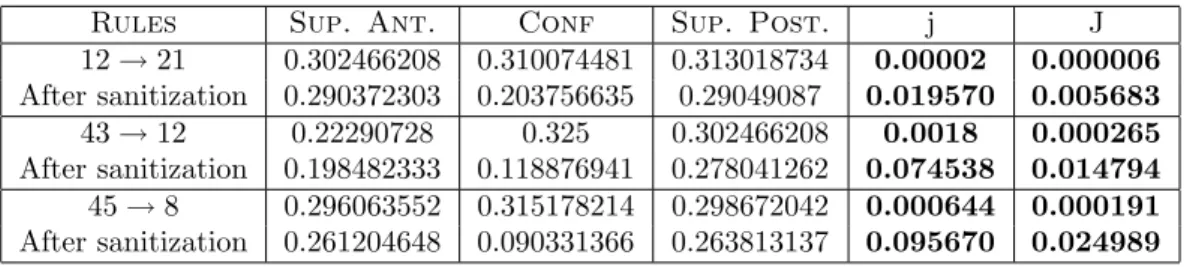
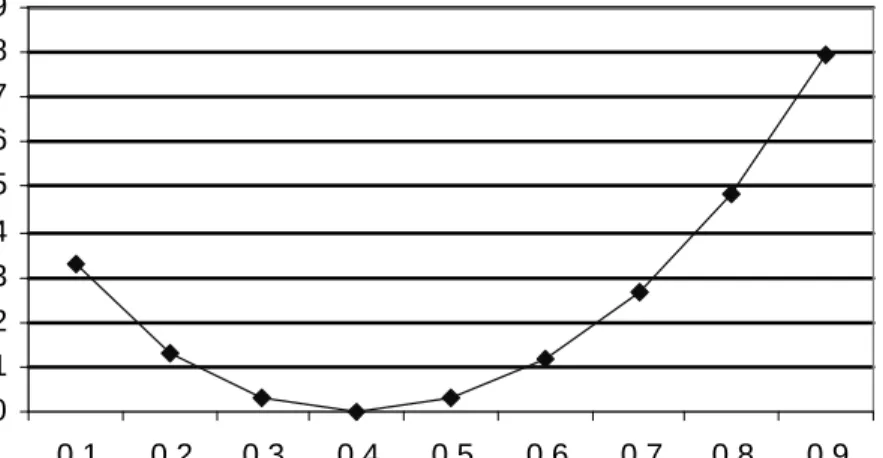
prelimi-nary tests executed in the context of this work, show that the simpleJ-measure does not provide an intuitive evaluation parameter. In fact, as the Information Theory suggests, we would expect as result that when the confidence decreases, the level of entropy increases (see Figure 3.1). Indeed, in some particular cases, the trend obtained is the one shown in Figure 3.2. This is due to the fact that theJ-measure represents the average conditional mutual information, or, in other words, the difference between the “a priori” and “a posteriori” proba-bilistic distributions of the two random variablesX andY. On the base of this observation, we note that if:
• P(X ∧Y) < P(X)×P(Y) the two variables X and Y are negatively correlated
• P(X ∧Y) > P(X)×P(Y) the two variables X and Y are positively correlated
• P(X∧Y) =P(X)×P(Y) the two variablesX andY are independent By remembering that:
P(X∧Y)
P(Y) =P(X|Y) (3.10)
we observe than theJ-measure does not take into account the type of correlation between the involved random variables. In fact that happen only in the case in which during the sanitization process, the confidence of the rule remains under the value of the support. In this case, when the confidence value decrease, the J-measure value increase. Studying the J-measure function, it is possible to see that it always has a minimum. The derived function is negative when
p(x|y)< p(x) and positive whenp(x|y)> p(x). For this reason, we finally adopt as measure the derivative of the J-measure (for make easy to understand the steps,sis equal top(x),bis equal top(y) and x is equal to (p(x|y))):
J0(X;Y =y) = b∗ x∗log2 x a + (1−x)∗log2 1−x 1−a = (3.11)
3.2. THE PRIVACY LEVEL MEASURE 23
Rules Sup. Ant. Conf Sup. Post. j J
12→21 0.302466208 0.310074481 0.313018734 0.00002 0.000006 After sanitization 0.290372303 0.203756635 0.29049087 0.019570 0.005683 43→12 0.22290728 0.325 0.302466208 0.0018 0.000265 After sanitization 0.198482333 0.118876941 0.278041262 0.074538 0.014794 45→8 0.296063552 0.315178214 0.298672042 0.000644 0.000191 After sanitization 0.261204648 0.090331366 0.263813137 0.095670 0.024989
Table 3.1: Example of rule entropy before and after the sanitization phase
Figure 3.1: Evolution of information entropy with respect to confidence
=b∗ 1∗log2 x a +x∗ a x∗ 1 a−1∗log2 1−x 1−a + (1−x)∗ 1−a 1−x∗ −1 1−a = (3.12) =b∗ log2 x a + 1−log2 1−x 1−a −1 =b∗ log2 x a −log2 1−x 1−a (3.13) Making the propers substitutions we obtain:
J0(X;Y =y) =p(y)∗(log2( p(x|y)
p(x) )−log2(
1−p(x|y)
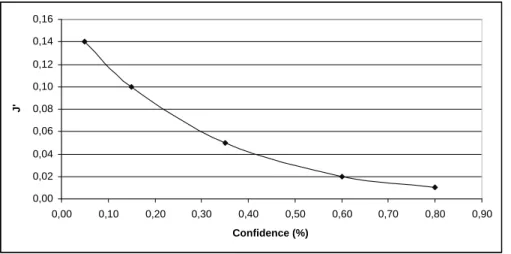
1−p(x) )) (3.14) Fig 3.3 shows the graph obtained when usingJ0.
Finally, we measure the amount of privacy introduced by the following expres-sion:
Level of privacy= (J10−J0) (3.15) where J0
1 is the calculated after the sanitization and J0 is measured before
sanitization.
24 CHAPTER 3. PRIVACY LEVEL 0 0,01 0,02 0,03 0,04 0,05 0,06 0,07 0,08 0,09 0,1 0,2 0,3 0,4 0,5 0,6 0,7 0,8 0,9 Confidenza (%) J-measure Confidence (%)
Figure 3.2: Evolution of information entropy with respect to confidence in some particular cases
in the level of privacy, results in an increase of entropy, as shown in Fig. 3.3. This trend is in accordance with the Information Theory, because if a rule or in general an information is well hidden, the informative value of its discovery is higher than an information that is simple to discover.
The measure we provided show how to use the concept of Information Con-tent to measure the Privacy level introduced by a sanitization in the context of Association Rule Mining. Making a little step, it is possible to extend this mea-sure to the case of Classification PPDM algorithms. In fact, in the classification context, we are interested to find a classification model able to describe some elements contained in a database. To each classification model, if we assume to be able to build the classification pattern, it is possible to associate a set of rules like the following:
if A1 A2...An then Ci
where each rule represent a class of the model. Applying then the expression 3.15 to these rules, we are able to compute the privacy lever introduced for every class.
3.2. THE PRIVACY LEVEL MEASURE 25 0,00 0,02 0,04 0,06 0,08 0,10 0,12 0,14 0,16 0,00 0,10 0,20 0,30 0,40 0,50 0,60 0,70 0,80 0,90 Confidence (%) J'
Chapter 4
Data Quality
The quality of the data is one of the most important properties of a database. Higher is the DQ, the better is the real world representation given by the models contained in the database and the higher is the usefulness of the information of the data contained in the database.
Therefore a set of operations that in some way contribute to downgrade the DQ of a database may results in huge economical and, in some specific cases, social damages.
The sanitization process performed by a PPDM algorithm constitutes poten-tially one of these specifications. For this reason it is important, when assessing PPDM algorithms, to take into account this relevant aspect. In what follows we present a set of parameters, called Raw Parameters, that can be used to make a non accurate, on the fly, DQ evaluation. Moreover, we present a most sophisticated techniques based on the concept of Information Quality Model. Finally we will describe a three-step framework that allows one to select from a set of PPDM algorithm the most suitable for a target database with respect to both Operational and DQ parameters.
In some cases it can be useful to be able to give a non detailed but fast evaluation of the quality of the data mining results after the sanitization process. For example in order to identify from a set of PPDM algorithms, the subset with a general high impact on the DQ.
In order to perform a fast assessment of damages to DQ, it can be useful to analyze what happens at macroscopic level when a generic PPDM algorithm is applied to a database. Some experimental measurements (contained in the appendix), show that the most evident effect of a PPDM algorithm with an high impact on DQ is generally identified as anInformation Loss of a database. It is possible then to identify the Information Loss as first crude measure of the DQ impact of PPDM algorithm.
Data can be analyzed in order to mine information in terms of associations among single data items or to classify existing data with the goal of finding an accurate classification of new data items, and so on. Based on the intended data use, the information loss is measured with a specific metric, depending
28 CHAPTER 4. DATA QUALITY
each time on the particular type of knowledge model one aims to extract. If the intended data usage is data clustering, the information loss can be measured by the percentage of legitimate data points that are not well-classified after the sanitization process. Data modification often applied by a privacy preserving technique obviously affects the parameters involved in the clustering analysis. There is, thus, the need to control, as much as possible, the results of such analysis before and after the application of a data hiding technique.
When quantifying information loss in the context of the other data usages, it is useful to distinguish between:
• Lost information representing the percentage of non-sensitive patterns (i.e., association, classification rules) which are hidden as side-effect of the hiding process
• Artifactual informationrepresenting the percentage of artifactual pat-terns created by the adopted privacy preserving technique
In case of association rules, the lost information can be modeled as the set of nonsensitive rules that are accidentally hidden, referred to as lost rules, by the privacy preservation technique. The artifactual information, instead, represents the set of new rules, also known as ghost rules, that can be extracted from the database after the application of a sanitization technique. Similarly, if the aim of the mining task is data classification, e.g. by means of decision trees inductions, both the lost and artifactual information can be quantified by means of the corresponding lost and ghost association rules derived by the classification tree. These measures allow one to evaluate the high level information that are extracted from a database in form of the widely-used inference rules before and after the application of a PPDM algorithm.
4.1
Data Quality in the Context of PPDM
Traditionally DQ is a measure of the consistency between the data views pre-sented by an information system and the same data in the real-world [70]. This definition is strongly related with the classical definition of information system as a “model of a finite subset of the real world” [56]. More in detail Levitin and Redman [59] claim that DQ is the instrument by which it is possible to evaluate if data models are well defined and data values accurate. The main problem with DQ is that its evaluation is relative [94], in that it usually de-pends from the context in which data are used. In the scientific literature DQ is considered a multi-dimensional concept that in some environments involves both objective and subjective parameters [104, 105]. In the context of PPDM, we are interested in assessing whether, given a target database, the sanitization phase will compromise the quality of the mining results that can be obtained from the sanitized database. The parameters we consider relevant in the con-text of PPPDM are the following: theAccuracy, measuring the proximity of a sanitized valueaI to the original valuea; theCompleteness, evaluating the
4.1. DATA QUALITY IN THE CONTEXT OF PPDM 29 database and finally theConsistencythat is related to the semantic constraints holding on the data and it measures how many of these constraints are still satisfied after the sanitization. We now present the formal definitions of those parameters for use in the remainder of the discussion. Let OD be the original database andSDbe the sanitized database resulting from the application of the PPDM algorithm. Without loosing generality and in order to make simpler the following definitions, we assume thatOD (and consequentlySD) be composed by a single relation. We also adopt the positional notation to denote attributes in relations. Thus, letodi (sdi) be thei-th tuple inOD (SD), thenodik (sdik)
denotes thekthattribute ofodi(sdi). Moreover, letnbe the total number of the
attributes of interest, we assume that attributes of positions 1, . . . , m (m≤n) are the primary key attributes of the relation.
Definition 1 1: Let sdj be a tuple of SD. We say that sdj is Accurate
if ¬∃odi ∈OD such that ((odik =sdjk)∀k = 1..m∧ ∃(odif 6=sdjf),(sdjf 6=
N U LL), f =m+ 1, .., n).
Definition 2 2:Asdj isCompleteif (∃odi ∈ODsuch that (odik=sdjk)∀k=
1..m)∧(¬∃(sdjf =N U LL), f =m+ 1, .., n).
LetCthe set of the constraints defined on databaseOD, in what follows we denote with cij thejth constraint on attribute i. We assume here constraints
on a single attribute, but, it is easily possible to extend the measure to complex constraints.
Definition 33: An instancesdkisConsistentif¬∃cij ∈Csuch thatcij(sdki) =
Chapter 5
Information Driven Data
Quality Schema
Current approaches to PPDM algorithms do not take into account two impor-tant aspects:
• Relevance of data: not all the information stored in the database has the same level of relevance and not all the information can be dealt at the same way.
• Structure of the database: information stored in a database is strongly influenced by the relationships between the different data items. These relationships are not always explicit.
We believe that in a context in which a database administrator needs to choose which is the most suitable PPDM algorithm for a target real database, it is necessary to also take into account the above aspects. To achieve this goal we propose to use Data Quality in order to assess how and if these aspects are preserved after a data hiding sanitization.
5.1
The Information Quality Model
In order evaluate DQ it is necessary to provide a formal description that allow us to magnify the aggregate information of interest for a target database and the relevance of DQ properties for each aggregate information (AI) and for each attribute involved in the AI. The Information Quality Model (IQM) proposed here addresses this requirement. In the following, we give a formal definition for an Attribute Class (AC), a Data Model Graph (DMG) (used to represent the attributes involved in an aggregate information and their constraints) and an Aggregation Information Schema (AIS).Before giving the definition of DMG, AIS and ASSET we introduce some preliminary concepts.
Definition 3 4: An Attribute Class is defined as the tuple
ATC=< name, AW, AV, CW, CV, CSV, Slink >where:
32 CHAPTER 5. INFORMATION DRIVEN DATA QUALITY SCHEMA
• Nameis the attribute id
• AW is the accuracy weigh for the target attribute
• AV is the accuracy value
• CW is the completeness weigh for the target attribute
• CV is the completeness value
• CSV is the consistency value
• Slinkis list of simple constraints.
Definition 4 5: A Simple Constraint Class is defined as the tuple
SCC=< name, Constr, CW, Clink, CSV >where:
• Nameis the constraint id
• Constraintdescribes the constraint using some logic expression
• CW is the weigh of the constraint. It represents the relevance of this constraint in theAIS
• CSV is the number of violations to the constraint
• Clinkit is the list of complex constraints defined onSCC.
Definition 5 6: A Complex Constraint Class is defined as the tuple
CCC =< name, Operator,CW, CSV, SCC link >where:
• Nameis the Complex Constraint id
• Operatoris the “Merging” operator by which the simple constraints are used to build the complex one.
• CW is the weigh of the complex constraint
• CSV is the number of violations
• SCClinkis the list of all theSCC that are related to theCCC.
LetD a database, we are able now to define the DMG, AIS and ASSET on
D.
Definition 5 7 : ADMG(Data Model Graph) is an oriented graph with the following features:
• A set of nodesNAwhere each node is an Attribute Class
• A set of nodesSCC where each node describes a Simple Constraint Class
• A set of nodesCCC where each node describes a Complex Constraint Class
• A set of direct edgesLN j,N k:LN j,N k∈((NAXSCC)∪(SCCXCCC)∪(SCCXNA)∪
(CCCXNA)).
Definition 68: AnAISφis defined as a tuple< γ, ξ, λ, ϑ, $, WAIS >where:
γ is a name, ξ is a DMG, λ is the accuracy of AIS, ϑ is the completeness of
AIS,$ is the consistency ofAIS andWAIS represent the relevance ofAIS in
the database.
We are now able to identify asASSET(Aggregate information Schema Set) as the collection of all the relevantAIS of the database.
The DMG completely describes the relations between the different data items of a given AIS and the relevance of each of these data respect to the data quality parameter. It is the “road map” that is used to evaluate the quality of a sanitized AIS
5.2. DATA QUALITY EVALUATION OF AIS 33
5.2
Data Quality Evaluation of AIS
By adopting the IQM scheme, now we are able to evaluate the data quality at the attribute level. By recalling Definition (1,2), we define the Accuracy lack of an attribute k for an AIS A as the proportion of non accurate items in a databaseSD. Ate the same way, the Completeness lack of an attribute k
is defined as the proportion of non complete items in SD. The accuracy lack index for an AIS can the be evaluated as follows:
ACL=
i=n
i=0
DM G.Ni.AV ∗DM G.Ni.AW (5.1)
whereDM G.Ni.AW is the accuracy weight associated with the attribute
iden-tified by the nodeNi. Similarly the completeness lack of an AIS can be measured
as follows: CM L= i=n i=0 DM G.Ni.CV ∗DM G.Ni.CW (5.2)
Finally the consistency lack index associated with an AIS is given by number of constraint violations occurred in all the sanitized transaction multiplied by the weight associated with every constraints (simple or complex).
CSL= i=n i=0 DM G.SCi.csv∗DM G.SCi.cw+ j=m j=0 DM G.CCj.csv∗DM G.CCj.cw (5.3)
5.3
The Evaluation Algorithm
In this section we present the methodology we have developed to evaluate the data quality of the AIS. This methodology is organized in two main phases:
• Search: in this phase all the tuples modified in the sanitized database are identified. The primary keys of all these transaction (we assume that the sanitization process does not change the primary key), are stored in a set namedevalset. This set is the input of the Evaluation phase.
• Evaluation: in this phase the accuracy, the consistency and the com-pleteness associated with the DMG and the AIS are evaluated using in-formation on the accuracy and completeness weight associated with the DMG and related to the transactions in Evalset.
The algorithms for these phases are reported in Figures 1 and 2. Once the evaluation process is completed, a set of values is associated with each AIS that gives the balanced level of accuracy, completeness and consistency. However, this set may not be enough. A simple average of the different AIS’s values could not be significant, because even in this case not all the AIS’s in the ASSET have the same relevance. For this reason, a weight is associated with each AIS that represents the importance of the high level information represented by the AIS
34 CHAPTER 5. INFORMATION DRIVEN DATA QUALITY SCHEMA
INPUT: Original database OD, Sanitized database SD
OUTPUT:a set Evalset of primary keys
Begin
Foreachti∈ODdo
{j=0;
While(sjk6=tik)and(j <|SD|)doj+ +; l=0;
While(sjl=til)and(l < n)dol++;
If(l < n)ThenEvalset=Evalset∪tik }
End
Figure 5.1: Search algorithm
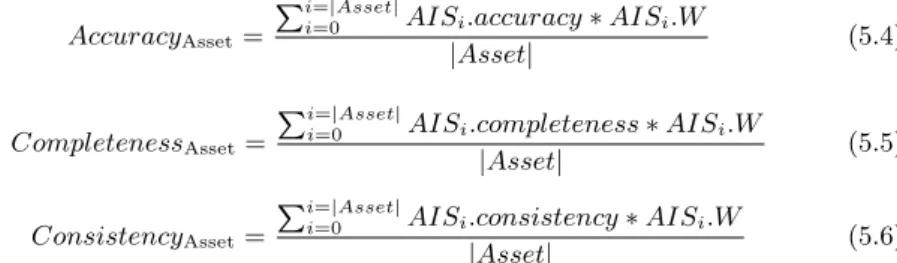
in the target context.The accuracy, the completeness and the consistency of the ASSET for each PPDM algorithm candidate are then evaluated as follows:
AccuracyAsset=
i=|Asset|
i=0 AISi.accuracy∗AISi.W
|Asset| (5.4)
CompletenessAsset=
i=|Asset|
i=0 AISi.completeness∗AISi.W
|Asset| (5.5)
ConsistencyAsset=
i=|Asset|
i=0 AISi.consistency∗AISi.W
|Asset| (5.6)
5.3. THE EVALUATION ALGORITHM 35
INPUT: the original database OD, the sanitized database SD,Evalset, IQM.
OUTPUT:the IQM containing a data quality evaluation
Begin
ForeachIESinIQMdo
{DM G=IQM.IES.link;
avet= 0;cvet= 0;
Foreach(tik∈Evalset)do For(j= 0;j < n;j+ +)do
If(tij6=sij)Then
{
Ifsij=N U LLThencvet[j] + +;
Elseavet[j] + +; validate constr(IES,DMG,j) } For(m= 0;m < n;m+ +)do { DM G.Nm.AV=avet[m] |SD| ;DM G.Nm.CV= cvet[m] |SD| ;} IQM.IES.AV= i=n i=0 (DM G.Ni.AV∗DM G.Ni.AW);
IQM.IES.CV= ii==0 (nDM G.Ni.CV∗DM G.Ni.CW);
IQM.IES.CSV= ii==0nDM G.SCi.CSV∗DM G.SCi.CW+
j=m
j=0 DM G.CCj .CSV∗DM G.CCj .CW;}
End
Procedure validate constr(IES,DMg,j)Begin NA=AIS.DMG.j
For k=1;k <|NA.slink|; k++
{ NC=NA.Slink[k]
ifNC .Clink==N U LLthen{if !(NC.constr(sij)) thenNC .CSV+ +;} else{ NO=NC .Clink; globalconstr=composeconstr(NO , sij)
if !(globalconstr) thenNO .CSV+ +}}
End
Chapter 6
Evaluation Framework
As shown by the approaches reported Chapter 2, and especially by the approach by Bertino et al. [10], in many real world applications, it is necessary to take into account even other parameters that are not directly related to DQ. On the other hand we believe that DQ should represent the invariant of a PPDM evaluation and should be used to identify the best algorithm within a set of previously selected “Best Algorithms”. To preselect this “best set”, we sug-gest to use some parameters as discriminant to select the algorithms that have an acceptable behavior under some aspects generally considered relevant espe-cially in “production environments” (efficiency, scalability, hiding failure and level of privacy). In order to understand if these four parameters are sufficient to identify an acceptable set of candidates, we performed an evaluation test. We identified a starting set of PPDM algorithms for Association Rules Hiding (the algorithms presented in [97] and a new set of three algorithms based on data fuzzification [10]). Then, by using the IBM synthetic data generator1we
generated a categoric database representing an hypothetical Health Database storing the different therapies associated with the patients. We also built the associated DMG. On this database, we applied the different algorithms and then we measured the previous parameters. Once we built the “Best Set” we discovered that some algorithms that performed less changes to the database, which in some way indicates a better quality, are not in this set. A reason is for example a low efficiency. For this reason we believe that even in the preselec-tion phase a “coarse” DQ parameter must be introduced. In our opinion, the
Coarse DQ Measure depends on the specific class of PPDM algorithms. If the algorithms adopt a perturbation or a blocking technique, the coarse DQ can be measured by the dissimilarity between the original datasetD and the sanitized one D’ by measuring, for example, in the case of transactional datasets, the difference between the item frequencies of the two datasets before and after the sanitization. Such dissimilarity can be estimated by the following expression:
Diss(D, D0) = n i=1|fD(i)−fD0(i)| n i=1fD(i) (6.1) 1 http://www.almaden.ibm.com/software/quest/Resources/datasets/syndata.html 37
38 CHAPTER 6. EVALUATION FRAMEWORK
where i is a data item in the original database D, and fD(i) is its frequency
within the database, whereas i’ is the given data item after the application of a privacy preservation technique and fD0(i) is its new frequency within the transformed databaseD’. The same method can be used, extending the previous formula, also in the case of blocking techniques. If the data modification consists of aggregating some data values, the coarse DQ is given by the loss of detail in the data. As in the case of thek−Anonymity algorithm [92], given a database
DB with NA attributes and N transactions, if we identify as generalization
scheme a domain generalization hierarchyGT with a depth h, it is possible to measure the coarse quality of a sanitized databaseSDB as:
Quality(SDB) = 1− i=NA i=1 i=N j=1 h |GTAi| |DB| ∗ |NA| (6.2) where h
|GTAi| represent the detail loss for each cell sanitized.
Once we have identified the Best Set we are able to apply our DQ-driven evaluation.
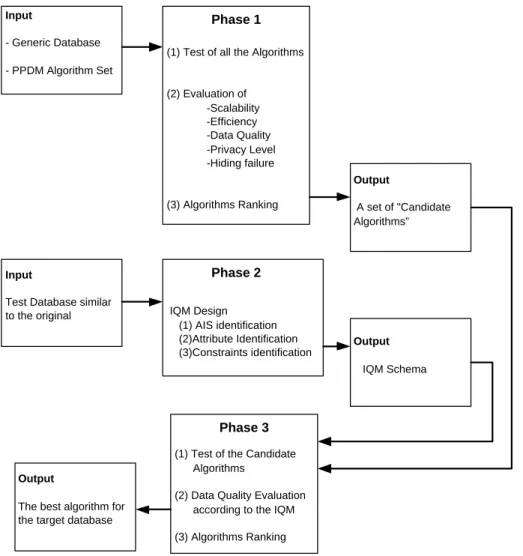
We now present a three steps Evaluation Framework based on the previous concepts.
1. A set of “Interesting” PPDM’s is selected. These algorithms are tested on a generic database and evaluated according the general parameters (Effi-ciency, Scalability, Hiding failure, Coarse Data Quality, Level of privacy). The result of this step is a restricted set of Candidate algorithms
2. A test database with the same characteristics of the target database is generated. An IQM schema with the AIS and the related DMG is the result of this step.
3. The Information Driven DQ Evaluation Algorithm is applied in order to identify the algorithm that finally will be applied.
As it is probably obvious to the readers, the most “time consuming” step in terms of required user interactions is step 2. The design a good IQM is the core of our evaluation framework. We believe that a top down approach is, in this cases, the most appropriate. More in detail, the first task should be the identification of the high level information that is relevant and for which we are interested in measuring the impact of PPDM algorithms. It could also can be useful to involve in this task some authorized users (e.g. in case of Health DBA’s, doctors, etc.) in order to understand all the possible uses of the data-base and the relevance of the retrieved information. The use of datamining tools could be useful to identify non-evident aggregate information.
A second task would then, given the high level information, determine the dif-ferent constraints (both simple and complex) and evaluate their relevance. Also in this case, discussions with authorized users and DB designers, and the use of DM tools (e.g. discover association rules) could help to build a good IQM. Finally it is necessary, by taking into account all the previous information, to rate the relevance of the attributes involved. This top down analysis is useful
6.1. A THREE-STEPS FRAMEWORK FOR THE EVALUATION OF PPDM ALGORITHMS39 not only for the specific case of PPDM evaluation, but, if well developed, is
a powerful tool to understand the real information contents, its value and the relation between the information stored in a given database. In the context of an “Information Society” this is a non negligible added value.
6.1
A three-steps framework for the evaluation
of PPDM algorithms
As shown by the approaches reported in the state of the art, and especially by the approach by Bertino et al. [10], in many real world applications, it is nec-essary to take into account also other parameters that are not directly related to DQ. On the other hand we believe that DQ should represent the invariant of a PPDM evaluation and should be used to identify the best algorithm within a set of previously selected “Best Algorithms”. To preselect this “best set”, we suggest to use theOperational Parameters presented before as discriminant to select the algorithms that have an acceptable behavior under some aspects gen-erally considered relevant especially in “production environments” (efficiency, scalability, hiding failure and level of privacy).
In order to understand if these four parameters are sufficient to identify an acceptable set of candidates, we performed an evaluation test. We identified a starting set of PPDM algorithms for Association Rules Hiding (the algorithms presented in [97] and a new set of three algorithms based on data fuzzifica-tion [10]). Then, by using the IBM synthetic data generator2 we generated
a categoric database representing an hypothetical Health database storing the different therapies associated with the patients. We also built the associated DMG. On this database, we applied the different algorithms and then we mea-sured the previous parameters. Once we built the “Best Set” we discovered that some algorithms that performed less changes to the database, which in some way indicates a better quality, are not in this set. A reason is for example a low efficiency. For this reason we believe that even in the preselection phase a “coarse” DQ parameter must be introduced. In our opinion, the Coarse DQ Measure depends on the specific class of PPDM algorithms. If the algorithms adopt a perturbation or a blocking technique, the coarse DQ can be measured by the dissimilarity between the original datasetDand the sanitized oneD’ by measuring, for example, in the case of transactional datasets, the difference be-tween the item frequencies of the two datasets before and after the sanitization. Such dissimilarity can be estimated by the following expression:
Diss(D, D0) = n i=1|fD(i)−fD0(i)| n i=1fD(i) (6.3)
where i is a data item in the original database D, and fD(i) is its frequency
within the database, whereas i’ is the given data item after the application of a privacy preservation technique and fD0(i) is its new frequency within the transformed databaseD’. The same method can be used, extending the previous formula, also in the case of blocking techniques. If the data modification consists
2
40 CHAPTER 6. EVALUATION FRAMEWORK
of aggregating some data values, the coarse DQ is given by the loss of detail in the data. As in the case of thek−Anonymity algorithm [92], given a database
DB with NA attributes and N transactions, if we identify as generalization
scheme a domain generalization hierarchyGT with a depth h, it is possible to measure the coarse quality of a sanitized databaseSDB as:
Quality(SDB) = 1− i=NA i=1 i=N j=1 h |GTAi| |DB| ∗ |NA| (6.4) where h
|GTAi| represent the detail loss for each cell sanitized. Once we have