Volume 11 Issue 1 Article 2 Published online: 12-7-2016
Development of a Problem-Based Learning Matrix for Data
Development of a Problem-Based Learning Matrix for Data
Collection
Collection
Shannon M. SipesIndiana University, [email protected]
IJPBL is Published in Open Access Format through the Generous Support of the Teaching Academy at Purdue University, the School of Education at Indiana University, and the Jeannine Rainbolt College of Education at the University of Oklahoma.
Recommended Citation Recommended Citation
Sipes, S. M. (2017). Development of a Problem-Based Learning Matrix for Data Collection. Interdisciplinary Journal of Problem-Based Learning, 11(1).
Available at: https://doi.org/10.7771/1541-5015.1615
This document has been made available through Purdue e-Pubs, a service of the Purdue University Libraries. Please contact [email protected] for additional information.
This is an Open Access journal. This means that it uses a funding model that does not charge readers or their institutions for access. Readers may freely read, download, copy, distribute, print, search, or link to the full texts of articles. This journal is covered under the CC BY-NC-ND license.
March 2017 | Volume 11 | Issue 1
ARTICLE
Problem-based Learning
As a polysemic term, problem-based learning (PBL) can be properly used to refer to a curriculum theory, an instruc-tional model, or an instrucinstruc-tional practice. Even when isolat-ing the terminology to practice, “the label ‘PBL’ is used to cover an amazing diversity of educational practices, ranging from problem-oriented lectures to completely open experi-ential learning environments” (De Graaff & Kolmos, 2003, p. 657). The engineering education community has specifically noted the variety of problem-based learning definitions and models within the field as a source of challenge when dis-cussing, researching, and implementing the pedagogy (Bed-does, Jesiek, & Borrego, 2010).
For instance, the acronym PBL may be applied to prob-lem-based learning at one institution and project-based at another, while the actual curriculum between the two institutions may look the same (Kolmos, 1996). One poten-tial reason for this broad application of terminology is that both problem- and project-based learning are based on an
individual’s self-directed learning and collaborative groups focusing on a problem (Perrenet, Bouhuiujs, & Smits, 2000). This ambiguity is problematic because a distinction does indeed exist between project-based and problem-based learning. Project-based learning tends to focus on the
appli-cation of knowledge, while problem-based learning tends to
focus on the acquisition of knowledge (Perrenet et al., 2000; Woods, 2002).
Problem-based learning is an accepted pedagogical choice for engineering education, given that engineering graduates are expected to work as part of multidisciplinary teams seek-ing solutions to complex problems (ABET, 2013). Felder and Brent (2003) suggest using PBL as an instructional technique to address all 11 of the ABET student learning outcomes, not just the teamwork outcome. In order to do this well, readers should consider Woods’s (1996a; 1996b; 1996c; 2012) work on PBL, as it provides specific techniques for faculty members to implement PBL in their own engineering courses. However,
Development of a Problem-Based Learning Matrix
for Data Collection
Shannon M. Sipes (Indiana University)
Abstract
Few of the papers published in journals and conference proceedings on problem-based learning (PBL) are empirical studies, and most of these use self-report as the measure of PBL (Beddoes, Jesiek, & Borrego, 2010). The current study provides a theoretically derived matrix for coding and classifying PBL that was objectively applied to official curriculum documentation in a content analysis. The results for the level of problem-based learning in two engineering program curricula are presented. By introducing such a matrix, this study offers a tool that can be applied by other scholars examining PBL, creating consis-tency in methodology, definitions, and language among scholars.
Keywords: problem-based learning, PBL, content analysis, engineering education, problem type
During data collection for this paper, Shannon M. Sipes was in the Office of Institutional Research, Planning, and Assessment at Rose-Hulman Institute of Technology. This research was conducted as part of a larger doctoral dissertation in the Department of Curriculum and Instruction at Indiana State University, examining the impact of problem-based learning on curiosity develop-ment in an undergraduate engineering student sample.
Correspondence concerning this article should be addressed to Shannon M. Sipes, Center for Innovative Teaching and Learn-ing, Indiana University, 1320 East Tenth Street, Bloomington, IN 47405. Email: [email protected]
the empirical literature on problem-based learning in engi-neering education is limited with mixed findings (Matusov-ich, Paretti, Jones, & Brown, 2012; Walker & Leary, 2009).
This leaves unexplored gaps in the literature that provide ample opportunities to continue expanding the body of knowledge. One area of unexplored knowledge is the lack of type comparisons when researching problem-based learning. This is relevant given that the foundation of problem-based learning is the problem itself. Jonassen and Hung (2008) advocate for “directly compar[ing] the effectiveness of PBL by problem type, rather than problem discipline, which represents a new research agenda for PBL researchers” (p. 22).
Margetson (1998) urged researchers to be more careful about what is classified as problem-based learning, remind-ing scholars that just because somethremind-ing is called problem-based learning does not necessarily mean it is problem-problem-based learning. Her suggested solution is to distinguish among the various types of problem-based learning implementations. Therefore, the purpose of this study is to introduce a new theoretically derived method for classifying and quantifying problem-based learning at the course level that will provide a common framework to more directly compare the work of individual researchers across disciplines examining PBL.
Introduction
Due to the nature of the lack of a single model of problem-based learning, it is important to begin any discussion of PBL by presenting the operational definitions, models, and theoretical basis one is using in any given study. One of the least prescriptive definitions of problem-based learning that allows for optimal flexibility in implementation describes problem-based learning as “focused, experiential learning organized around the investigation and resolution of messy, real-world problems” (Savery, 2006, p. 12). The current study uses this definition as a framework, conceptualizing prob-lem-based learning as an active-learning exercise rooted in an authentic problem.
Previous scholars’ overviews of various PBL models pres-ent the defining componpres-ents as key features (Newman, 2005), ground rules (Maudsley, 1999), essentials (Barrows, 1998), or themes (Savin-Baden & Major, 2004/2011). While variation exists among scholars in conceptualization of the breakdown and number of components necessary in PBL, there are four key components characteristic of problem-based learning that are common across scholarship: (a) use of ill-structured problems, (b) a student-centered approach where the students, rather than the instructor, determine what needs to be learned, (c) instructors as facilitators, guid-ing learnguid-ing, and (d) authentic problems (Barrows, 2002).
These components are addressed through four stages of an iterative cycle of problem-based learning: (a) reasoning/ problem identification, (b) self-directed study, (c) applying new knowledge and critiquing prior work, and (d) summa-rizing/integrating learning (Savery, 2006). In engineering education these four phases may be referred to as (a) prob-lem analysis, (b) solution design, (c) solution development, and (d) post-development review (Dunlap, 2005). Learn-ing across each of these phases is cumulative with learnLearn-ing in each phase influenced by learning in the previous phase (Yew, Chng, & Schmidt, 2011).
Multiple meta-analyses have been conducted on the topic of problem-based learning documenting the impact of PBL on learning content knowledge and skills (Dochy, Segers, Van den Bossche, & Gijbels, 2003; Gijbels, Dochy, Van den Bossche, & Segers, 2005; Strobel, & Van Barneveld, 2009; Walker & Leary, 2009). In addition to gains in long-term knowledge retention and skills, problem-based learning has been shown to enhance students’ intrinsic interest and motivation in the subject matter as well as their self-directed learning skills (Loyens, Magda, & Rikers, 2008; Pedersen, 2003; Strobel & Van Barneveld, 2009; Sungur & Tekkaya, 2006). However, scholars may find mixed results due to vari-ations in PBL implementation (Otting & Zwall, 2006; Walker & Leary, 2009).
The variation in implementation can be broadly catego-rized into three forms: (1) completely integrated curricula where all course work is completed within the PBL frame-work; (2) transitional curricula where some course work is presented via lecture and traditional methods in the early stages of course work, while later stages of work are presented within the PBL framework; or (3) single-course problem-based learning where a PBL framework is utilized within a single course (Saarinen-Rahiika & Binkley, 1998). Other variations in implementation include defining problem-based learning interchangeably with project-problem-based learning (Zheng, Shih, & Mo, 2009), implementing problem-based learning in online rather than face-to-face formats (Ge, Pla-nas, & Er, 2010), and implementing problem-based learning from either an instructional strategy approach or a curricu-lum design approach (Conway & Little, 2000).
Research on the effectiveness of problem-based learn-ing has mostly been done in fields outside of STEM due to a longer history with this teaching method (Beddoes et al., 2010). However, Beddoes and colleagues (2010) recently undertook a bibliometric analysis of engineering education research in order to examine the type of inquiry being con-ducted on PBL (both problem- and project-based learning). In their study, the authors examined engineering education journals and conference papers published between 2005 and 2008. Two thousand total papers were found, but only 885
of these met the broad definition of empirical research (i.e., any paper presenting empirical data). Of these 885, 105 were determined to be about PBL. The authors’ goal was to “obtain a global picture of research being done by those who self-label their work as PBL” (Beddoes et al., 2010, p. 12).
The most common type of empirical research on PBL identified by Beddoes et al. (2012) involved the descrip-tion and evaluadescrip-tion or assessment of a PBL implementa-tion. Other types of research identified included presenting an evaluation or assessment method; identifying challenges and solutions related to PBL implementation; studying stu-dent behaviors, beliefs, roles, or effectiveness; faculty/staff development; comparisons of PBL with traditional peda-gogy; investigations of the relationship between learning styles and PBL; and international transfer and comparison of PBL initiatives.
Across the PBL literature, there is variability in findings even on the same constructs (Walker & Leary, 2009). Two possible explanations for this variability are the discrepan-cies in implementation and problem type (Walker & Leary, 2009). Another explanation is the lack of consensus in defi-nitions of PBL (Xian & Madhavan, 2013). While multiple scholars have advocated for considering PBL as a “genus for which there are many species and subspecies” (Barrows, 1986, p. 485), the scholarly community is still lacking a depth of understanding in how PBL is defined and implemented in different disciplines (Xian & Madhavan, 2013).
Models of Problem-Based Learning
Savin-Baden’s Modes of Problem-Based Learning
Savin-Baden and Major (2004/2011) offer a curriculum design model of problem-based learning composed of eight modes of curriculum practice for problem-based learning. Seven of these are deemed helpful for implementation within a traditional lecture based curriculum (Savin-Baden, 2008). First is the single module approach where a single problem-based learning module is implemented in a single year in the curriculum. Second is problem-based learning on a shoe-string where problems are implemented in isolation within a single subject course. The funnel approach is the third type where students begin in lecture-based courses, move to some problem-solving learning in their second year, and participate in problem-based learning during their final year of study. The fourth mode (the foundational approach) is the one most often seen in STEM fields. Some foundational knowledge is necessary prior to being able to solve problems. Therefore, the foundational approach is similar to the fun-nel approach where students learn through lecture-based courses earlier in their education and move to problem-based
learning during later years. The fifth mode is the two-strand approach where problem-based learning and traditional courses are taken by students concurrently. In patchwork problem-based learning (the sixth mode), the entire curricu-lum is made up of concurrent problem-based learning mod-ules. The seventh mode is the integrated approach. In this case the curriculum is fully integrated, problems are sequen-tial, and students work in teams to create multidisciplinary learning. The final mode is known as the complexity model. In this mode, students create knowledge outside of the con-fines of subject area within a supercomplexity model. Savin-Baden and Major (2004/2011) point out that this mode is only possible in postgraduate programs.
While this model allows for categorization of an entire curriculum, it does not lend itself to the measurement of the amount of PBL within that curriculum or an examina-tion of the problems used within the PBL framework. As the most common type of PBL implementation is in a hybrid format (Savin-Baden & Majors, 2004/2011), including both lecture and an enhanced open-ended project to create a balance between skill development and content knowledge (Barroso & Morgan, 2009; Henry, Tawfik, Jonassen, Win-holtz, & Khanna, 2012), a model of instructional strategy offers the most utility to individual PBL scholars, as it can be applied at the level of the course in which data from multiple courses can be rolled up to provide insight into the overall curriculum.
Barrows’ Taxonomy
Due to the variations in PBL, Barrows (1986) proposed a taxonomy to assist faculty members in choosing the version of the method most appropriate for their needs. Through the taxonomy, four possible educational objectives are pre-sented: clinical (i.e., disciplinary) knowledge, clinical (i.e., disciplinary) reasoning, self-directed learning, and motiva-tion. Additionally, six variations in the design of PBL are also presented: lecture-based cases, case-based lectures, case method, modified case-based, problem-based, and closed-loop problem-based.
In a lecture-based case, the course content is presented via lecture followed by a case study used to demonstrate the rel-evance of the content. In a case-based lecture, the case comes prior to the content presentation. In the third variation, case method, students must review a complete case in order to prepare for a class discussion. In the modified case-based variation, problems are employed in small tutorial groups as the method of instruction. In PBL, students receive an entire problem case and engage in free inquiry in attempting to solve the problem. Finally, in closed loop problem-based variation, students evaluate their reasoning following the completion of the solution to the problem.
Barrow’s (1986) taxonomy itself is a grid consisting of the PBL variation in rows and the objective in columns. A numerical score ranging from 0–5 is provided for each com-bination of objective and variation based on how well the variations meet the objective. The maximum score a varia-tion could receive then is 20 if each of the four objectives received the maximum score of five (Margetson, 1998). A higher score indicates a PBL variation closer to the ideal.
While this model lends itself to the measurement of the amount of PBL within a curriculum, it does not allow for an examination of the problems used within the framework. Within any model of problem-based learning, the problem contextualizes the content and kicks off the learning cycle (Newman, 2005), yet neither Barrow (1986) nor Savin-Baden and Majors (2004/2011) combine the curriculum or instructional design aspect of PBL with the problem aspect.
Problem Type
Just as problem-based learning as a varied instructional strat-egy is being applied across a variety of disciplines, the types of problems used to situate learning also vary (Jonassen & Hung, 2008). This is due to the differences in types of prob-lems that different disciplines encounter and must solve. For example, in engineering, small problems from mathemat-ics and physmathemat-ics tend to be embedded in larger problems. In medicine, on the other hand, the problem is often a diagnosis (Perrenet et al., 2000).
Solving different kinds of problems requires the learner to employ different skill sets as problems may vary in struc-ture, complexity, and abstractness (Jonassen, 2000). There-fore, learning to solve different types of problems requires different types of instruction (Jonassen, 2011a). According to Jonassen (2000; 2011b), problems exist on a continuum rang-ing from well-structured to ill-structured. Well-structured problems are static, simple, and contain all of the necessary information to solve the problem within the description. Ill-structured problems are complex, dynamic, and lack the information needed for a simple solution. In fact, ill-struc-tured problems may have multiple acceptable solutions.
Well-structured problems (i.e., story problems, decision-making problems) tend to be abstract or decontextualized while ill-structured (i.e., policy, design) problems tend to be more contextualized and meaningful to students. In education, most problems tend to be well-structured while problems encountered in everyday situations tend to be more ill-structured (Jonassen, 2011a). Therefore, the qual-ity of problem type utilized in problem-based learning is an important variable in student learning and plays a role in the effectiveness of problem-based learning (Otting & Zwaal, 2006; Walker & Leary, 2009).
Jonassen’s Problem Type
Jonassen (2011b) suggests a typology of problems on a con-tinuum ranging from well-structured to ill-structured. This typology includes the following eight problem types: story problems, rule-using problems, decision-making problems, troubleshooting problems, strategic performance problems, policy problems, design problems, and dilemmas. It is the ill-structured problems that are theorized to be better suited to PBL (Jonassen, 2011b).
Story problems are the most well-structured, presenting information in a shallow context from which learners iden-tify key values, apply an algorithm, and generate a numerical answer. Rule-using problems have one correct solution, but the learner may take multiple paths to get there. Decision-making problems require the learner to choose a course of action. Troubleshooting problems require diagnosis or troubleshooting of a faulty system. Strategic performance problems are real-time situations where the learner must apply tactical solutions to solve a complex problem under time pressure. Policy problems encompass multiple issues and perspectives in one problem. Design problems require applying domain and strategic knowledge to create a design to solve the problem (common in engineering curriculum). Finally, dilemmas, the most ill-structured problems, do not have a clear solution or have solutions that will not be accepted by everyone.
Despite its recognized face validity, previous research in the PBL realm has neglected to empirically test Barrows’s (1986) taxonomy (Walker & Leary, 2009) or compare prob-lem types utilized in PBL impprob-lementation (Jonassen & Hung, 2008). Combining both the taxonomy and problem-type in measuring PBL represents a new research agenda (Jonassen & Hung, 2008). In an effort to address the need for more con-sistency in defining and measuring PBL, this paper offers a theoretically derived matrix for measuring the type and level of PBL in a curriculum for empirical purposes.
Methodology
A content analysis was implemented in this study to describe the PBL in the curriculum for two engineering programs to test a theoretically derived problem-based learning matrix. The deductive approach to content analysis was chosen over the inductive approach in scoring and categorizing PBL due to its usefulness in testing hypotheses or data in a new way (Elo & Kyngas, 2007). It began with the creation of a cat-egorization matrix used to code the data according to the categories (in this case theories) of interest. Those catego-ries are Jonassen’s problem type (2011a) and Barrows’s tax-onomy (1986).
PBL Matrix Variables
Problem-Based Learning. Because of the ambiguity in PBL definition and the convoluted nature of traditional courses with elements of PBL embedded in them (Albanese & Mitch-ell, 1993), PBL was operationally defined using Barrows’s taxonomy (1986) in combination with Jonassen’s problem type (2011a) for this study. Therefore, PBL will be viewed as a continuum rather than a self-reported, dichotomous con-struct. In the PBL matrix, Jonassen’s (2000) problem type is used on the X-axis to create the columns while Barrows’s (1986) taxonomy is used on the Y-axis to create the rows. This results in a series of 48 cells for each possible taxonomy/ problem type combination.
Problem-Based Learning Environment. While Barrows’s (1986) taxonomy and Jonnassen’s (2000) problem type theo-ries comprise two of the variables that constitute problem-based learning, a third variable results from the combination of these: problem-based learning environment (PBLE). Con-ceptually, PBLE is the learning environment that results from combining both a problem type and a problem-based learn-ing approach. Operationally it is the mathematical sum of all problem-type and taxonomy scores for any given course. Data Collection
Purposeful sampling was used in selecting the engineering programs and courses utilized for this study. External valid-ity for this study was enhanced by using all courses from the identified curriculum. Courses in the biomedical (BE) and civil engineering (CE) programs were used as the curriculum sample in an attempt to limit the sources of variability in the curriculum. The BE and CE departments have a small num-ber of faculty memnum-bers (BE = 12 and CE = 9), which reduces the number of faculty teaching the same course. Additionally, with a small department, the number of technical electives offered is also limited, making the number of courses and materials to code more manageable for the first implementa-tion of the coding matrix. Since program majors take most of the same courses within a department, a sample of electives from the humanities and social science (HSS) department were included for additional variability within the dataset.
Once the raw data file of specific courses to analyze was compiled, an email invitation was sent to each of the instruc-tors of the courses identified in the file, explaining the project and requesting access to their course binder(s). These bind-ers contain all documents used to design and implement a course including syllabi; lecture notes; assignments; and fac-ulty notes for improvement, assessments, etc. When a facfac-ulty member reported keeping course materials in an electronic format, those files were requested instead.
Courses were excluded from the dataset under three cir-cumstances: First, when the faculty member of record was no longer employed at the institution of data collection, thus limiting access to the course materials. Second, when the course was in a language other than English and the materi-als for these courses were in the native tongue of the instruc-tor. Third, courses taught by faculty members who declined to allow access to their documents were not included.
As access to the course materials was granted, each was coded and scored using the PBL matrix. Once the initial coding was completed, the binders were returned to the faculty owner and a member check was performed between myself and the fac-ulty member. In the case of a discrepancy between coding and the faculty member perception, the assignment in question was discussed further until a shared understanding was reached. This discussion involved a review of the criteria and description for each level of Barrows’s (1986) taxonomy and Jonnassen’s (2000) problem type theories as well as a deeper explanation by the faculty member of the assignment under review. The final scores were entered into the raw database as three data points: taxonomy score (average of the Y-axis), problem type score (average of the X-axis), and PBLE total (sum of all cells). Coding
Prior to coding, a key was created with the criteria for each level of Barrows’s (1986) taxonomy and Jonnassen’s (2000) problem type theories (Figure 1). This key was referenced when determining where to score an example of PBL. Each time an example of problem-based learning was identified in a course curriculum, the type of problem was also identified and the corresponding cell got a tick mark. Once the entire curriculum for a course was analyzed, the matrix was scored.
Each tick mark received a score based on its location in the matrix. Jonassen’s (2011b) problem types are scored hierarchi-cally from 1–8 with the higher score going to the less structured problem type. Each of the types of PBL in Barrows’s (1986) taxonomy is given a score based on how much it contributes cumulatively to the four objectives identified by Barrows (i.e., motivation, self-directed learning, clinical reasoning, and clini-cal knowledge). Based on the taxonomy, lecture-based cases receive a score of three, case-based lectures score a six, case methods score 13, modified case-based score 15, problem-based score 17, and closed-loop problem-based receive the maximum score of 20. When implementing the matrix, for example, the cell for evidence of a story problem in a lecture-based case received a score of three (1 x 3 or problem type x taxonomy).
Once each cell has a score, the scores for each row and each column were averaged to create a total taxonomy-type score and a total problem-type score. Since individual assignments are scored, averaging the row and column individually allows for identification of the average PBL strategy and average type
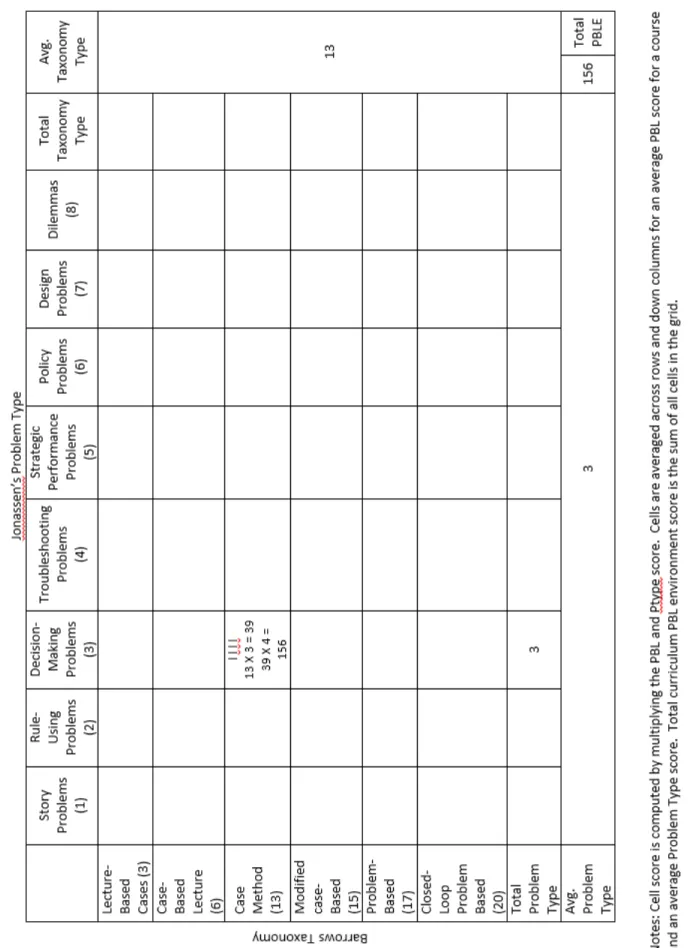
of problem used throughout the course. Additionally, all cells are summed to create a total composite PBLE score for the given curriculum. PBLE takes into account both taxonomy variation and problem type. It is the result of summing all cell scores in a curriculum. This environment score represents the students’ cumulative exposure to PBL, including problem type in the curriculum. It is a theoretically based (i.e., PBL and problem type), mathematically derived (i.e., total sum) variable created by the researcher of this study. Therefore, in addition to describing the curriculum of interest, the matrix provides 3 quantitative data points on the level of PBL in a curriculum. Coding Example. The completed PBL matrix for the fol-lowing example can be found in Figure 2 (next page). In a dynamics course in civil engineering, a series of assign-ments were labeled “Challenge Problem #X.” These were
independent of context within the course binder so a dis-cussion with the faculty member prior to coding was held to gain insight into the context of these assignments. The challenge problems were posed to students one at a time at the beginning of a new unit every 2 weeks to introduce the content. The assignment itself consisted of a real-world civil engineering case summarized by the instructor, sources used in constructing the case, and the problem the students needed to address. This informed the decision to place this example in the case method portion of the taxonomy and the decision-making problem portion of the hierarchy.
Therefore, a tick mark was placed in the cell that crossed decision-making problems and case method. One tick mark was made for each of the four challenge problem assign-ments. Once the entire binder was coded, the cells were Barrows’s (1986) Problem-Based Learning Taxonomy Jonassen’s (2000) Problem Type
Lecture-Based Cases
• Teacher lectures first and presents a case to demonstrate
content second
Story Problems
• Well-structured, shallow context, all information needed
contained in problem Case-Based Lectures
• Case is presented first followed by lecture on content Rule-Using Problems• One correct solution, but multiple paths can be taken to
get there Case Method
• A complete case is used to present content • Case is synthesized and organized for students
Decision-Making Problems
• Require choice in action
Modified Case-Based
• Guided inquiry or structured problems based on the
complete case
Troubleshooting Problems
• Require diagnosis or troubleshooting a faulty system
Problem-Based
• Simulation of an authentic problem allowing for “free
inquiry”
Strategic Performance Problems
• Real-time situations requiring tactical solutions to prob -lems under a time pressure
Closed-Loop Problem-Based
• Presentation of an authentic problem
• Self-directed learning for content followed by student
evaluation of resources
• Students revisit the problem and reflect on their problem
solving process
Policy Problems
• Multiple issues and perspectives in one problem
Design Problems
• Application of domain and strategic knowledge to create a
design to solve a problem Dilemmas
• Most ill-structured
• No clear solution or no solution deemed acceptable to
everyone
Fi gu re 2. Pr ob lem-b as ed le ar nin g c ur ric ul um m at rix co m plet ed f or ci vi l en gin eer in g d yn amics co ur se .
scored. For the cell in the example, two equations were used: 13 x 3 = 39 (i.e., case method x decision-making problems) and 39 x 4 (i.e., cell score x number of ticks in the cell). This resulted in a score of 156 for that cell.
Once all of the cells were scored, each row was averaged for an average taxonomy type score. This example resulted in a score of 13. Similarly, each column was averaged for an average problem type score. This resulted in a score of 3 for the average problem type in this curriculum. Finally, each cell score was summed to create a total PBL environment score. In this example that resulted in a score of 156.
Results
A total of 32 HSS courses, 40 BE courses, 33 CE courses, and 59 courses from other disciplines (i.e., math and sci-ence) formed the completed data for the curriculum. This represents 35% of the HSS courses, 75% of CE courses, 57% of BE courses, and 55% of courses in other disciplines from the curriculum population originally identified. The average matrix score for each type of course (i.e., HSS, BE, CE, and other) as well as all of the courses overall by each of the IVs (i.e., PBL Environment, PBL, and problem type) for BE stu-dents in the sample can be found in Table 1. CE courses are listed in the BE student matrix as a few of the students in the sample took at least one CE designated course.
The courses taken by BE majors that scored the highest in PBL were the courses with a BE prefix (Mpblenvironment = 521.63;
Mpbl = 140.72; Mproblem type = 29.85). This indicates that these students received most of their exposure to PBL while in their major courses. While the least amount of exposure to PBL for these students was in CE courses, this is not meaningful information since so few students took CE courses. The more meaningful variable would be the “other” category since this represents the math and science courses, which all students would have taken at some level. BE students received the least amount of exposure to PBL in “other” courses (M
pblenvi-ronment = 238.34; Mpbl = 33.63; Mproblem type = 14.33).
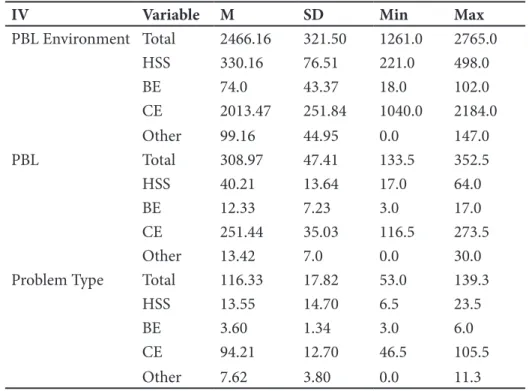
The average matrix score for each type of course (i.e., HSS, BE, CE, and other) as well as all of the courses overall by each of the IVs (i.e., PBL Environment, PBL, and problem type) for CE students in the sample can be found in Table 2 (next page). BE courses are listed in the CE student matrix as a few of the students in the sample took at least one BE designated course. The courses taken by CE majors that scored the highest in PBL were the courses with a CE prefix (Mpblenvironment = 2013.47; Mpbl = 251.44; Mproblem type = 94.21). This indicates that these students received most of their exposure to PBL while in their major courses. Similarly to the BE students, the least amount of exposure to PBL for CE students was in BE courses, which is not meaningful information since so few students took BE courses. The more meaningful variable would be the other category since this represents the math and science courses, which all students would have taken at some level. CE stu-dents received the least amount of exposure to PBL in other courses (Mpblenvironment = 99.16; Mpbl = 13.42; Mproblem type = 7.62).
IV Variable M SD Min Max
PBL Environment Total 1074.50 280.10 326.0 1892.0 HSS 307.16 87.70 60.0 563.0 BE 521.63 152.16 105.0 764.0 CE 140.0 0.0 140.0 140.0 Other 238.34 201.74 0.0 987.0 PBL Total 213.64 51.90 47.0 285.0 HSS 38.24 11.97 17.0 69.0 BE 140.72 40.06 30.0 187.0 CE 20.0 0.0 20.0 20.0 Other 33.63 20.79 0.0 98.0 Problem Type Total 58.23 12.68 11.5 82.0 HSS 13.68 4.26 6.0 24.5 BE 29.85 7.86 5.0 42.0
CE 7.0 0.0 7.0 7.0
Other 14.33 7.57 0.0 43.5
Discussion
The content analysis provided a rich source of data on the level of PBL in the curriculum for both the biomedical engineer-ing (BE) and civil engineerengineer-ing (CE) departments. It identified both the courses that contained PBL, as well as the level of PBL included in the official curriculum for each of these courses, allowing for direct comparison of PBL across disciplines. This analysis revealed engineering courses have higher levels of PBL environment than humanities and social science (HSS), math, or hard science courses (i.e., “other”) in the current sample. Within the engineering courses, the civil engineering courses contained a higher level of PBL environment than the biomedi-cal engineering courses. These courses had both a higher level of PBL on Barrow’s Taxonomy as well as problems that are more open-ended than those in the biomedical engineering courses. Although the level of planned PBL environment was similar for HSS courses taken by both CE and BE students, the math and science courses taken by BE students contained a higher level of planned PBL environment than those taken by CE students.
The higher level of PBL in the math and science courses for the biomedical engineering students is most likely influenced by the higher number of math and science courses these stu-dents are required to take compared to the civil engineering students. While the civil engineering students are required to take multiple courses in math and physics, the biomedical engineering students are required to take a series of biology courses in addition to the math and physics courses.
The higher level of PBL in civil engineering courses com-pared to biomedical engineering courses should be inter-preted with caution. Similarly, to the difference in math and science courses across the two departments, this could be the result of the sample size of courses analyzed. Seventy-five percent of courses with a CE prefix were included in the data-set, but only 57% of courses with a BE prefix were included. Future research should continue classifying PBL within the curriculum for a better picture of the amount and types of PBL across various disciplines. The two engineering cur-ricula chosen in the present study may not be representative of all engineering curricula. Continuing this work by apply-ing the matrix to additional fields of engineerapply-ing at both the current institution and additional colleges of engineering would provide a more complete picture of the usage of PBL in engineering education across subdisciplines and academic structures (i.e., academic quarter vs. academic semester).
Further, future research should not limit the implementa-tion of the PBL matrix to engineering curricula. The matrix itself is discipline independent. Applying it to curricula in dis-ciplines outside of STEM fields would provide insight into the usage of PBL on a broader basis and allow for the exploration of potential differences in implementation across disciplines.
Likewise, application of the matrix in a distance-learning environment was outside the scope of the current study, as the departments of focus did not offer distance courses at the time of data collection. With the rapid growth of distance-learning it is important to examine the curriculum that is
IV Variable M SD Min Max
PBL Environment Total 2466.16 321.50 1261.0 2765.0 HSS 330.16 76.51 221.0 498.0 BE 74.0 43.37 18.0 102.0 CE 2013.47 251.84 1040.0 2184.0 Other 99.16 44.95 0.0 147.0 PBL Total 308.97 47.41 133.5 352.5 HSS 40.21 13.64 17.0 64.0 BE 12.33 7.23 3.0 17.0 CE 251.44 35.03 116.5 273.5 Other 13.42 7.0 0.0 30.0 Problem Type Total 116.33 17.82 53.0 139.3
HSS 13.55 14.70 6.5 23.5 BE 3.60 1.34 3.0 6.0 CE 94.21 12.70 46.5 105.5 Other 7.62 3.80 0.0 11.3
delivered via this instructional mode. The current matrix allows researchers “a usable taxonomic classification for PBL [that] is long overdue and would help with further research into dPBL” (Barrows, 2002, p. 122), including comparing dPBL to PBL implemented face-to-face.
The data extracted from the PBL matrix in this study was used as continuous data. The demographic data suggests a three category grouping (i.e., high, medium, and low levels of PBL) may be an appropriate way to utilize the data. Within the current dataset, the data could be recoded into the three cat-egories in increments of 1,000 based on the demographic data on PBL in the curriculum. This would yield a categorization of “high” for PBL environment scores over 2,000, “medium” for scores between 1,000–2,000, and “low” for scores under 1,000. A larger study should be undertaken to validate the PBL matrix tool as a categorical measure vs. a continuous measure. The primary limitation of this study is in the design. It uti-lized archival data for the content analysis. Retroactively col-lecting data from living documents lead to gaps in data. While the complete curriculum was identified for each student in the dataset, the official curriculum could not be obtained for each of the identified courses. Some faculty members left the institute, binders may have been modified if a course in the dataset was in the older range, and some faculty members do not keep records of their instructional materials.
A second limitation of this study is the usage of the official curriculum rather than the operational curriculum. The offi-cial curriculum was chosen over the operational for the com-prehensiveness of the documentation that exists for the official curriculum. However, by limiting the scope of data used to the official curriculum, it is not possible to determine how much PBL a student was actually exposed to—only the amount of PBL the instructor planned to expose the student to.
Despite the limitations, this study made an entry into the gaps identified earlier in the introduction by empirically exam-ining the practice of PBL in two engineering departments, defining both the problem type and level of PBL implemen-tation. In their bibliometric analysis, Beddoes and colleagues (2010) found only 5% of papers published in engineering education journals and conference proceedings were empiri-cal studies about PBL. Further, the studies included in the 5% used self-report by the faculty member in identifying PBL. The current study not only used empirically collected data, but employed a third-party analysis of PBL rather than self-report. Additionally, this study provided a theoretically derived matrix for coding and classifying PBL. By introducing such a matrix, this study offered a tool that can be applied by other scholars examining PBL, creating consistency in methodology, definitions, and language, and allowing for direct comparison of the work across researchers. While I
applied the matrix in a content analysis in this study as an objective third-party, future implementations of the matrix could occur by the course instructor.
References
ABET. (2013). Criteria for accrediting engineering pro-grams. Retrieved from http://www.abet.org/wp-content /uploads/2015/04/E001-14-15-EAC-Criteria.pdf
Albanese, M. A., & Mitchell, S. (1993). Problem-based learn-ing: A review of literature on its outcomes and implemen-tation issues. Academic Medicine, 68(1), 52–81.
Barroso, L. R., & Morgan, J. R. (2009). Project enhanced learning: Addressing ABET outcomes and linking cur-riculum. Journal of Professional Issues in Engineering
Education and Practice, 135(1), 11–20. http://dx.doi.org
/10.1061/(ASCE)1052-3928(2009)135:1(11)
Barrows, H. S. (1986). A taxonomy of problem-based learn-ing methods. Medical Education, 20(6), 481–486.
Barrows, H. S. (1998). The essentials of problem-based learn-ing. Journal of Dental Education, 62(9), 630–633.
Barrows, H. S. (2002). Is it truly possible to have such a thing as dPBL? Distance Education, 23(1), 119–122.
Beddoes, K. D., Jesiek, B. K., & Borrego, M. (2010). Identify-ing opportunities for collaborations in international engi-neering education research on problem- and project-based learning. The Interdisciplinary Journal of Problem-Based
Learning, 4(2), 7–34. http://dx.doi.org/10.7771/1541-5015
.1142
Conway, J., & Little, P. (2000). Adopting PBL as the preferred institutional approach to teaching and learning: Consid-erations and challenges. Journal on Excellence in College
Teaching, 11(2/3), 11–26.
De Graaff, E., & Kolmos, A. (2003). Characteristics of prob-lem-based learning. International Journal of Engineering
Education, 19(5), 657–662.
Dochy, F., Segers, M., Van den Bossche, P., & Gijbels, D. (2003). Effects of problem-based learning: A meta- analysis. Learning and Instruction, 13(5), 533–568.
Dunlap, J. C. (2005). Problem-based learning and self-efficacy: How a capstone course prepares students for a profession. Educational Technology Research and
Develop-ment, 53(1), 65–85.
Elo, S., & Kyngas, H. (2007). The qualitative content analy-sis process. Journal of Advanced Nursing, 62(1), 107–115. http://dx.doi.org/10.1111/j.1365-2648.2007.04569.x Felder, R. M., & Brent, R. (2003). Designing and teaching
courses to satisfy the ABET engineering criteria. Journal
Ge, X., Planas, L. G., & Er, N. (2010). A cognitive support system to scaffold students’ problem-based learning in a web-based learning environment. The Interdisciplinary
Journal of Problem-Based Learning, 4(1), 30–56.
Gijbels, D., Dochy, F., Van den Bossche, P., & Segers, M. (2005). Effects of problem-based learning: A meta-analysis from the angle of assessment. Review of Educational Research, 75(1), 27–61.
Henry, H. R., Tawfik, A. A., Jonassen, D. H., Winholtz, R. A., & Khanna, S. (2012). “I know this is supposed to be more like the real world, but . . .”: Student perceptions of a PBL implementation in an undergraduate materials science course. The Interdisciplinary Journal of Problem-Based
Learning, 6(1), 43–81.
Jonassen, D. H. (2000). Toward a design theory of problem solving. Educational Technology Research and
Develop-ment, 48(4), 63–85.
Jonassen, D. H. (2011a). Learning to solve problems: A hand-book for designing problem-solving learning environments.
New York: Routledge.
Jonassen, D. (2011b). Supporting problem solving in PBL.
The Interdisciplinary Journal of Problem-Based Learning, 5(2), 95–119.
Jonassen, D. H., & Hung, W. (2008). All problems are not equal: Implications for problem-based learning. The
Inter-disciplinary Journal of Problem-Based Learning, 2(2), 6–28.
http://dx.doi.org/10.7771/1541-5015.1080
Kolmos, A. (1996). Reflections on project work and prob-lem-based learning. European Journal of Engineering
Education, 21(2), 141–148. http://dx/doi.org/0304-3797
/96/020141-08
Loyens, S. M. M., Magda, J., & Rikers, R. M. J. P. (2008). Self-directed learning in problem-based learning and its relationships with self-regulated learning. Educational
Psychology Review, 20(4), 411–427. http://dx.doi.org/10
.1007/s10648-008-9082-7
Margetson, D. (1998). What counts as problem-based learn-ing? Education for Health: Change in Learning and
Prac-tice, 11(2), 193–201.
Matusovich, H. M., Paretti, M. C., Jones, B. D., & Brown, P. R. (2012, June). How problem-based learning and the tradi-tional engineering design pedagogies influence the
motiva-tion of first-year engineering students. Paper presented at
the American Society for Engineering Education Annual Conference, San Antonio, TX.
Maudsley, G. (1999). Do we all mean the same thing by “prob-lem-based learning”? A review of the concepts and a formula-tion of the ground rules. Academic Medicine, 74(2), 178–185. Newman, M. J. (2005). Problem based learning: An intro-duction and overview of the key features of the approach.
Journal of Veterinary Medical Education, 32(1), 12–20.
Otting, H., & Zwaal, W. (2006). Critical task characteristics in problem-based learning. Industry and Higher
Educa-tion, 20(5), 347–357.
Pease, M. A., & Kuhn, D. (2011). Experimental analysis of the effective components of problem-based learning.
Sci-ence Education, 95(1), 57–86. http://dx.doi.org/10.1002
/sce.20412
Pedersen, S. (2003). Motivational orientation in a problem-based learning environment. Journal of Interactive
Learn-ing Research, 14(1), 51–77.
Perrenet, J. C., Bouhuijs, P. A. J., & Smits, J. G. M. M. (2000). The suitability of problem-based learning for engineering education: Theory and practice. Teaching in Higher
Educa-tion, 5(3), 345–358.
Saarinen-Rahiika, H., & Binkley, J. M. (1998). Problem-based learning in physical therapy: A review of the literature and overview of the McMaster University experience. Physical
Therapy, 78(2), 195–207.
Savery, J. (2006). Overview of problem-based learning: Definitions and distinctions. Interdisciplinary Journal of
Problem-Based Learning, 1(1), 9–20. http:/dx.doi.org/10
.7771/1541-5015.1002
Savin-Baden, M. (2000). Problem-based learning in higher
education: Untold stories. Philadelphia: The Society for
Research into Higher Education & Open University Press. Savin-Baden, M. (2008). Problem-based learning in elec-tronic engineering: Locating legends or promising prob-lems? International Journal of Electrical Engineering
Education, 45(2), 96–109.
Savin-Baden, M. & Major, C. H. (2011). Foundations of
prob-lem-based learning. New York: Society for Research into
Higher Education. (Original work published 2004) Strobel, J., & Van Barneveld, A. (2009). When is PBL more
effective? A meta-synthesis of meta-analyses comparing PBL to conventional classrooms. The Interdisciplinary
Journal of Problem-Based Learning, 3(1), 44–58.
Sungur, S., & Tekkaya, C. (2006). Effects of problem-based learning and traditional instruction on self-regulated learning. The Journal of Educational Research, 99(5), 307–317.
Walker, A., & Leary, H. (2009). A problem based learning meta-analysis: Differences across problem types, implementation types, disciplines, and assessment levels. The
Interdisciplin-ary Journal of Problem-Based Learning, 3(1), 12–43.
Woods, D. R. (1996a). Problem-based learning for large classes in chemical engineering. New Directions for
Teach-ing and LearnTeach-ing, 68, 91–99.
Woods, D. R. (1996b). Problem-based Learning: Helping
your students gain the most from PBL. Retrieved from
http://chemeng.mcmaster.ca/problem-based-learning #Books-to-help-with-PBL
Woods, D. R. (1996c). Problem-based Learning: Resources to
gain the most from PBL. Retrieved from http://chemeng
.mcmaster.ca/problem-based-learning#Books-to-help -with-PBL
Woods, D. R. (2012). PBL: An evaluation of the effectiveness of authentic problem-based learning (aPBL). Chemical
Engineering Education, 46(2), 135–144.
Xian, H., & Madhavan, K. (2013). Building on and honoring forty years of PBL scholarship from Howard Barrows: A sci-entometric, large-scale data, and visualization based anal-ysis. Interdisciplinary Journal of Problem-based Learning, 7(1), 132–156. http://dx.doi.org/10.7771/1541-5015.1325 Yew, E. H. J., Chng, E., & Schmidt, H. G. (2011). Is learning in
problem-based learning cumulative? Advances in Health
Sciences Education Theory and Practice, 16(4), 449–464.
http://dx.doi.org/10.1007/s10459-010-9267-y
Zheng, W., Shih, H., & Mo, Y. L. (2009, June). Integration of cogni-tive instructions and problem/project-based learning into civil engineering curriculum to cultivate creativity and self-directed
learning skills. Paper presented at the American Society for
Engineering Education Annual Conference, Austin, TX. Author Biography: Shannon M. Sipes is an instructional con-sultant in the Center for Innovative Teaching and Learning at Indiana University. Her current research interests include assessment methodology, curriculum design, and curiosity.