Problem-based Learning’s Role in the Development of
Life-long Learning Skills in Medical Practitioners
医師の生涯学習スキル開発におけるPBLの役割
Gregory V. G. O’Dowd
English
Abstract
This paper examines the role Problem-based Learning (PBL) can play in developing the necessary life-long learning (LLL) skills that medical students need for their future careers as medical practitioners. Also, the types of LLL skills that need to be developed will be highlighted as well as the suitability of PBL for the task. Finally, some relevant data collected in an on-going action research study of PBL will be examined. This paper suggests medical students need to be made more aware of the necessity to engage in life-long learning skills development through PBL tutorials that lay the basis for their ongoing personal growth and development as medical professionals.
Key words: problem-based learning, PBL, life-long learning, medical education
Introduction
Much of the literature on Problem-based Learning (PBL) in medical school programs is focused on its structure, formatting, roles and educational advantages over traditional didactic lectures (Barrows & Tamblyn, 1980; Barrows, 1985, 1994, 1996; Bridges, 1992; Albanese & Mitchell, 1993; Davis and Harden, 1999; O’Dowd, 2005). However, far less attention has been given to the utility of PBL in developing the necessary life-long learning (LLL) skills medical students need in their future careers. And although a lot of lip service has been paid to the concept of LLL and how it should be encouraged, very little action is actually overtly taken in medical courses to develop such skills. LLL is a largely misunderstood concept, especially by medical students, and often thought of as something done far down
their career track or merely for older people.
Indeed, one of the reasons PBL was first introduced at McMaster University School of Medicine in 1971 was to overcome the increasingly obvious deficits of the traditional style of medical school education in preparing graduates for the rigors of medical practice in the real world (Barrows & Tamblyn, 1980; Davis and Harden, 1999). Over time, PBL has developed along a variety of paths in various countries and institutions (O’Dowd, 2013), but the basic ideals remain the same; that is, to impart to graduate doctors all the real world skills they will need to be successful in their future careers, and that includes LLL skills.
LLL and its place in medical university education
Students at medical universities are usually clear about why they have come to study; to become a doctor and have a comfortable career (O’Dowd, 2006). But in my freshmen classes, I pose the question, “What does it mean to be a good doctor?” They are asked to list the qualities they think a good doctor requires, and then I unpack this concept so their horizons can be broadened. However, no freshman student in the past twelve years has ever listed “life-long learner” as being a quality a good doctor should possess. LLL is a concept that needs to be introduced and constantly emphasized to medical students so they can retain an awareness of the need to develop the necessary skills as they progress through the various stages of their studies.
Most Japanese medical students believe their studies and learning begins in lecture halls and ends with exams and final graduation. Indeed, LLL is a concept almost never raised during their coursework, perhaps because it is usually regarded as a natural extension of each student’s motivation in pursuing their studies; however, not all students are equally motivated. Unfortunately, graduates are now finding much more is required of them in terms of continuing the development of their medical knowledge base and acquiring new skills. If the purpose of each medical university is to produce graduates with the knowledge and skills needed to be a doctor (O’Dowd, 2009), why hasn’t more emphasis been put on LLL skills? A significant factor is that mass education has by necessity placed academic achievement (passing quantifiable tests and examinations) above all else. And although all Japanese freshmen may enter medical school with equal potential, only a fraction will become enthusiastic students who make the time to expand their studies and skills beyond the academic minimum required to pass. Indeed, my recent experiences give credence to the notion that a growing number of students are focused merely on passing their courses (requiring 60 points out of a total 100, which implies that almost 40% of the required knowledge in each course is either misunderstood or remains unlearnt) while placing priority on pursuing non-academic social activities (e.g. joining clubs) at the expense of higher academic achievement (O’Dowd, 2003, 2007). Nevertheless, all medical students will eventually graduate as “a doctor” (a
generic term) but far fewer graduate as “the doctor”, that is, the doctor sought after for their broad learning and good character, the doctor who will be respected by both colleagues and patients, and the doctor who will eventually become a leader in their chosen fields. Without developing LLL skills during their six year course of medical studies, newly graduated doctors will find it very difficult to expand their knowledge base in a timely manner, acquire the new skills and techniques demanded by patients, contribute to scholarship and research, or even communicate with colleagues about the constantly changing environment of modern medical practice both in Japan and abroad.
The transition from the traditional didactic lecture style to PBL has enabled the development of LLL skills to be restored to the educational reform agenda, but it is an opportunity that can easily be squandered if not carefully managed. Medical schools need to ensure that LLL skills are not overlooked in the process of establishing PBL in their reform efforts. The following section will highlight the types of LLL skills that medical students need to develop to be successful in their future careers.
Life-long learning
LLL has relevance to medical practitioners in particular; who would want to be treated by a doctor who hasn’t read a medical article nor kept skills up-to-date since they graduated from university? Indeed, LLL is recognition that doctors need to learn throughout their lifetime, as noted in the Council on Medical Education Report 3:
“The American Medical Association Principles of Medical Ethics states that “a physician must continue to study, apply, and advance scientific knowledge...” The process by which physicians keep their knowledge-base current typically is referred to as “lifelong learning”. Both the profession and the public expect that physicians have the willingness and ability to engage in lifelong learning. (Pan, 2008)
This report also noted that a gap exists between this ideal and reality as the medical education system, despite reforms, has generally failed to instill in graduates the ability to engage in LLL on their own. As in the past, medical students are schooled with increasing volumes of information but not the skills to update, replace, and acquire new knowledge and skills in a timely manner. I believe the main problem for medical schools and students lies in identifying what LLL skills are and how these can be nurtured and developed during their time studying at university.
First, the central aspects of LLL need to be illuminated. In a broad sense, LLL can be described as the active continuation of learning during one’s career or life; however, the true power embodied in this concept lies in the essential “active” elements (O’Dowd, 2004) that give it its dynamic potential:
¡being independent, adventurous and self-motivated,
¡not ceasing to seek new or relevant knowledge or learning opportunities,
¡having a commitment to improvement and willingness to try new things,
¡capable of critical self-reflection, and
¡the drive to continue expanding one’s knowledge base or acquire new skills.
In addition, life-long learners recognize the need to make strategic investments in themselves and reinforce their desire to continue their self-development through learning. In summary, life-long learning can be defined as the active process of continuing to pursue the acquisition of knowledge beyond any pre-determined limits to achieve self-improvement, self-betterment, and self-fulfillment. Or as life-long learners might say, “You’re never too young or old to learn new tricks.”
Next, what are LLL skills? They encompass a wide and diverse range of metacognitive, interpersonal and functional skills that enable learning. The prime LLL skills, distilled by this author in his research since 2004, include the following:
¡self-directed learning skills
¡critical thinking skills
¡lateral thinking skills
¡problem solving skills
¡recognizing the need for new skills
¡planning skills
¡time management skills
¡research skills
¡data management skills
¡collaborative team skills
¡interpersonal communication skills
¡leadership skills
¡evaluation skills
As the length of this list suggests, no learner is born with all these skills. These skills can be built up and developed (usually over time by training and practice) to become habits that students choose to possess. This achievement will require a considerable amount of motivation, time-management and will power, all attributes desired in those who study to become doctors and who understand the necessity of life-long learning. Nevertheless, by becoming an active learner and maintaining their curiosity and purpose, LLLs can find enjoyment and fulfillment in the LLL process.
Students who aspire to develop into life-long learners (LLLs) also exhibit a variety of specific organizational skills and strategies that make them superior learners. These attributes are all firmly grounded in the direct and indirect learning strategies outlined in O’Dowd, 1999:
1. LLLs think about themselves as learners and their learning styles and preferences. 2. LLLs think positively about their learning and plan how they will study.
3. LLLs have developed good study habits.
4. LLLs often like to work with other students to exchange views.
5. LLLs allow time to build their knowledge base and see themselves growing as learners. 6. LLLs set goals and monitor their time to make maximum use of it.
7. LLLs talk about their studies with the teacher and other students. 8. LLLs are often not afraid to ask questions.
9. LLLs focus on what needs to be learnt and pursue it with determination. 10. LLLs seek new opportunities to update their skills or acquire new skills.
By adopting these attributes and practicing them, average medical students can develop their potential to become successful life-long learners. Indeed, PBL is a methodology well suited to developing these skills and attributes.
Problem-based learning
PBL was originally developed in response to the criticism that traditional lecture-based teaching and rote-learning methods employed in medical universities were failing to produce graduate doctors fully prepared for the rigors of practicing medicine on patients in clinical settings (Barrows & Tamblyn, 1980; Barrows, 1996). Rather than having students passively endure teacher-based lectures that require them to cram massive amounts of medical information in the hope that they can pass snap-shot tests (regardless of their actual competency or ability to use the information) at the end of their programs, the PBL methodology endeavors to provide students with a continual series of close to real-life learning experi-ences to develop critical skills and the opportunity to actively participate in their own learning. Indeed, the PBL methodology is primarily a student-centered approach that requires students to take charge and be responsible for their own learning by cooperating with fellow students to achieve learning goals. Ideally, PBL is a teaching methodology that embodies most of the principles educators know improves learning: being active (not passive), student-centered, cooperating with others, enabling students’ learn-ing preference while also encouraglearn-ing the development of new learnlearn-ing strategies, and gettlearn-ing prompt feedback (Barrows & Tamblyn, 1980; Bridges, 1992; Albanese & Mitchell, 1993; Barrows, 1994; Bligh, 1995; O’Dowd, 2005; O’Dowd 2013). It also presents students with the opportunity to build their knowledge base in the context of needing to solve a relevant problem. Subject knowledge is learned in a small group format that engages them in a variety of learning tasks. These tasks require them to put into practice and develop the same kind of thinking processes and competencies they will be expected to use in their future real life careers. PBL offers an excellent opportunity to practice, use, and develop such
important processing skills as problem solving, interpersonal, group and team skills, the ability to cope with uncertainty, self-directed and life-long learning skills as well as self-assessment skills, all under the guidance of a tutor/facilitator. These are all necessary skills that doctors need to develop to be successful in their future careers. However, there is a notable dilemma; that is, students need good processing skills to be able to maximize the benefits of PBL. This, in turn, requires medical schools to provide adequate orientation and training (or re-training as such a methodology may be alien to the students learning experiences until this time) for students to prepare them to engage in PBL.
Of course, it is not surprising that PBL also helps prepare students for life-long learning as it was originally intended and designed to make their learning processes as close to what they would encounter in real life as possible, including developing the skills to become self-directed learners. By engaging in PBL, students have the opportunity to build and reshape their understanding of how to learn and knowledge acquisition skills as a natural consequence of their experiences and interactions in tutorial learning situations (Barrows & Tamblyn, 1980).
How PBL develops LLL
Being student-centered by design, PBL strives not just for the acquisition of needed medical knowledge but also for a holistic development of necessary professional skills (listed previously). Conceptually, PBL encapsulates virtually all of the lifelong learning skills needed and promotes them by engaging students in a variety of learning activities that (1) promotes their capacity for independent, self-directed learning, (2) requires them to take greater responsibility for not only their own learning but in collaboration with others, (3) enables greater metacognitive awareness of their thinking skills, and (4) exercises their ability to evaluate the quality of their reasoning skills and knowledge acquisition (Barrows, 1985). Indeed, studies are showing evidence that PBL can foster students’ abilities for self-directed learning and develop the characteristics of LLL (Holen, 2000).
By engaging students with a problem similar to those likely to be encountered in their future working careers, analyzing content, identifying learning issues, assembling information and sharing collaboratively, PBL also promotes the development and use of the many LLL skills listed earlier in this paper by:
¡activating students in their learning by requiring active participation,
¡encouraging more diverse self-directed learning skills and use of strategies,
¡training in problem-solving techniques, critical thinking and evaluation, and
¡development of cooperative discussion skills, team-work and leadership qualities.
Although this all seems attractive and desirable in theory, is this really what happens in practice? A key focus in my current research addresses whether medical students feel that LLL skills are actually
promoted when PBL is put into practice in Japanese medical universities. The next part of this paper will examine a snap-shot of how medical students perceive the role of LLL in their PBL tutorials.
Survey of students
A survey was initiated in the second semester of 2013 to investigate in part how medical students perceive PBL as well as the role of LLL in their PBL tutorials. Questionnaires were distributed to 112 3rd year medical students and 92 4th year students at Hamamatsu University School of Medicine (HUSM) at the beginning of their regular PBL tutorial period and collected at the end (109 and 92 surveys were returned, respectively). The questionnaire in Japanese (see Appendix 1a, with English translation in Appendix 1b) contained 20 items that students were asked to rank on a 5-point Likert scale; three items (numbers 9, 19 and 20) directly addressed the issue of LLL and will be examined in this paper.
Results
The following tables show the percentage of respondents for each of the items relevant to this particular study (items 1, 9, 17, 19, 20).
Table 1: Tutorial Learning 3rd Year Students at HUSM N = 109
Item Strongly Agree Neutral Disagree Strongly
Agree Disagree
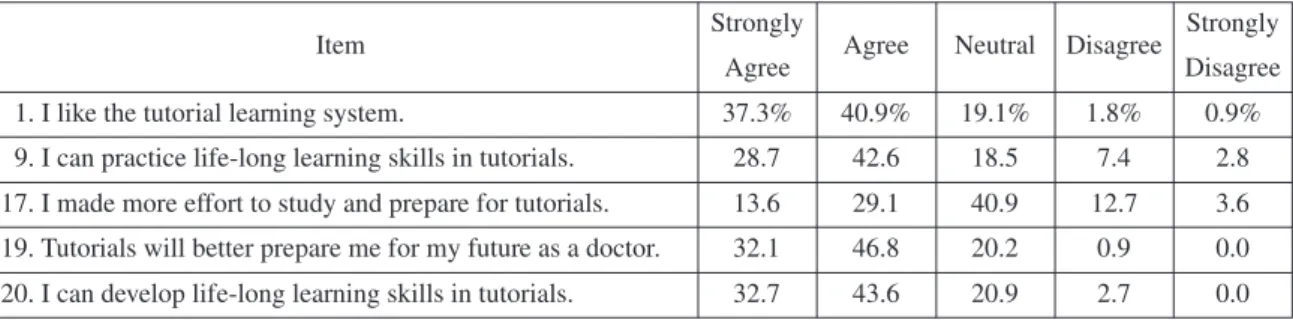
1. I like the tutorial learning system. 37.3% 40.9% 19.1% 1.8% 0.9%
9. I can practice life-long learning skills in tutorials. 28.7 42.6 18.5 7.4 2.8 17. I made more effort to study and prepare for tutorials. 13.6 29.1 40.9 12.7 3.6 19. Tutorials will better prepare me for my future as a doctor. 32.1 46.8 20.2 0.9 0.0 20. I can develop life-long learning skills in tutorials. 32.7 43.6 20.9 2.7 0.0
Item Strongly Agree Neutral Disagree Strongly
Agree Disagree
1. I like the tutorial learning system. 19.6% 29.3% 30.4% 8.7% 12.0%
9. I can practice life-long learning skills in tutorials. 7.6 29.3 39.1 16.3 6.5 17. I made more effort to study and prepare for tutorials. 10.9 31.5 35.9 9.8 10.9 19. Tutorials will better prepare me for my future as a doctor. 15.2 41.3 29.3 6.5 6.5 20. I can develop life-long learning skills in tutorials. 9.8 46.7 28.3 5.4 8.7
Table 2: Tutorial Learning 4th Year Students at HUSM N = 92
Discussion
The manner in which students approach their learning is dependent on a variety of factors, including their interest in each subject, the teachers/ tutors they have experienced, the learning strategies they usually depend on, the mix of other students in their tutorial groups, their future goals and aspirations, and the
skills (or lack of skills) that they bring to each new unit. These factors would also influence whether students engage in deep, superficial or strategic interactions with both course materials and fellow group members. Indeed, the fact that students commence PBL with different attitudes, characteristics, and study skills and preferences may partly explain the differences in knowledge building and skills acquisition experienced by students in PBL tutorials.
A preliminary analysis of the data obtained from the PBL tutorial survey revealed the following.
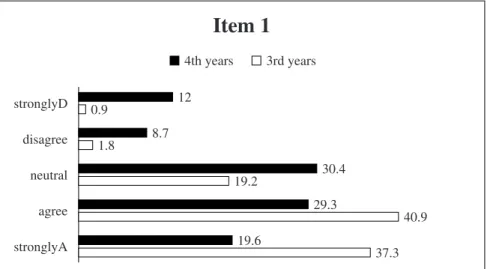
Figure 1. Item 1. I like the tutorial learning system.
The majority of third year students (78.2%) liked the tutorial learning system, dropping to 48.9% for fourth year students. The percentage of ambivalent students rose from 19.1% for 3rd years to 30.4% for 4th years, and students who didn’t like the approach was 2.7% and 20.7% respectively. I believe the initial burst of enthusiasm reflects the 3rd year students’ pleasure in addressing real life medical problems in PBL tutorials after two years of general course work; 4th year students, after a year of tutorial study, still see tutorials as a somewhat beneficial methodology. At the same time, the PBL methodology is markedly different from their previous educational experience, adding both a novel aspect as well as something unfamiliar that requires some adjustment to their learning approaches. Ambivalent 3rd year students seem have a wait-and-see approach, with a higher percentage of 4th years still unconvinced of the utility of PBL, also expressed in the significant percentage of 4th years (20.7%) who no longer appreciate the opportunities offered by tutorials.
Item 1
4th years stronglyD disagree neutral agree stronglyA 12 8.7 1.8 19.2 40.9 37.3 30.4 29.3 19.6 0.9 3rd yearsFigure 2. Item 9. I can practice life-long learning skills in tutorials.
Although a majority of third year students (71.3%) indicated that they became more aware of practicing LLL skills in tutorials, only 36.9% for fourth year students thought so. The percentage of ambivalent 3rd year students was 18.5%, jumping markedly to 39.1% for 4th years; students who didn’t think so were 10.2% and 22.8% respectively. This may reflect a cooling off in initial awareness of LLL skills development as students focus more on knowledge acquisition and adapting to changes to tutorial group membership and tutor support. Several students reported experiencing difficulties when the membership of their groups changed (group composition is randomly changed during the year to prevent students working in the same group continuously).
Item 9
4th years stronglyD 2.8 6.5 7.4 18.5 42.6 28.7 16.3 39.1 29.3 7.6 3rd years disagree neutral agree stronglyAItem 17
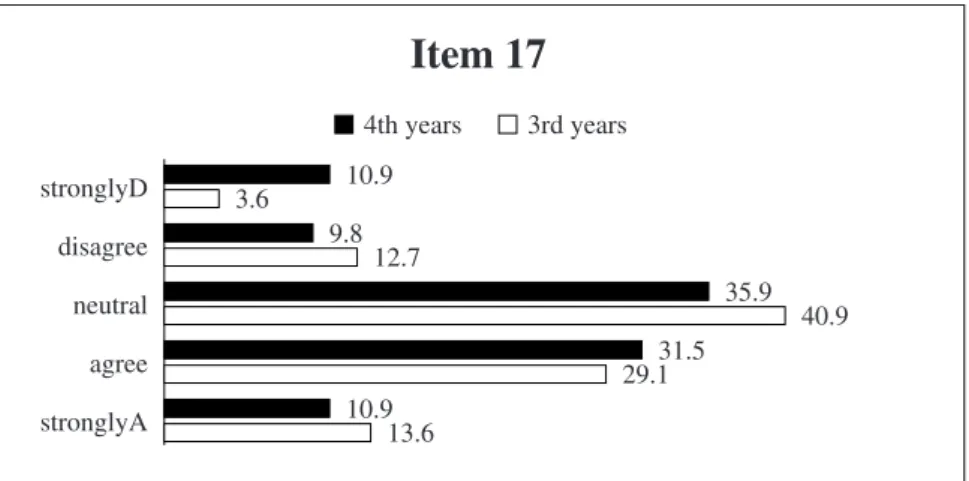
4th years stronglyD disagree neutral agree stronglyA 10.9 3.6 12.7 40.9 29.1 13.6 9.8 35.9 31.5 10.9 3rd yearsFigure 3. Item 17. I made more effort to study and prepare for tutorials.
Only 42.7% of 3rd year students indicated they made more study effort for tutorials, much the same as the 42.4% of 4th years. Slightly more 3rd year students were ambivalent (40.9%) than the 35.9% of 4th years; students who didn’t think so were 16.3% and 20.7% respectively. This may reflect the degree of
motivation that students maintain, with 4th years more focus on knowledge acquisition with an eye on upcoming academic achievement tests at the end of the fourth year program.
Item 19
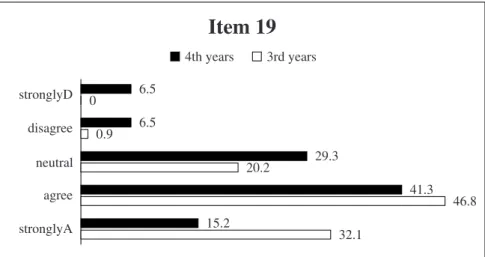
4th years stronglyD disagree neutral agree stronglyA 32.1 46.8 20.2 0 0.9 6.5 6.5 29.3 41.3 15.2 3rd yearsFigure 4. Item 19. Tutorials will better prepare me for my future as a doctor.
The majority of 3rd year students (78.9%) indicated they thought the tutorial learning system would better prepare them for their future, with 56.5% for 4th year students of the same opinion. The percentage of ambivalent students was 20.2% for 3rd years and 29.3% for 4th years, and only 0.9% and 13% respectively of students not linking tutorial study with their future career paths. These responses are the strongest indicator that the majority of these students understood the purpose of the PBL tutorial program at a critical stage of their studies.
Figure 5. Item 20. I can develop life-long learning skills in tutorials.
Item 20
4th years stronglyD disagree neutral agree stronglyA 8.7 5.4 28.3 46.7 46.7 43.6 20.9 2.7 0 9.8 3rd yearsAgain, closely tracking Item 19, the majority of 3rd year students (76.3%) recognized the relevance of PBL to developing LLL skills needed for their future, dipping to 56.5% for 4th years. The percentage of ambivalent students was similar to that for item 19 with 20.9% of 3rd years and 28.3% of 4th years. Students who didn’t think along these lines were 2.7% and 14.1% respectively, indicating these 4th year students lacked understanding of what LLL skills could be developed, or simply their apathy towards being pressured to engage in self-development in the model presented by PBL.
Generally, the great majority of 3rd year students were favorable to PBL tutorial study and the opportunity to practice some LLL skills, compared to just less than 50% of 4th years. From the 4th year students who discussed their negative impressions with the author, their initial experiences in tutorials has not met their high expectations; students mentioned factors such as having to work with less-motivated students who didn’t contribute equally to the tutorial work-load, feeling that progress was slower in tutorials, more time was required to prepare for tutorials, poor group dynamics, insufficient support from their various tutors, anxiety about whether they would sufficiently cover content for tests, and whether other tutorial groups were ahead of their own group, that is, the fear they were slipping behind other students. In turn, as students started to question the efficacy of tutorials, these concerns shifted their focus away from participating in LLL skills development to merely endeavoring to cover as much of the course content as they were able. Nevertheless, student who maintained a positive attitude to tutorials cited positive group experiences, the motivation stemming from the cases studied that reflected what they imagined they would be doing in the future, and the opportunities to be active in their learning. As for LLL skills development, students indicated that if such skills development were one of the major goals of tutorial education then the university should place more overt emphasis on it. Indeed, the university’s top two stated educational objectives for students of the Faculty of Medicine are:
1. to acquire essential knowledge and skills of medicine to solve problems, and
2. to learn how to accurately evaluate oneself and how to continue to educate oneself independently. (O’Dowd, 2009)
Both these objectives can be achieved through the university’s PBL tutorial program; what is needed is a continuation of the evolution of the program to achieve its full potential and provide students with the opportunities to better develop themselves for their future careers.
Although still limited, there is mounting evidence that PBL does exert a positive influence in making graduate students better doctors in practice (Matsui et al., 2007; Ishihara et al., 2007; Tayyeb, 2013). Indeed, after graduation, these doctors appear to have better self-directed learning skills as well as other professionally relevant skills. Of course, much more research is needed on the impact of PBL on student development of LLL skills.
Conclusion
The findings of this paper suggest that medical students need to be made more aware earlier of the necessity of engaging in and developing LLL skills through their PBL tutorials. In addition, medical universities need more focus on how to provide more overt opportunities and avenues for practicing and continuing students’ personal growth and development as life-long learners. PBL is an ideal platform to provide this needed focus through the provision of flexible learning opportunities to engage students’ interest and awareness of their overall skills development.
Of course, PBL tutorial learning should not be regarded as a panacea for addressing the problems raised in these issues as student preferences and choices are also affected by personal and environmental factors, so many individual exceptions, and even resistance, will persist. It also needs to be emphasized that changes in student attitudes to LLL skill development will not occur overnight; it still takes time for many learners to become comfortable with different concepts such as PBL and LLL, and some students may not change at all. Practicing LLL skills may initially be slow and uncomfortable for some students, especially those who may need these most, but raising awareness of the need for LLL skills and continually seeking to expand students’ learning experiences will not be without some benefit to most students. Medical students need to realize that the time to develop life-long learning skills is now.
Acknowledgements
This research is partially supported by the Grant-in-Aid for Scientific Research (C) from the Japan Society for the Promotion of Science(基盤研究(C)24530951).
References
Albanese, M.A., Mitchell, S. Problem-based learning: a review of literature on its outcomes and implementation issues. Academic Medicine. 68, 1. pp.52-81. 1993.
Bligh, J. Problem based, small group learning: an idea whose time has come. British Medical Journal. 311, pp.342-343. 1995.
Bloom, B. Taxonomy of Educational Objectives. New York: McKay. 1956.
Bridges, E.M. Problem-based Learning for Administrators. ERIC Clearinghouse on Educational Man-agement, University of Oregon. 1992.
Barrows, H.S., Tamblyn, R.M. Problem-based learning: an approach to medical education. Springer Series on Medical Education Vol. 1. New York: Springer Publishing.1980.
Barrows, H.S. How to design a problem-based curriculum for the preclinical years. New York: Springer Publishing.1985.
Illinois University School of Medicine. 1994.
Barrows, H.S. Problem-based learning in medicine and beyond: a brief overview. New Directions for
Teaching and Learning. 68, pp.3-12. 1996.
Davis, M.H., Harden, R.M. Problem-based learning: a practical guide. AMEE Medical Education Guide
No.15, Association for Medical Education in Europe. 1999.
Holen, A. The PBL group: self reflections and feedback for improved learning and growth. Medical
Teacher. 22.pp.485-488. 2000.
Ishihara, S., Matsui, K., Sato, Y., Tang, A.C., Suganuma, T., Fukui, Y., Yamaguchi, N., Kawakami, Y., Yoshioka, T. Self-efficacy achieved through problem-based learning tutorials. 医学教育. 38.1.pp.391-397. 2007.
Matsui, K., Ishihara, S., Suganuma, T., Sato, Y., Tang, A.C., Fukui, Y., Yamaguchi, N., Kawakami, Y., Yoshioka, T. Characteristics of medical school graduates who underwent problem-based learning.
Annals of Academic Medicine. 36.1.pp.67-71. 2007.
O’Dowd, G.V.G. Teaching how to learn: an introduction to learning strategies. The Report of the Foreign
Language Center, Tokai University. 19, pp.55-72. 1999.
O’Dowd, G.V.G. Developing life-long learning skills. Japan Assoc. of Language Teachers 4th Annual
College and University Educators SIG. Proceedings. pp.15-23. 2004.
O’Dowd, G.V.G. Problem-based learning: new road to learning at Hamamatsu University School of Medicine. Reports of Liberal Arts. Hamamatsu University School of Medicine, 19, pp.67-74. 2005. O’Dowd, G.V.G. Student expectations of medical school and the ripple effect. Reports of Liberal Arts.
Hamamatsu University School of Medicine, 20, pp.55-63. 2006.
O’Dowd, G.V.G. Developing higher-order thinking skills in medical students. Reports of Liberal Arts. Hamamatsu University School of Medicine, 21, pp.21-34. 2007.
O’Dowd, G.V.G. An examination of the roles of education and training in the making of a doctor. Reports
of Liberal Arts. Hamamatsu University School of Medicine, 23, pp.45-69. 2009.
O’Dowd, G.V.G. The evolution of problem-based learning in medical universities. Reports of Liberal
Arts. Hamamatsu University School of Medicine, 27, pp.23-33. 2013.
Pan, R.J.D. Physician lifelong learning. Report of the Council on Medical Education. CME Report 3-A-08. 203-A-08.
Tayyeb, R. Effectiveness of problem based learning as an instructional tool for acquisition of content knowledge and promotion of critical thinking among medical students. Journal of the College of