Evaluating the contribution of an organizational level
in the strategy process
A case study at Skanska Sweden AB and a comparative study of four
multidivisional corporations
Master of Science Thesis in the Master Degree Programs,
Quality and Operations Management and Supply Chain Management
ELIN DÖLERUD
HELENA NILSSON
Department of Technology Management and Economics
Division of Quality Sciences
CHALMERS UNIVERSITY OF TECHNOLOGY Göteborg, Sweden, 2012
Evaluating the contribution of an organizational level
in the strategy process
A case study at Skanska Sweden AB and a comparative study of four
multidivisional corporations
ELIN DÖLERUD
HELENA NILSSON
Examiner: Henrik Eriksson Supervisor: David Loid
Supervisor Skanska Sverige AB: Peter Samuelsson
Department of Technology Management and Economics CHALMERS UNIVERSITY OF TECHNOLOGY Göteborg, Sweden, 2012
Evaluating the contribution of an organizational level in the strategy process
A case study at Skanska Sweden AB and a comparative study of four multidivisional corporations
© ELIN DÖLERUD & HELENA NILSSON, 2012
Report No. E2012:035
Department of Technology Management and Economics CHALMERS UNIVERSITY OF TECHNOLOGY SE – 412 96 Göteborg
Sweden
Telephone +46 (0)31-772 1000
Reproservice, Chalmers Göteborg, Sweden, 2012
i
a comparative study of four multidivisional corporations ELIN DÖLERUD & HELENA NILSSON Department of Technology Management and Economics
Division of Quality Sciences
Chalmers University of Technology
ABSTRACT
This thesis develops a framework for evaluating what should be the contribution of an organizational level in the strategy process in multidivisional corporations. The background was a need at Skanska to evaluate the role of one of the levels in its strategy process. Based on the problems identified initially at Skanska, the development of the framework was guided by four research questions, concerning the areas Organization, Concretization, Roles and responsibilities and Communication. The framework was developed by a theoretical review and a comparative study, to finally be tested and reviewed in a case study at Skanska. The comparative study included; Lantmännen, Vattenfall, SCA and SKF. In addition to verifying the findings from the theoretical review, the comparative study contributed with practical examples that were used in the development of the framework.
The framework communicates that the cortex in answering the purpose is the organizational structure, which should be structured in accordance to the synergies which the company seeks to gain through the strategy process. To support this, the possibility of creating synergies and what the possible gains are should be compared with the cost of pursuing it. In the pursuit of synergies, through coordination and centralization of activities, resources, and decision making there needs to be a balance between the need for autonomy in the individual organizational units compared with the control exerted by the levels above. Finding the balance of the two first steps comes from looking into the third step, focus. Focus implies that the scope of each level in the strategy process should be limited. Possibilities for focus should therefore be investigated, avoiding overload in the process and raising performance at the level. Moreover, the value contribution of each level should be clear and clearly stated. Further, the degree of formalization of the decision roles within the organizational level should be investigated, to find out if there is a potential to improve performance by assigning clear decision roles. The above steps should be performed as an iterative process, in which they are viewed and reviewed in the light of knowledge gained from the other steps. The strategy should finally be visualized to facilitate successful communication in the strategy process.
In addition to the framework, the thesis presents case specific recommendations to Skanska. The theoretical and managerial contribution relies in the framework and the research process, from which it should be possible for companies to replicate the framework.
Key words: strategy process, organizational structure, organizational level, synergies, concretization, communication, roles and responsibilities, construction industry
iii
This Master of Science thesis was conducted during the spring of 2012 within the Master Programs Quality and Operations Management as well as Supply Chain Management at Chalmers University of Technology in Göteborg, Sweden. The thesis was carried out as a case study and a project at Skanska Sweden AB at its office in Gårda, Göteborg. The thesis was also carried out as a comparative study at Lantmännen, Vattenfall, SCA and SKF.
First, we would like to thank Peter Fredriksson for the initial contact and giving us the opportunity to carry out the thesis at Skanska. We would also like to give a special thanks to Peter Samuelsson who has served as our supervisor at Skanska. Your support, provision of information, and continuous feedback have been crucial during the writing of this thesis. We would also like to give special thanks to Åsa Ekenstierna, who has provided us with information and feedback on the report, and Sofia Petersson for making us feel welcome at Skanska and answering all our practical questions.
Further we would like to thank our supervisor at Chalmers, David Loid, as well as our examiner, Henrik Eriksson, for setting us on the right track. We would also like thank Martin Löwstedt for providing us with both with an external view on Skanska’s strategy process and an introduction to the research area of strategic management.
During the process of writing this thesis we have conducted several interviews with managers at Skanska. Therefore, we would like to thank Anders Erlandsson, Mikael Hammarfjord, Alexandra Lauren, and Jörgen Larsson for their participation.
We would also like to thank the participants and the companies in the comparative study for making time for us. Therefore we would like to give thanks to; Patrik Myrelid and Lantmännen; Jan Greisz and Vattenfall; Leif Åhman, Maria Duron, and SCA; and finally Susanne Hägglund, Christer Bergagård, and SKF.
This spring has provided us with valuable knowledge and insights into the research area of Strategic Management and how it works in practice at five multidivisional companies. We are truly grateful for this experience.
Göteborg, June 2012
v 1. INTRODUCTION ...1 1.1 Problem identification ...2 1.2 Purpose ...5 1.3 Research questions ...5 1.4 Delimitations ...5
1.5 Overview of the model of analysis ...6
1.6 Disposition of the thesis ...6
2. THEORETICAL FRAMEWORK ...7
2.1 Organization ...7
2.1.1 Fit between strategy and organizational structure ...7
2.1.2 The multidivisional structure ...8
2.2 Concretization ... 11
2.3 Roles and responsibilities ... 13
2.4 Communication ... 14
2.4.1 Strategy plan ... 14
2.4.2 Balanced scorecard ... 15
2.4.3 Strategy map ... 15
2.4.4 Strategic planning as a communicative process ... 17
2.5 Theoretical hypothesis ... 17
3. METHODOLOGY ... 19
3.1 Research strategy and design ... 19
3.2 Research process and method ... 20
3.2.1 Theoretical review ... 22
3.2.2 Comparative study... 23
3.2.3 Case study Skanska ... 24
3.3 Research quality ... 25
3.3.1 Reliability ... 25
3.3.2 Validity ... 26
4. EMPIRICAL FINDINGS COMPARATIVE STUDY... 27
4.1 Lantmännen... 27
4.1.1 Organization ... 27
vi
4.1.3 Concretization ... 29
4.1.4 Roles and responsibilities ... 30
4.1.5 Communcation ... 31
4.2 Vattenfall ... 31
4.2.1 Organization ... 32
4.2.2 The strategy process ... 33
4.2.3 Concretization ... 34
4.2.4 Roles and responsibilities ... 34
4.2.5 Communication ... 35
4.3 SCA ... 35
4.3.1 Organization ... 35
4.3.2 The strategy process ... 36
4.3.3 Concretization ... 36
4.3.4 Roles and responsibilities ... 37
4.3.5 Communication ... 38
4.4 SKF ... 38
4.4.1 Organization ... 38
4.4.2 The strategy process ... 40
4.4.3 Concretization ... 41
4.4.4 Roles and responsibilities ... 43
4.4.5 Communication ... 43
5. ANALYSIS COMPARATIVE STUDY ... 45
5.1 Organization ... 45
5.2 Concretization ... 47
5.3 Roles and responsibilities ... 50
5.4 Communication ... 51
5.5 Conclusion comparative study ... 53
6. EMPIRICAL FINDINGS CASE STUDY SKANSKA ... 55
6.1 Corporate background ... 55
6.2 Organization ... 56
6.3 The strategy process ... 59
6.3.1 Step 1 - Skanska Sweden level ... 61
vii
6.3.5 Perspectives on the strategy process ... 67
6.4 Concretization ... 67
6.5 Roles and responsibilities ... 69
6.6 Communication ... 71
7. ANALYSIS CASE STUDY SKANSKA ... 73
7.1 Organization ... 73
7.2 Concretization ... 75
7.3 Roles and responsibilities ... 77
7.4 Communication ... 78
8. DISCUSSION ... 81
8.1 Discussion on the key verifications ... 81
8.1.1 RQ 1 - How can the organizational structure support the strategy process? ... 81
8.1.2 RQ 2 - What can an organizational level contribute with in the strategy process? ... 82
8.1.3 RQ 3 - What should be the mandate of each level in the strategic work? ... 82
8.1.4 RQ 4 - How can strategy be communicated through the strategy process??... 83
8.2 Reflection on the methodology ... 83
9. CONCLUSION ... 85
9.1 Conclusion case study Skanska ... 85
9.2 Contributions of the thesis ... 88
9.2.1 The framework ... 88
9.2.2 Relevance of the results for other companies ... 89
9.3 Suggestions for future research ... 90
10. RECOMMENDATIONS TO SKANSKA ... 91 REFERENCES AND APPENDICES
ix
Figure 1 The structure of a strategy process (de Wit & Meyer, 2004) ...2
Figure 2 The relation between the purpose and the research questions ...5
Figure 3 Three different forms of the multidivisional structure (Hitt, et al., 2006) ...8
Figure 4 The cooperative form (Hitt, et al., 2006) ...9
Figure 5 The strategic business unit form (Hitt, et al., 2006) ... 10
Figure 6 The competitive form (Hitt, et al., 2006) ... 10
Figure 7 Strategy map framework (Kaplan & Norton, 2000) ... 16
Figure 8 The research process ... 21
Figure 9 Organizational chart Lantmännen (Lantmännen, 2010) ... 27
Figure 10 Strategy Process Lantmännen (Myrelid, 2009) ... 28
Figure 11 Synergy Matrix (Myrelid, 2009) ... 30
Figure 12 Organizational Structure Vattenfall (Vattenfall, 2011) ... 32
Figure 13 Strategy process and business plan process at Vattenfall (Greisz, 2012) ... 33
Figure 14 Focus in the corporate strategy plan (Greisz, 2012) ... 34
Figure 15 Organizational chart of SCA (Åhman, 2012) ... 36
Figure 16 SKF Group Organization (Bergagård, 2012) ... 39
Figure 17 SKF Industrial Market Strategic Industries Division Organization (Bergagård, 2012) ... 39
Figure 18 The strategy process of SKF (Hägglund, 2012) ... 40
Figure 19 Strategy maps in different levels (Hägglund, 2012) ... 41
Figure 20 Organizational chart of Skanska Group (Skanska.com, 2012) ... 55
Figure 21 Organizational structure of Skanska Sweden AB (Skanska Sverige AB, 2012a) .... 57
Figure 22 The organizational levels involved in the strategy process (Samuelsson, 2012) ... 58
Figure 23 Organization of BO’s strategy work (Skanska Sverige AB, 2011a) ... 58
Figure 24 Five year strategy process at Skanska (Skanska Sverige AB, 2012b; Samuelsson, 2012; Ekenstierna, 2012b) ... 60
Figure 25 Skanska Sweden strategy development process (Samuelsson, 2011-02-17; Samuelsson, 2012) ... 61
Figure 26 Branch of Operations strategy development process (Ekenstierna, 2012b) ... 62
Figure 27 Delivery of plans to the regions and the districts ... 64
Figure 28 Region strategy development as described by Hammarfjord (2012) ... 65
Figure 29 Focus in the strategy process ... 87
xi
Table 1 Differences between the multidivisional forms (Hitt, et al., 2006) ... 11
Table 2 The structure of a balanced scorecard (Kaplan & Norton, 2007) ... 15
Table 3 Theoretical Hypothesis ... 18
Table 4 Outline of the literature review ... 22
xiii
Organizational level Large multidivisional companies are often organized in three levels with a corporate center, divisions, and individual business units (Grant, 2006). These are referred to as top-management levels in the thesis and used in the following way: The highest organizational level is referred to as corporate level. This level includes only one organizational unit, the corporate management team. The division level includes the management team of the different divisions. There are several divisions within one corporation. The business unit level consists of the management teams of the different business units. By referring to the organizational level, all of the units in the same hierarchical level are included. For example, the division level includes all of the management teams of the different divisions within the corporation.
Organizational structure The organizational structure refers to the way in which the organization is built up through a number of entities, in different hierarchical levels, describing the responsibilities of each entity, as well as the relation between the entities.
Mandate The decision power of an entity/person. What role the entity/person has, what responsibilities are connected to the role and what decisions that can be taken by the entity/person.
Communication Used in the thesis regarding the strategy process, meaning written or verbal communication between individuals and/or organizational entities, regarding strategy issues.
Overload in the process Expression derived from Galbraith (1977), describing a situation where the need for information processing in the organization is larger than the individual can handle.
1
1.
INTRODUCTION
This chapter provides an introduction the concepts strategy, strategy process and explains why strategy is of importance for companies. Moreover, the purpose and the background to why this master thesis was conducted are presented. Finally, the research questions are stated along with the delimitations of the thesis, the overview of the model of analysis, and the disposition of the thesis.
Increased globalization, environmental awareness of customers and the rapid IT development are examples of market trends that have forced companies to become more flexible in order to stay competitive (Skjøtt-Larsen, et al., 2007). In doing so, Bergman and Kelfsjö (2010) argues that developing a well formulated, challenging, and shared vision is one of the most important tasks of top management. The vision statement describes a company’s aspirations for future results (Hambrick & Fredrickson, 2005) and should be translated to long-term goals and supported with strategies for how to achieve these goals (Bergman & Klefsjö, 2010). However, some companies are more successful than other in obtaining its vision. Thus, a successful strategy is of great importance for most companies since it prevents waste of time and resources (Hambrick & Fredrickson, 2005). According to Hambrick and Fredrickson (2005) a lack of a clear strategy can lead to interpretations of what the company should be doing and result in incoherent initiatives and activities.
In the construction industry in Sweden the topic of strategy has gained increasing importance since pressure has been put on construction companies to develop a more efficient building process as well as to raise ethical and environmental performance (Löwstedt, et al., 2011). In light of this, it was also concluded by Lutz and Gabrielsson (2002) that the construction industry must move towards a more long-term strategic focus.
Arguing that strategy has become a catch all term meaning whatever one wants it to mean, Hambrick and Fredrickson (2005) presents a framework for strategy design consisting of five elements; arenas, vehicles, differentiators, staging and economic logic. Correspondingly, the elements should provide the answers to; where the company should be active (which product segments, markets, geographic areas, core technologies, etc.), how to get there, how to win in the marketplace, what should be the speed and sequence of moves, and how results should be obtained (Hambrick & Fredrickson, 2005).
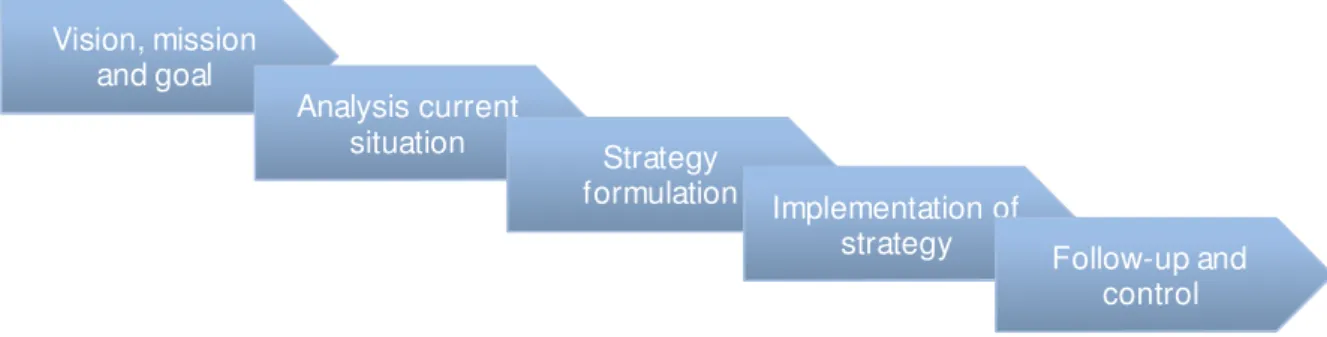
However, having the best strategy does not matter if it cannot be translated into operational plans and then executed to reach the performance targets of the company (Hambrick & Fredrickson, 2005). According to de Wit and Meyer (2004) the formal strategy process has five phases. First the identification and analysis phases, the strategy formulation phase and last the implementation and follow-up and control phase, illustrated in Figure 1 as semi parallel activities.
2
Figure 1 The structure of a strategy process (de Wit & Meyer, 2004)
According to Hitt et al. (2006) the organizational structure together with controls provides the framework for the strategy process. Large multidivisional companies are often organized in three levels with a corporate center, divisions, and individual business units (Grant, 2006). The divisions often represent a separate profit or business center through which top management delegates responsibilities (Hitt, et al., 2006). Strategies can be aggregated at different levels in an organization. The most common levels are functional, business and corporate (de Wit & Meyer, 2004). Business level strategy considers how to create an internally consistent whole by integrating the functional level strategies (de Wit & Meyer, 2004). Similarly, corporate level strategy aims at creating an internally consistent whole from the business level strategies, and there are basically two extremes to pursue; either acting as a tightly integrated unit or as many autonomous units (de Wit & Meyer, 2004). This is also a topic covered by Mintzberg (2003). According to Mintzberg (2003) decentralization in terms of strategy refers to the diffusion of decision making power as opposed to centralization in which top management makes all strategic decisions. The relative decentralization then refers to the degree that power is dispersed to the line managers, operators and/or support personnel (Mintzberg, 2003).
1.1
PROBLEM IDENTIFICATION
As argued by Hitt et al. (2006) the organizational structure and controls sets the framework for the strategy process. In light of this, in a small organization the strategy can easily be implemented as centralized decisions can be personally communicated to the implementers (Galbraith, 1977). However, according to Galbraith (1977) as organizations grow decisions become decentralized, because top management cannot handle the amount of information required to plan all resource allocation, schedules, and priorities. Therefore Galbraith (1977) argues that the point of decision is brought down the organization hierarchy to the point where the information exists. Describing it in the words of de Wit and Meyer (2004) the strategy is aggregated at different levels in an organization.
According to Galbraith (1977) organizations face a potential problem in such situation; how can the organization be sure that the decisions the employees make will be an appropriate response to the organization’s strategy? Although addressed by Galbraith in 1977, this is a problem that organizations still struggle with. Results of studies conducted over the last 25 years suggest that 60 to 80 percent of all organizations do not succeed in obtaining its predicted goals (Kaplan & Norton, 2008). According to Hambrick and Fredrickson (2005) an
Vision, mission and goal
Analysis current
situation Strategy
formulation Implementation of
strategy Follow-up and
3
organization must have formulated a single unified strategy that describes how the organization will achieve its mission and vision while upholding its values. Without a strategy that is specific enough or understandable middle management will create their own which results in interpretations of what the company should be doing and thus disjointed initiatives when looking at the large picture (Hambrick & Fredrickson, 2005).
Adding to this top-down perspective, Grant (2006) argues that at the same time as it is very important to create coordination and control the decisions and activities to make sure they stay in line with the corporate strategy it is important to balance this with an agile and flexible organization, to not interfere with the necessary autonomy and keep the organization creative and competitive. The choice of relative decentralization is therefore an essential issue (Grant, 2006; Mintzberg, 2003). This would indicate finding a balance of the two extremes previously presented by de Wit and Meyer (2004) either acting as a tightly integrated unit, or as many autonomous units.
Since the organizational structure provides the framework for the strategy process, it is important to consider the context of Skanska. Because Skanska is a large multidivisional company the strategy cannot be easily implemented by top management. Traditionally, the strategy process has been decentralized to a large extent. However, over the last decade the level of centralization and formalization has increased in order to utilize the size of the company and coordinate activities in order to increase the competitiveness (Samuelsson, 2012). It is also important for the company to act as a unified company towards the customers and raise ethical and environmental performance (Samuelsson, 2012). Keeping in mind the theory presented above it is important for Skanska to find a balance of which decisions should be made at each level in the strategy process. Moreover, voices have been raised concerning uncertainties about what should be handled on each organizational level and more specifically if and why BO should have a role in the strategy process (Ekenstierna, 2012a; Samuelsson, 2012).
Moreover, in a company with a wide array of business areas, such as Skanska, it is difficult to be specific enough in the strategy formulation on the highest top management level since that strategy is to fit the whole array of business areas. For example, formulating a specific strategy for the Building branch of operations will be very different from a specific strategy for the Road construction branch of operations. Also, there are geographical differences between the regions in the same business area of Skanska which also makes it difficult to formulate a specific strategy on the top management level. In light of these differences, the question of relative balance between autonomy and control is again an important issue for Skanska questioning how specific each level in the strategy process should be and how controlled the below levels should be from its output.
The purpose of top management, or the “parent company”, in the strategy process is to create synergies in multidivisional companies (Goold & Campbell, 1998). However, according to Goold and Campbell (1998) synergy opportunities often fall short of managers’ expectations and actually end up destroying value rather than creating it. The pursuit of synergies may also prove to be problematic. Hitt et al. (2006) argues that cooperation between units in
4
multidivisional companies result in a loss of managerial autonomy. Therefore managers may be reluctant to the integrative process through which synergies are created.
Concerns have been raised by managers at Skanska about the Building branch of operations’ role in the strategy process and whether or not it contributes with value to the whole process or if the cost of having meetings and putting effort into creations of plans exceeds the value created. Does the level only add complexity instead of making the strategic issues more concrete? Also, historically keeping in mind that the regions of Skanska have operated as self-governing unit, creating synergies through collaboration between regions might be problematic.
Moreover, in a complex organizational structure such as matrix organizations, strategic initiatives may stall or drift because responsibilities are unclear or fragmented (Goold & Campbell, 2002). Rogers and Blenko (2005) also argues that ambiguity over accountability of decisions can hurt the performance of an organization. Clearly assigning roles and mandates of each organizational level is therefore of importance to create a competitive organization (Rogers & Blenko, 2005).
The challenge described above is something that has become noticeable at Skanska. Besides questioning what value the Building branch of operations level contributes with, the mandate of the level has also been questioned (Samuelsson, 2012). This point towards that there is an unclear distribution of roles and mandates which might affect the organizations competitiveness negatively, considering the arguments presented by Rogers and Blenko (2005). Accordingly, Samuelsson (2012) describes that there is a need to enhance clarity on the roles and responsibilities of BO and through that lower the amount of rework in the strategy process.
Finally, according to Kaplan and Norton (2000) the success of strategy execution depends how well the people in the organization understand it, therefore communication is an essential issue. At Skanska concerns has been raised by for example Ekenstierna (2012a) that they communication of the strategy is ineffective, as it is her impression that the business plan does not succeed in communicating the strategy to all employees. Too much information is also described by Ekenstierna (2012a) as a problem on some of the levels in the strategy process which results in them not knowing how to relate and prioritize or have the energy to consider all information.
Concluding, it has been agreed upon that strategic management is of importance for a company to reach competitive advantage and theory describes a number of problem areas. Companies, of which Skanska is one, are struggling to reach its predicted goals and in the strategic work at Skanska there have been raised a number of problem areas, which we have seen above. Considering the issues concerning the strategy process at Skanska, it is interesting to further investigate the special challenges that a large company faces in creating a successful strategy process. Summarizing the issues present at Skanska there is an uncertainty concerning the contribution of the Building branch of operations level in the strategy process.
5
1.2
PURPOSE
The purpose of the master thesis is to develop a framework for evaluating what should be the contribution of an organizational level in the strategy process in multidivisional corporations.
1.3
RESEARCH QUESTIONS
Based on the issues described in the problem discussion and the purpose of the thesis, four research questions have been identified.
RQ 1: How can the organizational structure support the strategy process?
RQ 2: What can an organizational level contribute with in the strategy process?
RQ 3: What should be the mandate of each level in the strategic work?
RQ 4: How can strategy be communicated through the strategy process?
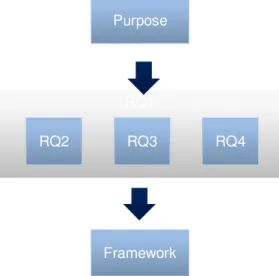
The first research questions aims at providing the context and the broader view of the reality in which the other research questions exist. The result from each research question is used as an input to the framework, see Figure 2. The framework provides a number of steps which can be used to evaluate the contribution of an organizational level.
Figure 2 The relation between the purpose and the research questions
1.4
DELIMITATIONS
The research is focused on the three top management levels in multidivisional corporations, called: corporate level, division level and business unit level. At Skanska, this included the Sweden level, the branch of operations level and the region level. However, to be able to present a more accurate view of the work in the region level, the district level at Skanska was also included in the data collection. Also in the comparative study of the other companies were other organizational levels included to present the most accurate picture.
RQ1 Purpose
RQ2
Framework
6
The thesis presents in the theoretical background an overview of the different perspectives in strategic management. However, the thesis is delimited from an in-depth investigation of the different strategy perspectives, since it was assessed that it would be of more value for the research to gain a deeper knowledge in a narrow scope of theories. For the same reason have this thesis not gone deeper into other areas of research that can be of relevance, such as Leadership theory and Organizational knowledge theory.
1.5
OVERVIEW OF THE MODEL OF ANALYSIS
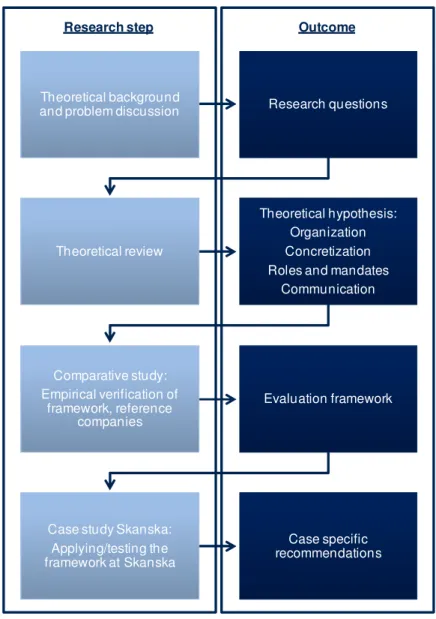
The research methods used in this thesis in order to answer the research questions and fulfill the purpose are described in detail in chapter 3, Methodology. However, a short summary of the model of analysis will be accounted for, to present the reader with the logic of the research process. The process can be described as a series of steps, where each research step has an outcome, which serves as an input to the following research step. The theoretical background and problem discussion provided the foundation around which the research questions were formulated. From the theoretical review, a theoretical hypothesis was formulated, which was empirically verified in a comparative study. The outcome of the analysis of the comparative study was a framework for evaluating the contribution of an organizational level, which was applied and tested in a case study at Skanska. The empirical findings from the case study resulted in a reviewed framework, answering the research questions, and recommendations to Skanska.
1.6
DISPOSITION OF THE THESIS
The thesis starts with the Introduction chapter, introducing the research area of strategic management and the problem identified at Skanska, as well as the purpose and corresponding research questions. Chapter 2, Theoretical framework, presents the theories that are being utilized to answer each research question. The chapter ends with a presentation of the theoretical hypothesis. The methodology is presented in chapter 3, before the comparative study and the case study. The comparative study presents the empirical findings from each of the four companies involved, in chapter 4, followed by an analysis of the findings in light of the theoretical framework in chapter 5. In chapter 6, the findings from the case study at Skanska are structured around the four research questions, in a similar way as for the companies described in the comparative study. It is the intention of the researchers that this will simplify for the reader to follow the reasoning for each of the four research questions. Chapter 7 presents the analysis for the case study, again presented in the structure of the research questions. The finishing chapters present the Discussion, Conclusions and Recommendations to Skanska.
7
2.
THEORETICAL FRAMEWORK
The theoretical framework presented in this section serves as a review of the theories that have been identified to be applicable in order to answer the research questions. Varying viewpoints are presented under the headlines Organization, Concretization, Roles and Responsibilities and Communication. In order to present the theories in a logic flow, each headline presents the viewpoints that are being used to answer the corresponding research question. A summary of the theoretical findings in form of a theoretical hypothesis is presented in the end of this chapter. This theoretical hypothesis is then tested and further analyzed in the following Comparative study. See Chapter 3 Methodology, for a more comprehensive description of the research process.
2.1
ORGANIZATION
Organization is the headline that gathers the theoretical findings regarding how the organizational structure supports the strategy process. The aim of this review is to formulate a theoretical hypothesis regarding the first research question. The approach of this review is that the answer lies in the fit between strategy and organizational structure.
The first author to express the importance of fit between organization and strategy was Chandler in 1962 (Furrer & H. Goussevskaia, 2008). Galbraith (1977) also emphasized the importance of having an organizational structure that effectively supports the implementation of the strategy. According to Hitt et al. (2006) the organizational structure of a company specifies its reporting relationships, controls, procedures, and authority and decision making processes. Thus, the structure of an organization specifies the work to be done and how to do it given the company’s strategy (Hitt, et al., 2006). As presented before the organizational structure also sets the framework for the strategy process. It is therefore important to have a structure that effectively supports the implementation of the strategy in order for the company to become competitive, Hitt et al. (2006) argues. Changes to the company’s strategy therefore calls for changes to its organizational structure and companies often alter its structure as a response to growth in size and complexity. The structure should provide stability to enable the company to use its current competitive advantage but also provide flexibility to enable development of future advantages (Hitt, et al., 2006).
2.1.1 FIT BETWEEN STRATEGY AND ORGANIZATIONAL STRUCTURE
Galbraith (1983) equals the company strategy to its level of diversification. Hitt et al. (2006) also stresses that there are different levels of diversification, that is, number and type of business in which a company will operate in. Three levels of diversification that is presented by Hitt et al. (2006) are the related constrained, the related linked and the competitive. In the related constrained the divisions are related and there are links between them, in the related linked there are fewer links between the divisions but the units within each division are related. In the competitive there is no dependence among the company’s divisions. Hitt et al. (2006) argues that multidivisional structure can be used to support implementation of related as well as unrelated diversification strategies.
8
2.1.2 THE MULTIDIVISIONAL STRUCTURE
The multidivisional structure often replaces a simple structure, in which top managers makes all decisions, or the functional structure, in which there is a straight line of decision authority, as the company grows in size and complexity (Hitt, et al., 2006). The key advantage of the multidivisional structure is the possibility of decentralized decision making (Grant, 2006). Because of this decentralized decision making the role of the corporate headquarter in the multidivisional company becomes to control activities through rules, procedures, and performance measurement to make sure that decisions made at lower levels are in line with the corporate strategy (Galbraith, 1977). Further, Grant (2006) argues that economies of scale, economies of scope, sharing of tangible and intangible resources as well as organizational capabilities, parenting advantages and finally internal capital and labor markets are the competitive advantages that are created through a multidivisional structure.
Depending on the level of diversification Hitt et al. (2006) suggest three variants of the multidivisional structure: The cooperative form, the strategic business unit form and the competitive form, see Figure 3. According to Hitt et al. (2006) the forms vary in terms of level of specialization, centralization and formalization. These are also design parameters that Mintzberg (2003) accounts for, describing that job specialization refers to the number of tasks and the workers´ control over these, behavior formalization refers to the standardization of work process through rules and regulations, and finally centralization refers to the diffusion of decision making power.
Figure 3 Three different forms of the multidivisional structure (Hitt, et al., 2006)
According to Hitt et al. (2006) the cooperative form utilizes horizontal integration to create interdivisional cooperation and can be used to implement a related constrained diversification strategy. As seen in Figure 4, the form shares centralized functions such as marketing and strategic planning to facilitate economies of scale (Hitt, et al., 2006). Also, according to Hitt et al. (2006) interdivisional cooperation results in sharing of both tangible resources such as facilities and equipment and intangible such as knowledge.
Cooperative Form Strategic Business Unit SUB Form Competitive Form Multidivisional Structure
9
Figure 4 The cooperative form (Hitt, et al., 2006)
To bring about cooperation Hitt et al. (2006) emphasize that the centralization of certain functions in itself functions as the mechanism as it links activities among divisions. Other mechanisms are direct contact between division managers but as this is time consuming, companies often forms temporary teams or task forces for larger cooperation projects (Hitt, et al., 2006). A loss of managerial autonomy and rewards based on individual division’s performance are according to Hitt et al. (2006) two potential conflicts to the cooperative form. Hitt et al. (2006) therefore emphasizes the importance of using reward systems that promote overall company performance. Grant (2006) also addresses several mechanisms to deal with cooperation problems, sprung from divergent goals of individuals. First, control mechanisms can be used through hierarchical supervision of actions outside each own area of discretion. To get well function control mechanisms positive and negative incentives, such as promotion or dismissal can be used. Second, performance incentives that links rewards to output can be used. Last, shared values are a powerful tool to align individual actions with company strategy.
However, according to Grant (2006) the desire to cooperate, which is created through the above mechanisms, is not enough. Individuals must also find a way of coordinating their efforts in which the following mechanisms with differing formalization degree can be used. Rules and directives, to which the employee agree to work according to. Routines, when activities are performed recurrently mutual adjustment and rules become institutionalized. Finally, mutual adjustment is the simplest form of cooperation between individuals with related tasks.
The second form of multidivisional structure is the Strategic Business Unit form which can be used to implement the related linked diversification strategy. Hence, when there is fewer links between the divisions but the units within each division are related. The form consists of three levels: The corporate headquarters, the strategic business units and the strategic business unit divisions, see Figure 5. The same problems and mechanisms as for the cooperative form are valid for the Strategic Business Unit form (Hitt, et al., 2006). Further, each strategic business unit is a profit center and strategic and financial controls are often made upon each strategic business unit’s performance (Hitt, et al., 2006).
President
Corp orate Human Resources
Strateg ic Plannin g Corpo rate
Marketin g Co rp orate R&D
Lab
Corp orate Fin an ce
Prod uct Division Pro duct Division
Pro duct Divisio n Prod uct Division Pro duct Divisio n
Leg al Affairs Govern men t
10
Figure 5 The strategic business unit form (Hitt, et al., 2006)
Finally, the third multidivisional form is the competitive form, see Figure 6. When there is no dependence among the company’s divisions and it can be used to implement the unrelated diversification strategy (Hitt, et al., 2006).
Figure 6 The competitive form (Hitt, et al., 2006)
There are three possible benefits of a competitive structure that Hitt et al. (2006) present. First, flexibility is created through development of different technologies. Second, the competitive form challenges status quo and performance as there is internal competition of corporate resource allocation. Last, internal competition motivates effort. The headquarters do not intervene in division’s strategy or affairs, and do only measure its performance.
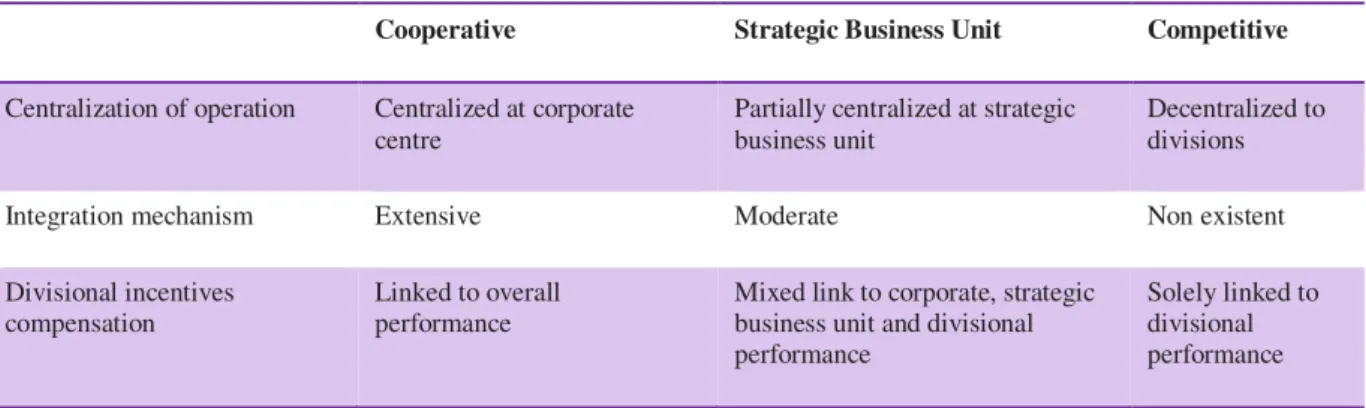
Comparing the three multidivisional structures the cooperative is the most centralized, and thus the most costly while the least costly is the competitive with its decentralized decision making (Hitt, et al., 2006). The differences in centralization, integration mechanism and compensation strategy between the multidivisional forms are further developed in Table 1. .
President
Corp orate Human Resources
Strateg ic Plannin g Corpo rate
Marketin g Co rp orate R&D Lab Corp orate Fin an ce Division
Division Division Division
Strategic Business Unit Division Division Strateg ic Business Unit Strategic Business Unit Division Division Division President Division
Division Division Division
Legal Affairs
Finance Auditing
11
Table 1 Differences between the multidivisional forms (Hitt, et al., 2006)
Cooperative Strategic Business Unit Competitive
Centralization of operation Centralized at corporate centre
Partially centralized at strategic business unit
Decentralized to divisions
Integration mechanism Extensive Moderate Non existent
Divisional incentives
compensation Linked to overall performance Mixed link to corporate, strategic business unit and divisional performance
Solely linked to divisional performance
2.2
CONCRETIZATION
Concretization is the headline that gathers the theoretical findings regarding how the strategy can become more concrete for each level in the strategy process. The aim of this theoretical review is to take the first step ahead on the road to answering the second research question; what can an organizational level contribute within the strategy process? As was presented in the theoretical background strategies can be aggregated in different levels in an organization, the most common levels are functional, business or corporate levels (de Wit & Meyer, 2004). The approach of this research is that the answer to the research question lies within the parenting concept and how to handle synergies in the strategy process. There is no consensus in research about what is the best approach in deciding the contribution of each level, but the most important aspect seems to be whether responsiveness or synergy is most important for competitiveness of the company (de Wit & Meyer, 2004).
The parenting theory is based on research on successfully diversified companies, in which diversified businesses are brought together under a parent organization (Campbell, et al., 1995). The theory argues that the parent organization can only justify itself if its own influence brings value to the underlying divisions or business units, in other words if the corporate-level strategies creates value for the levels below, or correspondingly, if the division-level strategies creates value for the levels below them. Further, parenting theory argues that bad parenting can cause managers in the business-units to make worse decisions than if they would not be under influence of the parent (Campbell, et al., 1995).
What is essential to success, according to Campbell et al. (1995), is that the parent organization or parent level, achieves a fit between the skills and resources of the parent and the needs and opportunities of the underlying units. Second, it is important to not have too many parent levels and units, but only those that are needed and have the resources to do their job (Goold & Campbell, 2002). To assess if a parent level in the strategy process is needed, it should be examined if the level has a clear and distinct parenting proposition, which does not echo the level below or above (Goold & Campbell, 2002). A rule of thumb suggested by Goold and Campbell (2002) is that a parenting level should improve the performance of the units below it by more than 10 percent.
12
Goold and Campbell (1998) argue that there are four managerial biases that executives are prone to because they might view the achievement of synergy as central to their job. Parenting bias is one of them, described by the authors as “a belief that synergy will only be captured by cajoling or compelling the business units to cooperate” (Goold & Campbell, 1998). The other three biases are; the synergy bias: underestimating the costs of synergies, skills bias: determination that all necessary skills are available within the organization, and upside bias: focusing too heavily on the potential benefits of synergies (Goold & Campbell, 1998).
Synergies are defined by Goold and Campbell (1998) as “the ability of two or more units or companies to generate greater business value working together than they could working apart”. Synergies can take different shapes, for example: shared know-how, shared tangible resources, pooled negotiating power, coordinated strategies, vertical integration or combined business creation (Goold & Campbell, 1998). However, creating synergies can have limiting effects on business unit responsiveness, which is of great importance to business units with a higher need to emphasize their own entrepreneurship (de Wit & Meyer, 2004). Synergies can be achieved by integrating the activities of the business units, and this often demands an extra level of management, resulting in more meetings, higher complexity and higher risk of conflicts of interest (de Wit & Meyer, 2004). The goal in creating synergies between the business units is therefore to realize a greater amount of value creation than value destruction through the loss of business responsiveness (de Wit & Meyer, 2004).
According to Goold and Campbell (1998), parenting bias and synergy bias are strongly connected, meaning that managers often suffer from both biases. This has the effect of many managers jumping at every opportunity to create synergies because they feel that it will not be achieved if they are not personally involved (Goold & Campbell, 1998). These managers have little or no trust at all in the unit managers to create synergies themselves and believe that the parent, meaning corporate management or division management, must therefore intervene (Goold & Campbell, 1998). However, the authors argue that in most cases the parenting bias leads to assumptions that are faulty and only leads to excessively interference, doing more harm than good. Most of the time unit managers are strongly active in creating synergies between business units (Goold & Campbell, 1998). Further, the authors argue that if the business unit managers should not strive to reach synergies, they often have good reason for this, such as lacking cost benefits of opportunity costs.
In order to get rid of the parenting bias and synergy bias Goold and Campbell (1998) suggests that companies should raise awareness and discipline (Goold & Campbell, 1998). The first step to reach is to acknowledge that there is a tendency within the company to overestimate the benefits and possibilities of synergies. The next step is then to thoroughly investigate how big the opportunities and benefits of synergies are (Goold & Campbell, 1998).
13
2.3
ROLES AND RESPONSIBILITIES
Roles and responsibilities is the headline that gathers the theoretical findings regarding what should be the mandate of each level in the strategic work. The aim of this review is to formulate a theoretical hypothesis regarding the third research question. In order to provide an answer to this question the research area of formal versus informal decision process is studied. In order for a company to realize the advantages of a strategy, it is important to be able to execute the strategy, through effective decision making (Neilson, et al., 2008). According to Nutt (2002), strategic decisions are most often made by judgment, but also by bargaining for consensus, and least common is by analysis. Often, strategic decision makers are influenced by personal, organizational, political and societal considerations and constraints, bringing high complexity and uncertainty into the process of decision making (McKenna & Martin-Smith, 2005). A slow and ineffective decision making process will unavoidably lead to suffering results (Rogers & Blenko, 2005).
According to de Wit and Meyer (2004) there is no consensus in research of whether to apply an intentionally designed, formal process or a gradually shaped, experimentation focused decision making process. The strategic planning perspective represents the formal view, with a structured process emphasis for implementing strategy top-down (de Wit & Meyer, 2004). The strategic incrementalism perspective represents the unstructured formation process where decision making is based on experimentation and parallel initiatives (de Wit & Meyer, 2004). According to Roger and Blenko (2005) and Nielson et al. (2008) an important step towards a well functioning decision making process is to clarify decision roles and responsibilities. This reasoning belongs to the more formal strategic planning perspective, arguing that a lack of clarity regarding decision roles can lead to status quo in the decision making process, blocked information flow within the organization, and result in workarounds not following formal reporting lines (Neilson, et al., 2008). Clarifying decision roles can be achieved by assigning roles in a structured way, suggested by Rogers and Blenko (2005), called the RAPID Decision Model.
The RAPID model consists of five decision-making roles (not necessarily executed in this exact sequence) (Rogers & Blenko, 2005). R stands for Recommend, meaning responsibility to give proposals based on input received from other people and achieving buy-in on the decision (Rogers & Blenko, 2005). Agree is the next role, representing a person with veto power over the recommendation (Rogers & Blenko, 2005). A veto in use will trigger a debate and result in a modified proposal. I for Input refers to people who are consulted because they are involved in the implementation and have the potential to facilitate execution of the decision (Rogers & Blenko, 2005). Decide is the role of the formal decision maker, the person who is ultimately accountable for the decision. He or she can resolve disagreements and bring the decision to closure, with the next step being implementation (Rogers & Blenko, 2005). The implementation of the decision is at last the responsibility of the person with the Perform-role, this can be the same person who recommended the decision in the first place (Rogers & Blenko, 2005).
14
According to Rogers and Blenko (2005), problems in the decision making process can often be a result of lack of clarity about who has the Decision role, too many people with veto power, or lack of significance in the input to the process (Rogers & Blenko, 2005). In addition, decision rights are not static and tend to become less clear when companies mature (Neilson, et al., 2008). Clarifying decision roles needs however to be done in combination with providing ways for effective information flow, or the people with responsibility cannot make informed decisions (Neilson, et al., 2008).
Mintzberg and Westley (2001) provides a different view on decision making, arguing that more intuitive and action-oriented approaches needs to be applied in addition to step-by-step logic. The main question is whether the decision approach should be based on facts, ideas or experiences (Mintzberg & Westley, 2001). A fact based “thinking first”-approach is suitable when the issue is clear, data reliable and the context is structured (Mintzberg & Westley, 2001). The idea based approach, called “seeing first”, applies the use of visual tools and it is suitable when elements needs to be combined in order to find a creative solution, commitment to the solution is important and communication has a big impact on the results (Mintzberg & Westley, 2001). Experience based “doing first” approaches are suitable when there is a novel and unclear situation and when it is hard to find the way forward (Mintzberg & Westley, 2001). In addition, McKenna and Martin-Smith (2005) argues that the decision making process cannot be described as a simple process including clear stages such as problem identification, evaluation, choice and implementation. They argue that the approaches of Mintzberg and other tools of decision science must be complemented by psychodynamics and relationship psychology.
2.4
COMMUNICATION
Communication is the headline that gathers the theoretical findings regarding how communication can support the contribution of each level in the strategy process. The result of this review is a theoretical hypothesis regarding the forth research question. In order to provide an answer to this question the tools such as strategy plan, balanced scorecard, strategy map are studied as well as the concept of strategic planning as a communicative process. According to Kaplan and Norton (2000) the success of strategy execution depends on how well the people in the organization understand it. Therefore organizations need tools for communicating the strategy. According to Spee and Jarzabkowski (2011) text within the planning process can take form as PowerPoint presentations, planning documents and targets that are part of a strategic plan. In this section we will present three written documents that can be used as such tools; strategy plans, balanced scorecards and strategy maps.
2.4.1 STRATEGY PLAN
A strategy plan typically concentrates on a medium to long term time frame and includes a performance plan, an operating budget, a capital expenditure budget, strategic targets for market share, employment level, output, and specific strategic milestones (Grant, 2006). According to Grant (2006) the performance plans are often developed annually and are then monitored on monthly and quarterly basis to detect deviations from targets and finally to be
15
reviewed at the end of each year. The performance targets emphasize financial indicators such as for example return on invested capital and growth of sales revenue but also strategic goals such as market share and quality and operational performance such as productivity and output (Grant, 2006).
2.4.2 BALANCED SCORECARD
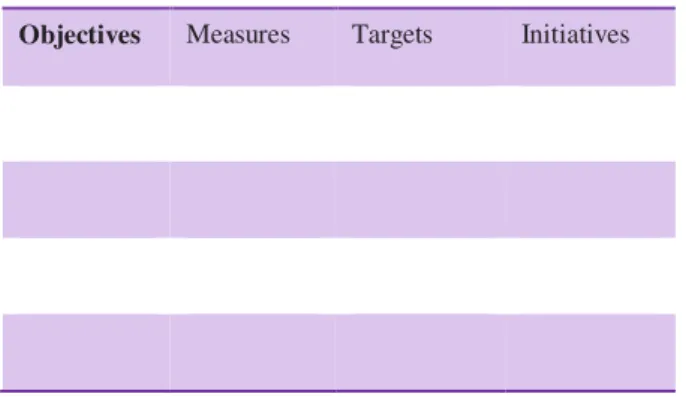
The balanced scorecard was introduced by Kaplan and Norton (1992). Fifteen years later Kaplan and Norton (2007) describes the balanced scorecard as “a sophisticated instrument panel for coordinating and fine-tuning a company’s operations and businesses so that all activities are aligned with its strategy”. Often it is used to build the content of companies’ strategy plans. The balanced scorecard does not only focus on the financial result of a company but also the intangible assets that companies need for future growth (Kaplan & Norton, 2007). It includes financial, customer, internal business processes and learning and growth. The areas should provide answers to the following questions: how should we appear to our shareholders; how should we appear to our customers; to satisfy our customers and shareholders which business process must we excel in; and finally how will we sustain our ability to change and improve in order to achieve our vision (Kaplan & Norton, 2007). The basic design of the balanced scorecard is illustrated in Table 2. The balanced scorecard hence links objectives with measures and according to Kaplan and Norton (1992) it also forces managers to only focus on the few measures that are critical.
Table 2 The structure of a balanced scorecard (Kaplan & Norton, 2007)
Financial / Customer / Internal Business Processes/ Learning and Growth
Objectives Measures Targets Initiatives
2.4.3 STRATEGY MAP
Through extensive research, gathered through working with the balanced scorecard at hundreds of companies, Kaplan and Norton (2000) brought the patterns and different items from the organizations’ balanced scorecard together into a common visual framework, a strategy map. Kaplan and Norton (2008) describe the strategy map as a tool for visualizing the cause and effect relation between the organization’s overall goal and the individual employees’ job, hence the performed activities. Another way of expressing it is that a strategy map shows how initiatives and resources including corporate culture and knowledge are converted into tangible outcomes (Kaplan & Norton, 2000).
16
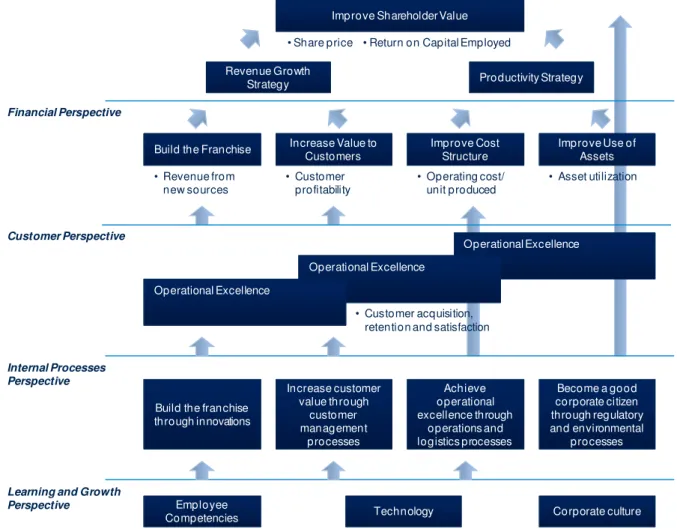
The strategy map framework that Kaplan and Norton (2000) present is illustrated in Figure 7. At the top is the financial strategy, increasing shareholder value, which can be done either through increasing revenue or productivity. Increasing revenue in turn can be pursued either through building the franchise with new markets, new products or new customer and through increasing value for existing customers. Productivity can be increased through improved cost structure with either lower fixed or variable costs and finally more efficient use of assets.
Figure 7 Strategy map framework (Kaplan & Norton, 2000)
Then in the customer perspective it is described how the company will differentiate including the set of product, the characteristics of its services, the customer relations, and the corporate image that the company offers. According to Kaplan and Norton (2000) there are typically three differentiators to choose among: Operational Excellence, Customer Intimacy and Product Leadership.
The internal process perspective is used to determine the activities by which the company will obtain the value proposition. According to Kaplan and Norton (2000) a complete strategy should involve specifying activities from several internal processes. The activities can be divided into four processes, as seen in Figure 7; first, franchising through innovating new products and services and by penetrating new markets and customer segments; second, increasing customer value through closer relationship with existing customers; third,
Improve Shareholder Value
• Share price • Return on Capital Employed
Revenue Growth Strategy Increase Value to Customers Improve Cost Structure Improve Use of Assets Build the Franchise
• Revenue from new sources • Asset utilization • Customer profitability • Operating cost/ unit produced Productivity Strategy Operational Excellence Operational Excellence Operational Excellence • Customer acquisition, retention and satisfaction
Financial Perspective
Customer Perspective
Build the franchise through innovations Increase customer value through customer management processes Achieve operational excellence through operations and logistics processes Become a good corporate citizen through regulatory and environmental processes Internal Processes Perspective
Learning and Growth
Perspective Employee
17
achieving operational excellence though improvement of supply chain management, internal operational processes such as utilization and capacity management; and finally, becoming a good corporate citizen through developing effective relationships with external stakeholders. Providing a bottom up explanation of the strategy map, it tells the company the knowledge (learning and growth), skills and systems (internal processes) that its employees require to innovate and build the right capabilities and efficiencies to deliver value to the market (the customer) which will lead to increased shareholder value (the financials) (Kaplan & Norton, 2000). The major benefit with the strategy map is that it enables the employees to organize their work in a coordinated manner toward the overall company goal (Kaplan & Norton, 2000).
2.4.4 STRATEGIC PLANNING AS A COMMUNICATIVE PROCESS
An alternative view on strategic planning was provided by Spee and Jarzabkowski (2011). The authors argue that strategic planning can be seen as a communicative process with increasing interpretation of talk and text. Even though their recommendations are based on studies conducted in a university context the authors expected their recommendations to be relevant in organizational contexts with diffuse power structures and democratic decision making.
Through their studies Spee and Jarzabkowski (2011) showed that communication is not a process that starts after the strategy plan has been developed but rather integrated in the planning process itself. Even though the final plan is only constructed by a few individuals, the content may have been influenced by many who participated in the communicative process (Spee & Jarzabkowski, 2011). There is increasing interpretation of talk and text in the strategy document, as during the construction of the plan participants reveal their interpretations which result in amendments that have to lead to agreed formulations in the final strategic plan. This interplay process, through which agreement has to be reached, minimizes competing interpretations and legitimizes the strategy plan though the organization. Spee and Jarzabkowski (2011) conclude that it is this recursive communication process rather than the strategy document in itself that is of significance.
2.5
THEORETICAL HYPOTHESIS
The below Table 3 is presented to give the reader a logic flow in the research. Based on the research question, the topic in literature was identified. The review of the topic resulted in a theoretical hypothesis which hence summarizes and concludes the information presented above in chapter 2.
18
Table 3 Theoretical Hypothesis
Research question Subject in literature Theoretical hypothesis
RQ1: How can the organizational
structure support the strategy process? Organization:
•Organizational structure and diversification strategy •Center versus business unit
decision making
The organizational structure sets the framework for the strategy process. Depending on the diversification strategy, different multidivisional structures are suitable with varying levels of centralization, formalization and specialization.
RQ2: What can an organizational level contribute with in the strategy
development and implementation process?
Concretization:
•Parenting theory •Synergy theory
The content of the strategy becomes more concrete for every level in the strategy process
A level in the strategy process should result in more value creation, through synergies, than value destruction, through increased cost
RQ3: What should be the mandate of
each level in the strategic work? Roles and Responsibilities: •Decision making process •Formal versus experimentation
focused process
A formal decision process can enhance the performance of an organization
RQ4: How can strategy be communicated through the strategy process??
Communication:
•Strategy Plan, Balanced Scorecard and Strategy Map
•Strategic planning as communicative process
Tools, such as strategy plan, balanced scorecard and strategy map can be used to enhance communication in the strategy process.
Strategic planning is a communicative process
19
3.
METHODOLOGY
The following chapter presents the design of the study, starting with the motivation for the choice of a qualitative research strategy. The chapter continues with an explanation and motivation of the chosen research design, including a case study at Skanska and a comparative study with reference companies. Further, an in-depth description of the research process and method is presented, with connections to the research question. This is followed by a description of data collection and analysis methods, such as interviews. Data collection is also given extra attention with regards to primary and secondary data. Finally, the research quality is discussed by the means of reliability and validity.
3.1
RESEARCH STRATEGY AND DESIGN
The distinction between qualitative and quantitative research is important according to Bryman and Bell (2011), since it provides a general orientation to how a business research study can be conducted. Bryman and Bell (2011) presents the following view on the difference between quantitative and qualitative research strategies: a quantitative study is deductive in its nature, meaning that its purpose is to test a theory by finding patterns or rules. Its approach is logical, analytical and objective, using the natural science model of providing and confirming or rejecting a hypothesis. A qualitative study on the other hand has, according to Bryman and Bell (2011) the purpose to generate a theory for understanding human existence. This is done by exploratory methods, with emphasis on understanding and interpretation. A similar view is presented by Holme and Solvang (1997), who argues that the qualitative method is suitable if the purpose of the study is to gain an in depth understanding, and that it provides flexibility to the study. Since this thesis is devoted to understanding and interpreting a system of people, and developing its own theory, the qualitative research strategy was chosen. Further, the study gains from the flexibility made possible by the qualitative approach.
The research design provides the framework for the collection and analysis of data and it is used to show how the different parts of the study work together to provide answers to the research questions (Bryman & Bell, 2011). For the purpose of answering the research questions presented earlier in the report, this thesis applies the following research designs: case study design and comparative design. Apart from these two research designs there are three more identified by Bryman and Bell (2011), experimental design, cross-sectional or social survey design, and longitudinal design.
The case study research design was chosen because the research questions identified required knowledge of the contribution of a level in the strategy process at Skanska. It was the wish of Skanska, when initiating the thesis project, to achieve learning about their own needs in the strategy process, regarding the contribution of the top management levels. According to Bryman and Bell (2011), researchers should choose cases when studying processes and where they expect learning will be greatest. Yin (2003) argues that a case design is appropriate when striving for a deep knowledge of a complicated problem concerning contemporary events, of which the investigator has little or no control, which is the case in this study. The problematic